 Reading Time: 38 minutes
For almost ten minutes, I sat there with both hands locked around the steering wheel. The engine was off. The air-conditioning was off. The windows were closed.
The September sun pressed against the windshield, slowly turning the inside of my car into an oven, but I barely noticed. I could hear nothing except the ticking sound of the cooling engine and the uneven rhythm of my own breathing.
Nick’s words kept playing inside my head.
You were supposed to keep driving.
Again.
And again.
And again.
I looked at my reflection in the rearview mirror.
Red eyes.
Crooked tie.
Sweat drying along my forehead.
A face that suddenly looked ten years older than it had when I kissed my wife goodbye that morning.
At 7:06 A.M., I had been Sebastian Hale, senior account strategist at Wilder & North Marketing.
I had a salary.
A health insurance plan.
A desk by the east windows.
A photograph of my daughters beside my monitor.
A half-finished coffee sitting beside a stack of campaign reports.
I had a future that seemed predictable enough to complain about.
By 9:17 A.M., I was unemployed.
All because I had stopped my car.
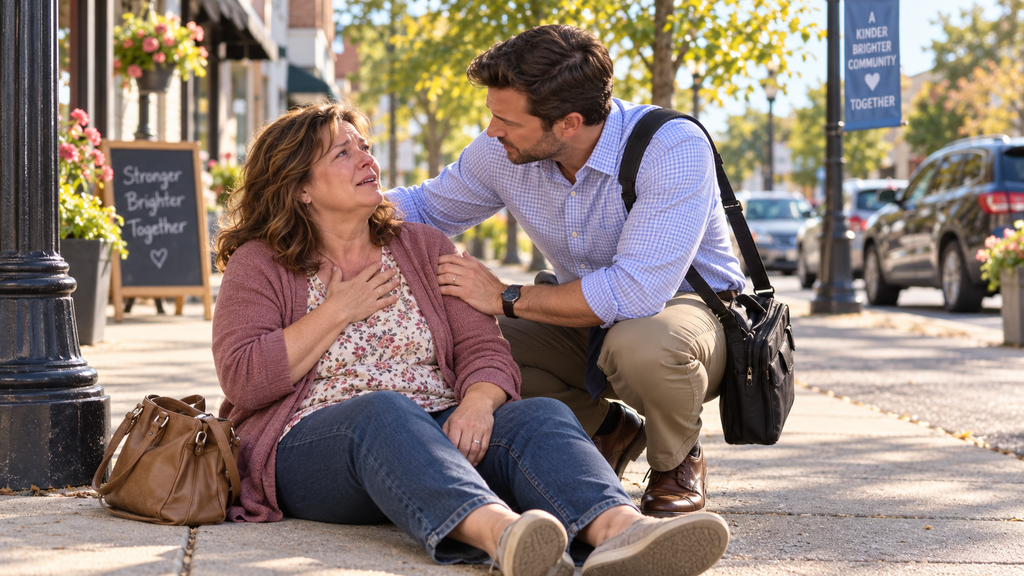
All because I had seen a woman fall.
I leaned my forehead against the steering wheel.
My phone vibrated again.
I ignored it.
Then again.
And again.
Finally, frustrated, I grabbed it from the passenger seat.
Thirty-seven missed calls.
Several messages.
Some from coworkers.
One from my wife, Anna.
Call me when you can. Love you.
Another came from Derek, one of the designers.
Man, I’m sorry. What Nick did was messed up.
Then:
I wanted to say something.
And another.
Nobody agrees with him, Seb.
I stared at those words longer than I should have.
Nobody agrees with him.
But nobody had stopped him.
Nobody had stood beside me.
Nobody had said, Nick, that’s enough.
There is a particular kind of loneliness that comes from being surrounded by people who silently know you’re being treated unfairly.
Their sympathy does not comfort you.
Sometimes it hurts worse.
Because it proves they understood.
They just weren’t willing to risk anything for you.
I tossed the phone onto the passenger seat.
Then I covered my face with both hands.
That was when the fear finally arrived.
Not anger.
Not humiliation.
Fear.
The kind that starts small and practical.
Mortgage.
Groceries.
School tuition.
Health insurance.
Credit cards.
My oldest daughter, Emma, needed braces.
My youngest, Lily, had a school trip coming up.
Anna worked as a part-time librarian because we had agreed years earlier that one of us should have a schedule flexible enough for the girls.
My salary paid most of the bills.
I had savings.
But not enough to pretend losing my job did not matter.
My throat tightened.
How was I supposed to tell Anna?
I imagined walking through our front door.
I imagined Emma looking up from homework.
Lily running to me because she still believed fathers could fix anything.
Then Anna asking the simple question.
“How was the presentation?”
I squeezed my eyes shut.
I didn’t know what frightened me more.
Telling her I had been fired…
or hearing myself explain why.
I reached for my phone.
Before I could call, another number appeared on the screen.
Unknown.
I almost rejected it.
Something made me answer.
“Hello?”
There was a pause.
Then a woman’s voice.
Weak.
Older.
Careful.
“Is this Sebastian?”
I sat upright.
“Yes.”
Another pause.
“I’ve been trying to find you.”
My fingers tightened around the phone.
“I’m sorry. Who is this?”
The woman breathed slowly.
Then she said:
“My name is Evelyn Mercer.”
Nothing.
The name meant nothing to me.
“I’m afraid I don’t—”
“You stopped for me this morning.”
Everything inside me froze.
The parking lot seemed to disappear.
The office.
Nick.
The lost account.
Everything.
All I could suddenly see was a gray sedan pulled halfway onto the shoulder.
A woman stumbling near the driver’s door.
One hand pressed against her chest.
The other reaching for something that wasn’t there.
Then her knees buckling.
I remembered slamming on my brakes.
Running.
Her falling against me.
Her face turning pale.
Her lips trembling.
The way she had whispered, “Please don’t leave me.”
My heart began beating harder.
“Evelyn?”
“Yes.”
“Oh my God.”
I straightened so quickly my head nearly struck the roof.
“Are you okay?”
There was a quiet laugh on the other end.
Tired, but alive.
“I am now.”
I closed my eyes.
For the first time all morning, something inside me loosened.
“Thank God.”
“They told me I had a cardiac event,” she continued. “A serious one. The doctor said if the ambulance had arrived much later…”
She stopped.
She didn’t finish.
She didn’t need to.
I swallowed.
“You’re in the hospital?”
“Yes.”
“Is someone with you?”
“My son.”
A man’s voice murmured something faintly in the background.
Evelyn answered him quietly, then returned to me.
“Sebastian, I need to ask you something.”
“Anything.”
“Why did you leave?”
I frowned.
“The paramedics had you. They said they were taking you straight in. I had a meeting, and I was already—”
“No. That’s not what I mean.”
Her voice became softer.
“Why did you leave before I could thank you?”
I stared through the windshield.
“I didn’t do anything worth thanking me for.”
The silence on the other end lasted several seconds.
Then Evelyn said something I would remember for the rest of my life.
“You stayed with a dying stranger when everyone else drove past.”
My eyes burned again.
“I just did what anyone should do.”
“But they didn’t.”
That hurt in a way I couldn’t explain.
I looked toward the traffic beyond the parking lot.
Cars moving.
People rushing.
Schedules.
Meetings.
Deadlines.
Everybody somewhere important.
“Several cars passed me before you stopped,” Evelyn said.
I hadn’t known that.
“When I started feeling the pain, I tried pulling over. I got out because I thought I needed air. I remember waving at a truck.”
Her voice shook.
“It didn’t stop.”
I said nothing.
“A woman slowed down,” she continued. “She looked directly at me. Then she drove away.”
I gripped the steering wheel.
“And then you came.”
I looked down.
Evelyn took a breath.
“I remember your face.”
I could barely speak.
“I was terrified.”
“I know.”
“No,” she said. “You looked terrified.”
Despite everything, I laughed once.
She laughed too.
For a brief moment, we were two strangers connected by the worst morning either of us had expected to have.
Then she asked:
“Did you make your meeting?”
My smile disappeared.
I could have lied.
I almost did.
Instead I said:
“No.”
“Oh.”
The way she said it told me she understood immediately.
“It was important?”
“Very.”
“And because you stopped for me…”
I rubbed my forehead.
“It’s fine.”
“Sebastian.”
“I’m serious.”
“You lost something because of me.”
“No.”
My voice came out harder than I intended.
I softened it.
“No, Evelyn. I didn’t lose anything because of you.”
That was the truth.
Or at least I wanted it to be.
“You needed help,” I said. “Whatever happened afterward isn’t your responsibility.”
She went quiet.
Then she asked:
“What happened afterward?”
I looked at the office building.
My former office.
“I got fired.”
The words sounded strange coming out loud.
Almost ridiculous.
Evelyn didn’t answer.
For several seconds, I thought the call had dropped.
“Evelyn?”
“You were fired?”
“Yes.”
“Because you stopped for me?”
“Technically because I missed the presentation.”
“But you missed it because you were helping me.”
“Yes.”
Her voice changed.
The weakness disappeared.
Something colder took its place.
“What is the name of the company?”
I almost laughed.
“No, no. Don’t worry about it.”
“What is the name?”
“Evelyn—”
“Sebastian.”
There was an authority in her voice now that had not been there before.
I hesitated.
“Wilder & North.”
Another pause.
“What was the presentation?”
“New business pitch.”
“For whom?”
I leaned back.
“I really don’t think—”
“For whom?”
I sighed.
“Mercer Urban Development.”
Silence.
Absolute silence.
I pulled the phone slightly away from my ear and checked that the call was still active.
“Evelyn?”
When she answered, her voice was almost too calm.
“Mercer Urban Development?”
“Yeah.”
“Was the meeting scheduled for eight-thirty this morning?”
I stopped breathing.
“Yes.”
Another silence.
Then I heard her whisper something.
Not to me.
To someone beside her.
A man’s voice responded.
Then Evelyn returned.
“Sebastian, I need you to listen carefully.”
A strange feeling moved through me.
“What?”
“Do not leave the city.”
I almost laughed.
“I wasn’t planning to.”
“No. I mean don’t make any major decisions today.”
“I don’t understand.”
“You will.”
Then she added:
“And please go home to your family.”
“Evelyn—”
“Go home, Sebastian.”
The line went dead.
I stared at my phone.
Mercer Urban Development.
I looked toward the Wilder & North building.
Then back at my phone.
Surely it was a coincidence.
Mercer wasn’t exactly an unusual surname.
Maybe it was nothing.
Maybe exhaustion had my mind searching for meaning where there wasn’t any.
I started the car.
The air-conditioning blasted hot air at first.
I loosened my tie.
Then I drove home.
I had no idea that less than four hours later, half the people in that office would be standing beside the windows watching three black vehicles pull into the parking lot.
And the woman stepping out of the middle one would be Evelyn Mercer.
Anna knew something was wrong before I even spoke.
We’ve been married fourteen years.
There are people who know your favorite food.
People who know your birthday.
People who know what songs you hate.
Then there are people who know exactly how far your shoulders drop when life has punched you somewhere you don’t want anyone to see.
Anna was one of those people.
She was standing in our kitchen when I walked in.
A dish towel rested over one shoulder.
Her brown hair was pulled into a loose knot.
She looked at me.
Then at the clock.
Then back at me.
“Seb?”
I set my laptop bag down.
She walked toward me slowly.
“What happened?”
I opened my mouth.
Nothing came out.
Anna’s expression changed.
“Are the girls okay?”
“Yeah.”
“Your mom?”
“She’s fine.”
“Then what happened?”
I stared at the kitchen floor.
“I got fired.”
Her eyes widened.
“What?”
“Nick fired me.”
“Why?”
I laughed once.
Not because anything was funny.
Because sometimes pain comes out wearing the wrong clothes.
“I was late.”
“You’ve been late maybe twice in three years.”
“I missed the Mercer presentation.”
Her face fell.
“Oh.”
She knew how important it was.
I had talked about that pitch for weeks.
I had practiced the deck at our dining-room table.
She had listened while packing school lunches.
She had even corrected a spelling mistake on slide forty-three.
“What happened?” she asked.
“There was a woman on the roadside.”
I told her everything.
The gray car.
The woman clutching her chest.
The ambulance.
The hospital bracelet the paramedic dropped that I picked up and placed beside her.
The forty minutes I lost.
The clients leaving.
Nick screaming.
The sentence.
You were supposed to keep driving.
I expected Anna to panic.
I expected her to ask about money.
Insurance.
Bills.
Instead, she walked forward and wrapped both arms around me.
And I broke.
Not dramatically.
Not loudly.
I simply put my face against my wife’s shoulder and cried.
The kind of crying men are often taught to apologize for.
The kind that comes when humiliation, fear, anger, exhaustion, and relief all arrive at once and your body cannot decide which one to feel first.
Anna held me.
No speech.
No advice.
Just her hands against my back.
After a while, she whispered:
“You stopped.”
I nodded against her shoulder.
“You saved somebody?”
“I don’t know.”
“Sebastian.”
She pulled away and held my face between her hands.
“You stopped.”
I looked at her.
She smiled through tears of her own.
“I’m proud of you.”
That almost destroyed me again.
“Anna, I lost my job.”
“We’ll figure out the job.”
“What about the mortgage?”
“We’ll figure it out.”
“Insurance?”
“We’ll figure it out.”
“The girls—”
“We will figure it out.”
She pressed her forehead against mine.
“But if you’d driven past that woman and she’d died…”
Her voice cracked.
“You would have carried that forever.”
I closed my eyes.
Anna kissed my cheek.
“Jobs can be replaced.”
She paused.
“A human being can’t.”
For a few minutes, we stood in the kitchen holding each other while the refrigerator hummed and sunlight moved slowly across the floor.
Then the back door slammed.
“Dad?”
Lily’s voice.
I wiped my face quickly.
Too late.
Our nine-year-old daughter came running into the kitchen with her backpack bouncing against her shoulders.
She stopped.
“Dad, why are you home?”
Behind her came Emma, twelve years old and already suspicious of anything adults tried to hide.
She looked at my eyes.
Then at her mother.
“What happened?”
Anna looked at me.
I had planned to keep it from them until later.
But children know when the atmosphere changes.
And I did not want my daughters learning that losing a job was something shameful.
So I sat them down.
I told them.
Not every ugly detail.
Just enough.
A woman needed help.
I stopped.
I missed a meeting.
My boss fired me.
Lily frowned so intensely that the little space between her eyebrows wrinkled.
“Because you helped somebody?”
“Basically.”
“That’s stupid.”
Anna covered a smile.
Emma didn’t.
“Your boss is an idiot.”
“Emma.”
“What? He is.”
I looked at both of them.
“We’re going to be okay.”
Lily immediately asked:
“Are we poor now?”
That made Anna laugh out loud.
I smiled for the first time all day.
“No, sweetheart.”
“Do I still get cereal?”
“Yes.”
“Good.”
She slid off the chair.
Then she came around the table and hugged me.
Emma joined her a second later.
I held my daughters.
And for that brief moment, everything felt smaller.
Manageable.
Painful, but manageable.
Then my phone rang.
Derek.
I almost ignored it.
Anna looked at the screen.
“Answer.”
I did.
“Derek?”
His voice exploded through the speaker.
“Dude, where are you?”
“Home.”
“You need to come back.”
My stomach tightened.
“No.”
“Seb, listen to me.”
“I am not going back there so Nick can humiliate me twice.”
“It’s not Nick.”
I frowned.
“What?”
“You need to get here.”
“Derek—”
“I don’t even know how to explain this.”
There were voices behind him.
Lots of them.
The office sounded chaotic.
“What happened?”
He lowered his voice.
“Three SUVs just pulled up.”
“So?”
“Sebastian, Mercer Urban’s board chair is here.”
My heartbeat skipped.
“Who?”
“The founder’s widow.”
I stopped.
Anna noticed.
“What is it?” she mouthed.
I held up one finger.
Derek continued.
“Evelyn Mercer.”
My mouth went dry.
He laughed nervously.
“Apparently she’s also the controlling shareholder.”
I stood completely still.
“And she’s asking for you.”
Forty minutes later, I pulled back into the parking lot of Wilder & North.
This time I wasn’t running.
I wasn’t carrying a laptop bag.
I wasn’t worried about a meeting.
I parked slowly.
Then I just sat there.
Anna had insisted on driving behind me in case things went badly.
She parked two spaces away.
“I can come in,” she said.
“No.”
“You sure?”
I looked toward the building.
Several faces disappeared from the windows the second I looked up.
“I’m sure.”
Anna reached across the center console and squeezed my hand.
“You don’t owe anybody in there an apology.”
I nodded.
Then I got out.
The lobby receptionist stood when she saw me.
“Sebastian.”
Her voice was awkward.
“Hey, Nina.”
She glanced toward the elevators.
“Everyone’s upstairs.”
“I figured.”
The elevator ride felt longer than usual.
Seven floors.
Seven quiet chimes.
When the doors opened, nobody was at their desk.
Almost the entire staff stood near the conference room.
The same conference room where I had been fired hours earlier.
People turned as I walked in.
Derek’s eyes widened.
One of the interns whispered:
“He’s here.”
Nick emerged from the conference room.
His face was pale.
Not angry.
Not confident.
Pale.
The look alone almost stopped me.
He walked toward me quickly.
“Sebastian.”
I waited.
His eyes flicked toward the conference room.
“Before we go in, I need you to understand there’s been a misunderstanding.”
I almost smiled.
“A misunderstanding.”
“Things got heated this morning.”
“You fired me.”
“I know.”
“You told me I should have left a woman collapsed on the road.”
His eyes hardened briefly.
Then softened again when someone shifted behind the conference-room glass.
“Lower your voice.”
I stared at him.
That was Nick.
Even now.
Even cornered.
Still worried about appearances.
“You screamed at me in front of the entire office.”
“Sebastian, this is not the time.”
“No.”
For the first time in three years, I felt completely unafraid of him.
“This is exactly the time.”
He stepped closer.
“I can fix this.”
“You can’t.”
“I can reinstate you immediately.”
I looked at him.
“You fired me.”
“I made a decision under pressure.”
“Then live with it.”
His mouth opened.
Before he could respond, the conference-room door opened.
A tall man in a charcoal suit stood there.
Mid-forties.
Silver beginning at his temples.
He looked from Nick to me.
“Mr. Hale?”
“Yes.”
He extended his hand.
“I’m Daniel Mercer.”
The surname landed harder than I expected.
“Evelyn is my mother.”
I shook his hand.
“How is she?”
“Alive because you were late for work.”
Nobody moved.
Daniel held my eyes.
Then he said:
“She’d like to see you.”
I followed him into the conference room.
Evelyn was sitting near the far end of the table.
She looked different than she had on the roadside.
Her face had more color.
Her hair had been brushed.
A light blue hospital bracelet remained around one wrist.
There was a small adhesive patch beneath the collar of her blouse.
She should have been in a hospital bed.
Instead, she was sitting inside the office that had fired me for keeping her alive.
Two attorneys stood near the windows.
Another woman I recognized from the Mercer pitch sat beside a stack of folders.
Nick’s business partner, Lawrence Wilder, sat across from them looking like he had swallowed something sharp.
Evelyn saw me.
She smiled.
“There you are.”
For a second, none of the corporate tension mattered.
I walked toward her.
“You shouldn’t be here.”
She laughed softly.
“That’s exactly what my son has been saying for two hours.”
Daniel sighed.
“Mother.”
“I’m fine.”
“You’re not.”
“I’m alive.”
Her eyes returned to me.
“Because of him.”
I sat in the chair beside her.
“How are you feeling?”
“Sore. Embarrassed. Angry.”
“Embarrassed?”
“I apparently tried to fight the paramedic who cut my blouse.”
I laughed.
Daniel shook his head.
“That part is true.”
Evelyn reached across the table.
Her fingers closed around mine.
“They told me what you did.”
I shrugged.
“I called 911.”
“You performed CPR when my pulse became irregular.”
“The dispatcher told me what to do.”
“You stayed until the ambulance arrived.”
“Of course.”
“You gave them your jacket to put under my head.”
“It was just a jacket.”
She looked at me for a long moment.
“Why do you keep trying to make what you did smaller?”
The question silenced me.
Maybe because humility sounds noble.
Sometimes it isn’t.
Sometimes we make our own goodness smaller because accepting that it mattered would force us to admit that the people who punished us for it were wrong.
Evelyn squeezed my hand.
“You saved my life.”
I looked down.
“I’m glad you’re okay.”
She smiled.
“So am I.”
Then she released my hand.
Her expression changed.
She looked toward Nick.
“So.”
The room changed with one word.
Nick straightened.
“Evelyn, first, let me say how relieved we are—”
“No.”
She didn’t raise her voice.
She didn’t need to.
“Do not start with the performance.”
Nick stopped.
Evelyn looked toward Lawrence.
“When my husband founded Mercer Urban Development thirty-eight years ago, he had a rule.”
Lawrence nodded stiffly.
“I’ve heard stories about Robert.”
“Then perhaps you’ve heard this one.”
She folded her hands.
“He said you learn everything you need to know about a person by watching what they do when helping someone costs them something.”
Nobody spoke.
Evelyn continued.
“We interviewed six agencies for our expansion campaign.”
Nick tried to speak.
She lifted one finger.
He stopped again.
“We liked your work.”
Her eyes traveled around the room.
“Your numbers were excellent. Your preliminary creative strategy was strong. Sebastian’s research, especially, was exceptional.”
My head turned.
She looked at me.
“You wrote the regional demographic analysis?”
“Yes.”
“And the customer-retention model?”
“Yes.”
“Impressive.”
Nick swallowed.
Evelyn continued.
“But this morning, I learned something far more important than anything in that presentation.”
She looked directly at Nick.
“I learned what kind of company you are when nobody important is watching.”
Nick’s face reddened.
“Mrs. Mercer, with respect, I think there has been a misunderstanding. Sebastian’s termination was not because he helped you. It involved a broader performance issue.”
I turned toward him.
I couldn’t believe it.
Neither could Derek, apparently, because through the glass wall I saw his mouth drop open.
Evelyn didn’t react.
“Is that true, Sebastian?”
I looked at Nick.
Then at Evelyn.
“No.”
Nick’s jaw tightened.
“Sebastian.”
“You asked.”
“Be careful.”
That old threat in his voice.
It almost worked.
Three years of habit nearly made me soften.
Then I remembered the parking lot.
The steering wheel.
The tears I had hidden.
The sentence.
You were supposed to keep driving.
“No,” I said.
Stronger this time.
“There was no broader performance issue.”
Nick leaned forward.
“We have documented concerns.”
“Show them.”
He stopped.
“Excuse me?”
“Show them.”
I looked at Lawrence.
“Three years of performance reviews are in HR.”
Lawrence’s face changed.
He knew.
I continued.
“My last review was six weeks ago. Nick gave me the highest score on the strategy team.”
Daniel glanced toward one of the lawyers.
The lawyer wrote something.
Nick noticed.
“That isn’t the point.”
“It became the point when you lied.”
The words came out calmly.
That surprised me.
Nick had spent years teaching everyone around him that authority meant volume.
Suddenly I realized the opposite could be true.
The calmest person in the room could be the one with nothing left to hide.
Evelyn looked at Lawrence.
“Would you like to clarify?”
Lawrence removed his glasses.
“Sebastian’s right.”
Nick turned.
“Lawrence—”
“His reviews are excellent.”
Nick stared at him.
Lawrence continued.
“I wasn’t present when he was terminated.”
“No,” I said. “You weren’t.”
Evelyn looked at Nick again.
“Then tell me what happened.”
Nick’s fingers curled against the table.
He looked trapped.
Eventually, he said:
“He missed the presentation.”
“Because?”
“He was late.”
“Because?”
Nick said nothing.
Evelyn waited.
Finally:
“He stopped to assist someone.”
“Someone.”
Her eyebrows rose.
“That would be me.”
Nick’s face burned.
“Had you known it was me, would you have fired him?”
The question hit the room like a dropped glass.
Nick looked at her.
Then at Daniel.
Then at the attorneys.
He knew there was no correct answer.
If he said yes, he would look cruel.
If he said no, he would admit that some lives mattered more than others.
He tried another direction.
“That’s hypothetical.”
“No.”
Evelyn’s voice sharpened.
“It is the entire question.”
Nick swallowed.
She leaned slightly forward.
“If Sebastian had known that the woman on the road controlled the company whose multimillion-dollar account you were trying to win, would you have wanted him to stop?”
Nick’s mouth opened.
Nothing came out.
“Of course you would,” Evelyn said.
She leaned back.
“But Sebastian didn’t know.”
Her gaze moved to me.
“That’s what makes his choice valuable.”
My throat tightened.
“He stopped for someone who could offer him nothing.”
She looked at Nick.
“And you punished him because you believed I was nobody.”
Silence.
Evelyn turned toward Daniel.
“How much was the preliminary contract?”
Daniel glanced at the folder.
“Three-year marketing engagement. Initial value was approximately eight-point-four million dollars, excluding expansion options.”
Someone outside the conference room audibly gasped.
Nick stared down.
Evelyn nodded.
“Thank you.”
Then she looked at Lawrence.
“Mercer Urban Development will not be awarding that contract to Wilder & North.”
Nick stood.
“Mrs. Mercer—”
“Sit down.”
He did.
Immediately.
There are moments when a person’s true power becomes visible.
Not because they shout.
Not because they threaten.
Because everyone else suddenly realizes they cannot control the outcome.
Evelyn continued.
“Additionally, several members of your staff contacted my office after learning what happened.”
Nick turned toward the glass wall.
Faces looked away.
“Apparently,” Evelyn said, “this morning was not an isolated example of your management style.”
Nick’s head snapped back toward her.
“What does that mean?”
“It means I know about unpaid weekend expectations.”
He went still.
“I know about staff being pressured not to record overtime.”
Lawrence’s face changed.
“I know about employees being threatened after raising concerns.”
One of the attorneys slid a folder across the table.
“And I know Sebastian is not the first person you have fired impulsively.”
Nick looked at the folder.
He did not touch it.
“Those are internal matters.”
“Correct.”
Evelyn nodded.
“And therefore someone internally should have handled them long before today.”
She turned toward Lawrence.
Lawrence looked exhausted.
Then he said quietly:
“You’re right.”
Nick stared at him.
“You don’t mean that.”
Lawrence closed his eyes for a second.
When he opened them, something had changed.
“I do.”
“Lawrence.”
“I’ve covered for you too many times.”
Nick’s chair scraped back.
“You wouldn’t have this company without me.”
Lawrence’s voice stayed low.
“Maybe.”
Then he looked at me.
“But today Sebastian wouldn’t have his job because of you.”
Nick laughed bitterly.
“Oh, please. Everyone in this room suddenly wants to pretend he’s some saint because the woman happened to be rich.”
The words were barely out before he realized what he had said.
Evelyn’s eyes narrowed.
“There it is.”
Nick froze.
She leaned forward.
“You still don’t understand.”
Nobody moved.
“You think this is happening because I am rich.”
Her voice was quiet.
“It isn’t.”
She touched the hospital bracelet.
“This is happening because I almost died.”
The anger in her face softened into something sadder.
“When I was lying on that road, I wasn’t a chairwoman.”
She looked around the room.
“I wasn’t a shareholder.”
“I wasn’t Robert Mercer’s widow.”
“I wasn’t someone with lawyers or properties or employees.”
She swallowed.
“I was an old woman who was frightened and couldn’t breathe.”
My chest tightened.
“And Sebastian treated that woman as if her life mattered.”
She looked at Nick.
“You would have driven past her.”
Nick said nothing.
Evelyn nodded slowly.
“That is why you will never represent my company.”
The meeting ended twenty minutes later.
I should have felt victorious.
I didn’t.
Watching Nick walk out of the conference room didn’t erase what had happened.
It didn’t put my job back.
It didn’t return the morning.
It didn’t erase the fear in my wife’s eyes when I told her we had lost our income.
Justice, I learned that day, does not always feel like fireworks.
Sometimes it feels strangely quiet.
Like standing in the ruins after a storm and realizing the person who broke your windows will finally have to answer for it.
But your windows are still broken.
Lawrence asked me to remain.
Most people left.
Eventually it was just Lawrence, Evelyn, Daniel, and me.
Lawrence rubbed both hands over his face.
“Sebastian.”
I waited.
“I owe you an apology.”
I said nothing.
He looked directly at me.
“I should have been here this morning.”
“You weren’t.”
“No.”
“And even if you had been, this wasn’t the first time Nick acted like that.”
He looked down.
“No.”
“Then being absent today wasn’t the problem.”
He nodded.
“You’re right.”
That surprised me.
He didn’t defend himself.
He didn’t explain.
“I let results excuse behavior,” he said. “Nick brought in business. I told myself his management style was aggressive but effective.”
He shook his head.
“I kept telling myself that talented people sometimes have rough edges.”
Evelyn gave him a look.
Lawrence corrected himself.
“That was cowardice.”
I appreciated the honesty.
Not enough to absolve him.
But enough to listen.
“I would like to reinstate you,” he said.
I laughed softly.
“Of course you would.”
He accepted that.
“With a promotion.”
“No.”
“Sebastian—”
“No.”
He went quiet.
Three years earlier, I would have agreed before he finished the sentence.
An hour earlier, maybe I would have too.
But something had shifted.
When a company fires you for doing the one thing you know was morally right, going back can feel like asking permission to become smaller again.
“I can’t work here,” I said.
Lawrence nodded slowly.
“I understand.”
“I don’t think you do.”
I looked through the glass wall at my old desk.
My mug was still there.
My daughters’ photograph.
A small plant Emma had given me for Father’s Day.
Three years of my life reduced to objects waiting for a cardboard box.
“I used to think loyalty meant staying,” I said.
“No matter how many weekends I lost.”
“No matter how many dinners I missed.”
“No matter how many times Nick screamed at somebody and we all acted like it was normal.”
I looked back at Lawrence.
“I thought being a good employee meant absorbing whatever the company gave you.”
My voice tightened.
“Then this morning I saved a woman’s life, and I was made to feel ashamed of it.”
Lawrence lowered his eyes.
“I can’t come back from that.”
He nodded.
“I understand.”
This time I believed him.
Then Daniel spoke.
“Good.”
I looked at him.
He smiled slightly.
“Because my mother has another idea.”
I glanced toward Evelyn.
She looked almost amused.
“What idea?”
Evelyn turned toward Daniel.
“You explain.”
He opened the folder in front of him.
“Mercer Urban has been planning to bring part of our brand strategy operation in-house.”
I frowned.
“We’ve been outsourcing almost everything,” he continued. “That worked when we were smaller. It doesn’t anymore.”
He slid a document toward me.
“We were preparing to hire a director of strategic communications.”
I stared at the paper.
Then at him.
“I don’t understand.”
“We’d like you to interview.”
I blinked.
“For the position?”
“Yes.”
“When?”
Evelyn smiled.
“You already are.”
I almost laughed.
Daniel continued.
“The job would oversee brand strategy, agency relationships, regional market research, and communications planning.”
I looked down at the document.
Then I saw the salary.
My eyes stopped.
It was almost twice what I had been making.
I looked back up.
“This is insane.”
Evelyn laughed.
“I’ve made bigger mistakes.”
“I’m serious.”
“So am I.”
“You don’t know me.”
“I know enough to start.”
“No, you know I stopped for you.”
Daniel nodded.
“That’s one reason.”
“That isn’t a qualification.”
“No.”
He tapped my old pitch deck.
“This is.”
I looked at him.
Daniel turned the pages.
“We spent most of the morning reviewing the material your firm submitted.”
He tapped several sections.
“Most of the strongest strategic recommendations were authored by you.”
I didn’t answer.
“We also contacted two former clients listed as references.”
My eyes widened.
“You did what?”
“They spoke highly of you.”
I glanced at Evelyn.
She shrugged.
“My son is thorough.”
Daniel smiled.
“Sometimes.”
He continued.
“We’re not offering charity.”
His expression became serious.
“If you were incompetent, saving my mother’s life would not qualify you to run strategy.”
That made sense.
“But competence is everywhere,” he said.
“Judgment isn’t.”
He closed the folder.
“We can teach systems.”
“We can adjust workflow.”
“We can hire expertise.”
“But we cannot train someone to have character after sixty years of not practicing it.”
Evelyn gave him a sideways look.
“Was that aimed at someone?”
“Possibly.”
She smiled.
Then looked at me.
“We want you to consider it.”
I looked at the number again.
My brain refused to process it.
That morning I had believed my career was over.
Now I was sitting across from the client whose account I had supposedly destroyed, being offered an opportunity bigger than anything I had imagined.
But something inside me resisted.
“This feels like payment.”
Evelyn’s smile disappeared.
“For saving me?”
“Yes.”
“Then don’t take it.”
I looked at her.
She shrugged.
“If that’s what you think this is, walk away.”
Daniel glanced at his mother but said nothing.
Evelyn folded her arms.
“I won’t insult you by pretending gratitude has nothing to do with why you’re sitting here.”
She paused.
“Of course it does.”
“But gratitude opened the door.”
She tapped the pitch deck.
“Your work kept you in the room.”
I looked down.
She continued.
“And maybe there is another reason.”
“What?”
“Someone once did something similar for my husband.”
Her voice softened.
“Years ago.”
Daniel looked at her.
Apparently he hadn’t expected that.
Evelyn leaned back.
“Robert was twenty-six.”
She smiled faintly.
“He owned two shirts, one terrible suit, and more ambition than common sense.”
I listened.
“He was driving through Missouri during a winter storm when his car went off the road.”
She looked toward the window.
“Nobody stopped for almost an hour.”
“The temperature was below freezing.”
“Then a truck driver named Walter Hayes found him.”
I watched her face.
“Walter pulled him out.”
“Wrapped him in a blanket.”
“Drove him forty miles to a hospital.”
“Robert tried to pay him.”
“Walter refused.”
She smiled.
“He said, ‘You don’t owe me. Just don’t drive past the next person.'”
The words went through me.
Nobody spoke.
“Robert never forgot it,” Evelyn said.
“Neither did I.”
She looked down at her hospital bracelet.
“This morning, when I realized what had happened…”
Her eyes filled.
“I wondered whether somewhere along the way, somebody stopped for you.”
I shook my head slowly.
“No.”
She nodded.
“Then maybe that’s how it works.”
I didn’t understand.
She smiled through tears.
“One person stops.”
“Then another.”
“Then another.”
“Eventually kindness reaches somebody who needed proof that the world still has some left.”
I looked away.
My eyes burned.
Evelyn pushed the folder toward me.
“Take it home.”
“Talk to your wife.”
“Think.”
Then she added:
“And for heaven’s sake, stop making decisions while you’re emotionally exhausted.”
That made all of us laugh.
Even Lawrence.
I closed the folder.
“Okay.”
“Okay you’ll consider it?”
“Yes.”
Evelyn nodded.
“Good.”
Then she pointed toward the hallway.
“Now go collect your desk.”
I had imagined cleaning out my desk alone.
That was how I’d seen fired employees do it in movies.
A cardboard box.
A security guard.
Coworkers pretending not to watch.
Instead, when I walked back into the main office, nearly everyone was waiting.
Nobody spoke at first.
Then Nina, the receptionist, walked toward me.
She hugged me.
“I’m sorry.”
That opened something.
Derek came next.
Then Melissa from accounts.
Then two of the interns.
Within minutes, my desk was surrounded.
Not celebration.
Not exactly.
More like shame becoming courage too late.
Derek picked up my little plant.
“I nearly killed this thing when you went on vacation.”
“You did kill it.”
“No, this is a replacement.”
I stared at him.
He grinned.
For the first time that day, I laughed hard enough for it to hurt.
Then Melissa handed me my daughters’ photograph.
She looked close to tears.
“I should’ve said something this morning.”
I didn’t know what to say.
She continued.
“We all should have.”
I looked around.
Several people avoided my eyes.
Others nodded.
“I was scared,” she said.
“Of Nick.”
I understood.
That didn’t make it harmless.
But I understood.
“I can’t tell you what you should’ve done,” I said.
She looked at me.
“But I can tell you what I wish somebody had done.”
“What?”
“Just said, ‘That’s wrong.'”
Her eyes filled.
I put the photograph into the box.
“Sometimes that’s enough.”
She nodded.
I lifted the box.
Then I saw something taped to the side of my monitor.
A sticky note.
I hadn’t noticed it before.
In Lily’s handwriting.
She had visited the office two weeks earlier and left it there.
DAD YOU WORK TOO MUCH. COME HOME.
I stared at those words.
Then I laughed quietly.
Maybe life sends warnings in ridiculous handwriting.
We just don’t always read them in time.
I tucked the note into my shirt pocket.
As I walked toward the elevator, Derek called after me.
“Seb.”
I turned.
He looked around at the others.
Then back at me.
“For what it’s worth…”
He swallowed.
“I’m glad you stopped.”
I nodded.
“Me too.”
The elevator doors closed.
And for the first time since I had entered that building three years earlier, I knew I would never walk into it as an employee again.
That night, our dining-room table became a negotiation chamber.
Anna sat across from me with the Mercer folder open.
Emma had tried unsuccessfully to spy from the stairs until Anna threatened to confiscate her phone.
Lily fell asleep on the couch halfway through a movie.
I told Anna everything.
She read the offer twice.
Then looked at me.
“This salary is real?”
“Apparently.”
She looked again.
“Seb.”
“I know.”
“This is…”
“I know.”
“Do they know you spend twenty minutes trying to choose toothpaste?”
“That wasn’t in the background check.”
She laughed.
Then became serious.
“Do you want it?”
I leaned back.
“I don’t know.”
That surprised her.
“You don’t?”
“I don’t want to take a job because somebody feels guilty or grateful.”
Anna thought about that.
“What did Daniel say?”
“That gratitude got me into the room. My work kept me there.”
“Do you believe him?”
“I think so.”
She closed the folder.
“Then what’s really bothering you?”
I stared at her.
That’s the annoying thing about marrying someone who knows you well.
Eventually, explanations stop working.
“I thought I’d be relieved.”
“After getting the offer?”
“Yeah.”
“But you’re not.”
I shook my head.
She waited.
Eventually I said:
“I feel stupid.”
“Why?”
“For everything I gave Wilder & North.”
Anna’s expression softened.
“I missed Emma’s science fair last year because Nick said the Harper account needed revisions.”
“You made it for the last twenty minutes.”
“Barely.”
“You did.”
“I missed your birthday dinner.”
“We celebrated Saturday.”
“I worked through Lily’s school play rehearsal.”
“You went to the actual play.”
I looked at her.
“Why are you defending me?”
“I’m not.”
She reached across the table.
“I’m reminding you that you weren’t a bad husband or father.”
I looked down.
“You were trying to provide.”
“I let them convince me everything was urgent.”
“Yes.”
That honesty hurt.
“Every email.”
“Every deck.”
“Every client tantrum.”
“Everything had to happen right now.”
I rubbed my forehead.
“And today the one actual emergency I saw was treated like an inconvenience.”
Anna squeezed my hand.
“Then maybe that’s what you learned.”
“What?”
“How to tell the difference.”
I looked at her.
She smiled.
“Not everything that screams is an emergency.”
I sat with that.
She was right.
Nick screamed constantly.
Deadlines screamed.
Notifications screamed.
Clients screamed.
Targets screamed.
The woman on the road hadn’t screamed.
She’d barely been able to whisper.
Please don’t leave me.
And yet hers was the only emergency that actually mattered.
Anna pushed the folder back toward me.
“Take the interview.”
“I’ve apparently already had it.”
“Then take the second interview.”
I smiled.
“And if the place is terrible?”
“Walk away.”
“What if I fail?”
“Then fail somewhere that pays twice as much.”
I laughed.
She smiled.
Then she became serious again.
“Sebastian.”
“Yeah?”
“Whatever happens next…”
She squeezed my fingers.
“Don’t become the kind of person who drives past.”
I looked at her.
“I won’t.”
Three days later, I returned to Mercer Urban Development.
Not to the office tower I expected.
Their headquarters occupied a converted brick manufacturing building near the river.
The lobby walls displayed photographs of neighborhoods they had redeveloped.
Schools.
Parks.
Affordable housing projects.
Commercial blocks.
Libraries.
Some glossy.
Some clearly chosen because Evelyn liked them.
Daniel met me downstairs.
“No tie today?”
I looked down at my open collar.
“I thought I’d try honesty.”
He smiled.
“Risky strategy.”
He gave me a tour.
I met the communications team.
A data analyst named Priya.
A brand manager named Joel.
Two designers who argued about fonts before asking me how I felt about their campaign strategy.
Nobody acted like Evelyn had ordered them to adore me.
That was reassuring.
At lunch, Daniel sat across from me in the cafeteria.
“I need to tell you something.”
I put down my fork.
“That sentence never ends well.”
He smiled.
“When my mother told me what happened, I didn’t want to hire you.”
I blinked.
“Okay.”
“I thought she was emotional.”
“Reasonable.”
“I thought she was trying to reward you.”
“Also reasonable.”
“So I checked.”
“Everything.”
“Your work.”
“Clients.”
“References.”
“Even former coworkers.”
I raised an eyebrow.
“You work fast.”
“My mother almost died.”
He looked down.
“It focuses you.”
There was something underneath the sentence.
Fear, probably.
I recognized it.
He continued.
“One former client told me you once talked your agency out of recommending a more expensive campaign because you believed the cheaper strategy would work better for them.”
I remembered.
A small medical nonprofit.
Nick had been furious.
“We lost money on that.”
“Exactly.”
Daniel leaned back.
“Another said you admitted a forecasting error before they noticed it.”
I smiled faintly.
“Nick was furious about that too.”
“I’m sensing a pattern.”
We both laughed.
Then Daniel said:
“The job is yours if you want it.”
I looked at him.
No drama.
No grand announcement.
Just that.
“The salary in the folder?”
“Yes.”
“Benefits?”
“Listed in the back.”
“Start date?”
“Whenever you’re ready.”
I stared through the cafeteria windows toward the river.
People were walking outside.
A cyclist passed.
Somebody pushed a stroller.
Life going on.
I thought about the road.
About Evelyn collapsing.
About Nick.
About my daughters.
About Lily’s sticky note.
DAD YOU WORK TOO MUCH. COME HOME.
Then I looked at Daniel.
“I have one condition.”
His eyebrows rose.
“Let’s hear it.”
“If someone on my team says they have a family emergency, medical emergency, something serious…”
He nodded before I finished.
“They go.”
“No debate?”
“No debate.”
“No asking whether it’s their mother or some random stranger?”
His expression tightened.
“No.”
I leaned back.
“Then I’ll take it.”
Daniel extended his hand.
“Welcome to Mercer.”
I shook it.
And just like that, the worst morning of my professional life became the doorway to the best opportunity I’d ever had.
But that wasn’t the part that changed me most.
That came later.
Three months passed.
Then six.
I settled into the job.
The work was challenging.
Sometimes exhausting.
But different.
At Mercer, people actually went home.
Not always on time.
But enough that it initially made me suspicious.
The first Friday I packed my laptop at 5:12, I looked around like I was committing theft.
Priya laughed.
“Sebastian.”
“What?”
“Go home.”
“I am.”
“You’ve been standing beside your bag for four minutes.”
I looked at the clock.
“Old habit.”
“Break it.”
So I did.
Slowly.
I went to Emma’s basketball games.
I helped Lily build a solar-system model that looked like Saturn had suffered a structural accident.
Anna and I started having dinner together without my phone beside the plate.
I still worked hard.
But I stopped worshipping urgency.
I learned that good leadership did not mean being available every second.
It meant creating a team capable of functioning without sacrificing themselves every time something went wrong.
Evelyn recovered.
She returned to work gradually.
The first time I saw her without the hospital bracelet, she held up her wrist.
“Look.”
“Finally free?”
“Almost.”
She smiled.
“Daniel still thinks I’m ninety.”
“You’re not?”
She smacked my arm.
We became friends in the strange way people sometimes do after surviving something together.
Not close like family.
But connected.
Every few weeks, she came by my office.
Usually without knocking.
Usually with coffee.
Usually to complain that Daniel would not let her attend something because he thought she needed rest.
One afternoon she sat across from my desk and said:
“I went back.”
“Where?”
“The road.”
I knew immediately.
My chest tightened.
“Why?”
“I don’t know.”
She looked toward the window.
“I wanted to see it.”
“What was it like?”
“Ordinary.”
She laughed softly.
“That’s what bothered me.”
“A patch of gravel.”
“Weeds.”
“A broken beer bottle.”
“Nothing that looks like the place where you nearly disappear.”
I understood.
She turned toward me.
“There was something there.”
“What?”
“A little roadside cross.”
I frowned.
“For you?”
“No.”
She shook her head.
“Someone else.”
Apparently a young man had died in an accident there years earlier.
Evelyn’s face became thoughtful.
“It made me wonder how many stories happen in places we drive past without noticing.”
That stayed with me.
We spend so much of life moving through landscapes that contain somebody else’s worst day.
A hospital we pass without seeing.
A bench where someone received terrible news.
A house where somebody is mourning.
A stretch of road where a stranger once decided to stop.
The world looks ordinary because we cannot see all the stories layered over it.
Maybe that’s mercy.
Maybe that’s the tragedy.
Nine months after I left Wilder & North, Derek called me.
We still spoke occasionally.
He had eventually resigned.
So had Melissa.
Nick had not returned to management.
After the Mercer disaster, Lawrence’s partners had forced an internal review.
There were complaints.
Financial irregularities.
Documented overtime issues.
Threatening emails.
Things people had tolerated for years because nobody wanted to be the first to say them aloud.
Nick was bought out of the agency.
Not dramatically.
No police.
No public humiliation.
Just consequences.
Quiet and permanent.
Wilder & North survived.
Lawrence changed some things.
Not everything.
Companies, like people, rarely transform overnight.
But the office became healthier.
At least according to Derek.
Then he told me something I did not expect.
“Nick asked about you.”
I looked up from my desk.
“What?”
“I saw him last week.”
“Why?”
“He was at a coffee shop downtown.”
“Okay.”
“He looked…”
Derek hesitated.
“Different.”
I leaned back.
“Different how?”
“Smaller.”
I didn’t like hearing that.
Not because I wanted him to succeed.
But because once someone has hurt you badly, you sometimes imagine their downfall will feel satisfying.
Often it doesn’t.
It just feels sad.
“What did he say?”
“He asked if you were doing well.”
I laughed softly.
“What did you tell him?”
“The truth.”
Derek paused.
“He said he wanted to apologize.”
My body tightened instinctively.
“Did he?”
“To me.”
“What for?”
“Everything.”
I stared at my computer screen.
Derek continued.
“He said losing the company forced him to look at himself.”
“Convenient.”
“Yeah.”
“But…”
“What?”
“He looked sincere.”
I rubbed my jaw.
“People always look sincere once consequences arrive.”
“True.”
Derek went quiet.
Then:
“He asked if I’d give you his number.”
I didn’t answer immediately.
Finally I said:
“No.”
“Okay.”
“I don’t hate him.”
“I know.”
“I just don’t need that conversation.”
“Fair enough.”
After we hung up, I thought about Nick for a long time.
I wondered whether he regretted firing me.
I wondered whether he regretted losing Mercer.
I wondered whether those were the same regret.
Maybe he changed.
Maybe he didn’t.
But I realized something important.
Forgiveness does not always require reopening the door.
Sometimes you stop carrying anger.
And that’s enough.
You do not owe everyone who harmed you access to the healed version of yourself.
The first anniversary of the roadside incident arrived quietly.
I almost forgot.
Anna remembered.
Of course she did.
That morning, I walked into the kitchen and found a small wrapped box beside my coffee.
“What is this?”
“Open it.”
I did.
Inside was a new tie.
Dark blue.
Simple.
I laughed.
“What?”
She pointed toward it.
“You lost the old one.”
“I didn’t lose it.”
“You threw it away.”
That was true.
The crooked tie I had worn the morning Nick fired me had sat in our closet for months.
One Saturday, I looked at it and realized I associated it with shame.
So I threw it out.
Anna lifted the new tie.
“For your second first day.”
“What does that mean?”
“The day after the day your life changed.”
I smiled.
“That’s not how anniversaries work.”
“It is in this house.”
She wrapped the tie around my neck loosely and kissed me.
Then she whispered:
“I’m still proud you stopped.”
I looked at her.
A year later.
And those words still affected me.
“I’m glad I stopped too.”
At work that afternoon, Evelyn asked me to attend a board meeting.
I assumed it was about a campaign.
It wasn’t.
When I walked in, she was standing beside a projection screen.
Daniel was there.
Several board members.
A large photograph of a newly completed community health clinic filled the screen.
“What’s this?” I asked.
Evelyn smiled.
“Sit.”
I sat.
Daniel began explaining.
Mercer Urban had partnered with a regional nonprofit to build emergency-response stations and public-access defibrillator points in underserved areas.
The first station would open near the highway where Evelyn collapsed.
I stared at the screen.
Then at her.
“You did this?”
“We did.”
She nodded toward the board.
Then she clicked the remote.
A new slide appeared.
THE WALTER HAYES COMMUNITY RESPONSE INITIATIVE
I remembered the name.
The truck driver.
The man who had rescued her husband decades earlier.
I smiled.
“That’s perfect.”
Evelyn’s eyes filled.
“I thought so.”
Then she clicked again.
The next slide showed a small plaque.
I read the inscription.
For every person who chooses to stop.
My throat tightened.
Below that line were two names.
Walter Hayes.
Sebastian Hale.
I looked at Evelyn.
“No.”
She smiled.
“Yes.”
“I don’t need my name on it.”
“I know.”
“Then take it off.”
“No.”
I laughed.
“Evelyn.”
She walked toward me.
“Sebastian, do you know what Robert did after Walter saved him?”
“You said he tried to pay him.”
“After that.”
I shook my head.
“He spent years trying to find him again.”
“Why?”
“Because Walter disappeared.”
She smiled sadly.
“Robert only knew his first name, the trucking company, and that he had a daughter in Oklahoma.”
“He never found him.”
I looked toward the screen.
“When Robert died, I found a letter in his desk.”
Her voice weakened.
“It was addressed to Walter.”
The room became quiet.
“He had rewritten it several times over the years.”
“What did it say?”
Evelyn blinked through tears.
“Mostly thank you.”
She smiled.
“But one line stayed with me.”
She took a folded page from her pocket.
“I brought it.”
She unfolded it.
Her hands trembled slightly.
Then she read:
“‘You asked me not to repay you. You asked me to keep it moving.'”
She lowered the page.
“I think that’s what this is.”
I looked at the plaque again.
For every person who chooses to stop.
Not a monument to me.
Not really.
A reminder.
A promise passed from stranger to stranger.
Walter stopped for Robert.
Robert taught Evelyn what it meant.
I stopped for Evelyn.
And now she was building something that might save someone neither of us would ever meet.
Kindness moving forward.
One ordinary decision at a time.
Two years later, someone used one of those public defibrillators.
A seventeen-year-old soccer player collapsed during practice.
His coach retrieved the unit from a response station less than two hundred yards away.
The boy survived.
I learned about it from an email Evelyn forwarded to me.
No subject line.
Just a newspaper clipping and four words.
It kept moving, Sebastian.
I sat at my desk staring at those words.
Then I called Anna.
“You okay?” she asked.
“Yeah.”
My voice broke.
“No.”
I laughed.
“I’m better than okay.”
I told her.
She went silent.
Then she started crying.
That evening, we told the girls.
Lily was eleven by then.
Emma fourteen.
They listened.
Then Lily said:
“So you saved that boy too?”
“No.”
“The coach saved him.”
“But if you hadn’t saved Evelyn…”
“That’s not how it works.”
“Why not?”
I looked at Anna.
She smiled.
I thought about the question.
Then I said:
“Maybe nobody saves anybody alone.”
Lily frowned.
“That doesn’t make sense.”
“It will someday.”
Emma rolled her eyes.
“Dad’s doing philosophy again.”
“I am not.”
“You are.”
Anna laughed.
And life moved on.
Years later, people would sometimes ask how I got the job at Mercer.
Usually at conferences.
Networking dinners.
Industry events.
They expected the standard story.
A recruiter.
A connection.
A successful pitch.
Instead, I told them:
“I was fired.”
That always got attention.
Then I told the rest.
Not every detail.
Just enough.
A woman collapsed.
I stopped.
I missed a meeting.
My boss fired me.
The woman turned out to be connected to the client.
Then she came back looking for me.
People loved the ending.
They always smiled at the coincidence.
The poetic justice.
The boss losing the account.
The better job.
The bigger salary.
Everybody thinks that is what the story means.
For a long time, I did too.
But it isn’t.
Because imagine changing one detail.
Imagine Evelyn wasn’t wealthy.
Imagine she had no company.
No influential son.
No multimillion-dollar account.
Imagine she was simply Evelyn.
A retired schoolteacher.
A grocery clerk.
A grandmother.
A waitress.
Someone living on Social Security.
Imagine nobody came back for me.
Imagine I stayed fired.
Imagine I spent six months unemployed.
Would stopping still have been the right thing?
Yes.
That’s the part that took me the longest to understand.
The right thing does not become right because life rewards you afterward.
Sometimes there is no reward.
Sometimes kindness costs you.
Sometimes integrity makes your life harder.
Sometimes nobody notices.
Sometimes the stranger never finds your name.
Sometimes your boss never apologizes.
Sometimes there is no wealthy woman returning in a black SUV.
Sometimes you simply lose something because you refused to abandon another human being.
And you have to live with that.
But you also get to live with yourself.
That matters.
More than I understood that morning.
Ten years after Evelyn collapsed, she died peacefully in her sleep.
Eighty-two years old.
I received the call from Daniel before sunrise.
For several seconds after he told me, I couldn’t speak.
I had known her health had been declining.
We all knew.
But grief doesn’t care what you know.
It cares what you loved.
Anna found me sitting on the edge of our bed with the phone still in my hand.
“Evelyn?”
I nodded.
She sat beside me.
I cried.
Not like the day I lost my job.
That had been fear.
This was gratitude with nowhere left to go.
Evelyn’s funeral was held on a clear Saturday morning.
Hundreds of people attended.
Executives.
City officials.
Construction workers.
Former employees.
Residents from neighborhoods Mercer had helped rebuild.
Nurses from the hospital that treated her.
Daniel spoke.
Then his sister.
Then a woman I had never met who ran one of the community clinics Evelyn helped fund.
Near the end, Daniel walked back to the podium.
“There is one more person my mother asked to speak.”
I looked around.
Then Daniel looked directly at me.
My stomach dropped.
Anna squeezed my hand.
“You knew?”
She smiled.
“Maybe.”
“I hate both of you.”
“No, you don’t.”
I walked to the front.
I had prepared nothing.
Daniel handed me an envelope.
“She left this for you.”
My hands shook.
I opened it.
Inside was a letter.
Her handwriting.
Messy toward the end.
But unmistakably hers.
I unfolded it.
Dear Sebastian,
If Daniel is making you read this publicly, blame him. I specifically told him he could decide.
People laughed softly.
I did too.
Then I continued.
I have spent many years thinking about the morning we met.
You remember it as the day you saved me.
I remember it differently.
My voice caught.
I stopped.
Breathed.
Continued.
You were not the only person whose life changed that day.
Before that morning, I had become impatient. Harder than I realized. I had spent decades around money, contracts, negotiations, and people who always seemed to want something.
I had started assuming everyone had a motive.
Then I fell on the side of a road.
And a stranger with somewhere important to be stopped anyway.
I swallowed.
The church was silent.
You reminded me that goodness still existed when there was no audience for it.
I hope you understand what a gift that was.
My eyes blurred.
I paused again.
Anna was crying.
So was Daniel.
I forced myself to continue.
Robert once told me that a good life is not measured by how many people know your name.
It is measured by how many lives become slightly better because you passed through them.
You made mine better, Sebastian.
Keep stopping.
Love,
Evelyn
I lowered the paper.
For several seconds, nobody moved.
Then I looked at the crowd.
All those people.
All those stories.
All those lives intersecting for reasons nobody could predict.
And I finally understood something Evelyn had been trying to teach me all along.
A life does not change only through huge choices.
Sometimes it turns on ten seconds.
One glance toward the shoulder of a road.
One foot moving from the accelerator to the brake.
One decision to be late.
One decision to care.
One decision to stop.
After the funeral, I drove home alone.
Anna took the girls—they weren’t girls anymore, but I still called them that—with Daniel’s family for lunch.
I told her I needed an hour.
She understood.
Instead of going home, I drove toward the old highway.
The road had changed.
New businesses.
Wider lanes.
A traffic light where there hadn’t been one.
But I recognized the curve.
I pulled over.
There it was.
The response station.
A small weatherproof cabinet.
Emergency equipment.
The plaque beneath it.
Weathered now.
Still readable.
THE WALTER HAYES COMMUNITY RESPONSE INITIATIVE
For every person who chooses to stop.
Walter Hayes
Sebastian Hale
I stood there with cars passing behind me.
For ten years, I had disliked seeing my name on that plaque.
It felt too self-important.
That day, for the first time, I understood why Evelyn had refused to remove it.
The plaque wasn’t saying:
Look what Sebastian did.
It was asking:
What will you do?
I touched the cold metal.
“Goodbye, Evelyn.”
The wind moved through the weeds.
A truck passed.
Then another car.
I stood there for another minute.
Then I went home.
Today, nearly fifteen years have passed since the morning Nick fired me.
Emma is twenty-seven.
Lily is twenty-four.
Anna still tells people I take too long choosing toothpaste.
Mercer Urban is larger than it was when I joined.
Daniel eventually became CEO.
I became Chief Strategy Officer.
Years later, I stepped down from the executive role and started teaching part-time.
Leadership.
Ethics.
Corporate culture.
The kinds of subjects I once thought were mostly business-school language.
On the first day of every class, I ask students a question.
“You are driving to the biggest meeting of your career.”
I walk slowly across the room.
“If you are late, you could lose your job.”
Then I stop.
“On the side of the road, someone collapses.”
The room always becomes quiet.
“What do you do?”
Most say they stop.
A few hesitate.
Some ask whether they can call emergency services while continuing.
Some ask how serious it looks.
Some ask whether other cars are around.
I let them debate.
Then I tell them:
“The interesting part isn’t your answer.”
They look confused.
“The interesting part is what you believe the person on the road has to be worth before you stop.”
That usually changes the room.
Because we’re taught to calculate value constantly.
Client value.
Employee value.
Customer value.
Market value.
Net worth.
Return on investment.
Potential.
Influence.
Connections.
Importance.
But none of those words belonged on the roadside that morning.
Evelyn was valuable because she was alive.
That should have been enough.
It was enough.
I once asked Daniel whether Evelyn really would have canceled the contract if Nick had apologized immediately.
He thought about it.
Then laughed.
“Absolutely.”
“Really?”
“She made the decision in the hospital.”
“Before she even met Nick?”
“Yes.”
“What if he’d been reasonable?”
Daniel smiled.
“She was willing to reconsider.”
I raised an eyebrow.
“And?”
“Then he lied about your performance record.”
I laughed.
“That did it?”
“That did it.”
We sat quietly.
Then Daniel said:
“You know, she never hated him.”
“Nick?”
“No.”
I looked surprised.
“She was furious with him.”
“That’s different.”
“She told me she felt sorry for him.”
“Why?”
Daniel looked toward the river.
“Because he had built a whole life around winning things and apparently never learned what anything was worth.”
That sentence followed me home.
Maybe that was Nick’s real punishment.
Not losing Mercer.
Not losing the agency.
Not being embarrassed.
Maybe it was spending years believing success was something you could measure in presentations, accounts, titles, and quarterly numbers.
I used to believe a version of that too.
That’s why Nick’s words hurt so deeply.
Part of me believed him.
Part of me believed being late made me a failure.
Part of me believed the meeting was more important.
Part of me believed I had destroyed my career over a stranger.
Then Evelyn taught me otherwise.
Careers are important.
Work matters.
Responsibility matters.
Showing up matters.
But sometimes you are confronted with something that matters more.
And when that happens, you don’t always get time to make a spreadsheet.
You don’t always get permission.
You choose.
Then you live with who that choice reveals you to be.
A few months ago, I was driving home after teaching an evening class.
Rain hammered the windshield.
Traffic moved slowly.
Up ahead, brake lights appeared.
A car had pulled crookedly onto the shoulder.
Hazard lights blinking.
A young man stood outside it.
He looked soaked.
He was holding one arm strangely.
Cars went around him.
I slowed.
For a second, I heard an old voice in my memory.
Not Evelyn.
Nick.
You were supposed to keep driving.
Then another.
Walter Hayes.
A man I never met.
Just don’t drive past the next person.
I pulled over.
The young man had slipped while getting out of his car.
He thought his wrist might be broken.
His phone was dead.
He was embarrassed.
Kept saying he was sorry for inconveniencing me.
I helped him call his brother.
Waited.
Gave him the old umbrella I kept behind my seat.
Nothing dramatic happened.
He wasn’t secretly a millionaire.
His brother didn’t own a company.
Nobody offered me a job.
No cameras arrived.
No miracle.
I was forty minutes late getting home.
That was all.
When I walked in, Anna looked at the clock.
Then at my wet clothes.
“You stopped again?”
I smiled.
“Yeah.”
She shook her head.
“Of course you did.”
I kissed her.
And that was the end of it.
Maybe that’s the most important ending.
Because kindness should not need a plot twist to justify it.
A stranger should not have to become wealthy later.
A compassionate act should not have to lead to a promotion.
The universe does not owe us payment for being decent.
Sometimes the reward is simply knowing that when a human being needed someone…
you were there.
I still remember the exact moment everything changed.
It wasn’t when Evelyn walked into Wilder & North.
It wasn’t when Nick lost the account.
It wasn’t when Daniel offered me the job.
It wasn’t even when Mercer doubled my salary.
My life changed earlier.
At 7:42 that morning.
A gray sedan was stopped near the edge of the highway.
I was already late.
My phone was buzzing.
My presentation was waiting.
My boss was expecting me.
And somewhere in my head, the part of me trained by deadlines and ambition was saying:
Keep going.
Then I saw her fall.
And I stopped.
I used to think losing my job was the price I paid for that decision.
Now I think losing that job may have been what finally showed me the price I had been paying for years before it.
Missing dinners.
Ignoring exhaustion.
Calling anxiety ambition.
Calling fear loyalty.
Treating every demand as an emergency.
Believing that my usefulness was the same thing as my worth.
I had been speeding toward a life where eventually I might have become someone like Nick.
Someone who could look at a stranger dying on the roadside and ask:
But what about the meeting?
That possibility scares me more than getting fired ever did.
So yes.
I lost my job because I was late.
I cried in my car.
I was humiliated in front of my coworkers.
I thought I had ruined my family’s future.
Then the woman I stopped for came looking for me.
She changed my career.
She became my friend.
And years later, after she was gone, I finally understood the favor had never moved in only one direction.
I helped keep Evelyn alive.
Evelyn reminded me how to live.
And if I could go back to that morning—
if I could sit beside the younger version of myself in that car—
if I could watch him staring at the clock while a woman stumbled beside the highway—
I wouldn’t tell him about the job waiting for him.
I wouldn’t tell him about Mercer.
I wouldn’t tell him about Nick losing the account.
I wouldn’t tell him about the salary.
The plaque.
The friendship.
The boy saved years later.
None of it.
I would tell him only this:
“You’re going to be late.”
He would probably look terrified.
Then I would say:
“Stop anyway.”
Because some meetings can be rescheduled.
Some jobs can be replaced.
Some opportunities return in forms you never expected.
But sometimes there is a human being standing on the edge of the road with one hand against her chest, terrified that nobody is going to notice.
Sometimes all the world is asking from you is five minutes.
A phone call.
A hand.
A little courage.
Sometimes the most important appointment of your life isn’t written on your calendar.
And sometimes…
the road you thought was making you late
is actually taking you exactly where you were supposed to go.
THE END! THANK YOU FOR READING!❤️