 Reading Time: 40 minutes
The first thing Judson McIntyre felt when he saw his bride step down from the stagecoach was disappointment. The second was irritation.
The third, though he would not admit it until much later, was shame. At the time, he disguised all three with cruelty. The stagecoach had arrived in Silver Hollow just before noon beneath a sky the color of old iron.
Winter was already breathing down from the mountains.
Snow clung to the highest ridges, though the valley itself remained mostly brown and gray, the streets churned into mud by wagon wheels and horse hooves.
Men stood beneath the awning of the mercantile smoking pipes and pretending not to stare.
Everyone in Silver Hollow knew why Judson McIntyre had come down from his claim.
He was collecting a wife.
A mail-order bride.
The phrase amused the miners.
Judson had spent eleven years living alone in a timber cabin high above the valley, trapping through winter, working a modest gold claim during the warmer months, and speaking to other human beings only when supplies forced him into town.
He was thirty-eight years old.
Broad across the shoulders.
Dark-haired.
Hard-faced.
And so famously unpleasant that Pete Rollins, who owned the saloon, had once said a grizzly bear would probably ask to be relocated before sharing a cave with him.
Judson had ignored the remark.
He ignored most things people said.
But even a man like Judson eventually discovered there were limits to solitude.
The previous winter had nearly killed him.
A fever had kept him bedridden for nine days.
The fire had gone out twice because he was too weak to rise.
He survived on cold beans and melted snow.
When spring came, he had written to a matrimonial agency in Denver.
His requirements were practical.
Healthy.
Strong.
No fear of isolation.
No delicate constitution.
Capable of hard work.
He had not asked for beauty.
Had not asked for refinement.
Certainly had not asked for romance.
Romance belonged to poems and fools.
Judson wanted survival.
So when the stagecoach door opened and Winifred Hayes appeared, he knew immediately that someone had made a mistake.
She paused at the top step, gathering the skirt of a green wool traveling dress with one gloved hand.
She was not thin.
She was not angular.
There was nothing hardened or rugged about her.
She had a soft, round face, dark brown hair tucked beneath a modest hat, and wide hazel eyes that blinked against the harsh Colorado sunlight.
Her figure was full and unmistakably feminine.
Not the shape Judson associated with women who swung axes or hauled water through waist-deep snow.
For one irrational moment, he thought perhaps another woman would step down behind her.
No one did.
Winifred descended carefully.
A trunk followed.
Then a carpetbag.
Then the driver tossed down one battered wooden crate.
Judson turned slowly toward Horace Bell, the local agent who had handled the arrangement.
“What is this?”
Horace blinked.
“Your bride.”
Judson looked back at Winifred.
She was standing only eight feet away.
Close enough to hear every word.
He should have known that.
Perhaps he did.
“What I requested,” Judson said, “was a woman suited to the mountains.”
Horace cleared his throat.
“Mrs.—well, Miss Hayes’s references were excellent.”
“She looks like she belongs behind a bakery counter.”
Winifred’s fingers tightened around the handle of her carpetbag.
Horace glanced nervously toward her.
“McIntyre—”
“I asked for a wife,” Judson growled.
His gaze moved dismissively over Winifred.
“Not a cook.”
A few men under the mercantile awning chuckled.
Judson heard them.
Winifred did too.
Still, she said nothing.
That should have stopped him.
It did not.
He had spent too many years using harshness as armor.
And armor, worn long enough, eventually becomes indistinguishable from skin.
“She’ll eat through my winter stores before Christmas.”
The laughter stopped.
Not because the sentence was especially clever.
Because even the roughest men in Silver Hollow understood when a line had been crossed.
Horace Bell looked horrified.
Winifred’s face did not crumple.
She did not cry.
That somehow made it worse.
A faint flush crept upward from her throat.
Her chin lifted by less than an inch.
She looked directly at Judson.
For one brief moment, their eyes met.
There was pain in hers.
But beneath it was something he did not expect.
Pride.
Not vanity.
Pride.
The kind belonging to someone who had already been stripped of too much to willingly surrender anything else.
“Mr. McIntyre?” she asked.
Her voice was soft.
Cultured.
Eastern.
“Yes.”
“I assume you have transportation.”
Judson stared.
“Yes.”
“Then perhaps we should leave before the weather changes.”
No accusation.
No tears.
No attempt to defend herself.
She simply reached for her trunk.
Horace hurried forward.
“I’ll get that.”
“So will I,” Judson muttered.
He lifted the trunk into his wagon.
It was heavier than he expected.
He told himself he resented that too.
He did not ask what she had packed.
The answer, he would later learn, was almost nothing.
Two dresses.
Three blouses.
Undergarments.
A sewing kit.
A photograph of her aunt.
A worn copy of Emerson.
A small Bible.
A wooden rolling pin that had belonged to her mother.
And one chipped china teacup wrapped in a towel.
That was what remained of Winifred Hayes’s former life.
Judson did not know it yet.
He barely knew anything about her.
He had simply decided, at first glance, that he knew enough.
And he would spend the following months learning what an expensive mistake that was.
The ride into the mountains lasted nearly five hours.
For the first hour, they barely spoke.
The wagon climbed steadily out of Silver Hollow, following a narrow trail that cut through stands of pine and aspen.
The higher they went, the colder the air became.
Winifred sat beside Judson with her gloved hands folded in her lap.
Her trunk and belongings rattled in the wagon bed.
Judson kept his eyes on the trail.
Several times he looked sideways at her.
Each time, he found her staring toward the mountains.
Not admiringly.
Not fearfully.
Simply watching.
Studying.
The peaks rose ahead of them in jagged white layers.
Beautiful from a distance.
Merciless up close.
Finally Judson spoke.
“Boston winters aren’t Colorado winters.”
“I assumed not.”
“You ever chopped wood?”
“No.”
“Skinned an animal?”
“No.”
“Fired a rifle?”
“No.”
“Set a trap?”
“No.”
Judson grunted.
Winifred looked at him.
“Have you ever baked bread?”
He frowned.
“What?”
“Bread.”
“I’ve eaten it.”
“That was not my question.”
“No.”
“Made soap?”
“No.”
“Mended a torn shirt?”
“I buy another.”
“Cooked anything that did not come from a tin?”
Judson’s jaw hardened.
“This isn’t Boston.”
“I am increasingly aware of that.”
“You think baking pies back east prepared you for this?”
“I never said that.”
“You’ll have to haul water.”
“Then show me where.”
“Chop ice in winter.”
“Then show me how.”
“Coyotes come close some nights.”
“I imagine they can be discouraged.”
Judson gave her a sharp glance.
She continued looking ahead.
“There are mountain lions.”
“Do they knock?”
He almost laughed.
Almost.
Instead, he scowled.
“You think this is funny?”
“No.”
Now she turned toward him.
“I think you have already decided I will fail, Mr. McIntyre. I see little purpose in helping you prove it.”
He had no immediate answer.
So he reached for the easiest weapon.
Cruelty.
“You’ll be begging to go back east by Christmas.”
Something changed in her face.
Not much.
Just enough.
She looked away.
“There is no east to go back to.”
Judson’s hands tightened on the reins.
He heard the finality in the sentence.
He considered asking what she meant.
Then pride prevented him.
They rode another mile before Winifred spoke.
“My aunt died in March.”
Judson glanced at her.
“She raised me after my parents died.”
“I’m sorry.”
The words came awkwardly.
Rusty from lack of use.
Winifred nodded.
“She left debts.”
Judson waited.
“The house was sold.”
Another pause.
“So was the bakery.”
“You owned a bakery?”
“My aunt did. I worked there.”
Judson remembered his insult at the depot.
Not a cook.
His stomach tightened.
Winifred continued.
“The creditors took most of what remained. I had seventeen dollars afterward.”
She folded her hands more tightly.
“The agency advertisement was in the newspaper.”
Judson said nothing.
“I had two choices. Become dependent on distant relatives who did not particularly want me, or take a chance on someone who claimed to need a wife.”
The words were polite.
The accusation inside them was not.
Judson stared at the trail.
“I need one.”
“That is encouraging.”
“I mean—”
“I understand.”
“No, you don’t.”
For the first time, frustration entered his voice for a reason other than anger.
He struggled to explain something he had never needed to explain.
“This country kills careless people.”
Winifred watched him.
“It kills experienced people too.”
“That isn’t reassuring.”
“It isn’t meant to be.”
He pointed toward the ridges.
“One bad snowstorm can bury the trail for weeks. If the roof fails, there’s nobody coming. If you get sick, the doctor is half a day away in good weather. If a horse breaks its leg, you walk. If your food spoils, you go hungry.”
Winifred listened without interrupting.
Judson continued.
“So when I asked for someone strong, I meant it.”
She looked at him for several seconds.
Then she said quietly, “Perhaps your mistake was assuming strength has only one shape.”
The wagon rolled onward.
Judson had no answer.
His cabin appeared shortly before sunset.
Winifred stared at it.
Judson watched her reaction.
It was worse than he remembered.
Or perhaps he was seeing it through her eyes.
The structure leaned slightly toward the south.
One shutter hung crooked.
Bundles of traps were stacked beneath the eaves.
Antlers had been nailed above the door.
A rusted bucket sat beside the steps.
The chimney smoked unevenly.
A broken chair rested upside down beside the woodpile as though it had died there.
Winifred climbed out of the wagon.
Judson waited for horror.
Instead, she looked around the clearing.
“There’s water?”
“Springhouse down slope.”
“How far?”
“Hundred yards.”
“Wood?”
“Behind the cabin.”
“Animals?”
“Horse. Two mules.”
She nodded.
Then she opened the door.
And stopped.
That reaction satisfied him somewhat.
The inside of the cabin smelled of smoke, leather, old grease, damp wool, and eleven years of male indifference.
There was one main room.
A small bedroom had been partitioned off in the back.
Dishes sat unwashed in a basin.
A blackened skillet rested on the stove.
Mud had dried across the floorboards.
Clothes hung from pegs.
A half-repaired trap occupied one chair.
The table bore rings from cups, knife marks, wax, dried food, and something Winifred elected not to identify.
Judson cleared his throat.
“It’s functional.”
Winifred slowly turned.
“Is it?”
He bristled.
“I’ve lived here eleven years.”
“That was the clue.”
He stared.
She removed her gloves.
“I would like hot water.”
“What for?”
She looked at the table.
Then at him.
Then at the table again.
“To determine what color the wood actually is.”
Judson almost laughed again.
He hated that she kept doing that to him.
Instead he muttered, “Bucket’s by the door.”
For the next four hours, Winifred worked.
At first Judson assumed it was some kind of nervous display.
A new bride attempting to prove usefulness.
Then he realized she was not performing for him at all.
She simply could not tolerate the state of the cabin.
She heated water.
Scrubbed the table.
Washed the dishes.
Swept the floor.
Opened the shutters.
Beat dust from blankets.
Sorted spoiled food from usable supplies.
Wiped the shelves.
Scoured the basin.
She found mouse droppings in a flour sack and threw the entire thing outside.
Judson objected.
“That flour cost money.”
“It is moving.”
“The mice are gone.”
“The flour is still moving.”
He stopped arguing.
By the time darkness settled over the mountains, Winifred’s shoulders ached.
Her palms were blistered.
Her back burned.
She had changed from her green traveling dress into a plain brown work dress.
Loose strands of hair clung to her forehead.
Still, she kept working.
Judson stood near the door watching.
“You can finish tomorrow.”
She wrung out a cloth.
“I can.”
“That means stop.”
“I understood you.”
“You’re exhausted.”
“Yes.”
“Then why are you still scrubbing?”
Winifred looked at the table beneath her hands.
“Because if I am going to sleep here tonight, I need one thing in this room to feel as though it belongs to me.”
The answer quieted him.
He looked around.
His cabin.
His table.
His stove.
His guns.
His traps.
His chair.
His entire life had been arranged for one person.
And he had expected her to walk into it as though she were another tool placed on a shelf.
Judson said nothing.
He went outside.
Twenty minutes later he returned with two full buckets of water.
Winifred noticed.
She did not thank him.
But the corner of her mouth moved.
Just slightly.
It was the first peace offering between them.
Neither recognized it yet.
The next morning, Winifred woke before sunrise.
The cabin was bitterly cold.
She dressed beneath the blankets.
When she entered the main room, Judson was already gone.
A note lay on the table.
CHECKING TRAPS.
BACK BEFORE DARK.
DO NOT WANDER.
She stared at it.
“Charming.”
She fed the stove.
Then she inspected the pantry.
Beans.
Salt pork.
Cornmeal.
Dried apples.
Coffee.
Molasses.
Potatoes beginning to sprout.
Onions.
Flour from an unopened sack.
A little sugar.
Some dried herbs so old they had nearly lost their scent.
Winifred stood with her hands on her hips.
Back in Boston, people had entered her aunt’s bakery every morning expecting bread to be waiting.
Fresh loaves.
Biscuits.
Pies.
Buns brushed with butter.
No one had cared about the hours required before sunrise.
No one had noticed swollen feet or burned fingers.
They had seen only the finished thing.
Winifred understood something about invisible work.
So she began.
When Judson returned that afternoon, the smell reached him thirty yards from the cabin.
He stopped walking.
Bread.
Fresh bread.
Not hardtack.
Not scorched pan biscuits.
Bread.
He opened the door.
Warmth rolled over him.
Winifred stood at the table slicing a loaf.
A pot simmered on the stove.
“What is that?”
She looked up.
“Food.”
“I can smell that.”
“Congratulations.”
His eyes narrowed.
She set a bowl before him.
Beans cooked with onion, salt pork, and molasses.
Simple ingredients.
But somehow transformed.
He took one bite.
Then another.
Then a third.
Winifred sat across from him.
Judson slowed, suddenly aware that she was watching.
“Well?”
“It’s fine.”
Her eyebrows lifted.
“Fine?”
“It’ll do.”
“Then I shall try harder tomorrow.”
He looked at her suspiciously.
She was hiding a smile.
After supper, he ate four biscuits.
When he thought she was not looking, he wrapped two in cloth for the next day.
She noticed.
She said nothing.
That became their rhythm.
Judson left early.
Winifred worked.
Sometimes at the cabin.
Sometimes beside him.
He taught her to swing an axe without wasting strength.
Her first attempt barely marked the wood.
Her fifth split the log badly.
Her twentieth split it cleanly.
She stared at the two halves lying in the snow as though she had conquered the mountain itself.
Judson nodded once.
“Better.”
Winifred looked at him.
“That sounded dangerously like praise.”
“Don’t get used to it.”
She smiled.
The sight unsettled him.
Not because it was unattractive.
Because it was.
Very.
She had a way of smiling that softened her whole face.
Judson found himself looking away whenever it happened.
He taught her to carry water with a wooden yoke across her shoulders.
She hated it.
The first day, she slipped near the springhouse and landed hard enough to bruise her hip.
Judson rushed forward.
Winifred sat in the snow, staring at the spilled buckets.
Then she started laughing.
He frowned.
“What’s funny?”
“I have crossed half the country, agreed to marry a man who insulted me in front of strangers, and today I have been defeated by a bucket.”
Judson’s mouth twitched.
She pointed at him.
“You almost smiled.”
“No.”
“You did.”
“Get up.”
“You smiled.”
“Winifred.”
It was the first time he said her name instead of woman or Miss Hayes.
She noticed.
So did he.
Neither commented.
At night, she sewed.
He carved.
Sometimes she read.
Sometimes they listened to the wind.
And slowly, without ceremony, the cabin changed.
Curtains appeared over the windows.
Judson complained.
“They’re unnecessary.”
“The wind comes through.”
“Always has.”
“That does not make it admirable.”
She stuffed cracks in the walls.
Mended blankets.
Repaired shirts Judson had intended to discard.
Organized supplies.
Hung dried herbs.
Scrubbed the stove.
She even washed the antlers over the doorway.
Judson caught her doing it.
“They’re antlers.”
“They were dusty.”
“They came off a dead animal.”
“And death is apparently no excuse for poor housekeeping.”
He laughed.
Actually laughed.
The sound surprised both of them.
Winifred turned.
For the first time she saw what Judson looked like when the hardness left his face.
Younger.
Warmer.
Almost handsome.
He saw her staring and immediately sobered.
“What?”
“Nothing.”
But something had shifted.
A thread had pulled tight between them.
And neither knew what would happen if someone tugged it.
The day Gar Dempsey came to the cabin began quietly.
Judson left before noon.
Weather was moving in, and he wanted to check several traps along the northern ridge before the snow.
“Bar the door,” he told Winifred.
“I know.”
“Shotgun’s loaded.”
“I know.”
“Don’t open for anyone.”
She looked at him.
“Do you believe I developed a death wish overnight?”
“I’m serious.”
“So am I.”
He hesitated.
Then: “I should be back before dark.”
Winifred nodded.
Judson almost said something else.
Be careful.
Perhaps.
Or I’ll hurry.
Or some version of what he was beginning to feel and had no language to admit.
Instead, he pulled on his gloves.
Then left.
Winifred watched through the window until he disappeared among the pines.
She did not know why she kept watching after he vanished.
She returned to the stove.
Bacon crackled in the skillet.
She was making biscuits.
Outside, the sky darkened.
Snow began in thin scattered flakes.
Winifred hummed while she worked.
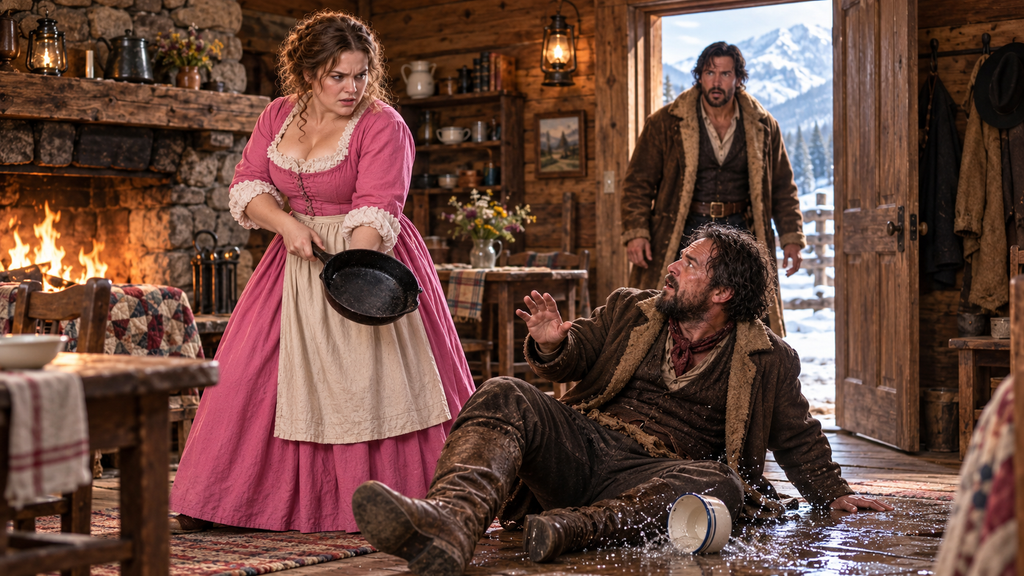
She had flour on her hands when the door slammed open.
The sound froze her blood.
A man stood in the doorway.
Tall.
Heavy coat.
Unshaven face.
A revolver in his right hand.
He kicked the door shut behind him.
Winifred stopped moving.
The stranger smiled.
“Well.”
His gaze crawled over her.
“Didn’t know McIntyre ordered by the pound.”
The sentence reached backward through time and touched another wound.
The depot.
Judson’s voice.
She’ll eat through my winter stores.
Winifred’s stomach tightened.
But humiliation could wait.
Fear could not.
She looked at the revolver.
Then at the shotgun.
Too far away.
The stranger noticed.
“Don’t.”
She looked back at him.
“Who are you?”
“Gar Dempsey.”
The name meant something.
Judson had mentioned it once after drinking.
Claim jumper.
Thief.
Killer.
A man wanted in two territories.
Winifred’s mouth went dry.
“My husband isn’t here.”
Gar grinned.
“I figured.”
“Then leave.”
He laughed.
“Or what?”
He stepped farther into the room.
Bloody mud slid from his boots onto the floor she had scrubbed that morning.
Something ridiculous happened then.
Winifred became angry.
Terrified, yes.
But angry too.
Perhaps fear had nowhere else to go.
Gar noticed her eyes move downward.
“What?”
“You’re bleeding on my floor.”
He stared.
Then laughed again.
“McIntyre gets himself a housecat and she’s worried about the floor.”
He came closer.
Winifred backed toward the stove.
Her hand touched the wooden handle of the skillet.
Bacon grease hissed.
Gar raised the revolver slightly.
“That’s far enough.”
Winifred stopped.
He smiled.
Then reached for her.
She moved.
Fast.
Faster than either of them expected.
Winifred grabbed the skillet with both hands.
The iron was heavy.
The handle scorching.
She swung with every ounce of strength she possessed.
Gar’s eyes widened.
The skillet struck the side of his face.
A terrible metallic crack filled the cabin.
Hot grease exploded across his cheek and forehead.
Gar screamed.
The revolver dropped.
Winifred dropped the skillet.
Then grabbed the fire poker.
Gar lunged blindly.
She swung.
The iron caught him behind the knee.
He collapsed.
Winifred hit him again.
Not the head.
The wrist.
He howled.
She kicked the revolver across the floor.
Gar grabbed her ankle.
Winifred fell.
Pain burst through her elbow.
For one terrible second his burned face was inches from hers.
“You fat—”
She drove her knee upward with every bit of force she had.
Gar made a strangled sound.
His grip loosened.
Winifred rolled away.
She scrambled upright.
Grabbed the fire poker.
And struck his shoulder.
Once.
Twice.
Gar went down.
Winifred stood over him panting.
Her hands shook violently.
Her heart battered against her ribs.
He groaned.
She looked at the deer rope Judson kept near the door.
Then at Gar.
“No,” he muttered.
Winifred swallowed.
“Yes.”
She tied his wrists.
Then his ankles.
Her knots were clumsy.
So she used more rope.
Then more.
When finished, Gar looked less tied than packaged.
Winifred dragged the revolver away.
Retrieved the shotgun.
Then sat in Judson’s chair.
Her legs were shaking too hard to stand.
For perhaps five minutes, there was no sound except her breathing.
Then she noticed the biscuits.
Still in the oven.
“Oh, no.”
She rushed to save them.
Gar stared at her from the floor in disbelief.
“You’re worried about biscuits?”
Winifred removed the pan.
Two were burned.
The rest survived.
She looked down at him.
“You interrupted them.”
Gar began cursing.
Winifred picked up her knitting.
Not because she felt calm.
Because she desperately needed her hands to do something besides tremble.
She sat near the fire.
Gar groaned.
Snow gathered outside.
And when Judson finally burst through the door three hours later, rifle raised and panic written openly across his face, this was what he saw.
His cabin was warm.
Biscuits cooled by the stove.
His wife sat knitting.
And Gar Dempsey—wanted for murder, robbery, and enough violence to make grown men lower their voices when saying his name—lay hog-tied on the floor with flour on his coat and bacon grease drying across his burned face.
Judson stopped dead.
Winifred looked up.
“You’re late.”
His eyes moved to Gar.
Then to Winifred.
Then to the skillet.
Then back to Gar.
“What happened?”
Winifred resumed knitting.
“You have a guest.”
Judson stared.
Gar muttered something obscene.
Winifred looked down.
“I warned you about your language.”
Judson slowly lowered his rifle.
“How?”
“Skillet.”
“What?”
“And the fire poker.”
Judson looked at Gar.
Gar looked away.
Something changed inside Judson McIntyre in that moment.
Not merely surprise.
Not admiration.
Shame.
Sharp, hot, unbearable shame.
He remembered the depot.
Remembered judging her body before her character.
Remembered mocking the hands that had just subdued a murderer.
Remembered telling her she was too soft for the mountains.
He opened his mouth.
“Winifred—”
The window exploded.
Glass flew across the room.
Judson threw himself sideways.
A rifle shot punched through the wall.
“Down!”
Winifred dropped the knitting.
But she did not crawl under the table.
She grabbed the shotgun.
Another shot struck the cabin.
Gar began laughing.
“They came.”
Judson crouched beneath the window.
“Who?”
“My boys.”
Gar grinned through blistered skin.
“Told ’em if I didn’t come out by sundown, burn the place.”
His eyes moved toward Winifred.
“And take whatever was left.”
Judson’s face went cold.
Winifred crossed the room.
She pressed the shotgun barrel against Gar’s throat.
“Speak about me again,” she said quietly, “and I will make your friends collect you in pieces.”
Gar stopped smiling.
Judson stared at her for half a second.
Then another shot shattered the shutter.
Three men.
Maybe four.
Twilight closing fast.
Snow thickening.
Judson looked toward Winifred.
“They’ll circle around.”
“What should I do?”
He pointed at the back door.
“Push the table against it.”
She moved immediately.
No argument.
No panic.
Judson took position near the window.
Muzzle flash.
He fired.
Someone shouted outside.
Winifred dragged sacks of flour and beans against the rear entrance.
Another bullet slammed through the wall.
She flinched.
Then kept working.
Judson shouted, “Stay low!”
She crouched.
A shadow ran toward the porch.
Judson fired.
Missed.
The man reached the door.
Winifred aimed.
The shotgun blast thundered.
The attacker spun sideways and disappeared into the snow.
Judson turned.
For one absurd second, they stared at each other through drifting smoke.
“You hit him.”
“I noticed.”
Another shot.
Judson grunted.
His body jerked.
Winifred’s blood went cold.
“Judson?”
“I’m fine.”
Blood darkened his coat near the ribs.
“You are bleeding.”
“Still fine.”
A man came through the shattered window.
Judson smashed the rifle stock across his jaw.
The attacker fell backward.
Then silence.
A long, terrible silence.
No more shots.
No voices.
Only wind.
Judson waited.
Five minutes.
Ten.
Nothing.
“They’re gone,” he said.
Winifred lowered the shotgun.
Then saw his side.
“Sit.”
“I said I’m fine.”
“You are leaking on my clean floor.”
Judson almost smiled despite the pain.
Winifred pointed at the chair.
“Sit.”
He sat.
She cut away the damaged shirt.
The bullet had grazed him.
Deep enough to bleed.
Not deep enough to kill.
Still, when she cleaned the wound with whiskey, Judson hissed.
“You’re enjoying that.”
“I am trying not to.”
“That isn’t comforting.”
“Hold still.”
Her hands were steady.
Judson watched her.
She had blood on one sleeve.
Soot on her cheek.
A small cut near her temple.
And the most determined expression he had ever seen.
“You should’ve hidden,” he said.
Winifred tightened the bandage.
“You should have ducked.”
“That’s different.”
“Because?”
“I’m the man.”
She stopped.
Judson immediately regretted it.
Winifred stared at him.
“Did the bullet identify your sex before striking you?”
His mouth opened.
Closed.
Gar laughed from the floor.
Winifred turned her head.
He stopped.
Judson looked at his wife.
And laughed.
Pain tore through his ribs.
He laughed anyway.
Winifred tried to remain stern.
Failed.
And for one impossible minute, after gunfire and blood and fear, they sat in the ruined cabin laughing together.
Gar Dempsey stared at both of them as though they were insane.
Perhaps they were.
Perhaps surviving something beside another person creates a kind of madness.
The kind that makes strangers feel less strange.
The kind that begins turning a marriage arranged on paper into something neither expected.
The storm trapped them for three days.
Snow buried the trail.
Wind screamed through the pines.
The temperature fell viciously after dark.
Gar remained tied in the lean-to, chained to a support post after Judson decided rope alone was too generous.
During those three days, Judson saw Winifred differently.
Not because she had proven she could be violent.
That was not the revelation.
The revelation was everything else.
She could be frightened and still move.
Tired and still continue.
Angry without becoming cruel.
Soft without becoming weak.
Judson had spent his entire adult life believing hardness was strength.
He had become hard after losing his first wife, Sarah, ten years earlier.
He rarely spoke of Sarah.
They had been married only eleven months.
She died in Denver from pneumonia while he was away working a freight job.
By the time Judson reached the boardinghouse, she was gone.
He had stood beside her coffin furious at the world.
Then he carried the fury into the mountains.
He worked.
Survived.
Stopped needing.
Stopped hoping.
Stopped loving anything that could be buried.
Then Winifred arrived.
With curtains.
And biscuits.
And maddening opinions.
And a chipped teacup.
And suddenly the cabin contained things he could lose again.
That frightened him more than Gar Dempsey ever could.
On the second night of the storm, Winifred sat near the fire in one of Judson’s flannel shirts.
Her green traveling dress had been torn during the attack.
Her hair hung loose.
Judson watched from the table.
She looked toward him.
“What?”
“Nothing.”
“You’ve been staring for three minutes.”
“I have not.”
“You are a poor liar.”
Judson looked into his coffee.
Winifred returned to sewing.
After a while, she spoke.
“My aunt used to say silence becomes dangerous when people begin putting their own meanings inside it.”
Judson glanced up.
“What’s that supposed to mean?”
“It means if you have something to say, say it.”
He did.
Eventually.
“I was wrong.”
Winifred’s needle stopped.
“At the station.”
She waited.
Judson swallowed.
Apologies were difficult things.
More difficult than bullets.
More difficult than winter.
“You heard everything I said.”
“Yes.”
“I knew you had.”
“Yes.”
“I should have apologized that day.”
“Yes.”
He almost frowned.
Winifred looked at him calmly.
Judson continued.
“I judged you before you spoke.”
“Yes.”
“Could you stop agreeing?”
“No.”
A smile threatened.
He fought it.
“I thought strength meant someone built for hard work.”
“You mean thin.”
Judson winced.
“I suppose.”
“You may say it.”
“I was cruel.”
“Yes.”
He looked at her.
Winifred’s eyes softened.
Judson continued.
“I have spent years deciding what people are before they can disappoint me.”
“That sounds lonely.”
“It is.”
The honesty surprised him.
Winifred set aside her sewing.
Judson looked toward the fire.
“When Sarah died, I decided needing someone was foolish.”
“Sarah?”
“My first wife.”
Winifred went still.
Judson had never told her.
“She died ten years ago.”
“I’m sorry.”
“So was I.”
His throat tightened.
“She was twenty-four.”
Winifred said nothing.
“I wasn’t there.”
Judson stared into the flames.
“She got sick. I was away. By the time somebody found me…”
He stopped.
Winifred’s voice was gentle.
“You did not cause her illness.”
“I left.”
“You went to work.”
“I left.”
Grief does not care about reason.
Winifred understood that.
So she did not argue.
After a long silence, she said, “My aunt died while I was in the next room.”
Judson looked at her.
“She had been sick for months. I knew the end was coming. I knew every hour with her might be the last.”
Her fingers tightened around the fabric.
“Yet when she died, I still spent weeks believing I should have done something differently.”
“What?”
“I never figured that out.”
Her eyes met his.
“That is the cruelty of grief. It invents crimes so we can punish ourselves for surviving.”
Judson felt the words enter a place he had kept sealed for ten years.
He looked away.
“I don’t know how to be a husband anymore.”
Winifred’s expression softened.
“I don’t know how to be a wife.”
“You’re doing better than I am.”
“I have superior biscuits.”
That did it.
He laughed.
Quietly this time.
Then looked at her again.
“You could go back.”
“Where?”
“Denver. Somewhere.”
“With what money?”
“The bounty on Dempsey is four hundred dollars.”
She blinked.
“I’d give it to you.”
“Why?”
“So you have a choice.”
Winifred studied him.
“And if I chose to stay?”
Judson’s chest tightened.
He answered carefully.
“Then I would spend the rest of this winter trying to deserve it.”
Silence.
The storm pushed against the cabin.
Firelight moved across Winifred’s face.
She lowered her gaze.
Then said, “The curtains need lining.”
Judson stared.
“What?”
“The wind still comes through.”
“That’s your answer?”
“For tonight.”
He understood.
Not forgiveness.
Not yet.
But possibility.
And to a man who had lived without hope for a decade, possibility felt dangerously close to grace.
After the storm, life settled into something new.
Judson no longer referred to the cabin as mine.
Sometimes he caught himself saying ours.
The first time it happened, Winifred heard him.
She did not mention it.
But later that evening, she placed the chipped china teacup on the shelf beside his tin mug.
Until then, she had kept it wrapped in her trunk.
Judson noticed.
He said nothing.
Some things were too important for words.
They taught each other.
He taught her how to read clouds.
How to know when snow was coming from the strange stillness in the air.
How to load the rifle.
How to set snares.
How to identify cougar tracks.
How to move quietly through timber.
She taught him to mend buttons.
He was terrible at it.
She made him try anyway.
He taught her to split wood.
She taught him that socks should be washed before they became capable of standing alone.
He showed her where wild berries grew in summer.
She showed him how dried apples, flour, and a spoonful of sugar could become something resembling joy.
Slowly, laughter entered the cabin.
Not often.
But enough.
Judson discovered Winifred snored when she was exhausted.
She denied it.
He discovered she spoke to bread dough while kneading it.
She denied that too.
She discovered he secretly whistled while checking traps.
He threatened to deny her coffee if she mentioned it.
She told him he did not have the courage.
They became familiar.
Then necessary.
Then something more dangerous.
Desire came quietly.
Judson noticed the curve of her neck when she pinned her hair.
The warmth of her body when they stood together at the stove.
The way her eyes changed when she laughed.
Winifred noticed his hands.
Scarred.
Strong.
Gentle in ways he seemed embarrassed to reveal.
He repaired the handle of her mother’s rolling pin after it cracked.
He carved her a box for sewing needles.
He began leaving the warmest portion of the buffalo robe on her side of the bed.
They still slept separately.
Judson on a cot in the main room.
Winifred in the small bedroom.
They had agreed to wait.
Neither quite knew for what.
One evening, Winifred stood on a chair trying to fasten a hook near the ceiling.
The chair shifted.
Judson caught her.
His arms went around her waist.
Her hands landed against his chest.
For one suspended moment, they did not move.
His face was inches from hers.
Winifred could feel his breath.
Judson’s grip tightened unconsciously.
Her lips parted.
Then Judson stepped back.
Winifred looked away.
“Thank you.”
“Mm.”
Neither spoke for the next hour.
Both heard everything inside the silence.
Two weeks later, smoke appeared on the southern ridge.
Judson saw it while returning from the traps.
One column.
Then another.
Deliberate.
A signal.
His instincts screamed.
He ran.
When he entered the cabin, Winifred looked up from kneading dough.
“What happened?”
“Pack.”
She saw his face.
Did not argue.
“What?”
“Food. Blankets. Ammunition.”
“Dempsey?”
“Maybe.”
Gar was still alive.
Still chained in the lean-to.
Judson had been waiting for weather clear enough to transport him to town.
But someone was coming.
Perhaps the men who had escaped.
Perhaps others.
Judson stepped into the lean-to.
Gar smiled.
“Knew they’d come.”
Judson grabbed his coat.
“How many?”
“Enough.”
“Why?”
Gar spat blood near Judson’s boot.
“You think this is about you?”
Judson’s eyes narrowed.
Gar laughed.
“That claim of yours is worth more than you know.”
Judson froze.
“What?”
“Found color down creek, didn’t you?”
Judson said nothing.
Gar’s smile widened.
“You never figured where it came from.”
Judson had found richer flakes the previous spring.
Not much.
Enough to wonder.
Gar and his men clearly believed there was more.
Judson returned inside.
“We leave now.”
Winifred had already packed.
He looked at her.
“You trusted me without asking.”
“You looked frightened.”
Judson nearly protested.
Then realized there was no point.
“Yes.”
“So we leave.”
They climbed toward a cave Judson knew high on the western slope.
Snow began before dark.
Behind them, smoke thickened.
From the ridge they watched men approach the claim.
Winifred’s chest tightened.
The cabin.
The curtains.
The table.
The bread rising beside the stove.
Her chipped teacup.
Her first real home since Boston.
Judson touched her shoulder.
“Don’t look.”
She did anyway.
Figures moved around the clearing.
One man kicked open the lean-to.
Another entered the cabin.
Winifred whispered, “They’re destroying it.”
“We rebuild.”
“What if they burn it?”
“We rebuild.”
“What if—”
“As many times as it takes.”
She looked at him.
Judson’s eyes were steady.
“As long as you’re alive,” he said, “the home isn’t down there.”
Winifred stared at him.
He seemed startled by his own words.
Then they kept climbing.
The cave was narrow, cold, and smelled of stone.
Judson built a small fire deep inside.
They ate cold biscuits.
Winifred wrapped herself in the buffalo robe.
Judson sat near the entrance with the rifle across his knees.
Hours passed.
The storm strengthened.
Around midnight, Winifred woke.
Judson was still awake.
She moved beside him.
“You need sleep.”
“So do you.”
“I had some.”
“You had twenty minutes.”
“That qualifies.”
He shook his head.
Winifred sat.
Their shoulders touched.
For a while they watched the snow.
Then she said, “I hated you.”
Judson looked at her.
“At the depot.”
“I deserved it.”
“Yes.”
“When did you stop?”
“I’m not entirely certain I have.”
He smiled faintly.
Winifred continued.
“I thought you were the cruelest man I had ever met.”
“Reasonable.”
“Then you carried water when you thought I was not looking.”
He glanced at her.
“You noticed?”
“I notice everything.”
“That’s unfortunate.”
“You repaired my rolling pin.”
“It was broken.”
“You gave me the better blanket.”
“You get cold.”
“You started wiping your boots.”
Judson frowned.
“That one nearly killed me.”
Winifred laughed.
Then became quiet.
“I began realizing you were not cruel because you enjoyed cruelty.”
Judson’s expression changed.
“You were afraid.”
He looked back toward the storm.
“Of you?”
“Of needing me.”
His jaw tightened.
Winifred’s voice softened.
“I am afraid too.”
That surprised him.
“Of what?”
“Of believing this is mine.”
She gestured vaguely toward the valley.
“The cabin. The life. You.”
Judson’s throat tightened.
“Everything I had disappeared once.”
Her eyes glistened.
“I survived it. But surviving something does not mean you want to practice.”
Judson turned toward her fully.
Winifred looked down.
“I am afraid of becoming at home somewhere that can be taken away.”
He reached for her.
Stopped.
Then asked, “May I?”
Her eyes lifted.
The question mattered.
Perhaps more than either expected.
Winifred nodded.
Judson touched her cheek.
His palm was rough.
Warm.
She leaned into it.
“I cannot promise nothing will happen,” he said.
“I know.”
“I cannot promise easy.”
“I know.”
“I can promise I will not decide for you again.”
Winifred swallowed.
“And I can promise the home is yours as much as mine.”
“Judson…”
“If the claim disappears, we find another.”
His thumb moved against her cheek.
“If the cabin burns, we build another.”
Her eyes filled.
“If winter takes everything except us, then we start with us.”
Winifred’s breath caught.
Judson stared at her.
Then kissed her.
At first, it was cautious.
Almost uncertain.
A question.
Winifred answered by gripping his coat and pulling him closer.
The kiss changed.
Ten years of loneliness met months of fear.
Judson held her as though he had forgotten there were things in the world that should be held gently.
Winifred kissed him with equal hunger.
Then they separated.
Breathing hard.
Judson rested his forehead against hers.
“I have wanted to do that for weeks.”
“I know.”
“You notice everything.”
“Unfortunately.”
He laughed softly.
Then kissed her again.
Outside, winter raged.
Inside a mountain cave, two people who had entered marriage as strangers began, finally, choosing one another.
When they returned two days later, the cabin still stood.
Barely.
The door was broken.
Furniture overturned.
Supplies scattered.
The mattress slashed.
Dishes shattered.
Gar Dempsey was gone.
Blood stained the snow around the broken chain.
Winifred stood in the doorway.
Judson waited behind her.
She entered slowly.
Her eyes moved across the wreckage.
The curtains had been ripped down.
The flour barrel overturned.
Her sewing box smashed.
Then she saw the shelf.
The chipped china teacup lay in pieces on the floor.
Winifred stopped.
Judson saw her face.
He had watched her fire a shotgun without crying.
He had watched her wrestle Gar Dempsey.
Watched her survive gunfire.
Watched her climb through a blizzard.
But when she knelt and picked up the broken porcelain, tears filled her eyes.
“My mother drank from this.”
Judson crouched beside her.
Winifred held two pieces.
“It was stupid.”
“No.”
“It was just a cup.”
“No.”
Her mouth trembled.
“It was one of the only things I had left.”
Judson reached for her.
This time she came into his arms immediately.
Winifred cried.
Not politely.
Not quietly.
She cried for the cup.
For her aunt.
For Boston.
For the house lost to creditors.
For every possession taken.
For the woman who stepped off a stagecoach with nowhere else to go.
Judson held her.
He did not tell her to stop.
He did not say it was replaceable.
He understood now.
Objects sometimes carried people inside them.
When Winifred finally lifted her head, she wiped her face.
“I’m sorry.”
“For what?”
“This.”
“Don’t apologize.”
She looked around the wreckage.
Then inhaled.
Picked up a broken chair.
Set it upright.
“We start again.”
Judson looked at her.
That sentence.
So simple.
So impossible.
We start again.
Not I.
Not you.
We.
“Yes,” he said.
“We do.”
Spring came late.
Winter fought hard before surrendering.
But eventually the snow shrank from the southern slopes.
The creek broke open.
Aspens showed green.
Birdsong returned.
Judson took Gar’s bounty papers to Denver after news came that the outlaw had been found dead two valleys south, apparently shot by one of his own men during an argument.
Four hundred dollars changed hands.
Judson returned with supplies.
Nails.
Glass.
A proper stove.
Fabric.
Coffee.
Sugar.
And one small wrapped parcel.
Winifred stood at the table when he placed it before her.
“What is this?”
“Open it.”
She peeled away the paper.
Inside was a china teacup.
White.
Painted with tiny blue flowers.
Not expensive.
Not old.
Not her mother’s.
Winifred stared at it.
Judson cleared his throat.
“I know it isn’t the same.”
She touched the rim.
“I tried to find one like yours.”
Her eyes filled.
Judson immediately looked uncomfortable.
“I can take it back.”
Winifred laughed through tears.
“No.”
“I didn’t mean to upset you.”
“You didn’t.”
She looked at him.
“It isn’t the same.”
“I know.”
“That’s why I like it.”
Judson frowned slightly.
Winifred held the cup between both hands.
“The old one belonged to the life I lost.”
Her eyes moved around the cabin.
“This one belongs here.”
Judson looked at her.
Winifred stepped toward him.
Then kissed him.
No hesitation now.
No fear.
When they separated, Judson murmured, “I also bought curtains.”
Her eyebrows rose.
“You?”
“Don’t make much of it.”
“What color?”
“Blue.”
She stared.
“What?”
“They were the only ones.”
“Judson McIntyre voluntarily purchased curtains.”
“I can return them.”
“You will do no such thing.”
She smiled.
He smiled back.
Spring filled the doorway behind them.
And for perhaps the first time in his life, Judson McIntyre understood that happiness did not always arrive dramatically.
Sometimes it looked like a woman holding a teacup.
Sometimes it smelled like fresh bread.
Sometimes it was blue curtains purchased in Denver.
Sometimes it was someone waiting when you came home.
By summer, the cabin had become almost unrecognizable.
Judson added another room.
Winifred planted potatoes, beans, cabbage, carrots, onions, and a small patch of flowers that Judson declared impractical.
She planted them anyway.
When the first yellow blossoms opened, he stood looking at them longer than necessary.
Winifred caught him.
“Impractical?”
“Still are.”
“You’ve been staring for five minutes.”
“I’m checking for insects.”
“Of course.”
Their marriage deepened.
Not because everything became easy.
It did not.
They argued.
About money.
About danger.
About Judson disappearing for hours without saying where he was going.
About Winifred attempting tasks beyond her strength rather than asking for help.
One afternoon, Judson returned to find her on the roof repairing shingles.
He nearly suffered a heart attack.
“What in God’s name are you doing?”
“Fixing the roof.”
“Get down.”
“No.”
“Winifred.”
“It leaks.”
“I’ll fix it.”
“You said that three weeks ago.”
“I’ve been working.”
“And now I am fixing it.”
“You could fall.”
“So could you.”
“I know how to climb.”
“I climbed up.”
“That is not the same thing!”
She looked down at him.
“Your argument is becoming emotionally weak.”
“Get off the roof!”
She did.
Eventually.
Then refused to speak to him for two hours.
Judson apologized before supper.
That was progress.
She kissed his cheek.
That was forgiveness.
He still hated the roof.
One evening in late August, they sat beside the creek.
The sun lowered behind the western peaks.
Winifred rested against Judson’s shoulder.
He held her hand.
Their wedding had been legal from the beginning.
The agency contract had arranged the civil paperwork in Denver.
But neither of them had spoken vows beyond what necessity required.
Judson looked at the water.
“I want to marry you.”
Winifred turned.
She blinked.
“We are married.”
“I know.”
“That generally prevents additional proposals.”
Judson frowned.
“You know what I mean.”
“I would like to hear you say it.”
He groaned quietly.
Winifred smiled.
Judson stood.
Then, awkwardly, lowered himself to one knee.
Her smile disappeared.
He took both her hands.
“I did this wrong.”
Winifred’s eyes filled.
“From the first second.”
Judson continued.
“I treated you like something I ordered.”
His voice thickened.
“Like you were supposed to arrive already shaped for my life.”
She squeezed his hands.
“I was wrong.”
A breeze moved through the aspens.
“You didn’t fit the life I had.”
Winifred’s mouth trembled.
Judson smiled faintly.
“You made it better.”
A tear slipped down her cheek.
“I asked for someone who could survive the mountains.”
He looked around at the valley.
“I didn’t understand survival.”
His eyes returned to hers.
“It isn’t being hard.”
Winifred remembered their wagon ride.
Sometimes the thing that doesn’t break is the thing that bends.
Judson continued.
“It’s getting up after something knocks you down.”
His voice broke slightly.
“It’s rebuilding after someone destroys what you love.”
He touched her hand to his chest.
“It’s letting yourself love again when you know exactly what it can cost.”
Winifred cried openly now.
Judson swallowed.
“So I am asking properly this time.”
He took a breath.
“Winifred Hayes, would you choose me?”
She stared down at him.
“Not because you have nowhere else to go.”
He tightened his grip.
“Not because some agency sent you.”
Another breath.
“Not because winter is coming.”
His eyes shone.
“Because you want this life.”
“Because you want me.”
Winifred lowered herself to her knees in front of him.
She touched his face.
“Yes.”
Judson closed his eyes.
“Yes?”
“Yes.”
He kissed her.
The creek ran beside them.
Aspen leaves whispered overhead.
There were no witnesses.
No priest.
No papers.
Only two people who had already survived enough to understand the weight of choosing.
They went to Denver two months later.
Winifred wore a blue dress she had sewn herself.
Judson wore a suit borrowed from Horace Bell because his own idea of formal clothing was a clean shirt.
Horace attended.
So did Pete Rollins.
The same men who had laughed at the depot stood quietly outside the courthouse afterward.
One miner approached Winifred.
“Ma’am?”
“Yes?”
He removed his hat.
“I was there when you came.”
Winifred understood.
His face reddened.
“I laughed.”
Judson stiffened beside her.
The miner continued quickly.
“I shouldn’t have.”
Winifred looked at him.
Then smiled.
“No.”
The man swallowed.
“But you learned.”
“Yes, ma’am.”
“That will do.”
Judson watched him walk away.
Then looked at Winifred.
“You forgave him quickly.”
“I did not say I forgave him.”
Judson blinked.
She smiled.
“Come along, husband.”
He laughed.
Years passed.
Not all gently.
There were difficult winters.
One year, snow reached the windows.
Another year, drought nearly ruined the garden.
A mine collapse killed two men farther down the valley.
A fever passed through Silver Hollow.
The claim produced enough to live, never enough to become rich.
Judson did not care.
He already possessed more than he expected life to give him.
Three years after Winifred stepped off the stagecoach, a daughter was born during a spring thunderstorm.
They named her Sarah Eleanor.
Sarah for Judson’s first wife.
Eleanor for Winifred’s aunt.
Judson cried when the baby wrapped her tiny hand around his finger.
Then denied it for the next twelve years.
Winifred never corrected him in public.
In private, she reminded him frequently.
“You wept.”
“My eyes watered.”
“For twenty minutes?”
“Smoke.”
“There was no fire.”
“Dust.”
“In a rainstorm?”
Judson glared.
Winifred kissed him.
Their daughter grew stubborn.
Curious.
Fearless.
At five, she tried to ride a mule without permission.
At six, she learned to knead bread.
At seven, she told a visiting trapper that his language was unacceptable and threatened him with her mother’s skillet.
Judson nearly fell from his chair laughing.
The skillet became family legend.
Winifred continued using it.
For bacon.
Cornbread.
Potatoes.
Once, years later, Judson looked at the dent Gar Dempsey’s skull had left in the iron.
“You ever think about replacing it?”
Winifred looked offended.
“And lose perfectly good seasoning?”
He laughed.
Time softened Judson.
Not completely.
He remained blunt.
Stubborn.
Quiet.
But strangers no longer mistook silence for coldness when they saw him with Winifred.
He touched her without thinking.
A hand at her back.
Fingers brushing hers.
A kiss to her temple while passing.
He learned to say thank you.
Then sorry.
Eventually, even I love you.
The first time came seven years into their marriage.
Winifred had known for years.
Still, hearing it nearly undid her.
They were sitting outside beneath a summer sky.
Sarah slept inside.
Judson stared toward the mountains.
“I love you.”
Winifred turned.
“What?”
Judson looked irritated.
“You heard me.”
“I did.”
“Then why ask?”
“I wanted to hear it twice.”
He glared.
She waited.
Judson muttered, “I love you.”
Winifred smiled.
“I love you too.”
“Good.”
“That is all?”
“What else?”
“You waited seven years.”
“I was making sure.”
She slapped his arm.
He caught her hand and kissed it.
As Silver Hollow grew, people began coming to the McIntyre cabin for more than business.
Travelers stopped during storms.
Neighbors brought sick children because Winifred knew remedies.
Young wives came for advice.
Hungry miners arrived suspiciously near supper.
Judson pretended to resent them.
Winifred knew better.
He built a larger table.
That told her everything.
Years earlier, Judson had feared Winifred would eat through his winter stores.
Now their pantry fed half the valley when someone was desperate.
One winter, a wagon overturned near the pass.
Six stranded travelers spent five days in their cabin.
Judson gave up his bed.
Winifred cooked three meals a day.
When the travelers left, one woman hugged her.
“This place feels safe.”
Winifred stood in the doorway afterward.
Judson came beside her.
“What?”
She looked around.
The curtains.
The table.
The stove.
Sarah’s drawings.
Boots near the door.
Steam on the windows.
She remembered the cabin as she first saw it.
Dark.
Dirty.
Empty.
“It became a home.”
Judson looked at her.
“You made it one.”
“We did.”
He shook his head.
“You.”
Winifred turned toward him.
Judson touched her cheek.
“I built walls.”
His voice softened.
“You built everything that made them matter.”
Tears burned her eyes.
After all those years, the cruel sentence from the depot returned.
I asked for a wife, not a cook.
Winifred smiled.
“You did ask for a wife.”
“I was an idiot.”
“Yes.”
“I believe wives are supposed to disagree sometimes.”
“Not about proven facts.”
He kissed her.
When Sarah was ten, she discovered the old agency letter tucked inside a cedar box.
She brought it to the table.
“Mama?”
Winifred froze.
Judson looked up from sharpening a knife.
Sarah held the yellowed paper.
“What’s this?”
Judson groaned.
Winifred stared at him.
“You kept it?”
“I forgot it existed.”
Sarah unfolded it.
Her eyes moved quickly.
Then widened.
“Papa ordered you?”
Judson closed his eyes.
Winifred bit her lip to stop from laughing.
“It was more complicated.”
Sarah looked horrified.
“You bought Mama?”
“No!”
Judson nearly shouted.
“I paid the agency fee.”
“That sounds like buying.”
“It wasn’t.”
Sarah looked at Winifred.
“Did you love him?”
Winifred considered.
“When I arrived?”
“Yes.”
“No.”
Judson winced.
Sarah looked at her father.
“Did you love Mama?”
“No.”
Winifred raised an eyebrow.
Judson added quickly, “Not then.”
Sarah frowned.
“Then why did you marry?”
Judson and Winifred exchanged a glance.
How could they explain?
Need.
Loneliness.
Survival.
Chance.
Fear.
Hope disguised as practicality.
Winifred reached for Sarah’s hand.
“Sometimes people begin at the wrong end of a story.”
Sarah frowned.
“What does that mean?”
“It means we did not marry because we loved each other.”
Winifred looked at Judson.
“We learned to love each other because we stayed long enough to truly see one another.”
Sarah considered that.
Then looked at her father.
“Were you nice to Mama?”
Silence.
Winifred looked down.
Judson sighed.
“No.”
Sarah’s eyes widened.
“I was awful.”
“How awful?”
“Sarah,” Winifred said.
But Judson raised a hand.
“No. She should know.”
He looked at his daughter.
“I insulted your mother the first day.”
Sarah gasped.
“Why?”
“Because I was stupid.”
“What did you say?”
Judson looked desperately toward Winifred.
She smiled sweetly.
“Tell her.”
He groaned.
By the end of the story, Sarah was furious.
“You said Mama would eat all your food?”
“I was an idiot.”
“She should have left you.”
“She nearly did.”
“I would have.”
“I know.”
Sarah crossed her arms.
Judson looked at Winifred.
“This child is entirely yours.”
“She has your temper.”
“She has your opinions.”
“She has your jaw.”
Sarah interrupted.
“Did Mama really hit a murderer with a skillet?”
Judson smiled.
“Oh, yes.”
Sarah stared at her mother with awe.
Winifred sighed.
And thus the legend grew.
Years became decades.
Silver Hollow changed.
The rough mining town became a settled community.
Roads improved.
Telegraph lines came.
Then rail service reached the lower valley.
The old trails widened.
Judson sold his claim when his knees began protesting steep climbs.
They kept the cabin.
Never considered leaving.
The place had grown too deeply into them.
Sarah married a schoolteacher from Denver.
Judson disapproved of him for almost an entire week.
Then discovered the man enjoyed fishing and surrendered.
Grandchildren came.
They filled the cabin with noise.
Winifred baked with them.
Judson taught them to track deer.
One winter evening, nearly thirty-five years after Winifred arrived in Colorado, they sat beside the fire.
The children and grandchildren had gone home.
Snow pressed against the windows.
The blue curtains had been replaced many times.
The table bore scratches from decades of meals.
A newer skillet sat on the stove.
The old one hung on the wall.
Judson was seventy-three.
His hair had gone white.
Winifred’s hands were thinner now.
Arthritis had begun bending her fingers.
She no longer hauled water.
No longer swung axes.
Judson watched her knitting.
“You still do that wrong.”
Winifred looked up.
“Do what?”
“Count stitches.”
“I have knitted for forty years.”
“Still looks suspicious.”
She smiled.
“Do you remember the first time you saw me knitting?”
Judson’s expression changed.
“Dempsey.”
“Yes.”
“You had him tied like a Christmas roast.”
“He deserved it.”
Judson laughed.
Then winced and rubbed his ribs.
The old gunshot wound still complained in cold weather.
Winifred noticed.
“Hurting?”
“A little.”
She set aside the knitting.
Moved her chair closer.
Their knees touched.
Judson looked at her.
Even after decades, some part of him still saw the woman stepping from the stagecoach.
Green dress.
Proud chin.
Wounded eyes.
He reached for her hand.
“Winnie?”
He rarely called her that.
Only when emotional.
“Yes?”
“I’ve been lucky.”
Winifred smiled.
“You have.”
He chuckled.
“I mean it.”
“So do I.”
His thumb moved slowly over her knuckles.
“I nearly ruined everything before it started.”
“Yes.”
“You never let me forget.”
“Someone must maintain historical accuracy.”
Judson smiled.
Then became serious.
“I looked at you and saw everything you weren’t.”
Winifred’s expression softened.
“Thin.”
“Judson.”
“Hard.”
She squeezed his hand.
“Experienced.”
He looked toward the room around them.
“I didn’t see what you were.”
“What was I?”
He turned back to her.
“Brave.”
Her eyes filled.
“Kind.”
She looked down.
“Stubborn.”
“That sounds more accurate.”
“Strong.”
Judson’s voice lowered.
“My home.”
Winifred looked at him.
Outside, snow covered the world.
Inside, the fire cracked quietly.
Judson swallowed.
“I asked for a wife.”
Winifred waited.
“And I got the heart of this place.”
Her mouth trembled.
“You finally learned to talk.”
“Took me a while.”
“Only thirty-five years.”
“I’m a slow learner.”
She leaned forward.
Their foreheads touched.
Judson whispered, “I’d choose you again.”
Winifred closed her eyes.
“All of it?”
“The depot too.”
“That seems foolish.”
“I’d need to meet the woman.”
Her eyes opened.
Judson smiled.
“To become the man.”
A tear slipped down Winifred’s cheek.
She kissed him.
Softly.
Slowly.
The kiss of two people who knew every scar.
Every regret.
Every version of each other.
Judson McIntyre died five winters later.
Quietly.
In the cabin.
With Winifred holding his hand.
He had been ill for several days.
Nothing dramatic.
Age simply reached the door and decided it had waited long enough.
Sarah came with her husband.
The grandchildren crowded the second room.
Snow fell outside.
Judson opened his eyes near midnight.
Winifred sat beside him.
He looked toward the curtains.
“Blue.”
She smiled through tears.
“Yes.”
“Bought those.”
“Not those exact ones.”
“Still counts.”
“Of course.”
His fingers searched weakly for hers.
She took his hand.
“You afraid?” Winifred asked.
Judson thought about it.
“No.”
“Liar.”
He smiled faintly.
“A little.”
“So am I.”
He looked at her.
“Don’t be.”
Her tears fell.
“You are asking too much.”
Judson’s eyes moved across her face.
“I waited ten years after Sarah because I thought loving someone meant losing them.”
Winifred bent over his hand.
“You were wrong.”
“Yes.”
His breathing became shallower.
“Losing someone means you had them.”
Winifred sobbed.
Judson squeezed her fingers.
Barely.
“Worth it.”
She kissed his hand.
“Every day.”
“Winnie?”
“Yes?”
“I’m sorry.”
“For what?”
“The depot.”
A broken laugh escaped her.
“Judson…”
“Still sorry.”
“I know.”
He closed his eyes.
Then opened them again.
“Did you ever forgive me?”
Winifred leaned forward.
She kissed his forehead.
“Long before you forgave yourself.”
Judson smiled.
His last clear expression.
A few minutes later, his breathing stopped.
The fire continued burning.
Snow continued falling.
Winifred sat beside him until morning.
Not because she could not let go.
Because thirty-nine years earlier, Judson McIntyre had stood at a stagecoach depot and decided strength had one shape.
Life had corrected him.
Slowly.
Patiently.
Beautifully.
And Winifred wanted one final night beside the man who had finally learned.
After the funeral, Sarah asked her mother to move to Denver.
Winifred refused.
“This is home.”
“You shouldn’t be alone.”
“I was alone once.”
She looked around the cabin.
“I am not now.”
Judson remained everywhere.
In the repaired table.
The cedar sewing box.
The marks beside the door where he measured Sarah’s height.
The peg where his coat had hung.
The shelf holding the blue-flowered teacup.
The roof he once shouted at Winifred for climbing.
The garden fence he rebuilt every spring while complaining about deer.
The old skillet on the wall.
The cabin itself held him.
Not as a ghost.
As history.
Winifred remained there another seven years.
Children visited.
Grandchildren stayed during summers.
She told stories.
Some became exaggerated.
Especially the one about Gar Dempsey.
By the time her youngest grandson heard it, family legend claimed Winifred defeated six armed men using nothing but a skillet, one biscuit, and righteous anger.
She never corrected them.
“Was Grandfather really mean when you met?” one granddaughter asked.
Winifred smiled.
“Terrible.”
“Then why did you stay?”
That question returned again and again.
Why stay?
Why forgive?
Why build a life with someone who began by hurting you?
Winifred never gave the easy answer.
She never said love fixes cruelty.
It does not.
She never said women should tolerate disrespect.
They should not.
She never romanticized Judson’s behavior.
Instead she told the truth.
“I stayed because I had nowhere else to go at first.”
The children listened.
“Then I stayed because he changed.”
She looked toward the old chair near the hearth.
“Not because I begged him.”
Her voice was firm.
“Not because I became smaller.”
She touched her chest.
“He changed because he finally saw me.”
The room grew quiet.
“And because he learned that love without respect is only another kind of hunger.”
Her granddaughter asked, “When did you love him?”
Winifred smiled.
“I don’t know.”
“That’s not an answer.”
“It’s the true one.”
She looked toward the window.
“Love rarely arrives with a trumpet.”
Outside, snow began falling.
“Sometimes it arrives carrying water.”
A pause.
“Sometimes repairing a rolling pin.”
Another.
“Sometimes buying ugly blue curtains.”
The children laughed.
Winifred smiled.
“And sometimes it arrives as an apology that takes a stubborn man far too long to say.”
Winifred Hayes McIntyre died in early spring at the age of eighty-two.
The snow was melting.
Water ran beneath the ice.
Aspen buds were beginning to swell.
Sarah found her sitting peacefully near the window, wrapped in the old buffalo robe.
A book rested open in her lap.
Emerson.
The same book she had carried from Boston.
Her blue-flowered teacup sat on the table.
Empty.
Her face looked peaceful.
Sarah cried.
Then smiled.
Because she knew where her mother would have wanted to be.
They buried Winifred beside Judson on the hill overlooking the creek.
Their stones were simple.
JUDSON MCINTYRE
BELOVED HUSBAND AND FATHER
WINIFRED HAYES MCINTYRE
BELOVED WIFE, MOTHER, AND HEART OF OUR HOME
Sarah chose the words.
No one argued.
The cabin remained in the family.
So did the skillet.
Generations later, children who had never known Judson or Winifred still heard the story.
About the proud mountain man.
The soft-faced woman from Boston.
The stagecoach.
The terrible insult.
The outlaw.
The skillet.
The gunfight.
The snowstorm.
The blue curtains.
The teacup.
But beneath the adventure lived a quieter story.
A more important one.
It was the story of a woman who crossed a continent because every road behind her had disappeared.
A woman who stepped into a stranger’s life and refused to allow his first judgment to become her identity.
She did not become strong because the mountains demanded it.
She had already been strong.
The mountains merely revealed it.
And it was the story of a man who believed hardness was the same thing as strength.
A man who had been wounded by loss and decided never to become vulnerable again.
Then life sent him someone he could not dismiss.
Someone who cooked.
Cleaned.
Argued.
Laughed.
Shot straight.
Forgave carefully.
Loved deeply.
And demanded that he become worthy of the life growing around him.
Judson did not save Winifred.
Winifred did not save Judson.
They changed beside one another.
There is a difference.
She taught him softness could survive winter.
He taught her that a place lost once did not mean every future home would disappear.
Together they learned that marriage was not shelter from hardship.
It was deciding who would stand beside you when hardship came through the door.
Sometimes carrying a revolver.
Sometimes wearing grief.
Sometimes looking like poverty.
Sometimes sounding like fear.
Sometimes arriving silently in the middle of the night.
And home?
Home was never the cabin.
Not really.
It was not the glass windows.
Not the stove.
Not the blue curtains.
Not the table.
Not the garden.
Not even the mountains.
Home was Judson carrying water without being asked.
Winifred saving biscuits while a murderer groaned on the floor.
It was arguments followed by apologies.
Fear followed by courage.
Loss followed by rebuilding.
It was the ordinary miracle of two imperfect people deciding, over and over:
We start again.
We start again.
We start again.
That was why, when people later asked Winifred whether she regretted answering the matrimonial advertisement, she always smiled before responding.
“Not in the end.”
And if they asked whether Judson regretted ordering a bride who turned out nothing like the woman he expected, the answer had been written across every year of his life.
He had wanted someone hard enough to endure the Rockies.
Instead, he received a woman soft enough to make the Rockies feel like home.
He had worried she would consume his winter stores.
Instead she filled his pantry, his table, his silence, and eventually his entire life.
He thought she was too delicate.
She defeated a killer with a skillet.
He thought she was too dependent.
She rebuilt herself after losing everything.
He thought she was merely a cook.
She became his partner.
His courage.
His conscience.
His laughter.
His second chance.
The mother of his child.
The keeper of his memories.
The woman beside whom he learned that surviving was not the same thing as living.
Once, long ago, at a muddy stagecoach depot beneath an iron-colored sky, Judson McIntyre had looked at Winifred Hayes and said:
“I asked for a wife, not a cook.”
He had spoken the words loudly enough for strangers to hear.
Decades later, if he could have returned to that exact moment, he would have stepped in front of his younger self.
He would have looked at that angry, frightened, foolish man and told him to close his mouth.
To carry her trunk.
To treat her gently.
To understand how incredibly close he was to insulting the greatest gift his lonely life would ever receive.
Because Judson had not merely been sent a wife.
He had been sent the woman who would turn his shelter into a home.
His solitude into companionship.
His fear into trust.
His survival into life.
And perhaps that was why the mountains seemed less cold after Winifred arrived.
Not because the winters changed.
They did not.
Snow still buried the trails.
Wind still clawed at the walls.
Coyotes still cried from the timber.
People still got sick.
Claims failed.
Crops died.
Loved ones were buried.
Life remained difficult.
But there was bread on the table.
There was laughter beside the fire.
There were blue curtains at the windows.
There were two chairs drawn close enough for knees to touch.
And whenever winter pushed against the door, there were two people standing inside instead of one.
That, Judson eventually learned, was the difference.
Not between weakness and strength.
Not between east and west.
Not between a cook and a wife.
Between existing—
and belonging.
Between surviving—
and living.
Between a cabin—
and a home.
And in the end, the woman Judson believed would never survive the mountains became the reason he finally learned how to live among them.
The skillet returned to the stove.
The curtains kept out the wind.
The table stayed mostly clean.
Children filled the second room.
Years gathered in the corners.
Love settled over everything quietly, the way snow settled over the pines.
And on long winter evenings, when the flames burned low and Winifred’s chair sat close beside his, Judson would sometimes look at her without speaking.
She always noticed.
“What?” she would ask.
“Nothing.”
“Judson.”
He would smile.
Then take her hand.
And sometimes, when pride loosened enough, he would say the sentence that mattered more than all the foolish ones he had spoken before it.
“I’m glad you stayed.”
Winifred would squeeze his fingers.
Her smile would be small.
Knowing.
Warm.
“So am I.”
And that was enough.
Because some of the greatest love stories do not begin with love.
Some begin with disappointment.
With mistakes.
With fear.
With two strangers staring at one another and seeing almost everything incorrectly.
Then life begins stripping away the assumptions.
One winter at a time.
One argument.
One kindness.
One apology.
One danger survived together.
Until eventually there is nothing left between them except truth.
Judson had thought Winifred was too soft.
The truth was that softness had never been her weakness.
It was her courage.
She stayed tender in a world that had every reason to harden her.
She could strike when necessary.
Stand when frightened.
Fight when cornered.
But afterward, she could still bake bread.
Plant flowers.
Hold a grieving man.
Raise a child.
Forgive without forgetting.
Begin again without pretending nothing had happened.
That was strength.
And Judson?
His strength was not the rifle.
Not his fists.
Not the muscles built by years of labor.
His greatest act of strength came much later.
It came when he admitted he was wrong.
When he allowed himself to need someone.
When he stopped treating love like a weakness that could be used against him.
When he gave Winifred a choice and accepted that love meant she was free to leave.
When he learned that keeping someone was not the same thing as deserving them.
Those lessons took years.
Some men never learn them.
Judson did.
Because Winifred refused to disappear inside the life he had prepared for her.
She changed the life instead.
And once he understood what she had done, he changed with it.
So the old family story was never truly about a mail-order bride.
It was never really about Gar Dempsey.
Or bacon grease.
Or gunfire.
Or a claim in Colorado.
Those were simply the things people liked repeating.
The real story was quieter.
A woman with nowhere to return to stepped through the doorway of a cold cabin.
A man who had forgotten how to love stood on the other side.
Neither knew what they were doing.
Neither understood what the other carried.
But morning came.
Then another.
Then another.
She swept.
He hauled water.
She cooked.
He repaired.
She challenged.
He listened.
Slowly.
Badly.
Then better.
And through hundreds of ordinary acts, something extraordinary happened.
They became family.
The cabin became home.
The stranger became beloved.
And the life neither had planned became the one neither would have traded.
That was Winifred Hayes McIntyre’s victory.
Not that she proved Judson wrong.
Though she certainly did.
Not that she subdued Gar Dempsey.
Though generations enjoyed telling that part.
Her greatest victory was simpler.
She refused to let someone else’s first impression become the final word on who she was.
She knew what she carried inside herself long before Judson learned to see it.
Eventually, he did.
And when he did, he loved her not despite the woman who stepped from that stagecoach—
but because of her.
The baker.
The survivor.
The stubborn wife.
The frightened woman who fought anyway.
The homemaker.
The mother.
The mountain woman.
The heart of his home.
And if there is anything worth remembering about them, perhaps it is this:
The world will often mistake gentleness for weakness.
It will mistake silence for surrender.
It will mistake softness for fragility.
It will look at someone once and decide what they can endure.
Let it.
Mountains have a way of revealing the truth.
So does winter.
So does love.
Winifred survived all three.
And Judson McIntyre, lucky fool that he was, had the privilege of spending the rest of his life learning exactly who she had been from the beginning.
Strong.
Not because she never trembled.
But because she moved while trembling.
Brave.
Not because she never feared loss.
But because she loved again after losing almost everything.
And powerful.
Not because she became hard.
But because after everything the world took from her—
she remained capable of making a home.
THE END! THANK YOU FOR READING!❤️