 Reading Time: 36 minutes
The notification was still glowing on Mark’s phone. FINAL NOTICE — PROPERTY LIEN For several seconds, I couldn’t hear anything.
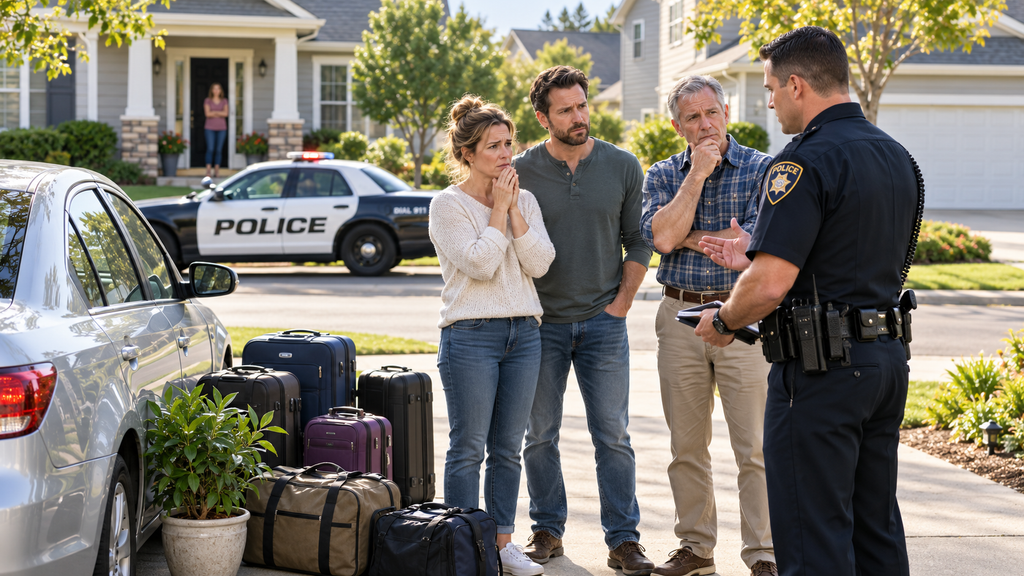
Not Diane crying beside the SUV. Not Lisa whispering under her breath. Not the distant sound of Officer Ruiz’s cruiser idling near the curb. Not even the wind moving through the trees.
All I could see were those four words.
Property.
Lien.
Final.
Notice.
They were ordinary words.
Words that belonged in bank letters and legal documents.
But standing there on my own front porch, staring at them on my husband’s phone, they felt like a threat written directly across my life.
I slowly lifted my eyes.
Mark was already looking at me.
And what I saw on his face told me everything I needed to know before he opened his mouth.
Fear.
Not confusion.
Not surprise.
Fear.
The kind of fear a person wears when the secret is no longer hidden.
I held out my hand.
“Give me the phone.”
He tightened his grip around it.
“Claire.”
“Give me the phone.”
“We should talk inside.”
“No.”
“Please.”
“No.”
I stepped closer.
“You stood outside this house and allowed your mother to call the police because I refused to let her move in.”
He looked away.
“You let her tell a police officer that this was your house.”
“Claire—”
“You let everyone stand here and treat me like I was some unreasonable woman trying to throw an old lady onto the street.”
My voice trembled.
“And the entire time, there was a lien against my property?”
“It isn’t exactly—”
I laughed.
The sound came out sharp and strange.
“Do not say ‘it isn’t exactly what it looks like.’”
Mark fell silent.
I pointed to the notification.
“How?”
He swallowed.
“How what?”
“How is there a lien attached to a house you do not own?”
Diane slowly lowered the small suitcase she was holding.
Lisa turned toward her brother.
Mark looked toward the street.
Toward the house.
Toward anywhere except me.
“How, Mark?”
He rubbed one hand over his face.
“I made some mistakes.”
“That is not an answer.”
“I’ve already told you I’m having financial problems.”
“A financial problem is missing a credit card payment.”
I pointed toward the phone.
“This is different.”
His jaw tightened.
“I was trying to fix it.”
“With my house?”
“It’s our home.”
“No.”
My answer came so quickly that even I was surprised by it.
“It is our home because we live here together.”
I pressed one hand against my chest.
“But legally, financially, and according to every document Officer Ruiz just looked at, it is my property.”
Mark’s eyes flashed.
“I’ve paid toward it.”
“You contributed to household expenses.”
“I paid part of the mortgage.”
“Sometimes.”
His face hardened.
“That doesn’t mean I have no rights.”
“I didn’t say you have no rights.”
I stepped closer.
“I asked you how there is a lien connected to property you cannot legally use as collateral.”
Silence.
Diane’s face changed.
It was subtle at first.
A flicker.
A hesitation.
Then she whispered, “Mark.”
He turned toward her.
“Don’t.”
That single word made my stomach drop.
I looked at Diane.
“What?”
She shook her head.
“Nothing.”
“What do you know?”
“Claire…”
“What do you know?”
Mark stepped between us.
“Leave my mother out of this.”
I stared at him.
“You brought your mother into this.”
He opened his mouth.
I didn’t let him speak.
“You told her she was moving into my office.”
I pointed toward the SUV.
“You let her pack her entire life into those suitcases.”
My finger moved toward the house.
“You told her I couldn’t stop you.”
Then I pointed toward the police cruiser.
“You allowed this situation to get so far that a police officer had to determine who actually owned the house.”
My voice dropped.
“So no, Mark. You do not get to tell me your mother is suddenly outside this.”
Diane started crying again.
Not loudly.
Quietly.
And somehow, that scared me more.
“What happened?” I asked her.
She shook her head.
“Ask him.”
“I am asking you.”
She looked at her son.
Mark’s face was pale.
“Mom.”
Diane’s mouth trembled.
“I’m sorry.”
“For what?”
“I thought you knew more than you did.”
My heartbeat thudded in my ears.
“Knew what?”
She looked down.
Then she said it.
“He used your name.”
The world seemed to tilt beneath my feet.
“What?”
Mark closed his eyes.
Diane covered her mouth.
Lisa stared at both of them.
“What does that mean?” Lisa asked.
Nobody answered her.
I didn’t look away from Diane.
“What do you mean, he used my name?”
She whispered, “On the paperwork.”
I turned toward my husband.
Slowly.
“What paperwork?”
“Claire.”
“What paperwork?”
He exhaled.
“It’s complicated.”
“No.”
I shook my head.
“It is suddenly very simple.”
I held out my hand again.
“Give me your phone.”
This time, he did.
His fingers loosened.
The phone dropped into my palm.
I opened the notification.
There was a preview.
A lender name.
A reference number.
Several missed messages.
And a warning that the account had moved into a final escalation process related to secured collateral.
My vision blurred.
Secured collateral.
My house.
I clicked farther.
The phone was locked behind his password.
Of course it was.
“Unlock it.”
He didn’t move.
“Mark.”
“Claire, I can explain without—”
“Unlock the phone.”
He hesitated.
Then entered the code.
The screen opened.
I scrolled.
Emails.
Bank messages.
Loan correspondence.
Not one.
Not two.
Dozens.
Some six months old.
Some older.
I opened the most recent.
Then another.
Then another.
My name appeared repeatedly.
Claire Bennett.
Applicant.
Co-guarantor.
Property owner.
My lungs stopped working properly.
“What is this?”
Mark stood motionless.
I looked at the bottom of one document.
There was my name.
And beneath it…
my signature.
Except I had never signed it.
My thumb froze against the screen.
I zoomed in.
I knew my own signature.
I had written it thousands of times.
On checks.
On legal documents.
On contracts.
On birthday cards.
On permission forms.
This one looked almost perfect.
Almost.
The first letter leaned too far forward.
The loop in my last name was slightly too tight.
The final stroke curved down instead of up.
Someone had practiced it.
Someone had copied me.
I stared at Mark.
“You forged my signature.”
He didn’t answer.
“You forged my signature.”
“Claire—”
“Yes or no?”
His eyes filled with tears.
That frightened me because I had never seen Mark cry when he had hurt me.
He cried when he was scared for himself.
“Yes.”
The word was barely audible.
Lisa gasped.
Diane lowered her head.
I stared at the man I had been married to for eleven years.
There are moments when betrayal arrives dramatically.
A lipstick mark.
A hotel receipt.
A message from another woman.
A confession screamed in an argument.
But this betrayal came through black letters on a glowing screen.
A copied signature.
A false application.
My name attached to a debt I knew nothing about.
And somehow that felt more intimate than infidelity.
He hadn’t just lied to me.
He had impersonated me.
He had taken the legal version of my voice and made it say yes when I had never even been asked.
“How many times?” I whispered.
He looked confused.
“How many times did you sign my name?”
“Claire…”
“How many?”
He rubbed his forehead.
“Three.”
I stared at him.
“Three?”
“One loan package and two refinancing applications.”
My stomach twisted.
“Refinancing?”
“I was trying to consolidate everything.”
“Everything?”
He said nothing.
“How much is everything?”
He had already given me a number earlier.
A number that had made my knees weak.
But suddenly I no longer trusted that number.
“Tell me the real amount.”
“That was the real amount.”
“All of it?”
He hesitated.
There it was.
“No.”
He looked down.
“How much, Mark?”
“It depends.”
“On what?”
“Interest.”
“Do not play with me.”
“I’m not.”
“How much debt do you have?”
He breathed out.
Then gave me the figure.
This time, Lisa actually said, “Jesus.”
Diane started crying harder.
I gripped the porch railing.
The number was nearly twice what he had admitted five minutes earlier.
I looked at him.
“You lied even after being caught.”
“I panicked.”
“You lied while Officer Ruiz was still standing here.”
“I didn’t know what to say.”
“The truth.”
My voice cracked.
“You say the truth.”
He wiped his face.
“I thought I could fix it.”
“When?”
“My business was supposed to recover.”
“It didn’t.”
“I know.”
“So you borrowed.”
“Yes.”
“And then borrowed again.”
“Yes.”
“And when nobody would lend you any more money in your own name…”
I looked down at the screen.
“You used mine.”
He didn’t answer.
I swallowed hard.
“How long?”
“Eight months.”
Eight months.
That number hurt worse than the debt.
Eight months meant birthdays.
Christmas.
Anniversary dinner.
Saturday mornings.
Family dinners.
Eight months of him asking whether I wanted coffee.
Eight months of him kissing me goodbye.
Eight months of him complaining about ordinary things.
Eight months of sleeping beside me while secretly gambling my future.
I whispered, “Eight months.”
He nodded.
I remembered one night in February.
He had come home late and seemed distracted.
I’d asked if something was wrong.
He’d wrapped his arms around me from behind while I was making pasta.
“Work stuff,” he’d said.
Then he kissed the side of my head.
“Nothing you need to worry about.”
Nothing I needed to worry about.
I almost laughed.
Instead, my eyes filled with tears.
“You looked me in the face.”
He frowned.
“What?”
“For eight months, you looked me in the face.”
“Claire…”
“You sat across from me at breakfast.”
I pointed toward the kitchen window behind him.
“You slept in our bedroom.”
My voice broke.
“You watched me pay the property tax.”
He closed his eyes.
“You watched me renew the homeowner’s insurance.”
“I know.”
“And all that time, you knew you had forged my name.”
“I was trying to protect us.”
“No.”
I shook my head.
“You were trying to protect yourself from having to tell me the truth.”
“It became bigger than I expected.”
“Debt doesn’t become bigger because your wife asks questions.”
“I was ashamed.”
“And your shame became my risk.”
He stepped toward me.
“I never thought they’d actually come after the house.”
I stared at him.
“You used a house as collateral and didn’t think they might come after the house?”
“I thought the business would generate enough—”
“To pay everything?”
“Yes.”
“Then why was your mother moving in?”
Silence.
Diane looked up.
That was when I knew we were only halfway through the truth.
I turned toward her.
“What was the plan?”
Mark said, “There wasn’t a plan.”
Diane whispered, “Yes, there was.”
He turned sharply.
“Mom.”
She shook her head.
“No.”
For the first time all afternoon, she looked angry at him.
Not at me.
At him.
“You’ve lied enough.”
Mark stared at her.
She wiped her face.
Then looked at me.
“He told me you were thinking of selling.”
“I wasn’t.”
“I know that now.”
“What did he tell you?”
“He said the debt had become serious.”
“How serious?”
“He said the bank could force the house issue.”
I looked at Mark.
“And?”
Diane continued.
“He told me there was one way to buy time.”
My skin prickled.
“What way?”
“If I lived here.”
I said nothing.
She took a shaky breath.
“He said having an elderly dependent resident in the property would complicate things.”
My eyes narrowed.
“He told you that?”
“Yes.”
“He wanted you to establish residency.”
“Yes.”
Lisa stared at Mark.
“You used Mom?”
Mark snapped, “That isn’t what I was doing.”
Lisa stepped toward him.
“She sold half her furniture!”
“I was giving her somewhere to live.”
“You told her she would be safe here.”
“She would have been.”
“Against Claire’s wishes?”
“I thought Claire would eventually understand.”
I laughed.
“Understand what?”
He looked at me helplessly.
“That I needed time.”
“So your plan was to move your mother into my house without asking me, let her establish residency, and then use that complication to delay whatever action was coming against the property?”
“It wasn’t that calculated.”
Diane shook her head.
“Yes, it was.”
Mark stared at her.
She continued.
“You told me not to sign a hotel lease.”
His face tightened.
“You told me once I got mail here, I would have rights.”
I felt cold.
Diane looked ashamed.
“I thought you were being selfish.”
She swallowed.
“I thought you knew about the debt and were refusing to help him.”
I closed my eyes.
Of course.
Of course Mark had created a version of events where I was the villain.
That explained the confidence Diane had arrived with.
The certainty.
The entitlement.
The way she kept calling it “Mark’s house.”
The way Lisa had looked at me like I was heartless.
He had spent months building a story around me that protected him.
I opened my eyes.
“What exactly did he tell you about me?”
Diane hesitated.
“Tell me.”
“He said you controlled the finances.”
“I manage the household accounts.”
“He said you wouldn’t let him access the equity.”
“That is because there was never a conversation about accessing the equity.”
“He said you were punishing him because the business had a bad year.”
I looked at Mark.
“A bad year?”
He stared at the ground.
Diane continued reluctantly.
“He said you cared more about keeping the house in your name than helping your husband.”
I inhaled slowly.
I had spent years thinking Diane resented me because she was possessive of her son.
Maybe some of that was true.
But now I realized she had been fed a steady diet of half-truths.
Every disagreement.
Every boundary.
Every question.
Mark had probably retold them with himself as the victim.
I looked at Lisa.
“What did he tell you?”
She crossed her arms.
“Pretty much the same.”
“Anything else?”
She hesitated.
“Lisa.”
“He said you had become obsessed with ownership after your father died.”
My throat tightened.
My father.
The house had been possible because of money my father left me.
Not all of it.
I had worked.
Saved.
Invested.
But my inheritance had formed most of the down payment.
My father had been careful about money his entire life.
He had once told me, after my first serious boyfriend broke my heart:
“Never confuse sharing your life with surrendering your independence.”
I thought he’d been old-fashioned.
Then when I bought the house, he insisted I have everything reviewed properly.
“Marriage is love,” he had said.
“Paperwork is paperwork. Respect both.”
Mark had laughed about it then.
“Your dad thinks I’m planning to steal the roof.”
I had kissed him.
“I know you wouldn’t.”
Now I wanted to sit on the floor and scream.
Instead, I looked at my husband and said, “You used my father’s death to make me sound greedy?”
He winced.
“I didn’t put it that way.”
“How did you put it?”
“I said you were emotionally attached to the house.”
“I am emotionally attached to the house.”
“That’s what I meant.”
“No.”
I shook my head.
“You meant that my attachment was the reason you couldn’t fix your problems.”
He said nothing.
“You turned my caution into cruelty.”
“Claire…”
“You turned my legal ownership into selfishness.”
“I was under pressure.”
“You turned my dead father into part of your excuse.”
“I never disrespected your father.”
“You forged his daughter’s signature to borrow against the house his money helped her buy.”
That shut him up.
Diane sat down on one of the suitcases.
Lisa covered her mouth.
For a few moments, nobody spoke.
Then I heard a car door.
Officer Ruiz was getting back out of his cruiser.
Maybe he had seen us arguing.
Maybe something in my face had worried him.
He approached slowly.
“Everything all right?”
I looked at him.
“No.”
Mark muttered, “Claire.”
I ignored him.
I held out the phone.
“I believe my husband forged my signature on documents connected to a loan secured against my property.”
Officer Ruiz’s expression changed immediately.
The casual family-dispute patience disappeared.
His posture straightened.
“Do you have the documents?”
“Some are on his phone.”
Mark stepped forward.
“Officer, this is a private financial matter.”
Ruiz looked at him.
“Sir, if a signature was forged on lending documents, that may not simply be a private financial matter.”
Mark went pale.
I asked, “What should I do?”
“First, preserve everything.”
He looked at the phone.
“Do not delete messages. Do not alter documents. Contact the lender immediately and tell them you dispute any signature you did not provide.”
“I will.”
“You should also contact an attorney.”
“I will.”
“And depending on what the lender confirms, you may want to make a formal report.”
Mark whispered, “Claire, please.”
Officer Ruiz glanced between us.
I handed the phone back to Mark.
“No.”
He stared at me.
“No what?”
“No more ‘please.’”
His face crumpled.
“I’m begging you.”
“For what?”
“To give me a chance to fix this.”
“You had eight months.”
“I know.”
“Eight months was your chance.”
“I can sell the business.”
“To pay back everything?”
“Some of it.”
“And the rest?”
“I’ll figure something out.”
I laughed quietly.
“That sentence is exactly how we got here.”
He looked wounded.
“I know I messed up.”
“No.”
I looked directly at him.
“You didn’t forget to pay a bill.”
My voice became steadier with each word.
“You forged my signature.”
He stared at me.
“You used property you did not own.”
His eyes dropped.
“You lied to lenders.”
His shoulders sagged.
“You lied to your mother.”
Diane started crying again.
“You lied to your sister.”
Lisa looked away.
“You lied to me every day for eight months.”
His lips parted.
“And when all of it started collapsing, your solution was to bring your mother into my house and create a legal complication so I would feel trapped.”
“I wasn’t trying to trap you.”
“Yes, you were.”
“No.”
“You told her I wouldn’t have a choice.”
Silence.
“You wanted me cornered.”
“I wanted time.”
“You wanted control.”
He shook his head.
“You already had control.”
I stepped closer.
“You controlled the information.”
He stared at me.
“You knew the debt.”
I pointed toward myself.
“I didn’t.”
“You knew the applications.”
“I didn’t.”
“You knew about the lien.”
“I didn’t.”
“You knew your mother was coming.”
“I didn’t.”
“You knew what story you had told everyone about me.”
My voice cracked.
“I didn’t.”
He looked like I’d slapped him.
“That is control, Mark.”
For the first time, I saw him understand it.
Not fully.
Maybe not permanently.
But enough that his expression changed.
His anger disappeared.
And shame took its place.
Officer Ruiz said quietly, “Mrs. Bennett, I recommend you secure your documents and speak to the lender before the end of the day if possible.”
I nodded.
“Thank you.”
He looked at Mark.
“Sir, I would strongly advise that you not attempt to move, destroy, or alter any financial records related to this matter.”
Mark swallowed.
“I understand.”
Ruiz returned to his cruiser.
This time, I watched until he drove away.
Then I looked at Diane.
“You cannot stay here.”
She nodded immediately.
“I know.”
There was no argument now.
No indignation.
No accusation.
Just exhaustion.
Lisa picked up two suitcases.
“I’ll take Mom to a hotel.”
Diane remained seated.
She looked up at me.
“Claire.”
I waited.
“I owe you an apology.”
I almost laughed.
Not because it was funny.
Because one apology could never carry the weight of that afternoon.
She seemed to understand.
“I know saying sorry doesn’t fix it.”
“No.”
“I should never have called the police.”
“No.”
“I should never have tried to force my way into your home.”
“No.”
“I thought…”
Her voice broke.
“I thought my son was being mistreated.”
I looked at Mark.
“So did he.”
Diane closed her eyes.
A tear slid down her cheek.
“He told me he was embarrassed because you controlled everything.”
“I controlled nothing about his business.”
“I know that now.”
She stood slowly.
“I believed him because he is my son.”
I nodded.
“I understand.”
She looked surprised.
Then I added, “But being someone’s mother doesn’t mean you stop questioning them.”
Her shoulders sagged.
“No.”
“It means sometimes you should question them first.”
She nodded.
Lisa helped her toward the SUV.
Before getting inside, Diane turned around.
“I really did sell my furniture.”
I felt something twist inside me.
The sentence was so small.
So human.
Despite everything, I felt sorry for her.
Not enough to change my decision.
But enough to see that Mark had not only betrayed me.
He had used his mother’s trust too.
“Go to the hotel,” I said quietly.
“Get some rest.”
She nodded.
“Thank you.”
Then they left.
Mark and I stood alone in the driveway.
The three empty spaces where the suitcases had been somehow looked like evidence.
He walked toward me.
I held up my hand.
“Don’t.”
He stopped.
“Where am I supposed to go?”
I stared at him.
For one absurd second, I almost laughed.
Three hours earlier his mother had asked me the same question.
Now he stood in front of the house he had nearly put at risk and asked where he was supposed to sleep.
“You can stay in the guest room tonight.”
His shoulders loosened.
“Thank you.”
“But only tonight.”
He froze.
“What does that mean?”
“It means tomorrow you begin making arrangements.”
“Claire.”
“It means I am speaking to a lawyer.”
His face drained.
“About the loan?”
“About everything.”
He stared at me.
“You’re not seriously talking about divorce.”
I didn’t answer.
“Claire.”
“You forged my signature.”
“I know.”
“You tried to use my home without my permission.”
“I know.”
“You lied to me for eight months.”
“I know.”
“What exactly do you think marriage is after that?”
He sat down hard on the porch step.
I watched him put his face in his hands.
He looked broken.
And the horrible part was that I still loved him.
Not the man standing in front of me.
But the man I thought he was.
The man who brought me soup when I was sick.
The man who held my hand at my father’s funeral.
The man who danced badly in the kitchen.
The man who painted our bedroom twice because I hated the first shade.
The man I believed had been beside me.
I missed him suddenly.
So fiercely that my throat closed.
Then I realized something worse.
Maybe that man had been real.
People aren’t divided cleanly into good and evil.
Mark could have loved me.
He could have cared for me.
He could have shared real laughter and real tenderness with me.
And he could still have done this.
That made it harder.
Because betrayal is easier when you can erase the person entirely.
But I couldn’t.
Eleven years had happened.
Love had happened.
And so had fraud.
Both were true.
I looked at him.
“Go inside.”
He wiped his face.
“Can we talk tonight?”
“No.”
“Tomorrow?”
“I don’t know.”
“Claire, please don’t decide everything while you’re angry.”
I stared at him.
“I’m not angry enough yet.”
He looked confused.
“I’m still in shock.”
Then I walked past him.
Into my house.
And locked myself in my office.
The office his mother was supposed to sleep in.
The office Mark had decided I could give up.
I pulled open the bottom drawer of the filing cabinet.
The property folder was still there.
I spread every document across the desk.
Deed.
Mortgage.
Tax records.
Insurance policies.
Closing statement.
Then I opened my laptop.
I called the lender.
The first representative transferred me.
The second transferred me again.
Eventually, a woman from the fraud department came on the line.
Her name was Melissa.
I will remember her voice for the rest of my life.
Calm.
Professional.
Kind without being pitying.
I explained everything.
The forged signature.
The lien notice.
My sole ownership.
The unauthorized application.
There was a pause.
Then she said, “Mrs. Bennett, I’m placing an immediate fraud alert on the account.”
My hands started trembling.
“Can they take my house?”
“I cannot make a final legal determination over the phone.”
My stomach dropped.
“But if you did not authorize the documents, there are dispute procedures.”
She asked me to verify several details.
Then she said something that made the room go cold.
“There appear to be multiple submissions associated with your name.”
I gripped the phone.
“What do you mean?”
“I’m seeing three separate applications.”
I closed my eyes.
Mark had admitted three.
At least that part had been true.
“One was approved?”
“One appears to have progressed farther than the others.”
“And the others?”
“Rejected.”
“Why?”
“I cannot discuss every underwriting note at this stage.”
“Were they also signed?”
A pause.
“Yes.”
My throat burned.
“Can you send them to me?”
“We can provide copies through the fraud process.”
“I need them.”
“I understand.”
I looked at my own signature on the mortgage paperwork from years earlier.
“Can you freeze everything?”
“We can flag disputed activity immediately.”
“Do it.”
“I’m doing that now.”
After the call, I sat completely still.
The house was silent.
Then I heard footsteps outside the office.
A gentle knock.
“Claire?”
Mark.
I didn’t answer.
“Claire, I know you don’t want to talk.”
Silence.
“I’m sorry.”
I stared at the door.
Those words used to matter.
I’m sorry.
Such an easy phrase.
Two words capable of meaning everything when spoken after an accident.
And almost nothing when spoken after a choice repeated for eight months.
He continued.
“I never wanted to hurt you.”
I closed my eyes.
That sentence angered me more than anything else he had said.
I opened the door.
He stepped back.
“I need you to stop saying that.”
“What?”
“That you never wanted to hurt me.”
His face tightened.
“It’s true.”
“No, it isn’t.”
“I swear.”
“You may not have wanted to watch me suffer.”
“That’s what I mean.”
“That is not the same thing.”
He stared at me.
“You wanted money.”
He looked down.
“You wanted time.”
His shoulders sagged.
“You wanted to save your business.”
He nodded faintly.
“And every time those things conflicted with my right to know what was happening…”
I swallowed.
“You chose what you wanted.”
“Claire…”
“So maybe you didn’t wake up every morning thinking, ‘How can I hurt my wife?’”
His eyes filled.
“But you were willing to hurt me if that was the cost of avoiding consequences.”
He looked shattered.
I almost hated myself for noticing.
“I love you,” he whispered.
I leaned against the doorframe.
“I believe you.”
His head lifted.
Hope appeared on his face.
I killed it immediately.
“That makes this worse.”
His mouth opened.
“Because if you did this while loving me…”
My voice broke.
“…then what exactly was your love protecting?”
He had no answer.
I closed the door.
The next morning, I woke before sunrise.
I had barely slept.
Mark had left a note on the kitchen table.
I’m going to the office. I’ll be back at noon. Please don’t do anything until we talk.
I read it twice.
Then tore it in half.
Not because I was being dramatic.
Because even in his apology, he was still trying to manage me.
Please don’t do anything.
As if I needed his permission to protect myself.
I called a lawyer at 8:03.
Her name was Rachel Stein.
By 9:30, I was sitting in her office with a folder on my lap and my entire marriage suddenly reduced to documents.
Rachel was probably in her late forties.
Dark hair.
Sharp eyes.
The kind of person who listened without interrupting.
I told her everything.
The debt.
Diane arriving.
The police.
The deed.
The forged documents.
The attempt to establish Diane in the house.
When I finished, Rachel sat back.
“Did you sign any authorization allowing your husband to pledge the property?”
“No.”
“Power of attorney?”
“No.”
“Did you authorize him to sign on your behalf?”
“Never.”
“Did you know about the loan?”
“No.”
“Did you benefit from the proceeds?”
“I don’t know.”
She raised an eyebrow.
“I mean, if he put money into household expenses, maybe indirectly, but I never knowingly received loan proceeds.”
“That distinction matters.”
She made notes.
“Do you have copies of everything?”
“Not yet.”
“We’ll get them.”
She looked directly at me.
“And Claire, change every financial password you have.”
I nodded.
“Banking.”
“Yes.”
“Email.”
“Yes.”
“Credit accounts.”
“Yes.”
“Tax portal.”
My stomach twisted.
“Yes.”
“Pull your credit reports.”
“I will.”
“Freeze your credit temporarily.”
I stared at her.
“You think he could have opened accounts in my name?”
“I think someone who forged your signature multiple times has already crossed a line you previously believed he wouldn’t cross.”
That sentence stayed with me.
A line you previously believed he wouldn’t cross.
How many marriages survive because both people share an invisible map of lines they assume the other person will never cross?
Mark had redrawn ours without telling me.
Rachel tapped the folder.
“What do you want?”
I stared at her.
“I don’t know.”
“That’s okay.”
“I mean legally?”
“Yes.”
I looked down at my hands.
“I want my house protected.”
“Good.”
“I want my name removed from anything I didn’t authorize.”
“Good.”
“I want to know exactly what he did.”
“Very good.”
Then she waited.
“And your marriage?”
I felt tears rise.
“I don’t know.”
For the first time since Diane’s SUV pulled into the driveway, I let myself cry.
Not loudly.
Not dramatically.
I covered my face and cried because eleven years is too long to erase in one afternoon.
Rachel pushed a box of tissues across the desk.
“I don’t have to decide today?”
“No.”
“What if I still love him?”
“That’s not a legal problem.”
A broken laugh escaped me.
She smiled faintly.
“You can love someone and still protect yourself from them.”
I looked at her.
“You can also leave someone you love.”
I cried harder.
“And you can stay, if staying is safe and what you genuinely choose.”
She paused.
“But before you make that decision, you need facts.”
Facts.
That word steadied me.
I wiped my face.
“Then get me facts.”
Rachel nodded.
“That I can do.”
By Monday afternoon, the first set of documents arrived.
I opened them at my desk.
The first refinancing application had been submitted eight months earlier.
My name was listed as co-applicant.
Income details.
Employer information.
Assets.
All accurate.
Which meant Mark had used information from our tax returns.
My stomach turned.
The signature was fake.
The second application came three months later.
Rejected.
The third came six weeks after that.
Different lender.
Different paperwork.
Another signature.
Each one slightly different.
Each one trying to become me.
But buried in the documentation was something else.
An email from Mark.
My wife is hesitant because she inherited the property and is sentimental about keeping it separate, but she has agreed in principle.
I stared at that sentence for nearly a minute.
Agreed in principle.
I had never agreed to anything.
Another email:
She is traveling for work, so I am helping coordinate signatures.
I had not been traveling.
Another:
Claire prefers not to be directly involved in financial discussions.
I laughed out loud.
A dry, ugly laugh.
He had not only forged my signature.
He had forged my personality.
He created a version of me who conveniently didn’t ask questions.
A silent Claire.
A cooperative Claire.
A Claire who agreed in principle.
A Claire who trusted Mark to handle everything.
A Claire who existed only because the real one would have said no.
I printed every page.
When Mark came home that evening, I was waiting at the kitchen table.
He stopped in the doorway.
“Hi.”
I said nothing.
His eyes fell to the papers.
“What’s that?”
“You tell me.”
He came closer.
I slid the first email across the table.
He read it.
His face changed.
“Claire…”
“Read it out loud.”
“What?”
“Read what you wrote.”
He shook his head.
“I know what it says.”
“I want to hear you say it.”
He swallowed.
Then read softly, “My wife is hesitant because she inherited the property and is sentimental about keeping it separate, but she has agreed in principle.”
I looked at him.
“When did I agree?”
“You didn’t.”
“Then why did you write that?”
“I needed them to keep the application open.”
“Read the next one.”
He looked at the page.
“Claire.”
“Read it.”
“She is traveling for work, so I am helping coordinate signatures.”
“Where was I?”
He closed his eyes.
“Home.”
“Read the last one.”
He did.
“Claire prefers not to be directly involved in financial discussions.”
I leaned back.
“I manage our taxes.”
“I know.”
“I compare insurance policies.”
“I know.”
“I negotiated the original mortgage.”
“I know.”
“I review every major purchase over a thousand dollars.”
“I know.”
“And you told a lender I preferred not to be involved in financial discussions?”
“I was trying to keep them from calling you.”
There it was.
The truth.
Not to protect me.
To prevent discovery.
I nodded.
“Thank you.”
He looked confused.
“For what?”
“For finally saying it correctly.”
He sat opposite me.
“I was afraid.”
“You keep saying that.”
“Because it’s true.”
“I know.”
His eyes lifted.
“I know you were afraid.”
I took a breath.
“But fear explains behavior.”
My voice softened.
“It doesn’t excuse it.”
He started crying.
“I don’t want to lose you.”
I looked at the man I had once thought I would grow old beside.
“You should have thought about losing me every time you signed my name.”
He covered his face.
For a moment, I almost reached across the table.
My body remembered comforting him.
Eleven years of muscle memory.
But I didn’t.
That was one of the hardest things I have ever done.
He eventually whispered, “I’ll do anything.”
I looked at him.
“Anything?”
“Yes.”
“Give me full access to every account.”
He hesitated.
Just for half a second.
But I saw it.
My heart sank.
“Every account, Mark.”
“Yes.”
“Business.”
“Yes.”
“Personal.”
“Yes.”
“Credit cards.”
He nodded.
“Loans.”
“Yes.”
“Everything.”
“I said yes.”
“Then give me the passwords.”
“I will.”
“Now.”
He stared at me.
Then pulled out his phone.
That night, the truth became worse.
There were accounts I had never known about.
Business credit lines.
Personal credit cards.
Short-term loans.
Cash advances.
A private loan from one of his friends.
Money borrowed from Diane.
That shocked me.
“You borrowed from your mother?”
He looked ashamed.
“Thirty-five thousand.”
I stared at him.
“She sold her furniture because she thought she needed to move in with us.”
“I know.”
“You owed her money?”
“Yes.”
“Did she know that was part of the reason you wanted her here?”
“No.”
I sat back.
I almost felt dizzy.
“So you told your mother she could live here…”
He nodded.
“…while owing her thirty-five thousand dollars…”
Another nod.
“…and used her fear of homelessness to pressure me?”
His face crumpled.
“When you say it like that—”
“How else should I say it?”
He had no answer.
Three days later, Rachel called.
“The lender has frozen enforcement related to the disputed signature while they investigate.”
I gripped the phone.
“Does that mean the house is safe?”
“For now, it means no immediate action should proceed under the disputed instrument.”
I closed my eyes.
“Thank God.”
“But there’s more.”
My stomach tightened again.
“What?”
“The lender wants handwriting analysis and a formal affidavit from you.”
“I’ll do it.”
“They may also refer the matter to law enforcement.”
I looked through the kitchen window.
Mark was in the backyard.
Standing near the fence.
Talking on the phone.
He looked older.
Tired.
Small.
“What happens to him?”
“That depends on the investigation.”
I swallowed.
“Do I have a choice?”
“About whether a private lender reports suspected fraud? Not necessarily.”
I closed my eyes.
“I see.”
“Claire.”
“Yes?”
“You did not create this situation.”
I stared at Mark through the glass.
“I know.”
But I wasn’t sure I believed it emotionally yet.
Logically, yes.
Emotionally, I still carried the reflex of marriage.
The instinct that his disaster was somehow ours.
His shame.
Our shame.
His debt.
Our debt.
His mistake.
Our problem.
Except some things stop being shared when one person removes the other’s consent.
That evening, I told Mark he needed to move out.
He stared at me from across the bedroom.
“For how long?”
“I don’t know.”
“You said you hadn’t decided about divorce.”
“I haven’t.”
“Then why do I have to leave?”
“Because I don’t feel safe living with you right now.”
His face changed.
“I would never hurt you.”
“You already have.”
“Physically.”
“Do you think physical harm is the only kind that counts?”
“No.”
“Then don’t make that distinction.”
He sat on the edge of the bed.
“Where will I go?”
“Hotel.”
“I can’t afford a hotel.”
“Stay with Lisa.”
“She’s furious with me.”
I said nothing.
“My mom?”
“She is in temporary housing because of you.”
He flinched.
“Claire.”
“What?”
“Do you want me homeless?”
I stared at him.
There was the old trick.
Maybe he didn’t even realize he was doing it.
Turning a consequence into my cruelty.
I walked toward him.
“I am not making you homeless.”
He looked away.
“I am telling you that you cannot stay in my house while I investigate how many times you used my identity without permission.”
He rubbed his eyes.
“I’m your husband.”
“And I am your wife.”
My voice shook.
“You should have remembered that before you turned me into collateral.”
The next morning, he packed two suitcases.
No police.
No screaming.
No dramatic scene.
Just the soft sounds of drawers opening.
Closet hangers moving.
A zipper closing.
I stood in the hallway while he carried the bags downstairs.
At the door, he turned.
“I love you.”
Tears filled my eyes.
“I know.”
“I know that sounds meaningless now.”
“It doesn’t sound meaningless.”
He looked surprised.
“It sounds tragic.”
His face broke.
I continued.
“Because I think you do love me.”
He stepped closer.
“And that still wasn’t enough to make you tell me the truth.”
He started crying.
“Can I hug you?”
I wanted to say yes.
God, I wanted to.
But I shook my head.
“No.”
He nodded.
Then walked away.
The door closed.
I leaned against it.
And cried until my legs gave out.
I sat on the floor of the entryway in the house everyone had been fighting over and felt completely empty.
For years, I thought strength would feel powerful.
It didn’t.
Strength felt like telling the person you loved to leave while every part of you wanted them to become someone safe enough to stay.
The investigation continued.
Handwriting analysis confirmed what I already knew.
The signatures were not mine.
The lender interviewed me.
Then Mark.
Then the broker.
I learned there had been irregularities in the application process.
Documents submitted electronically.
Statements Mark provided.
Representations that I had approved everything.
The lien was challenged.
Then suspended.
Then eventually released.
The day Rachel called me with the final confirmation, I was standing in the supermarket staring at tomatoes.
“Claire?”
“Yes.”
“It’s done.”
I gripped the cart.
“What’s done?”
“The disputed lien has been removed.”
I closed my eyes.
People moved around me.
A child complained about cereal.
A cart squeaked.
Somebody laughed two aisles over.
Normal life continued while mine shifted again.
“The house is clear?”
“The fraudulent instrument is no longer attached to the property.”
I put one hand over my mouth.
Tears came immediately.
“Thank you.”
“You did the hard part.”
“No.”
I laughed through tears.
“You did a lot of it.”
“I filed paperwork.”
Her voice softened.
“You were the one who finally refused to stay quiet.”
After the call, I stood in the produce section crying beside a display of tomatoes.
An older woman asked if I was all right.
I nodded.
“Yes.”
Then I laughed.
“I think I am.”
The financial consequences for Mark were serious.
His business collapsed within two months.
One major client left.
Then another.
The lenders pursued him personally.
His credit was destroyed.
There were legal consequences associated with the forged documentation.
I won’t pretend I enjoyed watching it happen.
I didn’t.
Revenge sounds satisfying when you imagine it from a distance.
But when the person facing consequences is someone whose face you know in sleep, it feels different.
I didn’t celebrate.
I didn’t post about it.
I didn’t send messages saying he deserved it.
I simply stopped protecting him from the results of his own decisions.
That was enough.
Diane called me six weeks after the day she arrived with three suitcases.
I almost didn’t answer.
Then I did.
“Hello?”
“Claire.”
Her voice sounded smaller than I remembered.
“Hi, Diane.”
There was a pause.
“I wanted to apologize again.”
“You already did.”
“I know.”
Another pause.
“This one is different.”
I sat down.
“Okay.”
She exhaled.
“I’ve been thinking about what you said.”
“What did I say?”
“That loving someone doesn’t mean defending everything they do.”
I waited.
“I spent Mark’s whole life making excuses for him.”
I looked toward the window.
Diane continued.
“When he was twelve and broke a neighbor’s window, I blamed the other boys.”
I almost smiled sadly.
“When he failed a college course, I told everyone the professor had it out for him.”
She gave a humorless laugh.
“When his first business failed, I said his partner ruined it.”
Her voice trembled.
“And when he told me you were controlling him…”
I closed my eyes.
“I believed him.”
“I know.”
“I wanted to believe him.”
That difference mattered.
She cried quietly.
“Because if I believed him, then he was still the boy I could protect.”
I swallowed.
“He’s not a boy.”
“No.”
“He hasn’t been for a long time.”
“No.”
“I think I knew that.”
She sniffed.
“I just didn’t know how to stop being his mother in the way I had always been his mother.”
I thought about that.
“You don’t have to stop being his mother.”
“I know.”
“You just have to stop being his shield.”
She was silent.
Then whispered, “Yes.”
I asked, “Where are you staying?”
“A small apartment.”
“Are you okay?”
“Yes.”
I believed her.
For the first time, our conversation did not feel like a negotiation.
She wasn’t asking for my house.
I wasn’t defending myself.
We were simply two women who had loved the same man in different ways and been manipulated by him in different ways.
Before we hung up, she said, “I was awful to you.”
I closed my eyes.
“You were.”
She laughed weakly through tears.
“I suppose I deserved that.”
“I’m not saying it to punish you.”
“I know.”
“I just don’t want to pretend.”
“Neither do I.”
“Then maybe that is where we start.”
She was quiet.
“Start what?”
“I don’t know.”
I looked around my kitchen.
“Something more honest than what we had.”
She cried again.
“So you don’t hate me?”
I thought carefully.
“No.”
“Do you forgive me?”
That question was harder.
“Not yet.”
She inhaled sharply.
“But maybe one day.”
“Thank you.”
“Don’t thank me yet.”
A small laugh.
“All right.”
Three months after Mark moved out, I filed for divorce.
Not because I had stopped loving him.
That would have been easier.
I filed because love had stopped being enough.
Trust had become something I could no longer rebuild while remaining legally bound to the person who had used my identity.
He did not fight me.
Maybe because he was exhausted.
Maybe because the legal advice he received made it clear fighting over the house would be pointless.
Maybe because some part of him finally understood.
We met in a conference room with our lawyers.
It was the first time I had seen him in almost a month.
He looked thinner.
There were gray strands at his temples I didn’t remember.
When he saw me, his eyes filled.
“Hi.”
“Hi.”
That was all.
Eleven years of marriage.
And our final formal negotiation began with one word each.
The divorce itself was less dramatic than our marriage’s collapse.
Numbers.
Accounts.
Furniture.
A car.
Retirement funds.
Debts.
My house remained mine.
The fraud-related debt remained his.
At one point, Mark asked to speak privately.
Rachel looked at me.
I nodded.
We stepped into the hallway.
He leaned against the wall.
“I’m sorry.”
I almost smiled.
“You’ve said that a lot.”
“I know.”
He looked at his hands.
“I’m trying to understand why I did it.”
“Do you?”
“A little.”
I waited.
“I think I kept believing the next loan would fix the previous one.”
I nodded.
“And once I lied to you once, telling the truth got harder.”
“That happens.”
“I kept thinking if I solved it before you found out, then maybe the lie wouldn’t matter.”
I looked at him.
“But you didn’t solve it.”
“No.”
“And it did matter.”
“Yes.”
He wiped his eyes.
“I blamed you because I couldn’t stand blaming myself.”
That was the first thing he had said that sounded like true accountability.
I stayed silent.
“I told Mom you were controlling.”
He swallowed.
“I told Lisa you cared more about the house than me.”
My throat tightened.
“I told lenders you agreed.”
He looked up.
“And every version made me look less guilty.”
I nodded.
“Yes.”
“I’m sorry.”
This time, I believed he understood the words.
That did not mean reconciliation.
Understanding arrived too late for that.
He took a shaky breath.
“Do you think you’ll ever forgive me?”
I looked at him for a long moment.
“Probably.”
Hope appeared in his eyes.
I continued.
“But forgiveness isn’t the same as coming back.”
The hope disappeared.
He nodded.
“I know.”
“I hope you really do.”
He looked toward the conference room door.
“I loved our life.”
“So did I.”
“I ruined it.”
I didn’t rescue him from that sentence.
For once, I let him carry his own truth.
“Yes.”
He closed his eyes.
A tear slid down his cheek.
Then he whispered, “I’m sorry.”
And I said, “I know.”
We went back inside.
The divorce became final the following spring.
The morning the paperwork arrived, I sat at my kitchen table with a cup of coffee.
I expected to feel free.
Instead, I felt sad.
Then relieved.
Then guilty for feeling relieved.
Then angry at myself for feeling guilty.
Healing, I learned, is not a clean road.
It loops.
One day you feel powerful.
The next day a song in a grocery store makes you cry.
One week you don’t think about him at all.
The next week you find one of his old T-shirts behind the dryer and sit on the laundry-room floor holding it like a widow.
Except he wasn’t dead.
The marriage was.
There is a strange grief in mourning someone who still exists.
I went to therapy.
At first, I talked almost entirely about Mark.
What he did.
Why he did it.
Whether he meant to hurt me.
Whether he ever loved me.
Eventually, my therapist asked,
“When do you think the story gets to become about you?”
I stared at her.
“I am talking about me.”
“No.”
She smiled gently.
“You are talking about what happened to you.”
That question stayed with me.
When does the story become about you?
So I started paying attention to my own life.
I repainted the guest room.
Not because Mark had slept there.
Because I wanted something different.
I bought a ridiculous yellow chair that he would have hated.
I put it by the bedroom window.
I turned the office into exactly what I wanted.
New shelves.
A reading lamp.
Plants I kept forgetting to water.
I replaced the dining-room light fixture Mark had loved and I had always secretly disliked.
The first time I turned on the new one, I laughed.
It was such a tiny thing.
But tiny decisions felt enormous after years of compromise.
I changed the locks.
Not because I thought Mark would come back.
Because I wanted to hear the click and know that the boundary was mine.
The first night after the locks were changed, I stood inside the front door with my hand on the deadbolt.
Click.
Safe.
Not because walls make people safe.
Not because legal documents make people safe.
But because I had finally stopped letting guilt make decisions for me.
Diane visited once.
Months after everything.
She called first.
That mattered.
“Would it be all right if I came by?”
I almost said no.
Then I said yes.
She arrived with one handbag.
No suitcases.
I noticed.
She noticed me noticing.
We both laughed awkwardly.
“I learned my lesson,” she said.
I smiled.
“So did I.”
She stood on the porch.
“May I come in?”
That question meant more than she knew.
I stepped aside.
“Yes.”
We had coffee at the kitchen table.
For the first twenty minutes, we talked about ordinary things.
Weather.
Her apartment.
Lisa’s children.
Then Diane looked around.
“You changed the light.”
“Yes.”
“I like it.”
“Mark hated this style.”
She gave a sad smile.
“That sounds like Mark.”
Silence settled.
Then she looked at me.
“I miss him.”
I blinked.
“You still see him.”
“Yes.”
“But I miss who I thought he was.”
My throat tightened.
“So do I.”
She nodded.
Maybe that was the first moment I truly forgave her.
Not completely.
But enough.
Because she finally understood that betrayal does not only destroy relationships.
It destroys versions of people.
The son she thought she raised.
The husband I thought I married.
The family Lisa thought she had.
All of us had to rebuild our understanding from the wreckage.
Diane took a folded paper from her handbag.
“What’s that?”
“A repayment schedule.”
I frowned.
“For what?”
“The money Mark borrowed from me.”
“You don’t need to show me that.”
“I know.”
She placed it on the table anyway.
“I made him sign it.”
I stared at her.
Then laughed.
She smiled.
“Look at me.”
“Yes.”
“Reading contracts.”
“My father would approve.”
Her face softened.
“I wish I’d met him.”
I looked at the house around us.
“In a way, you did.”
A year after the 911 call, I was sitting at the same kitchen table when the doorbell rang.
For a second, my body reacted before my mind did.
My chest tightened.
My shoulders stiffened.
Memory.
Then I reminded myself:
My house.
My door.
My choice.
I walked to the entryway and looked through the glass.
Officer Ruiz stood outside.
I opened the door.
He smiled.
“Mrs. Bennett.”
“Claire is fine.”
“Claire.”
He held an envelope.
“I’m sorry to show up unexpectedly.”
“That sentence gives me trauma now.”
He laughed.
“Fair.”
“What is it?”
“Your attorney asked that this final confirmation be delivered. It was routed through the department because of the report.”
I took the envelope.
Inside was a final release document.
The disputed lien had been formally cleared from every relevant record.
No pending claim.
No security interest based on the forged documents.
Nothing.
My house was mine.
Legally clean.
I stared at the paper.
Officer Ruiz said, “Good news?”
I nodded.
“Very.”
He smiled.
“I remember the first day.”
“So do I.”
“Your mother-in-law was determined.”
I laughed.
“That is one word.”
He smiled again.
Then his expression softened.
“You handled a difficult situation well.”
I shook my head.
“I don’t think I did.”
“No?”
“I was terrified.”
“That doesn’t mean you handled it badly.”
I looked at the document.
“I almost let guilt make me say yes.”
“To her moving in?”
“Yes.”
“Why didn’t you?”
I thought about it.
“Because something felt wrong.”
He nodded.
“Good instinct.”
“No.”
I looked back at the house.
“I think it was a boundary.”
He waited.
“I had spent years explaining myself whenever I said no.”
My throat tightened.
“That day I finally got tired of explaining.”
Officer Ruiz nodded slowly.
“Sometimes no is enough.”
I smiled.
“Yes.”
He started walking away.
Then stopped.
“Claire?”
“Yes?”
“Take care of the house.”
I looked at him.
Then at the porch.
The windows.
The front steps.
The trees.
Everything that had once felt like the center of a war.
“I will.”
After he left, I stood outside for a long time.
That first afternoon came back to me in pieces.
Diane’s suitcases.
Lisa’s accusing expression.
Mark saying it was his house.
The police cruiser.
Officer Ruiz asking for documentation.
My hands opening the filing cabinet.
The deed.
The silence after everyone saw my name.
At the time, I thought the most important revelation was that I owned the house.
I was wrong.
The deed was only paper.
Important paper.
Life-changing paper.
But paper.
The real revelation was everything that came after.
I learned that saying no does not make you cruel.
I learned that sympathy does not require surrender.
I learned that love without honesty can become another form of manipulation.
I learned that fear can explain terrible decisions without excusing them.
I learned that protecting someone from consequences is not always kindness.
Sometimes it is participation.
I learned that people can love you and still hurt you.
And that their love does not create an obligation for you to remain available for more harm.
Most of all, I learned something my father had tried to teach me years ago.
You should be able to share your life without surrendering ownership of yourself.
For years, I thought independence inside marriage meant having separate bank accounts.
A deed.
A career.
A savings account.
Those things matter.
But independence is also quieter.
It is the ability to ask questions without being called difficult.
It is the ability to say no without being punished.
It is the ability to change your mind.
It is the ability to insist that decisions affecting your life include your voice.
It is the ability to leave a room where everyone has agreed you are unreasonable and still trust what you know.
I closed the front door.
Locked it.
Then walked into the kitchen.
The afternoon sun stretched across the floor.
My coffee from that morning was still sitting on the table.
Cold.
I poured it out.
Made a fresh cup.
Then sat down.
My phone buzzed.
For one stupid second, my heart jumped.
Old reflex.
Mark.
But it wasn’t him.
It was Diane.
A message.
I heard the lien is officially gone.
I stared at the screen.
Another message appeared.
I’m glad.
Then a third.
And Claire… I’m proud of you.
My eyes filled.
There was a time when those words from Diane would have made me angry.
Proud of me?
After everything?
But now they felt different.
Maybe because she wasn’t claiming a role in my victory.
She was simply witnessing it.
I typed slowly.
Thank you.
Then stopped.
Deleted it.
Tried again.
Thank you. I’m proud of me too.
I stared at the message before pressing send.
Those words felt unfamiliar.
I’m proud of me.
Not proud because I saved the marriage.
I didn’t.
Not proud because I defeated Mark.
That had never been the goal.
Not proud because I kept the house.
Though I had.
I was proud because when the truth became unbearable, I did not look away.
I was proud because I stopped confusing endurance with loyalty.
I was proud because I stopped confusing silence with peace.
I was proud because I had finally understood that boundaries are not punishments.
They are information.
This is where I end.
This is what I will accept.
This is what I will not.
A few minutes later, Diane responded with a heart.
I smiled.
Then another notification appeared.
Mark.
I stared at his name.
We had not spoken in several weeks.
My thumb hovered over the screen.
Then I opened it.
Rachel told me the lien release is final. I’m glad.
I read it once.
Then again.
Another message appeared.
I know I don’t deserve an answer, but I wanted to say I’m sorry one more time. I’m doing the work.
I closed my eyes.
Doing the work.
Therapy, according to Diane.
Debt restructuring.
A job after the business collapse.
Slowly repaying his mother.
Maybe becoming someone better.
I genuinely hoped he did.
Not for me.
For himself.
For whoever he became after our marriage.
I typed:
I hope you keep doing it.
He responded almost immediately.
I will.
Then:
Do you ever miss us?
That question hurt.
Because the answer was yes.
I could have ignored it.
But I had spent enough time surrounded by lies.
So I wrote the truth.
Sometimes.
Three dots appeared.
Disappeared.
Appeared again.
Finally:
Me too.
I swallowed.
Then another message.
I wish I could go back.
I looked around the kitchen.
The new light.
The yellow chair visible through the hallway.
The quiet.
The house.
My life.
I typed:
I don’t.
Three dots.
Then nothing.
A minute passed.
Then his reply came.
I understand.
And I realized he finally did.
Not because he wanted to.
Because there was nothing left to manipulate.
No crisis to hide.
No property to leverage.
No mother to move in.
No story to rewrite.
Just two people standing on opposite sides of a truth.
I put the phone face down.
Outside, someone was mowing a lawn.
A dog barked.
A delivery truck stopped across the street.
Ordinary afternoon sounds.
I loved them.
There had been a time when quiet made me nervous.
When silence meant Mark might be hiding something.
When an unexpected car in the driveway made my stomach twist.
When a phone notification felt like a threat.
Now quiet was just quiet.
My home no longer felt like evidence.
It felt like home.
I carried my coffee onto the back patio.
The sky was turning gold.
I sat in the chair near the garden and remembered my father.
He had stood in this backyard once, not long after we bought the house.
Mark was inside assembling shelves.
Badly.
Dad had looked around and said, “You did well.”
I’d laughed.
“We did well.”
He gave me that look fathers give daughters when they know more than they are saying.
“You did well.”
At the time, I thought he was talking about the purchase.
Maybe he was.
Maybe he wasn’t.
I looked up at the darkening sky.
“I kept it, Dad.”
The words came out softly.
Then I shook my head.
“No.”
A smile spread across my face.
“I kept me.”
That was the real inheritance.
Not the money.
Not the deed.
Not the house.
The lesson.
A home should be a place where your no matters.
A marriage should be a place where your name cannot be used without your voice.
Love should never require you to pretend betrayal did not happen simply because the person who betrayed you is scared of the consequences.
And family does not get automatic permission to cross every boundary simply because they are family.
I stayed outside until the light disappeared.
Then I went inside.
Before bed, I passed my office.
The door was open.
For a second I remembered Diane saying,
“You don’t need that room.”
I smiled.
Then walked inside.
My books lined the shelves.
My laptop sat on the desk.
The property folder rested in the filing cabinet.
I pulled it out one last time.
Opened it.
The deed was on top.
Claire Bennett — Sole Owner.
A year earlier, those words had saved me.
But now they felt smaller somehow.
Because I finally understood ownership differently.
Yes, I owned the house.
But more importantly, I owned my decisions.
My boundaries.
My mistakes.
My future.
My yes.
And my no.
Nobody could forge those again.
I returned the deed to the folder.
Closed the drawer.
Turned off the light.
And walked upstairs.
My bedroom looked completely different now.
Different bedding.
Different paint.
The ridiculous yellow chair.
Photographs of places I had traveled since the divorce.
One picture from the coast.
Another from a weekend with friends.
One photograph of me and Diane at Lisa’s daughter’s graduation.
We had become something like family again.
Not the old kind.
The honest kind.
We didn’t pretend.
She never called the house Mark’s.
She never arrived uninvited.
And I never used forgiveness as an excuse to erase what happened.
The relationship survived because the boundaries did.
Funny how that works.
I changed into pajamas and climbed into bed.
Before turning off the lamp, I checked the security app.
Doors locked.
Windows secure.
Everything quiet.
Then I smiled at myself.
There had once been a woman standing on this same property while her husband, mother-in-law, sister-in-law, and a police officer waited for her to prove she belonged.
She had walked into her office.
Opened a drawer.
And carried out a deed.
She thought she was proving ownership of a building.
She didn’t know she was about to reclaim her entire life.
If I could speak to that woman now, I would tell her:
Hold the folder tightly.
Do not apologize.
Do not soften the truth because other people are embarrassed by it.
Do not confuse his panic with your responsibility.
Do not let his mother’s tears erase her choices.
Do not let your own love erase his.
And when the truth gets worse before it gets better…
keep going.
Because there will come a morning when your coffee is getting cold and nobody is arguing in your kitchen.
There will come an afternoon when the phone rings and you no longer fear what you’ll discover.
There will come a night when you lock the door and realize you are not keeping someone out.
You are protecting what is inside.
Your peace.
Your trust.
Your future.
Yourself.
I switched off the lamp.
Darkness filled the room.
But for once, darkness did not feel threatening.
It felt restful.
Safe.
Mine.
And as I closed my eyes, I remembered the question that had started everything.
Officer Ruiz standing on my porch.
Diane furious.
Mark silent.
Lisa confused.
And one simple question:
“Who owns this property?”
At the time, the answer had been legal.
A name printed on a deed.
Now, if someone asked me the same question, I would answer differently.
I would say:
“I do.”
Not just the house.
Not just the land.
Not just the walls and roof and rooms.
I own the life inside it.
I own the woman I became after everything fell apart.
And nobody—
not a husband,
not a mother-in-law,
not a debt collector,
not fear,
not guilt,
not even love—
would ever convince me again that I needed permission to protect what was mine.
Because the most important thing I saved was never the house.
It was the woman standing inside it.
And this time…
she finally knew her own worth.
THE END! THANK YOU FOR READING!❤️