 Reading Time: 25 minutes
“Mom, those are the fancy plates.” I looked down at the china in my hands as though I had somehow forgotten what I was holding. “Yes.”
Marissa leaned against the kitchen doorway, watching me with an expression halfway between amusement and concern. “We’re eating lasagna.”
“I know, sweetheart.”
“You use those plates for Christmas, anniversaries, and the one time Aunt Rebecca visited after marrying that dentist.”
“I remember.”
“So…”
“So tonight is important.”
She sighed, but I caught the smile tugging at the corner of her mouth.
“You’ve rearranged them three times.”
“Four,” a voice corrected from my phone.
My husband, Henry, was on speaker from his hotel room four hours away.
I glared at the phone sitting beside the fruit bowl.
“You’re not helping.”
“Mari,” Henry continued, clearly enjoying himself, “your mother has been moving those plates around for at least twenty minutes. Don’t interfere with the process. This is how she handles stress.”
“I am not stressed.”
Marissa and Henry both laughed.
Traitors.
I picked up a fork and shifted it perhaps half an inch.
Marissa pointed.
“You just moved that.”
“It was crooked.”
“It was not.”
“It was emotionally crooked.”
That made her laugh.
And for a few seconds, the tightness in my chest loosened.
Then I looked at the clock.
Six fifty-one.
Nine minutes.
Nine minutes until I met the man my only daughter planned to marry.
Nine minutes until I shook hands with the person she believed she wanted beside her for the rest of her life.
Nine minutes until I had to somehow behave like a normal mother instead of examining every look, every word, every gesture, and every pause for evidence that he might hurt her.
Henry seemed to hear my thoughts through the silence.
“I really am sorry I’m not there, Mercy.”
His voice had lost its teasing tone.
I looked toward the phone.
“You were supposed to be home this afternoon.”
“I know.”
His work trip had been scheduled to end that morning, but a client emergency had delayed him.
He had promised he would drive back first thing tomorrow.
Under normal circumstances, I would have understood.
But these were not normal circumstances.
For the first time in her entire life, Marissa was bringing a man home and saying:
This is him.
This is the person.
This is the man I’m going to marry.
And Henry, the person who had helped me raise her, was missing the first dinner.
“I’ll meet him tomorrow,” Henry said. “Properly. I promise.”
Marissa touched one of her earrings.
“Does this look like too much?”
My heart squeezed.
She had already asked that twice.
“No.”
I walked over and gently adjusted a loose strand of hair near her shoulder.
“You look beautiful.”
Her smile became smaller.
Softer.
“Thanks, Mom.”
I nearly added, “Maybe turn your hair this way.”
The words reached the back of my throat.
Then the doorbell rang.
Marissa froze.
My stomach dropped.
Henry said through the phone, “That him?”
Marissa whispered, “That’s him.”
I looked at her.
For a moment, she looked sixteen again.
Nervous.
Hopeful.
Terrified.
I squeezed her hand.
“Go.”
She inhaled.
Then she headed toward the front door.
I watched her walk away and remembered every year that had brought us to this moment.
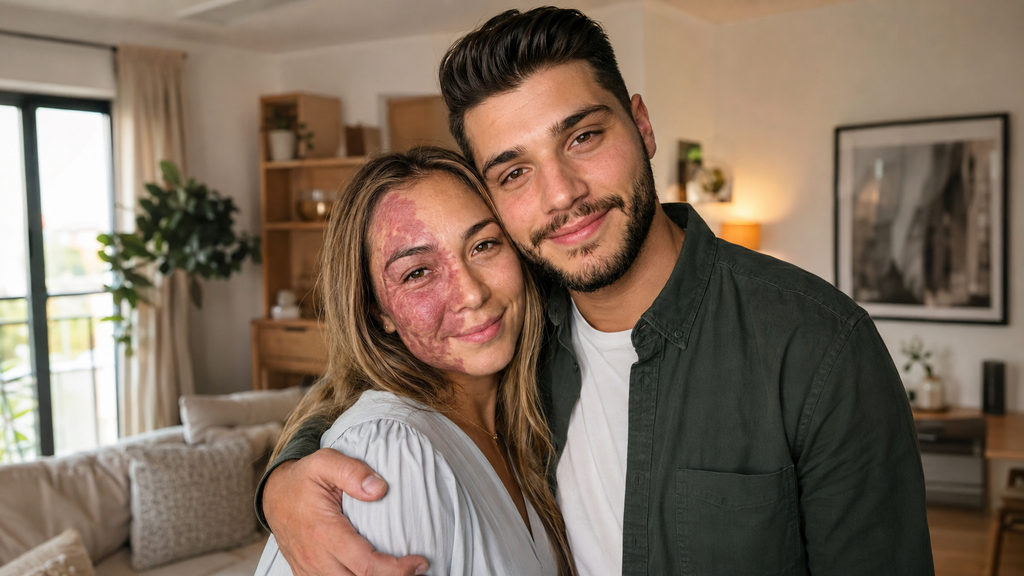
Marissa had been born with a dark reddish birthmark covering much of the left side of her face.
The doctors told me immediately that it was harmless.
The first time the nurse placed Marissa in my arms, I didn’t see a birthmark.
I saw enormous brown eyes.
Tiny fingers.
A wrinkled little forehead.
A mouth that opened in outrage because apparently being born had offended her deeply.
I kissed her cheek.
Both sides.
Every inch of her.
She was perfect to me.
For the first few years of her life, she thought so too.
At four years old, she drew a family portrait at preschool.
Her teacher showed it to me during pickup.
There were three stick figures.
Me.
Marissa.
And our old dog, Benny.
Marissa had colored half her own face bright purple.
I crouched beside her.
“Why purple?”
She looked at me as if the answer were obvious.
“Because purple is prettier than red.”
That was it.
No shame.
No embarrassment.
No fear.
She didn’t understand that the world had rules about faces yet.
Then she started school.
And children taught her.
Not all children were cruel.
Most weren’t.
But cruelty doesn’t require a majority.
It only requires a few people willing to find the place where someone is vulnerable and press there repeatedly.
By seven, Marissa understood that people stared.
By eight, she had heard the words “monster,” “burn face,” and “weird.”
By nine, she knew which side she preferred standing on during school photographs.
By eleven, she automatically tilted her head whenever someone lifted a camera.
By fourteen, every photograph became a negotiation.
“Let me see it.”
“Delete that one.”
“Take another.”
“Is the lighting bad?”
“Can we use the other picture?”
I answered every question.
Every time.
I thought I was helping.
“Of course, sweetheart.”
“This angle is better.”
“Stand over here.”
“Turn a little.”
“You look beautiful.”
I meant every word.
But somewhere along the way, reassuring my daughter became a reflex.
Then dating began.
Or rather, it began for everyone around her.
Not for Marissa.
At sixteen, her friends went to dances with boys.
Marissa went with groups.
At seventeen, she turned down a classmate who asked her to prom.
When I asked why, she shrugged.
“I don’t want to deal with pictures.”
I knew that wasn’t the entire answer.
But I didn’t push.
Her biological father had already given her enough reasons to doubt whether men stayed.
His name was Eric.
For the first few years, he tried.
Then trying became occasional visits.
Occasional visits became missed weekends.
Missed weekends became excuses.
Eventually, the excuses stopped.
He disappeared when Marissa was nine.
I spent years trying not to let my anger poison her.
“He loves you in the way he knows how,” I would say.
It was a lie.
Or maybe a half-truth.
Either way, it didn’t matter.
Children don’t measure love through intentions.
They measure it through who shows up.
Henry arrived in our lives when Marissa was twelve.
He never announced that he intended to become her father.
He never forced affection.
Never demanded a title.
Never said, “You can call me Dad.”
He simply appeared.
School concert?
Henry was there.
Parent-teacher conference?
Henry came.
Car broke down after volleyball practice?
Henry left work.
Flu?
He brought soup.
College applications?
He read every essay.
First apartment?
He carried boxes until midnight.
When Marissa cried over something she refused to explain, Henry never asked too many questions.
He left a cup of tea outside her bedroom and waited.
He didn’t replace Eric.
He did something more important.
He proved that one man leaving did not mean every man would.
Eventually, Marissa stopped waiting for Henry to disappear.
But dating remained different.
She never brought anyone home.
Not once.
Then, six months ago, my phone rang while I was folding laundry.
I almost ignored it because my hands were full of towels.
Then I saw her name.
“Mari?”
“Mom.”
Something in her voice made me sit down.
“What happened?”
“Nothing happened.”
“Then why do you sound like that?”
“Like what?”
“Like you’re calling to confess a crime.”
She laughed nervously.
Then silence.
“Mom…”
“Yes?”
“I met somebody.”
I stopped breathing.
Not literally.
But close.
“What?”
“I met someone.”
“A man?”
“No, Mom, a golden retriever. Yes, a man.”
I smiled so hard my cheeks hurt.
“Tell me everything.”
“I’m not telling you everything.”
“Then tell me ninety percent.”
“Twenty.”
“Seventy-five.”
“Thirty.”
“Fine.”
His name was Graham.
They had met through a mutual friend.
At first, Marissa insisted they were “just talking.”
Then she accidentally mentioned they had gone to dinner four times.
Then eight.
Then she spent Christmas with him.
Then one evening, she called me crying.
My heart nearly stopped.
“What did he do?”
“Nothing.”
“Mari, why are you crying?”
“He asked me to marry him.”
I had cried too.
Now that “somebody” was standing on my front porch.
I heard Marissa open the door.
“Hi.”
A man answered.
“Hi.”
I stayed in the kitchen for exactly three seconds before realizing hiding was ridiculous.
Then I walked into the hallway.
Graham was taller than I expected.
Dark hair.
Clean-shaven.
Broad shoulders.
And, annoyingly, the sort of effortless handsomeness that made mothers suspicious.
For one terrible second, a thought appeared in my mind before I could stop it.
Please don’t let this be some joke.
I hated myself immediately.
Marissa was twenty-eight years old.
Successful.
Funny.
Kind.
Intelligent.
Beautiful.
She was not the insecure teenager she had once been.
But mothers are made partly from memory.
And my memory still contained the little girl who came home from school crying because a boy refused to sit beside her.
Graham held out a bottle of wine.
“Mercy?”
“That’s me.”
“I’m Graham.”
He looked nervous.
That helped.
Anyone who wasn’t nervous meeting the mother of the woman he planned to marry had too much confidence.
Before I could respond, Marissa appeared behind me.
“Mari,” Graham said.
His face changed.
That was the first thing I noticed.
He didn’t look at her birthmark.
He didn’t look away from it either.
He simply looked at her.
His entire expression softened.
“Your mom actually let you bring dessert?”
Marissa rolled her eyes.
“I made it.”
“That wasn’t my question.”
She smacked his arm.
He laughed.
And something inside me loosened by one small degree.
Dinner went better than I expected.
Actually, that wasn’t true.
It went better than I had allowed myself to hope.
Graham asked questions without sounding as though he were being interviewed.
He asked about Henry.
About how Marissa had been as a child.
About our neighborhood.
About my work.
When I told a story, he listened instead of waiting for his turn to speak.
He knew Marissa hated the crispy corners of lasagna.
He traded his softer middle section with her without mentioning it.
He refilled her water while she was talking.
He laughed at her jokes.
Not too loudly.
Not performatively.
Naturally.
Then, halfway through dinner, Marissa started telling me about a weekend cabin trip.
“It was horrible,” she said.
“It was not horrible,” Graham argued.
“There were mosquitoes inside.”
“That was one mosquito.”
“It had descendants.”
“You opened the window.”
“Because there was smoke!”
“Because somebody murdered the campfire.”
Marissa pointed at him with her fork.
“You murdered the campfire.”
“I built the campfire.”
“You stacked wet wood like you were building a decorative sculpture.”
“I was creating airflow.”
“You were creating disappointment.”
Graham reached for his phone.
Marissa narrowed her eyes.
“No.”
He grinned.
“Oh, yes.”
“Graham.”
“Your mother deserves evidence.”
He found a photograph and held it toward me.
I took the phone.
And everything inside me went still.
Marissa stood beside a ruined campfire.
Her hair was blowing wildly across her face.
Her sweatshirt was too large.
She was laughing so hard that her eyes were nearly closed.
Her birthmark was completely visible.
No makeup attempting to soften it.
No carefully chosen side.
No strategic lighting.
No controlled expression.
Nothing hidden.
Nothing apologized for.
Just my daughter laughing.
Years earlier, she would have grabbed the phone from my hand.
“Delete it.”
“Let me see.”
“Why would you keep that?”
“Is it awful?”
Instead, Marissa kept eating.
“That picture is evidence of a crime.”
Graham pointed toward the photograph.
“You killed the fire.”
“It was raining.”
“You poured lighter fluid on wet wood.”
“Because you said the fire needed encouragement.”
“I said air.”
“You were very unclear.”
I laughed with them.
But even after Graham put the phone away, the photograph remained in my mind.
Marissa hadn’t asked to see it.
Not once.
The realization should have made me happy.
Instead, strangely, it frightened me.
Because somewhere deep inside, I had become accustomed to being the person who reassured her.
I knew how to help the insecure version of my daughter.
I wasn’t sure yet what my role was with the woman sitting in front of me.
After dinner, Marissa stood.
“I forgot the cheesecake.”
“You made cheesecake?” I asked.
She looked offended.
“I told you.”
“You said dessert.”
“That meant cheesecake.”
Graham stared at her.
“You hid cheesecake from me?”
“I know you.”
She bent down and kissed the top of his head.
“I’ll be right back.”
Then she disappeared toward the stairs.
Her footsteps faded.
I began stacking plates.
That was when Graham put down his fork.
The change in him was immediate.
The warmth disappeared from his face.
Not anger.
Not exactly.
Something serious.
Nervous.
He looked toward the hallway.
Then toward me.
And leaned forward.
“I did my part of the deal.”
I stopped moving.
Graham lowered his voice.
“Now it’s your turn.”
For several seconds, I honestly thought I had misunderstood him.
“What?”
His eyes widened slightly.
“The deal.”
I stared at him.
“What deal?”
A nervous laugh escaped him.
Not an amused laugh.
The laugh of a man suddenly realizing something had gone badly wrong.
“Mercy, come on.”
I placed the plate down.
“Come on what?”
He glanced toward the stairs.
“Henry really didn’t tell you?”
Something cold moved through my stomach.
“Tell me what?”
Graham’s face changed.
“You seriously don’t know.”
“No.”
My hands became cold.
And suddenly every protective instinct I possessed rose at once.
Henry.
A deal.
Graham.
My daughter.
Money.
The thought came so quickly and so violently that I hated myself for it.
But once it entered my mind, I couldn’t push it away.
Had Henry paid him?
Had Henry somehow decided that because Marissa struggled with dating, he needed to interfere?
Had Graham agreed to something?
Was this entire relationship—
My chair scraped against the floor as I pushed it backward.
“If someone offered you money to date my daughter—”
Graham’s face went white.
“What?”
“If Henry promised you something—”
“Mercy, no.”
I stood.
“Then what deal are you talking about?”
“Oh God.”
He rubbed both hands over his face.
“That’s what you thought?”
“Tell me what else I’m supposed to think.”
“No. Absolutely not. Nobody paid me to date Mari.”
“Then explain.”
“I can’t.”
“You can.”
“I mean I can, but not here.”
My voice dropped.
“You do not get to sit at my dining table, mention some secret deal involving my husband, and then tell me you can’t explain it.”
“It isn’t about my relationship with Marissa.”
“Then what is it about?”
He stood.
“Come with me.”
I folded my arms.
“Where?”
“Outside.”
“Why?”
“Because if I explain it in here, you’ll think I’m insane.”
“I passed that point approximately thirty seconds ago.”
He hurried toward the kitchen.
I followed.
Not because I trusted him.
Because I absolutely did not.
The backyard was almost completely dark.
The porch light illuminated the patio, but beyond that, only the small garden lamp near Henry’s shed cast a pale yellow glow across the grass.
Graham headed toward the far end.
“What exactly did you do?” I demanded.
He kept walking.
“Graham.”
“You’ll see.”
“I am not enjoying those words.”
“I wasn’t expecting you to.”
Then I saw movement near the shed.
A figure.
A man.
My heart slammed against my ribs.
For one second, I thought someone had broken into the yard.
Then the man stepped beneath the garden light.
I screamed.
“HENRY?”
My husband raised both hands like a criminal caught entering through a window.
“Hi.”
I stared at him.
“You’re supposed to be four hours away!”
“I was.”
“Henry.”
“This morning.”
“You told me you were staying another night!”
“I drove back early.”
My mouth fell open.
“And you didn’t tell me?”
Henry looked toward Graham.
Graham suddenly found the grass fascinating.
Then Henry glanced at a large object beside the shed.
It was covered with an old moving blanket.
“That would have ruined this.”
Graham murmured, “I’m going inside.”
“No, you’re not.”
He stopped.
Henry looked guilty.
Not playful guilty.
Actually guilty.
And somehow that frightened me more.
I pointed between them.
“What did the two of you do?”
Henry inhaled.
“Mercy, before you get angry—”
“I am already angry.”
“Fair.”
“Did you make some sort of deal with Graham?”
Henry winced.
“Yes.”
My stomach dropped.
I turned toward Graham.
He raised both hands.
“It’s not what you think.”
“I don’t even know what I think anymore.”
Behind us, the back door opened.
We all froze.
“Mom?”
Marissa’s voice drifted through the yard.
She hadn’t seen us yet.
“Mari, stay inside!”
Silence.
Then:
“Why?”
Graham whispered, “That sounded extremely suspicious.”
I glared at him.
Marissa stepped onto the patio holding a cheesecake.
“What are you all doing out there?”
Henry looked at Graham.
Graham looked at Henry.
Then Henry grabbed the moving blanket.
“We’re out of time.”
“Henry, don’t you dare—”
He pulled.
The blanket slid to the ground.
And beneath it stood an old wooden vanity.
Cream-colored paint.
Three small drawers.
Round mirror.
Brass handles.
A tiny chip near the top of the glass.
And one thin scratch along the left corner of the wood.
I stopped breathing.
I knew that vanity.
I had bought it for Marissa when she was six.
It had come from a small furniture shop downtown.
Nothing expensive.
But at six years old, Marissa thought it belonged in a palace.
She had spent hours sitting in front of that mirror.
Singing into a hairbrush.
Smearing glitter across her cheeks.
Making ridiculous faces.
Once, she had covered both eyebrows in blue eyeshadow and announced that she was “going to an important meeting.”
When I asked what meeting, she said:
“Princess business.”
I had taken hundreds of photographs of her at that vanity.
Before photographs became complicated.
Before mirrors became enemies.
Before she learned that other people thought some faces deserved more approval than others.
Years later, when Marissa was fifteen, I found the vanity in the garage.
I asked why she had moved it.
She shrugged.
“I don’t want something in my room whose whole job is looking at me.”
I tried not to cry until I was alone.
Eventually, I assumed we had thrown it away.
But there it was.
Restored.
The cream paint had been carefully refinished.
The scratches repaired.
The brass handles polished.
Even the chipped portion of the mirror had been stabilized without replacing the original glass.
My anger briefly vanished beneath confusion.
“Oh my God.”
Henry looked nervous.
“How did you…”
I touched the edge.
Then I looked at him.
“How did you arrange all of this?”
Henry nodded toward Graham.
“He helped.”
My head snapped toward him.
“The deal.”
Graham nodded.
“Part of it.”
I stared.
“Part?”
Before anyone could explain, Marissa walked toward us.
The cheesecake nearly slipped from her hands.
“Henry?”
He turned.
She saw the vanity.
And stopped.
Her expression changed so completely that my heart hurt.
“No.”
She placed the cheesecake carefully on the patio table.
Then slowly approached.
“You kept it?”
Henry didn’t answer immediately.
Marissa touched the little brass handle of the top drawer.
Her fingers trembled.
I looked at both men.
“You still haven’t explained the deal.”
Henry exhaled.
“No.”
He glanced toward Marissa.
“Graham’s part was telling me when Mari stopped checking every photograph.”
Marissa turned.
“What?”
Henry continued.
“My part was restoring this when that happened.”
Then he nodded at Graham.
“And apparently tonight, Graham decided you needed a part too.”
Graham shrugged weakly.
“I needed to get her outside somehow.”
I pointed at him.
“So you said, ‘I did my part of the deal. Now it’s your turn’?”
“When you repeat it like that, I understand why it sounded criminal.”
“Your delivery needs work.”
“Agreed.”
I looked at Henry.
“What exactly is my part?”
He held my gaze.
“Seeing what Mari doesn’t need from you anymore.”
The words hit somewhere deep.
Marissa stood beside the vanity.
“Henry, why did you keep this?”
He ran his hand along the polished edge.
“You told me you didn’t want it in your room.”
He smiled gently.
“You never told me to throw it away.”
Her eyes filled.
Then Graham stepped closer.
“This is where the deal started.”
Henry nodded.
“Months ago, before Graham proposed, he came to talk to me.”
Marissa’s head snapped toward Graham.
“You did?”
Graham looked sheepish.
“Yes.”
Henry immediately clarified.
“He didn’t ask my permission.”
“Good,” Marissa said.
“I wouldn’t have given it.”
“Excuse me?”
Henry smiled.
“I mean permission isn’t mine to give. You’re an adult. I told him exactly that.”
Marissa relaxed.
“A blessing is different.”
Graham added, “I mostly wanted him to know what I was planning.”
Henry looked at me.
“And I asked him one question.”
“What?” I said.
He looked toward Graham.
“What do you love most about her face?”
The backyard became completely silent.
Marissa looked down.
Graham groaned.
“That question was terrible.”
Henry laughed.
“That was exactly what he told me.”
Graham shoved his hands into his pockets.
“I said I didn’t know how to answer it without making her sound like a collection of parts.”
I looked at him.
“What did you say?”
He glanced at Marissa.
“I said when she’s trying not to laugh, her nose twitches.”
Marissa immediately covered her nose.
Graham smiled.
“I said when she’s angry, her left eyebrow moves before the right one.”
“That is not true.”
“It absolutely is.”
“It is not.”
“It’s happening right now.”
She tried not to smile.
He continued.
“I said she bites the inside of her cheek when she’s nervous. Her eyes get darker when she’s tired. When she actually laughs instead of politely laughing, she closes her eyes completely.”
Marissa’s eyes were shining.
Graham shrugged.
“So I told Henry I didn’t know what part of her face I loved most because I don’t look at Mari like that.”
Henry looked at me.
“That’s when I told him about the pictures.”
My chest tightened.
“What about them?”
“You remember how she used to check every photograph.”
Of course I remembered.
“Is this okay?”
“Can I see?”
“Delete that one.”
“Take another.”
Henry continued softly.
“I told Graham not to reassure her before she asked.”
I frowned.
“What?”
“He said I should just love her normally,” Graham explained.
Henry nodded.
“I told him something I wish I’d figured out sooner.”
He looked toward me.
“Sometimes reassurance can accidentally tell someone there was something to worry about.”
My throat tightened.
Henry continued.
“So I asked Graham for one favor. If there ever came a day when Mari stopped checking every picture…”
“Tell you,” I whispered.
“Yes.”
Graham took out his phone.
“A couple months ago, she stopped.”
He opened the lock screen.
There was Marissa.
Standing in a parking lot.
Wind blowing her hair everywhere.
Laughing.
Birthmark fully visible.
No posing.
No hiding.
No fear.
Marissa looked at him.
“You two have been monitoring my selfies?”
Graham grimaced.
“That sounds significantly worse when you say it.”
“You’ve been reporting my photographic behavior to my stepfather?”
“Only once.”
Henry corrected him.
“Twice.”
Graham glared.
“You said the second one didn’t count.”
“It counted.”
Marissa put a hand over her face.
“My family is insane.”
But she was smiling.
Then my eyes moved back to the photograph.
Without thinking, I said:
“You usually hate pictures like—”
I stopped.
The words disappeared.
Marissa looked at me.
Henry did too.
And suddenly I understood.
My part.
Henry’s voice was soft.
“Mercy.”
I swallowed.
“What?”
“Sometimes Mari walks into a room perfectly comfortable…”
He paused.
“And you start checking who’s looking at her.”
The truth of it stung immediately.
“I was protecting her.”
“I know.”
Henry’s tone was gentle.
No accusation.
No judgment.
Just honesty.
“You protected her when she needed protecting.”
He looked at our daughter.
“But sometimes now, you remind her there might be something to fear before anybody has done anything.”
I wanted to argue.
I wanted to defend myself.
Then memories began appearing.
Restaurants.
Family gatherings.
Weddings.
Photographs.
I always watched people.
Always.
If someone looked at Marissa too long, I noticed.
If a stranger whispered, I assumed.
If someone held a camera, I immediately adjusted the situation.
“Mari, come stand over here.”
“The light is better.”
“Turn a little.”
“Sweetheart, you look beautiful.”
Those words had always come from love.
But love can become habit.
And habit can outlive the problem it was created to solve.
I looked at my daughter.
She was no longer seven.
No longer eleven.
No longer fourteen.
She was twenty-eight.
Standing beside the man she intended to marry.
Laughing in photographs without asking permission from the world.
And I was still preparing her for insults that might never come.
“I think…”
My voice cracked.
“I think I spent so long watching everybody else for you that I forgot you might not need me doing it anymore.”
Marissa’s eyes softened.
She came toward me and took my hand.
“You were trying to help, Mom.”
I squeezed her fingers.
“I know.”
“No.”
She moved closer.
“You really were.”
Tears burned behind my eyes.
“But maybe I was protecting an old version of you.”
Marissa smiled sadly.
“Maybe.”
I laughed through the tears.
“I’m going to have to learn.”
“Learn what?”
“When you’re not asking me to protect you.”
She rested her head briefly against my shoulder.
“You can still protect me.”
“I can?”
“Just maybe don’t move me into better lighting every time somebody gets a phone out.”
I laughed.
“That frequently?”
“Mom.”
“Fine.”
Henry cleared his throat.
“Which brings us back to the vanity.”
Marissa turned.
Henry placed one hand on the old wooden top.
“I didn’t restore this because I thought you needed to look at yourself differently.”
His voice thickened.
“I restored it because I hoped someday it could just be furniture again.”
Marissa stared at him.
That sentence broke something open in all of us.
The vanity had once been a place of joy.
Then a symbol of pain.
Henry wasn’t trying to erase the pain.
He wasn’t pretending it had never happened.
He was giving Marissa the choice to reclaim something.
“If you want it back in the garage,” he added, “that’s where it goes.”
“No pressure.”
Marissa looked at the mirror.
No one spoke.
Finally, she pulled out the little chair.
And sat down.
For a long moment, my daughter looked at herself.
I stood behind her.
My old instinct rose immediately.
Tell her.
Tell her she’s beautiful.
Tell her not to worry.
Tell her the birthmark doesn’t matter.
Tell her—
I said nothing.
Marissa leaned closer to the glass.
Then gasped.
“Oh my God.”
My heart leapt.
“What?”
She pointed toward her hair.
“Is that gray?”
There was one tiny silver strand near her temple.
Graham made the mistake of laughing.
Marissa slowly turned toward him.
“You knew?”
Graham immediately stopped smiling.
“I would like a lawyer.”
“You knew?”
“Mari, there may be more than—”
She pointed at him.
“Finish that sentence and there will be no wedding.”
Henry burst out laughing.
Graham raised his hands.
“I love every gray hair you may or may not have.”
“Wrong answer.”
“I support whichever hairs you choose to acknowledge.”
“Better.”
I laughed so hard I had to wipe tears from my cheeks.
And that was when I realized something extraordinary.
Her birthmark was right there.
Visible in the mirror.
Visible to every person in the backyard.
And for the first time in years, it wasn’t the subject.
Nobody needed to explain it.
Nobody needed to reassure her about it.
Nobody needed to pretend not to notice it.
It was simply part of her face.
Like her brown eyes.
Like her crooked smile.
Like the tiny gray hair she had apparently just declared war against.
Henry touched the vanity.
“So.”
Marissa looked up.
“Where do you want it?”
She thought about that.
Then smiled.
“Our apartment.”
Graham blinked.
“Our apartment?”
She looked at him.
“Problem?”
“No.”
He glanced at the vanity.
“Just thinking about stairs.”
“There’s an elevator.”
“The elevator is broken.”
“Since when?”
“Yesterday.”
Marissa groaned.
Henry clapped Graham on the shoulder.
“Welcome to marriage.”
The four of us spent the next half hour loading the vanity into Henry’s SUV.
The cheesecake remained forgotten on the patio until I suddenly remembered it.
“Wait!”
Everyone froze.
“What?” Henry asked.
“The cheesecake.”
Graham turned instantly.
“I’ll get it.”
Marissa grabbed his shirt.
“No.”
“What?”
“You almost forgot our furniture, but you remembered cheesecake immediately.”
“I contain multitudes.”
“You contain sugar.”
We ate two slices standing in the kitchen before leaving.
Then we drove across town to Marissa and Graham’s apartment.
The elevator was, indeed, broken.
Naturally.
We carried the vanity upstairs.
Or attempted to.
Henry and Graham took most of the weight.
Marissa directed traffic.
I carried the drawers because I had no intention of throwing out my back three weeks before the wedding.
At the second-floor landing, Graham stopped.
“I need a break.”
Marissa stared.
“You’re thirty.”
“I’m preserving myself for our future.”
Henry said, “Lift.”
Graham groaned.
By the third floor, we were all sweating.
At the apartment doorway, Henry angled the vanity wrong.
Marissa immediately said:
“Dad, rotate it before you destroy the wall.”
Silence.
Absolute silence.
Henry froze.
Marissa froze.
Graham looked at me.
I looked at Henry.
For sixteen years, Marissa had called him Henry.
Never Dad.
Not because she didn’t love him.
Not because he wasn’t family.
The word simply belonged to a complicated place inside her.
Henry had never asked for it.
Not once.
Now it had slipped out naturally.
Dad.
Marissa’s mouth opened.
Then closed.
Henry looked down at the vanity.
His eyes were wet.
But because he was Henry, he didn’t make the moment heavier than she wanted it to be.
He simply cleared his throat.
“Right.”
His voice cracked slightly.
“Rotate.”
Marissa stared at him.
Then smiled.
“Yes.”
He turned the vanity.
They carried it inside.
Nobody mentioned the word again.
But something had changed.
Later, Henry and I stood near the apartment door while Marissa decided where the vanity should go.
“Bedroom,” Graham suggested.
“Too predictable.”
“Bathroom?”
“Too humid.”
“Living room?”
“So everyone can watch me do my eyebrows?”
“You barely do your eyebrows.”
“Because I was blessed.”
“With eyebrows?”
“With taste.”
Eventually, they placed it near the bedroom window.
The afternoon light would fall across it.
I almost said:
“That will be good lighting for pictures.”
I caught myself.
Henry noticed.
He smiled.
I elbowed him.
“Don’t.”
“I didn’t say anything.”
“You were thinking loudly.”
Before leaving, I hugged Graham.
Not politely.
Actually hugged him.
He seemed surprised.
“Thank you,” I whispered.
“For terrifying you at dinner?”
“No.”
I pulled back.
“For loving my daughter without treating her like she needs to be rescued.”
His expression became serious.
“I don’t.”
“I know.”
He looked toward Marissa.
“She rescues herself pretty well.”
“That she does.”
Then I whispered:
“Your secret-deal communication could use improvement.”
He laughed.
“Understood.”
Henry was already in the hallway.
I stepped toward the door.
Then something made me look back.
Marissa was sitting at the vanity.
She had taken out one earring.
Then the other.
Graham stood behind her in the bathroom doorway brushing his teeth.
He looked toward her reflection.
Marissa caught him.
“Stop staring at me, weirdo.”
Graham spoke around the toothbrush.
“I’m brushing my teeth.”
“Suspiciously.”
He flicked a tiny drop of water toward her.
She yelped.
“Graham!”
He ran.
Marissa jumped up and chased him.
Their laughter filled the apartment.
For a moment, I instinctively stepped backward toward the room.
Watch.
Protect.
Check.
Make sure.
Old habits do not disappear simply because someone points them out.
They fade in moments.
In choices.
In the split second where you decide whether love requires your presence or your trust.
I stood at the doorway.
My daughter was laughing.
Her birthmark was visible.
Her hair was messy.
There was probably cheesecake somewhere on Graham’s shirt.
And absolutely nobody needed me.
That realization might once have frightened me.
Instead, it felt like peace.
I looked at Henry.
He was waiting in the hallway.
His eyes were still slightly red.
I stepped outside.
Then I softly pulled the apartment door closed.
Henry and I walked toward the stairs.
Halfway down, I said:
“She called you Dad.”
Henry stopped.
“I heard.”
I smiled.
“You pretended not to.”
He looked down.
“She didn’t need me making it a big thing.”
There it was again.
The lesson.
Love was not always speaking.
Not always fixing.
Not always protecting.
Sometimes love was knowing when to say nothing.
We continued downstairs.
Outside, the night air had turned cool.
Henry unlocked the SUV.
Before getting in, I looked up toward Marissa’s apartment window.
The curtains were open.
The vanity sat near the glass.
For just a second, I could see her moving around inside.
Henry came beside me.
“You okay?”
I nodded.
“I think so.”
“You’re not angry anymore?”
“Oh, I’m still angry.”
He sighed.
“About the surprise?”
“You told me you were four hours away while standing in our backyard.”
“I needed the story to be believable.”
“You are sleeping very carefully tonight.”
“That sounds threatening.”
“It is.”
He smiled.
Then his expression softened.
“You know I wasn’t criticizing you.”
“I know.”
“You were the reason she survived those years.”
I looked down.
“I don’t know about that.”
“I do.”
He leaned against the SUV.
“You protected her when she was a child.”
Then he glanced toward the apartment window.
“But you raised her to become someone who eventually wouldn’t need protection every minute.”
That hurt.
And healed.
At the same time.
I thought about seven-year-old Marissa crying after school.
Eleven-year-old Marissa asking to stand on the other side of the camera.
Fourteen-year-old Marissa deleting twenty photographs because she hated every one.
Seventeen-year-old Marissa refusing prom because there would be too many pictures.
Twenty-two-year-old Marissa saying dating was “not worth the emotional administrative work.”
Then I remembered the photograph Graham had shown me.
Windblown hair.
Closed eyes.
Uncontrolled laughter.
Freedom.
Maybe healing had not arrived dramatically.
Maybe there had never been one moment where Marissa woke up and suddenly loved every part of herself.
Maybe healing happened quietly.
One photograph she didn’t delete.
One mirror she stopped fearing.
One man whose love didn’t feel like charity.
One stepfather who waited sixteen years to hear a word he never demanded.
One mother finally learning that protection could become trust.
Three weeks later, on the morning of Marissa’s wedding, I stood outside the bridal room and heard laughter.
I knocked.
“Come in.”
Marissa sat near the window.
Her hair was pinned back.
Completely back.
The birthmark was fully visible.
My heart stopped for a moment.
Not because of the birthmark.
Because she was radiant.
Her dress was simple.
Ivory.
No heavy embellishment.
She wore pearl earrings that had belonged to my mother.
When she saw me, she smiled.
“Well?”
My old answer rose automatically.
“You look—”
I paused.
Marissa lifted an eyebrow.
I smiled.
“Ready.”
Her expression changed.
Something passed between us.
Understanding.
“Yeah,” she whispered.
“I am.”
The photographer entered a few minutes later.
“Can we get some shots by the window?”
My body instantly prepared itself.
Good side.
Better angle.
Watch the light.
Before I could move, Marissa stood exactly where the photographer asked.
The camera clicked.
Once.
Twice.
Five times.
Ten.
Marissa never asked to see the screen.
Eventually, the photographer said:
“Beautiful.”
And moved on.
I blinked back tears.
Marissa noticed.
“Mom.”
“I’m fine.”
“You’re crying.”
“I’m allowed.”
“You told me mascara was expensive.”
“That is why I bought waterproof.”
She laughed.
Then the door opened.
Henry stepped inside.
He wore a dark suit.
His tie was slightly crooked.
Marissa looked at him.
“Dad, come here.”
This time, she said it deliberately.
Henry stopped.
His face changed.
I looked away because the moment belonged to them.
When I looked back, Henry was fixing the bracelet on her wrist.
Neither of them was speaking.
They didn’t need to.
Later, as the ceremony began, I sat in the front row beside Henry.
Graham stood at the altar.
The moment Marissa appeared, his shoulders dropped.
Like he had been holding his breath all day.
There were nearly two hundred people in the room.
Hundreds of eyes.
Dozens of phones.
Cameras.
Lights.
For most of my daughter’s childhood, that would have sounded like a nightmare.
Marissa walked forward anyway.
Head high.
Face uncovered.
No careful angle.
No hiding.
No apology.
And for the first time in my life, I didn’t scan the crowd to see who was staring.
I watched only her.
Henry reached for my hand.
I squeezed his.
Graham began crying before Marissa reached him.
She laughed when she noticed.
When they stood together, I remembered that first terrible thought from the night I met him.
Please don’t let this be some joke.
How unfair that thought had been.
Not because I was wrong to fear for her.
Because somewhere inside, I had briefly believed a man like Graham loving a woman like Marissa required explanation.
It didn’t.
Love didn’t need a reason.
It didn’t need compensation.
It didn’t need a deal.
The only deal had been between two men who loved my daughter enough to wait for the day she stopped asking the world for permission to be seen.
During the reception, the photographer approached.
“Family picture.”
We gathered near the garden.
Marissa stood between Graham and Henry.
I automatically moved toward her left side.
Then stopped.
Old instinct.
Marissa noticed.
She reached for my hand and pulled me beside her.
“Wherever you want, Mom.”
I laughed.
“Here is good.”
The photographer lifted the camera.
“Everyone ready?”
I looked at my daughter.
She wasn’t adjusting her hair.
Wasn’t turning.
Wasn’t checking.
She was simply smiling.
The camera clicked.
Nobody asked to see it.
That photograph sits in my living room now.
The fancy china cabinet is beneath it.
Henry says I deliberately positioned the picture there because I enjoy symbolism.
He is probably correct.
In the photograph, Marissa is laughing.
Graham is looking at her instead of the camera.
Henry looks proud.
I look slightly emotional.
And the birthmark covering the left side of my daughter’s face is completely visible.
Sometimes visitors notice it.
Sometimes they don’t.
I no longer watch to see which.
Months after the wedding, Marissa invited us to dinner.
When Henry and I arrived, the old vanity was still beside their bedroom window.
A little vase sat on top.
Two perfume bottles.
Three earrings with no matching partners.
A receipt.
A hairbrush.
Normal clutter.
Ordinary furniture.
Marissa caught me looking at it.
“What?”
“Nothing.”
“You’re doing your sentimental face.”
“I do not have a sentimental face.”
“You absolutely do.”
Graham shouted from the kitchen:
“She does!”
I ignored him.
Marissa stood beside me.
For a moment, we both looked into the round mirror.
Mother and daughter.
My hair grayer.
Her face older.
Both of us changed.
“I’m glad Henry kept it,” she said.
“Me too.”
She touched the old scratch near the corner.
“I remember doing that.”
“You cried for an hour.”
“I thought you were going to kill me.”
“You were nine.”
“You looked very intense.”
“It was new furniture.”
She laughed.
Then she looked at her reflection.
“When I put it in the garage, I really hated this thing.”
“I know.”
“I thought mirrors were the problem.”
I waited.
She continued.
“But it wasn’t the mirror.”
“No.”
“It was everything I thought people saw when they looked at me.”
I swallowed.
“And now?”
Marissa shrugged.
“Now I think people see whatever they see.”
I turned toward her.
She smiled.
“And I get to decide whether that controls my day.”
My eyes immediately filled.
She groaned.
“Mom.”
“I’m not crying.”
“You’re absolutely crying.”
“I have allergies.”
“In December?”
“Seasonal.”
She hugged me.
I wrapped my arms around her.
For so many years, I believed being a good mother meant standing between my child and every possible hurt.
I thought love meant anticipating pain before it arrived.
I thought if I watched closely enough, spoke quickly enough, reassured often enough, I could protect her from the things people had once made her believe about herself.
But children grow.
Pain changes them.
Love changes them too.
And eventually, if we are lucky, the child we spent years protecting becomes a person strong enough to decide which battles belong to her.
That is when motherhood changes.
You stop walking in front of them.
You stop trying to clear every path.
You stop checking every face in the room.
And you learn how to walk beside them.
Or sometimes behind them.
Close enough that they know you are there.
Far enough that they know they can do it themselves.
That night, when Henry and I were leaving, Marissa called after us.
“Mom?”
I turned.
She stood beside Graham.
“What?”
She smiled.
“Thanks.”
“For dinner?”
“No.”
She paused.
“For closing the door that night.”
I knew exactly what she meant.
The night we brought the vanity over.
The night I had stood in the doorway watching her laugh with Graham.
The night I almost stepped back inside because every instinct in me said:
Watch.
Protect.
Check.
Instead, I had closed the door.
I smiled.
“You noticed?”
“I notice everything.”
That was true.
She always had.
I nodded.
“Anytime.”
Henry and I walked toward the elevator.
It worked now.
Thank God.
Before the doors closed, I looked back once more.
Marissa had already turned toward Graham.
He said something.
She laughed.
And that was the image I carried home.
Not the little girl hiding one side of her face.
Not the teenager deleting photographs.
Not the young woman afraid that love would eventually leave.
Just Marissa.
Whole.
Loved.
Laughing.
And free.
For years, I had been terrified that the world would convince my daughter she was difficult to love.
What I never understood was that my job was not to convince the entire world otherwise.
My job was to love her until she learned that anyone incapable of seeing her worth did not deserve the power to define it.
Henry understood that.
Graham understood it too.
Eventually, I did.
And that mysterious “deal” I had nearly thrown Graham out of my house over?
It had never been about convincing someone to love my daughter.
It had been about waiting for the day she stopped believing love required convincing.
Graham had done his part.
Henry had done his.
And finally…
I learned how to do mine.
I learned to stop searching every stranger’s face for judgment.
I learned to stop correcting every photograph before Marissa asked.
I learned that telling someone they are beautiful every five minutes can sometimes make them wonder why you think they need reminding.
I learned that confidence is not always loud.
Sometimes it is simply leaving a photograph undeleted.
Sometimes it is sitting in front of an old mirror without flinching.
Sometimes it is wearing your hair however you want on your wedding day.
Sometimes it is calling the man who raised you “Dad” without planning to.
And sometimes…
Love means quietly closing a door.
Then trusting the person on the other side to call your name if she needs you.
THE END! THANK YOU FOR READING!❤️