 Reading Time: 35 minutes
My sister’s black SUV appeared at the end of the ranch road less than a minute after the sheriff’s vehicle turned onto my driveway. For some reason, that was the moment everything became real.
Not when the security camera sent the alert to my phone. Not when I saw my parents standing beside a realtor in the middle of my property.
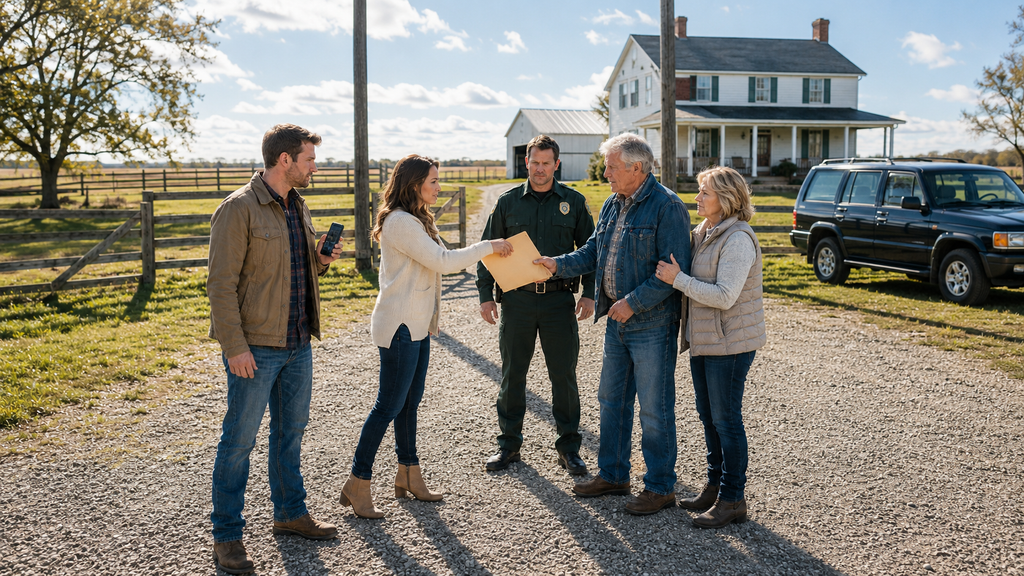
Not even when I heard my father casually discussing how quickly the ranch could be sold, as though my home were an old couch he had decided I no longer needed.
It became real when I saw my sister.
Her SUV rolled slowly over the gravel, passed the camera post near the gate, and stopped several yards behind the sheriff’s cruiser.
Dust drifted around the tires.
The engine shut off.
Then the driver’s door opened.
My sister stepped out.
For several seconds, no one moved.
She looked at the sheriff first.
Then at the realtor.
Then at our parents.
Finally, she looked at me.
Her expression changed.
Not dramatically.
Just enough for me to know she had not expected to see me there.
“What’s going on?” she asked.
My mother moved before anyone else could answer.
Of course she did.
Mom had always believed that if she spoke first, she could control the story.
She hurried toward my sister with both hands raised in that soothing way she used whenever she wanted to make something terrible sound reasonable.
“There’s been a misunderstanding,” she said quickly.
I almost laughed.
It came up in my throat like something bitter.
A misunderstanding.
Ten minutes earlier, my parents had been standing in my pasture with a realtor, talking about selling my ranch.
My ranch.
The house I had bought.
The land I had paid for.
The place whose deed carried my name and no one else’s.
They had walked through my property without permission.
They had discussed potential buyers.
They had spoken about timelines.
They had even talked about what the money could do for my sister.
But now that a sheriff was standing beside them, suddenly the entire thing was just a misunderstanding.
My sister frowned.
Her eyes moved to the realtor.
“I thought you were doing the property walk-through today.”
The realtor went very still.
I watched the realization cross her face.
It was subtle.
A tightening around the mouth.
A slight narrowing of the eyes.
Then she turned fully toward my sister.
“You knew about the proposed sale?” she asked.
My sister hesitated.
“I knew Mom and Dad said they were helping me sell some property.”
My stomach twisted.
I looked directly at her.
“Whose property?”
Her eyes came back to mine.
For a second, she said nothing.
That silence told me almost as much as an answer could have.
Because I suddenly understood something.
My sister had not expected me to be standing there.
Not because she assumed I was away for the afternoon.
Not because she thought I was at work.
She looked genuinely confused by my presence, as though my involvement in the sale had barely been part of the story she had been given.
Somewhere between my parents deciding that my ranch should solve her financial problems and inviting a realtor onto my land, they had built an entire version of reality in which my ownership barely mattered.
My father stepped forward.
“Can we not do this in front of everyone?”
The sheriff answered before I could.
“We’re already doing this in front of everyone.”
His voice was calm.
That calmness did something to my father.
Dad knew how to handle anger.
He could match anger.
He could become louder.
He could accuse.
He could interrupt.
He could turn a conversation into a contest and keep pushing until everyone around him was too exhausted to continue.
But calm authority gave him nothing to push against.
My sister folded her arms.
“What exactly happened?”
I looked at her.
There were a thousand things I could have said.
I could have told her about every Christmas where her chair at the table had been guaranteed while mine somehow depended on whether I was convenient.
I could have told her about birthdays where our parents gave her money because she was “going through a hard time” while I received a phone call reminding me that I was “doing well enough already.”
I could have told her about the bills I had quietly covered.
The times I had rearranged work.
The emergencies I had driven across the state to solve.
The family dinners where decisions affecting me had already been made before I arrived.
The years of being told that I was stronger.
More independent.
More capable.
As though competence were a punishment.
As though needing less meant deserving less.
But I did not say any of that.
Not then.
I kept my voice steady.
“They came onto my ranch with a realtor,” I said. “They told her they were selling it.”
My sister stared at our parents.
I continued.
“Dad told me you needed the money more than I needed the land.”
Her head turned sharply toward him.
“You said this was already arranged.”
My father’s jaw tightened.
“It was going to be arranged.”
“That isn’t what you told me.”
My mother stepped closer.
“We knew your sibling would understand once everything was explained.”
I looked at her.
“You didn’t explain anything to me.”
She barely acknowledged me.
Instead she turned back toward my sister.
“You know how difficult things have been for you lately.”
There it was.
That sentence.
The sentence that had been used like a master key for years.
Your sister is having a difficult time.
When she needed help paying rent.
Your sister is having a difficult time.
When she needed someone to cosign something.
Your sister is having a difficult time.
When she forgot Mom’s birthday and I was asked to smooth things over.
Your sister is having a difficult time.
When my parents canceled plans with me because she suddenly needed them.
Apparently, now it also meant:
Your sister is having a difficult time, so we decided to sell land we do not own.
My sister’s face tightened.
“I never asked you to sell their ranch.”
Dad exhaled sharply.
“You asked for help.”
“Yes.”
“And we found a way to help you.”
“No.”
Her voice was firmer now.
“You found somebody else’s property.”
For the first time since I had driven up and discovered all of them standing there, my father had no immediate answer.
And strangely, hearing the words from my sister hurt more than if I had said them myself.
Because they were so obvious.
So simple.
So impossible to twist.
They had found someone else’s property.
Mine.
The realtor looked down at the gravel for a moment.
Then she turned toward the sheriff.
“I want to be very clear,” she said. “I was contacted this morning and provided with information suggesting that the parents had authority to discuss a sale. I have not listed this property. I have not signed an agreement with the legal owner. Once I saw documentation showing otherwise, I stopped.”
The sheriff nodded.
“Good.”
My father seized on that immediately.
“Exactly.”
He looked at me triumphantly, as though the realtor had just proved his innocence.
“Nothing happened.”
I stared at him.
Nothing happened.
I could not believe he had said it.
He genuinely believed that because the sale had not gone through, because no buyer had signed papers and no money had changed hands, the rest somehow did not matter.
It did not matter that he had entered my property without permission.
It did not matter that he had represented himself as having authority over something that belonged to me.
It did not matter that he had brought a professional onto my land and discussed selling it.
It did not matter that he had apparently promised the proceeds to someone else.
To him, the only wrongdoing would have been getting caught after the paperwork was complete.
Being stopped early meant nothing had happened.
I looked at him.
“You brought a realtor onto my ranch.”
“We were discussing possibilities.”
“You were discussing listing it.”
“You weren’t answering our calls.”
I almost laughed again.
There it was.
The justification.
As though failure to answer a phone transferred ownership.
“I was working.”
“You always say you’re working.”
“Because I have a job.”
“You could have called us back.”
“And if I had?”
He paused.
I stepped closer.
“What would you have said?”
His mouth tightened.
I already knew.
He would have told me my sister needed help.
He would have told me the ranch was too much property for one person.
He would have told me I could always buy something else.
He would have told me family came first.
And when I said no, he would have treated that answer as the beginning of negotiations.
My father had never understood that “no” could be a finished sentence.
My mother looked between us.
“We would have explained everything.”
“No,” I said quietly. “You would have tried to convince me after you already made the decision.”
“That is not fair.”
“Neither is trying to sell my home.”
My mother’s face changed.
“This is not your home.”
For a second, even the sheriff looked at her.
I stared.
“What?”
She gestured toward the ranch.
“This place. This whole thing. You bought it a few years ago. You act like it’s some sacred family estate.”
My heartbeat changed.
Slow.
Heavy.
“You’re right,” I said.
She seemed surprised.
Then I continued.
“It’s not a family estate.”
I looked at both of them.
“It’s mine.”
Silence.
The wind moved through the dry grass beyond the fence.
Somewhere farther out, one of the horses shifted near the trough.
My mother folded her arms.
“You know what I mean.”
“No. I don’t think I ever did.”
The sheriff asked my parents once again to move toward their SUV.
My mother finally obeyed.
Dad did not.
He stayed planted beside the gravel drive, shoulders squared, staring at me with the exhausted irritation of a manager dealing with an employee who refused to follow instructions.
“You’re blowing this up,” he said.
I shook my head.
“No.”
My voice surprised me.
It was not angry.
It was not loud.
It was simply finished.
“I’m stopping it.”
My sister looked between us.
“Dad, get in the car.”
He turned toward her.
“You stay out of this.”
Her eyebrows rose.
“You did this because of me.”
“That doesn’t mean you understand what needs to happen.”
And there it was.
One sentence.
One careless sentence that exposed more truth than my father probably intended.
My sister went very still.
I saw it happen in her face.
The realization.
She was not in control of this plan either.
She had been the excuse.
The justification.
The reason my parents used to convince themselves they were doing something noble.
But they had not trusted her with the truth.
They had not asked her whether she wanted my ranch sold.
They had not told her they lacked permission.
They had simply informed her that some property was available and that things were being handled.
All those years, I had thought my sister was the favored child.
Maybe she was.
But standing there on the gravel, I realized favoritism could be its own kind of cage.
My parents gave her more.
More money.
More attention.
More forgiveness.
More rescue.
But perhaps that also meant they never expected her to stand on her own.
They treated me like the child who needed nothing.
They treated her like the child who could not manage without them.
Different roles.
Same control.
Dad looked at the sheriff.
“I’m talking to my family.”
The sheriff did not raise his voice.
“You can do that somewhere you have permission to be.”
That sentence traveled through me.
Somewhere you have permission to be.
Permission.
Such a small word.
My family had never cared much for it.
They came into my house without knocking.
They volunteered my time.
They discussed my finances.
They gave out my phone number.
They expected explanations when I said no.
They acted as though boundaries were merely obstacles placed by people who had forgotten their family obligations.
But this time there was a property line.
A deed.
A law.
Something my parents could not guilt into changing.
Dad finally moved toward the SUV.
The realtor remained where she was.
My sister stayed too.
My mother noticed immediately.
“Aren’t you coming?”
My sister shook her head.
“I want to know what you told the realtor.”
Mom’s mouth tightened.
“This is not the place.”
My sister gave a short, humorless laugh.
“It literally is the place.”
She pointed toward the pasture.
“It’s the property you were trying to sell.”
I turned my face away.
Not because I wanted to hide a smile.
There was no satisfaction in this.
I had spent most of my adult life wishing my family could become simpler.
Kinder.
Normal.
I did not enjoy watching them unravel.
But underneath the grief, I felt something else.
Relief.
For once, I was not the only person seeing it.
For once, I did not have to explain the pattern while everyone told me I was overreacting.
My sister had walked into the situation fresh.
And even she could see what was wrong.
The realtor asked the sheriff if she could retrieve several pages of personal notes from the property folder.
He allowed her to take what belonged to her while keeping the paperwork my parents had provided separate.
I stayed back.
My attorney’s voice echoed in my head.
Do not argue about ownership.
Document what they do.
Call the sheriff.
When he first gave me that advice, I had almost been disappointed.
It sounded too ordinary.
Too procedural.
A part of me had wanted him to give me some powerful speech I could deliver.
Some legal phrase that would finally force my parents to understand.
Instead, he had told me to keep records.
Save footage.
Have the deed available.
Do not get pulled into an argument.
Now I understood why.
My parents were experts at arguments.
They could transform facts into feelings within thirty seconds.
Ownership became sacrifice.
Permission became loyalty.
Boundaries became disrespect.
A simple “That belongs to me” could somehow turn into a two-hour discussion of everything they had done for me since childhood.
But documents did not participate in emotional manipulation.
The deed did not care that my parents had paid for braces when I was thirteen.
The security camera did not care that my mother thought I should be more generous.
The recording did not care that my sister was struggling.
The facts were boring.
That was exactly why they were powerful.
The deed had my name on it.
The camera showed my parents arriving without me.
The footage showed my father directing the realtor around the property.
The realtor had heard him speak as if he had authority to sell.
And I had never agreed to any sale.
Those facts could not be guilted.
They could not be interrupted.
They could not be rewritten at the dinner table.
My mother tried one more time.
She stood beside the passenger door of their SUV and looked at me with wounded disbelief.
“After everything we’ve done for you, I cannot believe you called law enforcement on your own parents.”
For years, that sentence would have crushed me.
After everything we’ve done for you.
It was one of her favorites.
The first half of it was always invisible.
The second half was always a demand.
After everything we’ve done for you, come home for Christmas even though we changed the date without asking you.
After everything we’ve done for you, lend your sister the money.
After everything we’ve done for you, apologize to your father even though he insulted you first.
After everything we’ve done for you, stop being dramatic.
After everything we’ve done for you, give more.
Give quietly.
Give without boundaries.
I looked at her.
“I called because people were trying to sell my property without permission.”
Her face hardened.
“We are not people.”
She placed one hand against her chest.
“We are your parents.”
“That doesn’t change the deed.”
The silence afterward was so complete I heard a bird calling from somewhere beyond the barn.
Dad opened the driver’s door.
“You’ll regret making this official.”
A cold feeling went through me.
Not fear exactly.
Recognition.
It was the kind of sentence he used whenever he could no longer win directly.
A warning disguised as concern.
I did not answer.
There was nothing left to explain.
The sheriff came closer.
He asked me quietly, “Do you want them formally told they do not have permission to remain on the property?”
For a second, the child inside me screamed.
These are your parents.
You cannot do this.
You are humiliating them.
You are making it worse.
You will ruin the family.
But another voice was louder.
The one I had spent years building.
The one that had signed a mortgage.
Negotiated contracts.
Managed emergencies.
Buried loneliness beneath work and kept moving.
The one that had bought this land.
“Yes,” I said.
One word.
It came more easily than I expected.
The sheriff turned toward my parents and told them plainly that they no longer had permission to remain on the property and needed to leave.
My mother climbed into the SUV.
Dad stood beside the open driver’s door.
He stared across the pasture.
I wondered what he was thinking.
Whether he still saw my ranch as money.
Whether he imagined what a developer would pay.
Whether he was calculating how much of my life he believed should belong to my sister.
Or whether, for the first time, he was beginning to understand that he could not decide.
Finally, he got inside.
The engine started.
The SUV reversed.
Gravel cracked beneath the tires.
The vehicle turned slowly.
The same security camera that had alerted me when they arrived captured them leaving.
I watched until their SUV passed the mailbox.
Then disappeared beyond the bend.
Only when they were gone did I realize how tightly I had been gripping my phone.
My fingers ached.
My palm had half-moon marks from my nails.
I slowly loosened my hand.
The realtor spoke first.
“I’m sorry.”
Her voice sounded different now.
Smaller.
Tired.
“I should have verified the ownership independently before I came out here.”
I looked at her.
She had been part of what happened.
That was true.
But she was not my enemy.
The moment I had shown her the deed, she had stopped.
She had handed the paperwork to the sheriff.
She had not doubled down.
She had not helped my parents continue pretending.
“You stopped when you saw the deed,” I said.
“Yes.”
“And you gave the sheriff what they gave you.”
“Yes.”
“That matters.”
Her shoulders relaxed slightly.
Not enough to look comfortable.
But enough to show she had been expecting something harsher.
“I was told the family had already discussed everything,” she said.
I almost smiled.
“That sounds like them.”
She glanced toward the road.
“I’m going to document everything on my side.”
“Please do.”
“I won’t contact you about any listing.”
“Good.”
She nodded.
Then she stepped away to speak with the sheriff again.
My sister remained beside her SUV.
She had not said much since our parents left.
The wind moved a strand of hair across her face.
She tucked it behind her ear and stared toward the pasture.
I could tell she wanted to speak.
I did not help her.
For once, I refused to do the emotional work for everyone else.
Finally, she looked at me.
“Were you really not invited to Christmas?”
That question nearly broke me.
Not the ranch.
Not the money.
Christmas.
I looked at her.
“No.”
Her forehead creased.
“I thought you said you couldn’t come.”
“I was never invited.”
She blinked.
“Mom told me you were doing your own thing.”
“I was.”
I looked toward the house.
“But I didn’t choose it before they chose for me.”
Her face changed.
Christmas had been eleven months earlier.
I remembered it too clearly.
I had been working late on December 22 when I realized no one had mentioned holiday plans.
Normally, Mom would call weeks ahead.
She would assign dishes.
Tell me what time to arrive.
Remind me not to wear boots in the house.
That year, silence.
Finally, I called.
Mom answered while music played in the background.
I heard voices.
Laughter.
My sister’s voice.
“Where are you?” I had asked.
There was a pause.
“Oh,” Mom said.
As though I had asked something inconvenient.
“We moved Christmas up.”
“To today?”
“Your sister’s schedule changed.”
I had stood alone in my kitchen.
A frozen dinner turning slowly in the microwave behind me.
“No one told me.”
“We assumed you were working.”
“I could have come.”
Another pause.
Then she sighed.
“You’re always so busy.”
Those five words had landed differently than anything before them.
You’re always so busy.
Not an apology.
A justification.
My independence had become an excuse to exclude me.
That night, I turned off my phone.
I drove out of town.
I spent Christmas morning at a small roadside diner almost two hours away.
I remember watching an elderly couple share pancakes at the booth beside mine.
The woman reached across the table and fixed the collar of her husband’s shirt.
Such a small thing.
I had cried in the parking lot afterward.
Not loudly.
Not dramatically.
Just sitting behind the steering wheel while snow melted against the windshield.
A few months later, I found the ranch.
People later assumed I bought it because I wanted land.
Because I liked horses.
Because it was an investment.
All of that was partly true.
But the deeper reason was something I did not understand until much later.
I wanted a place nobody could uninvite me from.
Now my sister stood on that same land and looked at me as if she were seeing parts of our family for the first time.
“They told me they had an asset they could sell,” she said quietly.
I waited.
“They didn’t say it was yours.”
I believed her.
That surprised me.
I had spent years suspicious of every situation involving my sister.
Not because she was cruel.
She usually was not.
But because she had benefited so often from our parents’ choices.
When one child receives more and the other receives less, resentment tends to travel sideways.
It is easier to blame a sibling than to admit the people raising you created the imbalance.
“What happened?” I asked.
She frowned.
“With what?”
“The money.”
Color rose into her cheeks.
“That’s between me and them.”
A younger version of me would have pushed.
How much?
Why?
Again?
What did they promise?
But something about standing on my own land after everything that had just happened made the answer obvious.
Her finances belonged to her.
My property belonged to me.
Maybe our family should have learned that distinction years ago.
“Fair enough,” I said.
She looked surprised.
Then she nodded.
A long moment passed.
Finally she said, “I’m not taking money from this place.”
I studied her.
“You were never going to.”
“I mean if they try another way.”
“That’s between you and them.”
“No.”
Her voice cracked slightly.
“It isn’t.”
She rubbed her hands together.
“I need you to understand that.”
I said nothing.
She continued.
“They told me they had a way to help me.”
Her eyes lowered.
“I should have asked more questions.”
“Maybe.”
She nodded slowly.
“I think part of me didn’t want to.”
That was the first truly honest thing she said.
I looked at her.
She swallowed.
“When someone offers to solve a problem for you, sometimes you don’t ask where the solution came from.”
“No.”
“I’m sorry.”
I looked away.
The words hurt.
Not because I did not want them.
Because I had wanted them too many times.
I wanted my mother to say them after Christmas.
I wanted Dad to say them after he used money I had given him for a medical bill to cover one of my sister’s expenses instead.
I wanted someone to say them when I was thirty and realized my parents had given my sister a copy of the family house key but never offered me one.
I wanted apologies for a hundred small things that sounded petty when separated but devastating when stacked together.
Now my sister was offering one apology.
I could not make it carry the weight of all those years.
“I need some time,” I said.
She nodded.
“I understand.”
I appreciated that she did not say, “But we’re family.”
She did not ask me to forgive her.
She did not ask me to comfort her.
She let the discomfort stay where it belonged.
The sheriff finished speaking with the realtor and walked back toward me.
He told me to preserve all security footage from the day.
“Keep the original files if you can,” he said. “Not just clips on your phone.”
“I will.”
“Back them up somewhere else too.”
“My attorney told me the same thing.”
He nodded.
“Good advice.”
I looked toward the camera post.
For years, the cameras had mostly captured deer.
Delivery trucks.
Storms.
Occasionally a neighbor turning around at the wrong gate.
I had installed them because the ranch was isolated.
At the time, it felt almost excessive.
Now those cameras were witnesses.
The boring decisions suddenly felt enormous.
The clean deed.
The saved closing documents.
The security footage.
The organized files.
The habit of keeping records.
Responsibility rarely looks dramatic while you are doing it.
Nobody applauds you for putting documents in labeled folders.
Nobody celebrates when you set up cloud backups.
Nobody gives you an award for reading contracts carefully.
But when someone walks into your life and tries to rewrite reality, those little acts become walls.
My parents could believe they deserved my ranch.
They could believe my sister needed it more.
They could believe raising me created some permanent claim over anything I later earned.
None of those beliefs transferred ownership.
Facts were stronger than entitlement.
The sheriff eventually left.
The realtor drove away a few minutes later.
Soon, only my sister and I remained.
She opened her driver’s door.
Then stopped.
Her eyes traveled across the pasture.
“It’s beautiful.”
I followed her gaze.
The late afternoon sun had begun turning the dry grass gold.
The fence line ran toward a distant cluster of trees.
A horse lifted its head near the barn.
The farmhouse behind us was not large.
It did not need to be.
Every inch of it had been chosen by me.
“It is,” I said.
She looked at me.
“I didn’t know you bought it because of Christmas.”
“I didn’t.”
She frowned.
I rested my hands against the porch railing.
“I bought it because I was tired of waiting for people to decide I belonged somewhere.”
She went silent.
I continued.
“Christmas just made me realize I had been doing that.”
Her eyes filled.
She looked away before anything fell.
For once, I did not move to comfort her.
I did not hate her.
But I was tired of being the person who absorbed everyone else’s emotions before I had dealt with my own.
She got into the SUV.
Before closing the door, she looked at me.
“I really am sorry.”
I nodded once.
Then she left.
No request for money.
No request that I reconsider.
No demand that I call Mom.
No lecture about family.
She simply drove away.
That mattered.
When the ranch finally went quiet, the silence felt strange.
Not peaceful.
Not yet.
More like the silence after a storm when the air has not decided what comes next.
I walked back into the house.
My coffee sat exactly where I had abandoned it beside the kitchen counter.
Cold.
I picked it up anyway.
For a few seconds, I stood there holding the mug with both hands.
This kitchen had been one of the reasons I bought the house.
Nothing fancy.
Wide farmhouse sink.
Old wooden cabinets.
Two windows facing west.
When I first toured the place, sunlight had spilled across the counter in a long golden stripe.
The realtor had been talking about plumbing.
I barely heard her.
I remember thinking:
I could breathe here.
That was what the ranch gave me.
Not prestige.
Not status.
Breathing room.
My phone buzzed.
Dad.
I watched the screen until it stopped.
Then Mom called.
Then Dad again.
I turned the phone face down.
Not because I wanted to punish them.
Because I knew exactly how those conversations worked.
They would begin with what happened.
Then move to what they meant.
Then to what I misunderstood.
Then to everything they had done for me.
Then to my sister’s problems.
Then to my selfishness.
Then somehow I would end up defending why I was allowed to say no to selling something I owned.
I was finished doing that.
I called my attorney instead.
He answered on the third ring.
“What happened?”
I told him everything.
The camera alert.
My parents.
The realtor.
The folder.
The sheriff.
My sister arriving.
My father refusing to leave at first.
The warning.
The formal instruction to leave the property.
My attorney listened without interrupting.
When I finished, he asked, “Did the sheriff tell your parents directly that they did not have permission to stay?”
“Yes.”
“Good.”
“I saved the footage.”
“Keep everything.”
“I will.”
“Original files if possible.”
“Yes.”
“Any messages from your parents?”
“They’ve called.”
“Save the call log. If they text, preserve the texts.”
A year earlier, I might have laughed at how formal it sounded.
My parents.
Evidence.
Call logs.
Security footage.
But nothing about the day felt funny.
“Do I need to do anything else?”
“Tonight?”
“Yes.”
“No.”
I exhaled.
He paused.
“Are they still on the property?”
“No.”
“Then tonight, keep your records and live your life.”
Something in that sentence nearly broke me.
Live your life.
As though that were allowed.
As though I did not need to spend the entire evening managing my parents’ feelings.
As though conflict did not require immediate resolution.
As though a problem could remain unresolved without becoming my emergency.
“Okay,” I said.
We ended the call.
I poured out the cold coffee.
Made another cup.
Then I walked onto the porch.
The sun had dropped lower.
Long shadows stretched from the fence posts.
I sat in the rocking chair near the window and watched the pasture.
It looked exactly as it had before my parents arrived.
That felt impossible.
The same grass.
Same barn.
Same horizon.
The land had not changed.
I had.
For years, my parents treated my independence as proof that I needed less from them.
Maybe I did need less.
But somewhere along the way, they confused needing less with deserving less.
Less attention.
Less consideration.
Less loyalty.
Less respect.
And because I was capable, I helped them make that mistake.
I rarely complained.
I solved my own problems.
I paid my own bills.
When things hurt, I went home and worked harder.
People love saying someone is “strong.”
They rarely ask what it cost that person to become that way.
My strength had been convenient for my family.
It meant they did not have to check on me.
It meant they could redirect resources.
It meant they could assume I would understand.
Again.
And again.
And again.
The ranch was the first thing they tried to take where my strength could not be used against me.
Because land has lines.
A property boundary is beautifully impersonal.
It does not care how guilty you feel.
The ranch did not belong to whoever needed it most.
It did not belong to whoever raised me.
It did not belong to the person with the loudest plan.
It belonged to me.
And for the first time, I could say that without guilt.
My phone buzzed.
I expected another call.
Instead, it was a message from my sister.
I almost ignored it.
Then I opened it.
She had written:
I told Mom and Dad they are not to use my financial situation as an excuse to pressure you again. I told them I will not accept anything connected to your property. You don’t have to reply. I just wanted you to know.
I read the message twice.
Then a third time.
I set the phone face down on the porch rail.
I was not ready to forgive everyone.
I was not ready to schedule some emotional family meeting.
I was not ready to hug my sister and pretend a single afternoon had erased decades of imbalance.
And for once, repair was not the emergency.
The boundary was.
That realization stayed with me through dinner.
I ate alone at the kitchen table.
Years earlier, that would have made me sad.
That night, it felt peaceful.
My parents had taught me to fear loneliness.
Not intentionally.
But through every holiday invitation, family dinner, and group photo, the message had been clear.
Belonging came from being included.
That meant exclusion felt like death.
Maybe that was why Christmas had hurt so badly.
The ranch taught me something different.
Belonging could be built.
It could be chosen.
A home could be a place where nobody had to approve your presence.
I washed my plate.
Checked the doors.
Then, before bed, I opened the security app.
The clips appeared in order.
My parents’ SUV turning onto the drive.
Dad stepping out.
Mom following.
The realtor holding her folder.
Dad pointing across the pasture.
The sheriff arriving.
My sister’s SUV appearing behind him.
My parents leaving.
I downloaded everything.
Saved one copy to my laptop.
Another to secure cloud storage.
Then I sat there staring at the thumbnail of my father pointing toward the field.
That image bothered me most.
Not the shouting.
Not his refusal to leave.
The pointing.
He looked comfortable.
Certain.
Like a man showing a contractor which wall he wanted removed.
He had stood on my land and acted as if it were already his decision.
I closed the app.
Locked my phone.
Went to bed.
Sleep did not come quickly.
At 1:17 in the morning, I was still awake.
The house creaked softly around me.
Wind brushed tree branches against the side window.
I thought about calling my parents.
Old habits are stubborn.
A voice inside me insisted that if I did not fix things immediately, the family might never recover.
Then another thought came.
Maybe anything that required me to surrender myself in order to survive was not worth preserving in its current form.
I rolled onto my side.
Eventually, I slept.
The next morning, the ranch was still mine.
No music played.
No dramatic announcement came from the sky.
Nobody stood at my gate cheering because I had defended my property.
There was only morning light.
Gravel.
Coffee.
Pasture.
My name on the deed.
For once, that was enough.
I was halfway through breakfast when someone knocked.
My whole body tightened.
I checked the camera before moving.
Not my parents.
A delivery driver.
I laughed despite myself.
The poor man looked confused when I opened the door smiling.
“Morning,” he said.
“Morning.”
He handed me a package.
I signed.
He left.
Ordinary life.
I had never appreciated it so much.
Around nine, Mom sent a text.
We need to talk.
I did not answer.
Ten minutes later:
Your father is devastated.
I set the phone down.
Another message appeared.
Your sister has turned against us because of what you said.
That one made me angry.
I picked up the phone.
Started typing.
Deleted it.
Started again.
Deleted that too.
Finally, I wrote:
I will communicate in writing for now. Do not come onto my property without my permission.
I read it twice.
Then sent it.
Mom replied almost immediately.
Do you hear yourself?
I did.
For the first time.
I sounded like someone setting a boundary instead of begging for one.
I did not respond.
Dad sent his own message twenty minutes later.
This has gone far enough.
I laughed.
Actually laughed.
I was standing by the kitchen sink when it came out of me.
Because for once, he was right.
It had gone far enough.
Years too far.
I saved the message.
Then went outside to work.
There were fence posts that needed checking along the south pasture.
A water line near the barn had been losing pressure.
Normal things.
Things that belonged to my actual life.
For several hours, I kept my phone in my pocket.
By noon, I had six missed calls.
I returned none.
At three, another text came from my sister.
Can I call you?
I considered ignoring that too.
Then I wrote:
Five minutes.
She called immediately.
“Hey.”
Her voice sounded cautious.
“Hey.”
“I won’t keep you.”
“Okay.”
A pause.
Then she said, “Mom says I betrayed the family.”
I closed my eyes.
“I’m sorry.”
“No. Don’t.”
Her voice sharpened.
“That’s why I called.”
I waited.
“I realized something last night.”
“What?”
“She does this to you all the time, doesn’t she?”
The question caught me off guard.
“What do you mean?”
“She tells people you’re angry when you’re not.”
I leaned against the fence post.
“She tells people you don’t want to come places.”
Sometimes.
“She says you think you’re better than us.”
I swallowed.
“She’s said that?”
“For years.”
The pasture blurred for a moment.
Not because I was crying.
Because pieces were rearranging.
“What else?”
My sister exhaled.
“I don’t know if telling you helps.”
“I’d rather know.”
“She told me you didn’t visit much because you hated being around my kids.”
My stomach dropped.
“What?”
“I know.”
“I love your kids.”
“I know that now.”
“No.”
My voice rose.
“I have always loved them.”
“I know.”
“I missed birthdays because nobody told me about them until afterward.”
Silence.
Then my sister said, “She told me you were always too busy.”
I stared toward the barn.
There it was again.
Too busy.
The perfect phrase.
Not cruel enough to sound like rejection.
Not specific enough to challenge.
Just enough to separate people quietly.
“I’m sorry,” my sister whispered.
I rubbed one hand over my face.
“How long?”
“I don’t know.”
“Years?”
“Yes.”
The anger that rose in me felt different from yesterday.
Yesterday had been sharp.
Immediate.
Protective.
This anger was grief wearing armor.
“How much did you know?” I asked.
“About what?”
“About how they treated me.”
She went silent.
That answer was painful.
“I knew some things,” she admitted.
“And?”
“And sometimes it benefited me.”
At least she said it.
“I told myself you didn’t care.”
“Why?”
“Because that made it easier.”
I closed my eyes.
There was no good response.
She continued.
“When they gave me money, I told myself you had plenty.”
“When they changed plans for me, I told myself you were independent.”
“When Mom said you didn’t want to come, I believed her because asking you directly might have made things uncomfortable.”
“That’s convenient.”
“I know.”
I heard the shame in her voice.
For years, I wanted my sister to understand.
Now that she did, I discovered understanding did not magically erase pain.
“I can’t fix this for you,” she said.
“No.”
“And I don’t expect you to forgive me because I finally noticed.”
“Good.”
Another pause.
Then she surprised me.
“But I’m going to stop participating in it.”
I stared at the fence.
“What does that mean?”
“It means if Mom says you don’t want to come somewhere, I’m calling you.”
I said nothing.
“It means I’m not accepting money unless I know where it came from.”
Still nothing.
“And it means if they start talking about you like you owe them something, I’m not going to sit there quietly anymore.”
My throat tightened.
“That might make your life harder.”
She gave a short laugh.
“Maybe it should be harder for me for a while.”
I almost smiled.
Almost.
“Five minutes,” I reminded her.
“I know.”
She exhaled.
“I just wanted to say that.”
“Okay.”
“Take care of yourself.”
“You too.”
We hung up.
I stood beside the fence for several minutes after the call ended.
Some wounds do not heal when someone apologizes.
But they stop getting deeper.
Sometimes that is where healing begins.
Three days passed before my parents tried again.
This time, they did not come to the ranch.
Dad sent an email.
Long.
Formal.
Almost businesslike.
He wrote that I had misunderstood their intentions.
That no transaction had been finalized.
That they had merely explored options.
That family assets had always been discussed collectively.
I stopped reading there.
Family assets.
My ranch had never been a family asset.
They had contributed nothing to its purchase.
Nothing to the mortgage.
Nothing to taxes.
Nothing to repairs.
Dad had visited twice.
Mom once.
And yet in his mind, my success had somehow entered a communal pool the moment someone else needed it.
I forwarded the email to my attorney.
Then I replied with one sentence.
The ranch is not a family asset.
Dad responded ten minutes later.
Everything we have ever done has been for this family.
I did not answer.
That evening, I found myself thinking about something that happened when I was twenty-seven.
My sister had just gone through a breakup.
She needed somewhere to stay.
I had a one-bedroom apartment.
Mom called.
“Can she stay with you?”
“For how long?”
“A few weeks.”
I slept on the couch for four months.
My sister took the bedroom.
I never complained.
When she finally moved out, Mom called me.
“You’re such a good sister.”
At the time, I felt proud.
Years later, I understood why the memory bothered me.
Nobody asked whether sleeping on my couch for four months was okay.
My willingness had been assumed.
I had confused being useful with being loved.
That was not entirely my family’s fault.
Some lessons we help teach people about us.
Every time I gave without limits, I showed them where the limits were not.
The ranch became the first place I drew one.
Perhaps that was why the reaction was so violent.
Not because the boundary was unreasonable.
Because it was new.
A week after the sheriff came, my sister showed up again.
This time she texted first.
Can I come by?
I almost said no.
Then I asked why.
I have something to give you.
I agreed.
At two in the afternoon, her SUV came up the drive.
Alone.
She parked near the house.
When she stepped out, she was carrying a cardboard box.
I stayed on the porch.
“What’s that?”
She climbed the steps.
“Things Mom had at her house.”
I frowned.
“What things?”
She set the box down.
Inside were photographs.
Birthday cards.
An old college sweatshirt.
A framed picture of me and our grandfather.
A ceramic horse I made when I was twelve.
I stared.
“Why did she have these?”
“She was cleaning out closets.”
“Recently?”
My sister shook her head.
“Some of it has been there for years.”
I picked up the photograph of Grandpa.
He had died when I was twenty-two.
The picture showed us standing beside his truck.
His arm around my shoulders.
I had forgotten the photo existed.
“Mom told me you didn’t want this stuff,” my sister said.
I laughed once.
It sounded broken.
“She says that a lot.”
“I know.”
We stood quietly.
Then my sister held out an envelope.
“What’s this?”
“Money.”
I did not take it.
She kept holding it.
“How much?”
“Eight thousand.”
I stared.
“Why?”
“Mom and Dad gave it to me two months ago.”
“For what?”
“My mortgage.”
I looked at her.
“And?”
“I asked where it came from.”
My stomach tightened.
“What did they say?”
“They said Dad had liquidated an investment.”
“Did he?”
She shook her head.
“I don’t know.”
“Then why are you giving it to me?”
“Because yesterday Mom said something.”
I waited.
“She said after everything they had already done to help me, the ranch sale was supposed to make everyone whole again.”
My body went cold.
“What does that mean?”
“She wouldn’t explain.”
I took out my phone.
“Did you spend any of this?”
“Some.”
“How much?”
“About twenty-five hundred.”
“Keep the rest until we know what happened.”
Her eyes widened.
“I don’t want it.”
“Neither do I if it isn’t mine.”
She looked at me.
That sentence seemed to land.
Money was not automatically mine because something suspicious happened.
The same principle applied.
Ownership mattered.
We took pictures of the envelope.
Documented the amount.
Then I called my attorney.
The situation became more complicated after that.
Not criminal-drama complicated.
Nothing cinematic.
Just paperwork.
Questions.
Bank records.
Transfers.
It turned out the money my parents gave my sister had not come from me.
But the investigation into it revealed something else.
For years, my father had been moving money between accounts while telling both of us different versions of his financial situation.
He told me he was struggling.
He told my sister he was comfortable.
He borrowed small amounts from me.
He gave larger amounts to her.
He had built an entire family economy based on secrecy.
Each person received only enough information to keep the system working.
For the first time, my sister and I started comparing notes.
And the more we compared, the more obvious everything became.
Mom told me Dad paid my sister’s tuition.
My sister had student loans.
Dad told her I had refused to help with Mom’s medical expenses.
I had paid almost half.
Mom told my sister I never called on birthdays.
I had screenshots showing unanswered calls.
Dad told me my sister never asked about me.
She had texts to Mom asking whether I was coming to events.
Neither of us had the full truth.
We had been living in parallel stories.
Stories edited by the same two people.
That discovery did something strange.
It reduced some of my resentment toward my sister.
Not all.
She had still made choices.
She had benefited.
She had looked away when looking closer might have required sacrifice.
But she had also been manipulated.
We both had.
Just differently.
My parents requested a family meeting.
I refused.
Then Dad asked again.
I refused again.
Mom sent:
Are you seriously going to throw away your family over land?
I stared at those words for a long time.
Then replied:
I did not bring a realtor to someone else’s property. I did not create this conflict.
Her response came quickly.
You care more about being right than people.
I almost answered.
Then stopped.
That was the trap.
If I defended myself, we returned to the old structure.
She accused.
I explained.
She moved the goalposts.
I explained again.
Eventually I became exhausted enough to apologize for something I had not done.
So I said nothing.
Two weeks later, my attorney sent a formal letter.
Nothing dramatic.
Just clear boundaries.
No entry onto my property without explicit permission.
No representation of authority regarding the ranch.
No attempts to list, sell, encumber, or otherwise negotiate concerning property they did not own.
My father called it humiliating.
I called it written.
That was the difference.
Autumn came slowly that year.
The pasture turned pale gold.
Mornings became colder.
I started wearing a jacket when I carried feed to the barn.
Life settled.
I had expected defending myself to feel triumphant.
It did not.
Mostly, it felt quiet.
There were days I missed my parents.
That was the part nobody explains about boundaries.
You can be completely right and still grieve.
You can protect yourself and still miss the people you need protection from.
Sometimes I would see something Mom would like and reach for my phone.
Sometimes I heard Dad’s favorite song on the radio.
Sometimes I remembered family vacations before everything became complicated.
People are rarely only the worst thing they have done.
That truth makes boundaries harder, not easier.
If my parents had been monsters every day, leaving emotionally would have been simple.
They were not.
Mom made the best chicken soup when I was sick.
Dad taught me how to change a tire.
They showed up to graduations.
They helped me move into my first apartment.
They also spent years teaching me that my needs came second because I could supposedly handle it.
Both things were true.
Love did not erase harm.
Harm did not erase love.
Growing up meant learning I did not have to choose only one truth.
In November, my sister called.
“Mom invited me to Thanksgiving.”
I laughed.
“I assumed she would.”
“She said you were invited too.”
I went still.
“Did she?”
“Yes.”
“Did she call me?”
“No.”
Of course.
My sister sighed.
“I told her I wasn’t going unless she asked you directly.”
“You don’t need to do that.”
“I know.”
“Then why?”
“Because I’m done letting her use me to create stories about you.”
A few hours later, Mom called.
I let it ring.
Then she sent a text.
You are welcome for Thanksgiving if you can put everything behind us.
I read the sentence twice.
There was the invitation.
Attached to a condition.
If you can put everything behind us.
Meaning:
If you do not mention what happened.
If you do not require accountability.
If you return to your role.
I replied:
Thank you for inviting me. I’m spending Thanksgiving at the ranch.
She sent back:
Of course you are.
I did not answer.
Thanksgiving morning, I woke before sunrise.
I made coffee.
Fed the horses.
Then started cooking.
At eleven, a vehicle came up the drive.
My sister.
She got out holding two pies.
I walked onto the porch.
“What are you doing here?”
She lifted the pies.
“Bringing dessert.”
“What about Mom?”
“She’s furious.”
I laughed.
“That seems to be a theme.”
My sister smiled.
A real smile.
For the first time in months.
“Can I come in?”
I looked at her.
Then at the pies.
Then back toward the house.
“Yes.”
She entered.
That Thanksgiving was awkward.
Painfully awkward at moments.
We did not pretend everything was fixed.
We did not spend the afternoon hugging and recounting childhood memories.
But we talked.
Really talked.
Not through Mom.
Not through Dad.
Directly.
My sister told me she had started meeting with a financial adviser because she wanted to stop relying on our parents.
She had downsized.
Sold a car she could no longer afford.
Picked up additional work.
She looked embarrassed telling me.
I did not understand why.
“That sounds responsible.”
“I should have done it years ago.”
“Maybe.”
She looked at me.
“You could say something nicer.”
“I could.”
We both laughed.
It felt good.
Later, we sat on the porch while the sky darkened.
She looked across the field.
“I get it now.”
“What?”
“Why you bought this place.”
I wrapped both hands around my coffee.
“It grows on you.”
“No.”
She shook her head.
“I mean why you needed somewhere that was yours.”
I said nothing.
She continued.
“I used to think you liked being alone.”
“Sometimes I do.”
“But not always.”
“No.”
She nodded.
“I think Mom convinced me your distance meant you didn’t care.”
“I think I convinced myself of that sometimes too.”
She looked surprised.
“Really?”
“It hurt less than admitting I cared and still wasn’t included.”
Her eyes lowered.
“I’m sorry.”
This time the apology did not feel like a weight.
Maybe because she was no longer asking it to fix everything.
It simply existed.
“I know,” I said.
Christmas came.
One year since the Christmas I had not been invited to.
Mom called three weeks ahead.
The conversation lasted nine minutes.
It was the first time we had spoken directly since the ranch incident.
She invited me.
No condition.
No “if you can behave.”
No “if you can move on.”
Just an invitation.
I thanked her.
Then I declined.
There was a long silence.
“You’re still angry.”
“Yes.”
“At least you admit it.”
“I’m also protecting my peace.”
She sighed.
“That phrase again.”
“What phrase?”
“Boundaries. Peace. All these therapy words people use now.”
I almost laughed.
“Mom, people have been saying no for a very long time.”
She did not find that funny.
“Your father misses you.”
“I miss him too.”
That seemed to surprise her.
“Then why are you doing this?”
I looked through the kitchen window toward the pasture.
“Because missing someone doesn’t mean I should pretend nothing happened.”
Another silence.
Finally she asked, “Will you ever forgive us?”
I thought carefully.
“I don’t know.”
She inhaled sharply.
I continued.
“But forgiveness isn’t the first thing I need.”
“What is?”
“Change.”
She did not answer.
We ended the call politely.
Not warmly.
But politely.
I spent Christmas at the ranch again.
This time, by choice.
That distinction changed everything.
My sister came in the afternoon with her children.
They ran across the yard.
Fed carrots to the horses.
Tracked mud into my kitchen.
One of them knocked over a cup of cocoa.
It was loud.
Messy.
Imperfect.
Wonderful.
At sunset, my oldest niece asked me, “Are we allowed to come next Christmas too?”
The question hit somewhere deep.
I crouched beside her.
“You’ll always be invited.”
She smiled.
Then ran after her brother.
I turned away before my sister could see my face.
She saw anyway.
She came beside me.
“You okay?”
“Yeah.”
And strangely, I was.
My parents did change.
Not immediately.
Not completely.
People rarely transform because someone gives a dramatic speech.
Change came slowly.
Dad stopped calling the ranch “family property.”
Mom stopped making plans through my sister and expecting them to reach me indirectly.
They both learned that if they wanted to visit, they asked.
Sometimes I said yes.
Sometimes I said no.
The first few times I said no, Dad took it personally.
Eventually he stopped arguing.
Months later, he came to the ranch alone.
He stood on the porch awkwardly.
In his hands was an old metal toolbox.
Grandpa’s.
“I thought you might want this.”
I stared at it.
“Yes.”
He set it down.
Neither of us spoke for several seconds.
Finally Dad said, “I was wrong.”
Those three words were almost unbelievable coming from him.
I waited.
He looked toward the pasture.
“I convinced myself I was helping your sister.”
He swallowed.
“That made it easy not to think about what I was doing to you.”
My throat tightened.
He continued.
“I didn’t think you’d actually lose the place.”
“That isn’t the point.”
“I know.”
That answer surprised me.
He rubbed one hand across the back of his neck.
“I know now.”
I looked at him.
“You had no right.”
“No.”
“You made me feel like I was selfish for protecting something I worked for.”
“Yes.”
“You told me she needed it more.”
His eyes dropped.
“I did.”
I waited for the explanation.
The justification.
The “but.”
It never came.
Finally he said, “I’m sorry.”
I believed he meant it.
That did not erase anything.
But it mattered.
I stepped aside.
“Do you want coffee?”
He looked at me.
“Yes.”
I let him inside.
Not because everything was repaired.
Because this time, he entered after being invited.
That difference meant everything.
A year after the sheriff drove onto my property, I stood near the same camera post watching the sunset.
The gravel looked the same.
The pasture looked the same.
The ranch had survived a year of storms.
One broken fence.
A frozen pipe.
Two veterinary emergencies.
And my family.
I opened the security app out of curiosity.
The old footage was still archived.
I played the clip once more.
My parents’ SUV.
The realtor.
Dad pointing across the land.
The sheriff.
My sister arriving.
My parents leaving.
Watching it no longer made my heart race.
It felt like watching another version of myself.
A person standing on gravel, scared and furious, still wondering whether she was allowed to protect what belonged to her.
I wanted to reach through the screen and tell her:
Yes.
You are allowed.
You do not need everyone to agree.
You do not need them to understand.
You do not need to be cruel.
You do not need revenge.
You only need to stop surrendering your life so other people can remain comfortable.
I closed the video.
Then deleted the shortcut from my favorites.
The original files remained safely backed up.
But I did not need to look at them anymore.
The ranch had become more than evidence.
It was home.
That evening, my sister came over with the kids.
Dad arrived later carrying steaks.
Mom brought salad.
They had all asked first.
That detail would sound ridiculous to anyone outside our family.
To me, it was everything.
We ate on the porch.
There were awkward moments.
Mom complained that the wind was ruining her hair.
Dad overcooked two steaks.
My nephew spilled lemonade.
My sister and I argued about whether the old oak near the driveway needed trimming.
Ordinary family problems.
I loved them.
Not because everything had become perfect.
Because none of us had to disappear to create the peace.
As the sun dropped behind the pasture, Dad leaned back in his chair.
“You know,” he said, “this really is a beautiful place.”
My body tensed automatically.
Then he added, “I understand why you wanted it.”
I looked at him.
Maybe he understood.
Maybe he only understood a small part.
That was enough for that evening.
Mom glanced toward the field.
“You always were the independent one.”
A year earlier, that sentence would have sounded like accusation.
This time I smiled.
“Yes.”
I was.
But independence no longer meant isolation.
It meant choice.
I could choose who entered.
Choose who stayed.
Choose who received my time.
Choose when to help.
Choose when to say no.
That was what my family had never understood.
A boundary was not a wall built to punish them.
It was a gate.
And gates could open.
They simply required permission.
After everyone left that night, I stood at the end of the driveway.
Their taillights disappeared beyond the bend.
The ranch settled into darkness.
I looked toward the camera post.
For most of my life, saying no to my family felt like starting a war.
That day with the sheriff taught me something simpler.
Sometimes no is not the beginning of the conflict.
Sometimes the conflict began years earlier, every time someone assumed your silence meant consent.
Every time your kindness was treated as obligation.
Every time your independence was used as proof that you deserved less.
No merely reveals what was already happening.
No draws a line around the life you were slowly losing.
No says:
This is mine.
This matters.
I matter.
And sometimes, strangely enough, no is the first word that gives a relationship any chance of becoming honest.
I walked back toward the house.
The porch light glowed against the dark.
Inside, dishes waited in the sink.
One of my niece’s crayons lay beneath the table.
Dad had forgotten his jacket on a chair.
Mom had left half a container of salad in the refrigerator.
Evidence of family.
But this time, family had visited.
Family had not invaded.
There was a difference.
I locked the door behind me.
Not because I was afraid.
Because it was my door.
The next morning, sunlight came through the kitchen windows.
I made coffee.
Walked onto the porch.
The pasture stretched beyond the fence.
Gravel curved toward the road.
Birds moved between the trees.
No dramatic announcement accompanied the moment.
No one applauded.
No music played.
There was only the ranch.
Still mine.
My family.
Still complicated.
My sister.
Still learning.
My parents.
Still changing.
And me.
No longer waiting for anyone to decide whether I belonged.
I took a sip of coffee and looked toward the horizon.
For years, I had thought belonging was something another person gave you.
An invitation.
A place at the table.
A key.
A phone call.
A seat saved beside someone else.
I know better now.
Sometimes belonging begins the moment you stop begging for a place in rooms where people keep forgetting to make space for you.
Sometimes you build your own table.
Sometimes you buy your own land.
Sometimes you stand at the edge of your own driveway while the people who spent years ignoring your boundaries finally learn where the property line is.
And sometimes the most powerful thing you can say to the people you love is not goodbye.
It is simply:
You may love me.
You may disagree with me.
You may be angry with me.
But you do not own me.
My life is not a family asset.
My peace is not community property.
My home is not available because somebody else needs it more.
I am allowed to keep what I built.
I am allowed to decide what I give.
I am allowed to say no without turning it into an apology.
And anyone who truly wants to remain in my life can learn to knock before they enter.
I looked across the pasture one last time.
Then I smiled.
The ranch was quiet.
The coffee was hot.
My name was still on the deed.
And for once, that was more than enough.
It was freedom.
THE END! THANK YOU FOR READING!❤️