 Reading Time: 34 minutes
My husband went pale. Not surprised. Not confused. Pale. The kind of pale that made me forget about the seventy thousand people surrounding us.
For one strange second, the roar of the stadium seemed to disappear. I looked at him. “Mark?” He didn’t answer. His eyes were fixed somewhere behind us.
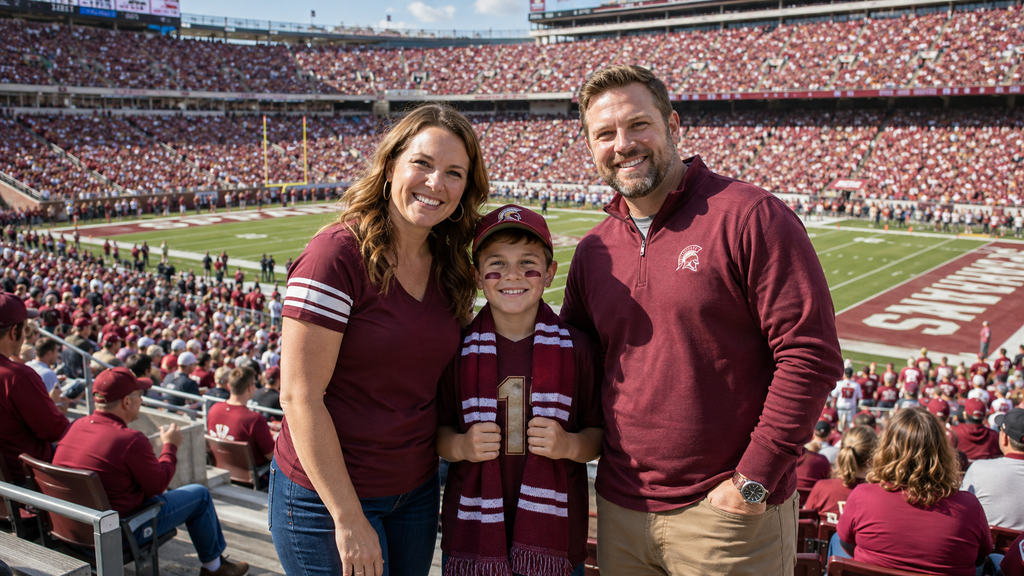
So I turned.
And that was when I saw the man standing at the end of our row.
He was wearing the blue-and-white jersey of Ethan’s favorite team.
At first, I didn’t recognize him.
There were too many people standing, too many phones held in the air, too much noise crashing around us.
Then Ethan screamed.
Not a frightened scream.
A scream of pure disbelief.
“DAD!”
He grabbed Mark’s arm.
“DAD, THAT’S JACKSON REED!”
My heart stopped.
Everyone who followed football knew that name.
Jackson Reed.
The team’s legendary quarterback.
Ethan’s hero.
The player whose poster had hung over Ethan’s bed since he was six years old.
The player whose number Ethan wore during every chemotherapy appointment because he said it made him feel brave.
The player whose interviews Ethan could practically recite from memory.
Jackson was walking toward us.
But he wasn’t alone.
Behind him were three other players.
Then the head coach.
Then the woman from the hospital wish organization.
And beside her stood Ethan’s oncologist, Dr. Patel.
That was when my smile disappeared.
Why was Ethan’s doctor here?
I looked at Mark.
He was still pale.
And now there were tears in his eyes.
“Mark,” I whispered.
“What’s happening?”
He swallowed.
“I don’t know.”
But I could tell he knew something.
Or at least suspected something.
Jackson reached our row.
Everyone around us was cheering.
Ethan seemed to forget that he was sick.
He forgot about hospitals.
He forgot about needles.
He forgot about scans.
He forgot about the thin blanket he slept beneath while chemotherapy drugs dripped into his body.
For that moment, he was simply a ten-year-old boy meeting his hero.
Jackson crouched in front of him.
“Are you Ethan?”
Ethan nodded so quickly I almost laughed.
“Yes.”
Jackson grinned.
“I’ve heard a lot about you.”
Ethan stared at him.
“You have?”
“I have.”
“How?”
Jackson looked toward the enormous screen.
Then he looked back at Ethan.
“Because a lot of people have been working pretty hard to get you here.”
Ethan looked at me.
I shrugged helplessly.
I knew nothing.
At least, I thought I knew nothing.
Jackson held out his hand.
Ethan reached for it.
Jackson didn’t shake it.
Instead, he pulled Ethan gently into a hug.
My son closed his eyes.
And suddenly I was crying.
I couldn’t stop myself.
For months, people had touched Ethan because they needed something from his body.
Doctors touched him to examine him.
Nurses touched him to insert IV lines.
Technicians touched him to position him beneath scanning machines.
I had touched him to comfort him while he vomited.
Mark had carried him when his legs became too weak.
But this was different.
This was someone touching my son because he wanted Ethan to know that he mattered.
When Jackson pulled away, he took off his jersey.
He signed the back.
Then he handed it to Ethan.
Ethan stared at it.
“You’re giving this to me?”
Jackson laughed.
“Unless you think I should give it to your dad.”
Ethan immediately clutched it to his chest.
“No.”
The entire section laughed.
Even Mark laughed through his tears.
Then the announcer’s voice returned.
“Ethan, we told you there was something you didn’t know about this trip.”
The stadium became quieter.
“But the surprise isn’t simply meeting your favorite player.”
Ethan looked up.
Neither Mark nor I moved.
The announcer continued.
“Several weeks ago, someone contacted the team and told us about a ten-year-old boy who had been fighting harder than anyone should ever have to fight.”
Pictures appeared on the giant screen.
My breath caught.
They were pictures of Ethan.
One showed him at six years old holding his first football.
Another showed him asleep on Mark’s chest after his first surgery.
Another showed him at the hospital wearing his favorite jersey.
Then came a photograph I had never seen.
Ethan was sitting beside another little boy in the pediatric oncology ward.
The boy had no hair.
Neither did Ethan.
They were smiling at each other while holding plastic swords.
The announcer said:
“We were told Ethan loved football.”
A cheer went through the crowd.
“But we were also told something else.”
The screen changed.
Words appeared.
ETHAN’S RULE: NO KID FIGHTS ALONE.
I covered my mouth.
I knew those words.
Ethan had said them months earlier.
One afternoon, after meeting a newly diagnosed six-year-old named Leo, Ethan had asked me if we could buy him a football.
I had told him we could.
Ethan had said:
“He shouldn’t be scared by himself, Mom. No kid fights alone.”
I thought it had been something only I heard.
Apparently, someone else had remembered.
The announcer continued.
“While Ethan has been fighting his own illness, hospital staff say he has spent much of his time trying to make other children less afraid.”
Another picture appeared.
Ethan handing a football card to Leo.
Another.
Ethan drawing team logos with a little girl in a hospital bed.
Another.
Ethan sitting in a wheelchair, giving two thumbs up to another patient being taken for surgery.
People around us began applauding.
Not politely.
Loudly.
Thousands of strangers were standing for my son.
Ethan looked overwhelmed.
He leaned toward me.
“Mom?”
I took his hand.
“It’s okay, sweetheart.”
“Why are they clapping?”
I couldn’t speak.
Jackson answered for me.
“Because they think you’re pretty incredible.”
Ethan lowered his head.
A shy smile appeared.
Then the announcer said something that changed everything.
“But there is one more reason Ethan’s story reached this stadium.”
Mark suddenly gripped the seat in front of him.
I looked at him.
“What?”
He shook his head.
Tears were sliding down his face now.
“What is it?”
He whispered:
“I wrote the letter.”
I stared at him.
“What letter?”
He looked at Ethan.
Then back at me.
“Three months ago.”
My stomach tightened.
Three months ago.
That was before Dr. Patel told us the treatment was failing.
Before the final wish.
Before the woman from the organization appeared.
Mark wiped his eyes.
“I wrote to Jackson Reed’s foundation.”
“You did what?”
“I didn’t think anyone would answer.”
The announcer continued speaking, but I barely heard him.
Mark leaned closer.
“Ethan was having that terrible week after his treatment. Remember? He wouldn’t eat. He wouldn’t talk. He just watched old game highlights.”
I remembered.
Of course I remembered.
There were nights from that period that would remain inside me forever.
Ethan curled beneath a blanket.
His skin gray.
His lips dry.
The television playing silently while he stared at football players running across the screen.
I had sat beside him pretending I wasn’t terrified.
Mark continued.
“He asked me if Jackson had ever been scared before a game.”
I nodded slowly.
“He asked me that too.”
“I went home that night and wrote to the foundation.”
His voice cracked.
“I told them about him.”
“Why didn’t you tell me?”
“Because nothing happened.”
Mark looked ashamed.
“They emailed once asking for medical verification. I sent them Dr. Patel’s office contact. Then I never heard anything else.”
I turned toward Dr. Patel.
He was standing several seats away.
And he was smiling.
The announcer’s voice became clear again.
“Jackson Reed’s Foundation originally wanted to invite Ethan to practice.”
The crowd cheered.
“But before those plans could be completed, Ethan’s condition changed.”
I felt my chest tighten.
“His doctors believed traveling might become impossible.”
Ethan squeezed my hand.
I squeezed back.
“So the foundation contacted an organization that specializes in granting wishes to children facing serious illnesses.”
I turned toward the woman who had visited Ethan’s hospital room.
She smiled through her tears.
Everything suddenly made sense.
The football game had never been random.
They had known.
They had all known.
Except us.
The announcer continued.
“When Ethan said his greatest wish was to attend a football game with his parents, everyone involved realized something extraordinary.”
Jackson looked at Ethan.
“You chose the same thing we were already trying to give you.”
Ethan’s mouth fell open.
“No way.”
Jackson laughed.
“Way.”
The crowd laughed with him.
But then Dr. Patel stepped forward.
And something in his expression made me frightened again.
He wasn’t smiling anymore.
The announcer said:
“And now, Ethan’s parents are about to learn the second part of the surprise.”
Mark looked at me.
I looked at him.
Dr. Patel came closer.
My entire body became cold.
Whenever a doctor approached us with that expression, my mind automatically prepared for terrible news.
Scans.
Numbers.
Progression.
Treatment failure.
Complications.
I almost said:
Please.
Not here.
Don’t tell us something terrible here.
Not while Ethan is smiling.
Dr. Patel seemed to understand.
He leaned toward us.
“This isn’t bad news.”
I nearly collapsed with relief.
Mark grabbed my hand.
Dr. Patel continued quietly so only the three of us could hear him.
“Two weeks ago, I received a call from a research hospital in Boston.”
I stared at him.
He continued.
“They have been studying a treatment specifically targeting the genetic mutation present in Ethan’s tumor.”
My breathing stopped.
For months, I had learned to fear the word treatment.
Treatment meant nausea.
Treatment meant pain.
Treatment meant hope followed by disappointment.
Treatment meant watching my child lose pieces of his childhood.
So I didn’t allow myself to react.
Dr. Patel seemed to know that too.
He said carefully:
“This is not a guarantee.”
Those five words grounded me.
“There are no guarantees,” he continued. “And I need to be completely honest about that.”
Mark nodded.
“But?”
Dr. Patel looked at Ethan.
“But Ethan may qualify.”
I felt Mark’s hand tighten around mine.
“For what?”
“A clinical trial.”
I stared at him.
The stadium disappeared.
The cheering.
The players.
The giant screen.
Everything.
There was only Dr. Patel.
Me.
Mark.
And the possibility contained in those words.
A possibility I had stopped allowing myself to imagine.
I whispered:
“You told us there weren’t any more treatments.”
“There weren’t.”
“When?”
“Three weeks ago.”
My voice shook.
“And now?”
“Now there may be one.”
I began crying before I realized what was happening.
Dr. Patel immediately added:
“Please understand what I’m saying. This treatment is experimental. Ethan still needs additional testing. He may not qualify. Even if he qualifies, we cannot know how his body will respond.”
“I understand.”
I didn’t.
Not really.
I only understood one word.
May.
For months, every sentence had ended with no.
No response.
No improvement.
No surgical option.
No standard treatment remaining.
No certainty.
Now someone had finally given us a may.
And when you are the mother of a dying child, sometimes may feels enormous.
Mark covered his face.
His shoulders shook.
I had rarely seen my husband cry.
He had cried quietly when Ethan was first diagnosed.
He had cried in the hospital parking garage after the second surgery.
He had cried once in our kitchen at two in the morning when he thought I was asleep.
But he always tried to hide it.
This time, he couldn’t.
Ethan tugged his sleeve.
“Dad?”
Mark immediately knelt beside him.
“Yeah, buddy?”
“Are you sad?”
Mark laughed through his tears.
“No.”
“Then why are you crying?”
Mark took Ethan’s face between his hands.
“Because sometimes people cry when they hear something they really needed to hear.”
Ethan studied him.
Then looked at me.
“Mom’s crying too.”
“I know.”
“Adults are weird.”
Jackson Reed laughed.
“That part is definitely true.”
Ethan grinned.
Then he looked at Dr. Patel.
“What did you tell them?”
Dr. Patel crouched.
He never talked over Ethan.
That was something I had always appreciated about him.
From the beginning, he treated our son as a person rather than a diagnosis.
“I told your parents that some doctors in Boston might have another medicine we can try.”
Ethan’s smile faded slightly.
“More chemo?”
“Not exactly.”
“Will I get sick?”
“We don’t know.”
“Will I lose my hair?”
Dr. Patel smiled gently.
“You’ve already beaten them to it.”
Ethan touched his bald head.
“True.”
Then he asked the question none of us wanted him to ask.
“Will it make me better?”
Silence.
Dr. Patel looked him directly in the eyes.
“I don’t know, Ethan.”
My heart broke all over again.
But I was grateful he didn’t lie.
Children know when adults lie about important things.
And Ethan had spent enough time around hospitals to understand more than most adults realized.
Dr. Patel continued.
“What I do know is that some very smart people think it might be worth trying.”
Ethan considered this.
“Do you think I should?”
Dr. Patel glanced at us.
“That’s something you and your parents will decide together.”
Ethan thought for approximately three seconds.
Then he said:
“Okay.”
I almost laughed.
“Okay?”
He nodded.
“I want to try.”
“Sweetheart—”
He looked at me.
“If it doesn’t work, I still got to come here.”
He lifted Jackson’s jersey.
“And I got this.”
Jackson put a hand over his heart as though Ethan had said something profound.
Maybe he had.
Then Ethan added:
“And if it does work, maybe I can come back next year.”
I couldn’t answer.
Mark turned away.
Dr. Patel wiped his eyes.
Even Jackson looked down for a moment.
Then the announcer spoke again.
“Ethan, we have one final question for you.”
Everyone turned toward the field.
A team employee held a football.
The announcer continued.
“Would you like to come down to the sideline and help lead the team onto the field for the second half?”
Ethan looked at me so fast I thought he might hurt his neck.
“CAN I?”
I laughed.
“Yes.”
“Really?”
“Yes.”
He turned toward Mark.
“Dad?”
Mark pretended to think.
“I don’t know. That sounds dangerous.”
“DAD.”
“I suppose we can allow it.”
Ethan threw his arms around him.
Around us, people were cheering again.
For once, I didn’t care that thousands of strangers were watching me cry.
A golf cart took us through the stadium corridors.
Ethan sat between Jackson and another player, talking so quickly I could barely follow the conversation.
He asked about plays.
About helmets.
About how loud it was on the field.
About whether players could actually hear coaches when the crowd screamed.
Then he asked Jackson:
“Were you ever scared?”
Jackson looked at him.
“Before games?”
“Yeah.”
“All the time.”
Ethan seemed shocked.
“You?”
“Especially me.”
“But you’re Jackson Reed.”
Jackson smiled.
“That doesn’t mean I don’t get scared.”
“What do you do?”
Jackson looked toward the tunnel leading to the field.
“I remind myself that being scared doesn’t mean I can’t take the next step.”
Ethan became quiet.
Then he nodded.
“I do that at the hospital.”
My throat tightened.
Jackson looked at him.
“I figured you probably did.”
When we reached the tunnel, Ethan climbed carefully from the cart.
His legs were weak.
He had lost weight.
The jersey hanging from his body made him look even smaller.
For one terrible instant, all I could see was how sick my child was.
Then Jackson handed him a football.
Ethan held it.
And his posture changed.
His shoulders lifted.
His face brightened.
He wasn’t a cancer patient standing in a stadium tunnel.
He was Ethan.
My Ethan.
The boy who used to run through our living room wearing a plastic helmet.
The boy who drew football plays on napkins.
The boy who once knocked over a lamp trying to reenact a touchdown and blamed “momentum.”
The team assembled behind him.
Massive men wearing helmets and shoulder pads.
Ethan looked tiny.
But somehow he didn’t look fragile.
Jackson knelt beside him.
“When those doors open, you run as fast as you can.”
Ethan looked at his legs.
“I can’t run very fast anymore.”
Jackson shook his head.
“Nobody said you have to be fast.”
He pointed toward the field.
“You just have to go forward.”
I turned away and cried again.
Those words would stay with me for the rest of my life.
You just have to go forward.
The doors opened.
Light poured into the tunnel.
The stadium exploded.
Ethan took one step.
Then another.
Then he started running.
Not fast.
Not like before the illness.
His body couldn’t do that anymore.
But he ran.
His little arms pumping.
The football tucked against his side.
Seventy thousand people were standing.
The team followed him.
Mark wrapped his arm around my shoulders.
I screamed Ethan’s name until my throat hurt.
Halfway onto the field, Ethan stumbled.
My heart jumped.
Jackson reached toward him.
But Ethan caught himself.
He looked back.
Jackson waited.
Ethan straightened.
And kept going.
The crowd became even louder.
I buried my face against Mark’s shoulder.
“He’s running.”
“I know.”
“Mark, he’s running.”
“I know.”
Three days earlier, I had helped Ethan walk from his hospital bed to the bathroom.
Now he was running onto a football field.
Maybe only thirty yards.
Maybe slowly.
Maybe with trembling legs.
But he was running.
And sometimes miracles aren’t cures.
Sometimes they are moments you thought your child would never experience.
After the game, we were taken into a private team room.
Ethan was exhausted.
I could see it immediately.
His cheeks had lost color.
His breathing was heavier.
The adrenaline that had carried him through the afternoon was fading.
I knelt in front of him.
“Ready to go back to the hotel?”
He looked worried.
“Are the players coming?”
“They probably have things to do, sweetheart.”
He tried to hide his disappointment.
“Oh.”
Then the door opened.
Jackson walked in.
Behind him came half the team.
Ethan’s eyes widened.
For the next forty minutes, players signed footballs, jerseys, programs, and even Ethan’s sneakers.
One defensive lineman signed Ethan’s bald head with a washable marker.
I stared at him.
“Did you just sign my son?”
The enormous man froze.
“Was I not supposed to?”
Ethan laughed so hard he started coughing.
Even I laughed.
It had been months since the three of us laughed like that.
Eventually, though, Ethan’s energy disappeared.
I saw his eyelids drooping.
Jackson saw it too.
He sat beside him.
“Tired?”
Ethan nodded.
“A little.”
“You did more running than me today.”
“No, I didn’t.”
“Sure felt like it.”
Ethan leaned against Mark.
Then something happened that I never expected.
He looked around at all the players.
And quietly said:
“Can I ask something?”
Jackson nodded.
“Anything.”
Ethan hesitated.
“If I don’t get better…”
My entire body went rigid.
Mark closed his eyes.
Nobody spoke.
Ethan continued.
“If the new medicine doesn’t work…”
He looked down at the football in his lap.
“Could you do something for me?”
Jackson’s expression changed.
“What?”
“There are kids at my hospital who like football.”
He looked at me.
“Leo does.”
I nodded.
“And Marcus.”
“Yes.”
“And that girl who likes your team but pretends she doesn’t.”
I smiled.
“Sophie.”
“Yeah.”
He looked back at Jackson.
“Could you send them stuff too?”
Jackson stared at him.
Of all the things Ethan could have requested…
More tickets.
Another meeting.
A signed helmet.
Money.
Anything.
He was thinking about the children he might leave behind.
Jackson leaned forward.
“Ethan.”
“Yeah?”
“Tell you what.”
He took the football from Ethan.
He turned it in his hands.
“Why don’t we make it bigger than that?”
Ethan frowned.
“What do you mean?”
Jackson looked toward a woman standing near the door.
She stepped forward.
He said:
“My foundation has been looking for a new project.”
The woman nodded.
Jackson continued.
“I think we just found one.”
“What project?”
Jackson smiled.
“We’re going to start something called Ethan’s Locker.”
Ethan stared at him.
“My locker?”
“Your locker.”
Jackson explained that the foundation would create special lockers at children’s hospitals filled with footballs, jerseys, games, hats, cards, tablets, and other gifts for children undergoing long-term treatment.
Ethan’s eyes became huge.
“At my hospital?”
“We’ll start there.”
“And Leo can get something?”
“Leo can get whatever he wants from it.”
“Even if he likes the Bears?”
Everyone laughed.
Jackson sighed dramatically.
“We’ll make an exception.”
Ethan grinned.
Then Jackson held out his hand.
“Deal?”
Ethan shook it.
“Deal.”
I looked at my son.
At ten years old, facing something no child should ever face, he had somehow turned his final wish into a wish for other children.
That was Ethan.
It had always been Ethan.
That night, back at the hotel, he fell asleep almost immediately.
He still wore the team jersey.
I tried to remove it.
His eyes opened.
“No.”
“You’ll be more comfortable.”
“No.”
“You’re sleeping in it?”
“Yes.”
“It probably smells like a football player.”
His eyes closed.
“Good.”
I kissed his forehead.
Five minutes later he was asleep.
Mark and I sat on the floor beside the hotel window.
Neither of us spoke for a long time.
The stadium was visible in the distance.
Lights still glowed around it.
Eventually, I whispered:
“You wrote to the foundation.”
Mark nodded.
“Why didn’t you tell me?”
“I thought it would be one more disappointment.”
I looked at him.
He stared at Ethan.
“I couldn’t give him anything.”
“That’s not true.”
“That’s how it felt.”
His voice broke.
“I’m his father. He would look at me when something hurt, and I couldn’t stop it.”
I reached for his hand.
“He would ask if the medicine was working, and I couldn’t answer.”
“You were there.”
“I wanted to fix it.”
“I know.”
“I kept thinking that’s what fathers are supposed to do.”
He wiped his face.
“And then I realized I couldn’t.”
I squeezed his hand.
“You gave him today.”
Mark shook his head.
“People I’d never met gave him today.”
“You started it.”
He looked at me.
“You wrote the letter.”
For a while, we watched our son sleep.
Then Mark whispered:
“Did you hear what Dr. Patel said?”
“Yes.”
“You think we should do it?”
“The trial?”
He nodded.
I stared at the carpet.
“I don’t know.”
It hurt to admit it.
For months, I had lived in a world where every decision felt impossible.
More treatment could mean more pain.
No treatment could mean less time.
Hope could keep us fighting.
Hope could also keep Ethan suffering.
I whispered:
“I’m scared we’re going to make him spend whatever time he has left in another hospital.”
Mark nodded.
“I’m scared of that too.”
“And I’m scared if we don’t try…”
“We’ll always wonder.”
“Yes.”
We sat silently.
Then a sleepy voice came from the bed.
“You guys are terrible whisperers.”
We both froze.
Ethan opened one eye.
“How long have you been awake?” I asked.
“Long enough.”
“You were supposed to be sleeping.”
“I was.”
He shifted.
Then he looked at us.
“You’re talking about Boston.”
Neither of us answered.
He sighed.
“Come here.”
I almost laughed.
Our ten-year-old was ordering us around like adults.
We walked to the bed.
He reached out both hands.
I took one.
Mark took the other.
“I want to try.”
I swallowed.
“You don’t have to decide tonight.”
“I already decided.”
“Ethan—”
“Mom.”
His voice was gentle.
“I know I might die.”
Every cell in my body rejected those words.
“No.”
He squeezed my hand.
“Mom.”
I started crying.
He waited.
That was another thing illness had done to my child.
It had taught him patience with adults.
“I know everybody thinks I don’t know.”
He looked between us.
“But I do.”
Mark sat on the edge of the bed.
“Buddy…”
Ethan looked at him.
“I hear stuff.”
“What stuff?”
“Doctors.”
“Nurses.”
“You shouldn’t have had to hear—”
“It’s okay.”
“No,” Mark said. “It isn’t.”
Ethan was quiet.
Then he said:
“I’m scared.”
That broke me.
All day he had been smiling.
Laughing.
Running.
Meeting heroes.
Now he was just a frightened little boy lying between his parents.
I climbed into the bed beside him.
He curled against me.
“What scares you?” I asked.
He thought.
“Not seeing you anymore.”
I closed my eyes.
His voice continued.
“And Dad.”
Mark lay on the other side.
Ethan reached for him.
We held our child between us.
“I don’t want you guys to be alone.”
I couldn’t speak.
Mark whispered:
“We’ll always have each other.”
“But you’ll be sad.”
“Yes.”
“At first?”
Mark’s voice cracked.
“For a very long time.”
Ethan frowned.
“That sucks.”
I laughed through my tears.
“Yes.”
“It does.”
Then he whispered:
“I don’t want to be dead.”
There it was.
The sentence that destroyed every protective wall I had built.
I pressed my face against his head.
“I don’t want that either.”
“I want to go back to school.”
“I know.”
“I want to play football.”
“I know.”
“I want to be eleven.”
I held him tighter.
“I know.”
We cried together.
No speeches.
No pretending.
No promises that everything would be okay.
Because sometimes love means refusing to lie, even when the truth is unbearable.
Eventually Ethan whispered:
“So I want to try the medicine.”
I nodded against his head.
“Okay.”
“But if it makes me too sick…”
“We stop.”
He looked at me.
“Promise?”
I looked at Mark.
Then back at Ethan.
“Promise.”
Three days later, we flew to Boston.
The tests began immediately.
Blood work.
Scans.
Biopsies.
Consultations.
More waiting.
Waiting is one of the cruelest parts of serious illness.
People imagine the worst moments happen when doctors deliver bad news.
Sometimes they do.
But there is another kind of suffering in waiting.
Waiting for a scan.
Waiting for a phone call.
Waiting for a doctor to enter the room.
Waiting while your entire life hangs on information you cannot access.
On the fourth day, we sat in a small consultation room.
Ethan played a football game on a tablet.
Mark bounced his knee.
I stared at the clock.
The doctor entered.
Dr. Laura Chen.
She sat down.
I studied her face before she spoke.
Parents of sick children become experts at reading doctors’ faces.
I couldn’t tell.
She placed a folder on the table.
“Ethan qualifies.”
Mark exhaled.
I covered my mouth.
Ethan looked up from the tablet.
“I do?”
Dr. Chen smiled.
“You do.”
“When do I start?”
She blinked.
“Someone is impatient.”
“I have school.”
I almost laughed.
Dr. Chen leaned toward him.
“We can begin tomorrow.”
Then she looked at us.
“I want to review the risks again.”
And she did.
There were many.
This was no miracle treatment.
No magical cure waiting behind a laboratory door.
It was experimental.
There could be severe side effects.
There could be no response.
There could even be complications that shortened the time Ethan had left.
When she finished, she asked:
“Do you understand?”
Mark nodded.
I nodded.
Then Ethan asked:
“How many kids has it helped?”
Dr. Chen paused.
“Not many children have received it yet.”
“How many?”
“Twelve in the current study.”
“And how many got better?”
I held my breath.
“Four had significant tumor reduction.”
Ethan calculated.
“So four out of twelve.”
“Yes.”
“That’s one out of three.”
Dr. Chen smiled.
“You’re good at math.”
“I hate math.”
I laughed.
“So do I,” Mark said.
I gave him a look.
“You’re an accountant.”
“That doesn’t mean I have to enjoy it.”
Ethan looked at Dr. Chen.
“One out of three is better than zero.”
She became very still.
“Yes.”
“It is.”
Treatment started the following morning.
For the first week, nothing dramatic happened.
Then Ethan developed a fever.
Then nausea.
Then fatigue so severe he barely spoke.
The fear returned.
Had we made the wrong decision?
Had we taken a happy child from a football stadium only to put him back into a hospital bed?
One night, his fever reached 104.
Doctors rushed into the room.
Machines beeped.
Nurses moved quickly.
I stood against the wall because there was nowhere else to stand.
Mark held my shoulders.
I watched people surround Ethan.
And all I could think was:
I promised him.
I promised we would stop if it became too much.
After nearly an hour, the fever came down.
Ethan slept.
Mark and I met with Dr. Chen.
“I want to stop,” I said.
Mark didn’t argue.
Dr. Chen nodded.
“That is absolutely an option.”
“Is this normal?”
“It’s a known potential reaction.”
“He’s suffering.”
“Yes.”
I started crying.
“I don’t know how to do this anymore.”
Dr. Chen sat with us.
Not as a researcher.
Not as an expert.
As a human being.
She said:
“You’re allowed to change your mind.”
I looked at Mark.
He nodded.
“We should ask Ethan.”
The next morning, we did.
Ethan listened.
Then asked:
“If we stop, does that mean I go home?”
“Yes,” I said.
“And if we keep going?”
“You might feel sick again.”
“For how long?”
“We don’t know.”
He stared toward the window.
Then he said:
“One more week.”
“Sweetheart—”
“One more.”
I looked at Mark.
Mark nodded slowly.
“One more week.”
Ethan looked at me.
“If it’s terrible again, we stop.”
I touched his cheek.
“Okay.”
The second week was easier.
Not easy.
Easier.
The fever didn’t return.
He ate more.
He started joking with nurses.
He decorated his IV pole with football stickers.
Jackson Reed called twice.
The first time, Ethan was asleep.
The second time, I handed him the phone.
Jackson asked:
“How’s my quarterback?”
Ethan said:
“Your quarterback is tired.”
“Quarterbacks are allowed to be tired.”
“Not during games.”
“Good point.”
They talked for ten minutes.
At the end, Jackson said:
“The first Ethan’s Locker opened today.”
Ethan sat up.
“What?”
“At your home hospital.”
He sent us photographs.
A beautiful blue locker had been installed in the pediatric oncology ward.
Across the top were the words:
ETHAN’S LOCKER
Underneath:
NO KID FIGHTS ALONE.
Ethan stared at the photo.
“Is Leo there?”
Jackson turned the phone.
Leo appeared on the screen wearing a ridiculous oversized helmet.
Ethan laughed.
“DUDE!”
Leo grinned.
“I GOT GLOVES!”
They talked over each other.
For ten minutes, the hospital room became something else.
Not a place of fear.
A clubhouse.
A meeting between friends.
After the call ended, Ethan looked at me.
“Even if this doesn’t work, the locker stays?”
“Yes.”
“Forever?”
“As long as they can keep it running.”
He smiled.
“Cool.”
Four weeks after treatment began, Dr. Chen ordered the first major scan.
That morning, I woke at 4:17.
Mark was already awake.
Neither of us said why.
We knew.
At eight, Ethan went downstairs for imaging.
He joked with the technician.
“If there’s a football inside me, you have to tell me.”
The technician smiled.
“Deal.”
The scan took forty minutes.
The wait for results took four hours.
Four hours.
Two hundred and forty minutes.
Fourteen thousand four hundred seconds.
I felt every one.
Finally Dr. Chen entered.
She held the scan report.
I stood before she sat.
“What?”
She looked at Ethan.
Then at us.
“There’s been a response.”
I didn’t understand.
“What does that mean?”
“The largest tumor has decreased approximately eighteen percent.”
Mark froze.
I stared at her.
“Decreased?”
“Yes.”
“You mean smaller?”
“Yes.”
“How much?”
“Eighteen percent.”
I began laughing.
Not because it was funny.
My body simply had no idea what else to do.
Mark sank into a chair.
He covered his face.
Ethan looked at the doctor.
“So the medicine is working?”
“It appears to be doing something.”
He smiled.
“Good.”
Dr. Chen lifted one finger.
“But we need to stay cautious.”
Of course.
Cautious.
That word became the railing we held while walking between hope and reality.
“This is one scan,” she continued.
“We need sustained response. And there are still significant areas of disease.”
I nodded.
I heard everything.
But there was only one sentence repeating inside my head.
The tumor was smaller.
For the first time in months, something inside my child was moving in the right direction.
We continued.
Another month.
Another scan.
Twenty-seven percent reduction.
Then another.
Thirty-four percent.
Some tumors stopped growing entirely.
Others shrank.
Ethan began gaining weight.
He still tired easily.
He still needed medication.
He still had difficult days.
Cancer did not magically disappear because something finally went right.
But slowly, cautiously, life started entering our conversations again.
Not death.
Life.
“What grade will I be in next year?”
“Can I play flag football?”
“Will my hair grow back curly?”
“Can we get a dog?”
The dog question became suspiciously frequent.
One afternoon Dr. Chen entered his room.
Ethan immediately asked:
“When can I get a dog?”
She looked at me.
I pointed at him.
“Do not encourage him.”
She laughed.
“Medically, I see no reason—”
“Traitor.”
Ethan cheered.
Mark bought him a dog three weeks later.
A golden retriever puppy.
Ethan named him Blitz.
Blitz ate two shoes, a television remote, half of an oncology appointment card, and one corner of Jackson Reed’s signed poster.
Ethan forgave him immediately.
Mark did not.
Six months after the football game, we returned home permanently.
Not because Ethan was cured.
He wasn’t.
The word cure remained too distant and too dangerous to use.
But his disease had stabilized enough for much of his treatment to be managed through regular visits.
The first morning home, I woke to a strange sound.
For months, hospital noises had trained my body.
Beeping monitors.
Rolling carts.
Intercom announcements.
Nurses opening doors.
But this sound was different.
Laughter.
I walked downstairs.
Ethan and Mark were in the backyard.
Ethan wore pajamas and football cleats.
Blitz chased him.
“Mom!”
He threw a football.
It landed three feet in front of me.
“That was terrible,” I said.
“I’m still recovering.”
“Convenient excuse.”
He laughed.
Then he ran toward me.
Actually ran.
Not thirty shaky yards in a stadium.
Across our backyard.
He collided with me.
I held him.
And for one second, I remembered the day Dr. Patel told us there might not be much time left.
I remembered sitting beside Ethan’s hospital bed believing we were approaching the end of our story.
I remembered thinking the football game would be our goodbye.
Instead, somehow, it had become a beginning.
A year after that first game, an envelope arrived.
Inside were three tickets.
Same stadium.
Same team.
Attached was a handwritten note.
You said maybe next year.
Time to keep your promise.
—Jackson
I sat at the kitchen table and cried.
Ethan found me.
“What happened?”
I handed him the tickets.
He stared.
“No.”
“Yes.”
“NO WAY.”
He ran through the house.
“DAD!”
Mark appeared from upstairs.
“What?”
“WE’RE GOING BACK!”
Mark looked at me.
His expression changed when he saw the tickets.
He came down slowly.
For a moment, none of us spoke.
Because all three of us remembered.
A year earlier, Ethan had said:
If it works, maybe I can come back next year.
We hadn’t known if next year existed.
Now it did.
The stadium looked exactly the same.
But we were different.
Ethan had hair again.
Short brown curls.
He hated them.
I loved them.
He was still thinner than most boys his age.
He still carried medication.
We still knew the location of the nearest hospital everywhere we traveled.
But he walked into the stadium on his own.
No wheelchair.
No oxygen.
No exhaustion after twenty steps.
He stopped at the entrance.
I almost walked into him.
“What?”
He looked around.
“This is where we came in last time.”
“Yes.”
He became quiet.
“Were you scared?”
I looked at him.
“When?”
“That day.”
I smiled sadly.
“Terrified.”
“But you smiled.”
“I didn’t want you to know.”
He nodded.
“I knew.”
Of course he had.
We always think we hide fear from children.
Most of the time, we only teach them to pretend they don’t see it.
He took my hand.
“It’s okay.”
Then he pulled me toward our seats.
“Come on.”
During the second quarter, the big screen suddenly showed us.
Ethan screamed.
“AGAIN?”
The crowd recognized him.
I don’t know how many people remembered his face.
But when the words appeared beneath us—
WELCOME BACK, ETHAN
—the stadium erupted.
Mark stood.
I stood.
Ethan waved.
Then the announcer spoke.
“One year ago, a very special young fan joined us.”
Pictures from the previous year appeared.
Ethan bald.
Thin.
Running onto the field.
I pressed my lips together.
The announcer continued.
“At the time, his family believed that game might fulfill one of his final wishes.”
The stadium became silent.
“But Ethan had another wish.”
The image changed.
NO KID FIGHTS ALONE.
People applauded.
The announcer continued.
“In the year since Ethan’s Locker began, twenty-six lockers have been installed in pediatric hospitals across the country.”
Ethan’s mouth fell open.
“Twenty-six?”
I didn’t know either.
The screen showed children opening lockers.
Children wearing jerseys.
Children holding footballs.
Children receiving gifts before surgery.
Then another number appeared.
4,812 CHILDREN SERVED
Ethan stared.
Nearly five thousand children.
Because one frightened ten-year-old had asked that other kids not be forgotten.
Jackson appeared from the tunnel.
This time, Ethan didn’t wait.
He ran down the stairs toward him.
An employee opened the barrier.
Jackson hugged him.
Then held him at arm’s length.
“Look at your hair.”
Ethan groaned.
“Everyone says that.”
“Because it’s ridiculous.”
“I know.”
Jackson turned him toward the screen.
“There’s something else.”
Ethan looked.
A new logo appeared.
THE ETHAN PROJECT
Jackson explained that the foundation was expanding.
Ethan’s Locker would remain.
But a portion of donations would now fund transportation and lodging for families whose children needed to travel for experimental treatments.
My knees nearly gave out.
Families like us.
Families who received a possible treatment hundreds of miles away.
Families who might have to choose between going and paying rent.
Families who might hear the words “clinical trial” and immediately wonder how they could afford to reach it.
Jackson handed Ethan a microphone.
“Want to say something?”
Ethan looked horrified.
“To everyone?”
“All of them.”
“I’m twelve.”
“I’ve heard twelve-year-olds talk before.”
The crowd laughed.
Ethan looked at me.
I nodded.
He took the microphone.
For several seconds, he said nothing.
Then:
“Hi.”
The stadium answered:
“HI, ETHAN!”
He jumped.
Everyone laughed.
He smiled.
“Okay, that was weird.”
More laughter.
Then his expression became serious.
“When I was sick…”
He stopped.
He looked at Jackson.
Then toward us.
“I mean, I’m still sick. Kind of.”
My eyes filled with tears.
“But when I was really sick, I thought being brave meant not being scared.”
The stadium became completely quiet.
“But I was scared all the time.”
He looked down at his shoes.
“I was scared of needles.”
A few people laughed gently.
“I was scared of scans.”
He paused.
“I was scared I was going to die.”
No one moved.
I covered my mouth.
Ethan looked back at the crowd.
“But somebody told me being scared doesn’t mean you can’t take the next step.”
Jackson looked down.
Ethan smiled at him.
“So I think that’s what brave is.”
He shrugged.
“Just taking another step.”
His voice trembled slightly.
“And if you know somebody who’s sick… you don’t have to know what to say.”
He thought.
“You can just be there.”
Another pause.
“Because nobody should fight alone.”
The crowd stood.
All of them.
Thousands.
Applauding my son.
I cried harder than I had the year before.
But this time, the tears felt different.
They still contained pain.
They always would.
But they also contained gratitude.
Ethan never became the same boy he was before cancer.
People sometimes talk about surviving illness as though life simply returns to normal afterward.
Ours didn’t.
Scans became part of our calendar.
A cough could still frighten me.
Every appointment brought back memories.
Every unexplained pain made my stomach tighten.
Ethan had scars.
Physical ones.
Emotional ones.
So did Mark.
So did I.
There were things we lost that we never recovered.
Friends from the oncology floor did not all have Ethan’s outcome.
Leo died the following spring.
He was seven.
His mother called me at three in the morning.
I knew before answering.
Ethan was devastated.
For days, he barely spoke.
Then he asked if we could put Leo’s name inside every Ethan’s Locker.
So we did.
A small plate was added.
FOR LEO, WHO TAUGHT US COURAGE CAN BE LOUD.
Sophie died two years later.
Marcus survived.
Some children improved.
Some didn’t.
That reality prevented us from turning Ethan’s story into something simple.
We never said everything happens for a reason.
Some things shouldn’t happen.
Children should not have to become brave because their bodies are trying to kill them.
Parents should not know the sound of oncology-floor monitors.
Ten-year-olds should not understand mortality better than many adults.
But if suffering came into our lives without permission, we could still decide what we built beside it.
That became Ethan’s greatest lesson to me.
Three years after the first football game, Dr. Chen entered the consultation room holding another set of scans.
By then, I had learned never to read her face.
Ethan was thirteen.
Tall.
Thin.
Annoyed with almost everything I said.
In other words, becoming a normal teenager.
He sat beside me wearing headphones.
Dr. Chen opened the scan.
“Ethan.”
He removed one earbud.
“Yeah?”
“I have good news.”
He stared.
“How good?”
She smiled.
“Very.”
Mark reached for my hand.
Dr. Chen turned the screen toward us.
“For the past eighteen months, we have been unable to identify active progression.”
I stopped breathing.
She continued.
“The remaining areas we’ve been watching appear stable and consistent with treated disease.”
I whispered:
“What are you saying?”
She looked at us.
“I’m saying Ethan has had an extraordinary sustained response.”
“Is he…”
I couldn’t say the word.
Dr. Chen understood.
“We still don’t use the word cured yet.”
My heart dropped slightly.
“But.”
There was that word.
That beautiful word.
But.
“If this continues, his prognosis is now dramatically different from what we discussed three years ago.”
Mark whispered:
“How different?”
Dr. Chen smiled.
“We are no longer talking about months.”
I covered my face.
Mark began crying.
Ethan stared at the screen.
Dr. Chen continued.
“We’re talking about years.”
I heard a sound come from my throat.
Half laugh.
Half sob.
Years.
Such a small word.
Five letters.
But to parents who once measured life in weeks, years sounded like eternity.
Ethan looked at her.
“So I’m not dying?”
Dr. Chen took a moment before answering.
“We’re all dying eventually.”
Ethan rolled his eyes.
“Doctor answer.”
She laughed.
Then she became serious.
“No, Ethan. Based on what we see now, I do not believe you are approaching the end of your life.”
His lower lip trembled.
He turned away.
I had rarely seen him cry since he became a teenager.
He wiped his face aggressively.
“Something in my eye.”
Mark laughed.
“Of course.”
“Shut up, Dad.”
I wrapped my arms around him.
He resisted for exactly two seconds.
Then he hugged me.
Hard.
“You’re crushing me,” I whispered.
“Good.”
I felt his shoulders shake.
“I thought I was going to die.”
“I know.”
“I really thought I was.”
“I know.”
“I planned stuff.”
I pulled back.
“What stuff?”
He looked embarrassed.
“Letters.”
My heart stopped.
“What letters?”
He glanced at Mark.
“You weren’t supposed to know.”
Mark’s face changed.
“Where are they?”
Ethan sighed.
“In my old football box.”
That night, we found them.
Three envelopes.
One said:
MOM
One:
DAD
One:
FOR BOTH OF YOU
We asked Ethan if he wanted us to read them.
He said no.
“Burn them.”
I couldn’t.
Neither could Mark.
They remained unopened inside a drawer.
Not because we expected to need them.
But because they belonged to a version of our son who had once believed goodbye was coming.
Someday, when he is older, they will be his decision.
At fifteen, Ethan joined his high school football team.
Not quarterback.
His doctors strongly discouraged high-impact play because of everything his body had endured.
So he became an assistant student coach.
At first, he hated the limitation.
“This is stupid.”
“It keeps you involved,” Mark said.
“I want to play.”
“I know.”
“I can play.”
“You can also injure yourself.”
“Dad.”
“Ethan.”
They argued for weeks.
Eventually Ethan accepted it.
And then something unexpected happened.
He loved coaching.
He noticed things other people missed.
He remembered plays.
He understood nervous players.
When freshmen panicked before games, Ethan sat beside them.
He never gave speeches.
He usually said something simple.
“You’re allowed to be scared.”
Then:
“Take the next step.”
The same words Jackson once told him.
I watched those words move from one person to another.
That is how kindness survives.
Someone gives it to you when you need it.
Years later, without realizing it, you give it away.
When Ethan turned sixteen, he asked us to return to the stadium.
Not for a game.
For a fundraiser.
By then, Ethan’s Locker existed in more than one hundred hospitals.
The Ethan Project had helped hundreds of families travel for specialized treatment.
Jackson Reed had retired from football.
His knees had finally convinced him that human bodies were not designed to be hit by enormous men every Sunday.
He remained involved with the foundation.
When Ethan walked onto the stage that evening, Jackson introduced him.
“This kid once led my team onto the field.”
Ethan corrected him.
“I led you approximately thirty yards.”
Jackson nodded.
“Best thirty yards of my career.”
The audience laughed.
Then a photograph appeared behind them.
Ten-year-old Ethan.
Bald.
Tiny.
Holding a football in the stadium tunnel.
Beside it appeared a recent photo.
Sixteen-year-old Ethan.
Tall.
Curly-haired.
Smiling.
I was sitting beside Mark in the audience.
I looked at the two photographs.
And the distance between them felt impossible.
Six years.
There had been a time when I would have sacrificed anything for six more days.
Now we had been given six years.
Mark reached for my hand.
“You okay?”
“No.”
He smiled.
“Me neither.”
Ethan stepped toward the microphone.
“I hate when people call me inspirational.”
Everyone laughed.
I laughed too.
Because that was absolutely something my son would say.
“I’m serious.”
He smiled.
“When people hear that I had cancer, sometimes they tell me I’m inspirational before they even know anything about me.”
He shrugged.
“I could be a terrible person.”
More laughter.
“But I understand why people say it.”
His expression changed.
“And I’m grateful I’m here.”
He looked toward us.
“But I don’t think surviving makes me better than the kids who didn’t.”
Silence filled the room.
“Leo didn’t lose.”
My eyes filled.
“Sophie didn’t lose.”
Ethan took a breath.
“People say things like ‘he lost his battle with cancer.’ I don’t like that.”
His voice became stronger.
“Because that makes it sound like surviving means you fought harder.”
He shook his head.
“I knew kids who fought harder than anybody.”
Jackson looked down.
Ethan continued.
“So the project isn’t about winners and losers.”
He pointed toward the words projected behind him.
NO KID FIGHTS ALONE.
“It’s about making sure that while somebody is fighting, they know somebody is standing beside them.”
The audience rose.
I didn’t.
I couldn’t.
I sat there crying while everyone around me stood.
Mark wrapped his arm around me.
I whispered:
“Do you remember what the doctor told us?”
He nodded.
“I remember everything.”
“He said we didn’t have much time.”
“I know.”
I looked at our son.
“We got so much time.”
Mark kissed my forehead.
“We did.”
When Ethan was seventeen, he received his acceptance letter to college.
He wanted to study pediatric medicine.
Of course he did.
Mark thought he might choose sports management.
I thought psychology.
Ethan chose medicine.
Specifically pediatric oncology research.
When I asked why, he looked at me as though the answer should have been obvious.
“Because somebody made the medicine that saved me.”
I became quiet.
He continued.
“Dr. Chen didn’t invent it. Dr. Patel didn’t invent it.”
“No.”
“Some researcher probably sat in a lab for years working on something without knowing if it would help anyone.”
“Yes.”
“And then it helped me.”
I nodded.
“So maybe I can do that for somebody else.”
I cried.
He groaned.
“Mom.”
“I’m allowed.”
“You cry about everything.”
“I earned the right.”
He smiled.
“Fair.”
The night before Ethan left for college, I found him in his bedroom.
Most of his belongings were packed.
The walls were nearly empty.
Except for one thing.
Jackson Reed’s signed jersey.
The one from the first football game.
It hung above his desk.
Old now.
Faded slightly.
Ethan stood looking at it.
“You taking it?” I asked.
He shook his head.
“No.”
“Why?”
“I think it belongs here.”
I entered.
He sat on the edge of his bed.
I sat beside him.
For a while, we said nothing.
Then he asked:
“Do you still have the letters?”
I knew exactly what he meant.
“Yes.”
“You never read them?”
“Never.”
He looked surprised.
“Seriously?”
“You asked us not to.”
“Dad didn’t?”
“No.”
“He definitely wanted to.”
“He did.”
Ethan smiled.
Then became quiet.
“Can I have them?”
I brought them downstairs.
He held the three envelopes.
His ten-year-old handwriting was printed across the front.
MOM.
DAD.
FOR BOTH OF YOU.
He stared at them.
Then asked:
“Fireplace?”
I hesitated.
“Are you sure?”
“Yeah.”
We called Mark.
The three of us sat in the living room.
Ethan opened the fireplace door.
He held the first envelope.
Then stopped.
“You know what’s weird?”
“What?” Mark asked.
“I don’t remember everything from when I was sick.”
I nodded.
“That’s normal.”
“But I remember that football game.”
“So do I.”
“I remember the screen.”
Mark laughed.
“I remember your mother almost falling over when Dr. Patel mentioned Boston.”
“I did not almost fall over.”
“You absolutely did.”
Ethan smiled.
Then held up the envelope.
“I wrote these because I thought I wouldn’t get to grow up.”
My throat tightened.
He looked around our living room.
At his college boxes.
At Blitz, now an elderly dog asleep near the sofa.
At his father.
At me.
Then he smiled.
“But I did.”
He dropped the letter into the fire.
The flames caught the corner.
Then the second.
Then the third.
We watched the envelopes burn.
I expected sadness.
Instead, I felt something close to peace.
Those letters had been written by a child preparing to disappear.
The young man sitting beside me no longer needed them.
When the last piece curled into ash, Ethan stood.
“Okay.”
“Okay what?” I asked.
“I need sleep.”
Mark laughed.
“You burn your final letters and then just go to bed?”
“I have to drive six hours tomorrow.”
I stared at him.
“What?”
“What?”
“You are not driving.”
“Mom.”
“Your father is driving.”
“Mom.”
“You can barely merge.”
“I’m eighteen.”
“You’re still terrible at merging.”
Mark sided with Ethan.
This led to a twenty-minute argument.
It was ridiculous.
Ordinary.
Beautiful.
I remember thinking:
This.
This was what I wanted.
Not some giant miracle.
Not stadium applause.
Not television cameras.
I wanted to argue with my grown son about highway merging.
I wanted laundry on his floor.
I wanted to complain that he never texted when he arrived somewhere.
I wanted him to become old enough to annoy me.
When your child is dying, ordinary life becomes the most precious thing in the world.
Years later, people still ask me about that football game.
Some remember seeing the clip online.
The sick little boy on the giant screen.
The quarterback surprising him.
The announcement of a possible treatment.
The tiny figure running from the tunnel.
They often say:
“That game changed his life.”
And they’re right.
But not exactly in the way people imagine.
The football game didn’t cure Ethan.
Doctors did not discover some magical treatment because seventy thousand people cheered.
There was no guaranteed miracle hidden behind that stadium seat.
The trial could have failed.
For other children, it did.
What that day gave us was something more complicated.
It gave Ethan joy at a moment when his world had become almost entirely medical.
It gave Mark proof that the desperate letter he had written in the middle of the night had mattered.
It connected our family to people who helped us reach a treatment we might otherwise have learned about too late.
It gave Ethan a way to turn fear into something useful.
And it taught me something I had misunderstood my entire life.
I used to think hope meant believing everything would turn out the way you wanted.
It doesn’t.
Hope is smaller than that.
And stronger.
Hope is sitting beside your child while a doctor says there may be one more option.
Hope is signing a consent form with shaking hands.
Hope is agreeing to one more week.
Hope is watching your son stumble on a football field and seeing him choose to keep running.
Hope is knowing there are no guarantees and taking the next step anyway.
Twenty years after that first game, I stood outside another hospital room.
I was older.
Mark was beside me.
His hair had turned gray.
Mine had too, although I blamed him for most of mine.
Through the glass, we could see a doctor speaking with a frightened little boy.
The doctor was tall.
Brown curls.
A familiar serious expression.
Dr. Ethan Carter.
Our son.
He had finished medical school.
Residency.
Research training.
And eventually returned to pediatric oncology.
On the wall outside the ward was a blue locker.
The newest version.
ETHAN’S LOCKER
NO KID FIGHTS ALONE.
I touched the lettering.
Mark smiled.
“Still weird?”
“Yes.”
“He hates when people make a big deal about it.”
“I know.”
Inside the room, Ethan crouched beside the boy.
The child was holding a football.
I couldn’t hear everything through the glass.
But eventually the boy asked something.
Ethan answered.
The child looked afraid.
Ethan sat beside him.
Then I saw my son say words I could read even through the glass.
Being scared doesn’t mean you can’t take the next step.
I closed my eyes.
Suddenly, I wasn’t standing in a hospital corridor.
I was back in that stadium tunnel.
Ethan was ten.
Bald.
Fragile.
Holding a football almost too large for his hands.
Jackson Reed was kneeling beside him.
The tunnel doors were opening.
And my child was running toward the light.
I felt Mark take my hand.
“You okay?”
I smiled.
“Yes.”
This time, I meant it.
The room door opened.
Ethan stepped into the hallway.
He was wearing a white coat.
A stethoscope hung around his neck.
But for one second, all I saw was my ten-year-old boy.
“Why are you two standing out here being creepy?” he asked.
Mark laughed.
“We came to take you to dinner.”
“I told you I’m working late.”
“You need food.”
“I’m a doctor.”
“You’re still our kid.”
Ethan rolled his eyes.
Some things never change.
Then he noticed me crying.
“Mom.”
“I know.”
“You promised you wouldn’t.”
“I never promised that.”
“You cry every time you come here.”
“You chose oncology. That’s on you.”
He laughed.
Then his expression softened.
“The kid in there likes football.”
“I saw.”
“He’s starting treatment tomorrow.”
I nodded.
“Scared?”
“Terrified.”
Ethan looked through the glass.
“But he’ll have people with him.”
I touched his arm.
“Yes.”
“He will.”
Before we left, the little boy’s mother came into the hallway.
Her face looked exhausted.
I knew that face.
I had worn it.
The expression of a parent whose world has suddenly become test results and treatment plans.
She recognized Ethan.
“Doctor?”
He turned.
She hesitated.
“My son asked me something.”
“What?”
“He wants to know if you’ll come see him before treatment tomorrow.”
Ethan smiled.
“Of course.”
She looked relieved.
“Thank you.”
Then she glanced toward the locker.
“He told me you were sick when you were a kid.”
Ethan nodded.
“I was.”
“Like him?”
“In some ways.”
Her eyes filled.
“And you’re okay?”
Ethan paused.
I knew why.
He would never promise another parent that their child’s story would match his.
He had seen too much.
He had lost too many friends.
So he answered carefully.
“I’m here.”
The woman nodded.
Sometimes that is enough.
As she returned to the room, Ethan looked at me.
“What?”
“Nothing.”
“You’re doing the face.”
“What face?”
“The proud mom face.”
“I don’t have a proud mom face.”
Mark snorted.
“You absolutely do.”
We walked toward the elevators.
Halfway down the hallway, Ethan stopped.
“What?” I asked.
He turned toward the locker.
A football was sticking out slightly from the bottom shelf.
He walked back.
He pushed it into place.
Then closed the door carefully.
I watched him.
And suddenly I understood something.
The final wish we thought we were giving our son all those years ago had never truly ended.
It had kept moving.
From Mark’s desperate letter.
To the wish organization.
To a football stadium.
To Jackson Reed.
To Boston.
To a clinical trial.
To Ethan’s Locker.
To thousands of children.
To research laboratories.
To hospital rooms.
To the frightened boy behind us.
One act of kindness had collided with another.
Then another.
Then another.
Until something that began as a dying child’s wish had become a chain of people refusing to let strangers fight alone.
Ethan caught me staring.
“Mom.”
“What?”
“Please don’t start crying again.”
I smiled.
“No promises.”
He groaned.
Mark laughed.
The elevator doors opened.
Ethan stepped inside.
Then he turned and held the door for us.
“Coming?”
I looked at my son.
My grown son.
The boy we once believed we were losing.
The boy who had asked only to see one football game before he died.
The boy who had stood beneath a stadium screen while an announcer told us there was something we didn’t know about the trip.
Back then, I thought the surprise was Jackson Reed.
Then I thought it was the clinical trial.
For years, I believed the miracle was that the medicine worked.
But standing there decades later, I finally understood.
The greatest surprise had been time.
Time for another birthday.
And another.
Time for school.
For a dog.
For arguments.
For grief.
For friends.
For football games.
For college.
For first dates.
For heartbreak.
For graduation.
For medical school.
For ordinary mornings.
For difficult nights.
For stupid jokes.
For growing older.
Time for my ten-year-old boy to become a man.
And time for that man to stand beside other frightened children and tell them the same thing someone once told him.
You can be scared.
You can be tired.
You can stumble.
You can even fall.
But as long as there is another step available to you—
take it.
I stepped into the elevator.
The doors closed.
And as we descended toward the lobby, Ethan was arguing with his father about where we should eat dinner.
I stood between them, listening.
Smiling.
Grateful beyond words for the ordinary sound of my family disagreeing about food.
Because once upon a time, I had taken my terminally ill ten-year-old son to a football game believing I was helping him fulfill his final wish.
I was wrong.
It wasn’t his final wish.
It was only the beginning.
THE END! THANK YOU FOR READING!❤️