 Reading Time: 35 minutes
My parents told Grandma Eleanor they were taking her out for lunch. Three hours later, a nursing facility in Ohio called me. Her suitcase was sitting in their lobby. My parents were gone.
And my eighty-one-year-old grandmother was sitting alone beside a grocery bag full of medication, still wearing the blue church coat she had carefully buttoned that morning because she believed her son and daughter-in-law were taking her somewhere nice to eat.
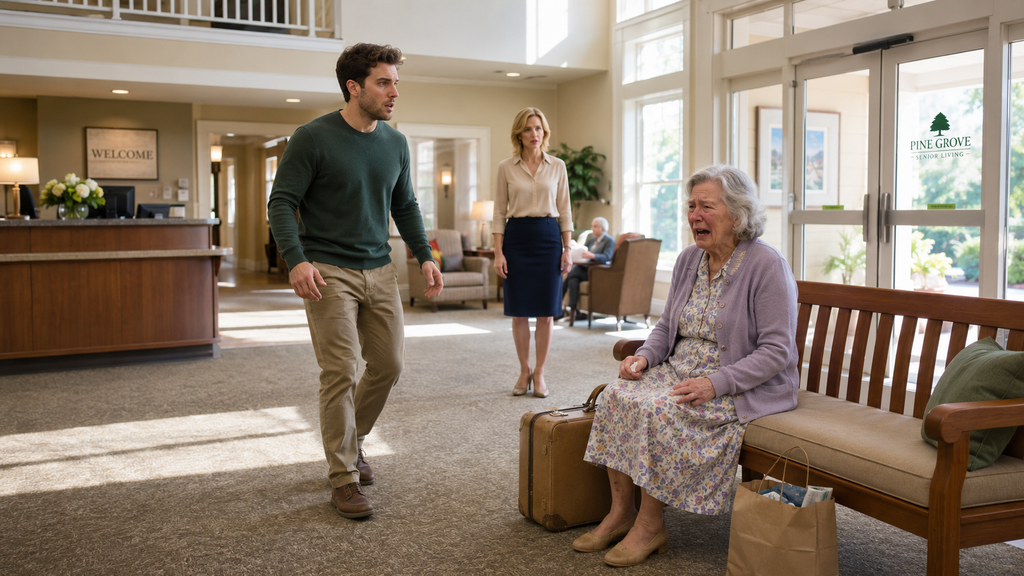
I drove one hundred and ninety miles to get her.
When I arrived, she didn’t cry.
She didn’t ask me why they had done it.
She didn’t even mention my parents.
She simply picked up her purse, walked slowly toward my car, climbed into the passenger seat, and fastened her seatbelt.
Then she looked directly at me.
“Don’t call them, Daniel.”
I froze with one hand still on the steering wheel.
“Grandma—”
“Not yet.”
Her voice was quiet.
Steady.
Almost frighteningly calm.
“I’ll tell you exactly where to drive.”
And that was the moment I realized my parents hadn’t simply abandoned my grandmother at a nursing home.
They had been trying to get her out of the way.
PART ONE — THE PHONE CALL
My name is Daniel Mercer.
I was thirty-five years old when my family cracked open in a way I still don’t think any of us completely recovered from.
At the time, I lived in Indianapolis and worked as an electrical engineer for a manufacturing company.
My life was ordinary.
Predictable.
I paid my bills.
I complained about traffic.
I ordered takeout too often.
I called Grandma every Sunday.
And until that Tuesday afternoon, I still believed my parents were fundamentally decent people.
Complicated?
Yes.
Selfish sometimes?
Absolutely.
But dangerous?
No.
At least, that was what I believed.
The call came at 3:17 p.m.
I remember the exact time because I had just started making coffee in my apartment kitchen.
My phone rang with an Ohio number I didn’t recognize.
Normally, I would have ignored it.
That afternoon, for some reason, I answered.
“Hello?”
A woman spoke carefully.
“Is this Daniel Mercer?”
“Yes.”
“My name is Hannah Pierce. I’m calling from Willow Grove Senior Living in Dayton.”
My first thought was that someone had the wrong number.
Then she said my grandmother’s name.
“Eleanor Mercer listed you as her emergency contact.”
My stomach tightened.
“What happened?”
“She’s physically fine.”
That sentence did nothing to make me feel better.
People usually didn’t begin conversations with she’s physically fine unless something else had gone very wrong.
The woman continued.
“Your grandmother was brought here earlier today by relatives. We were told they were considering placement in our assisted-living program.”
I set my coffee mug down.
“My parents?”
“I believe so. Richard and Patricia Mercer?”
“Yes.”
There was a pause.
Not a normal pause.
The kind people use when deciding how much of an uncomfortable truth they should say out loud.
“Mr. Mercer,” Hannah said, “the admission wasn’t completed.”
“What does that mean?”
“Your relatives said they needed to retrieve some paperwork from their vehicle.”
“And?”
“They never came back.”
For several seconds, I stared at the coffee machine.
I could hear it dripping.
One drop.
Then another.
Then another.
I felt strangely detached from my own body.
“What do you mean they never came back?”
“They left the building around one o’clock.”
“What time is it now?”
“Just after three.”
“And Grandma?”
“She’s still here.”
The room seemed to tilt.
“Did she agree to move there?”
Another pause.
“Mr. Mercer, I don’t think this is something I should discuss in detail over the phone.”
That answer was enough.
“Is she asking for me?”
“She asked us not to call your parents. She specifically gave us your number.”
I grabbed my keys.
“I’m coming.”
“It’s nearly three hours from Indianapolis.”
“I’m coming.”
I ended the call.
Then I called Dad.
Straight to voicemail.
I called Mom.
Same thing.
Again.
Voicemail.
I sent a message.
Where is Grandma?
No response.
I called again.
Nothing.
The coffee machine beeped behind me.
I didn’t even turn it off.
I drove out of Indianapolis with my heart pounding so hard that my chest hurt.
The entire drive, I invented explanations.
Maybe there had been a misunderstanding.
Maybe Dad had gotten sick.
Maybe Mom’s phone had died.
Maybe something had happened in the parking lot.
Maybe they really had gone for paperwork.
Maybe.
Maybe.
Maybe.
That word is dangerous when you love someone.
It lets you postpone believing what the evidence is already telling you.
Halfway through the drive, Dad finally texted.
Busy right now. Call later.
I stared at the message.
Then I called him immediately.
No answer.
My anger began replacing my fear.
I typed:
A nursing facility called me. Where are you?
The message showed as delivered.
No response.
I drove faster.
By the time I reached Willow Grove, it was nearly six.
The building was one of those carefully designed places that tried very hard not to look like a nursing facility.
Warm stone exterior.
Flower beds.
Rocking chairs near the entrance.
A little fountain beside the sidewalk.
Inside, the lobby smelled faintly like lemon cleaner and lavender.
And there was Grandma.
Sitting in a cushioned chair beside one brown suitcase.
A grocery bag rested at her feet.
Her medications were inside it.
Blood-pressure pills.
Pain medication.
Vitamin bottles.
A plastic organizer marked Monday through Sunday.
Her hands were folded in her lap.
Her gray hair was still pinned neatly behind her head.
Her coat was buttoned despite the warm room.
She looked very small.
Not weak.
Never weak.
But small.
And suddenly I remembered being seven years old, standing on a chair in her kitchen while she taught me how to make pancakes.
I remembered being thirteen and calling her after Dad screamed at me for wrecking his truck.
I remembered college tuition arriving when my parents said they couldn’t help.
Grandma never told me she’d paid part of it.
I found out years later.
This woman had shown up for me my entire life.
Now she was sitting in a nursing-home lobby because her own son had apparently left her there.
I walked toward her.
“Grandma.”
She looked up.
For a moment, she didn’t move.
Then something softened in her eyes.
“You came.”
Those two words nearly broke me.
“Of course I came.”
She stood.
I reached for her suitcase.
She let me take it.
Hannah, the administrator who had called me, walked over.
“We kept all the documents your relatives left at reception,” she said quietly.
Grandma answered before I could.
“Give them to Daniel.”
Hannah handed me a folder.
Inside was a partially completed admissions packet.
At the top, in my mother’s handwriting, were the words:
Increasing confusion. Unable to manage independently. Requires permanent supervision.
I stared at the page.
Grandma watched me.
“Later,” she said.
I nodded.
Then I thanked Hannah.
Before we left, she leaned closer to me.
“Your grandmother was very clear about wanting to leave.”
“I understand.”
“I just thought you should know.”
I did.
I understood more every minute.
Grandma climbed into my car.
She fastened her seatbelt.
I put the suitcase in the back.
Then I reached for my phone.
“Daniel.”
I looked at her.
“Don’t call them.”
“Grandma, they left you here.”
“I know.”
“They disappeared.”
“I know.”
“What happened?”
She stared through the windshield.
The sunset reflected against the glass.
“Drive.”
“Where?”
“First, the county courthouse.”
I blinked.
“What?”
“The courthouse.”
“Why?”
She opened her purse.
Her movements were careful.
Deliberate.
She removed a folded bank statement.
Several transactions had been circled with a red pen.
I took it.
Twelve thousand dollars.
Eighteen thousand.
Twenty-five thousand.
All withdrawn within six weeks.
I looked at her.
“What is this?”
“Your father.”
My stomach dropped.
Grandma continued.
“After my hip surgery in March, Richard convinced me to give him temporary financial power of attorney.”
I remembered the surgery.
She had fallen on wet stairs outside church.
Nothing catastrophic, thankfully, but recovery had taken months.
Dad had spent a lot of time helping her during the first few weeks.
At least, that was what everyone believed.
“He said it would make things easier,” Grandma continued. “Pay the hospital bills. Manage insurance. Handle repairs.”
“Did you authorize these withdrawals?”
“No.”
“Did Dad tell you about them?”
“No.”
I looked again at the statement.
“That’s fifty-five thousand dollars.”
“That’s what I found.”
“What do you mean, what you found?”
“I only had one month of statements.”
Something cold spread through me.
“When did you notice?”
“Yesterday.”
“And you confronted him?”
“Yes.”
“What did he say?”
Grandma gave a quiet, bitter laugh.
“He told me I was getting confused.”
I gripped the steering wheel.
“He said that?”
“He told me the money had been used for my care.”
“What care?”
“Exactly.”
My eyes drifted toward the back seat.
One suitcase.
One grocery bag.
That was apparently everything my parents had decided an eighty-one-year-old woman needed for the rest of her life.
Grandma stared straight ahead.
“This morning your mother called and said they wanted to take me to lunch.”
Her voice remained steady.
“They picked me up at eleven-thirty.”
“Did they tell you where?”
“No. Patricia said they knew a restaurant with a garden.”
My jaw tightened.
“They brought you here instead.”
“Yes.”
“Did they tell you this was a nursing facility?”
“Not until we walked inside.”
I wanted to turn the car around.
I wanted to find Dad.
I wanted answers immediately.
Grandma seemed to sense it.
She reached across and touched my arm.
“Not yet.”
“Grandma—”
“I have spent eighty-one years learning that angry people show their hand too early.”
I looked at her.
She almost smiled.
“We are going to let your father show us everything.”
The courthouse was only twelve minutes away.
We arrived twenty minutes before closing.
Grandma moved faster than I expected.
She walked directly to the records department and requested copies of every document filed against her property during the previous three months.
The clerk typed her address.
Maple Ridge Road.
The house Grandma and Grandpa had bought almost forty years earlier.
The same house where my father grew up.
The same house where I spent nearly every Christmas of my childhood.
The clerk frowned at the screen.
“Mrs. Mercer?”
“Yes?”
“There was a deed recorded twelve days ago.”
Grandma went completely still.
“What kind?”
“Quitclaim.”
“To whom?”
The clerk hesitated.
Then turned the monitor slightly.
GRANTEE: RICHARD MERCER.
My father.
I felt heat rush into my face.
Grandma stared at the screen.
There was no dramatic reaction.
No gasp.
No tears.
Only silence.
That scared me more.
“Print it,” she said.
The clerk did.
Grandma paid for a certified copy.
We walked outside.
Under the parking-lot lights, she opened the document.
I stood beside her.
Near the bottom was her signature.
Eleanor J. Mercer.
Grandma stared at it.
Then she touched the paper with one finger.
“That is not my signature.”
I looked more closely.
It looked close.
Very close.
But I had seen Grandma’s signature thousands of times.
Birthday cards.
Checks.
School forms.
Her real signature leaned slightly upward.
This one was too level.
Too smooth.
The final curve of the R was wrong.
“Could Dad legally do this using the power of attorney?”
“He could sign certain documents on my behalf.”
“But this says you signed it personally.”
“Yes.”
A chill went through me.
She folded the paper.
“Bank.”
The branch manager recognized Grandma.
Her name was Claire Benton.
She took us into a private office after Grandma explained what had happened.
Within fifteen minutes, Dad’s access was removed from every account.
Passwords changed.
Cards canceled.
Online credentials reset.
Then Grandma requested complete transaction records.
Claire printed page after page.
The machine hummed.
I watched the stack grow.
Grandma sat perfectly still.
Claire eventually stopped.
Her expression had changed.
“Mrs. Mercer…”
“How much?”
Claire swallowed.
“I need you to review these transactions yourself.”
“How much, Claire?”
The manager looked down.
“Approximately eighty-three thousand dollars.”
For the first time that day, Grandma’s face lost color.
Eighty-three thousand.
Not fifty-five.
Eighty-three.
Most of the transfers had gone to an account belonging to Mercer Renovations LLC.
Dad’s contracting company.
Dad had owned the company for almost twenty years.
It had done well once.
Very well.
Then business slowed.
Projects were delayed.
Suppliers complained.
Dad started talking about “temporary cash-flow problems.”
Apparently, Grandma had become his solution.
Claire pointed to another transaction.
Twenty thousand dollars.
Sent to a title company.
Grandma’s finger rested beside it.
“The house.”
Claire remained professional.
“I can’t confirm what the title company used the funds for.”
“But you can tell me who initiated the transfer.”
Claire checked.
“Online credentials associated with the authorized agent.”
“My son.”
Claire nodded.
Grandma sat back.
For a moment, she looked exhausted.
Not physically.
Emotionally.
There is a particular kind of exhaustion that appears when someone you love forces you to reconsider every memory you have of them.
I saw it on her face.
I hated Dad for putting it there.
Outside the bank, my phone rang.
Dad.
Grandma looked at the screen.
“Answer.”
I did.
“Dad.”
His first words were:
“Daniel, where is she?”
I almost laughed.
Not because anything was funny.
Because the question was unbelievable.
“You left her at a nursing facility.”
“That wasn’t supposed to happen.”
“What was supposed to happen?”
Silence.
Then Mom’s voice in the background.
“Tell him she needs supervision.”
Dad lowered his voice.
“Your grandmother hasn’t been herself.”
I looked at Grandma.
She raised one eyebrow.
“Really?”
“She’s been forgetful.”
“She passed a cognitive evaluation two months ago.”
Dad went silent.
I turned toward Grandma.
“You passed an evaluation?”
“Yes.”
Dad heard her.
His voice sharpened.
“You brought her to the bank, didn’t you?”
That sentence told me everything.
“You’re worried about the bank?”
“You don’t understand what’s happening.”
“I understand eighty-three thousand dollars disappeared from her accounts.”
Silence.
Not long.
Half a second.
But enough.
Grandma held out her hand.
I gave her the phone.
“Richard.”
Dad exhaled.
“Mom, listen to me.”
“No. You listen.”
Her voice was quiet.
That was Grandma’s most dangerous voice.
“You signed my name.”
“I had authorization.”
“You had authorization to manage my expenses while I recovered from surgery.”
“We talked about the house.”
“No.”
“You said you wanted to help the family.”
“I said I would help when I could.”
“You knew the company was struggling.”
“I did not give you permission to take my savings.”
“You would have agreed if you understood everything.”
Grandma’s expression changed.
There it was.
The real insult.
Not the money.
Not even the deed.
The belief that because she was old, her consent had become optional.
Mom grabbed the phone.
“Eleanor, stop this.”
Grandma’s eyes narrowed.
“Patricia.”
“Richard was trying to protect everything.”
“By stealing it?”
“He borrowed money.”
“Without asking.”
“We planned to repay it.”
“And when exactly were you planning to tell me?”
Mom’s voice became colder.
“You’re making this bigger than it needs to be.”
Grandma looked out across the bank parking lot.
“You brought me to a nursing home.”
“You need more care.”
“No. You needed me somewhere I couldn’t interfere.”
“That isn’t fair.”
“Neither was leaving me beside my suitcase and pretending you were going to the car.”
Mom was silent.
Then she said something I will remember until the day I die.
“You’re eighty-one years old, Eleanor. What exactly are you keeping that house for?”
Grandma’s face hardened.
She ended the call.
No goodbye.
No argument.
She simply pressed the button and gave me my phone.
Neither of us spoke for several seconds.
Then she said:
“Take me home.”
PART TWO — THE HOUSE
Maple Ridge Road had always felt peaceful.
Big maple trees.
Wide lawns.
Older houses with deep porches.
When Grandpa was alive, he used to sit outside every evening with a glass of iced tea and complain about squirrels digging holes in his garden.
I had driven that road hundreds of times.
But that evening, something felt wrong before we even reached the driveway.
There were two pickup trucks parked outside Grandma’s house.
The front door was open.
A folding table had been placed near the garage.
A man I didn’t recognize walked out carrying two dining-room chairs.
Then I saw the sign.
Red and white.
Planted in Grandma’s lawn.
ESTATE LIQUIDATION — SATURDAY
Tomorrow.
I hit the brakes.
Grandma stared through the windshield.
She didn’t move.
The man carrying the chairs noticed our car.
He stopped.
Grandma whispered:
“They’re selling my things.”
My chest tightened.
I parked behind the trucks.
Before I could tell her to wait, Grandma opened her door.
She stepped onto the driveway.
The man quickly lowered the chairs.
“Mrs. Mercer?”
Grandma stopped.
“Yes.”
His expression turned pale.
“I was told you relocated.”
“Apparently.”
He looked confused.
Grandma walked past him.
I followed.
Inside, the house no longer looked like Grandma’s.
Blue price stickers covered everything.
The lamp beside Grandpa’s old reading chair.
Twenty dollars.
Grandma’s china cabinet.
Two hundred.
The antique clock Grandpa had built by hand.
Seventy-five.
Boxes filled the hallway.
Photographs had been taken down.
Kitchen cabinets emptied.
Grandma’s dresses hung on portable clothing racks.
Someone had gone through her closets.
Her drawers.
Her memories.
Her life.
And assigned prices to all of it.
Grandma walked slowly into the dining room.
On the table sat a clipboard.
MERCER ESTATE SALE
She lifted it.
Her hands trembled.
Only slightly.
But I noticed.
The man entered behind us.
“My name is Kevin Doyle,” he said. “I run Doyle Estate Services.”
Grandma looked at him.
“My son hired you?”
“Yes.”
“What did he tell you?”
“That you had permanently entered long-term care.”
Grandma’s jaw tightened.
“And ownership of the house?”
“He said it had transferred to him.”
“Did you see proof?”
“Yes.”
“What proof?”
“A deed.”
“And?”
“A power of attorney.”
Grandma turned toward me.
“Daniel.”
“Yes?”
“Photograph everything.”
So I did.
Every room.
Every sticker.
Every contract.
Every box.
Every item already moved.
Every document Kevin had been given.
Kevin became increasingly uncomfortable.
“I want you to understand, Mrs. Mercer, we believed everything was legitimate.”
“I believe you.”
His shoulders relaxed slightly.
“Would you like us to stop?”
“Yes.”
“Immediately?”
Grandma looked around her dining room.
“My husband ate breakfast at this table for thirty-nine years.”
Her eyes moved toward a cardboard box containing Grandpa’s old woodworking tools.
“My grandchildren opened Christmas presents in this room.”
Then she looked at Kevin.
“Stop immediately.”
Kevin nodded.
“Done.”
The second truck belonged to a removal contractor who had been hired to dispose of anything considered too low-value for sale.
Trash.
That was how Dad had apparently described the things Grandma had accumulated over eight decades.
The contractor returned everything he had already loaded.
A box of books.
Old kitchenware.
Several picture frames.
Grandpa’s garden tools.
Then both trucks left.
My phone showed eleven missed calls from Dad.
Six from Mom.
Grandma didn’t answer.
Instead, she walked into the kitchen.
And made tea.
That was Grandma.
Chaos could be exploding around her and she would put water on the stove.
Tea meant thinking.
Tea meant organizing.
Tea meant she refused to let panic make decisions for her.
She set two cups on the table.
Then she took out a notepad.
“First,” she said, “police.”
I looked at her.
“Are you sure?”
She gave me a look that made me immediately regret the question.
“My son forged a deed, took money from my bank account, used my house for something, abandoned me at a nursing facility, and hired strangers to sell my belongings.”
She lifted her tea.
“What part would you like me to ignore?”
“None.”
“Good.”
She called the sheriff’s non-emergency line.
A deputy arrived forty minutes later.
He listened.
He photographed everything.
He copied the bank records.
The deed.
The nursing-home paperwork.
Kevin’s contract.
Grandma explained everything without exaggeration.
The deputy was careful.
“These situations can get complicated when powers of attorney and family relationships are involved.”
Grandma nodded.
“I understand.”
“Some financial decisions may fall into a civil dispute depending on how the documents were written.”
“I understand.”
“But if someone signed your name without authorization or knowingly misrepresented information, that can become something very different.”
Grandma leaned forward.
“Good.”
The deputy looked at her.
“Good?”
“Because I’m not reporting a family disagreement.”
Her voice was flat.
“I’m reporting what happened.”
After he left, I remembered something.
The envelope.
The one Grandma had shown me in the car.
“Grandma.”
She looked up.
“What’s inside the envelope from Grandpa?”
She went quiet.
Then she walked toward the hallway closet.
She reached inside her coat pocket and removed it.
The envelope was yellow with age.
Across the front, in Grandpa’s handwriting:
HOUSE DEED
She sat at the kitchen table.
Slowly opened it.
Inside was the original deed from years earlier.
There were refinancing papers.
Tax documents.
And one folded piece of notebook paper.
Grandma recognized it immediately.
She stopped breathing for a second.
Then she handed it to me.
Grandpa’s handwriting was shaky.
He had written it during the last year of his life.
Eleanor, keep the originals somewhere Richard cannot access if he ever starts asking too many questions about the house. I hope I’m wrong about him.
I read it twice.
Then a third time.
“You knew?”
Grandma shook her head.
“No.”
“Grandpa suspected something?”
“He worried about your father.”
“Why?”
She stared at the handwriting.
“Richard always needed rescuing.”
That sentence carried decades inside it.
Grandma continued.
“Your grandfather loved him. Very much. But he worried that Richard believed consequences were temporary inconveniences someone else should solve.”
I thought about Dad.
Growing up, I admired him.
He could charm anyone.
He convinced bankers to extend loans.
Customers to pay deposits early.
Suppliers to wait.
Relatives to invest.
He could make disaster sound temporary.
He could make irresponsible choices sound brave.
As a child, I thought that made him brilliant.
Grandpa had apparently seen something else.
“What did Dad ask Grandpa about the house?”
“A few years before your grandfather died, Richard asked whether we would consider using it as collateral for an expansion loan.”
“What did Grandpa say?”
“No.”
“Did Dad argue?”
“For months.”
Grandma looked down.
“Eventually your grandfather told him never to ask again.”
And now Grandpa was dead.
Grandma had been recovering from surgery.
Dad had power of attorney.
The opportunity had arrived.
Headlights swept across the kitchen wall.
Grandma and I both turned.
Dad’s SUV came up the driveway.
Mom sat beside him.
I stood.
“Stay here.”
Grandma stared at me.
I sighed.
“Right. Stupid suggestion.”
We walked outside together.
Mom got out first.
She slammed the door.
“What have you done?”
That was what she said.
Not Are you okay?
Not We’re sorry.
Not We made a mistake.
What have you done?
Grandma stopped on the porch.
“I came home.”
“You called the sheriff.”
“Yes.”
Dad stepped out.
He looked terrible.
Wrinkled shirt.
Unshaven face.
Dark circles under his eyes.
For a second, I almost felt sorry for him.
Then I remembered Grandma sitting beside that suitcase.
The feeling disappeared.
“Mom,” Dad said, “we can fix this privately.”
“Privately.”
“Yes.”
Grandma nodded.
“You mean without consequences.”
“No.”
“That is exactly what you mean.”
Dad ran both hands through his hair.
“The company is in trouble.”
“I know.”
“I had three commercial projects collapse.”
“I know.”
“Suppliers are threatening liens.”
“I know.”
“Payroll was due.”
“I know.”
“I needed temporary liquidity.”
Grandma stared at him.
“So you took my money.”
“I borrowed it.”
“Borrowing requires permission.”
“I was going to repay you.”
“When?”
Dad didn’t answer.
“Richard, when?”
“The Franklin project was supposed to close.”
“And?”
“The client filed bankruptcy.”
Grandma nodded slowly.
“So you couldn’t repay it.”
Dad looked away.
She pointed toward the house.
“What did you do with my property?”
Mom interrupted.
“We were protecting it.”
Grandma actually laughed.
It was short.
Bitter.
“You protected my house by taking my name off it?”
“It was only temporary.”
Dad closed his eyes.
“Patricia.”
But Mom kept going.
“The house was being used as collateral.”
The words settled over us.
Grandma stared at her.
“Collateral for what?”
Nobody answered.
I remembered the twenty-thousand-dollar title-company transfer.
“How much?” I asked.
Dad glared at me.
“This doesn’t involve you.”
Grandma answered immediately.
“He drove one hundred and ninety miles because you abandoned me.”
Then she looked at Dad.
“He’s involved.”
Dad’s shoulders collapsed.
Grandma repeated:
“How much?”
“One hundred and sixty thousand.”
Her face changed.
Even I could see the blow land.
“One hundred and sixty thousand dollars?”
“It was a bridge loan.”
“You borrowed one hundred and sixty thousand against my house?”
“The project was almost finished.”
“Without my permission.”
“I thought I could fix everything before you ever had to know.”
That was the sentence.
The truth.
He wasn’t planning to ask forgiveness.
He was planning for Grandma never to find out.
“And when the project failed?” I asked.
Dad’s expression told me before he answered.
“The lender started asking questions.”
“When was the payment due?”
“Friday.”
Three days away.
I looked toward the estate-sale sign.
Then toward Grandma.
Then back at Dad.
Suddenly the entire plan became horrifyingly clear.
They needed Grandma gone.
They needed the house emptied.
They needed anyone looking at the property to believe she had permanently entered care.
Dad saw that I understood.
“Daniel—”
“You put her in that facility because the loan was collapsing.”
“That is not what happened.”
“You told the estate company she wasn’t coming back.”
“She needed support.”
“She lives independently.”
“She’s eighty-one!”
Grandma flinched.
Not because the words hurt physically.
Because Dad had finally said the part he had been hiding.
Old.
Therefore manageable.
Old.
Therefore dismissible.
Old.
Therefore property could be taken in advance because eventually she would die anyway.
Mom stepped closer.
“Eleanor, nobody wanted to hurt you.”
Grandma looked at her.
“You packed my medication into a grocery bag.”
Mom’s mouth closed.
“You carried my suitcase into that building.”
Silence.
“You told strangers I was confused.”
Mom’s eyes filled with tears.
“We were scared.”
“So was I.”
That shut her down.
Grandma continued.
“I sat in that lobby for three hours wondering whether my own son intended to come back.”
Dad looked sick.
“Mom.”
“No.”
She pointed toward the driveway.
“You will leave.”
“Please.”
“Now.”
“You’re destroying my business.”
Grandma’s face became almost peaceful.
“No, Richard.”
She looked at him for a long time.
“You did that before I knew anything about it.”
They drove away ten minutes later.
Grandma watched the taillights disappear.
Then she walked inside.
Only after the door closed did she finally cry.
Not loudly.
No dramatic collapse.
She sat at the kitchen table.
Pressed both hands over her face.
And whispered:
“I raised him.”
I sat beside her.
“I know.”
“I raised him.”
There was nothing useful I could say.
So I simply stayed.
PART THREE — THE PAPER TRAIL
The next morning, Grandma called Rebecca Sloan.
Rebecca was an elder-law attorney who had handled Grandma and Grandpa’s estate planning for nearly fifteen years.
She was sixty-two.
Silver hair.
Sharp glasses.
The kind of woman who could make a room quieter simply by opening a folder.
We were in her office by nine-thirty.
Grandma handed her everything.
The bank records.
The deed.
The nursing-home documents.
The estate-sale contract.
Grandpa’s note.
Rebecca read silently.
Every few pages, her jaw tightened.
Eventually she looked up.
“Eleanor, did you sign this quitclaim deed?”
“No.”
“Did you authorize Richard to sign your name?”
“No.”
“Did you authorize him to transfer title to himself using his power of attorney?”
“No.”
“Did you approve a one-hundred-sixty-thousand-dollar loan secured against the property?”
“No.”
Rebecca nodded.
“Then we move quickly.”
By noon, she had prepared an emergency filing challenging the deed.
She requested temporary orders preventing sale, transfer, foreclosure, or additional encumbrances against the house while ownership was investigated.
She formally revoked Dad’s power of attorney.
Then she contacted the lender.
That was when the situation became much worse for my father.
Because lenders care about paperwork.
And paperwork leaves footprints.
The lender produced the document package used for the loan.
The quitclaim deed had been notarized.
The notary’s name was Scott Vance.
Grandma stared at the page.
“Who is he?”
Rebecca searched public records.
“Notary commission active. Office address…”
She paused.
Then turned the monitor toward us.
The office was two blocks from Dad’s business.
Grandma had never met him.
Never spoken to him.
Never been inside his office.
Then Kevin, the estate-sale operator, emailed me copies of everything Dad had provided.
One email immediately stood out.
Sent three days earlier.
From Dad.
Need house emptied immediately. Owner entered memory care and will not be returning. All remaining contents can be liquidated or disposed of.
Grandma read it.
Once.
Twice.
Three times.
Then she handed it back.
Rebecca looked at her.
“Are you okay?”
Grandma smiled faintly.
“No.”
Rebecca nodded.
“I’m sorry.”
Grandma looked toward the window.
“He wrote it like I was already dead.”
No one answered.
Because he had.
Investigators began interviewing people.
The nursing facility preserved its security footage.
At 12:41 p.m., cameras recorded Dad walking inside carrying Grandma’s brown suitcase.
Mom followed beside Grandma.
At reception, Mom filled out preliminary forms.
At 12:58 p.m., Dad and Mom walked through a side entrance toward the parking lot.
They never returned.
The admissions coordinator had documented Mom’s statements.
Resident demonstrates progressive confusion. Family reports inability to independently manage medications, finances, cooking, transportation, and personal safety. Long-term placement recommended.
Every sentence was false.
Grandma cooked.
Drove short distances.
Managed her medications.
Paid bills.
Attended church.
Volunteered twice a month.
And, most importantly, she had completed a cognitive evaluation after surgery.
Her physician’s report described her as alert, oriented, capable of independent decision-making, and demonstrating no evidence of significant cognitive impairment.
Grandma read Mom’s statement.
Her voice trembled.
“I trusted her too.”
That was the part nobody really understood.
Everyone focused on Dad because he had handled the money.
But Grandma had known Mom for almost forty years.
Birthday dinners.
Christmases.
Hospital visits.
Vacations.
Mom called her “Mama Eleanor” whenever she wanted to sound affectionate.
And she had stood inside a nursing home telling strangers that Grandma couldn’t care for herself.
The betrayal wasn’t one person.
It was a partnership.
The notary became the weakest link.
Scott Vance initially insisted Grandma had appeared personally.
He claimed he remembered her.
Silver hair.
Blue coat.
Soft voice.
There was one problem.
On the date the deed had supposedly been notarized, Grandma was at physical therapy seventeen miles away.
The clinic had sign-in records.
Payment records.
And security footage.
Scott changed his story.
He admitted Dad had brought the deed in already signed.
Dad said Grandma was recovering from surgery and couldn’t travel.
Scott notarized it as a favor.
“Did you witness Eleanor Mercer sign the document?” investigators asked.
“No.”
“Did you speak to her?”
“No.”
“Did you verify her identity?”
“Richard showed me a copy of her identification.”
“Did Eleanor authorize you to notarize her signature without appearing?”
Scott eventually answered:
“No.”
His professional license was immediately in danger.
So he cooperated.
He provided his journal.
Emails.
Text messages.
One email from Dad read:
She won’t understand the paperwork anyway. Just need this completed by Friday.
When Rebecca showed Grandma that line, something inside her changed.
Until then, I think a small part of her had still been looking for an explanation that would allow her to preserve some version of her son.
Desperation.
Panic.
Bad judgment.
A terrible decision made under pressure.
But that email eliminated the comforting possibilities.
Dad had known Grandma wasn’t signing willingly.
He knew she didn’t understand what he was doing because he deliberately prevented her from knowing.
He had used her age as justification.
She won’t understand.
Grandma sat silently.
Then folded the paper.
“Rebecca.”
“Yes?”
“I don’t want this quietly settled.”
Rebecca studied her.
“Okay.”
“I spent my life teaching my children that when they damage something, they repair it.”
Her voice remained calm.
“My son damaged something.”
She looked toward me.
“And I am done repairing his mistakes for him.”
Then investigators subpoenaed Dad’s company financial records.
That was where the last illusion disappeared.
Dad had claimed the eighty-three thousand dollars from Grandma’s accounts had been used to keep employees paid.
Some had.
But not all.
Twenty-seven thousand dollars had gone toward personal credit-card balances.
Nine thousand paid overdue installments on Mom’s SUV.
Six thousand covered part of a vacation deposit for a resort in Aruba.
The trip had later been canceled.
Several thousand paid personal taxes.
The remainder went to suppliers and business expenses.
Grandma stared at the breakdown.
Aruba.
That seemed to wound her more than anything.
“You were in the hospital recovering from surgery when they booked the trip?” I asked.
Grandma nodded.
She remembered Mom talking about it.
Patricia had sent her pictures.
Ocean views.
Private cabanas.
Luxury suites.
Dad had apparently been paying the deposit using money taken from his recovering mother.
Grandma looked at Rebecca.
“Did Daniel know?”
I froze.
Rebecca immediately understood what Grandma meant.
“No,” she said. “Nothing we have reviewed suggests Daniel knew anything.”
Grandma nodded.
Then she reached over and squeezed my hand.
That broke me more than I expected.
Because even after everything, she was worried about discovering whether there were any family members left she could trust.
I moved into Grandma’s guest room for several weeks.
Not because she needed supervision.
That distinction mattered.
She hated when anyone phrased it like she couldn’t manage alone.
I stayed because strange cars occasionally slowed near the property and because Dad kept appearing.
The first time, he knocked at eleven in the morning.
Grandma was pruning roses.
I answered.
“Is she here?”
“Yes.”
“I need five minutes.”
“No.”
“She’s my mother.”
“She told you not to come.”
“I need to explain.”
“You’ve explained.”
Dad looked older.
For the first time in my life, he looked smaller than me.
“Daniel, I messed up.”
“That’s an interesting description.”
“I panicked.”
“You forged her signature.”
“I didn’t forge it.”
“Then who did?”
He looked away.
That was answer enough.
“I was trying to save twenty employees’ jobs.”
“With Grandma’s money?”
“I was going to repay everything.”
“You tried to sell her furniture.”
“I needed the house cleared.”
“Because?”
“The lender wanted possession options if the loan defaulted.”
The casual way he said it stunned me.
“You were preparing to give them Grandma’s home.”
“I thought I had time.”
“You thought you had ownership.”
“I thought once the business recovered, I could reverse everything.”
I stared at him.
Then asked:
“Did you ever imagine what would happen if you failed?”
Dad didn’t answer.
I continued.
“Did you imagine Grandma spending the rest of her life in that facility while you told everyone she was confused?”
His face tightened.
“We would have moved her somewhere good.”
I almost hit him.
I didn’t.
Grandma’s voice came from behind me.
“No.”
We both turned.
She stood in the hallway.
“You would have moved me somewhere convenient.”
Dad’s eyes filled.
“Mom.”
“You decided the remainder of my life without asking me.”
“I’m sorry.”
“You decided where I would live.”
“I’m sorry.”
“You decided what would happen to my money.”
“I’m sorry.”
“You decided who would own my house.”
“I’m sorry.”
“You decided which pieces of my life were worth selling.”
He began crying.
Grandma watched him.
For a moment, I thought she might forgive him.
Not because he deserved it.
Because she loved him.
But she simply said:
“I believe you are sorry.”
Dad inhaled sharply.
“Then—”
“I believe you are sorry there are consequences.”
His face collapsed.
Grandma returned to the kitchen.
Dad never got his five minutes.
Mom took a different approach.
She sent messages.
Long ones.
At first:
Please convince Eleanor to stop this before the family is destroyed.
Then:
Your father made mistakes but he is not a criminal.
Then:
You are encouraging an elderly woman to act from anger.
Then:
I hope you can live with yourself if your father goes to jail.
I saved every message.
Eventually I replied once.
You left her at a nursing facility and drove away. Please stop contacting me.
Mom wrote back:
You don’t know the full story.
I never responded.
That phrase became her favorite defense.
The full story.
As if there were some missing chapter where abandoning an eighty-one-year-old woman and taking her assets became reasonable.
Six weeks after the nursing-home call, the lender made a decision.
Its attorneys had reviewed the evidence.
The deed.
The improper notarization.
Grandma’s medical records.
The banking trail.
Dad’s emails.
The lender agreed to release its claim against Grandma’s house.
Instead, it would pursue Dad and Mercer Renovations.
When Rebecca called us, Grandma sat at the kitchen table with the phone on speaker.
“The release is being recorded this afternoon,” Rebecca said.
Grandma didn’t speak.
I smiled.
“Grandma.”
She closed her eyes.
“Is it mine?”
“Yes,” Rebecca said. “The title will be restored entirely to you.”
Grandma began crying.
Not the quiet tears from before.
Real tears.
Relief.
Grief.
Exhaustion.
She covered her mouth.
I knelt beside her.
Rebecca remained silent on the phone.
Finally Grandma whispered:
“Thank you.”
The house was safe.
But the investigation wasn’t over.
Dad faced allegations involving unauthorized documents, financial misuse, fraud-related conduct, and exploitation of an elderly person.
Scott Vance faced separate professional and legal consequences.
Mom wasn’t initially charged in connection with the deed itself.
There was no evidence she had signed Grandma’s name.
But investigators examined her role in the nursing-home placement and the false statements about Grandma’s capacity.
She hired an attorney.
And then the family started choosing sides.
PART FOUR — FAMILY
Families like to believe blood makes them permanent.
It doesn’t.
Choices do.
Grandma had three surviving siblings, several nieces and nephews, cousins, old family friends, church friends, and neighbors.
Once the investigation became known, everyone developed an opinion.
Aunt Ruth called first.
She was Grandma’s younger sister.
“Eleanor, Richard made a terrible mistake.”
Grandma listened.
“But he’s your son.”
“I know.”
“He could go to prison.”
“I know.”
“Don’t you think losing his business is punishment enough?”
Grandma asked:
“If Richard were a stranger, what would you tell me?”
Aunt Ruth went quiet.
Grandma repeated:
“If a stranger took eighty-three thousand dollars from my accounts, forged paperwork, put a loan against my house, tried to sell my possessions, and left me at a nursing facility, would you tell me to forgive him because losing his business was punishment enough?”
“That’s different.”
“Why?”
“Because he’s family.”
Grandma closed her eyes.
“That should have made him more careful with me, not less.”
She ended the call ten minutes later.
A cousin said prosecution wouldn’t bring the money back.
Grandma answered:
“Then apparently consequences are only useful when they come with refunds.”
Another relative recommended counseling.
Grandma said:
“I’m not opposed to counseling.”
They looked relieved.
“Good.”
“For myself.”
Their relief disappeared.
“I am not attending therapy so someone can teach me how to tolerate being robbed politely.”
That was Grandma.
Still sharp.
Still Eleanor.
Not everyone defended my parents.
Some relatives came over with food.
Grandma’s church friends organized people to help put everything back after the estate-sale company removed the stickers.
One afternoon, six women in their seventies arrived carrying cleaning supplies, casseroles, and determination.
They spent three hours restoring Grandma’s house.
They put her china back into the cabinet.
Rehung photographs.
Polished Grandpa’s clock.
Returned books to shelves.
At one point, I found Grandma standing in the doorway watching them.
“You okay?” I asked.
“Yes.”
She smiled.
“I spent several weeks thinking getting older made me invisible.”
She looked at the women laughing in her living room.
“Apparently, I just needed better company.”
Dad’s business closed four months later.
Mercer Renovations had been struggling even before the scandal.
Once suppliers filed claims and customers learned about the financial problems, the remaining contracts disappeared.
Employees left.
Equipment was sold.
The office closed.
Dad blamed the investigation.
Grandma never did.
“The business was already drowning,” she said.
“He simply tried to use me as the life raft.”
Eventually, Dad accepted responsibility for reduced charges rather than face a full trial.
The final agreement included time in custody, supervised release, restitution, and restrictions preventing him from managing Grandma’s finances or contacting her except under approved circumstances.
Some relatives were furious.
Grandma attended the hearing.
I sat beside her.
Dad wore a dark suit.
He looked at her several times.
She never looked away.
When the judge asked if anyone had been harmed financially or emotionally, Grandma chose to speak.
She stood slowly.
The courtroom became silent.
“I am eighty-one years old,” she began.
“My son believed that number made my choices less important.”
Dad lowered his head.
Grandma continued.
“He did not simply take money.”
Her voice shook.
“He made decisions about how much of my life I was still entitled to control.”
The judge listened.
“He decided I did not need my house.”
Grandma looked directly at Dad.
“He decided I did not need my savings.”
Her eyes filled.
“He decided I did not need my furniture, my independence, or even the dignity of being asked where I wanted to live.”
Dad began crying.
Grandma did too.
But she kept speaking.
“I have forgiven many things in my life.”
Her voice became steadier.
“But forgiveness does not mean pretending something did not happen.”
Then she sat.
I squeezed her hand.
She squeezed mine back.
Restitution never restored everything.
That was something movies lie about.
There wasn’t a dramatic check returning every dollar.
Some money was gone.
Legal expenses consumed part of what remained.
Insurance covered certain losses.
Civil settlements recovered additional funds.
Scott’s insurer contributed after his notarization failures were established.
Grandma recovered enough to remain financially secure.
But not everything.
More importantly, money wasn’t the hardest thing to recover.
Trust was.
After betrayal, ordinary life becomes suspicious.
A phone call makes you wonder.
A bank letter makes your stomach tighten.
A relative asking an innocent financial question suddenly sounds dangerous.
Grandma changed every password.
Added fraud alerts.
Reviewed her credit reports.
Met with Rebecca monthly.
Updated her will.
Created stronger safeguards around financial authority.
Every document required independent witnesses.
Every account had alerts.
Every significant transaction triggered notifications.
She wasn’t paranoid.
She was experienced.
There is a difference.
Eight months after everything began, Grandma surprised me.
“I’m selling the house.”
I stared at her.
“No.”
She laughed.
“That wasn’t a request for permission.”
“I know, but…”
“You think they won.”
“Yes.”
She sat across from me.
“Daniel, your father tried to take my choice.”
She tapped the table.
“If I keep a house I no longer want simply to prove he didn’t take it, then he is still making my decisions.”
I didn’t answer.
Grandma smiled gently.
“I love this house.”
She looked around the kitchen.
“I loved raising children here.”
Her eyes became distant.
“I loved your grandfather here.”
Then she looked at me.
“But I am tired of stairs.”
I laughed softly.
“And the yard is too much.”
“I can help.”
“I know.”
She shook her head.
“That isn’t the point.”
“What do you want?”
“A smaller place.”
“Where?”
“Closer to you.”
That silenced me.
She smiled.
“Not too close.”
“Obviously.”
“Thirty minutes.”
“Acceptable.”
“With a porch.”
“Okay.”
“And tomatoes.”
“You can grow tomatoes anywhere.”
She frowned.
“That attitude is why yours taste terrible.”
For the first time in months, the house felt like home again.
Grandma sold Maple Ridge to a young couple.
No pressure.
No fake deed.
No manipulation.
She chose the price.
She chose the buyers.
She signed every page herself.
Before closing, Rebecca asked her three separate times whether the decision was entirely voluntary.
By the third time Grandma said:
“Rebecca, if you ask me once more, I’m increasing your legal bill by arguing with you.”
Rebecca laughed.
The sale closed.
Grandma purchased a single-story home thirty-two minutes from my apartment.
Two bedrooms.
One and a half bathrooms.
A broad porch.
A small fenced yard.
And enough garden space for tomatoes.
On moving day, we found the old estate-sale sign behind shelves in the garage.
Red and white.
Dusty.
ESTATE LIQUIDATION — SATURDAY
I held it up.
“You want me to throw this away?”
Grandma stared at it.
For several seconds, I thought she might cry.
Instead she said:
“No.”
“Evidence?”
“No.”
She picked up a thick black marker.
Then, across the sign, she wrote in enormous letters:
NOT YOURS TO SELL.
I stared.
Grandma nodded approvingly.
“Better.”
“What are you going to do with it?”
She carried it toward the garage wall.
“Hanging it up.”
I laughed.
“You’re serious?”
“Absolutely.”
And there it stayed.
Not as a reminder of what my parents had done.
As a reminder of what they had failed to do.
They failed to silence her.
Failed to erase her.
Failed to make decisions for her.
Failed to take away her home before she chose to leave it.
PART FIVE — ONE YEAR LATER
One year after the call from Willow Grove, Grandma asked me to take her to lunch.
The irony wasn’t lost on either of us.
“Where are we going?” I asked.
“Columbus.”
“That’s a long drive for lunch.”
“I’m old. I have time.”
“You constantly use age whenever it benefits you.”
“Correct.”
We drove through Ohio.
At some point, our route took us near Maple Ridge Road.
Grandma became quiet.
I almost kept driving.
Then she said:
“Turn.”
So I did.
We passed the old house.
The new owners had painted the shutters dark green.
Two bicycles leaned against the porch.
There were children’s toys near the yard.
Someone had planted flowers beside the mailbox.
Grandma watched through the passenger window.
The house slowly disappeared behind us.
“Do you miss it?” I asked.
“Sometimes.”
I waited.
Grandma adjusted her seatbelt.
“But houses aren’t people.”
I smiled.
“That sounds like something Grandpa would say.”
“No. Your grandfather would say houses are expensive boxes where plumbing breaks.”
I laughed.
She did too.
Then her expression softened.
“A home only has value when you’re free to live your own life inside it.”
I looked at her.
She stared ahead.
“They almost took that freedom.”
I didn’t know what to say.
Grandma continued.
“But almost isn’t the same as did.”
We stopped at a small diner outside Columbus.
Grandma ordered chicken soup and half a turkey sandwich.
I ordered a burger.
While we waited, she opened two packets of crackers.
“You know what your parents misunderstood?”
I looked at her.
“What?”
“They believed getting older makes a person easier to overlook.”
She crumbled crackers into her soup.
“I think it makes you notice more.”
“Because you’ve seen more?”
“That.”
She smiled.
“And because eventually you run out of patience for nonsense.”
I laughed.
“Grandma.”
“I’m serious.”
“I know.”
“When I was forty, I worried about keeping peace.”
She stirred the soup.
“At fifty, I worried about what relatives would say.”
Another pause.
“At sixty, I worried about disappointing people.”
She lifted a spoonful of soup.
“At eighty-one, Daniel?”
“What?”
She smiled.
“I was mostly worried whether the tomatoes were getting enough sun.”
I laughed so hard the people in the next booth looked at us.
Grandma started laughing too.
For a while, neither of us could stop.
And something about that moment felt important.
A year earlier, she had been sitting in a nursing-home lobby wondering whether her family planned to return.
Now she was eating soup.
Laughing.
Making decisions.
Growing tomatoes.
Living.
Not surviving.
Living.
There is a difference.
Dad eventually wrote her a letter.
It arrived nearly eighteen months after everything happened.
Grandma left it unopened for two days.
Then she called me.
“Come over.”
I drove to her house.
She was sitting on the porch with the envelope beside her.
“You want me to read it?”
“No.”
“Do you want me to stay while you do?”
“Yes.”
So I sat.
Grandma opened the letter.
It was four pages.
Dad apologized.
Not perfectly.
Not completely.
But differently than before.
He admitted that he had convinced himself he was saving the company.
Then convinced himself Grandma would never need the money.
Then convinced himself she was too old to understand complicated financial decisions.
Then convinced himself placing her somewhere safe would justify everything.
Each rationalization made the next one easier.
He wrote that by the time he realized what he had become, the consequences were already moving faster than he could control.
Grandma read silently.
At the end, he wrote:
I don’t expect you to forgive me. I just want you to know that losing your trust has been worse than losing the company.
Grandma folded the letter.
I waited.
Finally I asked:
“What are you thinking?”
She stared at the garden.
“That he finally wrote an apology without asking me to fix anything.”
“That’s progress.”
“Yes.”
“Are you going to respond?”
“Not today.”
She put the letter back inside the envelope.
Then she stood.
“Help me with the tomatoes.”
And that was that.
No dramatic reconciliation.
No perfect ending.
Real life rarely gives people one.
Over time, Grandma did send him a short letter.
She never showed me exactly what she wrote.
That was hers.
But she told me the last sentence.
I still love you, Richard, but love is not permission.
I think that sentence contained everything.
She loved her son.
That never disappeared.
But she stopped using love as an excuse to surrender her boundaries.
Dad eventually became eligible for supervised contact.
Grandma agreed to one phone call.
Then another months later.
They spoke cautiously.
Briefly.
There was no return to the old relationship.
Some things cannot return.
Sometimes rebuilding doesn’t mean restoring the exact structure that existed before.
Sometimes it means accepting that the old structure was unsafe.
Mom apologized too.
It took longer.
Much longer.
Her first apologies focused on Dad.
Her second focused on the family.
Her third focused on consequences.
Eventually, almost two years later, she said something different.
She sat across from Grandma in Rebecca’s office during a supervised meeting and said:
“I told myself you were old enough that moving wouldn’t matter.”
Grandma listened.
Mom began crying.
“I told myself you would adjust.”
Grandma’s expression remained still.
“I told myself we were doing what was necessary.”
Mom looked down.
“But I never asked what you wanted.”
Grandma nodded.
“That was the problem.”
“I know.”
“No.”
Grandma leaned forward.
“The problem was not that you forgot to ask.”
Mom looked at her.
“The problem was that you knew what I would say.”
Silence.
“And you decided my answer was inconvenient.”
Mom started crying harder.
Grandma did not rescue her.
That mattered.
The old Eleanor might have.
She might have moved closer.
Touched Mom’s hand.
Said, Don’t cry.
But Grandma had learned something.
Sometimes when someone finally feels the pain of what they did, comforting them too quickly only teaches them to avoid understanding it.
So Grandma let the silence stay.
Eventually Mom whispered:
“I’m sorry.”
Grandma answered:
“I believe you.”
Not I forgive you.
Not Everything is okay.
Just:
“I believe you.”
For that day, it was enough.
THE FINAL LESSON
It has been several years now.
Grandma still lives in the little house with the porch.
The tomatoes remain competitive.
Every summer she gives me more than I can possibly eat and acts personally offended when I suggest growing fewer.
The red-and-white sign still hangs in her garage.
NOT YOURS TO SELL.
Sometimes visitors ask about it.
Grandma gives different answers depending on her mood.
Sometimes:
“Long story.”
Sometimes:
“Family lesson.”
And sometimes:
“A reminder to read paperwork.”
But I know what it means.
It isn’t about property.
Not really.
It is about ownership of yourself.
Your choices.
Your dignity.
Your right to decide where you live.
What happens to your money.
Who enters your life.
Who leaves it.
Who gets forgiven.
Who earns trust again.
Who doesn’t.
Getting older doesn’t transfer those rights to your children.
Being family doesn’t create permission.
Helping someone doesn’t create ownership over them.
Loving someone doesn’t mean surrendering yourself to them.
And desperation does not magically transform theft into borrowing.
Every year on the anniversary of the nursing-home call, I take Grandma to lunch.
The first year, Columbus.
The second, Cincinnati.
The third, she chose a tiny restaurant almost an hour away because someone from church told her their lemon pie was “worth crossing state lines for.”
It wasn’t.
Grandma ate it anyway.
When we leave, I always walk beside her to the car.
Not because she cannot walk alone.
Because I want to.
She gets annoyed if I open the door for her too often.
“I am not fragile.”
“I know.”
“You hover.”
“I learned from experience.”
“You need hobbies.”
“I have hobbies.”
“Worrying about me is not a hobby.”
Sometimes she still drives herself.
Still attends church.
Still argues with cashiers when grocery prices are wrong.
Still makes pancakes from the same recipe she taught me when I was seven.
Still keeps Grandpa’s photograph beside her bed.
Still wears the blue church coat on cool afternoons.
The same coat she wore the day my parents abandoned her.
She refuses to throw it away.
I once asked why.
She ran her fingers over the sleeve.
“Because what happened while I was wearing it doesn’t get to own it.”
That answer stayed with me.
We often think healing means eliminating reminders.
Throwing things away.
Avoiding places.
Never mentioning names.
Grandma taught me something different.
Sometimes healing means taking the object back.
The coat.
The house.
The drive.
The lunch.
The word family.
You decide what it means now.
My parents told Grandma they were taking her out to lunch.
Instead, they packed one suitcase.
Put her medications into a grocery bag.
Drove her to a nursing facility.
Told strangers she was confused.
Walked out a side door.
And disappeared.
They believed that would be the day Grandma Eleanor lost control of her life.
They were wrong.
Because three hours later, someone called me.
I drove one hundred and ninety miles.
Grandma climbed into my car.
Fastened her seatbelt.
And said:
“Don’t call them. I’ll tell you exactly where to drive.”
The courthouse.
The bank.
Her house.
One decision after another.
One document after another.
One truth after another.
She recovered her title.
Stopped the estate sale.
Exposed the forged paperwork.
Protected what remained of her savings.
Forced the people who had underestimated her to answer for what they had done.
Then, when she was ready, she sold the house herself.
Not because anyone pressured her.
Not because anyone decided she was too old to need it.
Not because someone filled out a form and told strangers she belonged somewhere else.
She sold it because she wanted to.
That distinction became everything.
The last time we drove past Maple Ridge Road, Grandma looked at the house for several seconds.
Then she turned toward me.
“Do you know the strangest part?”
“What?”
“I spent so many years saving things for later.”
“What things?”
“China.”
She smiled.
“Money.”
Another pause.
“The good towels.”
I laughed.
“Everyone saves the good towels.”
“Idiots.”
She continued.
“I kept thinking I should preserve everything. For children. Grandchildren. Someday.”
Her expression softened.
“But when somebody almost took everything from me, I understood something.”
“What?”
“Things should support your life.”
She looked at me.
“Your life should not become a waiting room for your things.”
That weekend, she started using the expensive china.
Every Sunday.
No special occasion required.
The plates Grandpa bought her for their twenty-fifth anniversary.
The cups she had been terrified someone would chip.
The silverware she kept wrapped in cloth.
She used all of it.
One Sunday I accidentally chipped a plate.
I stared at the tiny crack.
“Oh no.”
Grandma looked.
Then shrugged.
“That means somebody used it.”
“You’re not angry?”
“It survived thirty years in a cabinet just to be afraid of dinner?”
She shook her head.
“Use the plate.”
So we did.
That is what her life became afterward.
Not perfect.
Not untouched.
Used.
Lived.
Chosen.
She traveled twice with church friends.
She planted too many tomatoes.
She adopted an elderly orange cat she swore she didn’t want.
She named him Walter.
She bought herself a ridiculous recliner with heat, massage settings, and enough electronic controls to operate a small aircraft.
She spent money without apologizing.
She invited people over when she wanted company.
Asked them to leave when she didn’t.
She updated her estate plan exactly the way she wanted.
And whenever anyone questioned one of her decisions, she would smile sweetly and say:
“I’ve already experienced one family takeover. Applications are closed.”
One afternoon, I found her sitting beneath the porch light watching rain fall across the yard.
Walter slept near her feet.
I sat beside her.
For a while, neither of us spoke.
Then Grandma said:
“Daniel?”
“Yeah?”
“Thank you.”
“For what?”
“For coming.”
I knew exactly what she meant.
I looked at the rain.
“You called.”
“No.”
She shook her head.
“The facility called.”
“Same difference.”
“It isn’t.”
She turned toward me.
“You came without asking whether it was convenient.”
I swallowed.
“Grandma.”
“You believed me before I had proof.”
That hurt.
Because I realized how badly she had needed someone to.
“I’d do it again.”
“I know.”
She reached over.
Took my hand.
And squeezed it.
“I know.”
We sat quietly.
Then she said:
“Your grandfather would have been proud.”
That was the closest I came to crying.
I looked away.
“Of you.”
Grandma laughed.
“Nice recovery.”
“I’m serious.”
“So am I.”
The rain continued.
Walter snored.
And in that ordinary moment, I finally understood something.
Saving somebody doesn’t always look like carrying them.
Sometimes it looks like believing them.
Driving.
Standing beside them.
Taking photographs.
Keeping messages.
Sitting silently while they cry.
And then respecting them enough to let them make their own decisions afterward.
Grandma never needed me to take over her life.
That was exactly what my parents had misunderstood.
She needed somebody willing to stand beside her while she took it back.
Months later, I drove her to another lunch.
Same routine.
She got into the passenger seat.
Fastened her seatbelt.
I started the engine.
“Where are we going?”
Grandma smiled.
“You drive.”
I laughed.
“That’s new.”
“I’m tired of giving directions.”
“Are you sure?”
She looked at me.
“Daniel, I trusted you with directions once.”
I smiled.
“That worked out pretty well.”
“Eventually.”
We pulled away from the house.
The garage door slowly closed behind us.
For one second, before it disappeared, I could see the red-and-white sign hanging on the wall.
NOT YOURS TO SELL.
Grandma watched it vanish from view.
Then turned toward the road.
“You know what else getting older teaches you?”
I sighed.
“I feel like I’m about to receive another lecture.”
“You are.”
“Go ahead.”
She smiled.
“Younger people think strength means holding on.”
“To what?”
“Everything.”
She looked out the window.
“Houses. Relationships. Old versions of people. Old versions of themselves.”
Her expression grew thoughtful.
“But sometimes strength is deciding what you’re finally willing to put down.”
I glanced at her.
“Did you put Dad down?”
She laughed.
“That sounded terrible.”
“You know what I mean.”
“I do.”
She became quiet.
“No.”
After a moment she added:
“I put down the responsibility for saving him.”
That answer stayed with me.
Because for decades, Grandma had confused love with rescue.
Dad failed?
Grandma helped.
Dad borrowed?
Grandma waited.
Dad needed?
Grandma gave.
Dad promised?
Grandma believed.
He had learned that love meant someone would always absorb the consequences.
Until the day she stopped.
That was when both of them changed.
Not because she stopped loving him.
Because she finally loved herself enough to stop disappearing inside that love.
At the diner, the waitress brought Grandma her soup.
I watched her open the crackers.
The same way she had done one year after the nursing-home call.
She caught me staring.
“What?”
“Nothing.”
“You’re staring.”
“I’m thinking.”
“That’s dangerous.”
I laughed.
She smiled.
Then she said:
“Your parents believed getting older made me easier to overlook.”
“I remember.”
“They were partly right.”
I frowned.
“How?”
“People do overlook old women.”
Her expression remained calm.
“They talk over us. Decide things for us. Assume softness means confusion.”
She placed the crackers into her soup.
“But what your parents forgot…”
She looked directly at me.
“…is that being overlooked can be useful.”
“How?”
“You hear what people say when they believe your opinion no longer matters.”
A slow smile crossed her face.
“And eventually, you learn exactly who they are.”
I leaned back.
“That’s terrifying.”
“It should be.”
Then she ate her soup.
I started laughing.
Grandma laughed too.
People turned toward us.
Neither of us cared.
When lunch was over, we walked back to the car together.
No suitcase.
No grocery bag of medication.
No strangers deciding where she belonged.
No side door.
No disappearing parents.
Just Grandma.
Me.
A parking lot.
An ordinary afternoon.
She opened the passenger door herself.
Before getting inside, she looked across the roof of the car.
“Daniel.”
“Yeah?”
“Next year, I choose somewhere with better pie.”
I smiled.
“Deal.”
She got in.
Fastened her seatbelt.
And this time, nobody had to tell me where to drive.
Because wherever Grandma wanted to go next was finally, completely, entirely her choice.
And after everything that had happened, nothing mattered more.
THE END! THANK YOU FOR READING!❤️