 Reading Time: 10 minutes
Richard followed us through the security corridor with the stiff, hurried walk of a man trying to recover control before anyone noticed he had lost it. “Claire.” I kept walking beside Admiral Keane. “Claire.”
The admiral glanced at me, silently asking whether he should intervene. I shook my head. Richard caught up near a portrait-lined hallway. “What exactly is going on?” I turned. Around us, military officers, civilian officials, congressional staffers, and invited families moved toward the reception rooms.
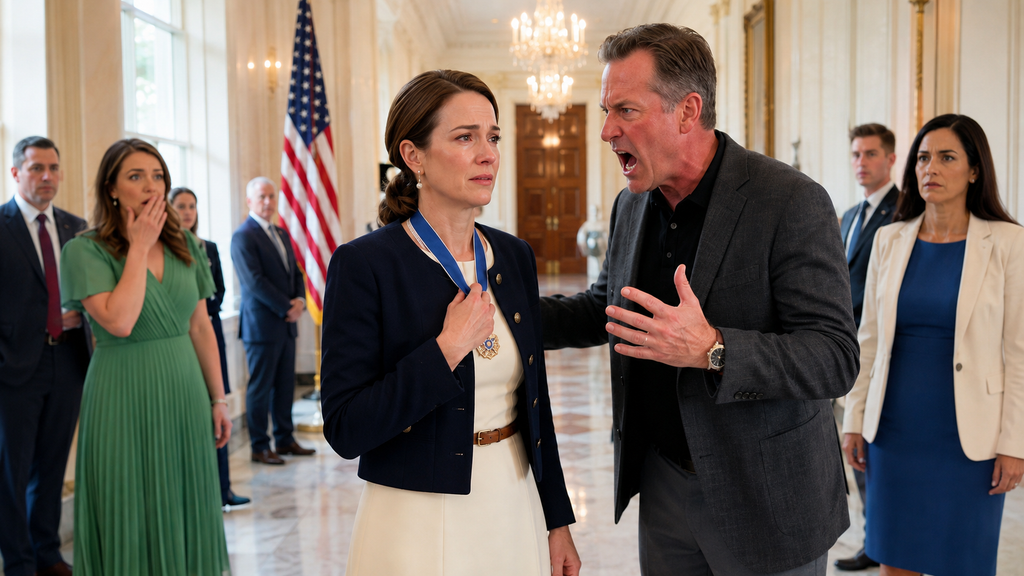
Richard lowered his voice.
“You told me this was some research recognition thing.”
“No. You assumed that.”
“You said you had consulting work with the Navy.”
“I did.”
“For what?”
Admiral Keane answered before I could.
“The Sentinel Survivability Review.”
Richard blinked.
That name meant something to him.
It meant something to nearly everyone in his industry.
Three years earlier, a naval weapons-testing accident off the Virginia coast had exposed a catastrophic design vulnerability in a new class of unmanned maritime defense systems.
The official investigation had resulted in contract suspensions, congressional hearings, and a classified technical overhaul.
Richard’s employer, Meridian Strategic Systems, had lost two major subcontracts afterward.
His expression hardened.
“You worked on Sentinel?”
“I led part of it.”
“That review destroyed companies.”
“No,” I said.
“Faulty engineering and falsified testing records destroyed companies.”
Keane’s jaw tightened slightly.
Richard looked from him to me.
“You never told me.”
“You never asked.”
“That’s ridiculous. We’ve been married twelve years.”
“Yes.”
The word landed harder than shouting would have.
For twelve years, Richard had known I had a doctorate in materials engineering.
He knew I occasionally traveled to Norfolk, Arlington, and Dahlgren.
He knew some of my contracts required nondisclosure agreements.
What he did not know was that I had spent nearly two decades working on naval structural survivability, blast-resistant composites, and failure analysis.
Not because I had hidden my education.
Because he had dismissed it.
Whenever someone asked what I did, Richard answered first.
“Claire does technical consulting.”
Then he changed the subject to himself.
A uniformed aide approached.
“Dr. Whitmore, ma’am, Secretary Donovan would like to greet you before the ceremony.”
Richard’s mouth opened.
I almost smiled.
Almost.
We entered a reception room overlooking the South Lawn.
Secretary of the Navy Elaine Donovan crossed the room immediately.
“Claire.”
She embraced me briefly.
“I’m glad you came.”
“Thank you, Madam Secretary.”
Donovan turned toward Richard.
“And you must be Dr. Whitmore’s husband.”
For years, I had been introduced as Richard Hale’s wife.
Now Richard was standing in a White House reception room being introduced through me.
The symmetry was difficult to miss.
“Richard Hale,” he said quickly.
“Meridian Strategic Systems.”
Donovan’s expression changed almost imperceptibly.
“I know Meridian.”
Richard swallowed.
Of course she did.
A photographer approached and asked us to move toward the fireplace.
Richard stepped beside me automatically.
The photographer shook his head.
“Sir, just Dr. Whitmore, Admiral Keane, and Secretary Donovan for this one.”
Richard stepped back.
I watched him from the corner of my eye.
He looked embarrassed.
And suddenly I remembered his words outside.
“Don’t embarrass me.”
The camera flashed.
Then Admiral Keane handed me a small folder.
“The President’s military aide asked me to confirm your citation before the program begins.”
I opened it.
At the top were the words:
PRESIDENTIAL MEDAL FOR DISTINGUISHED CIVILIAN SERVICE
Richard read them over my shoulder.
His face drained of color.
“You’re getting a medal?”
I closed the folder.
“Yes.”
“For Sentinel?”
“Not only Sentinel.”
The admiral looked at Richard.
“Your wife’s work has been quietly protecting American service members for nearly twenty years.”
Richard said nothing.
For perhaps the first time since I had known him, he had no immediate response.
But I knew him too well to believe silence meant acceptance.
Richard did not handle humiliation by reflecting.
He handled it by finding someone else to blame.
And when his eyes met mine across that elegant White House room, I could already see the calculation beginning.
He wasn’t wondering how he had failed to know me.
He was wondering how much my success could cost him.
I’ll continue directly from the provided Part 2 and keep the same suspenseful, emotional style. The continuation is based on the uploaded story text.
PART 3
The ceremony hall was filled with people who had spent their lives serving something larger than themselves.
Generals.
Scientists.
Engineers.
Officers who had returned from places most people only knew from headlines.
Families who had sacrificed years with their loved ones because duty had always come first.
And somehow, standing among them, I realized something that surprised me.
I wasn’t nervous.
For years, I had walked into rooms where I was expected to prove I belonged.
Rooms where men twice as loud as me repeated my ideas five minutes after I said them and received applause.
Rooms where people looked at my name tag, saw “Dr. Claire Whitmore,” and immediately searched for the man standing beside me.
Richard had never noticed.
Or maybe he had noticed and simply didn’t care.
Because to Richard, my achievements were only impressive when they could be attached to his reputation.
The applause began as the military band finished playing.
Everyone stood.
The doors opened.
The President entered with the ceremony officials behind him.
Richard stood beside me, perfectly composed.
At least from a distance.
But I knew him.
I saw the tightness in his jaw.
The way his fingers kept adjusting his watch.
The way his eyes moved around the room, calculating.
Richard was not someone who enjoyed being surprised.
Especially not when the surprise revealed that someone else had been living a life more significant than the one he had created for them.
The master of ceremonies stepped forward.
“Today, we recognize individuals whose dedication has strengthened the foundation of our national security and protected the lives of those who serve.”
The screen behind him illuminated.
Names appeared.
One after another.
Then the room became silent.
My name appeared.
DR. CLAIRE WHITMORE-HALE.
For a moment, I heard nothing.
Not the cameras.
Not the whispers.
Not the applause that followed.
I simply stared at my own name displayed beneath the presidential seal.
Because I remembered a different moment.
Twenty years earlier.
A small apartment.
A secondhand desk.
A young woman with too many textbooks and not enough confidence.
That woman had stayed awake until three in the morning studying material nobody around her understood.
She had been told engineering was too difficult.
That defense research was too demanding.
That she would eventually choose a “normal” life.
But she didn’t.
She chose the work.
She chose the impossible problems.
And she chose to keep going even when nobody clapped.
“Dr. Claire Whitmore,” the announcer continued, “for extraordinary contributions in advanced materials engineering, structural survivability research, and her leadership during the Sentinel Survivability Review.”
The applause became louder.
I walked forward.
Every step felt strangely calm.
I reached the stage.
The President shook my hand.
“Dr. Whitmore, your work saved lives.”
Those words nearly broke something inside me.
Not because they were unexpected.
Because they were the words I had spent years waiting to hear from the one person who mattered.
My husband.
I looked back.
Richard was standing among the audience.
And for the first time in twelve years, he was looking at me.
Not through me.
Not past me.
At me.
The medal was placed around my neck.
The cameras flashed.
And somewhere in that room, a version of myself that had spent years staying quiet finally disappeared.
After the ceremony, the reception began.
People approached me constantly.
Researchers I had worked with years ago.
Military officers.
Officials who knew my reports better than they knew my face.
“Your recommendations changed the entire testing process.”
“Your analysis after the Virginia incident prevented another disaster.”
“Your team’s work protected sailors who will never know your name.”
Each sentence felt like another piece of a life Richard had never bothered to understand.
Then he appeared.
“Claire.”
I turned.
His smile was back.
But it was different.
It was the smile he used when cameras were nearby.
The one designed to convince people everything was fine.
“You’ve been keeping a few things from me.”
I looked at him.
“No.”
His eyebrows lowered.
“No?”
“I didn’t keep anything from you, Richard.”
“You never told me you were this involved.”
“I told you what I did.”
“You said you were consulting.”
“I was.”
“You made it sound like paperwork.”
I almost laughed.
Not because it was funny.
Because it was unbelievable.
“Richard, you were there when I left for meetings. You knew I worked with the Navy. You knew I traveled. You knew I had a doctorate.”
“Yes, but…”
“But what?”
He hesitated.
That was rare.
Richard Hale always had an answer.
A correction.
A way to turn any conversation back toward himself.
But this time, he didn’t.
Because the truth was standing between us.
“You never thought it mattered,” I said quietly.
His expression changed.
“That’s not fair.”
“No?”
“No. I supported you.”
I stared at him.
Then I looked around the room.
At the people who knew my work.
At the people who had spent years trusting my judgment.
“Richard, you introduced me for twelve years as your wife.”
He frowned.
“Because you are my wife.”
“Yes.”
I nodded slowly.
“But you never introduced me as Claire.”
His face tightened.
“That’s ridiculous.”
“Is it?”
The silence between us grew.
“You knew every executive at your company. You knew every contract number. You knew every person who worked beneath you.”
“I built my career.”
“Yes.”
I looked directly at him.
“And I built mine.”
For once, he had nothing to say.
Then his expression shifted.
Not sadness.
Not regret.
Fear.
“Is this going to affect Meridian?”
There it was.
The question he truly wanted to ask.
Not how I felt.
Not why I had been overlooked.
Not how he had spent years standing beside someone he barely knew.
His first concern was himself.
“Meridian lost contracts because of Sentinel,” he said carefully.
“Because Sentinel exposed problems.”
“Problems connected to suppliers.”
“Yes.”
“Companies were damaged.”
“Companies that failed to meet safety standards.”
He lowered his voice.
“Claire, you understand how sensitive this is.”
I almost smiled.
Because that was the first time he had acknowledged what I had been doing.
Not as a hobby.
Not as a side project.
As something powerful.
Something that mattered.
“You’re worried,” I said.
“I’m being realistic.”
“No.”
I shook my head.
“You’re afraid.”
His eyes hardened.
“I’m trying to protect our future.”
“Our future?”
I repeated the words softly.
Then I looked at him.
“Richard, when you thought I was just your quiet wife standing beside you, you never worried about my future.”
He went silent.
The truth had finally reached him.
And the truth was something he couldn’t negotiate with.
Later that evening, after the official events ended, I stood outside the White House gardens.
The air was cool.
The lights reflected across the lawn.
For the first time in years, I allowed myself to simply exist.
No explaining.
No minimizing.
No making myself smaller.
Admiral Keane approached.
“Congratulations, Dr. Whitmore.”
“Thank you.”
He looked toward the building.
“You know, there were people who doubted your findings during Sentinel.”
“I know.”
“They said your models were too conservative.”
“They were.”
He smiled slightly.
“And then the real-world testing proved you right.”
I looked down at the medal.
“I didn’t do it to prove anyone wrong.”
“I know.”
His voice softened.
“You did it because you knew people’s lives depended on it.”
I nodded.
That was always the reason.
Not recognition.
Not awards.
Not applause.
People.
A few minutes later, Richard found me.
But this time, he didn’t walk ahead of me.
He stood beside me.
Almost cautiously.
“Claire.”
I looked at him.
“I owe you an apology.”
Those words surprised me.
Not because I didn’t think he could say them.
Because I had stopped expecting them.
“For what?”
He looked away.
“For making you feel invisible.”
The old me would have rushed to comfort him.
The old me would have said, “It’s okay.”
The old me would have protected his feelings before acknowledging my own.
But I wasn’t that woman anymore.
“It wasn’t just feeling invisible, Richard.”
He looked back.
“I was invisible.”
His face fell slightly.
And maybe, for the first time, he understood.
Not completely.
Not yet.
But enough.
“I should have asked more questions.”
“Yes.”
“I should have listened.”
“Yes.”
“I should have been proud.”
I held his gaze.
“That would have been nice.”
The sadness on his face looked real.
And strangely, that hurt more than his arrogance.
Because realizing someone could have loved you better but chose not to was a different kind of pain.
“Can we fix this?” he asked.
The question hung between us.
A year ago, I might have answered immediately.
Five years ago, I would have forgiven him before he apologized.
But time changes what you need.
“I don’t know.”
He looked surprised.
“You don’t know?”
“No.”
I touched the medal resting against my dress.
“Because today wasn’t about proving something to you.”
He stayed quiet.
“It was about remembering something about myself.”
“What?”
I looked toward the lights of the White House.
“That I was never small.”
The words were simple.
But they carried everything.
Every meeting where I had been underestimated.
Every presentation where someone else repeated my research and received credit.
Every dinner where Richard talked for two hours about his career and never once asked about mine.
Every moment I convinced myself love meant accepting less space.
I had spent years believing I needed permission to shine.
I finally understood I never did.
Three months later, I moved into my own office.
Not a corner of Richard’s study.
Not a spare room.
My own office.
A place with my name on the door.
Dr. Claire Whitmore.
I continued working with defense researchers, universities, and safety organizations.
I became a mentor to young engineers who reminded me of myself.
The quiet ones.
The ones with brilliant ideas who were still waiting for someone to believe them.
And Richard?
He changed.
But change did not erase history.
He began asking questions.
Real questions.
He attended my lectures.
He learned about my work.
He stopped introducing me as simply his wife.
Sometimes people truly change.
Sometimes they realize what they almost lost.
But sometimes the person they hurt has already become someone new.
And that was the hardest lesson Richard had to learn.
The woman he ignored for twelve years was gone.
In her place was someone who finally understood her own worth.
Months after the White House ceremony, I received another invitation.
Not as a guest.
Not as someone standing behind another person.
As the featured speaker.
I walked into that building again.
Same halls.
Same portraits.
Same powerful names surrounding me.
But this time, I wasn’t wondering if I belonged.
I already knew.
A young officer approached me before the event.
“Dr. Whitmore?”
“Yes?”
“I just wanted to say thank you.”
“For what?”
“My father served on a ship protected by the improvements from your research.”
I smiled.
“That means a lot.”
She nodded.
“He never knew your name.”
I looked at the medal in my hand.
“That’s okay.”
Because that was never why I did the work.
The greatest achievements are often invisible.
The strongest people are often the quietest.
And sometimes the person standing silently beside you is carrying a story greater than anything you could imagine.
Richard Hale once told me:
“Don’t embarrass me.”
He thought he was warning me not to make him look bad.
He never realized he was standing beside the person who would change the room.
The truth was never that I was his wife.
The truth was that he was lucky to have been standing beside me.
THE END! THANK YOU FOR READING!❤️