 Reading Time: 23 minutes
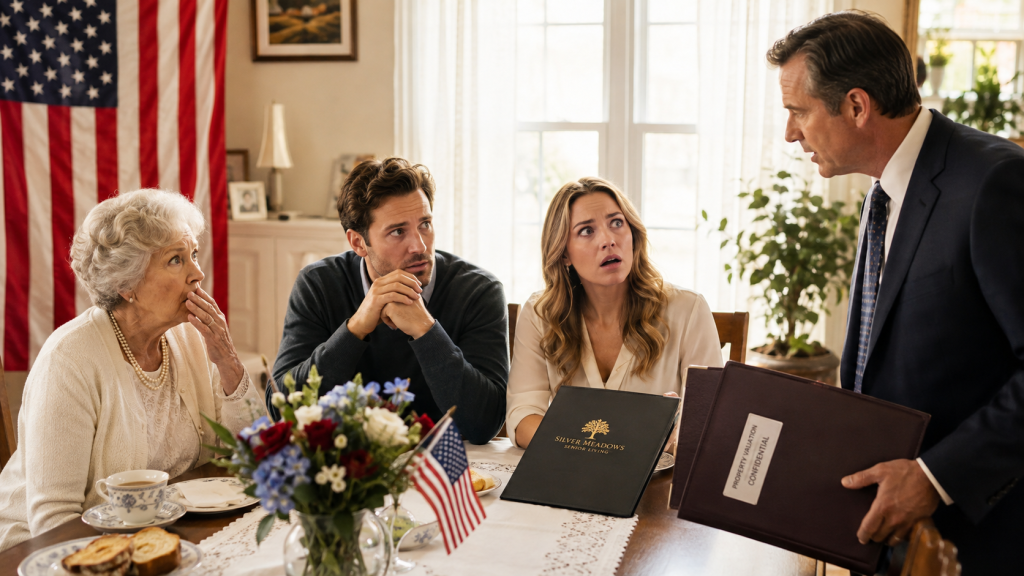
My daughter-in-law pocket-dialed me at 7:15 this morning. She never knew I answered. For nineteen minutes, I sat at my kitchen table with my tea going cold and listened to her and my son plan, in detail, what they were going to do with me by Christmas.
They were in the car. They were driving to my house. So I pulled my grocery notepad closer, clicked my pen, and started writing down every word. My name is Dorothy Bennett. I am seventy-three years old. My husband, Raymond, has been gone four years now.
We were married for forty-six years, and for most of those years, Raymond believed there were two things a person should never ignore: a strange noise coming from the furnace and a sentence that made your stomach tighten.

“Your body usually hears trouble before your pride does, Dot,” he used to say.
That morning, my body heard trouble at 7:15.
My son Mark calls me every Sunday at five.
Exactly eleven minutes.
I know because the little clock on my microwave faces the chair where I sit when he calls.
“How are you, Mom?”
“Fine.”
“Taking your vitamins?”
“Yes.”
“Need anything?”
“No.”
“How are the twins?”
“They’re good.”
“How’s Alicia?”
“Busy.”
Then there is usually a story about work, a complaint about traffic, and a promise that they will come by soon.
Eleven minutes.
Sometimes twelve if one of the twins wants to say hello.
Mark wasn’t always like that.
When he was eight, he used to sit on the kitchen counter while I cooked and tell me everything that had happened at school, including things I absolutely did not need to know.
When he was fourteen, he broke his wrist falling off a skateboard and refused to let the nurse take him into the examination room until I arrived.
When he was twenty-two and Raymond and I dropped him at his first apartment, he hugged me in the parking lot so long that Raymond finally said, “Dorothy, if you keep holding him, the boy’s going to miss his own adulthood.”
That boy still existed somewhere inside the forty-five-year-old man who called me every Sunday for eleven minutes.
At least, that was what I had been telling myself.
His wife, Alicia, calls me “Mother D.”
She says it in a voice like sweet tea with something floating in it.
The phone rang at 7:15 that morning, and when Alicia’s name appeared on the screen, my first thought was that somebody was in the hospital.
Nobody calls a seventy-three-year-old woman at 7:15 in the morning with good news.
“Alicia?”
No answer.
Just road noise.
A turn signal.
The radio playing low.
Then Alicia spoke.
But not to me.
“Did you bring the folder?”
“It’s in the back seat,” a man answered.
My son.
“And the brochure?”
“Glovebox.”
I opened my mouth.
I almost said, “Hello? Alicia? You called me.”
Then she laughed.
And what she said next closed my mouth for me.
“Relax, Mark. She’ll sign. She signs whatever we put in front of her. Remember the flu shot forms? She didn’t read one line.”
I put my hand flat on the kitchen table.
For a few seconds, I did not move.
Then I reached for the grocery notepad beside the fruit bowl.
Because Raymond always said:
“Dot, when it matters, write it down.”
So I wrote.
7:19 a.m.
Mark: “What if she asks to read it first?”
Alicia: “Then you take her glasses to get ‘cleaned.’ Honestly, do I have to think of everything?”
My pen stopped.
I touched the glasses sitting on my nose.
They were going to take away my glasses.
Not because they thought I was confused.
Not because I was ill.
Because they did not want me reading something they wanted me to sign.
The car noise continued.
Then Alicia said a name.
Silver Meadows.
I knew Silver Meadows.
It was one of those retirement communities with cheerful advertisements showing silver-haired couples drinking lemonade beside flower gardens.
Alicia’s cousin worked there.
“Family discount,” Alicia said.
They both laughed.
Not loudly.
Comfortably.
The way people laugh at a joke they have already told each other before.
I wrote again.
7:24 a.m.
Mark: “It just feels fast.”
For one breath, my boy was in that car again.
My little boy.
The child who once slept on the floor beside my bed when I had pneumonia because he was afraid I might stop breathing.
Then Alicia answered.
“Fast? We have been paying for that house for four years.”
I stared toward my living-room doorway.
Now here is the thing you need to know.
Nobody pays for my house.
Raymond and I bought it in 1976.
Three bedrooms.
One and a half bathrooms.
A maple tree in the front yard that was barely taller than Raymond when we planted it.
We paid $31,400.
Raymond worked at the power company.
I worked part-time at the library after Mark started school.
We skipped vacations.
We drove used cars.
I sewed curtains instead of buying them.
Raymond repaired everything until an appliance practically begged to be taken to the landfill.
And in 1998, after making the final mortgage payment, Raymond brought home a bottle of cheap champagne and a metal bucket.
We stood in the backyard and burned a photocopy of the mortgage papers.
“The roof may leak,” Raymond said, raising his glass, “but every leak belongs to us.”
I laughed so hard I spilled champagne on my sweater.
Nobody had made a payment on this house in twenty-eight years.
What Alicia called “paying for that house” was something entirely different.
Four years earlier, when their twins were born, Mark and Alicia were renting a cramped townhouse.
They wanted a home.
They had good jobs but not enough saved for the down payment they needed.
So I wrote them a check for forty thousand dollars.
Raymond had died only six months earlier.
I remember Mark refusing the check at first.
“Mom, Dad worked for this.”
“Yes,” I told him. “And your father would rather see his grandchildren have a backyard than see numbers sitting in my savings account.”
Mark cried.
He hugged me.
Alicia cried too.
At least I thought she did.
They bought their house three months later.
I never asked for a penny back.
Apparently, somewhere along the way, forty thousand dollars I gave them had become money they imagined they had given me.
At 7:26, Alicia spoke again.
“And the minute she’s settled at Silver Meadows, we list her place. Bruce says one-eighty, easy. That’s the lake trip, that’s the boat, that’s everything.”
Bruce.
Their realtor friend.
Bruce had been inside my house twice.
The first time, Alicia said he was “just admiring the crown molding.”
The second time, he walked through my dining room staring at the ceiling and asked whether the basement ever flooded.
I had thought it was odd.
Now it was not odd at all.
It was an inspection without the paperwork.
My hand was shaking by then, but I kept writing.
7:31 a.m.
Alicia: “Let me do the talking. You just look sad. Can you manage sad?”
My son answered:
“Yeah.”
That “yeah” cost me more than every word she said.
Because Alicia was Alicia.
I had never trusted her completely.
I had tried.
Lord knows, I had tried.
But Mark was my son.
My only child.
And sometimes the deepest wound does not come from the person holding the knife.
It comes from the person standing beside them saying nothing.
At 7:34, the call ended.
She must have shifted her purse and disconnected it.
I sat there for another minute.
Maybe two.
My tea was cold.
I poured it down the sink.
Then I rinsed my cup.
I don’t know why I did that.
Perhaps because when your entire understanding of your family changes before breakfast, washing a cup feels like proof that ordinary things still exist.
Then I made two phone calls.
The first was to Eleanor Whitaker.
Eleanor has lived next door for forty years.
She watched Mark learn to ride a bicycle on our street.
She brought casseroles when Raymond died.
She has arthritis in both knees, binoculars beside her kitchen window, and absolutely no respect for other people’s secrets when she believes those people are behaving badly.
“Eleanor,” I said, “I need your kitchen window and your phone camera for one hour.”
There was a pause.
“Finally,” she said.
Then she hung up.
That is why Eleanor and I have been friends for forty years.
The second call was downtown.
To Raymond’s oldest friend.
A man named Samuel Katz.
Sam is seventy-eight now.
He started as a small-town attorney working out of two rented rooms above a pharmacy.
By the time he retired, his firm occupied half a building downtown.
Raymond trusted him with everything.
Our wills.
Our house documents.
Our retirement accounts.
When Raymond became ill, Sam came to the hospital with papers Raymond insisted on reviewing while wearing a gown that did not close properly in the back.
After Raymond died, Sam helped me organize everything.
And before he left my kitchen that final afternoon, he gave me his personal number.
“If anyone ever makes you feel rushed about money, property, or paperwork,” he said, “you call me before you sign your name.”
At 7:39 that morning, I called.
He answered on the fourth ring.
“Dorothy?”
“Sam, are you dressed?”
A pause.
“That depends on how formal this emergency is.”
“I need you at my house by nine.”
“What happened?”
I looked at my grocery notepad.
“My son is coming to have me sign something.”
Sam’s voice changed.
“What something?”
“I don’t know yet.”
“Have you agreed to anything?”
“No.”
“Signed anything recently?”
“No.”
“Given anyone power of attorney?”
“No.”
“Good.”
I heard movement.
“I’m leaving in ten minutes.”
I hung up.
Then I put out the good cups.
The china ones with blue flowers that Raymond bought me for our twenty-fifth anniversary.
I sliced the banana bread Alicia always compliments and never eats.
And I set three places at my kitchen table.
Then I added one more.
For a guest they were not expecting.
Their car pulled into my driveway at 8:40.
I watched from behind the curtain.
Alicia checked her lipstick in the passenger mirror.
Mark sat behind the steering wheel for several seconds without moving.
Then Alicia said something.
He nodded.
And practiced looking sad.
I actually watched my forty-five-year-old son arrange his face before coming inside to deceive his mother.
That was the moment something inside me became very still.
The doorbell rang.
I counted to ten.
The way you do with children.
Then I opened the door wearing my warmest smile.
“What a surprise!”
“Mother D,” Alicia sang.
She had a beige folder pressed against her chest.
“We were just in the neighborhood.”
At 8:40 on a Saturday morning.
Of course they were.
“Come in, come in. I even have banana bread.”
They followed me into the kitchen.
Mark kissed my cheek.
It felt like an apology he was too cowardly to say aloud.
We sat.
Mark would not look directly at me.
Alicia set the folder beside the butter dish as casually as if it were a napkin.
Then she patted my hand.
“Mother D, Mark and I have been thinking about what’s best for you.”
“How thoughtful.”
“This big house. All these stairs.”
“You’re so right,” I said. “Stairs at my age.”
Her shoulders relaxed.
Mark looked at me then.
Only for a second.
Alicia opened the folder.
Inside were several documents and a glossy brochure.
Silver Meadows.
There it was.
A photograph of smiling older people beside a gazebo.
“It’s beautiful,” Alicia said. “They have activities, meals, transportation, nurses available—”
“Nurses?”
“Well, staff.”
“Do I need nurses?”
“No, no. Of course not.”
I took a bite of banana bread.
“So why would I live there?”
Alicia smiled.
“For peace of mind.”
“Whose?”
Her smile twitched.
Mark cleared his throat.
“Mom, we’re just worried about you being alone.”
“I’ve been alone for four years.”
“Yes, but you’re getting older.”
“So are you.”
Alicia laughed too loudly.
“Mother D, nobody is saying you’re incapable.”
That sentence interested me.
Because nobody had used the word incapable until she did.
Then she slid a document toward me.
“This just lets Mark help with some things. Bills, appointments, paperwork. Boring stuff.”
I reached toward it.
Alicia moved her hand over the top page.
“You don’t need to read every—”
The doorbell rang.
She frowned.
“Are you expecting someone?”
“Oh,” I said, pushing back my chair, “didn’t I mention?”
I opened the door.
Samuel Katz stood on my porch wearing a charcoal suit and carrying a leather folder.
“Morning, Dorothy.”
“Morning, Sam.”
He stepped inside.
Then he looked toward my kitchen.
“Morning, folks.”
I watched every drop of color leave Alicia’s face.
Mark stood so quickly his chair scraped across the floor.
“Mr. Katz?”
“Mark.”
Sam knew him, of course.
He had attended Mark’s high school graduation.
His wedding.
The twins’ baptism.
Alicia stared between us.
“What are you doing here?”
Sam took off his coat.
“Dorothy invited me.”
I pulled out the fourth chair.
“Sit down, Sam. Banana bread?”
“Always.”
He sat.
Alicia immediately closed her folder.
Sam noticed.
“What have we got there?”
“Nothing,” she said.
I smiled.
“Funny. Five minutes ago it was important enough for me to sign.”
Mark whispered, “Mom.”
I turned toward him.
“Yes?”
His mouth opened.
Nothing came out.
I slid my grocery notepad onto the table.
Alicia looked at it.
Then at me.
I began reading.
“Seven nineteen. Mark asks what happens if I want to read the papers. Alicia suggests taking my glasses away to be cleaned.”
Nobody moved.
“Seven twenty-one. Discussion of Silver Meadows. Family discount.”
Alicia’s mouth fell open.
“Seven twenty-six. After I am ‘settled,’ my house is to be listed for approximately one hundred eighty thousand dollars. The money is apparently intended for a lake trip and a boat.”
“Dorothy—”
I raised one finger.
She stopped.
“Seven thirty-one. Alicia says, ‘Let me do the talking. You just look sad. Can you manage sad?’ Mark says, ‘Yeah.’”
My son’s face crumpled.
“Mom, how did you—”
“Your wife called me at 7:15.”
Alicia grabbed her purse.
She searched through it.
Then pulled out her phone.
I watched her understand.
“No.”
“Yes.”
“It was an accident.”
“It certainly was.”
“You were listening to a private conversation!”
Sam slowly put down his coffee.
“That’s the argument you’re choosing?”
Alicia looked at him.
He continued.
“You accidentally called Dorothy. Dorothy answered her own telephone. You proceeded to discuss persuading her to sign documents she supposedly would not be allowed to read properly.”
“I never said that.”
“You did,” I said.
“You could have written anything on that pad!”
“I could have.”
I glanced toward the window.
“Fortunately, that is not all I have.”
Eleanor was visible behind her lace curtain next door, holding her phone.
Alicia followed my eyes.
“What is she doing?”
“Being Eleanor.”
Sam extended his hand.
“The documents, please.”
Alicia held the folder tighter.
“No.”
Mark finally spoke.
“Alicia, give them to him.”
She turned.
“Excuse me?”
“Give him the folder.”
Something in his voice had changed.
Maybe shame had finally outweighed fear.
She shoved the folder across the table.
Sam opened it.
He read the first page.
Then the second.
His expression hardened.
“What exactly did you tell Dorothy this document was?”
Alicia crossed her arms.
“Something to help Mark handle things.”
“This is a durable financial power of attorney.”
I looked at Mark.
His eyes dropped.
Sam continued.
“It gives Mark broad authority over Dorothy’s financial accounts and property.”
My stomach tightened even though I had expected something bad.
Then Sam lifted another sheet.
“And this appears to be paperwork related to a proposed transfer or sale arrangement concerning the residence.”
Alicia leaned forward.
“It’s just planning.”
“No,” Sam said. “Planning is discussing options with the owner. This is paperwork.”
Mark sat down.
“Mom, I wasn’t going to take your house.”
“Then why were you bringing papers about my house?”
He rubbed both hands over his face.
“Alicia said it would make things easier.”
“For whom?”
Silence.
I looked at my son.
“Mark, look at me.”
He did.
“Were you going to let me sign this without reading it?”
His eyes filled.
“Mom—”
“Yes or no?”
He whispered.
“Yes.”
There are moments when grief is loud.
When Raymond died, I screamed into a hospital pillow.
But there is another kind of grief that arrives quietly.
It sits down beside you.
It takes your hand.
And it tells you that the person you love is not the person you believed them to be.
I nodded.
“Thank you.”
Mark looked confused.
“For what?”
“For finally telling me the truth.”
Alicia stood.
“This is ridiculous. We’re trying to help you.”
I looked up at her.
“Sit down.”
She stared at me.
“Mother D—”
“My name is Dorothy.”
The room went silent.
She sat.
I turned to Sam.
“Tell them.”
Sam opened his leather folder.
He placed three documents on the table.
“The house cannot be sold by Mark, Alicia, or anyone acting on their behalf.”
Alicia frowned.
“Why?”
“Because Dorothy revised her estate arrangements after Raymond’s death.”
I had.
Two years earlier.
Not because I distrusted Mark.
Because I wanted everything organized.
The house had been placed into a trust structured to protect my right to live there for the rest of my life and to ensure that any future transfer followed my written instructions.
Mark knew there was a trust.
He apparently had never bothered to ask what it said.
Alicia’s face tightened.
“So Mark still inherits it eventually.”
Sam looked at me.
I nodded.
He answered.
“He did.”
One word.
Did.
Mark looked at me.
“Mom?”
I folded my hands.
“I changed that this morning.”
Alicia actually laughed.
“You can’t just change a trust in an hour.”
“Some provisions can be amended according to the trust terms,” Sam said. “And Dorothy already had alternative instructions prepared.”
That part was true.
After Raymond died, Sam had insisted I make contingency plans.
I had signed instructions identifying what would happen if Mark died before me, if our relationship changed, or if I later chose another beneficiary.
Until that morning, I had never imagined using them.
Mark’s voice cracked.
“You disinherited me?”
“No.”
He blinked.
I continued.
“I stopped treating inheritance as something you had already earned.”
That landed differently.
I could see it.
“I’m seventy-three, Mark. Not dead.”
He looked away.
“This house is where your father carried me across the threshold. It’s where you took your first steps. It’s where I sat beside Raymond during the last six months of his life. And this morning, before eight o’clock, you and your wife had already spent the money from selling it.”
Alicia pushed back.
“We were talking hypothetically.”
“You picked the realtor.”
Silence.
“You picked the retirement facility.”
Silence.
“You brought the paperwork.”
Silence.
“You even picked the boat.”
That one made Eleanor laugh next door.
We all heard it through the open kitchen window.
Alicia’s face turned scarlet.
Then Mark said something I did not expect.
“There is no boat.”
Alicia snapped her head toward him.
“Mark.”
He stared at the table.
“There isn’t going to be a boat.”
“What are you doing?”
He looked at his wife.
“I’m done.”
“Done with what?”
“This.”
He pointed toward the folder.
“You said she would be happier there.”
“She would!”
“You said the house was too much for her.”
“It is!”
“You said she’d agree if we explained it properly.”
Alicia’s voice rose.
“And you agreed!”
“Yes.”
Mark swallowed.
“I agreed.”
Then he looked at me.
“And I am ashamed of it.”
I wanted to forgive him immediately.
That is the danger of being a mother.
Your child can be forty-five years old and betray you before breakfast, and some foolish part of your heart still remembers tying his shoes.
But love is not the same as permission.
So I said nothing.
Mark continued.
“We’re in trouble.”
Alicia stood again.
“Don’t.”
He ignored her.
“What kind of trouble?” I asked.
He rubbed his forehead.
“Money.”
Of course.
The oldest motive in the world.
Their beautiful house had apparently been refinanced twice.
Alicia had lost money on an online business venture.
Mark had borrowed against his retirement account.
Credit cards.
Personal loans.
Private school tuition they could no longer comfortably afford.
A new SUV leased because Alicia believed appearances mattered for her work.
They were drowning.
And instead of telling me, they had looked across town at the little house Raymond and I had spent decades paying for.
A paid-off asset.
A solution.
My home had become a number on their imaginary balance sheet.
“How much?” I asked.
Mark hesitated.
“About eighty-six thousand.”
I nearly laughed.
Not because it was funny.
Because four years earlier I had handed them forty thousand dollars with no conditions.
If Mark had come to me and said, “Mom, I made mistakes and I need help figuring this out,” I would have helped him.
Maybe not with eighty-six thousand dollars.
But I would have sat with him.
I would have called Sam.
I would have helped him make a plan.
Instead, he had planned to remove me from my home.
“Why didn’t you ask me?”
His eyes filled again.
“I was embarrassed.”
I nodded.
“So you chose something more shameful.”
He covered his face.
Alicia grabbed her purse.
“I don’t have to sit here and be insulted.”
“No,” I said. “You don’t.”
She looked surprised.
“You may leave.”
“Mark?”
He stayed seated.
“Mark!”
He looked at her.
“I’ll come home later.”
Her face changed.
For the first time that morning, Alicia looked frightened rather than angry.
“You’re choosing her?”
Mark stood.
“No. I’m choosing to stop pretending this was okay.”
She stared at him for several seconds.
Then she walked out.
The front door slammed.
Thirty seconds later, Eleanor appeared at my back door carrying her phone.
“Did I miss anything?”
Despite everything, I laughed.
It came out unexpectedly.
Sam laughed too.
Even Mark gave a broken little chuckle.
Eleanor put her phone on the table.
“I have the arrival on video. Folder clearly visible. And, for whatever it’s worth, Bruce the Realtor drove slowly past Dorothy’s house at eight twenty-three this morning.”
Sam raised an eyebrow.
“You got that?”
“Of course I got that.”
She looked offended by the question.
Then she noticed Mark.
Her expression softened.
“I changed your diapers twice, young man.”
Mark closed his eyes.
“Please don’t.”
“I just want you to know exactly how disappointed I am.”
“Thank you, Mrs. Whitaker.”
“You’re welcome.”
She took a slice of banana bread and left.
Sam stayed another hour.
We reviewed every document.
Nothing had been signed.
Nothing had been transferred.
My accounts were secure.
My house was secure.
Before he left, he gave Mark the name of a financial counselor and told him something Raymond would have liked.
“Debt is a problem,” Sam said. “Dishonesty turns problems into disasters.”
Then he squeezed my shoulder and went home.
Mark and I were alone.
He sat at the same kitchen table where I had helped him with multiplication homework.
Neither of us spoke for a long time.
Finally he said, “Dad would hate me.”
“No.”
He looked at me.
“Your father would hate what you did.”
There is a difference.
A very important one.
Mark started crying.
Not dramatic crying.
Quiet tears.
The kind that embarrassed him.
I slid the tissue box across the table.
“I don’t know how I became this person,” he said.
“Yes, you do.”
He looked at me.
“You became him one small decision at a time.”
He nodded.
I continued.
“You hid the first bill.”
Another nod.
“You borrowed money instead of changing your lifestyle.”
“Yes.”
“You told yourself you’d fix it next month.”
“Yes.”
“You let Alicia convince you that my house was somehow part of your solution.”
He stared at his hands.
“Yes.”
“And then this morning you got into a car carrying papers you knew I shouldn’t sign.”
He cried harder.
“Yes.”
I reached across the table.
For one second, he thought I was going to hold his hand.
Instead, I took the folder.
“This stays with me.”
He nodded.
“And you’re going home.”
“Mom—”
“I love you.”
His face crumpled again.
“But you are not staying here today so that I can make you feel better about hurting me.”
He looked stunned.
I had never spoken to him that way.
Maybe I should have years earlier.
“You are going home. You are going to look at every dollar you owe. You are going to tell your wife that my house is not available. My savings are not available. My retirement is not available.”
He nodded.
“And you will not ask me for money.”
Another nod.
“You will call the counselor Sam recommended.”
“I will.”
“And until I decide otherwise, you do not have a key to this house.”
That one hurt him.
I saw it.
He reached into his pocket.
The key Raymond had given him when he was seventeen was still on his ring.
He removed it.
Placed it on the table.
Then pushed it toward me.
“I’m sorry, Mom.”
“I know.”
“Can you forgive me?”
“Someday.”
His eyes lifted.
“Not today.”
He nodded.
Then he left.
I watched him walk to his car.
He sat there for almost ten minutes.
Alicia was gone.
Apparently she had called a rideshare.
Eventually Mark drove away alone.
That afternoon, I changed the locks.
Not because I believed Mark would return.
Because boundaries work better when they have hardware.
I also installed a video doorbell.
Eleanor called it “the best seventy-three-year-old revenge purchase she had ever seen.”
I told her it wasn’t revenge.
And it wasn’t.
Revenge would have been trying to destroy their lives.
I did not want that.
I wanted mine protected.
The next few weeks were difficult.
Alicia did not call.
Mark did.
Not every day.
Every Wednesday evening.
The first time, he asked whether I needed anything.
I said no.
The second time, he told me he had met the financial counselor.
The third time, he told me they were selling the SUV.
By September, the twins had been moved from private school to the excellent public school three blocks from their home.
In October, their lake-club membership disappeared.
Alicia sold several designer handbags online.
I know because Eleanor found the listings.
I told her to stop investigating.
She told me to mind my own business.
Mark picked up weekend consulting work.
He and Alicia started marriage counseling.
For nearly three months, I did not enter their house.
They did not enter mine.
Then, one Sunday in November, Mark called.
“Mom?”
“Yes?”
“Can I ask you something?”
“You just did.”
He laughed softly.
It sounded like the old Mark.
“Can I come by?”
I looked at the clock.
Five-oh-three.
“Alone?”
“Yes.”
“Come at six.”
He arrived carrying no folder.
No brochure.
No sad face.
Just a grocery-store pie.
“Pumpkin,” he said.
“I can see that.”
“I didn’t know what else to bring.”
“You could bring yourself.”
So he did.
We sat at the kitchen table.
He told me the truth.
All of it.
He and Alicia had been fighting for years about money.
Alicia believed they deserved the lifestyle their friends had.
Mark believed he could keep earning enough to maintain it.
Every time they fell behind, they borrowed.
Every time he wanted to stop, Alicia reminded him that his mother had a paid-off house.
At first, he refused.
Then he began listening.
Then rationalizing.
Then participating.
“That doesn’t excuse me,” he said.
“No.”
“I know.”
That mattered.
He did not ask me to blame his wife.
He did not ask me to pretend he had been manipulated into innocence.
He owned his part.
Then he took an envelope from his coat.
My stomach tightened.
He saw it.
“No paperwork.”
He slid it toward me.
Inside was a cashier’s check.
Five thousand dollars.
“What is this?”
“The beginning.”
“Of what?”
“Paying back the forty thousand.”
I pushed it toward him.
“That was a gift.”
“I know.”
“Then keep it.”
“No.”
His voice was firm.
“Mom, please.”
I looked at him.
“I spent four years telling myself that because you helped us, somehow I had earned a claim on what you had left. I need to undo that in my own head.”
I understood.
So I accepted the check.
Then, the next morning, I deposited it into savings accounts for the twins.
I did not tell Mark.
Some things are still a mother’s business.
Thanksgiving came.
I did not host.
For the first time in thirty-seven years, I went to Eleanor’s house.
We ate turkey that was slightly dry and mashed potatoes with too much garlic.
It was wonderful.
Mark stopped by afterward.
Alone.
He hugged me on the porch.
“Happy Thanksgiving, Mom.”
“Happy Thanksgiving.”
“Love you.”
“I love you too.”
That was all.
Christmas approached.
The date Alicia and Mark had originally planned to have me “settled” at Silver Meadows.
On December 18, I drove there myself.
Not to move in.
To visit.
I wanted to see the place that had become such a large character in my life without ever meeting me.
It was actually lovely.
Bright rooms.
A library.
A garden.
People playing cards.
A woman named Ruth gave me a tour.
“You thinking of moving?” she asked.
“Not yet.”
“Good,” she said. “Stay home while you can. This place isn’t going anywhere.”
I liked Ruth immediately.
Before leaving, I asked whether Alicia’s cousin still worked there.
She did.
I did not make a scene.
I did not complain.
I simply asked for written information about their admission process and safeguards around consent.
Then I went home.
Because knowledge is useful.
And because nobody would ever again put paperwork in front of Dorothy Bennett and assume she would sign without reading.
Christmas morning arrived cold and bright.
At nine-thirty, my doorbell rang.
Mark stood outside.
Beside him was Alicia.
I almost didn’t open the door.
Then I saw the twins behind them holding presents.
So I did.
“Merry Christmas, Grandma!”
They ran inside.
Children should not inherit the punishment for adults’ mistakes.
Mark remained on the porch.
Alicia stood beside him.
She looked different.
Not physically.
Smaller somehow.
Less certain.
“Mom,” Mark said, “we can leave if you want.”
I looked at Alicia.
She swallowed.
“Dorothy, may I say something?”
Not Mother D.
Dorothy.
I stepped onto the porch and pulled the door mostly closed behind me.
She took a breath.
“I was wrong.”
I waited.
“I was greedy. And scared. And I convinced myself that because the house would eventually go to Mark, using it sooner didn’t really hurt anyone.”
“It hurt me.”
“Yes.”
Her eyes filled.
“I know.”
“Do you?”
“Yes.”
She looked toward the driveway.
“We nearly lost our marriage over this.”
“That was not because of me.”
“No. It wasn’t.”
Good answer.
She continued.
“Mark told me he would leave if I ever spoke about your money again as if it belonged to us.”
I looked at my son.
He said nothing.
Alicia held out an envelope.
I did not take it.
“What is that?”
“A letter. Nothing to sign.”
Despite myself, I smiled.
“So you’ve learned something.”
“A lot.”
I accepted it.
Then I opened the door.
“Come inside. It’s freezing.”
We did not magically become a perfect family that Christmas.
Real families do not work that way.
Trust does not grow back because somebody says sorry beside a wreath.
Alicia and I were polite.
Mark helped me carve the ham.
The twins argued over a board game.
Eleanor came over carrying a pecan pie and looked Alicia up and down like a security guard at an airport.
But we ate together.
That was enough.
Later, after everyone left, I opened Alicia’s letter.
It was three pages.
Handwritten.
No excuses.
She admitted things I had not known.
Bruce really had prepared to list my house.
She had already calculated what commission would be.
She had toured Silver Meadows without me.
She had even made a spreadsheet estimating how much money would remain after hypothetical fees.
Reading that hurt.
But she ended the letter with one sentence I kept.
I turned you into an asset instead of remembering you were a person.
That was exactly what had happened.
I folded the letter and put it into Raymond’s old desk.
Not because I wanted evidence forever.
Because forgiveness without memory is simply permission for history to repeat itself.
It has been seven months now.
I am still in my house.
The stairs are fine.
The maple tree Raymond and I planted nearly fifty years ago shades half the front yard.
I joined a morning walking group.
I had the upstairs bathroom remodeled.
I even replaced Raymond’s ancient recliner, something I had refused to do for four years because the indentation where he used to sit felt like part of him.
Mark visits twice a month.
Sometimes Alicia comes.
Sometimes she doesn’t.
That is all right.
We are rebuilding something.
Slowly.
Honestly.
And with boundaries.
Their debt is down considerably.
The SUV is gone.
The lake trip never happened.
There is definitely no boat.
Bruce has not been inside my house again.
And last month, Sam and I finalized the latest version of my estate plan.
Mark is still included.
But he no longer receives the house outright.
When I am gone, the house will be sold according to the trust instructions.
A portion will go to Mark.
A portion will go directly into protected accounts for my grandchildren.
And a portion will support the local library where I worked for twenty-two years.
When I told Mark, he nodded.
“It’s your house, Mom.”
Four simple words.
Seven months earlier, I would have given anything to hear him say them.
Now I believed him.
Before Sam left my house after we signed the final documents, he stood beneath the framed photograph of Raymond hanging in my hallway.
“You know what Raymond would say about all this?”
I smiled.
“I have an idea.”
Sam laughed.
“He’d say you handled it.”
Maybe.
But I know exactly what Raymond would have said first.
He would have pointed at that grocery notepad.
He would have tapped the page with his finger.
And he would have said:
“Good thing you wrote it down, Dot.”
The notepad is still in my kitchen drawer.
I kept those pages.
7:19.
7:21.
7:24.
7:26.
7:31.
Five little timestamps from nineteen minutes that changed my family.
Sometimes I look at them and wonder what would have happened if Alicia’s phone had not called me.
Maybe I would have signed.
Maybe Mark would have taken my glasses and pretended to clean them.
Maybe I would have trusted my son because mothers spend decades learning to trust the children they raised.
Maybe by Christmas I really would have been sitting in a room at Silver Meadows while strangers packed up Raymond’s tools, my wedding china, the height marks on the pantry doorway, and forty-seven years of memories.
Maybe Bruce would have put a FOR SALE sign in my yard.
Maybe Alicia would have been shopping for that boat.
I don’t spend much time wondering anymore.
Because none of it happened.
Christmas came.
And I was exactly where I wanted to be.
Home.
On Christmas night, after everyone left, I made myself a cup of tea.
Then I carried it into the living room and sat beside the window.
Across the street, houses glowed with Christmas lights.
The tree was reflected in the glass.
Raymond’s photograph sat on the bookshelf.
For years after he died, I had talked to that photograph.
At first every day.
Then once a week.
Eventually only when something important happened.
That night I picked it up.
“Well, Ray,” I said, “they tried to put me in a retirement home.”
His photograph, naturally, said nothing.
“And apparently they were buying a boat.”
Still nothing.
I laughed.
Then I felt tears coming.
Not angry tears.
Not even sad ones exactly.
Just the strange tears that arrive when you realize you survived something you never expected to face.
“I almost lost our boy for a while,” I whispered.
The house was quiet.
“But I think he’s finding his way back.”
I put the photograph down.
Then I looked around the room.
At the old hardwood floors Raymond refinished himself.
At the fireplace Mark once tried to climb when he was four.
At the Christmas stockings.
At the ceiling Bruce had studied while pretending to admire my crown molding.
My home.
Not an inheritance waiting to happen.
Not an asset.
Not a lake trip.
Not a boat.
A home.
Mine for as long as I choose.
People sometimes assume getting older means becoming powerless.
You move slower.
You forget where you put your keys.
You ask someone to read the tiny print on a medicine bottle.
Maybe your children start speaking a little louder when they explain technology.
And somewhere along the way, some people begin confusing age with helplessness.
Do not let them.
Seventy-three years did not make me foolish.
They taught me to listen.
They taught me that when someone rushes you, slow down.
When someone tells you not to read something, read every word.
When someone says they are doing something “for your own good,” ask exactly whose good they mean.
And when something feels wrong, write it down.
Most importantly, I learned something about love.
You can love your children without surrendering yourself to them.
You can forgive somebody and still change the locks.
You can hope a relationship heals while protecting your bank account.
You can accept an apology without pretending the betrayal never happened.
And sometimes the most loving word a mother can say to her grown child is not yes.
It is no.
No, you cannot take my home.
No, you cannot spend my future.
No, you cannot decide that my life is finished because managing it has become inconvenient for you.
No, you cannot inherit me while I am still alive.
I am Dorothy Bennett.
I am seventy-three.
I live in the house Raymond and I paid off in 1998.
The stairs do not frighten me.
My glasses are exactly where I left them.
My name is still on everything that belongs to me.
And this Christmas, instead of being “settled” somewhere I never chose, I stood in my own kitchen, poured tea into the good cups, sliced banana bread, and watched my grandchildren play beneath the roof their grandfather worked thirty years to protect.
The phone call that was never meant for me turned out to be the one I needed most.
Because for nineteen minutes, I heard exactly what people thought I was worth.
And then I spent the next seven months reminding them that my life was never theirs to price.
THE END. Thank you for reading.