 Reading Time: 18 minutes
My father stood in my kitchen asking to borrow $1,000, his hands trembling with humiliation. Before he could explain what the money was for, my wife looked across the room and said coldly, “Tell him to get another job. We’re not a bank.”
I gave him the money anyway. Three days later, the hospital called. My father was being rushed into emergency surgery, and before the doctors sedated him, he had left behind a sealed envelope for me with one very specific instruction:
“Do not let your wife see this.”
My father had come to my house that Tuesday because he needed to borrow a thousand dollars. Raymond Mercer was not a man who asked for help easily. Before he even had the chance to explain why he needed the money, Natalie embarrassed him in the middle of our kitchen.
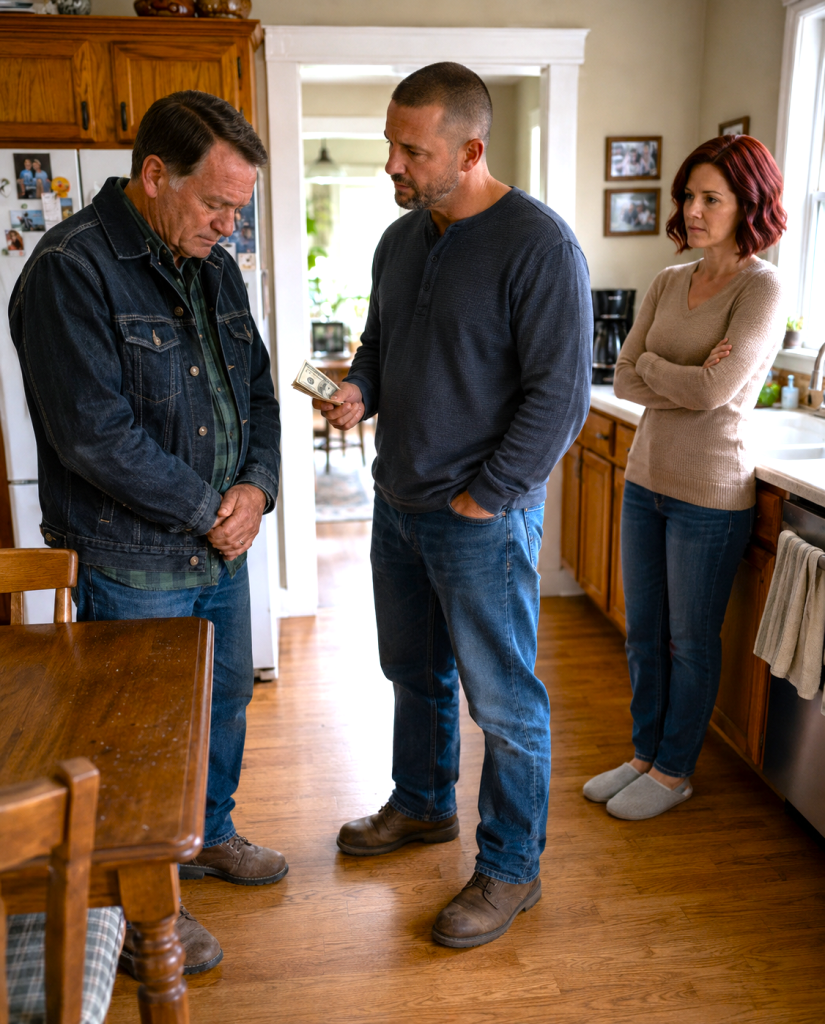
“Tell him to find another job,” she said loudly, making no effort to hide her irritation. “We’re not running a bank here.”
Dad stood beside the kitchen table with his rough, calloused hands clasped tightly together.
His shoulders were slightly hunched.
His eyes remained fixed on the floor.
I had never seen him look so ashamed.
Raymond had spent more than three decades working construction beneath the harsh Colorado sun.
He hauled lumber.
Poured concrete.
Repaired roofs.
And no matter how tired he was when he came home, he still checked my homework and made sure my lunch was packed for the next day.
Years later, I learned he had sold his motorcycle to help pay for my college expenses.
When I was nine, he even sold the only decent suit he owned so I could have new shoes for school.
He never told me about either sacrifice.
That was simply who my father was.
He gave quietly and never expected recognition.
Now, standing in my kitchen, he could barely look me in the eye.
“The money isn’t really for me, Grant,” he said softly. “I need some certified documents, legal help, and there’s a test I have to complete.”
Natalie folded her arms.
“There’s always some mysterious crisis.”
“That’s enough,” I said.
She rolled her eyes and turned toward the counter.
I guided Dad outside before things got worse.
The afternoon was warm, but Raymond rubbed his hands together nervously as though he were freezing.
“I didn’t come here to cause trouble,” he said. “If you can’t help me, I’ll understand.”
“What documents do you need?”
He hesitated.
“Old adoption records.”
I frowned.
“Whose adoption?”
His gaze shifted toward the house.
“I need evidence before I explain everything. Otherwise, someone might say I’m confused. Or accuse me of interfering in your marriage.”
My stomach tightened.
“Who would say that?”
He didn’t answer.
Instead, he placed one hand on my shoulder.
“I’m trying to give you something I should have given you a long time ago.”
There was something in his voice that unsettled me.
A warning.
An urgency he was trying very hard to hide.
But I also understood how much it had cost him simply to come here and ask.
My father had spent his entire life giving to me without requesting anything in return.
I wasn’t going to force him to defend himself while he stood embarrassed in my backyard.
“I’ll get the money.”
Relief briefly crossed his face.
“I’ll repay you.”
“You don’t have to.”
I went into my office and unlocked the small safe beneath my desk.
As I pulled out an envelope containing emergency cash, Natalie appeared in the doorway.
“You’re seriously giving it to him?”
“Yes.”
“We agreed we’d discuss large expenses before spending money.”
“We’re discussing it right now.”
“No. You’re completely ignoring what I think.”
“He has never asked me for money before.”
“That doesn’t mean he won’t start now.”
“He’s my father.”
“And this is our house.”
Something about those words bothered me.
Legally, the house belonged to me.
Dad had paid most of the down payment years earlier after selling the final piece of land his mother had left him.
Natalie knew that perfectly well.
I carried the envelope to the front door and handed it to my father.
His fingers shook slightly as he accepted it.
“I’m sorry, son.”
“You have nothing to apologize for.”
Dad looked past me toward Natalie.
Then he slipped the envelope into his jacket.
Normally, we hugged before he left.
That day, he simply walked away.
The second the door closed, Natalie turned on me.
“You made me look stupid.”
“You humiliated him.”
“He wouldn’t even tell you why he needed the money.”
“He’ll explain when he’s ready.”
“You always take his side.”
I looked straight at her.
“He spent his entire life taking mine.”
We barely spoke for the rest of the evening.
Three days later, an unfamiliar number appeared on my phone.
“Is this Grant Mercer?” a woman asked.
“Yes.”
“I’m calling from Valley Regional Hospital. Raymond Mercer listed you as his emergency contact.”
I stood so quickly that my chair rolled backward.
“What happened?”
“He collapsed earlier this morning. The doctors discovered an aortic aneurysm and took him directly into emergency surgery.”
My hand tightened around the phone.
“Is he alive?”
“He was stable when he entered the operating room.”
I exhaled shakily.
Then she continued.
“Before he was sedated, your father asked us to give you a sealed envelope. There is also an attorney waiting here to speak with you.”
I froze.
“An attorney?”
“Yes. Her name is Priya Desai.”
I grabbed my keys.
But before the woman ended the call, she added one final detail.
“Your father gave us explicit instructions that you must not discuss the envelope with your wife until after you’ve spoken to Ms. Desai.”
I stopped in the middle of the room.
My heart began pounding.
“What does Natalie have to do with this?”
“I’m sorry,” the woman replied. “He didn’t explain.”
I drove to the hospital so quickly that later, I could barely remember the route.
All I could think about was my father lying in an operating room.
And the sealed envelope waiting for me.
An envelope he had apparently spent weeks preparing.
An envelope my wife was never supposed to see.
The surgical waiting area was nearly empty when I arrived.
A television mounted high on the wall played a cooking show with the sound muted. Somewhere nearby, a vending machine hummed.
A woman in a navy suit stood when she saw me.
“Grant Mercer?”
“Yes.”
“I’m Priya Desai.”
She looked to be in her early fifties, with silver beginning to show at her temples.
She offered her hand.
“I’m your father’s attorney.”
“I didn’t know my father had an attorney.”
“He hired me eleven days ago.”
That made me stop.
Eleven days.
So whatever Dad had been doing had begun well before he came asking for money.
“How is he?”
“I don’t know anything beyond what the doctors have told you.”
Then Priya reached into her leather bag and removed a large cream-colored envelope.
My name was written across the front in Dad’s handwriting.
Underneath it were five words.
READ THIS BEFORE CALLING NATALIE.
My stomach turned.
“What is this?”
“Your father wanted you to read it privately.”
“Why?”
“Because some of what’s inside concerns your wife.”
I stared at her.
“Did my father think Natalie was doing something?”
Priya chose her words carefully.
“Your father believed you deserved information that had been withheld from you.”
I sat down.
My hands suddenly felt cold.
Priya remained standing.
“I should also tell you that the thousand dollars you gave him was used exactly as he said. Certified court records, archival searches, a DNA test, and part of my retainer.”
“A DNA test?”
She nodded.
“Read the letter.”
I opened the envelope.
Inside were several documents and a handwritten letter.
I recognized Dad’s handwriting immediately.
Grant,
If you are reading this, either I finally found the courage to tell you everything, or something happened before I could.
There is no easy way to say this.
Natalie knew your biological mother before she ever met you.
I stopped reading.
For several seconds I simply stared at the sentence.
Then I read it again.
Natalie knew your biological mother before she ever met you.
“That’s impossible.”
Priya said nothing.
I continued.
You have always known that I adopted you after your mother died. What I never told you was that your mother had another child before you.
A daughter.
Her name was Rebecca.
My breathing slowed.
I had known I was adopted.
Dad never hid that.
My biological mother, Elaine Porter, had died when I was four. Dad had been dating her for nearly two years and was already the only father I remembered. After her death, he fought for permission to adopt me.
What I had never heard was that Elaine had another child.
I turned to Priya.
“I have a sister?”
“Keep reading.”
I did.
Rebecca was born when your mother was seventeen. Elaine’s parents forced her to place the baby for adoption. She spent years trying to locate her daughter afterward but never succeeded.
Before Elaine died, she made me promise that if I ever found Rebecca, I would tell you.
Three months ago, I found her.
My hands started trembling.
Her legal name after adoption was Rebecca Anne Caldwell.
She later married a man named Thomas Hale.
They had one daughter.
Natalie Hale.
I stopped breathing.
The waiting room seemed to tilt around me.
“No.”
Priya sat across from me.
“Mr. Mercer—”
“No.”
I looked at the paper again.
Natalie Hale.
My wife’s maiden name.
I had known her mother was named Rebecca.
Rebecca had died years before Natalie and I met.
But Natalie rarely spoke about her.
According to Natalie, her mother had been unstable, secretive, and difficult.
I forced myself to continue.
Grant, Rebecca was your half-sister.
That means Natalie is your biological niece.
The paper slipped from my fingers.
I stood so abruptly that the chair scraped backward.
“No.”
Priya’s expression remained calm, but there was sympathy in her eyes.
“No, that can’t be right. Natalie is only five years younger than me.”
“That’s correct.”
“We’ve been married seven years.”
“I understand.”
“We dated for two years before that.”
“I understand.”
“Then why didn’t anyone know?”
“Your biological mother’s first adoption was sealed. Raymond only found the connection after locating records that became accessible under updated state procedures.”
I felt sick.
Then another thought hit me.
“You said Natalie knew my mother.”
Priya nodded toward the letter.
I picked it up again.
There was more.
And somehow, it got worse.
Natalie knows.
Not everything, perhaps. But enough.
Two weeks ago, I went to speak with her privately.
I showed her a photograph of Elaine.
Natalie recognized her immediately.
She told me Rebecca had kept photographs and letters hidden in a cedar box.
One of those letters mentioned a younger son named Grant.
Natalie admitted finding those letters when she was nineteen.
She knew her mother had a younger half-brother.
She knew his name.
She never told you.
I lowered the page.
My mind immediately went back to the first time Natalie and I met.
A charity fundraiser in Denver.
She had approached me.
Not the other way around.
“You’re Grant Mercer, right?”
Those had been her first words.
At the time, I assumed she had seen my name tag.
Now I couldn’t remember whether I had even been wearing one.
I kept reading.
I asked Natalie why she never told you.
She said she didn’t believe the Grant mentioned in the letters was you until after your engagement.
By then, she said, she was afraid of losing you.
I told her fear did not give her the right to hide something this serious.
She asked me to stay out of your marriage.
Then she told me something that frightened me.
She said, “Grant has already lost enough family. He doesn’t need you putting ideas in his head.”
That is why I hired Priya.
That is why I needed the DNA test.
I would not destroy your marriage based on suspicion.
I needed proof.
The DNA report is attached.
I found it underneath the letter.
The report compared my sample with DNA from a preserved medical sample connected to Rebecca through an authorized genealogical process Priya had helped coordinate.
The probability of a close biological relationship was overwhelming.
I read the conclusion three times.
Then I looked at Priya.
“So my wife is my niece.”
“Yes.”
I pressed both hands against my face.
The horror of the situation was difficult to describe.
Natalie and I had no children. After years of trying, we had eventually stopped discussing it.
For the first time in my life, I was grateful for that heartbreak.
Then Priya said something that shifted the entire situation again.
“There is another issue.”
I looked up.
“What?”
“Your father discovered the family relationship accidentally. It wasn’t what originally made him suspicious.”
“What was?”
“Money.”
She removed another folder.
Inside were copies of bank statements.
My bank statements.
Or rather, statements from an investment account I had barely thought about in years.
Dad had established it when I was a teenager.
He put small amounts into it whenever construction work was good. Later, I contributed too.
By my mid-thirties, the account had grown considerably.
Natalie handled most of our household finances because she worked in financial administration and always claimed she was better organized than I was.
I trusted her.
The statements showed withdrawals.
$8,000.
$12,500.
$17,000.
$9,300.
Again and again.
My chest tightened.
“What is this?”
“Your father noticed a tax document at your house several months ago while helping you repair the garage door. He saw an account balance that didn’t match what he remembered.”
“That account should have more than two hundred thousand dollars.”
“It had thirty-eight thousand last month.”
I stared at her.
“Where did the rest go?”
“That is what we haven’t fully established.”
I remembered Natalie’s words from three days earlier.
We’re not a bank.
My father had stood in my kitchen ashamed to ask for $1,000 while my wife had apparently moved more than $160,000 from an account Dad had helped build.
“Does she know Dad discovered this?”
“We believe so.”
“How?”
“Your father confronted her.”
I almost laughed from disbelief.
“When?”
“The same day he asked you for the money.”
Suddenly Dad’s humiliation made sense.
He had not been afraid to ask me for money.
He had been afraid of Natalie.
“She knew why he needed the thousand dollars.”
“Yes.”
“And she still stood there pretending he was some irresponsible old man looking for a handout.”
Priya didn’t answer.
She didn’t have to.
My phone rang.
Natalie.
I stared at her name.
Priya quietly said, “Your father specifically asked that you speak with me before you speak with her.”
I declined the call.
Ten seconds later, a message arrived.
Where are you?
Then another.
Grant?
Then:
Your dad isn’t answering. Is something wrong?
I felt anger rising inside me.
I typed only four words.
Dad is in surgery.
Her reply came almost instantly.
I’m coming to the hospital.
I looked at Priya.
“She’s coming.”
Priya gathered the documents.
“Then I recommend we move somewhere private.”
But Natalie was faster than I expected.
Twenty-five minutes later, she walked into the waiting area.
She saw me first.
Then Priya.
Then the envelope in my hand.
And I watched the color disappear from her face.
That was the moment I knew Dad had been telling the truth.
Natalie didn’t ask about his surgery.
She didn’t ask whether he was alive.
Her eyes went directly to the envelope.
“What did he give you?”
I stood.
“How much did you know?”
Her lips parted.
“About what?”
“My mother.”
Silence.
Just one second.
But it was enough.
“Natalie.”
“Grant, this is not the place.”
“How much did you know?”
She looked toward Priya.
“Why is she here?”
“Answer me.”
Natalie lowered her voice.
“I found some old letters after my mother died.”
“You knew she had a half-brother named Grant.”
“I knew there was someone named Grant.”
“You knew his mother was Elaine Porter.”
Her eyes filled with tears.
“I wasn’t certain.”
“Were you certain before our wedding?”
She looked away.
That was my answer.
I felt something inside me collapse.
“You knew.”
“I suspected.”
“That isn’t what I asked.”
“Grant, please.”
“Did you know before our wedding?”
Finally she whispered, “Yes.”
I stepped backward.
The woman I had slept beside for seven years suddenly looked like a stranger.
“Why?”
“I loved you.”
I stared at her.
“That was your reason?”
“I was terrified. We were already engaged when I confirmed it. My mother was dead. Elaine was dead. I didn’t have anybody to ask. I convinced myself those old records could be wrong.”
“You could have told me.”
“And lose you?”
“You let me marry you without knowing the truth.”
She started crying.
“I didn’t know what else to do.”
“You tell the truth. That’s what you do.”
People at the other end of the waiting room were beginning to look toward us.
I lowered my voice.
“Did you take money from my investment account?”
Her expression changed again.
This time, there was no confusion.
Only fear.
“Raymond told you that too?”
That sentence answered the question before she did.
“How much?”
“Grant—”
“How much money did you take?”
“I moved some investments.”
“Where?”
“I can explain.”
“Where?”
She swallowed.
“My brother needed help.”
I blinked.
“You told me you didn’t have a brother.”
“He’s my adoptive brother. Technically.”
“How much?”
“He had debts.”
“How much, Natalie?”
She whispered, “Around ninety thousand.”
“The account is missing more than that.”
Her eyes dropped.
I waited.
Eventually she said, “I also helped my aunt.”
“Which aunt?”
“My father’s sister.”
“And the rest?”
“There were expenses.”
“What expenses?”
She said nothing.
Priya spoke for the first time.
“Mrs. Mercer, I strongly suggest you retain independent counsel before discussing financial matters further.”
Natalie glared at her.
“This is my marriage.”
Priya remained composed.
“Then perhaps you should have treated it with more honesty.”
Natalie turned toward me.
“Grant, your father hates me.”
“No.”
My voice surprised even me with how calm it sounded.
“He protected me.”
“He has been trying to break us apart.”
“He paid the down payment on our house.”
“That doesn’t give him the right to control us.”
“He never tried to control us.”
“He was always watching.”
“Apparently someone needed to.”
She flinched.
Then a surgeon appeared through the double doors.
“Family of Raymond Mercer?”
I forgot Natalie instantly.
I rushed toward him.
“I’m his son.”
The doctor pulled down his mask.
“The surgery went well.”
My knees nearly gave out.
“He’s alive?”
“He is. The aneurysm was serious, but we repaired it before rupture. He’ll spend some time in intensive care. The next twenty-four hours are important, but right now I’m cautiously optimistic.”
I closed my eyes.
For several seconds, nothing else mattered.
Not Natalie.
Not the money.
Not the letters.
My father was alive.
When I opened my eyes again, Natalie was standing several feet behind me.
For the first time since arriving, she asked, “Can we see him?”
The doctor looked at me.
“Immediate family only, one person initially.”
I looked at Natalie.
Then I remembered Dad’s trembling hands in my kitchen.
“No,” I said. “I’ll go.”
Dad looked smaller in the hospital bed.
Machines surrounded him.
Tubes ran beneath the blankets.
The strong hands that had built houses, repaired roofs, changed my bicycle tires, and carried me to bed when I fell asleep on the couch now rested motionless beside him.
I sat down and held one of them.
For a while, I couldn’t speak.
Finally I whispered, “You should have told me.”
His eyelids moved.
I wasn’t sure whether he could hear me.
“You never should have had to borrow money from me to prove any of this.”
His fingers tightened faintly around mine.
That tiny movement broke me.
I bent forward.
“I’m sorry she spoke to you like that.”
A tear slid down the side of his face.
His eyes opened slightly.
“Grant.”
“I’m here.”
His voice was barely audible.
“Envelope?”
“I read it.”
His eyes closed.
“Sorry.”
“No.”
I squeezed his hand.
“You have nothing to apologize for.”
He tried to speak again.
I leaned closer.
“The house,” he whispered.
“What about the house?”
“Desk.”
Then he drifted back to sleep.
I didn’t understand until the following morning.
Priya did.
Dad had left another file in his desk.
With his permission, Priya and I retrieved it from his apartment.
Inside was the original documentation for my house.
Dad’s contribution to the down payment had not been a casual gift.
Years earlier, when I was still unmarried, Dad and I had signed a private agreement recording his contribution and confirming that the property was intended as my separate asset.
After Natalie and I married, she repeatedly encouraged me to refinance and add her name to the title.
I had nearly done it twice.
Both times, Dad advised me not to rush.
Natalie had always portrayed that advice as evidence that he disliked her.
Now I understood.
Dad had been protecting the one major asset she had not managed to touch.
Over the next two weeks, the rest came apart quickly.
A forensic accountant traced the missing investment money.
Some had gone to Natalie’s relatives.
Some had paid credit-card balances I never knew existed.
Nearly $46,000 had gone into an account solely in Natalie’s name.
Another $31,000 had been transferred to an investment account controlled by her adoptive brother.
And more than $20,000 had been spent on travel, jewelry, and purchases Natalie had hidden from me.
When I confronted her with the full accounting, she stopped denying it.
Instead, she became angry.
“You never cared about that account.”
“That doesn’t make it yours.”
“We’re married.”
“You hid the withdrawals.”
“Because I knew you’d overreact.”
“You took more than a hundred and sixty thousand dollars.”
“I was going to put it back.”
“With what?”
She had no answer.
Then she said the sentence that ended whatever remained between us.
“Your father had no business looking into our finances.”
I stared at her across the kitchen.
The same kitchen where Dad had stood asking me for $1,000.
The same kitchen where she had told him to get another job.
And suddenly the cruelty of that moment looked different.
It hadn’t been irritation.
It had been panic.
She knew exactly what he was trying to uncover.
“You weren’t embarrassed that he asked me for money,” I said.
“What?”
“You were afraid I’d ask why.”
Her face hardened.
“That’s ridiculous.”
“No. You knew he was collecting records. You knew he had confronted you. You knew if I gave him the money, he might finish what he started.”
She looked away.
That was enough.
“I want you to leave.”
Her head snapped toward me.
“This is my home.”
“No. It isn’t.”
She laughed once.
“You can’t just throw your wife out.”
“I’ve already spoken to an attorney.”
Her expression changed.
“You’re divorcing me?”
“Yes.”
“Because of Raymond?”
“No. Because you married me while hiding something that would have changed my decision to marry you. Because you took my money and lied about it. Because when an old man who sacrificed half his life for me stood in this kitchen asking for one thousand dollars, you humiliated him while knowing he was spending that money trying to protect me.”
She started crying.
This time I felt no urge to comfort her.
“You said you loved me,” she whispered.
“I did.”
“Then how can you do this?”
“Love without truth isn’t enough.”
She left two days later.
The divorce was ugly, but not in the way Natalie expected.
She initially demanded half the house.
The documentation Dad had preserved helped establish its separate-property history, though the final legal settlement still required months of negotiation.
The missing investment funds became part of that settlement too.
Natalie eventually agreed to repay a substantial portion through surrendered assets and her share of other marital property.
But the money became less important to me than I expected.
The thing I couldn’t stop thinking about was that Tuesday afternoon.
Dad rubbing his hands together in my backyard.
Dad saying, “I didn’t come here to cause trouble.”
Dad promising to repay money that had partly been used to discover someone else was taking mine.
I visited him every day during his recovery.
One afternoon, about three weeks after surgery, I finally asked the question that had been bothering me.
“Why didn’t you tell me sooner?”
He looked out the hospital window.
“Because I wasn’t sure.”
“About Natalie?”
“About any of it.”
He paused.
“I’ve seen families destroyed by accusations. Once words leave your mouth, you can’t always put them back. I wasn’t going to walk into your marriage with a twenty-five-year-old letter and tell you your wife had lied to you.”
“So you investigated.”
He smiled faintly.
“I tried.”
“With my thousand dollars.”
His expression became embarrassed.
“I was going to pay you back.”
I laughed for the first time in weeks.
“Dad.”
“What?”
“You sold your motorcycle for my tuition.”
“That motorcycle barely ran.”
“You sold your suit for my school shoes.”
He looked surprised.
“Who told you that?”
“Aunt Carol.”
“That woman talks too much.”
I smiled.
Then I reached into my jacket and placed an envelope on his blanket.
He frowned.
“What’s this?”
“Open it.”
Inside was a cashier’s check.
He stared at the amount.
$50,000.
Then at me.
“No.”
“Yes.”
“No, Grant.”
“It isn’t charity.”
“I don’t need fifty thousand dollars.”
“I know.”
“Then take it back.”
“No.”
He pushed the envelope toward me.
I pushed it back.
“For once in your life, stop arguing and let your son do something for you.”
His eyes became wet.
“I didn’t raise you so you could pay me back.”
“I know.”
“Then why?”
“Because you spent your whole life making sure I never had to stand in someone’s kitchen ashamed to ask for help.”
He looked down at the check.
Neither of us spoke for a while.
Finally he folded the envelope and placed it beside him.
“I’m buying another motorcycle.”
“You’re seventy-one.”
“So?”
“You just had major heart surgery.”
“A small motorcycle.”
I laughed so loudly a nurse looked through the doorway.
Dad grinned.
It was the first time I had seen him truly smile since everything happened.
Six months later, he moved into a small house fifteen minutes from mine.
He did buy the motorcycle.
It was used, slow, and according to him, “practically a bicycle.”
I hated it.
He loved it.
As for Natalie, I saw her only once after the divorce became final.
We met outside the courthouse.
She looked older.
Not physically, exactly.
Just tired.
She asked whether Dad was doing well.
“He is.”
“I’m glad.”
I nodded.
She hesitated.
Then she said, “I really did love you.”
I believed her.
That was perhaps the saddest part.
“I think you did too,” I said.
She looked surprised.
“But you were afraid of losing what you wanted, so you decided I didn’t deserve the truth.”
She lowered her eyes.
“I’m sorry.”
I had spent months imagining what I would say if she ever apologized.
In the end, I didn’t need a speech.
“I hope you build a better life.”
Then I walked away.
Dad was waiting for me across the street.
He had insisted on coming.
He stood beside his ridiculous motorcycle wearing a helmet that made him look ten years old.
“Well?” he asked.
“It’s finished.”
He studied my face.
“You okay?”
I looked back at the courthouse.
Then at him.
“Yeah.”
And for the first time, I meant it.
We drove home separately.
Dad, naturally, ignored the route I had suggested and took the longer road through the foothills.
I followed behind him.
The Colorado mountains rose in the distance, bright beneath the afternoon sun.
For most of my life, I had believed my father was the man who rescued me after my biological mother died.
Only after nearly losing him did I understand that rescue wasn’t something he had done once.
He had been doing it my entire life.
He rescued me when he adopted a frightened four-year-old boy who had nowhere else to go.
He rescued me when he worked overtime so I could attend college.
He rescued me when he sold things he loved without ever telling me.
And at seventy-one years old, with a damaged heart and trembling hands, he had done it again.
He walked into my kitchen and allowed himself to be humiliated because protecting me mattered more to him than his pride.
That thousand dollars never bought what I thought it did.
It bought records.
A DNA test.
An attorney’s time.
But most importantly, it bought the truth.
And the truth cost my marriage.
For a long time, I thought that meant I had lost everything.
I hadn’t.
I lost a relationship built partly on secrets.
I recovered money I hadn’t known was disappearing.
I protected the home my father had sacrificed to help me buy.
And I got something far more valuable than any of those things.
More time with him.
Dad still keeps the original thousand-dollar envelope in the top drawer of his desk.
I discovered that one Sunday while helping him organize paperwork.
Across the front, he had written a date.
Underneath it were six words:
THE DAY MY SON TRUSTED ME.
I stood there holding it for a long time.
Then Dad appeared behind me.
“You weren’t supposed to find that.”
“You kept the envelope?”
“Apparently.”
I turned around.
“You know what I remember about that day?”
He shrugged.
“What?”
“You apologizing to me.”
His smile disappeared.
“I hated asking.”
“I know.”
“I felt like I’d failed.”
That hurt more than I expected.
I placed the envelope back into the drawer.
“You didn’t fail me, Dad.”
He looked at me.
“You came to my house with almost no money, knowing my wife didn’t want you there, and you still chose to protect me.”
He swallowed.
“That’s what fathers do.”
“No,” I said. “That’s what you do.”
For once, Raymond Mercer had nothing to say.
So I hugged him.
The same way he had hugged me thousands of times when I was a boy.
And standing there in his little house, with his old motorcycle parked outside and the afternoon sun coming through the window, I finally understood something my father had spent a lifetime teaching me without ever putting it into words.
The people who truly love you do not always arrive carrying something to give.
Sometimes they arrive needing help.
Sometimes their hands shake.
Sometimes pride forces them to stare at the floor while they ask for an amount of money they once would have earned in a week.
And sometimes the most important decision you will ever make is whether you remember what that person gave you when they had more strength than they have today.
My father asked me for $1,000.
I gave it to him because he was my dad.
I had no idea he was using it to protect me.
But if I could return to that Tuesday afternoon and change one thing, it wouldn’t be the money.
I would have stopped him before he apologized.
I would have hugged him before he walked away.
And I would have told him what I finally understand now:
After everything he had given me, he never needed permission to ask.
THE END! Thank you for reading.