 Reading Time: 9 minutes
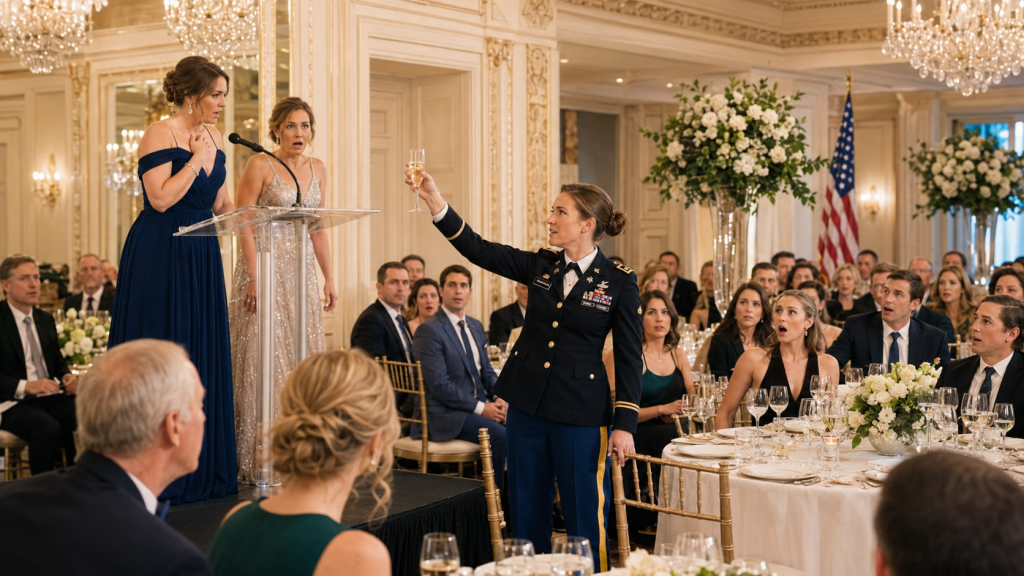
At my sister’s wedding, my mother introduced me to two hundred guests as the daughter with no degree, no future, and nothing to offer the family. Then she waited for them to laugh.The spotlight found me before I had time to prepare for it.
One second, I was sitting quietly at a corner table inside the Fairfield Officers Club, watching crystal glasses rise beneath enormous chandeliers while a string quartet played near the dance floor.
The next, a hard circle of white light trapped me in my chair.
Every face in the ballroom turned toward me.
My biological mother, Marlene Bennett,
stood onstage in a silver silk gown, one hand resting proudly on the shoulder of my stepsister,
Sloane Caldwell.
Sloane was still wearing her wedding dress,
a fitted white gown with a long train arranged perfectly around her chair.
Her new husband sat beside her, looking like a man who had just realized he had married into a family that treated cruelty as entertainment.
“And, of course, we must acknowledge my other daughter, Claire,” Marlene announced into the microphone.
She stretched the word other just enough to make the distinction clear.
I was not the bride.
I was not the daughter she displayed in company photographs or praised at charity dinners.
I was the other one.
The ballroom became so quiet that I could hear a server shift the weight of a silver tray near the wall.
I sat straight in my Army dress uniform with my hands resting beside an untouched champagne glass.
Every ribbon was aligned.
Every button reflected the chandelier light.
I had polished the oak-leaf insignia on my shoulders that morning until the metal looked like cold fire.
I had done it in the bathroom mirror of my hotel room because preparation was how I kept control when I knew I was walking into hostile territory.
I had expected cold greetings, forced photographs, and small remarks delivered where nobody else could hear them.
I had not expected my mother to put a spotlight on me in front of two hundred people.
Marlene smiled.
It was the same practiced smile she had used throughout my childhood whenever she wanted strangers to believe she loved me.
“Claire chose a very different path,” she continued.
Her voice was warm and amused, as though she were about to tell an affectionate family story.
“Instead of pursuing a real education or helping build this family’s company, she ran off to play soldier.”
A few people laughed.
The first laugh came from Grant, my stepfather.
He lifted his champagne glass toward me with a smirk, giving everyone else permission to join him.
Two men at his table chuckled immediately.
Sloane covered her mouth as if she were embarrassed by our mother’s joke, but the pleasure in her eyes gave her away.
She had worn that expression before.
She wore it when she received the car I had been told the family could not afford.
She wore it when Marlene gave her my father’s watch because it would look better in Sloane’s wedding photographs.
She wore it whenever someone reminded me that family resources were reserved for people with potential.
Her new husband stared down at his plate.
Several uniformed officers seated near the dance floor looked openly uncomfortable, but nobody interrupted.
I understood why.
It was a wedding, not a briefing room.
No one wanted to be the person who turned a cruel toast into a public confrontation.
Marlene understood that too.
She had spent her entire life using polite rooms as protection.
She knew most people would tolerate almost anything to avoid making a scene.
My mother waited for the first wave of laughter to fade before continuing.
“She may be uneducated and worthless in the business world, but I suppose every family needs someone willing to carry boxes.”
Grant’s table erupted.
The laughter traveled across the ballroom in widening circles.
Guests who barely knew me joined in because everyone around them was laughing, and laughter can become a kind of surrender when people are afraid to ask what is actually funny.
I watched strangers lean toward one another and repeat pieces of the insult.
No degree.
No future.
Playing soldier.
Carrying boxes.
Someone near the bar looked at my uniform, then laughed anyway.
Something hot rose beneath my collar.
It was not shame.
It was memory.
I remembered eating cold pasta alone in the kitchen while Marlene, Grant, and Sloane attended a company dinner without me.
I had been sixteen, old enough to understand that they had not forgotten to invite me.
My mother had left a note on the refrigerator telling me to clean the dishes before bed.
I remembered the birthday everyone forgot until the following morning, when Marlene handed me a drugstore card with the price sticker still attached and told me not to be dramatic.
I remembered my father’s study after he died.
The room had once smelled like coffee, old paper, and the cedar blocks he kept in the bottom desk drawer.
He used to let me sit on the rug while he worked, and whenever I asked too many questions, he would slide a legal pad toward me and tell me to write down the ones worth keeping.
After he was gone, Marlene emptied the room in a single weekend.
His books disappeared.
His framed photographs disappeared.
His desk was sold.
By Monday morning, the room had become storage for Grant’s company files.
Nobody asked whether I wanted anything.
I remembered the military academy application I had hidden inside a blue folder beneath my mattress.
I had spent weeks completing it.
I had written and rewritten every answer until the pages felt like the first honest description of the future I wanted.
Then the folder vanished.
I found it days later inside my mother’s desk, unopened but buried beneath company invoices.
When I confronted her, she did not apologize.
She told me military life was beneath our family and that my application would embarrass her if anyone found out.
“What would people think?” she asked.
That question had governed our house.
Not what was fair.
Not what was true.
Not what I needed.
What would people think?
Marlene cared about appearances because appearances allowed her to arrange every person around her into a flattering picture.
Sloane was the successful daughter.
Grant was the businessman who had rescued the family.
Marlene was the devoted mother who had sacrificed everything.
I was useful only as contrast.
If Sloane was ambitious, I had to be lazy.
If Sloane was educated, I had to be ignorant.
If Marlene was generous, I had to be ungrateful.
The truth had never fit the picture, so the truth was edited out.
I had spent years believing that if I became disciplined enough, accomplished enough, or quiet enough, my mother might eventually be forced to see me clearly.
The Army had taught me many things, but one of the hardest lessons was that endurance and acceptance were not the same thing.
You could survive disrespect without agreeing to keep standing in its path.
The laughter continued around me.
My mother looked pleased with herself.
She believed the spotlight belonged to her because she held the microphone.
I placed both hands on the table and stood.
The nearest guests stopped laughing first.
A woman beside me lowered her champagne glass.
A man across the table straightened in his chair.
Then the silence spread outward as people realized I was not going to sit there and absorb another joke.
I picked up my champagne glass even though I had not taken a single sip all evening.
The stem felt delicate between my fingers.
My hands remained steady.
“To family,” I said.
I did not raise my voice, but it carried farther than my mother’s microphone.
The musicians lowered their instruments.
A server stopped beside the wall with a tray balanced against one palm.
Grant’s smirk remained in place, though his eyes narrowed.
He expected anger.
That was how he and Marlene handled every confrontation.
They provoked, waited for a reaction, and then pointed to the reaction as proof that the other person was unstable.
I had learned that pattern before I was old enough to name it.
I looked around the ballroom at people who had laughed because it was easy.
“To the people who teach us what love should never look like.”
Grant lowered his glass.
Sloane slowly dropped her hand from her mouth.
Her husband finally looked at me.
My mother’s smile tightened at the corners.
“Claire,” she said into the microphone, stretching my name into a warning.
I looked directly at her.
For years, I had wanted her to admit what she had done.
I had imagined apologies in different rooms and different voices.
I had imagined her finding the courage to say she had failed me.
Standing there, I finally understood that waiting for her confession had kept me emotionally tied to a door she had no intention of opening.
I did not need her to admit the truth before I acted on it.
“And to the last night any of you will ever mistake my silence for weakness,” I said.
Nobody laughed.
I set the glass down.
The clear, sharp clink traveled through the ballroom.
No applause followed.
I did not need any.
Applause would have turned the moment into another performance, and I was finished performing for people who had already decided which version of me they preferred.
Marlene gripped the microphone with both hands.
Her expression told me she was searching for the sentence that would put me back in my assigned place.
She could call me dramatic.
She could remind everyone that it was Sloane’s wedding.
She could accuse me of ruining the evening after she had publicly humiliated me.
She had used all those methods before.
This time, I did not give her the chance.
I turned away from the stage and walked toward the ballroom doors while two hundred people watched.
My polished shoes struck the marble floor with a steady rhythm even though my heartbeat had become so loud I could barely hear anything else.
The spotlight followed me for several steps before someone finally switched it off.
The sudden darkness around my chair felt more honest than the attention had.
I passed Grant’s table without looking at him.
I passed relatives who had not called me in years but had laughed as if they knew my entire life.
I passed officers who avoided my eyes and others who gave me small, restrained nods that I did not yet have the strength to return.
Near the doors, I heard my mother say my name again.
This time she was no longer speaking into the microphone.
I kept walking.
No one stopped me.
Not Grant.
Not Sloane.
Not the woman who had just turned my life into entertainment at her favorite daughter’s wedding.
I pushed through the heavy doors and entered the formal hallway outside the ballroom.
The music did not resume immediately.
For several seconds, all I could hear was the muffled movement of two hundred people trying to decide whether they should pretend nothing had happened.
I crossed the lobby beneath smaller chandeliers and passed a wall of framed event photographs without slowing down.
A staff member near the coatroom looked at my face, then at my uniform, and quietly stepped aside.
The front doors opened onto cold night air.
The temperature struck my cheeks and filled my lungs so sharply that I almost stopped.
I had spent the entire evening holding myself still.
Outside, with nobody close enough to watch, my body finally began to understand what had happened.
I walked across the parking lot toward my SUV.
The heels of my shoes clicked against the pavement.
Behind me, light spilled through the officers club windows, warm and gold, turning the wedding into a distant picture of happiness.
From the outside, nobody would have known what had just happened inside.
That was my mother’s specialty.
She could make cruelty look elegant from a distance.
I unlocked the SUV and climbed into the driver’s seat.
By the time I closed the door, my hands had started shaking.
I wrapped them around the steering wheel and stared through the windshield.
My breathing came too fast at first, so I counted each inhale the way I had been taught during high-pressure training.
Four seconds in.
Hold.
Four seconds out.
The shaking did not stop immediately, but it became manageable.
I refused to look back at the building.
I knew what would be happening inside.
Marlene would be telling everyone I had always been overly sensitive.
Grant would say military service had made me hostile.
Sloane would insist she had never wanted the speech to happen, even though she had laughed with everyone else.
By morning, they would have rebuilt the entire event around the claim that I had created the scene.
For most of my life, that knowledge would have sent me back inside to defend myself.
I would have tried to explain calmly.
I would have searched for the perfect combination of words that no reasonable person could twist.
There was no such combination.
People committed to misunderstanding you do not need better information.
They need your continued participation.
That night, I had finally stopped participating.
I loosened my grip on the steering wheel and looked down at the oak-leaf insignia reflected faintly in the side window.
My mother had called me uneducated because my education did not resemble Sloane’s.
She had called me worthless in business because I had refused to join Grant’s company.
She had called me a freeloader even though I had built a life that required nothing from her.
The accusations were not descriptions.
They were punishments for choosing a future she could not control.
My phone rested facedown in the center console.
I knew messages would begin arriving soon.
Some relatives would tell me I should apologize for embarrassing the bride.
Others would claim they had not really been laughing at me.
A few might say they admired what I did while carefully avoiding the question of why they had remained silent.
I was not ready to read any of it.
I started the engine but did not shift into drive.
The dashboard lights came on, casting a soft glow across my hands.
For the first time that night, I had complete control over whether I stayed or left.
Then headlights swept across the parking lot.
A dark sedan turned into the row beside mine and stopped several spaces away.
The driver’s door opened.
A man in a dark military uniform stepped out, adjusted the front of his jacket, and looked toward the officers club.
He moved with purpose, not like a late wedding guest searching for the correct entrance.
He crossed the pavement, passed through the wash of light beneath the awning, and approached the same doors I had just left.
As he turned, the light caught the insignia on his collar.
I recognized it immediately.
A JAG lawyer.
For the first time since leaving the ballroom, I looked back.
He did not glance toward my SUV.
He did not hesitate at the entrance.
He opened the heavy doors and walked inside, carrying nothing visible except the authority of someone who had arrived for a reason.
The doors closed behind him.
I sat motionless with both hands resting on the steering wheel, listening to the engine idle.
My mother believed the night’s final word had belonged to her.
She had no idea who had just entered the room.
THE END! THANKS FOR READING!