 Reading Time: 14 minutes
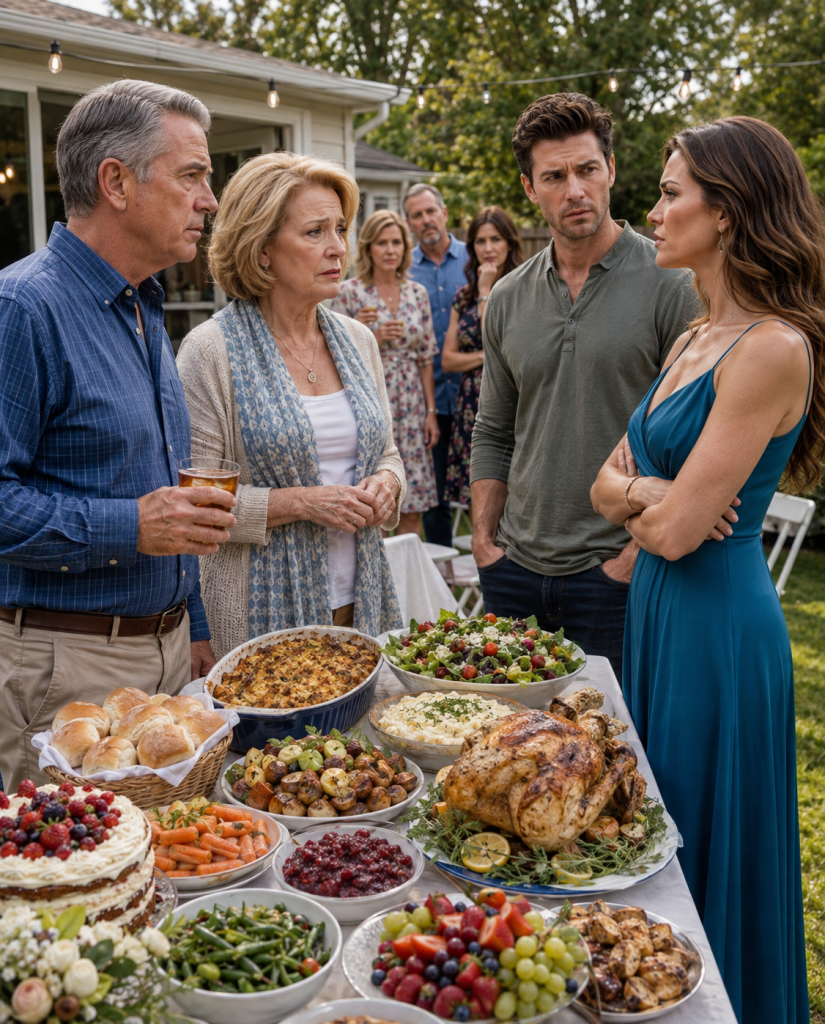
PART 2 The serving spoon slipped from Gloria’s fingers and struck the kitchen floor with a metallic crack.No one heard it except us.
The last of the cars had already disappeared down the street, carrying seventy-five relatives toward the private dining room Tiffany had reserved without telling us. Their laughter faded beyond the row of brick houses, leaving behind six crowded tables, seventy-five empty chairs, and enough untouched food to feed half the neighborhood.
Gloria stood frozen in the doorway.
Her apron was dusted with flour. A narrow white bandage wrapped around two fingers on her right hand,
and exhaustion had deepened the shadows beneath her eyes.
For nearly forty-eight hours, she had worked without complaint.
She had kneaded dough until her wrists ached, stood over boiling pots while her feet swelled,
and measured every ingredient according to Tiffany’s detailed instructions.
Now the birthday balloons knocked softly against the fence in the autumn wind.
“Hank,” Gloria whispered, “did I do something wrong?”
That question broke something inside me.
I had seen my wife endure difficult years without blaming anyone.
When our restaurant nearly closed during the recession,
she worked sixteen-hour days and still packed Kevin’s lunch before school
. When my back injury forced me to stop driving for three months,
she paid the mortgage without ever making me feel useless.
When Tiffany criticized our neighborhood, our clothes,
and the size of our home, Gloria always found an excuse for her.
“She’s young,” she would say.
“She wants things to be perfect.”
“She’s under pressure.”
But there was no excuse for what had happened that afternoon.
“You didn’t do anything wrong,” I said.
Gloria looked at the long table where she had placed Kevin’s tomato soup. The bowl was still covered, its surface beginning to cool beneath the lid.
“He used to ask for that whenever he was sick,” she murmured. “Even when he was twenty.”
I walked over and lifted the lid.
The smell of roasted tomatoes and basil rose into the cold air. For a moment, I saw our son as a little boy again, sitting at this same kitchen table with a blanket around his shoulders while Gloria fed him spoonful by spoonful.
Kevin had once adored his mother.
Somewhere along the way, admiration had become expectation.
Expectation had become entitlement.
And silence had become betrayal.
Gloria began stacking plates.
“What are you doing?” I asked.
“We have to put everything away.”
“No.”
She stared at me.
“We can’t leave it outside, Hank.”
“I don’t mean the food.”
My voice sounded different, even to me.
I had spent most of my life avoiding conflict. Driving a city bus had taught me that anger often burned itself out if you refused to feed it. I had dealt with shouting passengers, impatient supervisors, and strangers who blamed me for weather, traffic, and missed appointments.
I knew how to stay calm.
But calm did not mean weak.
And patience did not mean permission.
I took out my phone.
Earlier, while the guests were arriving, I had photographed the tables. I had wanted to remember Gloria’s work before everyone began eating. In one picture, she stood behind the trays with her bandaged hand resting beside a basket of croissants. She looked tired, but proud.
The photograph captured every detail Tiffany had ignored.
The thirty-eight dishes.
The handwritten labels.
The peach cobbler.
The folding chairs borrowed from church.
And the woman who had given everything she had because she believed her family mattered.
I opened the social media page for Gloria’s Corner.
The restaurant had a small but loyal following. Most posts were simple photographs of soup specials, pies cooling by the window, or customers celebrating birthdays in our cramped dining room.
My fingers paused over the screen.
I could have written Tiffany’s name.
I could have described how she had humiliated Gloria in front of everyone.
I could have told people that my own son walked away without even looking at his mother.
Instead, I uploaded the photograph and wrote one sentence.
“This is what love looks like after two sleepless nights. Sometimes the people who work the hardest never get invited to the table.”
I pressed post.
Gloria moved beside me.
“What did you do?”
“I told the truth.”
Her face filled with worry.
“Hank, take it down.”
“There are no names.”
“They’ll know.”
“They should.”
She looked toward the street as though Tiffany might suddenly return.
“You’ll make things worse.”
“No, Gloria. They made things worse. We just kept pretending they didn’t.”
She opened her mouth, but before she could answer, someone knocked on the side gate.
A woman in a gray sweater stood outside with two teenage boys. I recognized her as Miriam, the director of a shelter three blocks from the restaurant.
“I saw your post,” she said. “I hope I’m not intruding.”
The photograph had been online for less than ten minutes.
Miriam glanced at the tables.
“Is all this food really available?”
Gloria nodded slowly.
“Most of it.”
“Would you consider donating some to the shelter? We have thirty-two people tonight, including nine children.”
Gloria’s expression changed immediately.
“Of course.”
The sadness did not vanish, but purpose replaced it.
Within half an hour, the backyard filled again.
Not with relatives.
With volunteers.
They brought containers, foil, serving utensils, and folding carts. A retired teacher from across the street arrived after seeing the post. Two nurses stopped by after finishing their shifts. A delivery driver offered to transport the heavier trays.
People did not ask for gossip.
They did not ask who had abandoned the party.
They thanked Gloria.
They admired the croissants.
They praised the stuffed peppers.
They wrapped the roasted chicken carefully so nothing would spill.
By seven o’clock, we were standing inside the shelter’s dining hall.
The room was plain, with fluorescent lights and mismatched tables, but it felt warmer than our backyard had all afternoon.
Children lined up beside their parents.
An elderly veteran named Arthur took one bite of beef stew and closed his eyes.
“Ma’am,” he said to Gloria, “I haven’t tasted anything like this since my wife passed.”
Gloria’s lips trembled.
He reached across the table and touched the edge of her bandage.
“You made all this with an injured hand?”
“It’s only a small burn.”
Arthur shook his head.
“There is no such thing as a small sacrifice when someone makes it for strangers.”
That was the moment Gloria finally cried.
Not loudly.
She turned away and covered her face with her uninjured hand.
I held her while people continued eating behind us.
For two nights, she had worked to earn gratitude from people who believed her love was an obligation.
In less than two hours, strangers had given her what her own family could not.
Respect.
When we returned home, the backyard was empty except for a few crumbs and the forgotten bowl of tomato soup.
Gloria placed it in the refrigerator.
“Maybe Kevin will come tomorrow,” she said.
I wanted to tell her not to hope.
But hope had always been one of the things I loved most about her.
So I kissed her forehead and turned off the kitchen light.
At 5:42 the next morning, my phone began ringing.
Kevin.
I silenced it.
Thirty seconds later, he called again.
Then Tiffany.
Then a number I recognized as Tiffany’s mother.
By six fifteen, there were eleven missed calls and six messages.
The photograph had spread much farther than I expected.
Someone had shared it in a neighborhood group. A customer recognized our backyard and mentioned that Gloria had spent the previous two days preparing a birthday meal. Another person had posted a short video showing seventy-five guests leaving for Rosewood while the food remained untouched.
I had not known anyone was filming.
The video showed Tiffany tapping the glass.
It captured her announcement.
It captured Gloria standing behind the tables with her burned hand hidden against her apron.
Worst of all for Tiffany, it captured Kevin walking past his mother without saying a word.
The comments multiplied by the minute.
People called the scene cruel.
Others praised Gloria’s generosity after learning where the food had gone.
Customers began posting photographs of meals she had prepared for them over the years. One woman wrote that Gloria had fed her children for free after her husband lost his job. A man described how she kept the restaurant open late so his family could eat after his mother’s funeral.
By seven o’clock, the original photograph had been shared more than twelve thousand times.
Gloria sat at the kitchen table staring at my phone.
“This is getting too big.”
“Maybe it needed to.”
“Hank, people are attacking them.”
“I didn’t ask anyone to do that.”
“But we can stop it.”
I looked at her.
“Do you want me to delete the post?”
She hesitated.
That hesitation told me everything.
A knock sounded at the front door.
Kevin stood on the porch.
He wore the same navy jacket from the party, though it was wrinkled now. His eyes were red, and his hair looked as if he had run his hands through it all night.
“Dad,” he said, “we need to talk.”
I stepped aside.
He entered but did not remove his jacket.
Gloria rose instantly.
“Did you eat?”
Even after everything, that was her first question.
Kevin’s face tightened.
“Mom, please.”
She stopped.
He turned toward me.
“You have to delete that post.”
“Good morning to you too.”
“This isn’t funny.”
“I’m not laughing.”
“Tiffany’s being harassed. People found her workplace. Her manager called. Kayla’s friends are sharing the video everywhere.”
“Did you come here to see how your mother is?”
“I know she’s upset.”
“Do you?”
He glanced at Gloria’s bandaged hand.
For the first time, he seemed to notice it.
“What happened?”
“She burned herself making your daughter’s birthday food.”
His eyes dropped.
“I didn’t know.”
“You didn’t ask.”
“Dad, Tiffany didn’t mean for this to happen. Rosewood had a cancellation. She thought it would be nicer for Kayla.”
“She knew about the reservation before she arrived.”
Kevin said nothing.
“Didn’t she?”
He looked toward the window.
“She booked it three days ago.”
Gloria gripped the back of her chair.
“Three days?”
Kevin closed his eyes.
“She wasn’t sure she’d use it.”
“But she still gave me the list,” Gloria said.
“It was supposed to be a backup.”
“A backup?” I repeated. “Your mother spent her oven money on that backup.”
His head lifted.
“What oven money?”
“The restaurant oven needs repairs. She used five hundred eighty-seven dollars from her tip savings to buy the ingredients.”
Kevin looked at his mother.
“You paid for everything?”
“Tiffany said the party budget was tight.”
His face went pale.
The private room at Rosewood would have cost several thousand dollars.
Even before drinks.
Even before the custom cake Tiffany ordered from a fashionable bakery because Gloria’s red velvet cake was apparently too simple.
Kevin sank into a chair.
“I thought Tiffany reimbursed you.”
“She never offered,” I said.
Gloria touched my arm.
“Hank.”
“No. He needs to hear it.”
Kevin stared at the floor.
“I should have paid attention.”
“Yes.”
“I should have said something yesterday.”
“Yes.”
He looked up at his mother.
“I’m sorry.”
Gloria’s expression softened immediately, but I raised a hand.
“Sorry for what?”
Kevin frowned.
“What?”
“Be specific. Are you sorry she worked for two nights? Sorry you left? Sorry you knew about the restaurant and kept quiet? Or sorry the public found out?”
His jaw tightened.
“Why are you doing this?”
“Because vague apologies are how this family keeps avoiding the truth.”
“I came here to fix things.”
“No. You came here to fix the post.”
The front door opened without a knock.
Tiffany stormed inside.
She wore dark glasses despite the cloudy morning, and her expensive camel-colored coat hung open over yesterday’s dress.
“You!” she shouted, pointing at me.
Gloria flinched.
I remained seated.
“Take it down now.”
“Tiffany,” Kevin said.
“No. I am not going to let him destroy our lives because of one misunderstanding.”
“Was the restaurant reservation a misunderstanding?” I asked.
Her lips tightened.
“We were trying to give Kayla a proper celebration.”
Gloria’s face changed.
“A proper celebration?”
Tiffany pulled off her glasses.
Her eyes were swollen, but anger made them sharp.
“The backyard looked cheap. People were posting pictures before the party even began. Kayla was embarrassed.”
“By my food?” Gloria asked.
“By the whole setup.”
Kevin stood.
“Stop.”
But Tiffany had spent too many years speaking without consequences.
“The folding chairs didn’t match,” she continued. “The lights looked homemade. My parents were uncomfortable. Kayla is eighteen. She’ll remember that birthday forever.”
“Yes,” I said. “She probably will.”
Tiffany stepped toward me.
“You posted that picture to humiliate us.”
“I posted a picture of my wife.”
“You knew what people would assume.”
“They assumed correctly.”
Her face reddened.
“This is defamation.”
“Which part is false?”
She opened her mouth.
Nothing came out.
My phone rang again.
The screen displayed Gloria’s Corner.
I answered.
It was Elena, our morning server.
“Hank,” she said breathlessly, “you and Gloria need to come to the restaurant.”
“What happened?”
“There are people outside.”
“What people?”
“Customers. Reporters. A lot of them.”
Tiffany heard every word.
Her expression shifted from anger to fear.
“Reporters?”
I stood.
“We have to go.”
“I’m coming with you,” she said.
“No.”
“You created this situation.”
“You created it when you left the tables.”
She blocked the doorway.
“You will tell them it was a family misunderstanding.”
I looked at my son.
He stared at his wife as though he were seeing her clearly for the first time.
Then he stepped between us.
“Move, Tiffany.”
She turned.
“What did you say?”
“Let them go.”
“You’re taking their side?”
“I’m taking responsibility.”
The words seemed to shock him as much as they shocked her.
Tiffany’s voice lowered.
“Careful, Kevin.”
Something cold passed between them.
It lasted only a second, but I noticed.
So did Gloria.
Kevin looked away first.
We drove to the restaurant in silence.
A crowd filled the sidewalk outside Gloria’s Corner.
Some carried flowers.
Others held handwritten signs thanking Gloria for feeding the shelter. Local television vans were parked near the curb, and customers pressed close to the windows.
The moment Gloria stepped out of the car, applause erupted.
She stopped as if struck.
A little girl ran toward her holding a bouquet of grocery-store daisies.
“My mommy said you gave food to children,” she said.
Gloria knelt and accepted the flowers.
Inside, the restaurant was overflowing.
Orders had tripled overnight. People wanted to support her. A bakery offered to donate desserts for a week. A repair company volunteered to replace the broken oven at no cost.
Gloria kept whispering that it was too much.
I watched her move from table to table, thanking people who believed she had done something extraordinary.
To her, feeding hungry people was not extraordinary.
It was simply what food was for.
Around noon, a reporter asked whether she regretted preparing the birthday feast.
Gloria thought for a moment.
“No,” she said. “I regret that my granddaughter never tasted it.”
The clip spread even faster than the photograph.
By afternoon, Gloria’s Corner had received hundreds of reservation requests.
Then the first cancellation arrived.
It was not for the restaurant.
It was for Kevin.
He called me from his office.
His company had placed him on temporary leave.
Tiffany worked for a luxury event-planning firm, and several clients had complained after seeing the video. Her employer had removed her profile from its website.
Kayla’s university scholarship committee had also contacted the family after students began circulating posts accusing her of mocking her grandmother’s home.
I felt no satisfaction.
Consequences were heavier when they landed on people you loved.
That evening, Kevin returned alone.
Gloria was resting upstairs. I sat in the restaurant after closing, reviewing invoices at the counter.
He placed an envelope in front of me.
Inside was six hundred dollars.
“For the groceries,” he said.
I pushed it back.
“Give it to your mother.”
“I tried. She wouldn’t take it.”
“That sounds like her.”
He sat on the stool opposite me.
“Tiffany thinks you’re trying to destroy our family.”
“I think your family was already cracking.”
He rubbed his forehead.
“You don’t understand the pressure she’s under.”
“Then explain it.”
For a long time, he said nothing.
Finally, he whispered, “We’re in debt.”
I leaned back.
“How much?”
“More than I can handle.”
“How much, Kevin?”
“Two hundred and eighty thousand dollars.”
The number settled between us.
I had expected credit cards.
Maybe a second mortgage.
Not that.
“How?”
“The house. Cars. Kayla’s school. Tiffany’s business expenses. She said appearances mattered for her career.”
“Does she know you’re here?”
“No.”
He glanced toward the dark windows.
“I took loans against my retirement. Then personal loans. I borrowed from her parents. I thought I could manage it.”
“Why didn’t you tell us?”
He laughed bitterly.
“Because you would have told me to stop pretending I was rich.”
“I would have told you to stop drowning.”
His eyes filled.
“Tiffany said the Rosewood party could help her land two new clients. She invited people from work. The backyard wasn’t good enough for them.”
“So your mother’s labor was decoration?”
“I didn’t know what to do.”
“You knew exactly what to do. You were afraid to do it.”
He nodded.
That honesty was painful, but it was a beginning.
Then he slid another paper across the counter.
It was a bank notice.
The address printed at the top was not his house.
It was ours.
I read it twice.
A home equity loan had been opened against our property eight months earlier.
The signature at the bottom looked like mine.
It was not.
My hands became cold.
“What is this?”
Kevin’s voice broke.
“I found it last night in Tiffany’s office.”
I looked at the amount.
One hundred and fifty thousand dollars.
Borrowed against the home Gloria and I had spent thirty-two years paying off.
“Did you sign this?”
“No.”
“Did Tiffany?”
“I don’t know.”
“Don’t lie to me.”
“I swear, Dad. I didn’t know.”
The restaurant seemed to tilt around me.
On the final page was a notary seal and a copy of my driver’s license.
Someone had stolen my identity.
Someone close enough to access our personal files.
Someone who knew the house was fully paid.
Kevin covered his face.
“There’s more.”
I waited.
He took out his phone and opened a photograph.
It showed a contract between Tiffany’s event company and a private investor.
The investor’s name was familiar.
Rosewood Hospitality Holdings.
The company that owned the restaurant where our family had gone after abandoning Gloria’s birthday meal.
“What am I looking at?” I asked.
Kevin swallowed.
“Tiffany didn’t reserve that room because of a cancellation.”
I already knew the answer would hurt.
“She was paid to bring the party there,” he continued. “Rosewood wanted promotional footage showing a large family celebration. She signed the contract a month ago.”
A month.
Not three days.
Not a last-minute decision.
A month.
The list of thirty-eight dishes had never been a backup plan.
It had been a performance.
Tiffany wanted our backyard decorated and full when her guests arrived. She wanted photographs of a loving family gathering before moving everyone to Rosewood for the paid promotion.
Gloria’s food had been used as scenery.
Her exhaustion had been part of Tiffany’s marketing campaign.
“How much did they pay her?” I asked.
“Twenty-five thousand dollars.”
My voice came out almost inaudible.
“She told your mother the party budget was tight.”
Kevin looked sick.
“I know.”
The restaurant door opened behind us.
Gloria stood there.
She was still wearing her robe beneath her coat.
Neither of us had heard her come downstairs.
Her gaze moved from the bank notice to Kevin’s phone.
“How much did Tiffany receive?” she asked.
Kevin closed his eyes.
“Mom—”
“How much?”
“Twenty-five thousand.”
Gloria did not cry.
She walked to the nearest table and sat down carefully.
For forty years, I had watched my wife forgive people before they apologized. She believed anger was a burden best released quickly.
But that night, something inside her became still.
“She used my food to make herself look generous,” Gloria said.
Kevin knelt beside her.
“I’m sorry.”
“She let me spend my oven money.”
“I’ll fix it.”
“She watched me stand there with burned fingers.”
His shoulders shook.
“I know.”
“No,” Gloria said. “You watched me too.”
Kevin lowered his head.
The words landed harder than shouting would have.
Then Gloria looked at me.
“What do we do?”
I held up the bank document.
“First, we call the police.”
Kevin stood abruptly.
“Dad, wait.”
I stared at him.
“Tiffany might not have signed it.”
“Someone did.”
“If the police investigate, everything will come out.”
“That is usually how investigations work.”
“You don’t know what she’ll do.”
The fear in his voice was not only financial.
“What aren’t you telling us?”
He backed away.
“Nothing.”
“Kevin.”
His phone rang.
Tiffany’s name appeared on the screen.
He declined the call.
A message arrived immediately.
Then another.
He read them, and the color drained from his face.
“What did she say?” Gloria asked.
He did not answer.
I took the phone from his hand.
The first message read:
You had no right to take those documents.
The second was worse.
If your father reports anything, tell him to check the original deed to the restaurant before he destroys all of us.
I looked toward the wall where a framed photograph showed Gloria and me opening Gloria’s Corner twenty-three years earlier.
The restaurant had been purchased with savings from my driving job and money Gloria inherited after her mother passed.
At least, that was what I had always believed.
“What does she mean?” I asked.
Kevin shook his head.
“I don’t know.”
But Gloria had gone very still.
I turned toward her.
“Gloria?”
Her eyes remained fixed on the old photograph.
“There is something I never told you,” she whispered.
The room became silent.
“What?”
She pressed her bandaged fingers against the table.
“The money for the restaurant did not come from my mother.”
I felt a slow, unfamiliar fear.
“Then where did it come from?”
Before Gloria could answer, headlights swept across the restaurant windows.
A black sedan stopped outside.
A tall man in a dark overcoat stepped onto the sidewalk carrying a leather briefcase. He paused beneath the faded Gloria’s Corner sign and looked through the glass directly at my wife.
Gloria rose so quickly her chair nearly fell.
“No,” she breathed.
The man entered without knocking.
He was in his late sixties, with silver hair, an expensive suit, and a scar that ran from his right temple to his jaw. He looked at Gloria with the stunned expression of someone seeing a ghost.
“After all these years,” he said softly, “I finally found you.”
Kevin moved closer to his mother.
“Who are you?”
The stranger placed the briefcase on the counter.
“My name is Victor Hale.”
Gloria’s face had turned white.
I had never heard that name.
Victor opened the briefcase and removed a yellowed envelope bearing Gloria’s maiden name.
Then he looked at me.
“You should sit down, Mr. Mercer. Your wife’s restaurant, your home, and the money your daughter-in-law stole are connected to a secret that began thirty-eight years ago.”
Gloria gripped my arm.
“Hank, I can explain.”
Victor shook his head.
“No, Gloria. This time, he deserves the whole truth.”
He placed a photograph beside the bank notice.
It showed Gloria as a young woman standing next to Victor in front of a mansion I had never seen.
Between them stood a little boy.
On the back, written in Gloria’s handwriting, were five words:
For Kevin, when he is ready.
I looked at my wife.
Then I looked at my son.
Kevin stared at the photograph as though the floor had opened beneath him.
And before any of us could speak, someone outside smashed the restaurant window.
THE END! THANKS FOR READING!