 Reading Time: 17 minutes
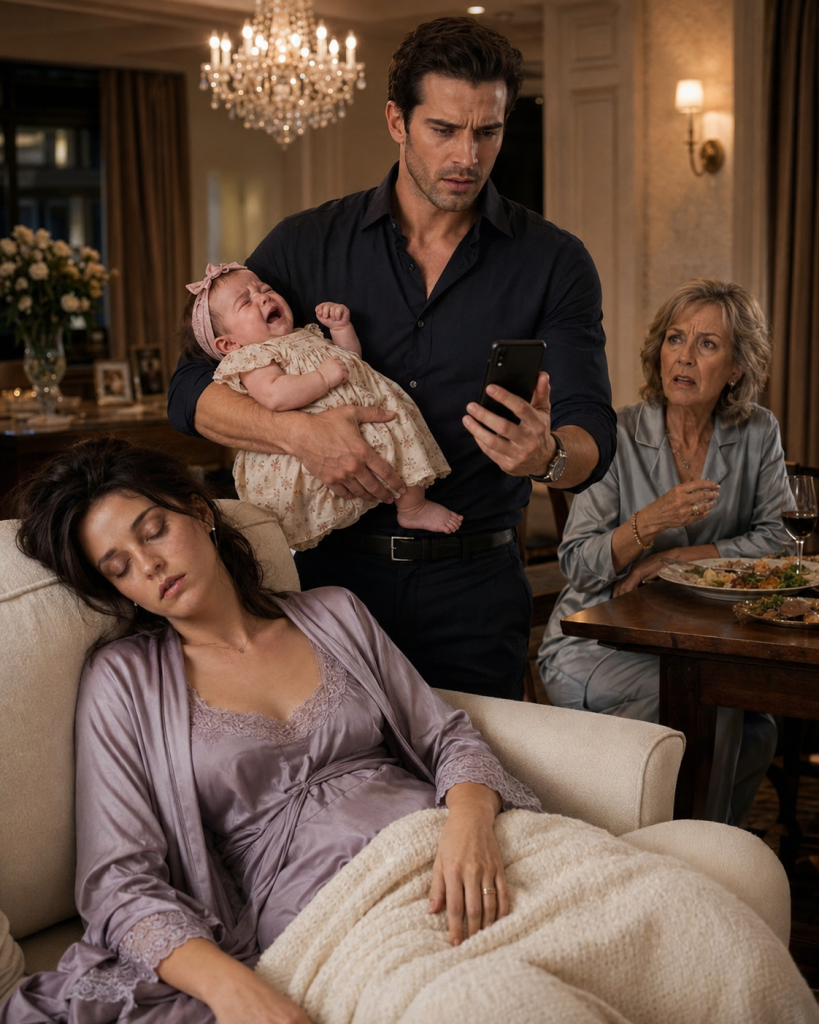
PART 2 The number was nine. My mother’s fork stopped halfway to her mouth.
For a second, neither of us moved. The baby’s cries echoed through the room, sharp and desperate, while Clara lay pale and barely conscious beneath my hand.
“You’re calling an ambulance?” my mother asked.
Her voice did not carry fear.
It carried irritation.
“I’m calling for help,” I said.
“Something you should have done the moment she collapsed.”
My mother set her fork down with deliberate care,
as if I were the one behaving irrationally.
“Daniel, think before you embarrass this family. The neighbors will see an ambulance outside. Clara will wake up in five minutes and laugh about how dramatic this became.”
I stared at her.
Even then, with my wife motionless on the couch and my newborn son crying himself breathless, my mother’s greatest concern was what strangers might think.
The dispatcher answered.
I gave our address, explained that Clara had given birth two days earlier, and described her cold skin, weak breathing, confusion, and inability to remain conscious.
My voice stayed calm, but my hands shook so badly that I nearly dropped the phone.
“Keep her lying flat,” the dispatcher instructed. “Do not give her food or drink. Is she bleeding heavily?”
I glanced toward the blanket covering Clara’s legs.
“I don’t know.”
My mother scoffed. “Of course she isn’t. She’s exhausted because she refuses to manage her time properly.”
The dispatcher heard her.
“Sir, move anyone interfering away from the patient.”
I lifted my eyes to my mother.
“You need to leave the room.”

Her face tightened. “This is my son’s house.”
“It is Clara’s house too.”
“I came here to help.”
“You watched her collapse.”
“She was being stubborn.”
“Our baby was screaming.”
“Babies scream.”
“And you kept eating.”
The words fell between us like stones.
My mother opened her mouth, but nothing came out.
For once, there was no clever insult waiting behind her teeth. No accusation disguised as advice. No old story about how much harder her life had been and how everyone else was weak by comparison.
Only silence.
Then she stood and began gathering the plates.
At first, I did not understand what she was doing. She carried the serving bowl toward the kitchen, lifted the pan from the stove, and reached for the cutting board covered in vegetable scraps.
She was cleaning.
Not because the room was messy.
Because she was trying to erase the evidence.
“Leave everything where it is,” I said.
She kept moving.
“I said leave it.”
My voice came out louder than I intended, and my son startled against my chest.
My mother turned slowly.
I saw something unfamiliar in her expression.
Fear.
Not fear for Clara.
Fear of losing control.
“You’re confused,” she said. “You’ve just come home to a stressful scene. You don’t understand what happened.”
“Then explain it.”
“She insisted on cooking.”
Clara’s fingers moved weakly beneath mine.
“No,” she whispered.
The word was so faint I almost missed it.
I leaned closer. “What did you say?”
Her eyelids fluttered.
“She made me.”
My mother’s face hardened.
“Clara, don’t start lying now.”
I looked from my wife to the grocery bags by the back door. One had split along the side. A carton of milk leaned against a bag of potatoes. The receipt lay on the floor, damp from something that had spilled.
Clara had not only cooked.
She had gone shopping.
Two days after giving birth.
I picked up the receipt.
The time printed across the top was 3:18 p.m.
“You sent her to the store?”
“I needed ingredients.”
“She was discharged from the hospital forty-eight hours ago.”
“She wanted fresh air.”
Clara made a sound that was almost a laugh, but there was no humor in it.
“She took my phone,” she whispered.
My mother’s eyes flashed toward her.
I felt something cold settle inside my chest.
“You took Clara’s phone?”
“She was constantly staring at it instead of taking care of the baby.”
“My phone was in the bedroom,” Clara murmured. “She said I couldn’t have it until the kitchen was clean.”
The dispatcher’s voice came through the speaker.
“Sir, paramedics are approximately four minutes away.”
Four minutes.
It felt like four years.
I sat on the floor beside Clara, holding our son against my shoulder while pressing two fingers to her wrist. Her pulse was there, but it felt fast and fragile.
“I’m sorry,” I whispered.
Clara’s eyes opened slightly.
“For what?”
“For bringing her here.”
My mother made an offended sound. “You invited me because neither of you could manage. Do not rewrite history just because she has decided to put on a performance.”
I stood.
My son was still crying, but his screams had weakened into broken hiccups.
“Pack your things.”
My mother blinked. “What?”
“You heard me.”
“You cannot be serious.”
“I have never been more serious in my life.”
She stared at me as if I had spoken in another language.
For thirty-four years, I had never truly defied her.
I had disagreed politely. Delayed answering her messages. Changed the subject when she insulted Clara. Made excuses for not visiting. But I had never drawn a line and forced her to stand on the other side of it.
That was how control survived in our family.
Not because my mother won every argument.
Because everyone learned that resisting her cost more than surrendering.
When I was eight, she stopped speaking to me for three days because I cried after falling from my bicycle.
When I was thirteen, she threw away a school trophy because I came second instead of first.
When I was nineteen, she called my first serious girlfriend until the girl finally ended the relationship.
When I married Clara, my mother smiled through the ceremony and later told me that kindness could not hide weak character.
I should have protected Clara then.
Instead, I had said, “That’s just how Mom is.”
Those six words became permission.
Permission for every cruel joke.
Every judgment.
Every unannounced visit.
Every time she rearranged our home, criticized Clara’s cooking, questioned our finances, or suggested that my wife was not strong enough to raise a child.
I had mistaken endurance for peace.
Now my wife lay unconscious because of it.
My mother stepped toward me.
“Daniel, you are emotional. Let’s wait until tomorrow.”
“You won’t be here tomorrow.”
“This is because of her.”
“This is because of you.”
“I raised you.”
“And I am finally understanding what that cost.”
The words wounded her.
I saw them land.
For one brief second, her face lost its hard expression. She looked older, almost small.
Then the front door burst open.
Two paramedics entered carrying bags and equipment. A third followed with a stretcher.
Everything moved quickly after that.
They placed an oxygen mask over Clara’s face, checked her blood pressure twice, examined her incision, and asked questions I could barely answer.
“How long has she been unconscious?”
“I found her like this about seven minutes ago.”
“Any fever?”
“I don’t know.”
“Has she been eating and drinking?”
I looked at the untouched bottle beside the bassinet.
“I don’t think so.”
One paramedic touched Clara’s forehead and frowned.
“Her temperature is high.”
“That’s impossible,” my mother said from behind us. “She felt cold.”
The paramedic looked at her. “Chills can happen with fever.”
My mother folded her arms.
“She was completely fine earlier.”
Clara stirred beneath the oxygen mask.
“No,” she whispered.
The paramedic leaned closer.
“What did you say?”
“She wouldn’t let me rest.”
The entire room went still.
My mother’s face went white.
Clara’s voice remained faint, but once she began, the words came faster.
“She woke me every time the baby slept. Said laundry had to be done. Said the kitchen smelled. Made me go shopping. Took my phone because I called Daniel.”
I looked at my mother.
“You called me?”
Clara nodded weakly.
I pulled out my phone.
There were no missed calls.
Then I remembered that my mother had asked to see my phone that morning. She claimed she needed to check the address of the pharmacy.
I opened the blocked contacts list.
Clara’s number was there.
For a moment, I could not breathe.
My mother had blocked my wife’s number on my phone.
She had isolated Clara inside our own home.
“You blocked her,” I said.
My mother lifted her chin.
“You were at work. She would have bothered you over nothing.”
One of the paramedics looked at her with open disgust.
I had never seen my mother embarrassed by another person’s opinion before.
This time, she looked away.
Clara’s blood pressure was dangerously low. The paramedics said they suspected an infection or severe dehydration, possibly both. They needed to take her to the hospital immediately.
I grabbed the diaper bag and followed the stretcher toward the door.
My mother reached for my arm.
“Daniel, we need to talk before you leave.”
I pulled away.
“There is nothing left to discuss.”
“You’re really choosing her over your own mother?”
I turned.
“My wife is being taken to a hospital because you treated her suffering like disobedience.”
“She is manipulating you.”
“Stop.”
“She wants to separate us.”
“Stop.”
“She has wanted me gone since the wedding.”
“No,” I said. “She wanted me to protect her. I was too cowardly to do it.”
My mother flinched.
I stepped closer.
“You have one hour to pack. After that, I’m changing the locks.”
Her mouth opened.
“You would not dare.”
“I should have done it years ago.”
Then I walked out.
The ambulance ride was a blur of sirens, medical questions, and the rhythmic beeping of machines.
I sat near Clara’s feet with our son strapped safely into his carrier beside me. His crying had finally stopped. Exhaustion had overtaken him, and he slept with one tiny fist resting against his cheek.
Clara drifted in and out of consciousness.
Each time her eyes opened, she searched for the baby.
“He’s here,” I told her. “He’s safe.”
She nodded weakly.
At the hospital, doctors took her through a set of double doors while a nurse led me and the baby to a private waiting area.
I called Clara’s sister, Mia.
She answered on the second ring.
“Is everything okay?”
“No.”
The word broke in my throat.
I told her what had happened.
For several seconds, Mia said nothing.
Then she asked quietly, “Where is your mother?”
“At the house, packing.”
“Good.”
Her answer came too quickly.
“You’re not surprised,” I said.
Mia sighed.
“Clara made me promise not to tell you.”
My stomach tightened.
“Tell me what?”
“Your mother has been doing things since she arrived.”
“What things?”
“She controlled when Clara ate. She criticized how often she fed the baby. She accused her of exaggerating pain. Yesterday, she made Clara stand in the kitchen for nearly two hours because the soup was not prepared the way she wanted.”
“Why didn’t Clara tell me?”
“She tried.”
The blocked number flashed through my mind.
Mia continued.
“She sent me voice messages. She was scared you would think she was turning you against your mother.”
I closed my eyes.
That was exactly what my mother had trained us to believe.
Anyone who challenged her was cruel.
Anyone who set a boundary was ungrateful.
Anyone who spoke about her behavior was trying to destroy the family.
“What else did Clara say?”
Mia hesitated.
“She thought your mother was interfering with her medication.”
My eyes opened.
“What?”
“Clara said the pain tablets kept disappearing. She thought she was losing track because she was exhausted. But yesterday, she counted them. This morning, half were gone.”
The waiting room seemed to tilt beneath me.
“Why would my mother take them?”
“I don’t know.”
A nurse entered before I could ask more.
“Mr. Hale?”
I stood, gripping the handle of the baby carrier.
“How is she?”
“Your wife has a serious postpartum infection. She is severely dehydrated, and her blood pressure is unstable, but the doctor believes we caught it in time.”
“In time?”
The nurse’s expression softened.
“Another hour without treatment could have led to organ complications.”
Another hour.
I imagined myself coming home at my usual time.
6:45 instead of 5:30.
My mother finishing dinner.
The baby crying until his voice disappeared.
Clara alone on the couch.
The thought nearly brought me to my knees.
“Can I see her?”
“Soon. We’re starting antibiotics and fluids. The doctor will speak with you.”
I sat again, staring down at my son.
He looked so small inside the carrier.
His entire world depended on adults noticing when he needed something.
Clara had noticed.
Even when she could barely stand, she had warmed his bottle. Changed his clothes. Tried to comfort him.
My mother had heard him cry and decided the sound was inconvenient.
I unlocked my phone and called a locksmith.
Then I called my neighbor, Mr. Bennett, and asked him to stand outside the house until the locks were changed.
Finally, I called my mother.
She answered immediately.
“You have made your point,” she said. “Come home so we can resolve this privately.”
“The locks are being changed.”
Silence.
“You cannot lock me out while my belongings are inside.”
“The locksmith will wait until you have packed.”
“You sent a stranger to watch me?”
“I sent a witness.”
Her breath sharpened.
“Clara has poisoned you against me.”
“Clara is in the hospital.”
“And you are blaming me for an infection she already had.”
“I am blaming you for stopping her from getting help.”
“I did no such thing.”
“You took her phone.”
“She was neglecting the baby.”
“You blocked her number on mine.”
Another silence.
Then her voice softened.
It was the voice she used when anger stopped working.
“Daniel, you are my only child.”
I closed my eyes.
“You know I love you.”
“I know you need control.”
“I sacrificed everything for you.”
“I did not ask you to sacrifice Clara.”
“She is temporary. I am your mother.”
“My wife and son are my family.”
“And what am I?”
I looked through the hospital window at the darkening sky.
“You are someone who needs help I cannot give.”
She began crying.
For most of my life, my mother’s tears had been an emergency. They could cancel holidays, end relationships, and force apologies from people she had wounded.
This time, they sounded different.
Not powerless.
Calculated.
“I’ll call you when I’m ready,” I said.
Then I ended the call.
Clara woke just after midnight.
Her skin had regained a little color, though exhaustion still hollowed her face. Machines surrounded the bed, and clear liquid flowed through two separate IV lines.
I sat beside her with our son asleep against my chest.
When she saw us, tears gathered in her eyes.
“I’m sorry,” she whispered.
I leaned forward.
“No. You do not apologize.”
“I should have fought harder.”
“You should never have been forced to fight alone.”
Her lips trembled.
“I thought if I complained, you would think I hated her.”
“I thought avoiding conflict made me a good husband.”
“You were trying to keep peace.”
“There was no peace. There was only silence.”
Clara looked toward the baby.
“Did she leave?”
“Yes.”
“Did she say I caused this?”
“Yes.”
A bitter smile touched Clara’s lips.
“She always does.”
I took her hand.
“Mia told me about the medication.”
Clara’s eyes shifted away.
“What happened?”
“I’m not sure.”
“Tell me everything you remember.”
She closed her eyes for a moment.
“The first night your mother arrived, she said I was taking too many pills. I told her the doctor prescribed them. The next morning, some were missing. I thought maybe I had taken them and forgotten.”
“And today?”
“I put the bottles in the bathroom cabinet. Later, they were on the kitchen counter.”
“Did you see her touch them?”
“No.”
“Did she give you anything?”
Clara hesitated.
“Tea.”
“What kind?”
“I don’t know. It tasted bitter.”
My heart began pounding.
“Did you drink it?”
“Only a few sips.”
“Why didn’t you tell the doctors?”
“I forgot.”
I stood and pressed the call button.
A nurse entered moments later. I explained the tea and the missing medication. Her expression became serious.
She asked Clara several questions, then left to notify the doctor and request additional blood tests.
Clara watched me from the bed.
“You think she put something in it?”
“I don’t know.”
But the fear in my voice answered for me.
An hour later, the doctor returned.
The initial toxicology screen did not show anything immediately dangerous, but he said certain substances required specific testing. He also explained that exhaustion, dehydration, infection, and incorrect use of medication could combine in unpredictable ways.
“We should involve hospital social services,” he said.
My stomach tightened.
“Why?”
“Because your wife reports being prevented from resting, denied access to her phone, and possibly having prescribed medication removed. Those are serious concerns.”
Clara looked frightened.
“Will they take the baby?”
“No,” the doctor said gently. “This is about keeping you and your child safe.”
A social worker arrived near dawn.
Her name was Evelyn. She spoke quietly, asked permission before sitting, and never once made Clara feel foolish.
She asked about my mother’s behavior, the blocked phone calls, the missing pills, the grocery trip, the forced cleaning, and the events leading to Clara’s collapse.
I listened as my wife described the previous forty-eight hours.
Each detail cut deeper than the last.
My mother had timed Clara’s showers.
She had thrown away pumped milk because she claimed it had been stored incorrectly.
She had refused to let Clara nap, saying sleep during the day created laziness.
She had told Clara that if she did not cook dinner, I would eventually become disgusted with her.
She had held the baby only once, then handed him back because he spit up on her sweater.
Worst of all, she had repeatedly told Clara not to contact me.
“Daniel is working,” she had said. “A good wife does not burden her husband with women’s problems.”
I covered my face with both hands.
Clara reached toward me.
“This is not your fault.”
“Yes, it is.”
“No. Her choices belong to her.”
“But I brought her into our home.”
“You believed she would help.”
“I ignored every warning sign because admitting the truth about her would have forced me to change.”
Evelyn waited until I looked up.
“Recognizing that now matters,” she said. “But boundaries must be followed by action.”
“I changed the locks.”
“That is a beginning.”
She encouraged us to document everything, save messages, photograph the condition of the house, preserve the medication bottles, and contact police if we believed anything had been tampered with.
Police.
The word made the situation feel suddenly larger.
Permanent.
My mother was cruel, controlling, and manipulative.
But had she truly put something in Clara’s tea?
Had she intentionally hidden medication?
I wanted the answer to be no.
Not because I trusted her.
Because some truths change the shape of your entire childhood.
If she was capable of hurting Clara deliberately, then every memory I had defended became questionable.
Every mysterious illness.
Every frightened babysitter.
Every relative who disappeared from our lives after arguing with her.
Near sunrise, Mia arrived carrying clothes for the baby.
She hugged me without speaking, then sat beside Clara’s bed and cried.
While they talked, I returned to the house with a police officer to collect Clara’s medication and the cup she had used for tea.
The front door opened with the new key.
The house was silent.
My mother was gone.
So were her suitcases.
The dining table had been wiped clean.
The pots had been washed.
The grocery receipt had disappeared.
But the cup remained beside the sink.
I slipped on gloves provided by the officer and pointed it out.
Then I walked upstairs.
The guest bedroom was empty except for an envelope on the pillow.
My name was written across the front.
Daniel.
Inside was a single sheet of paper.
You will regret choosing a liar over the woman who gave you life.
There was no apology.
No concern for Clara.
No question about the baby.
Only blame.
I folded the letter and handed it to the officer.
While he photographed the room, I searched the bathroom cabinet for Clara’s medication.
The bottles were there.
One prescription was almost empty.
The officer checked the label.
“This was filled three days ago.”
“Yes.”
“How many was she instructed to take?”
“One every six hours if needed.”
He counted what remained.
“There should be at least fourteen more tablets.”
My stomach turned.
We searched the trash cans.
Nothing.
The officer then noticed a small handbag beneath the guest-room dresser.
My mother must have overlooked it while packing.
Inside were tissues, lipstick, receipts, and a plastic pill organizer.
Several tablets filled the compartments.
The officer compared them with Clara’s prescription.
Some appeared identical.
Others did not.
He sealed the organizer in an evidence bag.
“Do you recognize these?” he asked.
I stared at the pale blue tablets.
“No.”
“Could they belong to your mother?”
“I don’t know.”
A memory surfaced.
Years earlier, my mother had been prescribed sleeping medication after my father left. She claimed she stopped using it, but I had occasionally seen bottles in her bathroom cabinet.
“What kind of pills are they?” I asked.
“We’ll have them tested.”
The officer continued searching the handbag.
At the bottom, beneath a folded scarf, he found a second phone.
Old.
Small.
Powered off.
He pressed the button.
The screen lit up.
The wallpaper showed a picture of my mother holding our son in the hospital.
I had never seen the phone before.
There were dozens of saved audio recordings.
Most were labeled with dates.
Some went back years.
The officer did not open them.
He placed the phone into another evidence bag.
“What is that?” I asked.
“We’ll need consent or a warrant before reviewing the contents.”
“But why would she have another phone?”
“I can’t answer that.”
I returned to the hospital shortly before eight.
Clara was awake, feeding the baby with a bottle while Mia supported her arm.
I did not tell her everything immediately.
Not the missing pills.
Not the second phone.
Not the unidentified tablets.
She needed rest.
But as I sat beside her, Clara reached beneath her pillow.
“There is something you need to hear.”
She handed me her phone.
“I thought your mother took it,” I said.
“She did. But last night, before she sent me to the store, I found it in her bag. I recorded part of what happened and then hid the phone inside the laundry basket.”
My hands tightened around it.
Clara opened an audio file.
At first, there was only the sound of dishes and the baby crying.
Then my mother’s voice filled the room.
“Stop pretending you cannot stand.”
Clara answered faintly. “I feel sick.”
“You are lazy.”
“I need my medicine.”
“You have had enough.”
“The doctor said—”
“I do not care what the doctor said. You will cook dinner before Daniel comes home.”
The recording crackled.
Clara’s voice came again.
“Please give me my phone.”
“No.”
“I need to call him.”
“You will not turn my son against me.”
Then there was another sound.
A door opening.
Footsteps.
And a second voice.
A man’s voice.
Low.
Familiar.
“You said she would only be tired,” the man said.
My mother answered sharply.
“She is fine.”
“The dosage may have been too strong.”
Clara stopped the recording.
My blood turned cold.
I knew that voice.
I had heard it at birthday dinners, family holidays, and childhood weekends.
It belonged to my mother’s younger brother.
Uncle Robert.
A pharmacist.
A man who had hugged Clara at our wedding.
A man who had visited our home the day after the baby was born, carrying flowers and offering to help with anything we needed.
“What was he doing there?” I whispered.
Clara shook her head.
“I don’t know. I never saw him. I was in the pantry when he came inside.”
I replayed the final seconds.
“The dosage may have been too strong.”
The sentence changed everything.
This was no longer a cruel woman pushing an exhausted mother too far.
This sounded planned.
I called the officer who had collected the evidence.
He returned to the hospital within twenty minutes and listened to the recording twice.
“Do not contact either of them,” he warned. “Do not tell them we have this.”
I nodded.
But my phone rang before he finished speaking.
Unknown number.
The officer motioned for me to answer and place it on speaker.
“Hello?”
For a moment, there was only breathing.
Then Uncle Robert spoke.
“Daniel, whatever Clara told you, she misunderstood.”
I looked at the officer.
“How did you know she told me anything?”
Silence.
Then my uncle’s voice hardened.
“You need to bring your mother home.”
“She is not coming back.”
“You don’t understand what she was trying to prevent.”
“Prevent?”
Another pause.
In the background, I heard my mother crying.
Robert lowered his voice.
“The baby should never have been born in that house.”
Every hair on my arms rose.
“What are you talking about?”
He exhaled slowly.
“Ask your mother what happened to your first brother.”
The call ended.
I stared at the phone.
“My first brother?”
I was an only child.
At least, that was what I had believed my entire life.
The officer immediately tried tracing the call, but the number disconnected.
Clara watched me from the bed, frightened and confused.
Mia had gone completely still.
“You had a brother?” Clara asked.
“No.”
But even as I said it, a forgotten image flashed through my mind.
A small framed photograph hidden in the back of my mother’s closet when I was seven.
My mother holding a newborn wrapped in a blue blanket.
On the back, written in faded ink, were three words.
My beautiful Thomas.
When I had asked who Thomas was, she tore the photograph in half and told me never to touch her private things again.
I had forgotten.
Or perhaps I had forced myself to forget.
The police officer asked me to write down everything I remembered.
The photograph.
The name.
My uncle’s statement.
My mother’s history with medication.
As I spoke, another memory surfaced.
My father once told me during an argument that my mother had “already destroyed one family.”
At the time, I thought he meant their marriage.
Now I was no longer sure.
The doctor returned that afternoon with the extended toxicology results.
Clara had traces of a sedative in her bloodstream.
It was not part of her prescribed medication.
The concentration was not high enough to explain everything, but combined with infection, dehydration, blood loss, and exhaustion, it could have caused her collapse.
The blue tablets found in my mother’s pill organizer were sent for testing.
The cup from the kitchen contained residue from the same class of sedative.
There was no longer any doubt.
Someone had put medication in Clara’s tea.
My mother had watched the effect begin.
And she had done nothing.
The police opened a formal investigation.
They searched for my mother and Uncle Robert, but both had disappeared.
Their phones were turned off.
Robert had not reported to work.
My mother’s car was found at a bus station twenty miles away, but security footage showed her leaving in Robert’s vehicle.
By evening, Clara was stable.
The doctors expected her to recover fully, though she would remain hospitalized for several days.
I should have felt relieved.
Instead, I felt as if the floor beneath my life had cracked open.
My mother had drugged my wife.
My uncle had helped.
A secret brother named Thomas might have existed.
And somehow, my newborn son was connected to something that happened before I was old enough to remember.
That night, while Clara slept, I sat beside the hospital window with the baby in my arms.
His eyes opened briefly.
He looked at me with the unfocused trust of a newborn.
“I will protect you,” I whispered.
The words felt like a vow.
My phone vibrated.
A message from an unknown number appeared.
There was no text.
Only a photograph.
It showed an old newspaper clipping laid across a wooden table.
The headline read:
LOCAL INFANT DIES IN UNEXPLAINED HOME ACCIDENT
Beneath it was a grainy picture of my mother, much younger, being escorted from a house while my father stood behind her.
The date was thirty-six years ago.
Two years before I was born.
A second image arrived.
It was the photograph from my childhood.
My mother holding the newborn in the blue blanket.
This time, it had not been torn.
The full image showed Uncle Robert standing beside her.
And behind them, reflected faintly in a mirror, was my father.
He was holding a bottle.
The same type of bottle the police had taken from my mother’s handbag.
A final message appeared.
Your mother did not act alone then.
She is not acting alone now.
I looked across the room at Clara sleeping beneath the hospital lights.
Then I looked down at my son.
Someone had targeted my wife.
Someone had drugged her while she cared for our baby.
And the conspiracy reached further than my mother and uncle.
My father had been dead for six years.
At least, that was what I had been told.
The phone rang again.
This time, the caller ID displayed a name that made my entire body go cold.
Dad.
THE END!THANKS FOR READING!