 Reading Time: 16 minutes
Thirty years ago, I buried Gabriel Ashford, the only boy I had ever loved.He was seventeen.I was sixteen.At the funeral, his mother sat in the front pew wearing black silk and a string of pearls. His father never looked in my direction. Their attorney stood near the church entrance as though grief required security.
The casket remained closed.They told everyone the fire at the Ashford family’s lake cabin had been too severe. Dental records supposedly confirmed Gabriel’s identity. His parents said he had gone there to prepare a surprise for my seventeenth birthday.
Then the cabin burned before midnight.
Because I had received a note asking me to meet him there,
the Ashfords blamed me.
“You filled his head with foolish ideas,” his mother, Evelyn,
whispered when I approached her after the service. “If Gabriel had never met you, he would still be alive.”
I carried those words for three decades.
I carried them through college, through a marriage that lasted eighteen years,
and through a divorce that left me living alone in a quiet Oregon town called Bellweather.
By forty-six, I had become skilled at surviving without expecting much from anyone.
I taught art at the local middle school. I kept a small vegetable garden. I owned too many books and one elderly cat named Winston, who disliked every man who came near my house.
My life was not unhappy.
It was simply smaller than the one I had imagined when Gabriel and I used to sit beside Lake Briarwood and make plans.
Then, one Thursday afternoon in early September, a moving truck stopped beside the vacant house next door.
I was watering my hydrangeas when the driver’s door opened.
A man stepped out.
The watering can slipped from my hand.
He was taller than Gabriel had been at seventeen, with broader shoulders and streaks of gray near his temples. Time had sharpened his face, but it had not changed the shape of his eyes or the slight bend in his nose from when Gabriel had fallen out of an apple tree at twelve.
The man looked toward me.
For one terrible, impossible second, our eyes met.
His face went still.
Then he turned away and began speaking to the movers.
I stood in my yard with water soaking my shoes.
That evening, I searched the property records online.
The new owner’s name was Daniel Cross.
He was forty-seven years old and had previously lived in Spokane, Reno, and several smaller towns. No social-media profiles appeared under his name. No marriage record. No professional biography.
Only a recently registered consulting company connected to an address in Portland.
I told myself resemblance was not proof.
People saw lost loved ones in strangers all the time.
Grief was clever. It could take an ordinary face and turn it into a miracle.
Still, I watched him through my kitchen window for four days.
He moved quietly.
He carried boxes into the house alone and covered the windows before sunset. He drove an older dark-blue truck and left each morning before six.
On the fourth evening, he knocked on my door.
Winston hissed before I even opened it.
The man stood beneath the porch light holding a small cardboard package.
“This was delivered to my house by mistake,” he said.
His voice nearly broke me.
Thirty years disappeared.
I heard Gabriel whispering to me beneath the bleachers at school. I heard him singing badly in his father’s boat. I heard him promising that one day we would leave Briarwood and never allow his family to control us again.
The man held out the package.
“Sarah Bennett?”
I stared at him.
“Yes.”
“I’m Daniel. Next door.”
I reached for the box.
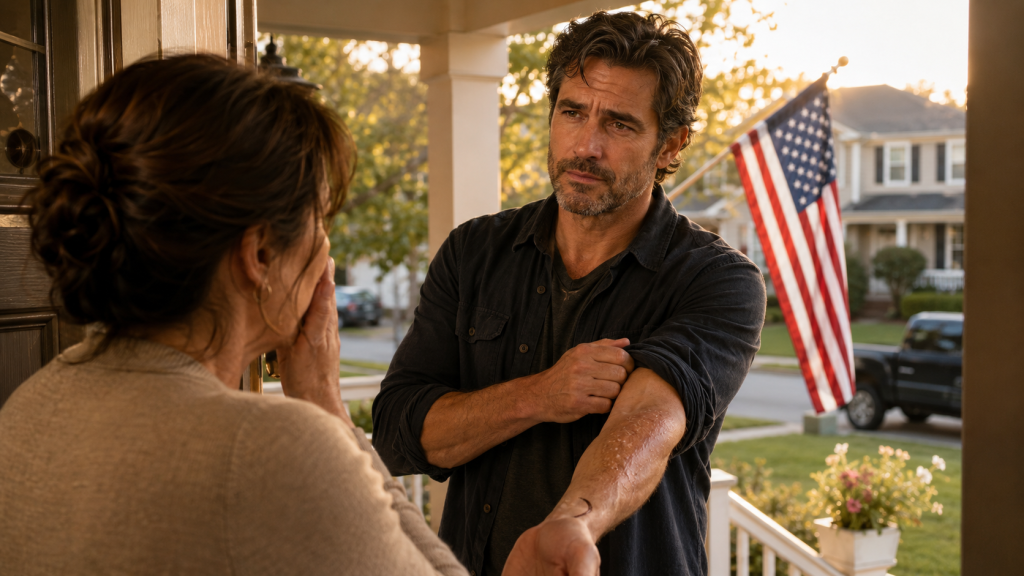
His sleeve pulled back.
Burn scars covered his wrist and disappeared beneath his shirt. Among them was a thin crescent-shaped mark near his thumb.
Gabriel had received that scar when we were eleven, after trying to cut a fishing line with my father’s pocketknife.
I stopped breathing.
“Gabe?”
His smile vanished.
The package slipped from my hands.
He looked over his shoulder toward the street.
A black SUV was parked beneath a maple tree across from our houses. Its windows were tinted. I had noticed it twice during the previous week but assumed it belonged to a visitor.
“You weren’t supposed to recognize me,” he said.
My knees weakened.
“Who are you?”
He stepped closer.
“Not here.”
“You are Gabriel.”
“Sarah, lower your voice.”
“I buried you.”
“I know.”
“I stood beside your grave.”
His expression twisted with pain.
“I know.”
Thirty years of grief, guilt, and unanswered questions rose inside me all at once.
I slapped him.
The sound echoed across the porch.
He did not move.
“You let me believe you were dead.”
“I didn’t have a choice.”
“You had thirty years.”
The black SUV’s headlights came on.
Gabriel grabbed my wrist.
“We need to go inside.”
I pulled away, but the vehicle rolled slowly forward.
Gabriel pushed me through the doorway, followed me inside, and locked the deadbolt.
Winston fled down the hall.
“What is happening?” I demanded.
Gabriel moved to the window and watched the SUV pass.
“They found me sooner than I expected.”
“Who found you?”
“My family.”
I laughed once, without humor.
“Your family buried you.”
“They buried someone.”
The room became silent.
I stared at him.
“What does that mean?”
Gabriel lowered the curtain.
“The body in that casket wasn’t mine.”
The words were too impossible to understand.
“You were at the cabin.”
“Yes.”
“There was a fire.”
“Yes.”
“Then whose body did they bury?”
He looked toward the floor.
“A boy named Luke Mercer.”
I sat down because my legs no longer trusted me.
Gabriel remained near the window.
“Luke was eighteen,” he continued. “His father worked on our property. He sometimes helped maintain the boats and cabins. That night, my father sent him to deliver fuel and supplies.”
“Why would your father send him there?”
“Because my parents knew I planned to leave.”
I looked up sharply.
Gabriel’s eyes met mine.
“I was going to take you away, Sarah. I had money hidden, two bus tickets, and a friend waiting in Portland. I left the note asking you to meet me after midnight.”
“I never received it until the next morning.”
“My mother intercepted the first one. The second was delivered too late.”
He rubbed the scarred skin on his wrist.
“My father came to the cabin before you arrived. We argued. He said you were ruining my future. He threatened to have your father arrested for theft from the Ashford company.”
“My father never worked for your company.”
“He supplied building materials. My father had already created false invoices using his name.”
A memory returned to me.
Three weeks after Gabriel’s funeral, my father’s small lumber business had been audited. He spent years paying legal fees before proving he had done nothing wrong.
I had always believed it was terrible timing.
It had been punishment.
“What happened in the cabin?” I asked.
“My father locked me in a storage room. He said I would remain there until I agreed to attend military school in Virginia. Luke arrived while we were fighting.”
Gabriel’s voice became strained.
“Luke tried to help me. My father shoved him. A lantern fell, and fuel spilled across the floor.”
I pressed my hand over my mouth.
“The fire spread immediately,” Gabriel continued. “My father escaped through the front. Luke tried to open the storage-room door, but part of the ceiling collapsed.”
“And you?”
“I broke a window.”
He looked at his scars.
“I crawled through burning glass and reached the lake. I remember hearing Luke screaming. Then nothing.”
His family found him unconscious near the shoreline.
Instead of calling an ambulance, they called their private physician.
Dr. Samuel Ward treated Gabriel’s burns at an isolated clinic owned by an Ashford business partner. For nearly two weeks, he remained sedated.
“When I woke up, my mother told me Luke was dead,” Gabriel said. “She said the authorities believed the body was mine.”
“They knowingly buried him under your name?”
“My father claimed correcting the mistake would expose the argument and the false financial records. He said Luke’s family had already accepted money to remain silent.”
“Why didn’t you go to the police?”
“I tried.”
Gabriel had been weak, heavily medicated, and seventeen years old. His parents told him I had confessed to starting the fire.
I stood so quickly that the chair scraped backward.
“They said what?”
“They showed me a statement with your signature. It said you had poured fuel on the porch because you were angry I planned to leave for college.”
“I never signed anything.”
“I know that now.”
“You believed I tried to kill you?”
“Not at first.”
His parents had shown him photographs of me entering the police station with my father. They said my family had agreed not to face charges if I stayed away from him.
In reality, we had gone to answer questions about the note found in my bedroom.
“My mother said you wanted me dead because I refused to run away with you,” Gabriel said. “She told me you attended the funeral only to protect yourself.”
I remembered Evelyn watching me cry beside the closed casket.
She had known her son was alive.
“Why did you stay hidden?” I whispered.
“My father gave me a choice. I could disappear under a new identity, or he would send the forged evidence to the district attorney and destroy your family.”
“You should have trusted me.”
“I was seventeen, injured, and terrified. They controlled every person around me.”
He was moved between private medical facilities for nearly a year. By the time he recovered, the Ashfords had obtained documents identifying him as Daniel Cross, the orphaned son of a deceased employee.
They sent him to a boarding school in Canada.
He escaped at nineteen.
“Why didn’t you come back then?” I asked.
“I did.”
My heart stopped.
“When?”
“October 1997.”
I had been nineteen and attending college in Eugene.
Gabriel went to my parents’ house. My mother answered the door.
“She told me you were engaged,” he said.
“I wasn’t.”
“She said you had finally recovered and that seeing me would destroy you.”
“My mother knew?”
“I don’t know what she knew. She looked frightened. She handed me a letter she claimed you wrote.”
“What letter?”
Gabriel reached into his jacket and removed a worn envelope.
The paper had been folded so many times it was beginning to tear.
Inside was a letter in handwriting that resembled mine.
Gabe,
Whatever happened between us ended at the cabin. I have built a new life, and I never want to see you again. Please stay dead to me.
Sarah
I shook my head.
“I didn’t write this.”
“I know.”
“How?”
“Because three years ago, I found the woman who did.”
The forger was a former secretary employed by Gabriel’s father. Before dying of cancer, she admitted creating the confession, the letter, and several financial documents.
She gave Gabriel copies and a recorded statement.
“Why wait three more years?” I asked.
“Because proving the truth meant finding Luke Mercer’s real records. My father had erased almost everything.”
“Is your father still alive?”
“Yes.”
“And your mother?”
“Yes.”
The answer made the walls feel closer.
Charles and Evelyn Ashford were both in their seventies. Their company had grown into a real-estate and investment empire worth hundreds of millions of dollars.
To the public, they were philanthropists.
They funded hospitals, scholarship programs, and youth centers.
One of those youth centers was named in memory of Gabriel.
His parents had built a charitable legacy around the death they invented.
“What are you doing here?” I asked.
“I finally found Luke’s sister.”
“Where?”
“In Bellweather.”
My town.
Gabriel explained that Luke’s younger sister, Rebecca Mercer, had changed her surname after marrying. She now lived less than three miles away and worked at the county records office.
“She contacted me six weeks ago,” he said. “She found an old evidence box while helping move archived files.”
“What was inside?”
“Photographs from the cabin, Luke’s original dental chart, and a report written by the first firefighter who reached the scene.”
The report stated that the dead boy wore a metal identification bracelet engraved with the initials L.M.
That detail disappeared from the official case file.
Rebecca also found a blood sample stored under the wrong case number.
Modern DNA testing could prove the body buried as Gabriel belonged to Luke.
“Then go to the police.”
“We need the evidence before my family takes it.”
“Rebecca has it.”
“She had it.”
Three days earlier, someone broke into her office.
The evidence box disappeared.
Rebecca vanished the same night.
I stared at him.
“You think your parents took her?”
“I think someone connected to them did.”
“And you moved next door to me because—”
“Rebecca mailed something before she vanished.”
“To me?”
Gabriel nodded.
“She said if anything happened, the safest place would be with the person my family had underestimated most.”
“What did she send?”
“I don’t know.”
I thought of the package he had brought to my door.
We both looked at the floor.
The cardboard box lay near the entrance where I had dropped it.
Gabriel picked it up.
The return address was a printing company in Salem.
Inside was a children’s art book titled The Colors of Oregon.
Nothing else.
Gabriel turned it over.
“This can’t be all.”
I examined the cover. I had used similar books in my classroom. This one felt unusually heavy.
Using a kitchen knife, I carefully separated the cardboard backing.
A small flash drive slid onto the table.
Gabriel closed his eyes.
“She found it.”
Before we could insert the drive into my laptop, glass shattered at the back of my house.
Gabriel pulled me away from the kitchen.
A dark figure reached through the broken door and unlocked it.
“Upstairs,” Gabriel whispered.
“I’m not leaving you.”
“Sarah.”
“I already lost you once.”
The intruder entered.
Gabriel pushed the flash drive into my hand.
“Bathroom window. Climb onto the porch roof and go to Mrs. Walsh’s house.”
“What will you do?”
“Delay him.”
I wanted to argue, but footsteps moved through the kitchen.
I ran upstairs.
From the bathroom window, I reached the porch roof and lowered myself to the lawn. I heard a crash inside my house, followed by a man shouting.
I ran barefoot across the wet grass to my neighbor’s home and called the police.
By the time officers arrived, the intruder had escaped.
Gabriel sat against my kitchen cabinets with blood on his lip and one eye swelling shut. He insisted he had fallen while chasing the burglar.
The officers questioned him closely.
He identified himself as Daniel Cross.
I almost corrected him but stopped.
Until we knew whom to trust, Gabriel had to remain dead.
The police found no weapon and no fingerprints. The intruder had worn gloves.
Nothing appeared stolen.
The flash drive remained hidden inside my shoe.
After the officers left, I cleaned Gabriel’s face at my kitchen table.
“You should go to a hospital.”
“I’ve survived worse.”
“That doesn’t make this acceptable.”
He looked at me with the same crooked smile he had at seventeen.
“You still become angry when you’re scared.”
“And you still use jokes when you’re lying.”
His smile faded.
“What else haven’t you told me?”
He looked toward the broken door.
“I have a daughter.”
The words surprised me more than they should have.
“Is she safe?”
“Yes. She is twenty-two and studying marine biology in California.”
“Her mother?”
“We divorced years ago.”
I nodded, trying not to show how the information affected me.
Thirty years had passed. Of course he had loved other people. I had married someone else too.
Still, part of me had remained sixteen, believing Gabriel belonged to the future we never reached.
“Does your daughter know who you are?” I asked.
“She knows my legal name. She knows nothing about the Ashfords.”
“Why come back now and risk exposing her?”
“Because my father contacted her.”
Charles Ashford sent Gabriel’s daughter an anonymous envelope containing photographs of Gabriel and me as teenagers.
Inside was a message:
Ask your father why another boy lies in his grave.
“That’s when I knew hiding would never protect anyone,” Gabriel said.
We opened the flash drive on an old laptop disconnected from the internet.
It contained scanned documents, photographs, and three audio recordings.
The first was the firefighter’s report.
The second was Luke Mercer’s dental chart.
The third was a recording of Rebecca speaking.
“If you are hearing this, someone has discovered what I found,” she said. “My brother did not die because of Sarah Bennett. The Ashfords paid my father seventy-five thousand dollars and threatened to send him to prison if he rejected their story.”
Rebecca’s father had struggled with alcohol and debt. He accepted the money, signed a confidentiality agreement, and moved the family out of Oregon.
Before his death, he confessed to Rebecca.
The recording continued.
“Luke was wearing our mother’s medical-alert bracelet on the night of the fire. The initials L.M. were visible in the original scene photographs. Dr. Samuel Ward changed the dental comparison and identified Luke’s body as Gabriel Ashford.”
Then Rebecca revealed something neither of us expected.
Gabriel’s father had not merely covered up the fire.
He had started it intentionally.
Luke secretly carried a small tape recorder that night because he suspected Charles Ashford was stealing from workers’ pension accounts. Luke planned to record a conversation about missing funds.
The recording survived inside a metal toolbox recovered from the cabin.
Rebecca had found a digitized copy.
We played the final audio file.
Static filled the room.
Then a younger version of Charles Ashford’s voice emerged.
“You will go to Virginia, Gabriel. This nonsense ends tonight.”
Gabriel’s teenage voice answered.
“I’m leaving with Sarah.”
“You will do no such thing.”
“You can’t control me forever.”
Then Luke spoke.
“Mr. Ashford, open the door.”
A struggle followed.
Charles shouted that Luke knew too much.
Then came the unmistakable sound of liquid splashing.
Gabriel stared at the laptop.
“I always believed the fuel spilled when the lantern fell.”
The recording captured Charles threatening Luke, followed by the scratch of a match.
A sudden roar swallowed every voice.
Luke screamed.
The audio ended.
Gabriel stood and walked into the dark living room.
I followed him.
“My father killed Luke,” he said.
“Yes.”
“And left me inside.”
His shoulders began shaking.
For thirty years, he had carried the belief that the fire was an accident caused by an argument. The truth was crueler.
I placed my arms around him.
At first he remained rigid.
Then he turned and held me as though the missing years had finally fallen upon him.
We stood together in my damaged house, surrounded by broken glass and memories neither of us could repair.
“I’m sorry,” he whispered.
“So am I.”
“I should have come back sooner.”
“You were a child when they took your life from you.”
“So were you.”
The next morning, we contacted a federal prosecutor rather than local police. Gabriel had spent years communicating with a retired investigator named Helen Price, who connected us with agents specializing in financial and public corruption.
We copied the evidence and placed it in three separate locations.
Then Gabriel publicly revealed himself.
Helen arranged an interview with a national news organization.
The story spread within hours.
GABRIEL ASHFORD, DECLARED DEAD IN 1996, FOUND ALIVE.
His parents issued a statement claiming the man was an impostor attempting to extort their family.
That defense collapsed when a court-ordered DNA test proved Gabriel was their biological son.
The body in his grave was exhumed.
DNA identified Luke Mercer.
Charles and Evelyn Ashford were arrested two weeks later.
Dr. Ward, now eighty-one, agreed to cooperate in exchange for consideration at sentencing. He admitted falsifying the dental records and treating Gabriel under a false identity.
Rebecca was found alive in a private rehabilitation facility owned through an Ashford subsidiary. She had been admitted under another name after being drugged and transported there.
The facility director claimed Rebecca was confused and had requested help.
Security footage proved otherwise.
She returned home to her husband and children.
The financial investigation uncovered decades of fraud: stolen pension funds, bribed officials, false charities, and shell companies used to silence former employees.
Charles was charged with murder, attempted murder, kidnapping, fraud, and conspiracy.
Evelyn faced charges for kidnapping, evidence tampering, fraud, and helping imprison her own son under a false identity.
During the trial, she looked at Gabriel for the first time in thirty years.
“I saved you,” she said from the witness stand.
Gabriel remained still.
“You erased me,” he replied.
She claimed every choice had been made to protect the Ashford name and prevent Charles from harming him further.
But the prosecution produced letters showing Evelyn arranged the false confession attributed to me. She had personally ordered employees to watch my family and prevent Gabriel from contacting me.
My mother was called to testify.
By then, she was seventy-eight and living in assisted care.
She admitted Evelyn had threatened to accuse my father of financial crimes if she allowed Gabriel near me.
“Why didn’t you tell your daughter he was alive?” the prosecutor asked.
My mother began crying.
“I thought keeping them apart would keep Sarah safe.”
I sat behind Gabriel in the courtroom.
For thirty years, adults had used the word protection to excuse cowardice, cruelty, and control.
After her testimony, my mother reached for me.
“I’m sorry,” she whispered.
“I know.”
“Can you forgive me?”
“I don’t know.”
It was the most honest answer I could give.
Charles Ashford was convicted on every major count.
He received life in prison.
Evelyn received twenty-eight years. At her age, it was effectively a life sentence.
Dr. Ward lost his medical license and was sentenced for falsifying records and conspiracy.
The Ashford companies were placed under federal control. Millions of dollars were returned to workers and families affected by the fraud.
Luke Mercer’s name replaced Gabriel’s on the grave.
At the new funeral, Rebecca stood beside her brother’s casket and placed a simple metal bracelet on top.
Gabriel and I stood several rows behind her.
This time, there were no lies beneath the flowers.
Afterward, Gabriel approached Luke’s grave alone.
“I should have saved him,” he said when he returned.
“You were seventeen and locked inside a burning room.”
“He saved me.”
“Yes.”
Gabriel established a scholarship in Luke’s name using money recovered from the Ashford estate. It supported students whose families had suffered from corporate fraud.
He also legally reclaimed his birth name.
Daniel Cross had kept him alive.
Gabriel Ashford had finally returned to claim the truth.
But returning to life was not the same as knowing how to live.
For several months, he remained in the house next door.
We spent evenings talking about the years between us.
I told him about my marriage to David, a decent man I had loved imperfectly. We divorced after realizing that companionship had replaced intimacy.
Gabriel told me about his former wife, Anna, and their daughter, Lily. He had loved them, but secrecy poisoned the marriage.
“I never knew how to give someone my whole life,” he said. “Half of it wasn’t mine to share.”
Lily visited during Christmas.
She had Gabriel’s eyes and an easy laugh. She hugged me after knowing me for less than an hour.
“So you’re Sarah,” she said.
“What has he told you?”
“That you were the reason he finally stopped running.”
Gabriel looked embarrassed.
Lily smiled.
“I like you already.”
Still, Gabriel and I did not simply resume the romance we had lost.
We were not teenagers.
Grief had shaped us. Other people had loved us. We had habits, fears, and scars that could not be erased by recognition.
We attended therapy separately.
We learned to speak without treating every disagreement like another disappearance.
Some days, being near him felt miraculous.
Other days, I became furious over something small because thirty years of abandonment had no ordinary place to go.
Once, when he failed to answer his phone for several hours, I drove to his house convinced he had vanished again.
I found him asleep on the couch.
When he woke, I was crying.
“You left,” I said.
“I was next door.”
“You left for thirty years.”
He did not tell me I was being unreasonable.
He held me until the panic passed.
“I cannot promise nothing will ever separate us,” he said. “But I can promise I will never choose silence again.”
A year after he knocked on my door, we returned to Lake Briarwood.
The Ashford cabin had never been rebuilt. Only the stone foundation remained among the trees.
We stood near the shoreline where Gabriel had been found.
“I dreamed about this place for years,” I said.
“So did I.”
“In my dreams, you were always calling for me.”
“In mine, you came.”
He reached into his coat and removed two faded bus tickets.
The tickets we had planned to use thirty years earlier.
His mother had kept them in a locked family archive along with other evidence.
“Our bus left at one fifteen in the morning,” he said.
“I would have gone with you.”
“I know.”
He handed me one ticket.
For a moment, we stood holding the future that had never happened.
Then I tore mine in half.
Gabriel looked surprised.
“We don’t need it anymore,” I said.
He smiled.
Together, we dropped the pieces into the cold water and watched them drift away.
The following spring, Gabriel proposed in my garden.
There was no crowd.
No expensive ring.
No dramatic speech.
He knelt beside the hydrangeas where I had first seen him step from the moving truck.
“I loved you when I was seventeen,” he said. “But I’m not asking you to marry the boy you lost. I’m asking whether you can love the man who came back.”
I touched the scars on his wrist.
“I already do.”
We married in a small ceremony beside the lake.
Rebecca attended with her family. Lily stood beside me. My mother watched from the front row, and although our relationship remained complicated, I allowed her to witness the life fear had once stolen from us.
At the reception, Gabriel took my hand.
“Do you regret recognizing me?” he asked.
I thought of the black SUV, the broken door, the courtroom, and Luke’s grave.
Then I thought of quiet mornings, shared coffee, and Gabriel laughing in my kitchen.
“No,” I said. “I regret that anyone ever taught us recognition was dangerous.”
For thirty years, I believed I had buried my first love.
The truth was that Gabriel had been buried too—not beneath the stone carrying his name, but beneath fear, lies, and another man’s identity.
When he knocked on my door, neither of us returned to the life we had planned as teenagers.
That life was gone.
Instead, we built something honest from what remained.
It was not perfect.
It was not untouched by loss.
But it belonged to us.
And every night, before turning off the lights, Gabriel checked the door, looked across the room at me, and said the words we had both waited thirty years to hear.
“I’m still here.”
THE END! THANK YOU FOR READING!