 Reading Time: 18 minutes
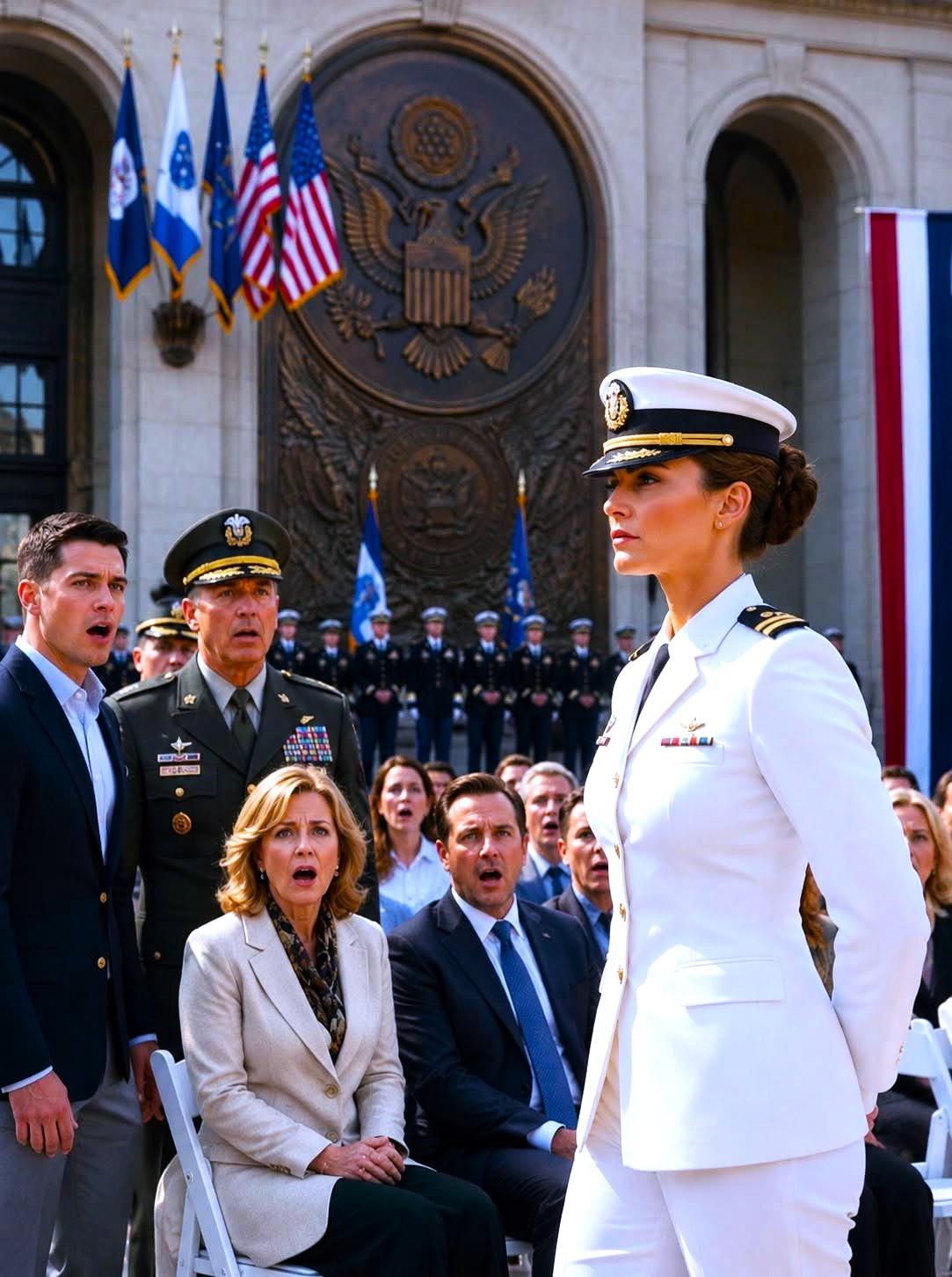
My brother received his Navy SEAL trident beneath a ceiling covered in flags, while I remained near the back exit in a gray blazer no one seemed to remember seeing me arrive in.
The auditorium smelled of polished floors, shining brass, and far too many expensive colognes battling for space in the air. Families filled every row. Children waved tiny American flags. Retired officers spoke quietly while comparing medals. Every few moments, a camera flash exploded, leaving a pale shadow floating across my vision.
My parents sat in the front row.
My father, Edward Mercer, had chosen the aisle seat so everyone could see him. Even in retirement, he still carried himself as though the Navy needed his approval before the sun could rise. His silver hair was trimmed to regulation length, and his old captain’s pin rested perfectly above the pocket of his dark suit.
Beside him sat my mother, Marianne, dressed in cream with pearl earrings. She held a monogrammed handkerchief against one eye, although I had not seen a single genuine tear.
Neither of them had looked toward the back.
That was fine.
For twelve years, my family had taught themselves not to notice me.
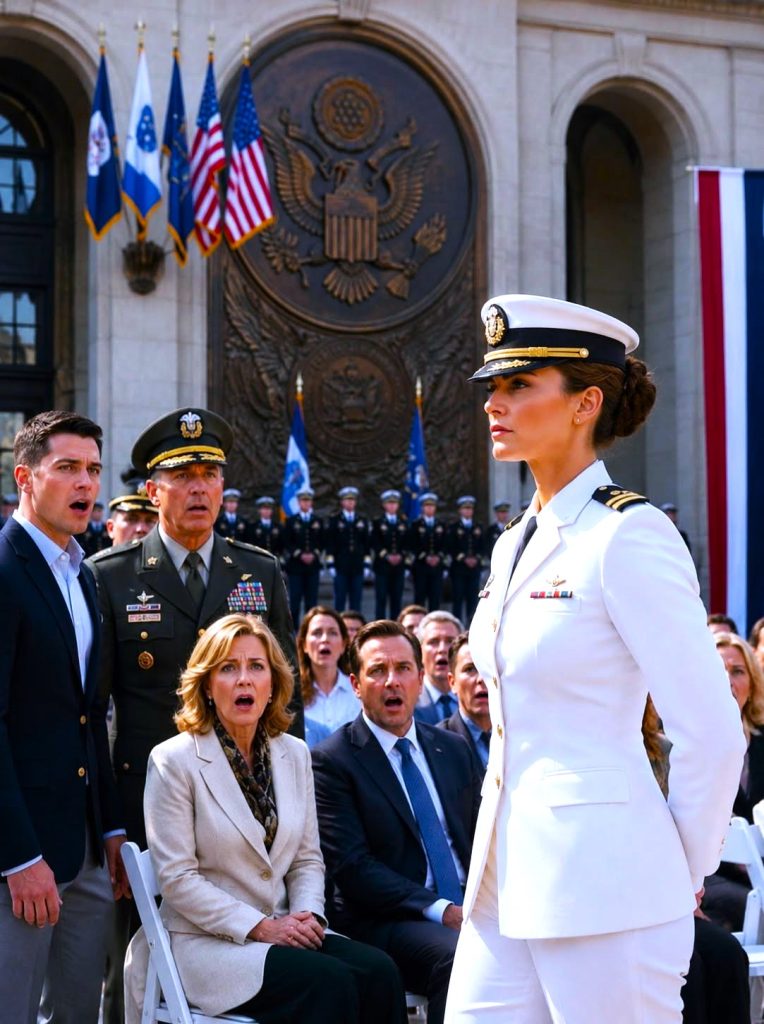
To them, I was Claire Mercer, the daughter who left the Naval Academy during her third year. The weak one. The disappointment. The name my mother avoided at luncheons and my father only mentioned when he needed an example of wasted potential.
My younger brother, Luke, had made sure that version of me never disappeared.
“Claire couldn’t handle the pressure,” he liked to say.
Sometimes he softened the words with a laugh.
Sometimes he simply called me a dropout to my face.
Now he stood onstage in a spotless white uniform, broad-shouldered and perfectly motionless beneath the lights. He looked exactly like the son my father had spent his entire life hoping to produce.
When Luke’s name was announced, my father rose before anyone else.
His applause cracked sharply through the auditorium.
“That’s my boy,” he said, loudly enough for three rows to hear.
Luke stepped forward. An instructor pinned the trident onto his uniform, and the room erupted in cheers. My mother covered her mouth. My father’s face shone with the kind of pride I had spent my entire childhood trying to earn.
I kept my hands relaxed at my sides.
Inside my jacket, my secure phone vibrated once.
It was not the soft buzz of my personal phone. This was one hard pulse against my ribs, followed by two shorter ones.
Priority traffic.
I waited until the audience stood for another round of applause, then slipped one hand into my pocket. The screen recognized my thumbprint and displayed a single encrypted message.
PACKAGE RECOVERED. ALL PERSONNEL ACCOUNTED FOR. PHASE THREE AUTHORIZED.
I read it twice.
Twenty-seven hours earlier, six people had been trapped beyond a collapsing extraction corridor somewhere in Eastern Europe. Their communications had gone silent. Local forces were closing in. Every standard option had already failed.
The plan that brought them out had been mine.
Nobody in that auditorium knew it.
Nobody in my family even knew I had been overseas.
They believed I processed insurance claims in a windowless office somewhere outside Arlington. My mother still occasionally mailed me articles about government clerical exams, as though even the career they imagined I had was somehow still not respectable enough.
I deleted the message and focused on the stage again.
Luke turned toward the audience.
His gaze moved across the front rows, absorbing every proud expression. Then his eyes traveled farther back, beyond the decorated officers and gathered families, until they reached the shadowed area near the rear doors.
He saw me.
For half a second, surprise broke through his carefully controlled expression.
Then one side of his mouth lifted.
It was not gratitude.
It was the same familiar smile he always wore whenever he believed having me nearby made his own success seem even more impressive.
Three weeks earlier, he had called specifically to make sure I understood the dress code.
“This isn’t one of your office mixers,” he had said. “Try not to look like you don’t belong here.”
“I’ll manage.”
“And don’t bring up the Academy. Today isn’t about old failures.”
I had nearly laughed.
Instead, I told him I understood.
I understood that Luke needed me to remain the family failure because his identity had been constructed around surpassing me.
I understood that my father needed my supposed weakness to prove his relentless parenting had not been the problem.
And I understood that my mother preferred a simple, embarrassing story over a complicated truth she could not share with her friends.
So I attended quietly.
I applauded when appropriate.
I stood near the exit.
And I waited for the ceremony to end.
The final class assembled onstage while a senior commander approached the microphone. He was introduced as Major General Thomas Rourke, a joint special operations commander who had spent decades working alongside elite military units.
Although the event belonged to the Navy, his attendance carried enormous weight.
The entire auditorium changed when he stood.
Conversations died instantly. Uniformed officers straightened. Even my father adjusted his jacket.
General Rourke began with the expected remarks about discipline, sacrifice, teamwork, and the responsibilities carried by those who wore the trident.
Then he spoke about humility.
“The symbol pinned to your chest today does not make you better than the people around you,” he said. “It makes you more accountable to them.”
My eyes moved toward Luke.
He was staring straight ahead.
“The strongest operator is rarely the loudest person in the room,” the general continued. “Real service often happens far from cameras, applause, and public recognition.”
That time, General Rourke’s eyes moved past the graduates.
They stopped on me.
I lowered my chin slightly.
It was the smallest possible warning.
Do not do this.
His expression changed.
A faint smile appeared.
Apparently, he had decided not to listen.
After the formal remarks, the graduates descended from the stage to greet their families. The auditorium filled with embraces, laughter, and the clicking of cameras.
I considered slipping out.
I had attended. I had supported Luke. I had fulfilled the obligation.
Then my mother finally noticed me.
Her eyes narrowed slightly as she examined my blazer, dark trousers, and simple low heels.
“Claire,” she said, sounding more surprised than pleased. “You came.”
“I said I would.”
My father turned.
For one second, something unreadable passed across his face. Then the old disappointment settled into place.
“You missed the family photographs before the ceremony.”
“No one told me there were photographs.”
“You could have asked.”
Luke joined us before I could answer. He had one arm around a laughing teammate and the other hand resting near his newly pinned trident.
“Well,” he said, looking me up and down. “You cleaned up better than expected.”
His teammate gave an uncomfortable smile.
“Congratulations, Luke,” I said.
“You understand what this means, right?”
“I have a general idea.”
He chuckled.
“I’m sure you’ve watched documentaries.”
My father smiled approvingly.
Mother touched Luke’s arm. “Your sister is proud of you. She simply has trouble expressing it.”
“I’m very proud of him,” I said.
It was true.
Whatever Luke had become inside our family, he had endured brutal training to earn the trident. That accomplishment deserved respect.
But Luke was not satisfied.
He leaned closer, lowering his voice just enough to make the insult feel private while ensuring everyone nearby could still hear it.
“Maybe today will finally show you why quitting was such a mistake.”
The old words landed exactly where he intended.
For an instant, I was twenty years old again, sitting alone in an Academy hallway while an admiral I had never met offered me a choice that would erase the future my family expected.
I remembered the sealed folder.
The intelligence assessment.
The photographs of a bombed marketplace.
And the sentence that changed my life.
Your analytical scores are exceptional, Midshipman Mercer. We believe you can serve more effectively somewhere else.
I had not failed out of the Academy.
I had been recruited out.
But the program did not officially exist, and the work that followed required silence.
The easiest cover story had been the most humiliating one.
She could not handle the pressure.
My father had believed it immediately.
Perhaps he had wanted to.
Before I could respond to Luke, a voice rang out from several yards away.
“Oh wow,” General Rourke said. “You’re here?”
The microphone near the stage was still active.
His words carried through the entire auditorium.
The crowd froze.
Conversations stopped in waves.
General Rourke stood near the first row, surrounded by senior officers. Yet his eyes were fixed directly on me.
Luke’s smile vanished.
My father turned slowly.
The general excused himself from the officers and walked down the center aisle.
People moved aside before he reached them.
I felt hundreds of eyes following him.
When he stopped in front of me, I offered a restrained nod.
“General.”
He extended his hand.
“Claire Mercer. I was hoping you might attend.”
I shook it.
“I came for my brother.”
“So I gathered.”
His voice remained warm, but his attention shifted briefly to Luke’s trident.
“Congratulations, Petty Officer Mercer.”
Luke swallowed.
“Thank you, sir.”
General Rourke looked back at me. “I received confirmation thirty minutes ago. Everyone made it out.”
“I know.”
His eyebrows rose. “Of course you do.”
The officers who had followed him stopped nearby. One of them, a rear admiral with a chest full of ribbons, stared at me in recognition.
“Mercer?” he asked. “The Mercer?”
My mother’s handkerchief slipped from her fingers.
Luke looked from the general to the admiral.
“Sir,” he said carefully, “you know my sister?”
General Rourke appeared genuinely surprised by the question.
“Know her?”
His eyes moved across my family.
Then he seemed to understand.
“You haven’t told them.”
“That was not necessary.”
My father stepped forward.
“I’m Captain Edward Mercer, retired.”
“I know who you are,” General Rourke replied.
My father’s shoulders lifted slightly.
Then the general added, “Your daughter’s work has crossed my desk for nearly a decade.”
The pride vanished from my father’s face.
“What work?”
I spoke before the general could answer.
“Sir, this is not the place.”
He studied me.
For years, General Rourke had been one of the few people capable of reading the difference between my calm expression and a direct order.
He gave a slight nod.
“Understood.”
But Luke had already heard too much to let the moment pass.
“My sister works in insurance.”
The rear admiral made a sound that might have been a cough hiding a laugh.
General Rourke’s expression became unreadable.
“Is that what she told you?”
“It’s what we all know,” my mother said.
General Rourke looked at me again.
I said nothing.
He finally turned toward Luke.
“Son, some of the people wearing medals in this building are alive because of decisions your sister made.”
A hush spread through those close enough to hear.
Luke stared at me as if my face had changed.
My father’s voice dropped.
“What exactly are you saying?”
“I am saying no more than I’m authorized to say.”
The general gestured toward a private reception room beyond the stage.
“Claire, when you are finished with your family, several people would appreciate a moment.”
“I’ll be there shortly.”
He shook my hand once more.
Then he leaned closer and said quietly, “You should have warned me they didn’t know.”
“I assumed discretion.”
He smiled.
“That has never been my strongest quality.”
When he walked away, the silence around us remained.
My mother was the first to speak.
“What did he mean?”
“I can’t discuss it here.”
Luke shook his head.
“No. You don’t get to do that.”
“Do what?”
“Stand there acting mysterious after a general walks across the room to greet you.”
“I didn’t ask him to.”
“What decisions? What people?”
“I can’t answer that.”
Luke laughed once, but there was no humor in it.
“Of course. Convenient.”
My father stepped closer.
“Claire, look at me.”
I did.
His face had changed. The familiar disappointment was gone, replaced by confusion and suspicion.
“Did you serve?”
“Yes.”
“Where?”
“I can’t tell you.”
“In what capacity?”
“I can’t tell you.”
“What rank?”
“That is complicated.”
His jaw tightened.
“I spent thirty-one years in the Navy. Do not speak to me as though I cannot understand a chain of command.”
“This isn’t about what you can understand.”
“Then what is it about?”
“Authorization.”
The word struck him harder than I intended.
My father had spent his life believing he occupied the highest level of knowledge in every room.
Now his own daughter was telling him he did not have clearance to ask about her career.
Luke removed his white cap and gripped it in both hands.
“You let me call you a dropout.”
“Yes.”
“For years.”
“Yes.”
“You let everyone believe you failed.”
“That story protected my work.”
“You could have told me something.”
“I tried once.”
He frowned.
“When?”
“The night before you left for basic training.”
His expression shifted.
“You told me service wasn’t about proving I was better than anyone.”
“I also said there were many ways to serve.”
“That wasn’t telling me anything.”
“No, Luke. It was giving you a chance to stop humiliating me without requiring an explanation.”
My mother touched my arm.
I instinctively stepped away.
Her hand remained suspended between us.
“Claire,” she whispered, “why would you let us think so poorly of you?”
The question hurt more than Luke’s insults ever had.
I looked at her carefully.
“I didn’t make you think poorly of me.”
Her eyes filled.
“You told us you were leaving the Academy.”
“I did.”
“You refused to explain.”
“I was not permitted to explain.”
“We thought you had thrown away your future.”
“You chose to believe the worst possible reason.”
My father’s face reddened.
“That is unfair.”
“Is it?”
“You disappeared. You stopped answering questions. You accepted some vague government position and came home once a year looking exhausted. What were we supposed to think?”
“You were supposed to think I was your daughter.”
He stared at me.
I had imagined saying those words many times.
In my imagination, they had sounded louder.
In reality, they came out softly.
That made them worse.
My mother looked down.
Luke’s teammates had gradually moved away, pretending not to watch. Other families resumed their conversations, but their glances continued drifting toward us.
My secure phone pulsed again.
I checked the message.
BRIEFING MOVED TO 1800. ROURKE REQUESTS YOUR PRESENCE AT RECEPTION.
“I have to go,” I said.
Luke stepped in front of me.
“No. Not yet.”
“Move.”
“Today was supposed to be my day.”
“It still is.”
“Then why does everyone suddenly care about you?”
I stared at him.
He looked younger without his confident smile.
For the first time, I saw not the cruel brother who had mocked me, but the boy who had spent his life competing for our father’s approval.
“Luke, I came here to support you. I stood in the back. I wore a plain suit. I did not speak to anyone. I intended to leave before the reception.”
“Then why did he recognize you?”
“Because we’ve worked together.”
“Doing what?”
“I can’t answer.”
His voice rose.
“Stop saying that!”
Several people turned.
My father grabbed Luke’s arm.
“Control yourself.”
Luke pulled away.
“No. She has been lying to us for twelve years, and somehow I’m the one being treated like an idiot.”
“I did not lie,” I said. “I protected classified information.”
“You let me build my entire career thinking I had surpassed you.”
“I never asked you to compete with me.”
“You didn’t have to. Dad compared us every day.”
My father stiffened.
“That is enough.”
“No, it isn’t,” Luke said.
He looked directly at him.
“You told me Claire quit because she was weak. Every time training got hard, you said, ‘Don’t become your sister.’”
My father’s mouth opened, but no words came.
Luke turned back to me.
“And you knew.”
“Yes.”
“You knew he used you to push me.”
“Yes.”
“Why didn’t you stop him?”
“Because by then, you enjoyed it.”
The answer silenced him.
His eyes hardened.
“I earned this.”
“I know.”
“You think you’re better than me.”
“No.”
“You stood there while a general praised you at my ceremony.”
“I asked him not to.”
“You gave him a look.”
Despite everything, I almost smiled.
“You noticed that?”
“I’m a SEAL.”
“You became one twenty minutes ago.”
A few nearby officers looked away, hiding smiles.
Luke’s face flushed.
Then a man in civilian clothes approached from the reception room. He was in his early forties, with a slight limp and a thin scar along his jaw.
When he saw me, relief softened his face.
“Ma’am.”
He stopped at a respectful distance.
I recognized him immediately.
Commander Aaron Hayes.
Three years earlier, his team had been surrounded in a mountain village after their extraction aircraft went down. I had coordinated the deception corridor that brought them home.
Hayes looked toward Luke.
“Is this your brother?”
“Yes.”
He extended his hand.
“Congratulations.”
Luke shook it automatically.
Hayes then looked at my parents.
“You raised an extraordinary daughter.”
My mother’s lips trembled.
My father recovered enough to ask, “How do you know Claire?”
Hayes glanced at me for permission.
I gave him a small nod.
“She helped bring my team home.”
My father’s expression changed.
“From where?”
“I can’t say.”
“Was she there?”
Hayes smiled faintly.
“Closer than anyone wanted her to be.”
I remembered the freezing command room, the failed satellite feed, and the final hour when I had boarded a transport because the people carrying out my plan needed someone who could adjust it in real time.
I had not slept for seventy-two hours.
Two days later, my father had sent me a message complaining that I missed my mother’s garden party.
Hayes’s gaze lowered briefly.
“I never properly thanked you.”
“You followed instructions. That was thanks enough.”
“I argued with half of them.”
“You followed the important ones.”
He laughed.
Then he became serious.
“Six people got home to their children because you refused to accept the original casualty estimate.”
My mother covered her mouth.
My father looked at me as if he had never seen me before.
Hayes nodded once and returned to the reception area.
For a long moment, none of us spoke.
Then Luke said, “He called you ma’am.”
“It’s a habit.”
“What are you?”
“That question has several answers.”
“Give me one.”
I considered him.
“I am the person called when the normal plan has stopped working.”
The arrogance disappeared from his face.
My father sat down in an empty chair.
He looked suddenly older than he had that morning.
“All those years,” he said. “Where were you?”
“Different places.”
“Were you in combat zones?”
“Yes.”
My mother made a broken sound.
“How many?”
“I don’t count them that way.”
“Were you ever hurt?”
I hesitated.
That was answer enough.
My mother’s face collapsed.
“When?”
“More than once.”
“And you never told me?”
“I couldn’t.”
“I’m your mother.”
“I know.”
Her voice shook.
“What if you had died?”
“You would have been told I died while serving the government.”
“Not the Navy?”
“Probably not.”
She stared at me.
The years seemed to rearrange themselves behind her eyes.
Every Christmas I had arrived late.
Every birthday I had missed.
Every phone call interrupted by a sudden alarm.
Every bruise I had dismissed as clumsiness.
My father leaned forward, elbows resting on his knees.
“When you left the Academy, was it because you were recruited?”
“Yes.”
“By whom?”
“I can’t say.”
“For what?”
“Strategic operations. Intelligence coordination. Recovery planning.”
“You were twenty.”
“I was evaluated earlier than most.”
“Why didn’t they approach me?”
The question was so completely my father that I almost laughed.
“They were recruiting me, Dad.”
He looked away.
My mother sat beside him.
Luke remained standing, the trident bright against his uniform.
His greatest achievement had not diminished.
But the comparison he had built around it had collapsed.
A photographer approached cautiously.
“Petty Officer Mercer, your class picture is ready.”
Luke stared at him as if he had forgotten where he was.
Then he straightened.
“I’ll be there.”
The photographer moved away.
Luke looked at me.
“Are you staying for the reception?”
“I have been requested to attend.”
“Of course you have.”
His bitterness returned, but it sounded tired now.
“Luke,” I said, “your accomplishment remains yours. Nothing about my career takes this away from you.”
“It feels like it does.”
“That is because you made my failure part of your success.”
He looked down at his cap.
“I repeated what Dad told me.”
“You were old enough to choose your own words.”
He nodded slowly.
There was no excuse left.
“I’m sorry,” he said.
My father looked sharply at him.
Luke kept his eyes on me.
“I’m sorry I called you weak. I’m sorry I made jokes about you. I’m sorry I invited you today because I wanted you to watch me succeed.”
The honesty surprised me.
“Thank you.”
He waited.
Perhaps he expected immediate forgiveness.
I could not give it.
“An apology is a beginning,” I said. “It is not the same as repairing twelve years.”
His jaw tightened, but he nodded again.
“I understand.”
“No, you don’t. But maybe someday you will.”
I turned toward the reception room.
My mother called my name.
When I looked back, tears were finally moving down her face.
Real ones.
“Will you come to dinner tonight?”
“I have a briefing.”
“Tomorrow?”
“I leave before dawn.”
“For how long?”
“I don’t know.”
Her shoulders fell.
I could have softened the answer.
For years, I had made everything easier for them. I had accepted their contempt because correcting them was impossible. I had laughed at insults so family gatherings would remain comfortable. I had protected their image of themselves while they destroyed mine.
I was tired of making the truth painless.
“I will call when I can,” I said.
The reception room was quieter than the auditorium. Senior officers stood in small groups beside tables covered with white cloths. At the far end, several men and women waited near General Rourke.
Some wore uniforms.
Others wore ordinary suits.
All of them had the watchful stillness of people accustomed to dangerous rooms.
When I entered, they turned.
General Rourke lifted a glass.
“To the woman who refuses to lose people.”
The others raised theirs.
I stopped near the doorway.
Praise had always made me uncomfortable.
Public praise felt almost unbearable.
“This was a collective effort,” I said.
A colonel with a bandaged hand shook his head.
“That is what you said last time.”
“It was true last time.”
“And yet,” Rourke said, “when everyone else recommended abandoning the corridor, you found another route.”
“I found a possibility.”
“You found three.”
“Only one worked.”
He smiled.
“There she is.”
The group laughed softly.
I accepted a glass of water.
For the next fifteen minutes, we discussed nothing operational. They asked about my flight, my health, and whether I had slept.
I lied about the sleep.
Then Luke appeared at the doorway.
He had completed his photographs. My parents stood several steps behind him.
General Rourke noticed them.
“Bring your family in, Claire.”
“They were just leaving.”
My father heard.
“No,” he said. “We would like to stay.”
The words came out carefully.
Not as a command.
As a request.
That was new.
They entered.
General Rourke congratulated Luke again and introduced him to several officers. This time, Luke listened without trying to impress anyone.
Commander Hayes spoke with my mother. I watched her face as he told her a carefully edited story about the night his team returned.
My father stood beside a display of historical photographs.
He appeared isolated even in the crowded room.
After several minutes, I joined him.
He looked at a black-and-white image of sailors standing on a ship.
“When you were ten,” he said, “you could name every vessel in my squadron.”
“I remember.”
“I thought you wanted to follow me.”
“I did.”
“What changed?”
“I learned that following you and serving the country were not the same thing.”
He closed his eyes briefly.
“I was hard on you.”
“Yes.”
“I thought it made you stronger.”
“It made me good at hiding pain.”
He looked at me then.
The truth landed.
His mouth tightened.
“Did I drive you away?”
“The program drove me away.”
“That is not what I asked.”
I looked through the reception room toward Luke.
He was listening to Hayes with an expression of unfamiliar humility.
“Yes,” I said. “You drove me away from the family.”
My father’s eyes became wet, although no tears fell.
“I was ashamed of you.”
“I know.”
“I told people you lacked discipline.”
“I know.”
“I removed your Academy photograph from my office.”
“I know.”
His voice broke slightly.
“Why did you keep coming home?”
The answer came easily.
“Because you were still my family.”
He looked down.
“I don’t deserve that loyalty.”
“No.”
He nodded as if I had confirmed something he already knew.
For once, he did not defend himself.
“I am proud of you,” he said.
I felt nothing at first.
For most of my life, those words would have meant everything.
Now they arrived twelve years late, weakened by the knowledge that he only offered them after a general publicly confirmed my value.
“I appreciate that,” I said.
He flinched.
It was polite.
It was distant.
It was all I could honestly give him.
At six o’clock, I joined a secure briefing in a restricted room across the base. The recovered personnel were safe, but the operation had uncovered information requiring immediate action.
For three hours, I studied maps, intercepted communications, and projected movement patterns.
When I finally left, the base had gone quiet.
My personal phone showed eleven missed calls.
Three from my mother.
Two from my father.
Five from Luke.
One from an unknown number.
I listened to Luke’s final voicemail.
“Claire, it’s me. I know you’re busy. I just wanted to say I’ve been thinking about what you said. You were right. I used you as the lowest point in every story about myself. I don’t know how to fix that yet. But I want to try. Also, General Rourke told me I talk too much. I think he likes you more than me. Call when you can.”
Despite myself, I smiled.
I returned to my hotel after midnight.
Outside my door sat a paper bag containing a sandwich, bottled water, and a handwritten note.
Claire,
You always forget to eat when you are working.
Mom
Underneath, my father had added a second line.
No questions. No pressure. We will wait until you are ready.
I carried the bag inside.
The next morning, I left before sunrise.
For six months, my family and I rebuilt our relationship in pieces.
My mother stopped sending me job listings.
Instead, she sent short messages asking whether I was safe. When I could not answer, she learned not to panic.
My father returned my Academy photograph to his office, but he placed it beside an empty frame.
He told me the empty frame was for a picture I chose myself.
Luke changed the way he spoke about me.
At first, he simply stopped calling me a dropout.
Then, during a family gathering, an uncle repeated the old joke.
Luke interrupted him.
“Claire didn’t fail. We failed her.”
The room became silent.
Luke did not explain further.
He did not use my secret to make himself important.
That mattered more than any apology.
A year after his trident ceremony, Luke deployed for the first time.
Three weeks into the mission, I received an urgent call.
His unit had encountered a changing operational environment. Their extraction timeline was collapsing.
I was not assigned to his mission.
But the officer requesting assistance knew our history.
“Can you stay objective?” he asked.
“I can.”
For fourteen hours, I treated Luke’s team like any other team.
I assessed terrain, tracked movement, challenged assumptions, and built alternatives.
When the final plan was approved, I did not tell Luke I had designed it.
He completed the mission.
Every member of his team came home.
Two months later, we sat together on my apartment balcony overlooking the Potomac.
Luke held a beer. I drank coffee.
He had lost weight during deployment. The arrogance that once sharpened his features had been replaced by something quieter.
“You were involved,” he said.
I looked at the river.
“With what?”
“Our extraction.”
“I can’t discuss operations.”
He laughed.
“That means yes.”
“It means I can’t discuss operations.”
He was silent for a moment.
“Thank you.”
I met his eyes.
“You followed the plan.”
“Hayes said that was thanks enough.”
“Hayes talks too much.”
Luke smiled.
Then he became serious.
“During training, I thought the trident would prove I was worth something.”
“And now?”
“Now I think it proves I’m responsible for something.”
General Rourke’s words had stayed with him.
I lifted my coffee cup.
“That sounds healthier.”
Luke leaned back.
“Dad still tells everyone about my ceremony.”
“I’m sure he does.”
“But now he says the most important thing that happened that day wasn’t me getting the trident.”
I raised an eyebrow.
“He says it was finding out how badly he had misjudged his daughter.”
I looked away before Luke could read my expression.
Some wounds heal dramatically.
Others close slowly, one honest sentence at a time.
My family could never return the years they had taken from me.
My father could not unsay the cruel comparisons.
My mother could not recover the birthdays she had spent apologizing for my supposed failures.
Luke could not erase the laughter that had followed his jokes.
But they could decide what happened next.
And so could I.
I had spent twelve years protecting my country in silence.
I had entered rooms under false names, built plans no one would ever publicly credit, and carried the weight of lives that depended on decisions made in seconds.
Yet the hardest mission had never involved hostile territory.
It had been walking back into a family that had already decided who I was.
Luke looked toward me.
“For what it’s worth, I’m glad you came that day.”
“So am I.”
“Even though General Rourke ruined my moment?”
“He improved it.”
“He said, ‘Oh wow, you’re here?’ like an excited uncle.”
“That is unfortunately accurate.”
Luke laughed.
This time, I laughed with him.
Across the river, the lights of Washington shimmered against the dark water.
My brother still wore his trident.
My father still displayed his captain’s pin.
My mother still kept a handkerchief inside every purse she owned.
And I still carried a secure phone no one was allowed to touch.
But I was no longer the family dropout.
I was Claire Mercer.
A daughter.
A sister.
An officer whose title did not fit neatly on public documents.
A strategist whose victories were usually recorded in classified files.
And the person called when the normal plan had stopped working.
For the first time in twelve years, my family did not need to know every detail in order to respect me.
They only needed to stop believing that silence meant weakness.
THE END! THANK YOU FOR READING!