 Reading Time: 11 minutes
My late husband’s daughter asked for the ring off my finger at the Cracker Barrel register while I was signing for his $1.89 senior coffee. Louis put it there when I was seventy-four, nineteen months after we married.
Pamela pointed at my hand and said, “That’s our mother’s diamond.” I checked the jeweler’s receipt that night and found the trade line none of us could say out loud. Then I called the family meeting myself.
I know this is the kind of story where people choose sides before they finish reading.
Maybe I would too.
Louis Gentry was married to Evelyn for forty-six years. She passed away before I ever had coffee with him at the senior center, before I knew he hummed when he balanced a checkbook, and before I knew he cut his pills in half with a steak knife because he hated the little plastic splitter.
I was not the other woman.
I need that said first.
I met Louis at a widows and widowers lunch at First Methodist in Tupelo. I was seventy-two. He was seventy-five. I had a coupon for meatloaf in my purse and no intention of flirting with anybody in orthopedic shoes.
He made me laugh by saying the church green beans had been cooked “until they confessed.”
It was the first real laugh I had managed since my first husband, Dale, died.
Louis did not ask for my number that day. He simply carried my tray to the return window because my wrist was hurting. The following Thursday, he saved me a seat. A week later, he brought me a newspaper clipping about tomato blight because I had mentioned my garden.
That was how it began.
Not with fireworks.
Not with betrayal.
With green beans, sore wrists, and tomatoes.
We became friends before either of us dared call it anything else. We talked about the people we had lost. I told him about Dale’s habit of leaving cabinet doors open. Louis told me Evelyn sang hymns while hanging laundry and could remember every birthday in the family without writing one down.
He never spoke badly of her.
That mattered to me.
Some widows and widowers feel threatened by the dead, but I did not. Evelyn had shared forty-six years with Louis. I shared the years that came afterward. Those truths could sit beside each other without fighting.
Two years after we met, Louis and I married at the courthouse with my sister Faye and his friend Mr. Willis standing behind us.
Pamela and Gregg did not attend.
Pamela said it was too soon, although Evelyn had been gone more than four years. Gregg said he had a work obligation. Louis pretended it did not hurt him.
After the ceremony, he bought me lunch at a diner and asked whether I was disappointed.
“I married you,” I told him. “Not an audience.”
A few months later, Louis took me to Feeney Jewelers downtown.
He bought me a small oval diamond, not flashy, set low because I still gardened and hated catching prongs in dish towels.
He slid it onto my finger in the parking lot beside a pickup with a cracked Razorbacks sticker.
“This one is yours,” he said.
I believed him.
For six years, we made an ordinary life together.
Ordinary can be a beautiful word when you have already buried one spouse and know that nothing is promised.
We planted tomatoes. We argued over thermostat settings. We watched game shows after supper. Louis wrote every expense in a little ledger, including church donations and the seventy-five cents he sometimes spent on a peppermint stick.
He kept Evelyn’s photograph on the mantel. I kept Dale’s photograph in the bedroom.
Nobody was erased.
When Louis’s health began failing, I drove him to appointments, organized his prescriptions, and slept in a vinyl chair beside him during hospital stays.
Pamela visited when she could. Gregg called more often than he came. I never judged them aloud. Adult children have jobs, families, resentments, and histories a second wife cannot fully understand.
Louis died on a Tuesday morning in January.
His final breath was so quiet I almost missed it.
One moment, his hand was warm inside mine.
The next, the room seemed larger than it had any right to be.
Pamela and Gregg were polite for three weeks.
Grief makes people behave better at first.
Then the boxes started.
They wanted Louis’s tackle box.
Fine.
His Army discharge papers.
Of course.
The blue recliner, even though it smelled like Bengay and sleep.
I said yes.
Pamela wanted his watch, Gregg wanted the tools, and both of them wanted access to the desk drawers. I let them look through everything except my personal papers.
I understood that they were not merely taking objects.
They were gathering proof that their father had existed before me.
Then Pamela saw the ring.
We were at Cracker Barrel because Louis used to like their hashbrown casserole, and I thought being around ordinary noise might help me eat.
The place smelled like biscuits, coffee, and maple syrup from the gift-shop candles.
I ordered chicken and dumplings but barely touched them. Pamela talked about clearing out the shed. Gregg stared at the little triangle peg game as if it contained the answer to something important.
When the check came, the server had mistakenly left Louis’s senior coffee on the bill.
One dollar and eighty-nine cents.
I almost asked her to remove it.
Instead, I paid.
It felt foolish, but I liked seeing his order printed there one last time.
At the register, I was signing the receipt when Pamela reached across the counter.
Her finger stopped inches from my hand.
“That’s our mother’s diamond.”
Not a question.
Gregg looked at my hand and then looked away.
I said, “Louis bought this for me.”
Pamela’s face tightened.
“He had no right to buy love with our mother’s things.”
That sentence stayed with me because it was not entirely unfair.
People nearby pretended not to listen. A cashier began rearranging gift cards. Somewhere behind us, a wooden toy clattered onto the floor.
I lowered my hand.
“Pamela, this is not the place.”
“It was never the place,” she said. “Not the courthouse. Not Dad’s house. Not Mom’s church pew. You just stepped into everything she left behind.”
I felt the accusation like a slap, though she never raised her hand.
Gregg murmured her name, but she turned and walked outside.
That night, I sat alone at the kitchen table.
The house still held Louis’s shape. His reading glasses rested beside the lamp. His slippers remained beneath the bed because I had not found the courage to move them. A half-used jar of orange marmalade sat in the refrigerator door.
I pulled the Feeney envelope from the recipe box where Louis kept important papers under a card for pecan tassies.
The receipt was dated April 18.
The ring had cost $3,860 before tax.
Below that, in blue ink, was the line that made me sit down.
Trade credit: Evelyn Gentry solitaire, $1,125.
I stared at the words until they blurred.
I had worn that ring to church.
I had worn it to Louis’s doctor appointments.
I had worn it to Evelyn’s grave when he asked me to go with him on her birthday.
I had placed my hand over his in hospice while that diamond caught the fluorescent light.
I had not known part of it came from her.
But there was another paper inside the envelope.
It was a handwritten note from Mr. Feeney.
“Louis, confirming both children declined the old setting on 3/2. We will apply trade as requested.”
Both children.
I called Pamela first.
She did not answer.
I called Gregg.
He did, and he sounded tired before I spoke.
I told him there was more to the story.
“There always is with Dad,” he said.
That hurt too, because I loved Louis, but I was not blind to him.
He was tender and stubborn.
He avoided hard conversations like they were potholes.
I asked Gregg what Mr. Feeney’s note meant.
There was a long silence.
“Dad asked us whether we wanted Mom’s ring,” he finally said. “Pam said she didn’t want to wear it. I said I didn’t need jewelry. We both assumed he’d leave it in the safe.”
“Did you know he traded it?”
“No.”
“Did Pamela?”
“I don’t think so.”
I looked down at my hand.
The diamond appeared different now, though nothing about it had changed.
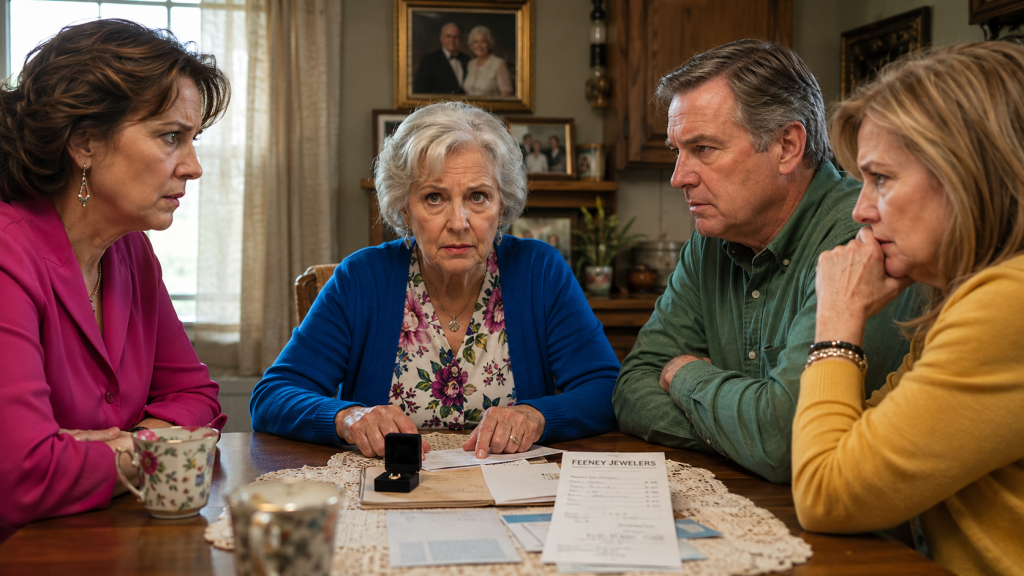
“I’m calling a family meeting,” I said.
Gregg sighed.
“That might make things worse.”
“They are already worse.”
So I called the meeting at my kitchen table for Sunday at two-thirty.
I placed the receipt, Mr. Feeney’s note, and the ring box on a folded dish towel.
I made coffee because my mother raised me that way.
Pamela came with her jaw tight. Gregg brought his wife, Nan, who kept smoothing her skirt as though she wished she were invisible.
Before anyone sat, I took off the ring.
My finger looked strange without it.
Then I placed it beside the receipt.
“What do you believe belongs to whom?” I asked.
Nobody answered at first.
Pamela stared at the ring. Gregg picked up Mr. Feeney’s note and read it twice, even though he already knew what it said.
Finally, he cleared his throat.
“Dad asked us whether we wanted Mom’s original ring. Pam said it should stay in the safe. I said I didn’t care.”
Pamela turned toward him.
“I did not say I didn’t want it.”
“You said you wouldn’t wear it.”
“That is not the same thing.”
Gregg rubbed his forehead.
“You told Dad keeping jewelry locked away was pointless.”
“I was grieving!”
“So was he.”
Pamela’s eyes filled with tears.
“I thought he would keep it exactly as it was. I thought someday Sophie might want it.”
Sophie was Pamela’s daughter, Louis’s oldest granddaughter.
I folded my hands in my lap.
“Neither of you knew he traded the setting?”
They both shook their heads.
“If Louis had told me,” I said, “I would have insisted we talk first.”
Pamela gave a bitter laugh.
“Would you?”
“Yes.”
“You married him even though we begged him not to.”
“No,” I said quietly. “You did not beg him not to marry me. You stopped answering his calls and hoped silence would make the decision for him.”
The room went still.
Pamela looked at me with open anger.
“You took Mom’s place.”
“I slept on my side of the bed,” I replied. “I cooked my own recipes. I kept her photograph on the mantel. I listened when your father talked about her. I went with him to her grave. I never asked him to stop loving her.”
Pamela’s mouth trembled.
“But he did stop.”
“No,” I said. “He learned to continue living. Those are not the same thing.”
Nan finally spoke.
“This isn’t really about the diamond, is it?”
Pamela wiped her cheeks with the heel of her hand.
“No. It feels like Mom disappeared a second time.”
Her honesty softened something in me.
I pushed the ring toward her.
“Then let us stop talking about jewelry and start talking about your mother—and about Louis—honestly.”
Gregg leaned back.
“There’s something else you deserve to know.”
He looked at me instead of his sister.
“Dad met with Mr. Feeney again after buying that ring.”
Pamela frowned.
“What are you talking about?”
Gregg reached inside his jacket and removed a small envelope.
“I found this in Dad’s tackle box. I was going to throw it away because I thought it was an old repair claim.”
He placed the envelope beside the ring.
Inside was a second receipt dated three weeks after Louis purchased my ring.
It listed a custom pendant and chain.
The description read: “Original Evelyn Gentry diamond reset as requested. Oval replacement stone retained in current bridal ring.”
I read it twice.
Then a third time.
My ring did not contain Evelyn’s diamond.
Louis had traded the old setting and used its value toward my ring, but before the work was finalized, he had returned and asked Mr. Feeney to remove Evelyn’s original diamond.
The stone in my ring was a different oval diamond.
Evelyn’s solitaire had been reset into a pendant.
“Where is the pendant?” Pamela whispered.
Gregg looked ashamed.
“I don’t know.”
Pamela stood so quickly her chair scraped the floor.
“You had this note and said nothing?”
“I found it yesterday.”
“You always do that. You keep information until you decide everyone is ready.”
“Like Dad,” Nan said softly.
Gregg looked at his wife but did not argue.
I picked up the second receipt.
At the bottom was another handwritten line.
“Hold for L.G. Collection by family instruction.”
There was no record of collection.
I called Feeney Jewelers Monday morning.
Mr. Feeney had retired, but his daughter, Caroline, now ran the shop. She remembered Louis.
“He came in three times,” she said. “The first time, he brought the old ring. The second time, he changed his mind about trading the diamond. The third time, he left a letter with us.”
“Do you still have the pendant?”
There was a pause.
“Yes, ma’am.”
My knees weakened.
Caroline explained that Louis had paid for the pendant but instructed them not to release it until all three of us came together: Pamela, Gregg, and me.
“He said you might arrive angry,” Caroline added. “He said anger was sometimes grief with nowhere to sit.”
That sounded exactly like Louis.
We went to the jewelry store the following Saturday.
Nobody spoke much during the drive.
Caroline met us near the back counter with a gray velvet box and a sealed envelope.
She gave the letter to Pamela.
“It is addressed to all three of you.”
Pamela opened it with shaking hands.
Louis’s handwriting leaned slightly to the right.
“My dear family,” she began.
Her voice broke after the first three words, so Gregg continued.
“If you are reading this together, then I failed to say certain things while I was alive. That will surprise none of you.”
A sad laugh escaped me.
The letter explained that Evelyn had once told Louis she wanted her diamond to pass to Pamela or to a granddaughter. After Evelyn died, Louis asked both children whether they wanted the ring. Their answers were unclear, and he interpreted their hesitation as refusal.
Then he met me.
He wanted to buy me a ring but felt guilty spending money on himself after years of medical bills. In a moment of stubborn practicality, he decided to trade Evelyn’s ring.
Afterward, he could not sleep.
“He wrote that?” Pamela asked.
Gregg nodded and continued reading.
“I realized I had confused permission with understanding. My children had declined the setting, but they had not declined their mother. I also realized Rose deserved a ring that carried no hidden burden.”
My name on the page nearly undid me.
Louis wrote that he returned to Feeney’s and paid to have Evelyn’s diamond placed in a pendant. He asked that it eventually go to Pamela, with the hope that she would offer it to Sophie on a meaningful day.
He also apologized.
Not vaguely.
Not with excuses.
He apologized to Pamela and Gregg for making decisions alone. He apologized to me for allowing even the smallest piece of another marriage to become entangled with ours without my knowledge.
Then came the final paragraph.
“Pamela, your mother cannot be replaced. Gregg, silence is not peace. Rose, you were never a visitor in my life. Please do not use this ring to punish one another. Jewelry is meant to mark love, not measure it.”
Caroline opened the gray velvet box.
Inside lay a delicate gold pendant holding Evelyn’s round diamond.
Pamela covered her mouth.
For several seconds, she did not touch it.
Then she whispered, “I remember this stone.”
She began crying—not the sharp, angry tears she had shed in my kitchen, but deep, exhausted sobs that seemed to have waited years for permission.
I stepped toward her, then stopped.
I did not know whether she wanted comfort from me.
She answered by reaching for my hand.
“I’m sorry,” she said.
I closed my fingers around hers.
“So am I.”
Gregg stared at the floor.
“I should have told you both as soon as I found the receipt.”
Pamela wiped her face.
“Yes, you should have.”
Then, after a pause, she added, “But you brought it.”
It was not forgiveness, exactly.
But it was a door opening.
Pamela took the pendant home.
Three months later, she invited me to Sophie’s college graduation dinner.
I nearly declined. I still felt like a guest in rooms where Evelyn’s memory sat at the head of the table.
But I went.
After dessert, Pamela stood and told Sophie there was something from her grandmother.
She fastened the pendant around her daughter’s neck and told the whole story—not only the flattering parts.
She explained Louis’s mistake, her own anger, Gregg’s silence, and the meeting at my kitchen table.
Then she looked at me.
“And this is Rose,” she said. “Granddad’s wife. She loved him, and he loved her. That truth does not take anything away from Grandma.”
Sophie hugged me.
I had not expected that.
Later, Pamela asked why I was not wearing my ring.
I had left it in its box after the family meeting. Even after learning the diamond was not Evelyn’s, the ring felt heavy with everything that had happened.
“I wasn’t sure it still belonged on my hand,” I admitted.
Pamela looked down at the pendant around Sophie’s neck.
“Dad bought it for you.”
“With credit from your mother’s setting.”
“He corrected that.”
“Not completely.”
“No,” Pamela said. “But maybe people do not always get to correct things completely. Sometimes they only leave us enough truth to finish the work.”
The following Sunday, I opened the ring box.
The oval diamond caught the morning light.
I remembered Louis in the parking lot, nervous as a teenager, standing beside that pickup with the cracked Razorbacks sticker.
“This one is yours,” he had said.
This time, I understood what ownership meant.
The ring did not give me Evelyn’s years.
It did not erase Pamela’s mother.
It did not prove Louis loved me more or less than anyone else.
It represented the late chapter we had been fortunate enough to share.
I slid it onto my finger.
A year has passed since then.
Pamela calls every Thursday evening. Gregg comes by once a month to repair something that usually does not need repairing. Nan no longer smooths her skirt at my kitchen table.
We still disagree.
Families do.
But now we say the difficult things before they harden into accusations.
The last time we went to Cracker Barrel, Pamela and I stood at the same register where she had demanded my ring.
The cashier asked whether we wanted separate checks.
Pamela shook her head.
“One family,” she said.
While I signed the receipt, she glanced at my hand.
The ring was there.
She touched it gently, not to take it, but simply to acknowledge it.
Then she said, “It suits you.”
I looked at the total.
Someone had accidentally added a senior coffee neither of us ordered.
One dollar and eighty-nine cents.
For a moment, I could almost hear Louis laughing.
I paid for it anyway.
THE END! THANKS FOR READING!