 Reading Time: 14 minutes
Last night, my son hit me. I did not cry. I stood in the middle of my kitchen with one hand pressed against my burning cheek while Dylan stared at me as though I had forced him to do it.
The clock above the stove read 11:43 p.m. A half-eaten bowl of soup sat on the counter. Rain tapped against the windows, and the refrigerator hummed behind us with the same steady sound it had made through twenty-eight years of birthdays, scraped knees, school mornings, and late-night arguments.
Dylan’s breathing was heavy. Mine had stopped.
He was thirty years old, six feet tall, and still living in the bedroom where I had once painted clouds across the ceiling because he was afraid of thunderstorms.
A few seconds earlier, he had demanded money.
Again.
He said he owed a friend. Then he said he needed to repair his car. Then he admitted he had not been to work in nearly two weeks.
When I told him I would not give him another five hundred dollars, his face changed.
“You don’t understand what I’m dealing with,” he said.
“I understand that I paid your phone bill yesterday.”
“That’s not the same thing.”
“I also covered your insurance last month.”
“You’re keeping score now?”
“No, Dylan. I’m trying to stop rescuing you.”
That was when he stepped toward me.
I should have moved.
My body knew something was coming before my mind accepted it. His jaw tightened. His hands curled into fists. His eyes became the eyes of someone searching for a target.
Still, I remained where I was.
Perhaps some foolish part of me believed there was a line a son could never cross.
Then his hand struck my face.
The sound was not dramatic. It was small and flat.
But it divided my life into before and after.
Dylan stared at me.
I stared back.
For one moment, he looked frightened by what he had done.
Then he covered that fear with anger.
“Now do you understand?” he said.
I lowered my hand from my cheek.
“Understand what?”
“That you can’t keep treating me like a child.”
Something cold settled inside me.
He had hit me to prove he was a man.
I wanted to scream. I wanted to ask where my little boy had gone. I wanted to remind him of every fever I had sat through, every lunch I packed, every Christmas gift I bought when money was tight.
Instead, I said, “Go upstairs.”
He laughed.
“You’re ordering me around now?”
“Go upstairs, Dylan.”
He must have heard something unfamiliar in my voice because he stopped smiling.
Then he muttered a curse and climbed the stairs, slamming his bedroom door so hard that a framed photograph fell from the hallway wall.
I picked it up.
It was a picture of Dylan at seven years old, sitting on my shoulders at Centennial Park. His front teeth were missing, and both of us were laughing.
The glass had cracked directly across his face.
I stood there for a long time.
Then I called my former husband.
Richard answered on the fourth ring.
“Eleanor?”
His voice was cautious. We had been divorced for eleven years and had mastered the distant politeness of people who once knew each other’s breathing patterns.
“I need you to come here tomorrow morning.”
“What happened?”
“Dylan hit me.”
Silence.
Then I heard Richard stand up.
“I’m coming now.”
“No.”
“Eleanor—”
“Tomorrow morning. Seven-thirty.”
“Why are you waiting?”
“Because tonight I need to decide what kind of mother I am going to be tomorrow.”
He did not understand, but he agreed.
My second call was to the Evanston Police Department.
The officer transferred me to Detective Marissa Vance from the Family Crisis Unit. Her voice was calm and direct.
She asked whether I was in immediate danger.
I looked toward the ceiling, where Dylan’s music had started pounding.
“I don’t know,” I admitted.
She asked whether there were weapons in the house.
“No.”
“Has he hit you before?”
“No. He has punched walls. Broken doors. Threatened me. But he has never hit me.”
“Do you have somewhere else to stay tonight?”
“It is my house.”
My voice broke on the last word.
Marissa paused.
“Yes,” she said. “It is.”
That sentence mattered more than she could have known.
We made a plan.
She would arrive at seven-fifteen the next morning. Richard would come at seven-thirty. Officers would remain nearby in case Dylan became violent.
After the call, I locked my bedroom door and wedged a chair beneath the handle.
I sat on the edge of my bed until dawn.
I did not sleep.
I remembered the first time Dylan wrapped his entire hand around my finger.
He was born at Evanston Hospital on a freezing February morning. Richard had cried harder than I did. The nurse placed Dylan against my chest, and I thought love meant I would always know how to protect him.
I had not understood that one day I might need protection from him.
At five-thirty, I showered.
The bruise on my cheek had darkened.
I covered part of it with makeup, then wiped the makeup away.
I did not want to hide what had happened.
At six, I went downstairs and began making breakfast.
Pancakes.
Bacon.
Fresh coffee.
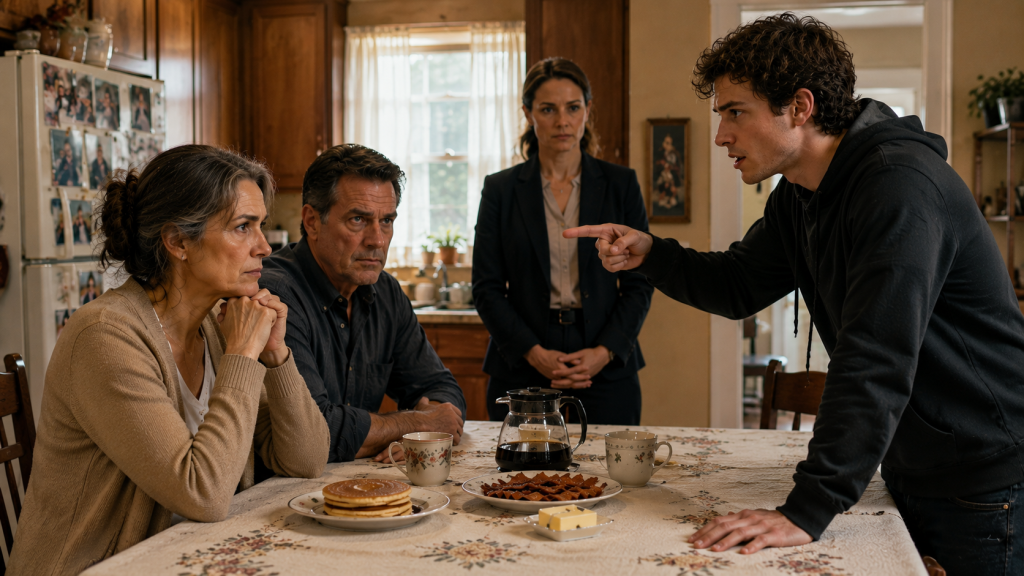
I laid out my mother’s embroidered tablecloth, the one I normally saved for Christmas and Easter.
This was not a celebration.
It was the final breakfast of a mother who had forgiven everything.
At seven-fifteen, Detective Vance arrived in a dark suit beneath a gray coat. She carried a folder and wore her badge clipped at her waist.
She looked at my cheek.
“You’re certain about this?”
“No,” I said. “But I’m doing it anyway.”
She nodded.
At seven-thirty, Richard came through the front door.
He looked older than he had the last time I saw him. His hair had gone almost completely gray, and guilt sat heavily across his face.
When he saw the bruise, his expression changed.
“I should have been here,” he whispered.
“What you should have done was stay involved years ago.”
He lowered his eyes.
“I know.”
“Today is not about your guilt.”
“No. Today is about keeping you safe.”
We sat at the table.
At eight, Dylan came downstairs.
He was wearing sweatpants and a clean T-shirt. His hair was damp from the shower. He looked relaxed, almost cheerful, as though the previous night had been nothing more than an unpleasant conversation.
“Something smells good,” he said.
Then he saw Richard.
His smile vanished.
“What is he doing here?”
Richard placed both hands on the table.
Dylan turned and noticed Marissa standing near the doorway.
His face hardened.
“What is this?”
I poured coffee into my cup.
“What I should have done the first day you made me afraid.”
Dylan stopped moving.
Not from remorse.
From surprise.
Children accustomed to a mother lowering her head do not recognize the sound of that mother standing up.
Marissa stepped forward.
“Good morning, Dylan. I’m Detective Marissa Vance with the Family Crisis Unit. I’m here because your mother requested an escort.”
Dylan laughed sharply.
“An escort? For what? Is she serving pancakes with a side of police now?”
Richard stood.
“So you understand that what happened last night was not a family argument. It was domestic violence.”
Dylan pointed at him.
“You shut up. You weren’t even here.”
Richard did not react.
That seemed to disturb Dylan more than shouting would have.
In the past, Richard and Dylan had fought like two fires trapped in the same room. Richard raised his voice. Dylan raised his higher. I always stood between them, attempting to calm them both.
That was why the divorce had once felt like freedom.
Richard’s temper had never turned physical, but he disappeared from Dylan’s life when parenting became difficult. Missed weekends became missed months. Phone calls became birthday texts.
Dylan had spent years blaming me for his father’s absence.
“I wasn’t here,” Richard said. “And that is something I will regret for the rest of my life. But I am here today.”
Dylan’s mouth twisted.
“So now you’re a father?”
Richard absorbed the insult.
“No. I did not come here to ask you to forgive me. I came because I will not allow you to hurt your mother again.”
Dylan glanced at the table.
The pancakes were still steaming. The bacon smelled of grease and salt. The coffee filled the kitchen with memories of birthdays, graduations, and rainy Sunday mornings.
For one second, I saw the little boy inside him.
Then he disappeared.
“What a ridiculous performance,” Dylan muttered. “What happens now? You throw me out of my own house?”
My house.
The words cut through me.
For years, he had called everything his.
His room.
His food.
His internet.
His refrigerator.
His driveway.
I allowed it because I wanted him to feel that he belonged somewhere after the divorce.
I did not realize he had begun confusing belonging with ownership.
“Yes,” I said.
Dylan stared at me.
“What?”
“You are leaving this house today.”
The kitchen became completely silent.
Outside, Evanston was waking. A neighbor started an SUV. A delivery truck rolled down the street. Somewhere, a garage door opened.
The world continued moving while my family broke apart over pancakes.
Dylan leaned toward me.
“You can’t do that.”
Marissa answered.
“The house belongs to Eleanor Miller. You are thirty years old. If she withdraws permission for you to live here, you must leave. If you threaten or assault her again, additional legal action will be taken.”
Dylan’s fists tightened.
I saw his knuckles whiten.
My body immediately wanted to retreat.
Fear is often faster than dignity.
Richard rose slowly.
“Do not even think about it.”
Dylan turned on him.
“You’re the reason I’m like this.”
Richard’s face tightened.
“I may be one of the reasons you are angry. I am not the reason you hit your mother.”
“You abandoned us.”
“I abandoned responsibilities I should have faced.”
“You ruined everything.”
“I helped damage this family,” Richard said. “But your pain does not give you permission to become violent.”
Dylan looked at the folder on the table.
“What’s that?”
Marissa opened it.
Inside were photographs of my bruised cheek, a statement I had given over the phone, information about a protective order, and the name of a lawyer.
Richard had added details for a treatment center in Chicago specializing in substance abuse, anger management, and trauma counseling.
Dylan pushed back his chair.
“I’m not crazy.”
“No one called you crazy,” I said.
“Then why is there a treatment center?”
“Because you are dangerous.”
The word changed his face.
He looked wounded, as though I had betrayed him.
“Me? Dangerous?”
“Yes.”
“Do you know what I’ve been through?”
There it was.
The list I had heard for years.
His father left.
His classmates had more money.
His first boss disrespected him.
His girlfriend cheated.
His anxiety made work impossible.
His friends pressured him.
His drinking was temporary.
His anger was caused by everyone else.
Some of those wounds were real.
I had spent years treating them as permission slips.
“Yes,” I said. “I know what you have been through. None of it gives you the right to raise your hand to me.”
Dylan stared at me as if I were speaking another language.
“I’m your son.”
“That is exactly why it took me this long.”
Marissa pulled out a chair but did not touch the food.
“Eleanor, I need you to confirm this in front of him. Do you want Dylan to leave the residence today?”
The kitchen seemed to grow around me.
I remembered holding Dylan for the first time.
I remembered his crooked baby teeth.
His first day of kindergarten.
The science project we built from cardboard and glue.
His warm forehead beneath my palm when he had pneumonia.
I remembered how he once promised that when he grew up, he would buy me a big house so I would never have to worry again.
Then I remembered his hand striking my face.
“Just so you understand.”
I looked directly at my son.
“Yes,” I said. “I want him to leave today.”
Dylan kicked his chair backward.
The plate shook. Maple syrup spilled across my mother’s white tablecloth, spreading through the embroidered flowers like a dark wound.
“You’re ungrateful!” he shouted. “I’m the only thing you have left!”
My chest tightened.
But I did not shout.
That was my victory.
“No, Dylan. I have myself. I forgot that while I was taking care of you.”
He stepped toward me.
Richard moved between us.
Dylan shoved him.
It was not a hard shove, but it was enough.
Marissa immediately lifted her phone.
“I’m requesting backup. Possible escalation at the residence.”
Dylan froze.
“You’re calling the police on me?”
“No,” I said. “I called them for me.”
That hurt him more than any insult.
He stared at me for a long moment, then stormed upstairs.
His bedroom door slammed.
Drawers opened and closed. Something glass shattered. He shouted curses at the walls.
Every sound shook through me.
For years, whenever Dylan became angry, I followed him.
I calmed him.
I apologized even when I had done nothing wrong.
I cleaned whatever he broke.
That morning, I remained seated.
I did not go upstairs.
I did not rescue him from his own rage.
Richard sat down again. His hands were trembling.
“Forgive me,” he said.
“Do not do this today.”
“Then when?”
“When I have enough space to be angry with you too.”
He nodded.
It was the most decent response he had given me in years.
Dylan came downstairs ten minutes later carrying a duffel bag, a jacket, and his phone.
He no longer looked furious.
He looked offended.
It was the particular offense of a person who believes the world owes him an apology for setting a boundary.
“I’m leaving,” he said. “But when you get sick, don’t come looking for me.”
The words hurt.
Of course they did.
A mother hears a sentence like that and remembers every fever, every hospital visit, every sleepless night beside a crib.
I took a breath.
“When I get sick, I will look for someone who does not hit me.”
Richard closed his eyes.
Dylan looked at me with an expression I will never forget.
It was not pure hatred.
It was fear.
Not fear of me.
Fear of losing the place where he had always unloaded everything he refused to face.
A patrol car stopped outside. Two officers waited near the gate without entering.
Across the street, Mrs. Higgins pretended to water a hydrangea bush already soaked from the rain.
That morning, I was grateful for witnesses.
Dylan walked toward the door.
Before leaving, he turned to Richard.
“Happy now? You finally destroyed the family.”
Richard answered quietly.
“The destruction began when you confused pain with permission.”
Dylan walked out.
He did not apologize.
He did not look back.
When the door closed, the house filled with a new kind of silence.
It was not peace yet.
It was the hollow stillness left behind when a machine that has been roaring for years is suddenly switched off.
I sat at the table and looked at the syrup stain.
Then I cried.
Not from guilt.
I cried for the little boy Dylan had once been.
I cried for the man he had become.
I cried for the mother who had spent years pretending that fear was patience and enabling was love.
I cried for every breakfast I had served after a frightening night, acting as though food could erase what happened.
Marissa waited until I finished.
Then she placed the report in front of me.
“This does not mean he stops being your son,” she said. “It means you stop being unprotected.”
I picked up the pen.
My hand shook as I signed.
Eleanor Miller.
The signature was crooked.
But it was mine.
I did not go to work at the library that day.
I called the director and said I had a family emergency.
She did not ask questions.
That afternoon, she sent a text.
“Your place is here whenever you are ready to return.”
I read the sentence several times.
Your place is here.
A life can begin rebuilding through very small sentences.
Richard stayed while a locksmith changed every exterior lock. Then he packed the rest of Dylan’s belongings and drove them to his sister’s home in Skokie.
I did not go with him.
I did not want to see Dylan’s clothes inside garbage bags or his shoes lined up beside someone else’s door.
That night, I ate toast and drank coffee for dinner.
The house sounded different.
Dylan’s bedroom remained closed. The smell of deodorant, dirty laundry, and delayed adulthood seeped into the hallway.
I passed the room three times.
On the fourth, I placed my palm against the door.
“I love you,” I whispered. “But I am not opening this door.”
That night, I slept with a chair beneath my bedroom handle.
I was not ashamed.
Fear does not disappear simply because a boundary has been set.
Over the next three days, Dylan called seventeen times.
Then came the messages.
“I’m sorry things got out of control.”
“You’re my mother. You can’t do this.”
“Richard is manipulating you.”
“You’re acting like I’m a criminal.”
“If something happens to me, it will be your fault.”
The final message nearly broke me.
Nearly.
I called Detective Vance.
“Do not answer,” she told me. “Save everything.”
Then I called a therapist whose office was near Green Bay Road.
The first appointment frightened me more than signing the police report.
I had always believed therapy was for people who had completely fallen apart.
The therapist, a calm woman named Dr. Helen Morris, listened while I explained everything.
Then she said, “Therapy is not only for people who break down. It is also for people who are ready to stop breaking themselves.”
I returned the next week.
And the week after that.
I learned that Dylan’s violence had not begun with the slap.
It began with doors kicked open.
Money demanded.
Threats disguised as jokes.
Silences used as punishment.
I had spent years moving the line of what I considered unacceptable.
Each time he crossed it, I drew another one farther away.
A week after he left, Dylan came to the house drunk.
He pounded on the front gate and screamed that I was ruining his life.
Mrs. Higgins called the police before I could.
From an upstairs window, I watched my son argue with an officer. When the officer touched his shoulder, Dylan pulled away. A second officer restrained him.
Then Dylan collapsed on the sidewalk and began sobbing.
I covered my mouth.
Every instinct screamed at me to go outside.
To tell the police he was upset.
To explain that he was not a bad person.
To take him home.
I remained behind the glass.
That was the hardest act of love I had ever performed.
He was taken to the station.
Richard met him there.
The protective order was enforced. Dylan was required to attend counseling, complete substance-abuse treatment, and follow court instructions if he wanted to avoid more serious consequences.
For weeks, he hated me.
I learned to survive his hatred.
I had spent my life believing a mother must remain loved by her child at any cost.
Now I understood that sometimes a mother must endure her child’s anger to stop him from destroying them both.
In September, Dylan asked to see me.
I agreed only if we met at a community outreach center with a social worker present.
He arrived thin and exhausted.
His hair was unstyled. Dark circles sat beneath his eyes.
He no longer resembled the giant who had stood over me in my kitchen.
He looked like a frightened boy trapped inside an adult body.
We sat across from each other.
For almost five minutes, neither of us spoke.
In the past, I would have filled the silence with questions, food, money, or apologies.
This time, I waited.
Finally, Dylan said, “I don’t know what to do with everything inside me.”
The sentence broke my heart more than his insults.
“Then get help removing it without throwing it at me.”
He wiped his nose with his sleeve.
“I hit you.”
“Yes.”
“I remember.”
“So do I.”
He lowered his head.
“I don’t know how to ask for forgiveness without making it sound too small.”
Outside the window, a bus passed toward downtown Chicago.
Life continued moving while my son struggled to tell the truth.
“Start by not asking me to forget,” I said.
He began crying.
I did not move to hug him.
Not yet.
“You cannot return to the house,” I continued. “Not now. Perhaps never in the way you lived there before.”
“Then what happens?”
“You work. You attend therapy. You follow the court order. You learn that loving someone does not mean owning their home, their money, or their forgiveness.”
Dylan nodded.
“Do you still love me?”
There it was.
The question that had trapped me for years.
I needed to answer honestly without allowing love to erase what happened.
“Yes,” I said. “I love you. But I will no longer be afraid of you just so you can feel loved.”
I do not know whether he understood every word.
But he listened.
Months passed.
Dylan found work at an auto repair shop near O’Hare. Richard helped him rent a room, paying the deposit but making it clear that he would not continue rescuing him financially.
I stayed out of it.
That was difficult too.
One afternoon, Dylan invited me to meet him at a diner near Centennial Park.
I entered with my purse held tightly against my chest.
He was already seated with two coffees and a small box of caramel pecan candies.
“I know you like these,” he said.
The gift made me want to cry.
Not because of the candy.
Because it was an effort that did not demand anything in return.
We spoke about ordinary things.
The weather.
His job.
A barbecue his manager had organized.
A book I recommended when he was a teenager that he now wanted to read.
When we stepped outside, Dylan stopped beside the sidewalk.
“Mom.”
I turned.
His eyes filled with tears.
“I never should have touched you.”
The world seemed to pause.
He did not say “but.”
He did not mention alcohol.
He did not blame his father, his anxiety, or me.
He simply said it.
I never should have touched you.
“No,” I answered. “You never should have.”
He cried silently.
This time, I hugged him.
Not as a mother attempting to rescue him from the consequences of his choices.
I hugged him as a woman who could offer love without reopening the cage.
My house is still mine.
Dylan’s old bedroom no longer looks the same. I packed his belongings into boxes and painted the walls light green. I placed a desk near the window and filled the shelves with books.
Sometimes I sit there in the afternoon with the ceiling fan turning above me and the smell of coffee rising from the kitchen.
My mother’s tablecloth never became completely white again.
The syrup stain remained faintly visible across the embroidered flowers.
I could have thrown it away.
Instead, I washed it, folded it carefully, and placed it in the top drawer.
I did not keep it as a reminder of shame.
I kept it as proof.
On the morning I made pancakes and bacon, I buried the version of myself who believed a good mother forgave everything.
But I did not bury the mother.
She is still here.
She simply learned something she should have understood from the beginning.
Loving your child does not require allowing him to break you.
Sometimes love looks like warmth, patience, and a home-cooked breakfast.
Sometimes it looks like changing the locks.
Sometimes it means watching your child face consequences while every part of your heart begs you to save him.
And sometimes love is standing in your own kitchen, looking at the person who made your home unsafe, and saying with a trembling but steady voice:
“This ends here.”
Then meaning it.