 Reading Time: 13 minutes
For two decades, I silently called him a burden. Sometimes I did not even say it silently. Sometimes I muttered it at the kitchen island while counting bills. Sometimes I said it to my wife, Sarah, when I thought the old man was asleep in the back bedroom.
Sometimes, God forgive me, I said it right to his face. Then Arthur Henderson died. And three days after the funeral, a probate attorney knocked on my front door holding a folder that knocked the wind entirely out of me.
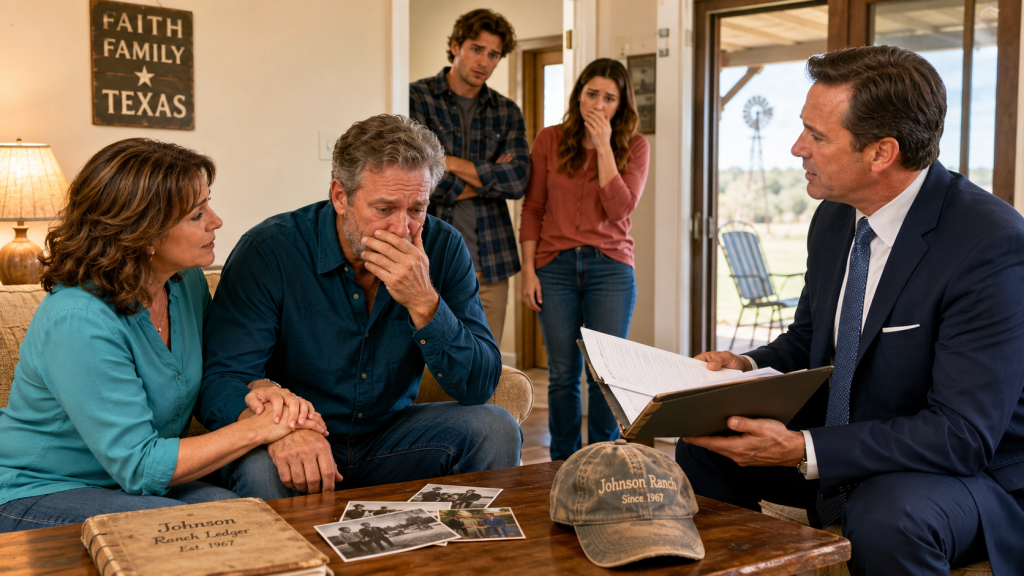
The attorney’s name was Mr. Calder. He was thin, gray-haired, and carefully dressed in a navy suit too formal for our small Austin living room with its water-stained ceiling, sagging couch, and coffee table I had repaired twice with wood glue.
Sarah sat beside me, both hands twisted in her lap. Her eyes were swollen from crying. Across from us sat her brother Kevin, leaning back like he owned the room, though he had not paid for a single thing in it. Two of Sarah’s other siblings hovered near the wall, suddenly interested in family after years of treating their father like an old coat they had forgotten in someone else’s closet.
My son Tyler stood in the hallway, twenty-four now, broad-shouldered, scruffy-bearded, his eyes red. My daughter Emma stood behind him, arms wrapped around herself.
Arthur’s old aluminum chair was empty on the back porch.
I could see it through the screen door.
For twenty years, he had sat there every morning with black coffee, his faded baseball cap low on his forehead, listening to an old portable radio that only picked up country stations when the weather felt generous.
For twenty years, I had walked past him and seen only the cost.
Food.
Medicine.
Electricity.
Doctor visits.
Laundry.
Space.
I had forgotten, somewhere along the way, that the man sitting in that chair was still a man.
Mr. Calder opened the yellow envelope in his hands.
“Mr. Henderson left a personal letter,” he said. “He instructed that I read it aloud before discussing distribution.”
Kevin rolled his eyes.
“Of course he did. Dad always loved drama.”
Sarah flinched, but said nothing.
The lawyer began reading.
“David, if you are hearing this, then I am gone, and you are probably sitting in that living room feeling angry, confused, and maybe a little guilty. Good. Guilt is painful, but sometimes it is the only medicine strong enough to reach a stubborn man.”
My throat tightened immediately.
I looked down at my rough hands, cracked at the knuckles from years of work at the transmission shop.
The attorney continued.
“I know you always thought I contributed nothing to this household. I know you called me a burden. Don’t think I didn’t hear you, son. These old ears worked better than you believed.”
Sarah squeezed my hand.
Her fingers felt like ice.
Kevin let out a sharp, nervous laugh — the kind that escapes a man’s throat when he already knows he has lost something enormous but cannot yet see the shape of it.
The attorney did not pause.
“I heard you say I was taking up the bedroom your children needed. I heard you counting pennies at the kitchen island to afford my pharmacy refills. I heard you when you sold your Chevy Silverado and came home walking under the blistering Austin sun, your work boots covered in dust.”
A lump rose in my throat so hard it hurt.
I remembered that day.
My truck’s transmission had died for good, and the repair cost more than the vehicle was worth. I sold it to a mechanic for parts and walked miles home from the shop because I was too proud to ask anyone for a ride.
By the time I reached the house, my shirt was soaked with sweat, my throat was dry, and my pride had been dragged behind me the whole way.
Arthur was sitting on the back porch.
He looked up and said, “Coffee’s fresh, son.”
I snapped at him.
“You should be offering me cash instead.”
He looked down at his shoes.
He did not defend himself.
He did not raise his voice.
He just nodded once and went quiet.
I had felt like a big man then.
Now the memory burned through me like shame had teeth.
The lawyer read on.
“I also know that even though you grumbled, you never once left me without a hot plate of food. You didn’t dump me in a state nursing home. You didn’t lock me out. You didn’t let me starve. And when my own biological children stopped by only to check whether I had died yet, you were the one making midnight runs to the twenty-four-hour pharmacy.”
Kevin slammed his palm onto the coffee table.
“This is a performance.”
The lawyer looked up, entirely unbothered.
“Mr. Kevin, your father left strict instructions. If you interrupt again, this reading will be suspended and resumed in front of a probate judge.”
Kevin’s jaw clenched.
His neck turned purple.
But he shut up.
On the table sat a worn blue ledger that Mr. Calder had placed beside the letter. It was filled with dates, numbers, and shaky handwriting.
Gas bill: David paid.
Cataract surgery: David sold his truck.
Christmas: David bought me a heated blanket, though he claimed it was from Sarah.
Tyler, back-to-school supplies: David skipped dinner.
I stared at that line until the words blurred.
Tyler shifted in the hallway.
He remembered.
Of course he did.
Children always remember the things you think you have hidden.
For years, Tyler and Emma had heard me complain about their grandfather. They had learned that ugly word from my mouth.
Burden.
The lawyer reached into his briefcase and pulled out a stack of old photographs.
In one, Arthur stood young and strong beside a Ford flatbed loaded with burlap sacks. His sleeves were rolled to the elbows, and his forearms looked like twisted rope. In another, he stood at a farmers market stall behind crates of tomatoes, onions, and bell peppers, smiling proudly beneath a wide straw hat.
I almost did not recognize him.
The Arthur I knew was frail.
Silent.
Bent at the shoulders.
A man who shuffled between the back bedroom, the porch, the bathroom, and the dinner table.
But in those photographs, he was alive with strength.
Calloused hands.
Straight back.
Bright smile.
A full life I had never once asked about.
Mr. Calder took a steady breath.
“Mr. Arthur Henderson owned three commercial warehouses in the industrial district and two valuable plots of land in the Hill Country near Fredericksburg. For many years, he leased them through a blind land trust managed exclusively by my firm.”
Kevin shot up from the couch.
“Lies. My dad was broke. We checked everything.”
The attorney looked at him calmly.
“You checked exactly what he allowed you to check.”
Sarah pressed one hand to her chest.
“My dad owned properties?”
“He had more than real estate, ma’am,” the lawyer said. “He had a very long memory.”
Then he unclipped another document.
“He left the deed to the house you currently live in to Mr. David Miller. The transfer paperwork was drafted eleven years ago and legally finalized six months ago.”
My ears began ringing.
“He also established a high-yield trust fund for his grandchildren, Tyler and Emma. Additionally, he set aside funds specifically to replace your roof, clear all utility debts, and completely pay off the personal loan Mr. David took out for his eye surgery.”
The room tilted.
“No,” I choked out.
Everyone looked at me.
“No, that can’t be right.”
Mr. Calder met my eyes.
“It is right. Mr. Henderson signed every document while in full possession of his mental faculties. We have medical evaluations, notarized recordings, and sworn witnesses.”
Kevin scoffed.
“Then why the hell did he never pay for anything? Why play poor? Why sit around while this idiot supported him?”
Any other day, that insult would have made me stand up.
Not that day.
Because I wanted to ask the same question.
The attorney returned to the yellow letter.
“You are probably going to hate me for not bringing out the money sooner. You have every right to be angry. But my biological children swooped in and took my first house the minute your mother-in-law died. I signed it over because I trusted them. They left me with nothing on paper. I knew that if they ever found out I still had assets, they would lock me away, declare me incompetent, or bury me in a facility where no one bothers to ask old men what they want.”
Sarah began to sob quietly.
Not the sharp grief from the funeral.
This was different.
This was shame.
“That is why nobody could know. Not even Sarah. Forgive me, sweetheart. You always had such a soft heart, and Kevin always knew how to use it. If he saw you with a dime of that money, he would have taken it from you with tears, threats, or lies.”
Kevin stepped toward the attorney.
“That old man was senile.”
Then Emma spoke from the hallway.
“Don’t you dare call him that.”
Her voice trembled.
But it held.
Kevin sneered.
“Shut your mouth, kid.”
Tyler stepped in front of his sister.
“The kid just graduated college, Uncle Kevin. And you’re still the same leech you always were.”
A suffocating silence filled the room.
Kevin clenched his fists.
“They brainwashed you.”
I finally found my voice.
“No,” I said. “I brainwashed myself with my own miserable pride.”
Everyone stared at me.
I slowly sank onto the edge of the coffee table because my knees would not hold me anymore.
For twenty years, I had counted every slice of bread as if it were a personal insult.
I had watched Arthur serve himself oatmeal and believed he was robbing me blind. I had never asked what had been stolen from him before he arrived at my house with his faded cap, his small suitcase, and his polite, “Thank you for having me, son.”
The lawyer reached for a velvet pouch.
“This is also for you.”
I opened the drawstring.
Inside was Arthur’s faded cap.
Underneath it sat a thick stack of bundled receipts.
Not his receipts.
Mine.
Emma’s high school tuition payment.
A late mortgage installment from 2019.
The refrigerator repair bill.
Tyler’s textbook fees at community college.
I looked up, bewildered.
“I paid these.”
“Sometimes,” Mr. Calder said gently. “And sometimes you came up short, and Mr. Henderson instructed me to cover the remaining balance quietly. He forbade me from telling you.”
“How?”
“He sold antique truck parts, collected modest rents from the land trust, moved interest around. Sometimes he even asked the lady at the corner store to pretend to extend you credit, although he had already paid the bill.”
Mrs. Jenkins.
The corner bodega.
I could see her wiping her hands on her apron, smiling across the counter.
“You can pay me later, David.”
I had thought she pitied me.
All those years, Arthur had been behind it.
Quietly.
Just as he had done everything.
The lawyer continued reading.
“I never wanted to buy your affection. I just wanted to protect the little dignity you had left. You were hard on me, yes. But you were not cruel the way my own children were cruel. There are men in this world who get tired and turn into beasts. You got tired and became bitter. I knew there was still a cure for that.”
I buried my face in my hands.
I did not want to cry in front of Kevin.
But the dam broke anyway.
Sarah knelt beside me on the rug.
“David…”
“I called him a burden,” I whispered. “I said it to his face.”
Sarah wrapped her arms around my shoulders.
“I left him alone too,” she cried. “So many times. To avoid fighting with you. To avoid fighting with my brothers. Mostly because I was a coward.”
Kevin laughed dryly.
“How touching. Everyone is a saint now. Well, we are still legally entitled to a portion. We are his biological children.”
Mr. Calder clicked open another section of his briefcase.
“Mr. Henderson did leave something for each of you.”
Kevin straightened immediately.
His siblings moved closer.
The attorney pulled out three crisp white envelopes.
“A personal letter for each child. And one dollar.”
Kevin blinked.
“Excuse me?”
“One single dollar for each child who abandoned him in his final years. Mr. Henderson specified clearly that this was not an oversight or typographical error. It is a legal symbol.”
Kevin’s face twisted.
“I’m contesting this will.”
“That is your right.”
“I’ll prove David manipulated a senile old man.”
The attorney glanced around our modest living room: the stained ceiling, scuffed floor, worn couch, and the empty porch chair beyond the screen door.
“I sincerely wish you luck convincing a Texas probate judge that the man who constantly complained about financially supporting his father-in-law somehow masterminded a plot to manipulate him into leaving millions.”
Kevin lunged toward the coffee table.
Tyler stepped in front of him.
The room erupted.
Chairs scraped.
Sarah pleaded for calm.
Emma cried out.
Kevin jabbed a finger at me over Tyler’s shoulder.
“You were always a broke nobody. That’s why he picked you. He knew you’d sit around crying and playing victim.”
I stood up.
For the first time in decades, I was not afraid of what Sarah’s family thought of me.
“He didn’t pick me because I was a good man,” I said. “He picked me because you were so much worse.”
Kevin opened his mouth.
Nothing came out.
He stormed out the front door, spitting curses into the yard. His siblings followed him quickly, each clutching their one-dollar envelope like it had burned them.
The house fell quiet.
Mr. Calder packed away the documents but left the yellow letter on the table.
“Mr. Henderson requested that I read the final paragraph only when you were alone,” he said quietly.
Sarah began to let go of my hand.
“I’ll make coffee.”
“No,” I said, holding tighter. “Please stay.”
The attorney nodded and read the final words.
“David, I am not leaving you this so you feel magically forgiven. I am not God. I leave it because sitting at your dinner table taught me that family does not always love prettily, but sometimes they stay. You stayed. You stayed through exhaustion, rage, bitterness, and words that hurt us both. But you stayed.
Do something good with what I leave you. Pay your debts. Fix the roof. Buy yourself another Chevy if you want.
But above all else, if one day a tired old man sits down at your dining table and cannot afford his way, remember my face before you call him a burden.”
Mr. Calder folded the letter and handed it to me.
I could not stand to walk him out.
Later that afternoon, I went to the back porch.
Arthur’s aluminum chair sat exactly where he had left it, beside the laundry vent. A faint circular coffee ring stained the concrete where he always set his mug. Sarah had not taken down his faded flannel shirt from the clothesline yet. It fluttered gently in the Texas heat.
I sat in his chair.
I had never done that before.
For twenty years, I considered that porch mine, hijacked by him.
But sitting there now, the chair held the heavy shape of his absence.
The next morning, we drove to the farmers market.
Sarah wanted flowers.
I did not fully understand why. We had already buried him. Still, I followed her through the crowded aisles of fruit, jalapeños, onions, barbecue smoke, and vendors shouting prices into the bright Austin morning.
She bought a large bouquet of orange marigolds.
“My dad loved this color,” she whispered.
From there, we drove to the cemetery.
Arthur’s grave was still covered in fresh dirt. Two cheap, wilted wreaths leaned nearby. A discarded plastic cup sat near the path.
Shame rose in me so fast I could barely breathe.
His final goodbye had looked so small.
So ordinary.
And he had been the man secretly holding pieces of our family together from the shadows.
I dropped to my knees in the dirt.
I did not know how to pray beautifully.
I just stared at the headstone and whispered, “I am so damn sorry.”
Sarah wept beside me.
Tyler removed his baseball cap and rested it against the grave marker for a long moment.
Emma placed a piece of pan dulce wrapped in a napkin near the flowers.
“For his morning coffee,” she whispered.
That broke me again.
Not because of the millions.
Not because of the warehouses or land or trust.
Because of all those mornings when a quiet old man ate toast at my table while I glared at him as if he were my enemy.
The following months were hell wrapped in legal paper.
Kevin followed through on every threat. He hired a sleazy probate lawyer, spread rumors to the neighbors, claimed I forged documents, accused Sarah of drugging her own father, and even showed up at the transmission shop to tell my boss I was a lucky thief.
But Arthur had paved every stone of the path.
There were medical evaluations.
Signed statements.
Video depositions.
In one recording, Arthur sat across from a notary in a crisp white shirt with his cap resting on his knees.
His voice was raspy but clear.
“I leave my estate to my son-in-law, David Miller, not because he loved me flawlessly, but because he gave me a roof when my own flesh and blood gave me excuses.”
I watched that video once.
Only once.
By the third month, Kevin lost his first injunction.
By month six, he stopped calling.
By month eight, he showed up drunk on our lawn.
It was a cold Austin night. Dry wind carried the smell of mesquite smoke from someone’s barbecue pit. I was on a ladder patching gutters with Tyler when pounding shook the front door.
I climbed down and opened it.
Kevin leaned against the frame, face bloated with rage.
“Give me something,” he slurred.
“No.”
“He was my dad.”
“He was Sarah’s dad. He was my children’s grandfather. And he was the man you abandoned in a laundry room for twenty years.”
“I had financial problems.”
“We all did.”
He shoved my shoulder.
Before I could react, Sarah stepped between us.
“Get off my property, Kevin.”
He looked at his sister with contempt.
“You chose a broke husband over your blood.”
Sarah took one step forward.
“No. I chose the man who stayed with my father when his blood threw him away.”
Kevin raised his hand.
I moved to block him.
But Emma shouted from the hallway.
“I already called 911.”
Kevin froze.
Then stumbled backward into the dark, cursing as he went.
That night, I finally understood Arthur’s true inheritance was not money.
It was a mirror.
And his children were terrified to look at themselves.
With a fraction of the trust, we wiped out our debts.
We replaced the roof before spring rain came.
I bought a used Ford F-150, not new, because I still felt too ashamed to spend freely.
Sarah turned the back bedroom into a quiet study. Emma had already moved into her own apartment, but Sarah said a room should wait kindly for family.
I bought a massive solid oak dining table for the kitchen.
A table big enough for all of us.
A table strong enough to hold memory.
I left Arthur’s aluminum chair on the back porch.
Not as punishment.
As witness.
Every morning, I brewed black coffee and set a cup beside the laundry vent.
At first, Sarah thought I was losing my mind.
Maybe I was.
But I needed a daily ritual of apology.
One Sunday, I took Tyler and Emma to the San Antonio Missions.
We walked through old stone archways, past tourists, balloon vendors, families with strollers, and children eating paletas. The historic chapels stood proud beneath the Texas sky, beautiful in a way that made you feel both small and responsible.
We stopped near the old aqueduct.
The limestone arches crossed the green land like an ancient spine.
Arthur had once told me structures like that were not built quickly.
Stone by stone, he had said.
Patiently.
I had not listened then.
Standing there, I finally understood.
A family is built the same way.
And it cracks when you stop caring for the water that keeps it alive.
Tyler stood beside me.
“Do you miss him, Dad?”
It took a long time to answer.
“I mourn the chance to have been better to him.”
Tyler nodded slowly.
“That’s another way of missing someone.”
I looked at my son.
He was grown now, and I refused to let him inherit my bitterness.
“When I get old,” I said, “if I get stubborn or difficult, call me out. But don’t let me become invisible.”
Tyler hugged me.
Not too tight.
Just enough.
A full year passed.
On the anniversary of Arthur’s death, Sarah cooked all afternoon. Pinto beans. Spanish rice. Fresh tortillas. Sweet bread. Cinnamon coffee.
She invited Mrs. Jenkins from the corner store and Mr. Calder, who had become part of the story none of us could tell without tears.
Before we ate, Sarah placed Arthur’s framed photograph in the center of the oak table.
It was an old picture from the Texas State Capitol. Arthur was young, handsome, smiling brightly, holding a brown paper bag of pastries.
He looked like a man who did not yet know how much he would lose.
I raised my coffee mug.
I did not give a polished speech.
I spoke from the chest.
“For twenty years, I thought this table became poorer every time he sat at it,” I said. “I was wrong. It became more human. I was just too blind to see it.”
No one replied.
They did not need to.
I filled the first plate and carried it to the porch, setting it in front of the empty aluminum chair.
Then I went back inside and served my family.
That night, after the dishes were cleared and the house fell quiet, I stood alone beside the laundry vent. The air smelled like damp Texas soil, detergent, and coffee.
Arthur’s repaired radio crackled softly, playing an old country song.
I closed my eyes.
For one second, I could almost hear his raspy voice in the breeze.
“Thank you, son.”
This time, the words did not fill me with anger.
I raised my mug toward the dark yard.
“No, Mr. Henderson,” I whispered. “Thank you.”
The old house breathed quietly around me.
And at last I understood the truth.
Some burdens do not weigh us down because of what they cost.
They weigh us down because we learn too late that they were blessings sitting quietly at our table, waiting for us to become human enough to see them.
THE END. THANKS FOR READING!