 Reading Time: 13 minutes
My husband begged me not to ruin dinner.So I slapped Rachel twice right back, right in front of the turkey, the roast beef, and his entire high-society family.That very night, I sent moving trucks and emptied the house they swore was theirs.
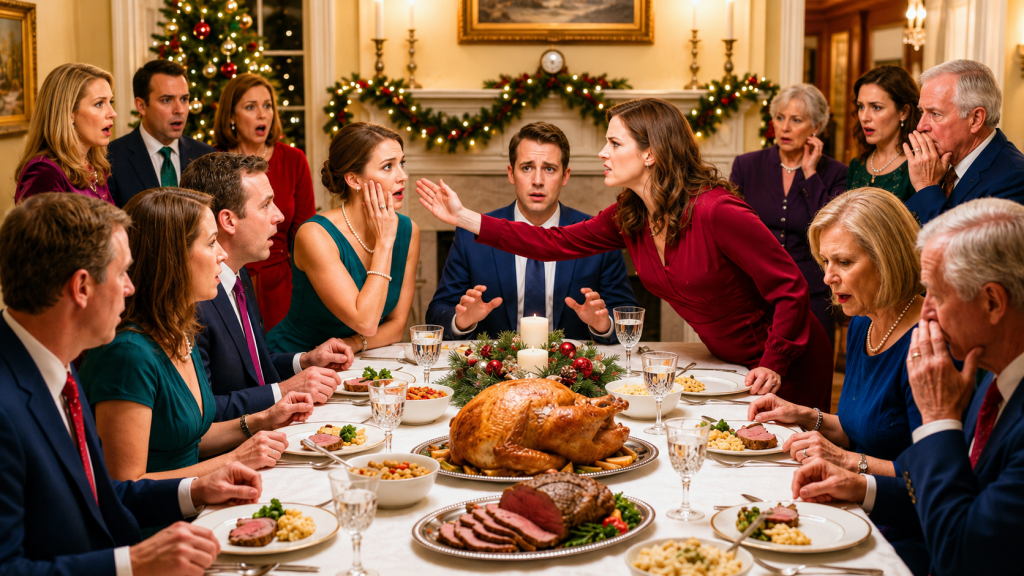
The slap echoed sharply. Louder than the Christmas carols playing on the TV. Louder than the clinking of wine glasses. Louder than every single humiliation I had swallowed for seven long years.
Lily pressed her tiny hand against her cheek, backing up until she hit the dining room chair. Her eyes were wide, huge, and filled with tears. But she didn’t cry. My baby girl didn’t cry. And that broke my heart even more.
Because a 5-year-old child should never have to learn how to take a hit just to keep adults comfortable.
Rachel, my husband’s sister, was still standing over her, her red fingernails suspended in the air and that smug look of satisfaction on her face that only cruel people wear when they think no one is going to stop them.
“To teach you some manners,” she said. “Clearly, your mother forgot to raise you.”
The dining room in my in-laws’ penthouse on Manhattan’s Upper East Side froze.
There was a stuffed turkey in the center of the table. Roast beef. Gourmet side dishes. Artisanal holiday punch served in vintage crystal glasses to look traditionally rustic, even though Eleanor, my mother-in-law, had never stepped foot in a local market unless it was to take photos.
The twinkling Christmas tree lights blinked over a family that believed they were elegant simply because they lived off Fifth Avenue, said “household staff” instead of “the help,” and knew how to tear someone down without messing up their hair.
I stood up so fast my chair screeched against the hardwood floor.
“What did you just do?”
Rachel turned to me with a twisted smile.
“Correcting your daughter.”
I felt my vision blur with rage.
“Correcting her?”
“My mother served her turkey, and the girl made a face. In this family, we teach respect.”
Lily looked down, her voice coming out tiny.
“I just said thank you, Grandma… but I asked if I could have a piece without the burnt skin.”
Eleanor tilted her chin up as if my daughter had just insulted the Pope.
“They talk back horribly at that age. Chloe, you spoil her.”
My father-in-law, Charles, just kept cutting his meat. He didn’t even look up.
Mark, my husband, was sitting right next to me. I watched him look at his sister. Then at his mother. Then at me.
I waited for him to stand up.
I waited for him to go to Lily.
I waited for him to say just one decent sentence.
But he only muttered, “Chloe, let it go. It’s Christmas Eve.”
I looked at him.
I truly looked at him.
And for the first time, I didn’t see the man I married.
I saw Eleanor’s obedient little boy.
Rachel’s cowardly brother.
A father who had just chosen to save face rather than protect his own daughter.
“Your sister hit Lily,” I said slowly. “And you’re asking me to let it go.”
Mark clenched his jaw.
“Rachel overreacted, yeah. But it’s not that big of a deal.”
Not that big of a deal.
The phrase landed on the table like another slap.
I saw the red mark rising on my baby girl’s cheek. I saw her lips trembling. I saw how hard she was trying not to cry, because in that house, she had already learned that if she cried, Eleanor would call her dramatic.
And in that exact second, I realized something horrifying.
If I didn’t defend my daughter right there, in that dining room, in front of everyone, Lily would grow up thinking that loving a family meant enduring abuse.
I walked over to Rachel.
She let out a little chuckle.
“What? Are you going to teach me manners now, country bumpkin?”
The first slap spun her face to the left.
The second one caught her right on the other cheek.
Clean.
Hard.
Precise.
With seven years of bitter insults packed into my hand.
“The first one was for Lily,” I told her. “The second one was so you understand that you never, ever touch my daughter again.”
Rachel shrieked as if the world had ended.
Eleanor bolted upright, knocking a wine glass onto the white tablecloth.
“You’re insane! You hit my daughter!”
“Your daughter hit a 5-year-old child.”
“My daughter is a respectable adult!”
“Then she should have acted like one.”
Mark grabbed my arm.
Hard.
“Apologize to Rachel right now.”
I ripped my arm away with a violent jerk.
“When Rachel hit your daughter, you didn’t move a muscle. Now that I gave your sister what she deserved, suddenly you know how to use your hands.”
He went entirely pale.
“Don’t compare the two.”
“I’ve done enough comparing for seven years.”
Seven years of smiling through insults.
Seven years of Eleanor correcting my accent from Georgia like I had crawled out of a barn instead of graduating top of my class from Emory.
Seven years of Rachel asking if I bought my dresses “off a discount rack,” while wearing earrings I had paid for with the joint credit card Mark claimed was only temporary.
Seven years of Charles calling me “ambitious” like it was a disease.
Seven years of Mark squeezing my knee under tables and whispering, “Just ignore them.”
Ignore them when Eleanor asked if I planned to “get my figure back” three weeks after giving birth.
Ignore them when Rachel joked that Lily had my “unfortunate stubborn chin.”
Ignore them when Charles introduced me at charity dinners as “Mark’s little Southern project.”
Ignore them when they treated me like I had married up, when the truth was I had quietly been holding the whole fragile Miller image together with my money.
Eleanor pointed toward the door, her finger shaking with pure malice.
“Get out of my house. This family does not need a low-class daughter-in-law.”
There it was again.
Low-class.
Trash.
The country bumpkin.
The girl who arrived in New York City with a taped-up suitcase and a scholarship.
The girl who worked as an intern, then an associate, then an executive, then a manager, until she became Chief Marketing Officer of a national beauty brand.
The girl who paid for the groceries, the private school tuition, the credit cards, the family vacations, and even the home renovations while they bragged about “the legacy of the Miller family fortune.”
I scooped Lily into my arms. Her burning cheek pressed against my neck.
“We’re leaving.”
Mark didn’t even bother to stand up.
He just said, “Go back to the apartment and calm down. We’ll talk tomorrow.”
Tomorrow.
As if my daughter could sleep off a blow to the face.
As if I were going to crawl back tomorrow to beg for forgiveness with a tray of holiday leftovers.
I walked toward the door without my coat, without my purse, without anything.
Eleanor screamed after me one last time.
“And don’t come back until you learn your place!”
I stopped.
I turned around.
They were all staring at me. Rachel was crying with her hands over her face. Mark was avoiding my eyes. Charles was still sipping his wine.
And Lily, whimpering in my arms, barely whispered, “Mommy, I’m sorry.”
That completely shattered me.
“No, my love,” I told her. “You never apologize for getting hurt.”
I stepped out into the hallway. The heavy door slammed shut behind us.
Then I heard the deadbolt turn.
They locked us out on Christmas Eve.
My daughter with a bruised cheek.
Me without a coat.
Like we were garbage.
The elevator ride down was agonizingly slow. Lily was shaking against my chest. I kept kissing her hair, breathing deeply to keep myself from breaking down.
When we reached the lobby, the doorman gave me a worried look.
“Mrs. Miller, is everything okay?”
“No.”
I pulled out my phone with freezing fingers.
First, I called Sarah, my best friend.
She answered with holiday music blasting in the background.
“Hey! Are you already drunk on eggnog or what?”
“Sarah, I need two moving trucks. Strong guys. And I need you to get here right now.”
The noise on the other end instantly died.
“Chloe, where are you?”
“Eleanor’s building. Lily was hit. I’m done.”
Ten minutes later, Sarah came through the revolving doors wearing pajama pants under her coat and murder in her eyes.
The doorman quietly brought Lily a blanket and an ice pack.
I took photos of her cheek right there under the lobby lights.
Then I called the police.
Not to make a scene.
To make a record.
Because I had finally learned something after seven years with the Millers. People with money rewrote stories quickly, and if you didn’t document the truth immediately, they would bury you under their version before morning.
The officer who arrived was calm, respectful, and kind to Lily.
He asked simple questions. Lily answered in whispers, one hand still pressed to her cheek.
“Yes, Aunt Rachel hit me.”
“No, I didn’t hit her first.”
“I asked for turkey without the black part.”
Sarah stood beside me, one arm around my shoulders, while the officer wrote everything down.
Mark finally called while the report was being taken.
His voice was tight, low, embarrassed.
“Chloe, Mom says you’re making this worse.”
I almost laughed.
“Your sister slapped our child, your mother locked us out, and you’re worried I’m making it worse?”
He lowered his voice.
“Just come home.”
“No, Mark. I’m going to our apartment, but not to calm down.”
“Don’t do anything stupid.”
For the first time all night, I smiled.
“Oh, Mark. I’m about to do the smartest thing I’ve done in years.”
He didn’t understand.
Of course he didn’t.
Mark had spent so long believing my patience meant weakness that he forgot patience has a limit.
By midnight, two moving trucks were outside the townhouse Mark loved calling “the Miller family residence.”
What his family forgot was that my name was on the deed.
I had bought it before the wedding.
I had paid every mortgage payment.
I had paid the property taxes.
I had paid for the kitchen remodel Eleanor showed off to her friends as if she had funded it herself.
I had let Mark’s parents host parties there. I had let Rachel stay in the guest room during her divorce. I had let Charles store wine in the cellar. I had let them speak about my home like it was theirs because I believed marriage meant sharing.
But sharing is not the same thing as surrendering.
Sarah stood beside me while movers carried out everything I owned.
My furniture.
Lily’s bedroom set.
My office equipment.
The paintings I bought.
The heirloom quilts from my grandmother.
The silverware Eleanor bragged about at parties but never paid for.
I moved quickly, calmly, and with paperwork in hand.
Every receipt.
Every ownership document.
Every pre-marital asset record.
Every bank statement.
Because while the Millers were busy calling me low-class, I had been smart enough to protect myself.
At 2:06 a.m., Mark arrived furious.
His coat was half-buttoned, his hair messy, his face red from anger and humiliation.
“What are you doing?”
I watched two movers carry out the velvet sofa Rachel once spilled wine on and then blamed on Lily.
“I’m leaving.”
“You can’t just empty the house.”
“My house,” I said.
His mouth tightened.
“We’re married.”
“Not for much longer.”
He looked past me at the truck.
“You’re being dramatic.”
There it was.
The Miller family lullaby.
Dramatic.
Sensitive.
Emotional.
Low-class.
I held Lily closer. She was asleep against Sarah’s shoulder now, exhausted, one cheek still marked.
I handed Mark an envelope.
“What is this?”
“A copy of the deed. A copy of the police report. Photos of Lily’s face. A temporary custody filing my attorney is submitting first thing in the morning. And the name of the hotel where you can stay tonight, because you are not entering my home.”
He stared at me like I had started speaking another language.
“You’re kicking me out?”
“You watched your sister hurt our daughter and asked me to protect dinner. Yes, Mark. I’m kicking you out.”
His face crumpled for half a second. Not with regret. With disbelief that I had finally stopped asking permission.
“My parents will destroy you.”
“No,” I said. “They’ll try. And this time, I’ll let the truth answer them.”
The next morning, Eleanor started the war.
By 8 a.m., my phone was full of messages.
You embarrassed this family.
You assaulted Rachel.
You are unstable.
You are not fit to raise Lily.
Charles left one voicemail that sounded like a boardroom threat.
“Chloe, reconsider your behavior before reputations are permanently damaged.”
I sent every message to my attorney, Denise Morales.
Denise was small, sharp-eyed, and had the kind of calm that made powerful men nervous.
When she reviewed the police report, the photos, the deed, and the messages, she looked at me over her glasses.
“They think you’re still afraid of them.”
“I was.”
“And now?”
I looked at Lily sitting in the corner of the office coloring a picture of a Christmas tree with too much purple.
“Now I’m afraid of what happens if I stay.”
Denise nodded.
“That is a better fear. It moves you forward.”
By noon, she filed for divorce, emergency temporary custody, exclusive use of the home, and a protective order preventing Rachel from having contact with Lily.
Mark’s attorney tried to frame the dinner as “a heated family disagreement.”
Denise placed Lily’s photograph on the table.
“Your client’s sister struck a child,” she said. “My client called police, documented it, and removed the child from danger. Choose your next sentence carefully.”
They did.
For three days, Mark sent me messages that swung between apology and blame.
I’m sorry it got out of hand.
You know Rachel didn’t mean it like that.
Mom is devastated.
Lily needs both sides of her family.
You’re destroying Christmas.
Finally, on the fourth day, he sent one message that told me everything I needed to know.
Can’t you just say sorry so this goes away?
Not “How is Lily?”
Not “I should have protected her.”
Not “I failed as a father.”
Just: make it go away.
I put the phone down and cried in my kitchen.
Not because I missed him.
Because I had loved a man who could look at his daughter’s pain and see only inconvenience.
Lily asked about him two nights later while I tucked her into bed at Sarah’s apartment, where we stayed until the townhouse locks were changed.
“Is Daddy mad at me?”
I sat down carefully beside her.
“No, sweetheart. You did nothing wrong.”
“Grandma said I ruined dinner.”
“You didn’t ruin anything. The grown-ups made bad choices.”
She touched her cheek, though the mark had faded.
“Do I have to say sorry to Aunt Rachel?”
“No.”
“Ever?”
“Never.”
Her little shoulders relaxed.
Then she whispered, “You slapped her because she slapped me?”
I took a breath.
“I should have used better hands than she did. But I want you to understand something. Nobody is allowed to hurt you. Not Aunt Rachel. Not Grandma. Not anyone. And Mommy will always protect you.”
Lily looked at me seriously.
“Even at Christmas?”
I kissed her forehead.
“Especially at Christmas.”
The custody hearing came in January.
Mark arrived with Eleanor and Charles sitting behind him like royal advisors. Rachel did not attend. Her attorney claimed she was “emotionally distressed.”
Lily’s child therapist submitted a statement. The police report was admitted. The building doorman confirmed we had been locked out without coats. Sarah testified that Lily was shaking when she arrived.
Mark’s attorney tried to suggest that I was unstable because I had emptied the townhouse.
Denise smiled.
“She removed her legal property from her legal residence after her child was harmed and after being locked out by hostile relatives. That is not instability. That is protection.”
The judge granted me temporary primary custody, ordered supervised visitation for Mark, and prohibited Rachel from contact with Lily during the investigation.
Eleanor gasped as if the judge had slapped her instead.
Outside the courtroom, she cornered me near the elevator.
“You think you won because a judge felt sorry for you?”
I looked at her expensive coat, her pearls, her perfect hair.
“No, Eleanor. I won because for once, your family didn’t get to tell the story first.”
Her eyes narrowed.
“You’ll never belong in our world.”
I smiled then.
A real smile.
“I know. That’s my gift to Lily.”
Mark tried counseling.
Not because he suddenly understood, but because the court ordered it.
During the first co-parenting session, the therapist asked him what he wished he had done differently on Christmas Eve.
Mark looked uncomfortable.
“I wish everyone had stayed calmer.”
The therapist waited.
I did too.
He added, “I wish Chloe hadn’t escalated.”
Something inside me went very still.
The therapist asked, “What about when your sister struck your daughter?”
Mark rubbed his forehead.
“I know that was wrong.”
“Then why didn’t you intervene?”
He looked down.
“My family is complicated.”
I said quietly, “So is being five.”
He had no answer.
That was the moment I stopped hoping he would become the man I needed him to be.
Sometimes divorce is not one big decision.
Sometimes it is a thousand small realizations finally standing up together.
By spring, the townhouse was mine again in every sense.
I repainted Lily’s room yellow.
She said pink reminded her of Rachel’s nails.
So we made it yellow with white clouds on the ceiling and purple curtains because she still believed purple belonged on everything.
I hosted Easter brunch for friends who loved us without measuring our worth. Sarah came. Denise came. The doorman came with his wife because Lily insisted he was part of our rescue team.
No one criticized the food.
No one corrected Lily’s manners.
No one called me dramatic when I cried during dessert.
Mark’s visits remained supervised for months.
He gradually learned how to speak to Lily without using his family’s words. Maybe therapy helped. Maybe losing control helped. Maybe shame finally did what love should have done.
I do not know.
I only know that I stopped managing his growth.
That was his job.
My job was Lily.
A year later, the divorce was final.
I kept the house.
I kept my company shares.
I kept custody.
Mark received structured visitation and mandatory boundaries regarding his family.
Rachel sent one written apology through her attorney.
It was stiff, legal, and useless.
Eleanor never apologized.
People like Eleanor mistake apology for losing.
But Lily did not need their apologies to heal.
She needed distance.
Safety.
A home where adults did not demand silence to preserve a table setting.
Last Christmas Eve, Lily and I stayed home.
No penthouse.
No crystal glasses.
No turkey carved by people who cared more about manners than kindness.
We made grilled cheese sandwiches and tomato soup.
Sarah came over in reindeer pajamas.
We watched cartoons.
Lily put an angel on top of the tree, then looked at me and said, “This Christmas feels quiet.”
I asked, “Quiet good or quiet bad?”
She thought about it.
“Quiet safe.”
I had to turn toward the kitchen so she would not see me cry.
Later that night, after she fell asleep, I stood in the doorway of her yellow room and thought about the woman I had been the Christmas Eve before.
Cold in a lobby.
Locked out.
Holding a child who thought she had to apologize for someone else hurting her.
I thought about how many years I had wasted trying to earn respect from people who had already decided I was beneath them.
I thought about Mark asking me not to ruin dinner.
And I finally understood something.
I did not ruin dinner.
Rachel did.
Eleanor did.
Mark did.
Charles did.
Every person at that table who saw a child get hurt and chose comfort over courage ruined dinner long before I stood up.
All I did was refuse to let my daughter become the next woman in that family taught to swallow pain politely.
People still whisper about what happened.
Some say I went too far.
Some say I should have handled it privately.
Some say a slap for a slap made me no better.
Maybe they are right in the clean, perfect world where every mother gets to respond with calm words and everyone listens.
But in that room, words had failed for seven years.
My daughter’s face was red.
My husband was silent.
And a whole family was waiting to see whether I would accept my place.
I chose Lily instead.
I would choose her again.
Not with the same hands, maybe.
But with the same fire.
Because motherhood is not politeness.
It is not keeping peace at any cost.
It is standing between your child and the people who believe their status gives them permission to wound.
It is saying no when everyone expects you to smile.
It is walking out without a coat.
It is making the record.
Calling the trucks.
Changing the locks.
Filing the papers.
Building a yellow room where a little girl can sleep without apologizing for taking up space.
The Millers thought they owned everything because they had money, history, and a dining room full of people trained to obey.
But they never owned me.
They never owned Lily.
And when they locked us out on Christmas Eve, they thought they were putting us in our place.
They were right.
They put us exactly where we belonged.
Outside their door.
Free.
THE END! THANKS FOR READING!