 Reading Time: 14 minutes
My parents ignored nine urgent calls from my hospital bed because they were helping my sister unpack her new suburban home. So I called my estate lawyer to the hospital, changed everything on the spot, and when they finally arrived, they learned exactly what their cruelty had cost them.
I counted the calls because the clock on the hospital wall was directly across from my bed. Nine. Nine times my thumb trembled against the hospital phone while monitors beeped softly beside me. Nine times I called my mother.
Then my father. Then the family group chat. Nine times the same answers came back.
Voicemail. Silence. One brief text from Mom that said, “We’re at Lauren’s. Is this urgent?”
I stared at the word urgent while a nurse adjusted the IV in my arm.
The day before, a delivery truck had run a red light and crashed into my car on my way home from a board meeting.
I remembered the sound more than the pain.
Metal folding.
Glass exploding.
A stranger screaming.
Then the ceiling of an ambulance, bright lights passing over my face, and a paramedic telling me to stay awake.
My injuries were serious.
Broken ribs.
A concussion.
Internal bleeding that required emergency surgery.
The doctors had warned me that the next twenty-four hours would be critical for my recovery.
So yes, I thought, staring at my mother’s text.
It was urgent.
My sister Lauren, however, had just moved into a new suburban home in Ridgefield with a white kitchen, a nursery she was not using yet, and a husband named Brent who believed lifting boxes was beneath him.
My parents had driven there “for a few hours” the morning after my surgery.
They posed for photos smiling on her front porch while I recovered beneath bright hospital lights.
At 6:40 p.m., my phone buzzed.
Lauren had posted a video.
“Couldn’t have done today without Mom and Dad!” she sang, turning the camera toward them.
My father was carrying a lamp.
My mother was arranging throw pillows.
Brent stood in the background holding iced coffee, laughing at something.
Lauren looked beautiful, glowing, and perfectly pleased with the world.
I watched the video twice.
Not because I wanted to.
Because sometimes pain makes you look again, just to confirm it really happened.
My mother had received my calls.
My father had seen my name.
They had chosen throw pillows.
I pressed the call button, but not for a nurse.
When Nurse Marisol leaned beside my bed, kind eyes full of concern, I asked her to call the number saved under Harding & Vance — Estate.
My voice was weak, but I spoke every word clearly.
“Are you sure?” she asked.
“Completely.”
She hesitated.
“Family can be complicated when people are scared.”
I turned my head slowly toward the phone lying on my blanket.
“They’re not scared. They’re busy.”
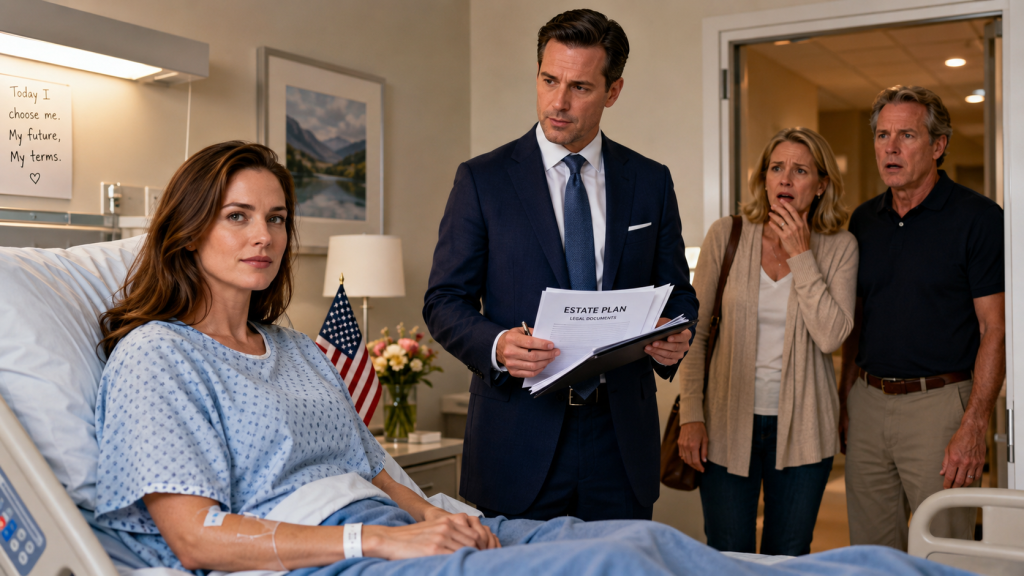
By 8:15 p.m., my estate lawyer, Julian Vance, stood at the foot of my hospital bed in a navy suit, his briefcase resting on a chair.
He had represented me since I sold my medical software company two years earlier.
My parents knew I was wealthy.
They had no idea how wealthy.
That was intentional.
When I founded the company, nobody in my family believed in it.
My father called it “a little computer project.”
My mother told me not to get above myself.
Lauren said, “Must be nice to play startup girl while the rest of us have real lives.”
Then the software was acquired by a major hospital technology firm.
Suddenly, the family tone changed.
My father wanted investment advice.
My mother wanted help renovating her kitchen.
Lauren wanted “a small bridge loan” for her wedding that turned into me paying for the photographer, flowers, and honeymoon upgrade.
I gave because that was what I had been trained to do.
Miranda helps.
Miranda understands.
Miranda can afford it.
More importantly, they had no idea they were still listed in my will.
They had no idea about the lake house.
The foundation seats.
The emergency account access.
The education trusts I had quietly drafted for Lauren’s future children, because even though my sister treated me like an ATM with a pulse, I had still imagined being a generous aunt someday.
They had no idea how much of my estate still had their names attached to it.
Julian did.
He looked at me with the careful sadness of a man who had seen too many people rewrite their lives from hospital beds.
“Miranda,” he said gently, “you don’t have to do this tonight.”
“Yes,” I whispered. “I do.”
“We can wait until you’re stronger.”
“I’ve waited thirty-six years to be strong enough.”
His expression changed slightly.
Then he opened his briefcase.
For the next hour, he read every change aloud.
My parents were removed as beneficiaries.
Lauren was removed entirely.
Their access to my emergency accounts was revoked.
My father’s name came off the lake house guest authorization list.
My mother’s pending kitchen renovation reimbursement was canceled.
The charitable foundation board seats they proudly talked about at church, even though they had never attended a single meeting, were reassigned to actual medical workers from St. Mercy.
The education trusts I had set aside for Lauren’s future children were redirected to a scholarship program for children of trauma nurses and emergency responders.
My medical proxy was changed from my mother to my best friend, Dr. Hannah Reeves, who had sat beside me all afternoon after finishing her own shift.
My parents’ authority to make decisions if I became unconscious was revoked.
That one hurt the most.
Not because I regretted it.
Because I had finally admitted something I had spent my whole life trying not to know.
If I could not speak for myself, they might still choose Lauren’s convenience over my life.
At 9:52 p.m., I signed.
My hand shook so badly Julian had to steady the clipboard.
At 10:03 p.m., my mother finally walked into my hospital room holding a takeout coffee.
My father followed behind her, coat still on, phone in hand.
Neither of them looked breathless.
Neither looked frantic.
Neither looked like a parent who had imagined losing a child and raced toward her.
My mother sighed as if I had inconvenienced her.
“Miranda, you scared us.”
Julian turned from the window.
I looked straight at both of them.
“No,” I said quietly. “You scared me.”
My mother blinked like she had misheard me.
Dad frowned.
“Don’t start,” Mom said. “We came as soon as we could.”
Julian closed his briefcase with a soft click.
“Actually, Mrs. Hale, your daughter called nine times over three hours while recovering from emergency surgery.”
Dad’s eyes snapped toward him.
“Who are you?”
“Julian Vance. Miranda’s estate attorney.”
My mother’s eyes flicked to me, then to the papers on the tray table.
“Estate attorney? Why is he here?”
I swallowed against the pain and lifted my phone, showing Lauren’s video frozen on the screen.
Mom smiling with throw pillows.
Dad carrying a lamp.
Lauren laughing in her perfect new house.
“Because while I was wondering if I would survive the night, you were decorating Lauren’s guest room.”
Mom’s face tightened.
“Your sister needed us.”
“So did I.”
Dad stepped forward.
“This is emotional blackmail.”
Julian calmly handed him a copy of the signed revisions.
“No, sir. This is legal documentation.”
My mother took the pages first.
Her eyes moved over the first paragraph.
Then the second.
Her mouth opened slightly.
“Removed?” she whispered.
Dad snatched the packet from her.
“The lake house?” he said, scanning fast. “The foundation seats? Lauren’s children’s trusts?”
“Gone,” I said.
Mom’s coffee slipped from her hand and splashed across the floor.
“Miranda, you can’t punish family over one mistake.”
I looked at the IV in my arm.
“Nine calls is not one mistake. It’s a pattern with a timestamp.”
Dad’s voice shook with anger.
“We’re your parents.”
“Then you should have answered.”
For a moment, nobody spoke.
The hospital room hummed around us.
The monitor beeped steadily beside my bed, as if it were the only thing in the room still committed to keeping me alive.
My mother looked genuinely stunned, but not in the way I had hoped.
Not stunned by what she had done.
Stunned that it had consequences.
“Miranda,” she said, lowering her voice. “You are hurt and emotional. I understand that. But this is not you.”
I almost laughed.
That sentence had followed me my entire life.
Whenever I said no, it was not me.
Whenever I asked for fairness, it was not me.
Whenever I stopped giving, forgiving, smoothing, paying, arranging, and understanding, suddenly I had become someone else.
“No, Mom,” I said. “This is me. You just preferred me useful.”
Her face crumpled into offense.
“How can you say that?”
“Because when Lauren needed help choosing where to put a lamp, you answered. When I needed help from a hospital bed, you asked if it was urgent.”
Dad slapped the papers against his palm.
“We didn’t know it was that serious.”
“I said hospital. Surgery. Please call.”
“You always handle things,” he snapped.
There it was.
The family motto carved into my bones.
Miranda handles things.
Lauren needs things.
I closed my eyes for one second.
When I opened them, Julian was watching me carefully, ready to intervene if my strength gave out.
But I was not done.
“That is exactly why you are no longer my emergency contacts.”
My mother grabbed the rail of the bed.
“You changed that too?”
“Yes.”
“Who did you choose?”
“Hannah.”
“The doctor friend?”
“The doctor friend who answered on the first call.”
Mom recoiled like I had slapped her.
“You chose a friend over your mother?”
“I chose the person who showed up.”
Dad’s jaw tightened.
“This is cruel.”
“No,” I said. “This is clarity.”
My mother started crying then.
Softly at first.
Then louder.
It might have moved me once.
It had moved me many times before.
When I was twelve and Lauren wanted my birthday bike because pink was her favorite color.
When I was seventeen and my college savings became Lauren’s emergency modeling school deposit.
When I was twenty-four and Mom cried because I refused to co-sign Kyle—no, not Kyle in this story, Lauren’s husband Brent’s truck loan before they were even married.
My mother’s tears had always been the alarm bell that sent me running back into obedience.
But that night, lying in a hospital bed with stitches under my gown and bruises across my ribs, her tears sounded different.
They sounded like strategy failing.
“You don’t understand what today was like,” she said.
“You’re right. I don’t. I was unconscious for part of it.”
Dad pointed toward the door.
“We should go. You’re clearly not rational.”
Julian stepped forward.
“Before you leave, you should know Mrs. Hale is not to be pressured regarding these documents. Any attempt to challenge her capacity tonight will be met with testimony from her attending physician, who has already confirmed she is alert and legally competent.”
Dad glared at him.
“You had a doctor sign off?”
Julian’s expression remained calm.
“Of course.”
My mother looked at me with something like betrayal.
“You planned this.”
“No. You earned it.”
They left fifteen minutes later.
Not because they had comforted me.
Not because I was okay.
Because Julian asked them to leave, and a nurse appeared in the doorway with the kind of face that said hospital security was one button away.
My mother paused before stepping into the hall.
“Lauren will be devastated.”
I looked at her.
“I almost died.”
She had no answer.
After they left, I broke.
Not dramatically.
Not loudly.
Just one quiet crack down the middle.
Marisol came in to clean the spilled coffee.
She did not say anything at first.
Then she touched my shoulder gently.
“Do you want me to call Dr. Reeves?”
I nodded.
Hannah arrived twenty minutes later wearing sweatpants and a sweatshirt, hair piled into a messy bun, face pale with worry.
She took one look at me and climbed carefully into the chair beside my bed.
“Tell me.”
So I did.
I told her about the calls.
The video.
The documents.
My parents’ faces when they realized the money was gone.
Hannah listened without interrupting.
When I finished, she said, “I’m proud of you.”
That made me cry harder than my mother’s tears had.
Because pride was not something my family offered when I protected myself.
They offered guilt.
The next morning, Lauren called.
I did not answer.
She called again.
Then texted.
What did you do to Mom???
Then:
Dad says you cut us all out because they were helping me move. Are you insane?
Then:
You know they didn’t mean anything by it.
Then:
You’re really going to punish my future children?
I stared at that last one for a long time.
Future children.
Children she did not have.
Children I had loved in advance because I thought generosity might someday make Lauren love me back.
I typed carefully.
Your future children did nothing wrong. That is why the money is going to children who already exist and need help.
She replied immediately.
Wow. You’re jealous because Mom and Dad love me more.
I stared at the message.
There it was.
Not hidden.
Not softened.
Not denied.
I had spent my whole life pretending my family’s favoritism was complicated.
Lauren had just named it like a trophy.
I blocked her.
Recovery was slow.
Pain has a way of making time thick.
My ribs burned when I breathed.
My head ached in waves.
The surgical incision pulled whenever I moved too quickly.
Hannah visited daily.
Julian checked in.
My assistant brought paperwork and cried when she saw me.
My parents did not return for three days.
When they did, they brought flowers from the hospital gift shop and faces arranged into concern.
Mom set the flowers on the windowsill.
Dad stood near the door.
“We’ve had time to think,” Mom said.
I waited.
She folded her hands.
“We were wrong not to answer sooner.”
Sooner.
Not wrong not to answer.
Wrong not to answer sooner.
It was an apology built with escape routes.
Dad cleared his throat.
“But what you did was extreme.”
There it was.
I looked out the window at the gray sky.
“You almost had me.”
Mom blinked.
“What?”
“When you said you were wrong, I almost believed this would be different.”
Her lips pressed together.
“Miranda, we are trying.”
“No. You’re negotiating.”
Dad’s face hardened.
“You can’t expect us to grovel.”
“I expected you to care before money disappeared.”
Mom sat in the chair beside me.
“Is that what you think this is about? Money?”
“Yes,” I said. “Not for me. For you.”
She looked wounded.
But she did not deny it.
Dad finally said, “The lake house has been important to this family.”
“No. It has been useful to this family. There is a difference.”
“We made memories there.”
“You made messes there. I paid the cleaning bills.”
Mom’s eyes filled again.
“You sound so cold.”
“I sound awake.”
That visit ended like the first.
With them leaving angry.
Only this time, I did not break afterward.
Something had settled inside me.
Not peace yet.
But structure.
A new skeleton made from truth.
Over the following weeks, the family machine activated.
Aunt Carol called to say parents make mistakes.
Cousin Mark texted that nobody should change a will while emotional.
Lauren sent messages from Brent’s phone until I blocked him too.
My father left a voicemail saying, “You are tearing this family apart.”
I saved that one.
Not because I needed it legally.
Because one day, if guilt tried to rewrite history, I wanted evidence of how easily they blamed the wounded person for moving away from the boot.
Julian advised me to hold firm.
“Families often react to boundaries as if they are theft,” he said.
“That’s exactly what it feels like.”
“To them, access was ownership. You revoked access. They experience that as loss.”
“What about me?”
He looked at me gently.
“You are experiencing the cost of finally choosing yourself.”
Months passed.
My body healed faster than my family did.
The bruises faded.
The stitches came out.
I returned to work part-time, then full-time.
St. Mercy threw a small welcome-back lunch in the conference room.
Someone made a cake shaped like a laptop because of my software company.
I laughed for the first time without pain.
The foundation board met in June.
For the first time, my parents’ names were not on the agenda.
Instead, we welcomed two new members.
Marisol, the nurse who cleaned my mother’s spilled coffee without judgment.
And Dr. Alan Pierce, the trauma surgeon who had saved my life.
My foundation shifted funding toward emergency family response programs: hotel vouchers for relatives of critical patients, childcare support for medical workers, transportation grants for low-income families rushing to hospitals.
At the first meeting, Marisol said, “Sometimes people don’t come because they don’t care. But sometimes they can’t come because they don’t have gas money, childcare, or permission from work.”
I thought about my parents in Lauren’s white kitchen.
They had every ability to come.
They chose not to.
That distinction mattered.
The lake house stayed empty for most of the summer.
I was not ready to go.
Too many family memories lived there.
Dad grilling like he owned the deck.
Mom criticizing the curtains.
Lauren taking selfies on the dock and captioning them “family paradise.”
Then, in late August, Hannah drove me there.
“You need to take it back,” she said.
The house smelled faintly of cedar and dust.
Sunlight cut across the floor.
The lake outside was silver.
For a while, I stood in the doorway afraid to step in.
Then Hannah pushed past me with grocery bags.
“I brought snacks, and I am not emotionally equipped to eat them in the car.”
I laughed.
We spent the weekend cleaning.
Not because it was dirty.
Because I needed to touch everything and decide it was mine again.
We moved the furniture.
Took down the family photos.
Replaced them with pictures of places I had traveled alone.
I changed the guest room into a reading room.
We sat on the dock at sunset with blankets over our knees.
Hannah raised a mug of tea.
“To emergency contacts who answer.”
I clinked my mug against hers.
“To chosen family.”
In September, my father wrote me a letter.
Not an email.
A real letter.
Miranda,
I have started this many times. Your mother thinks I should not send it unless you agree to meet first, but I think that is part of the problem. We always expected you to make things easier before we admitted anything was wrong.
I was angry about the will. I still do not understand all of it. But I keep seeing your calls on my phone. Nine missed calls. I told myself you were strong and would be fine. The truth is, I did not want to leave Lauren’s because she needed us in a way that made me feel useful. You never seemed to need us. I see now that maybe we taught you not to.
I am sorry.
Dad
I read it twice.
Then a third time.
It was not perfect.
It did not fix childhood.
It did not return those hours in the hospital.
But unlike my mother’s apologies, it did not immediately ask for something.
So I wrote back.
Dad,
Thank you for saying that. I am not ready to restore anything. If you want a relationship with me, it will have to exist without money, access, or pressure about Lauren.
Miranda
He responded three days later.
I understand.
My mother did not.
She sent a text from an unknown number.
You are letting bitterness ruin your life. Someday you will regret choosing strangers over blood.
I deleted it.
I did not block the number immediately.
I wanted to see if another message came.
It did.
Lauren is pregnant. I hope you’re happy knowing you stole from a baby.
I stared at the screen.
There was a time when that sentence would have opened my wallet.
Now it only closed a door.
I replied once.
No child has been stolen from. The trusts were never promised to Lauren. Do not contact me from new numbers.
Then I blocked her too.
Lauren’s pregnancy became the next family weapon.
Aunt Carol sent ultrasound photos.
Cousins tagged me in posts.
My mother told people I had abandoned my unborn niece or nephew.
But the strange thing about surviving a hospital bed alone is that public opinion loses some of its teeth.
People can call you selfish.
They can call you cold.
They can say blood is blood.
But once you have watched a ceiling clock mark nine unanswered calls while pain medication wears thin, you stop mistaking noise for truth.
My father and I began meeting for coffee once a month.
The first few times were awkward.
He tried not to mention Mom.
I tried not to flinch when he asked about my health.
Slowly, we learned a language that did not depend on me giving him things.
He apologized again.
Better.
Specific.
“I should have left Lauren’s the first time you called.”
“I should not have let your mother decide you were fine.”
“I should have known strength is not the same as not needing anybody.”
Those apologies mattered.
Not because they erased.
Because they named.
My mother still has not done that.
Lauren gave birth to a daughter in spring.
A beautiful little girl named Sophie.
I sent a gift through my father.
A soft blanket and a children’s book.
No check.
No trust documents.
No note to Lauren.
Just a card that said, “For Sophie. Welcome to the world.”
Lauren sent it back unopened.
That hurt less than I expected.
Maybe because rejection feels different when you are no longer begging to be chosen.
A year after the accident, I returned to St. Mercy on the anniversary and visited the trauma unit.
Marisol hugged me.
Dr. Pierce teased me for walking too fast.
I stood for a while outside the room where I had signed my family out of my future.
Someone else occupied it now.
A man with gray hair.
His daughter sat beside him, holding his hand.
She looked exhausted.
But she was there.
I hoped he knew what that meant.
That night, I drove to the lake house alone.
I opened the windows.
Lit a fire.
Made tea.
Then I took out the old will copies Julian had given me, the ones with my parents’ names still printed in all the places where trust used to live.
I did not burn them.
That felt too dramatic.
Instead, I placed them in a folder labeled Before.
Then I placed the revised documents in another folder labeled After.
Both mattered.
Before was not foolish.
Before was a version of me still hoping generosity could become love.
After was the version who survived the answer.
I keep both folders in the lake house desk.
Not as punishment.
As proof.
My parents ignored nine urgent calls from my hospital bed because they were helping my sister unpack her new suburban home.
That is the simple version.
The deeper version is that they had been ignoring me for years.
Ignoring my exhaustion.
My generosity.
My loneliness.
My need to be somebody’s first call, not just their emergency fund.
The accident did not change my family.
It revealed them.
And maybe that is why I changed everything from a hospital bed.
Because when life becomes fragile, clarity sharpens.
You see who runs toward you.
You see who checks whether your pain is convenient.
You see who answers.
My mother said I punished family over one mistake.
She was wrong.
I protected myself from a pattern with a timestamp.
Nine timestamps, actually.
Nine calls.
Nine chances.
Nine moments when they could have chosen me.
They did not.
So I chose myself.
And for the first time in my life, I did not feel cruel.
I felt alive.
THE END! THANNKS FOR READING!