 Reading Time: 13 minutes
My parents said they were arriving at my lake house with twenty guests and expected me to stock the refrigerator before they got there. When I refused, my mother laughed and asked if I honestly believed I could stop them.
By Friday morning, my father was yelling through the phone, “What did you do to the house?” I had just come off a twelve-hour shift at St. Mercy Medical Center. Most of it had been spent on my feet, helping patients struggle for one more breath under harsh hospital lights, holding hands through fear, listening to machines beep as if they owned time itself.
When I finally parked outside my apartment in Portland, Oregon, my scrubs smelled like disinfectant and old coffee, my back ached from standing, and my phone had been vibrating for nearly twenty minutes.
It was the family group chat.
Dad had tagged me three times.
Dad: We’re taking your lake house this weekend. Twenty guests.
Mom: Fill the fridge and behave yourself.
My younger brother, Kyle, responded with a line of laughing emojis.
I stared at the screen until the words blurred.
That lake house was not family property.
It belonged to me.
I had bought it after six years of double shifts, overtime, cheap meals, and roommates who stole my groceries.
It was a small, quiet place near Devils Lake, not grand enough for magazine covers, but beautiful to me.
Cedar walls.
A stone fireplace.
A dock that stretched into water so still it looked like glass at dawn.
A little kitchen where I could make coffee without anyone telling me I was selfish for wanting silence.
That house was the first thing I had ever owned that nobody in my family helped me buy.
Which, in my family, somehow meant they believed they had the right to use it whenever they wanted.
My parents had been like that my whole life.
What was mine was “family.”
What was theirs was “not your concern.”
When I was a teenager, my mother borrowed my babysitting money and called it “helping the household.”
When I got my first car, my father let Kyle take it on weekends because “boys need freedom.”
When I moved out, Mom cried that I was abandoning her, then asked if she could store boxes in my apartment for “just a month.”
Those boxes stayed for two years.
So when I bought the lake house, I told no one for three months.
I needed to sit on the porch by myself and feel the strange peace of having a door that locked for me.
But family secrets do not last long when you still have relatives who believe boundaries are insults.
Kyle found out through a cousin.
My mother found out through Kyle.
My father called me that same night.
“Why didn’t you tell us?” he demanded.
“Because I wanted it to be private.”
He laughed like privacy was childish.
“Private? It’s a lake house, Claire. Family is going to want to use it.”
That should have warned me.
The first time they “borrowed” it, I said yes.
I was working that weekend anyway.
They promised it would just be Mom, Dad, and Kyle.
When I drove out the following Monday, I found beer cans in the hot tub, muddy footprints on the rugs, a broken cabinet handle, and a cigarette burn on the porch railing even though nobody in my family admitted to smoking.
Mom said I was being dramatic.
Dad said houses were meant to be lived in.
Kyle said, “You should be grateful people like your place.”
After that, I changed the locks.
Then Dad somehow got the garage keypad code from a contractor.
The second time they went without permission, they left fish guts in the outside trash during a heat wave.
I cried in the driveway for twenty minutes before cleaning it because I was too tired to be angry.
That was last summer.
Now they were trying again.
Only bigger.
Twenty guests.
No permission.
No apology.
And apparently, I was expected to stock the refrigerator like hired staff.
I typed one word into the group chat.
Me: No.
Mom replied within seconds.
Mom: 😂😂😂 You really think you can stop us?
Dad sent a voice message.
I did not open it.
I already knew how he would sound.
Like a command pretending to be family love.
So I did not argue.
Arguing with my parents was like trying to put out a fire by explaining water.
I showered.
Changed.
Made black coffee even though it was almost evening.
Then I called my neighbor, Mrs. Harper, who lived across the gravel road from the lake house.
Margaret Harper was seventy-one, sharp-eyed, widowed, and in possession of more common sense than my entire family combined.
She had become my lake house guardian by accident after catching Kyle trying to drag her patio chairs to my dock one afternoon.
“Margaret,” I said, “if cars show up this weekend, they do not have permission to enter.”
She paused.
“Your parents again?”
“Yes.”
“How many this time?”
“Twenty guests.”
She made a sound like she had just smelled spoiled milk.
“Good,” she said. “I’ll watch the place.”
Then I opened my laptop and logged into the security system.
I changed every door code.
Disabled the old garage keypad.
Turned off the guest Wi-Fi.
Activated every camera.
Checked the smart lock logs.
Changed the alarm code.
Then I called the same locksmith who had helped me after Dad’s last “family weekend.”
By noon, the locks were changed.
By three, I had emailed the sheriff’s non-emergency office a written notice stating that no one had permission to enter my property that weekend except Mrs. Harper and emergency services.
I included the address.
My parents’ names.
Kyle’s name.
Screenshots of the group chat.
The dispatcher thanked me and said a patrol note would be added.
Then I went to sleep.
For once, I slept like someone who had stopped asking permission to protect her own peace.
Friday morning, my phone erupted.
Forty missed calls.
Dad’s name flashed across the screen again and again.
Mom.
Kyle.
Aunt Denise.
Dad again.
Dad again.
Dad again.
I answered the forty-first call.
“What did you do to the house?” Dad shouted.
His voice was furious.
In the background, Mom yelled, “Tell her to stop acting crazy!”
I sat up slowly, hair stuck to one side of my face, sunlight cutting across my bedroom wall.
“Good morning.”
“Don’t you good morning me! The front door code doesn’t work. The garage is locked. Cameras are everywhere. Your mother is standing outside with groceries melting, and everyone is looking at us!”
“Then everyone should leave.”
“This is a family weekend!”
“No,” I said. “It’s an attempted break-in with witnesses.”
For once, he went quiet.
Then his voice dropped into the tone he used when he wanted to remind me I was still his daughter.
“Open the door, Claire.”
I opened the live camera feed on my tablet.
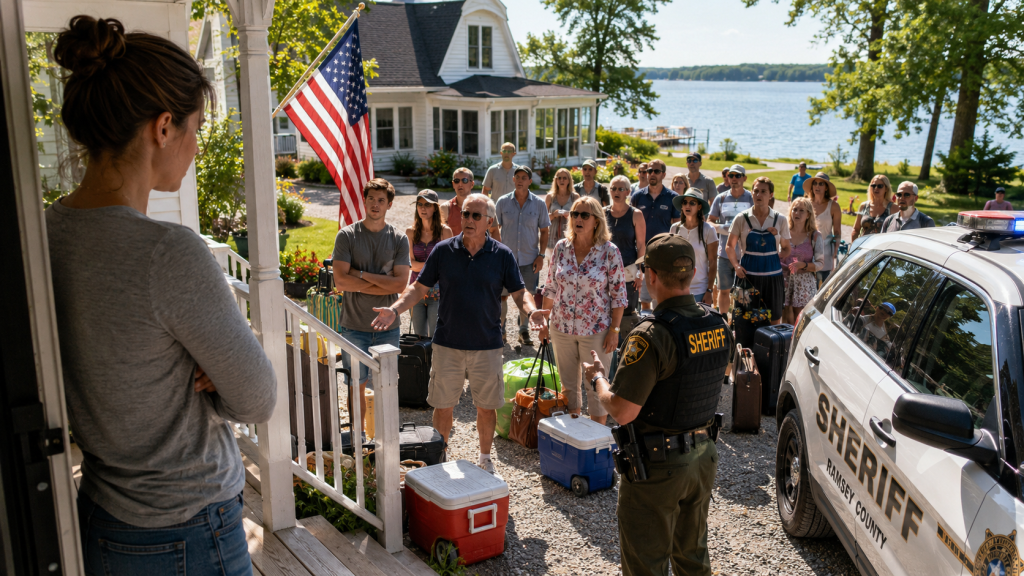
Twenty people were crowded on my porch and driveway.
Coolers.
Beach bags.
Folding chairs.
Children running near my flower beds.
Kyle standing by the garage with a beer in his hand at nine in the morning.
My mother wearing a sunhat and pointing angrily at the keypad.
Dad pacing near the front door like a rejected landlord.
Behind them, Mrs. Harper stood at her mailbox with folded arms and the calm face of a woman enjoying justice with her morning tea.
And behind them, a sheriff’s cruiser was slowly turning into the driveway.
Dad lowered his voice like that had ever worked on me.
“Claire, open this door before you embarrass your mother.”
I watched the sheriff’s cruiser stop behind their three SUVs, blocking the driveway.
“No, Dad. You embarrassed yourselves when you arrived at my private property with twenty guests after I said no.”
Mom grabbed the phone.
“We raised you. That house should be shared.”
“You raised me to work twelve-hour shifts and buy my own peace,” I said. “You don’t get to steal it because you packed snacks.”
On the camera, Deputy Lawson stepped out and spoke to Mrs. Harper.
She pointed toward my porch, then toward the security cameras.
Then he walked toward my parents.
Dad tried smiling.
I heard him say, “Family misunderstanding.”
Deputy Lawson took out a paper.
“Actually, sir, the owner submitted a written no-entry notice yesterday.”
Mom’s face fell.
Kyle muttered, “Are you serious?”
Dad returned to the phone, furious.
“You called the sheriff on your own parents?”
I looked at the camera feed, at the coolers, beach bags, and strangers standing under the security lights I paid for.
“No,” I said. “I protected my home from people who think love means access without permission.”
Deputy Lawson’s voice came through clearly.
“Everyone needs to leave the property now.”
Mom shouted, “Claire, tell him we can stay!”
I smiled for the first time all morning.
“Enjoy the melting groceries.”
Then I ended the call.
For a few minutes, I just watched.
Not because I was cruel.
Because I needed to see it with my own eyes.
I needed proof that the world did not collapse when I said no.
Dad argued first.
Mom cried next.
Kyle tried to joke with the deputy and failed.
Aunt Denise looked embarrassed and began carrying her cooler back to the car.
Children complained.
Someone’s husband asked loudly, “Wait, you said this was your family house.”
That was the sentence that made Mom’s head snap around.
Their guests had not known.
Of course they had not known.
My parents had invited people to my lake house by pretending it belonged to the whole family.
Maybe they said I was “letting them use it.”
Maybe they said I was “too busy to come.”
Maybe they said nothing at all because entitlement does not feel the need to explain itself.
Deputy Lawson spoke calmly, but firmly.
No one was allowed inside.
No one was allowed to remain on the property.
If they refused to leave, he would issue trespass warnings.
Mrs. Harper stood nearby like a witness carved from stone.
Dad pointed at the camera once, face red.
I knew he was pointing at me.
I lifted my coffee in a tiny salute he could not see.
By noon, they were gone.
By 12:15, the family group chat exploded.
Mom: I cannot believe you humiliated us like this.
Dad: You crossed a line.
Kyle: Lol you really had cops show up? Psycho.
Aunt Denise: I don’t know what’s going on, but this was very uncomfortable.
Cousin Brett: Your parents said they had permission.
Mom: SHE DID. SHE IS JUST BEING SPITEFUL.
Me: I said no in writing. You ignored it.
Then I sent a screenshot.
The chat went silent for almost three minutes.
Kyle finally replied.
Kyle: Still dramatic.
I removed myself from the group.
The silence that followed felt better than any vacation.
That evening, my mother called.
I almost let it ring.
Then I answered because sometimes you need to hear the final performance before you close the theater.
Her voice was soft now.
Dangerously soft.
“Claire, I don’t know what happened to you.”
I sat on my couch with my knees tucked under me.
“I learned to lock doors.”
She inhaled sharply.
“We are your parents.”
“Yes.”
“We sacrificed for you.”
“You also used me.”
“That is a terrible thing to say.”
“It’s a true thing to say.”
She started crying.
Not real crying.
Not the kind that catches in the chest.
The controlled kind, designed to make the listener rush in with guilt.
“I just wanted one nice weekend with family,” she said.
“At my house.”
“You have more than enough.”
“You don’t know what I have. You only know what you want from me.”
Her crying stopped.
There she was.
The real her.
Cold underneath the softness.
“You think you’re better than us because you bought a little house?”
“No. I think I’m allowed to decide who enters it.”
“Your father is devastated.”
“Dad is angry.”
“He feels betrayed.”
“He tried to break into my house.”
“He is your father.”
“And I am the owner.”
She went silent.
That word always bothered her.
Owner.
Not daughter.
Not child.
Not helper.
Owner.
Someone with legal rights she could not guilt her way through.
“You are going to regret treating your family like strangers,” she said.
“No, Mom. I regret treating strangers better than I treated myself.”
I hung up.
The next few days were strange.
Peaceful, but strange.
When you grow up in a family where boundaries are treated like violence, calm feels suspicious at first.
I kept expecting consequences.
A surprise visit.
A cruel post online.
Kyle showing up at my apartment.
Instead, I got little messages through relatives.
Mom was heartbroken.
Dad was not sleeping.
Kyle said I was greedy.
Aunt Denise said I should apologize “just to keep peace.”
But whose peace?
That was the question that would not leave me.
Because for years, keeping peace meant surrendering mine.
The next weekend, I drove to the lake house alone.
The driveway was empty.
The porch was clean.
The lake shimmered under a pale blue sky.
Mrs. Harper waved from across the road.
I carried one bag inside, set my keys on the counter, and stood there listening.
No one yelling.
No coolers dragged across the floor.
No Kyle turning up the music.
No Mom rearranging my kitchen cabinets because she “knew better.”
No Dad telling guests to treat the place like home when it was not their home.
Just quiet.
My quiet.
I walked room to room, touching small things.
The blanket over the couch.
The ceramic mug I bought at a local market.
The framed photo of the lake at sunrise.
The guest room with clean sheets no one had slept in without permission.
Then I went outside and sat on the dock.
For the first time, I let myself cry.
Not because I regretted calling the sheriff.
Because it had taken me so long.
I thought of the younger version of me who handed over babysitting money because Mom said family helped family.
The twenty-two-year-old who let Kyle borrow her car and then paid for the dent because Dad said boys made mistakes.
The nurse who worked Christmas shifts and sent gift cards home so nobody would accuse her of forgetting where she came from.
The woman who bought a lake house and still had to defend the lock on the door.
I cried for all of her.
Then I wiped my face, rolled up my jeans, and put my feet in the water.
That night, Mrs. Harper came over with a blueberry pie.
“I heard they finally left you alone,” she said.
“For now.”
She sat across from me on the porch.
“You did the right thing.”
“I keep wondering if I went too far.”
She gave me a look.
“Did they ask?”
“No.”
“Did you say no?”
“Yes.”
“Did they come anyway?”
“Yes.”
“Then you did not go too far. You met them where they arrived.”
I smiled faintly.
“You sound like you’ve done this before.”
“My late husband’s family once tried to hold a reunion in my barn because they said George would have wanted it.”
“What did you do?”
“Removed the barn doors for repairs and told them raccoons had priority.”
I laughed so hard I almost dropped my coffee.
That was the first real laugh I had felt in weeks.
The following month, I got a letter from my father.
Not a text.
Not a call.
A letter.
It was short.
Claire,
Your mother thinks I should demand an apology. Kyle thinks we should never speak to you again. I don’t know what I think. I was angry that day. I still am, if I’m honest. But Deputy Lawson asked me something before we left. He asked if I would have entered if the house belonged to a stranger. I said no. He asked why my daughter deserved less respect than a stranger.
I have not stopped thinking about that.
Dad
I read it three times.
It was not an apology.
But it was the closest thing to self-awareness my father had ever given me.
I did not respond right away.
I needed to decide whether a cracked door was safe or just another way for them to push in.
Two weeks later, I wrote back.
Dad,
The house is mine. Visits require an invitation. No guests without approval. No codes shared. No guilt if I say no. These are not punishments. These are conditions for trust.
Claire
He did not reply for nine days.
Then he wrote:
Understood.
Mom did not understand.
Or she pretended not to.
She sent a long email about being excluded, disrespected, and wounded.
She said she missed the daughter I used to be.
I almost answered with anger.
Instead, I wrote one sentence.
I miss her too, but she was exhausted from being used.
Then I blocked her email for a while.
Kyle remained Kyle.
He posted something online about “people who forget family once they get money.”
I did not respond.
A cousin commented, “Didn’t you try to party at her house after she said no?”
Kyle deleted the post.
Small mercies.
By autumn, my father asked if he could visit the lake house.
Just him.
No Mom.
No Kyle.
No guests.
I thought about it for three days before saying yes.
He arrived on a cool Saturday morning with one overnight bag and a nervous expression.
He stood on the porch without trying the door.
That mattered.
I opened it.
“Hi, Dad.”
“Hi.”
He looked older than I remembered.
Or maybe I was finally seeing him without the shadow of his authority making him bigger.
He stepped inside and looked around.
“It’s nice,” he said.
“Thank you.”
“I can see why you wanted it quiet.”
I waited.
He cleared his throat.
“I was wrong.”
The words were simple.
No tears.
No performance.
Just hard for him to say.
I folded my arms.
“Yes.”
He nodded.
“I treated it like family property because I treated you like family property.”
My throat tightened despite myself.
“That’s exactly what it felt like.”
“I know.”
“No, Dad. You didn’t know. That was the problem.”
He looked down.
“Deputy Lawson embarrassed me that day.”
“I know.”
“At first I hated him for it.”
“And now?”
“Now I think maybe I needed it.”
We sat on the porch that afternoon drinking coffee.
We did not fix everything.
One honest conversation does not erase decades.
But something shifted.
He asked about my work.
He asked how long it took me to save for the house.
Really asked.
So I told him.
The double shifts.
The frozen meals.
The roommate who stole groceries.
The years of never going on vacation because I wanted one thing no one could take from me.
He listened.
At one point, he wiped his eyes and pretended it was the wind.
I let him pretend.
When he left the next morning, he washed his mug, stripped the guest bed, and asked where to put the trash.
He did not ask for the door code.
That mattered too.
My mother did not visit.
Maybe she never will.
Part of me grieves that.
Part of me is relieved.
Some people only enter rooms to rearrange them around themselves.
I am no longer offering her keys.
A year has passed since the weekend they tried to take over my lake house.
The family still tells different versions of the story.
In Mom’s version, I called the sheriff over “a misunderstanding.”
In Kyle’s version, I went crazy because I work too much.
In Aunt Denise’s version, everyone was wrong and nobody should talk about it.
In mine, I said no.
They came anyway.
I protected what was mine.
That is the whole story.
Not dramatic.
Not cruel.
Just clear.
The lake house is still quiet.
The security cameras are still active.
Mrs. Harper still watches the road like a retired general.
I still work too many hours, though I am learning not to spend all my rest recovering from people who drain me.
Some weekends, I invite friends from the hospital.
People who bring food without expecting ownership.
People who wash their own dishes.
People who ask where towels are instead of opening every closet.
Sometimes Dad comes alone.
He sits on the dock and reads.
He asks before touching the thermostat.
He brings groceries he paid for himself.
We are rebuilding slowly, with rules strong enough to hold the weight of truth.
And every time I unlock the lake house door, I feel the same thing.
Relief.
Not because the house is expensive.
It is not.
Not because it impresses anyone.
It does not.
But because it is mine.
Bought with tired feet, long shifts, skipped vacations, and a stubborn belief that peace was worth saving for.
My parents once asked if I honestly believed I could stop them.
At the time, they thought it was funny.
They thought daughters were doors that opened no matter how hard you pushed.
They thought family meant access.
They thought my no was just a delay.
But Friday morning came.
The codes failed.
The garage stayed locked.
The cameras watched.
The sheriff arrived.
And the house remained exactly what I had built it to be.
A place where I could breathe.
A place where no one enters without permission.
A place where love is welcome, but entitlement stops at the door.
THE END! THANKS FOR READING!