 Reading Time: 18 minutes
I inherited my grandparents’ $900,000 estate, and my family received nothing. Enraged, they teamed up and told me I had until Friday to leave the house. My mother smirked and said, “Some people simply don’t deserve beautiful things.”
I smiled back and replied, “After everything I know about this family, you really thought I’d let that happen?” Two days later, they arrived with movers and smug faces, only to stop cold when they saw who was waiting on my porch. My name is Clare Thompson.
I was twenty-eight when my grandparents left me everything. Not because I was the favorite. Not because I begged. Not because I manipulated two old people the way my family later accused me of doing. They left it to me because I was the only one who stayed.
For the last six years of my grandmother’s life, I was the person who drove her to doctor appointments, labeled her medication bottles, cooked soft meals when her hands trembled too badly to hold a knife, and sat beside her bed through the nights when pain made sleep impossible.
For my grandfather, I was the one who learned how to read the farm accounts after his stroke, paid the property taxes on time, negotiated with contractors, and kept the lights on when everyone else was “too busy.”
My mother visited on holidays if the weather was nice.
My father came whenever Grandpa mentioned possibly selling land.
My sister Julia came for pictures.
She would wrap her arms around Grandma, smile for social media, post something like, “Family is everything,” then leave before dishes needed washing.
And me?
I was there when the oxygen machine beeped at three in the morning.
I was there when Grandma forgot my name but remembered the lullaby she used to sing me.
I was there when Grandpa cried in the bathroom because he could no longer button his own shirt.
I was there when they were people, not assets.
So when the lawyer read the will and said the house, the savings, the land, and the investment account were all mine, I did not feel victorious.
I felt tired.
Heartbroken.
Responsible.
The estate was worth almost $900,000.
The farmhouse alone sat on twelve acres outside Asheville, North Carolina, with a white porch, a red barn, two old magnolia trees, and a view of the Blue Ridge Mountains that could make even a cruel person go quiet for a moment.
My grandparents had bought it in 1978.
They raised my mother there.
They hosted Sunday dinners there.
They buried dogs behind the tool shed.
They measured grandchildren on the pantry door.
It was not just a house.
It was a life.
But to my family, it became a prize the moment Grandma’s breathing stopped.
After the reading, Julia stood in the attorney’s office with her arms crossed, looking like someone had personally insulted her by following legal documents.
“This is ridiculous,” she said.
Mr. Harper, my grandparents’ attorney, folded his hands.
“The will is clear.”
“My grandmother would never cut me out.”
“She did not cut you out,” he said calmly. “She left you several personal items.”
Julia laughed sharply.
“A teacup set and a quilt? Clare gets almost a million dollars, and I get a quilt?”
My mother did not speak at first.
She sat in the chair beside Julia, staring straight ahead, her face stiff with a kind of rage I had known since childhood.
The cold kind.
The kind that waited until there were fewer witnesses.
My father cleared his throat.
“There must be a mistake.”
“There is no mistake,” Mr. Harper said.
My mother finally looked at me.
Her eyes were flat.
“You must be very pleased with yourself.”
I almost laughed because nothing inside me felt pleased.
Grandma had been dead for eleven days.
Grandpa had followed her less than three months earlier.
The house still smelled like lavender soap and his old pipe tobacco.
Every hallway held a memory waiting to cut me open.
“No,” I said. “I’m grieving.”
Julia rolled her eyes.
“Please. You played nurse for years and got paid in property.”
That was when I understood.
They would never see care as love.
Only strategy.
They would never believe I stayed because my grandparents needed me.
Because they would never have done that themselves unless something was promised at the end.
The weeks after the will reading were ugly.
My mother called every day at first, pretending she wanted to “talk things through.”
Talking things through meant suggesting I sell the house and divide the money.
Then it meant calling me selfish.
Then ungrateful.
Then manipulative.
My father sent articles about “fair family estate distribution.”
Julia posted vague quotes online about betrayal, greed, and “true colors.”
Cousins I had not heard from in years suddenly had opinions.
One aunt sent me a message saying, “Your mother is devastated. A good daughter would not let this stand.”
I replied, “A good daughter would have visited her dying parents.”
She blocked me.
I moved into the farmhouse anyway.
Not because I wanted to isolate myself.
Because the house needed someone.
There were bills to settle, insurance to update, repairs to finish, and belongings to sort through.
Also, quietly, I needed the house too.
I needed to sit in Grandma’s kitchen and remember her hands rolling dough.
I needed to walk through Grandpa’s workshop and smell sawdust.
I needed to cry somewhere my grief did not have to perform for people who thought inheritance was more important than love.
For almost two months, my family kept their distance.
Then, last Wednesday, I came home from work and found Julia and my mother standing outside my front door.
Both wore the same satisfied smile.
The kind people wear when they believe they have already won.
Julia had on a cream pantsuit, gold earrings, and the expression of a woman arriving at a closing.
My mother stood beside her in a navy coat, holding her purse with both hands like she was about to attend church and destroy someone’s life afterward.
“Hi, Clare,” Julia said sweetly, though there was nothing kind in her voice. “We need to talk.”
Against my better judgment, I opened the door.
They walked into my living room as if they were inspecting a house that already belonged to them.
My grandmother’s quilt still lay folded over the back of the sofa.
Grandpa’s walking cane stood in the corner.
My mother looked around with faint disdain, as if grief had made the place untidy.
“What is this about?” I asked.
Julia turned toward me, smiling wider.
“Well, Clare, we have some important news.”
She pulled a polished folder from her expensive handbag.
“The house has been legally transferred into my name. You need to be gone by Friday.”
For a moment, I could only stare at her.
“What?”
“You heard her,” my mother said, stepping closer with cold eyes. “This house belongs to Julia now. Some people simply don’t deserve beautiful things, Clare.”
I forced myself to stay calm.
“And how exactly do you think you pulled that off?”
Julia gave a bored little shrug and looked at her nails.
“It wasn’t hard. We found old records proving Grandma and Grandpa had unpaid debts. Since you clearly weren’t managing the estate responsibly, we had to step in. The house was used to settle those debts, and I bought it properly. Everything is legal.”
“That’s impossible,” I said. “There were no debts.”
“According to who?” my mother snapped. “You? A twenty-eight-year-old girl who thinks she understands the real world? We hired actual lawyers, Clare.”
At that moment, my father walked in.
He used a copy of my key.
A key he was not supposed to have.
He entered with the confidence of someone who believed blood was permission.
“This place will be perfect for Julia,” he said casually. “She needs it more than you do. You’re young. You can rebuild your life.”
I looked at the three of them standing in my grandparents’ home.
The greed.
The entitlement.
The betrayal.
But instead of fear, a cold calm settled over me.
Because I had expected something like this.
Maybe not exactly this.
Not forged debts and fake transfers.
But something.
My grandparents had expected it too.
That was the part my family did not know.
Grandma had warned me two years before she died.
We were sitting at the kitchen table shelling peas into a blue bowl while Grandpa napped in his recliner.
Her hands were swollen from arthritis, but she refused to stop helping.
“Clare,” she said quietly, “greed wears familiar faces.”
I looked up.
“What do you mean?”
She glanced toward the hallway, as if my mother might appear from the wallpaper.
“When your grandfather and I are gone, they will come for this house.”
“Mom wouldn’t do that.”
Grandma’s face softened with pity.
Not for herself.
For me.
“Your mother has wanted beautiful things her whole life without wanting the work that keeps them beautiful.”
I said nothing.
She placed a pea into the bowl and continued.
“Your sister is worse because she believes wanting something is the same as deserving it.”
I remember feeling uncomfortable.
Defensive.
Sad.
Even then, part of me still wanted to believe my family had limits.
Grandma reached across the table and touched my wrist.
“That is why everything is protected.”
I did not understand until later.
Until Mr. Harper showed me the trust.
The recorded deed.
The video statements from both grandparents.
The forensic accounting folder Grandpa had quietly built after noticing suspicious attempts to access old property records.
They had known.
They had planned.
And for two years, under Mr. Harper’s guidance, I had kept copies of every threatening message, every strange letter, every fake creditor notice, every voicemail where my mother hinted that “legal pressure” might make me more reasonable.
So when Julia stood in my living room claiming the house had been transferred into her name, I did not panic.
I smiled.
“You really thought I’d let that happen after everything I’ve learned about this family?”
Julia’s smirk faltered.
“What is that supposed to mean?”
“It means,” I said quietly, “you should have checked your paperwork more carefully.”
My father’s eyes narrowed.
“Do not get smart with us.”
“That would be difficult,” I replied. “You set the bar so low.”
My mother stepped forward.
“You have until Friday.”
“And if I’m not gone?”
Julia tapped the folder.
“We come with movers. And police if necessary.”
I looked at the folder in her hand.
“Bring whoever you want.”
For the first time, uncertainty flickered in Julia’s eyes.
But my mother laughed.
“You always were arrogant for someone with nothing.”
I glanced around the room.
At the walls my grandparents painted.
At the fireplace Grandpa built.
At the floors Grandma polished for forty years.
“I have more than you think.”
They stormed out soon after, warning me again that I had forty-eight hours to leave.
My father paused at the door and held up the copied key.
“By Friday, this will not be trespassing.”
I took one step closer.
“It already is.”
He smiled.
“You wouldn’t call the police on family.”
I smiled back.
“You should test that theory.”
After they left, I locked the door and stood in the silence for a long time.
Then I called Mr. Harper.
He answered on the second ring.
“They made their move?” he asked.
“Yes.”
“Debt claim?”
“Exactly.”
“Transfer?”
“To Julia.”
He sighed.
“Predictable.”
“They’re coming Friday with movers.”
“Good.”
“Good?”
“Yes,” he said. “That gives us a stage.”
By sunset, I had sent him photos of the folder Julia briefly left on the coffee table when she thought I was too shaken to notice.
I had also sent him security footage from the small camera Grandpa installed above the porch light years earlier after packages went missing.
It recorded my father entering with an unauthorized key.
It recorded Julia threatening eviction.
It recorded my mother saying some people did not deserve beautiful things.
By Thursday morning, Mr. Harper had contacted Margaret Vale, a real estate and estate litigation attorney who had been quietly helping him prepare for exactly this kind of attack.
Margaret was sharp, direct, and very good at making polite threats sound like weather reports.
She called me at noon.
“Clare, I reviewed the documents. They are fraudulent.”
“I assumed.”
“No, you need to understand. This is not a misunderstanding. The debt assignment is fabricated, the creditor entity was formed six weeks ago, the county filing contains altered references, and the supposed transfer was pushed through using a clerk’s login after hours.”
My stomach tightened.
“So who did that?”
“We believe Julia paid someone. We are contacting the county recorder, and Detective Samuel Price from financial crimes is already interested.”
“Detective?”
“Yes. Your grandparents’ estate crosses the threshold for serious fraud. Also, Mr. Harper’s prior records show attempted interference going back nearly two years.”
I sat down at Grandma’s kitchen table.
For all my calm, hearing the words serious fraud made the room feel colder.
“They really tried to steal it.”
Margaret’s voice softened only slightly.
“Yes. They did.”
I looked at the pantry door where my height mark from age eight still sat beside Julia’s.
Grandma had written Clare — age 8 — grew like a weed.
Julia’s mark was above mine.
Julia always loved that.
Even as children, she enjoyed being taller.
Brighter.
First.
“What do I do Friday?” I asked.
“Open the door,” Margaret said. “Let them speak. Do not threaten. Do not touch documents they hand you unless necessary. We will be there.”
“We?”
“You’ll see.”
I slept in Grandma’s room that night because mine felt too small for the memories.
Her perfume still lingered faintly in the dresser drawer.
I held one of her sweaters to my chest and cried, not because I was afraid of losing the house, but because I wished she were there to sit across from me and say, “I told you, sweetheart, but I’m sorry I was right.”
Friday morning arrived cold and bright.
The sky was painfully blue.
The kind of beautiful day that feels insulting when people are coming to betray you.
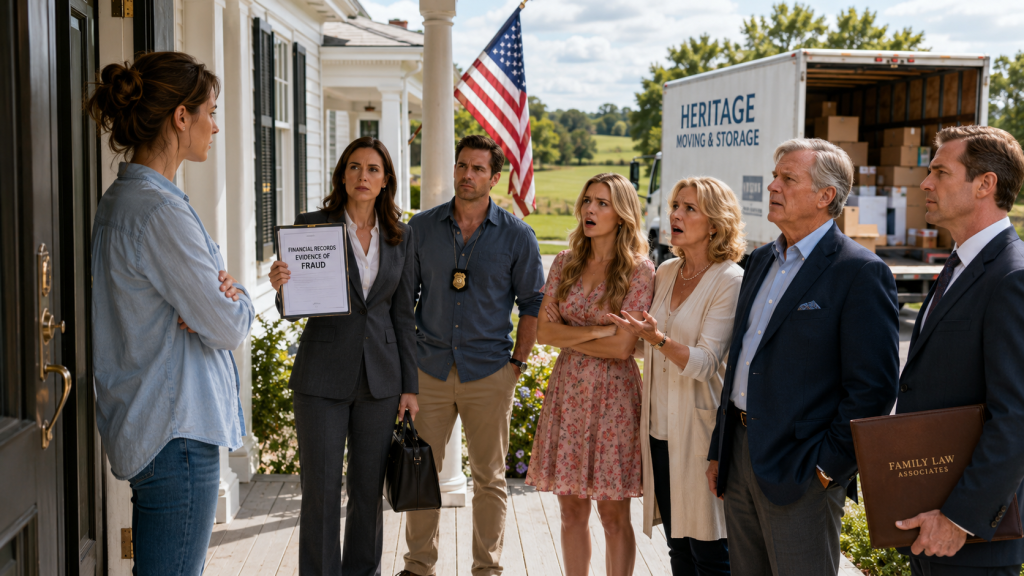
At exactly 9:00 a.m., a moving truck stopped in front of the house.
My parents climbed out first.
Julia followed, glowing with triumph.
Beside them stood a man in a sharp suit carrying a briefcase.
Their so-called lawyer.
Two movers stepped down from the truck and opened the back doors.
They looked bored.
They had probably been told this was a simple eviction.
Julia rang the doorbell like she was claiming a prize.
I opened the door.
“Good morning, Clare,” she said. “I hope you’re ready to go.”
“Actually,” I replied, “I’m not going anywhere.”
The man in the suit stepped forward and raised a stack of papers.
“Miss Thompson, if you refuse to vacate immediately, we will contact the police and have you removed.”
I looked at their confident faces.
So sure their fraud would work.
So sure grief had made me weak.
Then I glanced beyond them at the black sedan that had just pulled up quietly behind the moving truck.
“Please,” I said, opening the door wider with a calm smile. “Come in. There’s someone you should meet before you try to throw me out.”
Julia’s smile thinned.
“Who?”
Before I could answer, the sedan doors opened.
Two people stepped out.
Margaret Vale, my estate attorney, wearing a charcoal suit and carrying a leather file.
And Detective Samuel Price from the financial crimes unit, badge clipped neatly to his belt.
My mother’s face changed first.
My father stopped pretending to look relaxed.
Julia’s lawyer frowned.
“What is this?” he asked.
Margaret walked onto the porch and held up a thick file.
“This is the original estate trust, the recorded deed, the forensic audit, and evidence that the debt documents your clients used were fabricated.”
Julia laughed nervously.
“That’s ridiculous.”
Detective Price looked at her.
“Then you won’t mind explaining why your signature appears on a payment to the document clerk who altered county records.”
My mother grabbed Julia’s arm.
“Don’t say anything.”
I stepped aside.
“Too late. I already gave them everything.”
For two years, I had kept every voicemail, every threatening message, every strange letter, every attempt they made to pressure me into selling.
Grandma had warned me.
Greed wears familiar faces.
That morning, those faces stood frozen on my porch while their movers watched from the truck.
Margaret turned to the man in the suit.
“And you are?”
“Edward Lang,” he said stiffly. “Counsel for Julia Thompson.”
Margaret’s expression did not change.
“Mr. Lang, your eviction demand is void. Your documents are fraudulent. And if anyone enters this property without Miss Thompson’s permission, they will be trespassing.”
He adjusted his tie.
“I was retained based on documents provided by my client.”
Detective Price looked at him.
“Then I suggest you choose your next words carefully.”
Mr. Lang took a step back.
Julia’s face reddened.
“This is a setup.”
“No,” I said. “This is preparation.”
My father pointed at me.
“You have no idea what you’re doing.”
Margaret opened her file.
“Actually, she does. The estate was placed into a protected trust before the elder Thompsons died. Clare is the named beneficiary and trustee. Any transfer of this house without her approval is legally impossible.”
My mother’s mouth tightened.
“That old woman poisoned her against us.”
I felt something sharp move through me.
“Grandma protected what you were already trying to steal.”
“I am her daughter,” my mother snapped.
“You were her daughter when she needed rides to chemotherapy too.”
The words landed.
For once, she had no instant answer.
Detective Price stepped closer to Julia.
“Julia Thompson, we need you to come with us to answer questions regarding suspected fraud, conspiracy, and falsification of public records.”
Julia recoiled.
“No. Absolutely not.”
My father stepped in front of her.
“You are not taking my daughter anywhere.”
Detective Price’s voice stayed calm.
“Sir, obstruction will not help her.”
My mother turned on me with sudden fury.
“Clare, stop this. Right now.”
I looked at her.
All my life, that tone had worked.
It had made me apologize for Julia’s tantrums.
It had made me share things I wanted to keep.
It had made me shrink in rooms where Julia needed to shine.
But that morning, standing on the porch my grandfather had painted yellow because Grandma said it looked happy, my mother’s tone finally lost its power.
“No.”
Her eyes widened.
“What did you say?”
“I said no.”
“You would send your sister to jail over a house?”
“No, Mom. Julia may send herself to jail over a house.”
Julia burst into tears then.
Not soft tears.
Strategic tears.
The kind she had used since childhood when she broke something and wanted me blamed.
“Clare, please,” she sobbed. “I was scared. Mom said you were going to sell everything and leave us with nothing.”
I looked at my mother.
She looked away.
Julia continued.
“I thought we were just correcting things.”
“By fabricating debts?”
“I didn’t know the clerk would—”
She stopped.
Detective Price lifted his eyebrows.
Margaret made a small note.
My father closed his eyes.
Julia had just said too much.
The movers quietly climbed back into the truck.
Mr. Lang, the lawyer, walked to his car and began making a very serious phone call, probably to his own attorney.
My mother stood rigid, breathing hard through her nose.
“You always wanted to separate this family,” she said.
That almost made me laugh.
“You did that without my help.”
Detective Price guided Julia toward the sedan.
She cried the whole way, looking back at our parents as if they could still rescue her from consequences.
My father followed, arguing.
My mother stayed on the porch.
Her eyes moved over the house behind me.
The staircase.
The living room.
Grandma’s curtains.
The framed photo of my grandparents on the mantel.
“You don’t deserve this,” she said quietly.
I felt the old wound open.
Not because her words surprised me.
Because part of me still wanted a mother who would choose love before envy.
“Maybe not,” I said. “But Grandma and Grandpa believed I did. And their opinion matters more here.”
Her face hardened.
“You think you won.”
“No,” I said. “I think I finally stopped losing.”
She left without another word.
The moving truck drove away empty.
The black sedan followed with Julia inside.
By 10:15 a.m., the porch was quiet again.
Margaret stayed behind.
She walked through the house with me, checking the locks, documenting the unauthorized key, and arranging for an emergency protective filing.
“You handled yourself well,” she said.
“I don’t feel like it.”
“That’s normal.”
“I thought I would feel satisfied.”
“People expect justice to feel clean. Usually it feels like grief with paperwork.”
That was exactly right.
After she left, I sat on the kitchen floor and cried.
Not for Julia.
Not exactly.
For the family I wished I had.
For the grandparents who should not have needed to protect their own home from their daughter and granddaughter.
For the little girl in me who once believed if I were useful enough, kind enough, quiet enough, my mother might stop seeing Julia as gold and me as gravel.
The investigation moved quickly after that.
The document clerk confessed first.
He had been paid by Julia through a consulting company she created under a friend’s name.
My mother had provided old estate files and pressured him through a connection at the county office.
My father claimed he knew nothing about the fraudulent filing, but bank records showed he helped pay Mr. Lang before the fake transfer attempt.
Julia was not led away in handcuffs that morning, but charges were filed later.
Fraud.
Conspiracy.
Attempted unlawful transfer of property.
Falsification of records.
The legal words sounded cold compared to what it felt like.
It felt like my family had tried to rob a grave.
Julia eventually took a plea deal.
My father avoided criminal conviction by cooperating.
My mother was never charged, but the civil suit named her as a participant in the scheme.
That hurt her more than charges would have, I think.
Public embarrassment was the one pain she truly respected.
During mediation, my mother refused to look at me.
Julia cried quietly.
My father stared at the table like a man who had gambled and finally lost.
Margaret sat beside me with a folder so thick it looked like a weapon.
The settlement required them to pay my legal fees, surrender all copied keys, cease contact regarding the estate, and sign statements acknowledging the trust’s validity.
Julia had to write a letter of apology as part of her agreement.
It arrived two weeks later.
Dear Clare, I am sorry for the confusion and pain caused by recent events.
I stopped reading there.
Confusion.
She had tried to take my home with forged documents and called it confusion.
I placed the letter in a box labeled Legal, not Family.
That felt appropriate.
Months passed.
The house grew quieter.
The kind of quiet that comes after a storm breaks branches but leaves the roots alive.
I changed every lock.
Installed new cameras.
Updated the trust.
Transferred some liquid assets into a maintenance fund for the property.
Then, slowly, I began making the house mine.
Not by removing my grandparents.
Never that.
But by allowing myself to exist in the space too.
I painted the guest room a soft green.
I turned Grandpa’s old office into a reading room.
I kept Grandma’s blue mixing bowl on the kitchen shelf but bought my own yellow kettle.
I planted lavender along the path because Grandma had always wanted it, and Grandpa said he disliked the smell but secretly cut sprigs for her nightstand.
Sometimes I would find myself turning to tell them something.
The sink was finally fixed.
The magnolia bloomed early.
Julia’s fake lawyer wore ugly shoes.
Then I would remember they were gone.
Grief is strange that way.
It lets you laugh before reminding you why laughter echoes.
One afternoon, I found a sealed envelope in the back of Grandpa’s workshop desk.
My name was on it.
Clare-bear.
Nobody had called me that since I was twelve.
Inside was a letter from him.
My hands shook as I unfolded it.
Clare,
If you found this, I’m probably gone, and your grandma has already bossed heaven into better order.
I hope you know we didn’t leave you the house because you earned love by working. Love is not wages. We left it because you understood that a home is made by care. You gave us care when it was hard, boring, frightening, and thankless. That tells me you will care for this place after us.
Your mother may not understand. Julia may resent you. Do not spend your life begging hungry people to stop seeing you as food.
Protect what matters.
Then live.
I pressed the letter to my chest and cried until the sun went down.
Do not spend your life begging hungry people to stop seeing you as food.
That became the sentence that saved me.
Because even after everything, part of me still felt guilty.
Guilty when Mother’s Day came and I did not call.
Guilty when Julia’s birthday passed and I sent nothing.
Guilty when Dad left a voicemail saying, “We’re still family.”
Family.
They loved that word when consequences arrived.
They had not loved it when Grandma needed help bathing.
Or when Grandpa needed physical therapy.
Or when I sat alone after the funeral signing paperwork with hands that would not stop shaking.
A year after the porch confrontation, my father came by alone.
He parked at the gate because I had changed the access code.
For ten minutes, he stood outside holding his phone.
Finally, he called.
“Clare,” he said. “Can we talk?”
I looked through the camera feed.
He looked older.
Smaller.
But age is not the same as remorse.
“What about?”
He sighed.
“Your mother left.”
That surprised me.
“Left where?”
“Florida. With your Aunt Denise.”
I said nothing.
“She blames me.”
“For what?”
“For everything.”
I almost laughed.
“And do you blame yourself?”
The line went quiet.
Then he said, “Some.”
Some.
The smallest honest word I had ever heard from him.
I opened the gate.
He walked up slowly.
I did not invite him inside.
We sat on the porch instead.
The same porch where they had tried to remove me.
For a while, he stared at the mountains.
“Your grandfather loved this view,” he said.
“Yes.”
“He used to drink coffee here at dawn.”
“I know.”
He rubbed his face.
“I was angry when they left it to you.”
“I know.”
“I told myself you manipulated them.”
“I know.”
His voice roughened.
“But the truth is, I didn’t want to admit you were the one here. Because if you were the one here, then I wasn’t.”
That was the first real thing he had said.
I let the silence hold it.
He continued.
“I don’t expect forgiveness.”
“Good,” I said.
He nodded faintly.
“I deserved that.”
“You did.”
“I want to do better.”
I looked at him.
“For whom?”
He seemed confused.
“What do you mean?”
“Do you want to do better because you miss me, or because you lost access?”
He looked toward the locked gate.
Then back at me.
“I don’t know yet.”
That answer, strangely, mattered.
It was not pretty.
It was not polished.
It was honest.
So I said, “Then figure that out before you come back.”
He nodded.
When he left, I did not feel healed.
But I felt clear.
Clarity is its own kind of mercy.
Julia has not spoken to me since the settlement.
My mother sends cards with no return address.
I do not open them.
I place them in the Legal box too.
Maybe one day I will read them.
Maybe not.
Forgiveness, I have learned, is not a door other people get to pound on until you open it.
Sometimes it is a window you keep closed because the air outside is still poisoned.
As for the estate, it is no longer just an inheritance.
I started using part of the investment income to fund a small caregiving scholarship at the local community college.
Grandma had been a nurse’s aide before she married Grandpa.
She always said care work was sacred and underpaid.
So now, every year, two students who want to go into elder care receive tuition support in my grandparents’ names.
I also turned the back cottage into temporary housing for people caring for aging relatives in rural areas.
Not charity exactly.
More like honoring.
More like turning pain into something that does not rot.
The first woman who stayed there was named Ruth.
She was caring for her brother after a stroke and had nowhere quiet to sleep between hospital visits.
When she left, she hugged me and said, “Your grandparents must have been good people.”
I looked at the farmhouse, the magnolias, the porch, the mountains.
“Yes,” I said. “They were.”
That night, I made tea in Grandma’s blue mug and sat on the porch until stars appeared.
For the first time since the will reading, the house did not feel like a battlefield.
It felt like a promise kept.
I inherited my grandparents’ $900,000 estate, and my family received nothing.
That is the sentence everyone loved to repeat.
But it was never the full truth.
The full truth is that my grandparents left me their trust because I gave them mine when they needed it most.
They left me the house because I knew the difference between walls and home.
They left me the land because I had walked it with them in sickness and in grief.
They left my family nothing because my family had already shown them what nothing looked like.
No visits.
No care.
No humility.
No gratitude.
Just open hands arriving after closed caskets.
My mother said some people simply do not deserve beautiful things.
For a long time, I thought she meant me.
Now I understand.
Beautiful things require care.
Patience.
Respect.
Protection.
Love when nobody is watching.
And some people only want beauty after someone else has done all the work of keeping it alive.
So I kept the house.
I kept the land.
I kept Grandma’s mixing bowl, Grandpa’s letter, and the porch where they drank coffee together for forty-five years.
And when my family arrived with movers and smug faces, expecting me to vanish quietly, they found the one thing they never expected from me.
A locked door.
A lawyer.
A detective.
And a woman who had finally learned that inheritance is not always money.
Sometimes inheritance is courage.
Sometimes it is evidence.
Sometimes it is the voice of your grandmother whispering from the past:
Greed wears familiar faces.
And sometimes, the most beautiful thing you inherit is the strength to stop letting those faces inside.
THE END! THANKS FOR READING!