 Reading Time: 14 minutes
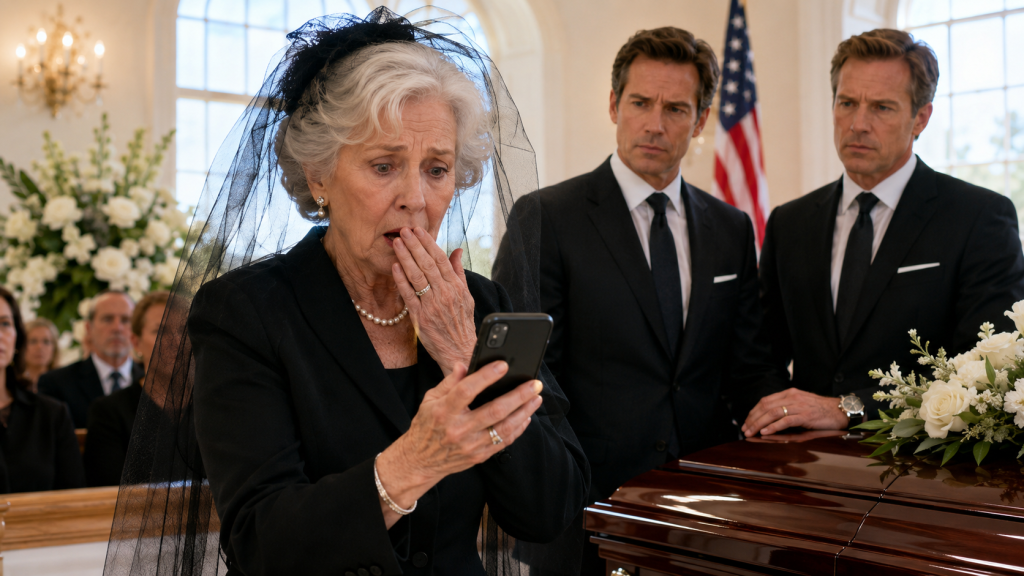
Right in the middle of my husband’s funeral, while my sons pretended to cry next to the casket, I received a text message. “I’m alive. Don’t trust them.” I thought it was a sick joke. Until the second message came with a photo of Robert’s desk and a caption:
“I hid the real will there.” My phone vibrated in my hand just as the pastor was saying the final prayer. I was standing in front of the casket of Robert Caldwell, my husband of forty-three years, with a black veil covering half my face and my legs trembling beneath my dress. The church smelled of lilies, polished wood, and expensive grief.
Rows of people sat behind me, whispering softly, dabbing their eyes, murmuring about what a generous man Robert had been. My sons, Richard and Harrison, stood to one side. Too quiet. Too clean.
Too calm for two men who had supposedly just lost their father. Richard held a folded handkerchief in his hand, but I never saw him use it. Harrison kept checking his watch. I told myself people grieved differently. I told myself shock made men strange.
I told myself anything except the truth.
Then my phone vibrated.
The message was from an unknown number.
“Theresa, don’t cry over that body. I’m not in there.”
I felt the air catch in my throat.
For a moment, the church blurred around me.
I stared at the closed mahogany casket, at the gold handles, at the wreath of white roses resting on top.
Robert’s casket.
Robert’s funeral.
Robert’s name printed on the program in my hand.
With freezing fingers, I typed:
Who are you?
The reply came fast.
“It’s Robert. Don’t trust our sons.”
I almost dropped the phone.
Richard turned his head.
“Everything okay, Mom?”
I clutched the phone to my chest.
“Yes,” I whispered. “I just got a little dizzy.”
He smiled at me.
But it was not a son’s smile.
It was the smile of someone checking if a door is securely locked.
Harrison stepped closer and took my arm.
“We’re going home now, Mom. You shouldn’t be alone.”
You shouldn’t.
He did not ask.
He ordered.
During the wake, everyone hugged me and told me the same empty things people say when they have no idea what else to offer.
“You’re so strong, Terry.”
“Robert is at peace now.”
“Your boys will take good care of you.”
I nodded like a fool.
But inside, only one sentence echoed in my mind.
Don’t trust our sons.
Robert had supposedly died of a massive heart attack in his office.
I was not there.
Richard called me at 11:40 at night.
“Mom, Dad is gone.”
By the time I arrived at the house, there was already an ambulance, signed papers, and a funeral home van waiting outside.
Everything had been too fast.
Too smooth.
Too rehearsed.
Robert had been seventy-one, yes.
But he was strong.
He still walked three miles every morning.
He still argued with contractors, fixed broken cabinets himself, and insisted on carrying grocery bags even when I told him he was not twenty-five anymore.
A heart attack could happen to anyone.
That was what the doctor said.
That was what Richard repeated.
That was what Harrison insisted I accept.
And now someone was texting me from the grave.
That night, when we finally arrived at the house in Greenwich, it felt unfamiliar.
The lights were dim.
Robert’s portrait still hung in the living room.
His reading glasses were on the side table, right next to the coffee mug he had used the morning before he died.
Or the morning before they told me he died.
Richard and Harrison stayed for a while.
Not to comfort me.
Not really.
They rummaged through drawers.
Made phone calls.
Whispered near the kitchen.
When they thought I was not listening, Harrison said, “We need to do it before she starts asking questions.”
Richard replied, “I’m bringing the doctor tomorrow. With her grief and her age, it’ll be easy.”
My hands turned to ice.
I did not understand everything.
But I understood enough.
When they finally left, I double-locked the front door and went upstairs to Robert’s study.
It smelled of rich wood, expensive pipe tobacco, and him.
My phone buzzed again.
It was a photo.
His desk.
The same mahogany desk where Robert kept contracts, property deeds, and old letters.
In the image, a red circle marked the bottom molding.
Beneath it was another message:
“Press the left corner. Don’t open anything in front of them.”
I knelt, trembling.
I ran my fingers along the carved wood.
For forty years, I had dusted that desk, admired that desk, watched Robert sit behind it through business calls, charity meetings, and late-night chess games.
I had never known it had secrets.
I pressed the left corner.
Click.
A hidden compartment popped open.
Inside, there was no jewelry.
No cash.
Just a folded letter, a USB drive, and a manila envelope with my name written across it.
Terry.
Robert was the only person who called me that.
My knees weakened.
I opened the letter.
“Terry,” it began.
I recognized his handwriting, and my heart broke all over again.
“If you are reading this, it means they already tried to get me out of the way. Richard and Harrison are not the men you think they are. I overheard them talking about life insurance, real estate, and doctors. They also asked how long a judge would take to declare you legally incompetent if I were gone.”
I covered my mouth to muffle a scream.
I kept reading.
“Do not sign anything. Do not eat anything they bring you. Do not believe the will they show you. The real one is hidden where only you would know to look.”
Right then, I heard a noise downstairs.
A car pulled into the driveway.
I turned off the lamp.
I peeked through the window.
It was my sons.
They were back.
Richard was holding a bag of pastries.
Harrison held a cardboard box of coffee.
And behind them walked a man in a white medical coat.
I clutched the letter to my chest.
The doorbell rang.
Once.
Twice.
Three times.
“Mom!” Richard yelled from the porch. “It’s us. We brought you dinner.”
I did not answer.
The phone vibrated in my hand.
New message.
“Don’t open the door for them.”
I froze.
Downstairs, Harrison banged harder.
“Mom, don’t make this difficult. The doctor just wants to check on you.”
Richard’s voice changed.
The sweetness was gone.
“Theresa, open the door.”
Theresa.
Not Mom.
Theresa.
I backed into the master bedroom and opened the wall safe Robert had insisted we keep behind a painting.
Inside was his old revolver.
I did not really know how to use it.
But holding it gave my shaking legs just enough courage to move.
Another message came through.
“Leave through the service door. The old driver is still loyal.”
The old driver?
William.
He had worked for Robert for twenty years, until Richard fired him without explanation two months earlier.
I crept down the back staircase without making a sound.
Outside, my sons were still pounding on the front door.
Then I heard glass shatter.
They were breaking in.
I crossed the kitchen.
On the island sat Robert’s last coffee mug.
And right beside it, something I had not noticed before.
A tiny empty vial tucked behind the sugar bowl.
I picked it up.
It smelled bitter.
Chemical.
Like death.
My phone buzzed.
“Did you see what they used?”
Tears blurred my vision.
I typed:
Where are you?
This time, the reply took longer.
My sons’ footsteps were already echoing inside the house.
“Mom!” Harrison shouted. “We don’t want to scare you, but you’re confused!”
I sprinted to the back door.
I shoved it open.
Out in the dark service alley stood an old taxi with its headlights off.
The driver rolled down the window.
It was William.
“Get in, Mrs. Theresa. Mr. Robert asked me to come if anything happened.”
I felt the ground shift beneath my feet.
“Do you know where my husband is?”
William did not answer.
He just stared past me toward the house.
Richard had just stepped out onto the back patio.
He spotted me.
“Mom, stop!”
I climbed into the cab.
William slammed on the gas.
As the house disappeared into the night, my phone vibrated one last time.
The message read:
“They will chase you. Do not trust William completely.”
I turned sharply toward the driver.
“Where are we going?”
William kept his eyes on the road.
“Somewhere your sons cannot find you tonight.”
“That is not an answer.”
“No, ma’am,” he said quietly. “It’s the safest answer I can give while your phone is still active.”
Behind us, headlights burst onto the road.
Richard’s SUV.
Then Harrison’s.
My breath caught.
“They’re following us.”
William did not look surprised.
“I expected they would.”
“Why are you helping me?”
His hands tightened around the steering wheel.
“Because Mr. Robert saved my son once. Paid for surgery when my insurance refused. He never told anyone. He said kindness loses value when it becomes a performance.”
That sounded like Robert.
So much like Robert that grief stabbed through me again.
“Where is he?” I asked.
William’s jaw tightened.
“That depends on whether you believe what you saw, or what they told you.”
My phone buzzed again.
A video.
I pressed play with trembling fingers.
Robert appeared on the screen.
Alive.
Pale, tired, sitting in a dim room with a blanket over his shoulders, but alive.
My heart stopped.
“Terry,” he said, voice rough. “If you are seeing this, then I failed to stay hidden long enough to stop them quietly. Listen carefully. I did not die of a heart attack. I was injected with something meant to mimic one. Your sons are involved in a takeover of everything I built. They plan to control you next.”
I could not breathe.
In the video, Robert leaned closer.
“The real will is not just in my desk. It is in the safety deposit box under my name at Hartwell Bank. Only you can access it. The USB has enough evidence to start the case, but the bank has the documents that finish it. And Terry, if they bring a doctor, do not let him near you. That is not a doctor.”
The video cut out.
I stared at the blank screen.
“He’s alive,” I whispered.
William nodded once.
“Yes, ma’am. But not safe.”
My phone immediately lit up again.
Unknown number.
“We know you have the USB. Bring it back, or the next accident will not look like an accident.”
My blood ran cold.
“They’re tracking me.”
William glanced at the rearview mirror.
“Then we go somewhere phones cannot help them.”
We drove nearly forty minutes through roads I barely recognized.
The city lights thinned.
Trees pressed closer.
The houses grew farther apart.
At last, we reached a small rural property surrounded by dark woods.
A single light flickered in a cabin window.
William stopped the cab.
“This belonged to Mr. Robert years ago,” he said. “No one knows about it.”
Inside, the cabin smelled like dust, old paper, and cold air.
William locked the door behind us, then pulled a small black device from a drawer.
“A signal blocker,” he said. “Mr. Robert left it here.”
My phone vibrated one last time before the signal died.
The message said:
“Mom, we are outside the bank records office. If you don’t come out, we will go after your husband first.”
I froze.
William read it over my shoulder.
“They’re bluffing,” he said.
“Are they?”
He did not answer fast enough.
I opened Robert’s envelope again.
Inside were several documents, a key, and the USB drive.
“Plug it in,” William said quietly.
There was an old laptop on the desk.
My hands trembled as I connected the drive.
The screen flickered.
A folder opened.
Inside it were documents.
Audio files.
Bank transfers.
Surveillance clips.
Everything.
Proof that Richard and Harrison had been slowly moving assets out of Robert’s companies.
Proof that they had paid a private physician to prepare paperwork questioning my mental competence.
Proof that they had arranged a fake emergency after Robert collapsed.
Then one file opened automatically.
A live camera feed.
The image showed the outside of the cabin.
My blood turned to ice.
Richard stood near the porch.
Harrison beside him.
And the man in the white medical coat stood behind them holding a black bag.
Richard looked directly toward the hidden camera.
“Mom,” he said calmly. “We know where you are.”
Harrison smiled.
“Game’s over.”
The power went out.
The cabin fell into darkness.
For one second, I forgot how to breathe.
Then William grabbed my arm.
“Basement. Now.”
We moved through the dark by memory I did not have and training he clearly did.
He pulled open a trapdoor beneath a faded rug.
A narrow staircase led down into cold blackness.
“Robert built this after a kidnapping threat in the eighties,” William whispered. “Move.”
Above us, glass broke.
The front door had a small window.
Richard had smashed it.
“Mother!” he called. “You’re frightened and confused. We’re here to help.”
The words made my skin crawl.
I descended into the basement with the USB, the letter, and the envelope pressed to my chest.
William followed and pulled the trapdoor shut above us.
Below, a dim battery light glowed automatically.
The basement was not storage.
It was a safe room.
There was a metal door, shelves of supplies, a phone line, and another monitor connected to the outside cameras.
On the screen, I watched my sons enter the cabin.
My sons.
The boys I had carried.
The boys whose fevers I had cooled with wet cloths.
The boys Robert had taught to ride bikes, tie ties, shake hands, and tell the truth.
Richard stepped carefully through the living room.
Harrison kicked over a chair.
The fake doctor stood near the door, nervous.
“She has the USB,” Harrison snapped. “Find it.”
Richard opened cabinets.
Harrison ripped drawers from the desk.
The doctor said, “This has gone too far.”
Harrison turned on him.
“It went too far when the old man didn’t die.”
My hand flew to my mouth.
William quietly picked up the safe-room phone.
“There’s a direct line,” he whispered. “To a federal contact Robert trusted.”
“Federal?”
“Mr. Robert suspected financial crimes. Not just family greed.”
He dialed.
My heart pounded so loudly I thought they would hear it through the floor.
On the monitor, Richard stopped moving.
He looked down.
Toward the rug.
Toward the trapdoor.
“Wait,” he said.
William spoke into the phone.
“This is William Hale. Emergency code Caldwell Red. Mrs. Theresa Caldwell is with me. Richard and Harrison are on-site. We need extraction.”
I heard a faint voice reply.
Then William hung up.
“How long?” I whispered.
“Ten minutes if they were already waiting.”
“If?”
He looked at the monitor.
“Then we pray the door holds.”
Richard crouched near the rug.
He pulled it aside.
The trapdoor appeared.
Harrison smiled.
“There you are.”
He yanked at the handle.
It did not open.
Steel locks held from below.
Richard leaned close to the floor.
“Mom. Listen to me. Dad was sick. You’re grieving. You don’t understand what you found.”
I stepped toward the phone speaker connected to the upstairs intercom.
My voice shook at first, then steadied.
“I found the vial.”
Silence above.
“I found Robert’s letter. I saw the transfers. I saw the doctor’s paperwork. I saw the video.”
Richard’s face changed on the monitor.
Not into guilt.
Into calculation.
“Mom,” he said carefully, “Dad was going to leave everything to charity. Harrison and I only tried to protect the family.”
“You tried to kill your father.”
Harrison slammed his fist against the trapdoor.
“He should have retired! He treated us like employees while strangers got donations and buildings named after them.”
My grief sharpened into something colder.
“Your father gave you companies. Homes. Trust accounts. Education. More than most people see in ten lifetimes.”
Richard’s voice hardened.
“And still kept control.”
There it was.
Not grief.
Not desperation.
Entitlement.
The family disease Robert had seen before I did.
The doctor backed away.
“I’m leaving,” he said.
Harrison grabbed him by the coat.
“No, you’re not.”
Red and blue lights flashed suddenly across the cabin windows.
Richard spun around.
William closed his eyes.
“Thank God.”
The next seconds happened fast.
Shouting.
Boots.
Doors bursting open.
Federal agents and local officers swarmed the cabin.
Harrison tried to run through the back.
He did not get far.
Richard stood frozen, hands halfway raised, still trying to look like a man who had been misunderstood.
The fake doctor dropped his bag and said he wanted a lawyer.
William opened the safe-room door only when an agent spoke the code Robert had left.
By then, my body was shaking so badly I could barely climb the stairs.
Outside, dawn was beginning to gray the trees.
Richard and Harrison were in handcuffs.
Harrison looked furious.
Richard looked insulted.
As if consequences were a social inconvenience.
Then I saw him.
Robert.
He was standing beside an ambulance, wrapped in a dark coat, leaning on a cane.
Alive.
Older than he had looked a week earlier.
Weaker.
But alive.
For a moment, I could not move.
He looked at me.
“Terry,” he said.
That was all.
I crossed the yard faster than my old knees should have allowed and collapsed into his arms.
He held me with shaking hands.
I cried into his coat like a young woman, like a widow, like a wife who had buried a man and then found him breathing.
“I thought you were gone,” I sobbed.
“I almost was,” he whispered.
I pulled back and touched his face.
“Whose body was in that casket?”
His eyes darkened.
“A man with no family. Already deceased. They arranged the identification through the doctor and a paid funeral contact. I was hidden before they could finish what they started.”
I felt sick.
Robert looked past me toward our sons.
“I needed them to believe I was gone long enough to expose everything.”
“You texted me?”
He shook his head.
“Not all of it. I scheduled some messages. William sent others. The final video was triggered when you opened the USB.”
“You should have told me.”
Pain crossed his face.
“I wanted to. But if you knew, they would have seen it in your eyes.”
He was right.
I hated that he was right.
The arrests made national news by noon.
Not because of the family drama.
Because Robert’s companies were tied to charity foundations, real estate holdings, medical investments, and public contracts.
The investigation uncovered more than attempted theft.
It uncovered forged documents, illegal transfers, false medical evaluations, and a scheme to take control of Robert’s estate by having me declared incompetent after his supposed death.
Richard and Harrison were charged.
So was the fake doctor.
So was the funeral contact who had helped move paperwork too quickly.
For weeks, I moved through life like someone walking through rooms after a fire.
Everything looked familiar.
Nothing felt safe.
Robert came home under protection.
The real will was retrieved from Hartwell Bank.
It left controlling shares of the family company to a trust managed by professionals, not our sons.
It protected me completely.
It created charitable foundations Robert had quietly planned for years.
And it left Richard and Harrison each one dollar, along with a handwritten line:
“You were given every opportunity to become honorable men. You chose hunger instead.”
When I read that, I wept.
Not because they lost the money.
Because Robert had accepted the truth before I did.
I kept seeing them as boys.
Richard with scraped knees.
Harrison asleep with a toy truck in his hand.
The law saw criminals.
Robert saw traitors.
But I saw all three at once, and that is a terrible thing for a mother.
Richard tried to call me from jail.
I did not answer.
Harrison sent a letter blaming Robert for “driving them to desperation.”
I burned it in the fireplace.
Not because I hated him.
Because I refused to let his version of events live in my house.
Months passed.
Robert recovered slowly.
Some days he was strong enough to walk the garden path.
Other days he sat by the window, silent and pale.
We did not speak much about forgiveness.
People love that word when they are not the ones who were betrayed.
What we spoke about was truth.
How we missed the signs.
How money had poisoned our sons slowly.
How Robert’s discipline had turned into distance.
How my excuses had become blindness.
How love without accountability can become permission.
One evening, Robert sat in his study, the secret compartment open between us.
“I should have shown you this years ago,” he said.
I sat across from him.
“Yes.”
“I thought protecting you meant carrying the ugly parts alone.”
“You were wrong.”
“I know.”
That was enough for that night.
A year later, I visited the cemetery where the false funeral had been held.
There was no grave for Robert there.
Only a stone bench beneath an oak tree.
I sat there with my hands folded in my lap, thinking about the woman I had been that day.
Veiled.
Shaking.
Surrounded by sons who were waiting for me to become weak enough to control.
Then I thought about the message.
I’m alive. Don’t trust them.
It had felt like madness.
It became salvation.
Robert and I live more quietly now.
The house in Greenwich has new locks, new staff, and no portraits of Richard or Harrison in the hall.
Their childhood photos are packed away, not destroyed.
I am not ready to look at them.
Maybe one day.
Maybe not.
William works for us again, though Robert calls him security now and William pretends not to enjoy the title.
Emily, my niece, visits often and says the house feels less haunted.
I tell her houses are not haunted by ghosts.
They are haunted by lies.
And once the lies are dragged into daylight, even grief can breathe.
Sometimes people ask if I feel lucky that Robert survived.
Of course I do.
Every morning I hear him cough in the bathroom, argue with the newspaper, or ask where his glasses are while they sit on his head, I feel the impossible gift of a second chance.
But survival did not return us to the life we had.
It gave us a different one.
Sharper.
Quieter.
More honest.
I buried my husband once while he was still alive.
I mourned beside a casket filled with deception.
I watched my sons pretend to grieve a father they had tried to erase.
And I learned that betrayal does not always arrive with shouting.
Sometimes it comes wearing black suits, holding your arm gently, saying, “You shouldn’t be alone.”
The text message saved me.
Robert’s hidden will protected me.
But the truth changed me.
I am no longer the woman who lets sons, doctors, lawyers, or anyone else tell her what she understands.
I understand perfectly now.
Love is not obedience.
Family is not immunity.
And grief does not make a woman helpless.
Sometimes it makes her dangerous enough to survive.
THE END! THANKS FOR READING!