 Reading Time: 11 minutes
My daughter told me I had two choices: serve her husband or leave her home. So I smiled, packed my suitcase, and walked out without raising my voice. Seven days later, I woke up to twenty-two missed calls and one message I never thought I would receive.
When my daughter said I could either wait on her husband or get out, I did not shout. I did not argue. I did not slam anything against the counter. And I did not remind her, at least not then, of every bill I had paid in silence, every bag of groceries I had carried into that house, and every piece of my retirement I had sacrificed because I thought that was what a father did.
I only smiled. Then I picked up my suitcase and left the house I had spent my whole life paying for. My name is Clark Morrison. I am sixty-eight years old, a retired bank manager from Kalispell, Montana, and for most of my life, I believed peace was worth almost any price. That was what my wife, Martha, used to tease me about.
“You’ll pay extra just to avoid an argument,” she would say, shaking her head while folding laundry at the kitchen table. And she was right. I paid for broken promises. I paid for bad decisions. I paid for silence at family dinners. After Martha died, I paid even more.
Maybe because grief made the house too quiet.
Maybe because my daughter, Tiffany, was all I had left.
Maybe because every time she called me “Dad” in that soft voice, I heard the little girl who used to run into my arms during thunderstorms and whisper, “Don’t let the sky break.”
So when Tiffany married Harry and said they were struggling, I helped.
At first, it was small.
A few hundred dollars for groceries.
A missed car payment.
A utility bill.
Then Harry lost a job he apparently hated anyway.
Then Tiffany said their apartment lease was ending, and moving in with me would only be “temporary.”
Temporary lasted three years.
Three years of Harry leaving empty beer bottles in the garage.
Three years of Tiffany saying, “Dad, please don’t start,” whenever I asked them to help around the house.
Three years of me paying the mortgage, utilities, insurance, groceries, and most of Harry’s truck loan while they told people they were helping me in my old age.
Helping me.
In my own house.
The house Martha and I bought in 1987.
The house where we raised Tiffany.
The house where Martha planted lilacs along the fence and painted the kitchen yellow because she said Montana winters needed courage.
That house was the last real piece of her I had.
And slowly, Tiffany and Harry began acting like I was the guest inside it.
Harry took over my recliner first.
Not just any chair.
Martha gave me that recliner before cancer took her. It was the last birthday present she ever bought me.
I used to sit there at night with coffee in my hands, listening to the quiet house and imagining she was still moving around in the kitchen.
Then Harry started sitting there.
At first, I said nothing.
Then he left stains on the armrest.
Then he put his boots on the footrest.
Then one day he said, “Clark, you mind sitting somewhere else? My back’s killing me.”
Tiffany looked at me with pleading eyes.
“Dad, it’s just a chair.”
No.
It was never just a chair.
But I moved.
That became the pattern.
Harry took.
Tiffany explained.
I adjusted.
Until the Saturday afternoon everything ended.
My keys were still warm in my hand when I came through the front door.
Grocery bags dug into my wrists. Soft spring sunlight slipped through the living room curtains and stretched across the hardwood floors Martha and I had refinished together two decades earlier.
Outside, a neighbor’s flag stirred in the mountain breeze.
Inside my house, Harry was sprawled in my leather recliner.
His feet were propped up.
A half-empty beer bottle hung from his fingers.
The basketball game blasted through the room, and the remote sat on his stomach like he was king of the house.
He did not even turn his head.
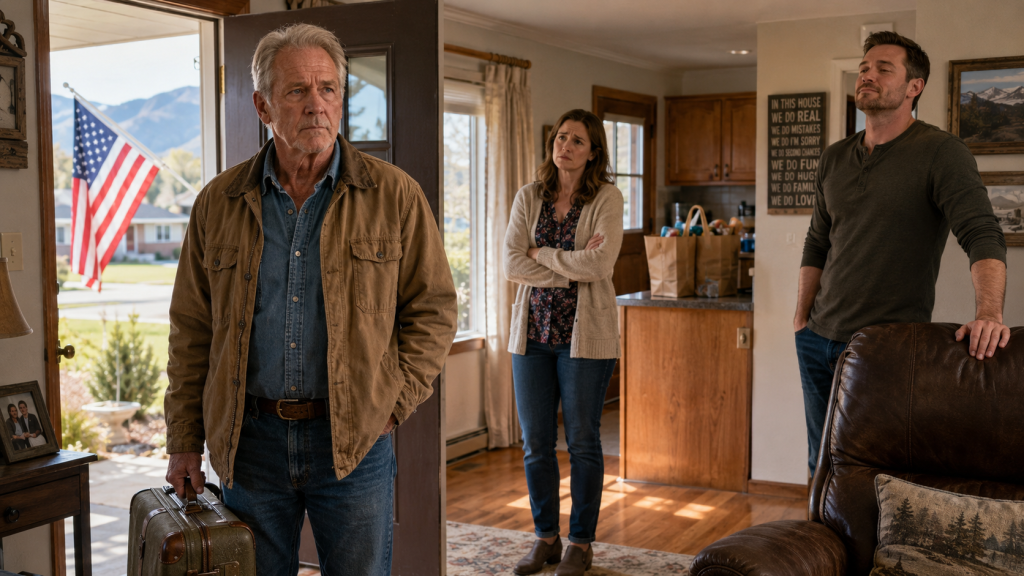
“Old man,” he said, still watching the screen, “bring me another beer from the fridge while you’re standing.”
I lowered the grocery bags to the floor.
The milk and bread landed with dull thuds.
The plastic handles had carved red lines into my palms.
“Excuse me?” I asked.
“You heard me,” Harry said. “Corona. Not that cheap stuff you drink.”
A chill settled deep in my chest.
I had bought those Coronas for him.
I had spent part of my Social Security check on beer I would never touch because Tiffany had once said Harry liked a decent drink after work.
I had called it kindness.
Another small payment toward peace.
“Harry,” I said evenly, “I just walked in. I need to put these groceries away.”
Only then did he look at me.
His expression was familiar.
Irritated.
Superior.
As if I were causing trouble by having a limit.
“What’s the big deal?” he said. “You’re already up. I’m comfortable.”
“The big deal,” I answered, “is that this is my house.”
Harry’s feet dropped to the floor.
He stood slowly, using his size like a threat.
He was thirty, broad-shouldered, and full of the careless confidence of a man who had never built anything but still expected to command it.
But I had spent thirty years in banking, sitting across from men who believed loud voices could change facts.
Harry did not scare me.
He only saddened me.
“Your house?” he said with a laugh. “That’s funny, considering your daughter and I live here.”
“You live here because I allowed it.”
“We pay the bills.”
“With my money.”
“Details.”
He stepped closer, beer still in his hand.
“Listen, Clark. We can do this the easy way or the hard way. You want to keep living here peacefully? Then you cooperate. That’s all.”
The kitchen door opened.
Tiffany stepped in, holding a dish towel.
Her blonde hair was tied back loosely. She glanced at Harry, then at me, then at the bags near the door.
“What’s happening?” she asked.
“Your father is making a scene,” Harry said. “I asked him for one beer, and now he’s acting like I insulted the president.”
Tiffany looked at me with disappointment.
Not worry.
“Dad,” she said, “just get him the beer. This isn’t worth a fight.”
I stared at her.
For one brief second, I searched her face for the child who used to climb into my lap during storms.
But that little girl was gone.
Now she stood beside her husband.
And Harry kept going.
“See, Clark, this is how things work now,” he said. “You live in our house. You contribute. So when I ask you to do something, you do it. No questions. No attitude.”
“Our house?” I repeated.
“That’s right,” Tiffany said.
Then she stepped beside him as if they had practiced the moment.
“Dad, you need to choose right now,” she said. “Either you help Harry and do what he asks, or you pack your things and leave.”
Her words stayed in the room like smoke.
Harry smirked, certain he had already won.
I looked at my daughter one final time.
“All right,” I said softly.
Harry leaned back, satisfied.
“Good. Now, about that beer.”
I picked up the grocery bags, placed them neatly on the kitchen counter, and turned toward the hallway.
“I’ll pack.”
Tiffany blinked.
“What?”
“I’ll pack.”
Harry laughed.
“Oh, come on. Don’t be dramatic.”
But I was already walking.
In my bedroom, I opened the closet and pulled out two suitcases.
Not three.
Not everything.
Just what mattered.
My clothes.
My medications.
The deed to the house.
My bank folders.
Martha’s photo from our twenty-fifth anniversary.
Her wedding ring, which I kept in a small velvet box beside my socks.
Tiffany appeared in the doorway, arms crossed.
“Dad, stop. You’re embarrassing yourself.”
I folded shirts carefully.
“I’m not embarrassed.”
“You’re really going to leave because Harry asked for a beer?”
“No,” I said. “I’m leaving because you told me to serve him or get out.”
Her face tightened.
“That’s not what I meant.”
“That is exactly what you meant.”
She looked away.
From the living room, Harry called, “Tell him he’ll be back by dinner.”
I closed the suitcase.
I carried both bags down the hallway.
Harry was back in the recliner, grinning.
“You forgot my beer.”
I looked at him.
“No, Harry. I didn’t.”
For the first time, uncertainty crossed his face.
Tiffany followed me to the front door.
“Dad, where are you going?”
“A motel.”
“You’re being ridiculous.”
“Maybe.”
“You can’t just leave.”
I almost smiled at that.
“You told me to.”
Her eyes filled with anger.
“I didn’t mean forever.”
“No,” I said. “You meant until I obeyed.”
She said nothing.
I stepped onto the porch.
The Montana air felt cool and clean in my lungs.
I turned once more.
“No, Tiffany. I won’t be back by dinner.”
Then I walked away.
That night, I checked into a small motel near Flathead Lake.
The room smelled faintly of bleach and old carpet, but it was quiet.
No basketball game.
No beer bottles.
No Harry.
No daughter explaining why I should swallow disrespect to keep everyone comfortable.
I set Martha’s photo on the motel desk.
Then I sat on the edge of the bed and cried.
Not loudly.
Not for long.
But enough.
A man can grieve while still being finished.
The next morning, I called my attorney, Elaine Porter.
She had handled Martha’s estate and knew exactly how much of the house, accounts, and family expenses were mine.
When I told her what happened, she was quiet for several seconds.
Then she said, “Clark, do you want them out?”
I looked at Martha’s photo.
“Yes.”
“Then we do this properly.”
By Monday morning, every account I had been funding was frozen.
The grocery card was canceled.
The automatic transfer to Tiffany’s checking account stopped.
The utilities remained paid, because Elaine advised me not to create unnecessary legal complications, but all optional payments ended immediately.
Harry’s truck loan payment, which I had foolishly been covering through my account, stopped.
The insurance I had been paying on their behalf stopped.
The mortgage payment Tiffany thought came from “their budget” did not process because there was no “their budget.”
There was me.
There had always been me.
On Tuesday, Tiffany called five times.
I did not answer.
She texted:
Dad, this isn’t funny.
Then:
Harry’s truck payment didn’t go through.
Then:
Why is the grocery card declined?
Then:
We need to talk like adults.
I stared at that one for a long time.
Like adults.
Adults pay their own bills.
On Wednesday, Harry called from Tiffany’s phone.
I let it go to voicemail.
His message was short.
“You better fix this, old man.”
I forwarded it to Elaine.
She replied:
Excellent. Keep everything.
On Thursday, Elaine filed formal notice terminating their permission to occupy the property.
They had no lease.
They had never paid rent.
They had no ownership interest.
My name alone was on the deed.
On Friday, Tiffany called eleven times.
I still did not answer.
On Saturday morning, exactly seven days after I walked out, I woke in the motel to twenty-two missed calls.
Most were from Tiffany.
Three were from Harry.
One was from a number I did not recognize.
Then came the message I never thought I would receive.
Dad, please come home. Harry left. We’re being evicted. I don’t know what to do.
I sat on the edge of the motel bed, reading those words until the screen dimmed.
Harry left.
Of course he did.
Men like Harry stay only while someone else pays for the roof.
Then Elaine called.
“Mr. Morrison,” she said, “the eviction notice has been delivered. Since the house is legally yours and they have no lease, they have thirty days.”
I looked at Martha’s photo on the motel desk.
For the first time in a week, I took a full breath.
“Good,” I said. “Now sell it.”
Elaine paused.
“The house?”
“Yes.”
“Are you certain?”
I looked at my wife’s smile in the photo.
The kitchen yellow she painted.
The recliner she bought me.
The floors we refinished.
The memories were real.
But so was what had happened inside them.
“I’m certain,” I said.
I expected selling the house to feel like another death.
In some ways, it did.
Tiffany showed up at the motel that afternoon, crying before I even opened the door.
She looked tired.
Not polished.
Not angry.
Just scared.
“Dad,” she whispered.
I stepped outside and closed the door behind me.
“No Harry?”
Her face crumpled.
“He took his clothes and left. He said he wasn’t going down with me.”
“With you?”
“With us.”
I said nothing.
She wiped her face.
“I was wrong.”
“Yes.”
The directness startled her.
“I should never have said that.”
“No.”
“I didn’t mean it.”
“Tiffany,” I said, “you meant it when you believed I had nowhere else to go.”
She lowered her eyes.
That hurt her.
Good.
Truth should hurt when lies have been comfortable.
“I’m sorry,” she said.
“I believe you’re sorry now.”
Her lips trembled.
“What does that mean?”
“It means consequences arrived before remorse did.”
She started crying harder.
“Dad, please don’t sell the house.”
There it was.
Not please forgive me.
Not are you okay.
The house.
I felt sadness settle over me, deep but not surprising.
“I am selling it.”
“But it’s Mom’s house.”
“No,” I said gently. “It was our home when your mother and I were alive in it together. After she died, I tried to keep it alive for you. You handed it to Harry and told me to serve him.”
She covered her mouth.
“I hate myself.”
“Don’t. Hate is useless. Change.”
She looked at me through tears.
“Can I come with you?”
“No.”
The word broke something in her face.
“I need time, Tiffany. And you need to learn how to stand without my wallet beneath your feet.”
She nodded slowly.
“Where am I supposed to go?”
“You have thirty days. Elaine can give you information for renters’ assistance, job placement, and financial counseling.”
“You sound like a banker.”
“I was one.”
For the first time, something almost like a laugh escaped her.
Then it turned back into tears.
I wanted to hold her.
God help me, I did.
But I knew if I did it too soon, she would mistake comfort for rescue.
So I stayed still.
She left without a hug.
That was one of the hardest things I had ever done.
The house sold faster than expected.
A young couple bought it.
They had a toddler, a baby on the way, and eyes full of the kind of hope Martha and I once carried through the front door.
Before closing, I went back alone.
Tiffany had moved into a small apartment by then.
Harry was gone.
The house was empty.
The recliner still sat in the living room.
I stood in front of it for a long time.
Then I called a furniture restoration shop and arranged to have it cleaned, repaired, and shipped to my new place.
That chair was not staying behind.
It had belonged to Martha’s love before Harry’s arrogance.
I took the photo albums.
Martha’s recipe box.
The porch wind chimes.
A jar of buttons from her sewing room.
Then I walked through every room and said goodbye.
In the kitchen, I touched the yellow wall.
“You were right,” I whispered to Martha.
“I was stronger than I thought.”
Two months later, I bought a smaller cabin outside Whitefish.
Nothing fancy.
A porch.
A view of the trees.
Enough room for the recliner, my books, and a guest bed if one day Tiffany visited for the right reasons.
Not need.
Not guilt.
Love.
She did visit eventually.
Six months after I left.
She had a job at a dental office.
She was in counseling.
She had filed for divorce from Harry after learning he had been seeing another woman while living under my roof.
That part did not surprise me.
She arrived with flowers and a casserole.
Martha would have laughed at the casserole.
It was slightly burned on top.
Tiffany stood on my porch and said, “I don’t want money. I don’t need anything fixed. I just wanted to see you.”
I studied her face.
For the first time in years, she looked like my daughter without trying to be someone’s wife first.
I stepped aside.
“Come in.”
We ate at my small table.
She apologized again.
Not dramatically.
Not to get something.
She named things specifically.
The bills.
The disrespect.
The recliner.
The beer.
The ultimatum.
“I treated you like you were only useful,” she said.
I looked down at my coffee.
“That was the part that hurt most.”
“I know.”
“No,” I said. “You’re learning.”
She nodded.
“I’m learning.”
That was enough for that day.
We are not magically healed.
Stories like ours do not mend just because one person cries and another person forgives a little.
But we are honest now.
That matters.
She pays her own rent.
She buys her own groceries.
She never asks me to cover Harry’s debts, though collectors still call sometimes.
When she visits, she brings coffee and sits on the couch.
No one sits in my recliner unless I invite them.
Last Sunday, she stood beside it and touched the repaired leather arm.
“Mom really bought this for you?”
“Yes.”
“It looks good here.”
“It does.”
She smiled sadly.
“I’m sorry he sat in it like that.”
“So am I.”
She looked at me.
“I’m sorry I let him.”
I nodded.
That apology reached somewhere the others had not.
Later, after she left, I sat in the recliner with a cup of coffee and watched evening fall over the trees.
The cabin was quiet.
Not lonely.
Quiet.
There is a difference.
For years, I thought keeping the peace meant staying, paying, swallowing words, and calling disrespect family.
Now I know peace is not the absence of conflict.
Peace is the absence of people who require you to disappear.
My daughter told me I had two choices.
Serve her husband or leave her home.
She forgot it was my home.
She forgot I had a third choice.
I could leave, take my dignity with me, stop funding the life that humiliated me, and let the truth do what I had been too tired to do.
Seven days later, twenty-two missed calls proved what I had always suspected.
They did not need me to serve beer.
They needed me to keep their whole world standing while they treated me like furniture.
So I stopped.
And when the house sold, when the accounts closed, when Harry left and Tiffany finally saw the wreckage clearly, I did not feel cruel.
I felt free.
Not because I lost my family.
Because for the first time in years, I stopped losing myself.
THE END! THANKS FOR READING!