 Reading Time: 18 minutes
When my son got married, I never told him that his late father had secretly left me a $4.2 million ranch in eastern Washington. Looking back, I’m grateful I kept that to myself. Because just a few days after the wedding, my new daughter-in-law showed up at my home in Seattle with a bright smile, a notary, and a stack of papers meant to force me out, place me into assisted living, and take control of everything I owned.
But the moment she slid that gold pen across my coffee table, expecting me to sign, the front door opened. My lawyer stepped inside, accompanied by the police. That was when the “sweet” new bride finally realized the quiet older woman she thought she could pressure had been keeping a secret powerful enough to completely ruin her plan. My name is Susan Whitaker.
I am sixty-nine years old, and for most of my life, no one looked at me and saw power. They saw soft cardigans. Gray hair pinned neatly at the back. Homemade soup cooling on the stove. A widow who still clipped grocery coupons and kept receipts in envelopes.
They saw an old woman living alone in a modest blue house in Seattle, with roses along the fence and a porch swing my husband built with his own hands. They saw someone harmless. That was their mistake. My husband, Robert, saw me clearly.
He used to say, “Susie, you are quiet, but you are not weak.”
I would laugh whenever he said that.
Maybe because I did not believe it then.
Robert and I were married for forty-two years.
We were not rich in the flashy way people imagine.
We lived carefully.
We raised our only son, Andrew, with secondhand furniture, packed lunches, and vacations that usually meant camping near a lake instead of flying somewhere expensive.
Robert worked as a land surveyor before starting a small property management business.
I worked wherever the family needed me.
School office.
Bakery counter.
Church daycare.
Reception desk at a dental clinic.
I did not mind.
I loved my son.
I loved my husband.
I loved our simple life.
Then Robert died three years ago.
One heart attack.
One phone call.
One hospital hallway.
One doctor with kind eyes saying words I still cannot repeat without feeling the floor vanish beneath me.
After the funeral, everyone told me how strong I was.
I hated that.
People call widows strong because they do not want to sit too close to grief.
Andrew came home for the funeral.
He cried, held my hand, and stayed for four days.
Then he returned to Portland, where he worked in marketing and lived a life I only knew through photos.
He called less after that.
At first, I excused it.
He was busy.
He was grieving.
He had his own life.
A mother learns early how to forgive being left behind.
What Andrew did not know was that a month after Robert’s death, our family attorney, Grace Whitmore, called me into her office.
Grace was a sharp woman in her sixties with silver glasses and a voice that made careless people sit straighter.
She placed a folder in front of me.
“Susan,” she said gently, “Robert left you something that he did not discuss with Andrew.”
I frowned.
“Robert and I had no secrets.”
Grace looked at me for a long moment.
“Not secrets meant to hurt you. Secrets meant to protect you.”
Inside the folder were deeds, maps, mineral rights documents, agricultural leases, and trust paperwork.
Nearly five hundred acres of ranch land in eastern Washington.
Rolling fields.
Two older houses.
A working barn.
Water rights.
A long-term grazing lease.
And a current valuation of approximately $4.2 million.
I stared at the number until the page blurred.
“This can’t be right.”
“It is,” Grace said.
“Robert never told me.”
“He purchased pieces of it over many years through an LLC. He wanted it kept separate from family pressure, creditors, and anyone Andrew might marry.”
I looked up sharply.
“Why would he say that?”
Grace sighed.
“Because Robert worried that Andrew trusted too easily. And because he worried that once people knew you had assets, they would stop seeing you as Susan and start seeing you as access.”
I cried in Grace’s office that day.
Not because of the money.
Because even after death, Robert was still trying to keep me safe.
Grace advised me to stay quiet.
No big announcements.
No family revelations.
No emotional decisions.
“Let people show you who they are before they know what you have,” she said.
I did.
For three years, I lived exactly as before.
Same house.
Same car.
Same grocery store.
Same Saturday calls with my sister.
I paid my bills.
I visited the ranch twice with Grace’s property manager, never telling Andrew where I had gone.
The land was beautiful in a rough, honest way.
Dry hills.
Wide sky.
Pine shadows.
Fences that needed work.
A little white ranch house with peeling paint and a porch facing the sunrise.
Every time I stood there, I felt Robert beside me.
Not as a ghost.
As a promise.
Then Andrew met Allison.
He told me about her over the phone.
“She’s amazing, Mom. Smart. Organized. She has goals.”
I wanted to be happy for him.
I really did.
Andrew was thirty-eight, and I had worried he might spend his life chasing women who admired his charm but not his heart.
Allison sounded impressive.
She worked in private senior living administration.
She knew real estate.
She loved “family structure,” whatever that meant.
The first time I met her, she smiled beautifully and hugged me lightly, the way people touch something they do not want to wrinkle.
“Susan,” she said. “Andrew talks about you all the time.”
That was not true.
I could tell by how little she knew.
She did not know I hated cinnamon in coffee.
She did not know I had once painted watercolors.
She did not know Robert called me Susie.
She looked around my Seattle home with polite disappointment.
“Oh, this is cozy,” she said.
Cozy.
The word people use when they mean small.
I cooked dinner that night.
Roast chicken.
Mashed potatoes.
Green beans.
Apple pie.
Allison ate three bites and said she usually avoided “heavy food.”
Andrew laughed awkwardly.
“Mom cooks old-school.”
Allison smiled.
“It’s sweet.”
Sweet.
Old-school.
Cozy.
In three words, she made my life sound like an object from a thrift store.
Still, I tried.
When Andrew proposed, I cried on the phone.
When Allison asked if I could help with some wedding errands, I said yes.
I addressed invitations.
I made hotel welcome bags.
I paid for the rehearsal dinner after Andrew admitted things were getting “a little tight.”
Allison thanked me with a text message.
So appreciated!
No period.
No warmth.
Just efficiency.
The wedding was beautiful.
Also painful.
Allison seated me in the third row behind two of her mother’s friends and a cousin she barely knew.
At the reception, she introduced me to guests as “Andrew’s mom, Susan,” like I was a distant neighbor.
When I offered months earlier to bake cookies for the dessert table, she laughed and said, “That’s adorable, but we hired professionals.”
During the speeches, her parents spoke.
Her maid of honor spoke.
Andrew’s college roommate spoke.
Even Allison’s boss spoke.
I was not called until the DJ checked his clipboard and looked confused.
“Oh, and I think the groom’s mother wanted to say something?”
Wanted.
Not invited.
Wanted.
I walked to the microphone with shaking hands.
I looked at my son, handsome in his tuxedo, smiling at his bride.
I said, “Andrew, your father would have been so proud of the man you—”
Allison started clapping.
Not gently.
Loudly.
“Beautiful, Susan. Thank you!”
The room followed her lead.
My speech ended after one sentence.
Andrew gave me an apologetic smile but did nothing.
That hurt more than Allison.
Later, while the dance floor filled, I stood near the edge watching my son spin his new wife beneath golden lights.
I remembered teaching him to dance in our kitchen when he was seven, his little feet on top of mine.
I remembered Robert saying, “One day he’ll dance with his bride, and you’ll cry like a fool.”
He was right.
I cried.
But not for the reason he imagined.
When I left, Andrew hugged me quickly.
“Love you, Mom.”
His eyes were already looking over my shoulder toward Allison’s family.
I drove home alone.
I sat in my car in the driveway for twenty minutes before going inside.
The house was dark.
The porch swing moved slightly in the wind.
I whispered, “Robert, I don’t think he sees me anymore.”
The next morning, I opened my safe.
Inside were Robert’s documents.
The ranch deed.
Trust structure.
Property reports.
Bank summaries.
I read everything again slowly.
Then I remembered what he had once said.
You’re stronger than you think.
And you have more than you realize.
A week after the wedding, Andrew called.
His voice had that careful tone adult children use when they are about to make a request sound like concern.
“Mom, Allison and I were talking.”
Of course they were.
“She thinks it might be time to consider simplifying things.”
“What things?”
“The house. Your paperwork. Long-term planning.”
I looked around my living room.
The quilt on the chair.
Robert’s books.
The framed photo of Andrew at twelve holding a trout.
“I’m fine, Andrew.”
“I know, Mom. But Allison works around seniors every day. She says waiting too long can make transitions harder.”
Transitions.
Another soft word for removing people from their own lives.
“Is this about assisted living?”
He sighed.
“Not immediately. But maybe eventually. Allison found a lovely place near us.”
“I don’t want to move to Portland.”
“You’d be closer to us.”
“Would I see you more?”
Silence.
That answered more honestly than words.
I said, “I’ll think about it.”
After we hung up, I called Grace Whitmore.
By the following Monday, I was in her office.
I told her everything.
The wedding.
The speech.
The “simplifying.”
The assisted living suggestion.
Grace listened without interrupting.
Then she leaned back.
“Susan, I recommend we tighten everything now.”
We updated my estate plan.
We placed the ranch into an irrevocable protective trust with me as income beneficiary and a professional trustee after my death.
We created medical directives naming my sister, not Andrew.
We established a springing power of attorney that could only activate with two independent medical evaluations.
We recorded my cognitive capacity through a geriatric specialist, who found me perfectly capable.
We set alerts on my home title, bank accounts, and credit.
And because Grace had seen too many polite family thefts, she suggested one more step.
“If they pressure you directly, I want documentation.”
So I documented everything.
Every call.
Every text.
Every email.
Allison sent brochures for senior communities.
I saved them.
Andrew sent articles about downsizing.
I saved those too.
Allison called once and said, “Susan, you don’t want to become one of those older people clinging to independence until something bad happens.”
I recorded the call.
I asked, “What bad thing do you think will happen?”
She laughed softly.
“Well, confusion. Falls. Financial mistakes. People taking advantage.”
“That does sound serious.”
“It is. That’s why Andrew and I want to help manage things before your judgment becomes a question.”
My judgment.
There it was.
I saved that too.
The next morning, I made an appointment with Detective Luis Ramirez, a contact Grace knew through elder exploitation cases.
He listened carefully.
“Has anyone threatened you?”
“Not directly.”
“Have they tried to get signatures?”
“Not yet.”
“Call us if they show up with documents.”
“I will.”
I did not have to wait long.
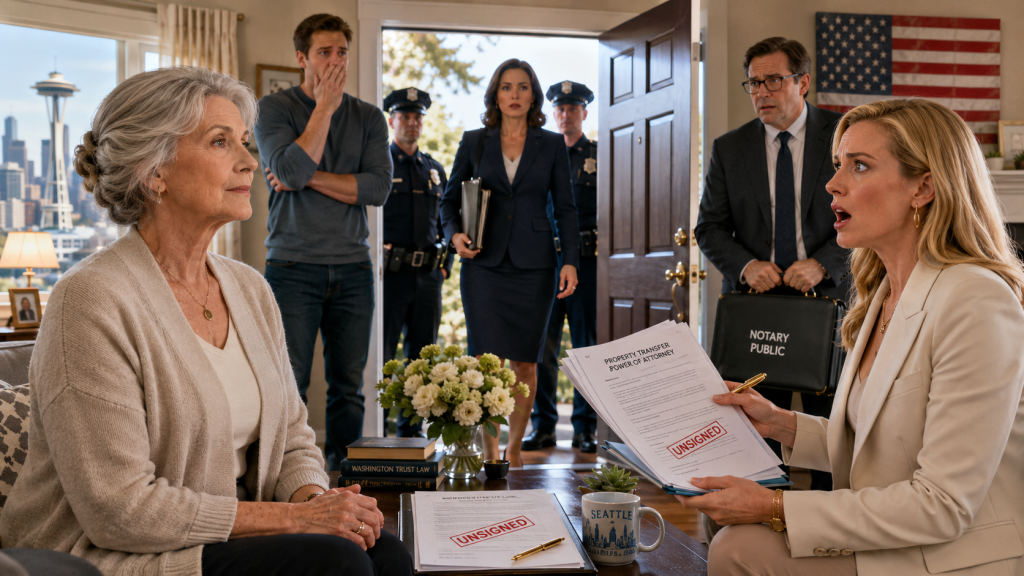
Five days later, Allison appeared at my Seattle house.
It was raining lightly.
She stood on my porch in a beige coat, smiling brightly, heels clicking against the old boards Robert had refinished himself.
Beside her stood a man in a suit carrying a briefcase.
“Mom,” she said warmly, though she had never once called me that before. “This is Peter. He’s a notary.”
My stomach did not drop.
It sank.
I already knew what this was about.
What they did not realize was that I had seen it coming long before they walked through my door.
I opened the door wider.
“Come in.”
Allison swept past me like she owned the place.
Peter nodded politely.
He seemed uncomfortable.
Good.
People should be uncomfortable when asked to witness theft.
Allison sat on my sofa and placed a folder on the coffee table.
“We just need to go over a few documents about the house.”
“The house?”
“And your care plan. Nothing scary.”
She smiled again.
Too many teeth.
“Andrew wanted to be here, but he had meetings.”
Of course he did.
She opened the folder.
The top document was a durable power of attorney naming Andrew and Allison as co-agents.
The second allowed immediate access to my bank accounts.
The third authorized sale of my Seattle home.
The fourth was an admission agreement for a private assisted living facility outside Portland.
The fifth was a statement claiming I had voluntarily requested family management due to “declining independence and early confusion.”
Early confusion.
My hands stayed folded in my lap.
Allison slid a gold pen across the coffee table.
“It’s just paperwork, Susan. Honestly, this protects everyone.”
Peter cleared his throat.
“Mrs. Whitaker, I’ll need to confirm you understand what you’re signing.”
Allison’s eyes flashed.
“She understands. Don’t you, Susan?”
I looked at the pen.
Then at Allison.
“You’ve been busy.”
She laughed lightly.
“I’m just organized. You’ll thank us later.”
“Will I?”
Her smile thinned.
“Andrew is worried. We all are. You live alone. This house is too much. And frankly, it would be irresponsible to wait until something happens.”
“What does Andrew say?”
“He agrees.”
“Did he read these?”
A pause.
“All of it is standard.”
That was not an answer.
I picked up the gold pen.
Allison leaned forward.
Peter opened his stamp case.
Right as I leaned toward the signature line, the doorbell rang.
Allison frowned.
“Ignore it.”
I smiled.
“No.”
I placed the pen down.
The front door opened before Allison could protest.
Grace Whitmore stepped inside first, carrying a leather briefcase.
Behind her were two police officers, including Detective Ramirez.
Allison’s smile froze.
Peter slowly lowered his notary stamp.
“Susan,” Grace said calmly, “do not sign anything.”
I sat back.
“I wasn’t planning to.”
Allison laughed nervously.
“This is a family matter.”
Detective Ramirez looked at the papers spread across the coffee table.
“A family matter involving a forced power of attorney, a property transfer, and assisted living admission forms?”
Allison’s face went pale.
“It’s not forced. Susan asked for help.”
Grace lifted a tablet.
“Actually, Susan has recordings of you stating her judgment would become a question and that control should be established before she became difficult.”
“That was taken out of context.”
“Then explain the false statement about early confusion.”
Allison opened her mouth.
No sound came out.
At that moment, Andrew appeared on the porch behind them, soaked from the rain and looking confused.
“Mom?” he said. “What’s going on?”
I turned to him.
“Your wife brought papers to take my house, control my accounts, and move me out.”
His face drained.
“Allison?”
Allison snapped, “I was helping!”
Andrew stepped inside slowly.
“You told me Mom agreed to talk about options.”
“She did.”
“No,” I said. “I didn’t.”
His eyes moved to the papers.
The power of attorney.
The home sale authorization.
The facility agreement.
He looked sick.
“Allison, why is your name on this?”
She lifted her chin.
“Because spouses handle things together.”
“You’ve been married to me for nine days.”
The room went silent.
Grace opened her folder.
“We also have reason to believe Allison contacted Evergreen Terrace Senior Living and represented Susan as cognitively declining despite no diagnosis. We have Susan’s recent cognitive evaluation confirming capacity.”
Allison’s expression hardened.
“You had yourself evaluated?”
“Yes.”
“That’s paranoid.”
“No,” I said. “That’s prepared.”
Andrew turned toward me.
“Mom, I swear I didn’t know she brought these.”
I wanted to believe him.
But wanting had betrayed me before.
“Did you talk about selling my house?”
His face reddened.
“We talked generally.”
“Did you talk about moving me?”
“I thought… maybe someday.”
“Did you ever ask me what I wanted?”
He looked down.
That was answer enough.
Allison suddenly pointed at Grace.
“This attorney is manipulating her. Susan is old and grieving. She doesn’t understand how vulnerable she is.”
Grace’s eyes cooled.
“Susan understands perfectly. In fact, the house is not the prize anyway.”
Allison’s mouth tightened.
“What does that mean?”
Grace placed another document on the table.
“Susan’s late husband left her a ranch in eastern Washington valued at approximately $4.2 million. It was placed into a protected trust yesterday.”
For a moment, no one moved.
Then Allison’s face changed.
The mask slipped completely.
Her eyes widened, not with concern.
With calculation.
Then fury.
“You hid that?”
I smiled.
“No, dear. I protected it from people exactly like you.”
Andrew stared at me.
“Dad left you a ranch?”
“Yes.”
“Why didn’t you tell me?”
“Because your father asked me not to until I knew who could be trusted.”
His face crumpled.
“Mom.”
Allison stood abruptly.
“This is ridiculous. Andrew is your only son. He has a right to know what assets exist.”
Detective Ramirez stepped closer.
“He has a right to be concerned about his mother. He does not have a right to take control of her property through misleading documents.”
Peter, the notary, raised both hands.
“I was told this was voluntary. I had no idea.”
Grace looked at him.
“Then you will provide a statement.”
He nodded quickly.
Allison grabbed her purse.
“I’m leaving. Andrew, come on.”
Andrew did not move.
Her eyes sharpened.
“Andrew.”
He looked at her as if seeing a stranger.
“You tried to put my mother in assisted living behind my back.”
“I tried to protect our future.”
Our future.
There it was.
Not my safety.
Not my dignity.
Their future.
Andrew whispered, “We’ve been married nine days.”
“And we need stability,” she snapped. “Your mother is sitting on millions while we drown in debt.”
The room went cold.
Andrew’s face changed.
“What debt?”
Allison realized her mistake too late.
Grace glanced at Detective Ramirez.
“Interesting.”
Allison’s lips pressed tight.
“I’m done.”
She tried to move toward the door, but Ramirez stopped her gently.
“We need to ask you some questions first.”
“I’m not under arrest.”
“No. But you are part of an elder exploitation complaint.”
Her face went red.
“Elder exploitation? She invited me in!”
I stood slowly.
“You came into my house with a notary and documents I had never reviewed.”
“You were going to sign.”
“I was going to let you show everyone who you were.”
Allison glared at me with open hatred now.
The sweet bride was gone.
In her place stood a woman angry that prey had become a witness.
Detective Ramirez asked her to step outside for a formal interview.
She refused twice.
Then Andrew said quietly, “Allison, go.”
She looked at him.
“You’re choosing her?”
He looked at me.
Then back at his wife.
“I’m choosing not to steal from my mother.”
Allison laughed bitterly.
“You are weak.”
That word seemed to land somewhere deep in him.
Maybe because he had spent years confusing being loved with being managed.
Maybe because he finally heard what she sounded like without sugar.
She left with the officers.
Not in handcuffs.
Not yet.
But without the papers.
Without the pen.
Without control.
When the door closed, Andrew and I stood in the living room surrounded by rainlight and silence.
Grace collected the documents carefully.
Peter gave a statement in the kitchen, his hands shaking.
I sat in Robert’s old armchair.
Andrew remained standing.
He looked younger than thirty-eight suddenly.
Like the boy who used to come home crying when older kids tricked him into trading good baseball cards for worthless ones.
“Mom,” he said. “I’m sorry.”
I looked at him.
“Did you know?”
“No.”
“Did you suspect?”
He swallowed.
“I knew she was intense. I knew she cared a lot about money. I thought she was just organized.”
“Did you want me to move?”
His eyes filled.
“I wanted life to be simpler.”
“For whom?”
That broke him.
He sat on the edge of the sofa and put his face in his hands.
“I don’t know.”
That answer hurt because it was honest.
“I love you,” he said. “But after Dad died, being around this house felt hard. Allison said if you moved closer, it would be better. She made it sound like I was helping.”
I looked toward the window.
The roses bent under the rain.
“Helping requires asking.”
“I know.”
“You let her call me confused.”
“I didn’t know she used that word.”
“But you let the idea exist.”
He nodded slowly.
“Yes.”
That mattered.
Not enough to fix everything.
Enough to begin truth.
Grace finished with Peter and returned to the living room.
“Susan, the documents are secured. Detective Ramirez will file the report. I recommend no unsupervised contact with Allison until this is resolved.”
Andrew looked up.
“What happens now?”
Grace’s voice was professional.
“That depends on what the investigation finds. But Allison attempted to obtain legal control over Susan’s assets using questionable claims about capacity. There may also be financial motives we don’t yet understand.”
Andrew closed his eyes.
“Debt.”
Grace looked at him.
“What debt?”
He shook his head.
“I don’t know. She mentioned debt. I didn’t know we had any besides the wedding balances.”
I sighed.
“The wedding balances?”
His face reddened again.
“We put some on cards.”
“How much?”
“I thought maybe twenty thousand.”
Grace’s eyes sharpened.
“You should pull your credit today.”
He did.
By evening, he discovered more than sixty-eight thousand dollars in new credit card charges, two personal loans, and one application for a joint line of credit he had not signed.
His new wife had married him with debt, lies, and a plan.
I wish I could say I felt satisfied.
I did not.
Watching your child realize he has been fooled is painful, even when his foolishness endangered you.
Andrew stayed that night in the guest room.
Not because everything was forgiven.
Because I did not want him driving back to Portland in a storm while his life fell apart.
He sat at my kitchen table with a cup of tea, staring at his credit report.
“I was so stupid.”
“You were lonely,” I said.
He looked at me.
“So were you.”
“Yes.”
“And I left you that way.”
I did not answer.
He put the report down.
“Mom, why didn’t Dad tell me about the ranch?”
I thought carefully before answering.
“Because he loved you. And he knew love does not always make people wise.”
Andrew’s eyes filled.
“He didn’t trust me?”
“He didn’t trust who might influence you.”
He wiped his face.
“He was right.”
The investigation moved quickly after that.
Allison had contacted Evergreen Terrace weeks before the wedding, asking about admission requirements for a “reluctant elderly parent.”
She had requested sample forms.
She had searched online for power of attorney templates.
She had emailed Peter the notary, claiming I had limited mobility, confusion, and had asked for help but might become emotional.
She had also researched ranch land transfers in Washington.
That meant she knew about the ranch somehow.
Grace discovered Allison had accessed Andrew’s email after the wedding and found an old message from Robert to Andrew containing one vague reference to “land out east.” She must have started digging from there.
She did not know the value.
Not until Grace said it aloud.
That explained the look on her face.
Not shock that I had hidden something.
Shock that the prize was bigger than she had imagined.
Andrew filed for an annulment first.
Then divorce when the annulment became legally complicated.
Allison fought him for exactly three weeks.
Then her own financial mess came out.
Old debts.
Lawsuits.
A previous engagement that ended after similar accusations from another man’s family.
She settled quickly when Grace and Ramirez made it clear the elder exploitation complaint would not disappear.
Peter cooperated fully.
Evergreen Terrace provided records.
Allison was not dragged away dramatically, but she was charged for financial misconduct connected to forged credit applications and faced investigation for attempted exploitation.
The law moved slower than emotions.
But it moved.
For months, Andrew came to visit every Saturday.
At first, we talked mostly about paperwork.
His divorce.
His credit.
My legal protections.
Allison’s case.
Then slowly, we talked about other things.
His grief after Robert died.
My loneliness.
The wedding.
The speech I never got to give.
That one made him cry hardest.
“I saw her clap,” he whispered. “I knew it was wrong. I just didn’t want conflict.”
I looked at him across the kitchen table.
“You chose peace over me.”
He nodded.
“I did.”
“Don’t do that again.”
“I won’t.”
Trust does not return because someone cries.
It returns like spring after a harsh winter.
Slowly.
Unevenly.
With cold days even after flowers appear.
But Andrew tried.
He stopped letting shame make him defensive.
He asked questions.
He listened to answers that hurt.
He visited the ranch with me that summer.
We drove across eastern Washington under a wide blue sky.
When we reached the gate, he stepped out of the car and stared across the fields.
“Dad owned all this?”
“Yes.”
Wind moved through the dry grass.
The old white ranch house stood in the distance.
Andrew’s voice broke.
“Why did he never bring me here?”
“He wanted to. I think he was waiting until it felt safe.”
“And it never did.”
“No.”
We walked to the porch.
I unlocked the door.
Inside, the house smelled of wood, dust, and sunlight.
Robert’s old surveying maps hung framed in the hallway.
I had put them there the year before.
Andrew touched one gently.
“I miss him.”
“I do too.”
For the first time in years, my son leaned his head against my shoulder like he had when he was small.
I held him.
Not as a child.
Not exactly.
As someone I still loved, but no longer needed to protect from consequences.
That is a different kind of motherhood.
Harder.
Healthier.
A year after Allison came to my house with the gold pen, the ranch hosted its first retreat.
Not for rich investors.
Not for Allison’s dreams.
For widows and older women rebuilding their legal and financial lives after loss.
Grace helped me establish a small foundation.
We offered free legal clinics, financial planning workshops, and quiet weekends on the land.
Women came from Seattle, Spokane, Portland, and tiny towns I had never heard of.
Some had children pressuring them to sign things.
Some had husbands who left debts behind.
Some had no one and were terrified of being alone.
On the first retreat weekend, I stood on the ranch porch watching ten women drink coffee while the sun rose over the fields.
One of them, a seventy-four-year-old retired librarian named June, said, “I forgot what it felt like to make a decision without asking permission.”
I thought of Allison’s gold pen.
Andrew’s silence.
Robert’s warning.
Grace’s steady voice.
And I said, “Then this place is doing its job.”
My Seattle house is still mine.
The roses still bloom along the fence.
The porch swing still creaks when the wind comes in from the water.
Andrew visits often now.
Not because he needs money.
Not because Allison sends him.
Because he wants to.
Sometimes we cook dinner.
Sometimes we talk about Robert.
Sometimes we sit quietly, which no longer feels like abandonment.
Allison is gone from our lives.
I hear updates only through attorneys, and that is more than enough.
I do not hate her every day.
Hate is too much work for someone who failed.
But I remember.
I remember her heels on my porch.
Her bright smile.
Her notary.
Her papers.
The gold pen sliding across my coffee table like a tiny weapon.
I remember the way she said, “This protects everyone,” when she meant herself.
I remember Andrew’s face when he realized the woman he married had tried to take his mother’s life apart before the thank-you notes from the wedding were even mailed.
Most of all, I remember the sound of the front door opening.
Grace stepping in.
Detective Ramirez behind her.
The sudden collapse of Allison’s confidence.
The moment she realized I was not confused.
Not helpless.
Not alone.
And definitely not poor.
People think the ranch saved me.
They are wrong.
The ranch was property.
Valuable, yes.
Protected, yes.
But land cannot save a person who refuses to see the truth.
What saved me was Robert’s warning.
Grace’s planning.
My own decision to stop mistaking quiet for helplessness.
For years, I thought being a good mother meant giving until nothing was left.
Money.
Time.
Forgiveness.
Excuses.
But motherhood cannot mean letting your child’s choices destroy your safety.
Love without boundaries becomes an unlocked door.
And not everyone who walks through means well.
When Allison called me “Mom” that day, she thought the word would soften me.
She thought age had made me desperate for affection.
Maybe part of me was.
But desperation is not the same as stupidity.
I had already taken control.
My accounts were protected.
My home title was protected.
My medical decisions were protected.
The ranch was protected.
And when she sat on my sofa with a notary and a smile, I let her believe she was winning just long enough for the truth to arrive with witnesses.
Now, whenever women at the ranch ask why I created the foundation, I tell them the simple version.
“My husband left me land, and I wanted it to do good.”
That is true.
But not the whole truth.
The whole truth is this:
A new bride once tried to erase me from my own life.
She thought an older widow would sign anything if pressured gently enough.
She thought my son’s love could be used as a leash.
She thought family meant access.
She was wrong.
The quiet older woman she underestimated had a lawyer, a trust, recordings, police at the door, and a $4.2 million secret in eastern Washington.
But even before all that, I had something more important.
I had finally learned to believe Robert.
I was quiet.
But I was not weak.
THE END! THANKS FOR READING!