 Reading Time: 19 minutes
One year after my divorce, my ex-mother-in-law spotted me at the clinic with a smug grin. She told me her son made the right choice leaving me and was now raising a daughter with my former friend.
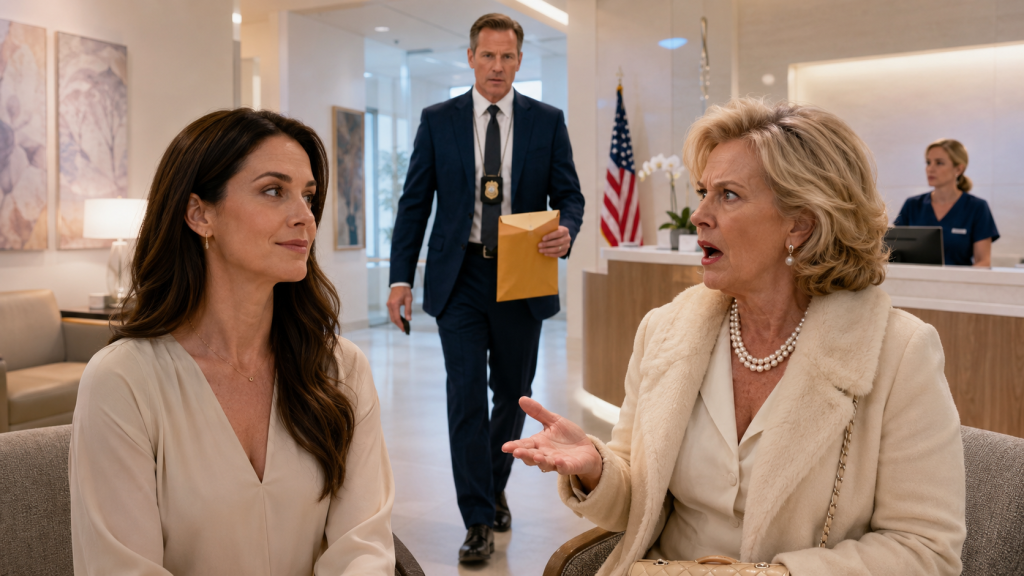
I stayed calm, smiled, and said, “Is that what you think?” Then a man stepped inside, and her face went completely pale. A year after the divorce, Patricia Parker saw me in the waiting room of Westbridge Fertility Clinic in Denver. I had imagined seeing her again many times.
At the grocery store. At a restaurant. Maybe outside the courthouse. In every imaginary version, I had something clever ready. Something sharp. Something that would prove I was no longer the woman who walked out of family court with shaking hands while she hugged my former best friend in the hallway.
But real life never gives you the scene you rehearse. It gives you fluorescent lights, beige chairs, a silent fish tank, and a folder of medical records sitting in your lap while your past walks in wearing pearls. Patricia Parker looked exactly the same. Perfect silver-blonde hair. Cream wool coat. Diamond earrings.
A perfume so expensive and sharp it arrived before she did.
And on her face was the same smug smile she had worn during my divorce hearing, when her son Ryan told the judge our marriage had been “emotionally empty.”
Emotionally empty.
That was how he described eight years together.
Eight years of doctor appointments, injections, failed transfers, debt, grief, and whispered prayers over pregnancy tests that stayed cruelly blank.
Eight years of me trying to become a mother while his family watched my body like it was defective equipment.
I had not seen Patricia since the courthouse.
That day, she did not look at me when the divorce was finalized.
She walked straight to Megan Ellis, my former best friend, and hugged her in front of everyone.
Megan had cried softly into Patricia’s shoulder.
Ryan stood behind them, one hand on Megan’s lower back.
I remember thinking grief could make a person hallucinate, because surely the two people I trusted most in the world had not become a family while I was still bleeding from losing mine.
But they had.
Now Patricia stopped beside my chair in the fertility clinic waiting room and looked me up and down.
“Well,” she said loudly enough for the receptionist to hear, “isn’t this interesting?”
I closed the folder in my lap.
“Hello, Patricia.”
Her smile widened.
“I heard you were still alone.”
I said nothing.
Silence had become easier for me after the divorce.
Not weak silence.
Not frightened silence.
The kind of silence that lets another person reveal how ugly they are willing to become.
Patricia’s eyes moved to the clinic logo on the wall.
Westbridge Fertility Center.
Then back to me.
“Oh, Claire,” she said softly, like she was pretending to pity me. “Still coming here?”
My throat tightened, but I kept my face calm.
“I have an appointment.”
“With what hope?”
The receptionist looked up.
A woman across the room shifted uncomfortably in her chair.
Patricia did not care.
Cruel people rarely mind an audience if they believe they are winning.
She leaned closer.
“Leaving you was the best choice my son ever made. Now he’s raising a beautiful daughter with Megan. A real family. Something you could never give him.”
The words struck exactly where she wanted them to.
A real family.
Something you could never give him.
There was a time when those words would have shattered me.
Maybe even six months earlier.
Maybe even six weeks earlier.
But not that day.
Because the folder in my lap held something stronger than pain.
It held proof.
Ryan and I had started trying for a baby two years after our wedding.
At first, it was sweet.
Hopeful.
We bought tiny socks once after a late dinner because I was three days late, and Ryan had laughed as he held them up to the light.
“Too small,” he said.
“That’s the point.”
He kissed me in the store aisle and said, “One day.”
One day became blood tests.
Then specialist appointments.
Then medication that made me cry over commercials.
Then injections Ryan learned to give me in the bathroom while I gripped the sink.
Then embryos.
Then waiting rooms.
Then phone calls that always began with a nurse saying my name too gently.
Our first transfer failed.
The second gave us a positive pregnancy test for eight days.
Eight beautiful, terrifying days.
Then it was gone.
The third transfer ended at nine weeks.
I miscarried at home while Ryan was on a business trip.
Megan came over with soup and held my hair while I vomited from pain and grief.
Megan had been my best friend since college.
She knew every fear I had.
Every appointment.
Every test result.
Every time Patricia said something poisonous and Ryan told me not to take it personally.
After the miscarriage, Ryan changed.
Not all at once.
At first, he was quiet.
Then distant.
Then irritated by my sadness.
He stopped asking about follow-up appointments.
He stopped calling the embryos “ours.”
He started saying things like, “Maybe we’re forcing something that isn’t meant to happen.”
And Megan became helpful.
Too helpful.
She checked on him, she said, because men grieved differently.
She stayed late at our house after bringing dinner.
She answered texts from him at midnight.
She told me, “He feels like he can’t talk to you without making you cry.”
I believed her.
That was the worst part.
I believed the woman who was helping my husband leave me.
Six months after our divorce, Megan announced she was pregnant.
Patricia called it a miracle all over social media.
My miracle granddaughter.
Ryan posted a photo of Megan holding her belly in a field of sunflowers.
Caption:
Sometimes life gives you joy when you stop forcing the wrong doors open.
I read that line until my hands went numb.
The wrong doors.
Me.
My body.
Our marriage.
Our embryos.
I blocked them after that.
Or tried to.
People still sent screenshots.
People always think pain needs updates.
The baby was born in February.
A girl.
Lila Rose Parker.
I saw one photo before I blocked the last mutual friend who sent it.
Tiny.
Dark hair.
A round face.
A little hand curled against Megan’s chest.
The strange thing was that I felt grief before anger.
Not because I wanted Ryan back.
I did not.
But because there was a child in the world connected to the life I had lost.
I told myself that was all.
Then, three months later, a billing notice arrived at my old email.
At first, I almost deleted it.
Westbridge Fertility Billing Department.
I thought it was an old statement.
Some leftover insurance adjustment from the years when my body had become a project coded into invoices.
But the date stopped me.
Embryo transfer.
Two weeks after Ryan filed for divorce.
Two weeks after he told me he needed “space to heal.”
The listed patient was Megan Ellis.
The embryo ID was one I recognized.
I knew that number better than I knew my old wedding anniversary.
We had two frozen embryos left after our last failed transfer.
Two.
The last two.
I had paid storage fees quietly even after the divorce because I could not bring myself to decide what to do with them.
Ryan had wanted them discarded.
I said no.
“They are our last chance,” I told him.
He looked at me and said, “They are cells in a freezer, Claire.”
But they were not just cells to me.
They were names I had never spoken aloud.
They were nursery colors I never chose.
They were the last fragile thread connecting me to the possibility of motherhood.
When I saw the embryo ID on Megan’s billing notice, my mind refused to understand.
I read it again.
Then again.
I called Westbridge.
The billing office apologized for the email and said they could not discuss another patient’s account.
I asked for my own records.
They transferred me to administration.
Administration transferred me to legal.
Legal said someone would call back.
No one did.
So I hired an attorney.
Then another.
Then I called Detective Andrew Cole.
I had met Detective Cole once years earlier, when he investigated Ryan’s business partner for insurance fraud.
Ryan hated him.
Patricia hated him even more because the investigation embarrassed the Parker name.
Andrew Cole was calm, careful, and impossible to intimidate.
At first, I thought he would tell me it was a civil matter.
Instead, he listened.
He asked for the billing notice.
He asked for my storage records.
He asked if I had consented to any embryo transfer after separation.
“No,” I said.
“Did you sign any release?”
“No.”
“Did you authorize use by Megan Ellis?”
I could barely breathe.
“No.”
Then he said, “Do not contact Ryan. Do not contact Megan. Let us verify the records.”
That was how I ended up at Westbridge Fertility Clinic one year after my divorce.
Not for hope.
Not for treatment.
For evidence.
And that was where Patricia found me.
She leaned closer and whispered, “That little girl is proof my son chose right.”
I finally smiled.
“Is that what you think?”
Before she could answer, the clinic door opened.
A tall man in a navy suit walked in carrying a sealed evidence envelope.
Patricia turned.
The color drained from her face.
She knew him.
Everyone in the Parker family knew him.
Detective Andrew Cole had once made their dinner parties uncomfortable by asking Ryan’s business partner questions that led to handcuffs.
Now he walked straight toward us.
He nodded to me.
Then looked at Patricia.
“Mrs. Parker,” he said. “Good. You’re here too.”
Patricia gripped her handbag.
“Why would I need to be here?”
Detective Cole held up the envelope.
“Because your son’s daughter was created using Mrs. Bennett’s frozen embryo,” he said. “And the consent form appears to have been forged.”
The waiting room went silent.
A woman near the fish tank covered her mouth.
The receptionist froze with one hand over her keyboard.
Patricia stared at him.
“That’s impossible.”
Detective Cole’s expression did not change.
“The clinic has security footage, billing records, and a digital login traced to Ryan Parker’s office computer.”
My chest tightened even though I already knew.
Hearing it aloud made the betrayal heavier.
It became real in the air between us.
Patricia shook her head.
“No. Megan carried that baby.”
“Yes,” I said quietly. “But she carried my child.”
Patricia’s smugness vanished completely.
“Ryan wouldn’t…”
Her voice failed.
Detective Cole opened the envelope and removed a copy of the consent form.
“Your name appears as a witness, Mrs. Parker.”
Patricia’s face collapsed.
“I didn’t know what it was.”
Her hand rose to her throat.
“Ryan said it was routine.”
I stood slowly.
“Routine?”
My voice shook, but not from weakness.
From the effort of holding back years of grief.
“You watched me grieve two miscarriages. You told me I was broken. You told your son he deserved a woman who could give him children. Then your family stole the last chance I had to become a mother.”
Patricia’s eyes filled with tears.
They gave me no comfort.
At that moment, the clinic doors opened hard.
Ryan rushed inside, breathless, wearing a gray coat over a dress shirt.
Megan followed behind him, pale and shaking.
She looked smaller than I remembered.
Her hair was pulled into a messy bun.
No makeup.
No smugness.
Just fear.
Ryan looked at Detective Cole first.
Then at me.
“Claire, this is a misunderstanding.”
I almost laughed.
That word.
Misunderstanding.
As if someone had misplaced a coat.
As if a frozen embryo could accidentally become a baby in another woman’s body.
Megan looked at me with wet eyes.
“I’m sorry,” she whispered.
I stared at her.
“You named my daughter without me.”
Her face crumpled.
Ryan snapped, “Do not say that.”
Detective Cole stepped between us.
“Ryan Parker, we need you to come with us.”
Ryan’s expression hardened.
“I’m not going anywhere without my attorney.”
“That is your right,” Detective Cole said. “But this conversation will not continue in this waiting room.”
Patricia sank into the chair beside her.
For the first time since I had known her, she looked old.
Not polished.
Not powerful.
Just old.
And afraid.
She looked at Megan.
“Megan,” she whispered. “Tell me he didn’t.”
Megan lowered her face.
Patricia made a sound like something inside her had cracked.
Ryan turned on Megan.
“Don’t.”
That single word told me everything.
Not a denial.
A command.
Megan began to cry.
“You said Claire had agreed,” she said. “You said the embryos were being donated because she wanted nothing to do with them after the divorce.”
My hands went cold.
Ryan’s jaw tightened.
“I told you what you needed to know.”
Megan looked up sharply.
“What I needed to know?”
The waiting room remained frozen around us.
Detective Cole gave a subtle nod to another officer who had entered behind him.
A woman in a dark jacket moved toward the clinic hallway.
Clinic staff began guiding patients into private rooms.
I watched everything as if from underwater.
Ryan and Megan.
Patricia in her chair.
The evidence envelope.
My name on a forged consent form.
Somewhere in Denver, a little girl named Lila was probably asleep or playing with toys, unaware that the adults around her had built her life on theft.
That thought nearly buckled me.
Not anger.
The child.
My child.
Not legally yet.
Not practically.
Not emotionally in any simple way.
But biologically, impossibly, devastatingly mine.
Detective Cole asked Ryan to step outside with him.
Ryan refused until the detective said something quietly that I could not hear.
Then Ryan’s face changed.
He looked at me once.
“You have no idea what this will do to her,” he said.
I understood immediately that he meant Lila.
Not me.
Never me.
I looked back at him.
“You should have thought of that before you made her life evidence.”
He flinched.
Good.
They took Ryan into a consultation room.
Not handcuffed.
Not yet.
But escorted.
Megan remained near the door, crying silently.
Patricia still sat frozen.
I stood there holding my folder so tightly the paper bent.
Megan whispered my name.
I looked at her.
“Don’t.”
“I need you to know—”
“No,” I said. “You needed me to know before you transferred my embryo. Before you carried my child. Before you let Patricia parade her around like proof that I was defective.”
Megan sobbed.
“I thought you signed.”
“You were my best friend.”
“I know.”
“You knew my signature.”
Her face crumpled.
That was the moment.
Not when she said she thought I agreed.
Not when Ryan commanded her to stay quiet.
When I reminded her that she knew my signature.
She had seen it on birthday cards, lease forms, clinic documents, wedding guest books, insurance paperwork.
She had watched me sign consent forms with shaking hands.
She knew the loops in my C.
She knew how I crossed the double T in Bennett.
She knew.
Her silence answered before her mouth did.
“I wanted to believe him,” she whispered.
I nodded slowly.
“Because believing him gave you my life.”
She covered her mouth.
Patricia suddenly stood.
“Where is the baby?”
Everyone looked at her.
“My granddaughter,” she said, voice frantic. “Where is Lila?”
Megan wiped her face.
“With my sister.”
Patricia looked at me, then away.
For the first time, she seemed to understand that the word granddaughter no longer belonged easily to her.
It did not belong easily to anyone.
That was the cruelty of what Ryan had done.
He had not just stolen from me.
He had created a child whose identity would one day require pain to explain.
The legal process began that afternoon.
It was not quick.
Stories like this never are, no matter how clean the evidence looks in dramatic moments.
There were search warrants.
Interviews.
Clinic audits.
Digital records.
Forensic document analysis.
The original consent form with my forged signature.
The witness line bearing Patricia’s name.
Security footage showing Ryan entering the clinic records office after hours with a temporary contractor badge.
Email trails.
Deleted messages recovered from Megan’s old phone.
Storage authorization requests from an IP address connected to Ryan’s office.
A payment from Patricia’s account to cover part of the transfer balance.
That last one nearly destroyed her.
She insisted Ryan told her it was for “fertility support” because Megan’s insurance did not cover everything.
I believed that part.
Not because Patricia was innocent.
Because Patricia’s cruelty had always been direct.
She would have insulted me to my face, not secretly forged my consent.
She loved Ryan blindly, but I do not think she knew the embryo was mine when she paid.
Still, she had signed something without asking because Ryan told her to.
Just like she had believed him when he called me cold.
Broken.
Obsessed.
A woman who could not move on.
Blind love can still become an accomplice.
Ryan was charged with fraud-related offenses, forgery, unlawful use of reproductive material, and several other crimes I had never imagined learning the names of.
The clinic faced a separate investigation for security failures.
Megan was not charged at first.
Then evidence showed she had received at least one message from Ryan weeks before the transfer saying:
Claire will fight this if she finds out. Keep Patricia out of details.
Megan claimed she thought he meant the divorce optics.
Detective Cole said that might matter in court.
It did not matter to me.
The first time I saw Lila after learning the truth was through a court-ordered photograph attached to a custody investigation file.
She was eleven months old.
Dark curls.
Soft cheeks.
Wide brown eyes.
My eyes.
Not exactly.
Not in a movie way.
But enough that I had to put the photo down.
My attorney, Rebecca Sloan, sat across from me.
She was known for reproductive law and complex custody disputes, and she had the steady voice of someone used to guiding people through impossible rooms.
“You do not have to decide everything today,” she said.
I stared at the closed folder.
“What are my options?”
She took a breath.
“This is complicated. Megan gave birth. Ryan is the legal father on the birth certificate. You are the genetic mother. Your consent was forged. The embryo belonged jointly to you and Ryan under prior storage agreements. We can petition for recognition, custody consideration, and protective orders depending on what the criminal case establishes.”
I closed my eyes.
“Can I lose her before I even meet her?”
Rebecca was quiet for a moment.
“There is no outcome here without grief.”
That was the most honest thing anyone had said.
People wanted to make it simple.
Friends said, “Fight for your daughter.”
Others said, “But Megan carried her.”
Some asked whether I even wanted a child born from such betrayal.
I hated that question.
Of course I wanted her.
And also, I did not know her.
And also, she was innocent.
And also, every path led through someone else’s pain.
I started therapy again.
Not the gentle kind where you talk about breathing and boundaries.
The kind where your therapist lets you say the ugliest thoughts and still looks at you like you are human.
“I’m jealous of Megan,” I admitted one day.
My therapist nodded.
“She felt Lila kick. She heard her first cry. She fed her. She got the newborn nights. She got the baby shower. She got everything I begged God for.”
“And what else do you feel?”
I gripped the tissue until it tore.
“I feel guilty for wanting to take that away.”
“Do you want to take it away?”
“I want what was stolen from me.”
“That is not the same question.”
I cried then.
Because she was right.
I wanted Lila safe.
I wanted the truth acknowledged.
I wanted Ryan punished.
I wanted Megan to understand what she had helped do.
I wanted my embryos back, though one had already become a person and the other had been mishandled in ways still under investigation.
I wanted to rewind time.
But wanting motherhood is not the same as wanting a child ripped from the only daily mother she has known.
That truth made me angry.
Mostly because it was true.
The first supervised meeting happened three months after the clinic confrontation.
A child welfare specialist arranged it in a quiet room with soft toys and neutral colors.
Megan was there, pale and sleepless, holding Lila on her hip.
Ryan was not allowed contact pending the criminal case.
Patricia had been removed from the room after arguing with the specialist.
I arrived with Rebecca and a trembling heart.
Lila looked at me with curiosity.
She was smaller than I expected.
Realer than the photo.
She held a stuffed rabbit by one ear.
Megan’s eyes filled when she saw me.
I ignored her and looked at the child.
“Hi, Lila,” I whispered.
The baby blinked.
Then leaned into Megan’s shoulder.
I felt something inside me fracture.
Not because Lila rejected me.
She was a baby.
She did what babies do.
She leaned toward the body she knew.
The smell she knew.
The arms that had held her.
And I stood there as the stranger whose DNA lived in her cells.
The specialist gently encouraged Megan to sit nearby and let Lila explore.
For the first twenty minutes, Lila stayed close to Megan.
Then she crawled toward a stack of soft blocks.
I sat on the rug a careful distance away.
She picked up a yellow block and held it out.
Not to me, exactly.
Just outward.
I took it like she had handed me glass.
“Thank you.”
She smiled.
Two tiny teeth.
My heart broke again.
This time differently.
Afterward, I sat in my car and sobbed until Rebecca knocked on the window and asked if she should drive.
I let her.
The months that followed taught me that justice is slow because reality is tangled.
Ryan eventually pleaded guilty to several charges after the digital evidence became impossible to explain.
His defense tried to argue that he believed he had joint authority over the embryos.
But joint authority did not explain forging my signature.
It did not explain using Megan as the recipient without my consent.
It did not explain hiding the transfer during divorce proceedings.
It did not explain telling everyone Lila was a miracle conceived naturally.
He was sentenced to prison time, though not as much as I wanted on my worst days.
Patricia cried at sentencing.
Not loudly.
No performance.
Just quiet tears.
When she saw me outside the courtroom, she approached slowly.
Rebecca moved closer, but I lifted a hand.
Patricia stopped a few feet away.
“I am ashamed,” she said.
I looked at her.
Her pearls were gone.
For some reason, that made her seem more human.
“I believed every terrible thing he said about you because it made it easier to believe my son was good.”
I said nothing.
She continued.
“I did sign the witness line. He told me it was for payment authorization and clinic paperwork. I didn’t read it.”
“That does not make it harmless.”
“I know.”
Her eyes filled.
“I called you barren.”
My stomach tightened.
“I remember.”
“I said Megan gave him a real family.”
“Yes.”
Patricia covered her mouth.
“I am sorry.”
The words came too late.
They always do.
But they were not nothing.
“What do you want from me?” I asked.
“Nothing.”
That surprised me.
She swallowed.
“I just wanted to say it without asking for forgiveness.”
I studied her.
Then nodded once.
It was all I could give.
Megan’s case moved through family court separately.
She eventually admitted under oath that she had suspected something was wrong but convinced herself Ryan had handled the legal side.
Her attorney argued that she had bonded with Lila from pregnancy through infancy and that removing the child entirely would be traumatic.
My attorney argued that I was the genetic mother whose consent had been stolen, and that fraud could not create permanent exclusion.
The judge appointed experts.
There were evaluations.
Reports.
Recommendations.
I hated every second.
Every professional sentence turned love into policy.
Attachment.
Genetic connection.
Best interest.
Transition planning.
Emotional harm.
Legal parentage.
But buried under all those words was a baby who deserved more care than any of the adults had shown at the beginning.
In the end, the court did not give anyone the clean victory people expected.
Ryan’s parental rights were suspended pending further proceedings.
Megan remained Lila’s residential caregiver under strict supervision, with my legal recognition established and a gradual custody-sharing plan ordered.
I became part of Lila’s life slowly.
Painfully slowly.
Two visits a week.
Then three.
Then overnight visits after months of bonding therapy.
The first time Lila slept at my house, I did not sleep at all.
She woke at 2:14 a.m. crying for Megan.
I went into the nursery I had prepared in soft green and stood beside the crib.
For one second, my old grief tried to turn cruel.
It whispered, She should be crying for you.
But love is not ownership.
So I picked her up, held her gently, and whispered, “I know, sweetheart. You miss her. That’s okay.”
She sobbed against my shoulder.
I rocked her until dawn.
In the morning, she ate banana slices in my kitchen and dropped half of them on the floor.
I cried while cleaning them up.
Not because it was sad.
Because it was ordinary.
And ordinary motherhood was the miracle I had been denied for years.
Megan and I had to learn a language neither of us wanted.
Schedules.
Medical decisions.
Birthday plans.
Therapy updates.
What Lila called each of us became its own careful conversation.
Megan was Mama because that was what Lila already knew.
At first, I was Claire.
Then one day, when Lila was almost two, she held up a book and said, “Mama Claire read?”
Megan looked like she might cry.
So did I.
We kept it.
Mama Megan.
Mama Claire.
Not perfect.
Not fair.
But honest enough for a child.
People asked whether I hated Megan.
The answer changed by day.
Sometimes yes.
Sometimes no.
Sometimes I hated Ryan so much there was no room left.
Sometimes I watched Megan hold Lila and felt a grief too complicated to name.
Sometimes I remembered her at my miscarriage, making soup, and wondered how a person could comfort you through one loss while helping create another.
Once, during a custody exchange, Megan said, “I know you think I stole her.”
I looked at Lila, who was asleep in the car seat between us.
“You participated in a theft,” I said. “But Lila is not stolen property. She is a person. That is the only reason I can stand here and speak calmly.”
Megan cried.
I let her.
There are tears people need to carry themselves.
Three years have passed since Patricia found me in that waiting room.
Lila is four now.
She has a laugh that starts quiet and then takes over the room.
She loves purple rain boots, strawberries, and asking why birds do not need traffic lights.
She knows she has a complicated story, though not the full weight of it yet.
We tell her she was wanted.
Because she was.
By me, before she was even born.
By Megan, when she carried her.
By people who are still learning how to place her needs above their shame.
Ryan is gone from her life for now.
Someday, she may ask to know him.
Someday, we will have to tell her what he did in words she can survive.
I dread that day.
But I will not lie to her.
Lies are how this began.
Patricia sees Lila in supervised family settings now.
Not often.
Not with the authority she once assumed.
The first time Lila called me Mama Claire in front of Patricia, Patricia turned away and cried.
I did not comfort her.
But I did not punish her either.
Age has humbled her.
Guilt has softened her in places pride used to live.
Whether that lasts, I do not know.
I no longer build my peace on other people’s transformations.
Last month, I returned to Westbridge Fertility Clinic.
Not for evidence this time.
The clinic had been restructured after the investigation.
New leadership.
New safeguards.
New consent protocols.
The remaining embryo connected to my case had been preserved under court order.
After years of legal and emotional chaos, I had to decide what came next.
I sat alone in a consultation room with the doctor, staring at the document.
This time, every page had my name printed correctly.
Every consent line waited for my real signature.
Not forged.
Not stolen.
Mine.
I thought of the woman Patricia mocked in the waiting room.
Still alone.
Still coming here.
With what hope?
I smiled sadly.
Hope, I had learned, was not always a baby.
Sometimes hope was proof.
Sometimes it was justice.
Sometimes it was a child handing you a yellow block on a rug.
Sometimes it was signing your own name and knowing no one else could take it.
I did not decide that day.
I took the papers home.
That night, Lila curled beside me on the couch with a picture book.
“Mama Claire,” she said, “why are you crying?”
I touched my face.
I had not realized I was.
“Sometimes grown-ups cry when something important feels big.”
She nodded seriously.
“Like when my balloon flew away?”
“Exactly like that.”
She patted my hand.
“You can have my purple balloon next time.”
I laughed through tears.
“Thank you.”
She leaned against me and went back to her book.
Her small weight beside me was not the motherhood I imagined.
It was harder.
Messier.
Shared with someone who hurt me.
Shadowed by a crime committed by the man I once loved.
But it was real.
And real was more sacred than perfect.
I still think about Patricia’s face in the clinic waiting room when Detective Cole walked in.
The way smugness drained into fear.
The way she learned, in one sentence, that the granddaughter she had used as proof of my failure was actually proof of her son’s betrayal.
I do not celebrate that moment anymore.
At first, I did.
I replayed it when anger kept me awake.
Now I understand it was not a victory.
It was a door opening onto grief for everyone.
For me.
For Megan.
For Patricia.
Most of all, for Lila, who deserved to begin life without becoming evidence.
But the truth had to come out.
Not because I wanted revenge.
Because a child’s story should not be built on forged papers and stolen consent.
Because motherhood should not be taken from one woman and handed to another through lies.
Because grief does not make people property.
And because Ryan Parker needed to learn that leaving a marriage did not give him the right to steal what remained frozen in hope.
One year after my divorce, Patricia Parker told me her son made the right choice.
She said he had a real family now.
Something I could never give him.
I smiled because, for once, I knew more than she did.
Then Detective Andrew Cole walked through the door with an evidence envelope.
The waiting room went silent.
Patricia went pale.
And the truth, which had been frozen, forged, hidden, carried, born, named, and celebrated without me, finally took its first breath in public.
My daughter was not proof that Ryan chose right.
She was proof that truth can survive even inside a lie.
And every time Lila reaches for my hand now, every time she calls me Mama Claire, every time she laughs in my kitchen with strawberry juice on her chin, I remember that what was stolen did not stay stolen forever.
It came back changed.
Complicated.
Imperfect.
But alive.
THE END! THANKS FOR READING