 Reading Time: 22 minutes
My parents ignored nine urgent calls from my hospital bed because they were helping my sister unpack her new suburban home. So I called my estate lawyer to the hospital, changed everything on the spot, and when they finally arrived, they learned exactly what their cruelty had cost them.
I counted the calls because the clock on the hospital wall was directly across from my bed. Nine. Nine times my thumb trembled against the hospital phone while monitors beeped softly beside me. Nine times I called my mother. Then my father.
Then the family group chat. Nine times the same answers came back. Voicemail. Silence. One brief text from my mother that said: We’re at Lauren’s. Is this urgent? I stared at the word urgent while a nurse adjusted the IV in my arm. The day before, a delivery truck had run a red light and crashed into my car.
I remembered the sound more than the pain. Metal folding. Glass exploding. A horn blaring somewhere far away.
Then the strange calm afterward, when I opened my eyes and saw blood on my blouse but could not understand why my legs refused to move.
The doctors told me I was lucky.
People say that when they do not know what else to call survival.
I had two cracked ribs, internal bleeding they had managed to stop, a fractured wrist, deep bruising across my chest, and a concussion that made the hospital lights feel too bright.
The next twenty-four hours, they said, were critical for my recovery.
So yes, I thought, staring at my mother’s text.
It was urgent.
But my sister Lauren had just moved into her new suburban home in Ridgefield.
A white kitchen.
A walk-in pantry.
A nursery she was not using yet but liked showing off because she said it made the house feel “future-ready.”
Her husband, Blake, believed lifting boxes was beneath him because he “managed logistics” at work, which apparently meant he could not carry a lamp across a living room.
My parents had driven there “for a few hours” the morning after my surgery.
They told me they would stop by the hospital afterward.
They promised.
My mother even said, “Don’t worry, Miranda. We’ll be there before dinner.”
Dinner came and went.
Hospital dinner, if anyone cares, was a plastic tray of lukewarm broth, gelatin, and mashed potatoes I could not taste because pain medication coated my tongue with bitterness.
At 6:40 p.m., my phone buzzed.
For one moment, hope rose so sharply I almost cried.
I thought it was my mother.
It was not.
Lauren had posted a video in the family group chat.
Couldn’t have done today without Mom and Dad!
Her voice sang through the speaker before I lowered the volume.
The camera panned across her new living room.
My father was carrying a brass lamp.
My mother was arranging cream throw pillows on a sofa Lauren had probably spent more on than I spent on my first car.
Blake stood in the background holding a coffee cup, smiling like a man who had conquered homeownership by watching other people work.
My mother turned toward the camera and laughed.
“Anything for our girl.”
Our girl.
I stared at those words until the screen dimmed.
The nurse beside me, Marisol, pretended not to notice.
She was kind enough to look busy with the IV line, even though we both knew she had heard.
I pressed the call button, but not because I needed more pain medication.
When Marisol leaned beside my bed, I said, “Can you please call the number saved under Harding & Vance — Estate?”
She blinked.
“Your lawyer?”
“My estate lawyer.”
Her face softened with concern.
“Miranda, are you sure?”
My voice was weak, but every word came out clear.
“Completely.”
Marisol hesitated.
I could see the question in her eyes.
Was I confused from pain medication?
Was this emotional?
Was I making decisions out of hurt?
The answer to all three might have been yes.
But hurt does not always make people irrational.
Sometimes it makes the truth impossible to ignore.
“I need to make legal changes tonight,” I said. “Please.”
She nodded.
“I’ll help.”
My parents knew I was successful.
They knew I had money.
What they did not know was how much.
Two years earlier, I sold my medical software company for more money than my family could imagine without becoming uncomfortable.
The company had started in my one-bedroom apartment after I got tired of watching clinics lose time, records, and patients inside outdated scheduling systems.
I had worked eighteen-hour days.
Missed holidays.
Lost friendships.
Built a product people said was too niche until hospitals started calling.
When the acquisition happened, my parents told everyone at church that their daughter was “doing well.”
Lauren told people I was “lucky.”
No one mentioned the years I ate cereal for dinner because I had paid developers before paying myself.
No one mentioned the panic attacks before investor meetings.
No one mentioned that when my company finally sold, my mother’s first question was whether I could help Lauren and Blake with a down payment someday.
I did.
Of course I did.
Because being the dependable daughter is not a role.
It is a cage decorated with gratitude.
I helped with Lauren’s wedding.
I paid off my father’s medical bills after his knee surgery.
I bought my parents a lake house after my mother cried about how she had always dreamed of having “one peaceful place for the family.”
Family.
That word had been used against me so often I had stopped noticing the bruises.
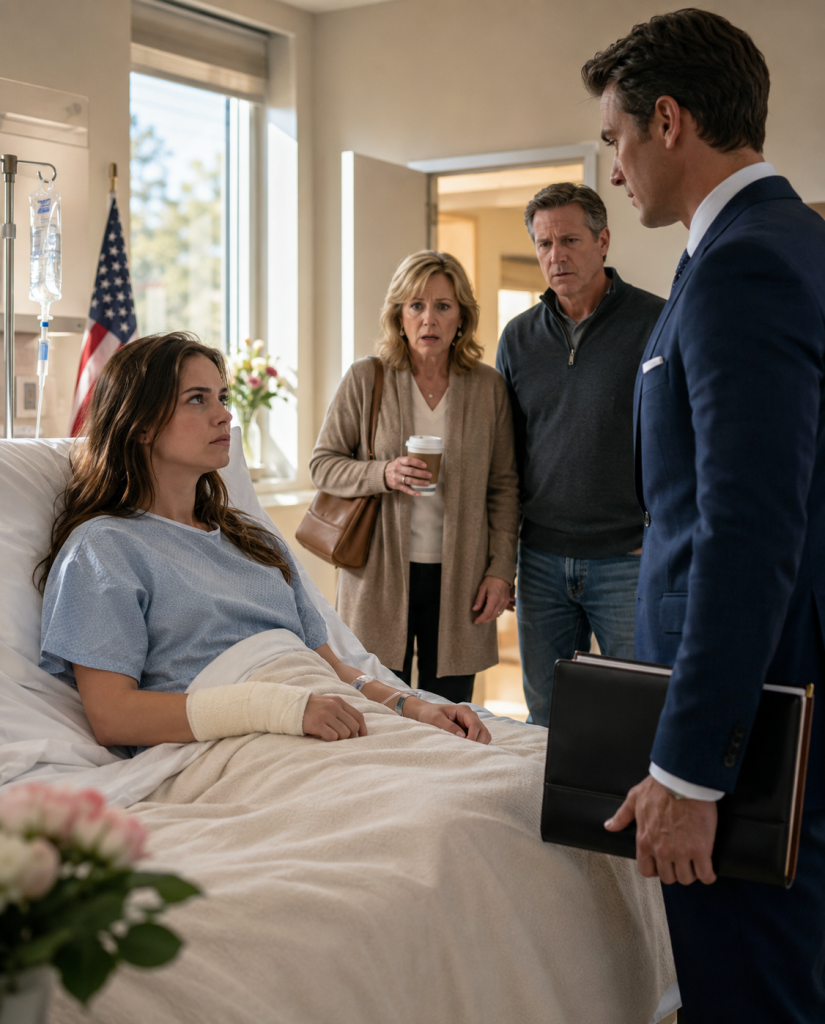
By 8:15 p.m., Julian Vance stood at the foot of my hospital bed in a navy suit, his briefcase resting on a chair.
He was in his late fifties, elegant, calm, and exactly the kind of lawyer wealthy people hire because he never looked surprised by human behavior.
He had represented me since the sale of my company.
He knew every trust, account, charitable foundation, property deed, and emergency directive connected to my name.
More importantly, he had warned me three times about leaving my family too much access.
“Sentiment,” he once told me, “is not an estate plan.”
I had laughed then.
I was not laughing now.
Julian looked at the monitors, then at the bruising visible above my hospital gown.
“Miranda,” he said gently, “you do not have to do this tonight.”
“Yes,” I whispered. “I do.”
He pulled a chair closer.
“Pain medication can complicate capacity questions.”
“I understand.”
“Then I need you to answer clearly. Do you know where you are?”
“St. Andrew’s Medical Center.”
“Do you know today’s date?”
“Yes.”
I gave it.
“Do you know why I am here?”
“To amend my estate plan, revoke certain beneficiary designations, update emergency financial access, and remove my family from positions of control.”
Julian studied me.
Then nodded once.
“Very well.”
Marisol stood near the door, not listening openly but close enough to assist if needed.
Julian called in another attorney from his firm through video to witness my capacity discussion.
He read every change aloud.
Slowly.
Carefully.
My parents were removed as beneficiaries from my will.
Lauren was removed entirely.
Their access to my emergency accounts was revoked.
My parents were removed as backup healthcare proxies.
Lauren was removed from all charitable foundation considerations.
The lake house they loved was transferred into the Miranda Hale Medical Scholarship Trust.
The education trusts my mother kept hinting I should create for Lauren’s future children were dissolved before they ever had names attached.
The board seats my parents proudly talked about at dinners, as if my foundation were a family souvenir, were reassigned to two physicians and one former foster care advocate.
My art collection would go to a women’s shelter network.
My private equity shares would fund rural trauma care.
My home would pass to a trust supporting first-generation medical entrepreneurs.
My family would receive nothing.
Not out of revenge, exactly.
Out of clarity.
Julian paused before the final clause.
“This removes your parents from the lake house immediately after the transfer is recorded. They will no longer have guest rights except by written permission from the trustee.”
I closed my eyes.
I thought of my mother standing on that dock in a white sunhat the day I gave them the keys.
“I always knew our family would end up somewhere like this,” she said.
Our family.
But it had been my money.
My work.
My loneliness.
My reward turned into shared property the moment they wanted it.
“Read it,” I said.
Julian did.
I signed slowly with my uninjured hand.
My wrist trembled.
The pen felt heavy.
Each signature hurt, not physically, but somewhere deeper.
I was not only changing documents.
I was grieving people who were still alive.
At 9:22 p.m., Julian notarized the final document.
At 9:38, digital copies were secured.
At 9:51, the updated emergency access directives were sent.
At 10:03 p.m., my mother finally walked into my hospital room holding a takeout coffee.
“Miranda,” she sighed, “you scared us.”
My father stood behind her, wearing a fleece jacket with Lauren’s moving-day dust still on one sleeve.
He looked tired.
Annoyed.
Not terrified.
Not like a father whose daughter had called nine times from a hospital bed after surgery.
Like a man interrupted during a long day.
Julian turned from the window.
My mother saw him and frowned.
“Who is this?”
“You know Julian,” I said quietly. “My attorney.”
Her eyes moved from him to the papers on the rolling table.
“What is going on?”
I looked straight at both of them.
“No,” I said. “You scared me.”
My mother blinked.
“What?”
“You asked if it was urgent.”
She shifted the coffee cup from one hand to the other.
“We were helping Lauren unpack. Your father’s phone was in the car half the day.”
“My phone died,” Dad added.
“You both posted videos.”
He looked uncomfortable.
Mom pressed her lips together.
“Miranda, this isn’t the time to keep score.”
“I counted nine calls.”
She sighed.
“There it is. You always do this.”
I almost laughed.
I always did what?
Remember?
Notice?
Refuse to pretend being neglected felt like love?
My ribs hurt too much to laugh, so I stayed still.
“You were recovering,” Mom said. “We knew you were in good hands.”
“I was in a hospital bed after surgery.”
“And we came.”
“After helping Lauren arrange throw pillows.”
My father’s face tightened.
“Your sister needed us.”
The monitor beside me beeped faster.
Marisol stepped closer, but I lifted one hand slightly.
I wanted them to say it.
I needed to hear it without excuses dressed as concern.
“And I didn’t?” I asked.
Dad looked away.
Mom set her coffee on the counter.
“Of course you did. But Lauren had movers leaving early, and Blake wasn’t much help, and she was overwhelmed.”
I stared at her.
“Lauren was overwhelmed by boxes. I was bleeding internally yesterday.”
Mom flinched, but only because the words sounded ugly.
Not because she had not known.
Julian stepped forward and placed the signed documents on the bedside table.
“Your daughter updated her estate plan tonight,” he said. “Everything is legally witnessed and notarized.”
Mom frowned.
“Estate plan? Miranda, this is dramatic.”
I turned my head slowly toward her.
“So was being alone after surgery while you decorated Lauren’s guest room.”
Dad’s face changed first.
“What did you change?”
Julian answered calmly.
“Mr. and Mrs. Hale, you have both been removed as beneficiaries. Lauren as well. Emergency account access has been revoked. Foundation seats reassigned. The lake house ownership is being transferred to Miranda’s medical scholarship trust.”
My mother’s coffee slipped from the counter when she reached for it.
The lid popped off.
Brown liquid splashed across the floor.
No one moved to clean it.
“You can’t punish family like this,” she whispered.
I looked at the IV in my arm.
Then at the parents who had taught me my pain was only real when it was convenient for them.
“No,” I said. “Family doesn’t ignore nine hospital calls and ask if surgery is urgent.”
Dad stepped closer.
“Miranda, you’re upset. We can talk about this when you’re better.”
“I am better,” I said.
Mom shook her head.
“No, you’re medicated. Julian, you should know better than to let her make decisions like this.”
Julian’s face did not change.
“Miranda demonstrated full capacity. The documents are valid.”
“She’s emotional.”
“Yes,” he said. “Being emotional does not make a person legally incompetent.”
Mom’s face flushed.
“This is family business.”
Julian looked at her evenly.
“Apparently not anymore.”
For the first time all night, I wanted to smile.
But the pain in my chest was too heavy.
My father stared at the papers.
“The lake house too?”
Of all things, that was what broke his voice.
Not the fact that I could have died.
Not the nine calls.
The lake house.
I closed my eyes.
“Yes.”
“Miranda,” he said, softer now. “Your mother loves that place.”
“I know.”
“We all do.”
“I know.”
“You gave it to us.”
“No,” I said. “I let you use it.”
His face hardened.
“You’re being cruel.”
There it was.
Cruel.
The word people use when someone stops making their life easier.
I turned toward him.
“Dad, when I woke up after surgery, I asked for you.”
He looked away.
“I asked the nurse if my parents were here. She said no. I called. I called again. I called until my hand shook too badly to hold the phone.”
Mom’s eyes glistened now, but I no longer trusted tears as proof of love.
“You knew I was alive,” she whispered.
“I knew you were busy.”
Silence filled the room.
Then Mom’s phone rang.
Lauren.
Of course.
Mom looked at the screen, then at me.
“Don’t answer,” Dad said under his breath.
But Mom did.
“Lauren, honey, not now.”
I could hear my sister’s voice shrieking through the speaker.
“What does she mean the lake house is gone? Blake just checked the property app because he was looking up tax stuff. Why is it listed under some trust?”
Mom’s face went pale.
“Lauren, lower your voice.”
“Is Miranda there? Put her on. Put her on right now.”
I held out my hand.
Mom hesitated.
Julian said, “Miranda is under no obligation to speak with her.”
“I want to,” I said.
Mom handed me the phone.
Lauren’s voice came through sharp and breathless.
“What did you do?”
“Hello to you too.”
“Don’t play games, Miranda. Why did you transfer the lake house?”
“Because it belongs to me.”
“It belongs to the family.”
“No. It belonged to my generosity.”
She scoffed.
“You’re unbelievable. I know you had an accident, but using it to hurt everyone is insane.”
I felt something inside me go very still.
“You know I had an accident?”
“Obviously.”
“And surgery?”
A pause.
“Mom said you were stable.”
“That wasn’t my question.”
Lauren sighed loudly.
“Oh my God, Miranda. I was moving. Do you know how stressful today was?”
I looked at my parents.
They were both staring at the floor.
“Yes,” I said. “I saw the throw pillows.”
Lauren went quiet.
Then she said the sentence that finished everything.
“You’ve always been jealous that they choose me when it matters.”
My mother whispered, “Lauren.”
But it was too late.
The truth had stepped into the room and closed the door behind itself.
I gave a small nod, though Lauren could not see me.
“Thank you,” I said.
“For what?”
“For finally saying it clearly.”
I handed the phone back to my mother.
“I’m done.”
Lauren was still talking.
Mom disconnected the call with shaking fingers.
No one spoke for several seconds.
Even my father looked stunned.
Maybe because Lauren had said the quiet part out loud.
Maybe because I had not collapsed beneath it.
Mom reached toward me.
“Miranda, she didn’t mean that.”
I shifted my arm away.
“She did.”
“She’s stressed.”
“She’s honest when she’s stressed.”
Dad rubbed his forehead.
“Can we please not make this worse?”
“It already is worse.”
Julian closed his briefcase.
“Miranda needs rest. I recommend you leave unless she asks you to stay.”
My mother stared at him like he had slapped her.
“She’s my daughter.”
Julian looked at me.
I looked at my mother.
“Please leave.”
Her face crumpled.
“Miranda.”
“Leave.”
Dad’s jaw tightened.
“Fine. We’ll talk when you’ve calmed down.”
I was too tired to explain that calm had gotten me here.
Calm had signed every page.
Calm had removed them from every place they thought they had earned by proximity.
They left with my mother crying quietly and my father walking stiffly beside her.
When the door closed, I thought I would feel victorious.
I did not.
I felt hollow.
Marisol came in with towels for the spilled coffee.
She cleaned the floor without making me ask.
Then she looked at me and said, “Do you want me to call anyone else?”
The question nearly broke me.
Anyone else.
Who was left when the people who should have come first did not come at all?
I thought of friends.
Colleagues.
Board members.
People who respected me.
People who liked me.
People who would be concerned if I texted.
But the child inside me, the one I rarely acknowledged, still wanted a mother.
Not an assistant.
Not a lawyer.
Not a nurse.
A mother.
I shook my head.
“No.”
Marisol squeezed my hand gently.
“Then I’ll check on you in a few minutes.”
That night, I did not sleep much.
Pain came in waves.
The medication blurred the edges of the room, but not the memory of Lauren’s voice.
You’ve always been jealous that they choose me when it matters.
I had spent thirty-eight years pretending it was more complicated than that.
It wasn’t.
Lauren was born four years after me, tiny and premature, and my parents never stopped treating her survival like a lifelong emergency.
When we were children, she cried if I got the bigger slice of cake, so I learned to choose the smaller one first.
She hated losing board games, so my mother told me to let her win because “you’re older, Miranda.”
She forgot homework, and I helped her finish it.
She crashed Dad’s car at nineteen, and my parents called me to lend her repair money.
She wanted a destination wedding, and my mother said, “You know Lauren. She dreams bigger than we can afford.”
I paid for the flowers.
Then the photographer.
Then the extra hotel rooms.
Every sacrifice was presented like maturity.
Every boundary was called selfishness.
When my company sold, my father cried and said he was proud.
For three whole minutes, I felt like I had finally become visible.
Then my mother said, “This could really help Lauren and Blake get started.”
I should have noticed then that pride in me had always been tied to usefulness.
The next morning, Julian returned with fresh documents and updates.
He looked more like a professor than a shark, which made people underestimate him exactly once.
“The transfers are moving,” he said. “I’ve also sent formal notices revoking family access.”
“Already?”
“You asked me to act quickly.”
“I did.”
He studied my face.
“Do you regret anything?”
I looked toward the window.
Snow had begun to fall outside, soft and steady.
“I regret waiting until a hospital bed to believe what I already knew.”
Julian nodded.
“That is different.”
My phone buzzed constantly over the next two days.
Mom.
Dad.
Lauren.
Blake.
Aunt Caroline.
A cousin I had not spoken to since Thanksgiving.
People who did not call after my accident suddenly cared deeply about family unity.
The messages followed a pattern.
At first, concern.
Miranda, we love you. Please call.
Then confusion.
I don’t understand why you would do this.
Then guilt.
Your mother has barely slept.
Then accusation.
Money changed you.
That one came from Lauren.
I almost responded:
No. Money revealed what you thought love should buy.
But I did not.
Julian advised silence.
Marisol advised rest.
My body demanded both.
On the third day, my parents returned to the hospital.
This time, they brought flowers.
Expensive ones.
White lilies in a glass vase.
My mother held them like a peace offering.
Dad stood behind her with a paper bag from my favorite bakery.
Old tricks.
Pretty things.
Familiar gestures.
They entered carefully.
No dramatic sighing.
No immediate accusations.
Mom’s eyes were red.
“Can we talk?” she asked.
I was stronger by then.
Still bruised.
Still in pain.
But less foggy.
“Yes.”
They sat in the chairs beside my bed.
For a moment, nobody spoke.
Then Dad cleared his throat.
“We handled this badly.”
I watched him.
Mom nodded quickly.
“We should have come sooner.”
“Yes,” I said.
She flinched at the flatness of my voice.
“We thought you were stable.”
“I was stable enough to ignore.”
“That’s not fair.”
I looked at her.
She closed her mouth.
Dad leaned forward.
“Miranda, we love you.”
I wanted that sentence to land somewhere useful.
It did not.
Love without action is just decoration.
“I believe you love me,” I said.
Relief crossed Mom’s face too soon.
I continued.
“I also believe you love what I provide. Stability. Money. Solutions. A safety net. A lake house. Emergency funds. A way to make Lauren’s life easier without asking her to become responsible.”
Dad’s expression tightened.
“That’s harsh.”
“It’s accurate.”
Mom clasped her hands in her lap.
“We never meant to make you feel less loved.”
“But you did.”
Tears filled her eyes.
“I don’t know how to fix that.”
“For once,” I said, “that is not my problem to solve.”
The room went very quiet.
Dad looked at the bakery bag on his lap.
“Are the legal changes permanent?”
There it was.
The question inside every apology.
I almost laughed.
“You waited less than five minutes.”
He looked ashamed, but not enough to stop.
“I’m asking because we need to understand.”
“No,” I said. “You need to know whether kindness can buy back access.”
Mom began crying.
“Miranda, please.”
“The changes are permanent.”
Dad closed his eyes.
“The lake house too?”
“Yes.”
“That place meant a lot to your mother.”
“So did having parents beside my hospital bed.”
Mom covered her face.
I softened for a second.
Then I remembered nine calls.
The video.
Lauren’s voice.
The word urgent sitting unanswered on my screen.
“I am not doing this to hurt you,” I said. “I am doing it because I finally understand that giving you more has never made you love me better. It only made you expect more.”
Dad looked at me then, really looked.
Maybe for the first time in years.
“You think we used you?”
I was quiet for a moment.
“I think you got comfortable letting me be the strong one. And strong people are easy to neglect because everyone assumes they can take it.”
Mom cried harder.
“I don’t want to lose you.”
“You lost access,” I said. “Not me. Not yet.”
Her hands lowered.
“What does that mean?”
“It means if you want a relationship with me, it has to exist without my money.”
Dad stared at the floor.
Mom whispered, “Of course.”
But her voice shook.
Not from emotion.
From uncertainty.
That told me everything.
They did not know how to relate to me without needing something.
A week later, I was discharged.
Julian arranged a private recovery nurse for the first several days.
Dana, my executive assistant, picked me up because I refused to let my parents perform concern after the fact.
Dana arrived in a black coat, hair pulled into a tight bun, carrying a tote bag filled with medications, paperwork, and the kind of organized competence that had kept my life functioning through company acquisition chaos.
When she saw me in the wheelchair, her face softened.
“You look terrible.”
“I appreciate your honesty.”
“You pay me for it.”
“I pay you for scheduling.”
“I include honesty for free.”
I smiled for the first time in days.
At home, my townhouse felt quiet but safe.
Dana had arranged fresh sheets, soup in the fridge, and a rotating schedule of nurses, friends, and colleagues who had insisted on helping once they learned what happened.
That was the strangest part.
People came.
Not because I had bought them lake houses.
Not because they expected education trusts.
Not because they wanted foundation seats.
They came because I was hurt.
My chief technology officer brought groceries and cried when she saw my bruises.
An old investor sent a driver and daily meals for two weeks.
A neighbor I barely knew shoveled my walkway.
Marisol, the nurse from the hospital, called once after her shift just to check in, though she did not have to.
Each kindness felt unfamiliar.
Not because I had never received kindness.
Because this kindness had no invoice attached.
Meanwhile, my family unraveled over lost benefits.
Lauren called from different numbers after I blocked her.
Blake emailed Julian twice asking whether the education trust “conversation” could be revisited because they were “planning for a family.”
Julian replied once:
Ms. Hale’s estate decisions are final. Future contact regarding expected gifts will be documented.
Blake stopped emailing.
My parents tried softer approaches.
Mom sent childhood photos.
Dad sent articles about forgiveness.
Aunt Caroline sent a message saying, “At the end of the day, blood is blood.”
I responded to that one.
So is internal bleeding. They ignored mine.
She did not reply.
Three weeks into my recovery, Julian called.
“The lake house transfer is complete.”
I sat by the window with a blanket over my legs.
Outside, sunlight reflected off the snow.
“Good.”
“There is another matter.”
“Of course there is.”
“Your parents are currently at the property.”
I closed my eyes.
“They were notified.”
“Yes.”
“And?”
“They have refused to leave. Your father told the property manager they were gifted the house verbally.”
I felt tired in a place sleep could not reach.
“What are my options?”
“As trustee representative, I can arrange formal removal. Quietly at first. Legally if necessary.”
I looked at the coffee table where my pain medication sat beside a stack of get-well cards from people who had actually shown up.
“Do it quietly first.”
Julian paused.
“Are you sure?”
“I am done protecting them from consequences. But I don’t need spectacle.”
“Understood.”
It did become a spectacle anyway.
Not because of me.
Because Lauren posted.
Can’t believe family can turn so cruel over a misunderstanding. Some people get money and forget who stood by them.
It was accompanied by a photo of the lake at sunset.
A lake she had visited twice a summer and never once helped maintain.
The comments filled with sympathy until someone from my company, who apparently had no patience for vague public martyrdom, replied:
Was the misunderstanding before or after Miranda was calling from the hospital after surgery?
The post disappeared within twenty minutes.
But not before screenshots reached everyone.
For the first time, the family narrative cracked outside the hospital room.
People began asking questions.
My parents stopped receiving only comfort.
They started receiving confusion.
Then criticism.
That upset them more than losing me, I think.
My father came to my townhouse one month after the accident.
He came alone.
Dana had just left, and my nurse was in the kitchen.
I saw him through the camera at the door.
He looked older.
Smaller.
For a moment, I almost did not answer.
Then I opened the door through the intercom.
He stepped inside carrying no flowers, no bakery bag, no offering.
Just himself.
That made me more willing to listen.
He stood in my living room, hands in his coat pockets.
“You look better,” he said.
“I am.”
“Good.”
Silence.
Then he said, “Your mother wanted to come.”
“Why didn’t she?”
“Because I told her I needed to speak first.”
I waited.
He looked toward the window.
“I failed you.”
The words were simple.
No explanation attached.
No but.
No defense.
I felt my throat tighten.
He continued.
“When Lauren was born early, your mother and I were terrified. We built our life around keeping her safe. Somewhere along the way, we started treating you like proof we had done something right because you didn’t need as much.”
He swallowed.
“But children shouldn’t have to earn attention by needing less.”
I looked down at my hands.
Bruises still colored one wrist.
“I needed you.”
“I know.”
“You didn’t come.”
His eyes filled.
“I know.”
There it was.
The beginning of something real.
Too late to undo.
Not too late to name.
“I don’t know how to forgive you,” I said.
He nodded.
“I’m not asking today.”
That surprised me.
He reached into his coat and pulled out an envelope.
My body tensed.
If it was a request, a deed, a financial document, I thought I might ask him to leave forever.
But he placed it on the coffee table and stepped back.
“It’s a letter. No request. No mention of the will. No mention of the house. I wrote what I should have said a long time ago.”
I stared at it.
“Mom?”
“She’s not there yet,” he said honestly.
The honesty hurt.
But it was better than performance.
“She’s angry?”
“She’s ashamed. She turns shame into anger when she doesn’t know where to put it.”
That sounded like my mother.
He moved toward the door.
“I’ll go.”
“Dad.”
He stopped.
“I don’t know if things can go back.”
He looked at me with wet eyes.
“Maybe they shouldn’t.”
Then he left.
I did not open the letter for two days.
When I finally did, I cried so hard my nurse came in from the kitchen.
My father had written about my childhood.
Not the polished version.
The real one.
The science fair he missed because Lauren had a cold.
The college move-in day I handled alone because Lauren had a panic attack over a breakup.
The company launch party they left early because Blake needed help fixing a dishwasher.
He remembered more than I thought.
That made it both better and worse.
At the end, he wrote:
You became extraordinary, and I mistook that for invulnerable. I am sorry. I do not want your money. I want to learn how to be your father without needing you to be useful first.
I folded the letter and placed it in my desk.
Then I called him.
Not to forgive.
Not yet.
Just to say I had read it.
My mother took longer.
Three months.
During that time, she sent messages that began with love and ended with guilt.
I did not answer most of them.
Therapy helped me understand that silence could be a boundary, not cruelty.
My therapist, Dr. Elaine Porter, said, “You are not withholding love. You are withholding access until safety exists.”
That sentence became another kind of legal document inside me.
Eventually, my mother asked to meet in Dr. Porter’s office.
Neutral ground.
No Lauren.
No Dad.
Just us.
She arrived wearing a navy coat and holding tissues.
She looked fragile, which made me angry because fragility had always been her shield.
When she sat across from me, she began crying immediately.
“I miss you,” she said.
I looked at Dr. Porter.
Dr. Porter nodded slightly.
I turned back to Mom.
“What do you miss?”
Mom blinked.
“What?”
“Do you miss me? Or do you miss calling me when something needs fixing?”
Her face crumpled.
“That’s cruel.”
Dr. Porter said gently, “Try answering the question.”
Mom pressed a tissue to her mouth.
“I miss my daughter.”
“Which version?”
She stared at me.
“The one who says yes? The one who pays? The one who doesn’t complain? The one who understands Lauren needs more? The one who lets everyone use the lake house and calls it family?”
Mom looked down.
“I don’t know how to answer without sounding awful.”
“Then start there.”
She cried harder.
“I think I did miss that version. At first.”
The truth entered quietly.
No thunder.
No dramatic music.
Just a mother admitting that convenience had become part of love.
She continued.
“Then your father showed me his letter. And I realized I didn’t know how to write one because I couldn’t remember the details the way he could. Not because they didn’t happen. Because I wasn’t looking.”
I closed my eyes.
That hurt.
“I wasn’t looking,” she repeated. “You were always handling things. I thought that meant you were okay.”
“I was a child.”
“I know.”
“Then an adult.”
“I know.”
“And when I called from the hospital?”
She sobbed.
“I thought stable meant safe.”
“No,” I said. “You thought Lauren’s need was louder.”
Mom nodded.
“Yes.”
It was the first time she admitted it.
I did not forgive her that day.
But something shifted.
Not enough to rebuild.
Enough to stop the bleeding.
Lauren never apologized.
Not really.
She sent one message six months later:
I’m sorry you felt abandoned, but you have to understand everyone was stressed.
I deleted it.
Blake later left her after the Ridgefield mortgage became too heavy without my quiet financial assistance.
My parents helped her downsize.
This time, they did not ask me for money.
That was progress, I suppose.
A year after the accident, the Miranda Hale Medical Scholarship Trust opened applications.
The lake house became its retreat center.
Not for my family.
For scholarship recipients, rural medical students, and young founders building healthcare tools for underserved communities.
The first weekend it opened, twelve students stayed there.
They sat on the dock with laptops and notebooks.
They cooked together.
They talked about debt, ambition, family pressure, and the exhaustion of being the first person in a room to believe you belong there.
I visited on Sunday.
Standing on that dock, watching them laugh where my family used to drink wine and call it ours, I felt something close to peace.
Not revenge.
Purpose.
The house was finally serving people who understood what it meant to fight for a future without applause.
My parents were not invited to the opening.
My father sent flowers.
My mother sent a short note.
I hope it becomes what you needed.
That one I kept.
Two years have passed now.
My body healed, though my ribs still ache when it rains.
The scar near my collarbone faded from angry red to pale silver.
The accident became one line in my medical history.
But the night of the nine calls became something else.
A dividing line.
Before it, I believed love meant giving people endless chances to choose me.
After it, I understood love also means recognizing when they don’t.
My relationship with my father is cautious but real.
We have lunch once a month.
He does not ask for money.
He asks questions about my work and waits for the answer.
Sometimes he slips into old habits and mentions Lauren too much.
Then he catches himself.
He is learning.
My mother is learning slower.
We speak occasionally.
Not intimately.
Not like the mother and daughter I used to imagine we could become if I just gave enough.
But honestly.
That may be better than fantasy.
Lauren and I do not speak.
I wish her no harm.
I also wish her no access.
Both can be true.
People think changing my estate plan was about punishment.
They are wrong.
Punishment would have required me to keep focusing on what they lost.
I changed my estate plan because I almost died and realized the people holding keys to my future could not be trusted to answer the phone when my present was breaking.
That is not punishment.
That is information.
I no longer count the calls with bitterness.
I count them like steps.
One.
The first time I hoped.
Two.
The first time I excused them.
Three.
The first time I felt foolish.
Four.
The first time I wondered if I mattered.
Five.
The first time I knew the answer might hurt.
Six.
The first time I thought of Julian.
Seven.
The first time I stopped waiting.
Eight.
The first time I understood.
Nine.
The last time I begged people to choose me before choosing myself.
Sometimes, late at night, I still see the hospital room.
The clock on the wall.
The IV in my arm.
The phone glowing with my mother’s text.
We’re at Lauren’s. Is this urgent?
I used to think urgent meant blood, surgery, monitors, and doctors speaking carefully.
Now I know urgent can also mean the moment your soul finally refuses to keep living on crumbs.
Urgent is the second you understand that being strong does not mean being available for neglect.
Urgent is calling the lawyer.
Urgent is signing the papers.
Urgent is removing people from places they should never have occupied.
Urgent is telling the truth while your voice shakes.
When my parents finally arrived with coffee and excuses, they expected gratitude because they had come at all.
Instead, they found Julian Vance standing at the foot of my hospital bed with the documents already signed.
They found their names removed.
Lauren’s too.
They found out the lake house was gone, the foundation seats were gone, the accounts were locked, and the daughter they had always called dependable had finally depended on herself.
My mother said, “You can’t punish family like this.”
But she was wrong.
I was not punishing family.
I was redefining it.
Family is not the person who asks if your surgery is urgent while fluffing pillows in your sister’s new house.
Family is the nurse who calls your lawyer without judgment.
The friend who brings soup without asking what she gets back.
The colleague who sits beside your bed and reads emails aloud because your eyes hurt.
The father who finally writes a letter without a request inside it.
The scholarship student who stands on your dock and says, “I didn’t know places like this were for people like me.”
Family, I learned, is not always who receives your inheritance.
Sometimes family is who teaches you what your inheritance should become.
I survived the crash.
I survived the surgery.
I survived the silence after nine calls.
But more than that, I survived the belief that love had to be earned through usefulness.
My body was broken that night.
But my will was finally healed.
And when the monitor beside me steadied after Lauren screamed about the lake house, I closed my eyes and rested for the first time all day.
Not because my parents had come.
Because I had stopped waiting for them to arrive as the people I needed.
I had arrived for myself.
THE END! THANKS FOR READING!