 Reading Time: 17 minutes
I came home for Thanksgiving and found the house freezing cold. My family had left a note saying, “We’re in Cancun. You handle Grandma.” Then I found her shivering on the floor, with the heater unplugged and her phone missing.
When she grabbed my wrist and handed me something, everything changed. When I opened the front door, the cold hit me like water from a basement pipe. My parents’ house in Ohio had always smelled like cinnamon candles, old carpet, and my mother’s expensive detergent.
That Thanksgiving morning, it smelled like metal and dust. The thermostat on the hallway wall blinked at forty-nine degrees.
My breath showed in front of my face. For a few seconds, I stood there with my suitcase still in my hand, wondering if the furnace had gone out. Then I saw the sticky note on the kitchen counter. Yellow paper.
My mother’s neat handwriting.
We’re in Cancun. Your flight got in first, so you handle Grandma. Back Sunday. Don’t make a scene.
For a moment, I just stared at it.
Don’t make a scene.
That was my mother’s favorite sentence.
When my brother Kyle crashed my car in high school and blamed me for leaving the keys out, I was told not to make a scene.
When Dad borrowed money from my college savings and called it “temporary family support,” I was told not to make a scene.
When Grandma Evelyn moved into the downstairs guest room after breaking her hip, and my parents acted like caring for her was a noble sacrifice instead of a legal and moral responsibility, I was told to be grateful they had opened their home.
Do not make a scene.
Translation: let us do whatever we want, and do not embarrass us by reacting.
My grandmother, Evelyn Whitaker, was eighty-two years old.
She had raised three children, survived breast cancer, buried her husband, and worked for twenty-nine years as a school secretary in the same small Ohio district where everyone knew her cinnamon rolls were better than anything sold at the bakery.
She was stubborn, funny, sharp when she needed to be, and proud in quiet ways.
After her fall that September, doctors said she needed help recovering.
My father insisted she move in with him and my mother.
“She’ll be safer with family,” he said.
Grandma had not looked convinced.
Neither had I.
But I lived in Denver, worked long hours as a paralegal, and had no spare bedroom at the time.
My parents had a downstairs guest room, a wide hallway, and enough money to hire part-time help if they wanted.
So Grandma moved in.
At first, my mother posted pictures online.
Mom smiling beside Grandma’s walker.
Mom arranging soup bowls.
Mom writing captions like, Family takes care of family.
But whenever I called Grandma, her voice sounded smaller.
Tired.
Careful.
She told me the house was cold even when my mother said it was not.
She told me her phone was “misplaced” too often.
She told me Dad kept bringing papers for her to sign.
“What papers?” I asked once.
“Oh, nothing important,” she said.
But her voice had tightened.
That Thanksgiving, I planned to fly in early and spend four days with her.
I thought my parents would be there.
I thought my brother would be there.
I thought we would eat dry turkey, endure my mother’s criticism, and then I would sneak Grandma extra pie after everyone went to bed.
Instead, the house was freezing, the family was in Cancun, and the sticky note sat on the counter like abandonment could be made polite with neat handwriting.
I dropped my suitcase.
“Grandma?”
No answer.
I moved through the hallway fast.
Her downstairs room was empty.
The bed was half-made, sheets twisted, her cardigan on the floor.
Her walker lay sideways near the bathroom door.
My heart began to pound.
“Grandma?”
Then I heard it.
A thin scraping sound from the living room.
I ran.
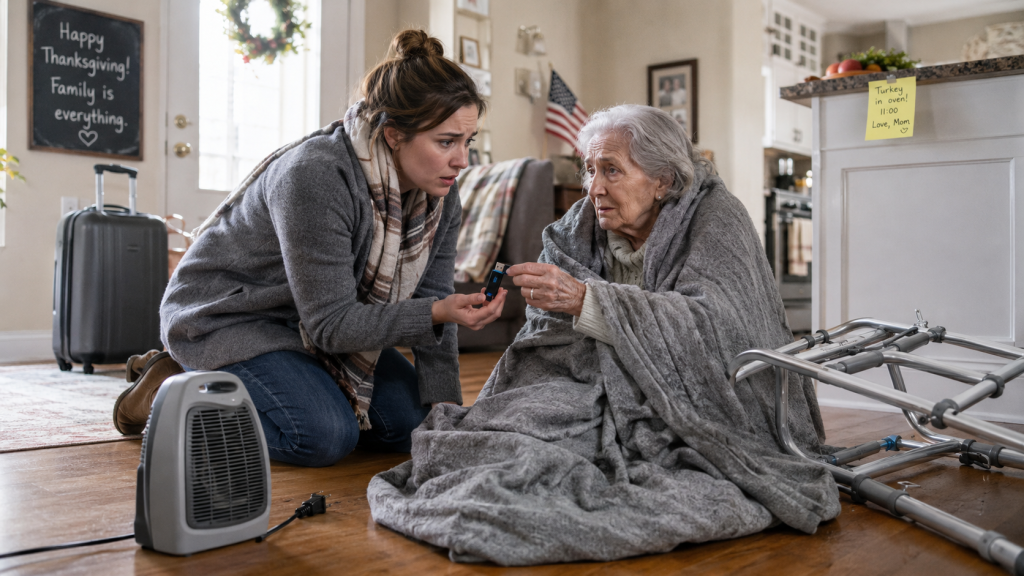
I found her on the hardwood floor beside the unplugged space heater.
She was wrapped in a blanket that had slipped off her shoulders.
Her lips were pale.
Her fingers trembled against the floorboards.
The lamp was off.
The curtains were drawn.
Her phone was gone from the little table where she always kept it.
For one terrible second, I thought she was already gone.
“Grandma,” I whispered, dropping beside her. “Oh my God.”
Her eyes opened.
Cloudy at first.
Then focused.
“Mara?”
“It’s me.”
I touched her face.
Her skin was cold.
Too cold.
“I’m calling 911.”
I pulled out my phone, but her hand shot up with surprising force and clamped around my wrist.
“Don’t tell them yet,” she whispered.
“Grandma, you’re freezing.”
“Listen.”
Her fingers pushed something small and hard into my palm.
A flash drive.
Black, with a strip of blue tape wrapped around it.
My stomach tightened.
“What is this?”
“The reason they left me here,” she breathed. “The reason they took my phone.”
I looked toward the empty hallway.
Suddenly, the whole house felt less empty than waiting.
Like my parents’ cruelty still stood in the corners.
“They wanted me to sign,” she said.
“Sign what?”
Her eyes filled with tears, but her voice stayed sharp.
“Power of attorney. The house. My accounts. Your father said I was confused. Your mother said no one would believe me.”
My hand closed around the flash drive.
For a moment, every strange phone call came back to me.
Grandma’s voice lowering.
Her saying, “Your father is worried about money.”
Her saying, “Your mother thinks I’m being difficult.”
Her saying, “If anything happens, Mara, you remember that I am not confused.”
I had thought she meant emotionally.
Now I understood.
She meant legally.
I dialed 911.
When the dispatcher answered, I gave the address and said my grandmother had fallen, that the house had no heat, that she was conscious but shaking.
I did not mention the flash drive.
While we waited, I dragged the blanket back over Grandma’s shoulders, plugged in the space heater, and rubbed her hands between mine.
The room warmed too slowly.
Grandma’s teeth chattered.
I tried to keep my voice calm.
“How long were you on the floor?”
Her eyes closed briefly.
“Since last night.”
My stomach turned.
“Last night?”
“They left before dawn yesterday. Said Kyle would come by. He didn’t.”
“Kyle knew?”
Her mouth trembled.
“He took my phone.”
I felt something inside me go still.
Not numb.
Focused.
My brother had taken an elderly woman’s phone, left her without heat, and flown to Mexico with my parents.
“Why didn’t they take you with them?” I asked.
Grandma gave a small bitter sound that might have been a laugh.
“Because I wouldn’t sign.”
A siren sounded in the distance.
Grandma gripped my sleeve.
“When they come back,” she whispered, “don’t be alone with them.”
“I won’t.”
“Promise me.”
“I promise.”
The EMTs arrived six minutes later.
Two men and one woman came in with medical bags and a stretcher.
Their expressions changed the moment they felt the temperature inside the house.
One of them, a woman named Casey, knelt beside Grandma.
“Ma’am, can you tell me your name?”
“Evelyn Whitaker.”
“Do you know where you are?”
“My son’s house,” Grandma said. “Unfortunately.”
Casey glanced at me.
I almost laughed.
Almost.
They checked her temperature, blood pressure, and oxygen.
They asked how she fell.
Grandma looked at me once.
Then said, “I was trying to reach the heater.”
Casey’s eyes moved to the unplugged cord.
She said nothing, but her jaw tightened.
They took Grandma to the hospital.
I followed in my rental car with the flash drive hidden in the lining of my purse.
At St. Anne’s Medical Center, they treated Grandma for mild hypothermia, dehydration, bruising from the fall, and exhaustion.
A social worker came before I had even finished the hospital coffee.
Her name was Denise.
She had kind eyes and a steel clipboard.
“Your grandmother says she lives with your parents,” Denise said.
“Yes.”
“And your parents are currently out of the country?”
“In Cancun.”
Denise wrote that down.
“Was a caregiver arranged?”
“My mother left a note telling me to handle Grandma because my flight got in first.”
Denise’s pen paused.
“Were you informed before arrival that you would be responsible for her care?”
“No.”
“Did your grandmother have access to a phone?”
“No. She says my brother took it.”
Denise looked up.
“She says?”
I opened my purse.
“I need to show you something, but I’m not sure what’s on it.”
The hospital could not access the flash drive for me, but Denise advised me to make copies and contact Grandma’s attorney immediately.
Grandma heard that from the bed and lifted one finger.
“Call Mr. Ellison.”
“Who is Mr. Ellison?”
“My lawyer.”
I blinked.
“You have a lawyer?”
Grandma’s lips twitched.
“I have lived eighty-two years, Mara. I have several things your father doesn’t know about.”
That was the first time I smiled that day.
I called the number she gave me.
Arthur Ellison answered on the second ring.
The moment I said my name, he said, “Is Evelyn safe?”
That told me everything.
“She’s in the hospital.”
“I’ll be there in thirty minutes.”
He arrived in twenty-two.
Arthur Ellison was tall, thin, and severe, with silver hair, a dark overcoat, and the expression of a man who had spent his entire life politely ruining liars.
He took one look at Grandma and softened.
“Evelyn.”
“Arthur,” she said. “I told you they were getting bold.”
“I wish you had called sooner.”
“They took my phone.”
His mouth tightened.
Then he turned to me.
“You have the drive?”
I nodded.
We went to a small consultation room near the nurses’ station.
I opened my laptop.
The flash drive contained video files, audio recordings, scanned documents, and a folder named If Mara Finds This.
My hands shook when I clicked it.
The first file was a video.
Grandma’s room.
Camera angle low, as if from a tablet propped against books.
My father stood near her bed holding papers.
“You are making this harder than it has to be,” he said.
Grandma sat in her chair, wrapped in a blue sweater.
“I am not signing.”
“You don’t understand what you’re doing.”
“I understand perfectly.”
My mother’s voice entered from off-screen.
“You’re acting paranoid, Evelyn. No one is stealing from you. We’re trying to simplify things.”
Grandma looked directly toward the camera for half a second.
“Then simplify your own accounts.”
My father slammed the papers against the dresser.
“You live in my house.”
“I was invited here after surgery.”
“You are a burden here.”
I heard myself inhale sharply.
Arthur’s face did not change, but his hand closed into a fist.
The second video was worse.
My mother stood beside the space heater.
Grandma’s voice said, “Linda, don’t unplug that. I’m cold.”
“You’re always cold,” my mother snapped. “The electric bill is ridiculous.”
“I pay you rent.”
“You call that rent? It barely covers the inconvenience.”
Then my mother unplugged the heater and walked out.
The third file showed Kyle entering Grandma’s room.
He looked annoyed, wearing sunglasses pushed up on his head.
“Dad says you can’t keep calling Mara and making drama.”
Grandma said, “Give me my phone.”
Kyle picked it up from the table.
“You can have it after the trip.”
“What trip?”
He grinned.
“Cancun.”
Then he left.
I sat frozen.
Arthur clicked into the audio folder.
There were recordings of my parents discussing power of attorney.
Dad’s voice: She’ll sign when she gets scared enough.
Mom’s voice: Mara is coming Thursday. We need it done before then.
Kyle’s voice: Just tell Mara Grandma is confused. She always believes old people are fragile.
I stood so quickly my chair scraped the floor.
Arthur paused the recording.
“Mara.”
“I need air.”
I walked into the hallway and pressed both hands against the wall.
For years, I had known my family was selfish.
Manipulative.
Cold when generosity required actual effort.
But this was not selfishness.
This was planned.
They had isolated an elderly woman, removed her phone, tried to pressure her into signing away control, and left her freezing while they went on vacation.
My parents had not simply failed Grandma.
They had punished her for refusing to be useful.
I returned to the room.
“What happens now?” I asked.
Arthur looked at me.
“Now we protect her before they return.”
Over the next three days, everything changed.
Grandma was admitted overnight, then transferred to a short-term rehabilitation facility under medical recommendation.
Arthur filed paperwork revoking all pending authorizations my father had tried to prepare.
He contacted adult protective services.
A police report was made.
Denise, the hospital social worker, documented the conditions in which Grandma had been found.
I photographed the house.
The thermostat.
The sticky note.
The unplugged heater.
The missing walker position.
The locked cabinet where Grandma said my father kept her bank statements.
Mrs. Donnelly, the neighbor, gave a statement that no caregiver had come by after my parents left.
I copied the flash drive three times.
One copy went to Arthur.
One to APS.
One into a safe deposit box Arthur helped me open.
And one stayed with me.
I did not tell my parents anything.
They texted from Cancun as if nothing had happened.
Mom sent a photo of herself holding a coconut drink.
Mom: Make sure Grandma eats soft foods. Don’t give her too much pie.
Dad sent: Furnace acting up? Call the service number on fridge if needed.
Kyle sent a selfie from a beach chair.
Kyle: Hope Grandma isn’t being too annoying lol.
I stared at that message for a long time.
Then I screenshotted it and added it to the folder.
By Saturday night, Grandma was warm, hydrated, and angry enough that I knew she would recover.
She sat propped in bed at the rehab center, eating mashed potatoes with a determination that made the nurse smile.
“You look better,” I said.
“I am better. Anger improves circulation.”
I laughed.
Then she reached for my hand.
Her fingers were still thin and bruised.
“I’m sorry you had to find me that way.”
My throat tightened.
“I’m sorry I didn’t see it sooner.”
“You live across the country.”
“I still should have known.”
“No,” she said sharply. “That is how people like your father survive. They make everyone else responsible for noticing what they hide.”
I sat beside her.
“Were they always like this?”
Her eyes moved toward the window.
The November sky was gray.
“Your father was always proud. Pride can grow into rot if no one cuts it back.”
“And Mom?”
“She likes comfort. People who worship comfort can become very cruel when asked to be decent.”
I thought about that.
My mother’s soft sweaters.
Her candle collection.
Her perfectly arranged living room.
Her ability to cry when challenged and sharpen her voice when alone.
“What were they trying to get?” I asked.
Grandma sighed.
“My house.”
“Your house?”
“My house in Lakewood. The one your grandfather bought before he died. I still own it. They wanted me to transfer it into a family trust controlled by your father.”
I stared at her.
“I thought you sold it.”
“That’s what your father told people.”
“Why?”
“Because he wanted everyone to think I had nothing left but what he provided.”
My stomach turned.
“And your accounts?”
“Enough to make them interested. Not enough to make them kind.”
She looked at me then.
“I changed my will six months ago.”
I blinked.
“What?”
“Arthur handled it.”
“Grandma—”
“Don’t look frightened. I did not leave everything to you.”
“That’s not what I meant.”
“I know. I left some to charity, some to your cousins, and some to you. Your father gets one dollar and an explanation.”
Despite everything, I laughed.
Grandma smiled.
“I wanted to make sure he knew it wasn’t a clerical error.”
My family returned Sunday afternoon.
Sunburned.
Smiling.
Dragging suitcases through the same front door they had left Grandma behind to freeze behind.
I was waiting in the living room.
Not alone.
Grandma sat in her recliner, wrapped in a thick blanket, a portable heater humming safely beside her.
Arthur Ellison sat in the armchair near the fireplace.
Two officers stood near the hallway.
Denise from the hospital was there too, along with an adult protective services investigator named Carla.
I stood beside Grandma’s chair with the remote in my hand.
The flash drive was already plugged into the television.
The front door opened.
My mother stepped in first, wearing sunglasses on her head and a flowing white cover-up beneath her winter coat.
She stopped so abruptly my father bumped into her.
“Mara?” she said.
Her eyes darted to Grandma.
Then to Arthur.
Then to the officers.
“Why are you still here?”
Dad’s smile disappeared.
Kyle walked in behind him, dragging a suitcase and looking at his phone.
“What’s going on?”
Grandma lifted her chin.
“Hello, Kyle.”
His face drained.
Maybe he had expected her to be in bed.
Or confused.
Or silent.
Maybe, deep down, he had expected something worse.
Dad recovered first.
“What is this?” he demanded.
I held up the sticky note.
“This is what I found when I arrived.”
Mom’s face tightened.
“You were supposed to help, not create drama.”
Grandma’s voice cut through the room.
“She helped.”
Mom looked at her with false softness.
“Evelyn, honey, you don’t understand what’s happening.”
Grandma’s eyes sharpened.
“I understand perfectly.”
Dad turned on me.
“You called people?”
“Yes. EMTs, adult protective services, Grandma’s attorney, and the police.”
“You had no right.”
Arthur stood.
“She had every right.”
Dad glared at him.
“This is a family matter.”
Arthur adjusted his glasses.
“Neglect, coercion, and suspected financial exploitation are not private family matters.”
My mother’s face went pale.
“Financial exploitation? That is disgusting.”
I looked at her.
“Then you’ll hate the videos.”
She froze.
Kyle’s phone lowered.
Dad took one step forward.
“What videos?”
I pressed play.
The television filled with Grandma’s room.
Dad holding papers.
His own voice came through the speakers.
“You are making this harder than it has to be.”
The color drained from his face.
Mom whispered, “Turn that off.”
I did not.
The next clip showed Mom unplugging the heater.
Then Kyle taking Grandma’s phone.
Then an audio recording of all three of them discussing how fear might make Grandma sign.
She’ll sign when she gets scared enough.
That sentence filled the living room like smoke.
No one moved.
Dad lunged toward the television.
One officer stepped forward.
“Sir, stop.”
Dad froze, breathing hard.
Mom began crying.
Not softly.
Not from remorse.
The kind of crying she used when people were watching.
“This is not what it looks like.”
Grandma laughed once.
Dry.
Sharp.
“It is exactly what it looks like, Linda.”
Mom turned to her.
“We were trying to help you.”
“You left me on the floor.”
“We didn’t know you fell.”
“You took my phone.”
Kyle blurted, “Dad told me to!”
Dad spun on him.
“Shut up.”
The officer looked at Kyle.
“Keep talking if you want.”
Kyle’s mouth opened and closed.
For the first time in his life, he looked like a spoiled child who had realized adults outside the family might not obey Dad.
Arthur opened his briefcase and removed several documents.
“Evelyn revoked all pending authorizations this morning. Any power of attorney forms prepared by you are void. Her financial institutions have been notified. Her accounts are secured. Her home in Lakewood is not transferable without her direct consent.”
Dad’s jaw tightened.
“She’s not competent.”
Grandma sat forward.
“Try me.”
The room went silent.
Arthur almost smiled.
“Evelyn was evaluated by medical staff and found lucid, oriented, and capable of making her own decisions.”
Mom gripped the back of a chair.
“Evelyn, please. This is Mara manipulating you.”
Grandma looked at her for a long moment.
“You always thought I was lonely enough to accept cruelty if it came with a roof.”
Mom flinched.
“I cooked for you.”
“You complained while doing it.”
“We gave you a room.”
“You locked my papers in your office.”
“We were protecting you.”
“You were waiting me out.”
That landed.
Mom’s tears stopped.
Dad’s face hardened into something ugly.
“You ungrateful old woman.”
The words left his mouth before he could stop them.
The officers heard.
Arthur heard.
Denise heard.
I heard.
And Grandma heard.
For a moment, pain flashed across her face.
Then it passed.
Something stronger replaced it.
She reached for my hand.
“I am changing my will.”
Dad’s eyes widened.
Mom whispered, “Evelyn.”
Grandma looked straight at them.
“No. You wanted me helpless. You wanted me frightened. You wanted my signature more than my safety.”
Her voice shook, but did not break.
“So here is the last thing I will sign for this family: the document removing you from anything that belongs to me.”
Dad began shouting then.
About betrayal.
About family.
About how much they had sacrificed.
Mom cried again.
Kyle insisted he did not know how serious it was.
The officers separated their voices from the facts.
Statements were taken.
The APS investigator asked questions.
Arthur remained calm through all of it.
I stood beside Grandma’s chair and realized my family no longer looked powerful.
They looked small.
Not because they had lost money.
Because the truth had entered the room and taken away the stage.
By evening, my parents were told not to contact Grandma directly while the investigation continued.
Grandma did not stay in that house another night.
Arthur arranged a private care suite at a rehabilitation residence first, then helped her return to her own Lakewood home once modifications were made.
Handrails.
Medical alert system.
New locks.
Security cameras.
A caregiver she chose.
A phone that stayed within reach.
I stayed in Ohio for three weeks.
My job in Denver gave me emergency leave after I told my supervisor enough of the truth.
During those weeks, Grandma grew stronger.
She walked farther each day with her walker.
She argued with the physical therapist.
She criticized hospital oatmeal.
She asked me to bring her lipstick before meeting with bank representatives.
“I refuse to let your father make me look pale in a legal setting,” she said.
That was Grandma.
My parents tried to control the story.
Of course they did.
Mom posted vague messages online about “family betrayal” and “elder care being misunderstood.”
Dad told relatives I had overreacted to a broken furnace.
Kyle claimed he had only taken Grandma’s phone because she kept “confusing herself.”
Then Arthur sent selected relatives a factual letter.
No drama.
No insults.
Just dates, medical findings, legal status, and the existence of recordings.
The family went quiet after that.
Some relatives apologized for believing my parents.
Some stayed silent because silence is easier than admitting you were fooled.
Aunt Carol called me crying.
“I knew your father was pushy,” she said. “I didn’t know he was capable of this.”
I did not comfort her.
I was tired of comforting people who should have noticed sooner.
Neither my parents nor Kyle faced the kind of dramatic punishment people imagine in movies.
Real consequences are slower.
Messier.
But they came.
Adult protective services substantiated concerns.
Financial institutions flagged accounts.
My father’s attempt to claim Grandma lacked capacity failed.
The pending documents he had prepared became evidence of coercion.
Kyle’s involvement cost him his job at a small accounting office when his employer learned he had taken an elderly relative’s phone during a financial dispute.
Mom lost her place on two charity committees after the story reached the wrong ears.
The same women who admired her Cancun photos suddenly stopped inviting her to brunch.
That hurt her more than any legal letter.
As for Dad, Arthur made sure he understood that one more attempt to contact Grandma about money would trigger immediate legal action.
Dad believed he could bully family.
He was less confident with lawyers who kept receipts.
Grandma returned to her Lakewood house in January.
Snow covered the porch railings.
The house smelled faintly of cedar, old books, and the lavender soap she always used.
I had not been there since childhood.
The living room still had Grandpa’s reading chair.
The kitchen still had the yellow clock shaped like a rooster.
Grandma stood in the doorway with her walker, looking around like someone returning to herself.
“I thought I’d never come back,” she whispered.
I touched her shoulder.
“You’re home.”
She nodded.
Then she pointed at the thermostat.
“Turn that up. I intend to be wasteful with heat.”
I laughed and cried at the same time.
We spent that first night eating soup at her kitchen table while snow tapped the windows.
She told me stories about Grandpa.
About raising my father.
About mistakes she had made.
“He was not born cruel,” she said quietly.
I stirred my soup.
“No one is.”
“I excused too much when he was young. Your grandfather was stricter. I softened things. I thought love meant protecting him from consequences.”
She looked toward the dark window.
“Sometimes protecting people from consequences teaches them other people are consequences.”
I thought about Dad.
About Kyle.
About my mother.
About every time I had been told not to make a scene.
“Maybe,” I said. “But his choices are still his.”
Grandma nodded.
“Yes. They are.”
In March, Grandma changed her will formally.
I went with her to Arthur’s office.
She wore a purple scarf, pearl earrings, and lipstick the color of cranberries.
Arthur read every page aloud.
Grandma listened carefully.
Her estate would support a scholarship fund for students entering elder care professions.
A portion would go to a local senior advocacy nonprofit.
Some would go to relatives who had shown kindness without expectation.
A portion came to me.
My father received one dollar and a letter.
Grandma asked me if I wanted to read the letter.
I said no.
“That is between you and him.”
She smiled.
“Good answer.”
Months passed.
I returned to Denver, but I came back to Ohio often.
Grandma and I spoke every evening.
Her new caregiver, Tessa, sent me updates.
Grandma learned to video call and accidentally showed me the ceiling for the first two weeks.
She got better.
She joined a senior book club.
She called Arthur “dramatic” when he insisted on reviewing a suspicious piece of mail.
She planted tomatoes in raised boxes that spring and sent me photos of every single one.
My parents did not apologize.
Not truly.
Mom sent one letter saying she hoped I was happy “destroying the family.”
Dad left a voicemail telling me lawyers had twisted everything.
Kyle texted once:
You really ruined my life over Grandma being cold?
I stared at that message for a long time.
Then I replied:
No, Kyle. You helped endanger her over money.
He never answered.
The hardest part was not losing them.
It was accepting that the family I had tried to keep had always required someone else to disappear.
First me.
Then Grandma.
Maybe others before us.
Peace built on silence is not peace.
It is a waiting room for harm.
The following Thanksgiving, Grandma and I spent the holiday at her Lakewood house.
Just the two of us.
No Cancun photos.
No sticky notes.
No cold rooms.
No one ordering anyone to stay quiet.
We cooked too much food.
Turkey breast.
Mashed potatoes.
Green beans.
Cranberry sauce from a can because Grandma said homemade cranberry sauce was “a scam against tired women.”
We set the table with her old blue plates.
Before eating, she raised her glass of sparkling cider.
“To making scenes,” she said.
I laughed.
“To making necessary scenes.”
She smiled.
“That’s better.”
After dinner, we sat in the living room with the heat turned high, watching snow fall beneath the porch light.
The space heater hummed safely nearby, plugged into a new outlet installed by an electrician Grandma had personally interviewed like a federal judge.
She reached for my hand.
“You saved my life.”
My throat tightened.
“You saved yourself. You recorded everything. You hid the drive. You refused to sign.”
“I was afraid.”
“I know.”
“I thought maybe no one would believe me.”
I looked at her.
“I believe you.”
Her eyes filled.
For a moment, she looked not eighty-two, not stubborn, not indestructible.
Just human.
An old woman who had been hurt by her own son and still found the strength to leave proof behind.
She squeezed my hand.
“That was enough.”
Later that night, after Grandma went to bed, I stood in the hallway and looked at the thermostat.
Seventy-two degrees.
Warm.
Steady.
Safe.
I thought about the year before.
The freezing house.
The sticky note.
The cold floor.
Grandma’s trembling fingers pressing the flash drive into my palm.
My mother had written, Don’t make a scene.
But some scenes must be made.
Some doors must be opened.
Some family secrets deserve witnesses.
I used to think loyalty meant protecting the people who shared your blood.
Now I know loyalty means protecting the person being harmed, even when the people harming them share your name.
My grandmother gave me the flash drive because she knew truth needs somewhere safe to go.
I became that place.
And when my parents came home sunburned and smiling, expecting Grandma frightened, confused, and ready to sign, they found her warm, awake, and no longer alone.
That was the moment everything changed.
Not because they finally understood.
I am not sure people like that ever fully understand.
It changed because Grandma did.
And I did too.
We were not the family embarrassment.
We were the witnesses.
We were the record.
We were the scene they told us not to make.
And once the truth played on that living room television, there was no cold room left for their lies to hide in.
THE END! THANKS FOR READING!