 Reading Time: 14 minutes
I raised my younger brother after our parents passed away — the day he turned eighteen, he handed me Mom’s old jewelry box and said, “There’s one thing she never wanted you to find out.” When I was twenty-six, my entire life changed overnight.
My ten-year-old brother, Lucas, had always been my favorite person in the world. From the day he was born, I felt protective of him in a way I never fully understood. I helped with his homework, took him to the park, packed snacks in his little backpack, and read him bedtime stories whenever our parents were busy.
He used to crawl into my bed during thunderstorms, dragging his blue blanket behind him, and whisper, “Maya, don’t let the sky get me.” I would wrap my arms around him and say, “I won’t. I promise.”
Back then, I thought that was just what big sisters did. Then one evening, everything fell apart.
Our parents were involved in a terrible car accident on their way home from dinner. My mother died at the scene, and my father passed away a few hours later at the hospital. By some miracle, Lucas survived with only bruises and a broken wrist.
When the police called me, I remember standing in my apartment kitchen with the phone pressed to my ear, listening to words that did not sound real.
Accident.
Hospital.
Critical.
Deceased.
I dropped to the floor before the call ended.
At twenty-six, I became an orphan.
Lucas became one at ten.
The first time I saw him after the accident, he was sitting in a hospital bed, his arm wrapped in a cast, staring at the wall like his soul had gone somewhere far away. When he saw me, he did not cry at first. He just looked at me and asked, “Where’s Mom?”
I had no answer that would not destroy him.
So I climbed into the hospital bed beside him and held him while the doctors and nurses watched quietly from the doorway.
When I finally told him, his whole body shook.
That sound still lives inside me.
Our relatives arrived quickly after the funeral. They brought casseroles, flowers, sympathy cards, and opinions. Everyone had something to say about what should happen to Lucas.
Aunt Carol said she could take him, but she lived four states away and already had three teenagers. Uncle Brian said boarding school might be best because “structure helps boys.” My mother’s cousin suggested rotating custody between relatives until we figured things out.
I listened to them discuss my brother like he was a package that needed shipping.
Then I looked across the living room and saw Lucas sitting on the stairs, holding Mom’s scarf against his chest.
He was listening.
His face was pale.
That was the moment I knew.
“No,” I said.
Everyone turned toward me.
Aunt Carol frowned. “Maya, sweetheart, this is not something you can decide emotionally.”
“I’m not deciding emotionally,” I said, though my voice was shaking. “Lucas stays with me.”
Uncle Brian sighed. “You’re twenty-six. You work full time. You live in a one-bedroom apartment.”
“Then I’ll find another apartment.”
“You don’t know what raising a child takes.”
I looked at Lucas again.
He was watching me now, his eyes wide and terrified.
“I know what losing family feels like,” I said. “And I’m not letting him lose me too.”
No one agreed easily. There were meetings, papers, court dates, background checks, and social workers. I had to prove I could provide a stable home while barely holding myself together.
I found a small two-bedroom apartment with peeling paint and noisy pipes. I sold my car and bought an older one with fewer payments. I took extra shifts at the clinic where I worked as an administrative assistant. I stopped buying coffee, stopped eating out, stopped doing anything that did not directly help keep us afloat.
At night, after Lucas fell asleep, I sat at the kitchen table surrounded by bills and cried quietly into my hands.
Some days, grief felt like a second person living in the apartment with us.
It sat beside me when I packed Lucas’s lunch.
It followed me to work.
It waited in the hallway when I came home.
Lucas had nightmares for months. He would wake up screaming, calling for Mom, and I would run to his room, pull him into my arms, and tell him I was there.
Sometimes he pushed me away.
Sometimes he clung to me so hard I could barely breathe.
Once, after a particularly bad dream, he whispered, “What if you die too?”
I smoothed his hair back from his damp forehead.
“I’m not going anywhere,” I said.
“You can’t promise that.”
He was only ten, but grief had made him older.
I swallowed my tears.
“You’re right,” I said softly. “But I can promise that as long as I am here, you will never be alone.”
He stared at me for a long time.
Then he whispered, “You’re like Mom now.”
Those words broke me in a way I could not explain.
I did not want to replace our mother.
I wanted her back.
But life did not care what I wanted.
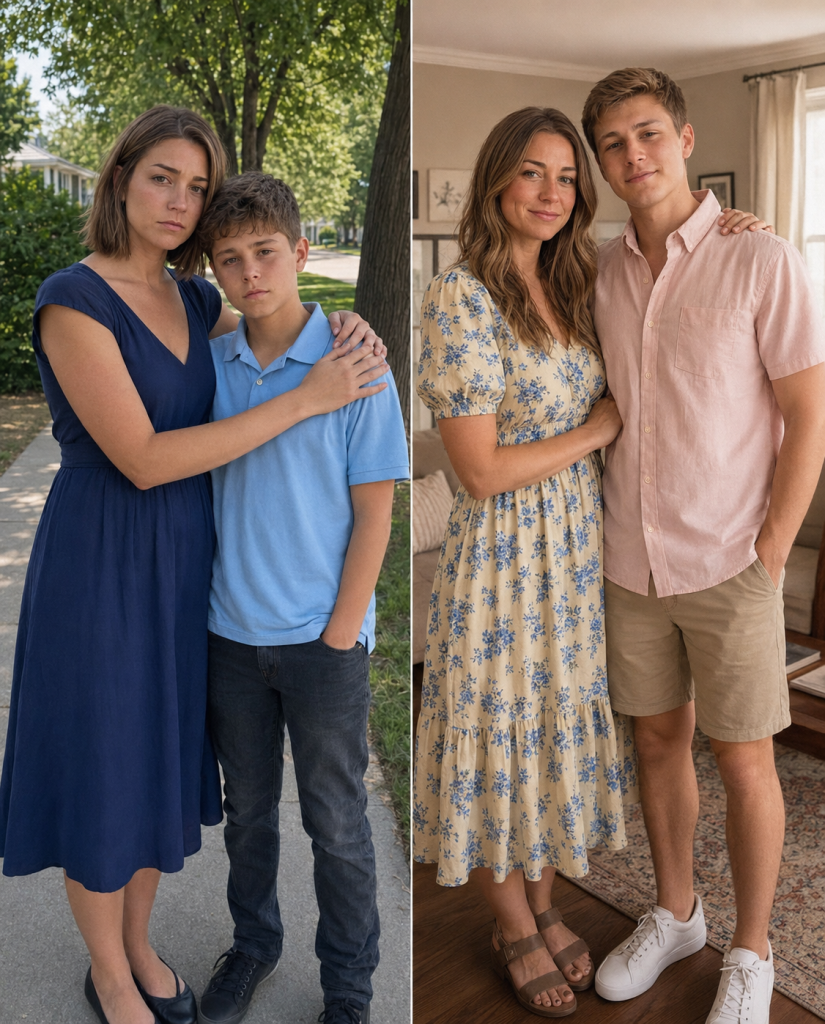
So I learned.
I learned how to attend parent-teacher conferences while being mistaken for Lucas’s mother. I learned how to cook meals that were cheap but filling. I learned how to remove grass stains, sign school forms, set boundaries, and pretend I was not terrified every single day.
Lucas learned too.
He learned how to make his own breakfast when I worked early. He learned how to sit quietly beside me when I paid bills. He learned that sometimes love looked like frozen pizza and a tired smile.
We had difficult years.
At twelve, he got into a fight at school because another boy said our parents were “dead forever.” I was called into the principal’s office and found Lucas sitting with blood on his lip and rage in his eyes.
In the car afterward, I wanted to lecture him, but instead he burst into tears.
“I hate him,” he sobbed. “I hate everyone who still has parents.”
I pulled into an empty parking lot and let him cry.
“I know,” I whispered. “Sometimes I hate them too.”
At thirteen, he stopped talking much. He wore hoodies even in warm weather and spent hours in his room. I worried constantly. I checked his grades, his friends, his mood, his sleep.
One night, I found him sitting on the bathroom floor with Mom’s old perfume bottle in his hand.
“I forgot her voice,” he said.
I sat beside him.
“I remember it,” I told him.
“Tell me.”
So I did.
I told him how Mom sang off-key while washing dishes. How she called everyone “honey” when she was distracted. How she laughed with her whole body. How she always smelled like vanilla lotion and laundry soap.
Lucas leaned his head against my shoulder.
“Don’t forget,” he whispered.
“I won’t.”
At fourteen, he began to come back to himself.
He joined the robotics club. He started smiling again, cautiously at first, like happiness was something fragile he did not fully trust. He grew taller than me almost overnight and teased me about needing a step stool.
At fifteen, he got his first crush and asked me how to talk to girls. I gave him terrible advice and then drove him to the mall to buy a shirt that was not black.
At sixteen, he got his learner’s permit. The first time he drove us to the grocery store, I pressed my foot against the imaginary brake so hard my calf cramped.
“Relax,” he said, laughing.
“I am relaxed.”
“You look like you’re preparing to meet God.”
“Keep both hands on the wheel.”
He laughed again, and for one beautiful moment, he sounded like a normal teenager.
Those moments kept me alive.
Birthdays.
School plays.
Burnt pancakes on Saturday mornings.
The way Lucas always saved me the last piece of cake.
The way he still knocked on my bedroom door during storms, even at seventeen, pretending he just wanted to check if the windows were closed.
Eight years passed faster than I ever imagined.
Suddenly, my little brother was graduating from high school.
I sat in the audience watching him walk across the stage in his cap and gown, and my chest hurt from pride. When they called his name, I clapped so hard my palms stung.
Lucas looked into the crowd, found me, and smiled.
I saw the ten-year-old boy from the hospital.
I saw the teenager who survived nightmares.
I saw the man he was becoming.
After the ceremony, he hugged me tightly and whispered, “We made it.”
I laughed through tears.
“Yes,” I said. “We did.”
A month later, Lucas turned eighteen.
I wanted to make the day special. Not huge, because neither of us loved big parties, but warm. Safe. Full of the family we still had.
I cooked his favorite meal: baked chicken, mashed potatoes, green beans, and chocolate cake with too much frosting. A few relatives came over. Aunt Carol cried when she saw how tall Lucas had become. Uncle Brian gave him a card with a hundred dollars inside and told him he was proud.
For once, the house felt full in a good way.
People told stories about Mom and Dad. Lucas laughed. I laughed. There was sadness under it, but not the kind that swallowed us. More like a shadow in the corner, present but quiet.
After everyone left, I began clearing plates from the table.
Lucas stood near the hallway, unusually silent.
“What?” I asked. “Too much cake?”
He shook his head.
“I need to give you something.”
He disappeared into his room.
When he came back, he was holding our mother’s old jewelry box.
I froze.
I had not seen it since the day she died.
It was small and wooden, with a faded rose painted on the lid. The corners were worn smooth from years of use. Mom used to keep it on her dresser, and when I was little, I would sit beside her while she opened it.
Inside were her earrings, necklaces, little pins, and her wedding ring on the nights she made bread and did not want dough stuck under it.
After the funeral, the box vanished.
I assumed one of my relatives had packed it away.
Lucas held it carefully, like it was heavier than wood and metal.
“Where did you get that?” I asked.
“In the attic,” he said. “I found it last year when I was looking for Christmas decorations.”
“Last year?”
He nodded.
“I didn’t know how to tell you.”
My stomach tightened.
“Tell me what?”
Lucas walked to the table and placed the jewelry box in my hands.
Then he looked me in the eyes and quietly said, “There’s one thing Mom never wanted you to find out.”
The room went silent.
I almost laughed because the sentence sounded impossible. My mother had secrets, maybe small ones, but not the kind that made an eighteen-year-old look like he was carrying a lifetime on his shoulders.
“What are you talking about?” I asked.
Lucas sat across from me.
“Open it.”
My fingers trembled as I lifted the lid.
The familiar scent hit me first.
Old perfume.
Wood.
A trace of vanilla.
Inside were Mom’s pearl earrings, her gold bracelet, a silver locket, and her wedding ring wrapped in a piece of blue cloth.
Beneath everything was an envelope.
My name was written on the front.
Maya.
My mother’s handwriting.
I forgot how to breathe.
“Lucas,” I whispered, “what is this?”
“I think you need to read it.”
I stared at him.
His eyes were wet.
That scared me more than the letter.
I opened the envelope slowly, afraid the paper might fall apart in my hands. The letter inside was folded twice. The edges were yellowed, and there were faint tear stains near the bottom.
My sweet Maya,
If you are reading this, then Lucas is old enough to know the truth, and I am no longer there to explain it myself.
I stopped.
My vision blurred.
Lucas reached across the table and placed his hand over mine.
“Keep reading,” he said.
I forced myself to continue.
There are things parents do because they believe they are protecting their children. Sometimes they are right. Sometimes they are only afraid. I have carried this secret for years, and every day I wondered if silence was mercy or theft.
My heart began to pound.
Lucas is not your brother by blood.
The words sat on the page like they did not belong to any language I understood.
I looked up at Lucas.
He was crying silently.
“What does that mean?” I whispered.
He did not answer.
I looked back down.
He is your son.
The room tilted.
A sound came out of me, small and broken.
“No.”
My chair scraped against the floor as I stood too quickly.
“No, that’s not possible.”
Lucas stood too.
“Maya—”
“No,” I said again, backing away from the table. “No, I would know. I would remember.”
But even as I said it, something cold opened inside me.
A blank place.
A place I had never touched.
The year I was sixteen had always been blurry.
I remembered being sick.
I remembered the accident.
Not the car accident that took my parents years later, but another accident before Lucas was born. I had fallen down the stairs at school during a winter dance. That was what I had been told. A concussion. Internal injuries. Weeks in the hospital. Medication. Confusion.
I remembered waking up and crying because my body hurt.
I remembered Mom sitting beside me, stroking my hair, saying, “It’s over now, baby. You’re safe.”
I did not remember why her eyes were always red.
My hands shook so badly the letter rattled.
I kept reading.
When you were sixteen, you went through something no child should ever endure. You were hurt, frightened, and afterward, your mind protected you by burying what happened. By the time we realized you were pregnant, you were already fragile beyond words. Your father and I made a decision. Maybe the wrong one. Maybe the only one we knew how to make.
When Lucas was born, we told everyone he was ours.
I covered my mouth.
The air left my lungs.
We wanted you to have a life. We wanted Lucas to be loved. We thought, in time, we would tell you. But every year you healed a little more, and every year the truth felt more dangerous. Then Lucas grew, and you loved him with a devotion that made me wonder if some part of your heart always knew.
I sank back into the chair.
Memories flashed through me.
Holding Lucas as a baby and feeling an ache so deep I cried when Mom took him from my arms.
Sneaking into his nursery just to watch him sleep.
Feeling angry when relatives called him “Mom’s little miracle,” though I never understood why.
The way Lucas reached for me before anyone else.
The way Mom watched us sometimes with guilt in her eyes.
I pressed the letter against my chest.
Lucas whispered, “I found it last Christmas.”
I looked at him.
“You knew?”
He nodded, tears slipping down his face.
“I didn’t want to believe it at first. I thought maybe Mom was confused or the letter wasn’t real. Then I found my birth certificate copy in the bottom of the box.”
My voice came out barely above a whisper.
“What did it say?”
“Your name was listed as mother. Then crossed out on another document. Mom and Dad adopted me legally a few months later.”
I closed my eyes.
Pain moved through me, but it was not simple pain. It was grief, shock, rage, love, and a strange, terrible recognition.
Lucas was my brother.
Lucas was my son.
Lucas was the child I had raised without knowing I had given birth to him.
“Why today?” I asked.
He wiped his face.
“Because Mom wrote on the back of the envelope that I should tell you when I turned eighteen. She said by then, no one could take me away from you.”
That sentence broke me.
I lowered my head and sobbed.
Not softly.
Not gracefully.
I cried for the sixteen-year-old girl who had lost more than she knew. I cried for my mother, who had made an impossible choice and carried the cost. I cried for my father, who must have loved us both enough to live inside a lie. I cried for Lucas, who had spent a year holding the truth alone.
And I cried because I had spent eight years thinking I chose to raise my brother after losing my parents.
But maybe, somewhere deep in me, I had been choosing my son all along.
Lucas came around the table and knelt beside me.
“I’m sorry,” he whispered. “I didn’t want to hurt you.”
I grabbed his hands.
“No. No, don’t apologize.”
“I was scared you’d look at me differently.”
I looked at his face.
The boy I had packed lunches for.
The teenager I taught to drive.
The baby I once must have held without being allowed to understand.
“I do look at you differently,” I said.
His face crumpled.
I pulled him into my arms before fear could take him.
“I look at you and see even more reasons to love you.”
He collapsed against me, sobbing like he had when he was ten.
For a long time, we stayed there on the kitchen floor, holding each other while the jewelry box sat open on the table and the past poured out around us.
The next few weeks were hard.
Truth is not a door you open once. It is a hallway, and every step reveals another room.
I found medical records. Old court papers. Letters from my mother to my father. Notes from doctors about trauma and memory loss. Some pages I could barely read. Some I chose not to read alone.
I began therapy.
Lucas came with me sometimes.
There were days I felt furious at my parents.
How could they hide something so huge from me?
How could they let me grow up beside my own child and call him my brother?
Then there were days I understood just enough to hate the situation instead of them.
They had been scared.
They had been grieving what happened to me.
They had wanted to protect a child who was still a child herself.
That did not make the lie painless.
But it made it human.
Aunt Carol eventually admitted she had known part of it. Not everything, she claimed, but enough. She cried when I confronted her.
“Your mother made us promise,” she said. “She said you would not survive knowing back then.”
“Maybe,” I replied. “But I survived not knowing too. And that had a cost.”
Lucas and I talked more honestly than we ever had.
At first, he did not know what to call me.
“Maya” felt normal.
“Mom” felt too heavy.
I told him he did not have to change anything.
“You can call me whatever feels right,” I said.
He nodded, but I could see the question stayed with him.
One night, during a thunderstorm, he knocked on my bedroom door like he had done since childhood.
He was eighteen, taller than me, almost grown.
“Windows are closed,” he said awkwardly.
I smiled through tears.
“Good.”
He stood there for another second.
Then he said, “Can I sit with you?”
I moved over.
He sat on the edge of the bed while thunder rolled above the apartment.
After a while, he whispered, “Do you think she was wrong?”
I knew he meant Mom.
I looked toward the window, watching rain slide down the glass.
“I think she was afraid,” I said. “And I think fear can make people do loving things badly.”
Lucas nodded.
“Do you forgive her?”
I thought about the jewelry box. The letter. The years stolen from both of us. I thought about Mom’s tired eyes and the way she kissed Lucas’s forehead every night like she was apologizing without words.
“I’m trying,” I said.
He leaned his head against my shoulder.
“So am I.”
Months passed.
The truth settled into our lives, not comfortably, but permanently.
Lucas started college nearby, partly because he said the program was good, partly because he was not ready to leave yet. I did not argue. I was not ready either.
On the morning he moved into his dorm, he packed too many hoodies and forgot towels. I teased him, cried in the parking lot, and helped him make his bed.
Before I left, he walked me to the car.
“I know this is weird,” he said.
“What is?”
He looked embarrassed, suddenly younger.
“I don’t want to replace Grandma. She raised me too. But sometimes when people ask who you are, I don’t know what to say.”
My throat tightened.
“What do you want to say?”
He looked down, then back at me.
“I want to say you’re my mom.”
The world went quiet.
I covered my mouth.
Lucas smiled nervously. “Only if that’s okay.”
I laughed and cried at the same time.
“Lucas, that is more than okay.”
He hugged me in the middle of the parking lot, surrounded by parents carrying laundry baskets and freshmen pretending not to be scared.
For the first time, he whispered, “Love you, Mom.”
I held him tighter.
“Love you too, sweetheart.”
That night, I went home to the apartment and opened Mom’s jewelry box again.
I placed her letter back inside, along with a new photograph: Lucas and me at his high school graduation, smiling through tears.
Then I added a note of my own.
Mom,
I know now.
I am angry.
I am grateful.
I am broken.
I am healing.
You should have told me.
But you were right about one thing.
Some part of my heart always knew.
I closed the jewelry box and set it on my dresser.
For years, I thought my life changed the night my parents died.
But the truth was, my life had changed long before that, in a hospital room I could not remember, with a baby I was told was my brother.
I lost the truth for eighteen years.
But I never lost him.
And maybe love is sometimes stronger than memory.
Because even when no one told me Lucas was my son, I loved him like he was mine from the very beginning.
The day he turned eighteen, he gave me Mom’s old jewelry box and uncovered the secret she had carried to her grave.
But he also gave me something else.
Not just the truth.
Not just pain.
He gave me back the missing piece of myself.
And when he called me Mom for the first time, I finally understood that family is not only what people tell you.
Sometimes family is what your heart recognizes before your mind is ready to know.
THE END! THANKS FOR READING!