 Reading Time: 14 minutes
My daughter married a Korean man when she was twenty-one. After that, she did not come home for twelve years. But every year, without fail, she sent me eighty thousand dollars. This Christmas, I chose to go to her without telling anyone.
And when I opened the door to her house, I froze. I will never forget the morning I held the plane ticket in my hands. My heart was beating so hard I thought it might burst through my chest. Twelve years.
Exactly twelve years since my daughter, Mary Lou, had walked through the airport gate with a suitcase in one hand and her new husband’s hand in the other. Twelve years since I had hugged her goodbye and told myself she would be back soon.
Twelve years of waiting.
Twelve years of birthdays without her.
Twelve years of Christmas dinners where I set an extra plate even though I knew she would not come.
And every year, exactly eighty thousand dollars arrived in my bank account.
Not seventy-nine thousand.
Not eighty-one.
Exactly eighty thousand.
The first time it happened, I thought it was a mistake.
I called the bank three times.
I even asked the woman behind the counter if someone could accidentally send that much money to the wrong account.
She checked everything and smiled.
“No, Mrs. Theresa,” she said. “It came from your daughter.”
My daughter.
Mary Lou.
My only child.
The little girl I raised alone after her father died before she turned five.
People in my town said I was lucky.
“You must be so proud,” my neighbor Clara told me. “Your daughter married rich. She takes care of you from overseas. Eighty thousand dollars every year? That is a blessing.”
I smiled when people said things like that.
I nodded.
I let them believe I was happy.
Because how do you explain to someone that money can fill a bank account but still leave a house empty?
How do you tell people that you can sit inside a renovated kitchen, with new cabinets your daughter paid for, and still cry into your soup because the chair across from you is empty?
My name is Theresa Miller.
I am sixty-three years old.
I was widowed young, and for most of my life, I had only one purpose.
Mary Lou.
She was the kind of child who made hard days softer.
She had round cheeks, bright eyes, and a laugh that sounded like bells when she was little.
She loved to read under the kitchen table.
She loved yellow dresses.
She loved drawing little houses with flowers by the door.
Whenever I worked late shifts cleaning offices, she would wait for me with a blanket on the couch and pretend she had not fallen asleep.
“Mom,” she used to say, “one day I’ll buy you a big house so you never have to work again.”
I would kiss her forehead and say, “I don’t need a big house. I just need you.”
She would laugh.
Back then, neither of us knew how true those words would become.
Mary Lou grew into a beautiful young woman.
Smart.
Quiet.
Kind.
The kind of girl who noticed lonely people.
She graduated college early and took a job at a trading company in the city. That was where she met Kang Jun.
He was Korean.
He was almost twenty years older than her.
And from the moment she brought him home, something inside me tightened.
It was not because he was Korean.
I want that clear.
I had no problem with where he came from.
What frightened me was his age.
His quietness.
The way Mary Lou watched him before she answered questions, as if she was measuring what he wanted her to say.
He was polite to me.
Too polite.
He brought expensive tea, fruit, and flowers.
He bowed slightly when he greeted me.
He said my daughter was special.
He said he wanted to give her a future.
But when he looked at her, there was something in his eyes I could not read.
Not love.
Not exactly.
Something more like ownership.
I told Mary Lou I was worried.
She became angry.
“Mom, please don’t do this,” she said. “I know what I’m doing.”
“You’re twenty-one.”
“I’m not a child.”
“He is much older than you.”
“That doesn’t mean he’s bad.”
“I never said he was bad.”
But maybe I should have.
Maybe I should have shouted.
Maybe I should have locked the door and begged her to stay.
But mothers are always balancing fear and trust.
Hold too tightly, and your child runs.
Let go too easily, and you wonder forever if you should have held harder.
So I gave in.
The wedding was simple.
Too simple.
No big celebration.
No long engagement.
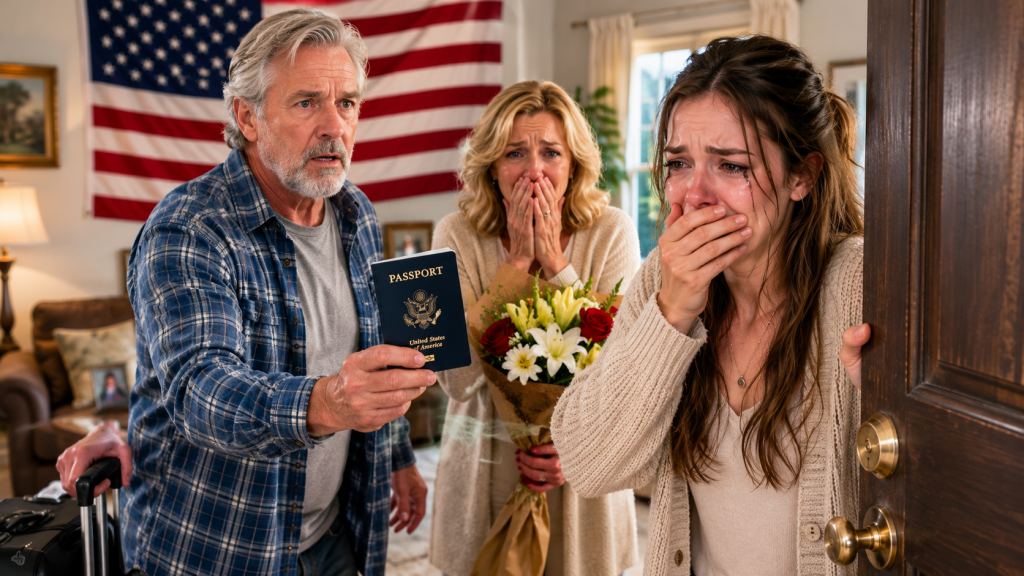
Within a month, Mary Lou married Kang Jun.
Within another week, she was leaving for South Korea.
At the airport, she cried harder than I had ever seen her cry.
She hugged me like she was trying to memorize my bones.
“Mom,” she sobbed, “please take care of yourself.”
“I will,” I said, stroking her hair. “You come home when you can.”
She nodded.
But her face looked strange.
Almost frightened.
I thought she was only scared of moving far away.
I did not understand then.
I watched her walk through security.
She turned back three times.
The last time, she lifted her hand.
Then she disappeared.
That was the last time I held my daughter for twelve years.
The first year, she called often.
Not every day, but enough.
She told me Korea was beautiful.
She said the food was different, but she was learning.
She said Kang Jun was busy with business.
When I asked what kind of business, she said, “Import and export, Mom. It’s complicated.”
Then the calls became shorter.
Her messages became careful.
“Mom, always take care of yourself. I’m doing well.”
I hated that sentence.
I’m doing well.
It sounded like a door closing.
By the fifth year, I stopped asking when she would come home.
Every time I asked, she paused too long.
Then she gave me an answer that sounded rehearsed.
“Soon, Mom.”
“I’m busy right now.”
“Maybe next year.”
“Kang Jun’s work is complicated.”
Once, we had a video call on Christmas Eve.
She looked beautiful, but thinner.
Her hair was tied back.
Her face was pale.
Behind her was a plain white wall.
No decorations.
No tree.
No husband.
“Where is Kang Jun?” I asked.
“At work.”
“On Christmas?”
She smiled, but it did not reach her eyes.
“In Korea, things are different.”
I did not believe her.
But I did not know what to do.
I was a sixty-year-old woman who had never left the country.
I barely knew how to use a smartphone properly.
South Korea felt like another planet.
So I waited.
And the money kept arriving.
Every January.
Exactly eighty thousand dollars.
The first few years, I saved almost all of it.
Then Mary Lou insisted I use it.
“Fix the roof, Mom.”
“Buy the good medicine.”
“Replace the old car.”
“Don’t work anymore.”
So I did.
I repaired the house.
I bought a safer car.
I stopped cleaning offices at night.
I donated to the church.
I helped Clara when her son needed surgery.
Everyone said, “Your daughter is an angel.”
I smiled.
But at night, I sat in Mary Lou’s old bedroom and touched the stuffed rabbit she left behind.
Money had made my life easier.
But it had not made me less lonely.
Every Christmas, I cooked beef stew because it had been her favorite.
I set the table for two.
I lit candles.
I waited until the food went cold.
Then I packed the leftovers and cried quietly so no one would hear.
This past December, something changed.
Maybe it was age.
Maybe it was loneliness.
Maybe it was the way Mary Lou’s last message sounded even shorter than usual.
“Mom, I’m doing well. Please don’t worry.”
Please don’t worry.
That was something people said when there was a reason to worry.
I sat at the kitchen table staring at those words for a long time.
Then I stood up and went to Clara’s house.
“I need help buying a plane ticket,” I told her.
She stared at me.
“To where?”
“Korea.”
Her mouth fell open.
I did not tell Mary Lou.
I did not tell anyone except Clara.
I was afraid if I told too many people, I would lose courage.
The paperwork was confusing.
The airport was terrifying.
The flight felt endless.
I had never been so far from home.
I gripped the armrest during takeoff until my fingers cramped.
The woman beside me kindly showed me how to use the screen on the seat.
When the plane finally landed in Seoul, I was exhausted, stiff, and afraid.
The airport was huge.
People moved quickly around me.
Signs were written in a language I could not read.
I clutched the paper where Clara had written Mary Lou’s address in Korean and English.
A taxi driver studied it, nodded, and helped me with my bag.
As the city passed outside the window, I pressed my hand to my chest.
“Mary Lou,” I whispered. “Mom is coming.”
The address led to a quiet neighborhood.
Not poor.
Not rich.
Just quiet.
The house was two stories with a small front garden.
The garden was neat, but cold-looking.
No toys.
No shoes by the door.
No signs of life.
I paid the driver and stood outside the gate for several minutes.
My daughter was somewhere inside.
After twelve years, I was close enough to touch the door.
I rang the bell.
No answer.
I rang again.
Still nothing.
The gate was not locked.
I do not know what made me open it.
Maybe worry.
Maybe instinct.
Maybe twelve years of unanswered questions.
I walked up the path slowly.
The front door was slightly open.
My heart began to pound.
“Mary Lou?” I called softly.
No answer.
I pushed the door open.
And froze.
The living room was large, clean, and completely lifeless.
Everything was in place.
Too much in place.
The sofa looked unused.
The table had plastic flowers in a vase.
There were no family photos.
No jackets.
No shoes.
No smell of food.
No sound of television.
No laughter.
No husband calling from another room.
Nothing.
It did not feel like a home.
It felt like a house pretending to be one.
“Mary?” I called again.
My voice sounded small.
I walked into the kitchen.
It was spotless.
Not the kind of clean that comes from care.
The kind of clean that comes from emptiness.
The refrigerator held a few bottles of water and some withered fruit.
No leftovers.
No vegetables.
No sauces.
No sign that anyone cooked there.
My stomach twisted.
I went upstairs.
There were three doors.
The first was a bedroom.
The bed was made so perfectly it looked untouched.
The closet was full of women’s clothes, but most of them were plain.
Black, gray, beige.
Not my Mary Lou’s colors.
No yellow dresses.
No bright scarves.
No earrings on the dresser.
No man’s clothing.
No trace of Kang Jun.
The second room was an office.
A desk.
A chair.
A computer.
Stacks of papers.
But no photos.
No personal things.
No sign of a married couple’s life.
My hands started shaking.
Then I opened the third door.
And my knees nearly gave out.
Boxes.
So many boxes.
Some were sealed.
Some were open.
Inside them were stacks of cash.
Dollars.
Bundles and bundles of money.
I stepped back, covering my mouth.
“What is this?” I whispered.
I knew Mary Lou sent me eighty thousand dollars every year.
But this was much more than that.
Far more.
Where did it come from?
Why was it hidden?
Why was it sitting in boxes inside a room with no lock?
I reached out and touched one stack with trembling fingers.
It was real.
My daughter had been living in a lifeless house with boxes of money and no husband in sight.
Fear crawled up my spine.
Then I heard the front door open downstairs.
My body went stiff.
Footsteps.
Slow.
Then faster.
Someone called out in Korean.
I did not understand.
Then, in English, a voice said, “Who is here?”
My heart stopped.
It was Mary Lou.
I rushed to the doorway just as she reached the top of the stairs.
For a moment, we stared at each other.
My daughter stood in front of me wearing a plain gray coat.
She was still beautiful.
But thinner.
So much thinner.
Her eyes looked older than mine.
“Mom?” she whispered.
I tried to speak.
No words came.
Her face crumpled.
“You weren’t supposed to come.”
That sentence broke something inside me.
Not “I missed you.”
Not “I’m happy.”
You weren’t supposed to come.
I stepped toward her.
She stepped back.
“Mary Lou,” I said, my voice shaking. “What is happening here?”
She looked past me into the room of money.
Her face went pale.
“You saw it.”
“Yes.”
She pressed one hand to her mouth.
“Mom, please don’t be scared.”
“Don’t be scared?” I repeated. “I haven’t seen my daughter in twelve years. I find her house empty, her husband gone, and a room full of cash. Tell me how not to be scared.”
Tears filled her eyes.
“I can explain.”
“Where is Kang Jun?”
She closed her eyes.
For a long moment, she said nothing.
Then she whispered, “He died nine years ago.”
The hallway seemed to tilt.
I grabbed the doorframe.
“Nine years?”
She nodded.
“You told me he was working.”
“I lied.”
“Why?”
Her tears spilled over.
“Because I was ashamed.”
I stared at her.
Ashamed.
My daughter had been alone in a foreign country for nine years, and she had been ashamed to tell her own mother.
She led me downstairs.
We sat at the kitchen table.
There was no tea.
No food.
Just two women sitting across from each other with twelve years of silence between them.
Mary Lou folded her hands tightly.
“Kang Jun wasn’t rich,” she said. “Not really. He wanted people to think he was. He borrowed money. He made promises. He used my name for things I didn’t understand.”
“What things?”
“Business loans. Visa papers. Company documents. He said it was normal. He said I was his wife and should trust him.”
Her voice trembled.
“When we came here, I found out he had debts. So many debts. He owed dangerous people money. He had told them I came from a rich American family.”
I covered my mouth.
“We were not rich.”
“I know. But he lied.”
She stared at the table.
“At first, I thought I could fix it. I got work. Cleaning hotels. Washing dishes. Teaching English at night. Translating documents whenever I could. Then Kang Jun got sick suddenly. Heart failure. He died before I even understood how bad everything was.”
“Why didn’t you come home?”
She laughed once, broken and bitter.
“With what money? My passport was being held by one of his creditors. I didn’t speak enough Korean then. I didn’t know who to trust. And I thought if I came home, everyone would know I had failed.”
“Failed?”
“My marriage. My life. Everything.”
I wanted to reach for her, but she looked so fragile I was afraid she would break.
“So the money?” I asked softly.
Mary Lou wiped her face.
“The first year after he died, I worked four jobs. I barely slept. I lived in one rented room. I ate instant noodles and rice. I saved everything because I kept thinking of you.”
“Me?”
“You had worked your whole life for me. You gave up everything. I wanted you to rest. I wanted people to respect you. I wanted you to think your daughter was safe and successful.”
My chest ached.
“So you sent eighty thousand dollars.”
She nodded.
“It became a promise to myself. Every year, no matter what happened, I would send it.”
“And the money upstairs?”
“I started earning more later. Translation work became a business. Then I invested in small rental properties with a woman who helped me when I had no one. The money upstairs is savings. Some of it is for taxes. Some is for returning to America. Some…” She swallowed. “Some I kept because I didn’t know how to stop being afraid.”
I looked around the empty kitchen.
“Mary Lou, you lived like this while sending me money?”
She could not answer.
Her silence did.
I stood and walked to her.
This time, when I reached for her, she did not step away.
I held her face in my hands.
She looked like my little girl and a stranger at the same time.
“Oh, my foolish child,” I whispered.
She broke.
Her knees folded, and I sank with her to the kitchen floor.
She cried against my chest like she had cried at the airport twelve years earlier.
“I’m sorry, Mom,” she sobbed. “I’m so sorry. I wanted to come home every year, but the longer I waited, the harder it got. I thought you would hate me.”
“Hate you?” I cried. “I was waiting for you.”
“I didn’t want you to see me like this.”
“Like what?”
“Alone.”
I held her tighter.
“Mary Lou, I have been alone too.”
That silenced her.
I touched her hair.
“All those years, people told me I was lucky because you sent money. But I didn’t want the money. I wanted my daughter.”
She cried harder.
“I thought I was helping you.”
“You were trying to love me the only way you thought you could.”
“Yes.”
“But love is not money, baby.”
“I know.”
“No,” I whispered. “I don’t think you did.”
That night, we did not sleep.
We sat on the kitchen floor because neither of us wanted to move.
Mary Lou made instant noodles because that was all she had.
She apologized for not having real food.
I laughed and cried at the same time.
“After twelve years,” I said, “you think I care what we eat?”
We ate from two bowls, sitting shoulder to shoulder.
Outside, the Korean winter pressed against the windows.
Inside, my daughter slowly came back to me.
She told me everything.
The early fear.
The shame.
The exhaustion.
The people who helped her.
The people who used her.
The years she spent pretending on video calls.
The Christmas nights when she cried after sending me cheerful messages.
“I set a place for you every Christmas,” I told her.
She covered her mouth.
“I bought a small cake every Christmas,” she said. “And I put one candle in it for you.”
We both cried again.
The next morning, I opened every curtain in the house.
Sunlight poured into rooms that had felt dead the day before.
Mary Lou blinked at the brightness.
“What are you doing?” she asked.
“Making this house look less like a storage unit for sadness.”
For the first time in twelve years, my daughter laughed.
It was small.
Rusty.
But it was hers.
Over the next few days, I learned the truth of her life.
Mary Lou was not helpless.
She was not a failure.
She was one of the strongest people I had ever known.
She had built a business from nothing in a country where she once could not even read the signs.
She had paid debts that were not hers.
She had survived grief, fear, loneliness, and shame.
But she had forgotten how to live for herself.
She knew how to send money.
She knew how to work.
She knew how to endure.
She did not know how to come home.
So I stayed.
Christmas came three days later.
We bought a tiny tree from a street vendor.
We decorated it with paper stars because neither of us had ornaments.
Mary Lou found an old yellow scarf in a drawer and wrapped it around the base.
“My favorite color,” she whispered.
“I remember.”
She looked at me.
“You remember everything.”
“I’m your mother.”
On Christmas morning, she handed me an envelope.
My heart sank.
“Mary Lou, no more money.”
She smiled through tears.
“It’s not money.”
Inside was a plane ticket.
For her.
To come home with me.
“I don’t know if I can stay forever,” she said. “My business is here. My life is complicated. But I want to come home for a while. I want to sit at our table. I want to eat your beef stew. I want to sleep in my old room. I want people to know I’m not a rich man’s wife. I’m just your daughter.”
I pressed the ticket to my chest.
“That is all I ever wanted.”
When we flew back together, Mary Lou held my hand during takeoff.
This time, I was not the only one afraid.
At my house, Clara was waiting with flowers and tears.
The neighbors came out when they saw us.
Some looked surprised.
Some embarrassed.
Maybe they realized their stories had been wrong.
Mary Lou stood beside me quietly.
Then Clara hugged her and said, “Welcome home.”
Mary Lou cried into her shoulder.
That Christmas dinner happened late.
Two days after Christmas, actually.
I cooked beef stew.
Real beef stew.
The kind Mary Lou loved as a girl.
I set two plates.
This time, the second chair was not empty.
My daughter sat across from me, wearing the yellow scarf from Korea.
She took one bite and closed her eyes.
“I missed this,” she whispered.
“I missed you.”
She reached across the table and held my hand.
“I’m sorry it took me twelve years to come back.”
I squeezed her fingers.
“You’re here now.”
For weeks, she stayed.
She slept in her old room.
At first, she kept waking before dawn like she had to rush to work.
Then slowly, her body remembered rest.
She helped me clean the attic.
She found her childhood drawings.
Little houses with flowers by the door.
She laughed at them, then cried.
One afternoon, she found the twelve Christmas cards I had written but never mailed because I did not know what to say beyond, “Please come home.”
She read every one.
Then she placed them in a box beside the paper stars from Korea.
“I want to keep these,” she said.
“Of course.”
People still asked about the money.
They asked carefully now.
Mary Lou did not explain everything.
She did not owe everyone her pain.
She simply said, “My mother needed me more than she needed my success.”
That was enough.
Months later, Mary Lou returned to Korea to settle her business affairs.
This time, she did not disappear.
She called from the airport.
She called when she landed.
She called the next morning.
She sent photos of her meals, her office, her little tree still standing in the corner.
And six months later, she came home again.
Then again.
The eighty thousand dollars stopped.
Nobody said anything to me about luck anymore.
But I felt luckier than I ever had when the money came.
Because now, on Sunday mornings, my phone rings and my daughter’s face fills the screen.
Not hurried.
Not distant.
Not pretending.
Just Mary Lou.
My child.
The daughter I thought I had lost to another country, another marriage, another life.
The truth is, she had not forgotten me.
She had been trying so hard to protect me from her pain that she built a wall out of money and silence.
And I had been standing on the other side, thinking the wall meant she did not want me.
We were both wrong.
That Christmas, when I opened the door to her house and froze, I thought I had found a terrible secret.
And I had.
But beneath that secret, I found something stronger.
A daughter who had survived.
A mother who had waited.
And a love that twelve years, two countries, and all the money in the world could never replace.
THE END! THANKS FOR READING!