 Reading Time: 11 minutes
My 22-year-old daughter brought her boyfriend over for dinner, and I welcomed him with a smile. But when he dropped his fork for the third time, I saw something under the table and dialed 911 without anyone hearing me. My daughter was pale.
He wasn’t blinking. And his shoe was stepping on her foot like a threat. My name is Mary Davis, and that night I made pot roast, mashed potatoes, green beans, and sweet tea because Danielle was finally going to introduce me to the man who, according to her, had “saved her life.”
That was exactly how she described him. “His name is Evan, Mom,” she told me over the phone two days earlier. “Please don’t judge him, okay?” “I don’t plan to judge him,” I said. But she got quiet after that. Too quiet.
Danielle had always been my sunshine child. Even as a little girl, she filled every room before she entered it. She laughed loudly, talked with her hands, and never met a stranger she couldn’t make smile.
But in the last few months, her voice had changed.
It had become careful.
Measured.
Like every word had to be approved before it left her mouth.
At first, I blamed adulthood.
She was twenty-two. She had moved into her own apartment. She had bills, work, and a life I wasn’t supposed to hover over anymore. I told myself she was just busy, just tired, just growing into the kind of woman who didn’t call her mother three times a week.
But a mother knows.
We know when “I’m fine” really means “please ask again.”
We know when silence has weight.
And Danielle’s silence had become heavy.
That Friday evening, I set the table with my good plates.
My husband had passed three years earlier, and since then, dinner at that table had usually been just me and the sound of the old kitchen clock. So when Danielle said she wanted to bring someone home, I tried to be happy.
I wanted to meet him.
I wanted to believe he was good.
I wanted to believe my daughter had found someone who made her feel safe.
They arrived at eight.
Danielle stepped in first, wearing a beige dress I had never seen before. Her hair was smooth, her lipstick perfect, and her smile so polished it made my heart ache.
It was not her smile.
It was a performance.
Evan stood behind her.
Tall.
Handsome.
White shirt pressed so sharply it looked expensive.
Flowers in one hand.
A bottle of wine in the other.
“Mrs. Davis,” he said, giving me a polite hug. “It’s a pleasure to finally meet you.”
His voice was smooth.
Too smooth.
He smelled of expensive cologne and something I could not name at first.
Later, I understood what it was.
Control.
“Mary is fine,” I said, taking the flowers.
He smiled.
“Danielle said you might say that, but I prefer to show respect.”
A nice answer.
A perfect answer.
The kind of answer a man gives when he has practiced appearing harmless.
I glanced at Danielle.
She was looking at the floor.
At dinner, Evan spoke well.
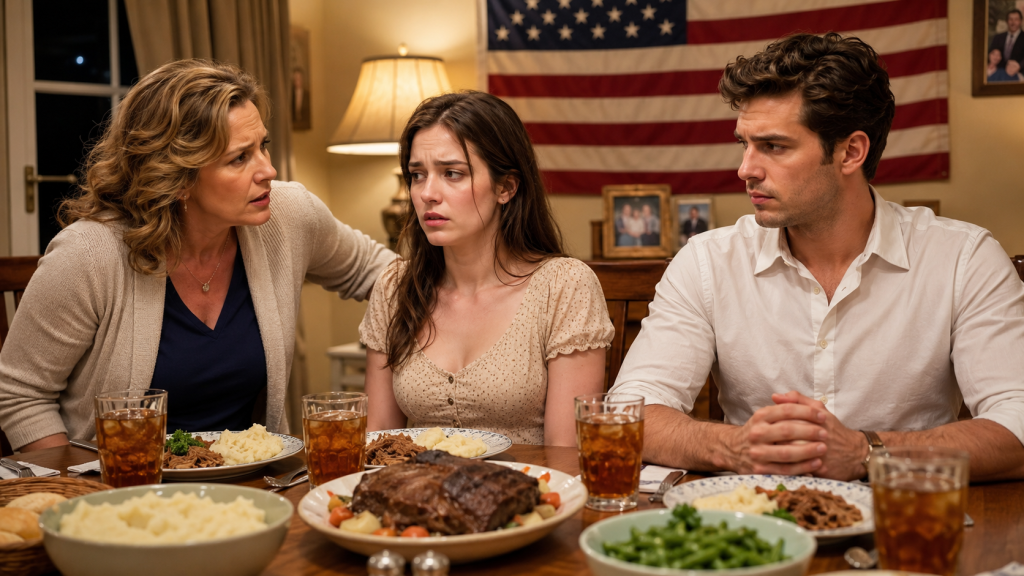
He told me he had businesses in Dallas, though he never clearly said what kind. He said he believed in discipline, ambition, and family values. He said young people wasted their lives because nobody taught them how to be guided.
Then he looked at Danielle and added, “A woman needs direction.”
My fork paused halfway to my mouth.
Direction.
I did not like that word.
Not for my daughter.
Not from a man who had known her less than a year.
Danielle kept her eyes on her plate.
I smiled politely because I had learned long ago that some men reveal more when they think you are fooled.
“So, Danielle,” I said gently, “how is work going?”
Before she could answer, Evan said, “She’s taking a break from that.”
I looked at him.
“A break?”
Danielle’s hand tightened around her glass.
Evan smiled. “That office wasn’t good for her. Too stressful. I told her she needed to focus on herself.”
“I liked my job,” Danielle whispered.
The room went still.
Just for a second.
Then Evan turned his head toward her.
Slowly.
Not angry on the outside.
But something in his eyes made my daughter shrink in her chair.
“You liked the idea of it,” he said softly. “But you were overwhelmed. Remember?”
Danielle swallowed.
“Yes,” she said.
It wasn’t agreement.
It was survival.
I felt my stomach twist.
I asked another question.
“Are you still seeing your friends from college?”
Again, Evan answered.
“Danielle has outgrown that crowd.”
Danielle did not look up.
I gripped the tablecloth over my lap.
This was not a boyfriend.
This was a man placing walls around my daughter one sentence at a time.
Then the fork fell.
Clink.
Evan looked down and laughed softly.
“How clumsy of me.”
He bent under the table to pick it up.
When he sat back up, he stared directly at me.
Not at the fork.
Not at Danielle.
At me.
It was a strange look.
Testing.
Watching.
As if he wanted to see whether I had noticed something.
I pretended I had not.
A few minutes later, it happened again.
Clink.
The fork hit the hardwood floor near Danielle’s chair.
Evan bent down.
This time, I saw his hand brush against Danielle’s ankle.
My daughter flinched.
Not startled.
Afraid.
“Everything okay, sweetie?” I asked.
Danielle lifted her eyes for the first time that night.
“Yes, Mom.”
But it wasn’t her voice.
It was fear shaped like a word.
Evan smiled at me.
“She’s tired. Long day.”
I smiled back.
“I asked my daughter.”
His smile did not move, but his eyes hardened.
Danielle stared at her plate again.
The third time the fork dropped, it rolled farther across the floor, almost beside my chair.
Clink.
“I’ll get it,” Evan said quickly.
But I moved first.
“No, no. I’ve got it.”
I bent down.
And that was when I saw everything.
Under the table, Evan’s right shoe was pressed on top of Danielle’s foot, pinning it hard against the floor.
Her toes were curled in pain.
But that was not what made my blood run cold.
It was her calf.
There were old bruises there, half-hidden beneath the hem of her dress.
Yellow-green marks.
A poorly covered bandage near her knee.
And taped beneath the inside of her dress, just low enough for me to see, was a small folded piece of paper.
Danielle had put it there on purpose.
She had known I would bend down eventually.
My hand trembled as I reached for the fork.
Evan bent down too.
“I’ll get that, ma’am.”
His voice was pleasant.
His eyes were not.
They ordered me to leave the paper alone.
I grabbed the fork.
And with two fingers, I ripped the note from Danielle’s dress before standing.
I hid it inside my fist.
“I’m going to get more napkins,” I said.
My voice sounded calm.
I do not know how.
I walked to the kitchen without running.
Because if I ran, he would know.
Because if I screamed, Danielle would pay.
Because suddenly my house, the place where I had rocked my daughter to sleep and baked birthday cakes and decorated Christmas trees, felt like a cage.
At the sink, I opened the paper.
Six words were written in black eyeliner.
Mom, don’t argue. He’s armed.
For a second, the room blurred.
The pot roast rose in my throat.
My daughter had sat through dinner with a gun in the room, with his foot crushing hers, with bruises on her body, and still she had found a way to warn me.
From the dining room, Evan called, “Everything okay, Mom?”
Mom.
The word made my skin crawl.
As if he had already claimed a place in my family.
As if he had already won.
I reached into the drawer where I kept old recipes, batteries, receipts, and my cell phone when I didn’t want it on the table.
My fingers shook as I dialed 911.
I didn’t speak at first.
I turned on the faucet to cover my breathing and set the phone near a drinking glass to make the sound carry.
The operator answered.
“911, what is your emergency?”
I whispered, “Private residence. My daughter is in danger. Armed man in my house. Send police quietly.”
“Ma’am, are you safe?”
“No.”
“Can you stay on the line?”
“I have to hang up.”
“Ma’am—”
In the dining room, Evan’s chair scraped.
“Mary,” he said.
Closer now.
Too close.
“Who are you talking to?”
I ended the call and slipped the phone into my apron pocket.
When I turned around, Evan was standing in the kitchen doorway.
He was no longer smiling.
Danielle stood behind him, crying silently.
“Mom,” she whispered. “I’m sorry.”
My eyes moved to her hands.
Empty.
Then to Evan’s belt.
There it was.
The black grip of a handgun tucked beneath his shirt.
Evan tilted his head.
“How curious,” he said quietly. “Danielle told me you were an obedient woman.”
My throat tightened.
Obedient.
So that was what he wanted from both of us.
I forced my face to stay still.
“I don’t know what you mean.”
He stepped into the kitchen.
“I think you do.”
Behind him, Danielle shook her head just slightly.
Don’t argue.
I remembered the note.
I remembered my daughter at six years old, running through the sprinklers in a yellow swimsuit.
I remembered her at twelve, crying when her father got sick.
I remembered her at nineteen, promising me she would never stay with a man who made her feel small.
And I realized how cruel life could be.
Because sometimes strong women are not trapped because they are weak.
They are trapped because someone studies exactly where to break them.
The doorbell rang.
Once.
Then again.
Evan froze.
A firm voice called from the front porch.
“Police department. Open the door.”
Evan’s eyes snapped to mine.
“What did you do?”
I lifted both hands.
“Nothing.”
He moved fast.
He grabbed Danielle by the arm and pulled the gun out, pressing it against her waist.
My daughter whimpered.
“Tell them everything is fine,” he hissed, “or your mother watches what happens next.”
My heart was beating so hard I could hear it in my ears.
The police knocked again.
“Mary Davis? We received a call. Please come to the door.”
Evan shoved Danielle forward.
“Walk.”
My daughter looked at me.
In that look, she was five years old again, afraid of thunder, reaching for my hand in the dark.
I could not let fear win.
Not in my house.
Not over my child.
What Evan didn’t know was that my late husband, Richard, had installed a panic lock on the front door after a break-in years earlier.
The door could not open from inside unless you released a second latch near the floor.
Evan didn’t know that.
He pushed Danielle toward the door, keeping the gun hidden against her side.
“Smile,” he whispered.
She reached for the knob.
Her hand shook.
“Open it,” he snapped.
She turned the knob, but the door did not move.
Evan cursed under his breath.
“What’s wrong with it?”
“The latch,” I said.
He glared at me.
“What latch?”
“The lower one.”
For half a second, his eyes dropped.
That was all we needed.
Danielle did exactly what I had once taught her in a parking lot when she was sixteen.
If a man holds you close, hurt what he uses to stand.
She slammed her heel down on his foot with everything she had.
Evan shouted and stumbled backward.
I grabbed the heavy glass pitcher of sweet tea from the entry table and swung it into his wrist.
The gun hit the floor.
Danielle screamed.
I kicked the gun under the couch as hard as I could.
Evan lunged toward it, but the back door burst open before he could reach it.
Two officers rushed in.
“Get down!”
Evan fought for three seconds.
Only three.
Then they had him on the floor, hands behind his back, his perfect white shirt twisted and stained with tea.
He looked up at me with pure hatred.
“You stupid old woman.”
I stepped closer.
“No,” I said. “I’m her mother.”
Danielle collapsed into my arms.
She shook so hard I could barely hold her upright.
“I tried to leave,” she sobbed. “I tried, Mom. He said if I told you, he’d hurt you. He said nobody would believe me because he was nice to everyone.”
I held her face between my hands.
“I believe you.”
She broke then.
Not quietly.
Not politely.
She broke like someone who had been holding her breath underwater for months and had finally reached the surface.
The officers searched Evan.
They found the gun.
They found two extra magazines.
They found Danielle’s phone in his pocket.
They found her apartment keys, her debit card, and a small notebook filled with names and addresses of people she loved.
Mine was on the first page.
Later, at the hospital, a nurse cleaned the bruises on Danielle’s leg.
There were more beneath her dress.
More on her ribs.
More on her arms where sleeves could hide them.
I sat beside her, holding her hand while she stared at the wall.
“He wasn’t like that at first,” she whispered.
“They never are,” I said.
“He was kind. He listened. After Dad died, I felt so lonely. He made me feel chosen.”
My eyes filled with tears.
“He chose someone who was hurting.”
She nodded.
“At first, he said my friends were using me. Then he said my job made me stressed. Then he said you didn’t understand me. Every time I gave up something, he said it proved I loved him.”
I squeezed her hand.
“That wasn’t love.”
“I know that now.”
But knowing something after surviving it does not erase the damage.
For weeks, Danielle stayed with me.
She slept in my room the first three nights like she had when she was little.
Every sound woke her.
A car passing outside.
The ice maker.
A branch against the window.
Sometimes I found her standing in the hallway at two in the morning, staring at the front door.
“He can’t get in,” I would tell her.
She would nod.
But fear does not leave just because the door is locked.
Evan was denied bail after prosecutors found out he had done this before.
Different women.
Different cities.
Same pattern.
Charm.
Isolation.
Control.
Threats.
By the time he reached Danielle, he had perfected the mask.
At the first hearing, he wore a suit.
He smiled at the judge.
He looked calm, respectful, almost wounded.
But when Danielle walked in, his face changed.
Only for a second.
I saw it.
So did the prosecutor.
So did my daughter.
This time, Danielle did not look away.
She stood in front of that courtroom and told the truth.
Her voice shook.
Her hands trembled.
But she did not stop.
She told them about the phone checks.
The forced apologies.
The money he took.
The threats.
The way he pressed his shoe on her foot under my dinner table to remind her what would happen if she spoke.
Then she looked at the judge and said, “I thought if I stayed quiet, he would only hurt me. But that night, I realized silence was how he kept winning.”
Evan stared at the table.
For the first time since I met him, he had nothing to say.
Months passed.
Danielle started therapy.
She got a new phone.
New locks.
A new job.
She cut her hair short one Saturday morning and cried when she saw herself in the mirror.
“Do you hate it?” I asked.
She shook her head.
“No. I look like myself again.”
That was the first day I believed we might really get her back.
Healing did not happen in one dramatic moment.
It happened slowly.
In small choices.
The first time she drove alone.
The first time she laughed without covering her mouth.
The first time she wore sandals again, even though the marks on her foot had not completely faded.
The first time she said, “I’m not ready to date anyone,” and did not apologize for it.
One evening, almost a year after that dinner, Danielle came over carrying grocery bags.
“What are we making?” I asked.
She smiled.
“Pot roast.”
I looked at her carefully.
“Are you sure?”
She nodded.
“I don’t want him to own that memory.”
So we cooked.
We mashed potatoes.
We made sweet tea.
We set the table with the good plates.
But this time, there was no fear sitting across from us.
No fork falling.
No foot under the table.
No man answering questions that belonged to my daughter.
Just Danielle and me.
Halfway through dinner, she looked at me and said, “Mom?”
“Yes, baby?”
“Thank you for noticing.”
I put down my fork.
A thousand answers filled my chest.
Thank you for fighting.
Thank you for surviving.
Thank you for trusting me enough to tape that note under your dress.
But all I said was the truth.
“I will always notice you.”
She cried then.
So did I.
People ask me sometimes how I stayed so calm that night.
The answer is simple.
I wasn’t calm.
I was terrified.
But motherhood does something strange to fear.
It turns it into movement.
Into thinking.
Into dialing 911 with shaking hands while water runs in the sink.
Into smiling at a dangerous man so he does not see your rage too soon.
Into waiting for the right second.
Into swinging a pitcher when your child’s life depends on it.
My daughter once told me Evan had saved her life.
She was wrong.
He had tried to steal it.
But that night, in the house where she grew up, with police at the door and a note written in eyeliner hidden under her dress, Danielle saved herself.
I only helped open the door.
And I learned something I will never forget.
When someone you love becomes quiet, listen harder.
When their smile looks wrong, look closer.
And when your child says, “I’m fine,” but her eyes are begging you not to believe her, trust the part of you that already knows.
Because sometimes the truth is not spoken out loud.
Sometimes it is hidden beneath a dinner table.
Taped to the inside of a dress.
Written in six desperate words.
Mom, don’t argue. He’s armed.
And sometimes those six words are enough to save a life.
THE END! THANKS FOR READING!