 Reading Time: 14 minutes
My eleven-year-old grandson called me in terror after hearing his teenage sister screaming from inside his stepfather’s room.I rushed over, forced my way in, and the moment I entered, everyone froze in shock.
Because what I saw was far worse than a family argument. When Caleb called me, he was whispering so hard I could hear his breath shaking through the phone. “Grandma,” he said, “please come over. Mia is screaming in Dad’s room.”
I was already reaching for my keys before he finished. Caleb never exaggerated. He was the kind of boy who apologized to chairs when he bumped into them. If he sounded terrified, something was terribly wrong.
“Where is your mother?” I asked. “At work. She won’t answer. Please hurry.”
My heart turned cold. “Caleb, listen to me. Go downstairs. Stand near the front door. Do not go back upstairs. Do you understand?”
“But Mia—” “I know, sweetheart. I’m coming. Stay where you can get out.”
His breathing hitched.
“Okay.”
I hung up and drove across Maple Hollow like the speed limit had stopped existing.
My daughter, Lisa, had married Darren Briggs three years earlier.
He was polite in public.
Helpful at church barbecues.
Always smiling at teachers, neighbors, and grocery cashiers with that careful smile people use when they want the world to admire them.
But I had never trusted him.
Not once.
There are men who enter a room and make everyone relax.
Darren entered a room and made me count the exits.
I could never fully explain it to Lisa.
Every time I tried, she defended him.
“He’s just reserved, Mom.”
“He’s trying.”
“He had a hard childhood.”
“He’s good to us.”
But good men do not make children go quiet when they walk into the kitchen.
Good men do not correct teenagers with a voice too soft for anyone else to hear.
Good men do not smile at grandmothers with eyes that never warm.
When I reached the house, the front door was unlocked.
Caleb stood in the hallway in his dinosaur pajamas, pale as paper, pointing upstairs.
“She told him to stop,” he whispered. “Then she screamed.”
My knees nearly gave out.
I touched his shoulder.
“Go outside. Stand by my car.”
“I don’t want to leave Mia.”
“I know. But I need you safe too.”
He hesitated, then nodded and ran out the front door.
I climbed the stairs fast, one hand gripping the railing.
My body was seventy years old, but fear made it remember every younger version of itself.
The bedroom door at the end of the hall was closed.
Behind it, I heard voices.
Darren’s voice, sharp and low.
Mia’s voice, choked with panic.
“You don’t understand,” Darren hissed.
“I understand enough!” Mia cried.
“Give me the phone.”
“No!”
I reached the door and slammed my fist against it.
“Open this door!”
Everything went silent.
Then something crashed.
I did not wait.
I threw my shoulder into the door once.
Pain shot down my arm.
I threw myself into it again.
The lock held.
So I stepped back, lifted my leg, and kicked near the handle with every bit of fury an old woman’s body could hold.
The door burst open.
Everyone froze.
Darren stood beside the bed, his face red and stunned.
Mia, fifteen years old, stood near the dresser with tears running down her cheeks, clutching Darren’s phone in both hands.
Her backpack lay open on the floor.
Papers were scattered everywhere.
A small black flash drive had rolled beneath the nightstand.
And on the bed, half-hidden under Darren’s jacket, were stacks of cash, fake prescription labels, patient forms, and a second phone blinking with a message notification.
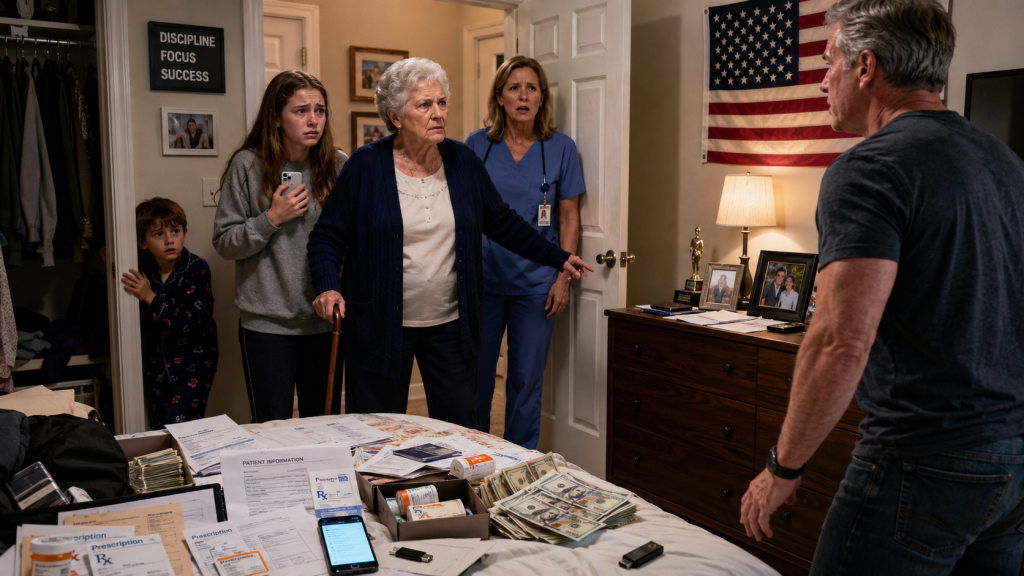
For one breath, none of us moved.
Then Mia looked at me like I had pulled her back from the edge of a cliff.
“He’s not my dad,” she said, her voice trembling. “And he’s been stealing Mom’s patient records from the clinic.”
Darren’s shock disappeared.
His eyes went cold.
“Give me the phone, Mia.”
I stepped between them.
“No,” I said.
Darren looked at me like he had forgotten I was supposed to be old.
Weak.
Polite.
“Evelyn,” he said carefully, “this is not what it looks like.”
“It looks like you locked yourself in a room with my granddaughter while she was terrified.”
His jaw tightened.
“She broke into my personal things.”
Mia shook her head.
“I was looking for my headphones. I saw Mom’s clinic forms in his drawer. Then his other phone kept buzzing.”
Darren took a step forward.
I lifted my cane between us.
“Do not come closer.”
His eyes flicked to the cane.
Then to Mia.
Then to the phone in her hand.
“Give it to me,” he said again, softer this time.
That voice made my skin crawl.
It was the voice he used in public.
The calm one.
The reasonable one.
The one that made people question their own instincts.
Then Lisa appeared in the doorway behind me, still in her scrubs, her face drained of color.
She had finally seen the missed calls and raced home from the clinic.
“What is happening?” she whispered.
Darren looked at his wife.
Then at me.
Then at Mia.
Then toward the hallway, where Caleb was no longer standing.
For the first time since I had known him, he had no smile ready.
“Lisa,” he said, “I can explain.”
Mia made a broken sound.
“Mom, don’t listen to him.”
Lisa’s eyes moved across the room.
The cash.
The labels.
The patient forms.
The second phone.
The flash drive under the nightstand.
Her hand went to her mouth.
“Darren,” she whispered, “what have you done?”
He tried to smile then, but it came out wrong.
“I was fixing our debts.”
The room seemed to tilt.
Lisa took one step backward.
“What debts?”
“Our debts.”
“We don’t have debts like this.”
His eyes hardened.
“You wouldn’t know. You never look at anything except work and the kids.”
I saw Lisa flinch.
That was how men like Darren worked.
Even caught, even cornered, they looked for someone else to blame.
Mia lifted the phone.
“He was selling names, prescriptions, insurance numbers—everything.”
Darren lunged.
I shoved my cane across his chest and shouted, “Caleb, call 911!”
From downstairs, Caleb’s terrified voice yelled, “I’m doing it!”
Darren froze for only half a second.
Then he grabbed for the phone again.
Mia backed into the dresser.
I swung my cane down—not at his head, not enough to injure him, but hard across his forearm.
He cursed and stumbled back.
“Stay away from her,” I said.
My voice did not shake.
That surprised even me.
Lisa stepped fully into the room now, her shock turning into something stronger.
“Darren, sit down.”
He stared at her.
“What?”
“Sit down.”
“You’re taking their side?”
Lisa looked at the patient forms on the bed.
“My clinic’s name is on those papers.”
“It’s not what you think.”
“Then explain it without moving another inch toward my daughter.”
He looked at Mia again, hatred flashing through his face so quickly that Lisa gasped.
That was the moment she saw him.
Not the husband she had defended.
Not the man who carried groceries and charmed neighbors.
The real Darren.
The one her children had been afraid to describe.
Sirens sounded in the distance.
Darren heard them too.
His expression changed.
Not fear.
Calculation.
He looked toward the bedroom window.
I knew what he was thinking before he moved.
I pointed my cane at him.
“Don’t be stupid.”
He turned on me.
“You old witch.”
Lisa’s face crumpled.
Not because he insulted me.
Because of how easily the mask had fallen.
The sirens grew louder.
Mia clutched the phone to her chest with both hands.
“Grandma,” she whispered.
“I’m here,” I said. “I’m not leaving.”
Police cars stopped outside moments later.
Two officers came up the stairs, followed by Caleb, who was wrapped in my coat and crying silently.
One officer guided Caleb back downstairs.
The other entered the room and immediately took in the scene.
“Everyone stay where you are.”
Darren raised both hands.
“Officer, thank God. My stepdaughter stole my phone and started screaming. This is a misunderstanding.”
Mia shouted, “No!”
The officer looked at her.
“What’s your name?”
“Mia.”
“How old are you?”
“Fifteen.”
“Are you hurt?”
She shook her head, then looked at Darren.
“No. But he tried to grab me.”
Darren laughed bitterly.
“She’s dramatic. Teenagers are like that.”
I stepped forward.
“I heard him demanding the phone. My grandson heard his sister screaming and called me. When I entered, I found those patient records, fake prescription labels, cash, a second phone, and a flash drive under the nightstand.”
The officer’s expression sharpened.
Lisa picked up one of the papers with shaking hands.
“This is from my clinic,” she said. “This is confidential patient information.”
The second officer arrived and radioed for detectives.
Darren’s face went pale.
“I want a lawyer.”
“That’s probably wise,” I said.
The officer glanced at me.
Not amused exactly.
But close.
Darren was escorted downstairs while the police secured the room.
He tried to look calm.
He tried to tell the officers Mia had misunderstood.
He tried to say Lisa had brought work home and misplaced files.
But the second phone kept buzzing.
Again.
Again.
Again.
The officer placed it in an evidence bag while the screen lit up with a message preview.
Need more names by tonight. Labels worked. Send next batch.
Lisa saw it.
She made a sound I will never forget.
It was not a sob.
It was the sound of a life splitting in half.
Mia dropped Darren’s other phone onto the bed like it burned her.
“I’m sorry, Mom,” she cried. “I didn’t know what to do. I found the papers yesterday, but he caught me looking tonight.”
Lisa pulled her into her arms.
“No, baby. You did exactly right.”
Mia collapsed against her.
Caleb came back upstairs despite the officer’s instruction and wrapped his arms around both of them.
For a moment, all three of them stood there in the wreckage of Darren’s secrets.
And I stood nearby, gripping my cane, trying not to fall apart.
Because I had been right about Darren.
And being right felt terrible.
The next hours passed in pieces.
Detectives arrived.
They photographed everything.
They took the cash, phones, labels, patient forms, laptop, and flash drive.
They asked Lisa questions.
Then Mia.
Then me.
Caleb was too shaken to say much, but he told them what he had heard.
“She screamed stop,” he whispered. “And then Grandma came.”
His little face crumpled.
I pulled him close.
“You did the bravest thing, sweetheart. You called for help.”
He pressed his forehead into my coat.
“I was scared.”
“Brave people are scared,” I said. “They just keep doing the right thing anyway.”
Darren was taken out in handcuffs before the neighbors even understood what had happened.
He did not look at Lisa.
He did not look at Caleb.
But he looked at Mia.
One cold, furious look.
I stepped in front of her before Lisa could.
“Keep walking,” I told him.
An officer guided him out.
The front door closed behind him.
For the first time in years, the house felt like it could breathe.
But breathing did not mean healing.
Not yet.
Lisa sat on the stairs with her head in her hands.
Mia stood frozen near the wall.
Caleb clung to me like he was afraid the house might swallow him.
I wanted to say something comforting.
Something grandmotherly.
Something soft.
But some moments are too big for soft words.
So I said the only true thing I had.
“You are all coming home with me tonight.”
Lisa looked up.
“Mom, I need to deal with—”
“No,” I said. “The police have the room. The house is not safe in your minds right now. You can deal with paperwork tomorrow. Tonight, your children sleep somewhere they know no one will come through the door.”
Mia began crying again.
That settled it.
I packed clothes for both children while Lisa called the clinic administrator.
I heard her voice break when she said, “I think patient files were stolen from my home.”
Then she listened.
Then she closed her eyes.
“Yes,” she said. “I understand. I’ll cooperate fully.”
When she hung up, she looked twenty years older.
“I could lose my job.”
“No,” I said.
“You don’t know that.”
“No, I don’t. But you did not steal those files. He did.”
“I brought some work home.”
“You brought work home because your clinic is understaffed and you were trying to help patients. Darren chose to steal.”
She pressed both hands over her face.
“I let him into our lives.”
I sat beside her on the bed.
“You loved someone who lied well. That is not the same as choosing this.”
“He was hurting them under my roof.”
The words were barely audible.
I looked toward the hallway where Mia was helping Caleb zip his backpack.
“Then start now. Believe them first. Protect them first. Let guilt come later.”
Lisa looked at me.
Her eyes were wet.
“Did you know?”
I wanted to lie.
I wanted to spare her.
But truth had already entered that house.
It deserved to stay.
“I knew something was wrong,” I said. “I did not know what.”
“Why didn’t I see it?”
“Because you wanted your family to be okay.”
She broke then.
I held my daughter while she cried like a child.
Outside, the police lights painted the walls red and blue.
When we reached my house, it was nearly midnight.
I made hot chocolate because grandmothers make hot chocolate when the world has gone mad.
Mia sat at my kitchen table in one of my old sweaters, both hands wrapped around the mug.
Caleb sat beside her, still pale.
Lisa stood at the window, staring into the dark yard.
No one spoke for a long time.
Then Caleb whispered, “Is he going to come back?”
Lisa turned around quickly.
“No,” she said, though her voice trembled.
I set my mug down.
“He will not come here. The police know. The neighbors know. And if he tries, he will meet me at the door.”
Caleb looked at my cane.
For the first time all night, he almost smiled.
Mia stared into her mug.
“He told me no one would believe me.”
Lisa closed her eyes.
“Mia.”
“He said I was nosy. That I was trying to ruin your marriage. He said if I told, you would lose your job and it would be my fault.”
Lisa crossed the kitchen and knelt beside her.
“No. Listen to me. None of this is your fault. Not my job. Not his crimes. Not the police. Nothing.”
Mia’s chin trembled.
“I was so scared.”
“I know,” Lisa whispered. “I am so sorry I didn’t see it sooner.”
Mia looked at me.
“Grandma did.”
Lisa turned toward me.
There was no accusation in her face.
Only grief.
I sat across from them.
“I saw shadows,” I said. “Mia found the light switch.”
The next morning, the truth widened.
The clinic called.
Then detectives.
Then federal investigators.
Darren had not acted alone.
The second phone connected him to a small ring that sold patient information, fake prescription labels, and insurance details. He had used Lisa’s access indirectly, taking papers she brought home, photographing forms, copying old files, and manipulating her schedule so she would be too exhausted to notice missing folders.
He had also opened credit accounts using pieces of stolen information.
The cash on the bed was not savings.
It was payment.
The flash drive contained scanned records.
Hundreds of them.
Lisa vomited in my bathroom after hearing that.
Then she washed her face, tied her hair back, and called her clinic again.
“I’ll cooperate with everything,” she said. “Every statement. Every hearing. Whatever it takes.”
That was the first step back to herself.
The days after Darren’s arrest were ugly.
People in town whispered.
Some defended him at first.
Darren?
Impossible.
He coached baseball.
He helped set up chairs at church.
He always seemed so nice.
I learned a long time ago that “nice” is what some people perform when they want access.
Kind is what they do when no one is watching.
Darren had been nice.
He had never been kind.
Lisa filed for divorce within a week.
She also filed for a protective order.
Mia started therapy.
Caleb slept on a mattress at the foot of my bed for nearly a month because he said the hallway was too quiet.
Every night, I told him the same thing.
“You are safe.”
Some nights, he believed me.
Some nights, he asked me to say it again.
So I did.
As many times as he needed.
Mia changed too.
At first, she barely came out of the guest room. She wore headphones without music playing, just to block the world out. She flinched when phones buzzed. She apologized whenever she asked for anything.
One afternoon, I found her sitting on the porch, staring at the maple tree in my yard.
I sat beside her.
For a while, we said nothing.
Then she whispered, “I should have told you sooner.”
I shook my head.
“You told when you could.”
“I was afraid Mom would pick him.”
“She didn’t.”
“She might have before.”
That hurt because it might have been true.
Not because Lisa did not love her children.
Because manipulation does not enter a family wearing horns.
It enters smiling.
It teaches people to doubt their own discomfort.
It makes mothers tired, children quiet, and outsiders look unreasonable.
I took Mia’s hand.
“You are not responsible for how long it took adults to catch up to the truth.”
She wiped her face.
“I hate him.”
“I know.”
“Is that bad?”
“No.”
She looked at me.
“You don’t think I should forgive him?”
“I think forgiveness is not a chore you owe people who hurt you.”
She breathed out shakily.
“What if everyone says I’m bitter?”
“Then send them to me.”
That time, she did smile.
Small.
Brief.
But real.
Months passed.
Darren’s case grew larger than Maple Hollow.
More arrests followed.
The clinic tightened its security procedures.
Lisa kept her job, though she was placed on leave during the investigation. When the investigators confirmed she had been deceived and had cooperated fully, she returned under supervision and later became part of a training program on patient privacy.
She carried shame for a long time.
But she also carried determination.
She listened more.
She asked Mia and Caleb questions and believed the answers.
She stopped defending old memories of Darren just because accepting the truth hurt.
That mattered.
Healing did not happen like people imagine.
There was no one big moment when everything became okay.
It came in ordinary pieces.
Caleb sleeping through the night.
Mia laughing at a movie.
Lisa changing the locks.
The three of them eating pancakes at my table on a Sunday morning without watching the doorway.
The first time Mia called the house “home” again.
The first time Caleb went upstairs alone.
The first time Lisa said Darren’s name without trembling.
One year after the night Caleb called me, we gathered in my kitchen for dinner.
Not a special dinner.
Just roast chicken, mashed potatoes, green beans, and the apple pie Caleb insisted on helping make, even though he peeled the apples in strange little squares.
Mia was sixteen now.
Taller.
Sharper.
Still healing, but no longer shrinking.
Caleb had outgrown the dinosaur pajamas but not his habit of apologizing to furniture.
Lisa looked tired, but her tiredness had changed. It was no longer the hollow exhaustion of a woman trying to keep a fake peace. It was the honest tiredness of rebuilding.
After dinner, Caleb stood at the sink beside me, drying plates.
“Grandma?”
“Yes?”
“Do you remember when I called you?”
I looked at him.
“Every day.”
His face grew serious.
“I thought I was being a baby.”
I put the plate down.
“Caleb, calling for help was the bravest thing you could have done.”
“But I was hiding.”
“You were surviving.”
He nodded slowly.
Then he said, “Mia says I saved her.”
I glanced toward the living room where Mia and Lisa were arguing gently over what movie to watch.
“She’s right.”
He swallowed hard.
“I didn’t feel brave.”
I touched his cheek.
“Bravery almost never feels brave while you’re doing it.”
He looked down at the towel in his hands.
“Did you feel brave when you kicked the door?”
I thought about the hallway.
The closed door.
Mia’s choked voice.
Darren’s command.
My old shoulder hitting wood.
“No,” I said. “I felt terrified.”
His eyes widened.
“You did?”
“Yes. But I was more afraid of not opening it.”
He smiled then.
A small, proud smile.
Later that night, after they went home, I sat alone in my living room with my cane beside my chair.
The house was quiet.
A safe quiet.
Not the heavy silence I had heard behind Darren’s door.
I thought about all the people who had admired him.
All the people who had called him helpful.
Respectable.
Steady.
I thought about how easily a smile can become camouflage.
Then I thought about Caleb’s whisper on the phone.
Grandma, please come over.
That whisper had done what all Darren’s fake charm could not stop.
It had brought the truth running.
People sometimes ask me how I knew to act so quickly.
I tell them this.
When a child calls in fear, you do not debate.
You do not wait to see if things calm down.
You do not worry about manners, embarrassment, or whether you might be overstepping.
You go.
You knock.
You kick the door if you have to.
Because the world is full of people who count on children staying quiet and adults staying polite.
Darren Briggs counted on that.
He counted on Mia being too scared.
Caleb being too young.
Lisa being too busy.
Me being too old.
He was wrong about all of us.
Mia was scared, but she held on to the phone.
Caleb was young, but he called for help.
Lisa was devastated, but she chose her children.
And I was old, yes.
Old enough to know that evil does not always shout.
Sometimes it whispers from behind a closed door.
Sometimes it wears a church smile.
Sometimes it hides stolen files under a jacket on a bed.
But love can be loud too.
Love can be a grandson dialing with shaking hands.
Love can be a mother signing statements through tears.
Love can be a teenage girl refusing to let go of proof.
Love can be a grandmother with aching knees and a cane, kicking a door until the truth has nowhere left to hide.
That night, Darren fooled half the town with his smile.
But he forgot one thing.
Grandmothers hear fear before anyone else hears the truth.
And when we hear it, we come running.
THE END. THANKS FOR READING!