 Reading Time: 13 minutes
I Walked Into My Parents’ 35th Anniversary Dinner Carrying a Handmade Photo Album—They Had Already Eaten, and the Only Thing Waiting at My Seat Was a $512.40 Bill I walked into my parents’ thirty-fifth anniversary dinner carrying a handmade photo album I had spent three weeks preparing.
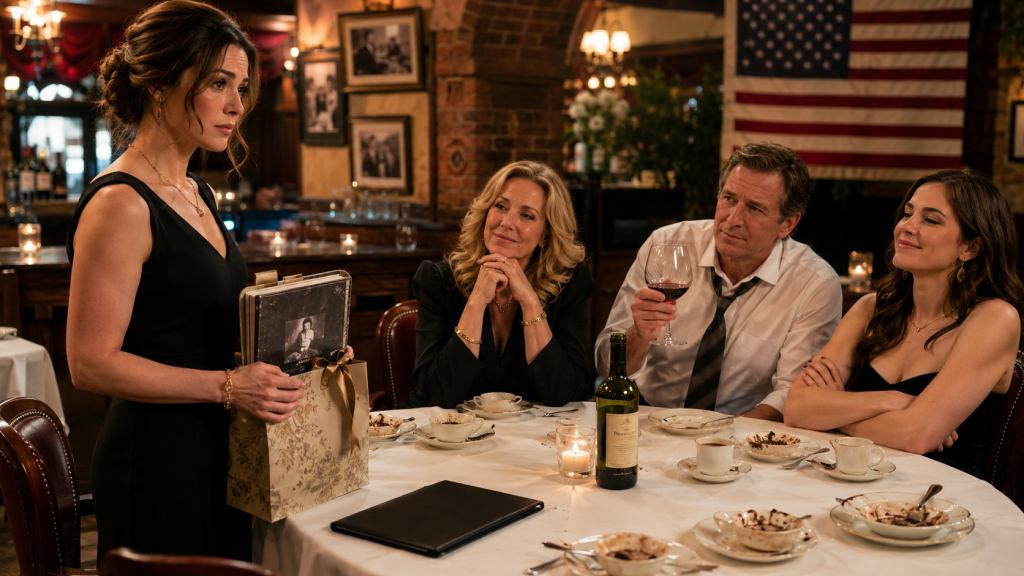
They had already finished eating. My chair had no plate. No glass. No napkin. Only a black leather folder containing a $512.40 bill placed exactly where my dinner should have been. My mother looked up and smiled.
“You’re here now, honey. You can cover this, right?” My older sister, Sabrina, laughed. “At least you’re useful for something.”
For a moment, I simply stood there. The warm Italian restaurant was crowded with families and couples enjoying Friday night. Soft music drifted through the room. Wine glasses touched. Servers moved between tables carrying bowls of pasta and baskets of bread.
At my family’s table, the celebration was already over.
The dessert bowls were empty.
Coffee cups held dark rings at the bottom.
Used napkins lay beside polished silverware.
A half-finished bottle of red wine stood near my father’s elbow.
The anniversary candle in the middle had burned almost completely down, leaving cloudy wax inside its glass holder.
Everyone had eaten.
Everyone had enjoyed themselves.
Everyone except me.
My name is Elena Brooks, and for most of my life, I believed being the easy daughter was something to be proud of.
I was the one who did not ask for much.
I understood when plans changed.
I forgave forgotten birthdays.
I accepted promises that quietly disappeared.
My mother loved telling her friends, “Elena never gives us trouble. She just figures things out on her own.”
When I was young, I thought that was praise.
I thought it meant I was mature.
Dependable.
Good.
It took me thirty years to understand that some families do not admire your strength.
They admire how convenient your silence makes their lives.
That evening, the gift bag containing the album cut into my fingers while I studied the people at the table.
My father, Harold, had loosened his tie and was sipping the last of his wine.
My mother, Vivian, smoothed her lipstick using the corner of her napkin.
Sabrina held her phone up to inspect her reflection.
No one looked embarrassed that I had arrived after the meal.
They looked relieved.
The person they expected to pay had finally appeared.
“Oh, Elena,” Mom said as if I had wandered in during the final minute of a movie. “You made it. We were just about to leave.”
“I texted that I would be fifteen minutes late. My meeting ran over.”
“We know,” Sabrina replied without looking up. “That’s why we started without you.”
Started without me was a gentle description of what they had done.
They had ordered appetizers.
Dinner.
Wine.
Dessert.
Coffee.
They had toasted my parents’ marriage from beginning to end.
Then they had waited for me to arrive and pay for a memory I had not been allowed to share.
Dad cleared his throat.
“Don’t make this awkward, sweetheart. It’s our anniversary.”
That was how my family handled everything.
If I noticed unfairness, I was making things awkward.
If I sounded hurt, I was ruining the mood.
If I refused to pay for something I had not chosen, I was selfish.
Sabrina leaned back.
“Honestly, Elena, you’re still so dramatic. It’s just dinner.”
Just dinner.
I looked down at the gift bag.
Inside was a leather-bound photo album I had created by hand.
I spent evenings searching through old boxes for photographs.
I scanned faded prints.
Restored damaged corners.
Removed scratches from my parents’ wedding pictures.
I arranged images of their first apartment, family vacations, Christmas mornings, school events, and backyard cookouts.
One photograph showed me at five years old in a yellow raincoat on our old porch.
Another showed Sabrina sitting on Dad’s shoulders while I stood nearby holding everyone’s jackets.
That detail should have warned me.
Even in childhood photographs, I was often present because I was carrying something for someone else.
The album had cost less than an expensive anniversary gift, but it contained hours of work.
I wanted to give them something that said I remembered their life with love.
They had given me a bill.
I placed the gift bag beside my empty chair and opened the folder.
The total was printed at the bottom.
$512.40.
My family watched me.
Mom wore her softest expression—the one she used whenever she wanted something unreasonable to sound loving.
“We knew you would want to treat us,” she said.
“Did anyone order anything for me?”
She blinked.
“You weren’t here, honey.”
“Did anyone ask the kitchen to save me a plate?”
Dad frowned.
“Elena.”
“Did anyone wait before ordering dessert? Did anyone leave me bread or water?”
Sabrina rolled her eyes.
“You said you were late.”
“Fifteen minutes.”
“The reservation was at seven.”
“I arrived at seven fifteen. You’ve already had three courses.”
Mom sighed.
“We got here early.”
Of course they had.
They arrived early, celebrated without me, and timed the end of the meal to my arrival.
The restaurant noise faded around me.
I stared at the bill and felt something inside me become very calm.
It was not peace.
It was the feeling of a door closing after years of being left open for people who never knocked.
I closed the folder.
Then I raised my hand toward a nearby server.
“Could you ask the manager to come over?”
Mom’s smile brightened.
She assumed I was arranging payment.
Sabrina lifted her purse.
“Finally.”
A man in a dark jacket approached a minute later.
“Good evening. I’m Anthony, the manager. Is everything satisfactory?”
“Yes,” I said. “I have one question. Whose card was used to reserve this table?”
My family went still.
Mom laughed lightly.
“What does that matter?”
Anthony checked the tablet he carried.
“The reservation was made under Vivian Brooks.”
“And which card secured it?”
He hesitated, glancing at Mom.
“A card ending in four-one-eight-seven.”
Mom’s personal card.
I knew the number because she once made me call the bank after she forgot her online password.
I nodded toward the empty place setting.
“Did I order any food or drinks?”
Anthony examined the table.
“No, ma’am.”
“Was anything ordered in my name before I arrived?”
“No.”
I slid the bill folder across the table and placed it in front of Mom.
“Then the person who reserved and enjoyed the meal can pay for it.”
Sabrina’s smile disappeared.
Dad straightened.
“Don’t embarrass your mother.”
“I’m not.”
“You called the manager over to create a scene.”
“I asked who made the reservation.”
Mom looked wounded.
“We thought you would want to do something special for our anniversary.”
“I made you something special.”
I touched the gift bag.
“You invited me after eating so I could cover the check.”
“We invited you at seven,” Dad said.
“And you arrived early enough to finish dinner by seven fifteen?”
No one answered.
Anthony shifted uncomfortably.
“I can return when you’re ready.”
Before he walked away, he added, “Mrs. Brooks, the card attached to the reservation was declined twice. We’ll need another form of payment.”
The table went completely silent.
Mom’s face changed.
“Declined?”
“Yes, ma’am.”
“That is impossible.”
“The server attempted it after dessert and again several minutes ago.”
Sabrina looked at me quickly.
That explained everything.
They had not merely planned for me to pay.
They had already tried to use Mom’s card and discovered it no longer worked.
My arrival had become their emergency solution.
Dad cleared his throat.
“It must be a bank error.”
Anthony remained polite.
“That may be the case, but payment will still be required tonight.”
Mom reached across the table.
“Elena, just handle it. We’ll straighten everything out later.”
Later was my family’s favorite repayment date.
Later never appeared on any calendar.
I had covered Dad’s car repair two years earlier.
Later.
I paid Mom’s dental bill when her insurance denied part of the claim.
Later.
I loaned Sabrina five thousand dollars to launch an online boutique.
She posted photographs from a beach vacation three weeks afterward and never repaid a cent.
Every time I asked, the family accused me of caring more about money than relationships.
Yet whenever money was needed, they remembered our relationship immediately.
Sabrina leaned toward me.
“You have plenty. Why are you acting like five hundred dollars will ruin you?”
“It won’t.”
“Then pay it.”
“No.”
Her mouth opened slightly.
I had refused her before, but never calmly.
Never in public.
Never without offering an explanation she could argue against.
Dad’s expression hardened.
“You are going to let your parents be humiliated on their anniversary?”
“You invited me to a dinner and gave me no dinner.”
“We thought you had eaten,” Mom said quickly.
“You never asked.”
“You work late. You’re always busy.”
“That didn’t stop you from expecting me to arrive with a credit card.”
Mom’s eyes filled with tears.
They came quickly.
My mother could produce tears whenever boundaries appeared.
“I cannot believe you would treat us this way after everything we’ve done for you.”
There it was.
The family history, rewritten in one sentence.
Everything they had done for me.
Not everything I had done for them.
When I graduated from college, my parents helped Sabrina move into a new apartment instead of attending the ceremony.
They said I would understand.
When I received my first promotion, Mom asked whether my increased salary meant I could help with the property taxes.
When I bought my condo, Dad criticized it for being too small to host holidays but asked whether he could use my parking space during football games.
My accomplishments were never celebrations.
They were new resources.
The more independent I became, the more my family believed I required less care and owed more help.
I looked at Mom.
“What exactly have you done for me recently?”
She stared as if I had insulted her.
“We raised you.”
“You also raised Sabrina.”
“That is completely different,” Sabrina said.
I almost laughed.
At least she admitted it.
Sabrina was always different.
When she struggled, the family gathered around her.
When I struggled, they praised my strength.
When she needed money, she was going through a difficult period.
When I needed support, I was being negative.
Our roles had formed so early that everyone forgot they were choices.
Sabrina was the daughter who needed saving.
I was the daughter who did the saving.
“Just give them your card,” she said. “We can discuss your feelings another time.”
“My feelings are why you invited me.”
She folded her arms.
“You make everything about yourself.”
I looked around the empty plates.
“No, Sabrina. This meal was clearly about all of you.”
Anthony returned discreetly.
“Have you decided how you’d like to handle the bill?”
Dad pulled out his wallet.
He removed one card, stared at it, then put it back.
His retirement account had been stretched by years of poor decisions.
Mom’s card was declined.
Sabrina’s boutique had failed six months earlier, though she continued presenting herself online as a business consultant.
They had all arrived expecting me to rescue them.
I stood and picked up my gift bag.
Mom reached for it.
“At least leave the present.”
I moved it beyond her grasp.
“No.”
Her face hardened instantly.
“Elena.”
“This belongs to the daughter you invited to celebrate with you. That woman never received a seat at this dinner.”
“You have a chair,” Dad said.
“A chair is not the same as a place.”
For once, he had no response.
I turned to Anthony.
“I’m sorry you were placed in this position. I did not make the reservation or consume anything. My family will arrange payment.”
He nodded.
“Understood.”
Sabrina stood.
“You cannot walk out.”
I faced her.
“Why not?”
“Because we’re family.”
“At least I’m useful enough to know when I’m being used.”
Her cheeks flushed.
I walked toward the exit.
Behind me, Dad called my name.
Mom began crying louder.
Sabrina accused me of ruining the anniversary.
I did not turn around.
Outside, cool air struck my face.
Rain had begun falling lightly.
I stood beneath the restaurant awning with the photo album pressed against my chest.
For years, I imagined setting boundaries would feel powerful.
It did not.
It felt sad.
Necessary decisions often do.
My phone began ringing before I reached my car.
Mom.
Dad.
Sabrina.
Then the family group chat filled with messages.
How could you leave us like that?
Your father’s blood pressure is rising.
Mom is humiliated.
You owe us an apology.
Not one message asked whether I was hurt.
Not one acknowledged the empty place setting.
I turned off my phone.
Later, I learned Dad used a backup credit card to pay the bill.
The transaction pushed the card over its limit.
They had to cancel the hotel room they booked for the weekend.
Sabrina posted a vague message online about selfish relatives who weaponized money.
Several cousins contacted me.
At first, they sounded concerned.
Then I discovered my family had told everyone I promised to host the anniversary dinner and arrived late before refusing to pay.
I sent no long defense.
I replied with a photograph I had quietly taken at the table.
My empty setting.
No plate.
No glass.
Only the bill.
The lies weakened immediately.
Aunt Linda called the next morning.
“Elena, did they truly finish the meal before you arrived?”
“Yes.”
“And put the check at your place?”
“Yes.”
She sighed.
“I’m sorry.”
I waited for the usual sentence.
But they’re still your parents.
Instead, she said, “Your mother did something similar to me when we were young.”
That surprised me.
Aunt Linda told me Vivian had always selected one person to absorb the inconvenience.
As teenagers, it was Linda.
After Mom married, it became Dad sometimes.
Then me.
“Your mother feels safest when someone else manages the consequences,” Linda said. “You have been doing that for years.”
“Why didn’t anyone tell me?”
“We thought you knew.”
I did know.
I simply had not allowed myself to name it.
The photo album sat on my dining table for several days.
I considered mailing it.
Then I opened it again.
The pages contained my family’s history, but they also contained mine.
The photograph in the yellow raincoat.
My first school play.
A birthday where I smiled beside a cake Sabrina chose.
A graduation picture with an empty space where my parents should have stood.
I had built an album celebrating people who repeatedly edited me out.
So I changed it.
I removed several pages.
Added journal entries.
Included copies of messages and memories written honestly.
Not cruelly.
Honestly.
Beside the graduation photograph, I wrote:
Mom and Dad did not attend. I told everyone they were delayed because I was embarrassed.
Beside a Christmas picture, I wrote:
I paid the heating bill that month. No one mentioned it.
Beside a family vacation photograph, I wrote:
I stayed home because there was “not enough room,” then covered the hotel deposit when Mom called.
The album became something different.
Not a gift.
A record.
For the first time, my family history included my experience.
Three weeks passed before Mom appeared at my condo.
She arrived without calling.
I opened the door but did not invite her inside.
She looked smaller than usual.
“We need to talk.”
“We can talk here.”
“In the hallway?”
“Yes.”
She glanced toward the neighboring doors.
“You’re still trying to embarrass me.”
“No. I’m protecting my space.”
Her mouth tightened.
“Elena, families make mistakes.”
“Which mistake are you apologizing for?”
“We should have waited.”
“That is not an apology.”
“We assumed you would be late longer.”
“You planned for me to pay.”
She looked away.
“Your father’s finances have been difficult.”
“You could have asked me before ordering.”
“You might have said no.”
“That was my right.”
Mom’s eyes filled with tears again.
“I wanted one beautiful night.”
“You had one. I was simply not included in it.”
“That isn’t fair.”
“What part?”
“You know how hard things have been.”
I almost surrendered then.
That was the pattern.
Mom became fragile.
I became responsible.
But I remembered the bill resting where my dinner should have been.
“I am no longer paying for things simply because you avoid planning for them.”
She stared at me.
“So this is about money.”
“No. It is about being treated like a person instead of an account.”
She remained silent.
Then she noticed the album on the table behind me.
“You kept our gift.”
“It was never given.”
“May I see it?”
“Not yet.”
Her expression became angry.
“You are punishing us.”
“A boundary feels like punishment when someone benefited from there being none.”
I had learned that sentence in therapy years earlier.
It finally made sense.
Mom left without apologizing.
Dad sent a letter a month later.
It was mostly defensive.
He explained their financial stress.
Mom’s embarrassment.
Sabrina’s struggles.
Near the end, he wrote one honest sentence:
We expected you to fix the situation because you always have.
I replied with one line.
That is exactly what needs to change.
Sabrina did not speak to me for almost a year.
When she finally called, it was because she needed help reviewing a contract for a new job.
I almost laughed at the predictability.
“I can recommend an attorney,” I said.
“You work with contracts.”
“Not for free.”
“You would charge your own sister?”
“Yes.”
She hung up.
Two days later, she called again.
“What is your rate?”
That was the beginning of our new relationship.
Not closeness.
Not forgiveness.
Clarity.
She paid for my time.
I reviewed the contract.
She thanked me.
No one died because I stopped giving unlimited access.
The world continued.
My parents’ thirty-sixth anniversary was quiet.
They went to a local café and paid for themselves.
Mom sent me a photograph afterward.
Two plates.
Two glasses.
A small slice of cake.
The message said:
We thought of you.
I stared at it for several minutes.
Then I replied:
I hope you had a lovely evening.
I did not rush back into the old role.
Healing did not mean pretending the restaurant never happened.
It meant observing whether behavior changed afterward.
Months later, Dad invited me to lunch.
The invitation included the time, location, and a sentence I never expected to read.
My treat. No surprises.
I accepted.
When I arrived, a plate and glass waited at my place.
Dad stood and hugged me awkwardly.
Mom looked nervous.
Sabrina was not there.
We ordered together.
Before dessert, Dad apologized.
Not for the misunderstanding.
Not for my reaction.
For what they had done.
“We invited you because we expected you to pay,” he said. “We told ourselves it was acceptable because you earn more. It wasn’t.”
Mom stared at her hands.
“You were right. We remembered you when the bill came.”
The apology did not erase thirty years.
But it was the first time they described the truth without making me responsible for comforting them.
I listened.
Then I said, “I need you to understand that I may never become the daughter I was before.”
Mom nodded.
“You shouldn’t.”
After lunch, I paid only for my own coffee because I had ordered it separately at the counter.
Dad paid the restaurant bill.
No drama.
No guilt.
No emergency.
Just adults paying for what they chose.
On their thirty-seventh anniversary, I gave them the photo album.
Not the original version.
The honest one.
Mom cried while reading it.
This time, I did not rush to stop her tears.
Dad spent a long time looking at the graduation page.
“We failed you that day,” he said.
“Yes.”
The word felt clean.
Sabrina eventually read the album too.
She became angry at first.
Then quiet.
“I didn’t know you paid for so much.”
“You never asked.”
“I thought you liked helping.”
“Sometimes I did.”
“And the rest?”
“I was afraid saying no would make all of you love me less.”
She looked down.
“Did it?”
“That is what I had to find out.”
The anniversary dinner did not destroy my family.
It exposed the structure we had been calling family.
Sabrina needed.
Mom arranged.
Dad avoided conflict.
I paid.
Once I stopped performing my role, everyone had to examine theirs.
Some relatives believed five hundred twelve dollars was a small amount over which to create conflict.
They missed the point.
The bill was not the wound.
It was the receipt.
Evidence of every birthday forgotten because I would understand.
Every loan ignored because I could afford it.
Every meal where I was welcome only after someone needed help.
That evening, my chair had no plate because no one expected me to eat.
They expected me to serve a purpose.
For the first time, I refused.
I walked out carrying the gift I had made, while the family who never saved me a place finally paid for their own celebration.
And that was the night I stopped being proud of being the easy daughter.
I became the daughter who asked questions.
The daughter who noticed.
The daughter who understood that generosity offered freely is love—but generosity demanded through guilt is exploitation.
A seat at the table should never depend on what you can pay.
And family should remember you before the bill arrives.
Thanks for reading❤️ Follow Page For More Real Life Stories.