 Reading Time: 12 minutes
After I sold my fine-dining empire in San Francisco, my parents invited me to their Atherton estate and pushed a waiver across the table. “This is for your own protection,” my mother said.
So I folded the papers calmly, while the one person they did not expect was already waiting outside the door. The manila folder was on the polished boardroom-style table when I walked into my parents’ estate.
Crisp paper. Bold legal headers. My full name printed across the front as if I were a hostile takeover target instead of their oldest daughter.
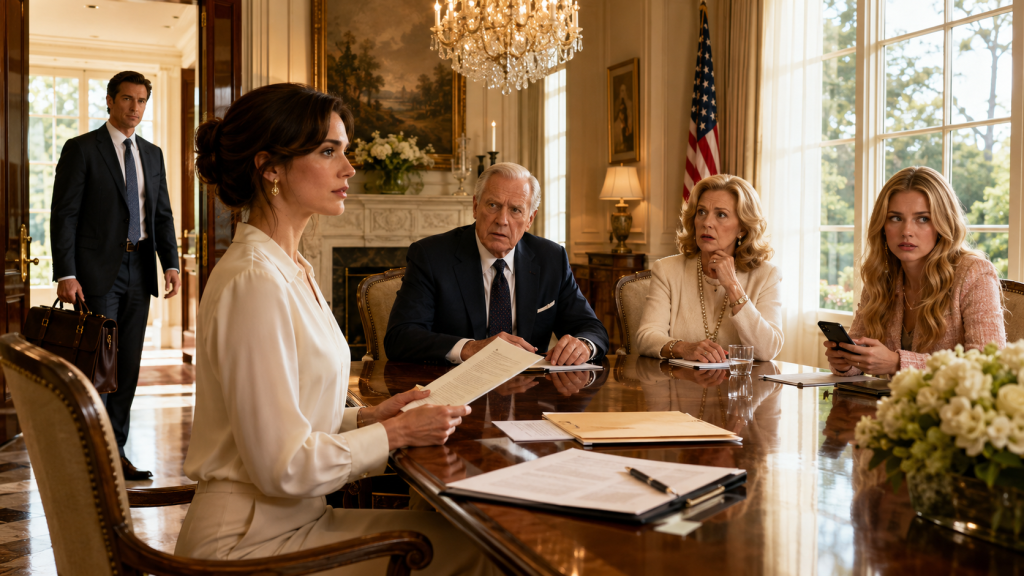
My mother, Eleanor Grant, sat beneath a crystal chandelier wearing pearls and a practiced mask of concern. My father, Richard, occupied the head of the table, calm in the way powerful men become when they believe every outcome has already been arranged.
My younger sister, Brooke, sat adjacent to him. Her phone rested face-up beside her hand, angled slightly toward my chair.
“We need to handle this today,” my father said.
Not hello.
Not congratulations.
Not are you all right?
My name is Alyssa Grant. I was thirty-two years old, and less than seventy-two hours earlier, I had sold Maison Grant, my fine-dining hospitality group, for twenty million dollars.
For almost a decade, those restaurants had been my life.
Not the glamorous version people saw in magazine profiles.
Not the Michelin-starred dining rooms glowing beneath handcrafted chandeliers.
The real version.
Sleeping on banquettes because I could not afford both rent and payroll.
Smelling like industrial bleach, garlic, smoke, and truffles.
Burning my forearms on the line while investors twice my age laughed at my business plan.
Missing holidays.
Forgetting birthdays.
Standing in a flooded kitchen at four in the morning while a plumber told me the flagship restaurant might not reopen in time for Friday service.
My family never respected any of it.
To them, I was the difficult daughter with a restaurant hobby.
Brooke was different.
Brooke had two million social-media followers, a wardrobe funded by my parents, and a lifestyle brand built on curated European vacations, luxury skincare routines, and inspirational captions she rarely wrote herself.
My parents called that success.
When I needed help launching my first restaurant, they called it irresponsibility.
When Brooke needed sixty thousand dollars to redesign her home studio, they called it an investment.
Only my grandmother Evelyn saw the difference.
She came to my first restaurant before it had proper chairs. She sat on an overturned produce crate in the kitchen and ate the risotto I had ruined twice before getting right.
“This is yours,” she told me. “Don’t let anyone convince you it belongs to them because they share your last name.”
Before she died, she gave me another warning.
“Stop cooking for the ghosts of this family, Alyssa. Some people hear success as an invitation.”
I thought she was being bitter.
Then my company sold.
Three weeks before the sale closed, my corporate attorney, Simon Pierce, discovered irregularities in the Grant Family Trust.
The trust had been created by my grandfather and expanded by Evelyn. It contained commercial property, investments, and family holdings worth tens of millions of dollars.
My father and mother had served as trustees since Evelyn’s death.
Simon had reviewed the trust only because the acquiring company wanted confirmation that none of my restaurant shares were entangled with family assets.
Instead, he found missing distributions, shell companies, unexplained loans, and signatures that did not match.
Millions had been redirected.
Some of the money had funded Brooke’s brand.
Some had covered my parents’ estate expenses.
Some had vanished into private companies controlled by people connected to my father.
Simon advised me not to confront them immediately.
“If they know what we found, they’ll destroy whatever records remain,” he said.
“So what do we do?”
“We let them believe you’re vulnerable.”
That was how the trap began.
The night after the sale closed, I invited my family to my Pacific Heights home for a celebratory dinner.
I served dry-aged beef, roasted vegetables, and a thousand-dollar bottle of Bordeaux my father had once said I would never be able to afford.
Halfway through dinner, I placed my wineglass down and told them the sale money was gone.
I claimed a shadow lender had enforced an old personal guarantee and seized all twenty million dollars.
I told them I was bankrupt.
My father’s expression changed first.
Not sorrow.
Calculation.
My mother asked whether the family trust could be exposed.
Brooke stopped eating and glanced at her phone.
Nobody asked where I would live.
Nobody offered help.
My father pushed his plate away.
“You should speak to a bankruptcy attorney,” he said.
My mother stood moments later, claiming she had a headache.
They left before dessert.
Brooke abandoned half a glass of wine and an old tablet on the side table.
My cousin Emma, who had served as Maison Grant’s chief operating officer, found it after they left.
The device was still logged into Brooke’s messages.
I knew opening them crossed a line.
Then I saw my name.
The family group chat had been active throughout dinner.
My father had written: We need to insulate the trust immediately. Execute the documents tomorrow.
My mother replied: Tell her to sign the waiver before she starts asking questions.
Brooke wrote: I’ll record her when she cries. If she sues us later, we leak the video and show everyone she was unstable after the sale collapsed.
For several minutes, my living room went completely silent.
San Francisco fog rolled against the windows. The untouched dessert waited on the dining table. Beyond the glass, the city lights glowed softly beneath the gray night.
I understood something I had spent my entire life trying not to know.
They were not worried that I had lost everything.
They were relieved.
My failure would make their theft easier.
The next morning, my mother called.
“Alyssa, your father and I want to help you.”
Her voice was warm enough to fool someone who had not read the messages.
She invited me to Atherton.
Now I sat across from them while my father pushed the folder toward me.
“Sign this,” he said. “It voluntarily removes you as a beneficiary of the family trust. In exchange, we will loan you enough money to avoid immediate legal action.”
I opened the folder.
The first page read:
IRREVOCABLE WAIVER OF BENEFICIARY RIGHTS AND AUDIT PRIVILEGES.
The agreement required me to surrender every claim to my grandmother’s trust.
It also prohibited me from requesting financial records, challenging past distributions, or suing the trustees.
In exchange, my parents would lend me two hundred thousand dollars.
They were offering me pennies to protect millions they had already stolen.
My mother touched my wrist.
“This is for your own protection.”
I looked at her manicured hand resting on my skin.
“Protection from what?”
“The stress of litigation,” she replied. “You’ve been through enough.”
Brooke lifted her phone slightly.
“Are you recording me?” I asked.
Her eyes widened with false innocence.
“No. Why would I do that?”
Her thumb moved across the screen.
Then she leaned back and smiled.
“Look at her,” she said softly. “The millionaire who lost it all.”
Something inside me became still.
Not broken.
Not numb.
Precise.
I folded the first page back into place and set the packet on the table.
“No.”
My father’s expression hardened.
“You are not in a position to be difficult.”
I met his eyes.
“That is the mistake you keep making.”
For the first time that morning, no one answered immediately.
Then the heavy dining-room doors opened.
Footsteps crossed the hardwood floor.
Brooke lowered her phone.
My mother gasped.
Simon Pierce entered carrying a large leather briefcase.
He placed it on the table with a heavy thud, looked at the waiver, and then at my parents.
“Good,” he said calmly. “You’ve already begun.”
My father rose from his chair.
“This is a private family matter.”
Simon opened the briefcase.
“Not anymore.”
He removed three sealed binders and arranged them across the table.
The first contained financial statements from the trust.
The second contained bank records, emails, and corporate registrations.
The third remained closed.
My father looked at me.
“You brought a lawyer into our home?”
“You brought legal documents to breakfast.”
Simon opened the first binder.
“Over the past six years, approximately nine million dollars was transferred from the Grant Family Trust into seven separate companies.”
He slid a diagram across the table.
Each company connected to another through a web of ownership records.
Two were controlled by my father.
One was registered to my mother’s longtime personal assistant.
Three were tied to Brooke’s manager.
The last belonged to a Delaware corporation with no public employees.
My mother shook her head.
“These were legitimate investments.”
Simon turned a page.
“Then perhaps you can explain why one of those investments paid for the renovation of this estate.”
My father’s voice sharpened.
“Trustees are permitted to invest funds.”
“They are not permitted to disguise personal expenditures as investments.”
Brooke’s confident expression faded.
Simon pushed a bank record toward her.
“Your lifestyle company received one point eight million dollars from a trust-funded entity.”
“That was a loan.”
“Where is the repayment schedule?”
Brooke looked at my father.
He said nothing.
Simon continued.
“We also found payments for private travel, luxury vehicles, jewelry, property taxes, and social-media production costs.”
My mother turned toward me.
“Alyssa, families help each other.”
“You never helped me.”
“That is not true.”
“When I opened my first restaurant, I asked Dad to co-sign a sixty-thousand-dollar loan.”
My father folded his arms.
“It was too risky.”
“You spent four times that amount on Brooke’s launch party.”
Brooke rolled her eyes.
“This is not about childhood jealousy.”
“No,” I replied. “It’s about theft.”
She grabbed her phone from the table.
Simon looked at it.
“You may want to stop recording.”
Her hand froze.
“California requires consent from all parties in certain confidential communications,” he said. “You have already announced your intention in writing to manipulate the recording.”
Brooke slowly set the phone down.
My father looked at Simon.
“You are making serious accusations without authority.”
Simon opened the second binder.
“Here is the authority.”
Inside were copies of emails exchanged between my parents and the attorney who had managed the trust accounts.
One message discussed classifying me as “financially erratic.”
Another proposed using my restaurant debt as evidence that I was incapable of managing an inheritance.
A third contained instructions to deny me access to the trust’s annual accounting.
My mother leaned back.
“You were always reckless with money.”
“I built a company worth twenty million dollars.”
“You said the money was gone,” Brooke snapped.
I looked at her.
“I lied.”
The words landed quietly.
Brooke blinked.
My father stared at me.
My mother’s mouth parted.
“The sale funds were never seized,” I continued. “There was no shadow lender. I am not bankrupt.”
Brooke’s face flushed.
“You tricked us.”
“I gave you an opportunity to show me who you were.”
My father struck his palm against the table.
“This is outrageous.”
Simon remained calm.
“Mr. Grant, sit down.”
“This is my home.”
“And these are potential exhibits in a civil fraud case.”
My father looked at the binders, then slowly returned to his chair.
My mother’s expression changed from shock to anger.
“You deceived your family.”
I almost laughed.
“You invited me here to steal my inheritance.”
“We were protecting the trust.”
“From me?”
“You spent years in restaurants that could have failed at any moment.”
“But they didn’t.”
“That does not erase the risk.”
“No. It only ruined the story you told about me.”
For years, my parents had needed me to be irresponsible.
My success had always threatened the family structure.
If I was unstable, their control looked reasonable.
If I was difficult, their coldness looked justified.
If I was poor, their refusal to help looked wise.
The sale of Maison Grant had made their version of me impossible to maintain.
So they needed me ruined.
Simon opened the third binder.
“There is another issue.”
My father’s confidence flickered.
“What issue?”
“Evelyn Grant amended the trust six months before her death.”
My mother’s face went completely still.
“That amendment was never finalized.”
Simon looked toward the doorway.
“That depends on whom you ask.”
A woman’s voice answered from behind him.
“It was finalized.”
Everyone turned.
Margaret Hale entered the room holding an old red leather portfolio.
She had been my grandmother’s personal attorney for thirty years.
I had not seen her since Evelyn’s funeral.
She was in her seventies now, with silver hair and a straight posture that made the room feel smaller.
My father stood again.
“Margaret.”
“Richard.”
He looked at the portfolio.
“You have no business here.”
“I am the drafting attorney for the final trust amendment.”
My mother whispered, “We were told those documents had been withdrawn.”
Margaret walked to the table and placed the portfolio in front of Simon.
“Evelyn expected you to say that.”
She opened it carefully.
Inside was the original signed amendment, notarized and witnessed.
Margaret read the key provision aloud.
“If any beneficiary is pressured, deceived, threatened, or financially coerced into surrendering rights, all current trustees shall be immediately suspended pending a forensic audit.”
Brooke stared at the waiver.
Margaret continued.
“If intentional concealment or misappropriation is found, the trustees lose all beneficial interests and must repay diverted funds.”
My father’s face reddened.
“This is absurd. My mother was ill.”
“She underwent two independent competency examinations,” Margaret replied. “Both are attached.”
My mother looked toward the doors as if considering escape.
Simon turned the waiver toward her.
“You told Alyssa this was for her protection. Your husband told her to sign it immediately. Your daughter attempted to record her emotional response. That is coercion documented in real time.”
Brooke stood abruptly.
“I had nothing to do with the trust.”
Simon removed several printed messages.
“You wrote that you wanted to make Alyssa look unstable if she sued.”
Brooke’s voice cracked.
“That was a joke.”
“Fraud investigators rarely appreciate jokes involving fabricated evidence.”
My father looked at me with open fury.
“You planned all of this.”
“I planned to learn the truth.”
“You destroyed this family.”
“No,” I said. “I stopped protecting the people who were destroying it.”
My mother’s eyes filled with tears.
For one dangerous second, she looked like the woman who used to brush my hair when I was a child.
“Alyssa,” she whispered, “we made mistakes.”
“Millions of dollars do not disappear by mistake.”
“We were going to replace it.”
“When?”
She had no answer.
My father pointed toward Simon.
“Get out of my house.”
Simon closed one binder.
“We will leave after you acknowledge receipt of the preservation notice.”
“What preservation notice?”
“You are prohibited from deleting financial records, transferring property, destroying electronic devices, or contacting witnesses for the purpose of influencing testimony.”
He placed the notice in front of my father.
My father did not touch it.
Then Margaret delivered the final blow.
“Richard, under Evelyn’s amendment, Alyssa becomes temporary controlling beneficiary once coercion is established.”
The color drained from his face.
“What does that mean?”
“It means,” Simon said, “that your access to the trust accounts was frozen at nine o’clock this morning.”
Brooke grabbed her phone.
“My accounts?”
“Any accounts receiving disputed trust funds may also be restricted.”
“This is insane!”
She turned to our parents.
“You said she was broke.”
My father glared at her.
“Be quiet.”
“No! You promised this would be handled.”
My mother snapped, “Brooke, stop talking.”
But Brooke had never learned how to remain silent when she felt deprived.
“You said Alyssa would sign because she was desperate. You said we could move the rest before the audit.”
The room went silent.
Simon slowly looked at my father.
“Thank you.”
Brooke realized what she had admitted.
Her hand flew to her mouth.
My father closed his eyes.
I stood.
For once, I did not feel victorious.
I felt tired.
I had wanted evidence.
I had received a confession.
Simon gathered the binders. Margaret closed the red portfolio.
Before leaving, I looked at the waiver one last time.
Then I tore my signature page in half.
My mother flinched.
“You will regret humiliating us,” my father said.
I folded the pieces neatly.
“You mistook accountability for humiliation.”
Outside, the Atherton sunlight was almost painfully bright.
Simon walked beside me toward the car.
“You did well,” he said.
“I feel terrible.”
“That does not mean you were wrong.”
I looked back at the estate.
The mansion had once seemed permanent. The stone entrance, manicured hedges, and long circular drive had made my parents appear untouchable.
Now it looked like evidence.
The forensic audit took seven months.
Investigators uncovered more than twelve million dollars in unauthorized transfers.
My parents had used trust money to fund their estate, private investments, political donations, and Brooke’s company.
They had also concealed distributions intended for me and two charitable foundations selected by my grandmother.
The civil court removed my parents as trustees.
They lost their beneficial interests under Evelyn’s amendment and were ordered to repay the diverted funds.
To satisfy the judgment, the Atherton estate was sold.
My father avoided prison by cooperating with investigators and agreeing to a settlement, but his reputation in the investment community collapsed.
My mother moved into a smaller home near Carmel and stopped speaking to me.
Brooke’s sponsors abandoned her after the trust litigation became public. She released a tearful video claiming she had been manipulated by “toxic family systems.”
She never mentioned the stolen money.
She did, however, return part of it.
I became controlling beneficiary of the restored trust, but I refused to use it as a private family account.
I reinstated the charitable distributions Evelyn had intended.
One funded culinary scholarships for young people from low-income families.
Another supported women opening small businesses without family backing.
I also created the Evelyn Grant Hospitality Fund.
The first recipient was a twenty-six-year-old cook from Oakland who had spent years working double shifts while developing a neighborhood restaurant concept.
When she received the grant, she cried.
“I thought people like me had to do everything alone,” she said.
I understood exactly what she meant.
A year after the meeting in Atherton, I returned to my first restaurant.
The new owners had preserved the kitchen wall where my earliest employees wrote their names during opening week.
Mine was still there, half-covered by an old shelf.
Alyssa—Day One.
Emma stood beside me.
“Do you miss it?” she asked.
“Every day.”
“Would you buy it back?”
I smiled.
“No.”
Selling Maison Grant had not ended my life.
It had freed me from needing to prove that my work mattered.
For years, every full dining room had felt like a message to my parents.
Every award had been another attempt to make them see me.
My grandmother had been right.
I had been cooking for ghosts.
I no longer needed their approval to understand my own value.
That evening, Simon and Margaret joined Emma and me for dinner at a small restaurant opened by one of the scholarship recipients.
The room was warm and crowded. The tables were simple. The chef moved through the kitchen with the exhausted happiness I remembered from my own early years.
Margaret raised her glass.
“To Evelyn.”
We all repeated the name.
I thought about my grandmother sitting on that produce crate years earlier, eating imperfect risotto and telling me that what I built belonged to me.
She had protected me long after her death.
Not simply with money.
With proof that someone in my family had seen me clearly.
I raised my glass.
“To knowing when to leave the table.”
Simon smiled.
“And when to bring a lawyer.”
We laughed.
For the first time, the story did not feel like betrayal.
It felt like inheritance.
Not the trust.
Not the millions.
The courage to stop feeding people who had spent years trying to starve me.
THE END! THANKS FOR READING!❤️