 Reading Time: 26 minutes
The first thing I heard was my brother screaming my name. “MICHAEL!” His voice thundered through the pediatric wing of Lake Forest Hospital, so loud that a little boy sitting near the nurses’ station began to cry.
I stood motionless outside Sophia’s examination room. For thirty-eight years, Marcus Vance had been my older brother. He had taught me how to ride a bicycle.
He had defended me against bullies.
He had helped me pay for college when our father died.
And until that Christmas evening, I had believed he was one of the finest men I knew.
But now, standing beneath the cold fluorescent lights of a hospital corridor, I realized something that made my stomach twist.
I had never truly known him.
“Where is my daughter?” Marcus shouted again.
Dr. Aris glanced toward the security guard approaching from the elevators.
“Michael,” he said quietly, “stay here. Let us handle this.”
I nodded.
Then I heard another voice.
My sister-in-law, Elisa.
“Marcus, please. People are staring.”
“I DON’T CARE WHO’S STARING!”
His footsteps came closer.
A moment later, Marcus appeared at the end of the hallway.
He was still wearing the expensive gray suit he had worn to Christmas dinner.
His hair was perfectly combed.
His shoes gleamed.
But his face was something I had never seen before.
Not frightened.
Not worried.
Furious.
He spotted me immediately.
“You.”
The word sounded like a threat.
“You took my daughter out of my house without my permission.”
I swallowed.
“She needed medical attention.”
Marcus laughed bitterly.
“Medical attention? Because she complained about a chair?”
“Because she has injuries, Marcus.”
His expression changed.
Only for a second.
But I saw it.
A flash of something behind his eyes.
Fear.
Then his familiar confident smile returned.
“Michael, listen carefully. My daughter has behavioral problems. We’ve been dealing with them for months. You know absolutely nothing about what happens in our home.”
“Then explain the bruises.”
Elisa appeared behind him.
Her face was pale.
She stared at the floor.
Marcus stepped closer.
“I’m going to give you one opportunity to fix this.”
“Fix what?”
“Tell the doctors you misunderstood everything. Tell them Sophia exaggerates. Then bring her out here.”
I looked toward my niece’s closed door.
Through the narrow glass window, I could see her sitting on the hospital bed.
Her stuffed rabbit was pressed against her chest.
A nurse was beside her.
Sophia wasn’t crying.
She was watching the door.
Waiting.
Waiting to see whether the adults would believe her this time.
I turned back toward Marcus.
“No.”
He blinked.
“What did you say?”
“I said no.”
His jaw tightened.
“You’ve always been jealous of me, Michael. My house. My business. My family. Is this your pathetic attempt to hurt me?”
For a moment, his words brought back every Thanksgiving dinner, every family gathering, every occasion when Marcus had reminded everyone how successful he was.
But then I remembered Sophia’s tiny hand pulling back her sleeve.
And the way she had whispered that she was afraid to go home.
“This isn’t about you and me,” I said.
Marcus leaned so close I could smell the wine on his breath.
“You have no idea what you’ve started.”
A calm voice interrupted him.
“Mr. Vance?”
Two police officers stood behind us.
The taller officer stepped forward.
“I’m Officer Daniel Brooks. Hospital staff requested our assistance. We’re going to need everyone to remain calm.”
Marcus immediately straightened his jacket.
His voice softened.
“Officer, thank goodness. My brother has taken my daughter without authorization. I want her returned to me immediately.”
The officer glanced toward Dr. Aris.
“Sir, we’ve been informed that medical staff have concerns regarding the child’s safety.”
Marcus smiled.
“My brother has created a misunderstanding. I’m happy to clear it up.”
“Then you’ll have an opportunity to provide a statement.”
“I don’t need to provide a statement. I need my daughter.”
Officer Brooks didn’t move.
“At the moment, she’s being evaluated by medical professionals. You cannot interrupt that examination.”
Marcus stared at him.
Then he reached into his pocket and removed his phone.
“My attorney will have a few things to say about this.”
“That’s your right, sir.”
Marcus began dialing.
And that’s when something happened that I will remember for the rest of my life.
The door behind us opened.
Sophia had apparently heard her father’s voice.
She stood just inside the room.
Her stuffed rabbit dangled from one hand.
“Daddy?”
Marcus spun around.
His face transformed.
Instantly.
The anger disappeared.
He crouched slightly and extended his arms.
“Princess! There you are! Come give Daddy a hug.”
Sophia didn’t move.
Her lower lip trembled.
Marcus’s smile faltered.
“Come on, sweetheart.”
She took one step backward.
Then another.
And in a voice so small I almost didn’t hear it, she said:
“Please don’t make me sit in the chair again.”
Nobody spoke.
Marcus slowly lowered his arms.
The nurse guided Sophia gently back into the examination room.
And Officer Brooks turned toward my brother.
“Mr. Vance,” he said, “I think we need to have a conversation.”
The First Secret
An hour later, Marcus was still arguing with the officers.
Elisa sat alone in a waiting room.
I found her staring at a paper cup of coffee she hadn’t touched.
For several seconds, neither of us spoke.
Then she whispered, “You shouldn’t have brought her here.”
I felt my chest tighten.
“Are you serious?”
Her eyes filled with tears.
“You don’t understand.”
“Then explain it.”
She glanced toward the hallway.
“Not here.”
“Elisa, Sophia has bruises. She’s terrified of her father. And when she tried telling you, you frightened her into silence.”
Her face crumpled.
“I know.”
Those two words stopped me cold.
“You know?”
A tear rolled down her cheek.
“I tried to stop it.”
I stared at her.
“Stop what?”
She covered her mouth.
For a moment, I thought she might refuse to answer.
Then she whispered, “The chair.”
I pulled out the empty chair opposite her.
“Tell me everything.”
Elisa looked toward the doorway again.
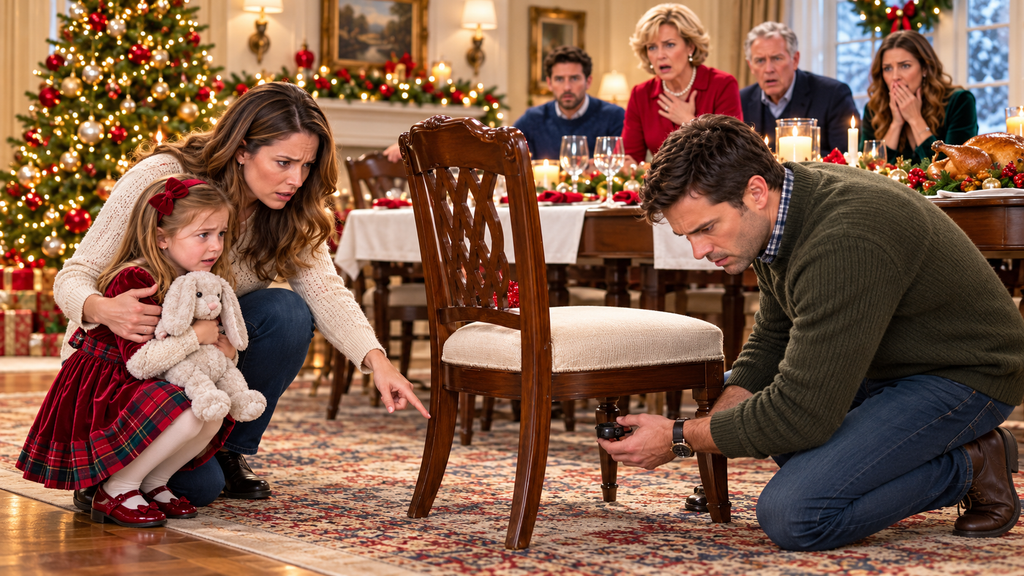
“Marcus calls it the quiet chair.”
I felt a chill.
“What does that mean?”
“He says children need discipline. Structure. Consequences.”
“And?”
“At first, he made Sophia sit there whenever she interrupted him or cried during meals.”
I waited.
Elisa’s hands began shaking.
“Then he installed something underneath it.”
“The black box?”
She nodded.
“He told me it monitored movement. That it would notify him whenever Sophia left her seat without permission.”
My stomach turned.
“She is five years old.”
“I know.”
“Why would a five-year-old need to be monitored at the dinner table?”
Elisa started crying harder.
“Because Marcus can’t stand being disobeyed.”
She explained that the device was part of a home-monitoring system Marcus had developed through his cybersecurity company.
The little black unit contained a motion sensor and microphone.
He had installed similar devices throughout the house.
Sophia’s chair was connected to an alert system.
Whenever she shifted too much, stood up, or left without permission, Marcus received a notification.
But the object itself wasn’t what had caused most of Sophia’s pain.
The bruises had another explanation.
A far more terrible one.
Elisa lowered her voice.
“When the alert went off, Marcus punished her.”
My throat tightened.
“What kind of punishment?”
She looked away.
I didn’t need her to finish.
I remembered Sophia’s arms.
The old marks.
The fresh ones.
The way she had flinched when Marcus raised his voice.
“And you let this happen?”
Elisa began sobbing.
“He told me she’d become uncontrollable if we didn’t establish boundaries.”
“She’s a little girl!”
“I know!”
Her voice broke.
“I know, Michael.”
I stood.
Anger surged through me so powerfully that I had to grip the back of my chair.
But Elisa caught my sleeve.
“There’s something else.”
I turned.
Her face had gone completely white.
“The device doesn’t just monitor movement.”
“What?”
“It records conversations.”
I stared at her.
“All conversations?”
She nodded.
“Marcus says the recordings are encrypted. He can access them from his office.”
A horrible thought struck me.
“Then he might have recorded what Sophia told me.”
Elisa looked down.
“He probably did.”
For a moment, the sounds of the hospital faded around me.
The beeping monitors.
The footsteps.
The distant voices.
All I could hear was Sophia whispering:
Daddy said the little black box has secrets inside.
I sat back down.
“Why would he record his own family?”
Elisa wiped her cheeks.
“Because he doesn’t trust anyone.”
“Even you?”
She gave a terrible little laugh.
“Especially me.”
Then she said something that made the entire evening take another frightening turn.
“Michael, you need to tell the police about his office.”
“What about it?”
“There is a locked room behind the bookcase.”
I stared at her.
“Marcus showed me his office last summer. There was no room behind the bookcase.”
“He built it afterward.”
“What’s inside?”
Elisa’s hands tightened around the coffee cup.
“I don’t know everything.”
“Elisa.”
She finally looked into my eyes.
“But I know that’s where he keeps the recordings.”
The Room Behind the Bookcase
Detective Dana Cole arrived shortly after midnight.
She was a composed woman in her forties, with dark hair pulled into a low ponytail and the steady expression of someone accustomed to hearing terrible things without letting them overwhelm her.
She listened while I explained everything.
The dinner.
The chair.
The bruises.
Sophia’s fear.
Marcus’s threats.
Then Elisa repeated what she had told me.
Detective Cole wrote carefully in her notebook.
“Has your husband ever physically harmed you?” she asked Elisa.
Elisa hesitated.
“Yes.”
I looked at her.
She lowered her eyes.
“Not recently. But he has.”
“Have you reported it?”
“No.”
“Why not?”
“Because Marcus always finds a way to make everyone believe him.”
Detective Cole paused.
“Mrs. Vance, I need you to understand something. Your daughter’s safety is our priority. What you tell us may help protect her, but we also need to understand what you knew and what you did.”
Elisa nodded through her tears.
“I understand.”
The detective turned to me.
“Michael, please don’t discuss the allegations with Sophia or ask her further questions. A trained interviewer will speak with her in an appropriate setting.”
“Of course.”
“And don’t attempt to retrieve any devices from the house yourself.”
“I won’t.”
Then she closed her notebook.
“We’re going to pursue the appropriate legal process to secure potential evidence.”
I nodded.
“What happens to Sophia tonight?”
“The medical team and child protection professionals are coordinating a safety plan. She will not simply be sent back into a situation they believe is dangerous.”
Relief rushed through me.
Not complete relief.
Not yet.
But enough that I could finally draw a full breath.
“Can I stay with her?”
“We’ll work with the hospital staff and the child protection team to determine what contact is appropriate.”
I thanked her.
She walked toward the hallway.
Then stopped.
“One more question.”
I looked up.
“Has your brother ever mentioned problems with his business?”
The question surprised me.
“Not to me. Why?”
“His wife mentioned the office contains financial files as well as security recordings.”
I frowned.
“Marcus owns a successful cybersecurity company. He employs almost eighty people.”
Detective Cole studied me.
“Successful?”
“That’s what he tells everyone.”
She didn’t respond.
But her expression told me that she was thinking something very different.
By three in the morning, I was sitting beside Sophia’s hospital bed.
Her stuffed rabbit rested against her pillow.
The hospital social worker had helped arrange for me to remain nearby while the next steps were being decided.
Sophia opened her eyes.
“Uncle Michael?”
“I’m here, sweetheart.”
“Is Daddy angry?”
I looked at her.
“You don’t have to worry about Daddy right now.”
She studied my face.
“Because he’s always angry when I tell secrets.”
I moved closer.
“Sophia, you haven’t done anything wrong.”
She was silent for a moment.
Then she asked a question that nearly shattered me.
“Do good girls get bruises?”
I felt tears burning behind my eyes.
“No, honey. Being good or bad doesn’t mean anyone gets to hurt you.”
“But Daddy says—”
“Daddy was wrong.”
She stared at me.
It was as if she had never considered that possibility.
“Grown-ups can be wrong?”
“Yes.”
“Even daddies?”
“Even daddies.”
She considered that quietly.
Then she reached for my hand.
“Will you be here when I wake up?”
I swallowed.
“I’ll be close.”
She closed her eyes.
And a few minutes later, she finally fell asleep.
I sat there long after the room became quiet.
Thinking about every Christmas photograph Marcus had sent me.
Sophia in a princess dress.
Sophia blowing out birthday candles.
Sophia smiling beside a swimming pool.
In every photograph, Marcus had written some variation of the same words.
Living the dream.
I looked at the little girl sleeping beside me.
And wondered how many photographs had been taken just minutes after she had cried.
How many smiles she had been instructed to produce.
How many times we had mistaken expensive surroundings for happiness.
Then my phone vibrated.
An unfamiliar number.
I opened the message.
YOU SHOULD HAVE STAYED OUT OF MY FAMILY.
A second message appeared.
YOU HAVE NO IDEA WHAT SHE’S GOING TO COST ME.
No signature.
None was necessary.
But it was the final sentence that made me stare at the screen.
Not what this will do to Sophia.
Not what this will do to our family.
What she was going to cost him.
I took screenshots and forwarded the messages to Detective Cole.
Then I looked back at my niece.
For the first time that night, I understood something clearly.
Marcus wasn’t merely afraid of losing control over his daughter.
He was afraid of losing something much bigger.
And somehow, Sophia was connected to it.
The Evidence Marcus Forgot to Destroy
Two days after Christmas, Detective Cole called me.
I was staying at a small hotel ten minutes from the hospital.
Sophia had been discharged into temporary protective care while the authorities evaluated relatives who might be able to provide a safe home.
I had submitted every document they requested.
Identification.
Employment information.
References.
A background check authorization.
I would have given them anything.
My house.
My savings.
Every possession I owned.
If it meant Sophia never had to be afraid of a dinner chair again.
“Michael,” Detective Cole said, “we’ve recovered something important.”
I sat upright.
“The black box?”
“Yes.”
My heart pounded.
“What’s on it?”
“The device itself was part of a larger recording system. Investigators recovered several related components and storage drives under a search warrant.”
I gripped the phone.
“And?”
She hesitated.
“We’ve found recordings that support serious concerns about Sophia’s treatment.”
I closed my eyes.
Some part of me had still been hoping.
Hoping there was an explanation.
Hoping Marcus had simply become a cruel, impatient father who could somehow acknowledge his behavior and change.
But I knew now that what Sophia had described wasn’t a misunderstanding.
It was something calculated.
“There’s more,” Detective Cole continued.
I opened my eyes.
“What more?”
“We found recordings of conversations that appear to involve financial misconduct.”
I frowned.
“What kind?”
“That investigation is still developing. But I’d like you to come to the station. There’s something I need to ask you about your mother.”
My breath caught.
“Our mother?”
“Yes.”
“She’s been dead for almost three years.”
“I know.”
The detective paused.
“Michael, did your mother ever discuss leaving money to Sophia?”
I stared at the wall.
“No.”
“Are you certain?”
“Absolutely.”
There was a brief silence.
Then she said:
“Your brother may have been keeping more than one secret.”
I arrived at the police station thirty minutes later.
Detective Cole brought me into a conference room.
An older man in a navy suit was sitting at the table.
He stood when I entered.
“Michael Vance?”
“Yes.”
“My name is Thomas Bennett. I was your mother’s estate attorney.”
I recognized him immediately.
He had attended her funeral.
But something about seeing him again, under these circumstances, made me uneasy.
“What’s going on?”
Bennett gestured toward a chair.
“Please sit down.”
I remained standing.
“Just tell me.”
He exchanged a glance with Detective Cole.
Then he opened a leather folder.
“Your mother established a trust for Sophia before she died.”
I blinked.
“A college fund?”
“Much more than that.”
He placed a document on the table.
I looked down.
At the top were the words:
THE EVELYN VANCE FAMILY TRUST — SOPHIA VANCE BENEFICIARY ACCOUNT
Below them was a number.
$6,400,000.
I stared at it.
“That can’t be right.”
“It is.”
“My mother had six million dollars?”
“She accumulated substantial assets through investments and property holdings. Your brother was aware of the trust.”
I sat down slowly.
“Why wasn’t I?”
“Your mother designated Marcus as trustee and named you as successor if he became unable or legally ineligible to serve. She intended the funds to support Sophia’s education, care, and future.”
I felt sick.
“Marcus never told me.”
Bennett’s expression darkened.
“We now have reason to believe that important communications and account statements were concealed.”
Detective Cole leaned forward.
“Michael, your brother’s company has been experiencing severe financial difficulties.”
I shook my head.
“That’s impossible. He just bought a new house in Aspen.”
“His lifestyle may not reflect the condition of his business.”
Bennett slid another document toward me.
“Records suggest substantial sums were transferred from Sophia’s trust into accounts connected to Marcus’s company.”
“How much?”
The attorney looked at me.
“Nearly four million dollars.”
For several seconds, I couldn’t speak.
Then I whispered:
“He stole from his own daughter?”
“We’re examining whether those transfers were unauthorized and how they were concealed,” Detective Cole said.
I thought about Marcus’s Christmas photographs.
The expensive vacations.
The sports cars.
The parties.
The way he bragged about building everything himself.
And I remembered his message.
You have no idea what she’s going to cost me.
Suddenly, I understood.
Sophia wasn’t just his daughter.
She was the beneficiary of a fortune he had been treating as his own.
But one question remained.
“What does any of this have to do with the chair?”
Detective Cole looked at me.
“That is what we’re trying to establish.”
Then she opened a folder containing a transcript.
“We recovered a conversation recorded several weeks before Christmas.”
I leaned forward.
“Between who?”
“Marcus and Elisa.”
She gave me a moment to read.
The transcript began with Elisa asking Marcus why the family’s accountant was requesting information about Sophia’s trust.
Marcus had replied:
Tell him the account is being reviewed.
Elisa asked whether the money was still there.
Marcus answered:
The company needs time.
Then came a sentence that made my blood run cold.
If anyone starts asking questions about that trust, we could lose everything.
I looked up.
Detective Cole turned the page.
The next recorded conversation had taken place three days later.
This time, Sophia’s voice appeared in the transcript.
She had asked her father what Grandma Evelyn had left for her.
Marcus demanded to know who had told her about the money.
Sophia said she had seen a letter.
Then the transcript recorded the sound of a chair scraping against the floor.
Sophia began crying.
And Marcus said:
You do not ask questions about things that belong to grown-ups. Do you understand?
The recording ended shortly afterward.
I pressed a hand against my mouth.
The little girl I had watched opening Christmas presents had been punished for asking about her own inheritance.
“She wasn’t trying to expose him,” I whispered.
Detective Cole shook her head.
“No. She was asking an ordinary question.”
I stared at the transcript.
And for the first time in my life, I hated my brother.
Not because he had lied to me.
Not because he had stolen money.
But because a five-year-old child had learned to associate curiosity with fear.
The Woman Who Tried to Warn Us
Three days later, I received a phone call from a woman named Rosa Martinez.
She had worked as Marcus and Elisa’s housekeeper for nearly six years.
Marcus had fired her the previous summer.
“Mr. Michael,” she said, her voice trembling, “I heard about Sophia.”
I moved into the quiet hallway of my hotel.
“Do you know something?”
She was silent.
Then she began crying.
“I tried to help that little girl.”
My chest tightened.
“What happened?”
“Last June, Sophia came into the laundry room while I was folding towels. She had been crying.”
I closed my eyes.
“She asked me whether bad children were supposed to hurt.”
I leaned against the wall.
Rosa continued.
“I told her nobody was supposed to hurt her. Then she showed me her arm.”
“Did you tell Elisa?”
“Yes.”
“What did she say?”
“She told me Sophia was clumsy.”
“And Marcus?”
Rosa’s voice changed.
“He fired me the next morning.”
I clenched my fist.
“Why didn’t you call someone?”
“I did.”
The words stunned me.
“What?”
“I contacted the child abuse hotline. I told them what I’d seen.”
I straightened.
“What happened?”
“I don’t know everything. Someone interviewed me. After that, Marcus’s attorney contacted me and accused me of inventing stories because I’d been dismissed.”
Rosa began crying again.
“I was frightened. I had two grandchildren living with me. Marcus threatened to sue me for everything.”
I closed my eyes.
“I should have kept pushing,” she whispered. “Every day I’ve wondered what happened to Sophia.”
I drew a shaky breath.
“Rosa, you did try.”
“But it wasn’t enough.”
I knew there was nothing simple I could say.
Because I was asking myself the same question.
Why hadn’t I visited more often?
Why hadn’t I noticed Sophia’s silence during video calls?
Why had I accepted Marcus’s excuses when he claimed she was sleeping or busy?
How many times had I laughed when he called her shy?
Rosa interrupted my thoughts.
“There is something else.”
I opened my eyes.
“What?”
“Your mother knew.”
The hallway seemed to tilt beneath me.
“What did you say?”
“Mrs. Evelyn visited before she became ill. She saw Marcus shout at Sophia during dinner.”
My throat tightened.
“What happened?”
“She told him that children weren’t furniture. That they couldn’t be ordered to sit silently just because adults wanted peace.”
I could almost hear my mother’s voice.
She had never been a sentimental woman.
But she believed children deserved respect.
Rosa continued.
“After that visit, your mother asked me to keep an eye on Sophia.”
Tears burned my eyes.
“She knew something was wrong?”
“She suspected it. She told me she was going to make sure Sophia had something of her own, something nobody could take away.”
The trust.
My mother hadn’t left Sophia the money because Marcus needed it.
She had left it because she was afraid Sophia might someday need protection from him.
And Marcus had taken that protection away.
The Recording That Changed Everything
The following Monday, Detective Cole called again.
This time, her voice was different.
“Michael, we found another recording.”
I gripped the phone.
“Of Marcus?”
“Yes. It came from a device in his home office.”
“What does it say?”
“I can’t discuss every detail while the investigation is active. But I can tell you that investigators have evidence he was attempting to create a false explanation for Sophia’s injuries.”
I went still.
“A false explanation?”
“He wanted other people to believe Elisa was responsible.”
I sat heavily on the bed.
Suddenly, memories rearranged themselves in my mind.
Marcus calling Elisa emotional.
Marcus making jokes about her forgetting things.
Marcus telling relatives she was struggling with motherhood.
It hadn’t simply been cruelty.
He had been constructing a story.
One in which he was the hardworking, concerned father.
Elisa was the unstable mother.
And Sophia was a confused child who needed strict discipline.
“Why?” I whispered.
Detective Cole was quiet for a moment.
“His communications suggest he was preparing for a divorce and a custody dispute.”
I felt a cold rush of understanding.
If Marcus gained control over Sophia’s legal and financial affairs, he might have believed he could maintain access to the trust.
“And the chair?”
“The monitoring system allowed him to track Sophia’s movements and record conversations. Some recordings appear to have been selectively edited.”
My heart pounded.
“He was trying to make evidence against his own wife?”
“That’s one avenue we’re investigating.”
I stared out at the parking lot.
Snow had begun falling again.
Slow.
Silent.
Beautiful.
How strange that the world could look so peaceful while something so terrible was being uncovered.
Then Detective Cole told me the final detail.
“Michael, the full recordings were preserved on an automatic backup system. Your brother apparently believed he had deleted some of them.”
I closed my eyes.
For a man who had built his fortune claiming to protect information, Marcus had made one catastrophic mistake.
He had trusted his own ability to erase the truth.
But the truth had survived him.
And it had been waiting beneath his daughter’s chair.
My Brother’s Last Threat
Marcus was arrested after investigators gathered sufficient evidence to seek charges.
His attorney issued a statement.
He denied harming Sophia.
He accused Elisa of manipulating the child.
He claimed I had been jealous of his success for years.
And he insisted the financial transactions were legitimate business decisions.
For nearly two weeks, his lawyer fought every allegation.
Then I received a handwritten letter.
It came through Marcus’s attorney.
I knew his handwriting before I opened the envelope.
Michael,
You have made a terrible mistake.
You think you’re saving Sophia, but you’re destroying the only family she has.
Children say things they don’t mean. Parents make mistakes. You don’t understand the pressure I’ve been under.
When all this is finished, Sophia will come home, and she will learn the truth about what you did.
You still have time to make this right.
Your brother, Marcus.
I read it twice.
There was no apology.
No concern for Sophia’s injuries.
No acknowledgment of her fear.
Only blame.
Only threats.
Only the assumption that he still had the power to decide what happened next.
I forwarded the letter to Detective Cole.
Then I took a blank sheet of paper.
For a long time, I sat staring at it.
Finally, I wrote six words.
Sophia is not yours to punish.
I never mailed the letter.
I realized Marcus didn’t need another argument.
He needed consequences.
And I needed to focus on Sophia.
The Little Girl Who Wouldn’t Sit Down
Almost a month after Christmas, child protection authorities approved me as Sophia’s temporary kinship caregiver.
There had been interviews.
Home visits.
Background checks.
Meetings with social workers.
And difficult conversations about what it would mean to care for a child who had experienced prolonged fear.
I had rearranged my home in Chicago.
My spare bedroom became hers.
I bought soft yellow curtains.
A small bookshelf.
A nightlight shaped like a moon.
And a white bedspread decorated with tiny blue stars.
But the most important thing I bought wasn’t expensive.
It was a small wooden rocking chair.
I placed it beside her bedroom window.
On the day Sophia arrived, she stood in the doorway holding her rabbit.
She looked at the room.
Then at me.
“Is this mine?”
“Yes, sweetheart.”
“All of it?”
“All of it.”
She touched the bedspread.
Then the curtains.
Then the little bookshelf.
“Can I put my rabbit here?”
“Anywhere you like.”
She carefully placed him on the pillow.
Then she noticed the rocking chair.
Her smile disappeared.
I saw her shoulders tighten.
“Do I have to sit there?”
The question nearly broke me.
“No.”
She looked surprised.
“Never?”
“Only if you want to.”
“What if I don’t?”
“Then you don’t.”
She stared at the chair for a long moment.
Then she whispered:
“Can I move it?”
I nodded.
“Of course.”
Together, we carried it into the hallway.
She watched as I placed it against the wall.
Then she breathed out.
It was such a small sound.
But I realized she had been holding her breath.
That evening, I made macaroni and cheese.
Sophia sat at the kitchen table.
She took three bites.
Then she looked at me.
“Uncle Michael?”
“Yes?”
“Can I stand up?”
I put down my fork.
“Of course.”
She stood.
Then sat down again.
A few minutes later, she stood a second time.
I said nothing.
She walked to the refrigerator.
Then returned.
Then she did it again.
Each time, she glanced at my face.
Checking.
Waiting.
Finally, she asked:
“Are you going to get mad?”
“No, Sophia.”
“Even if I get up a hundred times?”
I smiled gently.
“Even if you get up a hundred times.”
She considered that.
Then she stood up again.
And for the first time since Christmas, she laughed.
Not a nervous laugh.
Not the polite little sound she made when adults expected her to smile.
A real laugh.
Bright and surprised.
As if freedom itself had caught her off guard.
I turned toward the kitchen sink so she wouldn’t see me crying.
The Truth Elisa Could No Longer Hide
Elisa contacted me through her attorney in March.
She wanted to see Sophia.
By then, the authorities had established clear conditions regarding contact, and any visit would require approval and appropriate supervision.
I told Elisa I wouldn’t make promises on Sophia’s behalf.
She understood.
Or at least she said she did.
A week later, she asked to meet me alone.
We sat in a quiet café outside Chicago.
She looked almost unrecognizable.
Her expensive jewelry was gone.
Her hair was tied back.
She seemed smaller.
“Thank you for coming,” she whispered.
I didn’t answer.
For several minutes, she stirred a cup of tea she never drank.
Then she looked up.
“I need to tell you something.”
I waited.
“Marcus wasn’t the only one who lied.”
My stomach tightened.
“What do you mean?”
She swallowed.
“When the attorney asked about the trust distributions, I signed documents saying the money had been used for Sophia.”
I stared at her.
“Did you know that wasn’t true?”
Her eyes filled with tears.
“Yes.”
I looked away.
“You knew he was taking her money.”
“I knew some of it.”
“And you signed anyway.”
She nodded.
“Marcus said the company would collapse if we didn’t. He said everyone would lose their jobs. He said we’d replace the money before anyone noticed.”
I shook my head.
“That’s not an excuse.”
“I know.”
“Neither is being frightened of your husband.”
Her face crumpled.
“I know that too.”
I leaned forward.
“You watched your daughter suffer, Elisa.”
Tears spilled down her cheeks.
“I was afraid of what he’d do if I challenged him.”
“So you let Sophia carry the fear for you.”
She closed her eyes.
The words hung between us.
Painful.
Unavoidable.
Finally, she whispered, “Yes.”
For the first time, she hadn’t offered an explanation.
She had admitted the truth.
She reached into her handbag and removed a small envelope.
“Would you give this to Sophia someday?”
“What is it?”
“A letter.”
I didn’t take it immediately.
“What does it say?”
“That I’m sorry. That I should have protected her. That none of it was her fault.”
I looked at the envelope.
“Elisa, Sophia doesn’t owe you forgiveness.”
“I know.”
“She may not want to read it.”
“I understand.”
“And if she ever chooses to have a relationship with you, it has to happen because it’s healthy for her. Not because you feel guilty.”
Elisa nodded.
Then she said something I hadn’t expected.
“I’ve been working with the investigators.”
I looked up.
She wiped her cheeks.
“I gave them records. Emails. Account statements. Everything I kept.”
“Why now?”
Her voice broke.
“Because for years, I kept choosing what was easiest for me.”
She looked down at her hands.
“And every time I did, Sophia paid for it.”
I didn’t forgive Elisa that afternoon.
I wasn’t sure I ever would.
But I accepted the envelope for safekeeping, without promising to deliver it.
Because there was a difference between someone recognizing their wrongdoing and a child being ready to trust them again.
And Sophia deserved the freedom to decide that for herself.
The Day Marcus Finally Lost Control
The legal proceedings continued for months.
Financial investigators traced the unauthorized transfers from Sophia’s trust.
Former employees from Marcus’s company provided records.
Rosa Martinez gave a detailed statement about what she had witnessed.
Medical professionals documented Sophia’s injuries.
And investigators preserved the recordings recovered from the house.
Marcus’s attorneys challenged the evidence.
They questioned the witnesses.
They argued over the context of the recordings.
They tried to portray him as a stressed father dealing with a difficult child.
But each new discovery made his explanations harder to sustain.
The company Marcus had bragged about for years had been struggling under undisclosed debts.
Several major contracts had been lost.
He had concealed financial problems from employees and creditors while maintaining an extravagant lifestyle.
And when the business began collapsing, he had treated Sophia’s inheritance as a financial lifeline.
The investigation also uncovered communications showing that Marcus had considered using allegations against Elisa to strengthen his custody position.
The carefully constructed image of the perfect husband, father, and businessman began falling apart.
Eventually, faced with the accumulated evidence, Marcus entered guilty pleas to multiple charges connected to his treatment of Sophia, unlawful surveillance, and financial misconduct.
The court imposed a substantial prison sentence, along with financial penalties and restitution obligations.
The remaining family-law matters continued separately, with Sophia’s safety and welfare at the center of every decision.
I attended Marcus’s sentencing.
Not because I wanted revenge.
But because I needed to see the man I had once admired face what he had done.
He wore a plain dark suit.
No expensive watch.
No confident smile.
He looked older.
Tired.
When he saw me seated behind the prosecutors, his expression hardened.
For a moment, I recognized the Marcus from Christmas dinner.
The man who had ordered his daughter to sit.
The man who had threatened me in the hospital.
Then the judge began speaking.
She described the seriousness of exploiting a position of trust over a child.
She spoke about the lasting effects of repeated mistreatment.
And she made clear that wealth, professional status, and public reputation did not excuse the conduct before the court.
Marcus stared straight ahead.
When he was invited to speak, he stood slowly.
“I love my daughter,” he said.
My hands tightened.
“I never intended for any of this to happen.”
He paused.
Then he looked toward me.
“My brother has turned my family against me.”
I felt a familiar flash of anger.
Even now.
Even after everything.
He was still trying to make himself the victim.
But this time, nobody interrupted the proceeding to defend his pride.
Nobody rushed to repair his reputation.
Nobody ordered Sophia to remain silent.
And I realized the most important thing Marcus had lost wasn’t his company.
It wasn’t his money.
It wasn’t even his freedom.
It was his ability to control the story.
For years, he had decided what everyone was allowed to believe.
Now the evidence spoke for itself.
And no amount of shouting could silence it.
The Letter My Mother Left Behind
Several weeks after the sentencing, Thomas Bennett visited my home.
He carried a narrow wooden box.
It was scratched around the edges.
I recognized it immediately.
My mother’s old keepsake box.
“She left instructions that this should go to you under certain circumstances,” he explained.
I took it carefully.
Inside were photographs.
Birthday cards.
A silver bracelet.
And a sealed envelope.
My name was written across the front.
In my mother’s familiar handwriting.
My hands trembled as I opened it.
Dear Michael,
If you’re reading this, it may mean that something has happened that I hoped could be prevented.
You have always believed the best in your brother. I understand why. He was strong when you were young, and you needed someone to look up to.
But strength and goodness are not the same thing.
I stopped reading.
My throat tightened.
I have watched Marcus become a man who believes love means obedience.
He wants people to admire him. He struggles when they question him.
I worry most about Sophia.
She is gentle, curious, and sensitive. Those are beautiful qualities, but Marcus seems to mistake them for weakness.
I have tried speaking to him. I have tried speaking to Elisa.
I cannot know what the future will bring, but I want Sophia to have something that belongs to her, something no one can take simply because they are bigger or louder.
I wiped my eyes.
If the time ever comes when Sophia needs someone to stand beside her, I hope you will be that person.
You don’t need to be wealthy.
You don’t need to be powerful.
You only need to listen when she speaks.
That is something Marcus has forgotten how to do.
Love, Mom.
I lowered the letter.
For a long time, I sat completely still.
My mother had seen the warning signs years before I had.
She had tried to protect Sophia in the only way she knew.
But she had never imagined that the very person entrusted with that protection would exploit it.
I looked at her handwriting again.
You only need to listen when she speaks.
That was what had changed everything.
Not my brother’s wealth.
Not his influence.
Not the police investigation.
Not the millions of dollars.
It had started when a frightened five-year-old girl whispered:
The chair hurts.
And someone finally listened.
One Year Later
The following Christmas, snow fell softly over Chicago.
My house smelled of cinnamon, roasted chicken, and freshly baked sugar cookies.
A small Christmas tree stood beside the living room window.
Paper snowflakes covered the glass.
And somewhere upstairs, Sophia was singing along to a holiday song.
She had turned six that autumn.
She was taller now.
Her hair had grown past her shoulders.
And although there were still difficult nights, she was beginning to understand that our home had rules very different from the ones she had known.
She could ask questions.
She could say no to a hug.
She could cry without being punished.
She could make mistakes without being frightened.
Her therapist had helped her find words for feelings she’d once been taught to hide.
Some days were easier than others.
There were still moments when a raised voice on television made her freeze.
There were nights when she woke from dreams and needed reassurance that she was safe.
Healing hadn’t happened all at once.
And I had stopped expecting it to.
I was learning that love wasn’t always a dramatic rescue.
Sometimes, love was answering the same question fifty times.
Sometimes, it was leaving a hallway light on.
Sometimes, it was accepting that a child needed space instead of a hug.
And sometimes, it was sitting quietly beside a bedroom door until she felt ready to sleep.
The court had approved a longer-term guardianship arrangement, and Sophia was thriving in a new school.
Her teachers described her as thoughtful and imaginative.
She had made two close friends.
She loved painting.
She was fascinated by astronomy.
And she had developed a habit of leaving small handwritten notes around the house.
Most mornings, I found one beside the coffee maker.
Have a nice day, Uncle Michael.
Or:
Remember to feed Mr. Whiskers.
Mr. Whiskers was the stuffed rabbit.
Apparently, he had acquired an appetite for imaginary carrots.
That Christmas Eve, Sophia insisted on helping me prepare dinner.
She wore a red sweater with a reindeer on the front.
Flour dusted her cheeks.
And she had somehow managed to scatter sprinkles across half the kitchen.
“Uncle Michael!”
I looked up.
“Yes?”
“I made a special cookie.”
She held up a crooked star covered in blue frosting.
“It looks delicious.”
“It’s for Grandma Evelyn.”
My heart tightened.
“That’s very thoughtful.”
She looked toward the framed photograph of my mother on the mantel.
“Do you think she’d like it?”
I smiled.
“I think she’d love it.”
Sophia carefully placed the cookie on a small plate beneath the photograph.
Then she looked at me.
“Uncle Michael?”
“Yes, sweetheart?”
“Did Grandma really love me?”
I knelt beside her.
“Very much.”
“Even when I was little?”
“Especially then.”
She thought about that.
Then she smiled.
“I wish I remembered her better.”
I brushed a strand of hair away from her face.
“I can tell you stories about her.”
“All of them?”
I laughed.
“That might take a while.”
“Good.”
She took my hand.
“I like stories.”
After dinner, we sat in the living room opening Christmas presents.
Sophia received a small telescope.
A box of watercolor paints.
Three books.
And a plush rabbit that she immediately announced would become Mr. Whiskers’s younger brother.
Then she noticed one final package beneath the tree.
It was wrapped in silver paper.
“For me?”
I nodded.
She tore away the wrapping.
Inside was a small wooden plaque.
Painted across it were five simple words.
YOU ARE SAFE TO SPEAK.
Sophia stared at it.
Then she looked up at me.
“What does it mean?”
I sat beside her.
“It means that in this house, you can tell me when you’re happy.”
She nodded.
“And when you’re sad.”
Another nod.
“And when you’re scared.”
Her eyes filled with tears.
“And when something hurts?”
My throat tightened.
“Especially when something hurts.”
She looked down at the plaque.
For a long moment, she didn’t speak.
Then she climbed into my lap.
Her arms wrapped around my neck.
“Thank you for believing me,” she whispered.
I closed my eyes.
I held her carefully.
And for the first time in almost a year, I allowed myself to cry without hiding it.
Because I remembered the little girl who had stood beside her dining chair on Christmas evening.
The girl whose parents had laughed.
The girl who had learned to keep her pain hidden beneath long sleeves.
The girl who believed telling the truth might cause her to lose her family.
And here she was.
Safe.
Loved.
Still learning to trust.
Still learning to be a child.
After a while, Sophia pulled away.
“Uncle Michael?”
“Yes?”
“Can I ask you something?”
“Anything.”
She looked toward the dining room.
There was a new table there.
A simple round wooden table with four comfortable chairs.
No hidden devices.
No alarms.
No rules about sitting perfectly still.
Just a place to eat together.
“Can we have pancakes tomorrow?”
I smiled.
“Absolutely.”
“Even though it’s Christmas?”
“Especially because it’s Christmas.”
She grinned.
Then she grew serious again.
“And can I sit on the floor if I want?”
I felt my heart ache.
I took her little hand.
“Sophia, you can sit wherever you’re comfortable.”
She considered that carefully.
Then she climbed down from my lap, carried her new stuffed rabbit into the dining room, and sat cross-legged on the soft rug.
I watched from the doorway.
For a moment, she just sat there.
Quietly.
Looking around the room.
Then she tilted her head toward me.
“Uncle Michael?”
“Yes, sweetheart?”
“The chair doesn’t hurt anymore.”
I swallowed hard.
“No,” I whispered.
“It doesn’t.”
She smiled.
And went back to playing.
Later that night, after Sophia had fallen asleep, I stood beside the living room window.
Snow drifted through the darkness.
The Christmas lights reflected softly against the glass.
On the mantel stood my mother’s photograph.
Beside it was Sophia’s little star-shaped cookie.
I thought about Marcus.
About Elisa.
About the destroyed relationships, the stolen money, the lies, and the terrible choices that had brought us here.
The recovered funds were being placed under independent management for Sophia’s benefit.
Professionals were handling the legal and financial arrangements.
The adults who had failed her were facing their own consequences.
And Sophia no longer had to carry the burden of fixing what they had broken.
I had spent so much of my life believing that family meant loyalty.
That blood meant trust.
That loving someone meant defending them, even when they disappointed you.
But that Christmas had taught me something different.
Sometimes, loyalty means refusing to protect a lie.
Sometimes, loving your family means standing between a child and the people who have harmed her.
Sometimes, doing the right thing means accepting that someone you once admired is not the person you believed them to be.
And sometimes, the bravest person in the room is a five-year-old girl who finds the courage to whisper that something hurts.
I turned off the Christmas lights.
Walked upstairs.
And stopped outside Sophia’s bedroom.
Her door was slightly open.
The moon-shaped nightlight glowed beside her bed.
Mr. Whiskers was tucked beneath her arm.
The new rabbit lay beside him.
Sophia was sleeping peacefully.
I stood there for a moment.
Then I whispered the words I wished someone had said to her much sooner.
“You never have to earn the right to be safe.”
She stirred slightly.
But didn’t wake.
I smiled and gently closed the door, leaving it open just enough for the hallway light to shine through.
Because the little girl who had once been frightened to speak was finally learning that her voice mattered.
And the secret that had nearly destroyed our family had ultimately revealed something more important than money, power, or reputation.
The truth.
That a child’s pain should never be dismissed simply because an adult finds it inconvenient.
That silence protects the wrong people.
And that sometimes, changing a child’s entire future begins with five simple words.
“I believe you, sweetheart. Always.”
THE END! THANK YOU FOR READING!❤️