 Reading Time: 22 minutes
For several seconds, I couldn’t speak. My daughter Megan was crying on the other end of the phone, and I stood in the middle of Wendell’s beautiful yellow kitchen, staring at the photograph of my late husband.
“Mom, please say something,” she whispered. I gripped the edge of the kitchen counter. “What do you mean Zach has been transferring money?” Megan took a trembling breath.
“I found statements, Mom. Bank statements. He’s been moving money out of the account where you deposited Dad’s life insurance money. And I think he’s been doing it for months.”
My knees suddenly felt weak.
“How much?”
There was a terrible silence.
“Megan. Tell me.”
“At least sixty-seven thousand dollars.”
The room seemed to tilt.
Sixty-seven thousand dollars.
Money Dwight had worked his entire life to provide for me.
Money that was supposed to keep me comfortable during retirement, pay unexpected medical bills, and ensure I never became a burden to my children.
I pressed one hand against my chest.
“That can’t be right.”
“I wish it weren’t.”
Behind me, Wendell quietly turned off the radio.
He had heard enough to understand that something was terribly wrong.
“Mom,” Megan continued, “there’s something else. Zach has been telling people you’re becoming forgetful. He says you shouldn’t be making your own financial decisions anymore.”
A cold feeling traveled down my spine.
I remembered the way Zach had taken my phone from my hands.
The way he’d opened my banking application without asking.
The way he’d threatened to keep my grandchildren away if I continued seeing Wendell.
Suddenly, those incidents didn’t feel like separate moments.
They felt like pieces of a carefully constructed plan.
“Where is your brother?” I asked.
“At work, I think. But Mom, he doesn’t know I found the papers.”
“Don’t tell him.”
My own voice surprised me.
It sounded like the voice I used during emergencies at the hospital.
Calm.
Controlled.
Almost frighteningly steady.
“Take photographs of everything,” I instructed. “Don’t confront him. Don’t change anything on those documents. I’m coming home.”
I ended the call.
For a moment, I simply stood there.
Then my strength disappeared.
Wendell caught me before I reached the floor.
“Winnie!”
He guided me toward a chair.
“Sweetheart, look at me. Breathe.”
I stared at him.
“My son.”
The words barely came out.
“My own son has been stealing from me.”
Wendell knelt beside my chair.
His weathered hands covered mine.
“I’m so sorry.”
I began crying.
Not the quiet tears that had fallen when I saw the yellow kitchen.
These were deep, painful sobs that seemed to come from somewhere inside me I hadn’t known could still hurt.
“I trusted him,” I whispered.
“Of course you did.”
“He’s my boy.”
Wendell gently squeezed my fingers.
“And you’re his mother. Trusting him was natural.”
I shook my head.
“Everyone told me you were the danger.”
His expression changed.
Not with anger.
With sadness.
“Sometimes,” he said quietly, “the people warning us about a stranger are trying to keep us from looking at someone much closer.”
I looked around the kitchen.
The buttercup-yellow walls.
The white cabinets.
The handmade curtains.
The photograph of Dwight.
Everything Wendell had built was filled with love.
And suddenly, I understood something that hurt almost as much as the betrayal itself.
I had spent weeks questioning the intentions of a man who had never asked me for anything.
Meanwhile, I had never questioned the intentions of my own son.
“Wendell,” I whispered, “why did you do all this?”
He followed my gaze around the room.
Then he smiled sadly.
“Because you told me you missed having a place where you felt completely safe.”
“But your whole house…”
“It’s still my house, Winnie. I wasn’t going to ask you to leave yours or make a decision before you were ready.”
He paused.
“I just wanted you to know there could be room for you here, too.”
My eyes filled again.
“And Dwight’s photograph?”
Wendell looked toward the little wooden frame.
“You showed me that picture one Sunday. I asked Megan for a copy.”
“Megan knew?”
“Only about the photograph and the kitchen colors. I asked her not to spoil the surprise.”
He lowered his eyes.
“I loved my wife for thirty-eight years. Losing Ruth nearly destroyed me. I would never ask you to stop loving Dwight just because you’re learning to love someone else.”
Then he said something I would remember for the rest of my life.
“Love isn’t a chair, Winnie. Nobody has to get up so someone else can sit down.”
I covered my mouth.
For two years, I had believed loving another man somehow meant betraying Dwight’s memory.
And there stood Wendell, making space for both my past and my future.
Then he stood and reached for his truck keys.
“Come on. We’re going to take care of this.”
I shook my head.
“I don’t want you involved in my family’s mess.”
He looked at me gently.
“Then I’ll drive you home and sit in the driveway if that’s what you want.”
“Wendell…”
“You don’t have to face a frightening day alone just because you’ve spent your whole life being strong.”
That was when I finally understood the difference between someone who wanted control over my life and someone who simply wanted to stand beside me.
Forty minutes later, we pulled into my driveway.
Megan’s car was already there.
She came running out before Wendell had even stopped his truck.
“Mom!”
She wrapped her arms around me.
My daughter was thirty-eight years old, but when she began crying against my shoulder, I suddenly remembered holding her as a little girl after nightmares.
“I’m sorry,” she whispered repeatedly.
“Sweetheart, what are you apologizing for?”
“Because I believed him.”
I pulled back.
“Believed what?”
Megan swallowed.
“Zach told me Wendell had been asking about your insurance money. He said you were getting confused about your accounts. He made it sound like he was protecting you.”
I felt another sharp ache.
“And you believed him?”
She nodded miserably.
“He’s always been so convincing.”
We went inside.
Wendell offered to make coffee, but I asked him to join us at the kitchen table.
I wanted no more secrets.
Megan opened her laptop.
Spread across the screen were photographs of bank statements, transfer confirmations, and documents she had found while helping Zach organize paperwork for his home-office renovation.
“I wasn’t snooping,” she explained. “He asked me to find an old tax form. These were sitting in a folder labeled ‘Mom—Planning.'”
She enlarged one image.
My stomach dropped.
There was my name.
My address.
And beneath them, a document granting someone permission to make financial decisions on my behalf.
The signature looked like mine.
But I hadn’t signed it.
“Megan,” I whispered, “where did he get this?”
“I don’t know.”
I leaned closer.
The handwriting had the same exaggerated loop I made when writing the W in Winona.
But the final stroke was wrong.
After thirty-four years of signing hospital records and medication charts, I knew my own signature.
“That’s a forgery.”
Wendell remained silent beside me.
Megan opened another file.
There were electronic transfers to a company called Cedar Valley Property Services.
The first was for $8,500.
Then $12,000.
Then $18,400.
Smaller payments followed.
By the end, the total was $67,450.
My mouth went dry.
“I’ve never hired that company.”
Megan looked away.
“Mom, there’s more.”
She showed me the company’s registration paperwork.
The listed mailing address was a rented mailbox.
And the contact phone number belonged to Zach.
I stared at the screen.
“No.”
Megan nodded slowly.
“He created the business.”
The silence that followed felt endless.
Then Wendell asked a question.
“When was the first transfer?”
Megan scrolled upward.
“March fourteenth.”
I closed my eyes.
March fourteenth.
Three months before I had even met Wendell.
Three months before my son had begun accusing him of wanting my money.
The truth suddenly became painfully clear.
Zach hadn’t become suspicious because Wendell was interested in my finances.
He had become suspicious because Wendell’s presence threatened to expose what Zach was already doing.
I whispered, “He was afraid someone would notice.”
Megan nodded.
“That’s what I think.”
I looked toward the brown recliner beside the living-room window.
Dwight’s chair.
For years, that had been the place where he handled our household bills.
He was meticulous.
Every receipt went into a folder.
Every payment was recorded.
Every statement was checked twice.
I could almost hear his voice.
Winnie, never let anyone make you feel foolish for asking where your money went.
I had spent decades helping strangers survive their worst days.
Yet somehow, I had failed to recognize the emergency unfolding inside my own family.
But I wasn’t helpless.
And I wasn’t finished.
I reached for my phone.
“I’m calling the bank.”
The next two hours were some of the longest of my life.
After verifying my identity, I explained everything to the bank’s fraud department.
The representative listened carefully.
She asked whether I had authorized the transfers.
“No.”
Had I given Zach permission to create a business using my funds?
“No.”
Had I signed a financial power of attorney?
“Absolutely not.”
She explained that the bank would immediately restrict access to the affected account, review the disputed transactions, and investigate how the transfers had been approved.
Some money might be recoverable.
Some might not.
Because the transactions had been made using valid login credentials, the investigation could be complicated.
I understood.
I had been careless with access.
But I had not consented to theft.
The representative helped secure my accounts and advised me to file a police report, preserve the documents, and speak with an attorney.
Then she asked one final question.
“Mrs. Bennett, is there anyone else who may have access to your passwords or verification codes?”
I thought about Zach.
How often he’d borrowed my phone.
How he’d insisted on helping me set up banking alerts.
How he’d laughed when I said technology was confusing.
And suddenly, I remembered something.
Two months earlier, he had visited on a Saturday afternoon.
He’d told me my phone was receiving too many suspicious messages.
“Mom, let me fix it,” he’d said.
I had handed it over.
He’d spent nearly forty minutes working on it.
When he returned it, he’d told me everything was safe.
Now I wondered what else he’d changed.
“Yes,” I told the representative. “My son.”
After the call, Wendell helped me write down the next steps.
Not because I couldn’t remember them.
Because my hands were shaking too badly to hold the pen.
Megan sat opposite us, staring at the documents.
Then she whispered something that made me look up.
“Mom, I think Zach has been planning to sell your house.”
I froze.
“What?”
She turned the laptop around.
There was an email.
Subject: Preliminary Home Equity Review.
Attached were copies of my property information, income statements, and identification.
Someone had begun an application for a loan secured against my house.
The application had not been completed.
But the preparation was unmistakable.
I felt sick.
Dwight and I had bought that house thirty-one years earlier.
We’d painted the nursery together.
We’d watched Zach and Megan ride bicycles down the driveway.
We’d planted roses along the fence.
My husband had died in that house, holding my hand.
And my son had apparently considered using it to raise even more money.
“Why?” I whispered.
“Why would he do this?”
Megan began crying again.
“I don’t know.”
But just then, her phone vibrated.
She looked at the screen.
Her face turned white.
“It’s Zach.”
The message was short.
I’m coming over. We need to talk about Mom before she does something stupid.
I stared at the words.
For the first time in my life, I felt afraid of my own child.
Not afraid that he would strike me.
Afraid of what he was capable of saying.
Of how easily he could turn my fear into a weapon against me.
Wendell noticed my expression.
“Do you want me to stay?”
I looked at him.
Then at Megan.
Then at the photograph of Dwight on the mantel.
“Yes,” I said.
“And this time, nobody is going to speak for me.”
Zach arrived twenty minutes later.
He didn’t knock.
He used his key.
That small detail, something I’d never thought twice about before, suddenly bothered me.
He walked into the kitchen wearing his usual confident expression.
“Mom, we need to discuss—”
Then he noticed Wendell.
His face changed.
“What is he doing here?”
I remained seated.
“He’s my guest.”
Zach looked at Megan.
“You called him?”
“No,” Megan replied. “Mom did.”
He turned toward me.
“Mom, this is exactly what I’ve been worried about.”
I folded my hands.
“What have you been worried about, Zach?”
He hesitated.
“About you making bad decisions.”
“Such as?”
“Trusting strangers.”
Wendell said nothing.
Zach pointed toward him.
“You barely know this man.”
“I know he has never asked to use my bank account.”
The words landed like a slap.
Zach’s expression hardened.
“What are you talking about?”
I slid one statement across the table.
He glanced down.
Then he laughed.
It was a small, dismissive sound.
“Seriously? You’re looking at paperwork you don’t understand?”
I felt a familiar sting.
That tone.
The same tone he’d used whenever I asked questions about my accounts.
“Explain it to me,” I said.
He leaned against the counter.
“Those are transfers for property maintenance.”
“Which property?”
“My company handles some expenses for you.”
“What company?”
He paused.
I waited.
Finally, he said, “Cedar Valley.”
“Why does Cedar Valley have your phone number?”
His jaw tightened.
“Because I’m helping coordinate things.”
“And why did the transfers begin before I met Wendell?”
He stopped moving.
For one brief second, fear crossed his face.
Then he recovered.
“Mom, you’re confused.”
There it was.
The word he’d been using behind my back.
Confused.
As though age had erased thirty-four years of medical training.
As though becoming a widow meant I had lost the ability to understand numbers.
I leaned forward.
“Zachary, I worked in an emergency department for longer than you’ve been alive. I can recognize a pattern. I can read a statement. And I can tell when someone is lying to me.”
His face reddened.
Megan spoke.
“Zach, we found the authorization document.”
He turned sharply.
“What document?”
“The one with Mom’s signature.”
Silence.
Then he said, “You went through my private files?”
“You asked me to find your tax paperwork.”
“That doesn’t give you the right—”
“Did you forge Mom’s signature?”
He stared at her.
“Don’t be ridiculous.”
I placed the document beside the bank statement.
“Then explain why I never signed it.”
Zach looked toward Wendell.
And suddenly, his expression changed.
He pointed at him.
“This is your fault.”
Wendell lifted his eyebrows.
“Mine?”
“You’ve been filling her head with nonsense.”
I stood.
“No, Zach.”
He continued as if he hadn’t heard me.
“You show up out of nowhere. You act like some perfect gentleman. And suddenly my mother doesn’t trust her own family?”
“Stop.”
He turned toward me.
“You really believe him over your son?”
My throat tightened.
“I believed you for thirty-eight years.”
For a moment, his anger faltered.
I continued.
“I believed you when you said you needed access to my accounts. I believed you when you told me I couldn’t manage things alone. I even believed you when you said Wendell might be after my money.”
My voice broke.
“And all that time, you were taking it yourself.”
Zach looked down.
Then he said the words that shattered whatever remained of my trust.
“That money should have been mine anyway.”
Nobody moved.
Megan covered her mouth.
Wendell slowly straightened.
I stared at my son.
“What did you say?”
Zach lifted his chin.
“Dad worked his whole life for that money. And you just sit on it.”
I could barely breathe.
“Your father left that money so I’d be secure.”
“He left it to the family.”
“He left it to me.”
“You’re sixty-four, Mom!”
His voice rose.
“What are you going to do with all that money? Take vacations with this guy? Buy furniture? You’re not going to live forever!”
For several seconds, I heard nothing except the ticking of the kitchen clock.
My own child had measured my remaining life against the money he expected to inherit.
And apparently decided I was living too long to keep it.
I felt something inside me grow terribly still.
“Get out,” I whispered.
Zach blinked.
“What?”
“Leave my house.”
He gave a bitter laugh.
“You’re throwing your own son out?”
“No.”
I looked him directly in the eyes.
“I’m asking the man who stole from me to leave.”
His face darkened.
“Fine. But don’t expect to see Ella and Noah anymore.”
There it was again.
My grandchildren.
His final weapon.
I gripped the chair.
For one painful moment, I pictured their little faces.
Ella’s freckles.
Noah’s missing front tooth.
The way they ran into my arms every Christmas.
Zach knew exactly where to hurt me.
But this time, Megan stepped forward.
“You don’t get to use your children to cover up what you’ve done.”
“Stay out of this.”
“No.”
My daughter was crying, but her voice remained steady.
“You made me believe Mom wasn’t capable of making decisions. You made me suspicious of a man who treated her kindly. And now you’re threatening to punish your own children because she caught you stealing?”
Zach looked between us.
Then he grabbed his keys.
“You’ll regret this.”
I looked at the door.
“Maybe.”
My voice trembled.
“But at least the decision will be mine.”
He stormed out.
A moment later, his car roared down the driveway.
And the house fell silent.
I expected to feel relieved.
Instead, I felt empty.
Megan approached me carefully.
“Mom?”
I shook my head.
“Not yet, sweetheart.”
I walked into the living room.
Sat in Dwight’s old recliner.
And finally allowed myself to fall apart.
I cried for the boy who once brought me dandelions because he thought they were flowers worth buying.
I cried for the teenager who called home after his first driving lesson.
I cried for the young father who placed his newborn daughter in my arms and whispered, “Mom, I finally understand how much you loved us.”
Where had that boy gone?
When had love become entitlement?
And how had I missed it?
Wendell found me sitting there almost an hour later.
He didn’t tell me everything would be fine.
He didn’t promise Zach would apologize.
He simply brought me a glass of water and sat on the sofa.
After a while, I whispered, “Do you think I raised him wrong?”
Wendell looked at me.
“I think you raised a son who grew up and made choices you never would have made.”
I wiped my cheeks.
“I keep remembering when he was little.”
“Of course you do.”
“He wasn’t always like this.”
“I believe you.”
I looked toward the family photographs.
“How do I stop loving someone who has hurt me this much?”
Wendell took a slow breath.
“I don’t know that you have to stop loving him.”
He paused.
“But loving someone doesn’t mean letting them destroy you.”
Those words stayed with me.
The next morning, I called an attorney.
Her name was Patricia Lowell.
She specialized in estate planning and financial exploitation cases involving older adults.
I brought every document Megan had found.
Patricia listened without interrupting.
When I finished, she carefully removed her glasses.
“Mrs. Bennett, you’ve done the right thing by securing the accounts and preserving these records.”
“Can he take my house?”
“Not simply because he’s your son. And any document you didn’t sign needs to be examined carefully. We’ll also contact the lender involved in that preliminary loan application.”
Then she asked something unexpected.
“Has your son been making decisions about your medical care?”
I frowned.
“No.”
“Has he asked you to sign anything recently?”
I thought for a moment.
Then I remembered.
Three weeks earlier, Zach had brought me a folder.
He’d told me it contained updated emergency contact information.
“I just need your signature on a few pages, Mom.”
I’d been preparing dinner.
I hadn’t read everything.
But something about the paperwork had bothered me.
I’d told him I’d look at it later.
He’d become irritated.
“Why do you always make simple things complicated?”
At the time, I’d thought nothing of it.
Now my stomach tightened.
I told Patricia.
She wrote something down.
“Did you sign?”
“No.”
She looked relieved.
“Good. We’re going to review every authorization currently on file with your financial institutions.”
I sat back.
For the first time since Megan’s phone call, I felt a small measure of control returning.
Not because someone had taken over my life.
Because someone was helping me protect my right to direct it.
Over the next several weeks, the truth emerged piece by piece.
It was uglier than I had imagined.
Zach’s business had almost no legitimate customers.
He had used it to receive transfers from my accounts, describing them as home maintenance, emergency repairs, and personal assistance.
He had also been struggling financially for more than a year.
A failed investment.
Credit card debts.
Loans he’d hidden from his wife, Rachel.
And payments that had become impossible to maintain.
Rather than admit what was happening, he’d convinced himself that my money was an advance on his inheritance.
He hadn’t seen it as stealing.
He’d seen it as collecting something he believed was owed to him.
That realization sickened me.
But one discovery hurt even more.
Megan found an old message Zach had sent to Rachel months before I met Wendell.
Mom doesn’t need all that insurance money. She barely spends anything. We should be using it to get ahead.
Rachel had responded with one sentence.
It’s her money, Zach. Leave it alone.
He hadn’t listened.
When Patricia showed me the message, I looked away.
For weeks, Zach had portrayed Wendell as a dangerous outsider.
But his resentment had begun long before Wendell entered my life.
My happiness hadn’t caused his betrayal.
It had merely threatened his access.
There was another twist.
The bank’s investigation uncovered an attempt to redirect certain security notifications away from my phone.
The changes had been made during the same Saturday afternoon Zach had offered to “fix” my banking application.
I remembered thanking him afterward.
I’d even made him his favorite chicken casserole.
The memory nearly broke me.
A detective later interviewed me about the disputed transactions and documents.
I answered every question.
I provided the records.
I signed the necessary statements.
And when the detective asked whether I wanted the matter investigated even though my son was involved, I felt my heart contract.
“He’s my child,” I whispered.
The detective nodded.
“I understand.”
I looked at the photograph of Dwight in my handbag.
Then I answered.
“Yes. I want the truth investigated.”
It was one of the hardest sentences I had ever spoken.
Three weeks after the confrontation, Rachel came to my house.
She stood on the porch holding a small bakery box.
Her eyes were swollen.
“Winona, may I come in?”
I invited her into the kitchen.
She sat across from me, twisting her wedding ring.
“I didn’t know,” she whispered.
“I know.”
“Zach told me you had agreed to help him with the business. He said you wanted to support the family.”
I watched her struggle with the words.
“Then I saw the statements.”
She covered her face.
“I’m so ashamed.”
I reached across the table.
“You didn’t do this.”
Rachel shook her head.
“But I believed him when he said Wendell was dangerous.”
“So did Megan.”
“And when he said the children shouldn’t visit if you kept dating him…”
She paused.
I waited.
Rachel looked up.
“I told him he couldn’t make that decision for all of us.”
My breath caught.
“What?”
“Ella and Noah love you. They shouldn’t lose their grandmother because Zach is angry.”
Tears filled my eyes.
Rachel reached into her handbag.
Then she placed two folded pieces of construction paper on the table.
One was covered in pink hearts.
The other showed a crooked drawing of a woman with gray hair standing beside a enormous yellow sun.
At the bottom, in Noah’s uneven handwriting, were four words.
I miss you, Grandma.
I pressed the paper against my chest.
For weeks, I’d feared losing my grandchildren.
Now, sitting across from their mother, I realized Zach had never held all the power he claimed to have.
Rachel squeezed my hand.
“They’re coming on Sunday, if you want them.”
I laughed through my tears.
“If I want them?”
She smiled.
And for the first time in weeks, I felt something inside me begin to heal.
Sunday arrived with bright sunlight and the smell of cinnamon rolls baking in my oven.
I had barely opened the front door when two little bodies came flying toward me.
“GRANDMA!”
Ella nearly knocked me backward.
Noah wrapped his arms around my waist.
I held them both.
Tighter than usual.
Longer than usual.
“Grandma, are you crying?” Ella asked.
I kissed her forehead.
“Only because I’m happy.”
Noah studied my face.
“Daddy said you don’t like us anymore.”
My heart stopped.
Rachel looked horrified.
I knelt carefully, ignoring the ache in my knees.
“Oh, Noah.”
I held his little face between my hands.
“There is nothing in this world that could make me stop loving you.”
He frowned.
“Even if I break your flowerpot again?”
Despite everything, I laughed.
“Even then.”
He considered that.
“Good. Because I broke another one.”
Rachel covered her mouth to hide a smile.
And just like that, life offered me a tiny moment of normalcy.
A moment I hadn’t realized how desperately I needed.
Later, while Ella helped me frost the cinnamon rolls, she asked about Wendell.
“Is he your boyfriend, Grandma?”
I smiled.
“Yes, sweetheart.”
“Is he nice?”
“Very.”
She grinned.
“Does he know how to build things?”
I stared at her.
“Why do you ask?”
“Mom said he made you a surprise.”
I chuckled.
“Yes. A very special one.”
Ella leaned closer.
“Can we see?”
I hesitated.
Then I picked up the phone.
Wendell answered on the second ring.
“Morning, Winnie.”
“Are you busy?”
“Just sanding some shelves.”
I looked at my grandchildren.
“Would you mind having three visitors?”
There was a pause.
Then his warm laugh filled my ear.
“Sweetheart, I’ve got enough lemonade for ten.”
That afternoon, I brought Ella and Noah to Wendell’s house.
Their reactions were everything I could have hoped for.
Noah ran straight toward the pecan tree.
Ella stopped inside the yellow kitchen.
Her eyes widened.
“Grandma!”
I smiled.
“What?”
“It looks like sunshine!”
My throat tightened.
“That’s exactly what my mother used to say.”
Wendell stood beside me, looking almost embarrassed.
“I still have a few things to finish.”
Ella spun around.
“Can I help?”
He laughed.
“Of course.”
Noah appeared in the doorway.
“Do you have a hammer?”
“Several.”
“Can I use one?”
“With supervision.”
Noah’s eyes widened.
“You’re the best!”
I watched Wendell kneel beside the boy and explain why tools were not toys.
Patiently.
Without irritation.
Without trying to impress anyone.
Later, Ella noticed Dwight’s photograph.
“That’s Grandpa.”
“Yes, sweetheart.”
She looked at Wendell.
“Why do you have Grandpa’s picture?”
Wendell crouched beside her.
“Because your grandma loved him very much.”
Ella considered his answer.
“But she loves you too?”
He glanced at me.
His cheeks reddened.
“I hope so.”
Ella smiled.
“Then you should both have pictures.”
I laughed.
Wendell laughed.
And somehow, in that innocent little sentence, my granddaughter understood something the adults around me had made so complicated.
Love did not need to erase what came before it.
By the beginning of December, the investigation had moved forward.
The bank recovered some of the disputed funds and continued reviewing the remaining transfers.
The detective informed me that Zach’s case had been referred for possible criminal charges.
I didn’t celebrate.
There was no victory in hearing that your son might face prosecution.
There was only grief.
And the difficult knowledge that protecting myself was still the right thing to do.
One afternoon, I found an envelope in my mailbox.
My name was written across the front in Zach’s familiar handwriting.
Inside was a letter.
Mom,
I don’t know how to explain what happened.
I was drowning financially. Every month, I thought I could fix things. Then I got desperate.
At first, I told myself I was only borrowing the money.
Then I started believing I deserved it.
When you met Wendell, I panicked. I knew someone else might start paying attention to your accounts.
So I made him the enemy.
I know what I did was wrong.
I’m sorry.
I read it twice.
Then I turned the page over.
There was one more paragraph.
I understand if you don’t want to see me. But please don’t stop loving me.
My hands began trembling.
I sat at the kitchen table and cried.
Because I did love him.
I loved him with the same heart that had carried him for nine months.
The same heart that had waited anxiously through childhood fevers and first dates and difficult years.
That love was real.
But so was what he’d done.
And I finally understood that those truths could exist together.
I wrote him a reply.
Not immediately.
Not while I was crying.
I waited until the next morning.
Then I took out my best stationery and began.
Zachary,
I will always love you.
But love does not erase responsibility.
You took more than money from me. You took my trust. You made me question my judgment. You used my grandchildren to frighten me into doing what you wanted.
I hope you become the man I know you are capable of being.
But that will take honesty, accountability, and time.
For now, I need distance.
I will not abandon you. But I will not protect you from the consequences of your choices.
Love, Mom.
I sealed the envelope.
And when I placed it in the mailbox, I felt something unfamiliar.
Not happiness.
Not relief.
Peace.
The quiet peace of finally telling the truth.
Christmas Eve arrived beneath a sky full of stars.
For the first time in thirty-three years, I wasn’t hosting Christmas dinner at my house.
I was bringing dessert to Wendell’s.
He had insisted on cooking.
Megan and Rachel were joining us with the children.
The arrangement still felt strange.
But wonderful.
When I pulled into Wendell’s driveway, the pecan tree was wrapped in warm white lights.
A small wreath hung on the front door.
And beside the porch stood a handmade wooden sign.
WELCOME, FAMILY.
I stopped walking.
Wendell appeared in the doorway.
“Something wrong?”
I pointed toward the sign.
“You made another one.”
He smiled.
“I seem to have developed a habit.”
Inside, the house smelled of roasted turkey, cinnamon, and fresh bread.
Megan was helping set the table.
Rachel was pouring drinks.
Ella and Noah were arguing cheerfully about who had placed the star on the Christmas tree.
And on the mantel stood two photographs.
One of Dwight and me on our thirtieth wedding anniversary.
The other of Wendell and Ruth, taken years earlier.
I stared at them.
Wendell came up beside me.
“I hope that’s all right.”
I nodded, unable to speak.
He looked toward the photographs.
“I figured if we’re going to make new memories, we ought to be grateful for the people who helped us become who we are.”
I slipped my hand into his.
“Thank you.”
He squeezed it.
Then he led me toward the kitchen.
“There’s one more thing.”
I laughed softly.
“Wendell, if you’ve built another room, I’m going to have to start charging admission.”
He grinned.
“No more rooms.”
He opened a drawer.
Inside was a small wooden box.
It was made of polished walnut, with delicate flowers carved into the lid.
My breath caught.
“What’s this?”
“Open it.”
Inside lay a simple silver necklace.
Attached to the chain was a small heart-shaped pendant.
On one side was a tiny engraved sunflower.
On the other were four words.
Your Future Is Yours.
I looked up.
Tears blurred my vision.
“Wendell…”
He took my hand.
“Winnie, I know you’ve had a difficult year.”
I nodded.
“I know your family has been through things nobody should have to experience.”
His voice softened.
“And I know loving again can be frightening.”
He paused.
“I’m not asking you to sell your house. I’m not asking you to share your accounts. I’m not asking you to change a single thing about your life before you’re ready.”
He smiled.
“I’m just asking whether you’d like to keep making ordinary Sundays extraordinary with me.”
A laugh escaped through my tears.
“Oh, Wendell.”
“Because I’m getting rather fond of your cinnamon rolls.”
I wiped my cheeks.
“Just the cinnamon rolls?”
“Well…”
He leaned closer.
“The woman who makes them is pretty special too.”
I threw my arms around him.
“Yes,” I whispered.
“Yes to every Sunday we get.”
He held me close.
And for the first time since Dwight’s death, I no longer felt as though my life had divided into a happy past and an empty future.
There was still life ahead of me.
There was still laughter.
There was still love.
After dinner, everyone gathered in the living room.
Ella sat beside me, carefully examining my necklace.
“Grandma, what does this mean?”
She pointed to the engraving.
I read the words aloud.
“Your future is yours.”
She frowned.
“Wasn’t it always?”
I looked across the room.
At Megan laughing with Rachel.
At Noah showing Wendell the wooden birdhouse they’d built together.
At the photographs on the mantel.
And at the man who had spent months making a house feel like home, without ever demanding that I belong to him.
I thought about Zach.
About the money.
The fear.
The lies.
And the long road still ahead for our family.
Then I looked down at my granddaughter.
“Yes, sweetheart,” I answered.
“It was always mine.”
She smiled.
“Then why did someone have to remind you?”
I kissed her forehead.
“Because sometimes grown-ups forget things that children understand perfectly.”
She leaned against me.
Outside, the wind moved gently through the pecan branches.
Inside, the house glowed with warmth.
Later that evening, when everyone had gone home, Wendell and I sat together beside the Christmas tree.
He handed me a cup of coffee.
Two creams.
Exactly the way I liked it.
I smiled.
“You still remember.”
He shrugged.
“Some things are worth remembering.”
Those were the same words he’d spoken when we first met.
Only now, they meant so much more.
I rested my head against his shoulder.
“Wendell?”
“Hmm?”
“I’m glad I drove here that afternoon.”
He chuckled.
“Even though you nearly scared ten years off my life?”
“Even then.”
He turned toward me.
“Can I tell you something?”
“Of course.”
“When I heard your voice at the garage door, I thought my surprise was ruined.”
I laughed.
“It was.”
He shook his head.
“No, Winnie.”
He looked around the yellow kitchen, visible through the doorway.
“I spent months thinking I was building something for you.”
His eyes grew moist.
“But when you walked inside, I realized I was building something for myself, too.”
“What do you mean?”
He smiled softly.
“After Ruth died, I stopped believing this house could ever feel alive again.”
He glanced toward the Christmas tree.
“Then you came along.”
My eyes filled.
“And now?”
He kissed my forehead.
“Now it feels like Christmas.”
I closed my eyes.
For so long, I’d believed the hardest part of growing older was losing the people we loved.
I was wrong.
Sometimes, the hardest part was learning that people we loved could hurt us, and that we still had the right to protect ourselves.
Sometimes, courage meant opening your heart again.
Sometimes, it meant closing a door.
And sometimes, it meant understanding that those two choices were not opposites.
They were both acts of self-respect.
I never recovered every dollar Zach took.
Our relationship did not magically repair itself with one apology.
There were painful conversations, legal consequences, and boundaries that remained necessary long after Christmas.
But I stopped measuring my happiness by whether everyone in my family approved of my choices.
I stopped apologizing for wanting companionship.
I stopped believing that becoming older meant becoming less capable.
And I finally learned that being a mother did not require surrendering my independence.
The next spring, Wendell helped me plant buttercup-yellow roses along my driveway.
He insisted they would look lovely beside the old white fence.
As we worked, I noticed my knees beginning to ache.
Wendell immediately offered me a chair.
I laughed.
“You know, I spent thirty-four years telling people not to ignore their pain. You’d think I’d follow my own advice.”
He grinned.
“Retired nurses make terrible patients.”
“Retired electricians make terrible listeners.”
He pretended to look offended.
Then he leaned closer.
“Funny. I thought listening was how I won you over.”
I smiled.
“It was.”
Later, as we sat drinking lemonade beneath the afternoon sun, I looked at the roses we’d planted.
Some were already blooming.
Others were still tightly closed.
They reminded me of life.
Not everything opens at once.
Not every wound heals quickly.
And not every person we love becomes who we hoped they would be.
But as long as we’re here, there is still time for something beautiful to grow.
At sixty-four, I thought my love story had ended with Dwight.
At sixty-five, I understood that loving him had taught me how to recognize genuine love when it returned.
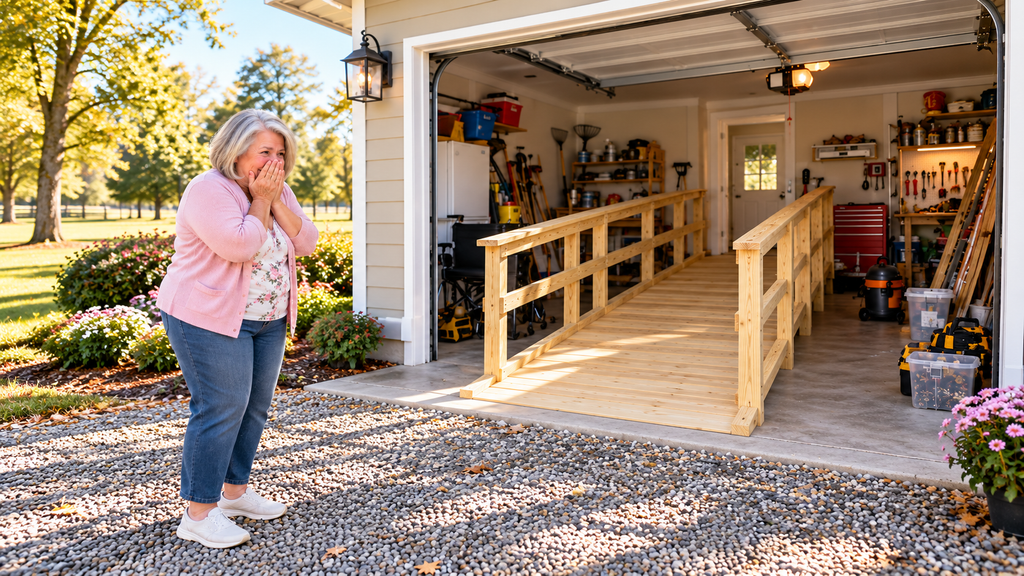
And the greatest surprise was not the yellow kitchen, the handmade ramp, or the man who quietly remembered the smallest details of my life.
It was discovering that I could lose my husband’s companionship, suffer my son’s betrayal, and still find the strength to begin again.
Because the most valuable thing Dwight left me wasn’t the life insurance money.
It was the life we had built, the confidence he had always encouraged in me, and the knowledge that I deserved to be treated with kindness.
Zach tried to take my financial security.
He nearly took my peace.
But he did not take my future.
And on an ordinary Sunday afternoon, sitting beside a gentle man beneath a pecan tree, I finally understood something I wished every widow, every mother, and every person afraid of beginning again could know.
You are never too old to find love. You are never too old to discover your own strength. And you are never obligated to sacrifice your peace just to keep someone else comfortable.
I had driven to Wendell’s house expecting to uncover a terrible secret.
Instead, I found a man building a place for me in his life.
And that unexpected discovery gave me the courage to uncover the secret hiding inside my own family.
The truth broke my heart.
But it also set me free.
And sometimes, the most beautiful new beginning comes after the moment you thought everything was falling apart.
THE END! THANK YOU FOR READING!❤️