 Reading Time: 15 minutes
My dad got married at seventy-three. I was sure his new wife was only after his house. But at his funeral, she didn’t ask for money, jewelry, or furniture. Instead, she placed a freezing cold key in my hand.
Before she walked away, she whispered something that completely took my breath away. “It’s time you knew who your mother really was.” My name is Harper Nelson. And that afternoon, I hated Dorothy with all my heart.
We had just buried my father in Savannah. It was raining lightly, the kind of soft Southern rain that makes everything smell like wet dirt, dead flowers, and old secrets.
The cemetery grass clung to my heels.
The black umbrella over my head did nothing to stop the chill spreading through my chest.
My siblings didn’t cry much.
Frank stood near the edge of the grave with his jaw tight, staring past the headstone toward the road as if he was already calculating the drive back to Dad’s house.
Claire kept dabbing the corner of her eyes, but her gaze moved too often toward Dorothy.
Toward her hands. Her purse. Her wedding ring.
I could only look at Dorothy. She was the new wife.
The unwanted widow. The intruder who had spent the last three years sleeping in the bed where my mother, Constance Nelson, had died of cancer.
Dorothy wore a plain black dress.
No jewelry except her thin wedding band.
No pearls.
No dramatic veil.
No expensive hat.
She had no makeup on, and in the rain, her face looked older than I remembered.
She didn’t look like a greedy gold digger.
She didn’t look defeated either.
She looked like someone who had been waiting for this exact day for years.
That made me hate her more.
Three years earlier, my father, Edward Nelson, gathered us for Christmas dinner.
The house smelled like roasted turkey, cinnamon, pine branches, and the lemon polish he used on my mother’s old dining table.
We thought he wanted to talk about his health.
He had been moving slower that year.
He forgot small things.
His knees hurt.
He had started sleeping in the recliner some nights because the stairs tired him.
Instead, right between the drinks and dessert, he set down his glass and dropped a bomb into the middle of the room.
“I’m getting married.”
Frank choked on his bourbon.
Claire dropped her spoon.
I actually laughed because I thought it had to be a joke.
“To whom?” I asked.
Dad looked at each of us, already bracing for the storm.
“Dorothy Quinn.”
Nobody said congratulations.
Not Frank.
Not Claire.
Not me.
We all thought the same thing.
A sixty-five-year-old widow did not suddenly appear at a local dance class and fall in love with an old man unless she wanted his large house, his pension, his savings, and the Nelson name.
Frank was the only one rude enough to say it out loud.
“Dad, she just wants your money.”
My father didn’t yell.
He only set his glass down and looked at us with deep disappointment.
“You know nothing,” he said.
That hurt more than shouting would have.
Because we thought we knew everything.
We knew our childhood home.
We knew the wraparound porch, the magnolia tree in the front yard, the cracked tile in the kitchen, and the locked back room where my mother stayed after her cancer treatments.
We knew our father’s lonely routine of going to church every Sunday and bringing white flowers to Mom’s grave afterward.
We knew how he had kept my mother’s photographs in every room for fifteen years.
We knew he still spoke to her picture before bed.
And then, suddenly, there was Dorothy.
Dorothy with her quiet voice.
Dorothy with her soft cardigans.
Dorothy who never changed the curtains.
Dorothy who never took down my mother’s photographs.
Dorothy who learned exactly how Dad liked his tea.
To everyone else, she looked gentle.
To me, it looked like strategy.
She was too careful.
Too respectful.
Too patient.
I hated her for not acting like a villain, because it made it harder to blame her.
After the wedding, Frank, Claire, and I watched her like hawks.
Every receipt was suspicious.
Every doctor’s appointment was a plot.
Every pill she handed Dad felt like poison in our minds, even though she kept a chart on the refrigerator and checked dosages twice.
Once, at Easter dinner, Frank had too much wine and asked her, “Have you forced him to change his will yet?”
The room went dead silent.
Dorothy did not get angry.
She folded her napkin, looked at him, and said quietly, “I hope your greed stops weighing you down one day, son.”
Frank laughed.
Dad slammed his hand on the table.
“You will respect her.”
It was the first time he ever chose another woman over us.
That was how it felt.
As if he had reached across the table, erased my mother’s place, and put Dorothy there instead.
After that, I stopped visiting as much.
I told myself I was busy.
Work.
My son’s soccer games.
Bills.
Life.
But the truth was simpler.
I did not know how to sit in that house and watch Dorothy love my father without feeling like she was stealing something from the dead.
Whenever I did visit, I found reasons to dislike her.
If she cleaned, she was trying to take over.
If she didn’t clean, she was lazy.
If she sat beside Dad, she was clinging.
If she gave him space, she was cold.
One afternoon, I arrived without calling and found her in the den.
Dad was asleep in his chair.
Dorothy stood behind him, gently brushing his thinning white hair with a comb.
She moved slowly, tenderly, as if each strand mattered.
Then she bent down and kissed his forehead.
Not for an audience.
Not for money.
Not for performance.
For love.
I turned around before she saw me.
I sat in my car for ten minutes, furious.
Not because she had done anything wrong.
Because if Dorothy was good, it meant we might be the cruel ones.
I was not ready for that.
When my father’s heart started failing, everything happened fast.
Hospital visits.
Oxygen tanks.
Medication lists.
Late-night calls.
Bills with numbers that made Frank swear under his breath.
Dorothy never left his side.
She slept in hospital chairs.
She rubbed lotion on his hands.
She read him the newspaper when his eyes got too tired.
She brought him white flowers from my mother’s grave one Sunday because he cried that he had missed visiting her.
Frank and Claire kept asking about the money.
Even I asked about the will.
I am not proud of that.
No one is a saint when death is near and a house full of memories has a price attached to it.
Dad died on a Thursday at 4:17 in the morning.
Dorothy was holding his hand.
I arrived twenty minutes too late.
The first thing I saw when I stepped into the hospital room was Dorothy leaning over him, whispering a long, secret message into his ear.
Her lips moved close to his face.
Her hand covered his wedding ring.
When she looked up, her eyes were dry.
“What did you say to him?” I asked.
My voice came out sharper than grief deserved.
Dorothy looked at me for a long moment.
“What I owed him for many years.”
“From before you even met him?”
For a split second, I saw fear in her eyes.
Not guilt.
Fear.
Then she looked down and whispered, “Yes.”
I carried that answer through the funeral.
Through the hymn.
Through the pastor’s words.
Through the sound of dirt hitting the casket.
What I owed him for many years.
What did that mean?
How could Dorothy owe my father anything before they met at dance class?
After the burial, we went back to the house.
The house felt wrong without Dad in it.
His chair sat empty.
His reading glasses were still on the side table.
A half-finished crossword puzzle lay beside his favorite pen.
Claire cried when she saw it.
Frank cleared his throat and said, “We need to talk about the estate.”
I turned on him.
“Today?”
He spread his hands.
“Harper, don’t pretend Dorothy isn’t already planning.”
Dorothy stood near the fireplace, still wearing her black dress, still holding her small purse.
She looked at all of us with tired eyes.
Then she calmly took off her black veil.
“I don’t want anything,” she said.
Frank stared.
Dorothy continued, “Not the house. Not the money. Not the furniture. It’s all yours.”
The room went silent.
Claire frowned as if Dorothy had spoken in another language.
Frank laughed bitterly.
“Are you trying to play the saint now?”
Dorothy did not answer.
She went upstairs.
We looked at one another, then followed.
In the bedroom she had shared with my father, Dorothy pulled a small cloth bag from the closet.
Inside were two dresses, a shawl, a worn book, and some medicine.
Three years of marriage fit into one small bag.
For the first time, shame flickered inside me.
Frank opened the closet door wider.
“We need to make sure you aren’t stealing anything of my mom’s.”
That line hurt her.
I saw it.
Dorothy’s hand tightened around the strap of her bag.
Then she turned toward the large wedding photograph of my mother on the wall.
Constance Nelson at twenty-six, beautiful and bright, wearing lace gloves and a smile I had spent my whole life trying to remember clearly.
Dorothy walked over and touched the frame gently.
Not like a thief.
Like someone asking forgiveness.
“Your mother wasn’t who you think she was,” Dorothy said quietly.
My body went rigid.
“Don’t you dare.”
Frank stepped forward.
“You do not get to talk about our mother.”
Dorothy closed her eyes.
When she opened them, they were wet for the first time that day.
“She made me promise not to tell you until Edward was gone.”
Claire whispered, “What are you talking about?”
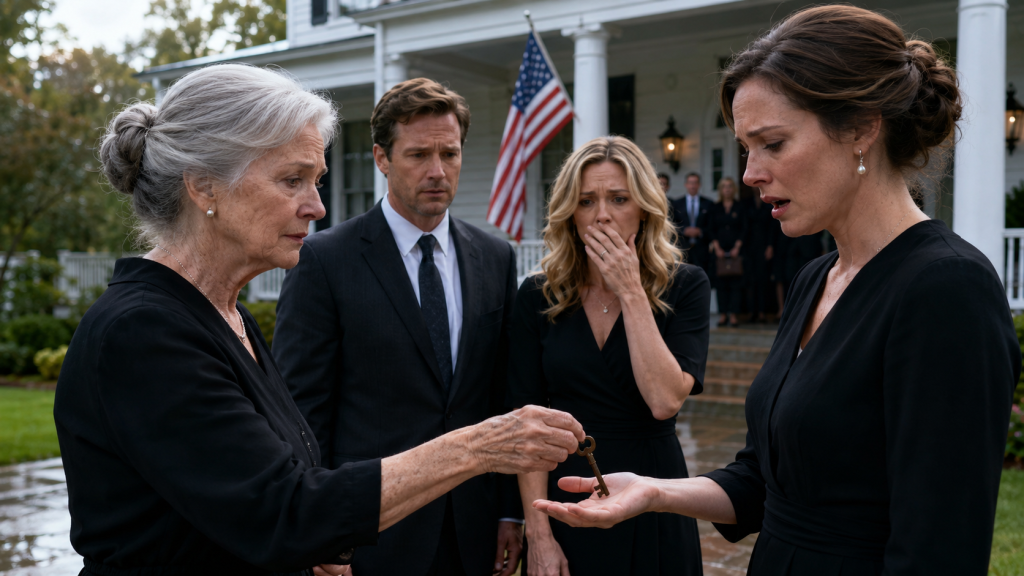
Dorothy reached into her pocket and pulled out an old, rusty key.
She crossed the room and placed it in my hand.
It felt ice-cold, as though it had been buried in the ground.
“Your dad wanted me to give this to you today.”
“What does it open?” I asked.
Dorothy looked toward the back hallway.
The locked room.
The room my mother had kept closed during her treatments.
The room my father had boarded from the inside twenty-four years earlier.
The room we were never allowed to touch.
Dorothy leaned close to my ear, smelling of rain and old perfume.
“Now the time has come for you to know who your mother really was,” she whispered, “and why Edward preferred that you hate him rather than tell you the truth.”
Then she walked toward the stairs.
Frank blocked her.
“You’re not leaving until we know what game you’re playing.”
Dorothy looked up at him with surprising strength.
“I have carried your family’s truth long enough. If you want answers, open the door.”
Then she moved past him.
Nobody stopped her.
My fingers closed around the freezing key as Dorothy walked out with her tiny bag, leaving the room silent.
Frank scoffed, but his voice shook.
“She’s playing games.”
Claire whispered, “Open it.”
I stared toward the hallway.
For twenty-four years, I had believed that room was sealed because my mother had suffered there during cancer.
Dad had told us it was too painful.
He said some places needed to rest.
As children, we accepted that.
As adults, we treated it like a shrine.
Now I walked toward it with my siblings behind me.
The hallway felt longer than usual.
Dust gathered along the baseboards near the back.
The door was dark wood, scratched at the bottom, with two boards nailed across it.
Frank found a hammer in the garage and pulled the boards loose.
Each crack of wood sounded like something waking up.
Then I slid the key into the old brass lock.
It turned too easily.
Like it had been waiting.
The door opened.
Inside was not a sickroom.
It was a studio.
Dust-covered canvases leaned against the walls.
Boxes filled the corners.
A long table sat beneath the covered window.
Old lamps.
Newspaper clippings.
Stacks of files.
Photographs.
Everywhere, there were photos of my mother.
But not the mother I remembered from family albums.
Not the sweet churchgoing woman in pastel dresses.
In these pictures, Constance Nelson stood on stages.
In courthouse hallways.
Outside government buildings.
At marches.
Beside women whose names had been crossed out in old newspapers.
She held signs.
She spoke into microphones.
She pointed at documents.
She looked fierce.
Alive in a way no family portrait had ever captured.
Claire opened a folder and gasped.
“Mom was an investigator.”
Frank pulled a newspaper clipping from the wall.
The headline was faded but still readable.
LOCAL ACTIVIST EXPOSES JUDGE’S CHILD EXPLOITATION RING
My knees weakened.
Another clipping.
NELSON TESTIMONY LEADS TO ARRESTS OF THREE OFFICIALS
Another.
KEY WITNESS HIDDEN AFTER THREATS
Then I saw Dorothy.
Young Dorothy.
She stood beside my mother in a grainy photograph, small and terrified, wrapped in a coat too large for her body.
My mother’s arm was around her shoulders.
On the back, in Mom’s handwriting, it said:
Dorothy Quinn, saved witness. Protect her at all costs.
I could not breathe.
Claire covered her mouth.
Frank sat heavily on a wooden chair, all his anger draining into confusion.
“What is this?” he whispered.
On the table sat a metal box.
Inside were letters tied with ribbon.
The top envelope had my name on it.
Harper.
Below it were envelopes for Frank and Claire.
My hands trembled so badly I nearly tore the paper.
The letter smelled faintly of dust and lavender.
My mother’s handwriting flowed across the page.
My dearest Harper,
If you are reading this, then your father is gone, Dorothy has kept her promise, and the last man tied to the old case is either dead or powerless enough that the truth can finally breathe.
I had to sit down.
Claire came beside me.
Frank took the letter from my hand only long enough to steady it so we could all read.
My children,
I know you remember me as sick. That was true. Cancer took my strength near the end, but it was not the only reason your father sealed this room. I was not only your mother. Before I was your mother, I was a researcher, an advocate, and sometimes an investigator for women and children no one powerful wanted to hear.
Dorothy Quinn was one of them.
She was nineteen when I found her.
She had seen crimes committed by men with money, badges, and judges’ robes. She was the witness who made the case possible. They called her unstable. They called her a liar. They threatened her, followed her, and tried to make her disappear.
Your father helped me hide her.
Your father helped me move evidence.
Your father took risks that could have destroyed his career, his safety, and our family.
But we did it because Dorothy deserved to live.
I looked up.
Frank was crying silently.
I had not seen my brother cry since our mother’s funeral.
I kept reading.
When I became ill, I made Edward promise me two things.
First, that he would protect the evidence in this room until the danger had passed.
Second, that if Dorothy ever returned needing protection, he would give her a home without question.
If he had told you the truth, you might have gone looking. You might have asked dangerous questions before it was safe. You might have hated Dorothy for surviving what I did not live long enough to explain.
So your father let you believe he was cold.
He let you believe he loved another woman too quickly.
He accepted your judgment because he would rather lose your affection than risk your lives.
Dorothy did not marry him for money.
She married him because she promised me she would watch over him when I no longer could.
He gave her shelter.
She gave him companionship.
And in the end, I hope they gave each other peace.
Do not punish her for surviving.
Do not punish your father for protecting you.
If you want to honor me, open the files, tell the truth carefully, and let the house become what it was always meant to be.
A safe place.
Your loving mother,
Constance
The room blurred.
I pressed the letter against my chest as if my mother’s hand might still be on the other side of it.
All my anger had nowhere to go.
For years, I had pictured Dorothy as a thief.
But she had been the last witness.
The woman my mother saved.
The woman my father protected.
The woman who came back not to steal his house, but to keep a promise to a dead friend.
Frank stood suddenly.
“Where is she?”
I ran.
Down the hallway.
Down the stairs.
Through the open front door.
Rain soaked my black dress within seconds.
Dorothy was halfway down the walkway, moving slowly toward the gate with her small bag in one hand.
“Dorothy!”
She stopped.
But she did not turn immediately.
Maybe she was tired of being accused.
Maybe she already knew apologies come too late in families like ours.
I ran barefoot across the wet grass.
“Wait!”
She turned slowly.
Her face was calm, but her eyes were raw.
I held up the letter, sobbing.
“You knew my mother.”
Dorothy’s face broke for the first time.
She pressed one hand to her mouth.
“She saved my life.”
“And you saved my father’s.”
Tears slipped down her cheeks.
“I tried.”
I stepped closer.
“Why didn’t you tell us?”
“Because Constance asked me not to. Because Edward asked me not to. Because some stories are not mine to open before their time.”
“We hated you.”
“I know.”
“You let us.”
“I had survived worse than being misunderstood.”
That sentence hollowed me out.
Behind me, Frank and Claire came onto the porch.
Frank looked smaller than I had ever seen him.
“We were wrong,” he said.
Dorothy looked at him for a long time.
“Yes,” she said softly. “You were.”
Claire started crying.
“I’m sorry.”
Dorothy’s eyes shifted to the house.
“Your father never wanted your inheritance. He wanted you alive.”
I looked back at the old home.
The white columns.
The wet porch.
The room full of hidden evidence.
The photographs of my mother I had never known.
For the first time, the house did not feel like property.
It felt like responsibility.
“Come back inside,” I said.
Dorothy shook her head.
“I can’t live there now.”
“Why?”
“Because I already said goodbye to Edward. And because you need to meet your mother without me standing in the doorway.”
“But where will you go?”
She gave a tired little smile.
“I have a sister in Charleston. I wrote to her last month. She’s waiting.”
I realized then that Dorothy had planned everything.
Not to take.
To leave.
She had waited until Dad was buried, handed over the key, and prepared to disappear before we could decide whether she deserved mercy.
I stepped forward and hugged her.
For a moment, she stood stiffly.
Then her bag dropped to the wet path, and she held me like someone who had been holding grief alone for too many years.
“I’m sorry,” I whispered.
She cried into my shoulder.
“So am I.”
We brought her back inside long enough to dry off.
Frank made coffee with shaking hands.
Claire sat beside Dorothy on the couch and asked about our mother.
Not the saint from family photographs.
The real woman.
The fierce woman.
The woman who knocked on locked doors, protected witnesses, and kept lists of names powerful people wanted buried.
Dorothy spoke carefully.
Not all at once.
Some memories came like glass.
She told us Constance had found her in a shelter after Dorothy escaped men connected to a corrupt judge.
She told us Mom built a case with documents, witnesses, and courage that frightened even the police.
She told us Dad had driven files across state lines in the trunk of his car while pretending to take fishing trips.
She told us my parents had argued about danger, about children, about whether truth was worth risk.
Then she smiled sadly.
“Your mother always won those arguments.”
By evening, the rain stopped.
The house smelled of coffee and old paper.
We returned to the sealed room together.
This time, Dorothy came with us.
She stood in the doorway and touched the frame.
“I haven’t been in here since your mother was alive,” she whispered.
We opened more boxes.
There were journals.
Recorded interviews.
Legal documents.
Photographs.
Paintings my mother had made of women whose names she refused to let history erase.
At the back of the room, covered by a white sheet, stood one large canvas.
Dorothy froze when she saw it.
I pulled the sheet away.
It was a portrait of Dorothy as a young woman, standing in sunlight, looking not terrified but strong.
At the bottom, my mother had painted one sentence.
Witnesses are not broken people. They are bridges to justice.
Dorothy sank into a chair.
For a long time, no one spoke.
The next weeks changed everything.
Frank stopped talking about selling the house.
Claire quit counting furniture.
I took leave from work and began cataloging the files.
An attorney helped us determine what could be released safely.
A local historian came.
Then a journalist.
Then a women’s advocacy foundation.
We learned that several men connected to my mother’s investigation had died.
Others had been imprisoned.
One final name had remained powerful for years, which was why Dad had waited.
He had not been stubborn.
He had been careful.
The locked room became public slowly.
Not as scandal.
As testimony.
We turned the back room into the Constance Nelson Archive for Witness Protection and Advocacy.
Dorothy’s portrait hung on the first wall.
At the opening, Dorothy stood beside me wearing the same plain black dress she had worn at the funeral, but this time with my mother’s small silver pin on her collar.
Frank apologized publicly.
Claire held Dorothy’s hand.
I gave a speech.
My voice shook at first.
“I spent three years believing Dorothy Quinn came into our family to take something from us. I was wrong. She brought back the part of our mother that fear had stolen from our memory. She kept a promise to Constance. She cared for Edward. She asked for nothing. And when the time came, she handed us a key.”
I looked at Dorothy.
She was crying.
“So today, this house is no longer an inheritance to fight over. It is a place where truth will be protected.”
People applauded.
Dorothy looked toward my mother’s photograph.
I like to think Mom heard.
My father’s grave changed after that.
For fifteen years, he had brought white flowers to Constance.
Now we brought two bouquets.
White flowers for my mother.
Yellow roses for my father.
Because yellow had been Dorothy’s favorite, and Dad had once planted an entire row of them behind the house after she said Savannah gardens needed more sunshine.
I used to think that meant he was replacing Mom.
Now I understand.
Love is not always replacement.
Sometimes it is a bridge between grief and survival.
One month after the archive opened, I drove Dorothy to Charleston.
She had refused to move back into the house, but she no longer left like a stranger.
When we reached her sister’s small blue cottage, she placed her hand over mine.
“Your mother would have been proud of you.”
I laughed through tears.
“For hating you first?”
“For opening the door anyway.”
She squeezed my hand.
“Harper, grief makes people guard the wrong rooms sometimes.”
I thought about that the whole drive home.
She was right.
I had guarded the image of my mother so fiercely that I nearly rejected the truth of her.
I had guarded the house so tightly that I almost missed what it was built to protect.
I had guarded my anger at Dorothy because it was easier than admitting my father had lived a heroic loneliness none of us understood.
My dad got married at seventy-three.
I was sure his new wife was only after his house.
But at his funeral, Dorothy did not ask for money, jewelry, or furniture.
She placed a freezing cold key in my hand and told me it was time to know who my mother really was.
I opened the room.
And behind that locked door, I found a mother braver than memory.
A father kinder than silence.
And a widow I had hated for three years, who had loved them both enough to be misunderstood.
That day, the house stopped being a prize.
It became a memorial.
And Dorothy Quinn, the woman I once called an intruder, became the last living piece of my mother’s truth.
THE END! THANKS FOR READING!