 Reading Time: 11 minutes
My husband hit me for asking where he had been all night. The next morning, I made his favorite Southern breakfast and served it with a smile. He called me a “proper wife.”
Then the kitchen door swung open, and every bit of color left his face. Everything changed because of one simple question. “Where did you spend last night?” That was all I said. My husband, Ethan Blackwood, replied with the back of his hand.
The blow pushed my lip into my teeth, and in an instant, I tasted blood. For a few seconds, the kitchen went still except for the rain tapping the windows and the soft crackle of grease cooling on the stove.
Ethan stood above me, completely calm. His white dress shirt remained flawless.
His wedding ring shone beneath the kitchen lights.
“Do not question me in my own home,” he said in a cold voice.
I touched my mouth and stared at the blood on my fingers.
Then I looked up at him.
A smile slowly came back to his face when he understood I would not fight back.
That had always been the part he enjoyed most.
The quiet.
He confused it with fear.
With obedience.
With weakness.
In Ethan’s mind, I was only a well-mannered Southern wife who would never resist.
What he forgot was that I had been raised in the house of a respected judge.
What he never truly valued was that I had spent years examining financial wrongdoing long before I became Mrs. Blackwood.
And what he did not know was that every suspicious conversation, every missing dollar, and every lie he had told during the past six months had been carefully recorded.
Saved.
Copied.
Protected.
Ethan straightened his cufflinks as if nothing at all had happened.
“My mother is coming by this morning,” he said. “Make breakfast. And try not to shame me.”
I pressed a napkin to my bleeding lip.
“Of course.”
That response pleased him.
He thought the subject was finished.
But for me, something had just begun.
For six years, I had lived inside Blackwood House, smiling beneath crystal chandeliers and pretending the walls were not closing in.
Ethan’s family was old Savannah money.
Not the loud kind.
The quieter, more dangerous kind.
The kind that wrapped control in manners and cruelty in tradition.
His mother, Margaret Blackwood, spoke softly enough that strangers thought she was graceful.
But every sentence she gave me had a hook hidden inside it.
“A wife should never embarrass her husband.”
“A woman’s first duty is to keep peace in her home.”
“Blackwood men need strong women beside them, not difficult ones in front of them.”
At first, I tried to be that woman.
I hosted dinners.
I sent thank-you notes.
I wore pearls to church even though they made my neck itch.
I learned Ethan’s favorite meals, his mother’s preferred flowers, his father’s old stories, and the exact tone that made guests believe we were happy.
But behind closed doors, Ethan changed.
Not all at once.
Men like him rarely do.
First came the comments.
Then the monitoring.
Then the passwords.
Then the bank accounts I could no longer access because, according to him, “you’re better with people than numbers, darling.”
That was almost funny.
Before I married Ethan, I had worked for one of the largest forensic accounting firms in Atlanta.
I investigated hidden assets, shell companies, false invoices, and fraud so polished it looked like luxury.
Ethan knew that.
He simply believed marriage had erased it.
Six months before the morning he struck me, I noticed the first irregularity.
A payment from the Blackwood Foundation to a consulting company I had never heard of.
Magnolia Strategic Partners.
The amount was small enough to hide.
Nine thousand dollars.
Then came another.
Then another.
Soon, I found the same vendor tied to three charity projects, two property renovations, and a client trust account Ethan claimed was “temporarily restricted.”
When I asked him about it, he smiled.
“You’re bored, Savannah. Don’t invent mysteries.”
But I kept looking.
Quietly.
Every file I found, I copied.
Every strange transfer, I saved.
Every conversation where Ethan mentioned money, I recorded in a secure folder my father’s old clerk had helped me create years ago.
I did not know whether I was building an escape or a case.
Then Ethan came home at dawn smelling of whiskey, rain, and perfume that was not mine.
I asked one question.
And he answered with his hand.
That night, after he left the kitchen, I locked myself in the bathroom and stared at my split lip.
I expected to cry.
I did not.
Instead, I took photos.
Front angle.
Side angle.
Time-stamped.
Then I sent them to my attorney, Grace Holloway, with one sentence.
It happened.
Her reply came thirty seconds later.
Do not confront him. Are you safe tonight?
I looked at the bathroom door.
Ethan was downstairs, already pouring himself bourbon.
Safe was not the word.
But I had survived long enough to be strategic.
For tonight, I typed.
Grace replied.
Tomorrow morning. 8:30. Keep him there.
So I did.
By morning light, the whole house smelled of comfort and old tradition.
Warm biscuits.
Peppered gravy.
Fried chicken.
Candied yams.
Buttered vegetables.
Sweet preserves.
Fresh coffee.
I shined the family silver.
Placed the crystal glasses.
Set flowers in the middle of the table.
Everything appeared perfect.
Exactly how Ethan preferred it.
He came downstairs at eight, freshly shaved, dressed in a navy suit, looking like the kind of husband women at church praised because they never saw the rooms where his voice changed.
His gaze moved to my lip.
The faint swelling was there, no matter how carefully I had covered it.
He smiled slightly.
“Use more powder.”
I poured his coffee.
“Of course.”
His mother arrived soon after.
Margaret Blackwood swept through the front door in cream silk, graceful pearls, costly perfume, and a permanent look of judgment.
Her gaze landed on my injured lip immediately.
Instead of worry, she gave a smug little smile.
“A wife ought to know when to stop speaking.”
Ethan laughed.
I only poured her coffee.
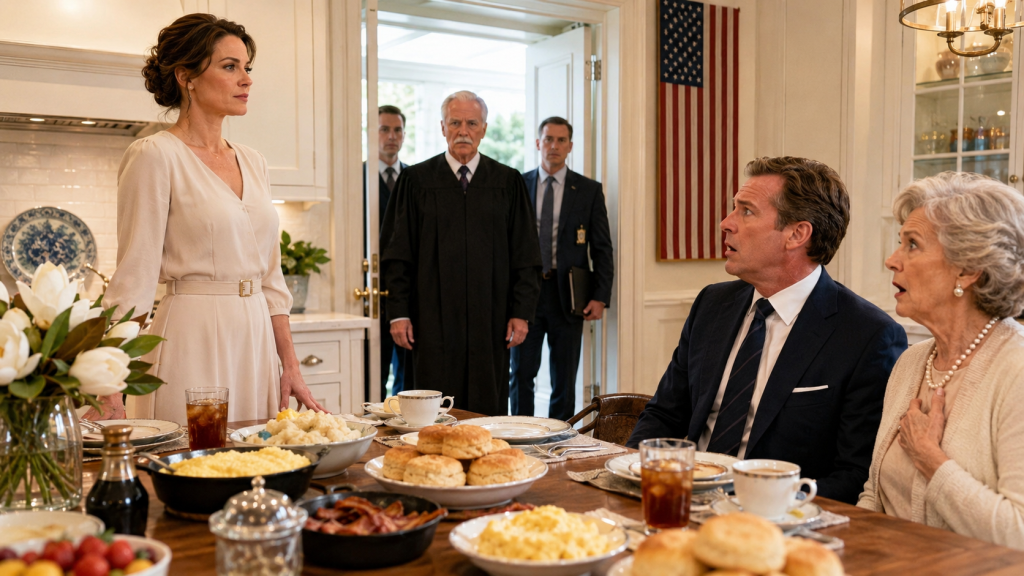
Before long, they sat at the dining table like honored guests.
Admiring the food.
Praising the arrangement.
Fully certain they were still in control.
“What a good wife,” Ethan said proudly from the head of the table.
Margaret nodded.
“Finally, you are learning.”
I set one last covered dish in front of him.
Then I stepped backward.
At that exact second, the kitchen door opened.
The entire room went silent.
Ethan turned toward the doorway.
The certainty disappeared from his face.
The coffee cup shifted slightly in his hand.
And for the first time that morning, he looked frightened.
Because the person stepping through that door was not anyone he ever thought would appear.
And they had not come for breakfast.
The man in the doorway was Judge Thomas Whitaker.
My father’s oldest friend.
The man who had signed Ethan’s first business license years ago.
Behind him stood two federal agents, my attorney Grace Holloway, and a forensic accountant carrying a black folder.
Ethan’s face emptied.
“Judge Whitaker,” he stammered. “What are you doing in my kitchen?”
The judge looked at my split lip.
Then at Ethan’s untouched plate.
“I am not here for breakfast.”
Margaret stood sharply.
“This is a private family matter.”
One agent answered, “Financial fraud, coercion, and assault are not private.”
Ethan’s chair scraped backward.
“Assault? She fell.”
I lifted the covered dish in front of him and removed the lid.
Inside were not biscuits.
There was a flash drive.
Bank records.
Shell-company transfers.
Photographs of my lip from the night before.
And a printed copy of the emergency protection filing Grace had prepared before sunrise.
Margaret gasped.
Ethan looked at me with pure hatred.
“You planned this?”
I smiled softly.
“No, Ethan. You did. I just kept the receipts.”
The forensic accountant opened the black folder.
“Mr. Blackwood, we traced six months of missing client funds through accounts connected to your mother’s trust and Magnolia Strategic Partners.”
Margaret’s pearls trembled against her throat.
“That’s impossible.”
Grace placed another paper on the table.
“Mrs. Blackwood has filed for divorce, emergency protection, asset freeze, and preservation of financial records.”
Ethan lunged toward me.
He did not make it two steps.
An agent moved between us before he reached my chair.
For the first time, Ethan learned what I had learned the night before.
Power changes when there are witnesses.
His face twisted.
“You’re my wife.”
I wiped my lip with a napkin.
“No, Ethan. I was your warning. You just mistook me for silence.”
The room went still.
The judge stepped forward, his expression colder than I had ever seen it.
“Ethan, sit down.”
Something about that voice worked.
Maybe because Ethan had spent his life respecting men with authority while punishing women who possessed it.
He sat.
Slowly.
But his eyes stayed on me.
“You have no idea what you’ve done.”
“I know exactly what I’ve done.”
Margaret recovered first.
“Savannah, dear, you are emotional. We can talk about this privately.”
I looked at her.
“You watched my lip bleeding and smiled.”
Her face hardened.
“You always were dramatic.”
Grace spoke before I could.
“My client will not be spoken to directly.”
My client.
Not wife.
Not daughter-in-law.
Not proper woman.
Client.
A person with rights.
The words steadied me more than I expected.
One federal agent placed a document on the table in front of Ethan.
“This is a warrant for business records associated with Blackwood Development, the Blackwood Foundation, Magnolia Strategic Partners, and related accounts.”
Ethan’s face went gray.
His mother whispered, “Ethan.”
He snapped, “Be quiet.”
For the first time in all the years I had known her, Margaret Blackwood obeyed someone out of fear.
The forensic accountant began listing transfers.
Foundation money moved to consulting accounts.
Consulting money routed to a private renovation project.
Client deposits shifted into short-term investment accounts without authorization.
Funds used to cover gambling debts and political donations.
Every number landed like a hammer.
Margaret gripped the back of her chair.
“That trust was for family protection.”
“No,” I said. “It was for hiding stolen money.”
She glared at me.
“You ungrateful little—”
Judge Whitaker cut in.
“Margaret, I suggest you stop.”
The way she looked at him told me she finally understood.
This was bigger than breakfast.
Bigger than a marriage.
Bigger than the Blackwood name.
The people at my kitchen table did not care about her pearls, her charity boards, or the family portrait hanging in the hall.
They cared about records.
Evidence.
Dates.
Money trails.
Photographs.
Truth.
Ethan tried one last mask.
He lowered his voice.
“Savannah, baby, this got out of hand. I was under pressure. You know how business is.”
I almost laughed.
Business.
That was what men like Ethan called theft when they wore suits.
“You hit me,” I said.
He glanced at the agents.
“I lost my temper.”
“No. You showed me who you are when you thought no one would believe me.”
His jaw tightened.
“You think they’ll believe you now?”
Grace opened a second folder.
“In addition to photographs, Mrs. Blackwood submitted audio from last night.”
She pressed play on her phone.
Ethan’s voice filled the kitchen.
Do not question me in my own home.
Then his mother’s voice from that morning.
A wife ought to know when to stop speaking.
Margaret sat down heavily.
The sound of her own cruelty frightened her more than the cruelty itself.
Ethan did not speak.
There was nothing left to say.
By nine-fifteen, agents were moving through the house.
By nine-thirty, Ethan’s office was sealed.
By ten, officers had arrived regarding the assault complaint.
Neighbors stood behind curtains pretending not to watch.
I stood in the foyer with my hands clasped in front of me, the perfect Southern hostess watching the destruction of a perfect Southern lie.
Ethan was led out first.
He shouted at me from the porch.
“You’ll come crawling back when you realize what I gave you.”
I looked at Blackwood House.
At the columns.
At the polished floors.
At the rooms where I had learned to move quietly.
Then I looked back at him.
“You gave me proof.”
His face changed.
The officer guided him into the car.
Margaret was not arrested that morning, but she was questioned.
Her trust accounts were frozen.
Her phone was taken.
Her social calendar, for once, could not save her.
Before she left, she turned to me in the hallway.
“You have ruined this family.”
I opened the front door for her.
“No, Margaret. I cleaned the kitchen after it already burned.”
She looked like she wanted to slap me.
But there were witnesses now.
So she walked out.
After everyone left, the house became strangely quiet.
Too quiet.
Grace found me in the dining room staring at the table.
The breakfast had gone cold.
Biscuits hardened.
Gravy formed a skin.
Coffee sat untouched in porcelain cups.
“Savannah,” she said gently. “You don’t have to stay here tonight.”
“I know.”
“Do you have somewhere safe?”
I nodded.
“My father’s old house.”
Judge Whitaker had already arranged for a driver and security.
Grace softened.
“You were very brave.”
I looked at the covered dish where the evidence had been.
“No. I was prepared.”
“Sometimes that is what brave means.”
I did not answer.
I was too tired.
Too empty.
Too full of everything I had not allowed myself to feel.
That evening, I left Blackwood House with two suitcases, my laptop, a folder of documents, and the silver cross my father had given me when I graduated college.
I did not take the pearls.
I did not take the crystal.
I did not take anything that felt like Margaret’s version of womanhood.
At my father’s old house, I locked the door behind me and finally cried.
Not pretty tears.
Not quiet tears.
The kind that came from the body after years of holding itself upright.
I cried for the woman who thought love required obedience.
For the girl who mistook charm for safety.
For every dinner where I smiled while Ethan corrected me.
For every time Margaret praised me only when I disappeared.
And for the moment the night before when blood touched my fingers and I realized my marriage had crossed a line even denial could not cover.
The investigation lasted months.
The fraud was worse than even I had known.
Ethan had used foundation accounts to cover losses.
Margaret had signed approvals while pretending not to understand where the money went.
Client funds had been moved, replaced, moved again, and hidden behind layered shell entities.
Magnolia Strategic Partners was not a consulting firm.
It was a laundry basket with a tax ID.
Several business partners turned on Ethan within weeks.
Men who had once toasted him at fundraisers suddenly could not remember who introduced them.
Margaret’s charity friends stopped calling.
Her name disappeared from event invitations.
The Blackwood reputation did not explode.
It rotted publicly, one document at a time.
Ethan tried to blame me.
Then stress.
Then bad advisors.
Then his mother.
Margaret blamed Ethan.
Then me.
Then “modern women with vendettas.”
In court, my attorney played the recordings.
Displayed the transfers.
Submitted the photos.
Ethan took a plea on several financial charges while the assault case strengthened the protection order.
The divorce was ugly.
But it was clean in one important way.
I never had to prove I was not crazy.
I only had to show what he had done.
And I had everything.
The morning the divorce finalized, I went back to Blackwood House one last time.
Not to live there.
To collect the final boxes of my personal things.
Grace came with me.
The rooms echoed.
Without Margaret’s flowers and Ethan’s bourbon and the constant pressure to perform, the house felt like a stage after the actors had fled.
In the kitchen, I paused.
The rain had stopped months ago.
Sunlight streamed through the windows.
For a moment, I could almost see myself from that morning.
Standing straight.
Lip swollen.
Hands steady.
Breakfast perfect.
Evidence hidden under silver.
I touched the edge of the table and whispered, “You got out.”
Grace looked at me.
“What?”
“Nothing.”
But it was not nothing.
It was a promise finally kept.
A year later, I opened a forensic consulting firm in Atlanta.
I named it Whitaker & Vale, after my father and my grandmother.
We specialized in financial abuse, hidden assets, and coercive control cases.
My first client was a woman whose husband had locked her out of every bank account and called it protection.
My second was a widow whose son was draining her trust.
My third was a nonprofit employee who suspected her director was stealing donations.
People asked why I worked so hard.
The answer was simple.
Because I knew what silence cost.
Because I knew that sometimes the most dangerous men are the ones who smile in public and use paperwork as a cage.
Because I knew a woman could serve breakfast with a split lip and still be the most powerful person in the room.
One afternoon, Judge Whitaker visited my new office.
He brought flowers and a framed photograph of my father in his judicial robes.
“He would have been proud,” he said.
I looked at the photo.
My father had raised me to be polite, yes.
But never powerless.
“He taught me to document everything,” I said.
The judge smiled.
“And your mother taught you to set a proper table.”
I laughed.
“I suppose both skills came in handy.”
He looked around the office.
“You turned pain into purpose.”
“No,” I said after a moment. “I turned evidence into freedom. Purpose came after.”
That night, I cooked breakfast for dinner.
Biscuits.
Gravy.
Fried chicken.
Sweet preserves.
Not for Ethan.
Not for Margaret.
Not for performance.
For myself.
I sat at my own table in my own apartment, barefoot, with music playing softly and the windows open.
The food was imperfect.
The biscuits were slightly too brown.
The gravy needed salt.
The flowers were wild daisies from the grocery store instead of formal arrangements from a florist.
And it was the best meal I had ever eaten.
Sometimes people ask why I smiled the morning after Ethan hit me.
They imagine revenge.
Coldness.
Calculation.
Maybe there was some of that.
But mostly, I smiled because I finally understood something.
He wanted me broken.
He wanted me frightened.
He wanted me scrambling for his approval before his mother arrived.
Instead, I became still.
Still enough to think.
Still enough to call the right people.
Still enough to serve him the one dish he never expected.
Consequences.
My husband hit me for asking where he had been all night.
The next morning, I made his favorite Southern breakfast and served it with a smile.
He called me a proper wife.
Then the kitchen door opened, and every bit of color left his face.
Because proper does not mean powerless.
Quiet does not mean empty.
And a woman who knows how to set a table may also know exactly how to turn it.
THE END! THANKS FOR READING!