 Reading Time: 80 minutes
“You said I was your baby.” Those six words hung between us in the hospital room. Nathan Cole stood beside the window, his silver hair still damp from the snowstorm outside. His hands were rough and scarred, the hands of a man who had spent a lifetime pulling strangers out of danger.
But when he looked at me, there was something in his eyes I couldn’t understand. Grief. Recognition. And a kind of love that frightened me because it seemed to have been waiting for thirty-five years. “Please,” I whispered. “Tell me what you meant.”
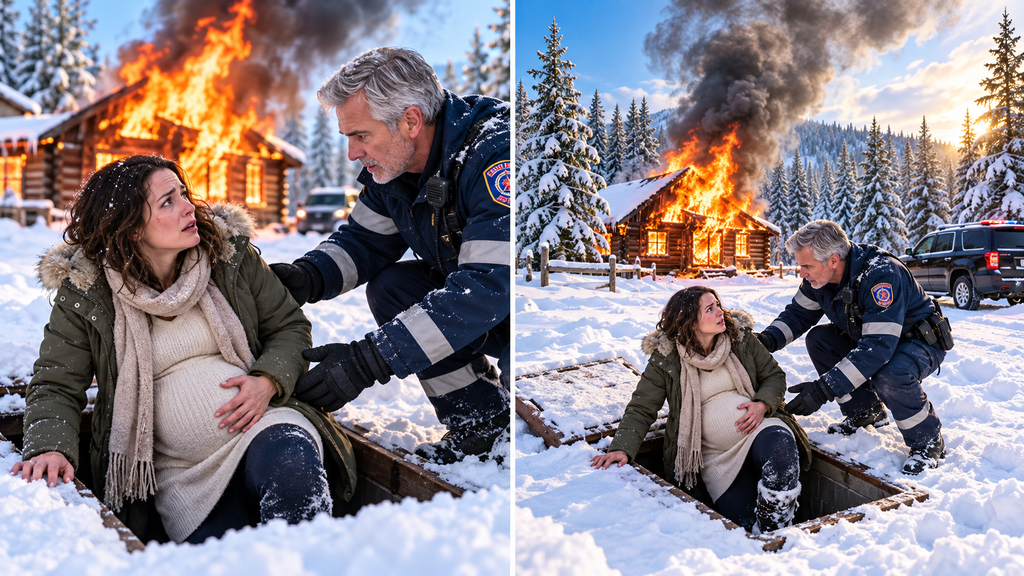
He pulled a chair toward my bed but didn’t sit.
Instead, he reached into his jacket and removed an old photograph.
The edges were yellowed. A crease ran diagonally across the middle.
It showed my mother, Evelyn Hart, standing beside a younger version of Nathan in front of a small white airplane.
She was laughing.
Not the polite smile she wore in company photographs or the determined expression I remembered from board meetings.
She was laughing with her whole heart.
Nathan was looking at her rather than at the camera.
On the back, written in my mother’s handwriting, were four words.
Our beginning. Summer 1990.
My fingers trembled.
“Where did you get this?”
“I’ve carried it for thirty-six years.”
“Were you and my mother married?”
“No.”
“Were you in love?”
His eyes filled.
“More than I knew how to survive.”
I looked down at the picture.
My mother had died three years earlier following a sudden stroke. She had left me her company, her cabin, her grandmother’s silver locket, and a lifetime of memories.
But she had never mentioned Nathan Cole.
Not once.
“What happened?” I asked.
He finally sat.
“Your mother and I met when she was twenty-four. She was working as a flight dispatcher, and I was a rescue pilot. We had almost nothing. She wanted to build a medical aviation company that could reach people in places ordinary ambulances couldn’t.”
I managed a faint smile.
“That sounds like her.”
“She was extraordinary.”
He paused.
“We planned to get married. Then she became pregnant.”
My hand went instinctively to my abdomen.
Even though Noah was no longer inside me, my body hadn’t caught up with the change.
Nathan noticed.
His voice softened.
“Evelyn was terrified. Not of being a mother. She was afraid she’d have to choose between the business she was building and the family she wanted.”
“Did you leave her?”
“No.”
The word came out sharply.
Then he lowered his eyes.
“I thought she left me.”
He explained that my mother’s wealthy business partner, Charles Voss, had opposed their relationship.
Charles controlled the early financing for what eventually became Northstar Air Rescue.
According to Nathan, Charles believed my mother needed a husband with money and influence, not a rescue pilot working unpredictable shifts.
One evening, Nathan received a letter.
It appeared to be from Evelyn.
She told him she’d lost the baby.
She said she could no longer bear to see him.
And she begged him never to contact her again.
“I tried,” Nathan whispered. “God knows I tried. But every letter came back. Every telephone call went unanswered. When I went to her office, security escorted me out.”
He swallowed.
“Three months later, I heard she’d given birth to a daughter.”
My throat tightened.
“Me.”
He nodded.
“I thought she had lied because she didn’t want me involved. I was hurt. Angry. Proud. I convinced myself she had made her choice.”
“Why didn’t you come back?”
His expression crumpled.
“Because I was a fool.”
For a moment, the only sound was the steady pulse of my hospital monitor.
Then he reached inside his jacket again.
This time he removed a folded sheet of paper.
It was a copy of a birth record.
My mother’s name appeared clearly.
Evelyn Hart.
Beside the entry for father was a name I had never seen on any document belonging to me.
Nathaniel James Cole.
I stared at it until the letters blurred.
“My birth certificate doesn’t say that.”
“I know.”
“How?”
“Your mother contacted me nine months before she died.”
My head snapped up.
“What?”
“She called one evening. She said she needed to tell me something about the past. Something she’d discovered in Charles Voss’s private papers after his death.”
“Charles died twelve years ago.”
“Yes. But some of his records weren’t returned to her until much later.”
Nathan hesitated.
“She believed someone had forged the letter that separated us. She wanted to find the original hospital records and prove what happened.”
“Did she?”
“She found enough to suspect the truth.”
“Then why didn’t she tell me?”
Nathan looked toward the door.
“Because someone began threatening her.”
A chill moved through me.
“What kind of threats?”
“Anonymous calls. Photographs of you leaving your office. Warnings that if she reopened the past, people she loved would suffer.”
My chest tightened.
“And she thought the threats had something to do with Charles?”
“At first.”
“At first?”
Nathan’s face hardened.
“Then she told me she believed someone inside Northstar was using the old company records to hide a much newer crime.”
I stared at him.
“Grant.”
Nathan didn’t answer immediately.
But his silence was enough.
I felt sick.
My husband had locked me inside a burning cabin.
He had left our unborn child to die.
Now I was learning that the secrets surrounding my birth might also be connected to him.
“How much did my mother know?” I whispered.
Nathan reached across the bed and took my uninjured hand.
“Enough to be afraid.”
He paused.
“And enough to leave instructions for me.”
“What instructions?”
His eyes moved to the silver locket resting against my hospital gown.
“She told me that if anything ever happened to you at Cedar Ridge, I was to find you before anyone from Northstar did.”
I looked at him.
“Why?”
Nathan’s voice dropped almost to a whisper.
“Because your mother believed the greatest threat to her daughter was already sleeping beside her.”
And suddenly, I remembered something.
Three nights before my mother’s stroke, she had called me.
It was nearly midnight.
She sounded exhausted.
“Sweetheart,” she’d said, “have you ever wondered why Grant never wants you involved in the insurance renewals?”
I’d laughed.
“Mom, I’m not the finance person. He is.”
She hadn’t laughed with me.
Instead, she’d said something strange.
“Never confuse the person who manages your money with the person who protects your life.”
At the time, I thought she was being overly cautious.
Now, lying in a hospital bed with burns on my hands and a surgical incision across my abdomen, I understood.
My mother had been trying to warn me.
And I hadn’t listened.
Nathan squeezed my fingers.
“There is something else.”
I turned toward him.
“Your mother’s monitoring contract was renewed every year, even after she died.”
“That isn’t possible. I never authorized it.”
“Someone did.”
“Who?”
He looked me directly in the eyes.
“Your husband.”
For the first time since escaping the fire, I felt something colder than fear.
Because Grant hadn’t simply forgotten about the emergency monitoring system.
He had kept it alive.
Which meant he either believed he controlled it—
Or he was trying to discover exactly what my mother had hidden.
And I had a terrible feeling it was the second.
CHAPTER 2: THE FUNERAL OF A LIVING WOMAN
On the fifth day after the fire, I watched my own funeral.
Dr. Amelia Ross had advised against it.
“You’ve survived an attempted murder, undergone emergency surgery, and delivered a premature baby,” she said gently. “You don’t have to expose yourself to more trauma.”
But I needed to see Grant.
Not through memories.
Not through the photographs that still filled my phone.
I needed to see the man who believed he had successfully murdered me.
The memorial was held in the largest church in our city.
Two hundred guests filled the pews.
There were white roses around my casket.
A framed photograph from our wedding stood beside it.
I remembered that picture.
Grant had kissed my forehead while I laughed, my veil lifting in the wind.
Back then, I had believed that being loved meant being safe.
Now the same photograph decorated my supposed funeral.
Grant approached the microphone.
He paused dramatically.
Then he lowered his head.
“My beautiful wife, Claire, was the heart of our family.”
I felt Nathan shift in the chair beside me.
Grant continued.
“She was generous. Compassionate. Brilliant. And she was already an extraordinary mother to our little boy, Noah.”
My breathing became shallow.
He had spoken my son’s name.
The son he had left to burn.
The son he believed had died with me.
Grant wiped a tear from his cheek.
“I take comfort in knowing that Claire and Noah are together now.”
I gripped the hospital blanket so tightly my injured fingers burned.
On the screen, Brooke sat in the front row.
She wore a black dress and a pearl necklace.
My pearl necklace.
I recognized the clasp.
My mother had given it to me on my thirtieth birthday.
I had been searching for it for months.
Now I knew where it had gone.
Brooke lifted a tissue to her eyes.
Then Grant said something that made Nathan sit forward.
“Claire believed in Northstar’s mission. To honor her memory, I will personally lead the company through this difficult transition.”
The camera moved across the congregation.
Several board members nodded.
One woman did not.
Margaret Vale.
Northstar’s longtime general counsel.
She was sitting in the third row, her face pale and her hands folded tightly around her program.
Margaret had worked with my mother for twenty-seven years.
She had attended my wedding.
She had been at the hospital when my mother died.
And now she looked as though she wanted to stand up and scream.
I leaned closer to the screen.
Grant continued.
“Tomorrow, we begin the process of restructuring Northstar so that Claire’s legacy can continue without interruption.”
Nathan muttered something under his breath.
“What?” I asked.
He turned toward me.
“That company is sixty-eight percent yours.”
“I know.”
“Then why is he announcing a restructuring before probate has even begun?”
I stared at Grant.
Because I knew exactly why.
He wasn’t grieving.
He was preparing to take control.
Grant stepped away from the microphone.
Brooke rose to meet him.
For one brief second, the camera caught their hands touching.
Not a formal gesture.
Not a moment of consolation.
Their fingers intertwined beneath the edge of his suit jacket.
It was quick.
Intimate.
Practiced.
My stomach turned.
I thought of all the evenings Brooke had joined us for dinner.
All the times she’d complimented my cooking.
All the baby gifts she’d brought.
She had even helped me choose the wallpaper for Noah’s nursery.
Little blue clouds.
Tiny silver stars.
I had cried with gratitude when she surprised me with a handmade blanket.
Now I wondered whether she’d selected those gifts while planning where my child’s body would be buried.
Grant returned to the microphone for one final statement.
“Claire once told me that love means trusting someone completely.”
I almost laughed.
Not because it was funny.
Because the cruelty was beyond anything I knew how to name.
He smiled sadly.
“And I hope she knew I would always protect what mattered most to her.”
Nathan reached over and closed the laptop.
“No more,” he said.
I looked at him.
“You don’t understand.”
“I understand enough.”
“No.”
I swallowed hard.
“He’s standing beside an empty casket.”
Nathan nodded.
“Yes.”
“And everyone believes he loved me.”
“Yes.”
I drew a shaky breath.
“Then we need to make sure that when he finally learns I’m alive, every single person in that church understands what he really did.”
Nathan studied me.
“What are you thinking?”
I looked toward the hospital window.
Snow was falling again.
Somewhere beyond those mountains, the ashes of my mother’s cabin were being examined by investigators.
Somewhere in the city, Grant was hugging mourners and accepting sympathy.
And somewhere inside Northstar, the money he had killed for was waiting.
“I want him arrested,” I said.
Nathan nodded.
“But not before we find out who helped him.”
CHAPTER 3: THE RECORDING NO ONE WAS SUPPOSED TO HEAR
The first person Nathan contacted was Detective Rebecca Shaw.
She arrived that afternoon with an investigator from the state fire marshal’s office, Daniel Mercer.
Neither wore a uniform.
Rebecca was in her forties, with dark hair pulled into a tight braid and the calm expression of someone who had learned never to let shock make her decisions.
She placed a recorder on the table.
“Mrs. Morgan, I understand you’ve been through something extraordinary.”
I nodded.
“I need you to tell me exactly what happened at the cabin.”
So I did.
I described the smoke.
The chained door.
The kitchen exit.
Brooke’s white coat.
Grant’s words.
And the sound of their SUV driving away while I was still trapped inside.
Rebecca listened without interrupting.
When I finished, she looked at Daniel.
He opened a folder.
“The initial scene assessment confirms that both primary exits were obstructed from the exterior,” he said. “We’ve also recovered metal chain fragments near the front entrance.”
My pulse quickened.
“So you can prove it?”
“We can prove someone interfered with the exits,” he replied. “The cause of the fire is still being investigated.”
Rebecca leaned forward.
“Your husband told authorities he was in the city when the fire began.”
“He was standing ten feet from the porch.”
“He claims he spent the evening at a charity event and returned home around midnight.”
“Brooke was with him.”
“According to their statements, Ms. Ellis was at her apartment.”
I laughed bitterly.
“Of course she was.”
Rebecca’s expression remained serious.
“We’re collecting surveillance footage, vehicle records, toll data, and witness statements. But there is another issue.”
She looked toward Nathan.
“We need to discuss the emergency monitoring system.”
Nathan straightened.
“My company received an automatic distress signal at 2:23 a.m.”
“From what?” I asked.
“A sensor your mother installed beneath the pantry floor. It detects extreme heat and sends a satellite alert independent of the cabin’s power supply.”
I remembered the old pantry.
The shelves.
The hidden passage.
“My mother built the tunnel and installed the alarm?”
“The tunnel existed before she purchased the property,” Nathan said. “But she restored it and updated the alarm.”
“Why didn’t I know?”
“She wanted you to know about the exit. She didn’t want the security equipment publicly documented.”
Rebecca glanced between us.
“There’s more.”
Daniel placed a photograph on the table.
It showed a small metal box, blackened by heat.
“We recovered this from the monitoring enclosure outside the cabin. The data module survived.”
I stared at it.
“What does it contain?”
Nathan answered.
“Audio.”
My heart stopped for a second.
“Audio?”
“The cabin had a limited security recording system. It was activated by a combination of smoke detection and unauthorized access alerts.”
Rebecca nodded.
“We’ve obtained a warrant for the records. The preliminary recording includes voices from outside the cabin.”
I could barely breathe.
“Grant’s voice?”
She didn’t answer immediately.
Instead, she opened her laptop.
“Mrs. Morgan, I’d like you to listen to a short section and tell me whether you recognize the speakers.”
The audio began with static.
Wind.
Crackling.
A car door.
Then Brooke’s voice.
“She wasn’t supposed to wake up.”
My hands went cold.
A second voice answered.
Grant.
“Calm down.”
“The chain is visible, Grant. What if someone finds it?”
“The fire will destroy most of it.”
“What about the alarm?”
“I disconnected the main panel.”
“You said there was no backup.”
“There isn’t one that matters.”
I closed my eyes.
There it was.
His voice.
Calm.
Controlled.
The same voice that had whispered goodnight to me hours before trying to kill me.
Then Brooke spoke again.
“What if she gets out?”
Grant’s answer was so quiet Rebecca had to increase the volume.
“She won’t.”
I began shaking.
Nathan placed a hand on my shoulder.
Rebecca stopped the recording.
“That’s enough for now.”
“No.”
My voice sounded strange.
“Play the rest.”
She hesitated.
Then she pressed the button.
A door slammed.
The engine started.
And just before the vehicle moved away, Grant said:
“Once the insurance company releases the money, we finish the second phase.”
Brooke asked, “And the documents Evelyn left?”
A pause.
Then Grant answered.
“Burn them.”
Rebecca closed the laptop.
For several seconds, nobody spoke.
Finally, I looked at Nathan.
“My mother’s documents.”
He nodded.
“That’s what we’re going to find.”
I turned to Rebecca.
“Why haven’t you arrested him?”
“Because we are preparing a coordinated case,” she answered. “There may be additional suspects, and we need to secure the evidence before anyone can destroy it. We are also arranging protection for you and your son.”
I understood.
But understanding didn’t make it easier.
Grant was walking freely through the world.
Noah lay in an incubator.
And I was hiding in a hospital room while the man who tried to murder us accepted condolences.
Then Rebecca asked a question that changed everything.
“Mrs. Morgan, do you know a man named Oliver Bennett?”
I frowned.
“He’s our corporate insurance broker.”
“Has he ever visited the cabin?”
“Yes. Twice, I think. He and Grant went there for a hunting weekend last year.”
Rebecca exchanged a look with Daniel.
“Why?”
She slid a photograph across the table.
It showed the melted remains of a mechanical lock.
“Because we found evidence that the cabin’s exterior chain assembly was purchased using an account associated with Mr. Bennett.”
I stared at the photograph.
A third person.
A third conspirator.
And suddenly I realized something terrifying.
Grant hadn’t planned a crime of passion.
He had organized a business transaction.
My death was simply the price of completing it.
CHAPTER 4: THE SON HE NEVER WANTED
That evening, the nurses finally allowed me to visit Noah.
Until then, I had only seen photographs.
They had warned me that he was small.
That he needed breathing support.
That he was being closely monitored.
But nothing prepared me for the sight of my child beneath the soft blue lights of the neonatal intensive care unit.
He was so tiny.
His skin looked almost transparent beneath the wires.
A little knitted cap covered his dark hair.
One hand rested near his cheek.
I stopped walking.
For a moment, I couldn’t move.
The nurse, Elena, stood beside me.
“Would you like to touch him?”
My eyes filled.
“Am I allowed?”
“Of course. Just wash your hands first, and I’ll show you how.”
My burned palms had been dressed carefully.
With Elena’s help, I slipped my fingers through the opening of the incubator.
I rested one fingertip against Noah’s tiny foot.
He moved.
Just slightly.
But he moved.
And something inside me broke open.
“Hi, sweetheart,” I whispered.
My voice trembled.
“It’s Mommy.”
Noah’s toes curled.
I started crying.
“I know,” I whispered. “I know it’s been a very frightening beginning.”
Elena stepped back to give us privacy.
I leaned closer.
“I promised you I’d get us out.”
My tears fell onto the sleeve of my hospital gown.
“And we did.”
For the first time since the fire, I allowed myself to understand what had nearly happened.
Grant hadn’t merely betrayed me as a wife.
He had been willing to erase his own son.
A child whose name we’d chosen together.
A child whose heartbeat he’d once listened to with tears in his eyes.
Or perhaps those tears had been another performance.
I didn’t know anymore.
I looked at Noah’s tiny face.
“Your father doesn’t get to decide whether you deserve to live,” I whispered. “And he doesn’t get to write the ending of our story.”
Behind me, Nathan cleared his throat softly.
I hadn’t heard him approach.
“May I?”
I nodded.
He stood beside the incubator.
For a long moment, he simply stared.
Then he smiled through tears.
“He has Evelyn’s nose.”
I looked at him.
“Does he?”
“Oh, absolutely. She used to hate it when I said that.”
I laughed softly.
The sound startled me.
It was the first time I’d laughed since the fire.
Nathan rested his hand against the incubator.
“Hello, Noah,” he whispered. “I’m your grandfather.”
The word settled into the room.
Grandfather.
My son had nearly lost his mother.
I had nearly lost my child.
And somehow, out of the ashes, we had found someone neither of us knew we had.
Nathan looked at me.
“I don’t expect you to trust me overnight.”
“I know.”
“And I don’t expect to replace the years we lost.”
I swallowed.
“I know that, too.”
His voice trembled.
“But if you let me, I’d like to spend whatever years I have left making sure neither of you ever feels alone.”
I reached for his hand.
For the first time, I didn’t feel like I was standing on the edge of something terrible.
I felt like I was standing at the beginning of something.
Then Elena returned with a sealed envelope.
“Mrs. Morgan? A courier delivered this to the hospital reception earlier. Security checked it.”
My name was printed across the front.
Claire Hart Morgan.
Not Claire Morgan.
My maiden name.
I opened it carefully.
Inside was a photograph.
It showed Grant standing outside Cedar Ridge.
Beside him was a man I recognized immediately.
Oliver Bennett.
The third conspirator.
On the back, someone had written:
Your mother knew about the insurance before she died.
Below that was a second sentence.
Ask Nathan what happened on September 14.
I looked up.
Nathan had gone pale.
“What’s wrong?” I asked.
He stared at the photograph.
“September fourteenth?”
“Yes.”
His lips parted.
Then he lowered himself into a chair.
“That was the day your mother died.”
CHAPTER 5: THE LAST DAY OF EVELYN HART
I had always believed my mother’s death was sudden.
She had been sixty-seven.
Healthy.
Active.
Still flying occasionally with Northstar’s medical teams despite everyone begging her to spend more time behind a desk.
On September 14, three years earlier, she collapsed in her office.
Grant was the one who found her.
At least, that was what he’d told me.
He had called an ambulance.
He had called me.
And he had stood beside my mother’s hospital bed while I held her hand and begged her to wake up.
She never did.
The doctors told us she’d suffered a devastating stroke.
There was no reason to suspect foul play.
Or so I thought.
Now I looked at Nathan.
“Why would someone write that date?”
He didn’t answer.
“Nathan.”
He ran a hand across his face.
“Your mother called me that morning.”
My pulse quickened.
“What did she say?”
“She told me she had finally found proof that someone had altered an important insurance document.”
“What document?”
“A policy tied to Northstar’s ownership.”
I looked down at the photograph.
“Mine?”
He nodded.
“She said she was going to confront the person responsible.”
“Grant.”
“She didn’t tell me his name.”
“Did you speak to her again?”
“No.”
His voice cracked.
“I called her office that evening. The receptionist told me she’d been taken to the hospital.”
I stared at him.
“And you never told me this?”
“I tried to reach you after the funeral, Claire. But my calls never got through.”
“Because Grant controlled my phone and schedule.”
Nathan looked devastated.
“I should have come in person.”
I shook my head.
For years, I had mistaken Grant’s constant supervision for care.
After my mother’s death, he had taken control of everything.
The funeral arrangements.
Her private office.
The lawyers.
The estate meetings.
My calendar.
My meals.
Even the medication I took during the weeks when grief left me unable to sleep.
He told everyone I needed rest.
He told me my mother’s paperwork was too complicated.
He said he would handle it.
And I let him.
Because I trusted my husband.
Because I was drowning in grief.
Because I didn’t know that the person holding me above water might be the one pushing me under.
I looked at Nathan.
“Did my mother have any other medical problems?”
“Not that she ever mentioned.”
“She was taking blood pressure medication.”
Nathan frowned.
“No.”
I looked up sharply.
“What?”
“Evelyn was proud of how healthy she was. She used to joke that she would outlive us all.”
I remembered the little orange pill bottle on her desk.
Grant had brought it to the hospital after she collapsed.
He’d told the doctors she sometimes forgot her medication.
I’d never questioned it.
Now I began to wonder whether the bottle had even belonged to her.
I turned to the nurse.
“Please contact Detective Shaw.”
Within an hour, Rebecca returned.
I told her everything.
The telephone call.
The insurance documents.
My mother’s unexplained medication.
The date written on the photograph.
Rebecca listened carefully.
“We’ll review the available medical records and the circumstances surrounding her death,” she said.
“Do you think Grant killed her?”
“I don’t know,” she replied. “And I won’t tell you otherwise until the evidence supports it.”
I appreciated her honesty.
Even though I hated the uncertainty.
Then she asked to see the envelope.
She examined it without touching the photograph directly.
“Do you recognize the handwriting?”
“No.”
Nathan shook his head.
Rebecca turned it over.
“Whoever sent this knows a great deal about your family.”
She paused.
“And may know you’re alive.”
My stomach dropped.
“Grant?”
“Possibly. But if he knew, I doubt he’d be arranging a funeral.”
“Then who?”
Rebecca looked toward the door.
“That’s what we need to find out.”
She gave instructions for additional security around the NICU and my room.
No visitors without approval.
No photographs.
No staff disclosures.
Then she asked Nathan to step into the hallway.
I couldn’t hear the conversation.
But I could see their expressions through the glass.
Nathan looked shocked.
Then angry.
Then frightened.
When he returned, he sat beside me and took my hand.
“Claire,” he said quietly, “there’s something you need to know.”
I waited.
“The person who mailed that envelope didn’t send it from the city.”
“Where did it come from?”
Nathan swallowed.
“From a post office three miles outside Cedar Ridge.”
I stared at him.
The cabin had burned five days earlier.
Grant believed I was dead.
And someone who knew about my mother’s final day had been close enough to the fire to watch everything unfold.
Someone was still there.
Someone was waiting.
And I began to understand that my husband might not have been the only person who wanted me dead.
CHAPTER 6: THE SECRET BEHIND THE WALL
Two days later, Margaret Vale arrived at the hospital.
She entered carrying a worn leather briefcase.
Her normally immaculate gray suit was creased, and there were dark shadows beneath her eyes.
When she saw me sitting upright in bed, she stopped.
For several seconds, she didn’t speak.
Then she covered her mouth.
“Oh, Claire.”
I tried to smile.
“Hello, Margaret.”
She crossed the room quickly and embraced me.
Not carefully.
Not professionally.
She held me as though I were her own daughter.
“I buried you,” she whispered.
“I know.”
“I stood in front of that casket.”
“I watched.”
She pulled away.
Her eyes were red.
“Grant told everyone there was nothing left to identify.”
My throat tightened.
“Was there anything in the casket?”
She shook her head.
“No. It was sealed. He claimed the fire marshal had authorized the memorial arrangements while identification work continued.”
I looked at Rebecca, who stood near the door.
She nodded once.
Grant had exploited confusion over the remains.
He had held a funeral before anyone had confirmed a death.
And two hundred people had believed him.
Margaret sat.
“I’ve spent the last week reviewing Northstar’s records.”
I leaned forward.
“What did you find?”
She opened her briefcase.
Inside were files, flash drives, bank statements, and a small black notebook.
“Your mother left me instructions,” Margaret said.
I stared at her.
“What instructions?”
“She said that if anything happened to her before she could finish an internal investigation, I was to protect you.”
“Why didn’t you tell me?”
Margaret’s eyes filled.
“Because I thought we had time.”
She removed a letter.
My mother’s handwriting covered the envelope.
For Claire, when the truth can no longer hurt her more than the lies.
I recognized every curve of the letters.
My mother used to leave notes in my lunchbox when I was a child.
Little reminders.
You are braver than you think.
Call me when you get there.
Don’t forget your scarf.
And now, after three years of silence, she had left one final message.
My hands shook as I opened it.
Inside were three pages.
I read slowly.
My darling Claire,
If you are reading this, it means the people I trusted to protect our family have failed us.
There are things about your birth I should have told you.
There are also things about Northstar that I have been afraid to admit.
For many years, I believed success meant protecting the company at any cost.
But a company is not a child.
And no fortune is worth losing the people we love.
My vision blurred.
I continued.
The truth about Nathan was stolen from both of us. I allowed a cruel man to convince me that Nathan had chosen to abandon us. By the time I discovered the deception, shame and fear had built walls I didn’t know how to climb.
I was wrong.
I hope you can forgive me.
I stopped reading.
Nathan had turned away.
His shoulders were shaking.
Margaret placed a tissue beside my hand.
I continued.
There is another truth.
Someone has been moving money through Northstar under the disguise of rescue-service development contracts.
The transfers are not ordinary business expenses.
I believe Grant knows more than he has told me.
I also believe Oliver Bennett has helped arrange insurance structures that place our family at extraordinary risk.
My mouth went dry.
I have preserved copies of the records. Margaret knows where to look.
But the most important evidence is not in the office.
It is where the first Northstar flight began.
Follow the red compass.
And Claire, whatever happens, remember this: you were never the mistake. You were the reason I learned what mattered.
All my love,
Mom.
I pressed the letter to my chest.
For several minutes, I couldn’t speak.
Then I looked at Margaret.
“What is the red compass?”
She opened the black notebook.
Inside the front cover was a hand-drawn map.
It showed Cedar Ridge.
The old cabin.
A narrow access road.
And a small structure labeled Station One.
I stared at it.
“I know that building.”
Nathan leaned closer.
“Your mother stored the original Northstar helicopter there.”
I remembered visiting as a child.
A tiny hangar near an abandoned airstrip.
It had been closed for years.
Margaret nodded.
“Evelyn purchased it through a separate trust. Grant doesn’t appear to know it still belongs to the family.”
“What’s inside?”
“I don’t know.”
Rebecca stepped forward.
“We’ll secure the location and seek the appropriate search authority.”
I looked at the map again.
At the little red compass my mother had drawn beside the hangar.
Then something occurred to me.
“Wait.”
Everyone looked at me.
I reached for the silver locket.
My mother had worn it every day.
Inside was her photograph.
On the back was a tiny engraved compass rose.
I had noticed it hundreds of times.
But never understood why it was there.
I turned the locket over.
A narrow red line had been etched into the north-pointing arrow.
Nathan leaned forward.
“Evelyn gave you that?”
“Yes.”
“May I see it?”
I handed it over.
He examined the hinge.
Then his expression changed.
“Claire.”
“What?”
“There are two compartments.”
I stared at him.
“What do you mean?”
He pressed a small indentation beneath the hinge.
The back opened.
Inside was a tiny folded strip of paper.
My heart hammered.
Nathan carefully unfolded it.
There were only four words.
Below the first landing.
And beneath them, a number.
0317.
Margaret whispered, “My God.”
I looked from the paper to the map.
The first Northstar landing.
The original hangar.
The hidden evidence.
My mother had carried the answer around her neck for years.
And after her death, she had left it to me.
Not as jewelry.
As a key.
CHAPTER 7: WHAT THEY FOUND UNDER THE HANGAR
I wasn’t allowed to go to Station One.
My doctors refused to discharge me.
Rebecca refused to risk my safety.
And Nathan refused to leave Noah unprotected while the investigation was unfolding.
So I waited.
That was the hardest part.
Waiting while other people uncovered the life my husband had hidden.
Waiting while the man I once loved continued pretending to mourn me.
Waiting while my baby fought to grow stronger.
The search began just after sunrise.
Detective Shaw, Daniel Mercer, two financial investigators, and a small forensic team entered the old hangar.
Nathan accompanied them to identify the building’s original layout but remained outside while they searched.
At 10:42 a.m., Rebecca called.
“We found something.”
My heart jumped.
“What?”
“A reinforced storage compartment beneath the concrete landing marker.”
“The first landing,” I whispered.
“Yes.”
The original Northstar aircraft had landed there thirty-six years earlier.
My mother had painted a red compass on the floor to mark the spot.
Over time, the paint faded.
But beneath it, investigators found a sealed metal hatch.
The code was 0317.
March seventeenth.
My birthday.
I pressed a hand over my mouth.
My mother had used the day I was born to protect the truth.
Inside the compartment were waterproof document boxes.
Computer drives.
Original incorporation records.
Insurance correspondence.
And something nobody expected.
A series of handwritten letters between my mother and Nathan.
Letters neither of them had received.
I stared at Rebecca through the video connection.
“What do you mean?”
“We found bundles of intercepted correspondence. Some appear to be originals. Others are copies.”
Nathan was standing nearby.
When Rebecca handed him one of the letters, his expression changed.
He read it.
Then covered his eyes.
I heard him whisper, “Evelyn.”
Later, he told me what it said.
My dearest Nathan,
The baby kicked for the first time this morning.
I wish you had been here.
I don’t understand why you’ve stopped answering me.
If you no longer love me, I will find a way to survive that.
But please don’t punish our child for whatever has happened between us.
She deserves to know her father.
Evelyn.
Nathan had never seen that letter.
He had believed my mother wanted him gone.
She had believed he had abandoned us.
Someone had stolen thirty-five years from our family.
And hidden the proof beneath the place where my mother’s dreams began.
But that was only the beginning.
In the financial records, investigators found transfers totaling nearly forty-two million dollars over seven years.
The money had moved through shell companies registered in several jurisdictions.
Many payments were disguised as aircraft modernization costs.
Others were listed as emergency medical equipment purchases.
But the equipment had never arrived.
Some of the supposed suppliers did not exist.
And the money eventually flowed toward accounts connected to Grant, Brooke, and Oliver Bennett.
I felt my stomach turn.
“Forty-two million?”
Rebecca nodded.
“That’s the preliminary total we’ve traced.”
“My husband said the company was struggling.”
“That appears to have been part of the deception.”
For years, Grant had told me Northstar needed to conserve cash.
He had delayed raises.
Canceled equipment upgrades.
Reduced training budgets.
Asked employees to work overtime.
Meanwhile, he had been draining the company.
I thought of the pilots who had accepted smaller bonuses.
The mechanics who had worked weekends.
The nurses who had skipped family dinners because a helicopter needed to fly.
All of them had sacrificed for a company they believed was fighting to survive.
Grant had stolen from every one of them.
But the next discovery frightened me more.
Inside one file was a document titled:
CONTINGENT SUCCESSION EVENT — HART CONTROL TRANSFER.
Rebecca explained that it outlined a proposed method for gaining control of Northstar after my death.
It involved estate documents, shareholder voting arrangements, and insurance proceeds.
Margaret examined it carefully.
Then she shook her head.
“This document is fraudulent.”
I looked at her.
“How can you tell?”
“The signature attributed to Claire is not hers. The witnessing details are inconsistent, and the voting transfer conflicts with the trust provisions Evelyn established.”
Grant had been preparing to inherit a company he had no legal right to control.
And when ordinary theft wasn’t enough, he had planned to murder me to complete the scheme.
I sat silently for a long time.
Then I asked the question I’d been afraid to ask.
“Was there anything about my mother’s death?”
Rebecca paused.
“Yes.”
My heart stopped.
“What?”
“A folder containing communications from the days immediately before her stroke.”
“And?”
“One message was sent from Grant’s company account to Oliver Bennett.”
Rebecca looked directly at me.
“It says, ‘Evelyn is becoming a problem. We need to resolve this before she gets the board involved.’”
I closed my eyes.
My mother’s last days had not been peaceful.
She had been afraid.
And I hadn’t known.
But Rebecca wasn’t finished.
“There is another message, dated the morning she collapsed.”
I opened my eyes.
“What does it say?”
Rebecca hesitated.
Then she read it.
“’The meeting is at noon. Make sure the documents are gone before she returns.’”
I looked at Margaret.
She was crying.
For the first time, I understood the full shape of Grant’s betrayal.
He hadn’t merely attacked me.
He had built an entire life around taking what my mother had created.
And every person who stood in his way had become an obstacle to remove.
Still, there was one question nobody could answer.
Who had sent the photograph to my hospital?
The envelope.
The warning about September fourteenth.
Someone knew.
Someone had been watching.
And that person remained hidden.
CHAPTER 8: THE WOMAN WHO CALLED FROM THE DEAD
The answer came at 11:16 p.m.
My hospital telephone rang.
The screen showed an unknown number.
I looked at the security officer outside the door.
Then at Nathan, who had fallen asleep in the chair.
I hesitated.
The phone rang again.
I answered.
“Hello?”
For several seconds, there was only breathing.
Then a woman’s voice whispered:
“Claire?”
My blood ran cold.
I recognized that voice.
But it was impossible.
Because I had heard it only in old recordings.
“Who is this?”
“Please don’t hang up.”
The woman sounded frightened.
“Your mother was my best friend.”
I sat upright.
“What?”
“My name is Diane Foster.”
I knew the name.
Diane had worked as my mother’s personal assistant during Northstar’s early years.
She had resigned when I was six.
Mom once told me Diane had moved overseas.
I had never met her as an adult.
“What do you want?”
“To tell you what really happened to Evelyn.”
I reached for the call button.
Nathan woke immediately.
I placed the phone on speaker.
“Why now?” I asked.
Diane began crying.
“Because I saw your funeral.”
The room went silent.
“I saw Grant standing beside that casket,” she continued. “And I remembered another funeral. Another room full of people believing what they were told.”
My hands went cold.
“What are you talking about?”
“Charles Voss.”
Nathan sat forward.
Diane continued.
“He didn’t separate your parents because he thought Nathan was unsuitable.”
“Then why?”
“Because Evelyn discovered he had been stealing from Northstar before the company was even profitable.”
I stared at the phone.
“And Nathan?”
“Nathan found evidence of it first. Charles knew he was going to tell Evelyn.”
Nathan whispered, “That’s impossible.”
“No,” Diane said. “It isn’t.”
She took a shaky breath.
“Charles forged letters to make them believe they’d abandoned each other. He wanted Nathan gone because Nathan was the one person Evelyn trusted more than him.”
I looked at Nathan.
His face had gone white.
“Why didn’t you tell her?” I demanded.
Diane was silent.
Then she whispered:
“Because Charles threatened my son.”
I closed my eyes.
Again.
Another mother.
Another child.
Another person forced into silence by someone with money and power.
“What happened on September fourteenth?” I asked.
Diane didn’t answer immediately.
Then she said:
“Evelyn called me the night before she died.”
My heart pounded.
“She told me she’d found documents connecting Grant to money that had been stolen from Northstar.”
“What did she ask you to do?”
“She wanted me to testify about Charles’s old records. She believed Grant had discovered and reused the same hidden accounts.”
I gripped the phone.
“Did she confront him?”
“Yes.”
“How do you know?”
“Because I was there.”
The words struck like a physical blow.
“You were in her office?”
“I was waiting in the reception area. Evelyn had asked me to come in through a private entrance.”
“What happened?”
Diane’s voice broke.
“I heard them arguing.”
“About what?”
“The missing money. The insurance. Your marriage.”
I stopped breathing.
“My marriage?”
“Evelyn told Grant she knew he was having an affair.”
I looked at Nathan.
He closed his eyes.
“She had photographs,” Diane continued. “Grant and Brooke at a hotel in Denver. She also had documents showing he had increased your insurance coverage without fully explaining the changes to you.”
My throat tightened.
“What did he say?”
“He told her she was imagining things.”
“Then?”
“She threatened to call the police.”
Diane began sobbing.
“And then I heard something fall.”
I closed my eyes.
“What happened?”
“When I entered the office, Evelyn was on the floor. Grant was kneeling beside her.”
“Was she conscious?”
“Barely.”
“Did you call an ambulance?”
“Grant already had his phone out.”
I swallowed.
“And he told you she’d suffered a stroke.”
“Yes.”
“Did you believe him?”
“At first.”
“What changed?”
Diane’s voice dropped.
“While we waited for the ambulance, Evelyn grabbed my hand.”
I felt tears filling my eyes.
“What did she say?”
Diane began crying harder.
“She said, ‘Don’t let him take Claire.’”
I covered my mouth.
My mother.
Even as she lay dying, she had been thinking about me.
“Then she tried to tell me something else,” Diane whispered.
“What?”
“She said one word.”
I could barely speak.
“What word?”
“Bluebird.”
Nathan made a sound beside me.
Not quite a gasp.
Not quite a cry.
I turned toward him.
“What does that mean?”
He stared at the phone.
Diane continued.
“Do you know?”
Nathan nodded slowly.
“Bluebird was the first helicopter Evelyn and I flew together.”
His voice trembled.
“She named it after the song her father used to sing to her.”
I remembered the tiny bluebird figurine on my mother’s desk.
The painted birds on my childhood bedroom walls.
The lullaby she used to sing.
Bluebird, bluebird, carry me home.
I pressed a hand to my chest.
“Where is Bluebird now?”
Nathan looked toward the window.
“At Station One.”
I stared at him.
“The hangar?”
He nodded.
“There’s a sealed maintenance compartment behind the rear cabin panel. Evelyn used to keep personal papers there.”
Diane whispered:
“Then that’s where you need to look.”
I turned back toward the phone.
“How do I know you’re telling the truth?”
Diane was quiet.
Then she said something that made my blood freeze.
“Because I know what Grant gave your mother to drink that morning.”
I stopped breathing.
“What?”
“Tea.”
I closed my eyes.
“Evelyn always drank coffee.”
“I know.”
Diane’s voice shook.
“But Grant brought her tea that day. He said it would calm her nerves.”
My heart pounded.
“What was in it?”
“I don’t know. But I watched him take the cup away after she collapsed.”
The silence was unbearable.
Then Diane whispered:
“Claire, there is one more thing.”
“What?”
“Grant knows you’re alive.”
For a moment, the entire world seemed to stop.
I gripped the receiver.
“How?”
Diane’s breathing quickened.
“Someone at the hospital told him.”
Nathan stood.
“Who?”
“I don’t know.”
“Diane, listen to me,” I said. “Where are you?”
There was a noise in the background.
A door.
Footsteps.
Diane gasped.
“Oh, God.”
“What happened?”
“They’re here.”
“Who?”
“I have to go.”
“Diane!”
Her final words came in a terrified whisper.
“Don’t trust the man who brought you out of the snow.”
Then the line went dead.
I turned slowly toward Nathan.
He stood motionless beside the bed.
And for one terrible second, I didn’t know whether I was looking at my father—
Or the next man who might betray me.
CHAPTER 9: THE QUESTION I DIDN’T WANT TO ASK
I didn’t sleep that night.
Neither did Nathan.
Detective Shaw arrived within twenty minutes of Diane’s call.
She listened to the recording from the hospital telephone system.
Then she asked Nathan to step outside.
He looked at me.
I couldn’t meet his eyes.
That hurt him.
I saw it.
But I couldn’t help it.
Every person I had trusted seemed to be hiding something.
My husband had tried to kill me.
My mother had hidden my father’s identity.
My mother’s closest friends had kept secrets for decades.
And now a frightened woman was warning me not to trust the man who had saved my life.
Rebecca closed the door.
“Claire, I need you to tell me whether Nathan has done anything that made you uncomfortable.”
“No.”
“Has he pressured you about Northstar?”
“No.”
“Your inheritance?”
“No.”
“Your son?”
I shook my head.
“He loves Noah.”
Rebecca studied me.
“Do you believe he saved you?”
“Yes.”
“Then we need to determine whether Diane’s warning is accurate, misunderstood, or deliberately misleading.”
I appreciated the way she said it.
Not accusing.
Not dismissing.
Just careful.
She continued.
“We’re tracing the call and attempting to locate her.”
“What if she’s dead?”
“We don’t know that.”
I looked toward the door.
“Do you think Nathan is involved?”
“I haven’t seen evidence of that. But we investigate facts, not feelings.”
I nodded.
Then I whispered:
“Please don’t let anyone near Noah.”
Rebecca’s expression softened.
“He has dedicated protection.”
After she left, Nathan returned.
He stopped just inside the doorway.
“I heard what she said,” he told me.
I looked at him.
“I know.”
He sat, but farther away than before.
“Claire, you don’t owe me your trust.”
My eyes filled.
“That’s not fair.”
“No,” he said quietly. “What’s happened to you isn’t fair.”
He reached into his jacket.
My whole body tensed before I could stop it.
Nathan noticed.
His face changed.
Slowly, he placed a small envelope on the bedside table.
“Your mother gave me this when we met again three years ago.”
“What is it?”
“A letter. She asked me not to open it until I had told you the truth.”
“Did you read it?”
“No.”
He pushed it toward me.
I opened it.
Inside was a single page.
Claire,
If Nathan is beside you when you read this, then life has given me one mercy I may not deserve.
He is a good man.
He was always a good man.
I allowed other people to decide what he meant to me, and I have regretted it every day.
If you choose to know him, let that choice be yours.
He has already lost too much.
Love, Mom.
I read it twice.
Then I looked at Nathan.
He was staring at the floor.
“Why didn’t you show me this earlier?”
“Because I wanted you to know me before you decided whether to believe a letter.”
My eyes filled.
“Nathan.”
He looked up.
“I don’t know who Diane meant,” he said. “But if you want me to leave, I will.”
I shook my head.
“I don’t want you to leave.”
He exhaled shakily.
“But I need you to tell me everything,” I said.
“Everything I know.”
“Even if it hurts.”
“Especially then.”
I looked at him for a long moment.
Then I asked:
“Are you really my father?”
His eyes filled.
“I believe I am.”
“Do you know?”
“We have the original record. But if you want certainty, I’ll take a DNA test.”
I nodded.
“I do.”
“Then we will.”
And that was when I understood something important.
Trust wasn’t the absence of questions.
Trust was what happened when someone answered them without punishing you for asking.
Grant had spent years making me feel guilty for doubting him.
Nathan simply offered the truth.
The difference was enormous.
But Diane’s warning still haunted me.
Don’t trust the man who brought you out of the snow.
And I couldn’t shake one possibility.
What if she hadn’t meant Nathan at all?
What if she was referring to someone else who had been present during the rescue?
Someone I’d been too frightened and exhausted to notice.
I closed my eyes and tried to remember.
The snow.
The lights.
The tracked rescue vehicle.
Nathan kneeling beside me.
And behind him—
Another man.
Tall.
Wearing a red rescue jacket.
Holding a radio.
A man whose face had been hidden by a helmet.
I opened my eyes.
“Nathan.”
“Yes?”
“Who was driving the rescue vehicle?”
He frowned.
“A volunteer responder.”
“What’s his name?”
Nathan thought for a moment.
“Ethan Pike.”
“Does he work for you?”
“He’s a contract rescue technician.”
“Do you trust him?”
Nathan hesitated.
And that hesitation was all I needed.
“Why?” I whispered.
Nathan looked toward the door.
“Because Ethan didn’t report for duty after your rescue.”
A terrible chill moved through me.
“And?”
“We haven’t been able to find him.”
CHAPTER 10: THE SECOND MAN IN THE SNOW
By morning, Ethan Pike had become a person of interest.
His employee file showed a clean driving record, emergency response certifications, and several years of mountain rescue experience.
Nothing remarkable.
Except for one detail.
He had been hired three months earlier.
His references had been checked by someone in Northstar’s human resources department.
Brooke Ellis.
When Rebecca told me, I felt as though the floor had disappeared beneath me.
“Brooke hired him?”
“She’s listed as the person who recommended him for the position.”
“But Northstar doesn’t manage Cedar Ridge Emergency Response.”
“No,” Nathan said. “We sometimes exchange personnel recommendations during seasonal recruitment.”
I stared at him.
“Did you know she was involved?”
“No.”
His face darkened.
“I approved the hire based on the credentials and references submitted to our operations manager.”
Rebecca opened a photograph on her tablet.
It showed Ethan standing beside a rescue truck.
He was younger than I’d expected.
Maybe thirty.
Dark hair.
Brown eyes.
A small scar through his left eyebrow.
Something about him seemed familiar.
I leaned closer.
“Where have I seen him before?”
Nathan frowned.
“Perhaps at the cabin?”
“No.”
I studied the photograph.
Then I remembered.
Six months earlier, Grant and I had attended a Northstar charity auction.
Brooke had introduced me to a man wearing a gray suit.
She had called him her cousin.
He had shaken my hand and congratulated me on my pregnancy.
I stared at Rebecca.
“That’s Brooke’s cousin.”
Rebecca looked up.
“Are you certain?”
“Yes.”
“What name did she use?”
I closed my eyes, searching my memory.
“Ethan.”
Nathan swore softly.
Rebecca made a note.
“Did she mention his surname?”
“No.”
Then another memory surfaced.
At the auction, Ethan had asked me a strange question.
He wanted to know whether I still visited Cedar Ridge during winter.
I had laughed.
“Of course. It’s my favorite place in the world.”
He smiled.
“Even with all those old passages under the property?”
I’d assumed Brooke had told him about the cabin’s history.
Now I remembered how Grant’s smile had tightened.
How he’d quickly changed the subject.
My breathing accelerated.
“He knew about the tunnel.”
Rebecca looked up sharply.
“What?”
“Ethan asked about it at the auction.”
Nathan leaned forward.
“Then he may have known the emergency exit existed before the fire.”
I stared at him.
“Why would Grant choose to burn the cabin if someone knew I could escape?”
Rebecca answered before he could.
“Because it’s possible they intended to intercept you.”
A cold sensation spread through my body.
I remembered the rescue.
How I had crawled through the tunnel.
How I’d collapsed in the snow.
How the light had appeared almost immediately.
“Ethan was there,” I whispered.
Rebecca nodded.
“What if he wasn’t there to save me?”
Nobody answered.
I continued.
“What if he was waiting at the tunnel exit?”
Nathan’s expression changed.
“He was driving the vehicle,” he said slowly. “But he stayed back while I treated you.”
“Why?”
“He said he needed to radio for the helicopter.”
Rebecca leaned forward.
“Did he?”
Nathan thought.
“He had the radio.”
“But did you hear him make the call?”
Nathan froze.
“No.”
Rebecca wrote something down.
Then she looked at me.
“Mrs. Morgan, do you remember anything else about the rescue?”
I closed my eyes.
Snow.
Smoke.
Nathan’s face.
The thermal blanket.
A voice behind him.
She’s conscious.
Another voice.
Then we have a problem.
My eyes opened.
“Oh, God.”
Nathan gripped the edge of his chair.
“What?”
“I remember hearing someone say, ‘Then we have a problem.’”
Rebecca’s pen stopped moving.
“Can you identify the voice?”
I shook my head.
“I was barely conscious.”
But the words were real.
I could hear them as clearly as I heard Rebecca’s next question.
“Did you hear anything after that?”
I closed my eyes again.
A radio crackling.
Footsteps.
An engine.
Then a distant voice.
She’s going with us.
Nathan.
Firm.
Angry.
And another man answering:
That’s not what I was told.
I began shaking.
“Nathan,” I whispered. “Did you argue with Ethan that night?”
His face went pale.
“Yes.”
“About what?”
He swallowed.
“Ethan wanted to transfer you in the tracked vehicle to a roadside ambulance.”
“And you refused?”
“Yes.”
“Why?”
“Because you were in active labor and struggling to breathe. A helicopter was already approaching. I wasn’t going to delay evacuation.”
He paused.
“Ethan was unusually insistent.”
I stared at him.
“And you never told anyone?”
“I reported the disagreement to the rescue coordinator. At the time, I thought it was a difference of medical judgment.”
Rebecca leaned back.
“Ethan may have been expecting to take control of Mrs. Morgan after she emerged from the tunnel.”
My stomach turned.
Grant hadn’t simply left me to die.
He had planned for the possibility that I might escape.
And he’d placed someone near the only route he believed I could use.
But he hadn’t counted on Nathan.
He hadn’t counted on the rescue helicopter.
And he hadn’t counted on the father I never knew recognizing a locket in the snow.
I looked at Nathan.
“You saved me twice.”
He shook his head.
“I did what any responder should have done.”
“No.”
My voice broke.
“You stood between me and someone who wanted me dead.”
He reached for my hand.
“And I’d do it again.”
CHAPTER 11: A MOTHER’S FINAL WARNING
The next breakthrough came from Bluebird.
The original helicopter had spent decades inside Station One.
Its paint was faded.
Its engine had been removed.
And its interior smelled of old leather and aviation fuel.
But behind the rear cabin panel, exactly where Nathan remembered, investigators found a small steel compartment.
Inside was a waterproof case.
And inside that case was my mother’s final recording.
Rebecca brought a verified copy to the hospital.
She warned me it could be upsetting.
I told her to play it.
The screen flickered.
Then my mother appeared.
She was sitting at her office desk.
The date in the corner read September 13.
One day before her death.
She looked tired.
There were shadows beneath her eyes.
But her voice was steady.
“My name is Evelyn Hart,” she began. “I am recording this statement because I no longer believe my family is safe.”
I pressed my hand over my mouth.
Nathan sat beside me.
Margaret stood near the window.
My mother continued.
“For several months, I have been reviewing financial irregularities at Northstar. What I have found suggests deliberate fraud involving company funds, insurance contracts, and forged ownership documents.”
She paused.
Then looked directly into the camera.
“Grant Morgan, if you ever see this, I want you to know that I trusted you.”
Her voice cracked.
“I welcomed you into my home. I treated you like a son.”
I began crying.
“And now I believe you intend to take everything I built.”
She reached for a folder.
“I have preserved copies of financial records and correspondence. The originals are stored where my daughter will eventually know to look.”
My mother’s eyes filled.
“Claire, sweetheart, if this recording reaches you, please understand something.”
I leaned toward the screen.
“I made mistakes. I trusted men who knew how to make greed look like ambition.”
She swallowed.
“And I allowed shame to keep me from telling you the truth about your father.”
Nathan bowed his head.
My mother continued.
“Nathan Cole is your biological father. He did not abandon us. I was deceived, and by the time I learned the truth, I had let too many years pass.”
Tears rolled down my face.
“I am sorry,” she whispered.
Then her expression hardened.
“But I refuse to let another man steal your future.”
She lifted a document toward the camera.
“The insurance policy Grant arranged does not work the way he believes it does.”
I stopped crying long enough to listen.
My mother continued.
“I instructed Margaret to prepare a protected ownership trust. Claire’s controlling shares cannot pass directly to Grant through ordinary inheritance. In the event of Claire’s death, those shares remain under independent management for her lawful descendants and designated charitable purposes, subject to the trust’s terms.”
Margaret nodded through tears.
My mother set the paper down.
“I also instructed the insurer to review the beneficiary arrangements on Claire’s personal coverage. I have reason to believe certain amendments were obtained improperly.”
I looked at Margaret.
“What does that mean?”
She raised one hand.
“Listen.”
My mother’s voice became quieter.
“If Grant is planning what I fear, he has made a terrible mistake.”
She stared into the camera.
“He believes killing my daughter will make him rich.”
A long pause.
“But the documents he needs are false. And the money he expects is not guaranteed to reach him.”
I felt my heart pounding.
My mother knew.
She had seen something terrible forming in the distance.
And she had tried to prepare for it.
Then she said:
“Claire, I pray you never have to watch this.”
Her eyes filled.
“I hope this becomes nothing more than a frightened old woman’s unnecessary precaution.”
She smiled faintly.
“If I am wrong, I will happily spend the rest of my life apologizing to Grant.”
Her smile disappeared.
“But if I am right, promise me you won’t let anger turn you into the person who hurt you.”
I began sobbing.
“Promise me you will protect yourself. Protect your family. Protect the people who have given their lives to Northstar.”
She pressed a hand over her heart.
“And remember that your worth was never measured by the company, the cabin, or the money.”
My mother took one last breath.
“You were the best thing I ever made.”
The recording ended.
For a long time, nobody moved.
Then Nathan leaned forward and buried his face in his hands.
Margaret was crying openly.
And I sat there staring at the blank screen.
I had spent years believing my mother’s greatest gift to me was Northstar.
Sixty-eight percent of a company worth more money than I could ever spend.
But that wasn’t her greatest gift.
She had given me evidence.
She had given me a way to protect my child.
And she had given me the truth about the father I had never known.
I looked at Margaret.
“Did Grant know about the trust?”
“He knew your mother intended to establish additional protections,” she said. “But he never received the final documents.”
“Why?”
“Because Evelyn removed him from the process.”
I stared at her.
“Then what did he think would happen when I died?”
Margaret’s expression darkened.
“He believed the forged documents would give him control before anyone discovered the trust restrictions.”
“Can he still collect the thirty million?”
“That depends on the valid policy terms, the insurer’s investigation, and the law. But the suspicious changes and the evidence of his involvement in the fire are now being examined.”
I nodded.
Justice would take time.
But for the first time, I knew Grant’s calculations had been built on lies.
He’d risked everything for money he might never touch.
And he still didn’t know how much evidence was waiting for him.
CHAPTER 12: THE CALL FROM MY DEAD HUSBAND’S OFFICE
Three days later, I received a telephone call from Northstar’s headquarters.
I was sitting beside Noah’s incubator.
He had gained a little weight.
His breathing support had been reduced.
The nurse had just told me that, if things continued going well, I might soon be allowed to hold him for longer periods.
Then my phone vibrated.
Margaret had arranged for a secure device that screened incoming calls.
The number belonged to Northstar.
Rebecca had approved a plan for recording any contact connected to the investigation.
I answered.
“Hello?”
For a moment, nobody spoke.
Then a man’s voice said:
“Claire.”
I stopped breathing.
Grant.
My husband.
The man who had stood beside my empty casket.
The man who had left me inside a burning house.
I nearly dropped the phone.
“Grant?”
He exhaled.
“Oh, thank God.”
His voice trembled.
“Claire, sweetheart, I knew it. I knew you were alive.”
I said nothing.
He began crying.
Or pretending to.
“I’ve been searching for you. They told me you were dead. I couldn’t believe it.”
I looked through the nursery window.
Rebecca stood outside.
I had already signaled her.
She nodded.
Grant continued.
“Where are you? Are you hurt? Is Noah with you?”
My hands shook.
For one terrible moment, I heard the man I had once loved.
The man who had brought me flowers.
Who had danced with me barefoot in our kitchen.
Who had kissed my pregnant stomach every night.
Then I remembered his voice outside the burning cabin.
There won’t be a separate investigation if they both die together.
I swallowed.
“Why did you leave me?”
Silence.
Then Grant said softly:
“Claire, I didn’t.”
I closed my eyes.
“I saw you.”
“You were confused. The smoke—”
“I heard you talking to Brooke.”
He exhaled sharply.
“Listen to me. Whatever you think you heard, there is an explanation.”
“Then explain.”
He paused.
“The propane system malfunctioned. I tried to get back inside, but the heat was too intense.”
“Why was the door chained?”
Silence.
“Grant?”
“I don’t know.”
“Why was Brooke there?”
Another pause.
“She came to help.”
I almost laughed.
“Help whom?”
“Claire, please. This isn’t something we should discuss over the phone.”
“Why not?”
“Because people are trying to turn us against each other.”
I looked at Rebecca.
She was listening through the authorized recording connection.
Grant lowered his voice.
“I’ve made mistakes.”
My stomach tightened.
“What mistakes?”
“Financial decisions. Things you might misunderstand. But everything I did was for us.”
“For us?”
“For our family.”
I looked at Noah.
His tiny chest rose and fell.
“Our family,” I repeated.
Grant seized on the words.
“Yes. Exactly. You and me and our son.”
I felt tears rising.
Not from love.
From disbelief.
He was speaking about Noah as though he hadn’t left him to die.
“Is Noah alive?” he asked.
I didn’t answer.
“Claire?”
I stared at the phone.
Then I said:
“You tell me.”
Silence.
I could almost hear him thinking.
Recalculating.
Trying to determine what I knew.
Finally, he whispered:
“Of course I want him to be alive.”
I closed my eyes.
“What happened to Mom?”
A long pause.
“What?”
“On September fourteenth. What happened in her office?”
Grant’s breathing changed.
“Claire, why are you asking about that?”
“Because I know she confronted you.”
“Who told you that?”
“Does it matter?”
“Yes.”
His voice sharpened.
“Who have you been talking to?”
And there he was.
The real Grant.
Not the grieving husband.
Not the frightened father.
The man who believed every question was a threat to his control.
I took a breath.
“I’ve been talking to people who knew my mother.”
“Claire, listen carefully.”
His tone changed again.
Low.
Cold.
“Those people don’t care about you.”
I said nothing.
“They care about your money. Your shares. Your inheritance.”
“And you don’t?”
Silence.
Then he said:
“I am still your husband.”
The words made my skin crawl.
I looked at my son.
“No,” I whispered. “You’re the man who tried to make me a widow without ever having to die.”
Grant stopped breathing for a moment.
Then he said something that made my heart turn over.
“If that’s what you think, sweetheart, you have no idea how dangerous the people around you are.”
I sat perfectly still.
“Are you threatening me?”
“I’m warning you.”
“About whom?”
He hesitated.
Then said:
“Nathan Cole.”
I closed my eyes.
Of course.
He knew Nathan had found me.
He knew about the rescue.
And now he was trying to destroy the only relationship that had given me strength.
“What about Nathan?”
Grant lowered his voice.
“Ask him why he was at the cabin before the fire started.”
My blood chilled.
“What?”
“Ask him how he knew exactly where you’d come out.”
I looked toward the nursery window.
Nathan stood on the other side, talking to Elena.
He looked up and smiled at me.
My heart twisted.
Grant continued.
“People don’t just appear in the middle of nowhere at two in the morning, Claire.”
I said nothing.
“Ask him what he was really doing there.”
Then the call disconnected.
I sat motionless.
Rebecca entered.
“Claire?”
I looked at her.
“He knows about Nathan.”
“We expected that possibility.”
“He said Nathan was at the cabin before the fire.”
Rebecca’s expression remained calm.
“That’s a claim we can investigate.”
“But what if—”
“Claire.”
She knelt beside me.
“Grant has already lied about where he was that night. Don’t let another unverified statement become proof simply because it frightens you.”
I looked at her.
She was right.
But fear doesn’t always listen to reason.
And somewhere in my mind, one question kept repeating.
Why had Nathan been close enough to reach me so quickly?
CHAPTER 13: THE TRUTH ABOUT THE RESCUE
Nathan answered before I could finish asking.
He took me to a quiet consultation room.
Rebecca joined us.
Then Nathan opened his phone.
On the screen was a map of Cedar Ridge.
“I was at the monitoring station,” he said.
“Why?”
“Because the cabin’s backup sensor had been reporting irregular interference for three nights.”
My heart pounded.
“What kind of interference?”
“Repeated attempts to interrupt the system’s signal. I thought a component might be failing.”
“Did you tell Grant?”
“I contacted the number listed for property administration.”
“Whose number?”
Nathan looked grim.
“Northstar facilities.”
I closed my eyes.
Grant’s department.
Of course.
“What happened?”
“Someone told me maintenance had been scheduled.”
“Who?”
“We’re still trying to identify the caller.”
Rebecca nodded.
“The call records have been preserved.”
Nathan continued.
“I didn’t believe the explanation. Evelyn had made me promise never to ignore an unusual alert from the cabin.”
“Because she was afraid for me?”
“Yes.”
He swallowed.
“So I drove out to the monitoring station to inspect the system.”
“When?”
“Just after midnight.”
“Before the fire.”
“Yes.”
I stared at him.
“Why didn’t you tell me?”
“I thought you’d heard it in my initial rescue statement. I didn’t realize it was something you didn’t know.”
Rebecca opened her notebook.
“Nathan’s vehicle location records, dispatch logs, and security footage confirm his arrival at the station shortly after midnight.”
I looked at her.
“And Ethan?”
“He joined Nathan later under the pretext of responding to a separate equipment issue.”
Nathan nodded.
“He said he’d been sent to assist.”
“By whom?”
“We don’t know yet.”
Rebecca continued.
“When the fire alert activated, Nathan and Ethan traveled to the property. Nathan directed the rescue. The helicopter dispatch was initiated through the independent emergency network.”
I exhaled slowly.
Nathan had not been waiting to hurt me.
He had been trying to prevent exactly what happened.
But there was more.
Rebecca placed another photograph on the table.
It showed an SUV parked near the cabin road.
Grant’s SUV.
The timestamp was 1:48 a.m.
Twenty-nine minutes before I woke.
The photograph had been captured by a remote traffic camera.
A second image showed the same vehicle leaving at 2:21 a.m.
Four minutes after I first saw smoke.
My hands trembled.
“You have him.”
Rebecca nodded.
“We have evidence placing his vehicle near the scene at the relevant time.”
Then she showed me something else.
A still image from the same camera.
At 2:34 a.m., another vehicle traveled toward the cabin.
A dark pickup.
Its registration was linked to Oliver Bennett.
I stared at the photograph.
“He went back?”
“Possibly to assess the scene,” Rebecca said. “We’re still establishing what he did.”
I leaned back.
Grant.
Brooke.
Oliver.
Ethan.
Four people.
Four lives connected by greed.
And I was the woman they had expected to disappear.
I looked at Rebecca.
“How much longer?”
She understood.
“How much longer before he’s arrested?”
“We’re moving quickly, but I won’t promise a precise time. We need to protect the evidence and coordinate with the prosecutors.”
I nodded.
Then she added:
“There is something you may want to know.”
“What?”
“Grant has scheduled an emergency Northstar board meeting.”
My heart sank.
“When?”
“Tomorrow morning.”
I looked at Margaret, who had just entered the room.
She nodded grimly.
“He intends to appoint himself acting chief executive and approve a major asset sale.”
“To whom?”
Margaret placed a document in front of me.
The buyer was listed as Westbridge Aviation Holdings.
I recognized the name.
It was one of Northstar’s competitors.
“What is he selling?”
“Several helicopters, two medical transport contracts, and a portion of the company’s operating rights.”
I stared at her.
“He can’t do that without shareholder approval.”
“He believes the forged succession documents will give him enough voting authority.”
I looked at the papers.
Then at Rebecca.
A terrible idea began forming.
“What if we let him walk into that meeting?”
Margaret frowned.
“Claire—”
“No.”
I sat straighter.
“He wants to stand in front of the board and claim he’s acting in my name.”
I felt something steady settle inside me.
“Then I want everyone in that room to hear what he really intended.”
Rebecca considered me carefully.
“We can discuss a safe way to correct the public record and prevent unauthorized corporate action. But any confrontation must be coordinated with the investigation.”
I nodded.
“I understand.”
And I did.
For the first time, I wasn’t acting out of panic.
I wasn’t trying to save a marriage.
I wasn’t trying to convince Grant to love me.
I was preparing to take back my life.
CHAPTER 14: THE BOARDROOM GHOST
The emergency meeting began at nine o’clock.
Northstar’s boardroom occupied the top floor of a glass building overlooking the city.
I had sat in that room hundreds of times.
As a teenager, I’d waited outside while my mother negotiated aircraft financing.
As a young executive, I’d presented safety proposals.
As my mother’s successor, I’d taken her seat at the head of the table.
And then, slowly, I’d allowed Grant to persuade me that financial management was too complicated, that I should focus on operations, that I was happier working with the medical teams.
I had trusted him to handle the details.
Now I understood why he’d encouraged that trust.
At 9:03 a.m., Grant stood before the board.
Margaret attended in person.
Rebecca had arranged for authorized investigators to monitor the proceedings while protecting the ongoing case.
I watched from a secure video connection at the hospital.
Noah was being cared for by his NICU team.
Nathan sat beside me.
Grant looked composed.
His hair was neatly styled.
His black suit was immaculate.
He wore his wedding ring.
I stared at the gold band.
He had promised to love me until death.
Then he’d tried to arrange my death himself.
“Thank you all for coming,” he began.
His voice trembled slightly.
“I know these have been difficult days for everyone.”
Several directors nodded.
Grant continued.
“Claire’s tragic death has left Northstar facing an unprecedented leadership crisis.”
Margaret sat perfectly still.
“As her husband and designated successor, I believe it is my duty to ensure continuity.”
He distributed a packet.
Margaret examined the first page.
“Grant,” she said calmly, “these documents have not been validated.”
He smiled.
“I appreciate your concern, Margaret, but our attorneys have reviewed them.”
“Which attorneys?”
A pause.
“Outside counsel.”
“Please identify them for the record.”
Grant’s smile tightened.
“We can address that later.”
Margaret folded her hands.
“No. We should address it now.”
The room became quiet.
Grant looked around.
“I’m not interested in procedural delays while this company is vulnerable.”
A director named Stephen Marsh cleared his throat.
“Margaret has a point. Claire held the controlling interest. We need confirmation of the estate’s legal position.”
Grant’s jaw tightened.
“We have confirmation.”
“From whom?”
“The estate administrator.”
Margaret raised an eyebrow.
“There is no court-appointed estate administrator for Claire Hart Morgan.”
The room went silent.
Grant stared at her.
Then smiled thinly.
“Perhaps you haven’t received the latest paperwork.”
Margaret opened her briefcase.
“Then perhaps you can explain why the signature on your proposed voting authorization doesn’t match Claire’s verified signature.”
Grant’s face changed.
Only slightly.
But I knew him.
I had spent five years watching his expressions.
That tiny movement beside his mouth meant he was angry.
Very angry.
“Margaret,” he said softly, “I understand you’re grieving.”
She looked directly at him.
“Do not use Claire’s death to silence me.”
I felt tears sting my eyes.
Grant straightened.
“I’m trying to save this company.”
Margaret nodded.
“Then let’s establish who has the authority to make that decision.”
She turned toward the room’s video display.
“There’s someone the board needs to hear from.”
Grant frowned.
“Who?”
Margaret pressed a button.
The screen changed.
My camera activated.
For one second, the room was silent.
Then someone gasped.
A chair scraped across the floor.
Stephen Marsh stood so quickly he knocked over his glass of water.
Grant stared at the screen.
His face went white.
I looked directly into the camera.
“Good morning, everyone.”
Nobody moved.
I took a breath.
“I apologize for not attending in person. My doctors insist I remain in the hospital.”
Stephen whispered:
“Claire?”
I nodded.
“Hello, Stephen.”
A woman near the window began crying.
Grant gripped the table.
“This isn’t funny.”
I looked at him.
“No, Grant. It isn’t.”
He stared as though he’d seen a ghost.
Because in a way, he had.
He had buried me.
He had mourned me.
He had announced his plans for my money.
And now the woman he’d tried to erase was staring back at him.
“Claire?” he whispered.
I held his gaze.
“Yes.”
His mouth opened.
Closed.
Then he laughed nervously.
“Oh, my God.”
He pressed a hand over his heart.
“My God, sweetheart. You’re alive.”
The room remained silent.
Grant looked around.
“She’s alive!”
He began smiling.
“Thank God!”
Then he turned back toward the screen.
“Claire, where are you? I’ve been desperate to find you.”
I stared at him.
For a moment, I saw the man I’d married.
The familiar face.
The practiced warmth.
The way he could make an entire room believe him.
Then I remembered Brooke’s voice.
She’s awake. You said she wouldn’t wake up.
I took a slow breath.
“Grant, please sit down.”
He froze.
“What?”
“Sit.”
Something in my voice made him obey.
I looked around the boardroom.
“I want to begin by correcting the record. I am alive. My son is alive. And I have not authorized Grant Morgan to act on my behalf.”
A stunned silence followed.
Stephen placed both hands on the table.
“Claire, what happened?”
I swallowed.
“Five days before my memorial, someone locked me inside the Cedar Ridge cabin and set a fire.”
A woman gasped.
I continued.
“I escaped through an emergency tunnel and was rescued. My son was delivered prematurely. We are both recovering.”
Grant stood abruptly.
“This is outrageous.”
I looked at him.
“Please let me finish.”
He shook his head.
“Claire, you are clearly traumatized. Someone has been feeding you lies.”
Margaret turned toward him.
“Sit down, Grant.”
He ignored her.
“This is a private family matter.”
I stared at him.
“No. Attempted murder is not a private family matter.”
The room erupted.
Stephen demanded an explanation.
Another director stood.
Someone began calling legal counsel.
Grant looked toward the door.
Then back at the screen.
I kept my voice steady.
“Grant, you told everyone at my memorial that you would protect what mattered most to me.”
His lips parted.
I leaned closer.
“Then tell them why you left Noah and me inside a burning cabin.”
For the first time since I’d known him, Grant had no answer.
CHAPTER 15: THE MAN WHO COULDN’T EXPLAIN THE CHAIN
Grant looked around the boardroom as though searching for someone to rescue him.
“Claire is confused,” he said.
His voice had become thin.
“She suffered smoke inhalation. She’s under medication.”
I almost smiled.
The same explanation he’d used after my mother’s death.
Confusion.
Stress.
Medical vulnerability.
He had spent years turning my suffering into a reason other people shouldn’t believe me.
Not anymore.
“I’m under medical care,” I replied. “But I’m fully capable of understanding what happened.”
Grant looked toward Margaret.
“End this call.”
Margaret didn’t move.
“End it now,” he snapped.
Stephen stood.
“Grant, sit down.”
Grant pointed toward the screen.
“You’re all being manipulated.”
I took a breath.
“Grant, did you visit Cedar Ridge on the night of the fire?”
“No.”
The answer came too quickly.
“Are you certain?”
“I was in the city.”
I looked at Rebecca, who was listening from the hospital conference room.
She gave a small nod.
I turned back.
“Then how do you explain the traffic camera that recorded your SUV arriving at 1:48 a.m.?”
Grant froze.
A director whispered:
“What?”
Grant swallowed.
“That’s impossible.”
I continued.
“How do you explain the chain recovered from the front entrance?”
His eyes narrowed.
“Claire—”
“How do you explain the security recording of you discussing the fire with Brooke?”
The room went silent.
Grant stared.
I saw the moment he understood.
I wasn’t simply alive.
I had evidence.
And the evidence existed beyond his control.
“I don’t know what you’ve been told,” he began.
I interrupted.
“Would you like the board to hear your voice?”
Margaret looked toward Rebecca’s representative in the room.
The investigators had already preserved the audio, but public disclosure would be handled carefully.
I didn’t need to play it.
Grant’s expression told me everything.
He knew what he’d said.
He remembered every word.
I looked around the room.
“The police are investigating. The board will receive verified information through the proper legal process. For now, I want to be absolutely clear that no transfer of my voting rights has been authorized.”
Stephen nodded.
“Understood.”
Margaret continued.
“The meeting’s proposed resolutions should be suspended pending legal review.”
Several directors agreed.
Grant slammed his palm onto the table.
“You can’t do this!”
I stared at him.
“Do what?”
“Destroy everything I’ve worked for!”
The room became very quiet.
I felt my heart beating.
“There it is,” I whispered.
Grant froze.
“What?”
“Everything you’ve worked for.”
I took a breath.
“Not everything my mother built.”
His jaw tightened.
“Not everything the rescue crews sacrificed for.”
I felt tears rising.
“Not everything our son nearly died for.”
Grant looked away.
I leaned closer to the camera.
“You never saw Northstar as a company that saved lives.”
My voice broke.
“You saw it as a vault you couldn’t open without killing me.”
For a moment, he looked almost frightened.
Then he turned toward the door.
Two investigators entered with uniformed officers.
Rebecca had coordinated the timing with the prosecutor’s office.
Grant stopped walking.
One officer addressed him.
“Grant Morgan, we have a warrant for your arrest.”
He stared.
Then laughed.
“This is ridiculous.”
The officer continued with the charges.
Attempted murder.
Arson.
Conspiracy.
And related financial offenses under investigation.
Grant looked back at the screen.
“Claire!”
I didn’t move.
“Tell them this is a mistake!”
I stared at the man who had once promised to grow old with me.
“No.”
He took a step toward the camera.
“Sweetheart, please.”
An officer moved between him and the display.
Grant’s voice rose.
“You don’t understand! I did this for us!”
I felt something break inside me.
Not my heart.
That had broken in the cabin.
Something else.
The last thin thread connecting me to the woman who had believed his lies.
I looked directly at him.
“You left your son to die.”
Grant stopped struggling.
For the first time, his face showed something close to shame.
Or perhaps only the shock of hearing the truth spoken aloud.
“You don’t get to call that love,” I whispered.
Then I ended the call.
CHAPTER 16: BROOKE’S LAST PERFORMANCE
Grant’s arrest made national news.
The story was almost impossible to believe.
A wealthy aviation executive accused of trapping his pregnant wife inside a burning cabin.
A memorial held for a woman who was still alive.
A multimillion-dollar insurance policy.
An attempted corporate takeover.
Within hours, Northstar’s offices were surrounded by journalists.
But Brooke Ellis had disappeared.
Her apartment was empty.
Her company laptop was gone.
Her telephone was turned off.
And someone had withdrawn nearly half a million dollars from an account linked to one of the shell companies.
Rebecca called me that evening.
“We believe she’s trying to leave the country.”
My stomach tightened.
“Can you stop her?”
“We’re coordinating with the appropriate authorities.”
I looked at Noah.
He was sleeping peacefully.
For the first time since his birth, he no longer needed continuous respiratory support.
I wanted to concentrate on him.
On his tiny fingers.
On the miracle of his breathing.
But every time I closed my eyes, I saw Brooke standing beside Grant outside the cabin.
I heard her voice.
She’s awake.
Not horrified that a pregnant woman was trapped in a burning house.
Horrified that the victim was conscious.
I had once thought Brooke was my friend.
Now I wondered whether every smile had been a calculation.
Two days after Grant’s arrest, Rebecca returned.
“We found her.”
I sat upright.
“Where?”
“At a private airfield.”
“Was she trying to escape?”
“She was preparing to board a charter aircraft.”
My heart pounded.
“Did you arrest her?”
“Yes.”
I closed my eyes.
Relief washed over me.
Then Rebecca continued.
“She wants to talk.”
I opened my eyes.
“About what?”
“Grant.”
I almost laughed.
“Of course she does.”
“She claims he manipulated her.”
I stared at Rebecca.
“Do you believe her?”
“That’s for the evidence to establish.”
I nodded.
Brooke had choices.
She had known I was pregnant.
She had seen me at the window.
And she’d driven away.
No explanation could erase that.
But her cooperation might expose more.
And it did.
During questioning, Brooke revealed that Grant had been planning the fire for months.
He had carefully selected a weekend when severe weather was forecast.
He believed the snow would delay firefighters.
He had studied the cabin’s original construction plans.
He had arranged for Oliver Bennett to obtain equipment.
And he had persuaded Ethan Pike to position himself near the property under the cover of a rescue assignment.
Brooke claimed Ethan’s instructions were to make sure I never reached a hospital.
I felt sick.
Then Rebecca told me something unexpected.
“Brooke says she tried to stop Grant when she realized the baby was in danger.”
I stared at her.
“Realized?”
Rebecca nodded.
“She claims Grant had told her you planned to terminate the pregnancy.”
For several seconds, I couldn’t speak.
Then I began laughing.
A terrible, broken laugh.
“I was eight months pregnant.”
“I know.”
“He’d decorated the nursery.”
“Yes.”
“He’d attended every appointment.”
Rebecca said nothing.
I wiped my eyes.
“Brooke knew I loved my son.”
Rebecca nodded.
“She had enough information to know his claim was false.”
The excuse was absurd.
But it revealed something important.
Brooke wanted to be seen as less cruel than Grant.
She wanted someone to believe that beneath her choices there had been a misunderstanding.
I had once been vulnerable to stories like that.
Not anymore.
Then Rebecca said:
“There’s one more development.”
I looked at her.
“Ethan Pike has been located.”
My breath caught.
“Is he alive?”
“Yes.”
“Where was he?”
“Staying in a motel under a false name.”
“And?”
“He says Oliver Bennett paid him to redirect your rescue and destroy evidence of the emergency monitoring system.”
I stared at her.
“So all four of them knew.”
Rebecca nodded.
“The evidence suggests they played different roles in the plan.”
I looked toward the window.
Outside, the city moved as though nothing extraordinary had happened.
Cars passed.
People walked their dogs.
A woman pushed a stroller along the sidewalk.
Ordinary life continued.
And I wondered how many people were walking beside someone who smiled at them while planning their destruction.
Then I looked at Noah.
And I remembered that surviving was not the same thing as living.
I had escaped the fire.
Now I needed to escape the fear.
CHAPTER 17: THE TRUTH ABOUT MY MOTHER’S DEATH
The investigation into my mother’s death took longer.
There was no miraculous confession.
No single document that explained everything.
Her medical records showed a catastrophic neurological event.
The original death certificate listed natural causes.
And three years had passed.
But the investigators continued.
They reviewed the office security footage that still existed.
Interviewed former employees.
Reexamined pharmaceutical records and laboratory reports.
Compared Grant’s statements with the timeline.
And eventually, they discovered something that made my blood run cold.
Grant had lied about when he found my mother.
He told investigators at the time that he’d entered her office shortly after noon and discovered her unconscious.
But access-control records showed he had entered at 11:37 a.m.
Diane arrived at 11:52.
The ambulance was called at 12:14.
For more than twenty minutes, Grant had been with my mother before emergency services were notified.
Rebecca explained the significance carefully.
“The delay is concerning, especially when considered alongside the other evidence. But we cannot conclude from the timing alone that he caused her stroke.”
I nodded.
I wanted answers.
But I didn’t want false certainty.
Not even about a man I hated.
Then Diane Foster was found.
She was alive.
The interruption during her telephone call had been caused by two men approaching her rented house.
She had fled through the back entrance and contacted a lawyer.
Once she was placed under protection, she gave a formal statement.
She described the argument.
The tea.
The collapse.
And Grant removing the cup before paramedics arrived.
She also provided an old notebook containing the observations she had written immediately afterward.
I stared at the photograph of its pages.
11:40 — Raised voices.
11:46 — Evelyn tells Grant she will contact police.
11:51 — Loud noise.
11:54 — Evelyn on floor. Grant says she fainted.
12:14 — Ambulance called.
The timeline was chilling.
But the most important evidence was a small audio file discovered in my mother’s cloud archive.
She had been recording a voice memo while preparing for her meeting.
The recording began with my mother dictating notes.
Then a door opened.
Grant entered.
The audio captured part of their argument.
“You cannot keep hiding the transfers,” my mother said.
Grant replied:
“You’re making a mistake.”
“No. The mistake was trusting you.”
“Evelyn, be reasonable.”
“I want you out of Northstar.”
A long silence.
Then my mother said:
“And I want you away from my daughter.”
Grant laughed.
“You really think she’ll leave me?”
“She will when she sees what you’ve done.”
Another pause.
Then Grant’s voice turned cold.
“You don’t understand how much I have invested in this.”
“I understand exactly what you’ve taken.”
“Then you know what happens if you go to the police.”
My mother answered:
“Yes. You’ll go to prison.”
There was a scraping sound.
Then a crash.
The recording ended.
I listened once.
Then asked Rebecca to stop.
I couldn’t bear hearing my mother’s voice again.
Not like that.
Not frightened.
Not trapped with the man who would later trap me.
The recording strengthened the investigation, but it didn’t establish the medical cause of her collapse.
Investigators eventually found additional evidence of Grant’s efforts to conceal the circumstances and delay assistance.
Prosecutors pursued charges supported by that evidence while continuing to examine the possibility of a direct role in her death.
I struggled with the uncertainty.
Part of me wanted a simple answer.
Grant killed her.
Then everything would fit.
Every strange moment.
Every warning.
Every time she’d looked at him with distrust.
But real truth doesn’t always arrive in a perfect sentence.
Sometimes the evidence proves cruelty without proving every suspicion.
Sometimes justice can hold someone responsible for what is established while leaving other questions unanswered.
And I had to learn to live with that.
One evening, I sat with Nathan beside the hospital window.
“Do you think Mom knew she was going to die?” I asked.
He shook his head.
“I think she knew she was taking a risk.”
“Why didn’t she walk away?”
“Because she spent her life protecting what she’d built.”
I looked down.
“She should have protected herself.”
Nathan nodded.
“Yes.”
I wiped a tear from my cheek.
“She was so brave.”
“She was.”
“And so stubborn.”
He smiled sadly.
“Very.”
For a moment, we both laughed.
Then Nathan looked at me.
“She would be proud of you.”
I shook my head.
“I don’t feel brave.”
“Bravery isn’t feeling safe, Claire.”
He took my hand.
“It’s deciding what matters when you’re afraid.”
I looked through the glass toward the NICU.
Noah was sleeping.
His little chest rising and falling.
And I knew exactly what mattered.
CHAPTER 18: THE PAPER THAT CHANGED THE INHERITANCE
While investigators worked on the criminal case, Margaret began unraveling Grant’s financial scheme.
The deeper she looked, the more astonishing it became.
Grant had created an entire network of false obligations.
He had reported debts that Northstar did not actually owe.
He had used inflated supplier invoices to justify transfers.
He had arranged consulting contracts with companies controlled by people close to him.
And he had manipulated internal forecasts to make the business appear weaker than it was.
I had trusted him when he said expansion wasn’t affordable.
I had believed him when he told me we needed to freeze hiring.
I had apologized to employees for cuts that never should have happened.
That knowledge hurt almost as much as his personal betrayal.
Because my mother’s company had been built to save people.
Grant had treated it as something to strip apart.
Margaret brought me the final trust documents.
We sat in the hospital family room while Noah slept nearby.
“Your mother was more careful than Grant realized,” she said.
She showed me the ownership structure.
The controlling shares were subject to protections that limited unauthorized transfers.
My mother’s estate arrangements also included provisions for descendants, independent oversight, and succession planning.
Grant had assumed that my death would make him powerful.
Instead, his forged documents had created a trail of evidence.
I looked at Margaret.
“Why did he think it would work?”
“Because fraud sometimes succeeds when nobody checks the details,” she said. “He controlled much of the information flowing to the board. He believed he could rush decisions while everyone was grieving.”
I stared at the papers.
“And the thirty-million-dollar policy?”
“The insurer has frozen any payout pending investigation and validation of the relevant coverage and beneficiary documents.”
“So he gets nothing?”
“At present, he has received nothing. The final insurance and legal decisions will follow the evidence and applicable law.”
I nodded.
That was enough for me.
I didn’t need a dramatic loophole.
I needed the system to work.
Then Margaret showed me something else.
My mother’s will included a personal letter that had never been delivered.
It was addressed to me.
I opened it carefully.
Claire,
I know you will inherit a company, but I hope you don’t inherit my loneliness.
I spent too many years believing that being strong meant never needing anyone.
It doesn’t.
Choose people who are happy when you succeed.
Choose people who tell you the truth even when you’re angry.
Choose people who love you when there is nothing to gain.
I stopped reading.
My eyes filled.
If I could give you one gift beyond everything I have built, it would be the courage to walk away from anyone who makes you feel small.
You deserve a life larger than another person’s greed.
Love always, Mom.
I held the letter against my chest.
For five years, Grant had slowly made my world smaller.
He had criticized my decisions.
Questioned my judgment.
Controlled conversations.
Explained away my concerns.
He rarely shouted.
He didn’t need to.
He made me doubt myself with a smile.
And because he was charming in public, I had begun believing the problem must be me.
Now, reading my mother’s words, I understood.
Love doesn’t require you to become smaller to keep someone else comfortable.
It doesn’t make your success a threat.
It doesn’t demand obedience as proof of loyalty.
And it certainly doesn’t place a chain on a door while you scream for help.
I looked at Margaret.
“I want to make changes.”
She nodded.
“What kind?”
“First, independent financial oversight.”
“Agreed.”
“Then a complete review of every contract Grant approved.”
“We’ve already begun.”
“And every employee who lost wages or benefits because of his fraudulent financial reports should be considered for restitution where the company can lawfully provide it.”
Margaret smiled faintly.
“Your mother would approve.”
I shook my head.
“Mom would have done it faster.”
Margaret laughed through her tears.
“Probably.”
Then I looked toward Noah’s room.
“And one more thing.”
“What?”
“I want Northstar to establish a program for families of premature babies who need emergency medical transport.”
Margaret’s expression softened.
“What will you call it?”
I thought about the snow.
The fire.
The helicopter that carried us to safety.
My mother’s last recording.
And the tiny boy who had survived when no one expected him to.
“The Noah Hart Foundation.”
Margaret smiled.
“That’s a beautiful beginning.”
CHAPTER 19: THE DNA RESULTS
The DNA results arrived on a rainy Thursday.
Nathan and I had submitted our samples through an accredited laboratory.
We agreed that whatever the result, we would face it together.
Still, when the envelope arrived, neither of us wanted to open it.
We sat in my hospital room.
Noah had been moved out of the highest-acuity section of the NICU.
He was growing stronger every day.
And for the first time, discharge was something the doctors had begun discussing.
Nathan held the envelope.
His hands trembled.
“Do you want to open it?” he asked.
I shook my head.
“You.”
He looked at me.
“Are you sure?”
I nodded.
He carefully tore the seal.
Unfolded the report.
Read the first line.
Then stopped.
His face crumpled.
I felt my heart pound.
“Nathan?”
He looked at me.
Tears streamed down his cheeks.
“What does it say?”
He tried to speak.
Couldn’t.
Then he turned the paper toward me.
The report supported a biological parent-child relationship with a probability exceeding 99.99 percent.
I stared at the result.
For thirty-five years, I had believed my father was a man who didn’t want me.
My mother had told me he left before I was born.
I had imagined him countless times.
At school concerts.
At graduation.
When I got married.
Sometimes I pictured him as kind.
Sometimes cruel.
Sometimes simply absent.
But never had I imagined he would be the man who pulled me out of the snow while my cabin burned behind me.
I looked at Nathan.
“Dad.”
The word escaped before I could think.
His hand flew to his mouth.
I stood carefully, still healing from surgery.
He rose to meet me.
And when we embraced, he held me like someone who had been waiting his entire life to come home.
“I’m sorry,” he whispered.
I shook my head.
“Don’t.”
“I missed everything.”
“You didn’t know.”
“I should have fought harder.”
I pulled back.
“Maybe. But we’re here now.”
He looked at me.
I smiled through tears.
“You can spend the next thirty-five years making up for it.”
He laughed.
A broken, joyful sound.
“I’ll try.”
Then I took his hand.
“Come meet your grandson properly.”
We walked together to Noah’s room.
The nurse smiled when she saw us.
“Good news?”
I nodded.
“The best.”
Nathan stood beside the crib.
Noah’s eyes were open.
Tiny.
Dark.
Curious.
Nathan leaned down.
“Hello again, little man.”
I smiled.
“There’s someone I want you to meet.”
My voice trembled.
“This is your grandfather.”
Nathan wiped his eyes.
Noah stretched one small hand.
Nathan offered a finger.
My son wrapped his fingers around it.
And Nathan began crying all over again.
I laughed through my own tears.
Three generations.
One room.
A family that had been broken by lies, then brought together by a miracle.
I thought of my mother.
How much she would have loved this moment.
How desperately she would have wanted to see Nathan holding our baby.
And for the first time, I didn’t feel only anger toward her for hiding the truth.
I felt sorrow for the years she’d lost.
For the fear she’d carried.
For the apologies she never got to finish.
Then I whispered:
“Mom, we found him.”
And somehow, saying it aloud made me feel as though she could hear.
CHAPTER 20: THE LETTER BROOKE NEVER EXPECTED ME TO READ
Three months after the fire, Brooke requested permission to send me a letter.
Her attorney contacted Rebecca.
I didn’t want it.
At first.
I wanted Brooke to disappear from my life.
I wanted to stop remembering the sound of her laughter in my kitchen.
The way she held Noah’s tiny socks against her cheek at my baby shower.
The way she told me Grant was lucky to have me.
But eventually, I agreed to read the letter through my attorney.
It was six pages long.
I expected excuses.
I expected blame.
And I found both.
Brooke wrote that she had fallen in love with Grant two years earlier.
She claimed he told her our marriage was over.
That I was cold.
Controlling.
Interested only in my inheritance.
She said she believed he would eventually divorce me.
Then Grant began talking about the insurance.
At first, she thought he was joking.
Later, she convinced herself he would never actually hurt anyone.
She admitted helping him alter travel records.
Admitted lying about their whereabouts.
Admitted knowing there would be a fire.
But she claimed she hadn’t understood the full plan until she saw me at the window.
Then came the sentence that made me stop reading.
When you looked at me through the glass, I wanted to run toward you.
I stared at those words.
My hands began shaking.
I remembered her standing beside the SUV.
Her white coat.
Her frightened expression.
Her hand on Grant’s sleeve.
She had wanted to run toward me.
But she hadn’t.
Instead, she’d climbed into the car.
And left.
I continued reading.
I know I don’t deserve forgiveness.
I know your son almost died.
I know I was cowardly.
I let myself believe that because Grant was making the decisions, I wasn’t responsible for them.
But I was.
I put the letter down.
For several minutes, I stared at the wall.
Then I called Margaret.
“I need you to answer something.”
“Of course.”
“Do you think Brooke is sorry?”
Margaret was quiet.
“Perhaps.”
“Does that matter?”
“It may matter to her.”
I closed my eyes.
“And to me?”
Margaret’s voice softened.
“You get to decide whether you want any relationship with her. Her remorse does not erase what she did.”
I thought about that.
For years, I had believed being kind meant giving everyone another chance.
My mother had taught me compassion.
But I had confused compassion with surrender.
I thought forgiving someone required reopening the door.
Now I understood that those were different choices.
I could stop carrying hatred without granting Brooke access to my life.
I could hope she became a better person without allowing her near my child.
I could recognize her humanity without minimizing her crime.
So I wrote a short reply.
Brooke,
I read your letter.
You stood outside a burning cabin while I begged for my life and my son’s life.
Whatever you felt in that moment, you chose to leave.
I cannot change what happened, and I will not pretend it was a misunderstanding.
I hope you tell the truth and accept responsibility.
Please do not contact me again.
Claire.
I signed it.
Then I put down the pen.
And for the first time, I felt no need to explain myself further.
CHAPTER 21: THE TRIAL THAT EXPOSED EVERYTHING
Grant’s criminal case moved through the courts over the following year.
There were hearings.
Motions.
Expert witnesses.
Financial reports.
Digital evidence.
Arguments over the admissibility of recordings.
And endless attempts by his defense team to challenge the prosecution’s case.
I attended when my doctors and Noah’s care allowed it.
Not because I enjoyed seeing Grant.
I didn’t.
Every time I heard his voice, part of me returned to that burning cabin.
But I wanted the truth placed on the record.
I wanted the world to understand that what had happened wasn’t a tragic accident.
It was a calculated betrayal.
The prosecution presented the emergency audio.
The traffic camera footage.
The physical evidence from the cabin.
The financial transactions.
The forged ownership documents.
And testimony from the people who had helped investigate the scheme.
Oliver Bennett eventually entered into a cooperation agreement.
His testimony described the planning meetings.
The equipment purchases.
The discussions about the insurance policy.
And Grant’s determination to gain control of Northstar.
Brooke also testified.
She cried frequently.
Sometimes I believed the tears.
Sometimes I didn’t.
But her emotions mattered less than the facts she described.
She confirmed that Grant had driven to Cedar Ridge.
That he knew I was inside.
That he heard me calling for help.
And that he left without attempting to rescue me.
When the prosecutor asked why, Brooke stared at her hands.
“Because he said everything depended on it.”
The courtroom became silent.
The prosecutor continued.
“Everything?”
Brooke swallowed.
“The money.”
I felt Nathan take my hand.
Brooke began crying.
“He said once Claire was gone, the company would finally be ours.”
The prosecutor asked:
“And what did he say about the baby?”
Brooke covered her face.
The judge instructed her to answer.
She whispered:
“He said the baby would complicate the inheritance.”
I closed my eyes.
Complicate the inheritance.
That was how Grant had spoken of his son.
Not as a person.
Not as a baby.
As a complication.
When it was my turn to testify, I walked slowly to the witness stand.
Grant watched me.
For the first time since his arrest, we were in the same room.
He looked older.
Thinner.
His hair had lost some of its careful polish.
But his eyes were unchanged.
They followed me with the same calculating attention I had once mistaken for devotion.
The prosecutor asked me to describe our marriage.
I told the truth.
Not just the fire.
I told them about the early happiness.
Our wedding.
Our travels.
The way Grant supported me after my mother’s death.
And the gradual changes.
How he took over decisions.
How he isolated me from financial information.
How he made questions feel like accusations.
Then I described Cedar Ridge.
The smoke.
The chain.
Brooke.
Grant.
The words I heard.
The escape tunnel.
The snow.
And the terror of believing my child might die inside me.
The prosecutor asked:
“What did you think when you saw your husband outside?”
I looked down.
For a moment, I couldn’t speak.
Then I answered:
“I thought he was coming to save us.”
Silence filled the courtroom.
I continued.
“Even when I saw the chain, I thought there had been some mistake.”
My voice trembled.
“I kept waiting for him to run toward the door.”
I looked at Grant.
“He never did.”
The prosecutor asked:
“What did you do when he drove away?”
I swallowed.
“I stopped calling his name.”
“Why?”
“Because I understood he wasn’t going to help me.”
I looked toward the jury.
“So I started looking for a way to save my son.”
A woman in the jury box wiped her eyes.
The prosecutor allowed a moment of silence.
Then asked:
“What do you want from this court?”
I took a breath.
“Justice.”
“Can you explain what that means to you?”
I looked at Grant.
“For a long time, I wanted him to understand what he did to us.”
My eyes filled.
“But I don’t know whether he ever will.”
I turned toward the jury.
“What I do know is that my son deserves to grow up in a world where his life matters more than someone’s desire for money.”
I swallowed.
“And I want the truth recorded so nobody can pretend this was an accident.”
The defense cross-examined me.
They questioned my memory.
My medication.
My emotional condition.
My financial interests.
They suggested Nathan had influenced my recollection.
They suggested I was angry because of Grant’s affair.
They suggested I had misunderstood his presence at the cabin.
I answered each question as carefully as I could.
When I didn’t know something, I said so.
When I couldn’t remember a detail, I admitted it.
I had spent years believing I needed to sound perfect to be believed.
Now I knew that truth didn’t require pretending certainty.
Finally, the defense attorney asked:
“Mrs. Morgan, isn’t it true that you stand to retain control of a very valuable company if your husband is convicted?”
I looked at him.
“Yes.”
He smiled slightly.
“And isn’t it also true that you stand to benefit financially from his removal?”
I took a breath.
“My husband tried to kill me and my unborn child.”
The attorney shifted.
I continued.
“I would trade every share I own to erase what happened that night.”
The courtroom became silent.
“But I can’t.”
I looked directly at him.
“So I’m here telling the truth.”
CHAPTER 22: THE VERDICT
The jury deliberated for two days.
Two days of waiting.
Two days of remembering.
Two days of trying not to imagine every possible outcome.
On the morning the verdict was announced, Nathan arrived at my house before sunrise.
By then, Noah and I had moved into a smaller home near the river.
I couldn’t return to the estate Grant and I had shared.
Every room felt contaminated by memories.
His coffee mug.
His clothes.
The nursery we’d decorated together.
I had kept Noah’s handmade blanket.
Everything else could wait.
Nathan brought breakfast.
Egg sandwiches.
Fresh orange juice.
And a tiny bluebird toy for Noah.
My son was now a bright-eyed baby who loved watching ceiling fans and grabbing my hair.
He had a scar near one wrist from his earliest days in intensive care.
The doctors expected it to become less noticeable as he grew.
Sometimes I kissed that little mark.
Not because I wanted him to remember the fire.
Because it reminded me that survival could leave traces without defining a whole life.
Nathan watched me feed him.
“Are you ready?” he asked.
“No.”
He smiled sadly.
“Neither am I.”
We left Noah with a trusted caregiver and traveled to the courthouse.
Margaret met us outside.
Rebecca stood near the entrance.
She gave me a reassuring nod.
Inside, Grant sat beside his attorneys.
He didn’t look at me.
The judge entered.
Everyone rose.
Then the verdicts were read.
Guilty.
On the principal charge of attempted murder.
Guilty.
On the arson charge.
Guilty.
On conspiracy.
Guilty.
On multiple related financial offenses.
I didn’t move.
I heard gasps.
Someone behind me began crying.
Nathan squeezed my hand.
Margaret covered her mouth.
Grant stared straight ahead.
His face had gone pale.
For a moment, I expected him to turn around.
To look at me.
To apologize.
To say something that might make sense of the five years we’d spent together.
He didn’t.
He leaned toward his attorney.
And asked about an appeal.
That was Grant.
Even at the end, he was thinking about how to escape consequences.
Not about the woman he’d nearly killed.
Not about the son he’d abandoned.
Only about himself.
I stood when the judge dismissed the courtroom.
My knees trembled.
Nathan steadied me.
Outside, journalists shouted questions.
“Claire, how do you feel?”
“Do you forgive your husband?”
“What happens to Northstar now?”
I stopped briefly.
The cameras turned toward me.
I looked at them.
Then said:
“My son and I are alive. Today, the court has recognized that what happened to us was a crime.”
I paused.
“No amount of money can restore what was taken from our family. But the truth matters.”
Then I walked away.
I didn’t need to give them more.
The verdict was enough.
Months later, at sentencing, Grant received a lengthy prison term.
The exact number of years didn’t change the reality of what he had done.
Brooke and Oliver also faced sentences for their roles.
Ethan was held accountable for his participation in the conspiracy.
The financial case continued to unwind through restitution proceedings, civil actions, and corporate recovery efforts.
Northstar recovered some of the stolen funds.
Not all.
Some money had passed through too many hands and too many accounts.
But the company survived.
The employees kept their jobs.
And the helicopters kept flying.
That mattered more to me than seeing Grant in handcuffs.
Because every emergency flight was proof that something good had outlived his greed.
CHAPTER 23: THE LAST VISIT
I hadn’t planned to see Grant again.
Then, six months after sentencing, a letter arrived through my attorney.
It was from him.
I nearly threw it away.
But one sentence caught my attention.
There is something about Evelyn’s death that you deserve to know.
I sat at the kitchen table, staring at the page.
Noah was playing on a blanket nearby.
He was learning to crawl.
Every few minutes, he lifted his head and smiled at me as if he’d discovered the most wonderful secret in the world.
I looked back at the letter.
Grant wanted a meeting.
Not a reconciliation.
Not a conversation about our marriage.
He claimed he had information about my mother.
I contacted Rebecca and my attorney.
They advised caution.
Grant had a history of manipulation.
He might be telling the truth.
He might be trying to regain control.
Ultimately, I agreed to a supervised visit.
Not because I owed him anything.
Because I wanted to hear what he had to say.
The prison visiting room was cold.
A thick pane of glass separated us.
Grant sat on the other side.
He looked older than he had in court.
His hair was shorter.
His face thinner.
He picked up the telephone.
I did the same.
For several seconds, we simply stared at each other.
Then he smiled faintly.
“Claire.”
I didn’t return the smile.
“What do you know about my mother?”
He looked down.
“It’s good to see you, too.”
I said nothing.
He sighed.
“You’ve changed.”
“Yes.”
His smile faded.
“I suppose I deserve that.”
I waited.
He studied me.
“How’s Noah?”
I felt anger rise.
“You don’t get to ask me that.”
He looked wounded.
A familiar performance.
“Claire, he’s my son.”
I leaned forward.
“He was your son when you left him inside a burning cabin.”
Grant looked away.
Silence stretched between us.
Then I repeated:
“What do you know about my mother?”
He exhaled.
“Evelyn was going to destroy me.”
I stared at him.
“She discovered the transfers.”
“Yes.”
“She knew about Brooke.”
“Yes.”
“And the insurance.”
Grant nodded.
I waited.
“Did you hurt her?”
He looked at me.
For the first time, he seemed genuinely uncertain.
“I didn’t intend for her to die.”
My entire body went cold.
I gripped the telephone.
“What did you do?”
Grant swallowed.
“We argued.”
“I know.”
“She threatened to go to the police.”
“I know.”
He closed his eyes.
“I tried to take the documents.”
My heart pounded.
“She wouldn’t let go.”
I stared.
“We struggled.”
His voice became barely audible.
“She fell.”
I stopped breathing.
“Did you call for help?”
He looked away.
“Grant.”
He swallowed.
“Not immediately.”
My eyes filled.
“How long?”
“I don’t know.”
“Stop lying.”
He flinched.
I leaned closer.
“How long did my mother lie on that floor while you thought about your future?”
Grant stared at his hands.
“I panicked.”
I felt something hot move through my chest.
Anger.
Grief.
Horror.
“You panicked.”
He nodded weakly.
I could barely speak.
“My mother was dying.”
His eyes filled.
“I didn’t know that.”
“You knew she needed help.”
He said nothing.
I stared at him.
“And you waited.”
He began crying.
“I never meant for any of this to happen.”
I shook my head.
“You meant to take her papers. You meant to hide the theft. You meant to keep me from knowing.”
“Claire—”
“And three years later, you meant to kill me.”
He closed his eyes.
I took a shaking breath.
“For years, I wondered when you stopped loving me.”
Grant looked up.
I stared at him.
“But now I understand I was asking the wrong question.”
His face crumpled.
“What question?”
I swallowed.
“Why did I keep believing that your need to possess something meant you loved it?”
He began crying harder.
I didn’t feel satisfaction.
I didn’t feel victory.
Only exhaustion.
I had once loved that man.
Truly.
Completely.
And now I was looking at someone I no longer recognized.
He pressed his hand against the glass.
“Claire, I’m sorry.”
I stared at it.
The same hand that had held mine at our wedding.
The same hand that had rested against my pregnant stomach.
The same hand that had fastened a chain across the cabin door.
I didn’t lift mine.
“Your apology belongs in your statement to the investigators,” I said.
He looked at me.
“Please don’t leave.”
I stood.
“Goodbye, Grant.”
He pressed closer to the glass.
“Claire!”
I turned.
For one second, he looked like the man I’d married.
Frightened.
Desperate.
Human.
Then he whispered:
“Did you ever really love me?”
I closed my eyes.
When I opened them, my answer was simple.
“Yes.”
His expression changed.
I continued.
“That’s why what you did hurt so much.”
Then I walked away.
I never visited him again.
Grant’s account of the confrontation was referred to investigators.
His words helped clarify parts of the timeline, but I left the legal conclusions to those responsible for reviewing the evidence.
I had spent too much of my life allowing his version of events to determine my peace.
I wasn’t going to do it anymore.
CHAPTER 24: THE HOUSE THAT BURNED
One year after the fire, I returned to Cedar Ridge.
The cabin was gone.
Only a stone chimney and portions of the foundation remained.
Snow covered the ground.
The trees stood black against the pale winter sky.
I parked beside the old access road.
Nathan was driving the second vehicle.
Margaret sat beside him.
Noah slept in his car seat, wrapped in a thick blue blanket.
I stepped into the snow.
For a moment, my body remembered before my mind did.
The cold.
The smoke.
The pain.
I heard the echo of my own screams.
Grant! Open the door!
My breathing quickened.
Nathan approached slowly.
“Claire?”
I held up one hand.
“I’m okay.”
He waited.
I closed my eyes.
Took a breath.
Then another.
The night of the fire had nearly destroyed me.
But it hadn’t.
I opened my eyes.
The ruins were quiet.
No flames.
No shouting.
No SUV disappearing into the darkness.
Only snow.
Wind.
And the people who loved me standing nearby.
I walked toward the place where the pantry had once been.
Investigators had cleared the remains months earlier.
The tunnel entrance had been preserved.
A temporary protective cover stood over it.
I knelt carefully.
My fingers touched the edge of the stone foundation.
I remembered crawling.
The darkness.
The splinters.
The desperate need to protect Noah.
I had been so frightened.
I thought I might die before reaching the hatch.
But I kept moving.
One inch.
Then another.
Then another.
I looked toward the distant tree line.
That was where Nathan had found me.
Where a tiny silver locket had reunited a father and daughter.
Where Noah’s life had been saved.
And where the old version of my life had ended.
Nathan came beside me.
“Your mother loved this place,” he said.
I nodded.
“So did I.”
He looked at the ruins.
“Do you want to rebuild?”
I considered the question.
For months, I’d assumed I would sell the property.
I couldn’t imagine returning.
But now, standing in the snow, I understood that Cedar Ridge belonged to more than one terrible memory.
My mother had taught me to bake bread there.
We had watched thunderstorms from the porch.
We had planted wildflowers near the stream.
She had taught me to identify birds by their songs.
When I was nine, she’d shown me the emergency tunnel and told me that preparing for danger wasn’t the same as expecting it.
I looked at Nathan.
“Yes.”
He smiled faintly.
“What kind of house?”
I thought for a moment.
“Not the old one.”
“No?”
“No.”
I looked toward the trees.
“I want something filled with light.”
Nathan nodded.
“Big windows?”
“Big windows.”
“A porch?”
“Definitely.”
“And a pantry?”
I laughed softly.
“Yes.”
He grinned.
“Another tunnel?”
I thought about it.
Then smiled.
“A properly designed emergency exit system, absolutely.”
Nathan laughed.
And for the first time, Cedar Ridge didn’t feel like the place where I’d almost died.
It felt like a place where I might begin again.
We stood together as the winter sun broke through the clouds.
Then Margaret brought Noah from the car.
She placed him carefully in my arms.
He blinked at the brightness.
Looked around.
And smiled.
I kissed his forehead.
“This is where your grandmother used to bring me,” I whispered.
Noah grabbed my scarf.
I laughed.
“She was a remarkable woman.”
Nathan stood beside us.
“She was.”
I looked at the ruins.
“And this is where you and I survived something terrible.”
Noah babbled.
I held him closer.
“But it isn’t where our story ends.”
CHAPTER 25: NORTHSTAR RISES AGAIN
Two years after the fire, Northstar celebrated its fortieth anniversary.
The company had changed.
So had I.
We had appointed an independent chief financial officer.
Strengthened our internal controls.
Created new audit procedures.
Expanded employee protections.
And established a transparent reporting system so no single executive could conceal the kind of financial misconduct Grant had committed.
The work was difficult.
Some board members resisted.
Some investors worried about the cost.
But I refused to compromise on the principles my mother had intended Northstar to represent.
We were not simply a company that owned helicopters.
We were a company that carried people when every second mattered.
And that mission deserved honest leadership.
The anniversary celebration took place at the original Northstar hangar.
Station One.
Bluebird had been restored.
Not to fly.
The aircraft was too old for that.
But to stand as a reminder of where everything began.
Its blue-and-white paint gleamed beneath the hangar lights.
The red compass had been repainted on the concrete floor.
Families gathered around displays showing Northstar’s history.
Pilots spoke with children.
Medical crews demonstrated rescue equipment.
And along one wall, photographs honored the people whose lives had been saved.
I stood near Bluebird with Noah in my arms.
He was two years old now.
Healthy.
Curious.
Determined.
He loved airplanes.
Every time a helicopter passed overhead, he pointed and shouted:
“Bird!”
Nathan always laughed.
“That’s my grandson.”
I looked at him.
He had become everything I had once imagined a father might be.
He attended Noah’s pediatric appointments when I needed help.
He repaired things around my house.
He brought soup when I was sick.
He called on ordinary Tuesdays for no reason other than to ask how my day was going.
He never tried to control my choices.
Never used his love as leverage.
And he never made me feel guilty for the years we had lost.
We had learned to love each other in the years we were given.
That was enough.
Margaret approached carrying a program.
“Ready?”
I nodded.
“As I’ll ever be.”
She smiled.
“Evelyn would be proud.”
I looked toward Bluebird.
“I hope so.”
Then I walked onto the stage.
The hangar became quiet.
I looked at the faces before me.
Pilots.
Nurses.
Mechanics.
Dispatchers.
Office workers.
Families.
People who had stayed with Northstar through scandal and uncertainty.
I took a breath.
“Forty years ago, my mother believed that where a person lived should not determine whether they could reach lifesaving medical care.”
A few people nodded.
“She began with two helicopters, a rented hangar, and an extraordinary amount of determination.”
Laughter moved through the crowd.
“She built a company that has carried thousands of patients through some of the most difficult moments of their lives.”
I paused.
“Two years ago, I became one of those patients.”
The room grew still.
“My son and I survived a fire at Cedar Ridge because people responded when we needed help.”
I looked at Nathan.
He stood in the front row holding Noah.
“I survived because a rescue worker refused to leave me behind.”
His eyes filled.
“And my son survived because doctors, nurses, pilots, and emergency crews did what they do every day.”
I looked across the crowd.
“Sometimes people call what happened to us a miracle.”
I smiled faintly.
“I understand why.”
Then I took a breath.
“But miracles often have names.”
I looked toward Elena, the nurse who had cared for Noah.
“Names like Elena.”
Then toward Rebecca.
“Rebecca.”
Toward Margaret.
“Margaret.”
And finally Nathan.
“And Dad.”
His face crumpled.
The audience began applauding.
I waited until the room quieted.
“Tonight, we’re announcing the permanent expansion of the Noah Hart Foundation.”
A screen behind me displayed photographs of families reunited after emergency medical flights.
“The foundation will help eligible families facing financial hardship during urgent pediatric and neonatal transport.”
I looked down at my notes.
Then set them aside.
I didn’t need them anymore.
“When my son was born, I was afraid I would never get to hold him.”
My voice trembled.
“I remember looking through the incubator at his tiny hands and wondering whether he knew I was there.”
I paused.
“And I remember promising him that if we survived, I would make sure our suffering led to something that could help someone else.”
The hangar was silent.
“Tonight, that promise becomes part of Northstar’s future.”
Applause filled the room.
I stepped back.
Nathan lifted Noah so he could see me.
My son waved both arms.
“Mommy!”
I laughed through tears.
“Yes, sweetheart.”
He grinned.
And in that moment, all the money in the world seemed small compared with one little voice calling my name.
CHAPTER 26: THE GIFT MY MOTHER LEFT BEHIND
After the celebration, Margaret asked me to meet her in the small office beside the hangar.
She carried an old wooden box.
I recognized it immediately.
It had belonged to my mother.
She kept it on a shelf in her study.
Dark walnut.
Brass corners.
A tiny bluebird carved into the lid.
I had asked about it when I was a child.
She always smiled and said it contained things too precious to throw away.
Margaret placed it on the desk.
“I found this while reviewing the final items from Evelyn’s private storage.”
I stared at it.
“Why now?”
“Because I wanted to make sure we had separated anything relevant to the investigations.”
She hesitated.
“And because I think you’re ready.”
I opened the box.
Inside were photographs.
Letters.
My first hospital bracelet.
A tiny pink sweater.
A folded paper crown I’d made in kindergarten.
And a little notebook.
On the cover, my mother had written:
Things I Never Want Claire to Forget.
I sat down.
Opened it.
The first entry was dated the day I was born.
Today, I met my daughter.
She has ten perfect fingers, a stubborn little chin, and the loudest cry I’ve ever heard.
I thought I understood love.
I was wrong.
I began crying.
The next pages contained memories.
My first steps.
My first word.
My first day of school.
The time I fell into a lake trying to rescue a duck.
The day I insisted on wearing rain boots to a formal dinner.
The afternoon I told my mother I wanted to become a pilot.
I laughed through tears.
Then I reached an entry from my seventeenth birthday.
Claire asked about her father again today.
My heart tightened.
I wanted to tell her everything.
I couldn’t.
I have spent so long trying to protect her from my pain that I’ve forgotten she deserves the truth.
I touched the page.
The next entry was years later.
Shortly after my wedding.
Grant is charming.
He knows exactly what to say.
Claire loves him.
I want to be happy for her.
But sometimes he watches her when she speaks, and I see something I recognize.
I stopped reading.
My chest tightened.
Not love.
Calculation.
I covered my mouth.
My mother had noticed.
Even before she found the financial records.
She had seen something in him.
The notebook continued.
I pray I am wrong.
A tear fell onto the page.
Then I turned to the final entry.
It had been written only weeks before her death.
If Claire ever reads this, I hope she knows how deeply I loved her.
I made terrible mistakes.
I let fear silence me.
I allowed powerful people to convince me that speaking the truth would destroy everything I’d built.
But nothing I built matters more than my daughter.
If I could tell her one thing, it would be this:
Never measure your life by what someone tries to take from you.
Measure it by what you refuse to surrender.
I closed the notebook.
For a long time, I sat in silence.
Then I looked at the little pink sweater.
My mother had kept it for thirty-five years.
Through business failures.
Through success.
Through arguments.
Through loneliness.
Through every chapter of our lives.
She had kept that tiny sweater because once, long ago, I had been her whole world.
And now Noah was mine.
I finally understood.
My mother had not been perfect.
She had hidden truths.
Made mistakes.
Allowed fear to make decisions she later regretted.
But she had loved me.
Completely.
And in the end, when she realized what Grant might do, she tried to leave me the tools to survive.
I held the notebook against my chest.
“Thank you, Mom,” I whispered.
Not for the company.
Not for the money.
For the love that remained after everything else had burned.
CHAPTER 27: THE DAY NOAH ASKED ABOUT HIS FATHER
Years passed.
Not quickly.
Not without pain.
But they passed.
The nightmares became less frequent.
The scars on my hands faded.
The memories of the fire stopped arriving every time I smelled smoke.
I built a new home at Cedar Ridge.
Just as I’d promised.
Large windows.
Warm wooden floors.
A wide porch overlooking the mountains.
And a kitchen filled with sunlight.
The emergency exits were modern, clearly marked, and carefully maintained.
Nathan insisted on checking the safety systems every autumn.
I pretended to complain.
He pretended not to enjoy it.
Noah loved the place.
He chased butterflies through the meadow.
Collected pinecones.
Built snowmen with his grandfather.
And insisted every bird in the forest was a bluebird.
One afternoon, when he was six, we sat together on the porch.
He was drawing a picture.
Three stick figures.
One tall.
One small.
One with silver hair.
He held it up proudly.
“That’s us.”
I smiled.
“It’s beautiful.”
He pointed.
“That’s you.”
“I see.”
“That’s Grandpa.”
“Very handsome.”
Noah giggled.
“And that’s me.”
I kissed his head.
Then he became quiet.
“Mommy?”
“Yes?”
“Why don’t I have a daddy like Ben does?”
My heart tightened.
I had known the question would come.
I’d prepared for it.
Spoken with a child therapist.
Thought about how to tell the truth without burdening him with details he wasn’t ready to understand.
Still, hearing him ask made my chest ache.
I put down my tea.
“Come sit with me.”
He climbed into my lap.
I wrapped my arms around him.
“You do have a biological father,” I said gently. “His name is Grant.”
Noah looked up.
“Where is he?”
“He lives somewhere he can’t come home from right now.”
“Why?”
I took a breath.
“Because he made some very serious choices that hurt people. A court decided he needed to be kept away from us.”
Noah frowned.
“Did he hurt you?”
I held him closer.
“Yes, sweetheart.”
He was quiet.
Then asked:
“Did he hurt me?”
My eyes filled.
“He put us both in danger when you were very little.”
Noah looked down at his hands.
“Was I bad?”
The question shattered me.
I immediately turned him toward me.
“No.”
My voice was firm.
“Never.”
He looked at me.
“You were a wonderful baby. You are a wonderful boy. Nothing your father did was because of anything you did.”
Noah considered that.
Then asked:
“Does Grandpa love me?”
I smiled through tears.
“Oh, yes.”
“Lots?”
“More than all the stars.”
He grinned.
“Do you?”
I kissed his forehead.
“Even more.”
He leaned against me.
For a while, we watched the birds.
Then he whispered:
“Can Grandpa come play airplanes?”
I laughed.
“Absolutely.”
He jumped down and ran toward the house.
“GRANDPA!”
Nathan appeared a moment later.
“Yes, captain?”
Noah grabbed his hand.
“Emergency rescue mission!”
Nathan saluted.
“Understood.”
They raced across the lawn.
I sat on the porch watching them.
And I realized that Noah hadn’t asked whether he was missing something.
He had asked why his family looked different.
I had answered as honestly as I could.
And he had returned to playing.
Children can carry truth when adults give it to them with love.
I wished my mother had known that.
Perhaps our lives would have been different.
But I couldn’t change the past.
I could only choose what kind of mother I would be now.
I would not hide hard truths simply because they frightened me.
I would not make Noah responsible for another person’s cruelty.
And I would never let him believe that being abandoned meant being unworthy of love.
CHAPTER 28: THE MAN WHO LOST EVERYTHING
Grant remained in prison.
Over the years, he sent letters.
Some were angry.
Some apologetic.
Some accused me of destroying his life.
Others insisted he had changed.
I never answered.
My attorney maintained necessary legal boundaries.
Noah’s safety came first.
Occasionally, people asked whether I had forgiven Grant.
At charity events.
During interviews.
Sometimes in private conversations with well-meaning friends.
I learned to answer simply.
“I don’t spend my life thinking about him anymore.”
And it was true.
There had been a time when I woke every morning furious.
I imagined him in his cell.
I wondered whether he regretted the fire.
Whether he thought of Noah.
Whether he remembered the sound of my voice behind the glass.
But slowly, those questions lost their power.
The people I loved filled the space he had once occupied.
My son.
My father.
Margaret.
The friends who had stood beside me.
The employees who helped rebuild Northstar.
The families whose children survived because a helicopter reached them in time.
My world had grown larger again.
Grant had tried to make my death the beginning of his new life.
Instead, his crimes had brought his old life to an end.
He lost his position.
His reputation.
His marriage.
His access to the company.
And the future he had imagined buying with my death.
The money he wanted became the evidence that helped convict him.
The cabin he burned revealed the secret passage that saved me.
The monitoring system he believed he’d disabled preserved his own words.
And the child he considered an obstacle became the reason I refused to surrender.
There was a kind of justice in that.
Not because suffering should be celebrated.
But because he had been so certain he understood every variable.
He had calculated insurance.
Shares.
Probate.
Public sympathy.
The weather.
The fire.
He had planned for everything except the possibility that the woman he underestimated would survive.
And perhaps that was his greatest mistake.
He believed my love made me weak.
He never understood that love was the reason I kept crawling.
CHAPTER 29: THE LAST SECRET OF CEDAR RIDGE
On the tenth anniversary of the fire, Nathan asked me to visit Station One.
Noah was eleven.
Tall for his age.
Curious about engineering.
Obsessed with helicopters.
He had recently announced that he wanted to become a rescue pilot.
Nathan had nearly cried with pride.
We drove to the hangar on a bright autumn afternoon.
Bluebird stood beneath the lights, polished and preserved.
The red compass gleamed on the floor.
Nathan led us toward a small room that had once served as the original Northstar office.
“I have something to show you,” he said.
I smiled.
“Another secret?”
He laughed.
“Not a dangerous one.”
On the desk stood an old tape recorder.
Beside it was a cardboard box.
Nathan opened the box.
Inside were cassette tapes.
Dozens of them.
Each labeled in my mother’s handwriting.
I stared.
“What are these?”
Nathan smiled sadly.
“Your mother and I used to record messages during our long flights.”
“Messages?”
“Sometimes we were stationed in different places. We didn’t always have reliable telephone connections. So we’d record little stories for each other.”
I looked at the tapes.
One label read:
Evelyn — July 1990.
Another:
Nathan — August 1990.
Then I noticed one marked:
For Our Baby.
My breath caught.
Nathan looked at me.
“I found these when we restored Bluebird. They were inside an old equipment case. I had them digitized.”
I stared at the label.
“Did Mom know?”
“I don’t think she remembered where they were.”
My hands trembled.
“Can we listen?”
Nathan nodded.
He pressed a button.
A soft hiss filled the room.
Then my mother’s younger voice emerged.
Bright.
Laughing.
Full of life.
“Hello, little one.”
I covered my mouth.
Noah moved closer.
Mom continued.
“Your father says you’re going to be a pilot.”
Nathan laughed on the recording.
A young man’s laugh.
“I said there’s a very good chance.”
My mother’s voice returned.
“Well, I say you can be anything you want.”
A pause.
“Even if that’s a poet who never gets on an airplane.”
Young Nathan chuckled.
“As long as she doesn’t become an accountant.”
My mother laughed.
I began crying.
I had never heard them together.
Not like this.
Not before the lies.
Not before Charles Voss.
Not before thirty-five years of separation.
On the recording, Mom continued.
“We don’t know your name yet. We don’t even know whether you’re a boy or a girl.”
Young Nathan said:
“But we already love you.”
My mother added:
“More than you can imagine.”
I pressed a hand over my heart.
Then came the final words.
“We hope your life is full of wonderful adventures, little one.”
A pause.
“And whenever you’re lost, remember that home isn’t always a place.”
Young Nathan asked:
“What is it, then?”
My mother answered:
“It’s the people who come looking for you.”
The recording ended.
For a long time, none of us spoke.
I looked at Nathan.
Tears streamed down his cheeks.
He smiled through them.
“She always said things like that.”
I laughed softly.
“I know.”
Noah looked between us.
“Was that Grandma Evelyn?”
I nodded.
“Yes, sweetheart.”
He stared at the tape recorder.
“She sounds happy.”
I smiled.
“She was.”
He looked at Nathan.
“And that’s you?”
Nathan nodded.
“A long time ago.”
Noah grinned.
“You sound young.”
Nathan laughed.
“Thank you for noticing.”
Then my son asked the question that made both of us cry.
“Were you talking to Mommy before she was born?”
Nathan nodded.
“Yes.”
Noah smiled.
“So you loved her before you met her?”
Nathan looked at me.
His eyes filled.
“Yes,” he whispered. “I did.”
Noah considered that.
Then said simply:
“That’s nice.”
I began laughing through my tears.
Children have a way of reducing life’s most complicated truths to their simplest form.
And he was right.
It was nice.
It was more than nice.
It was the proof I’d needed my entire life.
I had never been unwanted.
I had been loved before I knew what love meant.
And no forged letter, stolen year, or cruel man could change that.
CHAPTER 30: THE EMPTY CASKET
That night, after Noah had gone to bed, I sat alone on the porch at Cedar Ridge.
The mountains were quiet.
Stars filled the sky.
A gentle breeze moved through the trees.
I held my mother’s silver locket in my hands.
The same locket Nathan had recognized in the snow.
The same locket that had hidden the clue leading to the evidence beneath Station One.
The same locket my mother had worn while carrying secrets she never knew how to tell me.
I opened it.
Her photograph smiled back.
For years, I had believed the most important day of my life was the day I married Grant.
Then I thought it was the day Noah was born.
But now, looking across the dark mountains, I realized there was another day that had changed everything.
The night I crawled through the tunnel.
The night I chose to keep moving when every part of my body wanted to stop.
The night I learned that survival sometimes begins with the smallest possible decision.
One more breath.
One more movement.
One more inch toward the light.
I thought about the funeral.
The white roses.
The polished casket.
Grant’s black suit.
Brooke’s stolen pearls.
Two hundred people listening to a man praise the woman he’d tried to murder.
I had watched him mourn me.
Watched him speak about our unborn son.
Watched him promise to protect everything I’d left behind.
And for a long time, that memory had haunted me.
Not because of the casket.
Because of how convincingly he had lied.
I had wondered how a person could stand in front of so many people and pretend to grieve for someone he had deliberately hurt.
But eventually I stopped trying to understand Grant’s heart.
Some questions have answers that bring no peace.
What mattered was the truth.
I was alive.
Noah was alive.
My father was alive.
And my mother’s legacy had survived the man who wanted to consume it.
The empty casket no longer frightened me.
In a strange way, it had become a symbol.
Grant believed it represented the end of my life.
But it had actually marked the end of his control.
He stood beside that casket certain he’d won.
Certain the insurance would pay.
Certain the shares would be his.
Certain nobody would ever hear my voice again.
And five days after the fire, while he performed grief for a church full of people, I was sitting in a hospital room listening to my son’s heartbeat on a monitor.
He believed he had buried me.
But he had only buried the woman who trusted him blindly.
The woman who apologized for asking questions.
The woman who confused control with care.
The woman who believed marriage meant surrendering her judgment.
That woman was gone.
And in her place stood someone who knew the value of her own life.
Not because of thirty million dollars.
Not because of sixty-eight percent ownership in a company.
Not because of the house she’d inherited.
But because of the child sleeping upstairs.
The father who had searched for her in the snow.
The mother whose love had reached beyond death.
And the people whose lives she still had the chance to touch.
I looked toward the house.
Warm light shone through the windows.
Inside, Noah was sleeping.
Nathan was reading in the guest room.
The kitchen smelled faintly of apple pie.
For the first time in years, everything felt peaceful.
Not perfect.
Peaceful.
And I had learned that peace was worth more than any fortune.
I closed the locket.
Then whispered into the night:
“Mom, I made it home.”
The wind moved gently through the trees.
Somewhere in the distance, an owl called.
I stood and walked toward the porch door.
Before going inside, I looked back one last time.
Toward the dark ridge.
Toward the place where flames had once risen into the sky.
Toward the place where I had nearly lost everything.
And I smiled.
Because Grant Morgan had made one terrible miscalculation.
He thought thirty million dollars was the most valuable thing my life could give him.
He was wrong.
My life was valuable because it was mine.
Because it held the people I loved.
Because it held a future he couldn’t buy.
Because it held a little boy who called me Mommy.
And because, even when every door was locked, I had found a way out.
I stepped inside.
Noah’s laughter suddenly echoed from upstairs.
“Mom!”
I looked up.
He was standing at the landing in his pajamas, holding his favorite stuffed bluebird.
“What’s wrong, sweetheart?”
He grinned.
“Grandpa says tomorrow we can go see the helicopters!”
I laughed.
“Did he?”
“Yes!”
“Well, then you had better get some sleep.”
Noah nodded enthusiastically.
Then he paused.
“Mom?”
“Yes?”
He smiled.
“I love you more than all the stars.”
My eyes filled.
I pressed a hand over my heart.
“And I love you farther than every helicopter in the sky.”
He giggled and disappeared into his bedroom.
I stood there smiling.
And I thought about the night he was born.
How afraid I’d been.
How tiny he’d looked.
How desperately I’d prayed that he would live.
He had.
We both had.
I turned off the porch light.
Locked the door from the inside.
And walked upstairs to the family that had been waiting for me.
This time, nobody was trapped.
Nobody was hiding.
Nobody needed rescuing.
We were simply home.
And that was the happiest ending I could ever have imagined.
THE END! THANK YOU FOR READING!❤️