 Reading Time: 54 minutes
Gabriel looked directly into my eyes, and for a moment, neither of us spoke. The man standing before me was nothing like the homeless boy I remembered.
His expensive black coat hung perfectly from his shoulders. His dark hair was neatly trimmed, his face freshly shaved, and a beautiful silver watch rested on his wrist.
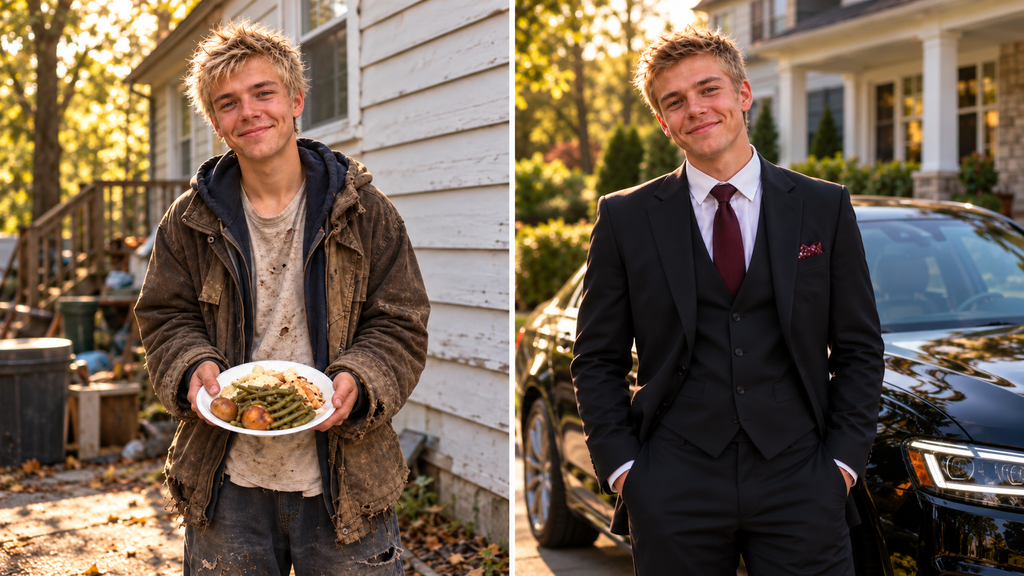
Behind him, the black SUV gleamed beneath the streetlights.
For twenty years, I had believed Gabriel was a helpless young man who survived because my mother brought him food.
Now he looked like someone who had never worried about money a day in his life.
I took a step backward.
“Gabriel, what’s going on?”
He glanced toward our old house.
“Your mother wanted me to tell you everything.”
“Then tell me.”
His expression changed.
“But before she died, she made me promise that I would never tell you the truth unless you came looking for me yourself.”
I felt something tighten in my chest.
“Why?”
“Because she wanted to know whether you’d come back for a man you spent your whole life believing wasn’t worth your kindness.”
I stared at him.
“Are you telling me this is some kind of test?”
Gabriel lowered his eyes.
“No. It’s the last thing your mother asked me to do.”
I looked down at the container of homemade dinner in my hands.
For years, I had blamed Gabriel for the distance between my mother and me.
Even after her death, I had felt angry that her last words had been about him.
And yet there I was, standing outside her house with food I had prepared for the very man I had spent twenty years resenting.
“Please,” Gabriel whispered. “Come inside.”
I hesitated.
Then he reached into his coat pocket and removed a familiar brass key.
My mother’s house key.
The one with the little blue ribbon tied around it.
My stomach dropped.
“Why do you have that?”
Gabriel looked at me with tears in his eyes.
“Because your mother gave it to me the night before her stroke.”
He unlocked the front door.
And when I stepped into the house, I discovered that the first secret had been waiting for me all along.
THE ROOM THAT HAD NEVER CHANGED
The house smelled exactly as I remembered.
Old wood.
Lavender soap.
The faint sweetness of cinnamon that always seemed to linger in my mother’s kitchen.
For a moment, I was eight years old again.
I could almost hear my father laughing in the living room.
Almost see my mother standing beside the stove, humming softly while she stirred soup in a dented saucepan.
But the house was silent now.
My father had been gone for twenty years.
My mother was buried beneath the oak tree at St. Mary’s Cemetery.
And the stranger standing behind me seemed to know this house better than I did.
Gabriel closed the door gently.
“Your mother never moved the furniture in here,” he said.
“I noticed.”
“She said some things deserved to stay exactly where they were.”
I turned toward him.
“Gabriel, please stop speaking in riddles.”
He nodded.
“You’re right.”
Then he walked toward the hallway.
“There’s something you need to see.”
He led me to my mother’s bedroom.
The bed was neatly made.
Her favorite blue cardigan hung over the back of a chair.
A small framed photograph stood on her nightstand.
It showed my parents on their wedding day.
My father, Thomas Bennett, was smiling proudly in his dark suit.
My mother, Margaret, held a bouquet of white roses.
I reached for the photograph.
“I haven’t seen this in years.”
Gabriel remained quiet.
Then he said something that made my fingers freeze.
“Look behind it.”
I turned the frame over.
Taped to the back was a small envelope.
My name was written across it in my mother’s familiar handwriting.
ELIZABETH — WHEN YOU ARE READY TO KNOW THE TRUTH.
My knees weakened.
“What is this?”
“One of the letters she left for you.”
“One of them?”
Gabriel nodded.
“There are seven.”
I looked up sharply.
“Seven letters?”
“Your mother spent the last three years writing them. She wanted to make sure you understood everything, even if she wasn’t here to explain.”
My hands began trembling.
I removed the envelope.
Inside was a folded sheet of paper.
The first line nearly broke me.
My darling Elizabeth,
If you are reading this, it means Gabriel has finally told you that the life you remember was not the whole truth.
There are things I should have explained when you were little.
I was afraid.
Not afraid that you would hate me.
I was afraid that telling you the truth would put you in danger.
I stopped reading.
“Danger?”
Gabriel said nothing.
I continued.
You remember the day your father died.
You remember the funeral.
You remember that I told you he had been killed in an accident.
But sweetheart, that wasn’t what happened.
The room seemed to tilt.
I read the next sentence twice.
Then a third time.
Your father did not die in an accident.
And Gabriel was never a stranger.
I lowered the letter.
“What does that mean?”
Gabriel’s face had gone pale.
He looked toward the window.
Then he whispered the words that changed everything.
“Elizabeth, your father saved my life.”
THE NIGHT MY FATHER DISAPPEARED
I remembered my father as a gentle man.
He was a mechanic with grease beneath his fingernails and a laugh so loud that neighbors sometimes knocked on our door to complain.
Every Sunday, he took me to the park.
Every birthday, he made me a cake.
It was usually crooked.
The icing was always uneven.
But he insisted no bakery in the world could make one better.
When I was eight, he disappeared from my life.
My mother told me there had been a highway accident.
A truck had lost control.
My father had been killed instantly.
There was a funeral, a closed coffin, and a gravestone.
I had never questioned it.
Why would I?
I was a child.
Gabriel sat on the edge of my mother’s bed.
“Your father wasn’t just a mechanic.”
I frowned.
“What are you talking about?”
“He worked for a transportation company called Halden Freight.”
“I know. He repaired their trucks.”
“He did more than that.”
Gabriel reached into his coat and removed a folded photograph.
He handed it to me.
My father stood beside a younger Gabriel in front of a large warehouse.
Gabriel looked painfully thin.
But he was smiling.
And my father’s arm rested affectionately around his shoulders.
On the back of the photograph, written in blue ink, were five words.
The family we choose matters.
I covered my mouth.
“Where did you get this?”
“Your father gave it to me two days before he disappeared.”
My voice cracked.
“Disappeared?”
Gabriel looked at me.
“Elizabeth, the official report said your father died in an accident. But there was no accident.”
A cold sensation moved through my body.
“No.”
“I wish I could tell you otherwise.”
“Then what happened?”
Gabriel clasped his hands together.
“When I was seventeen, I ran away from a children’s home outside the city. I had nowhere to go. I slept behind warehouses and searched dumpsters for food.”
I listened without moving.
“One night, three men caught me looking through a container behind Halden Freight. They accused me of stealing.”
He paused.
“They beat me.”
I looked at his hands.
There was a thin white scar across his right knuckle.
I remembered seeing it when I was a child.
“Your father found me.”
Gabriel swallowed.
“He pulled those men away. He took me to a hospital, paid for my treatment, and brought me food every day until I recovered.”
My eyes filled with tears.
“That sounds like Dad.”
Gabriel smiled sadly.
“It does.”
Then the smile vanished.
“But I saw something that night.”
“What?”
“One of the men had dropped a folder. When I picked it up, I saw invoices with the names of companies that didn’t exist. And beneath them were payment records connected to children being transported between facilities.”
I stared at him.
“Children?”
Gabriel nodded.
“Your father had already suspected something was wrong at Halden Freight. He’d been finding unusual records for months.”
My heart began pounding.
“He was investigating them?”
“Quietly. He was gathering evidence to take to the authorities.”
“And they found out?”
Gabriel closed his eyes.
“Yes.”
The silence stretched between us.
Finally, I whispered, “What did they do to him?”
Gabriel opened his eyes again.
“Two nights before your eighth birthday, your father called your mother from a pay phone. He said he’d discovered enough evidence to expose the entire operation.”
I felt my throat tighten.
“He told her he was coming home.”
Gabriel’s voice grew quieter.
“But he never arrived.”
I clutched the photograph.
“Who killed him?”
Gabriel looked directly at me.
“That’s the question your mother spent twenty years trying to answer.”
THE SECOND LETTER
I couldn’t breathe properly.
For two decades, I had believed my father died because of a terrible accident.
Now Gabriel was telling me that he might have been murdered because he had tried to protect vulnerable children.
And my mother had known.
She had lived with that knowledge.
Every day.
For twenty years.
“Why didn’t she tell the police?”
Gabriel’s expression darkened.
“She tried.”
He stood and walked toward the wardrobe.
Behind my mother’s neatly folded sweaters sat an old metal box.
I recognized it immediately.
When I was young, Mom kept it locked beneath her bed.
She told me it contained important papers.
I never knew what kind.
Gabriel placed the box on the bed.
“She left this for you.”
He handed me a small key.
Inside were documents, photographs, newspaper clippings, and several sealed envelopes.
On top was the second letter.
I unfolded it.
Elizabeth,
I went to the police three days after your father vanished.
I brought them everything he had left behind.
Instead of protecting us, one officer asked me a question that terrified me.
He asked whether my daughter still walked home from school alone.
My breath caught.
That evening, someone left a photograph on our porch.
It was a picture of you playing in the schoolyard.
Written on the back were the words: Keep asking questions, and she disappears too.
The letter slipped from my fingers.
Gabriel caught it before it reached the floor.
I felt sick.
“They threatened me?”
He nodded.
“Your mother believed someone inside the police department was connected to the company.”
I pressed a hand against my stomach.
“That’s why she stayed quiet?”
“That’s why she stopped asking questions publicly.”
I looked at him.
“What do you mean, publicly?”
Gabriel gave me a sad smile.
“Your mother never stopped fighting for your father.”
He reached into the metal box and removed a thick folder.
Inside were bank statements, photographs, property records, and dozens of handwritten notes.
Dates.
Names.
License plate numbers.
Business addresses.
My mother had been investigating for twenty years.
The same woman I remembered counting coins at the grocery store had been quietly collecting evidence against people powerful enough to threaten her child.
“She did all this?”
“Yes.”
“Alone?”
Gabriel looked down.
“No.”
I stared at him.
“You helped her?”
“Every day I could.”
A terrible realization began to form.
“The food,” I whispered.
Gabriel looked up.
“The food she brought you. The visits behind our house. You weren’t just living there.”
He shook his head.
“Not forever. At first I really had nowhere safe to sleep. Your mother fed me because I was hungry, and because your father had asked her to look after me. But eventually, we realized people were watching the house.”
He looked toward the window.
“So I stayed nearby. I could see anyone approaching from the back. I could warn her. And when she needed to pass information without attracting attention, she hid it in the containers she brought me.”
I slowly sat down.
The apple pies.
The casseroles.
The wrapped sandwiches.
The meals I had resented.
They had been something more.
“Gabriel…”
He shook his head gently.
“Your mother never used food only as a way to send messages, Elizabeth. She fed me because she cared about me.”
He paused.
“That part was real.”
I stared at him.
“Then why did she sometimes give you food when we barely had enough?”
His eyes filled.
“Because I was starving.”
I looked away.
“And because,” he added quietly, “she was trying to keep a promise to your father.”
THE PROMISE I NEVER KNEW ABOUT
Gabriel removed another envelope.
This one contained an old cassette tape.
My heart stumbled.
On the label, written in my father’s handwriting, were the words:
FOR MARGARET — IF I DON’T COME HOME.
I stared at it.
“Is that his voice?”
Gabriel nodded.
“Your mother listened to it every year on your birthday.”
My eyes burned.
“Why didn’t she ever let me hear it?”
“Because it contains names. She was afraid someone would learn she still had it.”
Gabriel reached into a drawer beside the bed.
Inside was a small cassette player.
The plastic had yellowed with age.
He placed the tape inside.
Then he looked at me.
“Are you ready?”
I wasn’t.
How could I be?
I had spent twenty years forgetting the exact sound of my father’s voice.
I could remember his laugh.
I could remember him calling me his little bird.
But his voice had become something distant, like music heard through a wall.
I nodded anyway.
Gabriel pressed play.
A soft clicking filled the room.
Then a familiar voice emerged through the static.
“Margaret, sweetheart, if you’re hearing this, something has gone terribly wrong.”
I covered my mouth.
My father.
My father.
Not a memory.
Not a dream.
His actual voice.
“I don’t have much time. I found the records. It’s worse than I thought.”
A faint noise sounded in the background.
He lowered his voice.
“There’s a man named Richard Halden. He’s using the company to move children from illegal placements. Some of the records show money paid to officials who were supposed to protect those children.”
My fingers tightened around the edge of the bed.
“If anything happens to me, don’t trust Detective Warren. I think he’s involved.”
Gabriel glanced toward the door.
On the tape, my father took a breath.
“Margaret, listen carefully. There is a boy named Gabriel. He’s seventeen. He’s had a terrible life, but he’s a good kid.”
I began crying.
“He helped me find the records. And because of that, he’s in danger too.”
A pause.
“If I don’t make it home, please don’t let them hurt him.”
My father’s voice broke.
“He’s just a boy, Maggie.”
I felt something inside me collapse.
“And please take care of Elizabeth.”
There was a long silence.
Then he added something I would carry for the rest of my life.
“Tell her I love her. Tell her every day. And when she’s old enough, tell her that courage doesn’t always look like fighting. Sometimes it looks like feeding someone the world has forgotten.”
The tape clicked off.
For several seconds, all I could hear was my own breathing.
Then I began to sob.
Not quietly.
Not gracefully.
I cried with the terrible, helpless grief of an eight-year-old girl who had just lost her father all over again.
Gabriel sat beside me.
He didn’t touch me.
He simply stayed.
Eventually, I turned toward him.
“My mother never told me any of this.”
“I know.”
“She let me hate you.”
His voice trembled.
“She was trying to keep you safe.”
“But she let me believe you mattered more to her than I did.”
Gabriel looked at me with such sadness that I almost couldn’t bear it.
“Elizabeth, your mother loved you more than anything in this world.”
“Then why did she push me away?”
He looked down.
“Because once the threats began, she believed that anyone close to her could become a target.”
I shook my head.
“That doesn’t explain everything.”
“No,” he admitted. “It doesn’t.”
He reached for the third letter.
“There’s something else.”
And the expression on his face told me that whatever came next would hurt even more.
THE BOY BEHIND THE FENCE
The third letter was shorter than the others.
My mother’s handwriting was shaky.
Elizabeth,
There is one thing I could never explain to you without reopening a wound you were too young to understand.
Gabriel was not the first child your father rescued.
Years before you were born, your father and I had a son.
I stopped reading.
My heart seemed to forget how to beat.
“What?”
Gabriel remained still.
I looked at him.
“My mother had a son?”
He nodded.
“Yes.”
“Before me?”
“Four years before you.”
I stared at the paper.
The words blurred.
I forced myself to continue.
His name was Samuel.
He was born on a snowy morning in February.
He had your father’s brown eyes and the tiniest dimple in his left cheek.
For almost three years, he was the center of our world.
Then one afternoon, he disappeared from the playground behind our apartment.
A terrible coldness spread through me.
We searched everywhere.
Police officers came to our house.
Neighbors helped.
Your father put posters on every telephone pole in the city.
But Samuel was never found.
I pressed my palm over my mouth.
I had never heard the name Samuel.
Not once.
When you were born, I promised myself I would never let anyone take another child from me.
That promise became the fear that shaped so much of your childhood.
I am sorry.
I looked at Gabriel.
“Why didn’t she tell me I had a brother?”
He swallowed.
“Your father suspected Samuel’s disappearance was connected to the same people he later investigated.”
My voice came out barely above a whisper.
“Did they find him?”
Gabriel hesitated.
And that hesitation frightened me more than anything he had said.
“Gabriel?”
He stood and walked to the window.
For a long moment, he looked out into the darkness.
Then he spoke.
“Your mother spent years believing Samuel was dead.”
I felt my chest tighten.
“And?”
Gabriel turned around.
“When your father found me, there was something about me he couldn’t explain.”
“What?”
“My age. My history. The records from the children’s home.”
I stared at him.
“Gabriel…”
“My earliest memories were of a place where children slept in rows of narrow beds. I was told my parents had abandoned me.”
He took a slow breath.
“But nobody could tell me where I was born.”
I gripped the edge of the mattress.
“No.”
“Your father started asking questions.”
“Gabriel, stop.”
“He found records showing that some children had been given new identities.”
I shook my head violently.
“No.”
Gabriel’s eyes filled with tears.
“He thought I might be someone your mother had been looking for.”
My heart was hammering so hard I could hear it.
“Are you saying…”
He reached into his pocket.
And removed a tiny silver bracelet.
It was tarnished with age.
One side was engraved with a name.
SAMUEL BENNETT.
On the other side was a date.
February 14.
Gabriel held it out to me.
“Your mother gave this to your brother when he was born.”
I stared at the bracelet.
Then at the man standing before me.
“Gabriel?”
His lower lip trembled.
“Elizabeth…”
I could barely speak.
“Are you my brother?”
He closed his eyes.
And for the first time since I had arrived, Gabriel began to cry.
“Yes.”
The word seemed to split the room in two.
I stood so quickly that the chair beside me fell backward.
“No.”
Gabriel remained where he was.
“No,” I repeated. “You can’t just say that. You can’t stand there after twenty years and tell me you’re my brother.”
“I know.”
“Do you have proof?”
He nodded.
“Yes.”
“Then show me.”
He reached into the metal box and removed a white envelope bearing the name of a medical laboratory.
Inside were documents confirming that Gabriel and my mother were biologically related.
A second report compared DNA from Gabriel and me, using a sample I had given during a family ancestry project years earlier.
I remembered that project.
Mom had asked me to participate.
She said she wanted to learn more about our family history.
I had mailed the kit without thinking much about it.
Now I understood.
The report identified us as biological siblings.
I read it.
Then read it again.
Gabriel watched silently.
“My mother knew?”
“Yes.”
“For how long?”
His voice broke.
“Since you were seventeen.”
I stared at him.
“Eleven years?”
He nodded.
“She knew for eleven years that you were my brother?”
“Yes.”
“And neither of you told me?”
Gabriel’s tears spilled down his cheeks.
“We wanted to.”
I backed away from him.
“Don’t.”
“Elizabeth—”
“Don’t tell me you wanted to!”
I pointed toward the hallway.
“Every summer I came home, you were there. Every Christmas, you were there. I watched her take food to you. I watched her buy you shoes when I needed school supplies.”
I started crying harder.
“And all that time, you were my brother?”
Gabriel lowered his head.
“Yes.”
I felt something deep inside me break.
Because suddenly, every memory looked different.
The boy who sat behind our house.
The young man who waved shyly when I came home from school.
The person who had once offered to teach me how to ride a bicycle.
The person I had ignored.
The man I had hated.
My brother.
My own brother.
I remembered one afternoon when I was twelve.
Gabriel had found a small wounded bird beside the road.
He brought it to our backyard in a cardboard box.
“Elizabeth,” he’d called softly, “do you want to help me?”
I had looked at him with disgust.
“Go away. You’re not part of this family.”
I could still see his expression.
How quickly his smile disappeared.
How he had quietly picked up the box and walked away.
Now I understood why those words had hurt him so deeply.
I covered my face.
“Oh, God.”
Gabriel took one tentative step toward me.
“Elizabeth…”
I shook my head.
“I’m so sorry.”
He stopped.
I looked up at him through my tears.
“I’m so sorry for everything I said to you.”
His face crumpled.
And when he finally opened his arms, I ran into them.
For the first time in my life, I hugged my brother.
We stood in our mother’s bedroom and cried for all the years we could never get back.
THE REASON HE NEVER LEFT
It must have been nearly midnight when we finally returned to the kitchen.
Gabriel made tea.
He knew exactly where my mother kept the cups.
Of course he did.
He had spent more time in this house than I had.
I sat at the table, still holding the silver bracelet.
“Why did she let everyone believe you were homeless?”
Gabriel placed a mug in front of me.
“Because it was safer for people to underestimate me.”
I studied his face.
“Safer from whom?”
He took a seat opposite me.
“The men who took Samuel Bennett.”
The sound of that name made me shiver.
“But you’re Samuel.”
Gabriel nodded.
“I am. But I lived as Gabriel for so long that I still use that name.”
“What happened after Mom learned the truth?”
“She wanted to tell you immediately.”
“Then why didn’t she?”
Gabriel looked at his tea.
“Because the people who had taken me were still alive.”
I felt fear return.
“Richard Halden?”
“Yes.”
“And Detective Warren?”
“Yes.”
“Are they still alive?”
Gabriel nodded.
“Richard Halden died six years ago. Detective Warren is retired. But Halden’s son took over the company.”
I frowned.
“His son?”
“Adrian Halden.”
The name sounded vaguely familiar.
Then I remembered.
I had seen him on television.
A wealthy businessman.
A philanthropist.
A man who attended charity galas and posed for photographs beside children’s hospitals.
“Adrian Halden is connected to this?”
Gabriel’s jaw tightened.
“We believe he’s been protecting the records his father left behind.”
I stared at him.
“Gabriel, what have you been doing all these years?”
He gave a small, tired smile.
“Trying to finish what our father started.”
“And the SUV? The clothes? The watch?”
He looked down at his sleeve.
“When I was twenty-two, I earned a scholarship to study accounting. I took classes at night while working during the day.”
“Mom never told me.”
“She was proud of me. But she was afraid you would ask questions.”
He continued.
“Later, I started a small forensic accounting firm. I helped businesses investigate fraud. Eventually, I built a company that worked with attorneys and financial investigators.”
I looked at him in disbelief.
“You’re an accountant?”
He smiled faintly.
“Among other things.”
“Are you wealthy?”
He hesitated.
“Comfortable.”
I glanced toward the expensive vehicle outside.
“Very comfortable?”
For the first time that night, he laughed.
“A little more than comfortable.”
I shook my head.
For twenty years, I had imagined him sitting alone behind our house, eating scraps and sleeping beneath newspapers.
He had been living an entirely different life.
“Why keep pretending?”
“I stopped living behind the house years ago. But I kept coming back to the shed and the little gate. People in the neighborhood were used to seeing me there. It was a convenient place to meet Mom without attracting attention.”
I thought about all the times I had seen him sitting outside.
All the times I had looked away.
“You didn’t need her food.”
“Not after a while.”
“Then why did she keep bringing it?”
He looked at me.
“Because she was our mother.”
Those five words made my eyes fill again.
“Even when she was angry with me?”
“She was never angry with you for leaving.”
“She acted like it.”
Gabriel sighed.
“She was afraid that if you stayed close, someone would connect you to the investigation.”
I lowered my eyes.
“But I needed her.”
“I know.”
My voice trembled.
“I needed my mother.”
Gabriel reached across the table.
“She knew that too.”
I looked at him.
“Then why didn’t she choose me?”
He squeezed my hand.
“Elizabeth, she was trying to save both of us. But sometimes she made choices that hurt the very people she wanted to protect.”
I sat quietly.
Because that was the truth I had been fighting all evening.
My mother had been brave.
She had been generous.
She had also been secretive, frightened, and painfully imperfect.
And because she was human, her love had not always reached me in the form I needed.
THE FOURTH LETTER
Gabriel opened another envelope.
“This is the letter she was most afraid you’d read.”
I looked at him.
“Why?”
“Because it explains the day with the apple pie.”
My heart tightened.
That afternoon had haunted me for twenty years.
I remembered every detail.
The sweet smell filling the kitchen.
The golden crust cooling beside the window.
The excitement I felt when I saw it.
And then the crushing disappointment when Mom said it wasn’t for us.
It was for Gabriel.
I took the letter.
My sweet Elizabeth,
I remember the apple pie.
I remember your little face when I told you it wasn’t for dinner.
And I remember what I said when you cried.
I have spent twenty years wishing I could take those words back.
A tear slid down my cheek.
You were eight years old.
You had lost your father.
You were frightened, lonely, and hungry for comfort.
And instead of holding you, I scolded you.
I was wrong.
I covered my mouth.
What you didn’t know was that Gabriel had been ill for three days.
He had a terrible fever and could barely stand.
The food I had brought him earlier that week had gone untouched.
That morning, he told me the only thing he remembered liking as a little boy was apple pie.
I didn’t know then that he was remembering the pies I used to bake for Samuel.
I stopped.
I could almost see it.
A lost child.
A mother who had spent years grieving.
A memory returning through the taste of apples and cinnamon.
When you asked whether the pie was for dinner, I should have told you that someone was sick.
I should have saved you a slice.
I should have explained that loving someone else never meant loving you less.
My tears fell onto the page.
Instead, I was frightened and exhausted, and I let my fear sound like anger.
Sweetheart, if I could live that afternoon again, I would put the pie down, kneel beside you, and tell you that you were the most precious gift life had ever given me.
Then I would cut that pie into three pieces.
One for you.
One for Gabriel.
And one for me.
Because even then, before I knew for certain who he was, some part of my heart had already recognized him.
I couldn’t read any further.
I pressed the letter against my chest.
For twenty years, I had carried the memory of that apple pie like proof that my mother loved someone else more.
Now, in her own words, she had finally given me what I needed.
An apology.
Not an excuse.
Not a demand that I understand.
Just an apology.
I began to cry again.
Gabriel quietly moved closer.
“She cried when she wrote that,” he said.
I looked up.
“You were there?”
He nodded.
“She kept starting over. She said no words seemed good enough.”
I smiled through my tears.
“She always said the right words came easier when she was baking.”
Gabriel laughed softly.
“That’s true.”
Then his expression changed.
“Elizabeth, there’s something you should know.”
“What?”
“That wasn’t the last apple pie she baked for you.”
I stared at him.
“What do you mean?”
He stood and opened the freezer.
Inside were several neatly labeled containers.
He removed a round package wrapped in foil.
On top was a piece of masking tape.
In my mother’s handwriting were the words:
ELIZABETH’S PIE — SAVE FOR WHEN SHE COMES HOME.
I stared at it.
The date was only two weeks old.
Two weeks before her death.
“She made this for me?”
Gabriel nodded.
“She’d been hoping you would visit.”
My lips trembled.
“She never asked.”
“She was afraid you’d say no.”
I touched the foil.
My mother had been waiting for me.
And I had been waiting for her.
Two stubborn people, divided by a misunderstanding that had grown into something enormous.
I began to sob.
Gabriel wrapped his arms around me.
And for a long time, neither of us spoke.
THE PHONE CALL
We were still sitting in the kitchen when Gabriel’s phone rang.
The sudden sound made us both jump.
He looked at the screen.
His expression changed instantly.
“What is it?” I asked.
He didn’t answer.
Instead, he stood and walked toward the hallway.
“Excuse me.”
“Gabriel?”
He stopped.
I could see fear in his eyes.
Real fear.
“Who’s calling?”
He hesitated.
Then he showed me the screen.
UNKNOWN NUMBER.
“That doesn’t tell me anything.”
He swallowed.
“This is the third call tonight.”
“From whom?”
He looked toward the front window.
“I don’t know.”
The phone stopped ringing.
Then a text message appeared.
Gabriel read it.
All the color drained from his face.
I stood.
“What does it say?”
He turned the screen toward me.
The message contained only one sentence.
YOUR MOTHER SHOULD HAVE KEPT HER MOUTH SHUT.
For several seconds, I couldn’t move.
Then another message arrived.
WE KNOW ELIZABETH IS WITH YOU.
I felt my blood turn cold.
Gabriel immediately reached for the curtains.
He closed them.
Then he checked the locks.
“Get your coat,” he said.
“What?”
“We need to leave.”
“Gabriel, what’s happening?”
He looked directly at me.
“Someone knows she left you the letters.”
My heart raced.
“How?”
“I don’t know.”
“Who would even know about them?”
He shook his head.
“That’s what scares me.”
The phone rang again.
This time, Gabriel answered.
He put it on speaker.
“Who is this?”
For a moment, there was only static.
Then a man’s voice spoke.
“Hello, Samuel.”
Gabriel’s face went white.
I stared at him.
The voice was older.
Rough.
Calm.
Almost amused.
“I see your mother finally told the little girl.”
Gabriel’s jaw tightened.
“What do you want?”
The man laughed softly.
“Your father asked that same question twenty years ago.”
My stomach twisted.
“Who are you?” I demanded.
The voice fell silent.
Then he said something that made Gabriel grip the counter.
“Elizabeth Bennett. You sound just like your mother.”
I felt sick.
“How do you know me?”
“Oh, I’ve known you since you were a child.”
Gabriel moved closer to the phone.
“If you come near my sister—”
“Your sister,” the man repeated thoughtfully. “How touching.”
A pause.
“Samuel, you were always supposed to stay lost.”
Then the line went dead.
Gabriel stared at the phone.
For the first time all night, the strong, wealthy man standing before me looked exactly like the frightened boy I remembered.
“Gabriel?”
He whispered a name.
“Detective Warren.”
THE MAN WHO ATTENDED MY FATHER’S FUNERAL
I remembered Detective Warren.
Or rather, I remembered a tall man in a brown coat who had stood beside my mother at my father’s funeral.
He had crouched down and handed me a piece of candy.
I remembered his gray eyes.
His thin smile.
And the way my mother had pulled me closer when he approached.
“That was him?” I whispered.
Gabriel nodded.
“He handled the missing-person investigation after Dad disappeared.”
“But Dad’s death was officially an accident.”
“Warren helped make sure it stayed that way.”
I sat down heavily.
“Why would he call now?”
Gabriel rubbed his forehead.
“Because he knows we’re close.”
“Close to what?”
Gabriel looked at the metal box.
“Your mother found something before she died.”
“What?”
“Something she believed could finally prove who was responsible for Dad’s disappearance.”
I stared at him.
“Then why haven’t you taken it to the police?”
“Because we weren’t sure which investigators could be trusted.”
He paused.
“And because Mom insisted that if anything happened to her, you should be the one to decide what happened next.”
I shook my head.
“Why me?”
Gabriel looked at me with a strange expression.
“Because the final piece of evidence belongs to you.”
I frowned.
“What are you talking about?”
He reached into the box again.
This time, he removed a photograph.
It showed my father kneeling beside me on my seventh birthday.
I was holding a bright red toy bird.
I remembered that bird.
It was made of painted wood, with tiny yellow wings and a hollow body.
My father had carved it himself.
I used to keep it beside my bed.
Eventually, I took it with me when I moved away.
It was still sitting on a shelf in my apartment.
Gabriel pointed to the toy.
“Do you still have this?”
“Yes.”
His eyes widened.
“Are you sure?”
“Of course. It was Dad’s last birthday present to me.”
Gabriel slowly sat down.
“Oh, thank God.”
I looked at him.
“Why?”
He took a breath.
“Your father told Mom that if anything happened to him, the safest place for certain information would be with the one person nobody would suspect.”
I stared at the picture.
“A seven-year-old girl?”
Gabriel nodded.
“Someone too young to understand what she was carrying.”
I felt a sudden wave of dizziness.
“The bird?”
“Your mother suspected it, but she never found a way to examine it without risking damage.”
I shook my head.
“You’re telling me I’ve had evidence about my father’s death sitting in my apartment all these years?”
Gabriel looked at me.
“I think so.”
The room seemed to grow colder.
For twenty years, I had protected that little wooden bird because it was the last thing my father gave me.
Now I wondered if he had given it to me because he knew his time was running out.
I looked toward the door.
“We need to go get it.”
Gabriel shook his head.
“Not tonight.”
I stared at him.
“Why not?”
“Because whoever called us knows you’re here. We need to make sure you’re safe first.”
I thought of my mother’s letters.
My father’s voice.
The hidden toy.
The years of silence.
Then I looked at my brother.
“No.”
He frowned.
“Elizabeth—”
“No more hiding.”
I stood.
“Mom spent twenty years hiding. Dad died trying to expose these people. You spent your life living with a name someone else gave you.”
My voice trembled.
“I have already lost too much to secrets.”
Gabriel looked at me for a long moment.
Then he nodded.
“All right.”
He picked up his phone.
“But we do this carefully.”
THE WOMAN WITH THE RED UMBRELLA
Gabriel didn’t call the police immediately.
Instead, he called a woman named Evelyn Price.
He explained that she was a retired federal investigator who had spent years working on cases involving financial exploitation and missing children.
My mother had contacted Evelyn seven years earlier.
Since then, Evelyn had quietly helped them review documents and find witnesses.
“Can we trust her?” I asked.
Gabriel answered without hesitation.
“Mom did.”
Twenty minutes later, a dark blue sedan stopped outside the house.
A woman in her late sixties stepped out.
She wore a raincoat and carried a folded red umbrella.
Her silver hair was pinned neatly at the back of her head.
She approached the front door without looking around.
Gabriel let her inside.
“Elizabeth,” he said, “this is Evelyn.”
The woman studied me.
Then her expression softened.
“You have your mother’s eyes.”
I felt an unexpected lump in my throat.
“Did you know her well?”
Evelyn nodded.
“Very well.”
She reached into her handbag and removed a small envelope.
“Margaret asked me to give you this if she didn’t survive.”
I stared at it.
“Another letter?”
“No.”
Evelyn’s expression became serious.
“This is something she never wanted Gabriel to know.”
I looked at my brother.
His face reflected my surprise.
“What?” he asked.
Evelyn hesitated.
Then she turned to me.
“Your mother suspected her stroke wasn’t entirely natural.”
The words hit me like a physical blow.
“What?”
Gabriel stepped forward.
“Evelyn, what are you saying?”
“I’m saying Margaret called me three days before she collapsed. She told me someone had been inside her house.”
I felt cold.
“Someone broke in?”
“Nothing obvious was stolen. But several drawers had been searched, and the medical organizer she kept beside her bed had been moved.”
Gabriel’s face hardened.
“Why didn’t she tell me?”
“She didn’t want you confronting anyone.”
Evelyn looked at me.
“Your mother had been receiving threats.”
I gripped the back of a chair.
“Did someone cause her stroke?”
Evelyn shook her head.
“We don’t know. A stroke can happen naturally, and suspicion isn’t evidence. But Margaret wanted an independent review of her medical records.”
Gabriel looked devastated.
“She never mentioned any of this.”
Evelyn touched his arm.
“She loved you, Samuel. Sometimes she tried to protect people by carrying everything herself.”
I looked at the envelope.
“What is inside?”
Evelyn nodded toward it.
“Open it.”
Inside was a single photograph.
It showed my mother standing outside a café.
Across from her sat a man in a dark suit.
Even though his face was partly turned away, I recognized him.
Adrian Halden.
The billionaire businessman.
My mother’s enemy’s son.
I stared at the picture.
“Why was she meeting him?”
Evelyn’s expression darkened.
“That’s what we need to find out.”
On the back of the photograph, my mother had written:
HE KNOWS WHERE THOMAS IS.
I felt the room spin.
“Where Thomas is?”
Gabriel took the photograph from my shaking hands.
He read the words.
Then looked at Evelyn.
“She wrote is?”
Evelyn nodded.
My voice came out as a whisper.
“Not where Dad was?”
Nobody answered.
A dreadful possibility opened before me.
I looked from Evelyn to Gabriel.
Then I asked the question neither of them seemed willing to say aloud.
“Is my father still alive?”
THE EMPTY COFFIN
For twenty years, I had visited my father’s grave.
I had brought flowers on his birthday.
I had cried there after my first heartbreak.
I had stood beside his headstone when I graduated from college, holding my diploma and wishing he could see me.
Now Evelyn was looking at me with an expression I couldn’t understand.
“Elizabeth,” she said carefully, “we don’t have proof that your father survived.”
“But you’re not saying he died.”
“No.”
I sank into a chair.
Gabriel looked just as stunned.
“Margaret never told me she suspected this.”
Evelyn nodded.
“She wasn’t certain.”
I stared at the photograph.
“Why would she write that?”
“Because Adrian Halden contacted her six weeks ago. He claimed he had information about what happened to Thomas.”
“What did he want?”
Evelyn hesitated.
“Money.”
I blinked.
“Money?”
“He wanted the original evidence your father had hidden.”
Gabriel clenched his fists.
“He knew about the bird.”
“Possibly,” Evelyn said.
I struggled to think.
“What happened to Dad’s body?”
Gabriel looked at me.
“There was an official identification.”
“By whom?”
“Detective Warren.”
“And Mom?”
Gabriel shook his head.
“She was told the injuries were too severe.”
My stomach turned.
“The coffin was closed.”
Evelyn nodded.
“Yes.”
I whispered, “Did anyone actually see him?”
Evelyn was silent.
Then she said, “The records are incomplete.”
I pressed my hands against my temples.
Everything I believed was coming apart.
First Gabriel was my brother.
Then my father’s accident became a possible murder.
And now my mother had left behind a photograph suggesting the man I mourned for twenty years might have survived.
I began to shake.
“Why would someone fake his death?”
Evelyn looked at Gabriel.
“Because a dead man can’t testify.”
He nodded slowly.
“But a hidden prisoner can’t testify either.”
I stared at him.
“Prisoner?”
Gabriel immediately shook his head.
“We don’t know that, Elizabeth.”
“Then what do we know?”
Evelyn took a deep breath.
“We know that your father found evidence of serious crimes. We know that he disappeared. We know that the investigation was compromised. And we know that someone has been threatening your family for twenty years.”
She leaned forward.
“What we need now is the evidence your father left behind.”
I thought of the little wooden bird sitting in my apartment.
For the first time, it frightened me.
THE DRIVE BACK
We left my mother’s house just after one in the morning.
Evelyn followed in her sedan while Gabriel drove me in the SUV.
The streets were nearly empty.
Rain streaked the windshield.
For a long time, we said nothing.
Then Gabriel reached toward the center console and handed me a small packet.
Inside were two slices of apple pie.
I stared at them.
“Where did you get this?”
“Mom made some last week. She froze several slices.”
I looked at him.
“You brought pie?”
He smiled sadly.
“She always said difficult conversations went better with something sweet.”
I laughed.
Then cried.
Then laughed again.
Gabriel kept his eyes on the road.
“She was afraid you’d never forgive her.”
I swallowed.
“I don’t even know what forgiving her means anymore.”
He nodded.
“That’s fair.”
I turned toward him.
“Did you ever hate her?”
Gabriel took a long breath.
“Sometimes.”
That surprised me.
“You did?”
“Of course. When she discovered I was Samuel, I wanted her to tell the whole world. I wanted to reclaim my name. I wanted you to know I was your brother.”
He glanced at me.
“But she kept saying it wasn’t safe.”
“She kept you hidden.”
“Yes.”
“And you stayed?”
He nodded.
“I loved her.”
I looked down.
“Sometimes love isn’t enough.”
“No,” Gabriel said softly. “Sometimes it isn’t.”
His honesty hurt.
But it also made me feel closer to him.
For the first time, Gabriel wasn’t simply the mysterious stranger my mother had protected.
He was my brother.
A person with his own anger, grief, and disappointments.
We both had been hurt by the same secrets.
And neither of us could recover the years we had lost.
After a while, he said, “Do you remember the blue bicycle?”
I looked up.
“What?”
“The one with the broken chain.”
I smiled faintly.
“Mine?”
“Yes.”
“Of course. Dad promised to fix it, but he died before he could.”
Gabriel nodded.
“I fixed it.”
I stared at him.
“What?”
“The summer you turned ten. I repaired the chain and painted the handlebars.”
My mouth fell open.
“I thought Mom did that.”
He smiled.
“She told me to leave it beside the porch before you woke up.”
I remembered that morning.
I had rushed outside and found my bicycle looking almost new.
I had assumed my mother had paid someone to repair it.
“That was you?”
Gabriel nodded.
“You rode it for three hours.”
I laughed through my tears.
“I fell into Mrs. Carlson’s flower bed.”
He grinned.
“Twice.”
I turned toward the window.
All those years, I had thought Gabriel was someone who took from my family.
Now I was beginning to see how much he had quietly given.
THE WOODEN BIRD
My apartment was on the fourth floor of an old brick building.
When we arrived, Gabriel parked across the street.
Evelyn waited outside while we went upstairs.
I unlocked my door with shaking hands.
Everything looked ordinary.
My gray couch.
The stack of books beside the window.
The half-finished puzzle on the dining table.
The framed photograph of my mother I had brought back from her funeral.
And above the fireplace, on a narrow wooden shelf, sat the red bird.
My father’s last birthday present.
For twenty years, it had followed me from home to home.
I had taken it to college.
Kept it in a shoebox during my first difficult years after graduation.
Placed it beside my bed when I was lonely.
It had always reminded me of my father.
I walked toward it.
Then stopped.
“Gabriel?”
“Yes?”
“Look.”
The bird wasn’t sitting where I usually kept it.
It had been moved.
Only an inch or two.
But I knew.
Someone had touched it.
Gabriel immediately stepped beside me.
“Don’t pick it up.”
I stared at him.
“Why?”
“Because we don’t know who was here.”
He took out his phone and called Evelyn.
“Someone’s been inside.”
My heart began racing.
“I locked the door.”
Gabriel checked the windows.
Everything appeared normal.
Then I noticed something on the floor.
A tiny piece of red paint.
I bent down.
The bird’s wing had been scratched.
My stomach dropped.
“Someone tried to open it.”
Gabriel nodded.
“Looks that way.”
Evelyn came upstairs.
She examined the shelf without touching it.
Then she took photographs.
“Any sign of forced entry?” she asked.
I shook my head.
“No.”
She looked around.
“Do you keep a spare key?”
“My neighbor has one.”
“Anyone else?”
I hesitated.
“My mother used to have one.”
Gabriel turned toward me.
“Where is it now?”
“I don’t know.”
Evelyn’s expression became serious.
“Elizabeth, has anyone else had access to your apartment recently?”
I thought.
Then something cold moved through my chest.
“My boyfriend.”
Gabriel looked at me.
“Your boyfriend?”
“Daniel.”
Evelyn leaned forward.
“How long have you been seeing him?”
“About eight months.”
“Does he have a key?”
I swallowed.
“Yes.”
Gabriel’s expression changed.
“What’s his last name?”
I stared at him.
“Why?”
“Elizabeth, please.”
I hesitated.
Then answered.
“Daniel Warren.”
The room went silent.
Gabriel looked at Evelyn.
Evelyn looked back at him.
I felt my stomach drop.
“Warren,” I whispered.
Gabriel’s voice was almost inaudible.
“Detective Warren has a son.”
I stared at him.
“No.”
Evelyn stepped closer.
“Elizabeth, what does Daniel do for work?”
“He’s a financial consultant.”
Gabriel closed his eyes.
“Of course.”
I backed away.
“No, you’re wrong.”
Neither spoke.
“Daniel is kind. He’s thoughtful. He helped me when Mom was sick.”
Gabriel looked at me with heartbreaking tenderness.
“Elizabeth…”
“He drove me to the hospital. He bought flowers for her room. He held me when she died.”
My voice broke.
“He loves me.”
Evelyn spoke gently.
“We don’t know yet whether he’s involved.”
But I could see what she was thinking.
The son of the man who had threatened my mother.
The man who knew about my father’s investigation.
The man who had called Gabriel that night.
And my boyfriend had a key to my apartment.
A key to the place where my father’s hidden evidence had been sitting for twenty years.
I stared at the bird.
Then at my phone.
Three missed calls from Daniel.
One message.
Baby, are you home? I have something important to tell you.
A second message arrived.
Please don’t trust Gabriel.
My blood turned cold.
I looked up.
“How does he know I’m with Gabriel?”
Nobody answered.
Then another message appeared.
Elizabeth, open the door.
At that exact moment, someone knocked.
Three times.
Slowly.
Deliberately.
THE MAN I THOUGHT I LOVED
I had imagined seeing Daniel a thousand times that week.
I had imagined falling into his arms and telling him how much I missed my mother.
I had imagined him comforting me.
Making tea.
Holding me while I cried.
I had never imagined standing in my own living room, afraid to open the door because the man on the other side might be connected to the disappearance of my father.
“Elizabeth?” Daniel called.
His voice sounded normal.
Warm.
Familiar.
“Sweetheart, it’s me.”
Gabriel moved toward the door.
Evelyn raised one hand.
“Don’t.”
Daniel knocked again.
“Elizabeth, please. I know you’re in there.”
My heart hammered.
I stepped closer.
“Daniel?”
“Thank God.”
I swallowed.
“Why are you here?”
“Because I’m worried about you.”
“How did you know I came home?”
A pause.
Then he said, “You told me you were going back to your mother’s place tonight.”
That was true.
I had mentioned it before leaving the funeral reception.
But I hadn’t told him when I would return.
Or that Gabriel would be with me.
“Daniel, who is your father?”
The silence on the other side was immediate.
Too immediate.
Finally, he answered.
“Elizabeth, please open the door.”
“Answer me.”
He sighed.
“My father is a retired police officer.”
“His name?”
Another pause.
“Charles Warren.”
I felt my chest tighten.
“Did you know my father?”
Daniel didn’t answer.
“Did your father investigate my father’s death?”
“Elizabeth, there are things you don’t understand.”
My eyes filled with tears.
“Then explain them.”
“Not through a door.”
Gabriel stepped beside me.
“Daniel, this is Gabriel Bennett.”
Silence.
Then Daniel whispered, “Samuel.”
I felt sick.
He knew.
He had known who Gabriel really was.
Gabriel’s voice hardened.
“How long have you been watching my sister?”
Daniel didn’t answer.
“How long?”
Finally, he said, “It wasn’t supposed to happen this way.”
My knees almost gave out.
I leaned against the wall.
“What wasn’t supposed to happen?”
Daniel’s voice broke.
“Falling in love with you.”
A sob escaped my throat.
Gabriel moved closer to me.
Daniel continued.
“I was supposed to find out whether you had something your father left behind.”
I closed my eyes.
There it was.
The truth.
Eight months of dinners.
Walks in the park.
Late-night conversations.
The way he kissed my forehead when I was sad.
The promises.
The plans.
I whispered, “You were using me.”
“At first.”
Those two words hurt more than anything else.
At first.
As though that made it better.
As though love could erase the fact that our entire relationship had begun as a lie.
Daniel’s voice grew desperate.
“Elizabeth, I swear I didn’t know what my father had done when I first met you.”
Gabriel laughed bitterly.
“Then who sent you?”
Daniel hesitated.
“Adrian Halden.”
The room went still.
Evelyn stepped forward.
“Daniel, if you have evidence of a conspiracy, now is the time to tell the truth.”
He sounded frightened.
“I tried to get out.”
Gabriel replied coldly.
“Then prove it.”
There was a long silence.
Finally, Daniel said something none of us expected.
“I know where Thomas Bennett is.”
My heart stopped.
I stared at the door.
“What?”
Daniel’s voice trembled.
“Elizabeth, your father is alive.”
THE NAME ON THE HOSPITAL RECORD
I don’t remember sitting down.
One moment I was standing beside the door.
The next, I was on the couch with Gabriel kneeling in front of me.
He held both my hands.
“Elizabeth, breathe.”
I shook my head.
“No.”
“Listen to me.”
“No, Gabriel. He can’t be alive.”
My voice rose.
“He can’t.”
Because if my father was alive, then what had I been mourning?
Who had I been talking to at the cemetery?
Why had he never come home?
Why had he never called?
Why had he allowed me to grow up without him?
Daniel was still speaking through the door.
“He wasn’t free to leave.”
Gabriel stood.
“Explain.”
Daniel’s voice became quiet.
“My father told me years ago that Thomas Bennett died in the accident. That’s what I believed. But when Adrian asked me to locate the wooden bird, I began looking through old files.”
A pause.
“I found a medical transport record from twenty years ago.”
Evelyn moved closer.
“What kind of record?”
“A transfer from a private clinic to a long-term care facility.”
Gabriel frowned.
“Under what name?”
Daniel answered.
“Michael Turner.”
I looked up.
“Who is that?”
Daniel continued.
“The patient arrived with severe head injuries and no identification. His photographs were kept in a restricted file.”
My heart began pounding again.
“I saw the photograph.”
Gabriel stared at the door.
“And?”
Daniel’s voice broke.
“It was Thomas Bennett.”
I pressed my hand to my chest.
“Where?”
“A private neurological care facility outside Ashford.”
Evelyn looked sharply at Gabriel.
“I know that place.”
He turned.
“You do?”
“Halden’s foundation funded it for years.”
My stomach twisted.
Daniel continued.
“Your father has significant memory problems. He doesn’t know who he is all the time.”
I began crying.
“Twenty years?”
“Elizabeth, I’m sorry.”
I couldn’t stop shaking.
For twenty years, my father might have been alive in a facility paid for by the people who destroyed our family.
My mother had spent her life trying to find him.
And died without knowing for certain.
I looked at Gabriel.
“We have to go.”
He nodded.
“We will.”
Evelyn raised her hand.
“Not without contacting federal investigators and getting independent verification of Daniel’s claims.”
Gabriel turned toward her.
“He’s my father.”
“And that’s exactly why we cannot afford to make a mistake.”
She looked at the door.
“Daniel, do you have those records?”
“Copies.”
“Where?”
“In my car.”
“Then leave them outside the door and step away. Do not touch anything else.”
For a moment, Daniel said nothing.
Then we heard footsteps.
A soft rustling sound.
And finally, his voice.
“Elizabeth?”
I closed my eyes.
“I know I don’t deserve your forgiveness.”
I said nothing.
“But I meant it when I said I loved you.”
Tears slid down my cheeks.
I wanted to believe him.
That was the worst part.
Even after everything, part of me still wanted the man I had loved to be real.
I forced myself to speak.
“Daniel, if you love me, tell the truth to the investigators.”
His voice broke.
“I will.”
Then his footsteps faded down the hallway.
THE FIFTH LETTER
We didn’t sleep that night.
Evelyn contacted an attorney she trusted and arranged for the records Daniel left outside my door to be securely collected.
Gabriel sat beside the wooden bird, staring at it as though it might suddenly speak.
I returned to my mother’s letters.
There were two I hadn’t read.
The fifth envelope had my name written across it.
Inside was a letter and a small photograph.
The photograph showed my mother standing beside Gabriel at a graduation ceremony.
He wore a dark cap and gown.
She was smiling so proudly that I felt a sharp pain in my chest.
On the back, she had written:
My son came home to me twice.
Once as Samuel.
Once as Gabriel.
I read the letter.
Elizabeth,
There is something I want you to understand.
When I discovered Gabriel was Samuel, I thought my heart would burst from happiness.
I had spent years imagining that my little boy was cold, hungry, frightened, or dead.
Then suddenly he was standing in front of me.
Alive.
Breathing.
Looking at me with the same brown eyes he had as a toddler.
I wiped my eyes.
But I also discovered something painful.
Samuel had grown into a man without me.
He had memories I wasn’t part of.
He had fears I couldn’t erase.
He had suffered things I could never undo.
Finding him did not give us back the years we lost.
And that taught me something about love.
Love is not ownership.
Love is not demanding that someone remain the person you remember.
Love is learning to see who they have become.
I looked toward Gabriel.
He was studying a document.
His brow was furrowed.
He looked so much like my father that my heart ached.
I continued reading.
I made mistakes with both of you.
I tried to protect you by keeping secrets.
I told myself there would always be time to explain.
But time is not something any of us can promise.
My eyes filled.
Elizabeth, if you take only one lesson from my life, let it be this:
Do not wait twenty years to say what matters.
Do not let pride keep you from reaching for someone you love.
And do not measure love by how much another person receives.
There was never a smaller piece of my heart reserved for you because Gabriel existed.
My heart simply grew big enough for both of you.
I lowered the letter.
And whispered, “Mom.”
The house was silent.
But for the first time since her funeral, I didn’t feel as though she was entirely gone.
Her words were there.
Her mistakes were there.
Her love was there.
And I was finally old enough to understand the difference.
THE BIRD’S SECRET
At dawn, Evelyn returned with an independent evidence specialist named Martin Hale.
He was a quiet man with gray hair and careful hands.
He examined the wooden bird under a bright lamp.
The toy was only six inches long.
Red paint.
Yellow wings.
A small metal pin connecting the tail.
My father had carved it for me when I was seven.
Martin turned it slowly.
“Interesting.”
Gabriel leaned forward.
“What?”
“Someone has tried to remove the tail.”
I swallowed.
“Can you open it?”
Martin examined the pin.
“Possibly. But we should document everything before we do.”
He photographed the bird from every angle.
Then used a small tool to loosen the pin.
The tail came away.
Inside was a narrow hollow compartment.
My hands began trembling.
Martin tilted the bird.
A tiny metal capsule slid onto the table.
Gabriel inhaled sharply.
“Oh, Dad.”
Martin opened the capsule carefully.
Inside was a strip of microfilm wrapped in protective paper.
And a folded note.
The paper was yellowed.
The handwriting was unmistakable.
My father’s.
I reached for it.
Evelyn nodded.
“It’s yours.”
I unfolded it.
To my little bird,
If you’re old enough to read this, I hope the world has been kind to you.
I made you this because I wanted you to remember that even small things can carry great courage.
Never be afraid to ask questions.
Never be ashamed of kindness.
And never forget that your father loves you.
I began crying.
At the bottom was one final sentence.
Tell your mother that the truth is in the numbers.
Gabriel stared at the microfilm.
“The accounting records.”
Evelyn nodded slowly.
“That may be what he meant.”
Martin examined the strip.
“This needs to be digitized professionally.”
Gabriel stepped back.
For the first time since I met him, he looked overwhelmed.
“Our father hid the evidence in her toy.”
I touched the little bird.
“He trusted me.”
Gabriel looked at me.
“He trusted both of you.”
I shook my head.
“No. He trusted Mom to protect me. And he trusted me not to throw away something he gave me.”
The realization made me smile through my tears.
For twenty years, I had kept that bird because I loved my father.
And perhaps, in some strange way, that love had kept his final act of courage safe.
WHAT THE NUMBERS REVEALED
By the following afternoon, the microfilm had been preserved and copied by specialists working with Evelyn’s attorney.
It contained hundreds of financial records.
Invoices.
Payments.
Account numbers.
Transfer logs.
Names of facilities.
And documents showing how money had moved between Halden Freight, several private institutions, and shell companies.
Gabriel spent hours studying the records.
His professional experience finally made sense to me.
He had built an entire career learning to follow money because he had spent his life trying to understand the people who destroyed our family.
I watched him at the dining table.
“Anything?”
He rubbed his eyes.
“Yes.”
My heart jumped.
“What?”
He turned his laptop toward me.
“These records show a network of payments that the old investigations never uncovered.”
Evelyn leaned over his shoulder.
Gabriel pointed to several entries.
“These accounts were used to pay people connected to the children’s facilities. Some of the payments correspond with unexplained transfers.”
I looked at the screen.
“Does it prove they took you?”
“It may help prove how the operation worked. But investigators will need to connect it to witness testimony and other records.”
He scrolled down.
Then stopped.
His expression changed.
“What?” I asked.
Gabriel didn’t answer.
He enlarged one of the entries.
At the bottom of a financial transfer record was a familiar name.
CHARLES WARREN.
Daniel’s father.
The retired detective.
Evelyn exhaled slowly.
“There he is.”
Gabriel leaned back.
“Payments made shortly before Dad disappeared.”
I felt sick.
“Was he paid to kill our father?”
Evelyn shook her head.
“We can’t conclude that from a payment alone.”
Then she pointed to another document.
“But this certainly raises questions he needs to answer.”
Gabriel continued searching.
Several minutes later, he went completely still.
I watched him.
“Gabriel?”
He whispered, “Oh, no.”
My stomach dropped.
“What?”
He turned the screen toward me.
A medical transport invoice.
Dated three days after my father’s supposed death.
Patient: Michael Turner.
Sending facility: Halden Medical Center.
Receiving facility: Ashford Neurological Residence.
Under special instructions was a handwritten note.
NO FAMILY CONTACT.
I felt the room grow quiet around me.
Then Gabriel pointed to the authorization signature.
R. HALDEN.
Richard Halden.
The man my father had tried to expose.
I began to cry.
My father hadn’t simply disappeared.
Someone had ordered that he be kept from us.
For twenty years.
THE SIXTH LETTER
That evening, while Gabriel and Evelyn worked with the attorney and investigators, I opened the sixth letter.
My mother’s handwriting was barely legible.
It had clearly been written when she was already unwell.
Elizabeth,
If Gabriel tells you that your father may still be alive, please do not blame yourself for anything that happened.
You were a child.
Nothing was your responsibility.
I wish I could have given you a happier childhood.
I wish you had grown up knowing your brother.
I wish Thomas had been there to teach you to drive, watch you graduate, and walk beside you on your wedding day if that was what you wanted.
My eyes filled.
But I cannot change what happened.
I can only tell you this:
Every night, before I went to sleep, I imagined our family sitting together at the kitchen table.
Thomas telling one of his terrible jokes.
Samuel stealing the last biscuit.
You laughing so hard that milk came out of your nose.
I laughed through my tears.
Dad had always told terrible jokes.
In my imagination, no one was missing.
No one was hungry.
No one was afraid.
And I was simply a mother feeding her family.
I pressed the letter to my heart.
At the bottom, my mother had written:
If you ever find your father, tell him I kept my promise.
Tell him Samuel came home.
Tell him Elizabeth grew into a beautiful, strong woman.
And tell him I loved him until my last breath.
I couldn’t move.
I sat there until the sun disappeared beyond my apartment windows.
Then I folded the letter carefully.
And made a decision.
If my father was alive, I would find him.
Not only for myself.
For Gabriel.
For my mother.
For the frightened eight-year-old girl who had spent twenty years waiting for someone to come home.
THE VISIT TO ASHFORD
Three days later, the investigators confirmed that Michael Turner had been a patient at Ashford Neurological Residence.
They could not immediately confirm that he was Thomas Bennett.
But they found enough inconsistencies in the records to request further examination.
The case had grown much larger than Gabriel and I had imagined.
Several former employees agreed to speak to investigators.
An old nurse remembered the arrival of a severely injured man who repeatedly called for someone named Margaret.
A former administrator recalled strict instructions that the patient was not to receive visitors.
And Daniel provided copies of records that supported the investigation.
His cooperation did not erase what he had done.
But it helped open a door that had been closed for twenty years.
On Friday morning, Gabriel and I drove to Ashford with Evelyn and our attorney.
I barely spoke during the journey.
My hands were cold.
My stomach twisted.
I had spent days imagining the moment.
What if the man wasn’t my father?
What if he was?
What if he didn’t recognize us?
What if I had spent twenty years longing for someone who no longer remembered my name?
Gabriel reached across the seat.
“You don’t have to go in.”
I looked at him.
“Yes, I do.”
He nodded.
“I know.”
The facility stood on a quiet hill surrounded by tall pine trees.
It looked peaceful.
Almost beautiful.
That made me angry.
How could a place connected to so much suffering look so ordinary?
Inside, a nurse led us down a long corridor.
My shoes clicked against the polished floor.
We passed a recreation room where several elderly patients sat watching television.
Some were reading.
Others stared out the windows.
Then the nurse stopped outside a door.
Room 214.
She looked at us gently.
“He’s awake. He’s been having a fairly good morning.”
My heart pounded.
Gabriel stood beside me.
His hand trembled as he reached for mine.
The nurse opened the door.
And there, sitting beside the window in a pale blue sweater, was an old man.
His hair was white.
His shoulders were narrow.
His face was lined with age.
But when he turned toward us, I knew.
I knew before anyone spoke.
The eyes.
The shape of his nose.
The small scar above his left eyebrow.
The same scar he had gotten when he fell from a ladder while fixing our roof.
My knees nearly gave out.
“Daddy?”
The man stared at me.
His expression was blank.
I took a step forward.
“Daddy, it’s Elizabeth.”
He looked confused.
Then frightened.
“I’m sorry,” he whispered. “Do I know you?”
My heart shattered.
Gabriel caught my elbow.
I wanted to scream.
I wanted to demand that someone give me back the twenty years we had lost.
Instead, I walked slowly toward the bed.
I knelt in front of him.
“My name is Elizabeth Bennett.”
The old man stared at me.
I swallowed.
“My mother was Margaret.”
Something changed in his face.
His eyes widened slightly.
“Margaret?”
I nodded.
“Yes.”
He looked toward the window.
“Margaret makes apple pie.”
A sob escaped my throat.
I nodded again.
“Yes, Daddy. She did.”
He smiled faintly.
“She puts too much cinnamon in it.”
I began crying so hard I couldn’t speak.
That was something my father used to say.
Every time Mom baked apple pie, Dad would announce that she’d used enough cinnamon to season the entire town.
She would tell him to stop complaining.
He would eat three slices.
I pressed my forehead against his hand.
“Daddy.”
His fingers moved slowly.
They touched my hair.
Then he whispered something.
“Little bird?”
I looked up.
My heart nearly stopped.
“What did you say?”
He studied my face.
His eyes filled with tears.
“Little bird.”
I covered my mouth.
He smiled uncertainly.
“You got so big.”
And I broke.
I leaned into him and sobbed.
Twenty years.
Twenty years of birthdays.
Christmas mornings.
Graduations.
Heartbreaks.
Lonely nights.
Twenty years of believing he was gone.
And now his hand was resting on my head.
Just as it had when I was a child.
THE SECOND REUNION
Gabriel stood near the door.
He hadn’t moved.
I turned toward him.
“Come here.”
He shook his head slightly.
His eyes were full of tears.
“I don’t know if he remembers me.”
I reached for his hand.
“Come here anyway.”
Gabriel approached slowly.
Our father looked up.
For a moment, his expression remained confused.
Then Gabriel knelt beside me.
“Hello, Dad.”
The old man stared.
Gabriel swallowed.
“My name is Gabriel.”
No reaction.
Then he added, “You used to call me Sam.”
Our father’s face changed.
His eyes moved slowly over Gabriel’s features.
“Sam?”
Gabriel nodded.
“Yes.”
Our father began trembling.
“Little Sam?”
Gabriel’s face crumpled.
“Yes, Dad.”
The old man reached toward him.
Gabriel took his hand.
And our father whispered the words that reduced both of us to tears.
“I looked for you.”
Gabriel bowed his head.
“I know.”
“I looked everywhere.”
Gabriel began crying.
“I know, Dad.”
Our father’s lips trembled.
“I couldn’t find you.”
Gabriel leaned forward.
“You did find me.”
The old man stared at him.
“You got so tall.”
Gabriel laughed through his tears.
“Yeah.”
Our father smiled.
Then looked between us.
“Where’s Maggie?”
The room fell silent.
My heart broke all over again.
Gabriel looked at me.
I looked at Evelyn.
Nobody wanted to say it.
Finally, I took my father’s hand.
“Daddy, Mom passed away.”
His expression became confused.
“Passed away?”
I nodded.
“She was sick.”
He looked toward the window.
“No.”
I swallowed.
“I’m sorry.”
For several seconds, he stared at the sunlight falling across the floor.
Then his eyes filled.
“She promised she’d wait.”
I began crying.
I pressed his hand against my cheek.
“She did wait, Daddy.”
My voice broke.
“She waited twenty years.”
He closed his eyes.
A tear slid down his face.
And in a voice so quiet I could barely hear it, he whispered:
“My Maggie.”
THE TRUTH ABOUT MY FATHER
In the weeks that followed, investigators pieced together what had happened.
My father had been intercepted on his way home after gathering evidence against Halden Freight.
There had been a violent confrontation.
He suffered a severe head injury.
Rather than allow him to reach a public hospital where he might eventually speak, people connected to Richard Halden arranged for him to be transferred under a false identity.
His injuries left him with lasting cognitive problems.
His memory came and went.
Some days he remembered pieces of his childhood.
Some days he believed he was still a young mechanic.
Some days he called for Margaret.
But throughout those twenty years, his true identity had been hidden from the people who loved him.
Richard Halden had died before he could be held accountable.
Charles Warren, however, was still alive.
And the evidence my father had hidden inside the wooden bird helped investigators uncover the financial network that had protected the people involved.
Other victims came forward.
Former employees provided testimony.
Old records were recovered.
The investigation expanded to include allegations of trafficking, financial crimes, conspiracy, and obstruction of justice.
For the first time in decades, families who had been told their children were missing without explanation began receiving answers.
Some reunions were joyful.
Others were devastating.
Not every child survived.
Not every parent lived long enough to learn the truth.
I began to understand the scale of what my father had tried to stop.
He hadn’t simply been protecting Gabriel.
He had been trying to protect countless children who had no one else.
And my mother had spent twenty years helping him keep that promise.
THE MAN WHO BETRAYED ME
Daniel came to see me six weeks after the investigation began.
I almost refused.
Part of me still loved him.
That made me angry.
I wanted the betrayal to erase every good memory.
But it didn’t.
The man who had lied to me was also the man who once stayed awake all night when I was sick.
He remembered how I liked my coffee.
He had held my hand at my mother’s funeral.
And he had entered my life because someone wanted information about my father.
Both things were true.
That was what made it hurt.
We met at a quiet café.
He looked exhausted.
His face was thinner.
There were dark circles beneath his eyes.
He stood when I approached.
“Elizabeth.”
I sat across from him.
For a moment, neither of us spoke.
Then he whispered, “I’m sorry.”
I looked at him.
“For what?”
He swallowed.
“For lying to you.”
“What else?”
His eyes filled.
“For getting close to you because Adrian asked me to.”
“What else?”
He lowered his head.
“For letting you fall in love with someone you didn’t really know.”
I felt tears burn behind my eyes.
“Did any of it mean anything?”
He looked up.
“Yes.”
I shook my head.
“How am I supposed to believe that?”
“I don’t expect you to.”
The answer surprised me.
He continued.
“I loved you. I still do. But I know that doesn’t undo what I did.”
I stared at him.
“Did you touch the bird?”
He nodded.
“Yes.”
My chest tightened.
“I tried to open it once. I couldn’t. I stopped because I knew what I was doing was wrong.”
I looked away.
He reached into his coat and removed a small envelope.
Inside was a photograph.
It showed my mother standing beside him in a hospital corridor.
I looked up sharply.
“What is this?”
Daniel’s eyes filled.
“She knew who I was.”
I froze.
“What?”
“Your mother found out about my father three months before she died.”
I stared at him.
“Then why didn’t she tell me?”
He swallowed.
“She confronted me.”
My heart pounded.
“What did she say?”
Daniel looked down.
“She told me that if I ever hurt you, she would make sure I regretted it.”
A strange smile tugged at my mouth.
That sounded like Mom.
Then Daniel continued.
“She also asked me whether I loved you.”
I looked at him.
“What did you say?”
“I told her yes.”
“And what did she say?”
His voice broke.
“She said love without honesty is just another kind of betrayal.”
I closed my eyes.
Mom.
Even near the end, she had been trying to protect me.
“Why did she let you stay in my life?”
Daniel shook his head.
“I don’t know. Maybe she thought I would tell you the truth myself.”
I sat quietly.
Finally, I stood.
Daniel looked up.
“Elizabeth?”
I met his eyes.
“I believe that you cared about me.”
Hope flickered across his face.
“But I can’t build a future on the way you entered my life.”
His expression collapsed.
I continued.
“You helped us find my father. I’ll always be grateful for that.”
My voice trembled.
“But gratitude isn’t trust.”
He nodded slowly.
“I understand.”
I picked up my purse.
And before I walked away, I said the words I had spent weeks trying to accept.
“I forgive you for what I can. The rest will take time. But we’re not going back to what we were.”
He began crying.
I walked out of the café.
And for the first time since meeting him, I felt completely honest with myself.
Love mattered.
But so did truth.
THE SEVENTH LETTER
I saved my mother’s last letter for the day we brought Dad home.
By then, arrangements had been made for him to receive appropriate medical care close to us.
His condition was complicated.
Some days he recognized me immediately.
Other days, he asked who I was.
Gabriel and I learned to celebrate small things.
A familiar song.
A shared memory.
The way Dad sometimes smiled when he smelled fresh bread.
He couldn’t return to the man he had been twenty years earlier.
But he was still our father.
And we were finally together.
On the morning of his homecoming, I sat at my mother’s kitchen table with the seventh envelope.
The house had been cleaned.
Fresh flowers stood beside the window.
The curtains were open.
Sunlight filled the rooms.
I unfolded the letter.
My precious Elizabeth,
If you’ve reached this letter, then you know the truth.
You know Gabriel is your brother.
You know your father was a brave man.
And you know that I was a mother who made too many mistakes while trying to protect the people she loved.
I smiled through my tears.
I wish I could sit beside you now.
I wish I could hold your hands and explain everything.
I wish I could tell you how proud I am of the woman you became.
You were always stronger than you knew.
Even when you were angry with me.
Even when you stayed away.
Even when our conversations were short and difficult.
I never stopped being proud of you.
I wiped my cheeks.
I kept every photograph you sent.
Every birthday card.
Every little message.
I read your graduation announcement so many times that the paper began to tear.
I followed your career with pride.
And every time someone asked whether I had children, I told them I had two.
One daughter who had learned to fly.
And one son who had finally found his way home.
I began to cry.
Elizabeth, I do not know whether your father is alive.
I pray that he is.
But if he isn’t, please remember that his love did not die on the day he disappeared.
It lived in the courage he gave Gabriel.
It lived in the little wooden bird he made for you.
And it lived in every meal I carried through our back gate.
I pressed the paper against my lips.
There is one final thing I want you to do.
Go into the kitchen.
Open the bottom drawer beside the stove.
Under the old tablecloths, you’ll find something I saved for you.
I looked toward the kitchen drawer.
My heart quickened.
I stood and opened it.
There were faded dish towels.
An old recipe book.
A stack of tablecloths.
Beneath them was a small wooden box.
I lifted it carefully.
Inside were two silver spoons.
Two faded baby photographs.
And a handwritten recipe card.
Across the top, Mom had written:
SAMUEL AND ELIZABETH’S APPLE PIE.
I began crying.
There were two little fingerprints pressed into the corner of the card.
One marked Samuel.
One marked Elizabeth.
And beneath the recipe was a note.
One pie.
Two children.
More love than I ever knew what to do with.
I held the card against my chest.
Then returned to the letter.
I know you remember the day I gave Gabriel the apple pie.
I know how much it hurt you.
If I could return to that afternoon, I would do everything differently.
But perhaps you can do something I never managed.
Make a pie for your family.
Sit down together.
Tell the truth.
And never allow silence to steal another year.
At the bottom of the page were my mother’s final words.
I loved you before you were born.
I loved you when you were angry with me.
I loved you when you left.
And I will love you wherever life takes you.
Forever,
Mom.
I sat at the kitchen table and cried until there were no tears left.
Then I stood.
Washed my hands.
Tied on my mother’s old apron.
And began peeling apples.
THE DINNER WE WAITED TWENTY YEARS TO SHARE
Gabriel arrived just before six.
He helped Dad out of the car.
Our father wore a soft gray sweater and held a small bouquet of flowers.
When he stepped onto the porch, he looked around slowly.
His brow furrowed.
“Where are we?”
Gabriel smiled.
“Home, Dad.”
Our father stared at the front door.
Then at the garden.
Then at the old wooden bench beside the steps.
His eyes widened.
“Maggie?”
My heart tightened.
He looked toward me.
“Is Maggie inside?”
I walked toward him.
“Daddy…”
He smiled.
“She’ll be angry if I’m late for dinner.”
I began crying.
Gabriel looked away.
For a moment, I didn’t know what to say.
How could I explain to a man whose memory came and went that the woman he loved had spent twenty years waiting for him?
Then I remembered something Mom once told me.
When someone is hurting, don’t always try to find the perfect words.
Sometimes just hold their hand.
So I reached for Dad’s hand.
“Come inside,” I whispered. “We made your favorite.”
He smiled.
“Apple pie?”
I laughed through my tears.
“Yes.”
Gabriel opened the door.
Our father stepped into the hallway.
He stopped.
His eyes moved over the old photographs.
The coat rack.
The familiar wallpaper.
The clock above the kitchen entrance.
Then his expression changed.
He stared at the framed wedding photograph on the wall.
Slowly, he raised his hand.
“Maggie.”
I stepped beside him.
“That’s Mom.”
He touched the glass.
His fingers trembled.
“She was beautiful.”
I nodded.
“She was.”
For a long moment, he stood silently.
Then he whispered:
“I was trying to get home.”
My heart stopped.
Gabriel turned toward him.
“Dad?”
Our father kept looking at the photograph.
“I had to get home.”
His voice grew stronger.
“She was waiting.”
Gabriel approached slowly.
“Dad, do you remember what happened?”
Our father closed his eyes.
His face twisted with effort.
“Truck.”
We went still.
“Men.”
He gripped the edge of the table.
“Don’t let them take the boy.”
Gabriel’s face crumpled.
Our father opened his eyes.
He looked directly at Gabriel.
“Sam.”
Gabriel began crying.
“I’m here, Dad.”
Our father grabbed his hand.
“I tried.”
Gabriel knelt in front of him.
“I know.”
“I tried to bring you home.”
Gabriel pressed his forehead against our father’s hand.
“You did.”
Our father started sobbing.
A terrible, broken sound.
“I’m sorry.”
Gabriel shook his head.
“No, Dad.”
“I’m sorry.”
Gabriel wrapped his arms around him.
“You found me. You saved my life. And Mom brought me home.”
I knelt beside them.
For a long time, the three of us remained on the kitchen floor.
We couldn’t get back the years.
We couldn’t bring Mom into that room.
We couldn’t make Dad healthy again.
But we could finally stop pretending we were strangers.
THE LAST SURPRISE
After dinner, Gabriel helped Dad settle into his chair beside the window.
I brought out the apple pie.
The crust was golden.
The filling bubbled gently at the edges.
The kitchen smelled of cinnamon and warm apples.
For a moment, I was eight years old again.
But this time, something was different.
There were three plates on the table.
One for Dad.
One for Gabriel.
One for me.
I began cutting the pie.
Gabriel watched quietly.
Then he said, “Wait.”
I looked up.
“What?”
He reached into his coat.
“I have something for you.”
I smiled.
“Another secret?”
He laughed softly.
“Hopefully the last one.”
He handed me a small envelope.
Inside was a photograph.
My mother stood in the backyard holding two little children.
A toddler boy with brown eyes.
And a baby girl wrapped in a pink blanket.
On the back, in my father’s handwriting, were the words:
OUR WHOLE WORLD.
I stared at the photograph.
It was the first picture I had ever seen of all three of us together.
My mother.
My brother.
Me.
Before Samuel disappeared.
Before my father was taken.
Before fear and grief swallowed our family.
“Where did you find this?” I whispered.
Gabriel smiled.
“Mom kept it hidden in her recipe book.”
I touched the photograph.
Then noticed something.
There was a tiny note folded behind it.
I opened it.
Mom had written only one sentence.
If the three of you are ever together again, save me a slice.
I laughed.
Then cried.
Then laughed again.
Gabriel put his arm around my shoulders.
“We should.”
I looked at him.
“What?”
“Save her a slice.”
My throat tightened.
I nodded.
We cut four pieces.
One for Dad.
One for Gabriel.
One for me.
And one for Mom.
I placed her slice on the little blue plate she had always used.
Then set it beside her photograph.
Our father looked toward it.
His expression softened.
“Maggie likes apple pie.”
I smiled through my tears.
“Yes, Daddy.”
He nodded.
“She always saves me the biggest piece.”
Gabriel laughed.
“Not anymore, Dad.”
Our father looked confused.
I smiled.
“Now we share.”
SIX MONTHS LATER
The investigation continued.
Eventually, prosecutors brought charges against several individuals connected to the old operation, including Charles Warren and Adrian Halden.
The evidence was complicated.
Some records were incomplete.
Some witnesses had died.
Some victims could not remember everything that happened to them.
But the case was no longer hidden.
And that mattered.
Other families began coming forward.
Some had spent decades searching for missing children.
Others had believed official explanations that never quite made sense.
Gabriel used his resources to help support independent legal assistance for victims and their families.
He also created a scholarship in our father’s name for young people who had grown up without stable homes.
He called it the Thomas Bennett Courage Fund.
I asked why he didn’t name it after Mom too.
He smiled.
“Because I have something else planned for her.”
A month later, Gabriel purchased the abandoned lot behind our childhood home.
The same place where I had first seen him sleeping beneath cardboard.
The same place where my mother had carried food through the back gate.
The same place where two brothers and sisters had lived only a few yards apart without knowing who they truly were.
He transformed it into a small community kitchen.
There were warm tables.
Clean bathrooms.
A pantry filled with groceries.
A counseling room.
And a bright sign above the entrance.
MARGARET’S TABLE
No one should go hungry. No one should be forgotten.
When I saw it for the first time, I couldn’t stop crying.
Gabriel stood beside me.
“Do you think she’d like it?”
I smiled.
“She’d say the sign was too expensive.”
He laughed.
“She probably would.”
“Then she’d go inside and start cooking.”
Gabriel nodded.
“Exactly.”
On opening day, dozens of people came.
Neighbors.
Volunteers.
Families.
People who had known Mom.
People who had received meals from her over the years.
I had never realized how many lives she’d touched.
One elderly woman approached me.
“Your mother brought me groceries after my husband died,” she said. “I never knew how she found out I needed help.”
A young man told me Mom had paid for his school uniforms when his family couldn’t afford them.
A mother of three said Margaret had once left a basket of food on her porch with a note reading:
You don’t have to explain. Just eat.
I listened to story after story.
And slowly, the woman I thought I knew became someone larger.
Not perfect.
Not always gentle.
Not always wise.
But courageous.
Generous.
And determined that the suffering she had experienced would not make her turn away from someone else’s pain.
WHAT HAPPENED TO MY FATHER
Dad came home to live with support from professional caregivers.
His memory remained unpredictable.
Some mornings he called me Elizabeth.
Other mornings he called me little bird.
Sometimes he asked when Mom would return from the grocery store.
Sometimes he remembered she had died and cried as though hearing it for the first time.
Those were the hardest days.
But there were beautiful ones too.
We learned that happiness didn’t have to depend on perfect memory.
Dad still loved music.
He still smiled whenever Gabriel told a terrible joke.
He still liked his toast almost burned.
And every time I made apple pie, he insisted there was too much cinnamon.
Some things had survived.
One afternoon, I found him sitting in the garden holding the little red bird.
He had asked me to bring it to him.
I watched from the doorway.
He turned it slowly in his hands.
Then whispered, “I made this.”
My heart jumped.
I approached carefully.
“You did, Daddy.”
He looked up.
“For my little girl.”
I knelt beside him.
“Yes.”
He smiled.
“She was always asking questions.”
I laughed through my tears.
“I still am.”
He studied my face.
For a moment, his eyes became clear.
“Elizabeth?”
I nodded.
“Yes, Daddy.”
He reached up and touched my cheek.
“I’m proud of you.”
I began crying.
He looked concerned.
“Why are you sad?”
I shook my head.
“I’m not.”
And for once, that was almost true.
ONE YEAR AFTER MOM’S FUNERAL
On the anniversary of our mother’s death, Gabriel and I visited her grave.
We brought white roses.
And a small apple pie.
Dad wasn’t feeling well enough to come, so we brought a photograph of him smiling in the garden.
Gabriel placed the flowers beside the headstone.
Then stepped back.
For a long time, neither of us spoke.
Finally, I knelt beside the grave.
“Hi, Mom.”
My voice trembled.
“I’ve been meaning to talk to you.”
The wind moved gently through the trees.
I looked at the name carved into the stone.
MARGARET BENNETT
Beloved Wife and Mother.
“I was angry with you for so long.”
My eyes filled.
“I thought you loved Gabriel more than me.”
Gabriel stood quietly behind me.
“I thought every meal you carried to him was something you had taken away from me.”
I wiped my cheeks.
“But I understand now.”
I paused.
“Not everything.”
My voice softened.
“I still wish you’d told me the truth sooner.”
A tear slid down my face.
“I still wish you had hugged me that day instead of yelling.”
I took a breath.
“And I still wish we had more time.”
The leaves rustled overhead.
“But I know you loved me.”
My voice broke.
“I know that now.”
Gabriel knelt beside me.
He placed his hand over mine.
“I wish she could see us,” he whispered.
I smiled through my tears.
“Maybe she can.”
He looked toward the headstone.
“Mom, Dad’s home.”
His voice cracked.
“We found him.”
I squeezed his hand.
“And Gabriel’s not alone anymore.”
He looked at me.
Neither was I.
We sat beside the grave for a long time.
Then Gabriel stood.
“Ready?”
I looked down at the little pie.
“One more thing.”
I cut a small slice and placed it carefully on a paper plate beside the flowers.
Gabriel smiled.
“Saving her a piece?”
I nodded.
“Always.”
THE REAL SECRET
For twenty years, I had believed my mother fed a homeless boy because she loved him more than she loved me.
I had built an entire story around that belief.
Every meal she carried outside felt like rejection.
Every kind word she spoke to Gabriel felt like something stolen from me.
Every time she defended him, I felt smaller.
I left home believing that distance would protect me from the pain.
But pain doesn’t disappear simply because we move away.
Sometimes it follows us quietly.
It settles into our memories.
It changes how we hear words.
It teaches us to expect rejection even where love exists.
I had spent twenty years misunderstanding my mother.
But she had also spent twenty years failing to explain herself.
Both things were true.
And the truth, when it finally arrived, was far more complicated than I had imagined.
Gabriel wasn’t a stranger.
He was my brother.
My father hadn’t simply been lost to an accident.
He had sacrificed his freedom trying to protect people who needed help.
My mother hadn’t been choosing another child over me.
She had been trying, imperfectly and desperately, to keep her broken family alive.
And the meals she carried through our back gate had been more than food.
They had been promises.
Promises to my father.
Promises to a lost son.
Promises that kindness would survive even when fear tried to destroy it.
But the greatest lesson came from something much smaller.
An apple pie.
A dessert I had resented for twenty years.
The same dessert that eventually brought us together.
Because on the day I finally sat at our old kitchen table with my father and brother, I understood something my mother had tried to teach me.
Love isn’t a pie.
Giving someone a slice doesn’t mean there is less left for you.
Real love grows when it is shared.
I wish I had understood that when I was eight.
I wish Mom had found the words to explain it.
But neither of us could go back.
All we could do was choose what came next.
So now, every Sunday, Gabriel and I cook dinner together.
Sometimes Dad helps.
Sometimes he sits by the window and tells us stories we’ve heard a hundred times.
Sometimes he forgets who we are.
And sometimes, for a few beautiful minutes, he remembers everything.
We eat at the old wooden table.
The one where I used to sit and wonder why my mother loved someone else more.
There are always three plates.
And a fourth place set beside Mom’s photograph.
Gabriel usually tells a joke.
Dad complains about the cinnamon.
I laugh.
And when dinner is finished, we pack the leftovers and carry them to Margaret’s Table, where someone who needs a meal is always welcome.
Because twenty years ago, my mother looked at a hungry young man and refused to turn away.
She didn’t know then that the stranger she was feeding was the son she’d lost.
She only knew that he was hungry.
And that was enough.
That is the part of her story I hope people remember.
Not the money Gabriel eventually earned.
Not the secrets she kept.
Not even the extraordinary way our family found one another again.
I hope they remember the woman who had almost nothing, yet still found something to give.
The woman who made mistakes, said the wrong things, carried too much fear, and loved her children more fiercely than she knew how to show.
And I hope they remember that sometimes the people we resent are carrying stories we have never bothered to hear.
The last time Dad asked about Mom, we were sitting beneath the oak tree in the backyard.
The afternoon sun warmed his face.
He watched the birds gathering along the fence.
“Where’s Maggie?” he asked.
I took his hand.
“She’s gone, Daddy.”
His eyes filled with tears.
Then he looked at me.
“Did she know I loved her?”
My throat tightened.
I thought about the letters.
The photographs.
The little silver bracelet.
The wooden bird.
The twenty years of searching.
The pies.
The promises.
I squeezed his hand.
“Yes, Daddy.”
I smiled through my tears.
“She knew.”
He nodded slowly.
Then he asked one final question.
“Did she know I was trying to come home?”
I leaned my head against his shoulder.
And whispered:
“She never stopped believing you would.”
Dad closed his eyes.
For a long time, he said nothing.
Then a peaceful smile appeared on his face.
“Good,” he whispered.
“Because I never stopped trying.”
I looked toward the back gate.
The same old gate through which Mom had carried food for twenty years.
Gabriel had painted it blue.
Mom’s favorite color.
Above it, he’d placed a little wooden sign.
Just five words.
THERE IS ALWAYS ROOM FOR ONE MORE.
I watched it move gently in the afternoon breeze.
And finally, after twenty years of anger, grief, and unanswered questions, I felt something I hadn’t experienced since childhood.
I felt home.
Not because everything had been repaired.
Some things never could be.
Not because all our questions had been answered.
Some never would be.
But because, at last, we were together.
And the love my mother had spent her life trying to protect had survived.
THE END! THANK YOU FOR READING!❤️