 Reading Time: 66 minutes
They thought humiliating my four-year-old daughter would force me to surrender. They thought I would come crawling back with two hundred thousand dollars, desperate for their approval.
But when my attorney opened the Easter envelope and played the recording from Emma’s stuffed bunny, we discovered something far worse than cruelty. My mother and sister had been hiding a secret that could destroy their reputation, their fortune, and the very mansion they worshipped.
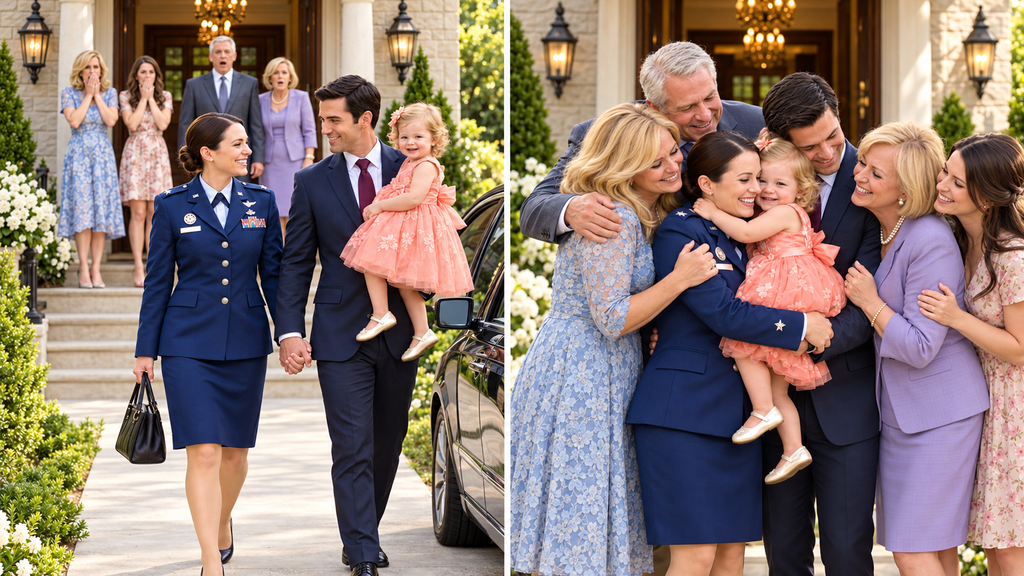
And the greatest shock came when I learned why they had been so desperate to get that money before Tuesday.
1. The Recording That Changed Everything
By the time we returned home from the clinic, it was nearly midnight.
Emma had fallen asleep in the back seat, still clutching her stuffed bunny. Her small face was swollen from crying, and every time the car passed beneath a streetlight, I caught another glimpse of the faint red marks near her hairline.
I couldn’t stop looking at them.
I couldn’t stop hearing her little voice.
Did I break Grandma’s egg?
Four years old.
My daughter was only four years old, and somehow, after being hurt and humiliated by her own grandmother, she still believed she might have done something wrong.
Daniel carried her upstairs while I stood in our entrance hall, staring at the family photograph hanging beside the staircase.
It had been taken at Christmas two years earlier.
Emma was sitting on Vivian’s lap, laughing as my mother pretended to steal her nose.
I remembered how grateful I had felt that evening.
My mother had actually smiled at my daughter.
She had held her without complaining.
I had gone home believing things might finally change between us.
Now, looking at that photograph, I wondered how many times I had mistaken a moment of politeness for love.
Daniel came downstairs twenty minutes later.
“She’s sleeping,” he said quietly. “I put the monitor beside her bed.”
I nodded.
He approached me, saw the photograph, and gently took it off the wall.
“You don’t have to decide what to do with this tonight.”
“I should have stopped visiting them.”
“Mara—”
“I knew what they were like.”
His expression softened.
“You knew they could be cruel to you. You didn’t know your mother would attack our daughter.”
I looked down at my hands.
“I kept believing that if I was patient enough, generous enough, useful enough…”
My voice broke.
“Eventually they’d love me.”
Daniel placed the photograph face down on the hallway table.
“You never had to earn that.”
I wanted to believe him.
But thirty-two years of being treated like the unwanted daughter of the Hale family had taught me otherwise.
Then Daniel reached into his pocket.
“There’s something we need to hear.”
He was holding the small recording device from Emma’s bunny.
My stomach tightened.
“I don’t know if I can listen to it.”
“We don’t have to do it tonight.”
I looked toward the staircase.
Somewhere upstairs, my daughter was sleeping with a night-light beside her bed because darkness still frightened her.
And in my mother’s mansion, the people who had hurt her were probably congratulating themselves.
“Play it,” I whispered.
Daniel connected the device to his laptop.
The screen displayed a saved recording.
The emergency button had activated a feature that preserved the previous two minutes of audio, as well as everything that happened afterward.
Daniel clicked the file.
At first, all we heard was silverware.
Music.
Adult conversation.
Then Beatrice’s voice filled the room.
“Honestly, Mara, is that the only dress you own? You look like you’re attending a funeral.”
My mother’s laughter followed.
I closed my eyes.
I had heard those words earlier that evening.
But somehow they sounded uglier the second time.
Then came Vivian’s demand.
“I need two hundred thousand dollars by Tuesday.”
My own voice sounded unusually small.
“Mother, that’s a lot of money. What exactly is it for?”
Vivian laughed.
“Don’t start interrogating me. After everything we’ve done for you, the least you can do is help this family.”
There was a clink of glass.
Then Emma’s sweet little voice.
“Mommy, look! The pink egg has a butterfly!”
And suddenly—
A chair scraped violently against the hardwood floor.
Vivian shouted.
“GET YOUR FILTHY HANDS OFF THAT!”
Emma screamed.
The sound was so sharp that Daniel immediately lowered the volume.
But I grabbed his wrist.
“No.”
“Mara—”
“Don’t stop it.”
The recording continued.
There was a thud.
A frightened cry.
Then Emma sobbing.
“Mommy! Mommy!”
I heard myself scream her name.
Beatrice shouted, “Stop making a scene!”
Then Vivian’s cold voice cut through the chaos.
“That child needs to learn her place!”
I covered my mouth.
I knew what had happened.
I had witnessed every second.
But listening to it without the distraction of movement made something painfully clear.
There had been no accident.
No misunderstanding.
My mother had deliberately hurt a little girl because she touched a decoration.
Daniel sat absolutely motionless.
His jaw was clenched so tightly that I could see the muscles moving beneath his skin.
Then the recording reached a sentence I hadn’t noticed during the confusion.
Beatrice spoke in a low voice.
“Mother, enough. Adrian said we cannot afford another incident before Tuesday.”
Vivian snapped back.
“Then Mara had better bring the money.”
I stared at the screen.
“What?”
Daniel paused the recording.
He replayed the last fifteen seconds.
Again, Beatrice’s voice.
Adrian said we cannot afford another incident before Tuesday.
I turned toward my husband.
“Why would Adrian care whether I gave Mother money?”
Daniel didn’t answer immediately.
Then he reached for his phone.
“I’m calling Elliot.”
“At midnight?”
“Especially at midnight.”
Our attorney answered on the third ring.
After listening to the recording, Elliot Rowe said something that made the room feel colder.
“Mara, I need you to stop thinking of that two hundred thousand dollars as a family request.”
“What do you mean?”
“I think your mother and sister are trying to cover something up.”
A pause.
“And I think they’re running out of time.”
2. The Secret Behind the Two Hundred Thousand Dollars
The next morning, I arrived at Elliot’s office with Daniel.
Emma stayed with Daniel’s older sister, Claire, a preschool teacher who had always treated her like the center of the universe.
Before leaving, Emma asked me whether Grandma Vivian was coming to our house.
“No, sweetheart.”
“Promise?”
I knelt in front of her.
“I promise. Nobody is coming here to hurt you.”
She wrapped her arms around my neck.
“Can Auntie Claire make the bunny pancakes?”
“Of course.”
“And Daddy won’t let Grandma take my bunny?”
My throat tightened.
“Never.”
By the time we reached Elliot’s office, I was no longer interested in being the obedient daughter.
I wanted answers.
Elliot greeted us with three folders and a cup of coffee I never touched.
“First,” he said, “we’re going to preserve the evidence properly. The recording stays private for now. We have to make sure the authorities receive it through the appropriate process.”
Daniel nodded.
“And the dining-room cameras?”
“The monitoring company has preserved the footage. I’ve requested a certified copy through the authorized account. We’ll confirm what can legally be used.”
I looked at Elliot.
“Can Mother be charged?”
“The police and prosecutor will decide that. But you have a medical report, an eyewitness account, and recordings that may corroborate what happened. I strongly recommend making a formal report.”
“Already decided,” I said.
Elliot studied me for a moment.
Then he opened the second folder.
“Now, about the estate.”
Inside were financial statements, bank records, tax receipts, and mortgage documents.
At the top of the first page was a familiar name.
WILLOW CREEK HOLDINGS, LLC
My company.
Ten years earlier, I had created Willow Creek using profits from a small business consulting partnership.
My family had never cared enough to ask what I did professionally.
They thought I spent my days shopping, decorating the house, and spending Daniel’s salary.
They didn’t know I had built an investment company long before Daniel and I married.
Daniel helped oversee its portfolio, but Willow Creek belonged to me.
And through that company, I had quietly kept my childhood home from financial ruin.
For years, I had paid overdue property taxes directly to the county.
Later, when a bank threatened to enforce the estate’s mortgage, Willow Creek purchased the outstanding loan.
I hadn’t bought the mansion.
I had bought the debt secured against it.
That difference mattered.
My mother still legally owned the property.
But Willow Creek was the creditor entitled to repayment under the mortgage documents.
I had chosen not to demand repayment.
Instead, I had authorized a temporary arrangement that allowed Vivian to remain in the house while the family stabilized its finances.
The arrangement was always supposed to be temporary.
But I had extended it again.
And again.
And again.
All because I couldn’t bear the thought of the Hale estate being sold.
Elliot slid a document toward me.
“Your mother’s latest extension expires Tuesday.”
I stared at him.
“Tuesday?”
He nodded.
“The same day she demanded two hundred thousand dollars.”
Daniel leaned forward.
“That’s not a coincidence.”
“No,” Elliot replied. “I don’t believe it is.”
He pointed to several entries highlighted in yellow.
“Your mother and sister have been attempting to refinance the estate through another financial institution. They’re representing the property as substantially more secure than it actually is.”
“How?”
“By omitting material information about the outstanding debt and presenting future funds as though they’re already committed.”
I felt my stomach turn.
“They told a bank I was giving them money?”
“Someone submitted documents stating that the family expected a two-hundred-thousand-dollar capital contribution before Tuesday.”
“But I never agreed to that.”
“Exactly.”
Daniel took the document.
“Who signed it?”
Elliot hesitated.
“Vivian Hale.”
My mother’s name appeared at the bottom.
Beside it was another signature.
Beatrice Whitcomb.
My sister.
And beneath their signatures was a section describing me as a committed private contributor.
I had supposedly agreed to provide the money from family resources.
I looked up slowly.
“Does the bank believe I signed something?”
“Not according to what we have so far,” Elliot said. “But the documents imply a commitment that doesn’t exist. We’re correcting the record today.”
I sat back in my chair.
Suddenly, Vivian’s demand made sense.
She hadn’t simply been asking me to rescue the family.
She needed my money to support promises she had already made.
“And Adrian?” I asked.
Elliot looked uncomfortable.
“There’s another organization involved.”
He opened the third folder.
Across the cover were the words:
THE EVELYN HALE HERITAGE FOUNDATION
I froze.
Evelyn Hale.
My grandmother.
The only person in that family who had ever loved me without requiring something in return.
“Why is Grandma’s name on that?”
Elliot exchanged a glance with Daniel.
Then he said, “That’s what worries me most.”
3. My Grandmother’s Name
My grandmother died when I was twenty-one.
She had been a remarkable woman.
Not wealthy in the flashy way my mother admired, but generous in all the ways that mattered.
She remembered birthdays.
She baked bread for neighbors.
She let me sit beside her at the kitchen table and paint wooden Easter eggs, even when I got more paint on the table than on the eggs.
When I was sixteen, after Vivian told me I would never be as beautiful or successful as Beatrice, Grandma Evelyn found me crying in the garden.
She sat beside me on the damp stone bench.
“Do you know why people grow roses, Mara?”
I shook my head.
“Because they want something beautiful?”
“Partly,” she said. “But a good gardener doesn’t hate a daisy for refusing to become a rose.”
She took my hand.
“You’re not a disappointment just because you were born different from your sister.”
I had carried those words with me for years.
Now, sitting in Elliot’s office, I discovered that Beatrice had created a charitable foundation in Grandma’s name.
Its stated mission was to preserve historic properties, fund educational programs, and protect the cultural heritage of our county.
On paper, it sounded wonderful.
In practice, Elliot had found worrying discrepancies in its public filings.
“Beatrice has been raising money using the Hale mansion as the centerpiece of a restoration campaign,” he explained.
“What restoration campaign?”
“That’s the question.”
He showed me photographs from the foundation’s website.
The mansion appeared in golden sunlight, its gardens carefully edited to look immaculate.
Below the photograph was a fundraising appeal.
Help preserve the Evelyn Hale family legacy for future generations.
I stared at the screen.
My sister was asking strangers to donate money to maintain the house I had already been maintaining.
“How much have they raised?”
“Public filings indicate several hundred thousand dollars over the last few years. We don’t yet know how much was spent on legitimate expenses.”
Daniel’s expression darkened.
“And Adrian?”
“As a state senator, Adrian Whitcomb has publicly endorsed the foundation. He appears at its events. That doesn’t necessarily establish wrongdoing, but it does explain why Beatrice is worried about scrutiny.”
I remembered the designer handbags.
The expensive vacations.
The charity dinners where Beatrice posed beside politicians beneath enormous chandeliers.
She had always told me that Adrian’s family was wealthy.
That money was never a problem.
Yet every few months, Vivian demanded another payment from me.
Twenty thousand.
Thirty-five thousand.
Fifty thousand.
Always some emergency.
Always a reason I couldn’t ask questions.
And always the same warning.
Don’t embarrass this family by being difficult.
I looked at Elliot.
“How much have I paid toward that house over the last decade?”
He opened a spreadsheet.
“Counting property taxes, insurance advances, emergency repairs, and the sums you’ve lent through Willow Creek, the total is approximately one million, four hundred thousand dollars. That’s separate from what Willow Creek paid to acquire the mortgage.”
I couldn’t speak.
I knew the individual amounts.
But I had never looked at the total.
One million, four hundred thousand dollars.
Money that could have gone into Emma’s future.
Money that could have helped families who genuinely needed it.
Money that could have built a hundred happy memories.
Instead, I had spent it protecting a mansion where my daughter wasn’t even allowed to touch an Easter decoration.
Elliot’s voice softened.
“Mara, you understand that ending financial support doesn’t mean Vivian loses the house tomorrow?”
“I know.”
“There are notices, legal requirements, opportunities to repay, refinance, or sell. We’ll follow the law. But you have every right to stop making voluntary payments.”
I stared at the documents.
“Then stop them.”
“You’re certain?”
I thought of Emma falling backward.
Of Vivian standing over her.
Of Beatrice blocking me from reaching my own child.
“Completely.”
I took a breath.
“And Elliot?”
“Yes?”
“I want every financial transaction connected to that foundation examined. If they used Grandma’s name to deceive people, I want the truth uncovered.”
He nodded.
Then he handed me a smaller piece of paper.
“I should warn you. Beatrice is already trying to get ahead of the story.”
He turned his laptop toward me.
A social media post appeared.
It had been uploaded less than an hour earlier.
And the first sentence made my blood boil.
4. My Sister Declared War
The photograph was from Easter dinner.
Someone had taken it before everything happened.
It showed Vivian smiling at the table.
Beatrice holding her wineglass.
And Emma reaching toward the jeweled pink egg.
The caption read:
“Heartbroken after a beautiful family Easter was ruined by an unfortunate incident. Some people confuse privilege with entitlement, and sadly, innocent family members suffer because of it.”
Beneath the photograph, Beatrice had written a longer statement.
She claimed I had arrived demanding money.
She claimed I had insulted Vivian.
She claimed Emma had been allowed to run wild among priceless antiques.
And then came the lie that made me feel physically sick.
Mother tried to prevent an accident when the child stumbled. Unfortunately, Mara reacted aggressively, caused a terrible scene, and threatened to destroy our family over a simple misunderstanding.
I stared at the screen.
“She says Emma stumbled.”
Daniel looked at me.
“I see it.”
“She says my daughter stumbled.”
“Mara.”
“My mother pulled her by the hair and kicked her!”
My voice echoed through Elliot’s office.
For a moment, nobody spoke.
Then I stood up.
“I want to respond.”
Elliot raised a hand.
“I understand. But don’t post anything about the evidence yet. We don’t want to compromise the investigation or expose Emma to more attention.”
“She is telling thousands of people my child caused this!”
“And we can address that,” he said firmly. “But the most important thing is protecting Emma. Your sister wants you to react publicly.”
Daniel came to stand beside me.
“She’s setting a trap.”
I looked at him.
“What kind of trap?”
“She knows you. She expects you to panic when your character is attacked. She wants you defending yourself online instead of looking at those financial documents.”
My phone rang.
Beatrice.
Her name glowed on the screen.
Elliot nodded toward it.
“Let it go to voicemail. Keep a record of what she says.”
I watched until the call ended.
Then another call came.
And another.
Finally, a voicemail appeared.
I played it aloud.
“Mara, stop being ridiculous. Mother has been crying all morning because of your behavior. You need to call her and apologize immediately.”
A pause.
“Also, I know you’re upset, but we still need that money by Tuesday. Adrian says the situation can be repaired if you cooperate.”
Another pause.
Then Beatrice’s voice changed.
It became low and sharp.
“And if you think you’re going to humiliate this family, remember that people with our connections can make life very uncomfortable for you and Daniel.”
The message ended.
Daniel held out his hand.
“Send that to Elliot.”
I forwarded it.
Then another voicemail arrived.
This one was from Vivian.
Her voice sounded tired, almost fragile.
“Mara, sweetheart, I think we’ve all been very emotional. Emma frightened me, and I reacted without thinking. You know I didn’t mean any harm.”
For one painful second, I felt the old instinct to comfort her.
Then she continued.
“Anyway, there’s no point involving outsiders. Family matters should remain within the family. Bring the envelope and the money tomorrow, and we’ll put this nonsense behind us.”
My eyes filled with tears.
Not because I believed her.
Because I finally understood.
My mother’s version of reconciliation was simple.
I apologized.
I paid.
And she faced no consequences.
I turned off the phone.
“No more.”
Daniel squeezed my hand.
“No more.”
Elliot closed the laptop.
“Then our first stop is the police station.”
5. The Question That Broke My Heart
The police officer who took my statement was named Detective Sofia Navarro.
She had patient brown eyes and a calm voice.
She didn’t interrupt me.
She didn’t ask why I had brought Emma to the mansion.
She didn’t suggest that children should be more careful around antiques.
She simply listened.
When I finished describing what happened, she asked, “Would you be comfortable allowing us to review the recordings?”
“Yes.”
“And your daughter’s medical records?”
“Yes.”
Elliot had already helped arrange the appropriate documentation.
Detective Navarro took notes.
Then she leaned forward.
“Mrs. Bennett, I want you to understand something. Whatever financial disagreements you have with your family, those are separate from what happened to your daughter.”
I nodded.
“A four-year-old child does not deserve to be physically hurt for reaching toward a decoration.”
I pressed my lips together.
It was the first time anyone outside our home had said those words so plainly.
I began crying before I could stop myself.
Daniel put his arm around me.
Detective Navarro passed me a tissue.
“We’ll investigate. There may be other witnesses, and we’ll need to verify the recordings. In the meantime, I recommend that you follow your attorney’s advice about preventing unwanted contact.”
When we left the station, Daniel drove directly to Claire’s house.
Emma was sitting on the kitchen floor wearing a pink apron.
There was flour on her cheeks.
A plate of crooked bunny-shaped pancakes sat beside her.
She looked up and smiled.
“Mommy! Mine has three ears!”
I laughed through my tears.
“That’s the most beautiful pancake I’ve ever seen.”
Claire caught my eye across the room.
She understood immediately.
“Why don’t you two go into the garden?” she suggested. “I’ll make some tea.”
Emma took my hand and led me outside.
The morning was bright after the rain.
Water droplets clung to the daffodils.
A robin hopped near the birdbath.
For several minutes, Emma told me about the pancakes she had made and the tiny purple flowers growing beside Claire’s fence.
Then she went quiet.
“Mommy?”
“Yes, baby?”
“Is Grandma still mad?”
My chest tightened.
“No, sweetheart. You don’t need to worry about Grandma.”
Emma looked down at her shoes.
“Did she hurt me because she doesn’t like me?”
I felt something inside my heart crack open.
I knelt in the grass.
“No, Emma. Listen very carefully.”
She lifted her eyes.
“You didn’t do anything wrong.”
“But I touched the egg.”
“That was not a reason for anyone to hurt you.”
“Not even Grandma?”
“Not even Grandma.”
Her lower lip trembled.
“She said I was bad.”
I gathered her into my arms.
“You’re not bad. You’re kind, and clever, and funny, and sometimes you make enormous messes with glitter.”
That earned a tiny smile.
“And sometimes you forget to put your shoes away,” I continued.
“Because they’re tired,” she whispered.
“Because they’re tired,” I agreed.
Then I kissed her forehead.
“But none of those things make it okay for someone to hurt you. Grown-ups are responsible for how they behave.”
Emma rested her head on my shoulder.
“Can we have Easter at our house next time?”
I closed my eyes.
“Yes, sweetheart.”
“With Daddy?”
“Of course.”
“And Auntie Claire?”
“Absolutely.”
She thought about it.
“And no angry people?”
I held her tighter.
“No angry people.”
For the first time since Easter dinner, Emma relaxed completely against me.
And I understood something I had been too frightened to accept.
I couldn’t give my daughter a loving grandmother by wishing Vivian were different.
But I could give her a mother who refused to let the same cruelty continue.
6. The Envelope Finally Arrived
At ten o’clock Tuesday morning, Elliot called.
“The notices have been delivered.”
I was sitting at our kitchen table.
Daniel was beside me, working on his laptop.
Emma was upstairs with Claire, building a castle from colored blocks.
I looked at the clock.
Ten o’clock.
My mother had demanded the money by Tuesday.
And Tuesday had arrived.
“What happened?” I asked.
“Vivian’s attorney acknowledged receipt of the documents. Beatrice called my office eleven times.”
“Eleven?”
“Twelve, actually. She just called again.”
I heard amusement in his voice, but only briefly.
“The notices confirm that Willow Creek will not provide further voluntary financial support or renew the existing forbearance arrangement. They also explain the outstanding debt and the legal options available to the property owner.”
“Did Mother see my name?”
“Yes.”
I sat very still.
For ten years, I had concealed the truth.
I had never asked for gratitude.
I had never told my mother that the anonymous company preserving the mansion belonged to the daughter she routinely called useless.
Now she knew.
“How did she react?”
Elliot paused.
“Her attorney said she became extremely upset.”
“Upset about Emma?”
“No.”
The silence answered everything.
“She wants to know whether she can challenge Willow Creek’s ownership of the loan.”
I let out a slow breath.
Of course.
Not Is Emma okay?
Not How do I apologize?
Not even Why did Mara help us for so long?
Her first concern was whether she could keep using my money without my consent.
Daniel watched my face.
I shook my head.
Elliot continued.
“There’s one more thing. Beatrice claims you’ve been secretly plotting to steal the family estate.”
I almost laughed.
“Steal it?”
“That’s her wording.”
“I paid their taxes. I bought the debt when the bank was threatening enforcement. I kept the property insured. How is that stealing?”
“It isn’t. But expect that accusation to become part of their public narrative.”
I looked out the window.
Our garden was full of spring flowers.
When I was younger, I had imagined one day inheriting the Hale mansion.
Not because I wanted its grand rooms or antique furniture.
Because it was the only place where I could still remember Grandma Evelyn’s laughter.
Now I realized I had been preserving the building while allowing everything she stood for to disappear.
“Let Beatrice say whatever she wants,” I said.
Elliot’s voice grew serious.
“Mara, there’s a complication.”
My hand tightened around the phone.
“What complication?”
“We’ve received a call from a woman named Nora Whitfield. She says she used to keep the books for the Evelyn Hale Heritage Foundation.”
I sat straighter.
“Why did she call?”
“Because she saw Beatrice’s social media post.”
“And?”
Elliot hesitated.
“She says your sister has been lying about where the foundation’s money went.”
A chill moved down my spine.
“How much money?”
“Potentially more than half a million dollars.”
I stared at Daniel.
“And she says she can prove it.”
7. The Woman Who Knew Too Much
Nora Whitfield arrived at Elliot’s office that afternoon carrying a worn leather briefcase.
She was in her late fifties, with silver-framed glasses and the exhausted expression of someone who hadn’t slept properly in weeks.
Before sitting down, she looked at me.
“You’re Mara Hale?”
“Mara Bennett now. Yes.”
Her eyes filled with tears.
“I knew your grandmother.”
The words caught me off guard.
“You did?”
“She helped pay for my accounting courses when I was twenty-three. I was raising my son alone and working nights. Evelyn heard about it through the church.”
I smiled faintly.
“That sounds like her.”
Nora nodded.
“She never told anyone. That’s the kind of woman she was.”
She placed her briefcase on the table.
“And that’s why I’m here.”
Inside were copies of financial records.
Bank statements.
Invoices.
Donor lists.
Emails.
A thick bundle of papers bound with a blue elastic band.
Nora removed the band.
“I worked for Beatrice’s foundation for almost four years. At first, I believed we were doing something good.”
She showed us photographs of fundraising dinners.
Donors standing beneath banners.
Children receiving symbolic scholarship certificates.
Politicians smiling beside the Hale family crest.
“People gave generously,” she continued. “Some of them were ordinary retirees. One elderly couple donated thirty thousand dollars because they believed their grandchildren would someday visit a public museum at the Hale estate.”
I remembered the mansion’s locked gates.
The security cameras.
The signs warning visitors to stay away.
“There’s never been a museum,” I said.
“No,” Nora replied. “There hasn’t.”
Elliot leaned forward.
“Tell us what you discovered.”
Nora opened a spreadsheet.
“The foundation reported expenditures for historic restoration, educational programming, and community outreach. But many of the invoices weren’t supported by real work.”
“What kind of invoices?”
“Roof restoration, garden reconstruction, antique conservation, architectural consulting.”
I frowned.
“But Willow Creek paid for the major roof repairs.”
“Exactly.”
Nora looked at me.
“When I checked the property records and vendor payments, I found that several projects had already been paid for by other parties. In other cases, there was no evidence the work had been performed at all.”
Daniel examined one invoice.
“Who owns this consulting company?”
“That’s where things became complicated.”
Nora pointed to the name.
WESTBRIDGE STRATEGIC SERVICES
“Westbridge received nearly two hundred thousand dollars from the foundation over eighteen months.”
“For what?”
“Public relations, community engagement, and historic preservation advisory services.”
“Did they actually do that work?”
“I couldn’t verify it.”
Daniel scrolled through the corporate records Elliot had pulled up.
Then he stopped.
“Adrian Whitcomb’s former campaign manager is one of the directors.”
The room fell silent.
I looked at Nora.
“Does Adrian know?”
“I don’t know how much he knows,” she answered carefully. “But his name appears in emails approving several foundation events, and his office coordinated some of the public appearances.”
Elliot closed the folder.
“These records should go to the appropriate investigators. We’ll make sure they’re preserved and that Nora gets independent legal advice.”
Nora nodded.
Then she hesitated.
“There’s something else.”
She reached into her briefcase and removed a single printed email.
It had been sent three days before Easter.
The sender was Beatrice.
The recipient was Vivian.
The subject line read:
TUESDAY DEADLINE — URGENT
My heart began pounding.
Nora slid the email across the table.
I read it slowly.
Mother, you must make sure Mara brings the full amount. The refinancing people are asking questions, and Adrian is furious about the missing foundation documentation.
If Mara refuses, we may have to reveal the private sale arrangement.
I stopped reading.
“Private sale?”
Nora looked away.
I read the next sentence.
She must not find out that we’ve already negotiated the estate’s future with Aster Quay Development.
My mouth went dry.
I looked at Elliot.
“What is Aster Quay Development?”
He reached for his laptop.
After several moments, his face changed.
“Mara…”
“What?”
He turned the screen toward me.
Aster Quay was a luxury development company.
Its portfolio included exclusive hotels, private clubs, and high-end residential conversions.
And according to the documents Elliot located, the company had been negotiating an option to acquire the Hale estate.
The same mansion my mother repeatedly insisted would never leave the family.
I whispered, “They were selling it?”
Nora’s face crumpled.
“I’m sorry.”
I stared at the email.
For a decade, my mother had accepted my help while telling me the mansion represented our sacred family legacy.
She had mocked my ordinary home.
She had insulted my husband.
She had called me selfish whenever I questioned her expenses.
And all that time, she and Beatrice had been negotiating to hand the estate to developers.
I heard my grandmother’s voice in my memory.
Some things are valuable because of the love that lives inside them.
My mother had never understood that.
To Vivian Hale, the mansion wasn’t a home.
It was a symbol.
A way to impress strangers.
And when its value as a symbol was threatened, she had apparently become willing to sell it.
Provided, of course, that she could keep the proceeds.
Daniel looked at me.
“Mara, are you okay?”
I nodded.
But I wasn’t.
Not yet.
Because one question still haunted me.
“Why would they need two hundred thousand dollars if they were already selling the house?”
Elliot studied the transaction summary.
Then he answered.
“Because the developer’s agreement depends on them clearing or restructuring the existing mortgage and resolving several title and conservation issues.”
He paused.
“And because the buyer hasn’t committed to purchasing the property unconditionally.”
I stared at him.
“So the sale isn’t guaranteed?”
“Not even close.”
Nora spoke almost in a whisper.
“Beatrice promised everyone there would be enough money.”
Her hands trembled.
“The bank. The donors. Adrian.”
She looked straight at me.
“And I think she made promises she can’t keep.”
8. The Video Nobody Could Explain Away
Wednesday morning brought the first major break in the investigation.
Elliot called just after nine.
“The monitoring company has released the preserved dining-room footage to the authorized account. The police have also requested it.”
I gripped the phone.
“Can we see it?”
“Yes. I’m sending you the verified copy now.”
Daniel and I sat together at the kitchen table.
I had believed the audio recording was the worst thing I would ever have to hear.
I was wrong.
The video showed the dining room from a high corner angle.
The enormous mahogany table.
The crystal chandelier.
The white roses in the silver vase.
Vivian sitting at the head of the table, her posture stiff and elegant.
Beatrice leaning toward Adrian’s empty chair.
He had left before dessert for what she called an important political meeting.
And there was Emma.
My little girl.
Wearing the pale yellow Easter dress she had helped choose herself.
She was swinging her legs beneath the chair, unable to reach the floor.
Then she noticed the egg.
It was pink, decorated with tiny stones and a golden butterfly.
Emma reached toward it.
Not grabbing.
Not throwing.
Simply reaching.
Vivian’s head snapped around.
She lunged.
Her hand closed around Emma’s ponytail.
She pulled.
Emma’s small body twisted backward.
Then came the movement I had been replaying in my nightmares.
Vivian struck out with her foot as Emma lost her balance.
My daughter hit the hardwood floor.
I watched myself leap from my chair.
Beatrice stepped into my path.
Her hand seized my arm.
I struggled to get around her.
Then I finally reached Emma and lifted her into my arms.
The whole thing lasted only seconds.
But watching those seconds felt like living an entire lifetime.
I paused the video.
Daniel was breathing heavily.
“I want to go over there,” he said.
I looked at him.
“I know.”
“I want to ask her how she could do that to our child.”
“I know.”
His eyes shone with anger.
“But I won’t.”
I reached for his hand.
“Thank you.”
He looked at the frozen image of Emma on the floor.
“She trusted them.”
I nodded.
“She did.”
He covered his face for a moment.
Then he straightened.
“Send it to Navarro.”
“I already have,” Elliot said when I called back.
Detective Navarro reviewed the footage later that day.
She spoke with several witnesses, including a woman who had worked in the Hale household for more than twenty years.
Her name was Rosa Alvarez.
I had known Rosa since childhood.
She used to sneak warm cinnamon rolls into my backpack when Vivian refused to let me eat dessert.
Rosa had been in the doorway during the Easter incident.
And unlike everyone else in that room, she refused to pretend that Emma had simply fallen.
When Detective Navarro interviewed her, Rosa described what she had witnessed.
Then she made a second statement.
One that shocked even me.
According to Rosa, this wasn’t the first time Vivian had become physically aggressive with someone she considered beneath her.
Rosa described years of intimidation.
Threats of dismissal.
Occasional grabbing and shoving.
The way Vivian would scream at employees behind closed doors, then emerge smiling when guests arrived.
I remembered being twelve years old and watching my mother slap a maid’s hand for breaking a teacup.
I had forgotten that memory.
Or perhaps I had forced myself to forget.
Now it returned with sickening clarity.
I sat on the edge of my bed that evening, thinking about how many warning signs I had ignored.
Daniel found me there.
“You look exhausted.”
“I keep remembering things.”
He sat beside me.
“About your childhood?”
I nodded.
“Things Mother did. Things Beatrice said. Things I told myself were normal.”
He waited.
“When I was fourteen, Beatrice broke one of Mother’s crystal glasses. She blamed me.”
“What happened?”
“Mother made me apologize in front of everyone at a dinner party. I hadn’t even touched the glass.”
Daniel said nothing.
“Afterward, Grandma found me in the pantry. She said the truth still mattered even when nobody wanted to hear it.”
I looked at him.
“I wonder what she would say now.”
Daniel took my hand.
“She’d tell you to protect Emma.”
I looked down.
“Yes.”
Then my phone vibrated.
An unknown number.
A text message appeared.
You think you’re winning, Mara? You have no idea what you’re destroying.
A second message followed.
Be at the mansion tomorrow at six. Come alone.
And then a third.
If you want to know what your grandmother really left you, you’ll come.
I stared at the screen.
My grandmother.
What could they possibly mean?
9. The Invitation I Refused
I showed the messages to Daniel.
He read them twice.
Then his expression changed.
“You’re not going.”
“I know.”
“They want you alone in that house after what happened to Emma.”
“I know, Daniel.”
He looked at me carefully.
“Then why are you shaking?”
Because the mention of my grandmother had reached a part of me I thought I’d buried.
For years, Vivian had insisted Grandma Evelyn hadn’t left me anything meaningful.
She said Grandma had been disappointed in how little I resembled the rest of the family.
She told me the few pieces of jewelry Evelyn owned had gone to Beatrice because Beatrice would appreciate them.
I never questioned it.
Not because I believed Beatrice deserved everything.
But because I had loved my grandmother so much that material possessions seemed unimportant.
Now someone was using her memory as bait.
I forwarded the messages to Elliot.
He called almost immediately.
“Do not attend that meeting. I’ll communicate with their attorney. If there’s an inheritance issue, it belongs in a documented legal process.”
“Do you think they’re telling the truth?”
“About your grandmother? I don’t know. But they’re trying to get you into a room without witnesses. That alone tells me the meeting is not being proposed in good faith.”
At five forty-five that evening, our security camera alerted us to someone approaching the front door.
Daniel opened the camera feed.
An older woman stood beneath the porch light.
She wore a dark coat and held a weathered cedar box against her chest.
“Rosa?” I whispered.
Daniel looked at me.
“That’s the woman from the mansion?”
“Yes.”
Rosa Alvarez had worked for my family for more than two decades.
I hadn’t seen her outside that house since I was a teenager.
Daniel spoke through the intercom.
“Mrs. Alvarez, are you all right?”
Rosa looked directly into the camera.
“Please tell Mara I have something that belongs to her grandmother.”
My heart thudded.
Daniel let her inside after confirming she had come alone.
The moment she saw me, Rosa began crying.
“Oh, my sweet girl.”
She used the same words she had spoken when I was eight.
When I fell out of a tree and scraped my knees.
When Beatrice told me nobody wanted me at her birthday party.
When Vivian forgot to collect me from a school concert.
Rosa set the box on our kitchen table.
“I’m sorry I didn’t come sooner.”
“What’s this?”
“Your grandmother asked me to keep it safe.”
I stared at her.
“Grandma?”
Rosa nodded.
“Before she died, she put away some letters and personal things. She wanted them delivered to you. Your mother found out and told me she would handle everything.”
My stomach tightened.
“She never gave me anything.”
“I know.”
“Why didn’t you tell me?”
Rosa lowered her eyes.
“Because I was afraid.”
She explained that Vivian had threatened to dismiss her if she interfered in family affairs.
Rosa had needed the job.
Her husband had been ill.
Her wages and insurance had been keeping them afloat.
“I’m not asking you to forgive my silence,” she whispered. “But when I saw what happened to Emma, I understood that keeping quiet was hurting another generation.”
She pushed the box toward me.
“Your grandmother loved you, Mara. Whatever your mother told you, please never doubt that.”
My hands trembled as I lifted the lid.
Inside were photographs.
Birthday cards.
A silver locket.
A bundle of letters tied with faded green ribbon.
And a small wooden Easter egg painted with crooked yellow flowers.
I recognized it immediately.
I had painted that egg when I was seven.
One flower had six petals.
The other had eleven.
Grandma called it the most beautiful egg in the world.
I lifted it carefully.
My throat closed.
Rosa touched my shoulder.
“There’s a letter underneath.”
I found an envelope.
Across the front, written in Grandma’s unmistakable handwriting, were five words.
For Mara, when she’s ready.
I held it for almost a minute before opening it.
Then I began to read.
10. What Grandma Evelyn Had Really Left Me
My darling Mara,
If you’re reading this, I hope you’re somewhere warm, somewhere peaceful, and surrounded by people who see your heart.
I worry about you sometimes.
Not because you are weak, but because you are so determined to make everyone else happy that you forget happiness belongs to you, too.
Your mother believes the Hale name is the most precious thing our family possesses.
I have always disagreed.
A name means nothing if the people carrying it have forgotten how to be kind.
My vision blurred.
Daniel pulled his chair closer.
I continued reading.
I know you dream of restoring this old house one day. You used to tell me that its empty rooms should be filled with books, music, and children laughing.
I hope you’ll remember that dream.
Long before you were born, I helped establish a preservation covenant protecting the oldest parts of the estate. I wanted the gardens, the orchard, and the little carriage house to remain part of our community’s heritage.
Some people may not appreciate the restrictions. They may believe a beautiful piece of land matters only because of what a wealthy buyer would pay for it.
But I have always believed a home is worth more when its doors open to people who need somewhere to belong.
I stopped.
“Daniel?”
He looked at me.
“What is it?”
“Grandma put legal protections on the estate.”
Rosa nodded.
“She did. She was very proud of it.”
I stared at her.
“Mother never mentioned that.”
Rosa gave a sad smile.
“Your mother and grandmother argued about it for years.”
I kept reading.
You will find copies of the recorded documents in this box. The originals were filed with the county and the regional heritage conservancy.
This does not make the house yours, sweetheart. I cannot promise you something I no longer control. But it preserves a part of what I hoped this place could become.
And if you ever find yourself able to make that dream real, I want you to know that I believed in you long before you believed in yourself.
One final thing, Mara.
Please don’t spend your whole life trying to win love from people who only offer it when you give them something.
Real love should not leave you feeling afraid.
All my love,
Grandma Evelyn.
I pressed the letter against my chest.
For years, Vivian had told me Grandma died disappointed in me.
That she thought I was too ordinary.
Too sentimental.
Too willing to settle for a simple life with Daniel.
Now I had proof that none of it was true.
My grandmother hadn’t been disappointed.
She had seen me clearly.
And she had loved the person I was.
I began sobbing.
Not delicately.
Not quietly.
I cried the way a child cries after spending far too long pretending she isn’t hurt.
Daniel held me.
Rosa wiped her cheeks.
Nobody told me to stop.
Nobody said I was being dramatic.
Nobody asked me to think about how my tears might embarrass the family.
Eventually, I unfolded the documents beneath the letters.
They included maps of the property.
A copy of a recorded preservation covenant.
And correspondence with the regional heritage conservancy.
The agreement protected several historic structures and placed significant restrictions on redevelopment.
It didn’t prohibit every possible sale.
But any buyer hoping to demolish protected buildings or convert the estate into a sprawling luxury complex would face serious obstacles.
Aster Quay’s proposed plans suddenly looked very different.
I remembered the photographs on its website.
Luxury swimming pools.
Modern glass extensions.
Private villas.
Underground parking.
I looked at Daniel.
“If that developer didn’t know about these restrictions…”
His eyes narrowed.
“Then the deal Beatrice’s been relying on might collapse.”
I called Elliot.
He listened carefully, then asked me to photograph the documents.
Twenty minutes later, he called back.
“The covenant appears to have been properly recorded. I’ll have our real estate counsel confirm its current status and enforceability, but the county records match what you’ve sent.”
“Does this mean they can’t sell?”
“No. They can sell, subject to the valid restrictions. And some redevelopment might still be possible with appropriate permissions. But it means they can’t simply promise a developer a blank slate.”
I looked down at Grandma’s letter.
“What if Beatrice promised exactly that?”
Elliot was silent for several seconds.
Then he said, “That’s a question the buyer will need answered.”
I finally understood why the mysterious text had mentioned my grandmother.
Vivian and Beatrice had wanted to control whatever I knew about her estate.
They thought her memory could lure me back to the mansion.
But instead, the woman they had spent years dismissing had left behind the one thing they couldn’t intimidate.
A truth recorded long before their lies began.
11. The Day My Sister Tried to Take Emma
The following morning, I was making breakfast when the preschool called.
The director’s voice sounded strained.
“Mrs. Bennett, Emma is safe. She’s in her classroom with her teacher.”
My entire body went cold.
“Why are you telling me that?”
“Your sister came to the school.”
I gripped the edge of the counter.
“Beatrice?”
“Yes. She told the receptionist that there had been a family emergency and she needed to collect Emma immediately.”
I couldn’t breathe.
“What?”
“She isn’t on your authorized pickup list. We didn’t allow her into the classroom.”
“Where is she now?”
“She left after we told her we would contact you. But I thought you should know.”
Daniel was already reaching for his car keys.
I raised my hand.
“Thank you for calling,” I managed. “Please do not allow anyone from my family near Emma. We’re addressing this with our attorney and the police.”
The director assured me that the staff would follow the documented safety plan.
I hung up.
For a moment, the kitchen tilted around me.
Beatrice had gone to my daughter’s school.
She had tried to remove Emma without my permission.
The same woman who stood between me and my crying child at Easter dinner had tried to reach her again.
Daniel’s face was pale with anger.
“Why would she do that?”
I knew the answer.
Because Beatrice had always believed that everyone else existed to serve her purposes.
My daughter was no exception.
I called Elliot.
He told us to preserve the school’s incident report and inform Detective Navarro.
Then he asked a question that made my stomach twist.
“Have you received any demands connected to Emma?”
I remembered the anonymous message.
Come alone.
And Beatrice’s threats about making life uncomfortable for us.
“Nothing specific.”
“Then don’t speculate. But we should ask the court for appropriate protection immediately.”
We drove to the preschool.
Emma was sitting at a little blue table, painting a picture of a rabbit.
When she saw us, she jumped up.
“Mommy! Daddy!”
I lifted her into my arms.
She hugged my neck.
“Did I get in trouble?”
“No, baby.”
“Miss Sophie said I had to stay inside.”
“Miss Sophie was keeping you safe.”
Emma leaned back.
“Was Aunt Beatrice here?”
I glanced at Daniel.
“Yes.”
Emma’s face changed.
It happened so quickly that it broke my heart.
One moment she was happy.
The next, she looked frightened.
“Is she going to take me to Grandma?”
“No.”
“Promise?”
“I promise.”
She buried her face against my shoulder.
And that was the moment my anger stopped being about the mansion.
I no longer cared whether Vivian lost her chandeliers.
Or whether Beatrice had to sell her expensive jewelry.
Or whether Adrian’s political friends stopped inviting them to dinner.
I cared about the fact that my daughter was beginning to fear ordinary things.
A knock at the door.
An unfamiliar car.
Someone saying her aunt’s name.
My family had made the world feel unsafe to a child who should have been worrying about nothing more serious than whether her crayons were sharp enough.
On the drive home, Emma asked to hold Daniel’s hand.
He reached backward as far as he safely could while I sat beside her in the back seat.
She curled her little fingers around his.
“Daddy?”
“Yes, princess?”
“Can bad people wear pretty dresses?”
Daniel looked at me in the rearview mirror.
My eyes filled.
“Yes, sweetheart,” he said. “Sometimes they can.”
“Even sparkly ones?”
“Even sparkly ones.”
Emma considered this carefully.
Then she whispered, “Aunt Beatrice has lots of sparkly dresses.”
Neither of us knew what to say.
That afternoon, Elliot filed the paperwork seeking a protective order to prevent Vivian and Beatrice from contacting or approaching Emma.
The police continued investigating the Easter incident.
We also made sure the school had photographs of both women and clear instructions about authorized pickup.
I thought those precautions would finally stop them.
I was wrong.
Because that evening, someone delivered a white envelope to our doorstep.
There was no return address.
Inside was a photograph of Emma playing outside our house.
And on the back, written in black marker, were four words.
YOU CAN’T HIDE FOREVER.
12. The Threat That Crossed Every Line
Daniel read the message once.
Then he put the photograph back into the envelope without touching it further.
“We’re calling Navarro.”
I nodded.
My hands had gone numb.
The photograph showed Emma in the garden the previous afternoon.
She was wearing her favorite red rain boots.
Our front gate was visible behind her.
Whoever had taken it had been close enough to see directly into the garden.
I wanted to believe Beatrice was only trying to frighten me.
But I wasn’t willing to gamble with Emma’s safety.
Detective Navarro came to our house that evening.
She examined the envelope, asked about our security cameras, and collected the photograph for analysis.
“Do you recognize the handwriting?” she asked.
“No.”
“Have you seen anyone unusual near the house?”
Daniel described a dark SUV that had driven slowly past our property twice during the week.
Navarro wrote everything down.
“We’ll investigate the origin of the photograph. In the meantime, keep the existing precautions in place and call immediately if anyone approaches you or Emma in a threatening way.”
I looked toward the staircase.
“Do you think they’ll try to hurt her again?”
Navarro chose her words carefully.
“I can’t predict what someone will do. But I take this seriously. You’ve done the right thing by reporting it.”
After she left, Daniel checked the outdoor cameras.
He contacted our security provider and arranged additional monitoring.
I stood in Emma’s bedroom doorway.
She was sleeping beneath a blanket covered in tiny yellow stars.
Her bunny rested against her cheek.
I watched her breathe.
And I thought about every time I had dismissed my mother’s behavior because I didn’t want to create conflict.
Every insult.
Every humiliating dinner.
Every financial demand.
Every moment when I had told myself that keeping the peace mattered more than speaking the truth.
There was no peace.
There had only been silence.
And now that silence had become dangerous.
The next morning, Elliot called with another development.
“Beatrice’s attorney has requested an urgent settlement meeting.”
I almost laughed.
“Settlement? For what?”
“They want to resolve the financial dispute and the allegations surrounding Easter.”
My stomach twisted.
“Emma’s assault isn’t something they can buy their way out of.”
“Correct. The criminal investigation isn’t yours to dismiss. But they can still propose resolving civil financial issues.”
“What are they offering?”
Elliot exhaled.
“They want you to sign a statement saying the incident was an accidental fall.”
I closed my eyes.
“And?”
“They want you to release Willow Creek’s claims against the estate.”
“Anything else?”
“Two hundred thousand dollars in immediate funding.”
For a moment, I couldn’t speak.
My daughter had been hurt.
My home had been threatened.
My sister had tried to reach Emma at school.
And they were still demanding money.
I looked at Daniel.
Then I said into the phone, “Tell them my attorney will communicate about legitimate financial matters. But I will not sign a lie about my daughter.”
Elliot’s voice was firm.
“I’ll make that clear.”
I thought the conversation was over.
Then he added, “Mara, your sister included something unusual in the proposal.”
“What?”
“She says she is prepared to make a very serious allegation against Daniel.”
My heart stumbled.
“What kind of allegation?”
“She claims the investment funds he manages have been involved in suspicious transactions with Willow Creek.”
I looked across the room.
Daniel’s expression changed when he heard his name.
“She says,” Elliot continued, “that if you don’t cooperate, she’ll make sure the allegation reaches his professional regulators and the press.”
I felt the familiar panic rising.
Not because I believed Daniel had done anything wrong.
But because I knew exactly how Beatrice operated.
She didn’t need the truth to be on her side.
She only needed enough doubt to hurt someone.
I looked at my husband.
“I’m sorry.”
He stared at me.
“For what?”
“They’re coming after your career because of me.”
Daniel walked over and took the phone from my trembling hand.
“Elliot,” he said, “preserve every word of that proposal.”
Then he looked at me.
“And Mara, don’t apologize for someone else’s threats.”
His voice grew calm.
Too calm.
The kind of calm that always meant he had made a decision.
“Your sister thinks she’s found the one thing that will frighten us into paying.”
He gave a humorless smile.
“She’s about to discover that threatening a fund manager over documented transactions is an excellent way to invite an independent audit.”
13. The Meeting Where My Mother Finally Understood
The settlement meeting took place the following Monday.
Not at the Hale mansion.
Not in Beatrice’s elegant dining room.
And certainly not without witnesses.
It took place in a neutral conference room with attorneys present.
Daniel came with me.
So did Elliot.
Vivian arrived wearing a pearl-colored suit and the diamond brooch she saved for important occasions.
Beatrice wore dark sunglasses despite the cloudy weather.
Adrian did not attend.
Two attorneys accompanied them.
My mother looked at me as though I had personally insulted her by making her leave the mansion.
“Mara,” she said, “you look tired.”
I didn’t answer.
She glanced at Daniel.
“I suppose this whole business has been stressful.”
He remained silent.
Beatrice removed her sunglasses.
“Can we please stop wasting time? Some of us have actual responsibilities.”
Elliot opened his folder.
“Then let’s begin.”
The first issue was the estate debt.
Our attorney explained Willow Creek’s position.
The outstanding mortgage had matured.
The temporary forbearance arrangement was ending.
No further voluntary advances would be made.
Vivian had several lawful options, including refinancing, selling the property, negotiating a repayment plan, or allowing the creditor to pursue the enforcement process.
Nothing would happen overnight.
But the days of unlimited extensions were over.
My mother looked at me.
“You’re seriously going to let your childhood home be sold?”
I met her eyes.
“I’m not stopping you from selling it, Mother.”
She flinched.
“I beg your pardon?”
“Beatrice already negotiated with Aster Quay Development. You were willing to sell the mansion when you thought it would make you rich.”
Beatrice’s face changed.
“That’s confidential.”
“Then perhaps you shouldn’t have used me as an imaginary source of financing.”
Her attorney raised a hand.
“We’re here to explore solutions, not exchange accusations.”
Elliot calmly placed the relevant correspondence on the table.
“Then we can discuss the documents.”
Vivian stared at the papers.
Then she turned toward Beatrice.
“You said Mara didn’t know.”
My sister’s cheeks flushed.
“Mother, don’t.”
I almost felt sorry for Vivian.
Almost.
Then she looked back at me.
“All right. Yes, we considered a private sale. That doesn’t mean we wanted to sell. We had no choice.”
“You had choices,” I replied.
“You don’t understand the costs of running an estate like ours.”
I couldn’t believe what I was hearing.
“Mother, I paid those costs.”
Silence.
“I paid your property taxes when you couldn’t.”
She looked away.
“I kept the insurance current.”
My voice trembled.
“I paid for roof repairs, plumbing emergencies, and structural work. I bought your mortgage when the bank was threatening enforcement. For ten years, I made sure you could sleep under that roof.”
Vivian’s eyes flickered.
“Well, nobody asked you to do all that.”
The words struck harder than I expected.
Nobody asked.
Years of financial support.
Years of worry.
Years of secretly checking due dates and arranging payments.
And my mother dismissed everything with five words.
I took a slow breath.
“You’re right.”
For the first time, Vivian looked uncertain.
“Nobody asked me to sacrifice that much. I chose to help. And now I’m choosing to stop.”
Beatrice leaned forward.
“You can’t just abandon your own family.”
I looked at her.
“You abandoned my daughter on the floor.”
Her mouth opened.
Then closed.
Vivian lifted her chin.
“Oh, for heaven’s sake. The child fell.”
Elliot slid a photograph from the verified video evidence across the table.
It showed Vivian’s hand gripping Emma’s ponytail.
“Mrs. Hale,” he said, “I strongly recommend that you discuss the incident with your criminal defense attorney before making further statements.”
Vivian glanced at the photograph.
For one second, the color drained from her face.
Then she pushed it away.
“I was disciplining her.”
I stared at my mother.
“She’s four.”
“Four is old enough to know not to touch other people’s property.”
I could hear my heartbeat.
I could hear the clock ticking on the conference room wall.
I could hear Daniel’s breathing beside me.
But the only thing I could think about was Emma.
Her little yellow dress.
Her terrified eyes.
Her tiny voice asking whether she had broken the egg.
I looked at Vivian.
“Do you know what Emma asked me after we left your house?”
My mother said nothing.
“She asked whether you hurt her because you didn’t like her.”
For a moment, something moved across Vivian’s face.
Not remorse, exactly.
Perhaps discomfort.
Perhaps the first faint realization that her behavior had consequences beyond her own inconvenience.
Then she looked down at her handbag.
“Children are sensitive.”
And just like that, the moment disappeared.
I stood up.
“We’re finished.”
Beatrice jumped from her chair.
“You cannot walk out on us!”
I looked back.
“Watch me.”
As Daniel and Elliot gathered the documents, Vivian spoke again.
Her voice was thin.
“If you do this, Mara, you’ll lose your family.”
I turned toward her.
“No, Mother.”
I swallowed the tears rising in my throat.
“I finally understand that a family isn’t something you keep by letting people hurt your child.”
Then I walked out.
For once, I didn’t wait for permission.
14. My Sister’s Husband Made His Choice
Three days later, Adrian Whitcomb appeared on television.
He stood in front of the state capitol wearing an expensive navy suit.
Behind him, flags moved gently in the afternoon breeze.
A reporter asked about the allegations surrounding the Evelyn Hale Heritage Foundation.
Adrian smiled.
“I have always supported the preservation of our region’s historic heritage. Any suggestion that I knowingly participated in financial wrongdoing is false.”
Another reporter asked whether his wife controlled the foundation’s finances.
“That organization has independent governance, and I encourage a complete review of its records.”
I sat on our sofa watching the interview.
Daniel sat beside me.
“That’s a carefully worded statement,” he said.
I nodded.
Adrian was good at carefully worded statements.
He could answer questions without really answering them.
He could make a scandal sound like a misunderstanding.
He could stand before cameras and appear deeply concerned while saying almost nothing.
Then a reporter asked about Easter dinner.
Adrian’s smile tightened.
“I won’t discuss a private family disagreement involving a minor child.”
I leaned forward.
A private family disagreement.
That was what he called it.
Daniel turned off the television.
“Don’t give him your afternoon.”
I looked at him.
“Do you think he knew about the foundation?”
“I don’t know. The records will matter more than his press conference.”
He was right.
I had to stop treating every confident statement from my family as proof.
Beatrice had spent years convincing people that she was important because she knew important people.
Vivian had spent her life pretending that money and manners were the same thing as character.
Adrian had mastered the art of making uncertainty sound reassuring.
But financial records didn’t care about expensive suits.
A bank transfer couldn’t be charmed.
An invoice couldn’t be persuaded to forget its date.
And Nora Whitfield had preserved enough documentation to give investigators a starting point.
Over the next several weeks, the foundation’s accounts came under formal scrutiny.
Nora cooperated through her own lawyer.
Other former employees began coming forward.
One remembered being instructed to classify a private dinner as a donor appreciation event.
Another described receiving invoices for work that had never been completed.
A landscaping contractor confirmed that the foundation had claimed reimbursement for work Willow Creek had already funded.
None of those statements alone established every allegation.
But together they painted a troubling picture.
The foundation’s independent board commissioned an outside review.
The relevant authorities requested records.
Adrian announced he would temporarily step away from his advisory role while the questions were examined.
Beatrice blamed me for everything.
Her messages became increasingly desperate.
One said I was destroying Grandma’s legacy.
Another accused Daniel of manipulating me.
A third insisted that Emma would grow up ashamed of the way I treated my mother.
I didn’t respond.
Then, late one night, Beatrice sent an email to Elliot.
It included a proposed financial settlement.
She was offering me a large payment from the anticipated estate sale.
In exchange, she wanted me to forgive the mortgage balance, withdraw the civil claims, and sign a statement minimizing the Easter incident.
I stared at the numbers.
For the first time in my life, my sister was offering me money.
Not because she had become generous.
Because she was frightened.
I thought about everything I could say.
All the cruel remarks I could finally throw back at her.
All the humiliations I could remind her of.
But none of those words would change what happened to Emma.
I dictated one sentence to Elliot.
“My client will not exchange the truth about a child’s safety for financial consideration.”
He sent it.
And for the first time since Easter, Beatrice stopped calling.
The silence lasted forty-eight hours.
Then the developer withdrew its proposed deal.
And the Hale family’s carefully constructed world began to collapse.
15. The Deal That Was Supposed to Save the Mansion
The letter from Aster Quay Development arrived on a Friday morning.
Elliot called as soon as he had reviewed it.
“The developer has terminated its negotiations.”
I sat down.
“Because of Grandma’s preservation covenant?”
“That’s part of it. Their due diligence also raised concerns about outstanding secured debt, the foundation’s fundraising representations, and the approvals needed for their proposed redevelopment.”
“Can they do that?”
“Under the conditions of their proposed agreement, apparently yes. Their counsel says the transaction can’t proceed on the assumptions Beatrice presented.”
I closed my eyes.
The mansion.
The property my mother insisted was too precious to sell.
The house Beatrice had used as a backdrop for every important photograph.
The symbol Adrian displayed whenever he wanted voters to believe he came from a noble, respectable family.
Its proposed buyer was gone.
And the mortgage still had to be dealt with.
“What happens now?” I asked.
“Vivian can look for another buyer or lender. She can negotiate. She can sell the property voluntarily. But she can’t simply ignore the debt.”
I leaned back.
“Willow Creek has to enforce its rights eventually?”
“If payment isn’t made and no acceptable arrangement is reached, yes. Subject to all required notices and procedures.”
I looked at the old photograph of Grandma Evelyn sitting beside me in the garden.
I didn’t want my mother to suffer.
That was the part nobody would understand.
I didn’t want Vivian sleeping in a car.
I didn’t want Beatrice’s children, if she had any, to suffer because adults had made terrible decisions.
I didn’t want to spend the rest of my life celebrating someone else’s misery.
I simply wanted the abuse to stop.
And I wanted the people who had treated me like an endless source of money to understand that I was no longer available for exploitation.
“Elliot,” I said, “can you make one final offer?”
“What kind?”
“An independent appraisal. A transparent sale process. Proper accounting of the debt. If Mother chooses to sell voluntarily, we cooperate with a lawful payoff and closing. I don’t need to punish her financially.”
“That’s reasonable.”
“She can keep whatever equity legally belongs to her after valid debts and costs are paid.”
Elliot paused.
“You realize that may leave her with substantial money, depending on the sale price.”
“I know.”
“Even after everything?”
I thought about Emma.
“Money isn’t what I’m trying to take away from her.”
“Then what are you trying to take away?”
I looked out at our garden.
“The power to hurt us.”
He was quiet for a moment.
Then he said, “I’ll prepare the proposal.”
Vivian rejected it.
Not immediately.
Not politely.
Two days later, Elliot forwarded her attorney’s response.
My mother called the proposed voluntary sale a humiliation.
She refused to cooperate with an independent broker.
She insisted the mansion was worth far more than any recent appraisal supported.
And she demanded that Willow Creek forgive the debt as compensation for what she called my years of emotional instability.
I laughed when I read that.
Not because it was funny.
Because I had finally reached the point where her insults no longer determined my decisions.
Daniel found me sitting at the dining table.
“What’s so amusing?”
I handed him the letter.
He read it.
Then he shook his head.
“She still thinks this is a negotiation about your self-esteem.”
“Apparently.”
He sat opposite me.
“Are you all right?”
I looked at him.
“I think I’m beginning to be.”
And I meant it.
For the first time in my life, I could imagine a future that didn’t revolve around Vivian’s approval.
I could imagine holidays without dread.
Birthdays without insults.
Family dinners where Emma could spill juice without anyone screaming.
I could imagine being happy without waiting for someone to tell me I had earned it.
That evening, Emma asked to help me bake cookies.
She poured far too much flour into the bowl.
She got chocolate on her nose.
She dropped a spoon.
And when the spoon hit the floor, she froze.
Her eyes widened.
“I’m sorry, Mommy.”
I looked at her.
The fear on her face nearly broke me.
I knelt beside her.
“It’s just a spoon, sweetheart.”
She stared at it.
“You’re not mad?”
“No.”
“Even though I dropped it?”
I smiled.
“Even though you dropped it.”
I picked up the spoon and placed it in the sink.
“Things fall sometimes. We clean them up.”
Emma looked at me for a long moment.
Then she smiled.
“Can I have another spoon?”
“Of course.”
And while she went back to stirring the cookie dough, I realized something.
Healing didn’t always arrive in dramatic speeches.
Sometimes it arrived in the simple sound of a spoon falling onto the kitchen floor.
And nobody being afraid afterward.
16. The Courtroom Where Nobody Could Hide
The hearing concerning Emma’s protection took place several weeks later.
I had spent days dreading it.
The thought of sitting in the same room as Vivian made my stomach hurt.
The thought of hearing Beatrice describe my daughter as spoiled or disobedient made me furious.
Daniel accompanied me.
So did Elliot.
Emma stayed with Claire.
She didn’t need to be there.
She had already experienced enough.
The courtroom was smaller than I expected.
There were wooden benches.
A flag.
A clock above the door.
Vivian sat near the front with her attorney.
Beatrice sat behind her.
Both women wore dark, conservative clothing.
Neither looked at me when I entered.
At first, I felt fourteen again.
The unwanted daughter standing outside my mother’s bedroom, waiting for permission to speak.
Then Daniel touched my hand.
I remembered where I was.
I remembered why.
I wasn’t there to ask my mother for anything.
I was there to protect my child.
The judge reviewed the applications and evidence presented.
Our attorney explained the Easter incident.
He described the medical documentation.
The school pickup attempt.
The threatening messages.
The photograph left at our house, whose sender had not yet been conclusively identified.
Vivian’s attorney argued that the family dispute had become exaggerated.
He claimed she had merely attempted to prevent Emma from damaging a valuable ornament.
Then the verified video was presented.
I looked down.
I couldn’t watch it again.
But I could hear the quiet in the courtroom.
A silence different from the one at the Hale mansion.
There, people had remained silent because they were afraid to challenge Vivian.
Here, the silence came because the evidence spoke for itself.
When the footage ended, the judge asked Vivian’s attorney whether he wished to address what was visible.
He offered an explanation about confusion, movement, and an accidental fall.
The judge asked several questions.
Then the matter turned to the school incident.
Beatrice claimed she had been concerned for Emma’s welfare.
The judge asked why she hadn’t contacted either parent before trying to collect the child.
Beatrice said there had been a family emergency.
“What emergency?” the judge asked.
My sister hesitated.
“An urgent personal matter.”
“What emergency required removing a four-year-old child from preschool without notifying her parents?”
Beatrice looked toward her attorney.
He whispered something.
She said she couldn’t remember the details.
I sat motionless.
For years, Beatrice had controlled every family gathering.
She interrupted conversations.
Corrected people’s clothing.
Decided who belonged at the dinner table.
But here, she couldn’t simply wave her hand and command everyone to accept her version of events.
The judge considered the evidence and issued protective restrictions preventing Vivian and Beatrice from approaching or contacting Emma, pending the applicable court procedures.
The decision did not resolve the separate criminal investigation.
It did not determine the estate’s financial future.
But it gave Emma an important layer of protection.
As we left the courtroom, Vivian called my name.
“Mara.”
I kept walking.
“Mara, please.”
Something in her voice stopped me.
I turned.
For once, she looked old.
Not elegant.
Not powerful.
Simply tired.
“Do you understand what you’ve done?” she whispered.
I looked at her.
“Yes.”
“Your own mother is being treated like a criminal.”
I swallowed.
“You hurt my daughter.”
“I never meant for it to go this far.”
I studied her face.
“Which part, Mother?”
She blinked.
“The hurting?”
My voice shook.
“Or the consequences?”
She said nothing.
I waited.
Part of me still hoped.
Still hoped she might say she was sorry.
Still hoped she would ask about Emma.
Still hoped she might finally see us as people rather than problems.
But Vivian only whispered, “You’ve embarrassed me in front of everyone.”
I felt the last fragile thread of expectation break.
I looked at her once more.
Then I said, “Goodbye, Mother.”
And walked away.
17. The Daughter My Mother Chose
By the beginning of summer, everything Beatrice had built her identity around was beginning to unravel.
The foundation’s independent financial review identified payments that required further investigation.
Several donors requested explanations.
The regional heritage conservancy began examining the estate’s compliance with its preservation obligations.
Adrian’s political opponents demanded answers about his connections to foundation contractors.
The newspapers carried photographs of Beatrice attending charity dinners in expensive gowns.
The headlines were increasingly uncomfortable.
One described the foundation’s finances as being under investigation.
Another questioned whether donors had been misled about the restoration work supposedly completed at the Hale estate.
I didn’t celebrate those stories.
Behind every suspicious payment was the possibility that someone who had donated in good faith had been deceived.
A retired teacher had given her savings because she believed the foundation would help children study local history.
A widower had donated in his late wife’s memory.
Several businesses had provided materials and services at reduced prices because they believed they were preserving an important community landmark.
Those people deserved answers.
Their trust mattered far more than Beatrice’s embarrassment.
One afternoon, Nora called.
Her voice sounded strange.
“Mara, have you spoken to your mother?”
“No. Why?”
“She’s asked for a meeting with the foundation’s independent directors.”
I frowned.
“What about?”
“She says Beatrice misled her about the finances.”
I closed my eyes.
Here it came.
The inevitable moment when the Hale family turned on itself.
Nora continued carefully.
“Vivian is claiming she believed the foundation’s fundraising activities were legitimate and that Beatrice handled all the accounting.”
“Is that true?”
“I can’t know what she genuinely believed. But some documents show Vivian approved expenditures and attended meetings where the financial problems were discussed.”
I remembered how quickly my mother had dismissed my questions over the years.
You don’t understand our responsibilities, Mara.
Your sister knows what she’s doing.
Stop interrogating me.
I asked Nora, “Is Beatrice cooperating?”
There was a long pause.
“She has started claiming that your mother pressured her to maintain the mansion at any cost.”
I stared at the wall.
Of course.
Beatrice blamed Vivian.
Vivian blamed Beatrice.
And I had spent thirty-two years believing they were an inseparable team.
Now that the money was disappearing, their devotion to each other appeared much less certain.
That evening, Elliot forwarded a letter from Vivian’s new attorney.
She wanted to negotiate independently from Beatrice.
Her attorney explained that Vivian was considering selling the estate and wanted to know whether Willow Creek would support an orderly transaction.
It was the first reasonable request she had made.
I told Elliot we would cooperate with a legitimate sale process.
Then I added one condition that had nothing to do with the financial agreement.
“Any discussions must stay between the attorneys. There will be no contact with Emma.”
“Understood,” he said.
A week later, Vivian accepted an independent appraisal.
The mansion was still valuable.
Its land, architecture, and history had considerable appeal.
But it wasn’t worth the fantasy price Beatrice had been promising.
The outstanding mortgage, other liabilities, deferred maintenance, and preservation restrictions meant there was far less financial freedom than Vivian had imagined.
For years, she had looked at those magnificent walls and believed she was wealthy.
She never considered how much of that wealth existed only on paper.
And how much of the building had survived because of my money.
Then something happened that shocked me more than the appraisal.
Beatrice called my mother a liar.
Publicly.
During an interview arranged by her attorney, she insisted Vivian had exercised ultimate control over the estate’s finances.
She claimed she had merely followed her mother’s instructions.
She suggested the foundation’s unusual transactions had been necessary because Vivian demanded lavish maintenance and expensive events.
When I read the statement, I almost heard my mother’s voice.
Beatrice would never betray this family.
My whole childhood had been organized around that belief.
Beatrice was the perfect daughter.
Beatrice was the beautiful daughter.
Beatrice was the one who made the family proud.
I was the difficult one.
The disappointment.
The child who asked too many questions.
But when trouble finally came, the daughter Vivian worshipped was willing to sacrifice her mother to save herself.
And the daughter Vivian had spent years humiliating was still offering a lawful, orderly way out of the financial disaster.
I wondered whether Vivian understood the irony.
I didn’t have to wonder for long.
Because three days later, Rosa called again.
And this time, she was crying.
“Mrs. Bennett,” she whispered, “your mother has told Beatrice to leave the house.”
I sat upright.
“What happened?”
“They had a terrible argument. Beatrice came here demanding money for her legal expenses. Your mother said there wasn’t any.”
“And?”
“Beatrice started screaming that she’d spent her entire life protecting the Hale name.”
Rosa paused.
“Then your mother said something I’ve never heard her say before.”
“What?”
“She said Beatrice had never protected anything except herself.”
I closed my eyes.
There it was.
Thirty-two years too late.
The truth.
But Rosa wasn’t finished.
“Beatrice laughed at her,” she whispered.
“She said, ‘You should have treated Mara better. At least she was stupid enough to keep paying for you.'”
I went completely still.
Rosa began crying harder.
“Your mother threw a glass at the wall. Beatrice left. She hasn’t come back.”
I looked at the photograph of Grandma Evelyn on my desk.
Then I said quietly, “Rosa, are you safe?”
“Yes, sweetheart.”
“Good. If you need another job, I can help you find one. You shouldn’t have to stay in the middle of this.”
Rosa sniffed.
“That’s very kind.”
I looked down.
“I learned it from Grandma.”
For several seconds, neither of us spoke.
Then Rosa whispered, “Yes, Mara. You certainly did.”
18. The Letter My Father Never Sent
My father had been dead for three years.
His name was Henry Hale.
He had been a quiet man.
Not cruel in the loud way Vivian could be.
Not calculating like Beatrice.
He rarely raised his voice.
He preferred newspapers, garden walks, and old jazz records.
As a child, I had believed he was the gentle parent.
The safe one.
But adulthood had forced me to recognize something painful.
My father had witnessed much of Vivian’s treatment of me.
And most of the time, he did nothing.
When she criticized my appearance, he remained silent.
When Beatrice insulted me, he changed the subject.
When Vivian excluded me from family celebrations, he told me to be understanding.
I loved him.
But his silence had hurt me, too.
One afternoon, Rosa contacted me about a few personal effects she had found while the estate was being inventoried.
Among them was a sealed envelope in my father’s handwriting.
My name appeared across the front.
I didn’t open it immediately.
For two days, it sat on my desk.
Then, one night after Emma went to bed, I carried it into the garden.
Daniel followed me outside.
“Do you want company?”
I nodded.
He sat beside me beneath the maple tree.
I opened the envelope.
Inside was a letter dated six months before my father died.
My dear Mara,
There are things I should have said to you long ago.
I know you have spent much of your life believing you disappointed your mother.
I wish I had been brave enough to challenge that belief when you were young.
The truth is that you have always been a good daughter.
You were thoughtful when nobody noticed, patient when you should not have needed to be, and generous even when generosity was not returned.
I was proud of you when you started your business.
I was proud of you when you married Daniel.
And I was proud when you became a mother.
I stopped reading.
Tears fell onto the page.
Daniel rested his hand against my back.
I continued.
But being proud of you is not enough.
I should have defended you.
I allowed your mother and sister to turn your kindness into an obligation.
I told myself keeping the peace was the responsible thing to do.
I was wrong.
My chest ached.
When I learned that Willow Creek had been helping preserve the estate, I suspected you were behind it.
I froze.
I read the sentence again.
My father had known?
Or at least suspected?
I never asked because I was ashamed.
You were protecting the home in which you had so often been made to feel unwelcome.
I wanted to thank you, but I also knew that gratitude without change would be another kind of cowardice.
If you ever decide to stop helping, I want you to know that you have my blessing.
You do not owe this family your future.
And if you have children, please give them the freedom to be loved without conditions.
That is what I should have given you.
Love, Dad.
I stared at the final words until the ink blurred.
Then I folded the letter and held it against my heart.
For years, I had carried anger toward my father without knowing what to do with it.
He had loved me.
But he hadn’t protected me.
His letter didn’t erase that.
It didn’t give me back the childhood I had lost.
But it told me something I desperately needed to hear.
I had never been the disappointment.
I had been a child waiting for the adults around me to act like adults.
Daniel waited until I was ready to speak.
Finally, I whispered, “I wish he’d told me this when he was alive.”
“I know.”
“He knew I was helping them.”
“He suspected.”
“And he didn’t stop it.”
Daniel looked at me.
“Maybe he didn’t know how.”
“That doesn’t make it right.”
“No,” he said. “It doesn’t.”
I leaned against him.
“I can love him and still be angry.”
“Yes.”
“I can miss him and still know he failed me.”
“Yes.”
I looked up at the dark branches.
“And I can stop protecting Mother without becoming a cruel person.”
Daniel kissed my forehead.
“Exactly.”
For the first time, I understood that forgiveness and reconciliation weren’t the same thing.
I could recognize the truth of my father’s regret without pretending he had been perfect.
I could acknowledge my mother’s humanity without allowing her near Emma.
And I could let the Hale mansion go without betraying my grandmother.
Because Grandma Evelyn had never asked me to save a building at the cost of myself.
She had asked me to remember what love looked like.
19. The Last Chance to Save the Estate
By late summer, the estate’s financial situation had become impossible to ignore.
Vivian had received the required notices.
The mortgage remained unpaid.
Several attempts to arrange new financing had failed.
Potential buyers had examined the property, but no acceptable sale had closed.
Some were concerned about maintenance costs.
Others wanted development rights the preservation covenant would not permit.
A few simply offered far less than Vivian believed the property was worth.
Elliot kept me informed.
“She still has options,” he reminded me. “But the process cannot remain suspended indefinitely.”
I nodded.
He had already arranged for Willow Creek to proceed with the lawful enforcement process while remaining open to a properly documented sale.
There would be no midnight eviction.
No private seizure of furniture.
No dramatic order to throw my mother into the street.
Those were the kinds of things Beatrice accused me of planning.
Reality was slower.
More formal.
And much less theatrical.
Documents had to be served.
Legal requirements had to be followed.
Parties had opportunities to respond.
All of it took time.
During those months, I focused on Emma.
We had found a child therapist who specialized in helping young children process frightening experiences.
Her name was Dr. Leah Morris.
She used drawing, stories, and play.
She never forced Emma to talk about Easter.
At first, Emma wouldn’t touch any decorative eggs.
If she saw one in a shop window, she would turn away.
Once, while we were grocery shopping, she saw a display of painted ceramic eggs and burst into tears.
I carried her out to the car.
She clung to me, trembling.
“It’s okay,” I whispered. “You’re safe.”
But healing wasn’t something I could hurry.
Week by week, Emma slowly regained pieces of herself.
She began singing in the bathtub again.
She stopped asking whether Grandma was coming every time the doorbell rang.
She returned to preschool without crying at drop-off.
And one afternoon, she showed me a picture she had drawn during therapy.
It was a large house.
The roof was purple.
The windows were yellow.
The garden was filled with enormous flowers.
Three stick figures stood in front.
One had curly hair.
One wore a blue shirt.
One was very small and held a bunny.
“Who’s this?” I asked, pointing to the little figure.
“Me.”
“And these two?”
“You and Daddy.”
I smiled.
“Where is the house?”
Emma looked at me as though the answer were obvious.
“It’s our happy house.”
My eyes filled.
“Why is it happy?”
She thought about it.
Then she said, “Because nobody has to be scared there.”
I pulled her into my arms.
And for the first time in months, I cried from relief rather than pain.
That evening, Elliot called with news about the mansion.
“The sale process is moving forward.”
I looked toward Emma, who was playing on the rug.
“Has Mother found somewhere else to live?”
“Her attorney says she’s considering several properties. She has some personal assets and potential proceeds after the estate’s obligations are settled. She is not without resources.”
I exhaled.
That mattered to me.
I didn’t want poverty to be her punishment.
I wanted the financial obligations dealt with fairly.
“Has she accepted the situation?”
Elliot hesitated.
“She understands it better than she did.”
I looked out at the setting sun.
“What about Beatrice?”
“She and Adrian are living separately for now. There are ongoing investigations and legal proceedings connected to the foundation.”
I nodded.
The family that had spent decades obsessing over appearances was finally being forced to confront what those appearances had concealed.
Then Elliot added, “Mara, there’s something you should consider.”
“What?”
“The property may attract bidders at the foreclosure sale. Willow Creek can protect its financial position, but if you want the estate itself, we need to discuss your options.”
I looked at Grandma Evelyn’s photograph.
For years, I had imagined preserving the house as a private family home.
A place where Vivian might eventually welcome me.
A place where Beatrice might finally treat me as an equal.
A place where Emma could run through the gardens without being scolded.
That dream was gone.
But Grandma’s letter had given me another.
I took a breath.
“Elliot, what would it take to turn the mansion into something useful?”
“Useful how?”
I looked down at Emma’s drawing.
“A place for children.”
He was quiet.
“Tell me more.”
I smiled through my tears.
And for the first time, I told someone the dream I had been too afraid to speak aloud.
20. The Day the Mansion Went Up for Sale
The morning of the foreclosure auction, the sky was gray.
I stood in front of my bedroom mirror fastening a simple silver necklace.
Daniel appeared behind me.
“You don’t have to attend.”
“I know.”
“Your attorney can handle everything.”
I looked at my reflection.
For years, I had dreaded walking into rooms where my mother might judge me.
Now I was preparing to attend the sale of the mansion that had defined my childhood.
And strangely, I felt calm.
“I want to be there,” I said.
Daniel nodded.
“Then I’ll be beside you.”
We drove downtown.
I wore a navy dress.
No designer label.
No diamonds.
Nothing Vivian would consider impressive.
Just a dress that made me feel comfortable.
Elliot met us outside.
He had spent weeks reviewing the sale requirements, title issues, financial statements, and bidding options.
Willow Creek held the secured debt.
We understood the rules governing the auction.
We also understood that any surplus after valid obligations and sale expenses would be handled according to law.
This wasn’t a game where the loudest person got to keep the house.
It was a public process.
And I intended to respect it.
Several bidders were present.
A local real estate investment group.
A preservation-minded couple.
A representative from a hospitality company.
And Willow Creek Holdings.
My company.
Vivian stood near the back of the room with her attorney.
I hadn’t expected her to attend.
For a moment, our eyes met.
She looked smaller than I remembered.
Not physically, perhaps.
But the invisible authority she had carried my whole life seemed to have disappeared.
She wasn’t standing beneath the portrait of her ancestors.
She wasn’t surrounded by silver candlesticks.
She wasn’t seated at the head of a dining table.
She was simply a woman facing the consequences of financial decisions she had refused to address.
Beatrice was nowhere to be seen.
The auction began.
Bids were announced.
Numbers climbed.
The room grew tense.
I listened while Elliot quietly explained each development.
Another bidder raised the price.
Then another.
Eventually, the number approached the limit that several interested parties were willing to pay.
A representative from the hospitality company hesitated.
He whispered to the man beside him.
Then shook his head.
The remaining bidders considered the price.
One withdrew.
Another declined to go higher.
When the next bid was announced, the room fell silent.
Elliot looked at me.
I nodded.
He had authority to proceed within the limits we had established in advance.
The final call came.
Once.
Twice.
A third time.
And then the auction ended.
Willow Creek Holdings was the successful bidder.
For several seconds, I couldn’t move.
The mansion wasn’t suddenly mine merely because a name had been announced.
The required payment, sale confirmation, title formalities, and other legal steps still had to be completed.
But after years of silently keeping the house alive, I had taken the first decisive step toward giving it a different future.
Daniel reached for my hand.
“You did it.”
I shook my head.
“Not yet.”
He smiled.
“What do you mean?”
I looked at Grandma’s letter tucked inside my handbag.
“There’s still so much to do.”
As we prepared to leave, Vivian approached.
Her attorney remained nearby.
“Mara.”
I stopped.
For the first time, she didn’t begin by criticizing my clothes.
She didn’t mention my hair.
She didn’t ask for money.
She simply looked at me.
“So,” she said quietly, “you finally got what you wanted.”
I studied her face.
“Is that what you think?”
“You wanted the house.”
“No, Mother.”
She gave a bitter laugh.
“Don’t insult my intelligence. You just bought it.”
I took a slow breath.
“I wanted a family.”
Vivian’s expression changed.
I continued.
“I wanted you to love me the way you loved Beatrice. I wanted you to ask about my work. To be happy when Daniel and I got married. To celebrate when Emma was born.”
My voice trembled.
“I wanted to come home without feeling like I had to earn my place at the table.”
She looked away.
“I did my best.”
I swallowed.
“Maybe you believe that.”
She opened her mouth.
I held up my hand gently.
“But your best left my daughter terrified.”
Tears shimmered in Vivian’s eyes.
It was the first time I had seen her close to crying without immediately demanding something from me.
“The house is all I’ve ever had,” she whispered.
I looked at her.
“No.”
She frowned.
“You had two daughters.”
The words hung between us.
“You had a husband who stayed beside you. You had a granddaughter who wanted nothing more than to show you a pretty Easter egg.”
I could barely speak.
“You had people who wanted to love you.”
Vivian looked down.
“And you kept choosing the house.”
She began crying.
Quietly.
Without theatrics.
Without an audience to impress.
For one moment, I felt the familiar urge to reach out.
To comfort her.
To promise that everything would be okay.
Then I remembered Emma’s frightened face.
I remembered all those years of apologies I had been forced to make for things I hadn’t done.
I remembered Grandma’s letter.
Please don’t spend your whole life trying to win love from people who only offer it when you give them something.
I took one step backward.
“I hope you find peace, Mother.”
She looked up.
“Does that mean you’ll forgive me?”
I thought carefully before answering.
“Maybe one day I’ll be able to forgive you.”
Her face brightened slightly.
Then I finished.
“But forgiveness won’t mean you get access to Emma. Her safety comes first, and that isn’t negotiable.”
Vivian’s expression fell.
I turned away.
And walked out with Daniel.
I didn’t look back.
21. The Secret Beneath the Floorboards
Several weeks later, once the sale had been completed and Willow Creek had lawfully taken possession, I returned to the mansion.
For the first time in my life, I didn’t feel like an intruder.
The front doors opened onto the enormous entrance hall.
Sunlight spilled through stained-glass windows.
Dust floated in the air.
Most of the personal furniture had been removed through the agreed arrangements.
Vivian had moved into a comfortable condominium in a neighboring town.
She had received the funds legally due to her after the estate’s obligations were settled.
She wasn’t homeless.
She wasn’t destitute.
But she no longer had the mansion to make her feel superior to everyone else.
Beatrice had already moved into a smaller rented apartment.
Her marriage remained strained.
Her reputation was damaged.
And the ongoing financial investigation had become the defining issue of her public life.
I walked through the empty rooms.
My footsteps echoed against the hardwood floors.
In the dining room, I stopped beside the spot where Emma had fallen.
The mark from the chair was gone.
The table had been removed.
There was nothing left to show what happened.
But I remembered.
I would always remember.
Daniel came to stand beside me.
“We can change this room.”
I looked around.
“Yes.”
“What do you want it to become?”
I imagined long wooden tables.
Shelves of art supplies.
Children painting.
Volunteers reading stories.
Parents talking over coffee.
A room where nobody had to worry about touching the wrong object.
“A children’s art room,” I whispered.
Daniel smiled.
“Then that’s what it’ll be.”
We continued through the mansion with the architect and a preservation specialist.
The restoration would need to respect Grandma’s recorded covenant.
The historic features would be protected.
The necessary approvals would be obtained.
And the charitable organization we intended to establish would have an independent board to oversee its work.
I had learned too much about what happened when a family treated charity funds like private money.
Grandma’s legacy deserved better.
As we inspected the old carriage house, one of the contractors called us over.
“Mrs. Bennett, could you take a look at something?”
A section of floorboards had been lifted during a structural inspection.
Beneath them was a shallow cavity.
Inside sat a small metal tin.
It was dusty.
Its hinges were rusted.
The contractor hadn’t opened it.
I knelt beside him.
Across the lid were two faded letters.
E.H.
My breath caught.
“Evelyn Hale.”
Daniel crouched beside me.
“Your grandmother?”
I nodded.
We carefully opened the tin.
Inside were several photographs wrapped in tissue paper.
A small notebook.
And a handful of old wooden Easter eggs.
My eyes filled.
The eggs.
Grandma’s painted eggs.
Not the jeweled ornaments Vivian displayed behind glass.
Not expensive antiques nobody was allowed to touch.
These were simple wooden eggs.
Covered in uneven brushstrokes.
Some painted by little children.
Some decorated with crooked flowers.
One had a blue rabbit with enormous ears.
Another had a yellow sun and the words:
HAPPY EASTER, GRANDMA!
I recognized the handwriting.
Mine.
I must have been six.
Daniel smiled.
“Looks like someone was quite the artist.”
I laughed through my tears.
“Clearly.”
Then I opened the notebook.
The first page contained a date from nearly twenty-five years earlier.
Below it, Grandma had written:
Ideas for the children’s house.
My hands began trembling.
I turned the page.
There were sketches of the carriage house.
Plans for a little library.
Notes about garden workshops.
A list of local teachers who might volunteer.
Ideas for summer music classes.
A children’s painting room.
A community Easter celebration.
Page after page of dreams.
Some simple.
Some ambitious.
All filled with the same generous spirit that had made Grandma Evelyn so beloved.
Then I reached the final page.
The handwriting was shakier there.
But the words were clear.
If I cannot make this happen, perhaps Mara will.
I covered my mouth.
Daniel’s eyes filled with tears.
For years, Vivian had called me sentimental.
Too soft.
Too emotional.
Too attached to things that didn’t matter.
And yet, long before I became a mother, long before I built Willow Creek, long before I had the resources to restore the estate, Grandma had looked at me and imagined that I might carry her dream forward.
I held the notebook against my chest.
“She knew.”
Daniel wrapped his arms around me.
“She knew what?”
I looked around the dusty carriage house.
“She knew what this place could be.”
Then I smiled through my tears.
“And now we’re going to show everyone.”
22. What Happened to Beatrice and Vivian
The months that followed were complicated.
There were no magical overnight solutions.
Restoring the estate was expensive.
Permits took time.
The conservation specialists disagreed about several proposed changes.
We had to revise building plans, assess accessibility, and make sure the organization could operate sustainably without depending forever on my personal contributions.
Sometimes I lay awake wondering whether I had taken on too much.
Daniel reminded me that building something meaningful didn’t require doing everything at once.
Emma reminded me that children rarely cared whether a room was perfect.
They cared whether someone welcomed them inside.
Meanwhile, the legal consequences of Easter continued.
Vivian’s criminal case proceeded separately from the property matter.
Eventually, after consulting her attorney and facing the video and other evidence, she accepted responsibility through a negotiated court resolution for her assaultive conduct toward Emma.
The court imposed conditions that included counseling, community service, and continued restrictions designed to protect my daughter.
The precise terms mattered less to me than one simple fact.
For the first time, Vivian could not make what happened disappear by insisting everyone had misunderstood her.
Beatrice also faced consequences.
Investigators reviewing the foundation’s records identified financial transactions that resulted in formal allegations of financial misconduct.
Beatrice maintained her innocence for months.
Then, as additional documentation was examined, she negotiated a resolution involving admissions about false records and misuse of charitable funds.
Restitution obligations followed.
The foundation underwent major changes under independent oversight.
The people who had donated to preserve Grandma’s legacy deserved the truth, and the remaining legitimate charitable resources were protected rather than treated as prizes in our family dispute.
Adrian’s position became increasingly difficult.
His public support of the foundation had tied his reputation to its activities.
Questions about his associates and his office’s involvement continued to attract attention.
He separated from Beatrice.
Eventually, he stepped down from several prominent responsibilities while ethics inquiries continued.
I didn’t know everything that happened behind the doors of their marriage.
I no longer wanted to.
For years, Beatrice’s glamorous life had been presented to me as proof that I had failed.
Her political connections.
Her elegant clothes.
Her carefully arranged photographs.
Her seat beside important people.
All of it had made me feel ordinary.
Now, watching the consequences unfold, I understood how little any of those things told me about happiness.
I didn’t need Beatrice’s life.
I didn’t even want it.
I had Daniel.
I had Emma.
I had a home where laughter was louder than criticism.
And I had work that mattered to me.
One afternoon, Elliot called to tell me Vivian had sent a letter.
It came through the attorneys because the protective restrictions remained in place.
I didn’t open it immediately.
The envelope sat on my desk for three days.
Then, after discussing it with Daniel, I read it.
The handwriting was my mother’s.
Neat.
Controlled.
Familiar.
Mara,
I have had a great deal of time to think.
I won’t pretend I agree with everything you’ve done. Losing the house has been extremely painful, and I still believe some matters should have stayed private.
I sighed.
There she was.
Still protecting appearances.
But I kept reading.
However, I understand now that I hurt Emma.
I have watched the footage. I cannot explain my behavior in a way that makes it acceptable.
I stopped.
For the first time, Vivian had written something without immediately blaming someone else.
I was angry. I felt disrespected. I reacted as though a decorative object mattered more than a child.
That was wrong.
My eyes filled.
I know saying this does not undo what happened.
I also know I treated you unfairly for many years.
Your father tried to tell me that. I refused to listen.
I do not know whether you will ever forgive me.
I hope Emma is happy.
Vivian.
I sat silently for a long time.
Then Daniel entered.
“Are you okay?”
I handed him the letter.
He read it.
Then he looked at me.
“What do you want to do?”
I thought about Emma.
About the fear she had carried.
About the long months it had taken for her to feel safe again.
Then I looked at my mother’s signature.
“I don’t want to answer yet.”
Daniel nodded.
“Then don’t.”
I folded the letter and placed it in a drawer.
I didn’t burn it.
I didn’t throw it away.
And I didn’t rush to offer forgiveness because someone had finally written the words I had spent my childhood longing to hear.
Perhaps Vivian’s regret was genuine.
Perhaps it would deepen.
Perhaps one day she would become someone capable of accepting responsibility without resentment.
But genuine change would have to be shown through consistent behavior over time.
And Emma’s safety would never depend on whether my mother felt lonely or wanted another chance.
For once, I allowed myself to make a decision without feeling guilty.
I could wish Vivian well.
I could hope she became a better person.
And I could still keep my distance.
23. The Easter Gift I Had Been Saving
Almost a year after the Easter dinner that changed our lives, the estate was ready to reopen.
Not as a private mansion.
Not as a luxury hotel.
And not as a monument to the Hale family’s importance.
We called it:
EVELYN HOUSE — A PLACE TO BELONG
The old mansion had been transformed into a community resource and arts center.
The restoration preserved its historic character.
The library held shelves of children’s books.
The former dining room became an art studio.
The music room hosted small concerts and lessons.
The gardens were open during supervised community events.
The carriage house contained a workshop where children could paint, build, and create.
There were after-school activities.
Family reading sessions.
Scholarship-supported programs.
And partnerships with local organizations providing practical support to children and parents.
An independent charitable board oversaw the programs and finances.
No one in my family could simply dip into the accounts because they wanted a new dress, an expensive vacation, or an impressive dinner.
I wanted every donor to know where the money went.
Every volunteer to understand the mission.
Every child who entered the building to feel welcome.
On the opening morning, I stood at the entrance wearing a simple pale blue dress.
Daniel adjusted the ribbon near the doorway.
Emma stood beside him in a yellow cardigan.
She was five now.
Her hair was tied back with a pink ribbon.
The faint marks from Easter were long gone.
But I knew some memories remained.
Healing didn’t mean forgetting.
It meant learning that the terrible thing that happened was not the whole story.
Emma looked up at the building.
“Mommy?”
“Yes, sweetheart?”
“Is this Grandma’s house?”
I knelt beside her.
“It used to be.”
She thought about that.
“Whose house is it now?”
I smiled.
“It belongs to the community through the organization we made. Lots of people will get to use it.”
Her eyes widened.
“Even little kids?”
“Especially little kids.”
She looked toward the open doors.
“Can they touch the toys?”
“Of course.”
“Can they paint?”
“Yes.”
“Can they laugh really loud?”
I laughed.
“As loud as they need to.”
Emma looked delighted.
Then she asked a question that made me blink back tears.
“Can they make mistakes?”
I took both her hands.
“Yes, baby. They can make mistakes.”
She nodded solemnly.
“Good. Because sometimes paint spills.”
I kissed her forehead.
“Yes, it does.”
Guests began arriving.
Teachers.
Local families.
Old friends of Grandma Evelyn.
Former donors who wanted to see her original dream become real.
Rosa arrived carrying a bouquet of daffodils.
When she saw the restored entrance hall, she covered her mouth.
“Oh, Mara.”
I hugged her.
“Do you think Grandma would like it?”
Rosa looked around.
Sunlight shone through the stained-glass windows.
Children’s laughter echoed down the corridor.
A volunteer was helping a little boy find the bathroom.
Another child was already asking when the painting workshop would begin.
Rosa wiped her eyes.
“Your grandmother would have loved every inch.”
The ceremony was simple.
No politicians making grand speeches.
No lavish banquet designed to impress strangers.
Just a gathering of people who cared about what the building could become.
I stepped up to the microphone.
My hands trembled slightly.
Daniel stood near the front with Emma on his shoulders.
I took a breath.
“When I was a little girl, I spent many happy afternoons in the garden behind this house.”
I looked toward the windows.
“My grandmother, Evelyn Hale, taught me how to paint wooden Easter eggs.”
Several people smiled.
“She also taught me that a person’s worth has nothing to do with their wealth, their appearance, or the name written above their front door.”
My voice grew steadier.
“She believed that beautiful places should create beautiful memories.”
I glanced at Daniel.
“She believed children deserved encouragement.”
Then I looked at Emma.
“And she believed kindness was not a weakness.”
I paused.
“For a long time, I thought preserving this house meant keeping everything exactly as it had always been.”
I looked around the room.
“Now I understand that preserving something meaningful sometimes requires changing what it is used for.”
A hush settled over the audience.
“This building has stood for generations. It has witnessed weddings, celebrations, arguments, losses, and beginnings.”
My throat tightened.
“But its most important days are not behind it.”
I looked at the children gathered near the front.
“They are ahead.”
I smiled.
“So welcome to Evelyn House.”
The room erupted in applause.
Emma clapped so enthusiastically that Daniel had to hold her ankles to keep her from slipping off his shoulders.
And in that moment, I knew I had made the right decision.
Not because Vivian had lost the mansion.
Not because Beatrice’s reputation had collapsed.
But because something that had once been used to make people feel small was now being used to help them grow.
24. The Pink Easter Egg
The afternoon’s final activity was an Easter egg painting workshop.
Dozens of children gathered around long wooden tables in the room where Vivian once hosted her elaborate holiday dinners.
The heavy antique chairs were gone.
The expensive tablecloths were gone.
The jeweled decorations nobody was allowed to touch were gone.
In their place were jars of paint.
Paper towels.
Brushes.
Little wooden eggs.
And children laughing as they created masterpieces only their parents could truly appreciate.
I stood near the doorway watching Emma.
She sat beside a little girl named Lily.
Both were covered in paint.
Emma had blue streaks on her fingers.
Lily had somehow gotten green paint on her elbow.
They were laughing.
Then Emma reached for a pink wooden egg.
My breath caught.
For one frightening second, I was back at the Easter dinner.
The chandelier.
Vivian’s sharp voice.
Emma’s scream.
The sound of her little body striking the floor.
I gripped the doorframe.
Daniel appeared beside me.
He followed my gaze.
Emma was holding the pink egg.
She examined it carefully.
Then dipped her brush into yellow paint.
I waited.
She painted a butterfly.
A crooked, cheerful butterfly with enormous wings.
Then she lifted the egg proudly.
“Mommy!”
I smiled through the sudden tears.
“Yes, baby?”
“Look!”
I walked over.
She held it up.
“It’s just like the one at Grandma’s house.”
My chest tightened.
“Yes, sweetheart.”
Emma studied the butterfly.
Then she looked at me.
“But this one’s better.”
I knelt beside her.
“Why?”
She smiled.
“Because I made it.”
I laughed.
“You’re right.”
She held it toward me.
“It’s your Easter present.”
I took it carefully.
“Thank you, sweetheart.”
Then she leaned closer.
“Mommy?”
“Yes?”
“You’re allowed to touch it.”
I stared at her.
She smiled brightly.
“You can hold it whenever you want.”
The tears came before I could stop them.
I gathered her into my arms.
“Oh, Emma.”
She laughed.
“Mommy, your face is wet!”
“I know, baby.”
“Are you sad?”
I shook my head.
“No.”
“Then why are you crying?”
I kissed her cheek.
“Because sometimes people cry when they’re very, very happy.”
She considered that.
Then she wrapped her little arms around my neck.
“I love you, Mommy.”
“I love you more than all the stars.”
She giggled.
“Even the really big ones?”
“Especially the really big ones.”
Daniel crouched beside us.
“Is there room in this hug for Daddy?”
Emma stretched out one arm.
“Yes, but don’t squish my egg!”
We laughed.
Daniel wrapped his arms around us.
And there, on the floor of the room where my daughter had once been hurt, the three of us held each other.
Nobody shouted.
Nobody criticized her.
Nobody told us to be quiet.
There was only laughter.
Warmth.
And the kind of love I had spent my entire childhood searching for.
25. The Final Surprise
As the celebration drew to a close, Elliot arrived carrying a small package.
He looked unusually pleased.
“There’s something I thought you should have.”
I smiled.
“Another document?”
“Not exactly.”
He handed me the package.
It was wrapped in brown paper.
Inside was a framed photograph.
Grandma Evelyn and I were sitting in the garden.
I couldn’t have been older than seven.
I was wearing a yellow dress.
She was laughing.
And in my small hands was the wooden Easter egg with the crooked flowers.
I stared at the photograph.
“Where did you find this?”
“Rosa gave it to the restoration team. They found the original tucked into one of the old family albums.”
I ran my fingers along the frame.
Elliot smiled.
“Look at the back.”
I turned it over.
A note had been written in faded blue ink.
Grandma’s handwriting.
My little Mara, who sees beauty in ordinary things.
Beneath it was another sentence.
One day, she will make this house a happier place than it has ever been.
I pressed the frame against my chest.
For a moment, I couldn’t speak.
Then Elliot handed me a second envelope.
“This came through the mail today. I thought you should decide whether you want it.”
I recognized the handwriting.
Vivian.
My mother.
I looked at the envelope for a long moment.
Then I opened it.
Inside was a single sheet of paper.
There was no demand.
No accusation.
No criticism.
Only a short message.
Mara,
I saw the newspaper photograph of Evelyn House.
The children looked happy.
Your grandmother would have been proud.
I wish I had understood what mattered sooner.
Vivian.
I read the words twice.
Then I folded the letter.
Daniel watched me.
“Are you okay?”
I nodded.
“Yes.”
“Do you want to write back?”
I looked through the open doors.
Emma was outside with Claire, chasing bubbles across the lawn.
Her laughter drifted through the garden.
I thought about what Vivian had lost.
The mansion.
Her social standing.
The illusion of being untouchable.
Her relationship with Beatrice.
The authority she once exercised over my life.
But I also thought about what she still had.
A chance to change.
A chance to face herself honestly.
A chance to build a life that wasn’t dependent on impressing strangers.
Whether she took that chance was up to her.
I put the letter back into its envelope.
“Not today.”
Daniel smiled.
“All right.”
I looked at him.
“Maybe someday. But I’m not going to rush Emma’s healing to make Mother feel better.”
He squeezed my hand.
“That’s the right priority.”
I looked toward the garden again.
Emma had fallen onto the grass laughing.
Claire was helping her up.
For a split second, my heart jumped.
Then Emma brushed off her knees and ran back toward the bubbles.
No fear.
No punishment.
Just a little girl enjoying a beautiful afternoon.
I realized then that I didn’t need to win an argument with Vivian.
I didn’t need Beatrice to admit that I was more successful.
I didn’t need Adrian’s political friends to approve of me.
I didn’t need an entire town to know how much money I had spent keeping the mansion alive.
All I needed was the life waiting for me outside.
My husband.
My daughter.
A garden filled with laughter.
And a building finally being used for the purpose my grandmother had dreamed of.
26. The Easter Gift They Never Expected — The End
That evening, after the last guests had gone home, I returned to the old dining room.
The tables were covered in drying wooden eggs.
Pink.
Purple.
Blue.
Yellow.
Some had flowers.
Some had rabbits.
A few were covered in glorious, unrecognizable blobs of paint.
Each one belonged to a child who had been welcomed into the room.
I walked toward the window.
Outside, the sky glowed orange above Grandma Evelyn’s garden.
The rose bushes were beginning to bloom.
The orchard had fresh green leaves.
The carriage house lights shone warmly across the path.
I thought about the previous Easter.
Vivian demanding two hundred thousand dollars.
Beatrice mocking my clothes.
Emma reaching for a jeweled egg.
The terrible seconds that followed.
Then the envelope in my purse.
The documents that revealed Willow Creek belonged to me.
The notice ending years of financial support.
I had arrived at that dinner carrying what I thought would be a final opportunity to help my family.
Instead, I left carrying my injured daughter.
For a long time, I believed the most important thing I did that night was stop paying for the mansion.
But I had been wrong.
The money wasn’t the most important thing.
The property wasn’t the most important thing.
Even the truth about Willow Creek wasn’t the most important thing.
The most important thing I did was decide that my daughter’s safety mattered more than my mother’s approval.
That decision changed everything.
It forced me to confront years of mistreatment.
It revealed financial secrets hidden behind polished appearances.
It exposed how little the people demanding loyalty had understood the meaning of family.
And eventually, it gave me the courage to turn a place of pain into something useful.
I picked up Emma’s pink wooden egg.
The yellow butterfly smiled crookedly at me.
I ran my thumb over the painted wings.
Then I placed it carefully on a shelf beside Grandma Evelyn’s old photograph.
Daniel appeared in the doorway.
“Ready to go home?”
I turned toward him.
For a moment, I looked around the room one last time.
This was the house where I had spent years feeling unwanted.
The house where my family convinced me I was worth less than my sister.
The house where Emma had learned fear.
But it would not be remembered only for those things.
Tomorrow, children would return to paint.
Next week, there would be music lessons.
In the summer, families would gather in the garden.
And next Easter, another little girl might reach for a beautiful egg.
When she did, nobody would yank her backward.
Nobody would shout that she didn’t belong.
Nobody would make her believe a broken ornament mattered more than her own heart.
Instead, someone would hand her a paintbrush.
And tell her to make something wonderful.
I smiled at Daniel.
“Yes. Let’s go home.”
He held out his hand.
I took it.
And as we walked through the front doors, I remembered one final thing my grandmother used to tell me.
The people who truly love you will never make you beg for a place in their hearts.
It had taken me thirty-two years to understand those words.
But I finally did.
My mother thought the worst punishment I could give her was to take away the mansion.
My sister thought the worst thing I could do was expose the truth about the money.
Neither of them understood.
I wasn’t trying to take everything away from them.
I was finally refusing to let them take anything more from us.
And the Easter gift they never expected?
It wasn’t the legal notice.
It wasn’t the mortgage.
It wasn’t the fortune they had spent years underestimating.
It was the freedom I gave my daughter.
The freedom to be little.
To make mistakes.
To laugh loudly.
To paint crooked butterflies.
To reach for beautiful things without being afraid.
And the freedom I finally gave myself.
To stop buying love from people who never intended to give it.
To close the door on cruelty.
And to build something better.
Because the greatest inheritance I could leave Emma was never a mansion, a bank account, or a famous family name.
It was the certainty that she would always be loved, even on the days she made mistakes.
THE END! THANK YOU FOR READING!❤️