 Reading Time: 38 minutes
“You were never supposed to discover who your real father is.” For one second, I forgot how to breathe. The words seemed to hang above the aisle like something physical.
Something sharp. Something everyone could see. Daniel’s hand closed around mine. Grandpa Arthur didn’t move. Mom did.
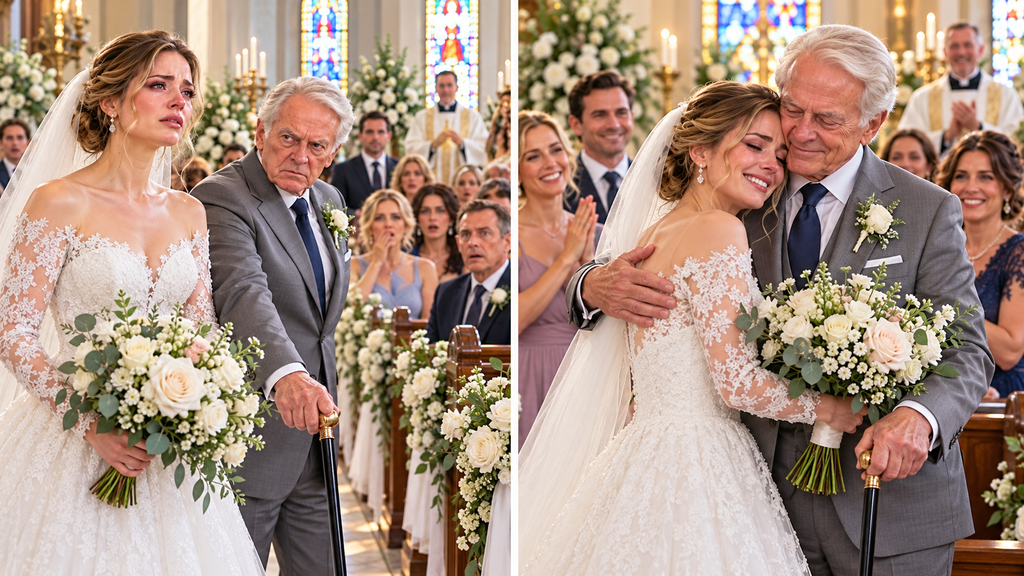
She lunged toward Dad so quickly that one of the flowers pinned to her dress tore loose and fell onto the floor.
“Robert.”
Her voice was barely a whisper.
But there was terror in it.
Real terror.
“Don’t you dare.”
Dad looked at her.
For almost thirty years, I had watched those two communicate through expressions.
A raised eyebrow.
A tightened jaw.
A glance across a dinner table.
They had built an entire marriage around secrets, appearances, and silent agreements.
But I had never seen them look at each other like this.
Like two people standing inside a burning house, each wondering who would reach the door first.
My sisters remained frozen in the front pew.
Paige stared at Mom.
Lauren stared at Dad.
The guests stared at all of us.
I looked down at the letter in my hand.
Grandma Rose’s handwriting blurred.
“Who is my father?”
No one answered.
I raised my voice.
“Who is my father?”
Mom stepped into the aisle.
“Emma, this is not how you want to learn this.”
I laughed once.
It came out broken.
“You mean in public?”
She flinched.
“Yes.”
“That’s interesting.”
I looked around the church.
“You had no problem calling me your greatest regret in front of my bridesmaids.”
Mom’s mouth tightened.
“That was different.”
“How?”
“You were provoking me.”
“I was standing in a wedding dress.”
Paige looked down.
Lauren shifted uncomfortably.
Dad rubbed one hand across his face.
“Margaret, enough.”
Mom turned on him.
“No. You don’t get to say enough. You started this.”
Grandpa’s cane struck the church floor.
Once.
The sound echoed.
Everyone fell silent.
“Emma asked a question.”
Mom’s face twisted.
“Dad, stay out of it.”
Grandpa looked at her with a sadness so deep that for a moment, his anger disappeared.
“I stayed out of it for too long.”
That stopped her.
Grandpa turned toward me.
“Emma.”
His voice softened.
“There are things in that letter Rose wanted you to know.”
I looked at the envelope.
My fingers were shaking.
Daniel moved closer.
“You don’t have to read it here.”
I looked at him.
His eyes were steady.
Not curious.
Not frightened.
Just there.
For me.
“I think I do.”
Mom whispered my name.
I ignored her.
I unfolded the first page.
Grandma’s handwriting was small and elegant.
The first line made my knees weak.
My dearest Emma, if you are reading this, then I failed to protect you while I was alive.
I swallowed.
Daniel’s hand moved to the small of my back.
I kept reading.
You were born into a family that believes appearances are more important than truth. I pray that by the time you are old enough to read this, that has changed. But knowing my daughter, I fear it will not.
A murmur moved through the church.
Mom’s face hardened.
“Rose always hated me.”
Grandpa turned slowly.
“No.”
His voice was quiet.
“She was afraid of what you were becoming.”
Mom’s face lost color.
I looked back down.
There is something you must understand. Robert Stone signed your birth certificate, but he is not your biological father.
My breath caught.
I looked at Dad.
He didn’t deny it.
For the first time in my life, I noticed how little of him I carried.
Paige had his narrow nose.
Lauren had his pale blue eyes.
Both had the same dimple in their left cheeks.
I had none of those things.
I had always been told I looked like Grandma.
Maybe that had simply been easier.
I continued.
Your biological father’s name was Jonathan Hale.
Somewhere behind me, someone gasped.
Dad closed his eyes.
Mom’s hands dropped to her sides.
Grandpa’s jaw clenched.
I whispered the name.
“Jonathan Hale.”
It meant nothing to me.
But it clearly meant something to others.
One of Dad’s business partners sitting three pews back turned to the woman beside him.
I heard him whisper, “My God.”
I looked up.
“Who was he?”
Grandpa answered.
“A lawyer.”
Mom snapped, “He was a nobody.”
Grandpa’s expression changed.
“No, Margaret.”
Then he looked at me.
“He was my attorney.”
The room tilted.
“What?”
“He handled the early estate planning for our family.”
I stared at him.
Grandpa continued.
“He was young. Brilliant. Came from nothing. Your grandmother trusted him more than almost anyone.”
Mom gave a bitter laugh.
“Too much.”
Grandpa looked at her.
“You were married when it happened.”
The words landed heavily.
Dad stared at the altar.
No one needed further explanation.
But Mom gave one anyway.
“It was one mistake.”
Grandpa’s eyes flashed.
“No.”
Mom stared at him.
“One mistake does not last eighteen months.”
That was the first real explosion.
Paige stood.
“What?”
Lauren stood too.
“Mom?”
Mom’s face crumpled.
“Sit down.”
Paige’s voice rose.
“You had an affair?”
“Sit down.”
“With Grandpa’s lawyer?”
“Paige!”
“And Emma was his?”
“I said sit down!”
The shout echoed against the stained-glass windows.
The organist quietly stepped away from the instrument.
Mom seemed to realize how loud she had been.
She lowered her voice.
“It was complicated.”
I folded Grandma’s letter slightly.
“How complicated can it be?”
Mom turned toward me.
“Emma, you have no idea what my marriage was like then.”
Dad looked at her sharply.
“Oh, now we’re doing this?”
She spun toward him.
“You were never home.”
“I was building the company.”
“You were sleeping with your secretary.”
The guests erupted.
Dad’s head snapped back.
Paige covered her mouth.
Lauren whispered, “What?”
Dad pointed at Mom.
“You swore you would never—”
Mom laughed.
“Oh, please. Suddenly honesty matters?”
I stared at both of them.
This was the family I had spent my entire childhood trying to impress.
The polished parents.
The perfect marriage.
The philanthropic couple smiling from magazine covers.
The Stone Family Foundation.
The charity dinners.
The anniversary speeches.
Dad calling Mom his “best decision.”
Mom posting photographs every year with captions about thirty-five years of trust.
And now, in less than five minutes, the whole structure had cracked open.
I looked at Grandma’s letter again.
Jonathan loved you before you were born.
That sentence hurt more than I expected.
I stopped.
Daniel looked at me.
“You okay?”
“No.”
My voice cracked.
“But keep standing here.”
“I’m not going anywhere.”
I read.
When Margaret discovered she was pregnant, she initially intended to leave Robert and raise you with Jonathan.
Mom closed her eyes.
Grandpa stared at the floor.
But Robert discovered the affair before she could leave.
Dad’s jaw tightened.
He still didn’t look at me.
Robert agreed to remain married to Margaret under one condition.
The child would be raised as his.
Jonathan would disappear.
I looked up.
“You made him leave?”
Dad finally met my eyes.
“I gave your mother a choice.”
Grandpa said sharply, “You threatened him.”
Dad’s eyes flashed.
“I protected my family.”
“You destroyed hers.”
I almost didn’t recognize Grandpa’s voice.
Dad pointed toward me.
“She had a home.”
Grandpa stared at him.
“A home where you punished her for another man’s mistake?”
Dad’s face changed.
That was enough.
I knew.
All those years.
The coldness.
The constant criticism.
The way he hugged Paige and Lauren but offered me awkward pats on the shoulder.
The missing birthday calls when I went to college.
The way he called me “your daughter” whenever arguing with Mom.
I had noticed.
Children always notice.
They simply invent kinder explanations because the truth hurts too much.
I looked at Dad.
“Did you hate me?”
His expression faltered.
“Emma.”
“That isn’t an answer.”
He looked toward the guests.
“This is not appropriate.”
I felt something inside me snap.
“For once in your life, stop worrying about what the room thinks!”
My voice broke across the church.
Dad froze.
“So tell me.”
I stepped closer.
“When I was little, and I waited by the window because you promised you’d take me fishing, did you forget?”
He said nothing.
“When Paige got into Northwestern and you threw a party, but when I got into Stanford and you said we couldn’t afford the flight to visit campus, was that because of money?”
Nothing.
“When I broke my arm at thirteen and Grandpa took me to the hospital because you and Mom were at Lauren’s dance competition, was that just bad timing?”
His eyes dropped.
I felt tears gathering.
I refused to wipe them.
“When I graduated summa cum laude and you left before my name was called because traffic might be bad, was that because you were busy?”
“Emma.”
“Did you hate me?”
Dad breathed out.
“No.”
“Then what?”
His face changed.
The anger disappeared.
For the first time, he looked old.
“I hated what you reminded me of.”
Silence.
Mom covered her mouth.
My chest felt hollow.
Dad swallowed.
“I knew every time I looked at you.”
His voice was quieter now.
“I knew she had loved someone else enough to leave me.”
Mom whispered, “Robert.”
He ignored her.
“You looked like him.”
I almost laughed.
“How would I know?”
Dad flinched.
“You had his mannerisms.”
“What mannerisms?”
“The way you watched people before speaking. The way you questioned numbers. The way you refused to accept an answer because an authority figure gave it to you.”
A strange smile crossed his face.
“You became a forensic accountant.”
He shook his head.
“Jonathan spent his whole life finding what people wanted hidden.”
Grandpa looked at me.
“Rose used to say that too.”
I looked down at the letter.
My biological father had been an attorney.
An investigator.
A man who followed hidden things.
And without knowing him, I had somehow chosen a life doing almost the same.
I read on.
Jonathan agreed to leave because Robert threatened to destroy him professionally and accuse him of mishandling client funds.
Grandpa’s cane trembled in his hand.
Mom whispered, “Dad didn’t know that.”
Grandpa turned.
“Yes, I did.”
Mom stared at him.
“What?”
“I found the draft complaint years later.”
Her face went white.
“You knew?”
“Rose found it first.”
I looked at Grandpa.
“What happened to Jonathan?”
Grandpa shut his eyes.
That frightened me more than anything else.
“Grandpa.”
He opened them.
“He moved to Oregon.”
“And?”
“He wrote.”
Mom stiffened.
I looked at her.
“Wrote to who?”
Grandpa didn’t answer immediately.
Then he said it.
“You.”
My entire body went cold.
“What?”
“He wrote to you every year.”
I stared at Mom.
She stepped backward.
“No.”
Grandpa nodded.
“Birthday letters. Christmas cards. Photographs. He sent them through Rose at first.”
Mom shook her head.
“No.”
“When Rose became sick, he began sending them directly.”
Mom’s eyes filled with tears.
I looked at her.
“You took them.”
She whispered, “Emma—”
“You took them.”
“It wasn’t like that.”
“What was it like?”
“He was trying to interfere.”
“In my birthday?”
“He wanted contact.”
“He was my father.”
“You had a father.”
I looked toward Robert.
“No.”
My voice was calm now.
“I had a man who tolerated me because divorcing you would have embarrassed him.”
Dad looked away.
Mom’s face twisted.
“You don’t know what Jonathan was like.”
Grandpa’s voice cut through hers.
“Yes, she does.”
Everyone turned.
Grandpa reached into his jacket.
Not for another envelope.
For a photograph.
He held it out.
I took it.
The picture had faded around the edges.
A man stood beside a lake wearing a rolled-up blue shirt and holding a little girl.
Me.
I was maybe two.
The man had dark hair.
Brown eyes.
My eyes.
My smile.
My chin.
I felt the world narrow to that photograph.
He was looking at me like I was everything.
On the back, someone had written:
Emma and Jonathan. August 1999. The last day Margaret allowed him to see her.
My knees weakened.
Daniel caught my elbow.
“I met him?”
Mom looked away.
Grandpa nodded.
“For two years.”
I looked at her.
“You let him know me.”
Mom started crying.
“I was confused.”
“You let him hold me.”
“Yes.”
“You let him love me.”
“Emma, please.”
“And then you erased him.”
Mom’s shoulders shook.
“He wanted you.”
“Of course he wanted me!”
“He wanted custody.”
The words came out like a scream.
The church fell silent again.
Mom pressed both hands to her forehead.
“He wanted custody. He wanted to tell everyone. He said Robert was cruel to you. He said he would take me to court. He said he had evidence.”
Grandpa’s face tightened.
“What evidence?”
Mom froze.
That question had not been expected.
Dad slowly turned toward her.
“Margaret?”
She backed away.
I saw it.
Another secret.
Another door opening.
“What evidence?”
I asked.
Mom’s mouth opened.
Nothing came.
Grandpa stepped closer.
“Margaret.”
She looked toward Dad.
“Don’t.”
Dad’s voice was low.
“What did he have?”
Mom started shaking her head.
“I don’t remember.”
Grandpa laughed bitterly.
“You remember every insult from 1987, but not what evidence a lawyer threatened to use against you?”
Evelyn Cross had remained quiet until then.
Now she stepped forward.
“I may be able to answer that.”
Everyone turned toward her.
She opened her briefcase again.
Dad whispered something under his breath.
Evelyn removed a sealed plastic folder.
“Jonathan Hale sent this to Arthur’s law office seventeen years ago.”
Mom made a strangled sound.
Grandpa turned.
“You never told me.”
Evelyn looked at him.
“Because Rose instructed our firm to hold it until Emma either discovered the trust fraud or reached thirty years old.”
My birthday was four months away.
I stared at the folder.
“What is it?”
Evelyn looked at me.
“Records.”
“What kind?”
“Bank records.”
Mom closed her eyes.
My stomach twisted.
I already knew what I was going to hear.
Evelyn continued.
“Jonathan believed Margaret and Robert had begun using your trust years earlier than our investigation initially showed.”
I looked at Dad.
“How early?”
Evelyn opened the folder.
“Before you turned five.”
I laughed.
It wasn’t funny.
Nothing about it was funny.
But there was something absurd about being robbed before learning multiplication.
“What did a five-year-old need that was worth stealing from?”
Evelyn’s eyes met mine.
“They weren’t stealing for you.”
Paige slowly sat down.
Lauren looked sick.
Evelyn began reading.
“Private school tuition for Paige.”
Paige closed her eyes.
“Mortgage arrears on the family home.”
Dad clenched his jaw.
“Medical bills for Lauren.”
Lauren whispered, “What medical bills?”
Mom turned toward her.
“You were sick when you were three.”
Lauren looked confused.
“You always said insurance paid.”
Nobody answered.
Evelyn continued.
“Robert’s first business loan.”
Dad’s head snapped up.
Grandpa went very still.
Evelyn looked at him.
“Yes.”
Grandpa stared at Dad.
“You built Stone Development using Emma’s money?”
Dad lifted his chin.
“It was a temporary bridge loan.”
“Did you pay it back?”
Silence.
Grandpa stepped forward.
“Did you pay it back?”
“No.”
Grandpa’s face went empty.
Not angry.
Empty.
That was worse.
Stone Development was worth nearly forty million dollars.
My father’s entire public identity had been built around being a self-made businessman.
Newspapers had written profiles about him.
He had given lectures on entrepreneurship.
He had accepted awards.
He had once stood at a charity banquet and told young entrepreneurs, “Nobody gave me anything.”
Apparently, a preschooler had.
I looked at him.
“How much?”
Dad swallowed.
“It was seventy-five thousand.”
Evelyn corrected him.
“Initially.”
He glared at her.
She didn’t blink.
“With subsequent transfers, the total exceeded four hundred thousand dollars.”
Paige whispered, “Oh my God.”
I looked at Dad.
“You stole four hundred thousand dollars from a child?”
“I borrowed it.”
“Without permission?”
“You were four!”
“That makes it worse!”
The shout tore out of me.
I felt Daniel move closer.
Grandpa looked toward Evelyn.
“How much would those funds be worth today?”
Evelyn hesitated.
“Depending on the valuation model and investment growth, several million.”
Dad gave a bitter laugh.
“Those projections are speculative.”
I stared at him.
“You’re arguing the interest rate?”
His mouth closed.
I shook my head.
“That’s who you are.”
Mom stepped forward.
“We did what we had to do.”
I turned.
“No.”
She stopped.
“You did what you wanted to do.”
“We were drowning.”
“And I was a child.”
“Paige needed school.”
“Then send her to a cheaper school.”
Paige looked away.
“Lauren was sick.”
“Then ask Grandpa for help.”
Mom’s face twisted.
“We had pride.”
I laughed.
“So you stole from me to protect your pride?”
Her voice rose.
“You benefited too!”
“How?”
“You lived in that house.”
“Did I?”
Mom froze.
I took one step toward her.
“I lived in the attic.”
Her mouth opened.
I kept going.
“Paige had the garden room. Lauren had the room with the balcony. I slept under a sloped roof where I hit my head if I stood too quickly.”
“You liked that room.”
“I told you I liked it because I was eight.”
Mom flinched.
“I wore Paige’s old school uniforms.”
“Children wear hand-me-downs.”
“You charged my trust for new ones.”
Her face drained.
That one had landed.
Paige looked sharply at Mom.
“What?”
I turned toward Evelyn.
“You found that too?”
She nodded.
“Several clothing reimbursements.”
I laughed quietly.
“So I paid for my sisters’ clothes while wearing their old ones.”
Mom whispered, “Emma.”
“No.”
I shook my head.
“You don’t get to say my name like you care how it sounds.”
Tears spilled down her cheeks.
And for the first time, they didn’t affect me.
Not because I was cruel.
Because I finally understood.
Some tears ask for forgiveness.
Others ask to escape consequences.
Mom’s had always been the second kind.
Dad took a deep breath.
“Fine.”
He sounded exhausted.
“Everything is out.”
Grandpa looked at him.
“No.”
Dad frowned.
“What?”
Grandpa’s expression hardened.
“Not everything.”
Dad stared at him.
Grandpa looked toward Mom.
“Tell her what happened to Jonathan.”
Something moved through me.
A warning.
A deep animal instinct.
Mom stopped breathing.
Dad’s face changed.
“What are you talking about?”
Grandpa’s eyes never left his daughter.
“Tell her.”
Mom shook her head.
“I don’t know what you mean.”
“Jonathan died when Emma was twelve.”
My knees almost gave way.
I looked at Grandpa.
“Died?”
He nodded.
I couldn’t speak.
I had imagined, even in those few minutes, that somewhere there might be a man.
Older now.
Maybe gray-haired.
Maybe remarried.
Maybe with other children.
I had imagined calling him.
Hearing his voice.
Asking whether he liked coffee.
Whether he hated thunderstorms.
Whether he watched people before he spoke too.
All those ridiculous little questions that suddenly felt unbearably important.
And with one sentence, they were gone.
“How?”
Grandpa looked at Mom.
She turned away.
“Car accident.”
Grandpa’s eyes narrowed.
“That’s what you told us.”
Dad frowned.
“Margaret?”
She wrapped her arms around herself.
“I don’t want to do this.”
I stepped toward her.
“You’re going to.”
She looked at me.
Something in my face must have frightened her.
Not rage.
Certainty.
For the first time in my life, she couldn’t redirect me.
Couldn’t shame me.
Couldn’t send me upstairs.
Couldn’t tell me I was dramatic.
Couldn’t remind me how much she had sacrificed.
I was no longer the child waiting for permission to ask a question.
Mom’s voice broke.
“Jonathan had been drinking.”
Grandpa’s cane struck the floor.
“No, he had not.”
She flinched.
“You weren’t there.”
“I saw the toxicology report.”
The air vanished from the room.
Mom stared at him.
Grandpa continued.
“Rose kept a copy.”
Mom whispered, “No.”
“Yes.”
Dad looked between them.
“What are you talking about?”
Grandpa’s eyes were fixed on Mom.
“Jonathan had no alcohol in his blood.”
Mom’s face went white.
Evelyn reached for another document.
Mom shouted.
“Stop!”
Everyone jumped.
Her voice echoed through the church.
She was shaking violently now.
Dad stepped toward her.
“Margaret, what happened?”
She backed away.
“I didn’t kill him.”
Nobody had accused her.
That made the room colder.
Paige whispered, “Mom?”
Mom looked around.
Two hundred faces.
No escape.
“I didn’t.”
Grandpa’s voice was deadly calm.
“Then tell us what you did.”
Mom pressed a hand against her chest.
“I met him.”
Dad stared at her.
“When?”
“The night he died.”
Dad physically recoiled.
“What?”
“He called me.”
“For what?”
“He had found more records.”
Grandpa’s face tightened.
Mom continued.
“He said he was going to report us.”
Dad stared at her.
“You told me he stopped contacting you years before.”
“I lied.”
“You lied?”
Mom laughed hysterically.
“Yes, Robert. I lied. Apparently everyone is shocked.”
Dad looked like he might collapse.
Mom turned toward me.
“He wanted to expose everything.”
“What everything?”
“The trust.”
“And?”
Her eyes closed.
“The foundation.”
That was new.
I stared.
“What about the foundation?”
Dad looked confused too.
“Margaret.”
She shook her head.
“I handled the books.”
I felt my stomach drop.
Mom had served as treasurer of the Stone Family Foundation for twenty-two years.
I already knew reimbursements from the trust had been disguised through foundation expenses.
But I had assumed Dad orchestrated it.
Now I wasn’t sure.
I whispered, “How much?”
Mom said nothing.
“How much?”
“Emma.”
“How much did you take from the foundation?”
Her lips trembled.
“More than I should have.”
Evelyn closed her eyes.
Dad stared at his wife.
“Tell me.”
Mom looked at him.
“About one point eight million.”
Paige let out a cry.
Lauren dropped into the pew.
Dad just stared.
“One point eight…”
His voice disappeared.
“You told me the audits were clean.”
“They were.”
“How?”
“I changed them.”
He looked physically ill.
“You forged audits?”
“No. I altered supporting documentation.”
I almost admired the distinction.
Even now.
Even standing in a church during her daughter’s destroyed wedding ceremony, my mother could still phrase fraud politely.
Grandpa looked at me.
“This is why Rose created your trust outside the family foundation.”
Mom snapped, “She never trusted me.”
“No.”
Grandpa’s voice broke.
“She loved you enough to be afraid of you.”
That silenced everyone.
Mom stared at him.
Grandpa’s eyes filled with tears.
“You were my daughter.”
His voice shook.
“You were funny. Brilliant. Stubborn. You used to rescue birds from the garden and keep them in shoe boxes.”
Mom’s mouth trembled.
“Dad.”
“I kept waiting for that girl to come back.”
She started crying.
Grandpa shook his head.
“She never did.”
Something inside Mom collapsed.
Her shoulders curled.
For the first time that morning, she looked less like Margaret Stone and more like a frightened child.
But Grandpa wasn’t finished.
“What happened that night?”
Mom wiped her face.
“Jonathan met me outside Portland.”
“Where?”
“A diner.”
“What did he want?”
“To give me one last chance.”
“To do what?”
“Tell Emma the truth.”
I felt my throat close.
“I was twelve.”
Mom nodded.
“He said you were old enough.”
My voice cracked.
“You could have told me.”
“You worshipped Robert.”
Dad made a bitter sound.
“No, she didn’t.”
We all turned toward him.
Dad looked at me.
His voice was barely audible.
“She was afraid of me.”
That admission hurt strangely.
Because it was true.
And because apparently he had always known.
Mom looked at him.
“She still wanted your approval.”
Dad nodded.
“That isn’t the same thing.”
No one argued.
Mom continued.
“Jonathan said if I didn’t tell you, he would.”
I stared at her.
“So what did you do?”
“I begged him not to.”
“And?”
“He refused.”
“And?”
Mom looked toward the stained glass.
“He left.”
I waited.
Nothing.
“That’s not all.”
She didn’t answer.
Grandpa whispered.
“You followed him.”
Mom closed her eyes.
Dad’s head turned sharply.
“You followed him?”
“I wanted his documents.”
Dad’s face drained.
“Oh my God.”
“I thought he had them in his car.”
“What happened?”
“I drove after him.”
Her voice became mechanical.
“I flashed my lights. He wouldn’t stop. I kept following.”
My hands went numb.
“He turned onto the mountain road.”
Grandpa closed his eyes.
Mom’s voice cracked.
“I pulled beside him.”
Paige whispered, “Mom, stop.”
But she couldn’t.
Not now.
“I was yelling.”
Dad stared at her.
“While driving?”
“Yes.”
“In the dark?”
“Yes.”
Mom’s breath hitched.
“He looked at me.”
A tear slid down her face.
“I remember that.”
No one moved.
“He looked at me like he was tired.”
My chest hurt.
“Then?”
“He looked forward again.”
She covered her mouth.
“And there was a truck.”
A sound escaped Grandpa.
Not a word.
Just pain.
Mom shook her head violently.
“I didn’t touch his car.”
Grandpa stared at her.
“I swear.”
She looked at me.
“I didn’t hit him.”
“What happened?”
“He swerved.”
I closed my eyes.
The church disappeared.
“He went through the guardrail.”
Someone behind us sobbed.
Mom’s voice became smaller.
“I stopped.”
I opened my eyes.
“You stopped?”
“Yes.”
“You called 911?”
She said nothing.
My stomach twisted.
“You called 911?”
Mom looked at the floor.
“No.”
Grandpa’s face changed.
Dad stepped backward.
“Margaret.”
She began sobbing.
“I panicked.”
“You left him?”
“He was down the ravine.”
“You left him?”
“I didn’t know if he was alive.”
“THAT IS WHY YOU CALL FOR HELP!”
The scream tore out of me so hard my throat burned.
Daniel caught my shoulders.
Mom stumbled back.
“I was scared!”
“So was he!”
“I had three daughters!”
“He had one!”
That sentence broke me.
My father had one daughter.
Me.
And he had died alone at the bottom of a ravine while my mother drove away.
I covered my mouth.
Daniel wrapped both arms around me.
I let him.
For several seconds, I couldn’t see.
Couldn’t hear.
Couldn’t feel anything except the pressure of his suit against my cheek.
I cried.
Not quietly.
Not elegantly.
Not in the controlled way Mom always approved of.
I cried like something inside me had finally been given permission to mourn a man I hadn’t known I lost.
A father whose letters I had never read.
Whose photographs I had never seen.
Who had held me.
Who had wanted me.
Who had tried to come back.
And who had died because he refused to let my mother keep lying.
Grandpa came toward me.
Daniel loosened his arms enough for Grandpa to reach me.
The old man pressed one shaking hand against my hair.
“I’m sorry.”
I grabbed his jacket.
“You knew he died?”
“Yes.”
“Did you know she was there?”
“No.”
His voice broke.
“No, sweetheart.”
Mom cried behind us.
“I didn’t know he was still alive.”
I turned.
“What?”
Everyone went still.
Mom wiped her face.
“The police report said he died later.”
Grandpa frowned.
“What do you mean?”
Mom looked at Evelyn.
“Tell them.”
Evelyn’s face was grim.
“You know about that?”
Mom nodded.
Evelyn looked at me.
“Jonathan survived the initial crash.”
I felt Daniel tighten his grip.
“How long?”
“Approximately forty minutes.”
The world seemed to stop.
Forty minutes.
Forty minutes in which one phone call might have mattered.
Mom collapsed into the front pew.
“I didn’t know.”
Grandpa looked at her.
“But you never checked.”
She sobbed.
“I couldn’t.”
“You could.”
His voice was quiet now.
“You chose not to.”
That distinction settled over all of us.
Dad turned away from his wife.
He walked toward the opposite side of the aisle and stood there, both hands on his hips, staring at nothing.
Paige was crying.
Lauren looked numb.
And suddenly something struck me.
“Why wasn’t she charged?”
Evelyn answered carefully.
“Because law enforcement never knew she was there.”
I looked at Mom.
Her face told me.
“Until now.”
Evelyn’s expression changed.
“Emma.”
I understood.
This wasn’t only a family confession.
There were two hundred witnesses.
Phones.
Recordings.
Guests had been filming.
Somebody near the back lowered a phone quickly when I looked around.
Mom understood too.
Her face went gray.
“Dad.”
Grandpa didn’t respond.
“Dad, please.”
He stared at her.
“You want me to protect you?”
“I’m your daughter.”
His face crumpled.
“And she is mine.”
He looked at me.
“Maybe not by blood in the way you thought.”
Then back at Mom.
“But she is my granddaughter.”
Mom whispered, “Please.”
Grandpa shook his head.
“I protected the wrong person long enough.”
Mom covered her face.
For several seconds, nobody spoke.
Then Daniel surprised everyone.
Including me.
He walked toward the altar.
The movement broke the spell.
He spoke quietly with Reverend Michael.
The pastor nodded.
Daniel returned.
He took my hands.
“Emma.”
I looked at him.
“This day is yours.”
I almost laughed.
“It doesn’t feel like it.”
“It still can be.”
I stared at him.
He glanced around the church.
“We can stop.”
My chest tightened.
“We can leave.”
He squeezed my hands.
“We can go somewhere with just Grandpa and get married another day.”
I swallowed.
“Or?”
“Or we finish.”
I looked toward the altar.
Flowers.
Candles.
Our families.
Our friends.
All of it had been chosen so carefully.
For months, I had imagined walking down that aisle.
Not like this.
Never like this.
Daniel touched my cheek.
“I don’t care which one you choose.”
His voice dropped.
“I just don’t want them choosing it for you.”
That changed everything.
I looked at Mom.
For my entire life, she had chosen.
Who I was.
What I deserved.
How much space I could occupy.
Which truths I could know.
Which relationships I could have.
Even today, she had tried to decide whether I was worthy of being walked down the aisle.
No.
I looked at Grandpa.
He understood before I spoke.
His eyes filled.
I held out my hand.
“Would you still walk me?”
Grandpa gave a shaky laugh.
“Try stopping me.”
A few people laughed through tears.
It was the first warmth the church had felt in nearly half an hour.
Mom stood.
“Emma, you cannot possibly continue after this.”
I looked at her.
“Why?”
She stared.
“Because this family is falling apart.”
I shook my head.
“No.”
I looked around.
“It already fell apart.”
Then back at her.
“We’re just finally admitting it.”
Her mouth opened.
I turned away.
Grandpa took my arm.
Daniel returned to the altar.
The organist sat cautiously at the bench.
Reverend Michael looked at me.
“Ready?”
I looked at Grandpa.
He smiled.
“Eyes forward, sweetheart.”
The music began again.
We walked.
One step.
Then another.
Past Paige.
Past Lauren.
Past my father.
Past my mother.
I didn’t look away from Daniel.
For the first time, walking toward my future did not feel like running from my family.
It felt like leaving behind the version of myself they had created.
When Grandpa and I reached the altar, Reverend Michael smiled softly.
“Who gives this woman in marriage?”
Grandpa’s expression shifted.
He looked at me.
Then toward the church.
“No one.”
A ripple went through the room.
Grandpa continued.
“She belongs to herself.”
Tears filled my eyes.
“And she chooses this man.”
Daniel’s eyes shone.
Grandpa placed my hand in his.
“That’s better.”
The church laughed again.
Even I did.
Grandpa kissed my forehead.
Then he whispered something only I could hear.
“Rose would be proud.”
I nearly broke all over again.
The ceremony that followed was nothing like what we rehearsed.
Reverend Michael skipped the polished speech.
He looked at Daniel and me and said, “Marriage is not the promise that nothing difficult will happen.”
His eyes moved briefly toward the pews.
“It is the promise that when difficulty comes, truth does not become optional.”
The silence was absolute.
Daniel said his vows first.
He held my hands.
“I had something longer prepared.”
A few people smiled.
“But right now, there’s only one thing I want you to hear.”
His voice shook.
“You never have to earn being loved in my home.”
That destroyed me.
My face crumpled.
Daniel’s eyes filled too.
“You never have to be useful enough.”
He squeezed my hands.
“Successful enough.”
Another squeeze.
“Quiet enough.”
My tears fell freely.
“You never have to solve a problem before you’re allowed to be tired.”
His voice broke.
“And when you ask me a question, I will never punish you for wanting the truth.”
Behind us, someone began crying.
I suspected Grandpa.
Daniel smiled.
“I choose you when things are beautiful.”
He glanced toward our guests.
“And apparently when everything explodes spectacularly.”
Laughter broke through the room.
I laughed through my tears.
“And I will keep choosing you after everyone leaves.”
When it was my turn, I could barely speak.
I had written three pages.
Beautiful vows.
Perfect vows.
They no longer mattered.
I looked at Daniel.
“I spent most of my life thinking love had to be earned.”
My voice trembled.
“I thought if I got better grades, caused fewer problems, needed less, achieved more, somebody would eventually look at me and decide I was worth staying for.”
Daniel shook his head gently.
I continued.
“Then you came along.”
I smiled through tears.
“And you never asked me to audition.”
His mouth trembled.
“You stayed when I was angry.”
I squeezed his hands.
“You stayed when I was scared.”
Another breath.
“You stayed when I spent eighteen months investigating my own family and filled our dining room with bank statements.”
Several guests laughed.
“And today, when the worst truths of my life came out in front of everyone we know, you didn’t ask me to calm down.”
Daniel smiled.
“You just asked what I wanted.”
I inhaled.
“So this is what I want.”
I looked directly at him.
“You.”
His tears finally fell.
“All of you.”
Then quietly:
“For as long as we get.”
When Reverend Michael pronounced us husband and wife, the church stood.
Not everyone.
Mom remained seated.
Dad too.
But I barely noticed.
Daniel kissed me.
And for one perfect moment, the chaos disappeared.
There was only him.
Only us.
Only the strange miracle that sometimes the worst day of your old life becomes the first day of your new one.
Then the church doors opened.
Two police officers stepped inside.
The applause faded.
Mom saw them first.
She stood so quickly her purse fell.
“No.”
Dad looked over his shoulder.
His face went blank.
One of the officers walked toward Evelyn.
They spoke quietly.
Evelyn nodded.
Mom started backing away.
“Dad.”
Grandpa remained seated.
“Dad.”
Nothing.
She looked at me.
“Emma.”
I held Daniel’s hand.
She stared at me like I was supposed to rescue her.
Maybe once I would have.
That was the cruelest thing about being raised by someone who hurts you.
You still learn to run toward their pain.
Even when they caused yours.
Mom took one step toward me.
“Please.”
I looked at her.
“I didn’t call them.”
She froze.
It was true.
I hadn’t.
Evelyn approached.
“I did.”
Mom turned.
Evelyn’s expression was professional.
“After Margaret admitted being present at Jonathan Hale’s accident and leaving without reporting it, I contacted authorities.”
Mom whispered, “You had no right.”
Evelyn looked almost offended.
“I’m an attorney.”
One officer stepped closer.
“Margaret Stone?”
She looked around wildly.
Dad turned away.
Paige started crying again.
Lauren covered her mouth.
The officer spoke calmly.
“We need to ask you some questions regarding the death of Jonathan Hale.”
“I need a lawyer.”
“You’re free to contact one.”
Mom looked toward Evelyn.
Evelyn didn’t move.
That seemed to shock Mom more than anything.
For years, lawyers had cleaned up her problems.
Accountants had adjusted numbers.
Assistants had rewritten schedules.
Publicists had smoothed scandals before they became scandals.
But there are moments when money stops being a door.
Sometimes it becomes a wall.
Mom looked at Dad.
“Robert.”
He stared at her.
“You left him there.”
She started crying.
“I was scared.”
“So was I.”
She blinked.
Dad laughed bitterly.
“For thirty years.”
He looked at me.
Then back at Mom.
“I thought I was punishing you.”
His face twisted.
“But I punished her.”
Mom whispered his name.
Dad shook his head.
“I’m done.”
The officers led Mom toward the back.
Nobody stopped them.
At the doors, she turned.
Her eyes found me.
For one terrible second, I saw my mother.
Not Margaret Stone.
Not the thief.
Not the woman who erased my father.
Just Mom.
The person whose hand I had held on my first day of kindergarten.
The woman who once stayed up all night when I had pneumonia.
The woman who taught me to make cinnamon rolls.
People are complicated that way.
Someone can hurt you terribly and still exist inside your happiest memories.
That doesn’t erase the harm.
It simply makes grief harder.
Mom’s lips moved.
“I loved you.”
I don’t know whether anyone else heard.
I did.
I looked at her.
Then I answered.
“I needed you to protect me.”
She closed her eyes.
The officers escorted her outside.
The doors shut.
The church remained quiet.
Then Grandpa rose.
“Reception.”
Everyone stared at him.
He lifted his cane.
“I’m eighty-one. I put on a suit. Somebody better feed me.”
The church erupted in laughter.
Even Dad smiled.
Barely.
But he did.
And somehow, we went to the reception.
Not because everything was fixed.
Nothing was fixed.
But because Daniel and I had just gotten married.
And I refused to let my mother take that too.
The reception took place at an old lakeside estate thirty minutes outside the city.
By the time we arrived, news had begun spreading.
Not publicly yet.
But privately.
Phones buzzed.
Guests whispered.
Some quietly left.
Others stayed.
I discovered that crisis reveals relationships faster than years of polite dinners.
People I barely knew hugged me.
A cousin I hadn’t spoken to since childhood brought me champagne and simply said, “I always wondered why they treated you differently.”
That sentence hurt.
Because I had spent years believing no one noticed.
Apparently everyone had noticed.
They simply hadn’t said anything.
Paige approached during dinner.
She looked different.
Not physically.
Her expensive dress was still perfect.
Her hair still immaculate.
But the smugness was gone.
She sat across from me.
“Can we talk?”
Daniel glanced at me.
I nodded.
He kissed my temple.
“I’m stealing Grandpa for cake negotiations.”
Grandpa called from another table.
“I heard that.”
Daniel smiled.
“Good.”
They walked away.
Paige watched them.
“You’re lucky.”
I looked at her.
“Yes.”
She nodded.
Then stared at her hands.
“I was awful to you.”
I waited.
“I don’t mean just today.”
She looked up.
“I mean always.”
Something inside me stayed guarded.
Paige swallowed.
“Mom made it feel like there was one place beside her.”
I frowned.
“What?”
“One place.”
Her voice broke.
“One favorite daughter.”
She laughed bitterly.
“Lauren and I fought for it constantly.”
I looked toward Lauren.
She stood near the windows alone.
Paige continued.
“You never did.”
“I knew I wouldn’t win.”
“That’s what made Mom hate you.”
I stared at her.
Paige wiped beneath one eye.
“You stopped competing.”
I thought about it.
She was right.
Around sixteen, I had stopped trying to win.
I worked.
I studied.
I applied to schools.
I built a life that required less and less from my parents.
Mom called it arrogance.
Maybe it had frightened her.
“She needed us orbiting her,” Paige said.
“And you left.”
Her voice softened.
“I think she took it as rejection.”
I gave a tired laugh.
“So she rejected me first?”
Paige shrugged helplessly.
“I’m not defending her.”
“Good.”
“I just think…”
She stopped.
“What?”
“I think she punished you because you proved we could survive without her approval.”
That sat heavily.
Paige looked down.
“And Lauren and I hated you for the same reason.”
I had not expected honesty.
Especially from Paige.
“What happens now?”
She laughed softly.
“My house may be partially yours.”
I almost smiled.
“Evelyn said there were traced assets.”
Paige touched her bracelet unconsciously.
“I’m guessing this too.”
I looked at it.
“You can keep the bracelet.”
She blinked.
“What?”
“I don’t want it.”
Her eyes filled.
“Emma.”
“That doesn’t mean we pretend everything’s fine.”
“I know.”
“It isn’t.”
“I know.”
“And if there are assets that legally belong to the trust, Evelyn will handle it.”
Paige nodded.
“I understand.”
I studied her.
“Do you?”
“Yes.”
A pause.
Then she said quietly:
“For the first time, I think I do.”
Lauren came later.
She was less composed.
She cried before sitting down.
“I didn’t know.”
I believed her.
That didn’t erase everything either.
But I believed her.
“I thought Mom paid for my house.”
“She did.”
“With my money.”
Lauren winced.
“Yes.”
I sighed.
“I’m sorry.”
My head snapped up.
She shook hers.
“No. I mean I’m sorry.”
Her hands trembled.
“I laughed when she made fun of your apartment.”
I remembered.
My first apartment after college had been small.
Seven hundred square feet.
Peeling paint.
No dishwasher.
I loved it.
Because I paid for it myself.
Mom called it “a depressing little box.”
Paige and Lauren laughed.
Lauren wiped her face.
“You looked so proud of that place.”
“I was.”
“And we made you feel embarrassed.”
I looked at her.
“Yes.”
She cried harder.
“I’m sorry.”
This time, I reached across the table.
Not because everything was forgiven.
Because for once, the apology sounded like it belonged to the person who owed it.
No explanation.
No “but.”
No mention of childhood.
No demand that I comfort her.
Just sorry.
That mattered.
Dad didn’t approach me until nearly midnight.
The reception was winding down.
Daniel had gone outside with friends to organize our departure.
Grandpa was eating a second piece of cake he had been specifically told not to eat.
I sat near the lake with my shoes off.
Dad came and stood beside me.
For a long moment, neither of us spoke.
Then he held out an envelope.
I stared at it.
“I’m getting tired of envelopes.”
He almost smiled.
“This one isn’t from a dead relative.”
“Promising.”
He sat.
The silence felt different from our usual silence.
Our old silences were punishments.
This one was simply two people who didn’t know where to begin.
Dad looked toward the water.
“I’m resigning from Stone Development tomorrow.”
I looked at him.
“Why?”
“Because Evelyn is right.”
“That must hurt to say.”
A faint smile.
“You have no idea.”
Then it disappeared.
“The company was built partly with your money.”
“Partly?”
He nodded.
“And I’m not going to pretend otherwise anymore.”
I looked at the envelope.
“What is that?”
“An agreement.”
My stomach tightened.
“I’m not signing anything.”
“I know.”
He handed it to me anyway.
“It’s my resignation and assignment of my shares to an independent trust pending valuation.”
I stared.
“All of them?”
“Yes.”
“That could be worth millions.”
“It is.”
“Why?”
He looked at me.
“Because they were never entirely mine.”
I studied his face.
This was the man who had spent my childhood teaching me that apologies were weakness.
I didn’t trust transformation that happened in one afternoon.
But I could recognize a first step.
“Evelyn should review it.”
“She drafted it.”
That surprised me.
“When?”
“Two months ago.”
I stared.
“You knew this was coming?”
Dad exhaled.
“Not today.”
“Then why?”
“Grandpa confronted me.”
I turned.
Dad nodded.
“He showed me some of the evidence.”
“What did you do?”
“Denied it.”
“Of course.”
“Then blamed your mother.”
“Also predictable.”
Another tiny smile.
“I blamed Jonathan too.”
My stomach tightened.
Dad looked ashamed.
“That’s when Arthur hit me.”
I blinked.
“Grandpa hit you?”
“With the cane.”
Despite everything, I laughed.
Dad laughed too.
It lasted maybe two seconds.
But it was the first time I could remember laughing with him.
Not at a family performance.
Not for a photograph.
With him.
The sadness returned quickly.
“I deserved it.”
“Probably.”
He looked toward the reception hall.
“I have spent twenty-nine years telling myself that raising another man’s child made me noble.”
I said nothing.
“It made every cruel thing easier to justify.”
He looked at me.
“I paid for this.”
“I stayed.”
“I gave you my name.”
“I kept my family together.”
His eyes watered.
“I made myself the hero.”
He shook his head.
“And you the debt.”
My throat tightened.
Dad looked away.
“I’m sorry.”
Those two words from him were almost disorienting.
I had imagined them many times.
They had sounded different in my head.
Bigger.
Healing.
Magical.
The truth was quieter.
“I don’t forgive you.”
His face tightened.
Then he nodded.
“I know.”
“I might someday.”
He looked at me.
“I hope so.”
“But I don’t know.”
“I understand.”
That mattered too.
No demand.
No “I’m your father.”
No “family forgives.”
Just understanding.
I looked at him.
“Are you my father?”
His eyes filled.
He stared at the lake for a long time.
“Legally?”
“No.”
I waited.
Finally, he whispered:
“I don’t know if I ever learned how to be.”
I looked down.
He continued.
“But I was there when you were born.”
My eyes lifted.
“You were?”
He nodded.
“You came out furious.”
Despite myself, I smiled.
“That tracks.”
“You screamed for fourteen minutes.”
He laughed softly.
“The nurse put you in my arms.”
His voice broke.
“And for fourteen minutes, I forgot.”
“Forgot what?”
“That you weren’t mine.”
My chest hurt.
He wiped one eye.
“And then your mother looked at you and started crying.”
He stared ahead.
“And I remembered.”
I closed my eyes.
How different my life might have been if he had stayed in those first fourteen minutes.
If he had chosen the baby instead of the betrayal.
But lives are built from choices people fail to make.
You can grieve them.
You cannot return and make them differently.
Dad stood.
“I won’t bother you on your honeymoon.”
I nodded.
He took two steps.
“Robert.”
He turned.
Calling him that felt strange.
But less strange than Dad.
“Did Jonathan know I loved yellow?”
He frowned.
“What?”
“I don’t know.”
I laughed awkwardly.
“It’s stupid.”
“No.”
He thought.
Then something changed.
“There’s a box.”
My heart stopped.
“What box?”
He looked toward me.
“Your mother kept it.”
“Where?”
“In the storage room at the house.”
I stood.
“What’s inside?”
His face softened.
“Letters.”
My entire body went still.
“Jonathan’s?”
Dad nodded.
“Why didn’t she destroy them?”
“I don’t know.”
“Have you read them?”
“Some.”
I stared at him.
“You read my letters?”
His shame returned.
“Yes.”
Anger flashed through me.
Then exhaustion.
“What did they say?”
Dad swallowed.
“That he missed you.”
My throat tightened.
“That he remembered everything.”
“What everything?”
“Your favorite songs.”
A breath.
“Foods.”
Another.
“The yellow raincoat you refused to take off one summer.”
I covered my mouth.
Dad looked at me.
“He loved you.”
I cried.
Quietly this time.
Dad stood there awkwardly.
Then, after a second, he held out his arms.
He didn’t move closer.
He gave me the choice.
I looked at him.
For years, I had wanted him to hug me like Paige and Lauren.
Without reluctance.
Without obligation.
I stepped forward.
He held me.
Not long.
Not perfectly.
But honestly.
When we separated, we were both crying.
“Give Evelyn the box.”
“I will.”
“And don’t read anything else.”
“I won’t.”
He nodded.
Then left.
Daniel found me ten minutes later.
He took one look at my face.
“What happened?”
I told him.
“The letters?”
I nodded.
He sat beside me.
“Do you want to get them tonight?”
I looked toward the lake.
A month earlier, I would have said yes.
Immediately.
I would have chased the answer.
Worked through the night.
Opened every document.
Solved everything.
But that was the old Emma.
The one who believed peace waited at the bottom of every mystery.
I leaned against Daniel.
“No.”
He kissed my hair.
“Tomorrow?”
“No.”
He waited.
I smiled faintly.
“After our honeymoon.”
His eyebrows rose.
“Seriously?”
“Yes.”
“Who are you?”
I laughed.
“I don’t know.”
He smiled.
“I like her.”
“So do I.”
We left the reception just after midnight.
Grandpa insisted on standing outside despite the cold.
Paige and Lauren stood beside him.
Dad remained near the doorway.
My mother was gone.
Her absence should have felt strange.
Instead, it felt like space.
Daniel opened the car door.
Before I got in, Grandpa called my name.
I turned.
He came toward me with his cane.
Slowly.
I met him halfway.
He took my face in both hands.
“You know something?”
“What?”
“When you were five, your grandmother asked you what you wanted to be.”
I smiled.
“I don’t remember.”
“You said a detective.”
I laughed.
“Really?”
“No.”
His eyes twinkled.
“You said a dinosaur.”
I laughed so hard I cried again.
“That sounds more accurate.”
Grandpa kissed my forehead.
“Go.”
I hugged him.
“Thank you.”
“For what?”
“For walking me.”
He held me tighter.
“I should have walked toward you years ago.”
I closed my eyes.
Then I whispered:
“You came today.”
His arms tightened.
“Yes.”
“That counts.”
Three weeks later, my mother was formally charged with leaving the scene of a fatal accident and obstruction related to the original investigation.
The exact legal questions were complicated by the age of the case.
Evelyn warned me there might never be a courtroom ending that felt proportionate.
Life rarely packages justice as neatly as stories do.
Sometimes justice is not prison.
Sometimes it is exposure.
Loss of reputation.
Loss of control.
Loss of the power to keep rewriting what happened.
The foundation investigation was more immediate.
Auditors uncovered years of improper transfers.
Some money had gone to family expenses.
Some to Dad’s company.
Some to properties.
Some simply disappeared into accounts Mom controlled.
The scandal hit local news.
Then national news.
“Prominent Philanthropic Family Accused of Diverting Charity Funds.”
I hated the headlines.
Not because they were wrong.
Because strangers suddenly knew pieces of my life without understanding the cost of living them.
I turned off my phone.
Daniel did too.
We spent ten days in a small seaside town where nobody knew the Stone name.
We ate too much.
Walked everywhere.
Slept late.
I discovered something shocking.
My husband snored.
He denied it.
I recorded him.
He accused me of fabricating evidence.
I informed him he had married a forensic accountant and should know better.
For ten days, I wasn’t a daughter.
Or witness.
Or beneficiary.
Or scandal.
I was simply Emma.
That may have been the greatest wedding gift I received.
When we came home, the box was waiting in Evelyn’s office.
It was plain brown cardboard.
No dramatic lock.
No ribbons.
Thirty years of stolen connection in something that looked like it had once held printer paper.
I sat across from Evelyn.
Daniel beside me.
Grandpa at the end of the table.
Evelyn pushed the box toward me.
“I haven’t opened it.”
I touched the lid.
My hands trembled.
Daniel placed his hand over mine.
“You don’t have to do it today.”
I smiled.
“That’s becoming your favorite sentence.”
“It works.”
I opened the box.
Letters.
Dozens.
Some sealed.
Some opened.
Some yellowed.
Birthday cards.
Photographs.
A tiny cassette tape.
A stuffed rabbit missing one eye.
I picked it up.
Something flashed inside me.
A memory.
Not clear.
A man making rabbit ears behind his head.
Me laughing.
A lake.
A blue shirt.
I started crying.
Grandpa looked away.
I picked up the first letter.
The envelope said:
Emma — Age 3.
My name was written carefully.
I opened it.
Sweet girl,
Today you asked me why clouds don’t fall.
I told you I didn’t know.
You told me grown-ups should know things.
I laughed for ten minutes.
I hope nobody ever teaches you to stop asking questions.
I couldn’t continue.
I pressed the letter to my chest.
Daniel rubbed my back.
After a while, I opened another.
Emma — Age 5.
You love yellow now.
Everything must be yellow.
Yellow socks.
Yellow cups.
Yellow crayons.
You informed me blue is “too serious.”
I laughed through tears.
Dad had remembered.
He really had.
Another.
Age 7.
Your mother sent me your school photograph.
You have missing front teeth.
I keep the picture on my desk.
Someday, if you want to know me, I will answer every question.
Even the painful ones.
Age 9.
I heard you won the spelling competition.
I have no idea whether you will ever receive these letters.
But I need to write them anyway.
Love should exist even when it is not witnessed.
That line broke Grandpa.
He stood and walked toward the window.
His shoulders shook.
I went to him.
He whispered, “That sounds like him.”
I hugged him.
“I wish I remembered.”
“You remember more than you think.”
“I remember almost nothing.”
Grandpa touched my temple.
“It’s in there.”
I looked at the remaining letters.
There were so many.
Then I saw one marked:
For Emma, if I don’t get another chance.
My heart stopped.
Daniel saw it too.
“You want me to open it?”
I shook my head.
I opened it.
The paper inside was different.
Longer.
Jonathan’s handwriting looked hurried.
Emma,
If you are reading this, then either I finally found enough courage to change your life, or I ran out of time.
There is something I need you to know first.
None of this was your fault.
I closed my eyes.
I kept reading.
Adults often make children carry consequences for choices they had no part in making.
If Robert is cold toward you, that is not because you failed him.
If your mother becomes angry when you ask questions, it is not because the question was wrong.
If you ever feel that you must earn love by being easier, quieter, smarter, prettier, more successful, or less inconvenient, please remember this:
You were loved before you achieved anything.
You were loved before you could speak.
Before you could walk.
Before you knew how to disappoint anyone.
I was crying so hard I could barely see.
Daniel took my hand.
I continued.
The first time I held you, you grabbed my finger and refused to let go.
I remember thinking I had never been chosen for anything so completely.
Whatever you are told about me, know this:
I did not leave because I stopped wanting you.
I left because I was afraid fighting for you would destroy the life around you.
I believed I could wait.
I believed someday truth would become easier.
That was my mistake.
Truth does not become easier because we postpone it.
It simply becomes more expensive.
I looked toward Evelyn.
She had tears in her eyes.
I read the last lines.
If someday you discover what was hidden from you, do not build your life around revenge.
Build something they cannot take from you.
A peaceful home.
Honest love.
Work that makes you proud.
Friends who do not require performance.
And when you have children, if you choose to, let them know love before they know achievement.
That will be enough.
I love you.
Dad.
I folded the letter.
Nobody spoke for a long time.
Then I laughed through my tears.
Daniel frowned.
“What?”
“He signed Dad.”
Grandpa smiled sadly.
“He was.”
I pressed the letter against my heart.
“Yes.”
And for the first time, saying that did not feel like betrayal.
Six months later, the financial case was settled.
It did not happen dramatically.
No judge banged a gavel while my family screamed.
Real consequences usually arrive through paperwork.
Valuations.
Depositions.
Asset transfers.
Tax amendments.
Restitution schedules.
Stone Development was sold.
Dad surrendered a substantial portion of the proceeds to restore my trust and repay foundation losses.
Paige sold her house voluntarily before litigation forced the issue.
Lauren refinanced hers and returned the portion traced to trust funds.
Neither blamed me.
That mattered more than the money.
Mom accepted a plea agreement.
She avoided the longest prison sentence prosecutors initially pursued, but she did not avoid punishment.
There was probation.
Restitution.
Community service.
Restrictions involving nonprofit financial roles.
And a public record she could not edit.
I visited her once.
Only once.
The meeting took place in a plain attorney’s conference room.
No designer clothes.
No church pews.
No audience.
Mom looked smaller.
She had cut her hair.
For years, it had always fallen perfectly to her shoulders.
Now it stopped near her chin.
“You look well,” she said.
“So do you.”
It wasn’t true.
We both knew.
She stared at her hands.
“I read the article about the foundation settlement.”
I waited.
“Your trust is restored?”
“Mostly.”
She nodded.
“I’m glad.”
Silence.
Then:
“Do you hate me?”
I looked at her.
I had spent months expecting that question.
The answer surprised both of us.
“No.”
She began crying.
“I did.”
Her face crumpled.
“For a while.”
I leaned back.
“But hatred is exhausting.”
Mom wiped her face.
“I’m sorry.”
I watched her carefully.
“For which part?”
She looked startled.
“All of it.”
“That’s too easy.”
Her mouth opened.
I continued.
“Are you sorry you took the money?”
“Yes.”
“Are you sorry you intercepted Jonathan’s letters?”
“Yes.”
“Are you sorry you followed him?”
She broke down.
“Yes.”
“Are you sorry you left?”
“Yes.”
Her voice collapsed.
I waited.
“And are you sorry you treated me like his punishment?”
That one took longer.
Finally, she nodded.
“Yes.”
I looked away.
“That was the worst part.”
She covered her face.
“I know.”
“No.”
I looked back.
“I don’t think you do.”
She lowered her hands.
“I spent my childhood trying to understand why you could love Paige and Lauren without effort but needed reasons to tolerate me.”
Mom started crying harder.
“I loved you.”
“You said that at the church.”
“I did.”
“I believe you.”
She froze.
That was not the answer she expected.
I continued.
“But love does not excuse cruelty.”
She looked down.
“You loved me.”
I said it again.
“And you hurt me.”
Both can be true.
People want villains to be simple.
Sometimes they aren’t.
Sometimes the person who hurts you also packs your lunch.
Tucks you into bed.
Holds your hair when you’re sick.
Then wounds you in ways you spend decades understanding.
Accepting that complexity does not mean excusing it.
It simply means telling the whole truth.
Mom looked at me.
“Will you ever forgive me?”
I thought carefully.
“I don’t know.”
She cried.
“I want to.”
Her eyes lifted.
“For me.”
I shook my head.
“For myself.”
That distinction hurt her.
But it was true.
“I don’t want to carry what you did forever.”
I stood.
Mom looked panicked.
“Are you leaving?”
“Yes.”
“Will I see you again?”
I looked at her.
“Maybe.”
She nodded.
It was the first time in my life my mother accepted an answer she didn’t like without punishing me for it.
That felt like something.
Small.
Late.
But something.
Dad moved into a modest apartment.
He started therapy.
The fact that Robert Stone voluntarily attended therapy may have been the least believable twist of the entire story.
Paige called me after his third session.
“He used the phrase ‘emotional accountability.’”
I nearly dropped my phone.
“You’re lying.”
“I swear.”
“Check for a head injury.”
We laughed.
That became our new beginning.
Not pretending.
Not rewriting.
Just small moments.
Paige and I met for coffee.
Lauren and I went hiking.
Sometimes conversations became awkward.
Sometimes old patterns returned.
Paige once made a cutting comment about my clothes and immediately stopped herself.
“I’m doing it again.”
“Yes.”
“Sorry.”
That was progress.
Lauren admitted she had spent years resenting how independent I was.
I admitted I had spent years resenting how easily she received affection.
We cried.
Then argued about where to eat.
Sisters.
Not healed completely.
Maybe never.
But real.
Grandpa moved closer to Daniel and me the following spring.
He claimed it was because his old house had “too many stairs.”
I knew better.
He wanted family nearby.
This time, family wanted him too.
Every Sunday, he came to dinner.
He still complained about salt.
Still cheated at cards.
Still ate desserts his doctor specifically banned.
On our first wedding anniversary, Daniel and I returned to the same church.
No guests.
No flowers.
Just us.
Grandpa came too.
We stood in the aisle.
At the exact spot where he had stopped one year earlier.
He tapped his cane.
“This is it.”
I looked around.
“This spot?”
“Yes.”
“The famous spot.”
Daniel smiled.
Grandpa turned toward the empty pew where Mom had been sitting.
Then he looked at me.
“Do you remember the eight words?”
I counted silently.
Tell Emma what you did with her inheritance.
Eight.
I smiled.
“I remember.”
Grandpa nodded.
“Good.”
He looked toward the altar.
“Some words change a life.”
I took his arm.
“Come on.”
“Where?”
“Walk me again.”
Daniel laughed.
Grandpa looked offended.
“To him?”
“Yes.”
“I already delivered you once.”
“So?”
“I’m not a shipping company.”
I laughed.
He gave in.
We walked slowly down the empty aisle.
At eighty-two, Grandpa moved more carefully now.
But his grip remained strong.
Halfway down, he stopped.
My heart jumped instinctively.
He looked at me.
Then said:
“You were worth every truth it cost us.”
My eyes filled.
“That’s nine words.”
Grandpa frowned.
“Are you sure?”
“I’m an accountant.”
“Annoying profession.”
We laughed.
Then kept walking.
Daniel waited at the altar.
Exactly as he had the year before.
Only this time, there was no scandal.
No shouting.
No police.
No secrets waiting in envelopes.
Just three people inside a quiet church.
When we reached Daniel, Grandpa took my hand.
He placed it in Daniel’s.
Then he said the words that mattered more than anything my mother had said on my wedding morning.
“She was never anyone’s regret.”
Daniel nodded.
“I know.”
Grandpa looked at me.
“And now she knows too.”
He was right.
That was the ending I never expected.
Not the money.
Not the trust.
Not the scandal.
Not even discovering who my biological father was.
The real ending was quieter.
I stopped trying to prove that I deserved a place in rooms where people had already decided I was too much.
I stopped translating cruelty into love because it came from family.
I stopped measuring my worth against the affection my sisters received.
I stopped believing that being rejected meant I was rejectable.
Grandma Rose had tried to protect me with money.
Jonathan tried to protect me with truth.
Grandpa protected me by finally refusing to remain silent.
Daniel protected me by never asking me to become smaller.
But in the end, I had to learn how to protect myself.
A year and a half after the wedding, I framed one photograph.
Not the expensive wedding portrait.
Not the photograph of Daniel and me cutting the cake.
Not the image that made newspapers after the scandal.
The old picture.
Jonathan holding two-year-old me beside the lake.
I placed it on the bookshelf in our living room.
Beside it, I put a photograph of Grandpa walking me down the aisle.
On the other side, a picture of Daniel laughing with cake frosting on his nose.
Three men.
Three different kinds of love.
One taught me where I came from.
One reminded me I had always mattered.
One showed me where I was going.
Sometimes visitors ask about the first photograph.
I tell them simply:
“That was my father.”
I no longer explain everything.
Not every truth belongs to everyone.
Some truths are not secrets.
They are simply yours.
On our second anniversary, Daniel found me sitting on the floor of the room across from our bedroom.
It had been his office.
Now it was empty.
Mostly.
A yellow paint sample sat beside me.
He leaned against the door.
“So we’re doing yellow?”
I smiled.
“Too serious?”
He stared.
Then understood.
His expression softened.
“You sure?”
I placed my hand over my stomach.
“Very.”
His eyes widened.
Then filled.
“Emma.”
I laughed as he dropped beside me.
He touched my stomach like it contained something sacred.
Maybe it did.
“When?”
“Seven weeks.”
“You’ve known?”
“Four days.”
“And you waited?”
“I wanted to tell you here.”
He looked around the empty room.
“The nursery?”
I nodded.
He kissed me.
Then laughed.
“Grandpa is going to lose his mind.”
“He already knows.”
Daniel pulled back.
“What?”
“He drove me to the appointment.”
“You told Grandpa before me?”
“He guessed.”
“How?”
“I threw up after Sunday lunch.”
Daniel sighed.
“The man notices everything.”
“Yes.”
We sat there on the floor.
Yellow samples around us.
My hand in his.
And suddenly I thought of Jonathan’s letter.
When you have children, if you choose to, let them know love before they know achievement.
That will be enough.
I cried.
Daniel panicked.
“What?”
I shook my head.
“Nothing bad.”
“You’re crying.”
“I know.”
“Is this hormones?”
“Say hormones again and our marriage ends.”
He smiled.
“Understood.”
I leaned against him.
“Our baby will never have to earn it.”
Daniel’s smile faded.
He understood.
“No.”
He kissed my forehead.
“Never.”
Months later, when our daughter was born, she came into the world screaming.
Daniel laughed through tears.
“Fourteen minutes?”
I smiled.
“Let’s see.”
Grandpa came to the hospital the following morning.
He was eighty-three then.
He walked slowly toward the bed.
When I placed our daughter in his arms, his face crumpled.
“What’s her name?”
“Rose.”
Grandpa closed his eyes.
A tear rolled down his cheek.
“Rose Jonathan Stone?”
I laughed.
“No.”
He grinned.
“Worth a try.”
“Rose Evelyn Carter.”
Daniel looked at me.
“That’s news to me.”
I smiled.
“Middle name negotiation remains open.”
Grandpa stared at the baby.
“She has your eyes.”
My throat tightened.
“Jonathan’s too.”
Grandpa nodded.
“Yes.”
Rose opened her tiny hand.
Her fingers wrapped around Grandpa’s.
He froze.
Then looked at me.
“Your father did that.”
I smiled through tears.
“I know.”
For the first time, the memory didn’t feel stolen.
It felt returned.
Years later, people still remembered the wedding.
Some remembered the eight words Grandpa spoke.
Some remembered Mom being escorted from the church.
Some remembered the financial scandal.
Some remembered the newspaper stories.
But those are not the parts I carry most.
I remember Grandpa’s hand around mine.
Daniel waiting.
My sisters crying.
Dad telling the truth for the first time.
Jonathan’s letter.
Grandma Rose’s warning.
And the moment I realized something my family had spent twenty-nine years trying to make me forget.
Being unwanted by one person does not make you unwanted.
Being mistreated by family does not make mistreatment your inheritance.
Money can be stolen.
Letters can be hidden.
History can be rewritten.
But truth has a strange patience.
It waits.
Sometimes inside a cardboard box.
Sometimes inside an old man’s jacket.
Sometimes inside bank records nobody thought you would examine.
And sometimes it waits inside you.
Quietly.
Until the day you are finally strong enough to stop asking permission to know it.
My mother walked both my sisters down the aisle.
Twice.
She refused to walk me because she called me her greatest regret.
For years, I might have carried those words forever.
Instead, my eighty-one-year-old grandfather offered me his arm.
Halfway down the aisle, he stopped.
He turned toward my mother.
And with eight words, he destroyed the lie my entire family had lived inside.
“Tell Emma what you did with her inheritance.”
Those words cost my family its reputation.
Its company.
Its secrets.
Its illusions.
But they gave me something worth far more.
My father.
My history.
My voice.
My sisters.
Eventually, pieces of my family back.
And most importantly…
myself.
And if I could return to that bridal suite and speak to the woman standing in front of the mirror after her mother called her a regret, I would tell her this:
Don’t cry because she refuses to walk you.
Look toward the door.
Someone better is coming.
And when he offers his hand…
take it.
THE END! THANK YOU FOR READING!❤️