 Reading Time: 36 minutes
The lawyer called at 9:07 the next morning. I was still sitting at my kitchen table. Larry’s letter had remained open in front of me all night. I hadn’t slept.
Every time I closed my eyes, I saw him sitting outside the subway station with that ridiculous cardboard sign resting across his knees. Marry me. I only have one month left to live.
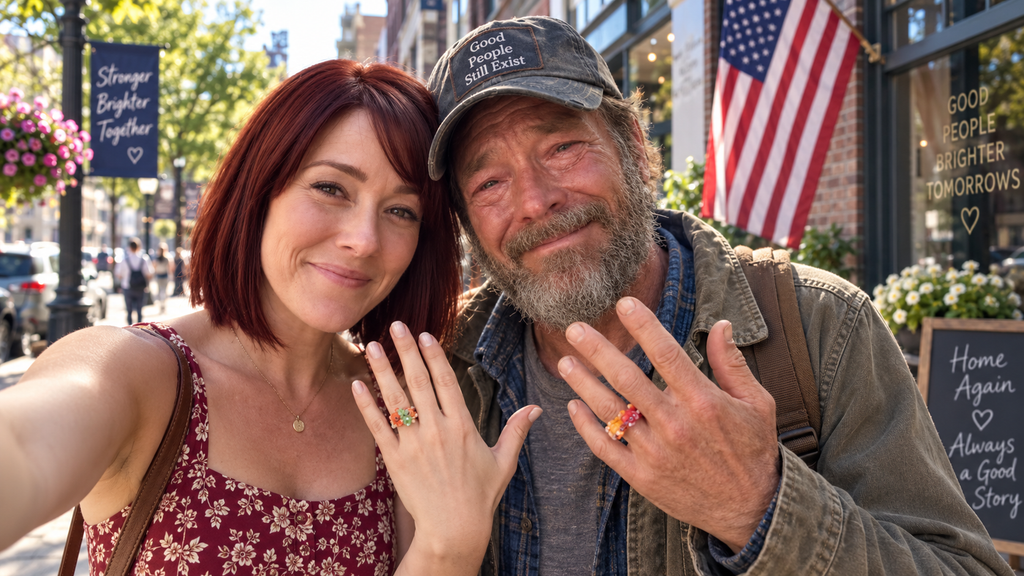
For three weeks, I had believed those words.
Maybe that was the worst part.
They weren’t completely false.
Larry really had been dying.
He really had been afraid.
But according to the pages spread across my kitchen table, that wasn’t why he had chosen me.
My phone buzzed beside my cold coffee.
An unfamiliar number.
Normally, I would have ignored it.
Instead, I stared at the screen until the third ring.
Then I answered.
“Hello?”
There was a short pause.
“Is this Sarah Bennett?”
My grip tightened around the phone.
“Yes.”
“My name is Evelyn Hart. I’m an attorney with Hart, Sullivan and Price.”
I stopped breathing.
Larry’s final sentence flashed through my mind.
Tomorrow a lawyer will call you.
Please listen to him.
Evelyn continued.
“I represented Lawrence Hale.”
I frowned.
“I’m sorry. Who?”
There was another pause.
Then she said quietly:
“Larry.”
I stood so quickly that my chair scraped backward across the kitchen floor.
“Larry’s last name was Hale?”
“Yes.”
I looked at the letter.
He had never told me his last name.
Not once.
At the courthouse, the clerk had handled most of the paperwork.
I had seen Lawrence E. Hale typed on the marriage license, but I hadn’t thought anything of it.
Larry had always just been Larry.
The man with the worn gray coat.
The man who complained about pigeons.
The man who drank his coffee black.
The man who had died with my hand wrapped around his.
“What is this about?” I asked.
Evelyn exhaled softly.
“I think it would be better if we spoke in person.”
My stomach tightened.
“Larry said you would call.”
“I know.”
“How?”
“Because I helped him prepare the letter.”
I looked down at the handwritten pages.
Suddenly they felt heavier.
“Did you know why he married me?”
“Yes.”
My voice became sharper.
“Then tell me.”
“I will.”
“Now.”
Another pause.
Then Evelyn said something that made me sit back down.
“Sarah, your husband was not always homeless.”
I stared at nothing.
“I figured that much out from the letter.”
“No,” she said.
“I don’t think you understand.”
Something in her voice made my skin prickle.
“Larry Hale was once one of the most respected corporate attorneys in this city.”
I laughed.
Not because anything was funny.
Because the statement sounded impossible.
“Larry?”
“Yes.”
“The man who slept near the subway?”
“Yes.”
“The man whose coat had duct tape inside one pocket?”
“Yes.”
I pressed my fingers against my forehead.
Evelyn continued.
“More importantly, Larry knew your father.”
My breath caught.
The apartment seemed to shrink around me.
“My father died when I was six.”
“I know.”
I whispered:
“You knew him too?”
“Not personally. But Larry did.”
I looked toward the envelope.
Part of me wanted to tear the remaining pages open and read everything immediately.
Another part was terrified of what they might contain.
“What does my father have to do with this?”
Evelyn’s answer came carefully.
“Almost everything.”
Twenty minutes later, I was in a taxi heading downtown.
I carried Larry’s letter in my purse.
The city moved outside the window in familiar pieces.
Traffic.
Pedestrians.
Delivery trucks.
Office workers staring at phones.
Normally I barely noticed any of it.
That morning, everything felt unreal.
When the taxi stopped at a red light near the subway station, I turned my head automatically.
Larry’s corner was empty.
For two years, there had always been something there.
A blanket.
A cardboard cup.
A backpack.
Larry himself.
Now there was only a dark rectangle on the pavement where his sleeping bag had rested.
Someone hurried over it without looking down.
My throat tightened.
Three weeks.
I had been married for three weeks.
And somehow, I knew less about my husband after his death than I had before our wedding.
Hart, Sullivan and Price occupied the twenty-third floor of a glass building overlooking the river.
The receptionist led me through a hallway lined with framed degrees and photographs.
Everything smelled expensive.
Polished wood.
Leather.
Coffee that probably cost more than the kind Larry and I drank every morning.
A woman in her late fifties stood when I entered the conference room.
“Sarah.”
She crossed the room and held out her hand.
“I’m Evelyn.”
I shook it.
Her expression was kind.
But there was sadness behind it.
She gestured toward the chair opposite her.
On the table sat a thick file.
A sealed envelope.
A wooden box.
And a photograph.
I noticed the photograph first.
My knees almost gave out.
My father was standing in it.
He looked younger than I remembered.
Maybe thirty-five.
His hair was dark.
His sleeves were rolled up.
He was laughing at something outside the frame.
Beside him stood another man.
Clean-shaven.
Broad-shouldered.
Wearing a navy suit.
For several seconds, I didn’t recognize him.
Then I saw the eyes.
Larry.
I reached for the photograph.
“No.”
My voice barely came out.
Evelyn remained silent.
I pulled the picture closer.
Larry looked nothing like the man I had known.
His hair was thick and brown.
His face was fuller.
His clothes were expensive.
Yet the expression was unmistakable.
That slightly crooked smile.
Those gentle eyes.
I turned the photograph over.
Three words were written on the back.
Michael and Larry.
My father’s name was Michael.
I sank into the chair.
“How?”
Evelyn sat across from me.
“Your father and Larry met in college.”
I stared at the photograph.
“They were friends?”
“Best friends.”
I swallowed.
“Why didn’t anyone ever tell me?”
“That question is complicated.”
“I’m starting to realize that.”
Evelyn folded her hands.
“Larry and your father founded a small technology logistics company when they were in their twenties.”
“My father worked in insurance.”
“That’s what you were told.”
I looked up.
Evelyn slid a document toward me.
At the top was a company name.
Bennett-Hale Logistics.
My father’s surname.
Larry’s surname.
I shook my head.
“I’ve never heard of this.”
“The original company disappeared decades ago. It was acquired by a larger corporation after your father died.”
I pushed the paper away.
“My mother told me Dad was an insurance salesman.”
“She may have had reasons for doing that.”
The words irritated me.
“What reasons?”
Evelyn glanced at the file.
“After your father’s death, there was a legal dispute.”
“What kind of dispute?”
“A very ugly one.”
She opened the folder.
Inside were old newspaper clippings.
Court filings.
Photographs.
Bank statements.
I saw my father’s name repeatedly.
Then Larry’s.
And another name.
Victor Bennett.
My father’s older brother.
My uncle.
A man I had not seen since childhood.
Evelyn tapped the papers.
“Your father and Larry built Bennett-Hale together. Your father handled operations. Larry handled contracts and financing.”
I listened silently.
“The business grew quickly.”
“How quickly?”
“By the year you were born, it was worth several million dollars.”
My mouth went dry.
That didn’t fit any version of my childhood.
We hadn’t been rich.
At least I didn’t remember being rich.
Our house had been nice but ordinary.
My mother clipped coupons.
My father drove an old station wagon.
Evelyn seemed to understand my confusion.
“Your father lived modestly.”
“Why?”
“He believed money disappeared faster when people started believing they deserved it.”
That sounded like something my father might have said.
At least the father I barely remembered.
Evelyn continued.
“Your uncle Victor joined the company later.”
My stomach tightened.
“He handled investments.”
She nodded.
“And apparently he was stealing.”
I stared at her.
“For years.”
“How much?”
“Larry estimated several million dollars.”
I felt dizzy.
“Did my father know?”
“Eventually.”
Evelyn pulled out another document.
“Two months before your father died, he discovered irregularities in company accounts.”
I looked at the date.
It was from the year I turned six.
“He confronted Victor.”
“What happened?”
“Victor denied everything.”
I waited.
“Your father planned to involve federal investigators.”
My hands became cold.
“And then he died.”
Evelyn nodded slowly.
My father had died in a car accident.
That was what I had always been told.
A rainy night.
A truck crossing the center line.
Nothing suspicious.
Nothing mysterious.
Just horrible luck.
I stared at Evelyn.
“Are you saying Victor killed my father?”
“No.”
Her answer came immediately.
“We have no evidence of that.”
I released a breath I hadn’t realized I was holding.
“But Larry suspected the timing.”
“Suspected?”
“Yes.”
“That isn’t the same thing.”
“No. And Larry never claimed otherwise.”
I appreciated that.
Even now, she seemed determined not to turn suspicion into fact.
“What happened to the company?”
“After your father died, Larry tried to continue the investigation.”
“And?”
“Victor accused Larry of stealing the money.”
I looked at the old newspaper clippings again.
One headline jumped out at me.
LOCAL ATTORNEY INVESTIGATED IN CORPORATE FRAUD CASE.
The photograph beside the article showed Larry.
Young.
Confident.
Terrified.
I covered my mouth.
“Oh my God.”
“The accusations destroyed him.”
“Was he convicted?”
“No.”
“But people believed it?”
“Enough people.”
Evelyn leaned back.
“Larry spent almost every dollar he had defending himself. His marriage ended. His law partners removed him from the firm. Clients disappeared. He developed a drinking problem.”
I closed my eyes.
The word liver failure suddenly felt different.
“He drank himself sick?”
“For a while.”
“How long?”
“Years.”
I thought of every morning I had seen Larry.
Never drunk.
Never slurring.
Never holding a bottle.
Just coffee.
Black.
Evelyn seemed to read my face.
“He stopped drinking twelve years ago.”
“Then why was he homeless?”
“That came later.”
She turned another page.
“Larry spent more than fifteen years trying to prove what Victor had done.”
“Why?”
“Partly to clear his own name.”
She hesitated.
“And partly because of you.”
I looked up.
“Me?”
“Your father had made Larry promise something.”
The room went completely silent.
Evelyn reached for the wooden box.
She pushed it toward me.
“This belonged to your father.”
My fingers hovered over it.
The box was scratched and faded.
A brass clasp rested at the front.
“What is it?”
“You should open it.”
I lifted the clasp.
Inside was an old wristwatch.
A fountain pen.
Several photographs.
And a small cassette tape.
Underneath them was an envelope.
SARAH.
Written in my father’s handwriting.
I knew his handwriting.
I had seen it on birthday cards my mother kept in a shoebox.
I touched my name.
For a moment, I couldn’t breathe.
“My father wrote this?”
“Yes.”
“When?”
“Three days before his accident.”
Tears filled my eyes immediately.
I hated that.
I hated crying in front of strangers.
But grief does not care about dignity.
I had been six years old when my father died.
I remembered pieces of him.
His hands.
The smell of peppermint gum.
The way he hummed while washing dishes.
How he used to carry me upside down through the hallway while my mother yelled that he was going to drop me.
I remembered his laugh.
But memories fade.
That is another kind of death nobody warns you about.
Eventually, you forget the exact sound of someone’s voice.
Then the shape of their hands.
Then the way they moved through a room.
And one day, you realize the person you loved has slowly become a collection of photographs.
I picked up the envelope.
“Why did Larry have this?”
“Your father gave it to him.”
“Why didn’t Larry give it to me years ago?”
Evelyn looked uncomfortable.
“That’s part of the story you may not like.”
I wiped my cheek.
“Apparently there are several parts like that.”
She nodded.
“Your father believed Victor was trying to seize control of Bennett-Hale.”
I listened.
“He transferred part of his ownership into Larry’s name temporarily.”
“How much?”
“Forty-nine percent.”
My eyes widened.
“Why?”
“To protect it from Victor while the fraud investigation was happening.”
“But Dad died.”
“Yes.”
“And the shares stayed with Larry?”
“For legal purposes, yes.”
“What about me?”
Evelyn pulled another paper from the folder.
“Your father intended those shares for you.”
My heart thudded.
“They were mine?”
“Eventually.”
“What does eventually mean?”
“When you turned twenty-five.”
I almost laughed.
“I’m thirty-three.”
“I know.”
“So where have they been for eight years?”
Her expression changed.
“That is where everything became complicated.”
After my father died, my mother wanted nothing to do with Bennett-Hale.
At least according to the records.
Within six months, she sold whatever interest remained in my father’s estate.
Then she moved us two states away.
She stopped answering Larry’s calls.
She returned letters.
Eventually, she remarried.
By the time I was ten, we were using my stepfather’s surname socially, although I had never legally changed mine.
Larry lost track of us.
There had been no social media then.
No easy internet search.
People could disappear simply by moving.
Especially children.
“What about when I became an adult?”
I asked.
“He searched.”
“How hard?”
“Very hard.”
I stared at her.
“He couldn’t find one person for twenty years?”
“He found several Sarah Bennetts.”
“Very funny.”
“I’m serious.”
She opened another section of the file.
Private investigator reports.
Dozens of them.
Different years.
Different cities.
Different women.
My stomach dropped.
Larry had been looking for me.
Over and over.
“He spent years on this?”
“Yes.”
“Why didn’t he just contact my mother?”
“He tried.”
“And?”
“She told him never to contact either of you again.”
My stomach twisted.
“What?”
Evelyn pushed a photocopy toward me.
It was a letter.
My mother’s handwriting.
I recognized it instantly.
Lawrence,
Michael is dead. Whatever business existed between the two of you died with him. Sarah will not be involved in any more lawsuits, accusations, or scandals. Do not contact us again.
I read it twice.
Then a third time.
My face burned.
“She knew?”
“She knew Larry was trying to reach you.”
I looked away.
“Why would she hide that?”
“Only your mother can answer.”
My relationship with my mother had never been easy.
She had always been private about my father.
Whenever I asked questions, she became uncomfortable.
“He was a good man.”
That was usually all she said.
Sometimes:
“It hurts too much to talk about.”
Eventually I stopped asking.
I had assumed silence came from grief.
Now I wasn’t sure.
“What happened to the company shares?” I asked.
Evelyn continued.
“Bennett-Hale was purchased during the litigation.”
“By whom?”
“A national logistics company.”
“How much were Dad’s shares worth?”
“At the time?”
“Yes.”
“A little over nine hundred thousand dollars.”
I stared.
That was more money than anyone in my family had ever mentioned.
“What happened to it?”
“Larry refused to spend it.”
My throat tightened.
“He kept it?”
“He placed it into long-term investments.”
“For me?”
“Yes.”
I laughed again.
I couldn’t help it.
It was too absurd.
A homeless man had apparently been managing an investment portfolio belonging to me.
“How?”
“He still had an attorney.”
“You.”
“Eventually.”
“Where did the money go?”
Evelyn was silent.
That silence terrified me more than anything else.
“How much is left?”
She folded her hands.
“Sarah, the original investment grew.”
“To what?”
She slid a printed statement across the table.
I looked at the number.
Then I looked again.
$6,842,311.17.
I stared at the paper.
“That can’t be right.”
“It is.”
“No.”
“Yes.”
I shook my head.
“Six million?”
“Nearly seven.”
I pushed the statement away as though it might burn me.
Larry.
The man I occasionally slipped twenty dollars at Christmas.
Larry.
The man whose boots had holes near the soles.
Larry.
The man who slept beneath a wool blanket outside a subway station.
Larry had been protecting almost seven million dollars that belonged to me.
My anger arrived before my gratitude.
“He had this?”
“No.”
“It was under his control.”
“Legally, yes.”
“And he slept on concrete?”
“Yes.”
“Why?”
Evelyn took a breath.
“Because he refused to touch what he believed belonged to your father.”
I stood.
“That makes no sense.”
“Sarah—”
“No.”
I paced toward the window.
“That man froze outside.”
“I know.”
“He skipped meals.”
“I know.”
“I watched him pick through a bag of donated clothes because his coat zipper broke.”
“I know.”
“And you’re telling me he could have taken money whenever he wanted?”
“Not without breaking the promise he made.”
I turned.
“He could have borrowed ten thousand dollars!”
“He wouldn’t.”
“Then he was insane.”
Evelyn’s face softened.
“Maybe he was ashamed.”
The anger disappeared for half a second.
Then came back.
“Ashamed of what?”
“Of failing.”
I stared at her.
She continued quietly.
“He believed your father trusted him with two things.”
“The money and me.”
“Yes.”
“And he thought he failed both.”
I sank back into the chair.
Evelyn opened another file.
“Larry eventually cleared his name.”
“When?”
“Four years ago.”
My head jerked up.
“What?”
“Victor’s former accountant came forward.”
She handed me a court document.
“There were preserved records. Offshore transfers. Forged signatures.”
“Victor stole the money?”
“Yes.”
“Was he charged?”
“He had already died.”
I remembered hearing years ago that Uncle Victor died of a heart attack.
My mother attended the funeral without me.
“At least Larry’s name was cleared.”
“Legally, yes.”
“But?”
“By then, most people who had abandoned him had moved on.”
I understood.
An accusation takes one headline.
Vindication sometimes gets two paragraphs nobody reads.
“What happened after his name was cleared?”
“He received a settlement.”
“How much?”
“Just over two million dollars.”
I stared.
“He had money.”
“Yes.”
“And still stayed homeless?”
“For most of it.”
“Why?”
“He gave nearly everything away.”
Of course he did.
Somehow that answer hurt the most.
“To whom?”
“Shelters. Addiction recovery programs. Legal aid organizations.”
Evelyn smiled sadly.
“He kept enough for medical treatment.”
“Not housing?”
“We tried.”
“Tried?”
“I personally found him an apartment.”
“What happened?”
“He lasted twelve days.”
Despite everything, I almost smiled.
“That sounds like Larry.”
“He said the building was too quiet.”
I covered my face.
Tears slipped between my fingers.
I could hear him saying it.
I could almost see that crooked grin.
Too quiet.
Exactly the sort of ridiculous excuse Larry would make.
“Why did he sit at that subway station?”
Evelyn’s answer came gently.
“Because that was where he first saw you.”
I lowered my hands.
“What?”
“Two years ago.”
I remembered the first morning.
At least I thought I did.
Larry had been sitting near the station wall.
I had dropped a glove.
He had picked it up and called after me.
Miss!
You dropped something.
I had thanked him.
The next day, I brought coffee.
Then again.
Then it became routine.
“He recognized me?”
“Not immediately.”
“How could he?”
“He had photographs of you as a child.”
“That wouldn’t help.”
“No.”
Evelyn smiled faintly.
“But you dropped your employee badge.”
My stomach dropped.
My full name had been printed across it.
Sarah Bennett.
“He saw my name.”
“Yes.”
“And then?”
“He called me that same afternoon.”
“You knew for two years?”
“Yes.”
I stood again.
This time anger won.
“You knew?”
“Sarah—”
“You watched me bring him coffee every morning while he knew exactly who I was?”
“Yes.”
“And neither one of you told me?”
“Larry asked me not to.”
“That doesn’t make it better.”
“I know.”
“Did he think this was funny?”
“No.”
“Was I some kind of test?”
The thought hit me hard.
Every morning.
Every conversation.
Every coffee.
Had Larry been studying me?
Judging me?
Trying to decide whether I was worthy of my own father’s money?
Evelyn shook her head.
“No.”
“How do you know?”
“Because I asked him the same question.”
I stopped.
“What did he say?”
“He said, ‘Michael’s daughter doesn’t have to prove anything to me.’”
My anger faltered.
Evelyn continued.
“He wanted to tell you almost immediately.”
“Then why didn’t he?”
“Because you came back the second morning.”
I stared.
“You brought him coffee.”
“So?”
“He hadn’t asked you for anything.”
“That doesn’t explain—”
“You came back again the next morning.”
Evelyn’s eyes glistened.
“And again.”
My throat tightened.
“He told me he had spent twenty years imagining what he would say if he ever found you. Then when he finally did, you sat beside him and complained about your boss.”
A laugh escaped me through tears.
That sounded right.
I had complained about my boss constantly.
“He said you treated him like a person before you knew who he was.”
I looked down.
“And that scared him.”
“Why?”
“Because he thought once he told you the truth, everything between you would become about the past.”
It already had.
“He liked being Larry.”
Evelyn’s voice softened.
“Just Larry.”
The funny homeless man outside the subway.
The man who knew which coffee I ordered.
The man who teased me about my shoes.
“He told me that those ten minutes every morning were the first normal part of his life in years.”
I wiped my face.
“So he lied.”
“Yes.”
The word surprised me.
Evelyn didn’t defend him.
She didn’t dress it up.
“He lied by omission,” she said. “For almost two years.”
I appreciated that too.
“Then he got sick.”
“Yes.”
“When did he find out?”
“About three months before the sign.”
“Three months?”
“He hid it.”
“Why?”
“You knew Larry.”
I almost laughed.
Apparently I didn’t.
Evelyn seemed to catch the thought.
“Maybe you knew the most important parts.”
I looked away.
“What did the doctors say?”
“Advanced liver disease. Complications. Treatment could slow things down but not reverse the damage.”
“Did he really have one month?”
“That was the estimate.”
“So that part was true.”
“Yes.”
“Why the marriage?”
Evelyn closed the folder.
“That is where the legal problem began.”
Apparently Larry had prepared a will naming me as the beneficiary of everything connected to my father.
Simple.
Or it should have been.
Then his younger brother appeared.
A man named Robert Hale.
Larry hadn’t spoken to him in almost twenty years.
After Larry’s name was cleared and news of the settlement became public, Robert contacted him.
Not because he missed him.
Because he believed Larry had money.
Larry refused to give him any.
Robert threatened to challenge any will Larry wrote.
“Could he?”
“He could try.”
“Would he win?”
“Probably not.”
“Then why marry me?”
“Because Larry was running out of time.”
Evelyn explained that a lawsuit could freeze an estate for years.
Legal costs could drain it.
Documents could be challenged.
Signatures questioned.
Mental capacity attacked.
Robert had already claimed Larry was mentally unstable.
Marriage changed everything.
As Larry’s legal spouse, I had rights that were much harder to challenge.
More importantly, Larry transferred the investment account connected to my father into a marital trust immediately after our courthouse ceremony.
“Wait.”
I stared.
“He did that the day we married?”
“The next morning.”
“So I already own it?”
“Yes.”
My pulse pounded in my ears.
“And Robert can’t touch it?”
“Not successfully.”
I leaned back.
There it was.
The real reason.
Not loneliness.
Not dignity.
Not fear of dying without a family.
Larry had married me to protect my father’s money.
I should have been grateful.
Instead, I felt strangely heartbroken.
“So the whole thing was business.”
“No.”
I looked at Evelyn.
She shook her head.
“Don’t make the mistake Larry was afraid you would make.”
“What mistake?”
“Believing one reason cancels out another.”
I didn’t answer.
“He married you to protect what belonged to you.”
She paused.
“But the sign was also true.”
“How?”
“He was afraid of dying as nobody.”
I looked toward the photograph.
“He had family.”
“Family is not the same as belonging.”
That sentence stayed with me.
Maybe because I understood it.
I had spent most of my adult life surrounded by coworkers, acquaintances, neighbors, people on my phone.
Yet there were evenings when I came home and realized nobody would notice if I didn’t speak for two days.
Larry had lived among thousands of people.
But almost no one knew his name.
“He cared about you,” Evelyn said.
“Then why couldn’t he trust me with the truth?”
“Because shame makes people strange.”
I smiled bitterly.
“That sounds convenient.”
“It does.”
At least she admitted it.
“Did he love me?”
The question escaped before I could stop it.
Evelyn looked surprised.
So was I.
I wanted to take it back.
Instead, she considered her answer.
“Not romantically.”
I nodded.
That was what I expected.
“But I think he loved you.”
I looked up.
“In the way a person can love someone they feel responsible for. In the way he loved your father. In the way people sometimes love the last good thing connecting them to a life they lost.”
My throat tightened.
Evelyn reached for the sealed envelope.
“There’s something else.”
She slid it toward me.
“This one is from Larry.”
“I already have his letter.”
“This was separate.”
I opened it.
There was only one sheet.
Sarah,
If you are reading this in Evelyn’s office, then by now you know enough to be furious with me.
You should be.
I had a hundred chances to tell you the truth.
I wasted all of them.
At first, I told myself I needed to confirm your identity.
Then I told myself I needed to finish the legal work.
Then I told myself I would tell you after Christmas.
Then after your birthday.
Then after I found the right words.
The truth is simpler.
I was afraid.
For two years, you knew me as the worst version of what my life became and treated me better than most people treated me when I had everything.
I was afraid that if I told you about the company, the money and your father, I would stop being Larry.
I would become a problem from your past.
So I became selfish.
I kept the mornings.
I kept the coffee.
I kept your ridiculous stories about your office.
And when the doctor told me I was dying, I realized my selfishness had created one final problem.
I had protected your father’s money but failed to give it to you.
I could not die with that promise unfinished.
So I asked you to marry me.
I am sorry.
Not for marrying you.
Never for that.
I am sorry I made kindness carry a burden it did not know it was carrying.
You gave me dignity long before the courthouse.
The marriage papers only gave the law a name for something you had already done.
You made me family.
Larry.
I lowered the page.
Evelyn handed me a box of tissues.
I took one.
Then another.
For several minutes, neither of us spoke.
Finally, I asked:
“What was in my father’s envelope?”
Evelyn glanced toward it.
“That is yours.”
I picked it up.
The paper was old.
Yellow at the edges.
My name had been written across the front by a man who had been dead for twenty-seven years.
I opened it slowly.
Inside were four pages.
The first line destroyed me.
My little Sarah,
If Larry gives you this someday, something has gone wrong.
I covered my mouth.
My eyes blurred.
I kept reading.
Your mother tells me I worry too much. She is probably right. But grown-ups sometimes create problems children should never have to carry, and I want to make sure none of ours become yours.
You are six years old as I write this.
You are upstairs refusing to sleep because you insist the moon is following you.
For the record, I told you it is not.
You told me I am wrong.
You will probably continue telling me I am wrong for the rest of my life.
I hope you do.
I laughed and cried at the same time.
I could almost hear him.
The letter continued.
Larry is my closest friend.
If life becomes complicated, trust him.
He is terrible at cooking, worse at remembering birthdays, and far too proud for his own good, but he is loyal.
There is money connected to the company.
Someday, some of it should belong to you.
I do not care whether you become rich.
I care that you become free.
Use it for education.
A home.
Travel.
Starting something.
Helping somebody.
Or keep it in a bank and forget about it.
Money is useful, Sarah.
But it is not proof of a good life.
If I am not around when you read this, I need you to understand something.
You were never the thing I worried about leaving behind.
You were the reason I wanted to stay.
I had to stop.
I lowered the paper to the table.
My entire body shook.
I had spent twenty-seven years wondering whether my father knew he was going to die.
Wondering what he would have said.
Wondering whether he had thought about me during his final moments.
Now I had an answer.
Maybe not the answer.
But something.
I continued.
Be kind when you can.
Be careful when you must.
Do not confuse the two.
Some people will mistake kindness for weakness.
Let them.
They are usually wrong.
And if Larry is standing beside you when you read this, tell him I still think he cheats at poker.
Love always,
Dad.
I laughed so loudly that Evelyn began crying too.
I pressed the letter against my chest.
For twenty-seven years, I had possessed exactly six handwritten words from my father.
Happy birthday, princess. Love, Dad.
Now I had four pages.
Four pages.
It felt like getting part of someone back from the dead.
When I finally calmed down, I looked at Evelyn.
“There’s one thing I need to do.”
“Whatever it is, I would advise waiting until you’ve had time to process everything.”
“I need to talk to my mother.”
Evelyn hesitated.
“I suspected that.”
“She knew.”
“Some of it.”
“She kept Larry away from me.”
“We don’t know why.”
“I intend to find out.”
My mother lived forty minutes outside the city.
I called from the lobby.
She answered on the second ring.
“Sarah?”
“Are you home?”
“Yes.”
“I’m coming over.”
“What happened?”
“I found out about Larry Hale.”
Silence.
Not confusion.
Not Who?
Silence.
That told me everything.
“Mom?”
Her voice changed.
“Sarah…”
“You knew.”
Another pause.
Then:
“Come over.”
I arrived fifty minutes later.
My mother was waiting at the dining table.
She had made tea.
That was what she did when she was afraid.
Tea meant someone had died.
Tea meant somebody was sick.
Tea meant something awful needed to be discussed but she wanted a cup between her hands while doing it.
She looked older than usual.
“Sit down.”
I remained standing.
“You knew Larry.”
“Yes.”
“How well?”
“He and your father were very close.”
“Why did you never tell me?”
Her eyes dropped.
“Because I wanted that part of our lives gone.”
“Why?”
She closed her eyes.
“When your father died, everything became chaos.”
I waited.
“There were investigators. Lawyers. Reporters. People calling the house.”
“So you blamed Larry.”
“At first.”
“Did you believe he stole from Dad?”
“I didn’t know what to believe.”
“You told him never to contact me.”
Her eyes lifted.
“You know about the letter.”
“I know a lot.”
She pressed her lips together.
“You were six.”
“I stopped being six twenty-seven years ago.”
“I know.”
“Then why didn’t you tell me later?”
She looked toward the window.
“Because by then, I was ashamed.”
“Of what?”
“Of being wrong.”
There it was.
A simple answer.
Almost disappointingly human.
She had believed Larry might be guilty.
Then years passed.
Evidence emerged.
Doubts grew.
Eventually, she realized she had probably kept an innocent man away.
“Did Dad leave me money?”
She nodded.
“Some.”
“Did you know Larry controlled part of it?”
“Yes.”
“And you still refused his calls?”
“I thought the money was poisoned.”
I stared at her.
“Money isn’t poisoned.”
“You didn’t live through it.”
“No. Because nobody ever told me anything.”
Her face tightened.
“Your father’s death destroyed me.”
“And that gave you the right to erase him?”
The question hit harder than I intended.
My mother looked down.
I immediately regretted the cruelty.
But I didn’t take it back.
Because part of it was true.
“I didn’t erase him.”
“You made him into an insurance salesman.”
“He worked in insurance before the company.”
“That’s not the same thing.”
“No.”
“Why didn’t you tell me who he really was?”
“Because every part of that business reminded me of losing him.”
I sat down.
For the first time, I noticed her hands trembling.
She was seventy now.
When my father died, she had been thirty-six.
Younger than I was.
That realization softened something in me.
Not forgiveness.
Not yet.
But perspective.
“When did you find out Larry was innocent?”
“Years ago.”
“How many?”
She didn’t answer.
“Mom.”
“About ten.”
I stared at her.
“Ten years?”
She nodded.
“And you still never told me?”
“I didn’t know where he was.”
“You could have told me he existed.”
“I know.”
“Why didn’t you?”
Tears filled her eyes.
“Because every year I waited made telling you harder.”
That I understood more than I wanted to.
Silence grows roots.
A secret kept for one day can be explained.
A secret kept for ten years becomes part of the architecture of a family.
Remove it and everything shifts.
“He found me two years ago,” I said.
My mother looked surprised.
“What?”
“He was living near my subway station.”
Her face changed.
“Living?”
“Homeless.”
She covered her mouth.
“Oh my God.”
“He recognized my name.”
“Did he tell you?”
“No.”
“That sounds like Larry.”
Despite myself, I almost smiled.
“You remember him?”
“Very well.”
“What was he like?”
My mother looked toward the ceiling, searching old memories.
“Annoying.”
I laughed.
She did too.
“He argued about everything. Your father loved that about him.”
“What else?”
“He always overdressed.”
I thought of the man in the photograph.
The navy suit.
“Larry?”
“Three-piece suits in July.”
I smiled.
“He was terrible with children.”
“That surprises me.”
“No, not cruel. Just terrified.”
She laughed through tears.
“When you were born, your father made him hold you. Larry looked like someone had handed him a live grenade.”
I laughed harder.
“And then?”
“He wouldn’t give you back.”
That broke me again.
My mother reached across the table.
For the first time in years, I let her hold my hand.
“He married me,” I whispered.
Her eyes widened.
“What?”
“I married Larry.”
She stared.
“You married Larry Hale?”
“Three weeks before he died.”
My mother blinked repeatedly.
Then, unbelievably, she started laughing.
Not a polite laugh.
A full, shocked, almost hysterical laugh.
“What?”
I demanded.
She shook her head.
“Your father would find that hilarious.”
“Why?”
“He used to joke that Larry would eventually become family whether anyone liked it or not.”
I stared at her.
Then I laughed too.
For several minutes, the two of us sat at the dining table laughing and crying over the strangest marriage either of us had ever heard of.
Eventually, my mother became serious.
“Did he tell you why?”
“Yes.”
“And the money?”
“I know.”
She closed her eyes.
“Michael would be relieved.”
“Dad knew Larry would protect it?”
“Your father trusted Larry more than anyone.”
I looked at her.
“Including you?”
The question hurt.
She accepted it.
“In business?”
She nodded.
“Yes.”
At least she didn’t lie.
“I want to know more about Dad.”
“You should.”
“No.”
I squeezed her hand.
“I mean everything.”
Her eyes filled again.
“The company. Larry. Uncle Victor. The arguments. The good things. The bad things.”
I swallowed.
“I’m tired of loving a man everyone edited for me.”
My mother cried then.
Quietly.
Maybe because she knew I was right.
Maybe because she had spent twenty-seven years editing him for herself too.
We talked until after midnight.
For the first time in my life, my father became a person instead of a saint in a photograph.
He had a temper.
He worked too much.
He forgot anniversaries.
He once backed the station wagon through the garage door.
He loved jazz.
He hated olives.
He secretly gave money to a cashier whose son needed surgery.
He and Larry once drove eight hours to rescue a friend whose car had broken down and spent the entire return trip arguing about who had gotten them lost.
My mother showed me photographs I had never seen.
Dad and Larry fishing.
Dad asleep on an office couch.
Larry wearing a ridiculous Christmas sweater.
My parents dancing in the kitchen.
Me sitting on Larry’s shoulders when I was three.
I froze at that one.
“I knew him.”
My mother nodded.
“You adored him.”
I touched the photograph.
I couldn’t remember the moment.
But there it was.
My tiny hands tangled in Larry’s hair.
His hands holding my ankles.
My father laughing beside us.
For years, I thought Larry entered my life outside a subway station.
He hadn’t.
He had simply returned.
Three days later, Robert Hale challenged the estate.
I almost admired the speed.
Evelyn called me at work.
“Don’t panic.”
“That’s never a good way to start a conversation.”
“He filed a petition.”
“Larry’s brother?”
“Yes.”
“What does he want?”
“The settlement money. Personal property. Anything not included in your marital trust.”
“What about Dad’s account?”
“Protected.”
I leaned against the wall outside the conference room.
“Can he take anything from me?”
“Probably not.”
“Probably?”
“Lawyers are legally forbidden from saying definitely.”
I smiled.
“You’re making that up.”
“Mostly.”
The hearing took place six weeks later.
By then, Larry had been dead nearly two months.
I wore black.
Not because I was trying to look like a grieving widow.
I still wasn’t sure what kind of widow I was.
But black felt appropriate.
Robert Hale sat across the courtroom.
The resemblance to Larry startled me.
Same eyes.
Same jaw.
But harder somehow.
He looked at me as though I had stolen something from him.
Maybe in his mind, I had.
His attorney argued that Larry had been mentally impaired.
That our marriage was suspicious.
That a thirty-three-year-old woman marrying a terminally ill homeless man three weeks before his death clearly suggested manipulation.
The words made my stomach twist.
Because from the outside, he had a point.
It looked terrible.
His lawyer displayed photographs.
Larry outside the station.
Larry in worn clothes.
Larry entering hospice.
Then he displayed our courthouse marriage certificate.
“Ms. Bennett had known Mr. Hale casually.”
Casually.
Two years of coffee became one word.
“Mr. Hale was medically vulnerable.”
True.
“She became his wife shortly before his death.”
True.
“And then acquired control of millions of dollars.”
Also true.
I hated how facts could be arranged into lies without changing a single fact.
Evelyn stood.
She didn’t raise her voice.
She didn’t need to.
She produced medical evaluations showing Larry had full mental capacity.
Emails he had sent months before the marriage.
Drafts of estate documents.
Records proving he had searched for me for years.
And finally, my father’s original documents.
Robert’s lawyer changed strategy.
He claimed Larry should have transferred the money decades ago.
Evelyn agreed.
That surprised everyone.
Including me.
“Mr. Hale made mistakes,” she said.
I looked at her.
“He delayed. He allowed shame and personal failure to affect decisions he should have made sooner.”
The judge listened.
“But delay does not turn theft into ownership, nor does regret prove incapacity.”
Then Evelyn placed Larry’s handwritten letter into evidence.
Robert’s attorney objected.
The judge allowed it.
I had given permission.
Parts were read aloud.
Not all of it.
Just enough.
I was afraid.
For two years, you knew me as the worst version of what my life became and treated me better than most people treated me when I had everything.
The courtroom became very quiet.
Robert looked down.
For the first time, I wondered whether he missed his brother.
Not the money.
Larry.
Families are complicated that way.
Someone can be greedy and grieving at the same time.
Cruel and wounded.
Wrong and still human.
The judge upheld the transfers.
Larry’s personal estate was divided according to his will.
Most went to charities.
A smaller amount went to me.
Robert received exactly one thing.
A sealed envelope.
After the hearing, he opened it in the hallway.
I tried not to watch.
I failed.
He read the page.
His face changed.
The anger disappeared.
Then he sat down on a bench.
Just sat there.
I walked past.
“Sarah.”
I stopped.
Robert looked at me.
His eyes were wet.
“I was a terrible brother.”
I didn’t know what to say.
So I said nothing.
“He asked me for help years ago.”
Robert looked at the letter again.
“I told him he deserved what happened.”
My heart tightened.
“Why?”
“I believed the papers.”
I thought about my mother.
So had she.
Robert swallowed.
“Then when he was cleared, I was too ashamed to call.”
That sentence sounded familiar.
Too ashamed.
Too late.
Too many people had built their lives around those words.
“What did he write?”
I asked.
Robert laughed once.
“He forgave me.”
I nodded.
“That sounds like Larry.”
Robert looked toward me.
“I’m sorry I challenged you.”
“I understand why you did.”
“I thought you were some woman who found a dying man with money.”
“Technically, I found a dying man without shoes that matched.”
Robert laughed.
It sounded almost like Larry.
That hurt.
Before leaving, he held out his brother’s letter.
“Do you want to read it?”
I shook my head.
“No.”
He seemed surprised.
“That one is yours.”
It was the first inheritance Larry gave his brother.
And maybe the only one Robert actually needed.
The money sat untouched for months.
Six million dollars.
Nearly seven, technically.
Every time I opened the account statement, I felt nauseated.
People assume receiving money solves something.
It does solve many things.
Bills.
Debt.
Rent.
Security.
But money connected to dead people is different.
It carries voices.
Expectations.
Questions.
Every dollar felt like part of a conversation I had never gotten to finish.
I paid off my small apartment.
Then I did nothing.
I kept going to work.
Kept taking the subway.
Kept ordering coffee.
One cup.
That was harder than I expected.
The first morning I accidentally said, “Two.”
The barista reached for the second cup.
Then I remembered.
“One.”
She looked at me.
“You okay?”
“Yeah.”
I wasn’t.
I carried my coffee toward Larry’s corner.
Someone else was sitting there.
A young man wrapped in a blanket.
He looked maybe twenty.
I almost walked past.
Then he glanced at my cup.
“Coffee smells good.”
I stopped.
“What do you take in yours?”
He blinked.
“What?”
“Coffee.”
“Anything.”
“Cream?”
“Sure.”
“Sugar?”
“Like six.”
I laughed.
“Six?”
“Life is short.”
I froze.
Then I smiled.
“Apparently.”
I went back to the coffee stand.
Two cups.
For the first time since Larry died.
I sat beside the young man for five minutes.
His name was Marcus.
He had been sleeping outside for eleven weeks.
He had lost his job after missing shifts while caring for his mother.
Then rent.
Then the apartment.
Then almost everything else.
I listened.
Not because I believed I could fix him.
Larry had taught me better than that.
People are not problems waiting for strangers to solve.
Sometimes they just need someone to notice they exist.
Over the next month, I started noticing more.
The old woman sleeping near the bus depot.
The veteran who always stood outside the pharmacy.
The teenage couple living in their car.
The man who washed in the library bathroom before job interviews.
Once you stop looking away, homelessness becomes frighteningly visible.
I started visiting shelters.
Not as a donor.
Not at first.
I volunteered.
Served meals.
Sorted clothes.
Helped with forms.
That was where I learned how absurdly difficult it could be to escape homelessness.
You needed identification to get a job.
You needed an address to replace identification.
You needed identification to sign a lease.
You needed money for transportation.
A phone for employers.
Clean clothes.
Medication.
Storage.
References.
A hundred tiny doors.
Each locked by a different key.
One evening, I called Evelyn.
“I know what I want to do with some of the money.”
She sounded suspicious.
“Should I be worried?”
“Probably.”
“That is not reassuring.”
“I want to open a transitional housing center.”
Silence.
Then:
“How much coffee have you had?”
“Three cups.”
“I knew it.”
“I’m serious.”
“So am I.”
I explained.
Not a shelter with rows of beds.
Something smaller.
Private rooms.
Mailing addresses.
Lockers.
Showers.
Job counseling.
Addiction services.
Mental health referrals.
Legal help.
A place where someone could stay long enough to become stable.
Evelyn listened.
Finally, she asked:
“What are you going to call it?”
I already knew.
“The Second Cup.”
She was quiet.
“That’s perfect.”
The building took almost a year.
An abandoned four-story hotel near the west side.
Forty-two rooms.
A commercial kitchen.
A courtyard.
The renovation nearly destroyed my sanity.
Contractors disappeared.
Pipes burst.
Permits were delayed.
The elevator failed inspection twice.
At one point, I stood in the lobby surrounded by plaster dust and wondered whether Larry was somewhere laughing at me.
Probably.
My mother helped.
That surprised me.
She volunteered every Thursday.
Robert donated furniture.
That surprised me more.
Evelyn handled the legal work at a ridiculous discount while pretending she wasn’t doing me a favor.
Marcus became our first resident.
The young man from the subway.
Within four months, he had a job at a warehouse.
Three months later, he moved into a studio apartment.
The morning he left, he handed me a coffee.
Black.
I stared at it.
“You know I take cream.”
“I know.”
“Then why is this black?”
He grinned.
“For Larry.”
I cried in the lobby like an idiot.
Opening day came eighteen months after Larry’s death.
We placed a small brass plaque beside the front entrance.
Not a giant memorial.
Larry would have hated that.
Just a few lines.
THE SECOND CUP
For people who need another morning.
In memory of Lawrence “Larry” Hale,
who believed dignity begins with being seen.
I stood in front of it for a long time.
My mother came beside me.
“He would complain.”
“About what?”
“The picture.”
I looked at the framed photograph hanging inside the lobby.
Larry in his navy suit beside my father.
“He would say his hair looked terrible.”
I laughed.
“His hair did look terrible.”
My mother smiled.
Then she took my hand.
“Your father would be proud.”
I looked at her.
For years, words like that would have comforted me automatically.
Now I understood something different.
“I hope so.”
Not I know.
Not definitely.
Just hope.
Dead people shouldn’t become imaginary judges controlling the living.
My father had given me money.
Larry had protected it.
But the life built afterward still had to be mine.
The Second Cup grew.
Slowly.
Messily.
Not every story had a happy ending.
That mattered.
One resident disappeared after three weeks.
Another relapsed.
One stole from us.
Another screamed at a volunteer.
A woman named Janice returned to an abusive partner twice before leaving for good.
Real life refused to behave like an inspirational story.
People did not become transformed because someone gave them a warm bed.
Some failed.
Some returned.
Some vanished.
Some succeeded and then failed later.
But many made it.
A mechanic named Theo saved enough for an apartment.
A mother named Carmen reunited with her daughter.
A former teacher named Abdul found work tutoring children.
A woman named Grace entered treatment after living on the streets for eleven years.
Every time someone moved out, we gave them two coffee mugs.
One for themselves.
One for someone else.
It became a tradition.
I never explained why.
The people who needed to understand eventually did.
Two years after Larry died, I visited his grave.
I didn’t go often.
Maybe that sounds strange.
But I never felt Larry there.
Larry belonged near the subway.
In coffee steam.
In bad jokes.
In pigeons stealing muffins.
Still, on the anniversary of his death, I went.
I brought two coffees.
Mine with cream.
His black.
I placed his cup beside the headstone.
LAWRENCE EVERETT HALE
1959–2024
BELOVED FRIEND.
I stared at those words.
Beloved friend.
Not attorney.
Not founder.
Not millionaire.
Not homeless man.
Not husband.
Friend.
That felt right.
I sat in the grass.
“You caused an unbelievable amount of paperwork,” I told him.
A breeze moved through the trees.
No answer.
Obviously.
“You could have just told me.”
Still nothing.
“You were a coward.”
A bird landed near another grave.
“You were also kind.”
My throat tightened.
“And stubborn.”
I looked down.
“And annoying.”
Tears arrived.
I let them.
“I’m still angry with you.”
That was important.
Love does not require rewriting people into saints.
Larry lied to me.
He manipulated circumstances.
He decided for me what truth I could handle.
Those things were wrong.
But people can hurt you and love you.
Fail you and save you.
Be selfish and generous.
Human beings are inconvenient that way.
“I forgive you,” I whispered.
The words felt different once spoken.
Not dramatic.
Not magical.
Nothing inside me suddenly healed.
Forgiveness was quieter.
More like setting down a bag you had forgotten you were carrying.
“I forgive you.”
I drank my coffee.
Larry’s went cold beside the stone.
Before leaving, I placed something beneath the cup.
A small piece of cardboard.
I had cut it from an old moving box.
Across it, in black marker, I had written:
YOU WERE NEVER NOBODY.
I stood.
Then I walked away.
Six months later, another letter arrived.
This one was not from Larry.
The return address belonged to a storage company in another state.
Inside was a short note from an employee.
Dear Ms. Bennett,
We recently received instructions from Hart, Sullivan and Price regarding a storage unit registered to Lawrence Hale. Most contents were transferred to your attorney. One envelope was found taped beneath a desk drawer and appears to be addressed to you.
My heart stopped.
Another envelope.
Larry’s handwriting.
SARAH.
I laughed.
“You have got to be kidding me.”
I sat at the same kitchen table where I had opened his first letter.
By then, so much had changed.
There were brochures for The Second Cup stacked near the fruit bowl.
Photographs of residents covered the refrigerator.
My father’s old watch sat inside a glass case on the bookshelf.
I opened the envelope.
Inside was a single photograph.
Me.
Age three.
Sitting on Larry’s shoulders.
My father stood beside us.
All three of us were laughing.
On the back, Larry had written:
Your father gave me this photograph the week it was taken.
I carried it through every apartment, office, motel room, shelter and street corner for thirty years.
When people say you cannot take things with you, they are right.
But sometimes one thing carries you.
I turned the photograph over again.
There was one final sentence.
You were family long before you married me.
I pressed the picture against my chest.
And finally, finally, I understood.
Larry had told me he didn’t want to die as nobody.
For months after his death, I thought that sentence had been part of the lie.
It wasn’t.
The money explained why he needed the marriage legally.
My father explained why Larry chose me specifically.
But neither explained why his voice had cracked that freezing morning when he told me he wanted someone in the world whose name was connected to his.
The answer was simpler.
Larry had spent decades protecting a promise.
He lost his career.
His reputation.
His marriage.
His home.
Almost everything that once told the world who Lawrence Hale was.
And somewhere along the way, he began believing that losing those things meant losing himself.
Then one morning, a woman he had known as a child walked past him outside a subway station.
She didn’t recognize him.
She didn’t know about the company.
She didn’t know about the money.
She didn’t know about the scandal.
She didn’t know he had once been important.
She just noticed he looked cold.
And brought him coffee.
The next morning, she brought another.
Then another.
For two years.
Larry had spent half his life trying to return something to me.
What he never understood was that during those mornings, without realizing it, I had returned something to him.
His name.
His dignity.
His place in someone’s day.
Maybe even a small piece of home.
People later asked me whether I regretted marrying him.
Friends.
Coworkers.
Reporters after The Second Cup received attention.
One journalist asked me directly:
“If you had known everything that morning, would you still have said yes?”
For a long time, I didn’t know how to answer.
Because knowing changes choices.
If Larry had told me about my father…
About the money…
About the promise…
About his past…
Maybe I would have suspected him.
Maybe I would have called a lawyer.
Maybe I would have demanded proof.
Maybe I would have walked away.
Maybe we never would have married.
But that wasn’t what happened.
What happened was this:
A dying man held up a cardboard sign.
A woman stopped.
He asked for something unreasonable.
She said yes.
For three weeks, they became family.
And after he died, she discovered they had been family long before either of them understood it.
So when people ask if I regret marrying Larry, my answer is always the same.
“No.”
I regret that he lied.
I regret that fear stole years from him.
I regret that my mother stayed silent.
I regret that my father died before he could tell me everything himself.
I regret that Larry believed he needed a legal document to prove he belonged somewhere.
But I do not regret the courthouse.
I do not regret holding his hand.
I do not regret being beside him when he died.
And I definitely do not regret buying that first cup of coffee.
Because the most valuable thing Larry left me was never six million dollars.
It wasn’t the company shares.
It wasn’t my father’s watch.
It wasn’t even the letter.
It was one uncomfortable truth.
We spend too much of our lives asking people what they have.
A career.
A house.
A family.
Money.
Status.
A clean coat.
A permanent address.
And we forget to ask who they are when all of that disappears.
I knew Larry when almost everything had disappeared.
And somehow, that meant I knew him in a way many people from his successful years never had.
He was funny.
He was proud.
He was maddeningly secretive.
He hated cinnamon.
He believed pigeons were organized criminals.
He cheated at cards.
He gave away money he probably should have used on himself.
He kept promises far too long.
He loved my father.
He cared about me.
And at the end of his life, he was afraid.
Not of death.
At least not only death.
He was afraid that when he disappeared, the world would close over the place where he had been.
That nobody would remember the shape of his life.
He was wrong.
Every morning at The Second Cup, coffee begins brewing at 5:30.
By six, people start coming downstairs.
Some are looking for work.
Some are going to treatment.
Some simply need somewhere warm to sit.
There is a jar beside the coffee machine.
Inside are little pieces of cardboard.
Anyone leaving the program writes one sentence before moving out.
Something they want the next person to know.
The notes say things like:
You can start over at forty-eight.
Call your daughter.
One bad year is not your whole life.
Take the interview even if you’re scared.
Stay one more night.
Ask for help before you disappear.
You still matter.
And on the wall above the jar is Larry’s original cardboard sign.
Marry me. I only have one month left to live.
I kept it.
Evelyn found it among his belongings.
The edges are bent.
The marker is faded.
Someone spilled coffee across one corner.
Visitors often ask why it hangs there.
I usually smile.
“It’s a long story.”
And sometimes, when the morning is quiet, I stand beneath that sign holding two cups of coffee.
One with cream.
One black.
I think about the man in the torn coat who once believed he needed a wife so he wouldn’t die as nobody.
And I wish I could tell him what happened afterward.
I wish I could tell him about Marcus.
About Carmen.
About Grace.
About the forty-two rooms.
About the people who arrived with everything they owned inside plastic bags and left carrying apartment keys.
I wish I could tell him my mother finally talks about Dad.
That she laughs again when she tells old stories.
That Robert volunteers every Christmas and pretends he doesn’t cry when residents move out.
That Evelyn still sends invoices we both know she will never collect.
I wish I could tell him I listened to the old cassette tape from my father.
I saved it for almost a year before I found the courage.
Dad’s voice crackled through the speaker.
For five seconds, nobody spoke.
Then he laughed.
Twenty-seven years vanished.
I collapsed onto the floor.
Because there it was.
The sound I had forgotten.
My father laughing.
Larry’s younger voice came through next.
“Michael, stop messing with the recorder.”
Dad said:
“I’m leaving historical evidence that you’re terrible at poker.”
Larry shouted something in the background.
My father laughed again.
I listened to those fourteen minutes more than fifty times.
Nothing important happened on the tape.
That was what made it precious.
Two friends argued.
Someone opened a soda.
My father complained about a baseball team.
Larry told him he was an idiot.
A phone rang.
Life happened.
Ordinary life.
The kind nobody realizes is sacred until it disappears.
That recording is now backed up in six different places.
I learned my lesson.
Some things should never be trusted to one copy.
The last time I visited Larry’s grave, I did not bring flowers.
I brought coffee.
And a photograph.
The one of me on his shoulders.
I sat beside him until sunset.
Then I said the thing I wished I had understood while he was alive.
“You didn’t need to marry me to belong somewhere.”
The cemetery remained silent.
“But I’m glad you did.”
I smiled.
“Even if it was the strangest proposal in human history.”
A breeze moved through the grass.
I stood.
Then I left his coffee beside the stone.
As I walked toward the gate, my phone rang.
It was Marcus.
He now worked full-time for The Second Cup.
“Sarah, we’ve got a problem.”
“What happened?”
“We’re out of coffee.”
I stopped walking.
“You’re joking.”
“I wish.”
“Forty-two rooms and nobody noticed we were running out of coffee?”
“I noticed.”
“When?”
“About thirty seconds ago.”
I looked back toward Larry’s grave.
For some reason, I started laughing.
Marcus sounded confused.
“What?”
“Nothing.”
“Can you pick some up?”
“How much?”
“A lot.”
I shook my head.
“I’m on my way.”
Before hanging up, Marcus said:
“Oh, and there’s someone here asking for you.”
“Who?”
“New guy.”
“What does he want?”
“I don’t know.”
There was a pause.
“He’s holding a cardboard sign.”
I froze.
My heart did something strange.
“What does it say?”
Marcus laughed.
“You’re not going to believe this.”
“Try me.”
“He wrote, ‘Need work. Will do anything except wear a tie.’”
I laughed so hard I had to wipe tears from my eyes.
“I’ll be there in twenty minutes.”
I ended the call.
Then I looked one final time at Larry’s headstone.
For almost two years, I had believed I was the person helping him.
Buying coffee.
Sitting beside him.
Giving him ten minutes of conversation before work.
Agreeing to a ridiculous marriage because I thought a dying stranger deserved not to feel alone.
But grief has a way of turning stories around.
Larry had been helping me too.
He carried my father back into my life.
He returned a history that had been hidden from me.
He gave me the means to build something meaningful.
And most importantly, he taught me how dangerous it is to decide what a person is worth based on the worst chapter of their life.
A successful attorney became homeless.
A wealthy man wore donated shoes.
A stranger became my husband.
A cardboard sign became the beginning of a family story.
And a cup of coffee became an inheritance no bank could ever measure.
I walked through the cemetery gates toward my car.
The sky above the city had turned gold.
People moved along the sidewalks beyond the fence.
Hundreds of them.
Thousands.
Each carrying some invisible history.
Promises.
Mistakes.
Grief.
Secrets.
Second chances.
Somebody hurried past without looking at anyone.
Someone else stopped to help an elderly man cross the street.
A woman knelt beside a child tying his shoe.
A delivery driver handed food to a man sitting against a building.
Small things.
Ordinary things.
Things nobody writes newspaper articles about.
But maybe that is where a life actually happens.
Not in the headlines.
Not in bank accounts.
Not in the titles people put beneath our names.
Maybe we are remembered in smaller ways.
Who we sat beside.
Who we noticed.
Who we called back.
Who we forgave.
Who received the second cup.
Larry once told me he was terrified of becoming another forgotten name on a government form.
He never did.
Because every morning, when the doors of The Second Cup open, his story begins again.
Not as Lawrence Hale, attorney.
Not as Lawrence Hale, businessman.
Not even as Lawrence Hale, homeless man.
Just Larry.
The man who sat near a subway station.
The man who drank his coffee black.
The man who asked a ridiculous question.
And the man whose final secret changed the course of my life.
I once thought I married Larry because I felt sorry for him.
I was wrong.
Pity lasts minutes.
What happened between us lasted far longer.
I married him because for one reckless moment, I believed no human being should leave this world believing they belonged to nobody.
And Larry married me because twenty-seven years earlier, he had promised my father he would protect something precious.
For most of his life, he believed that precious thing was the money.
It wasn’t.
It was me.
And somewhere between two cups of coffee, a cardboard sign, and three strange weeks of marriage, we both finally kept the promise.
THE END! THANK YOU FOR READING!❤️