 Reading Time: 32 minutes
Nathan hesitated, glancing at me as though asking permission to reveal the next piece. For several seconds, neither of us moved.
The ballroom had become so quiet that I could hear the faint clink of silverware being gathered in the kitchen behind the closed service doors.
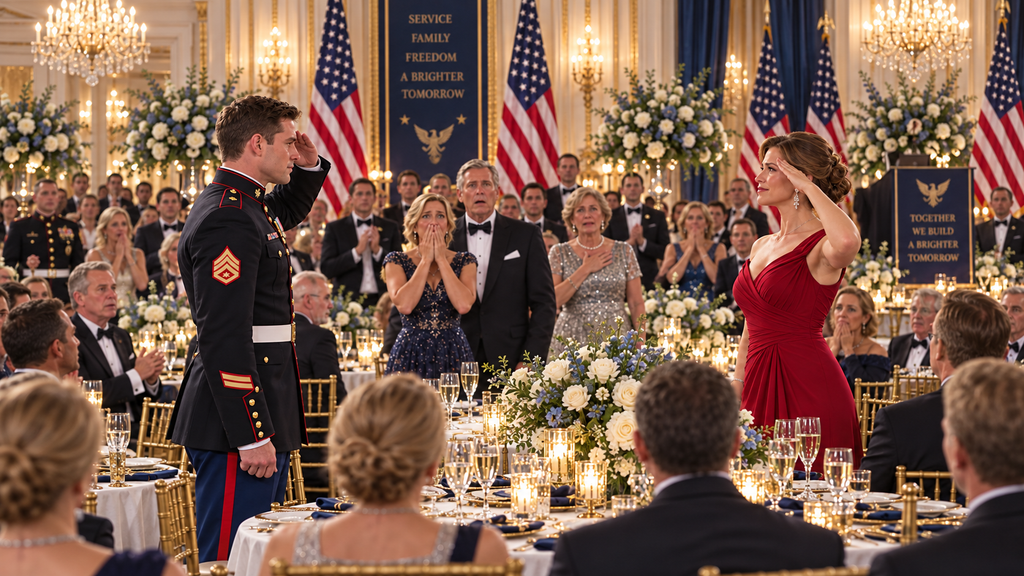
My father was still staring at me.
My mother’s gaze remained fixed on the tablecloth.
Lillian looked from Nathan to me, confusion replacing the happiness that had been glowing on her face only minutes earlier.
Nathan didn’t need to ask me aloud.
I knew exactly what he wanted to say.
And for almost twenty years, I had made sure nobody said it.
Not because I was ashamed.
Not because I wanted to protect my father.
And certainly not because I thought what happened outside Basra should remain hidden forever.
I had stayed silent because there are memories you survive once with your body and then spend the rest of your life refusing to survive again for other people’s curiosity.
I slowly nodded.
Nathan exhaled.
Then he turned toward my father.
“There’s something else you should know, sir.”
My father swallowed.
Nathan’s voice dropped.
“The reason Rear Admiral Morgan doesn’t like talking about that mission isn’t because the Navy trained the emotions out of her.”
I felt my fingers tighten against the edge of the table.
Nathan continued.
“It’s because she was nearly killed.”
Lillian’s face went pale.
My father blinked.
“What?”
Nathan looked at me briefly.
I gave him another small nod.
He continued.
“Our convoy was struck shortly after 0200.”
His military precision returned as he spoke, but there was something beneath it now.
Memory.
Not storytelling.
Not performance.
Memory.
“The lead vehicle was disabled immediately. Communications were intermittent. We had men wounded, two vehicles pinned, and fire coming from multiple directions.”
The room remained completely still.
Nathan looked at my father.
“Your daughter was already injured when she took command.”
My father’s mouth opened slightly.
No words came.
Nathan continued.
“She had shrapnel in her side.”
My mother closed her eyes.
Lillian whispered, “Vivian…”
I stared at the water glass in front of me.
Condensation slid slowly down its side.
One drop.
Then another.
Nathan’s voice carried through the room.
“She could have been evacuated.”
He paused.
“She refused.”
My father turned toward me.
“You were wounded?”
I didn’t answer.
Nathan answered for me.
“Badly.”
Dad’s expression changed.
The confidence was gone.
The easy sarcasm was gone.
The man who had spent most of my adulthood treating my service like an embarrassing personality defect suddenly looked very old.
Nathan continued.
“We had eleven people who needed extraction.”
He swallowed.
“I was one of them.”
Lillian’s hand flew toward his arm.
Nathan looked at her.
“I’ve never told you every detail.”
She stared at him.
“You told me you were hurt in Iraq.”
“I told you enough.”
His eyes shifted toward me.
“But not everything.”
He turned toward the room again.
“Our vehicle rolled after the blast.”
His voice remained steady.
“I was trapped.”
My chest tightened.
Suddenly I could smell diesel again.
Burned rubber.
Dust.
Hot metal.
Blood.
I could hear men shouting coordinates.
Somebody screaming for a medic.
Somebody calling my name.
Morgan.
Morgan.
Morgan.
I blinked.
Charleston returned around me.
Nathan was still speaking.
“The vehicle had started burning.”
Lillian covered her mouth.
Nathan’s voice broke slightly for the first time.
“She came back for me.”
My father looked at me.
I looked away.
“She was told not to,” Nathan said. “Two men tried to stop her because she was losing too much blood.”
A cousin near the center of the table whispered something I couldn’t hear.
Nathan continued.
“She crawled underneath the wreckage.”
His jaw tightened.
“She cut my harness.”
He paused.
“And when another round hit nearby, she covered me with her own body.”
I closed my eyes.
There it was.
The memory I hated most.
Not the pain.
Not the blood.
Not the explosion.
Nathan screaming that he couldn’t feel his leg.
I remembered grabbing his vest.
I remembered telling him to look at me.
I remembered saying the same sentence over and over.
“You’re going home, Cole.”
He had been twenty-eight.
Recently married.
A photograph of his wife and infant daughter had been laminated inside his vest.
He kept trying to reach it.
I kept pushing his hand away.
“You’re going home.”
“But—”
“You’re going home.”
Another explosion.
Then nothing.
Nathan’s voice pulled me back.
“She dragged me almost thirty yards.”
My father whispered, “Thirty yards?”
Nathan nodded.
“With a fragment lodged less than an inch from an artery.”
My father sat down.
Not slowly.
His knees seemed to give way.
The chair caught him.
My mother was crying now.
Quietly.
Her napkin trembled between both hands.
Lillian walked around the table toward me.
I lifted one hand.
“Not yet.”
She stopped immediately.
That hurt her.
I could see it.
But I couldn’t handle being touched.
Not then.
Nathan understood.
He always had.
“The citation didn’t tell the whole story,” he said.
My father looked up sharply.
“Citation?”
Nathan stared at him.
“You really don’t know?”
Dad looked at Mom.
Mom’s face collapsed.
That was when I realized something I had not expected.
She knew what was coming next.
Nathan noticed too.
His voice softened.
“Ma’am?”
Mom looked at me.
“Vivian…”
I felt cold.
“What?”
She shook her head.
“I’m sorry.”
Three words.
They landed harder than Nathan’s entire story.
I stared at her.
“Sorry for what?”
Dad suddenly looked uncomfortable.
Mom pressed her lips together.
I could almost see the argument happening inside her.
Tell the truth.
Protect him.
Tell the truth.
Protect him.
For forty years, protecting him had usually won.
That night, perhaps because forty strangers were watching, perhaps because Nathan had finally broken through a wall our family had spent decades building, or perhaps because she was simply tired…
Mom chose the truth.
“We knew you were injured.”
The room tilted.
I stared at her.
“What?”
Lillian whispered, “Mom?”
My mother’s tears came faster.
“The Navy called.”
My heartbeat seemed to disappear.
I could hear my own breathing.
Slow.
Measured.
Dangerously controlled.
“When?”
Mom looked down.
“The morning after it happened.”
I turned toward my father.
He would not look at me.
Something inside my chest began to crack.
Not loudly.
Not dramatically.
It felt more like ice breaking underneath deep water.
“You told me,” I said slowly, “that you didn’t know.”
Dad rubbed his jaw.
“Vivian…”
“You told me the notification never reached you.”
“It was complicated.”
I laughed.
One small sound.
No humor in it.
“Complicated?”
Lillian stared at our parents.
“What are you talking about?”
Mom was openly sobbing now.
“The Navy called us.”
“When?” Lillian demanded.
Mom looked at her.
“The weekend of your graduation.”
Lillian froze.
Her college graduation.
I remembered it perfectly.
Because I had promised her I would attend.
I had bought the ticket months before.
She had mailed me the invitation with a handwritten note across the bottom.
Don’t you dare miss this, Viv.
I kept that invitation inside my locker overseas.
Then Basra happened.
I woke up days later in a military hospital.
One of the first things I asked was whether my family had been notified.
A nurse told me they had.
Nobody came.
Lillian called me after graduation furious and crying.
“You promised.”
I had been heavily medicated.
I could barely sit upright.
But I couldn’t tell her where I was.
The operation remained classified.
So I said only:
“I’m sorry.”
She didn’t speak to me for nearly four months.
My father later told me they hadn’t known anything had happened until long after the fact.
I believed him.
For twenty years…
I believed him.
I looked at Mom.
“You knew.”
She nodded miserably.
“Yes.”
“You both knew.”
“Yes.”
“And you didn’t come.”
Mom wiped her face.
“Your father said—”
“Eleanor.”
Dad’s voice was sharp.
Mom turned toward him.
“No, Robert.”
He stared at her.
She shook her head.
“No.”
For perhaps the first time in my life, my mother did not obey the warning in his voice.
She looked directly at me.
“Your father said Lillian only graduated once.”
Lillian stumbled backward.
Nathan caught her hand.
Mom continued crying.
“He said the Navy officer told us you were stable.”
I looked at Dad.
“What exactly did they say?”
He rubbed his forehead.
“It was a long time ago.”
“What did they say?”
“Vivian…”
“What did they say?”
His voice finally cracked.
“They said you were seriously wounded.”
Something disappeared inside me.
Not love.
Love is stubborn.
Sometimes cruelly so.
Something else disappeared.
The last excuse I had ever made for him.
For years, I had told myself Dad misunderstood me because he didn’t know.
He didn’t know what I had survived.
He didn’t understand the responsibilities I carried.
He didn’t understand why crowds sometimes made me uncomfortable.
He didn’t understand why I sat facing exits.
He didn’t understand why fireworks could make every muscle in my body tense before my brain reminded me where I was.
He didn’t understand why I occasionally went silent during family arguments instead of shouting back.
He didn’t know.
That had been the story I told myself.
But he had known enough.
He knew his daughter was lying wounded in a military hospital.
And he chose a graduation ceremony.
Worse…
He allowed Lillian to believe I had simply broken my promise.
I looked at my sister.
Her face was covered in tears.
“No,” she whispered.
I said nothing.
She shook her head violently.
“No. No, Vivian.”
I couldn’t breathe properly.
Nathan stepped toward me.
“Ma’am?”
“I’m fine.”
The automatic answer.
The answer of every officer.
Every eldest daughter.
Every person who learned too young that being useful was safer than being vulnerable.
Nathan’s expression told me he didn’t believe me.
Neither did I.
Lillian walked toward our parents.
“You told me she didn’t care enough to come.”
Dad stood.
“That is not what I said.”
“Yes, it is.”
“Lillian—”
“You said, ‘That’s your sister. Duty always comes before family.’”
Dad’s face tightened.
“I was angry.”
“You let me hate her.”
“I didn’t make you hate anyone.”
“You let me believe she chose work over me!”
Her voice echoed through the ballroom.
Several guests looked toward the doors, clearly wondering whether they should leave.
Lillian didn’t care.
Neither did I.
She pointed toward me.
“She was in a hospital?”
Dad said nothing.
“Answer me!”
“Yes.”
The word was barely audible.
Lillian stared at him as if she had been slapped.
Nathan reached for her.
She stepped away from everyone.
Her hands were shaking.
“I spent years making jokes about that.”
Her eyes found mine.
“Vivian…”
I looked down.
She approached me slowly.
“I made jokes about you missing my graduation.”
“I remember.”
“I called you selfish.”
“Yes.”
“You never corrected me.”
“I couldn’t tell you where I had been.”
“Later.”
Her voice broke.
“You could have told me later.”
“I could have.”
“Why didn’t you?”
That question hurt more than accusation.
Because it deserved an answer.
I looked at my sister.
“Because by then it had become easier not to need anyone.”
She started crying harder.
I immediately regretted saying it.
Not because it wasn’t true.
Because it was.
And sometimes the truth hurts most when nobody intended to use it as a weapon.
Lillian crossed the final distance between us.
This time, I didn’t stop her.
She wrapped both arms around me.
For the first second, my body went rigid.
Then something inside me surrendered.
My forehead rested against her shoulder.
She cried into my hair.
“I’m sorry.”
I closed my eyes.
“I know.”
“I’m so sorry.”
“I know.”
“I would have come.”
That sentence broke me.
Not visibly.
I didn’t collapse.
I didn’t sob.
My knees didn’t buckle.
But tears slipped out before I could stop them.
“I know you would have.”
She pulled back.
“I would have been there.”
“I know.”
“You should have had somebody.”
I looked at my parents.
“Yes.”
The word sat between us.
My father flinched.
Nathan remained near the table.
He looked uncomfortable now.
Not because he regretted speaking.
Because good officers know when a truth has become bigger than the mission that released it.
He cleared his throat.
“Ma’am, I apologize. I didn’t intend to expose private family matters.”
I wiped my face.
“You didn’t.”
He nodded.
“Thank you.”
Dad looked toward him.
“You mentioned a citation.”
Nathan went still.
I almost laughed.
Of everything said, that was what my father had grabbed onto.
A medal.
Something measurable.
Something he could understand.
Nathan glanced at me.
I sighed.
“It was the Navy Cross.”
My father stared.
Someone at another table gasped softly.
Lillian looked confused.
Nathan explained quietly.
“It’s the Navy’s second-highest decoration for valor.”
My father’s face went white.
“The Navy Cross?”
“Yes,” Nathan said.
Dad turned to me.
“You received the Navy Cross?”
I nodded.
“And you never told us?”
I stared at him.
“When would you have liked me to mention it?”
He opened his mouth.
I continued.
“During one of the Christmas dinners when you joked that I was wasting my life?”
His mouth closed.
“Or the Thanksgiving when you introduced me to Uncle Daniel’s business partner as your daughter who ‘still hadn’t figured out civilian life’?”
“Vivian…”
“Maybe during Mom’s sixtieth birthday when you spent twenty minutes explaining Lillian’s promotion and then told everyone I had gotten ‘some new Navy desk job’?”
Lillian closed her eyes.
Dad looked around the room.
Embarrassment rose across his face.
For years, he had embarrassed me publicly without hesitation.
Now, apparently, truth felt humiliating.
“I didn’t know,” he said.
I stared at him.
“You never asked.”
Silence.
“You never asked what I did.”
He looked at the floor.
“You never asked where I served.”
Nothing.
“You never asked what the ribbons meant.”
Nothing.
“You never asked why people occasionally came up to me in airports and shook my hand.”
His eyes rose toward mine.
“You decided who I was a long time ago.”
“Vivian…”
“The difficult daughter.”
“That isn’t fair.”
“Isn’t it?”
“I was proud of you.”
Something almost resembling anger rose in me.
“Were you?”
“Of course.”
“Name one promotion ceremony you attended.”
He froze.
Lillian looked toward him.
Mom closed her eyes again.
Dad searched his memory.
I waited.
Lie to me.
I almost wanted him to.
Give me something I could fight.
Instead he whispered, “I don’t remember.”
“I do.”
His eyes met mine.
“None.”
The word was gentle.
That made it worse.
“Captain?”
He said nothing.
“None.”
I continued.
“Rear admiral lower half?”
Silence.
“None.”
“Upper half?”
His face tightened.
“None.”
My voice remained calm.
“You didn’t even call.”
“I sent a message.”
“Three days later.”
His shoulders dropped.
The ballroom around us felt smaller.
The chandeliers seemed too bright.
The harbor outside too beautiful for what was happening inside that room.
My mother whispered, “Vivian, we were wrong.”
I looked at her.
She was not innocent.
For years, I had made her one in my mind because she was kinder than Dad.
But silence can become participation if practiced long enough.
“You were there,” I said.
Her face crumpled.
“I know.”
“When he made those jokes.”
“I know.”
“When he told people I was damaged.”
She nodded.
“When he compared us.”
“Yes.”
“You always told me afterward not to take it personally.”
She started to speak.
I raised my hand.
“I took it personally because it was personal.”
She covered her mouth.
“I know.”
“No.”
My voice softened.
“I don’t think you did.”
She cried silently.
“I think you wanted peace.”
“Yes.”
“And every time peace required one person to swallow the hurt, you picked me.”
Her chin trembled.
“Because you were stronger.”
There it was.
The sentence strong children hear their entire lives.
I almost smiled.
Not because it was funny.
Because I had expected it.
“Mom.”
She looked at me.
“Being able to carry something doesn’t mean it wasn’t heavy.”
She broke.
My mother lowered her face into both hands.
Lillian turned away, crying again.
Even Dad looked shaken.
Nobody spoke for several seconds.
Then Nathan pulled out the chair beside Lillian.
“Maybe we should give everyone some privacy.”
My father looked around.
For the first time, he seemed to remember the forty guests surrounding us.
“Yes.”
His voice sounded hoarse.
“Yes, of course.”
But before anyone moved, one elderly man near Nathan’s parents stood.
I recognized him as Nathan’s uncle.
He had introduced himself earlier as Patrick.
He looked at me uncertainly.
“Admiral Morgan?”
“Yes?”
He cleared his throat.
“I hope I’m not overstepping.”
I waited.
“My brother served.”
He gestured toward another man seated beside him.
“Vietnam.”
The brother gave me a small nod.
Patrick continued.
“Our family spent years joking about things we didn’t understand.”
His gaze shifted toward my father.
“Sometimes people make jokes because the alternative is admitting they never bothered to ask questions.”
My father stared at him.
Patrick looked back at me.
“I’m sorry we laughed.”
That apology nearly undid me more than anything else.
Not because Patrick mattered.
He didn’t know me.
But because a stranger had managed in thirty seconds what my father had avoided for decades.
Accountability.
No explanation.
No defense.
No demand that I forgive him.
Just:
I’m sorry.
I nodded.
“Thank you.”
One by one, several people murmured the same thing.
Then Nathan’s mother stood.
She crossed the room.
She was small, elegant, silver-haired, wearing a dark green dress.
Her name was Caroline.
She stopped in front of me.
“My son came home because of you.”
I opened my mouth.
She shook her head.
“Please.”
Her eyes filled.
“Just let me say it.”
So I did.
She took my hands.
“Nathan came home.”
Her voice trembled.
“He got to raise his daughter.”
Nathan looked down.
Caroline continued.
“He got divorced, unfortunately.”
Several people laughed weakly through tears.
Nathan groaned.
“Mom.”
She ignored him.
“He met Lillian.”
Her fingers tightened around mine.
“And tomorrow I get to watch my son marry a woman he loves because you refused to leave him behind twenty years ago.”
I could no longer stop my tears.
Caroline whispered, “Thank you for bringing my boy home.”
There are moments when rank becomes meaningless.
When uniforms disappear.
When years collapse.
I was no admiral standing in that room.
Nathan was no commander.
We were simply two people who had once been very young in a place where young people died.
I squeezed Caroline’s hands.
“He brought people home too.”
She nodded.
“I know.”
Nathan wiped his eyes.
Lillian walked to him.
For several seconds, they simply held each other.
I watched them.
And strangely, despite everything that had happened, that was the moment something warm entered my chest.
Tomorrow my sister would marry a good man.
Not a perfect man.
Not a hero carved from stone.
A good man.
A man who understood loyalty.
A man who knew that strength was not the absence of fear.
A man who had recognized me before anyone in my own family had truly bothered to.
My father quietly said my name.
“Vivian.”
I looked at him.
“Can we talk somewhere private?”
Part of me wanted to say no.
A very large part.
But boundaries are not the same thing as avoidance.
I had spent enough of my life leaving rooms emotionally while remaining physically inside them.
So I nodded.
“Five minutes.”
He flinched at the limit.
Then nodded.
“Five minutes.”
We walked onto the terrace.
Charleston Harbor stretched beyond the railing, dark blue beneath the night sky.
Warm September air moved across the water.
Inside, voices slowly returned.
Outside, Dad stood several feet away from me.
For once, he looked unsure what to do with his hands.
No wineglass.
No audience.
No joke.
No daughter standing nearby for comparison.
Just him.
And me.
He looked over the railing.
“When you were little, you used to follow me everywhere.”
I almost laughed.
Of course he would begin with nostalgia.
“You had this red bicycle,” he continued. “You were determined to ride without training wheels before any of the boys on our street.”
“I remember.”
“You fell six times.”
“Seven.”
He smiled faintly.
“Seven.”
I said nothing.
“Every time, you got back up.”
His smile faded.
“I think I got used to that.”
I looked toward the harbor.
“Used to what?”
“You getting back up.”
I turned toward him.
He swallowed.
“When Lillian got hurt, she cried.”
I waited.
“When you got hurt, you clenched your jaw and said you were fine.”
“She learned crying brought comfort.”
The sentence left my mouth before I could soften it.
Dad closed his eyes.
“Yes.”
I continued.
“I learned being hurt annoyed you.”
“That’s not true.”
“You asked for honesty.”
He stared at me.
I realized he had not actually asked for honesty.
But he didn’t correct me.
“When I cried,” I said, “you told me to toughen up.”
He looked away.
“When I struggled in school, you said I was lazy.”
“That was—”
“When Lillian struggled, you hired tutors.”
His mouth closed.
“When I joined ROTC, you said it was probably the only way I’d pay for college.”
He winced.
“When Lillian got into graduate school, you threw a party.”
“I was proud of both of you.”
“You were proud when I made you look successful.”
He stared at me.
“But you never liked what success looked like when I chose it myself.”
The wind lifted a strand of hair across my cheek.
Dad rubbed his palms together.
“I thought the military was temporary.”
“I know.”
“You were always smart. I thought you’d go to law school.”
“I know.”
“Or business.”
“I know.”
“You could have made so much money.”
I laughed softly.
“There it is.”
He looked confused.
“What?”
“Even now.”
“I’m trying to explain.”
“You’re explaining why my life disappointed you.”
“No.”
“Yes.”
His face hardened instinctively.
For one second, the old Robert Morgan appeared.
The man who hated losing arguments.
The man who believed volume could substitute for reflection.
Then something changed.
His shoulders dropped.
He whispered, “Maybe I am.”
I stared at him.
That was new.
He looked across the water.
“I didn’t understand it.”
“You didn’t have to.”
He nodded.
“I know that now.”
I folded my arms.
He took a breath.
“When the Navy called about your injury…”
His voice stopped.
I waited.
“I was scared.”
I said nothing.
“I didn’t want to go to that hospital.”
My jaw tightened.
“Why?”
“Because I was terrified of what I would find.”
The honesty of it surprised me.
He rubbed his forehead.
“The officer said you were alive. Stable. They couldn’t tell us much. Your mother wanted to leave immediately.”
I looked toward the ballroom doors.
“I told her no.”
“I know that now.”
“I told myself Lillian needed us.”
I felt anger rising again.
“Lillian had hundreds of people around her.”
“I know.”
“I had no one.”
His voice cracked.
“I know.”
“No.”
I stepped closer.
“You know the sentence. You don’t know what it felt like.”
He said nothing.
“I woke up in a room I didn’t recognize.”
My voice shook despite my effort to control it.
“I couldn’t feel part of my left side.”
He went pale.
“I had tubes everywhere.”
I swallowed.
“One of my people had died.”
Dad’s eyes filled.
“Another might lose his leg.”
Nathan had kept his leg.
Barely.
“I asked the nurse whether my family had been called.”
I wiped one tear away angrily.
“She said yes.”
Dad looked like he wanted to speak.
I didn’t let him.
“For four days, every time that door opened, I thought it might be Mom.”
His face collapsed.
I continued.
“Or you.”
“Vivian…”
“I kept making excuses.”
My voice broke.
“Maybe your flight got canceled.”
He covered his mouth.
“Maybe the Navy gave you the wrong hospital.”
His eyes shut.
“Maybe you weren’t allowed in.”
I laughed once through my tears.
“Do you know what the hardest excuse was?”
He shook his head.
“That maybe you were too scared.”
He looked at me.
“Because if you were scared, I could forgive that.”
“I was.”
“But you stayed home anyway.”
His eyes dropped.
“Yes.”
“And then you lied.”
“Yes.”
“You let me believe nobody told you.”
“Yes.”
“Why?”
He was crying now.
I had seen my father cry only twice before.
At his own father’s funeral.
And when our childhood dog died.
Never for me.
He wiped his eyes roughly.
“Because when you came home, I saw how you looked at me.”
I waited.
“And I knew.”
“Knew what?”
“That I had failed you.”
The anger inside me suddenly lost its shape.
Not vanished.
Just changed.
Dad leaned against the railing.
“And instead of admitting it, I made you the problem.”
That sentence stunned me.
He looked toward me.
“I told myself you had changed.”
I said nothing.
“That the war had made you distant.”
His face twisted with shame.
“But you weren’t distant because of the war.”
I felt tears moving down my cheeks.
“You were distant from me.”
I breathed slowly.
“Because I had taught you I wasn’t safe.”
The words remained between us.
I looked at my father.
Really looked at him.
He had spent decades dominating rooms.
Telling stories.
Making judgments.
Explaining everyone else to themselves.
Now he stood in front of me with nowhere to hide.
He whispered, “I am sorry.”
I wanted to accept it.
God, I wanted to.
There is a part of every neglected child—even one in her fifties, even one with stars on her uniform—that still waits for those words.
I wanted them to fix everything.
But apologies are not time machines.
“I believe you’re sorry.”
Hope entered his face.
I continued.
“That doesn’t mean everything is repaired.”
The hope changed.
Not disappeared.
Matured, perhaps.
He nodded.
“I understand.”
“I don’t think you do yet.”
“Then tell me.”
“No.”
He blinked.
I wiped my cheeks.
“That’s part of the problem.”
“What?”
“I’ve spent my life doing the emotional work for this family.”
He stared at me.
“Explaining.”
I counted quietly on my fingers.
“Excusing.”
Another finger.
“Forgiving before anyone apologized.”
Another.
“Showing up.”
Another.
“Sending gifts.”
Another.
“Pretending jokes didn’t hurt so everyone else could enjoy dinner.”
Dad’s eyes dropped.
“I’m not doing that anymore.”
He nodded slowly.
“If you want a relationship with me, you figure out how to build one.”
“I will.”
“Not with speeches.”
“I understand.”
“Not with one emotional weekend.”
“Yes.”
“Not because Nathan embarrassed you.”
His eyes sharpened.
“He didn’t embarrass me.”
“He exposed something you were ashamed of.”
Dad considered that.
Then nodded.
“Yes.”
I looked back toward the ballroom.
“And one more thing.”
“Anything.”
“Stop comparing Lillian and me.”
He closed his eyes.
“I will.”
“She isn’t responsible for this.”
“I know.”
“Don’t punish her because you’re ashamed.”
“I wouldn’t.”
I looked directly into his eyes.
“You have.”
His expression changed.
“When you make one child the golden child and the other the disappointment, both children pay.”
He looked toward the glass doors.
Through them, Lillian stood in Nathan’s arms.
My father stared at her for a long time.
“What did it cost her?”
I thought about that.
“A sister.”
His eyes returned to me.
“For a while.”
He nodded.
Then whispered, “Can I hug you?”
The question almost broke my heart.
Because for once…
He asked.
I shook my head.
“Not tonight.”
Pain flashed across his face.
But he nodded.
“Okay.”
No guilt.
No sarcasm.
No complaint.
Just okay.
It was the first boundary I had ever given my father that he accepted immediately.
And somehow, that mattered.
I went back inside alone.
Lillian met me near the terrace doors.
“Are you okay?”
“No.”
Her eyes filled again.
I gave her a tired smile.
“But I will be.”
She nodded.
“I’m canceling tomorrow.”
I blinked.
“What?”
“The wedding.”
Nathan’s head snapped toward us from across the room.
I almost laughed.
“No.”
“Vivian, this is insane. We can’t have a wedding after—”
“Yes, you can.”
“I don’t care about the wedding.”
“I do.”
She stared at me.
“Your wedding is not responsible for this family’s problems.”
“But—”
“And if you cancel tomorrow because of me, I’m going to be extremely annoyed.”
A tiny smile appeared through her tears.
“How annoyed?”
“Rear admiral annoyed.”
Nathan called from several feet away.
“You should listen to her.”
Lillian looked at him.
“You stay out of this.”
“Yes, ma’am.”
That got the first real laugh of the night.
Small.
Shaky.
Necessary.
Lillian turned back to me.
“I feel horrible.”
“I know.”
“I really did think you didn’t care.”
“I know.”
“I said awful things.”
“Some.”
Her eyes widened.
“Some?”
I smiled faintly.
“You were twenty-two.”
“That’s not an excuse.”
“No.”
I reached for her hand.
“But unlike Dad, you were working with the information you were given.”
She squeezed my fingers.
“Why did we let so much time pass?”
That question had no single answer.
So I gave her the truest one.
“Because distance becomes a habit.”
She nodded.
“Can we break it?”
I looked at my little sister.
Not Dad’s favorite.
Not the golden child.
Not the woman whose achievements had been weaponized against mine.
My sister.
The girl who used to crawl into my bed during thunderstorms.
The teenager whose first speeding ticket I hid from Dad for three weeks.
The college student who mailed me care packages containing terrible cookies and celebrity magazines because she thought deployed officers desperately needed celebrity gossip.
The woman standing in front of me now.
“Yes.”
Her face crumpled again.
“But slowly,” I added.
She laughed through tears.
“Slowly.”
“And no pretending tonight didn’t happen.”
“Never.”
“And if Dad starts comparing us again?”
She wiped her eyes.
“I throw something at him.”
“Figuratively.”
“Fine.”
“Thank you.”
Nathan approached.
He looked at me with the cautious expression of a man wondering whether his future sister-in-law might court-martial him at her sister’s rehearsal dinner.
“Ma’am.”
I raised one eyebrow.
He corrected himself.
“Vivian.”
“Better.”
He smiled.
Lillian looked at him.
“How long have you known?”
Nathan hesitated.
“Known what?”
“That Vivian was the officer who saved you.”
“I recognized the name when you first mentioned your sister.”
My eyes narrowed.
Lillian stared at him.
“You knew?”
“Not for certain.”
“Nathan.”
He raised both hands.
“Rear Admiral Vivian Morgan isn’t exactly an uncommon-sounding combination of names.”
“It’s very specific.”
“Yes.”
“You Googled her, didn’t you?”
Nathan looked guilty.
I almost smiled.
He looked at me.
“Professional curiosity.”
“You looked me up.”
“Yes, ma’am.”
“Nathan.”
“Yes, Vivian.”
Lillian crossed her arms.
“And?”
He glanced toward me.
“I thought it might be her.”
“Why didn’t you say anything?”
His expression became serious.
“Because the woman you described didn’t sound like the officer I remembered.”
That hurt in a completely different way.
Lillian’s arms dropped.
“What did I say?”
Nathan chose his words carefully.
“That your sister was distant.”
She looked at me.
“That she cared more about rank than relationships.”
Lillian closed her eyes.
Nathan continued.
“That she missed important family events because work always came first.”
My throat tightened.
“And then,” Nathan said, “you showed me that family photograph from your mother’s birthday.”
He looked at me.
“I knew.”
“When?”
“Six months ago.”
I blinked.
“You knew six months ago?”
He nodded.
“Why didn’t you contact me?”
“Because I wasn’t sure you would want that.”
The answer was exactly right.
Nathan understood something my family had never understood.
Access to someone’s history does not create entitlement to their pain.
He continued.
“I hoped we would meet before the wedding.”
“You could have warned me,” Lillian said.
Nathan looked at her.
“Warned you about what?”
“That my sister was a rear admiral!”
He smiled slightly.
“I assumed your sister’s rank was something your family knew.”
The smile vanished.
“Apparently, I assumed wrong.”
Lillian shook her head.
“How did I not know?”
I answered.
“You knew I was an admiral.”
She stared at me.
“Technically.”
“You sent flowers.”
“I thought admiral was admiral!”
Nathan covered his mouth, hiding a smile.
I almost laughed.
Lillian pointed at him.
“Don’t.”
“Yes, ma’am.”
I looked at my sister.
“You’ve never understood Navy ranks.”
“Because you send me abbreviations!”
“I send you congratulations cards.”
“With initials!”
Nathan finally laughed.
And then I did too.
Something loosened.
Not healed.
Loosened.
Sometimes that is enough for one night.
Eventually, the dinner resumed.
Not normally.
Normal had left the building.
But plates were cleared.
Coffee arrived.
People spoke softly.
Dad barely said a word.
Mom occasionally looked toward me and then away.
I didn’t rescue either of them from their discomfort.
That was new too.
At ten thirty, guests began leaving.
Nathan’s relatives hugged Lillian.
Several shook my hand.
Caroline hugged me again.
Dad approached while I collected my purse.
“Vivian?”
“Yes?”
“I’m glad you came.”
I looked at him.
“So am I.”
His eyes softened.
“Will you be at breakfast?”
“No.”
His disappointment was immediate.
I continued.
“I’ll see you at the ceremony.”
He nodded.
“Okay.”
That word again.
Okay.
I left the yacht club alone.
Outside, the air smelled like salt and rain.
I walked toward the parking lot.
“Vivian!”
I stopped.
Lillian hurried down the steps barefoot, holding her shoes in one hand.
“Seriously?”
“What?”
“You’re getting married tomorrow and already running around barefoot?”
“My feet hurt.”
“You bought those shoes.”
“They’re stupid shoes.”
“You paid eight hundred dollars for stupid shoes?”
Her mouth dropped open.
“How do you know how much they cost?”
“I know things.”
She reached me.
For several seconds, we stood beneath the parking lot lights.
Then she handed me an envelope.
“What is this?”
“Open it later.”
I stared at her.
“Is this another wedding job?”
“No.”
“Because I’m not arranging centerpieces.”
“Vivian.”
“I’m serious.”
She smiled.
“Open it later.”
Then she hugged me.
This time I hugged her immediately.
“I love you,” she whispered.
I closed my eyes.
“I love you too.”
She pulled away.
“And Vivian?”
“Yes?”
“If you ever nearly die again, you are required to tell me.”
I stared at her.
“That is an extremely unreasonable request.”
She laughed.
“I mean it.”
“I’ll do my best.”
“Good.”
I watched her walk back toward the yacht club.
Nathan stood at the top of the steps waiting for her.
He put his jacket around her shoulders.
Then he looked toward me.
He didn’t salute.
He simply nodded.
I nodded back.
Some gestures mean more than rank.
I didn’t open Lillian’s envelope until I reached my hotel room.
Inside was an old photograph.
I sat down slowly.
We were children.
I looked about twelve.
Lillian maybe six.
We were sitting on the dock behind our grandparents’ old lake house.
She had two missing front teeth.
I wore a ridiculous yellow life jacket.
On the back, in Lillian’s handwriting, were four lines.
You were my first hero.
I’m sorry I forgot.
Please stand beside me tomorrow.
Love, Lil.
Underneath the photograph was another piece of paper.
The wedding program.
My name had been added beneath the family section.
Rear Admiral Vivian Morgan — Sister of the Bride
Then someone had crossed out the rank in blue pen.
Under it, Lillian had written:
Vivian Morgan — My Big Sister
I sat on the edge of the hotel bed for a very long time.
Then I cried.
Not the controlled tears from the yacht club.
Not the quiet kind.
I cried the way I had not allowed myself to cry in years.
For the hospital room.
For the graduation I missed.
For every Christmas joke.
For every phone call I almost made home and decided against.
For every promotion ceremony where I scanned the chairs even though I knew nobody from my family was coming.
For the young officer I had once been.
For the woman she had become.
For Lillian.
For me.
Then I slept.
The next morning, Charleston woke beneath a clear blue sky.
The wedding took place at a historic waterfront estate shaded by oak trees dripping with Spanish moss.
White chairs lined the lawn.
Hydrangeas and garden roses framed the aisle.
The harbor glittered beyond the trees.
I arrived forty minutes early.
Old habit.
Nathan was near the altar with his groomsmen.
When he saw me, he smiled.
No salute.
Good.
He walked over.
“Morning.”
“Commander.”
His eyes narrowed.
“Are we back to that?”
“Maybe.”
He laughed.
Then he became serious.
“How are you?”
“Still angry.”
“Reasonable.”
“Still hurt.”
“Also reasonable.”
“But happy for you.”
His smile softened.
“Thank you.”
I adjusted his tie by half an inch.
“You’re crooked.”
“I survived combat just to be bullied by my future sister-in-law.”
“You survived combat because I dragged you out of a burning vehicle. Standing still while I fix your tie seems manageable.”
He laughed loudly.
Several groomsmen looked over.
Nathan lowered his voice.
“I never thanked you properly.”
“You did.”
“No.”
His expression changed.
“I thanked the officer.”
I looked at him.
“I never thanked the person.”
I tried to joke.
“Dangerous territory before a wedding.”
He ignored me.
“For years, I remembered your voice.”
My throat tightened.
“You kept saying I was going home.”
I nodded.
“I believed you.”
He looked toward the chairs where his mother was being escorted to her seat.
“And you were right.”
“Yes.”
He swallowed.
“I got twenty years you could have lost trying to give them to me.”
I looked toward the harbor.
“That’s not how it works.”
“Maybe not.”
He took a breath.
“But I need you to know I used them.”
I looked at him again.
“I raised Sophie.”
His daughter.
“She’s twenty-one now.”
“I know.”
His brows lifted.
“I know things too.”
He smiled.
“I screwed up a marriage.”
“I heard.”
“That apparently traveled through Navy intelligence.”
“Your mother.”
“Worse.”
I laughed.
Nathan continued.
“I made mistakes.”
“We all do.”
“But I got to make them.”
That silenced me.
“I got birthdays.”
He swallowed.
“Christmas mornings.”
His eyes shone.
“My daughter’s first day of school.”
I looked away.
“Her high school graduation.”
My chest tightened.
“I met Lillian.”
He smiled toward the house.
“And today I get to marry her.”
His voice broke.
“Because you went back.”
I pressed my lips together.
Nathan extended his hand.
I looked at it.
Then ignored it and hugged him.
He froze for half a second.
Then hugged me back.
“Take care of her,” I whispered.
“With everything I have.”
I stepped away.
“You’d better.”
“Yes, ma’am.”
I rolled my eyes.
Then I saw my father.
He stood near the back row.
Alone.
He wore a charcoal suit and blue tie.
When our eyes met, he started toward me.
Then stopped.
He seemed to remember last night.
Instead of assuming access, he gave me space.
I appreciated that.
More than I expected.
My mother approached several minutes later.
“Vivian.”
“Mom.”
She looked exhausted.
Her eyes were swollen.
“I wrote you something.”
I almost sighed.
Apparently my family had discovered written communication overnight.
She handed me a folded sheet of paper.
“You don’t have to read it now.”
“Okay.”
“And you don’t have to answer.”
I looked at her.
“Thank you.”
She nodded.
Then she surprised me.
“I spent most of last night thinking about what you said.”
“Which part?”
“That I chose peace.”
Her eyes filled.
“You were right.”
I said nothing.
“I thought being a good wife meant smoothing everything over.”
The words came carefully.
“I told myself your father didn’t mean things the way they sounded.”
She shook her head.
“Sometimes he did.”
That mattered.
“And even when he didn’t, you still heard them.”
“Yes.”
“I should have protected you.”
“You should have challenged him.”
She nodded.
“Yes.”
She didn’t ask for forgiveness.
That mattered too.
“I’m going to do better.”
I looked toward Dad.
“For yourself too, I hope.”
Mom followed my gaze.
Then she gave a tiny, sad smile.
“For myself too.”
Someone called her name.
She squeezed my hand lightly.
Then walked away.
I put her letter inside my purse.
I would read it later.
Not because I owed her that.
Because I wanted to.
There is a difference.
Lillian asked me to come upstairs fifteen minutes before the ceremony.
She stood in front of a tall mirror in her wedding dress.
For a moment, I forgot every painful thing that had happened between us.
She looked like my little sister.
Not a bride.
Not Dad’s favorite.
Not the successful one.
Just Lil.
Her blonde hair was pinned loosely at the back.
The dress was simple.
Elegant.
She turned.
“Well?”
“You look terrible.”
Her mouth dropped open.
Then I smiled.
She laughed.
“You’re awful.”
“You look beautiful.”
She rushed forward and hugged me.
Careful of makeup.
Careful of dress.
Not careful of emotion.
“I’m nervous.”
“Good.”
“Good?”
“It means this matters.”
She pulled back.
“I kept thinking about that hospital.”
I sighed softly.
“Lil.”
“No, I need to say this.”
I let her.
“If I had known…”
“I know.”
“I would have been there.”
“I know.”
“You keep saying that.”
“Because I know.”
She wiped beneath one eye.
“I spent so long being angry at you.”
“I was angry too.”
“At me?”
“Sometimes.”
Her face fell.
I took her hands.
“But mostly I was angry that loving this family always seemed to require pretending nothing hurt.”
She stared at me.
“I don’t want that anymore.”
“Neither do I.”
“Then promise me something.”
“What?”
“No more disappearing.”
I raised an eyebrow.
“I’m not disappearing.”
“You do emotionally.”
That surprised me.
She squeezed my hands.
“When something hurts, you vanish.”
I looked down.
“Maybe.”
“Don’t.”
“Lil—”
“I’m not asking you to tell me everything.”
Her voice softened.
“But give me the chance to show up.”
I looked at her.
That was harder than any promise I had made in uniform.
Because trusting people to show up is terrifying after learning they might not.
Still…
I nodded.
“I’ll try.”
She smiled through tears.
“I’ll take it.”
A knock came at the door.
Dad.
Lillian stiffened.
So did I.
He entered slowly.
For a moment, he looked like the father I remembered from childhood.
Proud.
Emotional.
Overwhelmed.
Then his eyes found me.
He stopped.
“Am I interrupting?”
Lillian looked at me.
I shook my head.
“No.”
Dad approached her.
“You look beautiful.”
“Thank you.”
His eyes filled.
“I’m supposed to walk you down the aisle.”
“Yes.”
He swallowed.
Then Lillian surprised both of us.
“I want Vivian on the other side.”
Dad stared.
I did too.
“Lil…”
“I want both of you.”
Dad looked toward me.
He didn’t object.
He simply asked, “Would you?”
I looked at my sister.
“You’re sure?”
“Yes.”
So when the music began, my father stood on Lillian’s right.
I stood on her left.
Her arm linked through mine.
The doors opened.
Everyone stood.
For years, Dad had made our family feel like a competition.
One daughter winning meant the other losing.
One daughter praised meant the other diminished.
But as we walked together beneath the oak trees, something changed.
Nobody was ahead.
Nobody was behind.
Lillian was not the favorite.
I was not the disappointment.
We were simply two daughters walking beside our father.
Not healed.
Not yet.
But walking in the same direction.
Halfway down the aisle, Dad quietly said my name.
I looked over.
“Thank you.”
I knew what he meant.
Not forgiveness.
Not absolution.
Just thank you.
I nodded.
Then we delivered my sister to Nathan.
His eyes never left her.
Good.
The ceremony was beautiful.
Nathan cried first.
Lillian teased him for it while crying harder.
When they exchanged vows, I looked toward Nathan’s mother.
Caroline was already looking at me.
She pressed one hand over her heart.
I smiled.
At the reception, my father behaved differently.
Not dramatically.
That was important.
He didn’t suddenly tell every guest how extraordinary I was.
He didn’t hijack conversations to boast about my rank.
He didn’t turn yesterday’s neglect into today’s trophy.
When someone asked what I did in the Navy, Dad looked at me and said:
“You should ask Vivian. She tells her own story better than I ever did.”
I nearly dropped my champagne.
It was small.
But change usually is.
At first.
During dinner, Lillian tapped her glass.
“I have something to say.”
Nathan groaned.
“This wasn’t scheduled.”
“I’m the bride.”
“Apparently rank exists everywhere.”
People laughed.
Lillian stood.
“I want to thank everyone for coming.”
She looked around.
“Yesterday did not exactly go according to rehearsal-dinner tradition.”
More laughter.
Dad stared at his plate.
Lillian continued.
“But something important happened.”
She looked at me.
“I got my sister back.”
My eyes burned.
“I want to be careful how I say that because Vivian didn’t go anywhere.”
The room quieted.
“She was always there.”
Her voice shook.
“I just accepted somebody else’s version of who she was.”
Dad looked up.
Lillian continued.
“When we were children, Vivian taught me how to swim.”
I smiled.
“She also told me there were sharks in the lake.”
“That was educational.”
Everyone laughed.
“She taught me to drive.”
I shook my head.
“A mistake.”
“She threatened my first boyfriend.”
“He deserved it.”
Nathan called out, “Name?”
“No.”
More laughter.
Then Lillian’s expression softened.
“She showed up for me more times than I remembered.”
My throat tightened.
“And yesterday I learned how many times she had been carrying things alone.”
Silence.
“So I want to say something publicly because some of my mistakes were public.”
She looked directly at me.
“Vivian, I’m sorry I believed distance meant you didn’t love me.”
Tears rose.
“I’m sorry I judged sacrifices I never bothered to understand.”
Her voice trembled.
“And I’m proud of your rank.”
She smiled.
“But I’m much prouder that you’re my sister.”
I stood.
She opened her arms.
I crossed the room and hugged her.
The applause came slowly.
Then thunderously.
I didn’t care.
I whispered into her ear.
“You’re ruining my reputation.”
She laughed against my shoulder.
“Good.”
Then Nathan stood.
“No speeches from military personnel,” Lillian warned.
He ignored her.
“I’ll be brief.”
I raised an eyebrow.
Nathan looked toward me.
“Twenty years ago, Admiral Morgan gave an order I didn’t think I could follow.”
Everyone quieted.
“She told me I was going home.”
His voice tightened.
“I’m glad she was right.”
Then he looked at Lillian.
“And Vivian…”
He smiled.
“I’ll get your sister home too.”
That did it.
Lillian cried.
Caroline cried.
My mother cried.
Half the room cried.
I looked at Nathan and nodded.
“You’d better.”
He raised his glass.
“To family.”
I lifted mine.
But before I drank, Dad stood.
My stomach tightened.
He didn’t take the microphone.
He didn’t make a speech.
Instead, he looked at me from across the room.
Then at Lillian.
He lifted his glass.
“To my daughters.”
That was all.
No comparisons.
No joke.
No explanation.
My daughters.
I drank.
Six months later, I received an invitation in the mail.
Not from the Navy.
From my father.
The card was simple.
Dinner.
Just you and me.
No speeches.
No excuses.
No jokes unless you make them first.
I would like to know my daughter.
I stared at it for almost ten minutes.
Then I called him.
He answered on the first ring.
“Vivian?”
“You forgot one condition.”
Silence.
“What condition?”
“You pay.”
He laughed.
Then stopped himself.
“Was that allowed?”
I smiled.
“That one was.”
We had dinner.
It was awkward.
Then less awkward.
He asked about the Navy.
Really asked.
He learned the difference between ranks he had spent decades pretending not to care about.
He asked about my commands.
My deployments.
The people I had lost.
I did not answer everything.
And for the first time, he accepted that too.
A month later, he attended a Navy retirement ceremony for one of my close friends.
He sat in the second row.
Not because anyone important had arranged a seat.
Because he arrived forty minutes early.
Old habits can be replaced.
Slowly.
Mom changed too.
She stopped telling me to ignore things for the sake of peace.
Once, during Thanksgiving, Dad began telling an old story about how stubborn I had been as a teenager.
Mom interrupted.
“Robert.”
He stopped.
Looked at me.
Then said, “Actually, Vivian, you tell it.”
I nearly laughed.
Lillian and Nathan visited whenever they could.
Nathan eventually stopped calling me “ma’am.”
Mostly.
His daughter Sophie once asked me whether the story about Basra was true.
I told her part of it.
Not everything.
Some memories still belong to those who carried them.
She listened carefully.
Then she hugged me.
“My dad says you’re why he met me.”
I shook my head.
“No.”
She looked confused.
“Your dad is why he met you.”
I smiled.
“I just helped him get there.”
A year after Lillian’s wedding, I stood on another stage.
This time, in uniform.
Rows of sailors filled the auditorium.
Friends.
Colleagues.
Officers who had served beside me for decades.
I was receiving a major service recognition before transitioning into my final assignment.
I had attended hundreds of military ceremonies.
I knew exactly what they sounded like.
The rustle of dress uniforms.
The click of shoes.
Commands spoken sharply.
Polite applause.
But that morning, as I walked toward the stage, I looked into the audience.
And stopped.
Dad sat beside Mom.
Lillian beside them.
Nathan on her other side.
Caroline too.
Even Sophie.
My entire family.
Dad saw me looking.
He didn’t wave.
Military ceremony.
He had learned.
Instead, he sat a little straighter.
And for reasons I could not explain, that almost made me laugh.
Afterward, families gathered outside.
Dad waited until everyone else finished congratulating me.
Then he approached.
“Admiral.”
I smiled.
“Robert.”
He rolled his eyes.
“Can a father hug his daughter today?”
I studied him.
A year earlier, I had said no.
Today…
I opened my arms.
He held me tightly.
Not dramatically.
Not long enough to become uncomfortable.
Just long enough.
When we separated, his eyes were wet.
“I am proud of you.”
There had been a time when those words might have changed my entire life.
A time when I would have traded medals, promotions, commands, almost anything to hear them.
But I had learned something important.
I had never needed his pride to make my life valuable.
Still…
I was glad to hear it.
“Thank you.”
He nodded toward the ribbon rack on my uniform.
“I know what most of those mean now.”
“Most?”
“I’m studying.”
“Clearly not hard enough.”
He laughed.
Then his expression became serious.
“I wasted a lot of years.”
I looked toward Lillian.
Nathan had his arm around her.
Mom stood beside Caroline.
Sophie was taking photographs.
“Yes.”
Dad inhaled.
“I can’t get them back.”
“No.”
He nodded.
“Then I won’t waste the ones left.”
That was the closest thing to a promise I trusted.
Not because it was beautiful.
Because he had finally learned promises required follow-through.
People sometimes ask whether war changed me.
The answer is yes.
Of course it did.
War changes everyone it touches.
It taught me how quickly ordinary mornings become before and after.
It taught me how heavy another human body feels when you are dragging them toward safety.
It taught me that courage usually doesn’t feel courageous while you are doing it.
Mostly, it feels like fear with responsibilities attached.
It taught me that people can be brave and terrified at the same time.
Strong and wounded.
Commanding and lonely.
It taught me that coming home does not always mean the dangerous part is over.
But my father had been wrong about something.
War did not take my emotions away.
If anything, it made them sharper.
I loved harder because I knew people disappeared.
I remembered birthdays because I had watched men die before theirs.
I answered midnight phone calls because once, somewhere overseas, I had seen what happened when someone believed nobody would answer.
I kept photographs.
Old letters.
Bad drawings from nieces and nephews.
Lillian’s terrible care-package cookies.
I kept everything.
The Navy had not trained the feelings out of me.
I had simply learned where they were safe.
For a long time, my family had not been one of those places.
Now…
They were learning.
So was I.
And perhaps that was the real ending.
Not my father discovering my rank.
Not Nathan’s salute.
Not the Navy Cross.
Not forty people learning that the daughter they had laughed at was more accomplished than they realized.
Those moments were dramatic.
But life rarely changes permanently because of dramatic moments.
Life changes afterward.
When the embarrassed father decides whether to call.
When the hurt daughter decides whether to answer.
When the mother learns that keeping peace is not the same thing as protecting people.
When sisters stop competing in a contest neither of them created.
When apologies become behavior.
When boundaries remain standing even after anger fades.
When people stop asking the strongest person in the family to carry everything simply because she always has.
That was what changed us.
Slowly.
Imperfectly.
Honestly.
Two years after Lillian’s wedding, our family returned to the Carolina Yacht Club for my parents’ anniversary.
The same ballroom.
The same harbor.
Possibly even the same pianist.
Dad stood near the long dining table holding a glass of wine.
For a moment, the scene felt so familiar that my muscles tightened automatically.
Then one of his friends approached.
“Robert!”
Dad shook his hand.
The man looked toward Lillian.
“I remember your younger daughter. Marketing executive, right?”
“Consulting now,” Dad said proudly.
Then the man looked at me.
“And Vivian?”
My father turned.
Our eyes met.
There was a pause.
Two years earlier, he would have answered for me.
He would have made a joke.
Reduced decades to a punch line.
Explained my life before I could open my mouth.
Instead, he smiled.
“You’ll have to ask her.”
The man looked confused.
Dad shrugged.
“She has quite a story.”
Then he walked away.
I watched him cross the room toward my mother.
Nathan appeared beside me holding two glasses.
He handed me one.
“You’re smiling.”
“No, I’m not.”
“You absolutely are.”
“Commander.”
“Admiral.”
“You’ve been warned.”
He laughed.
Across the room, Lillian waved us over.
Dad stood beside her.
Mom beside him.
No perfect family.
No erased history.
No miracle.
Just people who had finally stopped pretending love automatically meant knowing how to love each other well.
We joined them.
Dad looked at me.
“You okay?”
For most of my life, that question had been rhetorical.
Something people asked while expecting only one answer.
Fine.
I’m fine.
Always fine.
That evening, I considered it.
Then I smiled.
“Yes.”
And for once…
I meant it.
Because being strong had never meant feeling nothing.
It meant learning that strength could include grief.
Anger.
Tenderness.
Boundaries.
Forgiveness that arrived slowly.
And sometimes forgiveness that never arrived at all.
It meant understanding that medals could recognize courage but could not heal childhood wounds.
Rank could command thousands of people but could not force one father to understand his daughter.
Respect demanded by insignia was never as valuable as respect freely given.
Nathan’s salute had silenced a ballroom.
But the salute had not changed my life.
The silence afterward did.
Because for the first time, my family had been forced to stop talking long enough to see me.
Not Rear Admiral Vivian Morgan.
Not the wounded veteran.
Not the decorated officer.
Not the difficult daughter.
Not the sister who missed graduation.
Not the woman war supposedly damaged.
Me.
Just Vivian.
And after spending half a lifetime believing I had to earn my place everywhere I stood…
That was enough.
More than enough.
It was home.
THE END! THANK YOU FOR READING!❤️