 Reading Time: 43 minutes
Lucas’s eighteenth birthday fell on a Saturday. For weeks, I had been planning the party as if preparation itself could protect the day from disappointment. Maybe that sounds ridiculous.
But when you have spent eighteen years watching someone you love learn to expect less from one particular person, you start trying to fill every empty space before they notice it is there.
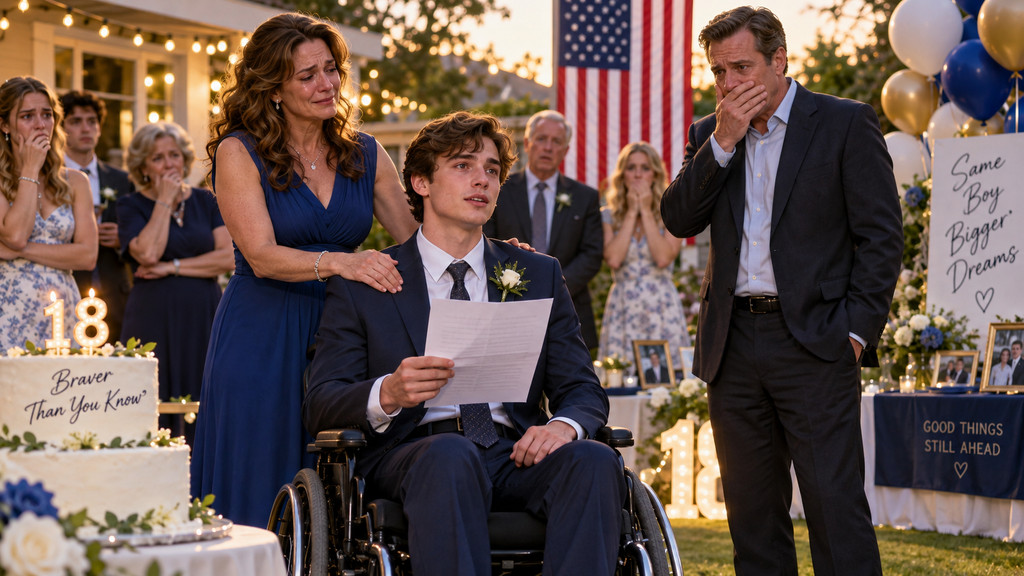
I ordered food from Lucas’s favorite Italian restaurant.
I rented folding tables for the backyard.
I strung warm white lights beneath the maple tree.
I printed photographs from every stage of his life and clipped them along a long piece of twine stretched across our dining room wall.
Lucas at four, grinning with chocolate frosting around his mouth.
Lucas at seven, wearing enormous safety goggles during his first science camp.
Lucas at ten, holding a blue ribbon from a school robotics competition.
Lucas at thirteen beside Coach Miller at his first adaptive sports tournament.
Lucas at sixteen, volunteering with a little boy named Eli who had been afraid to try wheelchair basketball until Lucas spent almost an hour sitting beside him and talking.
Lucas at seventeen, standing beside his science teacher with the regional engineering prize in his hands.
And finally, his senior graduation photograph.
Dark blue gown.
Gold honor cords.
That crooked smile I knew better than my own reflection.
When I stepped back and looked at the photographs, I felt the familiar ache behind my ribs.
Eighteen years.
Somehow, the tiny boy I used to carry from his bed to the bathtub had become a young man who could argue about renewable-energy systems for forty minutes without taking a breath.
He had become stronger than anyone in our home seemed to understand.
Especially his father.
Nathan came downstairs around nine that morning wearing golf clothes.
He stopped at the bottom of the staircase and looked through the sliding doors at the decorated backyard.
“You’re doing all of this?”
I turned from the kitchen counter.
“It’s his eighteenth birthday.”
“I know how old he is.”
“Then why are you asking?”
Nathan opened the refrigerator.
“I just think this is a little much.”
I stared at him.
There were moments during our marriage when a single sentence seemed to illuminate everything I had spent years refusing to see.
That was one of them.
A little much.
For Lucas.
His own son.
Eighteen years old.
Scholarship recipient.
Honor graduate.
Volunteer.
Future engineer.
A young man who had spent most of his childhood learning how to enter rooms that were not designed for him while his father complained that life had not given him the son he ordered.
And a backyard party was “a little much.”
I folded the dish towel slowly.
“What would be the correct amount?”
Nathan glanced at me.
“What?”
“How much celebration is Lucas allowed to have before it becomes too much?”
His jaw tightened.
“That’s not what I meant.”
“It usually isn’t.”
“Claire.”
I turned away before the argument could grow.
Not today.
I refused to let Nathan make that day about himself.
He had already taken enough birthdays from us.
When Lucas was six, Nathan spent half his party outside talking with another father about little league.
When Lucas was nine, Nathan gave him a baseball glove.
A baseball glove.
I remember Lucas holding the gift on his lap and looking confused.
Nathan laughed and said, “Maybe someday we’ll find a use for it.”
I had nearly thrown the thing through a window.
When Lucas turned twelve, Nathan disappeared before cake because one of his coworkers had invited him to a high-school football game.
At fourteen, he told Lucas he was “too old for birthday parties.”
At sixteen, he forgot entirely until I reminded him at dinner.
Every time, Lucas said the same thing.
“It’s okay, Mom.”
Three words that had broken my heart more times than I could count.
It’s okay.
Children say those words when they learn that asking for more hurts worse than pretending they never wanted it.
That morning, however, something felt different.
Lucas came into the kitchen around ten wearing a gray T-shirt and black jeans.
His hair was still damp from his shower.
He rolled toward the refrigerator, took out a carton of orange juice, and drank straight from it.
I stared at him.
He lowered the carton.
“What?”
“A glass, Lucas.”
“I’m eighteen.”
“Congratulations. Eighteen-year-olds still understand glasses.”
He smiled.
“There’s no evidence supporting that.”
Nathan snorted quietly from the other side of the room.
For just a second, it almost sounded like an ordinary family morning.
Then Lucas looked toward his father.
“Dad, you’ll be here tonight, right?”
Nathan stopped scrolling through his phone.
“For the party?”
Lucas nodded.
Nathan looked at his watch.
“I told Mark I might meet him for nine holes this afternoon, but yeah. I should be back.”
Should.
I watched something flicker behind Lucas’s expression.
It vanished quickly.
“All right,” he said.
Nathan must have sensed my stare because he added, “Obviously I’ll be here for the important part.”
Lucas gave him a small smile.
“Good.”
There was something about the way he said it that made me pause.
Not hopeful.
Not relieved.
Certain.
I should have asked him then.
I should have noticed the folded pages tucked beneath his thigh.
But the doorbell rang, and suddenly the house filled with activity.
My sister arrived carrying trays of cookies.
Coach Miller came early to help arrange the tables.
Two of Lucas’s classmates brought speakers.
His engineering teacher, Mr. Patel, showed up with a card and a small box wrapped in silver paper.
By noon, laughter moved through every room in the house.
Nathan left for golf at twelve fifteen.
Of course he did.
I watched his car pull away.
Coach Miller was beside me at the kitchen island.
He followed my gaze through the window.
“He coming back?”
“He says so.”
Coach Miller nodded.
He did not say anything else.
He knew enough.
Everyone close to Lucas eventually knew enough.
Cruelty repeated often enough stops being private.
By four o’clock, the backyard was full.
Neighbors.
Relatives.
Teachers.
Friends.
Parents from the adaptive sports program.
Several younger kids Lucas mentored.
People kept arriving with cards and envelopes and ridiculous balloons.
Someone brought an eighteen-shaped balloon almost as tall as I was.
Lucas was surrounded almost immediately.
And watching him there, laughing beneath those lights, I understood something that made my throat tighten.
Nathan had spent eighteen years behaving as though Lucas’s disability had made his life smaller.
But Lucas had built an enormous life.
Look at all these people, I thought.
Look at all this love.
Look at everything his father refused to see.
At five thirty, Nathan still had not returned.
I texted him.
No response.
At five forty-five, I called.
Voicemail.
At six, we started serving dinner.
Lucas never asked where he was.
That hurt more than if he had.
At six twenty-three, Nathan finally appeared through the side gate.
He had changed shirts.
Apparently he had showered at the golf club.
He carried a small white envelope in one hand.
“Sorry,” he said, kissing my cheek as though we were playing the role of a happy married couple for an audience. “Round went long.”
“You were supposed to be here an hour ago.”
“I’m here now.”
His eyes moved toward the tables.
“Wow. Lot of people.”
“For Lucas.”
“Yes, Claire. I understand whose birthday it is.”
He walked away before I could answer.
I stood there staring at him and realized I felt tired.
Not angry.
Not even disappointed.
Tired.
There is a particular exhaustion that comes from repeatedly explaining basic kindness to an adult who has decided not to understand.
For years, I had translated Nathan to Lucas.
Your father is stressed.
Your father works hard.
Your father loves you in his own way.
Your father doesn’t mean it like that.
Your father grew up differently.
Your father needs time.
Eighteen years of translation.
Eighteen years of turning sharp edges into softer words.
And suddenly I wondered why.
Why had I made it my responsibility to turn cruelty into something our child could survive?
Why had I protected Nathan from the consequences of being exactly who he chose to be?
I looked across the backyard.
Lucas was talking with Eli, the nine-year-old boy he mentored.
Eli had muscular weakness and had only recently started using a wheelchair regularly.
I watched Lucas lean closer as the boy spoke.
He listened carefully.
Completely.
The way Nathan had never listened to him.
Then Eli laughed.
Lucas laughed too.
And something inside me settled.
No more translating.
No more protecting.
If Nathan embarrassed himself tonight, I would let him.
If Lucas wanted to speak, I would let him.
If the truth made Nathan uncomfortable, then for once Nathan could carry his own discomfort.
At seven, we brought out the cake.
It had a small fondant model of one of Lucas’s prototype designs on top—a compact robotic attachment he had created for his senior engineering project.
Everyone gathered around.
My sister lit the candles.
Eighteen flames.
The backyard lights glowed above us while the last orange streaks of sunset disappeared behind the trees.
I stood beside Lucas.
Nathan stood on his other side.
For the photograph, we looked almost perfect.
A mother.
A father.
Their eighteen-year-old son.
All smiling.
Families are strange like that.
A camera captures faces.
It rarely captures history.
Everyone sang.
Lucas closed his eyes before blowing out the candles.
I wondered what he wished for.
He extinguished all eighteen at once.
People cheered.
Then came presents.
Cards.
Jokes.
More photographs.
Nathan handed Lucas the white envelope.
“Happy birthday.”
Lucas opened it.
Inside was a gift card.
I saw the logo.
A sporting-goods store.
For one second, I thought I had to be mistaken.
Then I saw the amount.
Two hundred dollars.
Lucas stared at it.
Nathan patted his shoulder.
“Thought maybe you could find something useful there. They’ve got outdoor gear, clothes, all kinds of things.”
My sister looked down.
Coach Miller rubbed the back of his neck.
Mr. Patel suddenly became very interested in his plate.
Lucas looked at the card again.
Then he placed it quietly inside the envelope.
“Thanks, Dad.”
Nathan smiled, apparently unaware of the awkwardness spreading through the people closest to us.
“You’re welcome.”
I wanted to scream.
Instead, I leaned toward Lucas.
“You okay?”
He looked at me.
And smiled.
But it was not the smile of the little boy who used to say it was okay.
It was different.
Calm.
Almost peaceful.
“Yeah, Mom.”
Then he touched the folded papers tucked beside his chair.
“I’m ready.”
“For what?”
He looked toward the small microphone his classmates had set up for music.
“I want to say something.”
My stomach tightened.
“Lucas…”
“Trust me.”
Those two words stopped me.
Because they were not spoken by a child.
They were spoken by a young man who had spent years preparing for a moment I knew nothing about.
I nodded.
“All right.”
Lucas rolled toward the microphone.
At first, almost nobody noticed.
Then Mr. Patel saw him and lowered the music.
Conversation gradually quieted.
Lucas adjusted the microphone downward.
Someone near the back called, “Speech!”
A few people laughed.
Lucas smiled.
“Yeah,” he said. “Actually.”
Everyone turned toward him.
I stood near the cake table.
Nathan remained beside me.
Lucas unfolded three pages.
His hands were steady.
Mine were not.
He looked around the backyard.
“At the risk of making all of you regret coming here…”
People laughed.
Lucas smiled.
“I wanted to say thank you.”
His eyes moved across the crowd.
“Seriously. There are people here tonight who have known me since I was little, people who taught me, people who coached me, people who tolerated me through group projects…”
Mr. Patel called, “Barely.”
Everyone laughed again.
Lucas pointed at him.
“Especially Mr. Patel.”
Then his expression softened.
“When Mom asked what I wanted for my eighteenth birthday, I didn’t really know what to say. Because eighteen feels weird. Everybody keeps telling me I’m an adult now, which is terrifying because yesterday I spent twenty minutes looking for my phone while it was in my hand.”
A wave of laughter moved through the yard.
I laughed too.
Nathan smiled.
For a few moments, it was light.
Easy.
Then Lucas glanced down at the papers.
“I kept thinking about what turning eighteen is supposed to mean.”
He paused.
“I guess it means people expect you to start deciding who you are.”
Something changed in his voice.
Subtle.
But I heard it immediately.
“I’ve been thinking about that a lot because for a long time, other people decided who I was before I got a chance.”
The backyard became quieter.
Lucas looked toward the younger children from the adaptive sports program.
“When you grow up with a disability, adults talk about you in strange ways. Sometimes they talk around you even when you’re sitting right there. They talk about what you’ll never do. What you might not become. What your parents must have lost.”
My breath caught.
Nathan stopped smiling.
Lucas continued.
“I remember being seven years old and hearing someone tell my mom that she was ‘so strong’ for raising me.”
He smiled faintly.
“I remember wondering what exactly she was surviving.”
A few people lowered their eyes.
“My mom never treated me like something she had to survive.”
His voice shook slightly then.
Just once.
“She treated me like her son.”
I pressed my fingertips against my lips.
Lucas looked at me.
“And Mom, before I say anything else, I need you to hear this in front of everyone because I know you spent years believing things you should never have been made to believe.”
My heart stopped.
Beside me, Nathan shifted.
Lucas looked directly into my eyes.
“My disability was never your fault.”
Silence.
Complete silence.
“You did not cause it.”
He swallowed.
“You did not fail me.”
My vision blurred.
“You did not give me a broken life.”
I covered my mouth.
Lucas’s voice became stronger.
“You gave me a life.”
A tear rolled down my cheek.
Then another.
“You sat beside me during appointments when I was scared. You learned how to take apart my first wheelchair because the repair company couldn’t come for three days. You fought with the school when they tried to put my classes in buildings I couldn’t access. You carried me up two flights of stairs at Aunt Rebecca’s wedding because the elevator broke, even though I was twelve and nearly as tall as you.”
People laughed softly through their tears.
I remembered that staircase.
I remembered Lucas apologizing the entire way.
Sorry, Mom.
Sorry, Mom.
Sorry.
As if his body had been an inconvenience he needed to apologize for.
“You taught me how to drive with hand controls. You stayed awake until two in the morning helping me finish my science-fair project even though you didn’t understand half of it.”
“That is true,” I whispered.
More laughter.
Lucas smiled at me.
“And every single time somebody made me feel like less, you found a way to remind me I was not.”
He folded one page backward.
“So this part is for you.”
My shoulders began shaking.
“I got the final confirmation yesterday.”
I frowned through my tears.
Confirmation?
Lucas smiled.
“The Henderson Foundation is covering the remainder of my university expenses that my engineering scholarship doesn’t cover.”
People gasped.
I stared at him.
“What?”
He laughed.
“I was going to tell you.”
“When?”
“Now.”
Everyone laughed.
I shook my head, crying openly.
Lucas continued.
“It includes tuition, housing, assistive technology, research funding, and a paid summer internship after my first year.”
Mr. Patel shouted, “Yes!”
The backyard erupted.
People clapped.
Coach Miller whistled so loudly several people jumped.
I put both hands over my face.
Nathan clapped too.
But when I looked toward him, something about his expression bothered me.
Not pride.
Surprise.
Almost confusion.
As though he could not understand how Lucas had accomplished something so significant without him.
The applause faded.
Lucas waited.
Then he said, “That’s not actually the reason I wanted to speak.”
The room changed again.
He looked down.
“I wrote most of this speech three months ago.”
My eyes moved toward him.
Three months?
“I kept rewriting it because I was afraid.”
He inhaled.
“And I’m tired of being afraid in my own family.”
Nathan went completely still.
My stomach dropped.
Lucas raised his eyes.
This time he was looking directly at his father.
“Dad.”
Nathan cleared his throat.
“Yeah?”
Lucas held his gaze.
“I need you to listen until I’m finished.”
No one moved.
Nathan gave a stiff smile.
“Of course.”
Lucas nodded.
“When I was little, I thought you didn’t like me because I wasn’t old enough yet.”
Nathan’s face changed.
Lucas continued.
“I thought maybe when I got older, we’d find something we both liked.”
He looked down at the paper.
“I remember asking Mom what football team you liked when I was eight because I wanted to learn the players’ names.”
I remembered.
God, I remembered.
Lucas had watched football videos for weeks.
He memorized statistics.
Learned positions.
Asked me what a quarterback did.
He had not cared about football.
He cared about Nathan.
“I thought if I learned enough,” Lucas said, “maybe you’d want to watch games with me.”
Nathan opened his mouth.
Lucas raised his hand.
“Please. Let me finish.”
Nathan closed it.
“When I was nine, you gave me a baseball glove for my birthday.”
His voice remained calm.
“I slept with it beside my bed for almost a month.”
I felt as though someone had struck me.
I had not known that.
Lucas looked toward the grass.
“I knew I couldn’t use it the way you probably imagined. But I thought maybe the gift meant you had some plan. Maybe we were going to figure something out together.”
Nathan’s face had gone pale.
“You never mentioned the glove again.”
Nobody spoke.
“So eventually, I put it in my closet.”
Lucas paused.
“I still have it.”
Nathan looked down.
“When I was twelve, I heard you tell Uncle Steve that having me meant you’d never know what it felt like to raise a ‘real boy.’”
My sister gasped softly.
Nathan’s head snapped up.
“I never—”
“You did.”
Lucas’s voice did not rise.
That made it worse.
“I was in the hallway.”
Nathan stared at him.
“You thought I was upstairs.”
Lucas unfolded another page.
“When I was thirteen, I heard you blame Mom because she didn’t find better doctors sooner.”
My fingers went cold.
“When I was fourteen, you told Mr. Henderson at his barbecue that some men get sons and some men get ‘life lessons.’”
Nathan’s lips parted.
“When I was fifteen, you said it was difficult watching other fathers get the life you expected.”
Lucas’s voice broke.
Only slightly.
“I was standing behind you.”
Nathan whispered, “Lucas…”
“I said let me finish.”
For the first time, there was anger.
Not loud.
Not uncontrolled.
But unmistakable.
Nathan fell silent.
Lucas breathed slowly.
“When I was sixteen, I won the statewide science competition.”
He looked at his father.
“You didn’t come.”
Nathan stared at the ground.
“You told Mom you had a meeting.”
He paused.
“You were at a football game.”
Nathan’s head jerked upward.
My stomach turned.
I looked at Nathan.
“What?”
He did not look at me.
Lucas continued.
“I know because Mr. Donnelly posted a picture.”
I stared at my husband.
I remembered that night.
I remembered sitting beside Lucas in the auditorium.
One empty chair on his other side.
I remembered telling Lucas his father desperately wanted to be there.
I remembered Nathan arriving home late and saying the client dinner had run long.
A football game.
He had missed our son receiving one of the most important awards of his childhood for a football game.
I felt something inside me break cleanly.
Not crack.
Break.
Nathan whispered, “Claire, I can explain.”
“No.”
My voice surprised even me.
“Not now.”
Lucas looked at me.
I nodded.
Continue.
He did.
“When I was seventeen, I stopped trying to impress you.”
Nathan shut his eyes briefly.
“That was probably the hardest year.”
Lucas stared at the paper.
“Because when you spend most of your childhood trying to earn someone’s love, giving up does not feel like freedom at first.”
His voice trembled.
“It feels like admitting you were never going to earn it.”
I saw Coach Miller wipe his eyes.
Mr. Patel looked down.
Several of Lucas’s friends stood frozen near the patio.
Nathan’s face had lost nearly all its color.
And I finally understood the opening line of the story I would remember for the rest of my life.
Our son stood at his eighteenth-birthday party, looked directly at his father, and delivered a speech that drained every trace of color from Nathan’s face.
But Lucas was not finished.
Not even close.
“The thing is,” he said, “I don’t think you hated me.”
Nathan looked at him.
“I think you hated the future you imagined losing.”
The words seemed to move through everyone.
“You wanted a son who played football.”
Lucas glanced toward his wheelchair.
“You got me.”
He smiled sadly.
“And somewhere along the way, you decided those two things could not both be worth celebrating.”
Nathan’s eyes filled.
It was the first time I had seen him cry in years.
Lucas continued.
“I know you probably think you hid it.”
Nathan whispered, “I never wanted you to feel—”
“But I did.”
Four words.
That was all.
But they landed harder than anything else.
Lucas looked directly at him.
“I did feel it.”
Nathan’s shoulders dropped.
“I felt it every time you compared me to somebody else.”
A pause.
“I felt it every time Mom defended me and you acted like she was being unrealistic.”
Another pause.
“I felt it every time you looked embarrassed when strangers stared.”
Nathan began shaking his head.
“I wasn’t embarrassed by you.”
Lucas’s expression changed.
“Then what were you embarrassed by?”
Nathan had no answer.
Lucas waited.
Nothing.
He nodded slowly.
“That’s what I thought.”
The silence was unbearable.
Then Lucas picked up the last page.
“There’s one more thing.”
I saw Nathan tense.
Lucas looked toward me first.
“Mom, I’m sorry I didn’t tell you this earlier.”
My heart started pounding.
“What?”
He reached beneath the seat cushion beside him and pulled out an old envelope.
The paper was yellowed at the edges.
Nathan saw it.
And froze.
Not metaphorically.
His entire body stopped.
His eyes locked onto that envelope.
I turned toward him.
“What is that?”
Lucas held it carefully.
“I found this in Dad’s desk last year.”
Nathan’s voice came out sharply.
“You went through my desk?”
Lucas did not flinch.
“I was looking for the title paperwork for the adaptive hand-control equipment because Mom said you kept old vehicle documents there.”
Nathan’s eyes moved wildly toward the guests.
“Lucas, this is not the place.”
Lucas laughed once.
There was no humor in it.
“That sentence is kind of the problem, Dad.”
Nathan went silent.
Lucas looked at me.
“This letter is from Dr. Harris.”
I recognized the name instantly.
The pediatric neurologist who had helped diagnose Lucas.
My knees nearly gave out.
“The doctor?”
Lucas nodded.
“It was sent after my diagnosis.”
I stared at the envelope.
“I don’t remember a letter.”
“That’s because it was addressed to Dad.”
Nathan whispered, “Claire.”
I turned toward him.
The expression on his face told me everything before Lucas read a single word.
“No,” I said.
Nathan stepped closer.
“It’s not what you think.”
“What does it say?”
“Claire—”
“What does it say?”
My voice cracked across the yard.
Nathan stopped.
Lucas looked down.
“I’m not going to read the whole thing because most of it is medical information.”
He swallowed.
“But there’s a paragraph Mom needs to hear.”
Nathan’s face had turned gray.
Lucas read.
“Based on the available clinical findings, there is no reasonable basis to conclude that earlier parental recognition or intervention would have prevented Lucas’s mobility impairment.”
I stopped breathing.
Lucas continued.
“The condition appears to have developed independently of any action or inaction by either parent.”
The backyard disappeared.
For eighteen years, Nathan’s voice had lived inside my head.
If you had noticed sooner.
If you had pushed the doctors.
If your family didn’t have—
If you had—
If you had—
If you had.
For eighteen years.
Eighteen.
I looked at Nathan.
He would not meet my eyes.
Lucas lowered the letter.
“Dad received this four months after my diagnosis.”
I felt sick.
“Nathan.”
He stared at the ground.
“Nathan, look at me.”
Slowly, he raised his face.
“You knew?”
His eyes were wet.
“Claire…”
“You knew?”
“I knew what the doctor said.”
The world tilted.
I gripped the back of a chair.
“You knew.”
“It wasn’t that simple.”
A strange sound escaped me.
Half laugh.
Half sob.
“Not that simple?”
“I was angry.”
“At me?”
“At everything!”
Nathan suddenly raised his voice.
“At the situation. At the doctors. At myself. At life. I didn’t know what to do with any of it.”
“So you gave it to me.”
He stared.
I stepped closer.
“All of it.”
“Claire…”
“You took your anger, your disappointment, your grief, whatever you want to call it, and you put it on me.”
“I never said you caused it.”
My eyes widened.
The audacity of that sentence almost left me speechless.
“You spent eighteen years suggesting exactly that.”
“I said things I shouldn’t have.”
“You let me believe I had hurt our child.”
“I didn’t mean—”
“For eighteen years!”
The words tore out of me.
A few people flinched.
I no longer cared.
“For eighteen years, Nathan, I lay awake wondering if I had missed something. I replayed my pregnancy. I replayed every appointment. Every fever. Every time he stumbled as a toddler. I wondered whether there was some moment when a better mother would have understood.”
My voice dissolved.
“You watched me do that.”
Nathan began crying.
“I was ashamed.”
“Of what?”
He looked at Lucas.
Then me.
“Of how I felt.”
I stared at him.
“And making me ashamed was easier?”
Nathan covered his mouth.
Lucas sat silently.
I looked at the letter again.
Something inside me became very quiet.
The kind of quiet that comes after a door closes.
I had thought the worst thing Nathan had done was fail to see Lucas.
I was wrong.
He had seen enough to know better.
He had simply chosen resentment anyway.
And when the truth threatened the story he needed to tell himself, he hid the truth.
He let me carry the blame because he did not want to carry his own disappointment.
Lucas spoke softly.
“Mom.”
I turned.
He held out the letter.
I walked to him.
My hands shook as I took it.
There it was.
Black ink on old paper.
A few sentences that could have freed me seventeen years earlier.
I ran my thumb over the fold.
Then I looked at Nathan.
“Where was this?”
He did not answer.
Lucas did.
“Locked drawer.”
My eyes stayed on my husband.
“Locked?”
Nathan closed his eyes.
I nodded slowly.
That answer was enough.
Lucas took a breath.
“I found something else with it.”
Nathan’s eyes opened.
“What?”
For the first time, genuine fear flashed across his face.
Lucas reached beside him again and pulled out a small notebook.
Nathan stared.
I had seen it before.
Brown leather.
Nathan carried it during the first years of our marriage.
He used to write financial notes and work reminders in it.
Lucas opened it.
“Dad wrote in this after some of my appointments.”
Nathan moved forward.
“That is private.”
Coach Miller stepped subtly between Nathan and Lucas.
Nathan stopped immediately.
Lucas looked at the notebook.
“I’m not reading it.”
Relief crossed Nathan’s face.
“For a while,” Lucas continued, “I thought I would.”
He closed it.
“I wanted everyone to hear what you wrote.”
Nathan stared at him.
“But I changed my mind.”
Lucas placed the notebook on the table.
“I don’t need to humiliate you.”
Those words seemed to cut Nathan deeper than any quotation could have.
“I just needed Mom to know the truth.”
I started crying again.
Lucas looked at his father.
“And I needed you to know something.”
Nathan whispered, “What?”
“I remember you.”
Nathan flinched.
Lucas’s voice softened.
“I remember all of it.”
Not angry.
Not cruel.
Just true.
“The jokes.”
His eyes filled.
“The looks.”
A tear slipped down his cheek.
“The things you said when you thought I couldn’t hear you.”
Nathan wiped his face.
“And I remember the things you didn’t do.”
Lucas paused.
“You probably don’t remember those.”
Nathan’s shoulders shook.
“The awards you missed.”
A breath.
“The nights you didn’t come home until after I went to bed.”
Another.
“The times Mom asked you to take me somewhere and you said you were busy.”
Lucas wiped his cheek.
“The time I asked you if you wanted to come watch wheelchair basketball, and you said it wasn’t really your thing.”
Nathan pressed both palms against his eyes.
“It became my thing,” Lucas said, “because somebody showed up.”
He turned.
“Coach Miller.”
The older man lowered his head.
“You taught me how to stop being embarrassed about taking up space.”
Coach Miller’s eyes glistened.
Lucas looked at Mr. Patel.
“You taught me that being good at something isn’t the same as being useful, and that the best engineering starts by listening.”
Mr. Patel nodded, unable to speak.
Then Lucas looked at me.
“And Mom…”
His voice broke completely.
I walked toward him before he could finish.
He held up one hand.
“Wait.”
I stopped.
He smiled through tears.
“I practiced this.”
A laugh moved softly through the crowd.
I laughed too.
He looked down at his final page.
“You taught me that love is not measured by how normal somebody can make your life look.”
I closed my eyes.
“You never asked me to become easier to love.”
That sentence undid me.
I bent forward, covering my face.
My sister put an arm around me.
Lucas continued.
“So tonight I’m choosing what I carry into adulthood.”
He looked at Nathan.
“And what I leave behind.”
Nathan stared at him.
“I’m leaving behind the idea that I owe anyone proof that my life is worth as much as theirs.”
Silence.
“I’m leaving behind the idea that my body is an apology.”
Coach Miller began crying openly.
“I’m leaving behind the idea that being your son means I have to keep auditioning for the role.”
Nathan’s knees seemed to weaken.
He grabbed the back of a chair.
“And I’m leaving behind your disappointment.”
Lucas folded the papers.
“Because it belongs to you.”
Nathan stared at him.
Lucas placed the speech on his lap.
“It was never mine.”
Nobody moved.
No applause.
No cheering.
Not yet.
The moment was too raw for that.
Nathan took one step toward Lucas.
“Son…”
Lucas’s eyes closed briefly.
Then opened.
“My name is Lucas.”
Nathan looked confused.
“I know.”
“Then use it.”
Nathan swallowed.
“Lucas.”
“Yes?”
“I am sorry.”
Lucas held his gaze.
Nathan’s voice shook.
“I’m sorry.”
A long pause.
Then Lucas asked the question I think Nathan had spent eighteen years avoiding.
“For what?”
Nathan opened his mouth.
Nothing came.
Lucas waited.
Nathan looked around the yard as if somebody might hand him the answer.
Nobody did.
Finally, he whispered, “For hurting you.”
Lucas nodded.
“How?”
Nathan stared.
“What?”
“How did you hurt me?”
Nathan’s breathing became uneven.
Lucas remained calm.
“If you’re apologizing, then tell me what you’re apologizing for.”
Nathan looked at me.
I said nothing.
For years, I had given him words.
Not this time.
He had to find his own.
Nathan looked back at our son.
“I made you feel unwanted.”
Lucas’s face tightened.
Nathan continued.
“I made you feel like you disappointed me.”
A tear fell.
“I compared you to a child who never existed.”
Lucas’s chin trembled.
“I blamed your mother because I didn’t know how to accept that my expectations had changed.”
He looked at me.
“I lied to her.”
My eyes burned.
“I hid that letter.”
Nathan’s voice became barely audible.
“I let her carry something I knew wasn’t hers.”
He looked back at Lucas.
“And I missed your life.”
That was the sentence that finally broke him.
Nathan folded forward.
His hands covered his face.
“I missed your life.”
He sobbed.
Not quietly.
Not gracefully.
Eighteen years of denial seemed to collapse all at once.
“You were right there.”
His shoulders shook.
“You were right there, and I kept looking for somebody who wasn’t.”
Lucas cried silently.
Nathan sank into a chair.
“I’m sorry.”
No one rescued him.
No one told him it was okay.
Because sometimes forgiveness offered too quickly becomes another way of protecting the person who caused the wound.
Lucas wiped his face.
“I believe you’re sorry.”
Nathan looked up.
Hope appeared immediately.
Lucas saw it.
“But that doesn’t fix it.”
The hope faded.
“I know.”
“I need space from you.”
Nathan nodded too quickly.
“Okay.”
“I mean real space.”
Nathan’s face tightened.
“For how long?”
“I don’t know.”
“Lucas—”
“I don’t know.”
His voice became firmer.
“I spent eighteen years waiting for you to be ready to have me as your son.”
Nathan flinched.
“I’m not spending the beginning of my adult life waiting again.”
Nathan lowered his eyes.
Lucas continued.
“If you want a relationship with me someday, then you need to figure out why you did this without making me responsible for teaching you.”
Nathan nodded.
“I will.”
“You need help.”
“I know.”
“Actual help.”
“I know.”
Lucas took a deep breath.
“And you need to stop blaming Mom for everything you refuse to face in yourself.”
Nathan looked at me.
“I will.”
I stared at him.
For eighteen years, I had wanted to hear that.
Now it felt strangely small.
Promises are inexpensive when the consequences finally arrive.
Lucas looked around the yard.
“That’s all.”
Nobody knew what to do.
Then Eli, the nine-year-old from Lucas’s adaptive sports program, started clapping.
Just a few small claps.
His mother touched his shoulder, perhaps worried it was inappropriate.
But Lucas smiled.
So Eli clapped harder.
Coach Miller joined him.
Then Mr. Patel.
Then Lucas’s friends.
Then my sister.
And suddenly everyone was applauding.
Not because Lucas had destroyed his father.
He hadn’t.
That was never what the speech was.
They applauded because he had finally named the truth.
Because he had taken eighteen years of shame that had been handed to him and refused to carry it one day longer.
I walked to him.
He opened his arms.
I bent down and held my son.
He buried his face against my shoulder.
For several seconds, we were both crying too hard to speak.
Then he whispered, “You really didn’t know about the letter?”
“No.”
“I’m sorry.”
I pulled back instantly.
“No.”
I cupped his face.
“No, Lucas.”
He looked at me.
“You do not apologize for telling me the truth.”
His mouth trembled.
“I thought it would hurt you.”
“It does.”
I nodded.
“It hurts terribly.”
His eyes filled again.
“But the lie hurt longer.”
He pressed his forehead against mine.
“I love you, Mom.”
“I love you more than you will ever understand.”
From behind us came Nathan’s voice.
“I’m going to go.”
I looked over my shoulder.
He stood near the gate.
His face was swollen.
His posture seemed smaller somehow.
For years, he had filled every room with dissatisfaction.
Now he looked like a man seeing the actual size of himself for the first time.
Lucas nodded.
“Okay.”
Nathan waited.
Perhaps some part of him expected Lucas to stop him.
He did not.
Nathan looked at me.
“Claire?”
I stood.
“I’ll talk to you tomorrow.”
“Can I come home?”
The question stunned me.
Home.
The word suddenly felt different.
I looked through the sliding glass doors.
At the photographs.
At the kitchen where Lucas had learned to cook.
At the hallway where he had overheard his father saying he was not a real boy.
At the staircase where I had once sat crying silently because Nathan had accused me of missing the signs of Lucas’s condition.
At the dining room where years of certificates and scholarship letters had been met with a single word.
Good.
I thought about the locked drawer.
The letter.
The lie.
“No.”
Nathan stared.
“Claire.”
“Not tonight.”
“This is my house too.”
“Then you can call a lawyer tomorrow.”
His face changed.
Lucas looked at me.
So did everyone else.
But I had never been more certain of anything.
Nathan whispered, “What are you saying?”
I walked closer.
“I’m saying I cannot keep living inside a marriage where I’m required to absorb whatever you refuse to face.”
“Claire, please.”
“I defended you.”
My voice shook.
“For years.”
He closed his eyes.
“I defended you to him.”
I pointed toward Lucas.
“I made excuses for you because I thought there was some good man beneath all that resentment who simply didn’t know how to reach his son.”
“There is.”
“Maybe.”
Nathan opened his eyes.
“But if he exists, Nathan, I have spent eighteen years waiting for him too.”
His mouth tightened.
“I can change.”
“I hope you do.”
He stared at me.
I meant it.
Not sarcastically.
Not cruelly.
For Lucas’s sake, I hoped Nathan changed.
For Nathan’s sake, I hoped he changed.
But I finally understood something I wish I had learned years earlier.
Someone’s potential to become better is not a contract requiring you to remain available while they continue hurting you.
“I hope you become someone Lucas can someday trust.”
I swallowed.
“But I don’t know if I can ever trust you again.”
Nathan looked toward the letter in my hand.
He nodded.
Slowly.
Painfully.
Then he left.
The gate closed behind him.
Nobody spoke for several seconds.
I stood beneath the string lights holding a seventeen-year-old medical letter in one hand and watching the man I had loved for more than two decades walk away.
I expected to feel devastated.
Instead, beneath the grief, I felt something else.
Relief.
It frightened me at first.
Then I realized relief does not mean the love was false.
Sometimes relief simply means the burden was real.
Lucas rolled beside me.
“You okay?”
I laughed through my tears.
“Why are you asking me that?”
“Because you look like you might either cry or commit a felony.”
Coach Miller coughed into his hand.
My sister laughed.
I looked at Lucas.
And for the first time that evening, I laughed so hard I had to wipe tears from my eyes again.
“Cake,” Lucas announced.
“What?”
“We still have cake.”
He turned toward everyone.
“I did not emotionally traumatize this entire backyard just to let expensive cake go to waste.”
That broke the tension.
People laughed.
Mr. Patel raised his plate.
“Finally, leadership.”
Someone restarted the music.
My sister began cutting cake.
Conversations returned slowly.
Not normally.
Nothing about that evening would ever be normal again.
But life has a strange ability to continue around enormous moments.
Children asked for second slices.
Someone spilled lemonade.
Eli challenged Lucas to a race across the patio.
My aunt complained about mosquitoes.
The birthday balloons kept bumping against the fence.
And in the middle of everything, Lucas smiled.
Really smiled.
Not the careful smile he used around Nathan.
Not the reassuring smile he gave me when he wanted me to stop worrying.
His own smile.
Free.
Later, after everyone left, I found him alone beneath the maple tree.
Most of the string lights were still on.
Empty plates covered the tables.
Crushed napkins moved across the grass in the night breeze.
Lucas was staring at the photographs clipped along the wall inside.
I sat beside him.
For several minutes, neither of us spoke.
Then he said, “I almost didn’t do it.”
“The speech?”
He nodded.
“I felt sick all week.”
“Why didn’t you tell me?”
“Because you would’ve worried.”
“I’m your mother. Worrying is one of my primary skills.”
He smiled.
Then his face grew serious.
“I was scared you’d defend him.”
The words hurt.
Not because they were unfair.
Because they weren’t.
I looked down.
“I probably gave you reasons to think that.”
“Mom—”
“No.”
I shook my head.
“You told the truth tonight. I need to do the same.”
He watched me.
“I should have protected you better.”
“You did protect me.”
“Not enough.”
I looked toward the house.
“I kept telling myself your father’s behavior wasn’t bad enough to break up our family.”
Lucas said nothing.
“I thought staying gave you stability.”
My voice cracked.
“I thought if I loved you enough for both of us, maybe his failures wouldn’t hurt as much.”
Lucas looked at his hands.
“I knew you were trying.”
“That doesn’t mean I always got it right.”
“No parent gets it right.”
“That sounds suspiciously mature.”
“I turned eighteen today.”
“Ah. Of course.”
He smiled.
Then he reached for my hand.
“I never blamed you for Dad.”
I squeezed his fingers.
“I blamed myself.”
“I know.”
I looked at him.
“How?”
Lucas shrugged sadly.
“Because every time he hurt me, you looked like you got hurt twice.”
I closed my eyes.
Children see everything.
That is what adults forget.
We think whispered arguments disappear behind bedroom doors.
We think forced smiles hide tension.
We think children only remember what we explain.
They do not.
They remember the temperature of rooms.
The silence after certain names.
The footsteps in hallways.
The way one parent looks when the other parent leaves.
Lucas rested his head against my shoulder.
“You know the weirdest thing?”
“What?”
“I don’t hate him.”
I stroked his hair.
“You don’t have to.”
“I thought after the speech I would.”
He stared into the dark yard.
“But mostly I feel sad.”
“For him?”
“Kind of.”
He thought.
“He missed a lot.”
“Yes.”
“And now he can’t get it back.”
“No.”
Lucas nodded.
“That’s sad.”
I looked at my son.
Nathan had spent years mourning the imagined child he believed he had lost.
Lucas, meanwhile, was mourning the father who had been physically present but emotionally absent.
Only one of those losses had ever been real.
The next morning, Nathan sent me a message.
Can we talk?
I stared at it for several minutes.
Then I replied.
Tomorrow. Public place.
He answered almost immediately.
Okay.
No argument.
No guilt.
No demand.
It was such a small change that I almost laughed.
One respectful text after eighteen years.
Change does not arrive dramatically most of the time.
Sometimes it begins in the absence of an old behavior.
Nathan and I met at a coffee shop Monday morning.
He looked terrible.
Unshaven.
Wrinkled shirt.
Dark circles beneath his eyes.
I had seen him after funerals looking more composed.
He stood when I approached.
“Thank you for coming.”
I sat.
He remained standing for a second, then sat across from me.
Neither of us ordered anything.
Nathan placed his hands on the table.
“I called a therapist.”
I said nothing.
“My first appointment is Wednesday.”
“That’s good.”
“I also called Lucas.”
My eyes sharpened.
“He didn’t answer.”
“Did you leave a message?”
“Yes.”
“What did you say?”
Nathan swallowed.
“I told him he didn’t need to call me back.”
I watched him carefully.
“And?”
“I told him I would respect what he asked for.”
I nodded.
Nathan looked down.
“I barely slept.”
I did not tell him I had slept better than I had in months.
Maybe years.
“I kept thinking about everything he said.”
His fingers trembled.
“I remember giving him that baseball glove.”
“So does he.”
Nathan closed his eyes.
“I thought I was being optimistic.”
I stared.
“Optimistic?”
“I thought maybe…”
His voice faded.
I waited.
Nathan looked ashamed.
“I thought maybe the doctors could be wrong.”
There it was.
Even the gift had not been for Lucas.
It had been for the imaginary son Nathan refused to bury.
“I used to imagine that one day he would walk into the backyard.”
I felt something cold settle inside me.
Nathan continued.
“I know how terrible that sounds.”
“It sounds honest.”
He nodded.
“I think I spent years waiting for his life to become the life I had planned.”
“And while you waited, you missed the one he had.”
Nathan flinched.
“Yes.”
We sat quietly.
After a minute, he said, “I need to explain the letter.”
“You can explain it.”
He looked relieved.
“But you cannot excuse it.”
The relief disappeared.
“Okay.”
He took a breath.
“When Dr. Harris sent it, I had already spent months telling myself there had to be a reason.”
I looked at him.
“I kept thinking if there was a reason, then there was something we could fix.”
“We?”
He looked down.
“You.”
The word barely came out.
I nodded.
At least he said it.
“I blamed you because if you were responsible, then somebody was responsible. And if somebody was responsible, then maybe the world wasn’t as random as it felt.”
I stared at him.
“That is one of the cruelest things anyone has ever admitted to me.”
“I know.”
“No.”
I leaned forward.
“I need you to understand what you did.”
His eyes filled.
“You were afraid of randomness, so you gave me guilt.”
Nathan nodded.
“You wanted a reason, so you made me the reason.”
“Yes.”
“You received proof that I had done nothing wrong.”
His mouth trembled.
“Yes.”
“And instead of showing me…”
“I put it away.”
“In a locked drawer.”
“Yes.”
I looked through the café window.
A woman across the street pushed a stroller.
A delivery truck stopped at the curb.
Normal life everywhere.
“How many times did you watch me cry about it?”
Nathan stared at the table.
“I don’t know.”
“I do.”
He looked up.
“A lot.”
My eyes burned.
“You held me sometimes.”
Nathan started crying.
“You held me while I cried over something you knew wasn’t true.”
“I’m sorry.”
“I don’t know what to do with that.”
“I know.”
“No, you don’t.”
He nodded.
“You’re right.”
We sat there for nearly an hour.
Nathan did not beg me to stay.
To his credit, he did not accuse me of abandoning him.
He did not say I was overreacting.
He did not ask me to hide what happened from our families.
Instead, he answered my questions.
Ugly questions.
Questions whose answers hurt.
Had he really gone to the football game instead of Lucas’s science award?
Yes.
Had he lied because he knew I would be furious?
Yes.
Had he complained about Lucas to coworkers?
Yes.
Had he ever wished Lucas were different?
Nathan cried before answering.
“Yes.”
I hated the answer.
But I respected the fact that, for once, he did not soften it.
Then I asked the hardest question.
“Did you love him?”
Nathan stared at me.
“Yes.”
“Did you?”
“Yes.”
His voice broke.
“I loved him badly.”
That sentence stayed with me.
Loved him badly.
People sometimes imagine love as proof of innocence.
I loved you, therefore I could not have harmed you.
But those things are not opposites.
A person can love you and still wound you.
They can love you selfishly.
Fearfully.
Conditionally.
They can love the person they want you to become while failing the person standing before them.
Love does not erase damage.
Sometimes love makes the damage harder to name.
Nathan wiped his face.
“I don’t expect you to forgive me.”
I watched him.
“That’s good.”
A surprised breath escaped him.
Almost a laugh.
I continued.
“Because I don’t know whether I will.”
He nodded.
“And even if I do, forgiveness would not mean returning to how things were.”
“I understand.”
“I’m filing for separation.”
His expression collapsed.
He looked toward the window.
Then down.
For several seconds, he said nothing.
Finally, he whispered, “Okay.”
That hurt too.
Strangely.
I had spent years wishing he would listen to me.
Now he finally was.
But listening after the bridge collapses does not rebuild it automatically.
“I’m not doing this to punish you.”
“I know.”
“I’m doing it because I don’t know who I am in this marriage anymore.”
Nathan nodded.
“I made you smaller too.”
The accuracy startled me.
“Yes.”
He rubbed both hands over his face.
“I’m sorry.”
“I know.”
This time, I believed him.
And still I left.
That was another lesson I had learned too late.
You can believe someone is sorry and still decide not to return.
The separation became official three months later.
Nathan rented an apartment fifteen minutes away.
At first, Lucas had almost no contact with him.
Nathan sent one text every Sunday.
Nothing dramatic.
No manipulation.
Usually something simple.
Thinking of you. Hope classes are going well.
Lucas rarely responded.
Nathan kept going to therapy.
I knew because he told me during conversations about paperwork and finances, but I refused to manage his progress.
That was his work.
Not mine.
Meanwhile, Lucas prepared for university.
Our house filled with boxes.
Chargers.
Books.
Tools.
Clothes.
Half-finished packing lists.
For someone who could design sophisticated mechanical systems, my son was astonishingly incapable of folding a sweatshirt.
One afternoon, I walked into his room and found six hoodies stuffed into a suitcase like victims of a small textile explosion.
“What happened here?”
Lucas looked innocent.
“I packed.”
“This is not packing. This is evidence.”
He laughed.
“I’m an engineer, not a magician.”
“Fold them.”
“They’ll unfold.”
“You are testing the limits of my unconditional love.”
He grinned.
Those weeks were good.
Painful, but good.
Without Nathan’s resentment filling the rooms, the house felt lighter.
I hated realizing that.
I had spent years believing his moods were weather.
Something we had to adapt to.
Only after he left did I understand they were choices.
One evening, while we were packing kitchen supplies for Lucas’s dorm, he stopped.
“Mom?”
“Yes?”
“Dad asked if he could come move me in.”
I froze with a box of plates in my hands.
“What did you say?”
“I haven’t answered.”
I set the plates down.
“What do you want?”
He looked uncertain.
“I don’t know.”
“Then don’t answer yet.”
“What do you think I should do?”
I almost answered automatically.
For eighteen years, I had tried to guide him toward his father.
Give him another chance.
He’s trying.
He loves you.
But this was not mine to manage.
“What I think doesn’t matter.”
Lucas frowned.
“It matters.”
“Not more than what you think.”
He stared at the box between us.
“I kind of want him there.”
I waited.
“But I don’t want it to become a whole emotional thing.”
“Then tell him that.”
“He’ll probably cry.”
“He might.”
“I hate when he cries.”
“Why?”
“Because I feel guilty.”
There it was.
I leaned against the counter.
“Lucas, somebody feeling pain because of a boundary does not automatically make the boundary cruel.”
He looked at me.
“That sounds like something you learned in therapy.”
“It is absolutely something I learned in therapy.”
He smiled.
I had started seeing a therapist too.
At first, I went because I wanted help understanding Nathan.
Three sessions in, my therapist asked why so much of my life revolved around understanding everyone except myself.
I did not appreciate the question.
Which probably meant I needed it.
Lucas eventually told Nathan he could come.
With conditions.
No speeches.
No pressure.
No photographs pretending everything was repaired.
No asking when Lucas would forgive him.
Nathan agreed.
Move-in day came in late August.
The campus was beautiful.
Wide paths.
Automatic doors.
Accessible dorms.
Ramps that looked like intentional parts of the architecture rather than apologetic additions bolted onto old buildings.
Lucas noticed immediately.
“They actually thought about us before construction.”
He sounded almost amazed.
I swallowed.
“You deserve spaces that expect you.”
He looked at me.
“Was that inspirational?”
“Very.”
“I hated it.”
“Unfortunate.”
Nathan arrived separately.
He wore jeans and an old university T-shirt he had bought online.
He stood awkwardly beside his car.
“Hey.”
Lucas nodded.
“Hey.”
For a moment, nobody moved.
Then Nathan opened his trunk.
“I brought tools.”
Lucas looked inside.
There were so many tools it looked as though Nathan expected us to construct another dormitory.
Lucas raised an eyebrow.
“Planning to rebuild the campus?”
Nathan smiled nervously.
“I wasn’t sure what you’d need.”
For the next three hours, we carried boxes.
Nathan followed Lucas’s instructions.
That sounds insignificant.
It wasn’t.
When Lucas said a shelf needed to be six inches lower, Nathan moved it.
When Lucas said the desk placement blocked his turning radius, Nathan shifted it.
When Lucas explained where he wanted things, Nathan listened.
He did not suggest what would be “easier.”
He did not take over.
He did not treat accessibility as a burden.
At one point, Lucas was installing a small device beneath the desk.
Nathan crouched beside him.
“What does that do?”
“It lets me control the lamp, fan, blinds, and door from one panel.”
“You built it?”
“Modified it.”
Nathan nodded.
“That’s clever.”
Lucas looked at him.
For years, Nathan had offered praise like a ration.
Small.
Rare.
Conditional.
I watched Lucas absorb those two words cautiously.
“Thanks.”
Nathan did not add anything.
That restraint mattered.
Later, when everything was unpacked, we stood near the dorm entrance.
The goodbye.
I had been dreading it for months.
I hugged Lucas so tightly he complained about respiratory function.
“Mom.”
“I know.”
“Mom.”
“One more second.”
“You’re crushing my internal organs.”
“You have extras.”
“That is medically inaccurate.”
I released him, crying.
He wiped one of my tears with his thumb.
“I’m two hours away.”
“That is essentially another continent.”
“I will call.”
“Every day?”
He stared at me.
“Frequently.”
“I’ll accept frequently.”
He turned toward Nathan.
The air changed.
Nathan looked terrified.
Not of rejection exactly.
Of doing the wrong thing.
Which, considering our history, was progress.
He stepped forward.
Then stopped.
“Can I hug you?”
Lucas looked surprised.
Nathan had never asked before.
He had always assumed access.
Father.
Son.
Family.
As if relationships themselves granted permanent permission.
Lucas studied him.
Then nodded.
“Yeah.”
Nathan hugged him.
Briefly.
Carefully.
When he stepped away, his eyes were wet.
He did not say, I’m proud of you.
Maybe he sensed those words would feel complicated.
Instead he said, “Thank you for letting me come.”
Lucas nodded.
“Thanks for helping.”
We started walking toward the parking lot.
After about ten steps, Lucas called, “Dad.”
Nathan turned so quickly I almost smiled.
“Yeah?”
Lucas pointed toward the room.
“You forgot your drill.”
Nathan laughed.
“I’ll get it.”
Lucas watched him walk back inside.
Then looked at me.
“That was okay.”
I squeezed his shoulder.
“Okay is a beginning.”
During Lucas’s first semester, things changed slowly.
Very slowly.
He called me four or five times a week.
Sometimes because he missed me.
Usually because he needed to explain why his meal plan was a criminal conspiracy.
He called Nathan twice.
Then three times.
Nathan never told me details unless Lucas had already mentioned them.
That mattered too.
He was finally learning that his relationship with our son did not belong to him as evidence.
It did not need to be displayed to prove improvement.
In October, Lucas joined a research team working on low-cost modular accessibility devices.
In November, one of his designs won a student innovation grant.
The university posted a photograph.
Lucas stood beside his prototype, smiling beneath a banner.
Nathan sent me the link.
One sentence.
He looks happy.
I stared at it for a long time.
Then replied.
He is.
Nathan did not write, I’m proud.
Did not ask whether Lucas had mentioned him.
Did not turn the accomplishment into his own regret.
A year earlier, that would have been impossible.
Christmas was strange.
Lucas decided he wanted Nathan there for dinner.
Not Christmas morning.
Dinner.
Nathan arrived at five with pie.
My sister nearly dropped a serving spoon when she saw him.
But she behaved.
Mostly.
Nathan looked around the house.
The family photographs were still up.
Some included him.
Some did not.
He did not comment.
At dinner, Lucas talked about university.
Research.
Friends.
A professor who assigned an impossible project.
A girl named Maya who was apparently “just a friend,” which he said far too quickly.
Nathan listened.
Actually listened.
Then Lucas mentioned that his adaptive technology group planned to attend a major design competition.
Nathan asked, “Can people come watch?”
Lucas paused.
“Yes.”
Nathan nodded.
“If you’re comfortable with it, I’d like to.”
Lucas looked at me.
I kept my face neutral.
His choice.
Lucas looked back at Nathan.
“Okay.”
Nathan smiled.
“Okay.”
In March, the competition took place in another state.
Nathan drove four hours.
He arrived early.
I knew because Lucas called me afterward.
“He was in the front row.”
I smiled into the phone.
“How did that feel?”
“Weird.”
“Good weird or bad weird?”
“Both.”
I understood.
Healing often feels like that.
Good things can hurt when they remind you how long you waited for them.
Lucas’s team placed second.
Nathan did not leave after the awards.
He stayed while Lucas packed equipment.
He helped another student load a wheelchair into a van.
Then he took Lucas and two friends to dinner.
A week later, Lucas called me.
“Dad apologized again.”
I sat on my bed.
“What happened?”
“Nothing.”
“What do you mean?”
“He just apologized.”
Lucas sounded almost puzzled.
“We were talking about the competition, and he said seeing me there made him think about how much he missed when I was younger.”
I waited.
“He said he was sorry.”
“And?”
“And nothing.”
“No explanation?”
“No.”
“No request for forgiveness?”
“No.”
“No ‘but I was going through a hard time’?”
“No.”
I smiled.
“What did you say?”
“I said, ‘I know.’”
A laugh escaped me.
“What?”
“That’s what I used to say to him.”
Lucas laughed.
“Genetics.”
By the second year of university, Lucas and Nathan spoke regularly.
Not constantly.
Not like nothing had happened.
Their relationship did not become one of those miraculous stories where eighteen years of damage disappear after a single emotional speech.
Real life is rarely that tidy.
Some things never came back.
Lucas never became comfortable watching football with Nathan.
Nathan eventually stopped asking.
Father’s Day remained complicated.
Certain jokes still made Lucas go quiet.
There were moments when Nathan said something careless and Lucas pulled away.
But now Nathan noticed.
And when he noticed, he did something he had almost never done before.
He corrected himself.
Without demanding praise.
Without collapsing into self-pity.
Without making Lucas comfort him.
Three years after the birthday party, Nathan and I finalized our divorce.
People were surprised it took that long.
But separating a twenty-three-year marriage is not like removing a bandage.
There were accounts.
Property.
Insurance.
Memories.
Habits.
The practical skeleton of an entire adult life.
Nathan asked once, during mediation, whether I thought there was any chance for us.
I looked at him across the conference table.
He had changed.
I could admit that.
He went to therapy every week.
He volunteered with an adaptive recreation program—not because Lucas asked him to, but because his therapist apparently challenged him to confront the discomfort he had spent years avoiding.
He apologized to my family.
He told his own father the truth about how he had treated Lucas.
He had become more patient.
Less defensive.
More willing to admit when he was wrong.
If I had met that man at thirty, perhaps our story would have been different.
But I had not.
I had married the man who became Nathan as I knew him.
And becoming better did not erase what had happened.
“I forgive parts of it,” I told him.
He nodded.
“But I don’t want the marriage back.”
Pain crossed his face.
He looked down.
“I understand.”
“I hope you know that your changes matter.”
He looked at me.
“They matter to Lucas.”
I paused.
“They matter to me too.”
His eyes filled.
“But I spent too many years disappearing inside this relationship.”
He nodded.
“I know.”
“I want to find out who I am when I’m not trying to hold everybody together.”
Nathan smiled sadly.
“You deserve that.”
Four simple words.
I had once wanted him to say things like that so badly.
Now I could receive them without needing them.
That was freedom too.
Lucas graduated four years after his eighteenth-birthday speech.
The ceremony took place beneath a bright May sky.
Thousands of people filled the stadium.
I sat beside my sister.
Nathan sat two seats away.
Coach Miller came too.
Mr. Patel had driven three hours.
When Lucas’s name was announced, we all stood.
Dr. Lucas Bennett.
Bachelor’s degree in mechanical engineering.
Graduating with honors.
Recipient of the Chancellor’s Innovation Award.
He rolled across the stage wearing a blue gown.
For one ridiculous moment, I saw every version of him at once.
The toddler gripping my hands.
The six-year-old afraid of his first wheelchair.
The nine-year-old sleeping beside a baseball glove he did not understand.
The twelve-year-old comforting me when I should have been comforting him.
The teenager pretending one word from his father was enough.
The eighteen-year-old beneath the backyard lights saying:
I’m leaving behind your disappointment.
Because it belongs to you.
It was never mine.
Lucas accepted his diploma.
The stadium erupted.
Nathan shouted louder than anyone.
I looked toward him.
Tears streamed down his face.
But he was smiling.
Not grieving the son he imagined.
Celebrating the one standing before him.
Finally.
After the ceremony, Lucas found us near the fountain.
I hugged him first.
Naturally.
Mother’s privilege.
Then Coach Miller.
Mr. Patel.
My sister.
Several friends.
Nathan stood slightly apart.
Waiting.
Lucas looked toward him.
“Dad.”
Nathan stepped forward.
Lucas held out his diploma.
“Want to see?”
Nathan took it carefully.
His hands trembled.
He looked at the name.
Then back at Lucas.
“I’m proud of you.”
Lucas smiled.
This time, he did not look away.
“Thanks.”
Nathan’s face crumpled.
Lucas laughed.
“Don’t start.”
“I’m trying.”
“You cry constantly now.”
“Therapy ruined me.”
Everyone laughed.
Then Lucas reached forward.
He hugged his father.
Not because he owed him.
Not because the past had disappeared.
Because he chose to.
That difference mattered.
Later that evening, we went to dinner.
At some point, Lucas stood to make another speech.
Everyone groaned.
He laughed.
“This one is short.”
Nathan pointed at him.
“You said that last time.”
The table burst into laughter.
Even Lucas laughed.
Then he raised his glass.
“I just wanted to thank everybody who helped me get here.”
He looked at me.
“Especially Mom.”
I shook my head.
He ignored me.
“She taught me that the people who really love you don’t spend their lives wishing you were easier.”
My eyes filled.
Then he looked at Nathan.
“And Dad…”
The table became quieter.
Nathan looked nervous.
Lucas smiled.
“Thank you for learning how to see me.”
Nathan’s eyes immediately filled.
Lucas continued.
“I wish you had learned sooner.”
Nathan nodded.
“So do I.”
“But I’m glad you learned.”
Nathan lowered his head.
“Me too.”
Lucas raised his glass.
“To people becoming better.”
We raised ours.
And maybe that would have been a beautiful place to end the story.
But life kept going.
It always does.
Two years after graduation, Lucas launched a small accessibility-design company with Maya—the “just a friend” who, unsurprisingly, had become very much not just a friend.
Their first major product was a modular home-control system designed for people with limited mobility.
Affordable.
Repairable.
Customizable.
Lucas insisted those three words mattered more than flashy technology.
“Independence shouldn’t be a luxury product,” he said during an interview.
I watched the video online six times.
Nathan watched it eleven.
I know because he admitted it.
The company grew.
Slowly at first.
Then quickly.
One afternoon Lucas called me while I was grocery shopping.
“Mom?”
“Yes?”
“We got it.”
“Got what?”
“The grant.”
I stopped in the cereal aisle.
“What grant?”
“The national accessibility innovation grant.”
I nearly dropped my phone.
“Lucas!”
A woman beside me jumped.
“Sorry.”
She moved her cart away from me.
Lucas laughed.
“We got the full amount.”
“How much?”
He told me.
I sat down on a stack of bottled water.
“Mom?”
“I’m sitting.”
“You’re in the store, aren’t you?”
“Possibly.”
“Please don’t cry in public.”
“Too late.”
He laughed.
That evening, Nathan called too.
“Did he tell you?”
“Yes.”
“I knew he could do it.”
I smiled.
There was a time when that sentence would have made me angry.
You knew?
When?
But I did not want to live forever measuring the present against the worst of the past.
People who change deserve accountability.
They also deserve the possibility of being recognized for the change.
“Yes,” I said.
“He did.”
A few months later, Lucas invited both of us to the opening of his company’s first independent workshop.
The building had wide entrances.
Adjustable-height worktables.
Accessible equipment.
A quiet room.
Charging stations.
Bathrooms designed with actual wheelchair users involved in the planning.
On one wall was a framed photograph.
Lucas at thirteen.
Beside Coach Miller.
Holding his first adaptive-sports medal.
Underneath it was a quotation.
People spend too much time grieving what they can’t do and forget to notice what they can.
I stood staring at it.
Coach Miller appeared beside me.
“He remembered.”
“He remembers everything.”
The older man smiled.
“So do you.”
“Yes.”
Nathan joined us.
He read the quotation.
Then stared at the photograph.
“I remember that day.”
I looked at him.
“You weren’t there.”
His face tightened.
“No.”
He nodded.
“I remember not being there.”
For a second, I saw the old shame.
Then something different.
Acceptance.
Not self-punishment.
Not excuses.
Just acknowledgment.
He looked toward Lucas across the workshop.
“I missed a lot.”
“Yes.”
Nathan nodded.
“But I’m here now.”
I looked at him.
“Yes.”
And that was enough.
Not everything.
Enough.
During the opening ceremony, Lucas gave a speech.
Of course he did.
My son had apparently developed a lifelong relationship with microphones.
He thanked investors.
Engineers.
Users who had tested prototypes.
Maya.
Coach Miller.
Me.
Then he paused.
“There’s one more person I want to mention.”
Nathan looked toward the floor.
“My father.”
The room became quiet.
Nathan raised his head.
Lucas looked at him.
“My dad and I had a difficult relationship for a long time.”
Nathan swallowed.
“I’m not going to pretend otherwise.”
Lucas smiled faintly.
“He spent part of my childhood wishing I were different.”
Nobody moved.
“And I spent part of my childhood wishing he were different.”
Nathan wiped his eyes.
“Turns out we both eventually got part of our wish.”
Soft laughter moved through the room.
Lucas continued.
“I didn’t change in the way he once hoped.”
His smile widened.
“I’m still extremely disappointing at football.”
People laughed.
Nathan laughed hardest.
“But my father changed.”
Lucas paused.
“Not overnight.”
Nathan nodded.
“Not because someone forced him.”
Another pause.
“And not perfectly.”
Nathan laughed through his tears.
“But he changed enough to understand that loving someone means being curious about who they are instead of mourning who they aren’t.”
The room became silent again.
“And Dad…”
Nathan looked at him.
“Thank you for doing the work.”
Nathan pressed his lips together.
He nodded.
“You’re welcome.”
Lucas smiled.
“I love you.”
Nathan’s face collapsed.
“I love you too.”
I looked away because some moments belong mostly to the people inside them.
That night, after everyone left, Lucas and I sat on the workshop floor eating leftover cake.
Apparently cake would always follow our family’s emotional breakthroughs.
Maya sat nearby sorting cards.
Nathan had already gone home.
Coach Miller had left.
The building smelled faintly of sawdust, metal, and frosting.
Lucas leaned against a workbench.
“Mom?”
“Hmm?”
“Do you ever think about that birthday?”
I laughed.
“Only approximately once a week.”
He smiled.
“Same.”
He ate another bite of cake.
“Do you regret staying with Dad as long as you did?”
The question surprised me.
I thought carefully.
“I regret some things.”
He waited.
“I regret explaining away behavior I should have confronted.”
I looked down at my paper plate.
“I regret protecting you from conflict when sometimes the conflict needed to happen.”
Lucas nodded.
“I regret carrying blame that wasn’t mine.”
Another breath.
“And I regret believing that keeping a family under one roof was always the same thing as keeping a family whole.”
Lucas stared at me.
“But?”
I smiled.
“You know me too well.”
“Unfortunately.”
I nudged his chair with my foot.
“But I don’t believe regret has to become another kind of prison.”
He listened.
“I made choices with the understanding I had then.”
I looked around the workshop.
“Now I understand more.”
Lucas nodded slowly.
“So do I.”
Maya glanced at us.
“Are you two about to start another emotional speech?”
“Yes,” Lucas said.
She stood immediately.
“I’m getting more cake.”
We laughed.
A year later, Lucas and Maya got married.
Nathan walked into the ceremony beside his own father.
I sat in the front row.
When Lucas came down the aisle, he looked at me first.
Then Nathan.
Then the woman waiting for him.
He was radiant.
During the reception, Nathan asked me to dance.
I almost said no.
Then I thought about how strange life was.
So I said yes.
We moved awkwardly among the other guests.
For a while, neither of us spoke.
Then Nathan said, “You look happy.”
“I am.”
He nodded.
“Good.”
“You?”
He glanced toward Lucas.
“Yeah.”
He smiled.
“I am too.”
The song continued.
Nathan looked older now.
So did I.
There were silver strands in his hair.
Lines near his eyes.
Time had done what time always does.
It kept moving, even through the years we thought would define us forever.
“I owe you something,” he said.
I raised an eyebrow.
“If you say another apology, I’m leaving the dance floor.”
He laughed.
“No.”
“What, then?”
“Thank you.”
I stared.
“For what?”
“For loving him enough when I didn’t know how.”
My throat tightened.
“Nathan—”
“I know I should have.”
He swallowed.
“I know you shouldn’t have needed to compensate for me.”
His eyes shone.
“But you kept him believing he was worth loving until I learned how to stop making him doubt it.”
I looked toward our son.
Lucas was laughing with Maya.
He looked peaceful.
Certain.
Loved.
“He always was.”
“I know.”
Nathan nodded.
“I know now.”
We finished the dance.
Then went separate ways.
Not enemies.
Not partners.
Something else.
Two people who had once built a life together.
Two people who had hurt each other.
Two people who had eventually learned that some relationships are repaired by staying and others are repaired by letting go.
Years have passed since that eighteenth-birthday party.
I still have the speech.
Lucas gave me the pages afterward.
They are folded inside a box in my bedroom along with old report cards, photographs, ribbons, and the hospital bracelet from the day he was born.
I also kept Dr. Harris’s letter.
For a long time, I did not know why.
Part of me hated it.
It represented years stolen by a lie.
Eventually, though, its meaning changed.
Now when I see that letter, I do not think first about Nathan.
I think about the woman I used to be.
The woman who spent years believing that if she had somehow been smarter, faster, more observant, more perfect, her child might have had a different life.
I wish I could sit beside her.
I wish I could take her hand.
I wish I could tell her what Lucas told me beneath those backyard lights.
You did not cause it.
You did not fail him.
You did not give him a broken life.
You gave him a life.
And what a life it became.
Lucas is thirty-one now.
His company employs more than forty people.
Some are disabled.
Some are not.
He refuses to call accessibility a “special feature.”
“It’s just design,” he says.
He and Maya have a little girl named Sophie.
She is four.
And she has Nathan completely wrapped around one tiny finger.
The first time I saw him sitting on the floor letting Sophie put plastic hair clips through what little hair he had left, I nearly laughed myself unconscious.
Lucas took a picture.
Nathan threatened to disown all of us.
Nobody took him seriously.
Last summer, we all gathered at Lucas’s house for Sophie’s birthday.
There were balloons.
Too much food.
Children running everywhere.
Nathan arrived early.
He helped set up tables.
At one point, I stepped outside and found him beside Lucas near the driveway.
Sophie had received a small foam football from one of the other children.
Nathan held it.
For just one second, an old memory flashed through me.
Friday-night stadium lights.
Nathan dreaming about a son.
A baseball glove in a nine-year-old’s bedroom.
Eighteen years of disappointment.
Then Sophie grabbed the football.
“Grandpa!”
Nathan crouched.
“What?”
“Throw it.”
Nathan looked toward Lucas.
Lucas smiled.
“Go ahead.”
Nathan tossed the foam ball gently.
Sophie missed it completely.
It bounced off her shoulder.
She shrieked with laughter.
Nathan laughed too.
Then Sophie picked it up and threw it.
The ball traveled approximately three feet and landed in a flowerpot.
Nathan applauded as though she had won the Super Bowl.
Lucas looked at me.
I looked at him.
Neither of us needed to say anything.
Later, while Sophie opened presents, Nathan sat beside Lucas.
I heard him say, “You know, I used to think this was what I wanted.”
Lucas glanced at him.
“What?”
Nathan gestured toward the football lying in the grass.
“This.”
Lucas waited.
Nathan smiled.
“Turns out I didn’t know what I wanted.”
Lucas looked toward Sophie.
“Most people don’t.”
Nathan nodded.
“No.”
He looked at his son.
“But I should’ve known what I had.”
Lucas was quiet.
Then he said, “Yeah.”
Nathan did not argue.
He did not turn it into a dramatic apology.
He simply nodded.
“Yeah.”
That was enough.
When I think about that birthday party now, I remember the silence most.
The moment before Lucas began.
The moment after he said my disability was never your fault.
The moment Nathan realized our son remembered everything.
People sometimes ask whether Lucas’s speech destroyed our family.
It did not.
The family had already been fractured by years of resentment, blame, fear, and silence.
The speech simply turned on the lights.
What happened afterward was painful.
A marriage ended.
A father had to face himself.
A mother had to admit that endurance and love were not always the same thing.
A son had to decide what kind of relationship, if any, he wanted with the man who had spent years grieving him while he was still alive.
But something else happened too.
The truth gave all of us a choice.
Nathan chose to change.
I chose to leave a marriage that had made me responsible for wounds I did not create.
Lucas chose to stop auditioning for love.
And eventually, after enough time and enough work, he chose to let his father know him.
Not the imaginary boy.
Not the athlete Nathan once dreamed about.
Not the tragedy people assumed.
Lucas.
Funny.
Brilliant.
Stubborn.
Compassionate.
Terrible at remembering where he leaves his phone.
Unreasonably passionate about correctly loading a dishwasher.
An engineer.
A husband.
A father.
My son.
Nathan once believed Lucas’s disability was the tragedy of our family.
He was wrong.
The tragedy was all the years he spent looking at his son and seeing an absence.
The miracle was that Lucas never allowed his father’s blindness to become his own.
He learned to see himself clearly.
And eventually, he taught the rest of us to do the same.
On his eighteenth birthday, my son stood beneath a string of backyard lights with three trembling pages in his hands.
He looked directly at the father whose approval he had chased his entire childhood.
And he finally stopped asking for it.
He did not scream.
He did not insult him.
He did not seek revenge.
He simply handed back the shame that had never belonged to him.
“I’m leaving behind your disappointment,” he said.
“Because it belongs to you.”
Then he looked at me.
And for the first time in nearly eighteen years, I realized I could put down my burden too.
That night did not end with a perfect family.
It ended with something better.
The truth.
And sometimes the truth does not save the life you had.
Sometimes it gives you permission to build a new one.
THE END! THANK YOU FOR READING!❤️