 Reading Time: 33 minutes
“You know about this?” Graham’s voice sounded strange. Not angry yet. Not frightened yet. Just uncertain. As though he had opened an ordinary envelope and somehow found a door inside it.
I placed my coffee cup carefully on its saucer. “Yes,” I said. Paige stopped halfway into the kitchen. She was still wearing her robe, one hand holding the banister behind her.
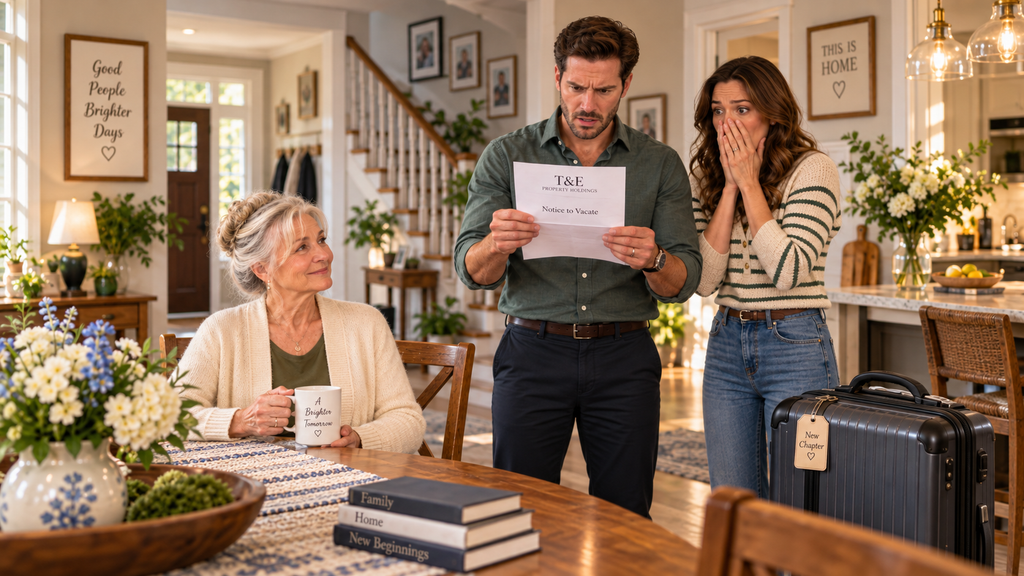
“Yes what?”
Graham looked down at the pages again.
Then back at me.
“Mom.”
His voice lowered.
“What is this?”
I glanced toward the envelope on the table.
“What does it say?”
His jaw tightened.
“You know exactly what it says.”
I did.
Of course I did.
Martin and I had reviewed every line the afternoon before.
Notice of termination of tenancy.
Thirty days.
The property would be vacated no later than December 31.
No renewal.
No extension.
The home would be listed for sale shortly afterward.
Everything had been written professionally, legally, and without hostility.
There was nothing Graham could argue with.
Nothing Paige could reinterpret.
Nothing they could smile their way around.
Paige grabbed the notice from him.
Her eyes moved quickly across the page.
Then more slowly.
Then she read the first paragraph again.
“This has to be a mistake.”
“It isn’t,” I said.
Her head snapped toward me.
“How would you know?”
I folded my hands in front of me.
Graham was already looking at the second document.
The one Martin had placed behind the termination notice.
The ownership disclosure.
The corporate information.
And beneath that, the short handwritten note I had asked him to include.
I watched my son reach it.
His face changed before he finished the first sentence.
He looked at the page.
Then at me.
Then back at the page.
His lips parted.
“No.”
Paige moved closer.
“What?”
Graham didn’t answer.
“Graham, what does it say?”
He lowered himself slowly into the kitchen chair opposite mine.
For the first time in years, my son looked very young.
Not forty-seven.
Not a husband.
Not a father.
Not the man who had decided which senior residence would be suitable for his mother.
He looked eight years old again.
Like the little boy who had once stood in our old kitchen after breaking one of Thomas’s fishing rods and waited for me to tell him whether his father would be angry.
“Mom owns the company.”
Paige blinked.
“What company?”
Graham looked up.
“T&E Property Holdings.”
The kitchen became completely silent.
Paige stared at him.
Then at me.
Then she laughed.
It was only one little sound.
Sharp.
Disbelieving.
Almost offended.
“No, she doesn’t.”
Graham pushed the ownership page toward her.
“Yes.”
“No.”
“Paige.”
“No.”
She picked it up.
I could see the moment she found my name.
Evelyn Mercer.
Sole beneficial owner.
The color drained from her face.
She read another line.
Then another.
“This house…”
She stopped.
I finished the sentence for her.
“Belongs to me.”
Paige lowered the page.
Graham rubbed both hands over his face.
“You bought our house?”
“No.”
The answer came so calmly that both of them looked at me.
“I bought my house.”
Graham flinched.
That distinction mattered to me.
They had called it their home for years.
I understood that.
I had called it their home too.
But they had never owned it.
They rented it.
And when the previous owner decided to sell, I bought it through a company.
Legally.
Quietly.
Without asking them for anything.
Paige stared at me.
“When?”
“March.”
“March?”
“Yes.”
“You’ve owned this house since March?”
“Yes.”
“And you just…”
She gestured around the kitchen.
“…kept living here?”
I almost smiled.
“Where else would the owner live?”
That was the first moment Graham became angry.
Not shouting angry.
Not yet.
But I saw it arrive behind his eyes.
“You let me pay rent to you.”
“Yes.”
His chair scraped backward.
“You took rent from your own son?”
I looked at him.
“You paid exactly the same rent you had been paying before.”
“That’s not the point.”
“What is the point?”
“You should have told me.”
“Why?”
“Because I’m your son!”
There it was.
That sentence.
I had been expecting it.
I had heard variations of it for most of my adult life.
Because I’m your son.
Because we’re family.
Because family helps.
Because mothers sacrifice.
Because mothers forgive.
Because mothers give.
Because mothers make room.
Nobody ever seemed to finish the thought.
Because mothers are people too.
I looked at him.
“You’re right,” I said.
He paused.
“I am?”
“Yes.”
“You are my son.”
I leaned forward slightly.
“And I was your mother when you and Paige toured Pine Harbor without telling me.”
Neither of them spoke.
“I was your mother when you paid a deposit on a room you chose for me.”
Paige crossed her arms.
“We were trying to help.”
“I was your mother when you chose January first as my move-out date because Owen wanted my bedroom.”
Graham looked away.
“I was your mother when you let your wife joke that perhaps my birthday present would buy me a bus ticket.”
Paige’s mouth tightened.
“That was a joke.”
“Yes.”
I nodded.
“It was.”
She seemed surprised that I agreed.
Then I continued.
“And I was your mother when my grandchildren learned to laugh at me because they watched the adults they trusted do it first.”
That one reached Graham.
I saw it.
His eyes dropped.
Paige shifted her weight.
“We never mistreated you.”
I looked at her.
“No?”
“No.”
Her voice became firmer now.
Defensive.
“You lived here for four years, Evelyn. You had meals. You had a room. You had family around you. You weren’t abandoned somewhere.”
The words sat between us.
I could have become angry.
I could have listed every meal I prepared.
Every grocery receipt.
Every school pickup.
Every load of laundry.
Every evening I stayed home with the children so Graham and Paige could go to dinner.
Every birthday cake.
Every stomach flu.
Every forgotten permission slip.
Every holiday I helped arrange.
Every morning I woke before them because somebody needed breakfast.
But something about reaching seventy-three had taught me that the truth does not become stronger simply because you shout it.
So I asked one question.
“Do you know what my favorite meal is?”
Paige frowned.
“What?”
“My favorite meal.”
She looked at Graham.
Graham stared at me.
Neither answered.
I continued.
“Do you know which television program I watch every Thursday night?”
Silence.
“Do you know the name of the woman I have lunch with twice a month?”
Nothing.
“Do you know what kind of flowers Thomas used to bring me on our anniversary?”
Graham’s expression changed.
He should have known that one.
He had seen them growing up.
White daisies.
Never roses.
Thomas said roses tried too hard.
He preferred flowers that looked like they had wandered in from a field.
Graham looked down.
I sat back.
“You knew which nights I could babysit.”
Nobody said anything.
“You knew which grocery store had the bread Owen liked.”
Silence.
“You knew which medicine Lily needed when her allergies became bad.”
Paige’s eyes lowered.
“You knew I could drive someone to school.”
My throat tightened despite all the rehearsing I had done.
“You knew I could cook.”
I looked at my son.
“You knew I could clean.”
Then I said the sentence I had been carrying for months.
“But none of you knew me anymore.”
Graham closed his eyes.
Paige turned toward the window.
For several seconds, all we heard was the refrigerator humming.
Then footsteps sounded upstairs.
Owen came down first.
He was fourteen.
Tall enough now that he no longer looked like the boy who used to crawl beneath my blankets during thunderstorms.
Lily followed him.
Eleven years old.
Hair tangled from sleep.
“What’s happening?” Owen asked.
Paige moved quickly.
“Nothing.”
He looked at the papers.
“It doesn’t look like nothing.”
Graham gathered them together.
“Go get breakfast.”
“There isn’t any breakfast,” Paige said automatically.
Everyone looked at her.
For almost four years, breakfast had appeared in that kitchen as reliably as sunrise.
Eggs.
Toast.
Oatmeal.
Pancakes on Saturdays.
Fruit cut for Lily because she hated biting into whole apples.
Coffee prepared before Graham came downstairs.
I had not cooked that morning.
For the first time, Paige seemed to notice what that meant.
Lily looked at me.
“Grandma, are you sick?”
“No, sweetheart.”
I smiled.
“I’m fine.”
Owen saw my suitcase near the hallway.
His face changed.
“Are you going somewhere?”
I did not want them to learn through an argument between adults.
So I answered him honestly.
“Yes.”
“Where?”
“To my own home.”
His brow furrowed.
“This is your home.”
My chest hurt.
Children can sometimes say in six words what adults spend years avoiding.
I held his gaze.
“It was for a while.”
He looked at his father.
“Dad?”
Graham rubbed his forehead.
“Go upstairs, Owen.”
“No.”
“Owen.”
“Why does Grandma have a suitcase?”
“Because she’s moving.”
Paige finally said it.
Owen stared at her.
“What?”
Lily’s face immediately crumpled.
“No.”
She hurried toward me.
“You can’t.”
I stood as she wrapped both arms around my waist.
That nearly broke me.
Her cheek pressed against my cardigan.
“You can’t go.”
I placed one hand over her hair.
“I’m not disappearing.”
“But where are you going?”
“I bought a little house.”
“When?”
“A few months ago.”
“Why didn’t you tell us?”
The question was innocent.
That made it harder.
I looked at Graham.
Then at Paige.
“Because I wanted to be sure first.”
Owen stepped closer.
“Sure about what?”
“That it was really mine.”
He looked confused.
I understood.
At fourteen, home is supposed to be something adults provide without conditions.
He did not yet understand how quickly an adult can begin to feel like a visitor in the same rooms where she serves everyone.
Lily tightened her arms around me.
“Can I visit?”
“Of course.”
“Can I sleep over?”
“If your parents say yes.”
“Do you have a room for me?”
I smiled.
“I have a room for whoever comes with kindness.”
Paige’s eyes flashed toward me.
I did not look at her.
Lily lifted her face.
“Is it yellow?”
I blinked.
“How did you know?”
“You always said you wanted a yellow kitchen someday.”
I stared at my granddaughter.
She remembered.
A silly thing.
Something I must have said while cooking months earlier.
Maybe years.
For a second, my vision blurred.
“Yes,” I whispered.
“The kitchen is yellow.”
She smiled through her tears.
“Then I want pancakes there.”
“You can have pancakes there.”
Owen looked at the notice on the table.
“Are we moving too?”
Nobody answered quickly enough.
He picked it up.
Paige reached for it.
“Owen, give me that.”
He pulled it away.
“I can read.”
He skimmed the first page.
His eyes widened.
“We have to leave?”
“Your father and I will handle it,” Paige said.
“Why?”
He looked at me.
Then at Graham.
Then at me again.
“Grandma owns the house?”
Graham stood.
“This is between adults.”
Owen stared at his father.
“Then why are we the ones moving?”
I saw irritation rise in Graham’s face.
“Owen.”
But my grandson had inherited Thomas’s habit of asking the question nobody wanted to answer.
“Did you make Grandma leave?”
“No,” Graham said quickly.
I said nothing.
Owen looked toward my suitcase.
“Then why is she leaving today?”
That silence answered him.
Children notice more than adults think.
They notice doors closing.
Eyes rolling.
Jokes repeated too many times.
The difference between asking someone to sit with you and asking them to clean up after you.
Owen placed the notice down.
His voice became quieter.
“Is this because of that old-people place?”
Paige stiffened.
“What old-people place?”
“The brochure.”
He pointed toward the sideboard.
“I saw it.”
Graham said, “It’s a very nice senior community.”
Owen looked horrified.
“You were sending Grandma away?”
“We were not sending her away.”
“You picked the place.”
“We were trying to find somewhere she’d be happier.”
“Did she say she wasn’t happy?”
Nobody answered.
Owen looked at me.
“Did you?”
“No.”
He turned back toward his parents.
“Then how did you know?”
Paige’s patience finally snapped.
“Enough!”
Lily jumped.
I felt her fingers tighten around my sweater.
Paige saw it and immediately lowered her voice.
“We are not doing this in front of the children.”
She looked at me.
“This was obviously planned.”
“Yes.”
“You planned to humiliate us.”
“No.”
“Really?”
Her voice trembled.
“You arranged for a courier to serve us an eviction notice while you sat here drinking coffee.”
“A tenancy termination.”
“Don’t correct me.”
“Then don’t accuse me of something I did not do.”
“You bought our house in secret!”
“Your landlord put it up for sale.”
“You could have helped us buy it.”
That stopped me.
Not because I had not expected it.
Because there it was again.
Help us.
I looked at her.
“With what?”
She stared at me.
“With the purchase.”
“With whose money?”
Paige opened her mouth.
Closed it.
Graham looked toward me.
And I knew the next secret was beginning to surface.
He had always known my finances were modest.
At least, he believed they were.
Thomas and I had lived carefully.
We had saved.
But we had never been wealthy.
Buying a house like this would have required more money than Graham thought I possessed.
His anger faded into confusion.
“Mom.”
I waited.
“How did you buy this house?”
Paige turned to him.
“That’s what I’ve been asking.”
“No.”
His eyes remained on me.
“I mean how.”
I touched the edge of my coffee cup.
“I paid for it.”
“With what?”
“My money.”
“What money?”
I almost laughed.
Not because anything was funny.
Because for ten months I had wondered how long it would take before someone finally asked that question.
“What money?” I repeated.
“Yes.”
“You mean the money you assumed I did not have?”
Graham looked embarrassed.
“I didn’t say that.”
“You didn’t have to.”
“Mom.”
He sat down again.
“Please.”
There was no authority in his voice now.
No irritation.
Just confusion.
“How much did the house cost?”
“That is not important.”
“It’s important to me.”
“It shouldn’t be.”
“Well, it is.”
Paige suddenly became very still.
She was looking at me in a new way.
I recognized it immediately.
Calculation.
Not cruelty.
Not exactly.
Calculation is quieter.
People think greed announces itself with open hands.
Sometimes it simply appears as attention.
For months, I had been invisible.
Suddenly Paige was studying my cardigan, my shoes, my suitcase, the envelope, my watch.
Recalculating me.
“Evelyn,” she said carefully, “is there something you haven’t told us?”
“Yes.”
Graham stared.
I stood.
Lily reluctantly released me.
I walked toward the hall table where my purse rested.
From inside, I removed a small envelope.
The original ticket was no longer there, of course.
Martin had taken care of that months earlier.
But I had kept a photocopy.
Not because I needed proof.
Because sometimes a life changes on a piece of paper so small you can fold it into your palm.
I returned to the table.
Placed the copy in front of Graham.
He looked at it.
For several seconds, nothing happened.
Then his eyes moved toward the top.
Then toward the numbers.
Then toward the prize information.
He stopped breathing.
Paige stepped closer.
“What is that?”
He did not answer.
She snatched it from him.
I saw her lips move as she read.
Then she whispered:
“Oh my God.”
Owen leaned over.
“What?”
Paige covered the page with her hand.
“Nothing.”
He frowned.
“It says eleven million.”
Graham stared at me.
“Eleven million dollars?”
I shook my head.
“No.”
He swallowed.
“But—”
“The advertised prize was eleven million.”
I sat again.
“Taxes and payment terms reduced what I received considerably.”
“How much?”
I looked directly at him.
“Enough.”
His mouth remained open.
Paige slowly lowered herself into the chair beside him.
“When?”
“My birthday.”
For a second, nobody understood.
Then Graham’s face went white.
My birthday.
The scratch ticket.
The laughter.
The bus joke.
His expression crumpled.
“Mom…”
Paige whispered:
“No.”
I looked at her.
“Yes.”
“The ticket I gave you?”
“Yes.”
“That ticket?”
“Yes.”
She stared at the copy.
“You won millions of dollars on the ticket I bought?”
“Yes.”
“Why didn’t you say anything?”
There are questions people ask because they genuinely want an answer.
And questions they ask because they cannot imagine a world in which the answer will make them feel worse.
This was the second kind.
I looked at the woman who had placed a two-dollar ticket inside a birthday card and made sure the price sticker remained attached.
“I did say something.”
She frowned.
“You said you lost.”
“I said not even enough for the bus.”
“That’s lying.”
“No.”
My voice remained calm.
“That was repeating your joke.”
She looked away.
Graham covered his mouth with one hand.
“You knew that night?”
“Yes.”
“You sat right there…”
“Yes.”
“…with millions of dollars in your pocket?”
“Technically, I had a lottery ticket in my pocket.”
“Mom.”
“Yes.”
“Why didn’t you tell me?”
That question hurt.
Because despite everything, one small part of me had imagined telling him.
I had imagined Graham laughing in disbelief.
Throwing his arms around me.
Calling me lucky.
Calling his father’s memory lucky.
Perhaps telling me that after everything I had done, I deserved something extraordinary.
I had imagined that version for nearly an hour after everyone went to bed.
Then I remembered Paige calling me a problem.
I remembered Graham saying, “What do you expect me to do? She’s still my mother.”
And the answer became clear.
“Because I needed to know something.”
He stared at me.
“What?”
“Whether I mattered when I had nothing useful left to give you.”
His eyes filled.
I had not expected that.
Not so quickly.
I continued anyway.
“I needed to know whether you wanted me here because you loved me or because I cooked dinner and handled school pickups.”
“That isn’t fair.”
“Perhaps not.”
“You should have talked to me.”
“I tried.”
“When?”
“So many times that you stopped hearing it.”
He shook his head.
“No, Mom.”
“Yes.”
I began counting quietly.
“When I asked whether we could have dinner together once a week without phones.”
He looked toward Owen and Lily.
“When I asked whether I could use the living room one evening because there was a movie I wanted to see.”
Paige shifted.
“When I told you my back was hurting and asked if somebody else could carry the laundry upstairs.”
No answer.
“When I told Paige I wanted to visit Ruth for two weeks and she reminded me Lily had camp.”
Paige looked down.
“When I mentioned finding a small apartment and you told me not to be ridiculous because rents were too expensive.”
Graham whispered, “I thought you were worried about money.”
“You thought a lot of things.”
I looked at him.
“You rarely asked.”
His eyes shone.
“I didn’t know.”
“That is exactly the problem.”
Silence filled the room again.
Then Paige asked the question I knew she would eventually ask.
“So what happens now?”
I looked at her.
“With what?”
“With the house.”
“You received the notice.”
“You’re really making us leave?”
“I am ending the month-to-month tenancy.”
“Before New Year’s?”
“You wanted me gone January first.”
Paige’s cheeks flushed.
“That’s different.”
“How?”
“You have somewhere to go.”
“So will you.”
“You don’t know that.”
“No.”
I nodded.
“You’re right.”
I looked around the kitchen.
“And when you selected Pine Harbor for me, you didn’t know what it would feel like for me to leave either.”
Graham whispered, “Mom, please don’t do this.”
I turned toward him.
“Do what?”
“Punish us.”
My heart sank.
“You still think this is punishment.”
“What else would you call it?”
“Freedom.”
He stared at me.
“Freedom from us?”
“No.”
“Then what?”
“Freedom from owing each other things we never agreed to.”
I gestured toward the house.
“You should not live in a home owned by a mother you resent.”
“I don’t resent you.”
“You did.”
He shook his head.
“I was frustrated.”
“Those are different words for similar wounds.”
He leaned forward.
“I never wanted you gone.”
“Then why did you arrange somewhere for me to go?”
His face twisted.
“Because Paige and I thought—”
He stopped.
Paige looked sharply at him.
I waited.
“Go ahead.”
Graham lowered his voice.
“We thought it was becoming difficult.”
“For whom?”
Nobody answered.
“For whom, Graham?”
He rubbed his hands together.
“For everyone.”
I nodded.
“Thank you.”
He looked confused.
“For what?”
“For finally saying the truth.”
Tears filled my eyes.
I did not wipe them immediately.
I had spent too many months believing strength meant never letting anyone see what hurt.
I was beginning to understand that dignity and emotion were not enemies.
“You wanted more room.”
I looked at Owen.
“You wanted privacy.”
I looked at Paige.
“You wanted your household back.”
Then I looked at my son.
“And perhaps you wanted to stop feeling responsible for me.”
His eyes closed.
“Yes.”
The word came out almost silently.
Paige stared at him.
Graham’s shoulders dropped.
“Yes,” he repeated.
“I did.”
Nobody moved.
He started crying.
Not loudly.
Graham had never been a loud crier.
Even as a little boy, tears simply slipped down his cheeks while he tried to pretend they weren’t happening.
“I love you,” he said.
His voice broke.
“But sometimes I felt responsible for you, and I hated myself for feeling trapped.”
I nodded.
“I know.”
“I should have said something.”
“Yes.”
“I shouldn’t have let Paige…”
He stopped.
Paige stiffened.
I raised one hand.
“No.”
Graham looked at me.
“Do not put everything on your wife.”
Paige seemed surprised.
“So much of this is between you and me.”
I took a breath.
“You are my son.”
My voice shook.
“You knew me before Paige ever did.”
That sentence landed heavily.
“When your father died, I was not myself for a very long time.”
I looked toward the window.
“Maybe I leaned on you more than I realized.”
Graham wiped his face.
“You had every right.”
“No.”
I shook my head.
“Grief does not give us rights over people.”
I thought about Thomas.
His hands.
His awful singing.
The way he always left cabinet doors open.
The way he kissed my forehead every morning before walking out the door.
“When Thomas died, the quiet in our house frightened me.”
I smiled sadly.
“I had spent fifty years telling him to stop making noise.”
Owen gave a small, watery laugh.
“So when you asked me to come here, I came.”
I looked at Graham.
“And maybe neither of us understood that moving into your house was not the same as building a new life.”
He nodded slowly.
“At first, I think you liked having me here.”
“I did.”
“I liked being needed.”
That was difficult to admit.
I had blamed them for turning me into a household helper.
But there had been another side.
I had made myself useful because being useful felt safer than being lonely.
“I said yes too often,” I continued.
“I volunteered before anyone asked. I cooked because I knew how. I folded laundry because it was there. I picked up children because I could.”
My fingers tightened together.
“And then one day I realized everyone had stopped seeing those things as gifts.”
Paige whispered, “They became expectations.”
I looked at her.
“Yes.”
She lowered her head.
For the first time that morning, there was no defense in her voice.
“I’m sorry.”
I did not immediately say it was all right.
Because it wasn’t.
People often say “It’s okay” when what they mean is “I don’t want you to feel uncomfortable anymore.”
I was finished rescuing everyone from discomfort.
So I answered differently.
“I believe you’re sorry.”
Paige looked up.
“But forgiveness does not mean returning to the same arrangement.”
She nodded faintly.
“I know.”
At 9:12, a car pulled into the driveway.
My taxi.
Lily heard it first.
Her eyes widened.
“Grandma.”
I stood.
“It’s time.”
“No.”
She hugged me again.
This time Owen joined her.
He had not hugged me like that in at least two years.
Teenage boys begin to act as though affection is embarrassing.
But grief makes people honest.
I held both of them.
“I love you,” I whispered.
“More than you can understand.”
“Are you mad at us?” Owen asked.
I pulled back.
“No.”
“Not even because we laughed at the ticket?”
That question nearly undid me.
“You followed the example you were given.”
His eyes moved toward his parents.
“Now you’re old enough to choose your own example.”
He nodded.
Lily wiped her nose.
“Do you really have roses?”
“Six bushes.”
“What colors?”
“Pink, yellow, red, and one that can’t seem to decide.”
She smiled.
“Can I help with them?”
“Yes.”
“Even if I kill one?”
“Especially then.”
Graham walked toward my suitcase.
“I’ll carry it.”
For a second, I almost said no.
Pride can be another kind of cage.
So I allowed my son to carry my suitcase.
We walked outside together.
The November air was cold and bright.
My breath appeared in front of me in little white clouds.
The taxi driver came around to open the trunk.
Graham placed my suitcase inside.
Then he stood there.
Hands in his coat pockets.
Looking at me.
“Can I see the house?”
I knew what he meant.
My cottage.
Not the rental.
My home.
“Someday.”
His face fell.
“Not today.”
He nodded.
“Okay.”
I touched his cheek.
For an instant, he leaned into my hand like he used to when he was small.
“I need my new home to belong to me before it becomes somewhere everyone else needs something.”
A tear slid down his face.
“I understand.”
“I hope you do.”
Paige stood a few feet away.
Her arms folded tightly against the cold.
“I am sorry, Evelyn.”
I looked at her.
“I know.”
“I mean it.”
“I believe you.”
“I shouldn’t have made you feel…”
She searched for the word.
“Inconvenient.”
“Yes.”
Her eyes became wet.
“I think I got too comfortable with everything you did.”
I nodded.
“You did.”
“And the senior place…”
She winced.
“That was wrong.”
“It wasn’t wrong to suggest it.”
She looked surprised.
“It was wrong to decide it before asking me.”
She nodded.
“Yes.”
I stepped toward the taxi.
Then Graham said:
“What about the money?”
I turned.
The question hung there.
Paige looked embarrassed.
Graham raised both hands.
“No, I don’t mean…”
He shook his head.
“I mean, are you safe? Is it managed? Does somebody know what they’re doing? You’ve never handled that kind of money before.”
For the first time that morning, I laughed.
A real laugh.
“Oh, Graham.”
He frowned.
“What?”
“I raised you.”
He blinked.
“So?”
“That was far more complicated.”
Even Paige smiled faintly.
“I have attorneys.”
I continued.
“An accountant.”
“A financial adviser.”
“Insurance.”
“A revised estate plan.”
Graham nodded slowly.
“And a will?”
“Yes.”
His expression became uncomfortable.
“I’m not asking what’s in it.”
“I know.”
I paused.
“But there is something you should know.”
Everyone became still.
“The children have educational trusts.”
Paige’s mouth fell open.
“What?”
“Owen and Lily.”
I looked at them.
“There is money reserved for education, training, or a first home after a certain age.”
Graham whispered, “Mom…”
“You and Paige cannot withdraw it.”
His mouth closed.
“The trustees are independent.”
I turned toward my grandchildren.
“It does not make you rich.”
Owen nodded.
“It gives you a chance.”
I looked at both of them.
“What you do with the chance will be your responsibility.”
Lily hugged me again.
“I don’t care about the money.”
I kissed the top of her head.
“Good.”
I looked at Graham.
“That is the only financial arrangement concerning your household.”
He understood.
“So you’re not giving us anything.”
I held his gaze.
“No.”
Paige looked away.
Graham nodded slowly.
“Okay.”
I could see that it hurt him.
Not simply because of the money.
Because boundaries sound cruel to people who have never had to hear them from you.
“I am not disinheriting you to teach you a lesson.”
I continued.
“I am choosing not to create another chain between us.”
“What happens to the rest someday?”
“That is private.”
He nodded.
I opened the taxi door.
Then Graham said one more thing.
“Mom.”
I looked back.
“I really did love having you here.”
I believed him.
That was perhaps the saddest part.
People can love you and still fail you.
Those truths can exist together.
“I know.”
He swallowed.
“I just forgot how to show it.”
I nodded.
“Then learn.”
I got into the car.
Nobody stopped me.
Nobody threatened.
Nobody shouted.
As we pulled away, I watched them through the rear window.
Paige stood beside Graham.
Lily waved both arms.
Owen lifted one hand.
My son simply watched the car disappear.
And for the first time in four years, I did not wonder what I should prepare for dinner.
I did not wonder who needed picking up.
I did not wonder which clothes were still in the dryer.
I looked forward.
My sister Ruth was waiting on the front porch when I arrived.
She wore a red coat and held two mugs of coffee.
The moment the taxi turned into the driveway, she began waving like I had returned from war.
Maybe in a small way, I had.
The cottage looked even prettier than I remembered.
Yellow siding.
White trim.
Bare rose bushes waiting for spring.
A little brass number beside the door.
Ruth hurried down the steps.
“You made it.”
“I made it.”
She huggedged me so tightly I almost lost my glasses.
Then she held my face between her hands.
“How bad?”
I thought about it.
“Bad enough.”
“Did Graham cry?”
“Yes.”
“Good.”
“Ruth.”
“What?”
She took my suitcase.
“I’m your sister. I’m allowed one petty moment.”
I laughed.
That laugh followed us into the house.
There were no chores waiting.
No school schedules taped to the refrigerator.
No baskets of other people’s clothing.
No voices calling from another room.
Just sunlight crossing the wooden floor.
My chair by the window.
The blue sofa.
The oak table.
A vase of daisies Ruth had placed in the center of it.
I stopped.
My throat closed.
“Where did you find those?”
She shrugged.
“Grocery store.”
I touched one white petal.
“Thomas used to buy me these.”
“I know.”
Of course she knew.
She was my sister.
She remembered me from before I was somebody’s mother.
Before I was somebody’s mother-in-law.
Before I was Grandma.
Before anybody needed anything from me.
She remembered Evelyn.
That first night in my cottage, I slept badly.
Not because I was afraid.
Because silence takes practice.
At 2:16 in the morning, I woke convinced I had forgotten to set an alarm for Lily’s school.
Then I remembered.
Not my responsibility.
At 4:05, I woke again thinking Graham needed breakfast before an early meeting.
Not my responsibility.
At 6:30, I got out of bed.
The house was cold.
I put on slippers and made coffee.
One cup.
Only one.
That was when I cried.
Not because I regretted leaving.
Because habits are a strange kind of grief.
For four years, I had measured love in portions.
Four eggs.
Five plates.
Two lunch boxes.
Three loads of laundry.
One woman disappearing gradually into what everyone needed.
Now the kitchen counter held a single cup.
I stood beside it and cried for the life that had ended.
Then I opened the curtains.
Sunlight filled the room.
And I began another one.
The first week was difficult.
I kept buying too many groceries.
I made enough soup for six people and laughed when Ruth came over with containers to freeze it.
I caught myself checking the time around three every afternoon.
School pickup.
Then I would remember.
I did not have to go anywhere.
On the fourth day, I drove to a bookstore.
I spent almost two hours there.
Nobody called asking where I was.
Nobody texted a shopping list.
Nobody needed medicine collected from a pharmacy.
I bought three novels and a ridiculous jigsaw puzzle showing the coast of Italy.
Then I sat in a coffee shop by myself.
For ten minutes, loneliness sat across from me.
Then something else took its place.
Peace.
Peace is quieter than happiness.
People mistake the two.
Happiness jumps.
Peace settles.
I began walking every morning.
I joined a gardening club Ruth had been trying to drag me into for years.
I met a woman named Celeste who had divorced at sixty-eight and purchased a motorcycle at seventy.
I did not purchase a motorcycle.
I am not insane.
But I did let her convince me to take a watercolor class.
My first painting looked like someone had dropped a tomato into a pond.
I hung it in the kitchen.
Because I liked it.
That was enough.
Graham called three days after I left.
I watched his name appear on my phone.
I let it ring.
Then I called him back that evening.
I wanted the first conversation to happen because I chose it.
Not because I had been summoned.
“Hi, Mom.”
“Hello.”
“How are you?”
“Good.”
“How’s the cottage?”
“Quiet.”
He laughed awkwardly.
“I bet.”
There was a pause.
Then he said:
“We found a place.”
I leaned back in my chair.
“I’m glad.”
“It’s smaller.”
“That can be good.”
“Paige isn’t thrilled.”
“I’m sure.”
He laughed again.
A little more naturally.
“We move December twenty-second.”
“Before Christmas.”
“Yes.”
“Owen is angry.”
“At me?”
“At everyone.”
“That sounds fourteen.”
“He says we deserve it.”
I sighed.
“Do not let him turn this into a war.”
“I know.”
“He loves you.”
“I know.”
“And Paige.”
“Yes.”
“Children should not have to choose sides because adults behaved poorly.”
“I agree.”
There was another pause.
Then Graham said:
“I’ve been thinking about Dad.”
That surprised me.
“What about him?”
“The boxes.”
“What boxes?”
“T&E.”
I smiled.
“You finally remembered.”
“I don’t know how I missed it.”
“You were eight when the business closed.”
“I used to build forts out of those boxes.”
“Yes.”
He laughed softly.
“Dad would have thought the company name was funny.”
“He would.”
Then Graham became quiet.
“What would he think of me?”
That was not a question I wanted.
It would have been easy to punish him with the memory of his father.
Thomas would be disappointed.
Thomas would never have allowed this.
Thomas would be ashamed.
But the dead should not be turned into weapons.
So I said:
“Your father loved you.”
“That isn’t what I asked.”
“It is the answer he would want me to give.”
Graham went silent.
Then he whispered:
“I’m sorry, Mom.”
“I know.”
“No.”
His voice shook.
“I don’t think you do.”
So I listened.
He told me things he had not said that morning.
He admitted he had been embarrassed sometimes when coworkers learned his mother lived with him.
Not because of me.
Because he felt people assumed he was supporting me.
He admitted Paige had pushed harder for Pine Harbor than he had, but he had agreed because saying no to her seemed more difficult than talking to me.
He admitted he had known the bus-ticket joke was cruel.
He laughed anyway.
Because correcting his wife in front of everyone would have been uncomfortable.
He admitted that after I stopped cooking breakfast, before I even left the house, he realized he could not remember the last time he had made me breakfast.
I listened.
I did not rescue him.
When he finished, he was crying again.
“I became selfish.”
“Yes.”
“I don’t know when.”
“It rarely happens all at once.”
“How do I fix it?”
“You don’t.”
He stopped.
“What?”
“You don’t fix four years with one apology.”
His breathing changed.
“But you can behave differently tomorrow.”
There was a long silence.
“And the day after that.”
Another pause.
“And the day after that.”
He whispered:
“Okay.”
That became the beginning.
Not forgiveness.
Not yet.
Beginning.
Paige did not call for almost two weeks.
Then one afternoon, a package appeared on my porch.
Inside was my old recipe book.
I had left it behind accidentally.
A note rested on top.
Evelyn,
I thought about writing something long, but everything I write starts sounding like an excuse.
So I’ll only say this.
I am sorry I treated your generosity like an obligation.
I am sorry my children learned disrespect by watching me.
I am sorry I helped make you feel unwelcome in a house where you had done so much to create a home.
I don’t expect you to forgive me quickly.
Paige.
I read it twice.
Then I placed it inside the recipe book.
I did not call her.
But I did not throw the note away.
Some bridges are rebuilt one board at a time.
Christmas came three days after they moved.
Graham asked if I would come to their new place.
My first instinct was no.
Then he said something that changed my mind.
“You can come for two hours.”
I laughed.
“Two?”
“Yes.”
“No cooking.”
“That seems suspicious.”
“No gifts except whatever you already bought.”
“I already bought things.”
“Of course you did.”
“And if you want to leave after ten minutes, I’ll drive you home.”
I was quiet.
Then he added:
“And Mom?”
“Yes?”
“You are invited.”
Not needed.
Invited.
I went.
Their new rental was smaller.
Three bedrooms.
One bathroom upstairs.
A narrow kitchen.
The dining table barely fit six people.
Paige had burned the ham.
I knew it before she opened the oven.
I smelled it from the front door.
Normally, I would have stepped in.
Turned down the heat.
Made gravy.
Rescued everything.
Instead, I removed my coat and sat down.
Paige entered the living room with panic in her eyes.
“The ham is ruined.”
Graham looked at me instinctively.
Then caught himself.
He stood.
“I’ll order pizza.”
Paige stared at him.
“On Christmas?”
“Jesus ate bread.”
“That is not the same thing.”
Owen laughed.
Lily looked at me.
“Grandma knows how to fix burned ham.”
Everyone went still.
I smiled.
“I do.”
Paige opened her mouth.
Then closed it.
She took a breath.
“Would you like to help?”
There was a world of difference between those words and expectation.
I stood.
“Yes.”
We trimmed the burnt edges.
Made a mustard glaze.
Saved what we could.
Nobody acted as though I owed them the rescue.
That mattered.
After dinner, Owen gave me a gift.
A small wooden sign he had made in school.
It said:
GRANDMA’S HOUSE
Underneath, in smaller letters:
PANCAKES BY APPOINTMENT.
I laughed until tears ran down my face.
Then Lily handed me an envelope.
Inside was a drawing.
My yellow cottage.
The roses were enormous.
A blue figure stood on the porch.
“That’s you,” she said.
“Why am I blue?”
“I ran out of peach.”
“Fair enough.”
Beside me she had drawn four smaller figures.
Herself.
Owen.
Graham.
Paige.
Above them she had written:
VISITORS.
Not residents.
Not people who needed me.
Visitors.
I framed that picture.
It still hangs beside my kitchen door.
In January, the old house went on the market.
Graham did not ask what I was listing it for.
He did not ask whether he could purchase it cheaply.
Paige did not ask whether I could help with their new rent.
That was how I knew something had begun to change.
Three offers came in.
I accepted one from a young couple with two daughters.
At closing, the woman told me they had been trying to buy a home for three years.
She cried when I handed over the keys.
I thought I would feel triumphant.
Instead, I felt relieved.
That house had become too heavy with meaning.
It had never been revenge.
Selling it felt like setting something down.
In February, Pine Harbor called me.
That made me laugh.
Apparently, Paige had forgotten to cancel the assessment appointment.
The woman on the telephone was kind.
She asked whether I was still interested in touring the community.
I almost said no.
Then I thought about it.
“Actually,” I said, “yes.”
I went.
Not because I intended to move there.
Because I had spent months thinking of the place as a threat.
I wanted to see what it really was.
It was lovely.
Truly.
Bright apartments.
A library.
Gardens.
A dining room that smelled much better than I expected.
I met a seventy-nine-year-old woman who had moved there by choice after selling her large home.
“I was tired of gutters,” she told me.
We laughed.
That visit taught me something.
Pine Harbor had never been the insult.
The insult had been being excluded from the decision about my own life.
There may come a day when I choose a place like Pine Harbor.
And if I do, it will not mean anyone discarded me.
It will mean I chose.
Choice.
That was the thing I had almost forgotten belonged to me.
By spring, the roses began blooming.
The stubborn bush near the porch produced pale orange flowers.
Lily declared the color “sunset sherbet.”
So that became its official name.
The grandchildren started visiting every other Saturday.
Not every weekend.
I refused.
That surprised everyone.
“I have things to do,” I told Graham.
He smiled.
“Since when?”
“Since I stopped doing all of your things.”
He deserved that one.
Owen helped me put up shelves in the garage.
Lily planted herbs.
Ruth came over.
Sometimes Paige came too.
The first few visits between us were awkward.
We were careful.
Too polite.
Like strangers trying not to step on broken glass.
Then one Saturday, Paige arrived alone.
She carried a small bakery box.
“No children?”
“Graham took them to soccer.”
She held up the box.
“I brought cake.”
“Is the price sticker still attached?”
Her face froze.
For one second, I regretted the joke.
Then Paige started laughing.
I laughed too.
It was not cruel.
It was release.
She followed me into the kitchen.
We made coffee.
Then she looked around.
“It really is beautiful here.”
“Thank you.”
“I can see why you wanted it.”
I nodded.
She touched the edge of the table.
“I was jealous of you.”
That was not what I expected.
“Of me?”
“Yes.”
“Why?”
She sat down.
“You were better at my house than I was.”
I stared at her.
“What does that mean?”
“You cooked better.”
She smiled sadly.
“You remembered school projects. You knew when Graham needed quiet after work. You knew which shirts Owen refused to wear. You made holidays feel like something.”
She looked down.
“I started feeling like a guest in my own home.”
Understanding came slowly.
“That’s why you wanted me gone.”
“Partly.”
She nodded.
“And because instead of admitting I felt inadequate, I decided you were overstepping.”
I sat opposite her.
“You could have told me.”
“Yes.”
Her eyes filled.
“You could have done less.”
“Yes.”
We both laughed softly at the absurdity.
“So many things would have been easier if we had just spoken honestly.”
“Most disasters are like that,” I said.
She looked at me.
“I’m not asking you to forget.”
“Good.”
“I’m asking whether maybe someday we can be… something better than what we were.”
I thought about it.
“Yes.”
She wiped one eye.
“Thank you.”
“But Paige?”
“Yes?”
“You are never choosing my nursing home.”
She burst out laughing.
“Deal.”
“And no scratch tickets.”
“That seems unfair. I have a proven record.”
I laughed so hard I nearly spilled my coffee.
That afternoon, before she left, Paige asked for my ham recipe.
I gave it to her.
Not because she needed it.
Because for the first time, she had asked.
Summer arrived.
Then autumn.
One full year after my seventy-third birthday, I celebrated seventy-four on my porch.
I made none of the food.
That was my rule.
Ruth ordered lunch from my favorite Italian restaurant.
Celeste from watercolor class brought wine.
Graham brought flowers.
White daisies.
When he handed them to me, I froze.
He looked nervous.
“I remembered.”
I touched the petals.
“Yes.”
My throat tightened.
“You did.”
The grandchildren gave me a new gardening hat.
Paige handed me a card.
There was no scratch ticket inside.
Instead, there was a photograph.
Taken years earlier.
Thomas and me standing beside a lake.
I had not seen it in decades.
Graham must have found it in a box.
On the back Paige had written:
For Evelyn.
Not Mom.
Not Grandma.
Not the woman who helps.
Just Evelyn.
I had to sit down.
Because sometimes the smallest recognition reaches the deepest wound.
After cake, Graham stood beside me near the porch railing.
The sun was setting.
The grandchildren were chasing each other through the yard.
Paige and Ruth were arguing over whether somebody had taken the serving spoon.
“You happy?” he asked.
“Yes.”
“Really?”
“Really.”
He nodded.
“I’m glad.”
We stood silently for a while.
Then he said:
“I used to think that morning was the worst thing you ever did to me.”
I turned toward him.
“The eviction notice?”
“Yes.”
“It wasn’t an eviction.”
He smiled.
“I know.”
He had learned not to argue terminology with me.
“What do you think now?”
He watched Owen running across the lawn.
“I think it might have been the first time you stopped protecting me from the consequences of how I treated you.”
I said nothing.
“And I needed that.”
I looked at him.
“You needed me to leave?”
“No.”
He shook his head.
“I needed to understand you could.”
That sentence stayed with me.
For decades, I had believed unconditional love meant proving you would never leave.
Never stop helping.
Never withdraw.
Never say enough.
But Graham was right.
Sometimes people only recognize that your presence is a gift when they understand it is not a debt.
He glanced at me.
“Do you regret not telling us about the lottery sooner?”
I thought carefully.
“No.”
“Not even a little?”
“Sometimes I regret the reason I had to keep it secret.”
He nodded.
“But not the secret itself.”
“No.”
“What was it like?”
“What?”
“Knowing.”
I smiled.
“Terrifying.”
“Really?”
“I was seventy-three years old and suddenly had enough money to become somebody completely different.”
“Why didn’t you?”
“I had spent seventy-three years becoming this one.”
He laughed.
That night, after everyone left, I sat alone on the porch.
The dishes could wait.
The glasses could wait.
Everything could wait.
Fireflies moved above the grass.
Somewhere down the street, a dog barked.
I could hear Ruth’s car starting next door.
My house smelled faintly of coffee and birthday cake.
On the table beside me rested one white daisy that had fallen from the bouquet.
I picked it up.
For years, I thought the winning ticket had changed my life.
It hadn’t.
Money bought the cottage.
Money bought the rental property.
Money paid the lawyers.
Money created the trusts.
Money gave me choices.
But money did not give me courage.
The courage came from the moment I understood that I had been shrinking myself to fit into other people’s comfort.
The lottery simply removed my excuses.
That was the real gift hidden beneath the silver coating.
Not eleven million dollars.
Permission.
Permission to stop proving my usefulness.
Permission to say no.
Permission to have plans that did not involve my family.
Permission to love my son without financing his life.
Permission to adore my grandchildren without raising them.
Permission to forgive Paige without becoming her unpaid housekeeper again.
Permission to miss Thomas without spending the rest of my years living as though my own life had ended when his did.
And most importantly—
Permission to belong to myself.
A few weeks after my birthday, I received a letter from Martin.
He rarely sent paper letters anymore, so I knew immediately something unusual was inside.
It was the final statement connected to the sale of the old rental house.
Everything was settled.
Taxes.
Fees.
Closing costs.
The remaining proceeds had been transferred into my investment account.
At the bottom, Martin had written one sentence by hand.
I hope the new chapter is treating you well.
I smiled.
Then I took out stationery.
Real stationery.
Thomas used to tease me because I insisted on keeping it.
I wrote back:
Martin,
The new chapter is quieter than the last one.
I think that is why I can finally hear myself in it.
Evelyn.
Before sealing the envelope, I sat for a while looking through the kitchen window.
Lily’s herbs were growing badly.
Owen’s garage shelf leaned slightly to the left.
My watercolor painting was still terrible.
The sunset-sherbet roses were losing their petals.
Everything was imperfect.
Everything was mine.
My phone rang.
Graham.
I answered.
“Hello?”
“Mom?”
“Yes?”
“Quick question.”
I smiled.
“What do you need?”
Then I stopped.
Old reflex.
Old language.
I corrected myself.
“What’s your question?”
He laughed.
“I was wondering if you’re free for dinner Sunday.”
“Are you inviting me or asking me to cook?”
“Inviting.”
“Are you sure?”
“Yes.”
“What are you making?”
There was a pause.
“Paige says lasagna.”
“That doesn’t answer my question.”
He laughed.
“I’m making lasagna.”
I winced dramatically even though he could not see me.
“Then I may need to update my will.”
“Mom.”
“I’m kidding.”
“Mostly?”
“Mostly.”
He laughed again.
Then his voice softened.
“I love you.”
There had been a time when those words automatically made me answer by offering something.
I love you too.
Do you need groceries?
I love you too.
Should I bring dessert?
I love you too.
Do you need me to watch the children?
That evening, I answered differently.
“I love you too, Graham.”
Nothing more.
Nothing attached.
No service offered.
No sacrifice volunteered.
Just love.
It was enough.
Before hanging up, he said:
“Sunday at six?”
“I’ll be there at six-thirty.”
“Why?”
“Because I’m seventy-four and nobody tells me when to arrive anymore.”
He laughed.
“Yes, ma’am.”
I put down the phone.
Then I made myself tea.
One cup.
Still only one.
But I no longer looked at that single cup and saw loneliness.
I saw space.
Space for whatever came next.
And plenty came next.
I traveled with Ruth.
We visited Charleston in the spring.
Savannah that autumn.
At seventy-five, I finally went to Italy.
Celeste came too.
She flirted shamelessly with a widowed tour guide named Marco who was at least twelve years younger than she was.
I reminded her constantly that she was ridiculous.
She reminded me constantly that being ridiculous was one of the privileges of surviving long enough to stop caring.
We stood in Florence one afternoon looking at buildings older than every problem I had ever had.
And suddenly my family drama seemed very small.
Important, yes.
Painful, yes.
But not the whole story.
That realization changed me almost as much as leaving Graham’s house.
Family is part of your life.
It should never be permitted to become the entire border around it.
When I returned from Italy, Lily came over and helped me unpack.
She found a photograph of me standing near the sea.
“Grandma.”
“Yes?”
“You look different.”
“How?”
She studied it.
“Younger.”
I laughed.
“I assure you I am not.”
“No.”
She shook her head.
“I mean you look…”
She struggled for the word.
“Bigger.”
I stared at her.
Children again.
Always finding the sentence adults miss.
I knew exactly what she meant.
For years, I had made myself small enough to fit wherever people placed me.
A downstairs bedroom.
A kitchen routine.
A babysitting schedule.
A senior-living brochure.
Now I had expanded back into my own life.
I no longer existed only in relationship to other people.
I was Evelyn.
I painted badly.
I traveled.
I grew roses.
I liked Italian food.
I hated crossword puzzles.
I enjoyed mystery novels.
I preferred coffee too strong.
I loved the ocean but disliked boats, despite being married for decades to a man who adored them.
I could be impatient.
I could be stubborn.
I sometimes forgot birthdays unless they were written down.
I snored.
I laughed too loudly when something genuinely amused me.
I had money.
I had boundaries.
I had regrets.
I had time.
And I had finally stopped apologizing for wanting some of that time for myself.
Years later, when Graham asked me again what happened to the original scratch ticket, I told him the truth.
Martin returned it to me after everything was completed.
I placed it inside a small frame.
Not on a wall.
Inside a drawer in my desk.
On the back, I wrote the date.
And underneath:
THIS DID NOT SAVE ME.
I DID.
That is what I wanted my grandchildren to understand someday.
Luck can open doors.
Money can buy independence.
But neither matters if you are too frightened to walk through.
I was seventy-three years old when my family believed they were arranging the final chapter of my life for me.
A little studio at Pine Harbor.
Meals at scheduled times.
Group activities.
A room emptied for somebody younger.
They thought they were deciding where I would spend my remaining years.
They were wrong.
My remaining years belonged to me.
On my seventy-sixth birthday, Graham arrived first.
He carried daisies again.
Paige brought a lemon cake from the bakery because she finally accepted that not every family celebration required me to produce the dessert.
Owen drove himself.
Lily brought another drawing.
Ruth brought champagne.
Celeste arrived forty minutes late wearing a scarf she claimed had been given to her by an Italian gentleman.
Nobody believed her.
Everyone laughed.
At some point, Graham wandered into the kitchen while I was cutting the cake.
He leaned against the counter.
“You know what I think about sometimes?”
“What?”
“That stupid bus-ticket joke.”
I kept cutting.
“I wish I could take it back.”
“I know.”
“I must have looked like such an idiot.”
“You did.”
He laughed.
“Thanks.”
“You’re welcome.”
Then he became serious.
“Did it hurt that much?”
I set down the knife.
“The joke?”
“Yes.”
I thought about the answer.
“No.”
He looked surprised.
“It wasn’t the joke itself.”
“What was it?”
“The fact that nobody thought I could go anywhere.”
His eyes narrowed slightly.
“I don’t understand.”
“You all thought I was dependent.”
I wiped icing from the knife.
“You thought I had nowhere else to live.”
“No other plans.”
“No money.”
“No direction.”
“And that made the joke safe.”
Graham looked down.
“Yes.”
“I think that was what hurt.”
He nodded slowly.
Then he looked toward the living room, where his children were arguing over music.
“I will never make somebody feel trapped like that again.”
I smiled.
“Then something good came from something ugly.”
He stepped closer and kissed my forehead.
Just the way his father used to.
My eyes filled immediately.
“Dad used to do that.”
“I know.”
He smiled.
“I remember.”
That was when I understood that our relationship had survived.
Not unchanged.
Thank God.
Some relationships should not return to what they were.
They should become something healthier.
Graham was no longer the little boy I had to rescue.
I was no longer the mother who had to prove love through exhaustion.
We were simply two adults.
A son.
A mother.
People capable of disappointing each other.
People capable of changing.
People who had finally learned that love without respect becomes obligation, and obligation without honesty becomes resentment.
We had learned the lesson late.
But late is not the same as never.
That evening, after everyone sang Happy Birthday, Paige handed me a small wrapped box.
I narrowed my eyes.
“If this is a scratch ticket, you’re leaving.”
Everyone laughed.
“It isn’t.”
I opened it.
Inside was a little silver keychain.
A tiny house.
On the back were engraved three words.
YOUR LIFE. YOUR KEY.
I ran my thumb across the letters.
For a moment, I could not speak.
Paige became nervous.
“Too much?”
“No.”
I looked at her.
“It’s perfect.”
And it was.
Because she finally understood.
The house had never really been the point.
Neither was the money.
Not even the winning ticket.
The point was the key.
Who held it.
Who decided.
Who got to open the door.
For too long, I had handed other people the keys to my life because I believed that was what love required.
Then one birthday, beneath a layer of silver dust, I discovered enough money to buy those keys back.
But the strangest thing is this:
I eventually realized they had always been mine.
So if there is one thing I hope my grandchildren remember long after I am gone, it is not that their grandmother won the lottery.
It is not that I secretly purchased the house their parents rented.
It is not that I served them a legal notice on a December morning.
Those details make a dramatic story.
But they are not the lesson.
The lesson is this:
Never make someone earn their place in your life by being useful.
Never confuse a person’s kindness with an obligation to keep giving.
Never make decisions for someone simply because they are old enough that you assume they will accept them.
And never mistake silence for weakness.
Sometimes silence is where a person makes the biggest decision of their life.
That was what happened to me.
At seventy-three, I stopped arguing.
Stopped begging.
Stopped trying to convince anyone that I deserved space.
I simply created my own.
And when my son read that letter at the kitchen table and looked at me as though he had never truly known his mother—
he was right.
He hadn’t.
Not completely.
But neither had I.
It took leaving that house for both of us to meet her.
Her name was Evelyn Mercer.
She was seventy-three.
She had lost a husband.
Raised a son.
Loved a family.
Made mistakes.
Forgiven too much.
Given too much.
Stayed too long.
Won a fortune.
And finally learned something money could never purchase.
Her life still belonged to her.
And this time—
she intended to live it.
THE END! THANK YOU FOR READING!❤️