 Reading Time: 40 minutes
“Samuel… put the bat down.” Warren Voss stepped into the light behind his son.
He wore dark trousers, a white dress shirt open at the collar, and the expression of a man who had spent most of his life believing every room belonged to him.
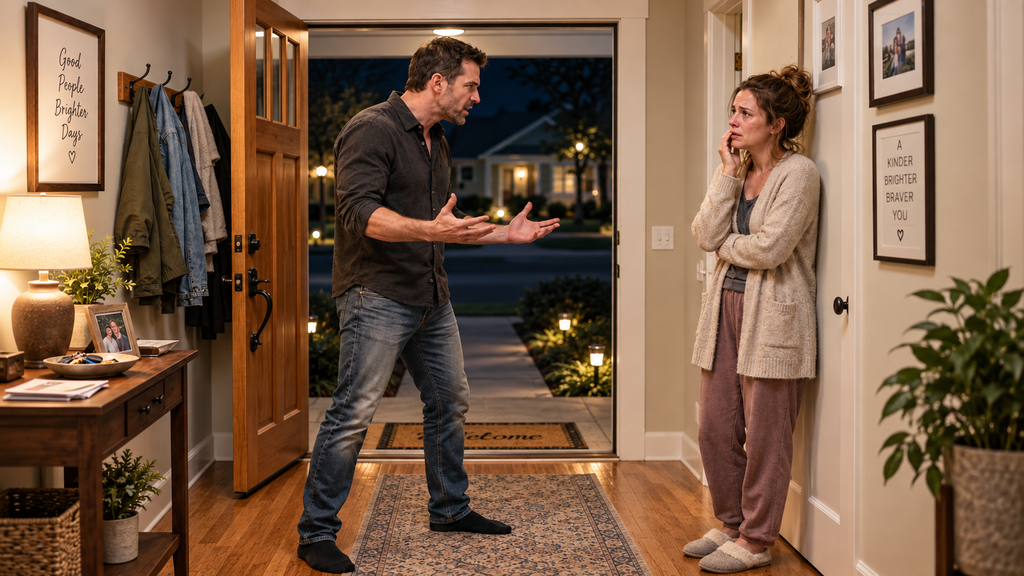
Daniel stood between us in his silk robe.
For the first time since opening the door, he wasn’t smiling.
His eyes kept moving from my face to the baseball bat in my hand.
Then back to my face.
Warren came closer.
“Whatever Claire told you,” he said, “you need to calm down before you do something stupid.”
I looked at him.
Then at Daniel.
Neither of them asked whether Claire was alive.
Neither asked whether she needed a doctor.
Neither asked how badly she had been hurt.
That told me everything.
I lowered the end of the bat until it rested against the porch boards.
“I am calm.”
Daniel laughed once.
It was nervous.
“You show up at my house in the middle of the night carrying a baseball bat, and you expect us to believe you’re calm?”
“I don’t care what you believe.”
Warren folded his arms.
“Then what exactly do you want?”
I looked straight at Daniel.
“I want him to answer one question.”
Daniel’s jaw tightened.
“What?”
I stepped forward.
And I asked the question that finally wiped the arrogance from his face.
“Which story are you planning to tell the police?”
Silence.
Absolute silence.
Daniel blinked.
Warren’s expression changed almost imperceptibly.
But I saw it.
Daniel recovered first.
“What police?”
“The police examining my daughter.”
Daniel stared at me.
Then he looked at his father.
That look lasted less than a second.
It was enough.
I understood immediately.
They had already discussed what they would say.
Warren stepped closer.
“Samuel, nobody needs police involved in a private marital disagreement.”
I almost laughed.
Instead, I tightened my hand around the bat.
“A marital disagreement?”
“Yes.”
“My daughter arrived on my porch barefoot with one eye swollen shut.”
Warren’s expression barely changed.
“People become emotional during arguments.”
“She has two cracked ribs.”
Daniel’s face twitched.
“That’s not—”
“A fractured wrist.”
Daniel stopped.
“Bruising around her throat.”
Warren’s arms slowly unfolded.
“And enough blood on her clothes that the doctor cut her blouse away because it was stuck to her skin.”
Daniel swallowed.
I watched his face carefully.
Then I said the last part.
“The doctor photographed everything.”
Daniel went completely still.
There it was.
Fear.
Not remorse.
Not shame.
Fear.
Warren looked at his son.
Daniel looked at the floor.
I had spent my entire life around animals.
You learn things when you work around frightened creatures.
A horse about to kick shifts its weight.
A dog about to bite goes still.
A guilty man does something similar.
He starts calculating.
Daniel was calculating.
Warren was too.
Warren recovered faster.
“Dr. Ellis is a country physician,” he said dismissively. “He’s hardly an expert in forensic medicine.”
I looked at him.
“You’re right.”
That made him hesitate.
“So after Ellis stabilized her, an ambulance took Claire to Hartwell Regional.”
Daniel’s face changed again.
I continued.
“The emergency room documented the injuries.”
Warren’s lips pressed together.
“A hospital advocate spoke to her.”
Daniel stepped backward.
“And before I drove here,” I said, “Claire gave a statement.”
Warren’s eyes narrowed.
“To whom?”
I didn’t answer immediately.
That was when Daniel made his mistake.
He snapped, “She can’t prove anything.”
I looked at him.
He seemed to realize what he had said.
Too late.
I leaned slightly against the bat.
“Interesting.”
Daniel’s nostrils flared.
“What?”
“I never accused you of anything.”
His face drained.
Behind him, Warren closed his eyes for half a second.
A father disappointed in his son’s stupidity.
Not his cruelty.
His stupidity.
Daniel pointed at me.
“Get off my property.”
I stayed exactly where I was.
“This property?”
“Yes.”
“The house Claire helped pay for?”
Daniel scoffed.
“My family owns this house.”
“No.”
That stopped him.
I let the silence stretch.
“Your father owns the land.”
Warren said nothing.
“You own part of the structure through Voss Residential Holdings.”
Still nothing.
“And Claire owns thirty percent.”
Daniel’s mouth opened.
I could almost see him searching his memory.
I remembered the day clearly.
Three years earlier.
Claire had called me after the wedding.
Daniel wanted to buy property on Voss Hill.
The mortgage company required more cash than they had available.
I had sold twenty-two acres from the north field.
Land my father had worked.
Land his father had worked before him.
I transferred the money to Claire.
Not Daniel.
Claire.
My lawyer had insisted on paperwork.
At the time, I had been embarrassed by it.
Daniel had laughed when he learned I’d used an attorney.
“Sam thinks he’s Warren Buffett now,” he had joked.
I’d laughed with him.
I wish I hadn’t.
The money had purchased Claire’s ownership interest.
Thirty percent.
Not charity.
Not a gift to Daniel.
An investment legally recorded in her name.
Warren finally spoke.
“That ownership interest is irrelevant tonight.”
“Maybe.”
I looked at Daniel.
“But it becomes relevant if somebody tries throwing her belongings into the street.”
Daniel’s expression hardened.
“Claire isn’t coming back here.”
“Good.”
That surprised him.
“She doesn’t want your house.”
I glanced beyond him into the enormous foyer.
Marble floor.
Two-story chandelier.
Oil paintings.
A staircase that probably cost more than the house I lived in.
All that money.
All that shine.
And somehow, Daniel had convinced himself those things made him powerful.
“She wanted a husband,” I said. “Apparently that was too expensive for you.”
Daniel stepped toward me.
Warren grabbed his arm.
“Enough.”
But Daniel was angry now.
That was useful.
Angry men talk.
“You think you know anything about our marriage?” Daniel shouted.
“I know what she looked like when she reached my porch.”
“She pushed me!”
Warren’s head snapped toward him.
There.
Another mistake.
I didn’t move.
Daniel kept going.
“She came at me first.”
I stared at him.
“With what?”
“What?”
“What did she attack you with?”
He hesitated.
“She… pushed me.”
“Then you broke her ribs?”
“I didn’t say that.”
“You strangled her?”
“I didn’t strangle anybody!”
“I never said you did.”
His face froze.
Warren stepped between us.
“This conversation is over.”
“No,” I said.
“It is.”
I looked at Daniel over his father’s shoulder.
“Tell me what happened.”
Daniel laughed bitterly.
“You’re insane.”
“Tell me.”
“Get off my porch.”
“Tell me why my daughter was bleeding.”
Daniel’s eyes flashed.
“She wouldn’t shut up!”
The words exploded out of him.
Warren went motionless.
So did I.
Daniel was breathing hard now.
“She kept pushing and pushing and pushing. Every little thing became an argument. Money. Where I went. Who I talked to. When I came home.”
I said nothing.
“She knew exactly how to provoke me.”
Still I said nothing.
Because I knew something Daniel didn’t.
Men like him hated silence.
Silence made them fill the space.
“She embarrassed me in my own house!”
His voice became louder.
“She threatened to leave.”
I finally spoke.
“So you stopped her.”
Daniel looked at me.
“I told her to calm down.”
“With your fist?”
“Don’t twist my words.”
“Then explain the blood.”
“She fell.”
There it was.
The story.
I nodded slowly.
“She fell.”
“Yes.”
“Where?”
Daniel hesitated.
“The stairs.”
Warren stared at him.
I nearly felt sorry for Warren then.
Almost.
Because Daniel apparently didn’t know Claire had already told us what happened.
There had been no fall down the stairs.
The stairs weren’t involved at all.
“She fell down the stairs?” I asked.
“Yes.”
“All those injuries came from falling?”
“Yes.”
Daniel’s confidence began returning.
He had found his lie now.
People like Daniel always became calmer once they settled on a lie.
They treated the lie like land.
Once they planted a flag in it, they defended it forever.
“She’d been drinking,” he added.
My fingers curled around the bat.
Claire had stopped drinking more than a year earlier.
Not because she had a problem.
Because Daniel told everyone alcohol made her “unattractive.”
He had controlled even that.
But I let him continue.
“She got hysterical. She slipped. I tried helping her.”
“You helped her?”
“Yes.”
“Is that why she was outside without shoes?”
Daniel paused.
“She ran out.”
“You said you threw her out.”
“I never said that.”
“She says you did.”
“She’s lying.”
“Why would she lie?”
“To hurt me.”
“Why would she want to hurt you?”
Daniel threw his hands up.
“Because she’s crazy!”
Warren said sharply, “Daniel.”
But the dam had broken.
“She is! Ask anyone. She’s unstable. She’s always crying. Always complaining. Nothing I do is enough. I give her everything and she acts like some kind of victim.”
My teeth pressed together so hard my jaw hurt.
Three years.
For three years I had watched my daughter become quieter.
I had noticed.
God help me, I had noticed.
Claire used to laugh so loudly when she was young that her mother would shush her in restaurants.
She used to sing while helping me mend fences.
Terribly.
Always half a note wrong.
But after marrying Daniel, the singing stopped.
Then the laughing.
Then the phone calls.
At first, I thought marriage had made her busy.
Then she started canceling Sunday dinners.
Daniel always had a reason.
Claire had a headache.
Claire had plans.
Claire wasn’t feeling social.
Once, I drove over unexpectedly with a bushel of peaches.
Claire answered the door wearing sunglasses.
Inside.
In October.
Daniel appeared behind her smiling.
“She has a migraine.”
I accepted it.
I hated myself for that now.
I should have asked.
I should have looked closer.
I should have told my daughter she never needed permission to come home.
But guilt is a strange thing.
It can either bury you or teach you.
Standing on Daniel’s porch, I decided mine would teach me.
I would not spend the rest of that night thinking about what I should have done yesterday.
I would do what needed doing now.
Daniel was still talking.
“I’ve protected her reputation for years.”
I stared at him.
“Protected her?”
“Yes.”
“From what?”
“Herself.”
My stomach turned.
Warren stepped in again.
“My son has said enough.”
I looked at him.
“Actually, I agree.”
Warren’s eyes narrowed.
Then he noticed where my left hand was.
Not on the bat.
Inside my jacket pocket.
His gaze dropped.
When I pulled my hand out, I was holding my phone.
The recording screen glowed red.
Daniel stared at it.
Warren’s face went pale.
Not much.
But enough.
I had started recording before I got out of my truck.
Dr. Ellis had told me to.
Not because he expected a confession.
Because men like Daniel often threatened the people around their victims.
“Keep your phone running,” Ellis had said. “And Samuel?”
“What?”
“Don’t hit him.”
I’d looked at the old bat in my hand.
Ellis knew me too well.
“If you hit that man,” he’d said, “Daniel becomes the victim. Claire deserves better than that.”
Those words had stayed with me all the way up Voss Hill.
Claire deserves better than that.
So the bat stayed pointed toward the floor.
Daniel lunged for the phone.
I stepped backward.
Warren caught him.
“Daniel!”
“You recorded me?”
Daniel’s voice cracked.
I slipped the phone into my pocket.
“You invited me to keep talking.”
“You can’t use that!”
“Maybe.”
“This is private property!”
“Maybe.”
“My lawyers will destroy you!”
There was the Daniel I knew.
The expensive suits.
The family name.
The assumption that enough money could turn consequences into inconveniences.
I looked at him.
“Then hire good ones.”
He started forward again.
Warren blocked him.
“Stop talking.”
For the first time, Daniel obeyed.
Warren looked at me.
His expression had changed completely now.
The arrogance remained.
But something else had appeared beneath it.
Calculation.
“Samuel,” he said quietly, “there is no reason for this situation to become destructive.”
I almost admired the wording.
Not violent.
Not criminal.
Destructive.
As though his son’s reputation were the thing being harmed.
“My daughter is lying in a hospital bed.”
“And that is unfortunate.”
I stared at him.
Unfortunate.
I repeated the word in my mind.
Unfortunate.
Like rain during a picnic.
Like a flat tire.
Like a bad harvest.
I looked at Warren Voss, and for the first time I understood exactly what kind of man he was.
Daniel hadn’t become cruel despite his father.
He had learned cruelty from him.
Warren simply wore his better.
“You’re right about one thing,” Warren continued. “My son should not have lost his temper.”
Daniel looked at him.
I said nothing.
Warren continued.
“He made mistakes.”
“Mistakes?”
“We can all agree tonight became unacceptable.”
“Tonight?”
Warren hesitated.
I caught it.
“Why did you say tonight?”
His face tightened.
“Because we’re discussing tonight.”
“You said he made mistakes.”
“Yes.”
“How many?”
Warren’s eyes sharpened.
“Samuel—”
“How many times has he done this?”
Daniel snapped, “Shut up.”
He wasn’t talking to me.
He was talking to his father.
That told me even more.
I looked between them.
Warren’s voice became low.
“Daniel, go upstairs.”
“No.”
“Now.”
“No.”
They stared at each other.
And then I understood.
Warren knew.
Maybe not everything.
Maybe not every bruise.
But enough.
I stepped closer.
“How many times did Claire come to you?”
Warren looked at me.
“Excuse me?”
“How many times did she ask you for help?”
He didn’t answer.
Daniel said, “She never—”
“I’m asking your father.”
Warren’s jaw tightened.
“That has nothing to do with—”
“How many times?”
Silence.
Then Daniel exploded.
“You told me you handled it!”
Warren turned.
“Daniel.”
“You said she wouldn’t tell anyone!”
Everything stopped.
Even Daniel seemed to hear his own words after they left his mouth.
I felt something cold move through me.
Not anger.
Something worse.
Understanding.
I stared at Warren.
“You knew.”
He said nothing.
“You knew he was hurting her.”
“No.”
Daniel looked horrified.
“Dad—”
Warren turned on him.
“Be quiet.”
Daniel laughed in disbelief.
“You told me—”
“I said be quiet.”
I stared at the two of them.
And suddenly Claire’s isolation made sense.
The cancelled dinners.
The changed phone number.
The day she told me Daniel’s father thought I visited too often.
The time Warren called me personally and explained that young couples needed “room to establish their own household.”
I had thought he was being formal.
He had been separating her from us.
Not dramatically.
Not all at once.
Little by little.
One Sunday dinner at a time.
One phone call.
One holiday.
One excuse.
Until Claire lived in a mansion filled with people who could hear her crying and still convince her she was alone.
I took one slow breath.
Then another.
Warren looked at me.
“How much?”
I thought I’d misunderstood him.
“What?”
“How much money will make this go away?”
Daniel’s head turned.
“Dad.”
Warren ignored him.
“You spent most of your savings helping Claire with the house. I know what your farm earns. I know what medical treatment costs.”
I stared at him.
He stepped closer.
“Five hundred thousand.”
I said nothing.
“One million.”
Daniel whispered, “Dad, what are you doing?”
Warren’s voice stayed calm.
“Samuel understands reality.”
No.
Warren understood transactions.
That was different.
“Two million.”
I almost smiled.
Not because it was funny.
Because for the first time in my life, someone had put a price on my daughter directly in front of me.
It clarified things.
“You think I’m poor,” I said.
Warren shrugged.
“I think you’re practical.”
“No.”
I looked him straight in the eye.
“You think poor men don’t have principles.”
His expression hardened.
“Everyone has a price.”
I nodded once.
“Maybe you do.”
Then I reached into my shirt pocket.
Warren stiffened.
I pulled out a folded piece of paper.
“What’s that?”
I opened it.
“A photograph.”
It was an old photograph.
Claire at seven years old.
Missing two front teeth.
Sitting on my shoulders at a county baseball game.
Her mother’s arm around mine.
The three of us laughing into the sun.
The bat I carried that night was visible in the picture.
New then.
Polished.
My wife, Ellen, had bought it for my thirty-eighth birthday because she knew I had wanted one since I was a boy.
Claire used to steal it from the closet and pretend she was a professional player.
One summer evening she hit a ball through our kitchen window with it.
I was furious.
Ellen laughed until she cried.
After Ellen died, I couldn’t bring myself to throw the bat away.
Not because it was valuable.
Because it belonged to the last years when our family was still whole.
I held the photograph where Warren could see it.
“See her?”
Warren said nothing.
“She was seven there.”
I looked at Daniel.
“She thought everybody was good when she was seven.”
Daniel stared at the photo.
“She thought monsters only existed in movies.”
My voice cracked slightly.
I hated that.
Then I realized I didn’t care.
“She thought if she ever got scared, her daddy would come.”
I folded the photograph.
“And tonight she did.”
I put it back into my pocket.
Warren stared at me.
“Three million.”
I shook my head.
“Ten.”
He thought I was negotiating.
That was how damaged his mind was.
“Ten million,” Warren said. “Claire signs a confidentiality agreement. Daniel enters counseling. You forget the recording exists.”
I stared at him for a long moment.
Then I began laughing.
Quietly.
Warren frowned.
“What is funny?”
“You.”
His expression darkened.
“You still think we’re negotiating.”
I looked toward the road.
Headlights appeared below the hill.
One pair.
Then another.
Then another.
Warren turned.
Daniel stepped onto the porch.
“What is that?”
The vehicles climbed slowly.
Not county sheriff’s cruisers.
Warren relaxed for half a second.
Then he recognized the markings.
His face changed.
State Bureau of Investigation.
Daniel looked at his father.
“Dad?”
Warren didn’t answer.
Two dark vehicles stopped behind my truck.
Doors opened.
Four investigators stepped out.
A woman in a dark jacket walked toward us.
Behind her came a uniformed state trooper.
Then another vehicle appeared.
Hartwell Regional’s victim services coordinator stepped out with a woman carrying a case bag.
I set the baseball bat against the porch railing.
Warren stared at me.
“You planned this?”
“No.”
That was the truth.
Claire had.
Not all of it.
But enough.
Before the ambulance left my house, Claire had grabbed my hand.
Her face looked broken.
Her voice didn’t.
“Daddy.”
“I’m here.”
“Don’t let them make this disappear.”
“I won’t.”
She looked at the baseball bat.
Then back at me.
“Don’t go to jail for me.”
Those words saved Daniel Voss from the worst mistake of my life.
Maybe they saved me too.
I kissed Claire’s forehead.
“I promise.”
Then she whispered something else.
“There’s a safe behind the painting in Daniel’s office.”
I leaned closer.
“What?”
“He keeps things.”
“What things?”
“Videos.”
The blood in my body seemed to stop.
Claire swallowed painfully.
“Not just of me.”
That changed everything.
The state investigators had already been contacted before I drove up the hill.
Not because of my influence.
Not because I secretly owned the county.
Not because I was some powerful man Daniel had underestimated.
I was exactly what he thought I was.
A farmer.
A father.
A seventy-dollar pair of work boots and dirt beneath my fingernails.
But Daniel made one mistake.
He believed “nobody” meant powerless.
Those were not the same thing.
The lead investigator stopped a few feet from the porch.
“Samuel Reed?”
“Yes.”
“Step away from the residence, please.”
I moved immediately.
Daniel pointed at me.
“He threatened me!”
The investigator looked at the bat.
Then at me.
“Did you threaten Mr. Voss?”
“No.”
“He came here carrying that!”
“I did.”
Daniel almost smiled.
The investigator asked, “Did you strike anyone with it?”
“No.”
“Raise it toward anyone?”
“No.”
Daniel shouted, “He lifted it!”
I looked at the investigator.
“I raised it to show him what I was carrying. I never swung it.”
She nodded.
“We’ll sort that out.”
Then she faced Daniel.
“Daniel Voss?”
“Yes.”
“We need to speak with you.”
Daniel folded his arms.
“I want my attorney.”
“That’s your right.”
“My father is calling him now.”
Warren already had his phone out.
The investigator continued.
“We also have authorization securing the residence while we apply for further search authority regarding evidence connected to an ongoing domestic violence investigation.”
Warren lowered the phone.
“You have what?”
“You heard me.”
“You cannot enter this house.”
“We’re not discussing that on the porch.”
“This property belongs to Voss Residential Holdings.”
“Then I’m sure your attorney can explain the warrant process.”
Warren stepped forward.
“Do you know who I am?”
The investigator looked at him.
“Yes.”
For some reason, that one word was more satisfying than anything I could have said.
Warren’s face tightened.
The investigator continued.
“And you’re interfering with an active investigation.”
He stepped back.
Daniel looked at me.
Pure hatred filled his face.
“You did this.”
I shook my head.
“No.”
I looked toward the road.
“Claire did.”
Daniel’s confidence cracked.
“What?”
“She told them.”
His mouth went slightly open.
“She told them everything.”
“No.”
That one word came out almost soundlessly.
“Everything she remembered.”
“She wouldn’t.”
“She did.”
Daniel stared at me.
Then something frightening happened.
His face changed.
Not fear.
Fury.
“She has no idea what she’s done.”
I moved before I realized it.
One step.
The trooper immediately raised a hand.
“Sir.”
I stopped.
The bat remained against the railing.
Daniel saw that.
He smiled.
Tiny.
Ugly.
Triumphant.
He thought my restraint meant I was scared.
Then the investigator spoke.
“Mr. Voss, turn around.”
Daniel looked at her.
“What?”
“Turn around and place your hands behind your back.”
Warren stepped forward.
“On what charge?”
The investigator didn’t look at him.
“Daniel Voss, you’re under arrest based on probable cause related to aggravated domestic assault, unlawful restraint, witness intimidation, and additional offenses pending investigation.”
Daniel’s mouth fell open.
“No.”
“Hands behind your back.”
“You can’t arrest me.”
The trooper moved closer.
“Sir.”
Daniel backed toward the doorway.
“This is my house.”
“Turn around.”
“My wife is mentally ill!”
The investigator didn’t react.
“She hurts herself!”
“Turn around.”
“She attacked me!”
“Hands behind your back.”
Daniel looked at Warren.
“Dad!”
And there it was.
For one strange second, he didn’t look wealthy.
He didn’t look powerful.
He looked like a frightened little boy calling for the father who had always cleaned up his mess.
Warren raised his phone.
“My attorney is on his way.”
The investigator nodded.
“He can meet your son at the station.”
Daniel looked at me again.
“You’re going to regret this.”
The investigator’s voice hardened.
“Do not communicate threats.”
“I wasn’t threatening anybody.”
“You will have an opportunity to explain that.”
The trooper took his wrist.
Daniel pulled away.
“Don’t touch me!”
“Turn around.”
“This is insane!”
“Sir.”
Daniel resisted again.
And every ounce of arrogance he had worn when he opened that front door started falling apart.
The silk robe.
The marble floor.
The mansion.
The Voss name.
None of it mattered.
Steel cuffs closed around his wrists.
Daniel stared at them as though handcuffs were objects designed for another species.
People beneath him.
Poor people.
Violent people.
Criminal people.
Not Daniel Voss.
Never Daniel Voss.
But the cuffs did not care.
The law, when it finally arrived honestly, did not care either.
The trooper led him down the steps.
Daniel twisted toward me.
“Tell Claire she’ll come crawling back!”
I said nothing.
“Do you hear me?”
Nothing.
“She has nothing without me!”
I finally answered.
“She has herself.”
Daniel laughed.
I stepped closer to the edge of the porch.
“And that is the one thing you spent three years trying to take from her.”
His smile disappeared.
The trooper guided him toward the vehicle.
Daniel kept looking back.
Then he noticed the old baseball bat leaning against the railing.
And I saw understanding reach him.
I could have swung it.
I had wanted to.
God forgive me, I had wanted to more than I had ever wanted anything.
When I first saw Claire bleeding on my porch, I imagined breaking every bone in Daniel’s body.
I imagined making him afraid.
I imagined making him beg.
For a few minutes, revenge felt identical to love.
But it wasn’t.
Love was carrying Claire inside.
Love was calling the doctor.
Love was believing her.
Love was documenting the injuries.
Love was listening when she said she wanted the police.
Love was standing on that porch and refusing to become the weapon Daniel desperately needed me to become.
Because if I had hit him, Daniel would have spent the rest of his life saying, “See? Claire comes from violent people.”
Instead, he’d given us his own words.
His own lies.
His own anger.
His own confession.
I picked up the bat.
Warren watched me.
“Samuel.”
I turned.
He looked older suddenly.
Not weak.
Just old.
There is a difference.
He lowered his voice.
“You have no idea what you’re starting.”
I looked toward the vehicle holding his son.
“No.”
Then I looked back at him.
“Your son started it.”
Warren’s jaw tightened.
“You think this ends with Daniel in handcuffs?”
“No.”
“Good.”
He stepped closer.
“Because I have friends in this county.”
“I know.”
“Judges.”
“I know.”
“Business owners.”
“I know.”
“People whose careers I’ve supported for twenty years.”
“I know.”
“You cannot win a war against my family.”
I studied him.
There was no point threatening him.
No point boasting.
No point pretending I had some hidden army waiting beyond the hill.
So I told him the truth.
“This isn’t a war.”
He frowned.
“It’s evidence.”
I pointed toward the investigators.
“And evidence doesn’t care who attends your Christmas parties.”
For the first time all night, Warren had nothing to say.
I got back to Hartwell Regional shortly after sunrise.
The sky had begun turning pale behind the hospital windows.
Claire was awake.
She looked smaller in that bed than she had looked as a child.
A bruise spread purple along her cheek.
Medical tape held an IV against her hand.
Her left wrist was wrapped.
Every breath seemed shallow.
But when I entered, she turned her head.
“Daddy?”
I immediately went to her.
“I’m here.”
She looked behind me.
“Did you…”
“No.”
Her eyes moved to my hands.
I understood.
“Daniel is alive.”
She closed her eyes.
Not disappointment.
Relief.
That hurt more than I expected.
She had truly thought I might kill him.
Maybe because Daniel had taught her that angry men always became violent eventually.
I sat beside her.
“I promised you.”
A tear slipped toward her ear.
“I thought you’d hate me.”
“For what?”
“For staying.”
My chest tightened.
“Claire.”
“I should’ve left the first time.”
I leaned forward.
“There was a first time?”
She looked away.
That answer was enough.
“How long?”
Her lip trembled.
“Almost two years.”
The room blurred for a second.
I looked down at my hands.
Two years.
I thought about every birthday.
Every Thanksgiving.
Every cancelled visit.
Every time I asked, “Everything okay?”
Every time Claire smiled and said, “Fine.”
“I should’ve known.”
“No.”
“I should have.”
“Daddy.”
“I saw you changing.”
She squeezed my fingers weakly.
“He was good at hiding it.”
“I should’ve—”
“No.”
Her voice became firmer.
I looked at her.
“Don’t do that.”
“Do what?”
“Make his choices your guilt.”
I stared at my daughter.
Even lying bruised in a hospital bed, she was trying to protect me.
I shook my head.
“No more protecting everybody else.”
A tiny smile touched the uninjured corner of her mouth.
“Deal.”
I held her hand.
After a while, she asked, “What happened?”
So I told her.
Not everything.
Not yet.
I told her Daniel had been arrested.
Her fingers tightened.
I told her the investigators were at the house.
She stared at the ceiling.
I told her Daniel had claimed she fell down the stairs.
A strange laugh escaped her.
It turned into a wince.
“Don’t laugh.”
“Sorry.”
“You don’t need to apologize.”
“He always said he’d use that story.”
I froze.
“What?”
She swallowed.
“Whenever he’d hurt me, afterward he’d tell me what we’d say if someone noticed.”
I felt sick.
“The stairs?”
“Sometimes.”
Her eyes became distant.
“Sometimes I walked into a cabinet.”
She touched her cheek carefully.
“Sometimes I fell in the shower.”
Her voice became smaller.
“Once he said I got drunk and hit my own face against the bathroom sink.”
I had to look away.
Claire continued.
“If I didn’t repeat the story correctly, he’d make me practice.”
I stood abruptly.
She flinched.
That stopped me immediately.
My anger vanished beneath shame.
“I’m sorry.”
“No. It’s okay.”
“No.”
I sat back down slowly.
“No sudden movements.”
She looked at me.
“That bad?”
“I saw you flinch.”
Her eyes filled.
“I’m working on it.”
Those four words nearly broke me.
I’m working on it.
As though fear were homework.
I lifted her hand carefully and pressed it against my forehead.
“You don’t have to work on anything today.”
She began crying.
Not loudly.
Claire cried the way people cry when they have spent years learning to make sadness quiet.
I moved closer.
“It’s okay.”
“He said you wouldn’t want me.”
I felt my heart stop.
“What?”
“He said if I left, you’d be ashamed.”
I stared at her.
“He said I chose him over you and Mom.”
My throat tightened.
“He said you were too proud to take me back after I’d ignored you for so long.”
I shook my head.
“Claire—”
“He said I’d embarrassed you.”
“No.”
“And when I told him you loved me, he laughed.”
Her entire face crumpled.
“He said fathers love good daughters.”
I couldn’t breathe properly.
I stood and leaned over the bed.
Carefully.
So carefully.
I wrapped my arms around her.
She buried her face against my chest.
I had held my daughter after nightmares.
After scraped knees.
After her mother died.
After her first broken heart.
But I had never held her like that.
Like someone returning from a war nobody knew she’d been fighting.
“You listen to me.”
She shook against me.
“There is no version of your life where you cannot come home.”
Her fingers clutched the back of my shirt.
“Do you understand?”
She cried harder.
“You can fail.”
I kissed the top of her head.
“You can mess up.”
Another kiss.
“You can disappear for ten years.”
I held her tighter.
“You can call me from the other side of the world with nothing but the clothes you’re wearing.”
My own tears fell into her hair.
“And if I am still breathing, I will come get you.”
“Daddy.”
“You never earn your way out of being my daughter.”
She made a sound I hadn’t heard since her mother died.
A child’s sob from inside a grown woman.
I just held her.
For as long as she needed.
The search of Daniel’s house lasted sixteen hours.
What investigators found changed the case completely.
Claire had been right about the safe.
Behind an oversized landscape painting in Daniel’s office was a concealed wall compartment.
Inside were three phones.
Two external hard drives.
Cash.
Prescription medication issued to other people.
Documents.
Photographs.
And recordings.
Daniel had recorded Claire repeatedly.
Sometimes during arguments.
Sometimes afterward.
In several videos, Claire sat crying while Daniel demanded that she repeat statements admitting she was “unstable.”
Another showed him telling her that if she ever reported him, he would release private recordings to embarrass her.
There were photographs of injuries.
Not taken by Claire.
Taken by Daniel.
Like trophies.
I learned that detail two days later.
I walked outside the hospital and vomited beside my truck.
But Claire had been right about something else too.
Not all the material involved her.
Investigators identified two previous girlfriends.
Both had left Hartwell County years earlier.
One had previously reported Daniel for assault.
The report had disappeared.
The other had gone to an emergency room with a broken collarbone.
She had told nurses she’d fallen from a horse.
She had never owned a horse.
Then the investigators found emails between Warren and a former sheriff’s deputy.
Money had changed hands.
Favors had been promised.
Complaints had been “handled.”
A whole little machine had existed around Daniel.
Not a giant criminal empire.
Nothing dramatic enough for movies.
Something more ordinary.
And maybe more frightening.
Phone calls.
Donations.
Pressure.
People deciding a wealthy family’s reputation mattered more than a frightened woman’s truth.
A receptionist losing paperwork.
A deputy discouraging a complaint.
A landlord suddenly refusing to renew a lease.
A boss receiving a phone call.
A woman learning, one quiet consequence at a time, that speaking against Daniel Voss made life harder.
That was how Warren protected his son.
Not by hiding every crime.
By making truth expensive.
But this time, the truth had become more expensive to bury.
State investigators had it.
The hospital had it.
The district attorney from another county was assigned to review the evidence because of Warren’s local connections.
And Claire had finally decided she was done being quiet.
Three weeks after the attack, she sat at my kitchen table.
Her bruises had begun fading.
One wrist remained in a brace.
She wore one of my old flannel shirts because most of her clothes were still evidence or inside Daniel’s house.
She held a cup of coffee between both hands.
“You don’t have to do this,” I told her.
“Yes, I do.”
Across from her sat the investigator.
A recorder rested on the table.
Claire stared at it.
“You can stop whenever you want,” the investigator said.
Claire nodded.
She took a breath.
Then another.
“My husband first hit me eleven months after we got married.”
My hand tightened beneath the table.
Claire continued.
“We were arguing because I wanted to visit my father for his birthday.”
I looked toward the window.
She kept talking.
“He slapped me.”
Her voice trembled.
“Then he cried.”
That surprised me.
Claire saw my face.
“He cried harder than I did.”
The investigator nodded gently.
“What happened afterward?”
“He got on his knees.”
Claire swallowed.
“He said his father had been cruel to him growing up. He said he’d never done anything like that before.”
A pause.
“He promised he’d see a therapist.”
“Did he?”
“For three appointments.”
“What happened after that?”
“He said the therapist was biased against him.”
The investigator took a note.
Claire continued.
“Then six months later he hit me again.”
This time she didn’t stop.
She talked for nearly four hours.
Not all of it was violence.
That mattered.
She described the beginning too.
Flowers.
Trips.
Surprise dinners.
Daniel telling her she was the only person who understood him.
Daniel calling me “Dad.”
Daniel telling everyone he adored his wife.
Then the changes.
Little criticisms.
Friends he didn’t like.
Clothes he thought made her look cheap.
Jobs he said embarrassed his family.
He convinced her to stop working.
“Why spend your life behind a desk when I can take care of you?”
Then he controlled the accounts.
He complained about my visits.
He complained about her friends.
He complained about her cousin calling too often.
Every person Claire loved became a problem Daniel expected her to solve by removing them.
Then came the insults.
Then the threats.
Then the first slap.
Then apologies.
Then flowers.
Then months of tenderness.
Then another slap.
Then a punch.
Then a shove.
Then the night he locked her in the bedroom.
Then the night he stood in the doorway and told her she would never survive without him.
Then the first time Warren learned.
Claire had called Warren after Daniel broke a lamp beside her head.
“What did Warren say?” the investigator asked.
Claire stared into her coffee.
“He told me marriage required maturity.”
I looked at her.
“What?”
“He said Daniel was under pressure.”
The investigator asked, “Did you tell him his son had assaulted you?”
“Yes.”
“What did he say?”
Claire looked down.
“He said, ‘Do you want one argument to destroy everything Daniel has built?’”
Something in my chest burned.
The investigator continued.
“Did Warren ever ask whether you were safe?”
“No.”
“Did he tell you to contact law enforcement?”
“No.”
“Did he offer somewhere for you to stay?”
“No.”
Claire’s voice went flat.
“He transferred twenty thousand dollars into my account the next morning.”
The investigator looked up.
“Why?”
“He called it a vacation fund.”
Claire gave a bitter little smile.
“I understood.”
Silence filled my kitchen.
A price.
Warren had been paying prices for years.
He just assumed everybody accepted them.
The investigator eventually turned off the recorder.
Claire sagged back in the chair.
“You did very well.”
Claire nodded.
After the investigator left, I started washing mugs.
Claire remained at the table.
“Daddy?”
“Yeah?”
“Can I ask you something?”
I turned.
“Anything.”
“Why did you take the bat?”
I looked toward the hallway closet.
It was back inside.
Same place it had lived for decades.
I dried my hands.
“Because when I saw you on that porch, I wasn’t thinking.”
“You looked like you were thinking.”
“I wasn’t.”
I sat down across from her.
“I wanted him to feel what you felt.”
Claire said nothing.
“I wanted him scared.”
I looked at my hands.
“For a little while, I thought if I made him hurt enough, I’d be fixing something.”
“Why didn’t you?”
I looked at her.
“Because you asked me not to.”
She blinked.
“And because Dr. Ellis told me something I didn’t want to hear.”
“What?”
“That if I attacked Daniel, I’d give him a gift.”
Claire frowned.
“A gift?”
“A new story.”
I nodded.
“He wouldn’t be the husband who beat his wife anymore. He’d be the poor man attacked by his crazy wife’s violent father.”
Claire stared at me.
“And rich people like Daniel are very good at choosing the story everybody else hears.”
Her eyes filled slightly.
“So you didn’t hit him.”
“No.”
She reached across the table and took my hand.
“Thank you.”
Those words surprised me.
“You’re thanking me?”
“Yes.”
“For not committing assault?”
A tiny laugh escaped her.
Then she winced and held her ribs.
“Still hurts?”
“A little.”
“Then don’t laugh.”
“Dad.”
“Sorry.”
She smiled.
It was small.
But it was Claire.
The old Claire.
Somewhere in there.
Still alive.
Daniel spent eleven days in custody before bond was granted under strict conditions.
No contact with Claire.
No weapons.
No approaching my property.
Electronic monitoring.
He was required to surrender his passport.
Warren posted the bond.
Of course he did.
Three hours after Daniel left custody, a black SUV drove slowly past my farm.
It didn’t stop.
It didn’t need to.
I wrote down the plate.
Two days later, another vehicle appeared.
Then anonymous calls started.
Silence when I answered.
Claire received emails from newly created accounts.
Nothing explicitly threatening.
Just messages.
You should think about what you’re destroying.
Families forgive.
Public trials expose everyone.
You won’t like people hearing the truth about you.
Claire forwarded every one.
Investigators traced several accounts.
One connection led to an employee of a public-relations company Warren had hired.
The intimidation charges expanded.
Then something Warren hadn’t expected happened.
The story became public.
Not because Claire sold it.
Because court documents did.
A regional newspaper published the first report.
Then a television station picked it up.
Then another.
The headline didn’t mention me.
It didn’t call me a heroic father.
Good.
It named Claire.
At first, she hated that.
Then she read the article.
There was no shame in it.
No whispered language.
No suggestion she had caused what happened.
It said she had reported prolonged domestic abuse.
It said evidence had been recovered.
It said investigators were examining possible interference with earlier complaints.
Then women began contacting the investigators.
One.
Then three.
Then seven.
Some had dated Daniel.
Some had worked for Voss companies.
Some had simply known things.
One former receptionist admitted Warren had once ordered her to destroy a letter from a woman accusing Daniel of assault.
Another employee had copies of emails.
A retired deputy kept notebooks.
A former tenant described Warren threatening to evict her after she agreed to testify in an unrelated case against a Voss employee.
The family that owned half the town discovered something money had hidden from them for too long.
People had been keeping receipts.
Warren resigned from the county development board six weeks after Daniel’s arrest.
His statement said he wanted to “protect the county from distraction.”
Nobody believed him.
Two months later, investigators announced a separate inquiry into obstruction, witness intimidation, improper influence, and financial misconduct.
Warren’s friends stopped answering calls.
Men who had laughed beside him at charity dinners suddenly remembered appointments when reporters asked for comment.
His name disappeared from campaign brochures.
The Voss logo came down from the youth athletic center.
One afternoon, Claire and I drove past it.
Workers were unscrewing the giant metal letters.
She watched through the passenger window.
“Does that make me terrible?”
“What?”
“That I enjoy seeing that.”
I considered it.
“No.”
She looked at me.
“Maybe don’t throw a party.”
She smiled.
“Small cake?”
“Small cake seems morally acceptable.”
She laughed.
This time she didn’t wince.
I noticed.
She did too.
Neither of us said anything.
But it felt like a victory.
The divorce took nine months.
Daniel fought everything.
Naturally.
He challenged Claire’s ownership interest in the house.
The court rejected him.
He tried arguing the money I’d given Claire had really been intended for both of them.
My attorney produced the transfer documents.
The letter.
The deed.
Every signature.
Daniel’s own lawyer had reviewed the arrangement three years earlier.
His signature appeared on the acknowledgment.
I remembered the day Daniel mocked me for getting an attorney.
“Old Sam protecting his little farm money.”
That old farm money became very inconvenient for him.
Claire didn’t want the mansion.
She never wanted to set foot inside again.
So when the settlement finally came, her attorney pushed for a sale or buyout.
Daniel’s side stalled.
Then the criminal charges made financing difficult.
Voss Residential Holdings began losing lenders.
Properties went up for sale.
The empire wasn’t collapsing overnight.
Real life rarely works like that.
But cracks appeared.
And cracks matter.
Because Warren had built his whole world on the belief that appearances were structure.
They weren’t.
Claire eventually sold her ownership interest through the divorce settlement.
After fees and taxes, she received enough money to start again comfortably.
The first thing she bought wasn’t a new house.
It was a used blue pickup truck.
I stared at it in my driveway.
“You had access to luxury cars for three years.”
“I hated all of them.”
“This has one hundred eighty thousand miles.”
“Exactly.”
“The passenger window sounds like it’s dying.”
“It has character.”
“It has rust.”
“Character.”
I shook my head.
She smiled.
Then she tossed me the keys.
“Come on.”
“Where?”
“I found a place.”
We drove twenty minutes north.
A small white farmhouse stood on six acres.
Nothing fancy.
A crooked porch.
Old oak tree.
Detached workshop.
The kitchen needed updating.
The barn leaned slightly to the east.
Claire stepped onto the porch.
“What do you think?”
I looked around.
“You want my honest opinion?”
“Yes.”
“The roof needs work.”
“I know.”
“Those gutters are useless.”
“Probably.”
“The north fence is falling over.”
“Yep.”
“You’ll spend a fortune fixing this.”
Claire smiled.
“So you like it?”
I looked at my daughter.
Really looked.
Her hair had grown longer.
The bruises were gone.
The wrist brace was gone.
She still looked over her shoulder sometimes in crowded places.
She still startled when a door slammed.
Sometimes she woke from nightmares.
Healing wasn’t a movie ending.
It wasn’t one dramatic victory followed by permanent peace.
It was work.
Slow work.
Annoying work.
Therapy every Wednesday.
Legal appointments.
Bad days.
Good days.
Then bad days again.
But Claire was standing on that porch choosing something for herself.
Not asking whether Daniel would approve.
Not asking whether Warren thought it was appropriate.
Choosing.
I walked to the porch railing.
“Your mother would’ve loved this.”
Claire’s eyes changed.
“You think?”
“She’d complain about the kitchen for two months.”
Claire smiled.
“She’d rip those cabinets out herself.”
“She’d make me do it.”
“She’d supervise.”
“Exactly.”
We stood quietly.
Then Claire said, “I think I want it.”
“Then buy it.”
She looked at me.
“Just like that?”
“It’s your life.”
She swallowed.
“I forgot what that felt like.”
I put an arm around her.
“You’ll remember.”
She bought the house.
And over the next six months, we fixed it.
Together.
Not because she needed rescuing.
Because that’s what families do.
We replaced the porch boards.
Repaired the fence.
Painted the kitchen.
She chose yellow.
I hated it.
She said that was part of the reason she chose it.
One Saturday morning, I arrived with lumber and found music blasting through the open windows.
Claire was singing.
Off-key.
Half a note wrong.
Exactly like before.
I stood beside my truck listening.
I didn’t go inside immediately.
I just stood there.
And cried.
Not because she was broken.
Because she wasn’t.
Daniel’s trial began fourteen months after the night Claire reached my porch.
By then, prosecutors had assembled evidence from multiple cases.
The charges against him were serious.
Claire had the choice not to attend every day.
She attended anyway.
On the morning she testified, she wore a dark blue suit.
Simple earrings.
Hair pulled back.
Her hands shook in the courthouse hallway.
I noticed.
She caught me looking.
“Don’t.”
“Don’t what?”
“Give me that dad face.”
“What dad face?”
“The one where you’re considering kidnapping me and driving to Canada.”
“I don’t have passports.”
She smiled.
“Good.”
Then her smile disappeared.
“I’m scared.”
I nodded.
“I know.”
“What if I freeze?”
“Then you freeze.”
“What if I cry?”
“Then you cry.”
“What if I can’t do it?”
I looked at her.
“You already did the hardest part.”
“What?”
“You survived the night.”
She stared at me.
“Everything after that is just telling the truth about it.”
The courtroom was packed.
Daniel sat beside his attorneys.
He wore a charcoal suit.
Expensive.
Perfectly tailored.
His hair was neat.
He looked almost exactly like the man who had married my daughter.
That disturbed me more than if he had looked monstrous.
We like monsters to look like monsters.
It makes the world easier.
Daniel looked respectable.
That was the point.
Claire walked to the witness stand.
She was sworn in.
For the first few questions, her voice shook.
Then the prosecutor asked about the night she escaped.
Claire looked toward Daniel.
He stared back at her.
For years, that look had controlled her.
I could tell.
Her shoulders tightened.
Her breathing changed.
Then Claire looked away from him.
She looked at me.
I didn’t nod.
I didn’t smile.
I just stayed there.
She took one breath.
Then she told the truth.
Daniel had come home angry.
He had been drinking.
He became furious because Claire had contacted an attorney about separation.
He took her phone.
Blocked the door.
Demanded she tell him who else knew.
She refused.
He slapped her.
She tried leaving.
He grabbed her hair.
She screamed.
He struck her again.
She fell against a table.
He kicked her.
When she tried reaching the front door, he pulled her backward.
His arm pressed against her throat.
She bit him.
He threw her down.
Then he kept hitting her.
Claire’s voice broke.
The judge asked if she needed a moment.
She nodded.
The courtroom waited.
Daniel’s attorney looked down.
Daniel didn’t.
He kept staring at Claire.
Then she said something I will remember until I die.
“He kept telling me I had nowhere to go.”
The prosecutor waited.
Claire looked toward the jury.
“And then I remembered I did.”
Her eyes found mine.
“My father.”
I lowered my head.
Tears blurred everything.
Claire continued.
“When Daniel went into the bathroom, I ran.”
“Did you take shoes?”
“No.”
“Your purse?”
“No.”
“Money?”
“No.”
“Your phone?”
“No.”
“What did you take?”
Claire paused.
“Nothing.”
“And where did you go?”
“Home.”
That word nearly destroyed me.
Not my house.
Home.
The prosecutor nodded.
“No further questions at this time.”
Daniel’s attorney approached.
He was skilled.
Very skilled.
He questioned inconsistencies.
Dates.
Details.
Why Claire hadn’t reported the first attack.
Why she had remained married.
Why photographs from vacations showed her smiling.
Why she had sent Daniel loving messages after previous incidents.
Claire struggled.
Anyone would.
Then the attorney asked:
“If you were truly afraid of your husband, Mrs. Voss, why did you repeatedly tell him you loved him?”
The courtroom became silent.
Claire looked at him.
“Because I did.”
The attorney paused.
That wasn’t the answer he expected.
Claire continued.
“I loved him.”
Her eyes filled.
“That was why it took me so long to understand that loving someone doesn’t make what they’re doing to you acceptable.”
No one moved.
“I kept believing the man who apologized was the real Daniel.”
She looked toward her husband.
“And the man who hurt me was some temporary version I could fix.”
Her voice became steadier.
“But eventually I realized they were the same man.”
Daniel looked down.
The attorney tried again.
“You had opportunities to leave.”
“Yes.”
“You had access to transportation.”
“Sometimes.”
“You had family nearby.”
“Yes.”
“Yet you stayed.”
“Yes.”
“Why?”
Claire looked straight at him.
“Because abuse doesn’t begin with someone breaking your ribs.”
Silence.
“It begins with someone breaking your certainty.”
The attorney stopped.
Claire continued.
“They make you question what happened.”
She touched the edge of the witness stand.
“Then they make you question whether it was serious.”
Her eyes moved toward the jury.
“Then whether you caused it.”
Another breath.
“Then whether anyone would believe you.”
She looked at Daniel.
“Then whether you could survive without them.”
The attorney didn’t interrupt.
“And eventually,” Claire said, “the door can be unlocked and you still feel trapped.”
Nobody in that courtroom moved.
The attorney returned to his table shortly afterward.
The recording from Daniel’s porch was played three days later.
My voice sounded strange coming through courtroom speakers.
Older.
Tired.
Daniel’s voice sounded exactly like I remembered.
She wouldn’t shut up.
She knew how to provoke me.
She embarrassed me.
She threatened to leave.
Then came Warren.
Ten million.
Claire signs a confidentiality agreement.
Daniel enters counseling.
You forget the recording exists.
Warren was no longer in the courtroom.
His own legal problems had become substantial by then.
But Daniel was.
He sat perfectly still while his words returned to him.
That’s the thing about words.
Powerful people often behave as though words disappear after being spoken.
They don’t.
Sometimes they live longer than reputations.
The prosecution also presented messages.
Emails.
Medical records.
Photographs.
Statements from previous women.
Financial records.
The videos.
Not all were shown publicly.
Thank God.
But enough.
After more than two weeks of testimony, the jury left to deliberate.
Claire and I waited in a small room.
She paced.
I sat.
Then she paced more.
“Sit down,” I said.
“I can’t.”
“You’re making me dizzy.”
“Close your eyes.”
“I’ll fall asleep.”
“Good.”
She kept pacing.
Four hours passed.
Then five.
When we were called back, Claire grabbed my hand.
The jury entered.
I looked at Daniel.
He stared ahead.
The clerk read the first verdict.
Guilty.
Claire’s grip tightened.
Second count.
Guilty.
Third.
Guilty.
Then another.
And another.
Not every charge.
Real cases are complicated.
But enough.
Enough that Daniel’s life would no longer be controlled by the family name alone.
Enough that the record would carry what he had done.
Enough that Claire didn’t have to wonder whether anyone believed her.
She did not cheer.
Neither did I.
She simply lowered her head.
And whispered:
“It’s over.”
I squeezed her hand.
“The trial is.”
She looked at me.
“The rest is yours.”
Warren Voss took longer.
Men like Warren often do.
He had never thrown the punches.
He had built the shelter around the man who did.
Financial investigators eventually proved multiple acts of obstruction and witness intimidation.
Several corruption-related allegations became separate cases.
Some charges were dismissed.
Others held.
His attorneys fought for years.
By then, I barely cared.
That surprised me.
At first, I wanted to watch every piece of his world collapse.
Then life moved.
Claire’s house needed a new well pump.
My tractor broke.
A calf got sick.
The county fair arrived.
Christmas came.
Then spring.
Eventually, Warren Voss stopped occupying space in my thoughts.
That turned out to be another kind of justice.
Because for years he had made people arrange their lives around his power.
Now I could go entire weeks without remembering he existed.
Claire eventually changed her last name back to Reed.
The morning the paperwork arrived, she drove straight to my farm.
She walked into the kitchen holding the document.
“Guess who I am.”
I looked at the page.
“Still the woman who owes me forty dollars for truck parts.”
“Dad.”
“Claire Reed.”
Her smile trembled.
I stood.
She hugged me.
“I missed that name.”
“It was always yours.”
She pulled away.
“You know what I mean.”
I did.
She framed the name-change order.
I teased her for that.
She framed it anyway.
Two years after the night everything changed, Claire invited several people to her house for dinner.
Nothing fancy.
Neighbors.
Dr. Ellis.
Her therapist and her husband.
One of the hospital advocates.
A woman named Julia who had survived a relationship similar to Claire’s and had become her friend.
There were kids running through the yard.
Music.
Too much food.
Claire stood near the porch laughing.
Really laughing.
Head back.
Eyes closed.
The sound carried across the field.
I was repairing a loose board on the barn door.
Dr. Ellis walked over.
“You’re fixing things at a dinner party?”
“Board was loose.”
“It’ll still be loose tomorrow.”
“That attitude is why your porch sags.”
“My porch does not sag.”
“It absolutely sags.”
He laughed.
Then he looked toward Claire.
“She looks good.”
“Yeah.”
“You look different too.”
“I look old.”
“You were old before.”
I stared at him.
He smiled.
Then his eyes dropped toward the barn.
The old baseball bat hung inside above my workbench.
I’d moved it there.
“Still have it.”
“Yep.”
“Ever regret not using it?”
I looked at the bat.
Then at Claire.
A little girl ran toward her holding a flower.
Claire crouched.
The child placed the flower behind Claire’s ear.
Claire laughed.
“No.”
Ellis nodded.
“Good.”
I wiped sawdust from my hands.
“There were nights I did.”
He looked at me.
“Right after.”
I leaned against the barn.
“I’d wake up angry that Daniel still had all his teeth.”
Ellis smiled slightly.
“Understandable.”
“But then I’d think about Claire having to sit through my trial.”
His smile disappeared.
“Having to explain why her father attacked her husband.”
I shook my head.
“I would’ve made myself another problem she had to survive.”
Ellis looked toward the house.
“Instead, you became the place she could run to.”
I swallowed.
“I should’ve been that place sooner.”
“You were.”
I looked at him.
“She ran there, didn’t she?”
I didn’t answer.
Because maybe he was right.
Maybe love isn’t proving you can stop every terrible thing before it happens.
Maybe sometimes love is making sure that when someone finally finds the strength to run, there is a light on somewhere.
A door unlocked.
Someone who believes them.
Someone who doesn’t say:
Why didn’t you leave earlier?
Why didn’t you tell me?
How could you let this happen?
Someone who simply says:
Come inside.
You’re safe here.
Later that night, after everyone left, Claire and I sat on her porch.
Crickets filled the dark field.
She had two mugs of tea.
She handed me one.
“I’ve been meaning to ask you something.”
“Dangerous sentence.”
“I’m serious.”
“So am I.”
She smiled.
Then she looked toward the barn.
“The bat.”
“What about it?”
“What was the question?”
I frowned.
“What question?”
“The one you asked Daniel.”
I remembered.
Which story are you planning to tell the police?
“That.”
“Oh.”
“You never told me.”
So I did.
Claire listened.
Then she laughed softly.
“I always imagined it was something terrifying.”
“Like what?”
“I don’t know.”
She deepened her voice.
“Which kneecap do you like more?”
I nearly spit out my tea.
“Claire.”
“What?”
“I did not drive there to kneecap your husband.”
“Former husband.”
“Good correction.”
She smiled.
Then she became quiet.
“Were you scared?”
I looked out toward the field.
“Yes.”
She seemed surprised.
“You didn’t look scared.”
“I was terrified.”
“Of Daniel?”
“No.”
“Warren?”
“No.”
“Then what?”
I looked at her.
“Me.”
Claire’s expression changed.
“I knew how angry I was.”
I stared into my mug.
“And I knew if I let that anger decide who I became for five minutes, I could lose you too.”
She reached over.
Her hand covered mine.
For a while we sat without speaking.
Then she said:
“You know something?”
“What?”
“Daniel was right about one thing.”
My head turned immediately.
“What?”
Claire smiled.
“He said my father was nobody.”
I stared at her.
“He was.”
Her smile widened.
“He was nobody to Daniel.”
She squeezed my hand.
“No title he respected.”
She looked toward the dark fields.
“No fortune he cared about.”
“No political office.”
“No fancy connections.”
Then she looked back at me.
“Just my dad.”
My throat tightened.
“And it turned out that was exactly who I needed.”
I looked away because I wasn’t going to cry in front of her again.
She saw anyway.
“Dad.”
“Bug flew into my eye.”
“At night?”
“Big bug.”
“Both eyes?”
“Aggressive bug.”
She laughed.
I laughed too.
And that sound carried out into the darkness.
A year later, Claire began volunteering twice a month at Hartwell Regional.
Not as a counselor.
She wasn’t trained for that.
She simply sat with people waiting for advocates.
Sometimes she brought coffee.
Sometimes clean clothes.
Sometimes she said nothing.
One cold February night, a young woman arrived with bruises around her wrist.
Her boyfriend had been arrested.
The woman kept saying she needed to go home before he became angrier.
Claire sat beside her.
The woman whispered:
“You don’t understand.”
Claire looked at her.
“No.”
She didn’t tell the woman she understood everything.
Every story is different.
Instead, she said:
“But I understand being afraid that leaving will make things worse.”
The woman began crying.
Claire stayed.
Hours later, the woman’s sister arrived.
Before leaving, the woman hugged Claire.
When Claire came home the next morning, she drove to my farm.
I was making coffee.
She walked into the kitchen, sat down, and cried.
I didn’t ask why immediately.
I put a mug in front of her.
After a while she told me.
“I kept wanting to tell her what to do.”
“But you didn’t.”
“No.”
“Why?”
“Because everybody told me what to do.”
Claire wiped her face.
“Daniel told me to stay.”
“Warren told me to stay quiet.”
“Friends told me I should leave.”
“People online say women should just walk out.”
She shook her head.
“But nobody understands how terrifying every choice feels when you’ve been trained to believe every choice is wrong.”
I sat across from her.
“So what did you tell her?”
“That she deserved to be safe.”
I nodded.
“Sounds right.”
“And that when she was ready, people would help.”
I smiled.
Claire looked toward the window.
“I think Mom would’ve been proud of me.”
I had to swallow before answering.
“She is.”
Claire looked at me.
I wasn’t a religious man.
Never had been.
But some truths don’t need theology.
“Your mother spent her whole life teaching you kindness.”
I reached across the table.
“You think something like death gets to erase that?”
Claire cried again.
So did I.
We blamed the coffee.
Years passed.
The story people told about Daniel eventually changed.
At first, he was the wealthy businessman accused of assault.
Then he was the disgraced heir.
Then the convicted abuser.
Eventually he was simply a name older people remembered when explaining why several county policies had changed.
That might have been the thing he’d have hated most.
Becoming ordinary.
Warren’s influence disappeared more slowly.
But it disappeared.
Buildings were sold.
Boards replaced him.
People stopped lowering their voices when they said his name.
The Voss family remained wealthy.
Consequences do not always make people poor.
Justice is not a fairy tale.
But money could no longer purchase silence as cheaply as it once had.
New domestic violence reporting procedures were adopted by the county.
Complaints involving prominent public officials or major donors received independent review.
Hospitals strengthened evidence-preservation procedures.
None of it was perfect.
Systems rarely become perfect.
But they became harder to manipulate.
And that mattered.
Claire eventually met someone.
His name was Ben.
I distrusted him immediately.
That was unfair.
I told him so.
“Nothing personal,” I said the first time he came for dinner.
“I’m sure.”
“I’ll probably dislike you for six months.”
Claire covered her face.
“Dad.”
Ben smiled.
“Six months isn’t too bad.”
“It could be longer.”
Claire kicked me under the table.
Ben didn’t try charming me.
Smart man.
He didn’t brag.
He didn’t ask about my land.
He didn’t talk over Claire.
When she disagreed with him, he didn’t become cold.
When she said she didn’t want to attend something, he said okay.
The first time I saw that happen, I nearly dropped my fork.
Such a small thing.
Okay.
One word.
No punishment.
No silence.
No interrogation.
Okay.
Claire noticed me staring.
Later she pulled me aside.
“Stop evaluating him like livestock.”
“I am not.”
“You looked at his teeth.”
“He smiled.”
“You checked his truck tires.”
“Safety.”
“You asked Dr. Ellis whether he knew his family.”
“Hartwell is small.”
“You ran a background check.”
I became silent.
Claire’s eyes widened.
“Dad!”
“It was public information.”
She laughed so hard she had to lean against the wall.
Eventually, Ben and I became friends.
Against my better judgment.
Years later, when he asked me for my blessing before proposing, I said no.
His face fell.
Then I explained.
“You don’t need my permission.”
He stared at me.
“Claire isn’t something I transfer to you.”
He nodded slowly.
“If she wants to marry you, that’s her decision.”
Then I held out my hand.
“But if you’re asking whether I’ll be glad to have you in the family…”
Ben shook it.
“I will.”
Claire married him the following spring.
Small ceremony.
Her farmhouse.
Oak tree.
Dr. Ellis somehow gave a twenty-minute toast despite being told five.
Claire wore a simple dress.
Ben cried before she reached him.
So did I.
Again.
Aggressive bugs.
Very aggressive.
At the reception, Claire found me sitting alone near the barn.
She walked over.
“Why are you hiding?”
“Too many people.”
“You invited half of them.”
“Terrible judgment.”
She sat beside me.
For a moment we watched people dance beneath string lights.
Then Claire said:
“I wish Mom could see this.”
“She can.”
Claire smiled.
“You’re getting sentimental.”
“Age.”
“Should I worry?”
“Probably.”
She rested her head against my shoulder.
I looked toward the barn wall.
The baseball bat was still there.
Old wood.
Scratched.
Worth almost nothing.
Once, I’d carried it up Voss Hill thinking it might help me defend my daughter.
I had been wrong.
The best thing I ever did with that bat was not swing it.
Because Daniel thought strength meant making people afraid.
Warren thought strength meant making people obey.
I learned something different.
Strength was carrying your injured daughter inside when your heart wanted revenge.
Strength was listening when she said she was scared.
Strength was allowing evidence to speak when anger wanted to scream.
Strength was standing beside someone without taking their choices away.
Strength was being patient while they rebuilt.
And sometimes strength was simply keeping the porch light on.
I’m seventy-one now.
My knees hurt when rain is coming.
I don’t cut hay as fast as I used to.
Ben helps with the heavier work.
Claire insists I should sell the farm and move closer to town.
I tell her I’ll consider it.
I won’t.
She knows.
On Sunday afternoons, Claire and Ben bring their little girl over.
Her name is Ellen.
After Claire’s mother.
She is six.
Last summer, I found her in the barn holding my old baseball bat.
My heart nearly stopped.
She dragged it outside.
“Grandpa!”
“What?”
“Pitch to me!”
I stood there staring.
The bat looked enormous in her little hands.
For one second I was back on Voss Hill.
Dark porch.
Daniel’s face.
Claire’s blood.
All that rage.
Then Ellen shouted:
“Grandpa!”
I blinked.
“Sorry.”
“You’re slow.”
“I’m seventy-one.”
“Mom says that’s not an excuse.”
“Your mother says too much.”
I found an old tennis ball.
Ellen stood in the yard.
“Ready?”
“Yes!”
I tossed it.
She swung too early.
Missed.
Again.
Missed.
Third try, the bat connected.
The ball rolled maybe twelve feet.
Ellen screamed like she’d hit it over a stadium wall.
Claire came onto the porch laughing.
“That’s my girl!”
Ellen ran toward her.
“Mommy! I hit it!”
“I saw!”
I stood there holding the bat.
Claire looked at me.
Then at it.
She understood immediately.
She always does.
I walked over and handed the bat to Ellen.
“You keep it.”
Claire looked surprised.
“Dad?”
Ellen hugged it.
“Really?”
“Really.”
“But that’s Grandma’s bat.”
“I know.”
Claire stared at me.
For decades I’d kept it because it reminded me of Ellen.
Then I carried it on the worst night of my daughter’s life.
For years afterward, I couldn’t look at it without remembering Daniel.
I didn’t want Daniel living inside that piece of wood anymore.
So I knelt in front of my granddaughter.
“Your grandma gave me this a long time ago.”
“Before I was born?”
“Long before.”
“Before Mommy?”
“No. Your mommy was little.”
Ellen looked impressed.
“That’s really old.”
Claire laughed.
“Careful.”
I smiled.
Then I tapped the bat gently.
“It belongs to someone who’ll use it for what it was made for.”
“Baseball?”
“Exactly.”
She ran toward the yard.
Claire stayed beside me.
Her eyes were wet.
“You okay?”
“Yep.”
“You sure?”
I looked at my daughter.
She was forty now.
Happy.
Not every day.
Nobody is.
But free.
There is a difference.
“I’m sure.”
She slipped her arm through mine.
Ellen called from the yard.
“Grandpa! Pitch!”
“Coming!”
Claire whispered:
“You know what I remember most about that night?”
I looked at her.
“Not Daniel.”
That surprised me.
“Not the hospital.”
Her grip tightened around my arm.
“I remember your porch light.”
My chest tightened.
She continued.
“I could see it from the road.”
Her voice softened.
“I was barefoot. I could barely breathe. Every step hurt.”
She looked toward my old farmhouse.
“And then I saw that light.”
I couldn’t speak.
“And I knew you were home.”
A tear escaped down her cheek.
“I knew if I could just reach that porch, somebody would believe me.”
I pulled her against me.
She rested her head on my shoulder.
Across the yard, her daughter complained loudly that we were taking too long.
Claire laughed through tears.
“Coming, Ellen!”
Then she looked at me one last time.
“Daniel said you were nobody.”
I smiled.
“So I’ve heard.”
“He was wrong.”
“No.”
I shook my head.
“He wasn’t.”
Claire frowned.
I looked at the farmhouse.
The peeling paint.
The old porch.
The fields beyond it.
No mansion.
No marble.
No board position.
No important last name.
“I was nobody important to people like Daniel Voss.”
I looked at my daughter.
“But that’s the mistake men like him make.”
“What?”
“They think the people who matter are the people everybody knows.”
I watched my granddaughter raise the old bat.
“They forget sometimes the most important person in the world is just the one whose door you can knock on at two in the morning.”
Claire squeezed my hand.
I walked into the yard.
My granddaughter planted her feet.
“Ready, Grandpa?”
“Ready.”
I tossed the ball.
She swung.
Crack.
This time the ball sailed past me.
Ellen screamed.
Claire cheered.
And I laughed harder than I had in years.
The old baseball bat had finally become what it was supposed to be again.
Not a weapon.
Not a threat.
Not a symbol of revenge.
Just a piece of wood in a little girl’s hands on a sunny afternoon.
Maybe that was the real ending.
Daniel had tried to convince Claire that violence was power.
Warren had spent a lifetime teaching his son that money was power.
They were both wrong.
Power was Claire getting out of that house.
Power was her telling the truth while her voice shook.
Power was surviving long enough to laugh again.
Power was buying a crooked little farmhouse because she liked the oak tree.
Power was singing badly while painting her own kitchen yellow.
Power was helping another frightened woman without deciding for her.
Power was falling in love again without surrendering herself.
Power was raising a daughter who had never learned to flinch when a door slammed.
And me?
I never became somebody important.
I remained Samuel Reed.
Farmer.
Widower.
Father.
Grandfather.
A man with dirt beneath his fingernails and more fence posts than money.
That turned out to be enough.
Because years ago, at 2:17 in the morning, my daughter arrived barefoot on my porch believing her life was over.
Daniel thought she had nowhere to go.
He thought her father was nobody.
He thought fear had made her his forever.
But he had forgotten something.
A person does not need the whole world waiting for them.
Sometimes they only need one light in the darkness.
One unlocked door.
One person who says:
“I believe you.”
One place where they don’t have to explain why they stayed.
One pair of arms that doesn’t demand an apology.
One home.
And on the worst night of Claire’s life, when Daniel Voss threw her bleeding into the darkness and told her nobody would believe her…
my porch light was on.
I was home.
And that was enough to change everything.
THE END! THANK YOU FOR READING!❤️