 Reading Time: 32 minutes
Three hours and forty-one minutes. That was how long it took for my life to divide itself into two pieces. Before I opened that camera feed. And after.
I would remember that number for the rest of my life. Not because of the flight. Not because of the police. Not because of the headlines that came afterward.
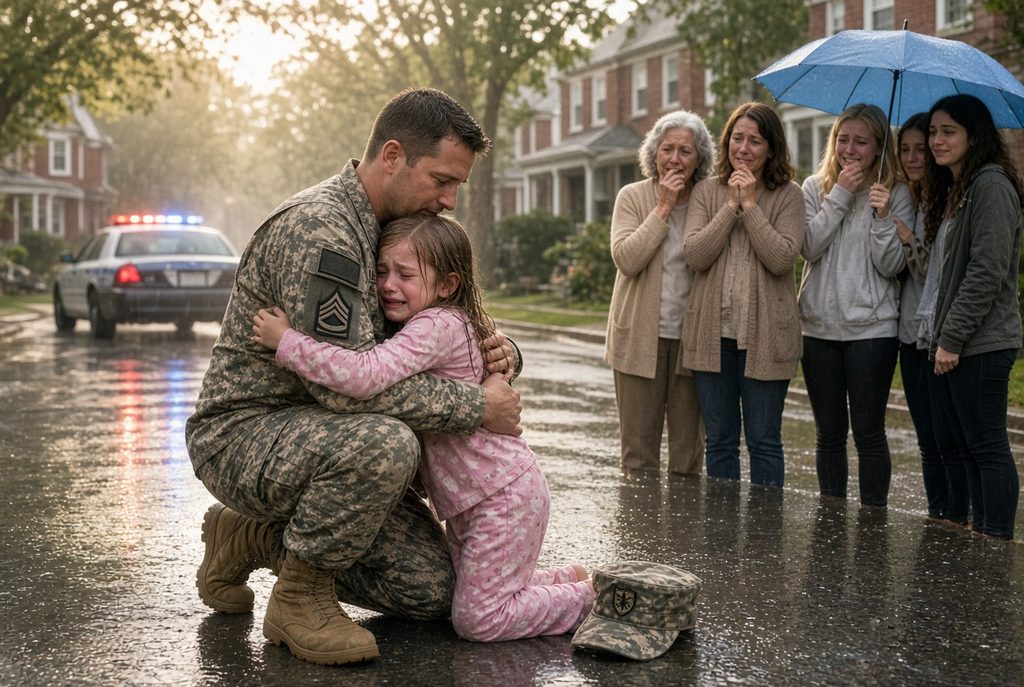
I remembered it because for three hours and forty-one minutes, my eight-year-old daughter had believed there was a chance her father would not reach her in time.
And no father should ever have to live with that.
Neither should a child.
When Lily crashed into my chest in that living room, she hit me hard enough to make me stagger backward.
Her arms locked around my waist.
She buried her face against my uniform shirt.
And she screamed.
Not cried.
Screamed.
“Daddy!”
That one word tore straight through me.
I had heard people call for medics under fire.
I had heard soldiers call for their mothers.
I had stood beside men receiving news that their best friends were gone.
I thought I understood what fear sounded like.
I did not.
Not until I heard my daughter say my name like she had spent the last several hours wondering whether she would ever get to say it again.
I dropped to my knees.
“I’m here.”
Her fingers twisted into my shirt.
“You saw me?”
“I saw you.”
“You heard me?”
“Every second.”
“I screamed really loud.”
“I know.”
“I thought you couldn’t hear.”
“I heard you, sweetheart.”
Behind us, the room went silent.
Even the officers stopped moving.
Lily pulled back.
There were dried tears on her cheeks.
Her hair was tangled.
Her pajamas were stained.
She smelled faintly of soap, rainwater, and something chemical that made my stomach turn.
A paramedic had already checked her skin, and Lieutenant Harris had quietly informed me that the liquid poured onto her clothing appeared to be a foul-smelling mixture intended to frighten her rather than ignite.
That distinction offered me almost no comfort.
Because Lily had not known that.
To an eight-year-old child watching an aunt carry a red fuel container toward her, the technical composition of the liquid did not matter.
She had believed she might die.
And they had laughed.
I lifted my daughter’s face carefully between my hands.
“Are you hurt?”
“My arms hurt where Grandma grabbed me.”
My jaw tightened.
“Anywhere else?”
She shook her head.
Then her eyes moved toward the fireplace.
Toward Claire.
My wife.
Lily’s mother.
Claire stood with her arms folded.
Her phone was already sealed inside an evidence bag.
She looked irritated.
Not horrified.
Not ashamed.
Not devastated by the sight of our daughter trembling in my arms.
Irritated.
As though the worst thing that had happened that afternoon was that someone had interrupted her fun.
Lily lowered her voice.
“Mommy said I deserved it.”
Something inside me became very still.
I looked at Claire.
“What did you say?”
Claire rolled her eyes.
“Oh, don’t start.”
Lieutenant Harris turned toward her.
“Mrs. Reed, I strongly recommend that you stop speaking.”
Claire ignored him.
“It was a joke, Elias.”
My daughter flinched.
I felt it.
Her entire body tightened at the word.
Joke.
I stood slowly.
Lily immediately grabbed my hand.
She did not want me more than a few inches away from her.
So I stayed beside her.
“What part was the joke?”
Claire scoffed.
“Seriously?”
“Yes.”
I kept my voice calm.
“What part?”
Claire glanced around at the officers as though expecting one of them to agree with her.
Nobody did.
Marlene shifted in the dining chair, her wrists cuffed behind her.
Tessa stared at the floor.
Natalie had finally stopped crying.
Brooke stood near the wall with her makeup smeared, looking less confident than she had on the security footage.
Claire exhaled dramatically.
“We were teaching Lily a lesson.”
Lily squeezed my fingers.
I asked, “What lesson requires dragging an eight-year-old across concrete?”
Claire opened her mouth.
I continued.
“What lesson requires surrounding her with adults while she begs you to stop?”
“Elias—”
“What lesson requires pouring liquid onto her clothing while someone carries a fuel can?”
“It wasn’t gasoline!”
Claire shouted it.
The room froze.
That sentence told me everything.
Lieutenant Harris slowly looked toward her.
Claire realized it too late.
She had just admitted knowing exactly what had happened.
She tried to recover.
“I mean…I don’t know what Brooke put in there. It was probably water.”
Brooke looked at her sharply.
“You told me what to use.”
Claire’s face changed.
“Shut up.”
Brooke stared at her.
“You literally mixed it.”
“Brooke!”
“Enough.”
Harris stepped between them.
“No one speaks to anyone except counsel.”
Marlene suddenly leaned forward.
“This is ridiculous.”
I looked at her.
Her silver hair was still perfectly styled.
That bothered me more than it should have.
Something about the fact that she had terrorized my child and still somehow looked ready for a dinner reservation made the whole scene feel even uglier.
Marlene glared at me.
“You’ve completely overreacted.”
I said nothing.
She continued.
“Children need discipline. Your daughter has become spoiled because you’re never here.”
Lily stepped closer to me.
Marlene saw it.
And smiled.
Actually smiled.
“There. You see? She hides behind you.”
I moved Lily behind my leg.
“Mrs. Archer?”
My neighbor was standing near the hallway with an officer.
She looked up.
“Yes?”
“Would you please take Lily into the kitchen for a minute?”
Lily immediately shook her head.
“No.”
I crouched.
“I’ll stay where you can see me.”
“No.”
Her voice cracked.
“Don’t go.”
I looked at Harris.
Then at Marlene.
“No. She stays with me.”
Marlene laughed bitterly.
“Of course she does.”
I faced her.
“You dragged my daughter outside.”
“She was being disrespectful.”
“You dragged her across my driveway.”
“She wouldn’t listen.”
“You restrained her while three grown women surrounded her.”
“She was throwing a tantrum.”
“You told her to call for me because I couldn’t save her.”
For the first time, Marlene’s expression faltered.
Only slightly.
I had heard that line through the camera.
Perfectly.
So had the cloud recording.
So had Garrett.
So had the security monitoring company.
And by then, so had the police.
Marlene looked away.
I stepped closer.
“Do you remember saying it?”
“My attorney will discuss whatever ridiculous accusation—”
“You said, ‘Call your daddy. Go ahead. He’s thousands of miles away. Let’s see how fast the hero gets here.’”
Marlene’s face went white.
Claire whispered, “Elias.”
I turned toward her.
“No.”
Just one word.
She stopped.
For years, I had allowed Claire to interrupt difficult conversations.
I had allowed her to redirect.
Deflect.
Minimize.
Change subjects.
Rewrite arguments after they ended.
I had mistaken patience for strength.
I would not make that mistake again.
“You filmed it.”
Claire swallowed.
“It was supposed to embarrass her a little.”
“She is eight.”
“She lied.”
“About what?”
Claire hesitated.
That was the first crack.
I saw Harris notice it too.
“What did Lily lie about?”
Claire looked at Lily.
My daughter immediately lowered her head.
I stepped between them.
“Don’t look at her.”
Claire snapped, “You’re acting insane.”
“What did she lie about?”
Silence.
Then Tessa spoke from near the wall.
“She told a teacher.”
Claire spun around.
“Tessa!”
Harris lifted a hand.
“Don’t.”
But it was too late.
I looked at Tessa.
“Told a teacher what?”
Tessa pressed her lips together.
Her face had gone pale.
Claire shouted, “She doesn’t know what she’s talking about!”
Harris stepped closer to Claire.
“Mrs. Reed, last warning.”
I barely heard him.
My attention was on Tessa.
“What did my daughter tell her teacher?”
Tessa’s eyes moved to Lily.
Then back to me.
“That Claire had been locking her in her bedroom.”
My hand went cold.
I looked down at Lily.
She stared at the floor.
“Lily?”
She did not answer.
I crouched.
“Sweetheart.”
Her chin trembled.
“Did Mommy lock you in your room?”
A tear rolled down her cheek.
“Sometimes.”
The entire room seemed to tilt.
“How many times?”
“I don’t know.”
“Why?”
“When I made her mad.”
Claire erupted.
“Oh my God, Elias, she had timeout!”
Lily jerked backward.
I stood immediately.
“Don’t yell.”
“That’s what it was! A timeout! Parents put children in their rooms!”
Harris asked, “Was the door locked from the outside?”
Claire said nothing.
“Mrs. Reed?”
“It was childproofing.”
My chest tightened.
I suddenly remembered something.
Two months earlier, I had noticed a new latch mounted high outside Lily’s bedroom.
Claire told me Lily had been sleepwalking.
I had believed her.
God.
I had believed her.
“How long?”
Claire folded her arms.
“Don’t interrogate me in my own house.”
I stared at her.
“Your house?”
The words escaped before I could stop them.
She blinked.
I continued quietly.
“You’re standing in a house full of police officers after terrorizing our daughter, and the thing you’re worried about is whose house this is?”
Claire’s confidence finally cracked.
“That’s not what I meant.”
“Then tell me what you meant.”
She said nothing.
Lily tugged my sleeve.
“Daddy?”
I looked down immediately.
“What, sweetheart?”
Her voice became almost inaudible.
“Mommy said if I told you, you’d leave us.”
I stopped breathing.
“She said what?”
Lily wiped her cheek with her sleeve.
“She said if I told you when she locked the door, you would get mad and leave, and then it would be because of me.”
Claire closed her eyes.
Marlene muttered, “Children misunderstand things.”
That was when Mrs. Archer spoke.
“No.”
Everybody turned.
My seventy-one-year-old neighbor had been standing quietly in the hallway.
Now she stepped forward.
Her hands were shaking.
But her voice was not.
“She did not misunderstand.”
Claire stared at her.
Mrs. Archer looked at me.
“I heard Claire say something similar last month.”
I felt my heart sink.
“When?”
“Behind the fence.”
Mrs. Archer swallowed.
“Lily was crying in the backyard. Claire told her if she kept making trouble, her father might decide he didn’t want to come home anymore.”
Lily’s grip tightened around my hand.
I could barely look at her.
All those deployments.
All those missed breakfasts.
All those nights when I called from another time zone and told her I loved her.
How many times had she hung up believing one mistake could make me disappear?
I bent down and pulled her into my arms.
“Listen to me.”
She looked at me.
“There is nothing you could ever tell me that would make me stop loving you.”
Her face crumpled.
“Nothing?”
“Nothing.”
“What if I’m bad?”
“You are not bad.”
“But what if I do bad things?”
“Then we figure them out together.”
“What if I make Mommy mad?”
I closed my eyes for half a second.
Then opened them.
“That is not your responsibility.”
She stared at me.
I touched my forehead to hers.
“You are a child. Grown-ups are responsible for their own choices.”
Behind me, somebody sniffled.
It was Natalie.
She was crying again.
I did not care.
Not yet.
Lily whispered, “Are you going away again?”
“No.”
It was an immediate answer.
I had no idea what it would cost me professionally.
I did not care.
“Not until you feel safe.”
She wrapped herself around me.
And for the first time since entering that house, I stopped thinking like an officer.
I stopped thinking about evidence.
Charges.
Statements.
Procedures.
I thought only like a father.
And I held my little girl until her breathing slowed.
Thirty minutes later, the house began emptying.
Brooke was escorted outside first.
Then Tessa.
Then Natalie.
Marlene followed last.
The moment officers lifted her from the chair, she started shouting.
“This family is making a mistake!”
Nobody answered.
“You think you’re helping that girl?”
Harris guided her toward the door.
“You’re teaching her she can destroy adults whenever she doesn’t get her way!”
Lily heard her.
I covered my daughter’s ears.
Marlene saw me do it.
Her expression twisted.
“Elias! You can’t keep my granddaughter away from me!”
I looked directly at her.
“Yes.”
Marlene stopped.
“Yes, I can.”
“You have no right!”
“I am her father.”
“Claire is her mother!”
I glanced toward Claire.
She was being questioned by another officer.
Then I turned back.
“And Claire is about to explain her behavior to people who won’t laugh with her.”
Marlene’s face hardened.
“I’ll fight you.”
I nodded once.
“Then fight.”
She seemed surprised.
Maybe she expected anger.
Maybe she expected a threat.
Instead, I gave her the only thing people like Marlene truly feared.
Certainty.
“You can hire attorneys.”
I kept my voice level.
“You can make accusations. You can call relatives. You can post whatever you want online. You can tell everyone I’m controlling, cruel, unstable, absent, military, aggressive, impossible.”
Her lips parted.
“But from this moment forward, every conversation happens through attorneys. Every visit happens only if a court authorizes it. Every message is preserved. Every call is documented. And you will never again be alone with my daughter.”
“You can’t promise that.”
“I just did.”
Harris led her away.
She screamed my name all the way down the driveway.
I never looked back.
Claire was not immediately taken away.
That surprised me.
It made her confident.
For approximately six minutes.
Then Detective Lena Morales arrived.
She was in her mid-forties, dark-haired, expressionless, and carrying a tablet.
She had spent years working crimes involving children.
She did not raise her voice.
She did not need to.
She walked into my dining room, introduced herself, and asked Claire to sit.
Claire refused.
Morales sat anyway.
“Mrs. Reed, your sister has provided an initial statement.”
Claire’s face changed.
“Which sister?”
Morales ignored the question.
“Another sister has provided access to a group conversation.”
Claire glanced toward me.
I said nothing.
Morales continued.
“And one of the phones recovered inside the residence appears to contain messages discussing today’s event before it occurred.”
Claire swallowed.
“It was a joke.”
Morales nodded.
“You’ve said that.”
“Because it was.”
“Then the messages should support that.”
Claire’s shoulders relaxed slightly.
Morales tapped the tablet.
“Except they don’t.”
Claire went still.
Detective Morales read without dramatizing.
That somehow made it worse.
“‘She needs to learn what happens when she runs her mouth at school.’”
Claire’s lips parted.
Morales looked up.
“Your account sent that yesterday at 9:42 p.m.”
Silence.
She continued.
“‘Mom has the fake gas can. Brooke will do the pouring. I’ll record it.’”
Lily buried her face against me.
Claire said, “That’s out of context.”
Morales nodded.
“Okay.”
She scrolled.
“Here’s more context.”
“No.”
Claire stepped forward.
“I want a lawyer.”
Morales stopped immediately.
“Understood.”
She rose.
“You won’t be questioned further without counsel.”
Claire looked relieved.
Then Morales added, “But you should understand something.”
Claire stared at her.
“The investigation does not disappear because you stop answering questions.”
That confidence vanished again.
An officer stepped closer.
Claire looked at me.
“Elias.”
I did not respond.
“Please.”
It was the first time she had sounded afraid.
Not sorry.
Afraid.
There is a difference.
“Elias, tell them this is a family matter.”
I stared at the woman I had married eleven years earlier.
I remembered our wedding.
She had worn lilies in her hair because she said they reminded her of her grandmother’s garden.
Years later, we gave our daughter the same name.
I remembered Claire crying when Lily was born.
I remembered her holding that tiny newborn against her chest and whispering, “I’ll protect you forever.”
Where had that woman gone?
Or had she ever existed?
Maybe cruelty does not arrive suddenly.
Maybe it grows behind closed doors in small permissions.
A sarcastic remark nobody challenges.
A punishment that goes too far.
A child silenced because keeping peace feels easier than asking uncomfortable questions.
A lie believed because the truth would require changing your entire life.
I had been trained to identify threats.
Yet I had missed one living under my own roof.
That truth would follow me for years.
Claire stepped closer.
“You know me.”
I answered quietly.
“I thought I did.”
Her eyes filled.
That was when she finally began crying.
“Don’t do this.”
I almost laughed.
Not because anything was funny.
Because the sentence was so completely backward.
“I didn’t.”
“What?”
“I didn’t do this.”
I looked toward our daughter.
“You did.”
Claire followed my eyes.
For the first time that evening, she truly looked at Lily.
Our daughter’s cheeks were swollen from crying.
A blanket was wrapped around her shoulders.
One hand clung to mine.
Claire whispered, “Baby…”
Lily hid behind me.
Claire froze.
There it was.
The consequence no judge could manufacture.
No prosecutor could impose.
No lawyer could negotiate away.
Her own child was afraid of her.
Claire covered her mouth.
“Lily.”
My daughter whispered, “I don’t want Mommy.”
Claire broke.
She sank into a chair.
I wish I could say watching her cry made me feel victorious.
It did not.
I felt empty.
Because I had loved this woman.
Because Lily loved this woman.
Because there are victories no decent person celebrates.
Sometimes winning simply means stopping something terrible before it gets worse.
By midnight, Lily and I were gone.
I did not sleep in that house.
Neither did she.
Garrett arranged a secure guest residence through an old friend until my attorney could address temporary custody and property access.
The location was quiet.
No reporters.
No relatives.
No neighbors staring.
Just a two-bedroom cottage beside a lake, forty minutes from Fairfield.
The first night, Lily refused to sleep alone.
I made no argument.
We pushed two mattresses together.
She lay beside me holding the stuffed fox I had bought at the airport.
I had forgotten it was still in my bag until nearly one in the morning.
When I gave it to her, she stared at it for several seconds.
“You really bought this for me?”
“Of course.”
“Before you saw the camera?”
“Yes.”
She hugged it.
“What should I name him?”
I looked at the ceiling.
“Maybe Denver?”
She giggled.
It was the first laugh I had heard from her.
A real one.
Small.
Exhausted.
But real.
“That’s a weird fox name.”
“I’m not good at naming foxes.”
“You named me.”
“Your mother named you.”
The smile disappeared.
I regretted the sentence immediately.
Lily stared at the stuffed animal.
“Do I still have to love Mommy?”
That question hurt more than anything that had happened inside the house.
I rolled onto my side.
“You don’t have to decide how you feel tonight.”
“But she’s my mom.”
“Yes.”
“And she did something bad.”
“Yes.”
“So am I supposed to hate her?”
“No.”
“Then what?”
I searched for the right answer.
For once, military training offered nothing.
“You’re allowed to feel two things at once.”
She looked confused.
“You can love somebody and still be angry.”
“Really?”
“Yes.”
“You can miss someone and still not feel safe around them.”
She nodded slowly.
“You can remember good things someone did and still tell the truth about the bad things.”
“Even if they get in trouble?”
“Especially then.”
She hugged Denver the fox tighter.
“Mommy said families don’t tell on each other.”
I swallowed.
“Safe families tell the truth to each other.”
“What if the truth makes everybody mad?”
“Then they can be mad.”
I brushed hair from her forehead.
“The truth is still the truth.”
She thought about that.
Then whispered, “Daddy?”
“Yes?”
“You came.”
I closed my eyes.
“I told you.”
“No.”
She touched my sleeve.
“When Grandma said you couldn’t come…you came anyway.”
I looked at her.
“I will always try.”
“Even from the sky?”
I smiled.
“Even from the sky.”
She finally closed her eyes.
Within ten minutes, she was asleep.
I stayed awake until sunrise.
The next morning, the internet exploded.
I had spent much of my career avoiding public attention.
By breakfast, millions of strangers knew fragments of my family nightmare.
Claire’s relatives had posted short clips before police arrived.
They had believed the footage made Lily look spoiled.
Instead, the videos horrified people.
One clip showed Marlene dragging her.
Another showed Brooke holding the red can while Natalie laughed.
A third captured Claire saying, “Maybe now she’ll stop tattling.”
That sentence spread everywhere.
Within hours, Claire’s family began deleting posts.
It was too late.
People had downloaded them.
Screen-recorded them.
Archived them.
News stations started calling.
Online commentators began inventing details.
Some portrayed me as a heroic military father.
Others suggested the entire event was staged.
A few dug into my service history.
Others posted photographs of my house.
That was when I shut everything down.
Through my attorney, Daniel Mercer, I released one statement.
Nothing more.
A minor child had been harmed.
Authorities were investigating.
Her privacy mattered more than public curiosity.
No interviews.
No exclusive stories.
No photographs of Lily.
No monetizing her trauma.
Then I turned off my phone.
Garrett found me on the cottage porch an hour later.
He handed me coffee.
“You look terrible.”
“Thank you.”
“You’re welcome.”
We sat quietly.
Garrett had once been the man I trusted on missions where one wrong decision could kill everyone in the room.
Now he sat beside me staring at ducks.
Life was strange.
“You know this isn’t your fault,” he said.
I did not answer.
He glanced at me.
“Elias.”
“I should have known.”
“Maybe.”
I turned.
He shrugged.
“You want me to lie?”
“No.”
“You should’ve noticed things sooner.”
The honesty almost made me smile.
Garrett continued.
“But missing warning signs is different from causing them.”
I looked toward the lake.
“I left her there.”
“You left her with her mother.”
“I left her.”
“You went to work.”
“I flew across the country while she was being locked in her room.”
“You didn’t know.”
“That doesn’t make it easier.”
“No.”
He took a sip of coffee.
“It doesn’t.”
We sat in silence.
Then he said, “So what are you going to do with the guilt?”
I looked at him.
“Excuse me?”
“You can carry it around until Lily starts worrying about you too.”
He pointed toward the cottage.
“Or you can use it.”
“How?”
“Become harder to fool.”
That sentence stayed with me.
Become harder to fool.
Not angrier.
Not crueler.
Not suspicious of everyone forever.
Just harder to fool.
I nodded.
Garrett stood.
“Your lawyer called.”
“What happened?”
“Emergency custody hearing tomorrow.”
My stomach tightened.
“And Claire?”
“She retained counsel.”
“Of course.”
“Marlene too.”
I stared at the lake.
Garrett hesitated.
“There’s something else.”
I looked at him.
“The school sent records.”
My chest tightened.
“What records?”
“Reports from Lily’s counselor.”
I stood.
“What reports?”
Garrett looked toward the cottage.
“Daniel wants to explain.”
I was already reaching for my phone.
There were four reports.
Four.
Not one.
Not two.
Four.
The first had been filed six months earlier.
Lily had told a school aide she sometimes stayed in her bedroom “until Mommy feels better.”
The aide asked what she meant.
Lily said the door could not open.
The school counselor contacted Claire.
Claire explained that Lily had developed a habit of locking herself inside her room during tantrums.
The counselor accepted the explanation.
The second report came two months later.
Lily arrived at school without lunch.
When asked why, she said her mother told her she could “learn how hunger feels” after refusing dinner.
Claire later claimed Lily was exaggerating.
The third incident involved a bruise on Lily’s upper arm.
Claire said Lily fell from playground equipment.
Lily initially agreed.
Then quietly told a teacher, “Grandma squeezed me because I talked back.”
The fourth report was the one that triggered everything.
Three days before my flight, Lily told her teacher she was afraid of spending the weekend with Claire’s family because they were planning “a punishment surprise.”
The teacher called Claire.
Claire assured her the child had misunderstood a planned family game.
Then Claire apparently told Marlene.
And Marlene became furious.
Lily had exposed them.
So they decided to teach her what happened to children who “tattled.”
I read the reports twice.
Then a third time.
My hands shook so badly I finally placed the papers on the table.
Daniel sat across from me.
“Why wasn’t I contacted?”
“That’s one of the questions we’re asking.”
“I am her father.”
“Yes.”
“The school has my number.”
“Yes.”
“They have my emergency contact information.”
“Yes.”
“Then why did they only call Claire?”
Daniel removed his glasses.
“Because she repeatedly represented herself as the primary household contact while you were traveling.”
I stared at him.
“She told them you were unavailable for parenting decisions.”
My jaw tightened.
“That’s not true.”
“I know.”
“She had my deployment schedule.”
“Yes.”
“She knew exactly when I could be reached.”
“Yes.”
I stood and walked toward the window.
“Six months.”
Daniel said nothing.
“For six months, my daughter was trying to tell people.”
“Yes.”
“And every adult explanation outweighed hers.”
Daniel’s voice softened.
“Until now.”
I turned.
“I want everything.”
“You’ll get everything we can legally obtain.”
“School emails. Counselor notes. Medical appointments. Security footage. Text records. Every call to her pediatrician.”
“Already requesting them.”
“I want to know every time Claire took Lily anywhere without telling me.”
Daniel nodded.
“Elias.”
“What?”
“The goal can’t be revenge.”
I stared at him.
“It isn’t.”
“Good.”
He paused.
“Because there is a difference between proving Lily needs protection and trying to destroy every adult who failed her.”
I did not like hearing that.
But I knew he was right.
“So what is the goal?”
Daniel looked toward the bedroom where Lily was coloring.
“Safety.”
I nodded.
“Then get me safety.”
The emergency custody hearing began at 9:00 the next morning.
It lasted fifty-two minutes.
Claire sat across the courtroom wearing a navy dress I had bought her for our anniversary.
Seeing it felt surreal.
Her attorney argued that the incident had been reckless but misunderstood.
He emphasized that the liquid was not gasoline.
That nobody had intended physical injury.
That Claire had never been arrested before.
That separating a child entirely from her mother could itself be traumatic.
Some of that was legally reasonable.
Emotionally, I hated every word.
But courts are not built to process hatred.
They process evidence.
Our evidence was substantial.
Security footage.
Neighbor testimony.
Messages.
School records.
Police reports.
Photographs.
And Lily’s interview with a trained child specialist.
I never watched the full interview.
I could not.
Daniel told me enough.
Lily described being locked in her room.
Being told not to contact me.
Being warned that telling adults would “break the family.”
She described Marlene pinching her arm.
She described Claire telling her that a good daughter keeps family secrets.
Then the judge watched part of the driveway video.
Nobody spoke while it played.
Marlene’s voice came through the speakers.
“Call your daddy.”
Lily screamed.
“Daddy!”
“Louder!”
Laughter.
“Daddy!”
More laughter.
Then Brooke’s voice.
“Hold her still.”
I stared at the table.
I could not watch again.
I listened.
That was worse.
When the video ended, Judge Rebecca Sloan remained silent for several seconds.
Then she removed her glasses.
Temporary sole physical custody was granted to me.
Claire was prohibited from unsupervised contact pending further evaluation.
Marlene, Brooke, Tessa, and Natalie were placed under temporary no-contact restrictions involving Lily.
The court ordered that communication about Lily occur through approved channels.
Counseling was authorized immediately.
Claire began crying.
Her attorney touched her arm.
She shook him off.
Then she looked at me.
I expected anger.
Instead, she looked terrified.
“Elias.”
The judge glanced toward her.
Her attorney whispered something.
Claire ignored him.
“Please don’t take her away forever.”
I could have answered cruelly.
Part of me wanted to.
But Lily would eventually hear about everything said in that courtroom.
And I wanted to become the kind of father she could safely remember.
So I said only this.
“Then become someone she can feel safe with.”
Claire cried harder.
The hearing ended.
I walked out without looking back.
The criminal investigation continued.
Contrary to the fantasies people posted online, nobody kicked down doors with military teams.
No secret unit stormed the neighborhood.
No one disappeared.
There were warrants.
Interviews.
Evidence reviews.
Lawyers.
Hearings.
Slow procedures.
Frustrating delays.
Real accountability is often less cinematic than revenge.
But it lasts longer.
Brooke cooperated first.
Investigators confirmed the red can had been cleaned and filled with a mixture designed to smell frightening while reducing actual fire risk.
That fact became central to the defense.
They had planned not to burn Lily.
They argued that proved there was no serious intent to harm her.
The prosecution argued something different.
They had engineered a situation specifically to make a child believe adults might set her on fire.
The terror was not accidental.
The terror was the point.
That distinction mattered.
Brooke turned over the group messages.
Hundreds of them.
Months of conversation.
Claire complaining that Lily was “becoming manipulative.”
Marlene saying children needed to fear consequences.
Tessa joking about sending Lily to a strict boarding school.
Natalie suggesting embarrassing punishments.
And Claire repeatedly complaining that Lily “worshipped Elias” and used me as protection whenever mother and daughter argued.
Then investigators found the message that changed how I viewed my marriage forever.
Claire had written it two months earlier.
“When Elias is home she acts like I’m nobody.”
Marlene responded:
“Then stop letting her think Daddy always saves her.”
I read those words alone in Daniel’s office.
They were not disciplining Lily.
They were competing with her.
With an eight-year-old child.
Claire resented how safe Lily felt with me.
Marlene resented my influence.
And instead of building a healthier relationship, they tried to break hers with her father.
Not by convincing her I was bad.
By teaching her I was powerless.
That was why Marlene taunted her on the driveway.
Call your daddy.
Let’s see how fast the hero gets here.
It was never just a punishment.
It was a demonstration.
They wanted Lily to scream for me and watch nothing happen.
They wanted her to learn that I could not protect her.
They wanted the person she trusted most to fail in real time.
Except the camera had sent an alert.
And I had opened it.
For weeks, Lily woke from nightmares.
Sometimes she screamed.
Sometimes she simply appeared beside my bed at two in the morning holding Denver the fox.
I stopped asking what happened.
I moved over.
She climbed in.
Therapy helped.
Slowly.
Her therapist, Dr. Maya Chen, taught both of us things I wished I had known years earlier.
Traumatized children do not always cry.
Sometimes they become unusually obedient.
Sometimes they apologize constantly.
Sometimes they ask permission to eat.
Sometimes they watch adults’ faces before answering simple questions.
Sometimes they become experts at managing everyone else’s emotions because they believe safety depends on keeping adults happy.
Once I learned what to watch for, I saw it everywhere.
“Can I get water?”
“Yes.”
“Are you sure?”
“Yes.”
“Will you be mad?”
“No.”
A few days later:
“Can I use the blue towel?”
“Of course.”
“Even though Mommy said those are for guests?”
“You live here.”
“Does that mean I’m a guest?”
“No.”
A week later:
“Daddy, if I spill this, will you yell?”
“No.”
“What if it’s a big spill?”
“We’ll clean it.”
“What if it’s really big?”
“Then we’ll use more towels.”
She stared at me like I had explained some incredible secret.
Children should not be astonished by kindness.
That realization broke my heart repeatedly.
So we practiced normal life.
Pancakes.
School.
Cartoons.
Bike rides.
Library trips.
We adopted a routine.
Every night before bed, Lily told me three things.
One good thing.
One hard thing.
One thing she wanted me to know.
Sometimes the third thing was silly.
“I hate peas.”
“I already knew.”
“You said anything.”
“Fair.”
Sometimes it was heavier.
“I miss Mommy.”
“That’s okay.”
“Are you mad?”
“No.”
“Really?”
“Really.”
Sometimes she surprised me.
“Grandma wasn’t mean all the time.”
“I believe you.”
“She made good cinnamon toast.”
“You’re allowed to remember that.”
“Does it make me bad?”
“No.”
There was that word again.
Bad.
It took months before she stopped using it to describe herself.
Claire wrote letters.
The first arrived six weeks after the incident.
Three pages.
Mostly excuses.
Stress.
Loneliness.
My absences.
Her mother’s influence.
Lily’s behavioral issues.
Online pressure.
By the final paragraph, she had somehow transformed herself into another victim.
I gave the letter to Daniel.
Lily never saw it.
The second letter was shorter.
“I understand now that I frightened her.”
Still not enough.
The third came after Claire began court-ordered therapy.
That letter was different.
No excuses.
No accusations.
No mention of me until the last paragraph.
She wrote:
“I kept telling myself I was losing control of my daughter when what I was actually losing was her trust. Instead of asking why she felt safer telling other people things than telling me, I punished her for telling. I taught her that my feelings mattered more than her fear. I cannot undo that.”
I read that sentence several times.
Then she wrote:
“I do not deserve access to Lily simply because I gave birth to her. If she ever wants a relationship with me again, I understand it will have to happen at her pace, not mine.”
I hated how relieved I felt.
Because part of me wanted Claire to remain a monster.
Monsters are easier.
You defeat them.
Leave them.
Lock the door.
Never look back.
People are harder.
People can do terrible things and later understand them.
People can love someone and still damage them.
People can change without being entitled to forgiveness.
That was the lesson I had to teach Lily.
And myself.
Accountability was not the same as hatred.
Change did not erase consequences.
Forgiveness, if it ever came, belonged to the injured person.
Not the person requesting it.
Marlene never apologized.
Not once.
She fought every restriction.
She blamed me.
The school.
The police.
The internet.
Claire’s sisters.
Even Lily.
At one hearing, she claimed I had “brainwashed” my daughter against her.
Judge Sloan asked a simple question.
“What would you like to say to Lily if contact were permitted?”
Marlene answered:
“I’d tell her she needs to understand what she’s done to this family.”
The judge stared at her.
Then denied the request.
That was Marlene.
Even standing at the edge of losing her granddaughter permanently, she could not imagine a world in which Lily’s pain mattered more than her own embarrassment.
Tessa eventually accepted responsibility.
Natalie did too.
Both completed required counseling and remained away from Lily.
Brooke’s cooperation played a role in resolving her case.
Claire faced the most complicated consequences because she was Lily’s mother and an active participant.
The final legal outcomes were less dramatic than strangers online demanded.
Some people wanted years of imprisonment.
Others wanted the case dismissed as family stupidity.
Reality landed somewhere between those extremes.
There were criminal consequences.
Protective restrictions.
Required treatment.
Family court oversight.
And a permanent record of what had happened.
But the greatest punishment was not delivered in a courtroom.
It happened eight months later.
Claire saw Lily for the first time in a supervised therapeutic setting.
Lily asked me whether she had to go.
“No.”
“Will Mommy be sad if I don’t?”
“Probably.”
Lily looked worried.
“But that is not why you should go.”
She stared at me.
“You go only if you want to.”
She thought for two days.
Then said yes.
I drove her.
She carried Denver the fox.
When we reached the clinic, Lily froze at the entrance.
I crouched beside her.
“We can leave.”
“I know.”
“You don’t have to prove anything.”
“I know.”
“You want me inside?”
She nodded.
The therapist allowed me to remain for the beginning.
Claire was already sitting in the room.
She looked different.
Thinner.
No makeup.
Hands folded in her lap.
When Lily entered, Claire immediately started crying.
But she did not move toward her.
That mattered.
Months earlier, Claire would have rushed forward and demanded a hug.
This time, she stayed in her chair.
“Hi, Lily.”
Lily stood beside me.
“Hi.”
Claire wiped her cheek.
“I’ve missed you.”
Lily said nothing.
The therapist gently asked whether Lily wanted to sit.
She chose a chair beside mine.
For several minutes, nobody spoke.
Then Claire said the words I had been waiting almost a year to hear.
Not for me.
For our daughter.
“What I did was wrong.”
Lily stared at her.
Claire continued.
“You did not make me do it.”
Another tear rolled down her cheek.
“You did not deserve it.”
Lily’s fingers tightened around the fox.
“And you were right to tell your teacher.”
Lily looked at me.
Then back at Claire.
“You got mad.”
“Yes.”
“You said I ruined everything.”
“I was wrong.”
“Grandma said it too.”
“She was wrong.”
“Did you think it was funny?”
Claire’s face collapsed.
“At the time…yes.”
Lily swallowed.
“Why?”
Claire closed her eyes briefly.
“Because I was being cruel.”
No excuse.
No explanation.
Just the truth.
Lily whispered, “I thought you were going to let them burn me.”
Claire covered her mouth.
The therapist leaned forward, but Claire raised one hand gently.
She needed to hear it.
Lily continued.
“I thought Daddy wasn’t coming.”
Claire sobbed silently.
“And you laughed.”
“I know.”
“Why didn’t you help me?”
Claire stared at her daughter.
“I should have.”
“That’s not why.”
The room became still.
Lily wanted an answer.
A real one.
Claire took several seconds.
“Because I cared more about proving that I was in charge than about whether you were scared.”
Lily looked down at Denver.
“That was mean.”
“Yes.”
“Really mean.”
“Yes.”
“I don’t trust you.”
Claire’s lower lip trembled.
“I understand.”
“I don’t know if I love you.”
That one almost destroyed her.
I saw it.
Claire’s whole body flinched.
But she did not make Lily comfort her.
Instead she nodded.
“That’s okay.”
Lily looked surprised.
Claire wiped her tears.
“You don’t owe me an answer.”
For the first time, Lily’s shoulders relaxed.
Only slightly.
But I noticed.
Therapy taught me to notice small things.
The session lasted thirty-four minutes.
When we left, Lily held my hand.
At the car she stopped.
“Daddy?”
“Yes?”
“I think Mommy is different.”
“Maybe.”
“Do you believe her?”
“I believe she is trying.”
“Is that the same?”
“No.”
She nodded.
That answer seemed to satisfy her.
“Can people change?”
“Yes.”
“Does that mean they get everything back?”
I looked at her.
“No.”
Lily smiled faintly.
“I knew that.”
One year after the driveway incident, I retired from active operational command.
People assumed I did it because I was angry with the military.
I wasn’t.
The military had given me purpose, discipline, friendships, and a life bigger than myself.
But priorities change.
I accepted a stateside advisory role with predictable hours.
No emergency overseas rotations.
No months of absence.
No classified assignments that required disappearing from my daughter’s life.
Some colleagues told me I was walking away at the height of my career.
Maybe.
I did not feel like I was walking away.
I felt like I was finally walking toward something.
On my last formal day, Garrett attended the ceremony.
Lily sat in the front row.
When the speech ended, she ran to me.
“You’re really done flying away?”
“Mostly.”
“Mostly?”
“I still like airplanes.”
She narrowed her eyes.
“No secret missions?”
“Not without checking with my commander.”
“Who’s your commander?”
I pointed at her.
She grinned.
“Good.”
The house on Oak Ridge Lane was sold.
I could never live there again.
Neither could Lily.
People told me not to let one terrible memory chase us from our home.
But walls remember.
At least children believe they do.
For months, Lily refused to walk near the driveway where it happened.
So I stopped asking her to.
We bought a smaller house twenty minutes away.
Yellow kitchen.
Big backyard.
A maple tree.
No exterior lock on Lily’s bedroom.
The first night, she walked around testing doors.
Front door.
Back door.
Closets.
Her bedroom.
Bathroom.
I watched silently.
Finally she asked, “Why don’t you have a lock outside my door?”
“Because I don’t need one.”
“What if I get in trouble?”
“Then we talk.”
“What if I won’t listen?”
“Then we keep talking.”
“What if I slam the door?”
“I’ll probably tell you not to slam doors.”
She smiled.
“That’s it?”
“Depends how hard you slam it.”
She laughed.
That laugh filled the hallway.
I remember thinking I would buy a thousand doors just to hear that sound again.
Two years passed.
The video disappeared from most people’s attention.
The internet found new scandals.
New villains.
New heroes.
New things to outrage over.
That was fine with me.
Lily was not content.
She was a person.
And she deserved to become something other than the crying girl in a viral video.
At ten, she joined a soccer team.
She was terrible at first.
Spectacularly terrible.
She ran in the wrong direction during her first game.
Afterward she climbed into the car and said, “We are never discussing this.”
I promised nothing.
By the end of the season, she scored twice.
At eleven, she started drawing.
At twelve, she went through a phase where every answer was “maybe.”
“Did you finish your homework?”
“Maybe.”
“Did you brush your teeth?”
“Maybe.”
“Is the kitchen currently on fire?”
“Maybe.”
Normal.
Beautifully, frustratingly normal.
Her relationship with Claire developed slowly.
Supervised visits became longer.
Eventually they moved to carefully structured outings.
Claire remained in therapy.
She never asked me to reconcile.
I respected her for that.
Our marriage ended legally long before Lily decided what relationship she wanted with her mother.
Claire understood those were separate issues.
One afternoon, nearly three years after the incident, she called me.
We rarely spoke directly.
“I wanted to tell you something.”
“What?”
“My mother contacted me.”
I stiffened.
“What did she want?”
“To meet Lily.”
“No.”
“I already said no.”
I was silent.
Claire continued.
“She told me I’ve been manipulated by you and the therapists.”
“That sounds like Marlene.”
“She said a mother should defend her family.”
I waited.
Claire’s voice shook.
“I told her Lily is my family.”
For a moment, I said nothing.
Then I answered.
“Good.”
Claire gave a weak laugh.
“That’s all?”
“What do you want, a medal?”
“No.”
She laughed again.
A real laugh this time.
Then grew quiet.
“Elias?”
“Yes?”
“Thank you for coming home that day.”
My grip tightened around the phone.
“I shouldn’t have needed to.”
“I know.”
We ended the call.
There are some apologies that cannot repair what happened.
But they can prove someone finally understands it.
That was enough.
When Lily turned thirteen, she asked to see the security footage.
I refused.
“No.”
She crossed her arms.
“It’s about me.”
“Yes.”
“So shouldn’t I decide?”
“When you’re older.”
“How old?”
“I don’t know.”
“That’s unfair.”
“Probably.”
She glared at me.
I waited.
Finally she asked, “Do you still have it?”
“The lawyers do.”
“Did you keep a copy?”
“Yes.”
“Why?”
That question surprised me.
I thought about it.
“Because there was a time when people tried to tell you what happened wasn’t serious.”
She said nothing.
“I kept proof so you would never have to wonder whether you imagined it.”
Her expression softened.
“Do you think I forgot?”
“No.”
“Some parts feel blurry.”
“That’s okay.”
“Sometimes I remember Grandma’s voice more than her face.”
I nodded.
“That’s okay too.”
She looked toward the window.
“Do you hate her?”
“Marlene?”
“Yes.”
I answered carefully.
“I don’t spend much time deciding.”
“That sounds like an adult fake answer.”
I smiled.
“Fine.”
She waited.
“I hate what she did.”
“Not her?”
“I don’t know what good hating her would do for us.”
Lily considered that.
“Mom says Grandma is still angry.”
“Probably.”
“At me.”
“That is her problem.”
“She says I destroyed the family.”
“No.”
Lily looked at me.
“The family already had cracks. You just stopped hiding them.”
She became quiet.
Then she said, “I like that answer.”
“So do I.”
Years later, Lily would barely remember the stuffed fox’s original color.
Denver became faded from being carried everywhere.
One ear tore.
His tail had to be sewn back on twice.
Eventually he lived on a shelf beside trophies and framed photographs.
But she never threw him away.
Neither did she forget the sentence I had made her repeat when she was nine.
Adults are responsible for their own choices.
It became a family rule.
When I lost my temper, I apologized.
No “but you made me angry.”
When Lily lied as a teenager, she faced consequences.
No “you forced me to lie.”
When Claire missed a scheduled call once, she acknowledged it.
No excuses.
No guilt.
Just responsibility.
That was how our strange, damaged family rebuilt itself.
Not by pretending nothing happened.
By refusing to pretend again.
On Lily’s sixteenth birthday, Claire came to dinner.
By then, their relationship was imperfect but real.
Claire did not live with us.
She never would.
But she attended school concerts.
Soccer finals.
Birthdays.
Therapy when Lily wanted her there.
She had learned the most difficult role of her life.
Being Lily’s mother without assuming that title entitled her to Lily’s trust.
After dinner, Lily disappeared upstairs.
Claire and I stood in the kitchen.
“She looks like you,” Claire said.
“No, she doesn’t.”
“She argues like you.”
“That I believe.”
Claire smiled.
Then her expression turned serious.
“Do you ever think about that day?”
“Yes.”
“Every day?”
“Not anymore.”
She nodded.
“I do.”
I looked at her.
“Every day.”
I did not know what to say.
Claire looked toward the stairs.
“I still hear her calling you.”
My chest tightened.
Claire swallowed.
“That was the moment I should have stopped it.”
“You should have stopped it before it started.”
“I know.”
She nodded.
“No argument.”
We stood quietly.
Then she said, “I spent years being jealous that she trusted you more.”
I stared at her.
“I thought if I could prove you weren’t always going to save her, she’d need me more.”
My stomach twisted.
Claire’s eyes filled.
“I didn’t understand that making a child lose one safe parent doesn’t magically make the other parent safe.”
I leaned against the counter.
“No.”
“It just leaves them with nobody.”
“Yes.”
She wiped her cheek.
“I almost did that to her.”
I had no comforting response.
Some truths should remain uncomfortable.
Then footsteps sounded above us.
Lily shouted, “Dad!”
I looked up.
“What?”
“Where did you put my charger?”
“I didn’t touch your charger!”
“You always say that!”
Claire started laughing.
I looked at her.
“What?”
“Nothing.”
“Why are you laughing?”
“Colonel Reed defeated by a phone charger.”
From upstairs:
“DAD!”
I sighed.
“Coming!”
Claire smiled.
Normal life.
After everything, normal life felt miraculous.
At eighteen, Lily graduated high school.
The ceremony was held on a bright Saturday afternoon.
I sat in the bleachers wearing sunglasses because I had made the mistake of telling everyone I did not cry at graduations.
Garrett sat beside me.
“You’re crying.”
“Sunlight.”
“Sure.”
“Allergies.”
“Of course.”
“Shut up.”
When Lily’s name was called, I stood so quickly I nearly knocked over the man in front of me.
She crossed the stage.
Accepted her diploma.
Then turned toward the stands.
She found me.
And pointed.
The same way she had when she was four and wanted everyone at preschool to know which father belonged to her.
I pointed back.
After the ceremony, she ran into my arms.
I lifted her even though she was far too old for it.
“Dad!”
“You weigh more now.”
“Put me down!”
“Never.”
She laughed.
Claire joined us.
There was an awkward second.
Then Lily pulled her into the hug.
Claire froze.
I saw her eyes close.
She did not take that moment for granted.
None of us did.
Garrett took the photograph.
Three people.
A father.
A daughter.
A mother who had nearly lost everything and spent years learning that remorse is a practice, not a sentence.
It became one of my favorite pictures.
Not because it proved our family was healed.
Families are not broken bones.
They do not return perfectly to their original shape.
It proved something better.
We had built a new shape.
That evening, Lily and I sat on the back porch.
Her graduation cap rested on the table.
“You know what everyone at school thinks is cool?”
“What?”
“That you diverted an airplane because of me.”
I groaned.
“Please don’t make that my legacy.”
“They think you’re basically an action movie character.”
“I spent most of that flight making phone calls.”
“Very cinematic phone calls.”
“Lily.”
She laughed.
Then grew quiet.
“Dad?”
“Yes?”
“You know what I remember most?”
I expected the driveway.
The red can.
The screaming.
The police.
Instead she said:
“The fox.”
I looked at her.
“What?”
“When you came in, and later you gave me Denver.”
She smiled.
“I remember thinking you had bought me something before you even knew I needed saving.”
My throat tightened.
She continued.
“It meant you were already thinking about me.”
I looked toward the yard.
There are moments when your children accidentally show you exactly what mattered.
Not the grand rescue.
Not the aircraft diversion.
Not the police convoy.
A stuffed fox bought in an airport gift shop.
Proof that she had been loved before the crisis.
Proof that the love did not begin because she screamed.
I reached over and squeezed her hand.
“I was always thinking about you.”
“I know.”
Then she said something I will carry until the day I die.
“That is why Grandma was wrong.”
I turned.
“About what?”
“When she said calling you wouldn’t matter.”
Lily smiled.
“She thought the important part was how fast you got there.”
I waited.
“It wasn’t.”
“What was?”
“That you were coming.”
I could not speak for several seconds.
Then I nodded.
“Yes.”
She leaned her head against my shoulder.
And beneath the fading summer sky, I understood something I had spent years trying to learn.
Protection is not always arriving before something bad happens.
Sometimes you cannot.
Sometimes people you trusted hide things from you.
Sometimes the warning comes late.
Sometimes the camera alert arrives after your child has already cried.
Protection is what you do after you know.
Do you believe them?
Do you listen?
Do you stay?
Do you build a life where they no longer have to scream before someone pays attention?
That became my mission.
Not revenge.
Not punishment.
Not humiliating Claire’s family.
Lily.
Always Lily.
People still occasionally recognized me.
A cashier once stared at my name on a credit card and asked if I was “that military dad from the video.”
I said yes.
She smiled.
“You really showed those women.”
I understood what she meant.
But the phrase never sat right with me.
Because that story was not about me defeating anybody.
I went home that night and found Lily studying at the kitchen table.
She was in college by then, home for the weekend.
Books everywhere.
Coffee untouched.
Denver the fox still sat upstairs.
I asked her, “You good?”
She looked up.
“Define good.”
“Alive?”
“Yes.”
“Fed?”
“Debatable.”
I opened the refrigerator.
“You’ve been home six hours.”
“And yet nobody has presented me with dinner.”
“Tragic.”
“Some father.”
I laughed.
Twenty minutes later we were eating pasta.
She told me about classes.
A professor she liked.
A roommate she did not.
A paper she had procrastinated on.
Nothing dramatic.
No emergency.
No police.
No cameras.
And I realized this was the ending I had wanted all along.
Not chaos on someone’s doorstep.
Not screaming relatives in handcuffs.
Not viral justice.
This.
My daughter complaining about homework while stealing garlic bread from my plate.
Safe enough to be annoying.
Safe enough to argue.
Safe enough to tell me when I was wrong.
Safe enough to close her bedroom door without fearing someone would lock it from the outside.
Safe enough to know that if she called me, I would answer.
Years after that terrible afternoon, I finally deleted the security camera application from my old phone.
The evidence existed where it needed to exist.
I no longer needed to carry the footage in my pocket.
Before deleting it, I opened the archive one final time.
I did not play the worst video.
I chose an older clip.
Two weeks before everything happened.
Front porch camera.
Lily running out the door with her backpack.
Claire behind her holding a lunchbox.
Me standing by the car.
Lily had forgotten something.
She ran back toward the house.
Then turned around.
“Daddy!”
Video-me looked up.
“What?”
“I love you!”
“I love you too!”
She ran inside.
That was all.
Ten seconds.
Ordinary.
I watched it twice.
Then closed the app.
For years, I had allowed one terrible recording to define that camera.
But cameras catch other things too.
Goodbyes.
Homecomings.
Children running through sprinklers.
Packages arriving.
Neighbors waving.
A little girl yelling that she loves her father because the thought occurs to her and she sees no reason to keep it inside.
I deleted the app.
Not the memory.
Those are different things.
Some memories deserve to remain.
Not because pain should control us.
Because truth matters.
Marlene wanted Lily to learn that calling for help was useless.
Instead, Lily learned the opposite.
Claire wanted her to believe telling the truth destroyed families.
Instead, she learned truth exposes what was already broken.
Her aunts wanted humiliation to teach obedience.
Instead, their own recording became evidence.
And I learned perhaps the hardest lesson of all.
Being a protector does not mean being invincible.
It means listening when someone you love says they are afraid.
It means believing them before their fear becomes convenient to dismiss.
It means admitting when you missed something.
It means changing your life when the truth demands it.
Three hours and forty-one minutes after my phone first flashed at thirty thousand feet, I walked through my own front door and found my daughter waiting for me.
For a long time, I thought that was the moment I saved her.
I was wrong.
Saving her happened afterward.
In courtrooms.
In therapy offices.
During nightmares.
Over pancakes.
At parent-teacher meetings.
Inside ordinary conversations where I reminded her again and again that her voice mattered.
It happened when I refused to make her responsible for my emotions.
When I allowed her to miss her mother.
When I refused to force forgiveness.
When I chose a smaller career so I could give her a larger piece of my life.
When I sat beside her after bad dreams.
When I answered difficult questions.
When I apologized after making mistakes.
When I showed her that safety was not a dramatic event.
It was a pattern.
A thousand ordinary moments.
That is what finally healed us.
Not what happened three hours and forty-one minutes after the camera alarm.
What happened every day afterward.
And if you asked Lily today what she remembers about the afternoon her grandmother told her to scream for a father who could not possibly reach her in time, she would probably smile sadly and tell you the same thing she told me on graduation night.
“They thought the important part was whether Dad could get there fast enough.”
Then she would shrug.
“But I knew something they didn’t.”
“What?”
“He was already on his way.”
And she was right.
I had been on my way long before the aircraft turned around.
Long before the police arrived.
Long before anybody understood what was happening inside that house.
I had been on my way since the day Lily was born and wrapped her tiny hand around my finger.
Because that was the day I made a promise.
Not that nothing bad would ever happen to her.
No parent can honestly promise that.
I promised something harder.
That if the world ever frightened her, she would never have to face it alone.
That if she told me the truth, I would listen.
That if she called my name, I would answer.
And that wherever I was—
across a street,
across a country,
or thirty thousand feet above the earth—
I would always find my way home.
THE END! THANK YOU FOR READING!❤️