 Reading Time: 40 minutes
I stood on a kitchen chair with one hand gripping the cabinet and the other holding the small black camera. For several seconds, I could not breathe.
It was barely larger than a matchbox. A tiny lens. A blinking green light. A memory card. And suddenly, the worst afternoon of my daughter’s life was sitting in the palm of my hand.
Months earlier, Melissa had installed the camera after a string of package thefts in our neighborhood.
She had been staying with me for a few days at the time.
“You travel too much,” she had told me. “You need cameras inside too. What if somebody comes in through the back door?”
I had laughed and told her I didn’t want my house feeling like a bank vault.
She installed one anyway.
Eventually, I stopped thinking about it.
Apparently, so had she.
I climbed down from the chair slowly.
Lily was asleep on the couch.
She had finally exhausted herself after crying through most of the morning.
Her stuffed rabbit was tucked beneath one arm.
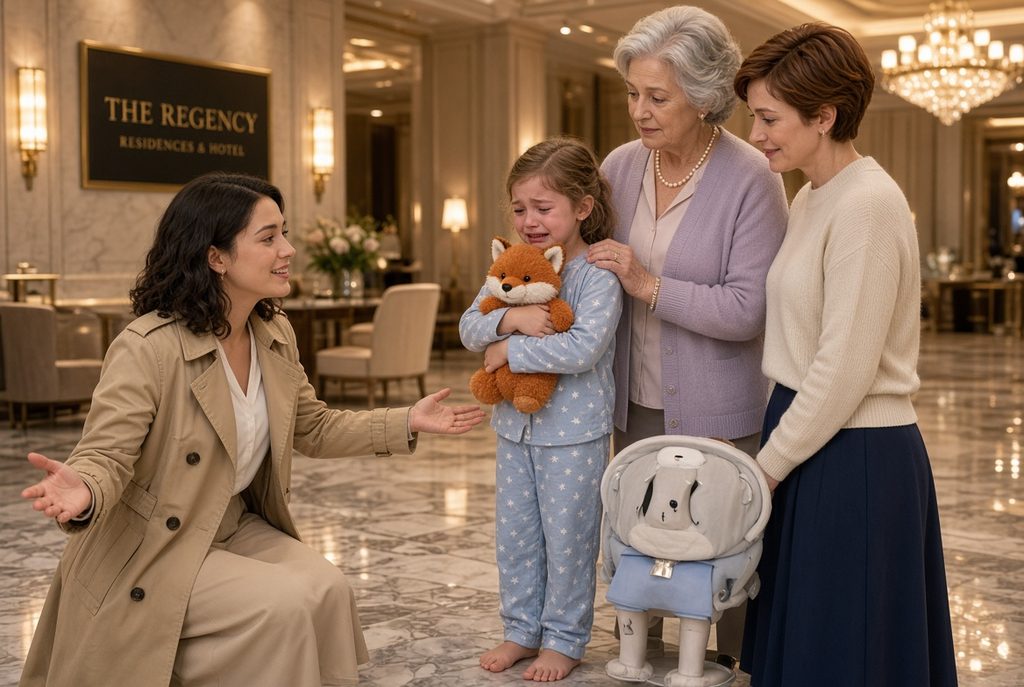
The stuffed fox I had bought for her in Denver sat untouched on the coffee table.
I had imagined giving it to her while she ran into my arms laughing.
Instead, I had brought it into a house full of police officers.
Even looking at it made my chest ache.
I carried the camera into my bedroom, closed the door halfway, and opened my laptop.
My hands shook so badly that I dropped the memory card twice.
I almost called my attorney first.
I probably should have.
But I needed to know.
I needed to see what my little girl had experienced while I was hundreds of miles away believing she was safe with family.
The files were organized by date.
I clicked Thursday.
There were hours of footage.
At first, everything looked normal.
At 8:14 that morning, Melissa entered my kitchen carrying two coffees.
Lily followed behind her wearing the pink dinosaur pajamas she loved because preschool had been canceled that day due to a water problem in the building.
That explained why Lily had still been in pajamas when I came home.
Melissa set down the drinks and checked her phone.
Lily climbed onto a stool.
“Auntie, can I have cereal?”
“Get it yourself.”
“I can’t reach the bowls.”
Melissa sighed dramatically.
“Then wait.”
Ten minutes later, my mother entered the house.
I stopped the video.
My heart started pounding.
Melissa had lied.
She told me Evelyn came over later because Lily was “out of control.”
But there she was at 8:26 in the morning.
Invited.
Expected.
Carrying her purse and a bakery box.
I pressed play.
Evelyn kissed Melissa on the cheek.
She did not greet Lily.
Instead, she looked around my kitchen and said, “Where does Natalie keep her paperwork?”
My stomach dropped.
Melissa pointed toward the hallway.
“Probably the office or bedroom.”
My mother nodded.
Then she said something that made every hair on my arms rise.
“We need to know before she gets back.”
I leaned closer to the screen.
Melissa lowered her voice.
“I told you, she keeps everything locked.”
“Then find the key.”
Lily was still sitting at the kitchen counter.
She heard them.
Children hear far more than adults realize.
She turned around.
“Mommy says nobody goes in her bedroom.”
My mother looked at her.
It was the look I knew from childhood.
The one that could make a room feel ten degrees colder.
“Your mother isn’t here.”
Lily’s shoulders shrank.
I paused the video again.
I had seen that exact reaction in myself when I was little.
The lowered eyes.
The stiff shoulders.
The immediate instinct to become smaller.
For thirty-three years, I had convinced myself that my mother’s cruelty belonged to my childhood.
That somehow I had escaped it.
That because she was gentler around Lily when I was present, she had changed.
She had not changed.
She had simply learned when to hide it.
I pressed play.
At 8:47, Melissa walked toward my bedroom.
Lily followed her.
“Auntie, Mommy said no.”
Melissa turned.
“Go watch television.”
“No.”
“What did you say?”
“Mommy said nobody goes in her room.”
Melissa smiled.
It wasn’t a pleasant smile.
“You think you’re the boss because your mother treats you like a princess?”
Lily shook her head.
“I’m telling Mommy.”
My mother walked into frame.
“No, you’re not.”
Lily backed away.
“I want my mommy.”
“She’s not here.”
“I want to call her.”
“You’ll call her when we say you can.”
That was the moment my hands started shaking again.
I had left instructions.
Clear instructions.
Lily could call me whenever she wanted.
Anytime.
For any reason.
Melissa had promised.
I watched my sister take Lily’s tablet off the counter and place it on top of the refrigerator.
Lily immediately started crying.
Not screaming.
Not throwing things.
Crying.
“Please give it back.”
Melissa ignored her.
My mother pointed toward the living room.
“Go sit down.”
Lily didn’t move.
“Now.”
Lily shook her head.
“I want Mommy.”
My mother walked toward her.
Lily backed up.
“Don’t.”
Evelyn grabbed her wrist.
Even through the grainy footage, I saw Lily flinch.
I stopped breathing.
My mother pulled Lily toward the living room.
Lily twisted away.
“Let go!”
Then Melissa moved behind her.
And pinched her.
Hard.
Right above the elbow.
Lily screamed.
I slammed my laptop shut.
The sound echoed through the bedroom.
For several seconds, I sat completely still.
My heart was beating so hard I could feel it in my throat.
From the living room came the soft sound of Lily shifting on the couch.
I opened my bedroom door and looked at her.
Still asleep.
Safe.
Home.
I walked into the bathroom and locked the door.
Then I sat on the floor and cried.
Not loudly.
I pressed a towel over my mouth because I didn’t want Lily to hear me.
I cried because my own sister had put her hands on my child.
I cried because my mother had stood there and allowed it.
I cried because I had trusted them.
But mostly, I cried because every time Lily had said she didn’t want Grandma watching her, I had assumed it was ordinary childhood preference.
Every time she had hidden behind me when Melissa visited, I had told her to say hello.
Every time she said Grandma was “mean when Mommy isn’t there,” I had answered with some version of:
“Grandma loves you.”
I had taught my daughter to doubt her own instincts.
That realization hurt more than anything I saw on the recording.
I sat on the bathroom floor until my tears stopped.
Then I washed my face.
And when I walked back into my bedroom, something inside me had changed.
The fear was gone.
The guilt was still there.
The anger was still there.
But beneath both was something colder.
Clarity.
I opened the laptop.
This time, I watched everything.
At 9:12, my mother and sister entered my bedroom.
The kitchen camera caught only part of the hallway, but the audio carried.
Drawers opening.
Closet doors sliding.
My mother saying, “She has to have the papers somewhere.”
Melissa answered, “What exactly are you looking for?”
“The insurance paperwork. Beneficiaries. The trust documents.”
My blood ran cold.
A month earlier, Evelyn had asked me whether I had established a trust for Lily.
It had seemed like a harmless question.
I had told her yes.
Nothing more.
Now I understood.
Melissa came back into the kitchen carrying a folder.
My folder.
The one containing copies of Lily’s birth certificate, my life-insurance information, and several financial documents.
She opened it on the counter.
My mother leaned over.
“There.”
Melissa frowned.
“What?”
“Look at the trustee.”
Melissa looked.
“So?”
“She named Rachel.”
Rachel was my best friend.
We had known each other since college.
She was also the person I had chosen to manage Lily’s trust if something happened to me.
My mother looked furious.
“She chose Rachel over family?”
Melissa laughed.
“You expected her to pick you?”
“I am Lily’s grandmother.”
“You and Natalie barely speak.”
“That doesn’t matter.”
“Apparently it does.”
My mother flipped through the documents.
Then she said quietly:
“If Natalie died tomorrow, Rachel would control everything.”
The room around me seemed to disappear.
I replayed the sentence.
Once.
Twice.
Three times.
Not because I misunderstood it.
Because I needed to make absolutely certain I had heard correctly.
My mother had said:
“If Natalie died tomorrow, Rachel would control everything.”
There was no threat in her voice.
No obvious sinister implication.
But hearing someone discuss your death while going through your financial documents creates a kind of cold inside you that is difficult to describe.
I kept watching.
At 10:03, Lily wandered into the kitchen.
She saw the folder.
“That’s Mommy’s.”
Melissa closed it.
“Go play.”
“I’m telling her.”
My mother turned.
“You are becoming very disrespectful.”
“You’re not supposed to touch Mommy’s stuff.”
“Your mother has filled your head with nonsense.”
“No.”
“Yes.”
“No!”
That was Lily’s first raised voice all morning.
My mother immediately grabbed her arm.
Lily pulled away.
“Stop!”
Melissa stepped in.
“Quit acting like a brat.”
“I’m not a brat!”
“Then behave like a normal kid.”
“I want Mommy!”
My mother leaned close to her.
“If you keep screaming, I’ll call the police.”
Lily froze.
Even on video, you could see the fear spread across her face.
My mother saw it too.
And instead of stopping, she continued.
“Do you know what police do with children who hurt people and don’t listen?”
Lily shook her head.
“They take them away.”
My hand covered my mouth.
Melissa laughed.
Not nervously.
Not awkwardly.
She actually laughed.
Then she crouched beside Lily.
“They have special places for bad kids.”
Lily’s face crumpled.
“I’m not bad.”
“Then prove it.”
“I want Mommy.”
“You’ve said that fifty times.”
“I want her!”
Melissa pinched her again.
This time on the cheek.
Exactly where I had seen the redness.
Lily screamed and slapped Melissa’s hand away.
Melissa stood up.
“There. She hit me.”
My mother’s eyes sharpened.
“There we go.”
Melissa rubbed her wrist theatrically.
“She attacked me.”
Lily stared at them, horrified.
“I didn’t!”
“You hit me.”
“You pinched me!”
“Stop lying.”
“I’m not lying!”
My mother picked up her phone.
“Do you want me to call the police?”
Lily started sobbing.
“No!”
“Then apologize.”
“But she hurt me.”
“Apologize.”
Lily shook her head.
“No.”
Evelyn dialed.
My heart stopped.
She actually called.
Not because Lily was dangerous.
Not because anyone was hurt.
Not because there was an emergency.
She called because a five-year-old child refused to apologize after an adult pinched her.
On the recording, I heard my mother’s voice transform.
She suddenly sounded fragile.
Concerned.
Almost frightened.
“Yes, hello. I’m calling because my granddaughter is completely out of control.”
I stared at the screen.
“She’s five,” my mother continued. “She’s hitting people, screaming, locking doors. We’re afraid she may hurt herself or somebody else.”
Lily screamed from across the room.
“I didn’t hit her! She pinched me!”
Melissa grabbed Lily by the arm.
Lily pulled away and ran down the hallway.
A door slammed.
My mother told the dispatcher:
“Now she’s barricaded herself in a bedroom.”
I looked at the timestamp.
10:19.
The officers had arrived at 10:41.
I had pulled into the driveway at 3:18.
That meant they had called the police hours before I returned.
The officers had apparently left and then returned later after another call.
I checked the remaining footage.
I was right.
The first responding officers spoke with my mother and Melissa.
Lily refused to leave my bedroom.
Eventually, the officers determined there was no immediate danger and left.
But after they were gone, my mother stood outside the bedroom door.
“You embarrassed me.”
Silence.
“Open the door.”
Silence.
“If you make me call them again, they really will take you.”
Lily started crying from inside my bedroom.
“I want Mommy.”
Melissa leaned against the wall.
“You know Natalie is going to believe her.”
“Then we control the story before she gets home.”
That sentence changed everything.
My mother looked at Melissa.
“What do you mean?”
“We tell Natalie Lily attacked me.”
“And the police?”
“They already have the report.”
“What about the mark on her cheek?”
Melissa hesitated.
Then shrugged.
“She scratches herself when she cries.”
I felt physically sick.
My mother nodded.
Not shocked.
Not disgusted.
Not concerned.
She nodded as though they were discussing a grocery list.
Then Melissa said:
“She’s five. Natalie will calm down.”
Evelyn’s answer came immediately.
“She always does.”
That was their mistake.
They thought they knew me.
And maybe they did know the old version of me.
The daughter who hated conflict.
The sister who apologized first.
The woman who always ended family arguments by saying, “Fine, forget it.”
The one who kept forgiving because keeping the peace felt easier than admitting I did not have the family I wished I had.
But motherhood had changed the equation.
There are things you will tolerate when they happen to you that become absolutely unforgivable when someone does them to your child.
At 11:02, Lily finally opened the bedroom door.
My mother made her sit on the couch.
For nearly twenty minutes, Evelyn lectured her about obedience.
Then Melissa told her:
“If you tell your mom I pinched you, I’ll say you’re lying.”
Lily whispered:
“I’m not lying.”
Melissa leaned close.
“Adults believe adults.”
I paused the video.
That sentence stayed on the screen inside my mind.
Adults believe adults.
Maybe that was what Melissa had relied on her entire life.
Maybe that was what my mother had taught us.
Whoever controlled the story controlled the truth.
At 2:51, my mother called the police again.
This time, she claimed Lily had started another “episode.”
What had actually happened was that Lily tried to retrieve her tablet from the refrigerator so she could call me.
Melissa stopped her.
Lily screamed.
My mother dialed.
The second officers were still there when I arrived.
I copied every file.
Then I copied them again.
One copy went onto an external drive.
One went into encrypted cloud storage.
One went to my attorney.
I called him before noon.
His name was David Chen.
He had handled my divorce four years earlier and had the unusual ability to become calmer when everyone else became emotional.
I told him only one thing at first.
“The camera recorded everything.”
There was a pause.
“How bad?”
“Worse than I thought.”
“Send me the files. Don’t edit them. Don’t post anything online. Don’t confront either of them.”
“I wasn’t planning to.”
“That surprises me.”
“It shouldn’t.”
Another pause.
Then he said, “Natalie?”
“Yes?”
“Whatever you’re thinking about doing, let the evidence do most of it for you.”
I looked toward the living room.
Lily was awake now, quietly arranging crayons by color.
“I don’t want revenge.”
“That’s good.”
“I want distance.”
“Good.”
“I want protection.”
“Better.”
“And I want them to understand that they will never get close enough to do this again.”
David was quiet for a moment.
“That we can work with.”
The pediatrician saw Lily that afternoon.
Dr. Patel had treated her since she was a baby.
Lily trusted her.
Mostly because Dr. Patel wore sneakers with cartoon strawberries on them and kept stickers in every drawer.
The appointment took nearly an hour.
I told Dr. Patel what had happened without adding anything I could not prove.
She examined the redness and small marks on Lily’s arm.
By then, the cheek redness had faded, but there was still faint tenderness where Melissa had pinched her.
Dr. Patel documented everything.
Then she asked Lily whether she knew why the police had come.
Lily stared at her shoes.
“Because I was bad.”
My heart cracked all over again.
Dr. Patel crouched in front of her.
“Did you hurt someone?”
Lily shook her head.
“Aunt Melissa hurt me.”
“What did she do?”
“She pinched me.”
“Did anyone else hurt you?”
Lily thought.
“Grandma grabbed me.”
“Did Grandma say something that scared you?”
Lily nodded.
“She said police take bad kids.”
Dr. Patel glanced at me.
I looked away because tears had already filled my eyes.
Then Lily whispered:
“I tried to be good so Mommy could find me.”
I had to leave the room for thirty seconds.
I stood in the hallway with my face turned toward the wall.
A nurse walked past and pretended not to notice me crying.
When I returned, Lily was choosing a sticker.
She picked a fox.
Of course she did.
The child therapist appointment happened the next morning.
By that evening, David had reviewed the footage.
He called me.
“I’m going to ask you several questions.”
“Okay.”
“Did your mother have permission to enter your house?”
“No.”
“Did Melissa have permission to give her access?”
“No.”
“Did either have permission to search your bedroom or financial records?”
“No.”
“Did you give either of them authority over Lily’s medical decisions?”
“No.”
“Does your mother have any legal custodial rights?”
“No.”
“Does Melissa?”
“No.”
“And you want no direct contact between either of them and Lily for now?”
I looked at Lily sleeping beside me.
“For now?”
David understood.
“For the foreseeable future.”
“Yes.”
The next thing he said surprised me.
“I also want you to contact the police department and ask to speak with a supervisor.”
“I already requested the reports.”
“This isn’t just about the report. The call may have been knowingly false or materially misleading. The video matters.”
I looked at the camera files on my laptop.
“What happens to them?”
“That depends on the department, prosecutor, and what statutes apply. Don’t assume criminal charges. But the footage should absolutely be preserved and reviewed.”
I had imagined the cameras would give me leverage in a family confrontation.
Instead, they gave me something stronger.
A record.
A timeline.
Proof.
The kind of proof that did not care who cried louder.
The next morning, Sergeant Ruiz called me.
I brought the files to the station.
David came with me.
Officer Daniels was there.
So was Officer Reyes.
When I walked into the small conference room, Daniels stood.
“Ms. Harper.”
“Natalie is fine.”
He nodded.
“I’m sorry your daughter was frightened.”
I sat across from him.
“I understand you were responding to information you were given.”
His expression changed slightly.
“That information now appears incomplete.”
Officer Reyes looked at me.
“Do you have the recording?”
I handed David the drive.
He placed it on the table.
“Full files. Original timestamps. No edits.”
For the next forty-seven minutes, we watched pieces of my daughter’s worst day.
I had already seen it.
Watching police officers see it was different.
They heard my mother describe Lily as dangerous while the recording showed a frightened five-year-old asking for her mother.
They watched Melissa pinch her.
They watched Lily slap the hand away.
Then they heard Melissa say:
“She attacked me.”
Officer Daniels stopped the video.
He leaned back slowly.
“That’s what she told us.”
I nodded.
“She claimed Lily struck her without provocation.”
Officer Reyes stared at the screen.
“She omitted the pinching.”
“Yes.”
We continued.
When the recording reached Melissa saying, “Adults believe adults,” Officer Reyes’ jaw tightened.
When they heard my mother tell Lily the police would “really take her” if she forced Evelyn to call again, Daniels muttered something under his breath.
At the end, nobody spoke for several seconds.
Finally, Sergeant Ruiz folded his hands.
“Ms. Harper, I need to be careful about what I say at this stage. But this footage will be reviewed.”
“That’s all I’m asking.”
“We’ll also preserve the call audio.”
“Thank you.”
Officer Daniels looked at me.
“I want you to know something.”
I waited.
“When we arrived the second time, your daughter was not behaving like an aggressive child.”
I swallowed.
“She was frightened.”
“Yes.”
He looked down.
“I should have recognized sooner that the fear was directed toward the adults in the room, not toward us.”
“You were responding to a call.”
“That doesn’t mean we can’t learn from it.”
His willingness to say that mattered more than he probably knew.
I nodded.
“Thank you.”
When I got home, I had thirty-six missed calls.
Twenty from Melissa.
Sixteen from my mother.
I had blocked neither of them yet because David had advised me to preserve everything.
There were messages too.
The first few from Melissa were angry.
What the hell is wrong with you?
Mom says you changed the locks.
You’re seriously keeping Lily away from us over one bad afternoon?
Then:
Natalie, pick up.
Then:
I know you’re talking to a lawyer.
Then:
Did you go to the police?
And finally:
CALL ME NOW.
My mother’s messages were different.
She began with authority.
You need to stop this ridiculous behavior immediately.
Then guilt.
I cannot believe you would throw away your family over a child’s tantrum.
Then insult.
This is exactly why Lily has behavioral problems. You refuse to discipline her.
Then fear.
Natalie, whatever Melissa did, I had nothing to do with it.
I stared at that message for a long time.
Whatever Melissa did.
Interesting.
Three days earlier, my mother had insisted Melissa had done nothing.
Now suddenly she was separating herself.
That night, Melissa came to my house.
The doorbell rang at 7:42.
Lily was upstairs taking a bath.
I checked the new doorbell camera.
Melissa stood on the porch.
She looked furious.
She knocked hard.
“Natalie!”
I did not answer.
“Natalie, open the door.”
Another knock.
“I know you’re inside.”
I picked up my phone and called the non-emergency police line.
Not because I wanted drama.
Because I had spent my entire life handling family problems privately.
That was exactly how my mother preferred it.
Private conflict.
Private cruelty.
Private apologies.
Private forgiveness.
No records.
No witnesses.
Not anymore.
I told the dispatcher that a family member I had instructed not to contact me was refusing to leave my property.
Then I waited.
Melissa kept pounding.
“This is insane!”
I watched through the camera.
“Mom is devastated!”
I almost laughed.
Not because anything was funny.
Because of course she was devastated.
Not that Lily had been frightened.
Not that Melissa had hurt her.
Not that they had lied to police.
She was devastated because I had stopped cooperating.
Finally, Melissa shouted:
“You’re ruining this family!”
That sentence followed me through childhood.
Whenever my mother insulted me and I defended myself, I was ruining the family.
Whenever Melissa borrowed money and I asked her to repay it, I was ruining the family.
Whenever I missed a holiday because of work, I was ruining the family.
Whenever I disagreed, resisted, objected, withdrew, or simply said no, somehow the destruction belonged to me.
I opened the door.
Not fully.
Only far enough for the chain to remain latched.
Melissa’s face changed.
“There you are.”
“You need to leave.”
“Are you serious?”
“Yes.”
She stepped closer.
“You called the police on us?”
“No.”
“You gave them some kind of recording.”
“Yes.”
Her face went white.
That was the moment I knew.
She remembered the camera.
Her eyes flicked toward the kitchen window.
Then back to me.
“What recording?”
I almost admired the instinct.
Even after realizing she had been caught, she lied automatically.
I said nothing.
Her voice dropped.
“That camera wasn’t supposed to still be running.”
There it was.
A confession wrapped inside a complaint.
I watched her understand what she had just said.
“Natalie—”
“You need to leave.”
“Listen to me.”
“No.”
“You don’t understand what happened.”
“I watched what happened.”
“She was screaming!”
“After you pinched her.”
“She hit me.”
“After you pinched her.”
“She was being impossible.”
“She was five.”
“She’s manipulative.”
“She was five.”
“Stop saying that!”
I stared at my sister.
“Why? Does her age make what you did sound worse?”
Melissa’s eyes filled with tears.
I felt nothing.
Not because I had stopped loving my sister.
That would have been easier.
I still loved the person I had spent years wishing she would become.
But love is not the same as access.
And forgiveness is not the same as permission.
“You don’t know what it’s like,” she said. “You always make everything look easy.”
I almost laughed again.
“My marriage failed.”
“At least you got the house.”
“I worked for it.”
“You travel for work.”
“To pay for it.”
“Mom always talks about how successful you are.”
“Then tell Mom to build a life she likes instead of resenting mine.”
Melissa flinched.
“You think you’re better than us.”
“No.”
“Yes, you do.”
“No, Melissa. I think I’m responsible for protecting my daughter from people who scare her and hurt her.”
“I barely pinched her.”
There are sentences that end relationships.
That was one of them.
Not because she admitted it.
Because of the word barely.
As though the amount mattered.
As though I had some acceptable threshold for how hard my sister could hurt my five-year-old.
I stared at her.
“Leave.”
“Natalie.”
“Leave my property.”
“Natalie, please.”
“You lied to police.”
Her face hardened again.
“I panicked.”
“You told Lily adults would believe adults.”
Melissa looked away.
“You searched my bedroom.”
“That was Mom.”
“You carried the folder into the kitchen.”
“She wanted to know something.”
“What?”
Melissa said nothing.
“What was she looking for?”
“I don’t know.”
“You expect me to believe that?”
“She’s your mother.”
“That is no longer an answer to anything.”
A cruiser turned onto my street.
Melissa saw it.
“You called them again?”
“I told you to leave.”
“You’re trying to get me arrested.”
“I’m trying to make you leave.”
Two officers stepped out.
Melissa’s shoulders dropped.
She looked suddenly small.
For one brief second, I remembered her at twelve years old, hiding behind me after she broke a neighbor’s window.
I had taken the blame that day.
I told our mother it was my fault because Melissa was terrified.
I had protected her.
For years afterward, I kept doing it in different forms.
Explaining her.
Covering for her.
Lending money.
Ignoring insults.
Accepting apologies that contained no change.
Protecting everyone except myself.
And now protecting Melissa would mean failing Lily.
The choice was no longer difficult.
The officers asked Melissa to leave.
She argued for several minutes.
Then she got into her car.
Before driving away, she rolled down the window.
“You’ll regret this.”
I stood on my porch.
“No, Melissa.”
She stared at me.
“This is the first thing I won’t regret.”
Then she drove away.
The next morning, my mother came.
Of course she did.
Unlike Melissa, Evelyn did not pound on the door.
She stood in front of the camera perfectly composed.
Hair styled.
Lipstick on.
Purse hanging from one arm.
She looked like she was arriving for lunch.
I spoke through the doorbell.
“You need to leave.”
Her face tightened.
“Natalie, open the door.”
“No.”
“This is between mother and daughter.”
“No. This is about my daughter.”
“I am not having this conversation through a camera.”
“Then we aren’t having it.”
She looked around the street.
My mother hated being embarrassed more than almost anything in the world.
“People can hear you.”
“That’s fine.”
Her expression sharpened.
“You are enjoying this.”
I stared at her face on my phone.
“No.”
“You always wanted an excuse to punish me.”
That almost made me angry.
Then I realized anger would only pull me back into the old dance.
I kept my voice calm.
“You told my five-year-old daughter that the police would take her away.”
“She needed to understand consequences.”
“You lied to the dispatcher.”
“I was worried.”
“You watched Melissa pinch her.”
“I didn’t see it.”
“The camera did.”
Silence.
For the first time, my mother lost control of her expression.
Just for a second.
Her eyes widened.
Then narrowed.
“What camera?”
I said nothing.
She stepped closer to the door.
“Natalie.”
Still nothing.
“What did you record?”
I almost smiled.
Not because I enjoyed her fear.
Because the woman who had spent my entire life forcing me to explain myself was suddenly desperate for information I did not owe her.
“You’ll learn whatever you need to learn from the appropriate people.”
Her face changed.
“Did you give recordings to police?”
I did not answer.
Her voice rose.
“I am your mother.”
“And Lily is my daughter.”
“I would never hurt her.”
“She was terrified of you.”
“She’s dramatic.”
“She’s five.”
“Stop hiding behind her age.”
“There’s nothing to hide behind.”
My mother leaned toward the camera.
“You think those police officers care about some family argument?”
I remembered Sergeant Ruiz.
Officer Daniels.
Officer Reyes.
The flash drive.
The call recordings.
My attorney.
The pediatric report.
The therapist notes.
I answered simply.
“We’ll see.”
That was when Evelyn finally lost her composure.
“You ungrateful little—”
She stopped herself.
Probably remembering the camera.
I waited.
She took one step backward.
Then another.
Finally, she said:
“If you do this, there’s no coming back.”
For most of my life, those words would have terrified me.
No coming back.
No Christmas.
No birthday calls.
No family dinners.
No mother.
No sister.
No illusion.
But inside the house, I could hear Lily laughing at a cartoon.
A real laugh.
The first deep, carefree laugh I had heard from her since Thursday.
I looked through the door.
My mother stood outside.
My daughter was inside.
For once, the difference between family and blood seemed completely clear.
“I know,” I said.
Then I ended the call.
Four days later, David asked me to come to his office.
He had news.
The police were still reviewing the incident.
He warned me repeatedly not to assume criminal prosecution.
Real life was not television.
Evidence did not automatically produce handcuffs.
A terrible act did not always fit neatly into a criminal statute.
And prosecutors made decisions based on evidence, intent, jurisdiction, and legal standards, not emotion.
I understood.
But something else could happen immediately.
Protection.
David had prepared paperwork seeking temporary restrictions on contact.
The exact legal mechanism depended on the court and circumstances, but his objective was simple:
No unsupervised contact.
No approaching Lily’s school.
No showing up at my home.
No direct communication with Lily.
And no using third parties to pressure us.
I signed.
Then we talked about my estate documents.
That conversation was almost worse than discussing the police.
“What exactly did your mother see?” David asked.
“Copies of the trust documents.”
“Anything concerning access?”
“No.”
“Beneficiaries?”
“Yes.”
“Trustee?”
“Yes.”
“Insurance?”
“Yes.”
He nodded slowly.
“We revise everything.”
“I already wanted to.”
“We also notify the school in writing.”
“Done.”
“Pediatrician?”
“Done.”
“Emergency contacts?”
“Done.”
“Any other person who might release Lily to either of them?”
I thought.
“My neighbor Susan sometimes helps.”
“Tell her.”
“I will.”
David looked at me for a long moment.
“You’ve been busy.”
“I haven’t slept much.”
“That will catch up with you.”
“I know.”
He closed the folder.
“You don’t have to solve your entire life this week.”
I stared at him.
“It feels like I do.”
“No. You have to make Lily safe this week. The rest can happen later.”
That sentence stayed with me.
Make Lily safe this week.
Not fix the family.
Not understand my mother.
Not diagnose Melissa.
Not decide whether I would ever forgive either of them.
Just make Lily safe.
That I could do.
So I did.
I took a week off work.
Normally, that would have frightened me.
I had spent years building a career that demanded reliability.
But when I explained to my supervisor that there had been a family emergency involving Lily, he said:
“Take the week.”
I started apologizing automatically.
He interrupted me.
“Natalie.”
“Yes?”
“Take care of your kid.”
Simple.
Kind.
No guilt.
No scorekeeping.
It was strange how unfamiliar healthy support felt.
For the first two nights, Lily slept in my bed.
On the third night, she asked if police could open locked doors.
I told her police were not coming to take her.
She asked:
“Even if Grandma calls?”
“Even if Grandma calls.”
“What if she says I’m bad?”
I swallowed.
“You are not bad.”
“But what if she tells them?”
I sat beside her and tucked the blanket beneath her chin.
“Then there will be adults who know the truth.”
She thought about that.
“Do they know Aunt Melissa pinched me?”
“Yes.”
“Do they know Grandma scared me?”
“Yes.”
Her eyes filled.
“Are you mad at me?”
The question destroyed me.
“Why would I be mad at you?”
“Because I yelled.”
I pulled her into my arms.
“You are allowed to yell when somebody hurts you.”
She pressed her face against my neck.
“Grandma said good girls listen.”
I closed my eyes.
There were a thousand things I wanted to say about my mother.
None belonged inside a five-year-old’s head.
So I chose something simpler.
“Good kids can say no when something feels wrong.”
“Even to grown-ups?”
“Especially to grown-ups sometimes.”
She leaned back.
“What if the grown-up gets mad?”
“Then you come find me.”
“What if you’re in Denver?”
That one hurt.
I kissed her forehead.
“Then you call me. Or Rachel. Or your teacher. Or another safe grown-up. And I promise I will believe you.”
She stared at me.
“Always?”
“Always.”
Children do not understand legal documents.
They do not care about reports or court filings.
What they remember is whether the person they trust turns toward them or away from them when they are afraid.
I had turned toward Lily.
I would spend the rest of my life doing that.
On day six, Melissa called from a new number.
I answered because David had advised me that controlled communication could sometimes be useful, especially if she was willing to discuss practical matters.
I recorded my notes immediately afterward.
Her first words were:
“You’ve destroyed Mom.”
I nearly hung up.
Instead, I said:
“If this conversation is going to be about blaming me, it’s over.”
“You got papers served on her.”
“Yes.”
“She screamed so loudly the neighbors came outside.”
I said nothing.
One week earlier, my five-year-old had been screaming because she thought police were taking her away.
Apparently, now my mother knew what helplessness felt like.
Melissa continued.
“She says you’re trying to make her look like a criminal.”
“I submitted evidence.”
“You know what I mean.”
“No. I don’t.”
“She’s sixty-two, Natalie.”
“And Lily is five.”
“There you go again.”
“Yes. There I go again.”
“You’re going to keep saying that forever?”
“As long as you keep acting like her age doesn’t matter.”
Melissa exhaled sharply.
“You really hate me.”
I leaned against the kitchen counter.
“No.”
“Don’t lie.”
“I don’t hate you.”
“You called the police.”
“I didn’t call police over what happened that morning. Mom did.”
“You know what I mean.”
“I gave police a recording of a police call. That’s not the same thing.”
“You’re splitting hairs.”
“No. I’m refusing to accept your version of events.”
Silence.
Then Melissa said something quieter.
“I’m sorry.”
I waited.
For years, those two words had been enough.
Sorry I borrowed your dress without asking.
Sorry I told Mom what you said.
Sorry I missed your birthday.
Sorry I called you selfish.
Sorry I needed another loan.
Sorry I screamed.
Sorry.
Sorry.
Sorry.
A word used so often it became a substitute for change.
“What are you sorry for?” I asked.
She sounded irritated.
“What?”
“What exactly are you sorry for?”
“For what happened.”
“What happened?”
“Natalie, come on.”
“No.”
She went silent.
I waited.
Finally:
“I shouldn’t have pinched her.”
My eyes closed.
“Okay.”
“And I shouldn’t have said she was manipulative.”
“Okay.”
“And maybe we shouldn’t have called the police.”
“Maybe?”
She sighed.
“We shouldn’t have called.”
“What else?”
“What do you want from me?”
“The truth.”
“I’m trying.”
“Why were you searching my bedroom?”
Silence.
“Melissa.”
“Mom asked me to.”
“Why?”
“She wanted to see your trust paperwork.”
“Why?”
“I don’t know.”
“You do know.”
“No.”
“You talked about it with her.”
“Not really.”
“I have the recording.”
Silence again.
Longer.
Then Melissa said:
“She was angry you named Rachel.”
“That doesn’t explain why she wanted the documents.”
“She thinks family should handle family money.”
“It’s not family money.”
“I know.”
“It’s Lily’s trust.”
“I know.”
“She thought she should control it?”
Melissa didn’t answer.
That was answer enough.
I looked around my kitchen.
The same kitchen where they had opened my private documents.
The same kitchen where they had lied about my daughter.
Suddenly, pieces of the last few years clicked together.
My mother’s questions about my salary.
My insurance.
My mortgage.
Whether my house was paid off.
Whether Lily had a college fund.
Whether I had updated my will after the divorce.
I had laughed some of them off as intrusive mother behavior.
Now they looked different.
I lowered my voice.
“Was Mom planning to challenge the trust?”
Melissa started crying.
Not loudly.
Quietly.
That frightened me more.
“I don’t know.”
“What did she want?”
“She thought if something happened to you, she should be the one raising Lily.”
My hand tightened around the phone.
“She has never been named guardian.”
“I know.”
“She knows that.”
“Yes.”
“So why was she looking?”
“She wanted to know what Rachel would control.”
I felt cold.
“Why?”
“I don’t know.”
“Melissa.”
“I swear.”
“Were you helping her?”
“At first.”
“What does that mean?”
“She said you were trying to cut us out.”
“Of my estate?”
“Of everything.”
“Melissa, I’m thirty-three years old.”
“I know.”
“I’m allowed to choose my own trustee.”
“I know.”
“I’m allowed to decide who cares for Lily.”
“I know.”
“And none of that gives either of you permission to search my room.”
“I know!”
Her voice cracked.
“I know, okay?”
I said nothing.
Then she whispered:
“Mom said if we found something, she could talk you into changing it.”
That sounded exactly like Evelyn.
Not steal it.
Not forge it.
Not commit some elaborate crime.
Talk me into changing it.
Pressure.
Guilt.
Family duty.
The weapons she understood best.
“Why didn’t she just ask me?”
Melissa laughed bitterly.
“Would you have changed it?”
“No.”
“Exactly.”
There it was.
The simplest truth.
They did not respect my boundaries because they already knew the answer.
So they went around them.
After I hung up, I called David.
That conversation led to additional security around my estate documents and school records.
But something more important happened later that afternoon.
Lily drew a picture.
It showed two stick figures standing in front of a blue house.
One large.
One small.
Both holding hands.
Above them was a giant orange fox.
I smiled.
“Who’s that?”
“That’s you.”
“And this?”
“Me.”
“What’s the fox doing?”
“Guarding us.”
I laughed softly.
“Foxes guard houses now?”
“This one does.”
She pointed toward the corner of the page.
There were two tiny figures outside a black fence.
“Who are those?”
Lily hesitated.
“Grandma and Aunt Melissa.”
My smile disappeared.
“Why are they outside?”
“Because they’re in timeout.”
I almost laughed again.
Instead, I kissed the top of her head.
“That’s one way to describe it.”
A week after I came home from Denver, the temporary court order was addressed.
That was the day they screamed.
Not metaphorically.
Actually screamed.
The courthouse hallway was narrow and crowded.
David stood beside me.
Rachel sat on my other side.
I had asked her to come because I needed someone there who knew me without requiring me to perform strength.
My mother arrived with Melissa.
Evelyn wore navy blue.
Pearls.
Perfect hair.
She looked as though she were attending a charity luncheon.
Melissa looked like she had not slept.
The moment my mother saw me, she walked straight toward us.
David stepped slightly forward.
“Ms. Harper, I recommend you speak through counsel.”
“I do not need your permission to speak to my daughter.”
David did not move.
“No, but there are restrictions regarding contact.”
My mother’s face flushed.
She looked around.
“Do you hear this, Natalie? You have a stranger telling your own mother when she can speak to you?”
I stood.
“He isn’t telling you.”
Her eyes snapped toward me.
“I am.”
She stared at me.
“After everything I have done for you.”
There it was.
The opening line to every debt she believed I owed.
“I fed you.”
I said nothing.
“I clothed you.”
Still nothing.
“I kept a roof over your head.”
“You were my parent.”
Her face changed.
“You think that means nothing?”
“No. I think those were your responsibilities.”
Melissa stepped in.
“Natalie, don’t.”
I turned toward her.
“Don’t what?”
“Humiliate her.”
I looked at the courthouse hallway.
People were pretending not to listen.
My mother had spent years telling private stories about me to relatives, friends, church members, anyone who would validate her.
But now, with facts present, suddenly privacy mattered.
“I didn’t bring us here,” I said.
Evelyn laughed sharply.
“Yes, you did.”
“No. You called police on a five-year-old because she wouldn’t let you search my bedroom in peace.”
“That is not what happened.”
“I watched the recording.”
“She was hysterical.”
“She was scared.”
“She hit Melissa.”
“After Melissa pinched her.”
“It was barely a pinch!”
Melissa’s face went white.
My mother spun toward her.
“Stop talking.”
Rachel looked at me.
David said quietly:
“Let’s go inside.”
But Evelyn was losing control.
She pointed at me.
“You have poisoned that child against us.”
I felt something settle inside me.
Maybe this was the moment I had been waiting for my entire life.
Not to win.
To stop trying to win.
I had spent decades arguing with my mother as if the right combination of words would make her understand me.
They never did.
Because understanding was not what she wanted.
Submission was.
I lowered my voice.
“No.”
She sneered.
“No what?”
“No more explaining.”
She stared.
“You want to call me ungrateful? Fine.”
“Natalie—”
“You want to tell people I’m cruel? Fine.”
“Stop.”
“You want to say I ruined the family? Fine.”
People were definitely listening now.
I didn’t care.
“But you will never frighten my daughter like that again.”
Her face twisted.
“You cannot keep my granddaughter from me.”
“Yes, I can.”
“She is my blood.”
“She is my responsibility.”
“I have rights.”
“Then your attorney can explain them.”
That was when my mother screamed.
“You selfish little bitch!”
The hallway fell silent.
Completely silent.
Even the clerk behind the counter looked up.
My mother realized what she had done.
Her face went pale.
Then Melissa grabbed her arm.
“Mom.”
Evelyn jerked away.
“This is her fault!”
A deputy approached.
“Ma’am, lower your voice.”
My mother turned on him.
“She stole my granddaughter!”
The deputy blinked.
I watched something in Melissa break.
“Mom, stop.”
“She did!”
“No!”
Melissa’s voice echoed just as loudly.
She started crying.
“Stop making everything worse!”
My mother stared at her.
Melissa’s shoulders shook.
“You told me this would be easy.”
Evelyn froze.
Rachel squeezed my hand.
David did not move.
My sister wiped at her face.
“You said Natalie would calm down.”
“Melissa.”
“You said if we made Lily sound unstable, Natalie would finally discipline her.”
My heart stopped.
My mother’s eyes widened.
“Be quiet.”
“You said the police report would scare her.”
“Melissa!”
“You said Natalie was too weak to fight us!”
People in the hallway stopped pretending not to listen.
My mother grabbed Melissa’s wrist.
Melissa pulled away.
“Don’t touch me!”
“Lower your voice.”
“You don’t get to tell me that anymore!”
And there it was.
The same story repeating itself.
Different daughter.
Different age.
Same mother.
For the first time, I saw Melissa not as the older sister who had hurt my daughter.
Not only as that.
I saw the girl who had grown up beside me under the same roof.
The girl who learned early that the safest place in our family was beside our mother, never in front of her.
Melissa had become Evelyn’s ally because alliances offered temporary protection.
She hurt me because hurting me kept the spotlight away from her.
Understanding that did not excuse what she did to Lily.
Nothing would.
But it explained why, with consequences finally closing in, she turned on the person she had spent years defending.
My mother looked at her with pure fury.
“You idiot.”
Melissa laughed through tears.
“There she is.”
“Enough.”
“No. Natalie was right.”
Evelyn’s face changed again.
Melissa looked at me.
“I’m sorry.”
I did not answer.
Not there.
Not then.
An apology in a courthouse hallway was not a bridge back into Lily’s life.
Maybe someday it would mean something.
But consequences had to come before reconciliation.
If reconciliation came at all.
The hearing was not dramatic.
Real courtrooms rarely are.
There was no shouting inside.
No judge pounding a gavel while everyone gasped.
There were documents.
Statements.
Questions.
Footage.
The police incident reports.
The pediatric documentation.
A summary of Lily’s therapy visit.
The recording.
My mother’s attorney tried to frame the situation as a misunderstanding between relatives.
David did not exaggerate.
That was one of the reasons I trusted him.
He simply presented the timeline.
My mother entered a home without my permission.
My sister allowed her entry beyond the limited babysitting arrangement.
They searched private documents.
Melissa physically pinched Lily.
My mother threatened Lily with police removal.
A police call materially misrepresented what had happened.
The adults discussed controlling the story before I returned.
They later appeared at my home after I instructed them not to.
There was enough concern to justify boundaries while everything else was reviewed.
The final order was not some cinematic lifetime ban.
It did not need to be.
It created distance.
Structure.
Rules.
No unsupervised contact with Lily.
No contact with her school.
No appearing at my house without written invitation.
No direct communication with Lily.
Any future changes would have to go through proper channels.
To my mother, it might as well have been exile.
Outside the courthouse, she looked at me with a hatred so cold that I barely recognized her.
“You’re happy now?”
I held my purse with both hands.
“No.”
“You won.”
“This wasn’t a game.”
“You took my granddaughter.”
“No.”
“She loved me.”
“She was afraid of you.”
Her mouth tightened.
“Children forgive.”
I looked straight at her.
“So do adults.”
She seemed confused.
I continued.
“Forgiveness doesn’t mean access.”
Her eyes filled with tears.
For one second, I almost stepped toward her.
Thirty-three years of programming is difficult to erase.
My mother cried.
I comforted.
My mother raged.
I apologized.
My mother accused.
I explained.
The old reflex rose inside me.
Then I remembered Lily asking:
Are you mad at me because I yelled?
I let my mother cry.
She wiped her face angrily.
“You’ll come crawling back.”
I shook my head.
“No.”
“You always do.”
“Not this time.”
She laughed bitterly.
“Everyone says that.”
I looked toward Rachel waiting beside her car.
Then back at my mother.
“I hope you take care of yourself.”
Her expression hardened.
“Don’t patronize me.”
“I’m not.”
“You think you’re so strong.”
“No.”
That answer surprised her.
I continued.
“I think I waited too long to become strong where it mattered.”
Then I walked away.
Melissa called my name.
I stopped.
She stood several feet behind me.
Eyes swollen.
Mascara gone.
For once, she looked nothing like the smug woman I had found in my living room.
“Natalie.”
I waited.
“I meant what I said.”
“What part?”
“I’m sorry.”
I studied her face.
“I believe you feel sorry.”
She flinched.
“That’s not the same thing?”
“No.”
“What do you want me to do?”
It would have been easy to say nothing.
To punish her with uncertainty.
But I did not want to become my mother.
So I told her the truth.
“Get help.”
She stared.
“Therapy. Counseling. Whatever you need.”
“For pinching Lily?”
“For thinking it was okay.”
Her face crumpled.
I continued.
“For helping Mom search my room. For lying. For deciding a five-year-old needed to be controlled instead of comforted. For spending your life doing whatever Mom wants and then acting shocked when someone gets hurt.”
Melissa looked down.
“I don’t know who I am without her.”
That was the first honest thing she had said to me in years.
My anger softened.
Not disappeared.
Softened.
“You should probably find out.”
She nodded.
“Will you ever let me see Lily again?”
I looked at her.
“I don’t know.”
Her eyes closed.
“But if there is ever a chance,” I continued, “it will be because you changed when nobody was watching. Not because you cried today.”
She nodded again.
Then she walked away.
The police investigation continued.
I will not pretend it turned into some enormous criminal case.
It did not.
Life is messier than stories people tell online.
There were questions about the accuracy of the calls.
There were interviews.
There was documentation.
The department retained the recordings and evidence.
The incident involving physical contact with Lily was reviewed.
David kept me updated.
But eventually, I realized something important.
I had been waiting for punishment to make me feel safe.
It never would.
Safety came from what I controlled.
My house.
My locks.
My daughter’s emergency contacts.
My boundaries.
My willingness to say no.
My willingness to believe Lily.
That was the real ending.
Not whether my mother was charged with something.
Not whether Melissa suffered enough.
The ending was that I stopped handing other people the power to decide whether my boundaries mattered.
Three weeks later, Lily returned to preschool.
I walked her inside.
Normally, she would run straight toward the art table.
That morning, she held my hand.
Her teacher, Ms. Thompson, crouched near the doorway.
“We’re happy to see you.”
Lily stayed behind my leg.
Ms. Thompson didn’t force her.
She simply smiled.
“We have new glitter glue.”
Lily peeked around me.
“What colors?”
“All of them.”
“Purple?”
“Two purples.”
Lily loosened her grip on my hand.
Then tightened it again.
I bent down.
“I’ll be here after lunch.”
“You promise?”
“I promise.”
“Not Denver?”
“Not Denver.”
She looked uncertain.
I kissed her forehead.
Then Ms. Thompson held out her hand.
Lily stared at it.
She did not take it.
Instead, she walked beside her on her own.
I watched until she disappeared into the classroom.
Then I cried in my car for ten minutes.
Healing rarely announces itself.
It happens in small moments.
The first night Lily slept in her own bedroom again.
The first time a police car drove past and she did not hide.
The first time she said “Grandma was wrong” instead of “I was bad.”
The first time she laughed about the stuffed fox.
She named him Officer Fox.
That one made me uncomfortable at first.
Then she explained:
“He’s the police that helps kids.”
So Officer Fox stayed.
He slept beside her pillow.
About a month after everything happened, Officer Reyes stopped by.
Not officially.
She had called first.
She brought Lily a small coloring book from a community event.
I almost said no.
Then I asked Lily.
“Do you want to see Officer Reyes?”
Lily looked scared.
“Is she mad?”
“No.”
“Did Grandma call?”
“No.”
“Then why?”
“She wants to say hello.”
Lily thought for a long time.
Then nodded.
Officer Reyes arrived without flashing lights.
No cruiser in the driveway.
She wore plain clothes.
That had been intentional.
She sat on the living-room rug.
Exactly where Lily had been sitting when I came home.
For a while, neither said much.
Then Reyes opened the coloring book.
“There’s a fox in here.”
Lily’s eyes widened.
“I have a fox.”
“I heard.”
“His name is Officer Fox.”
Reyes smiled.
“That’s a very important job.”
Lily looked at her carefully.
“Do police take kids who yell?”
Reyes’ smile disappeared.
“No.”
“What if they’re bad?”
“Kids aren’t taken away because they get upset.”
“What if a grown-up says they’re bad?”
Officer Reyes glanced at me.
Then back at Lily.
“Police are supposed to ask questions and figure out what happened.”
Lily looked down.
“Grandma lied.”
“Yes.”
“Are you mad at Grandma?”
Reyes chose her words carefully.
“I think grown-ups should tell the truth when they call police.”
Lily nodded.
Then she asked:
“Are you mad at me?”
Officer Reyes looked surprised.
“No.”
“Even though I yelled?”
“No.”
“Even though I locked Mommy’s door?”
“No.”
Lily seemed to consider this.
Then she moved closer and showed Reyes the stuffed fox.
It was the first time I saw the fear loosen its grip on her.
Not disappear.
But loosen.
After Reyes left, Lily stood at the window.
“Mommy?”
“Yes?”
“She’s nice.”
“Yes.”
“Are all police nice?”
I smiled sadly.
“Police are people. Some are kind. Some make mistakes. Some help. But if you’re ever scared, you can always tell me.”
She nodded.
“Officer Fox helps.”
“Definitely.”
That night, she slept alone.
Two months passed.
Melissa did exactly what I told her.
At least as far as I could verify.
She started therapy.
She moved out of the apartment she had been renting near our mother and moved across town.
She stopped calling every day.
That mattered.
For the first time, she seemed to understand that respecting me meant accepting silence when I asked for it.
She sent one letter.
Not to Lily.
To me.
It was six pages long.
I read it twice.
She did not ask me to forgive her.
She did not blame our mother.
She admitted things.
She admitted she had resented me for years.
My job.
My house.
The fact that I left an unhealthy marriage when she remained in relationships that made her miserable.
The fact that I had always seemed capable of saying no eventually, while she felt trapped under Evelyn’s approval.
Then she wrote something that made me cry.
I hated that Lily listened to you because I have spent my whole life listening to Mom.
I resented a five-year-old for having a relationship with her mother that I secretly wished we had.
There was no excuse after that sentence.
No “but.”
No attempt to make me comfort her.
Just:
I hurt her because I was angry at myself, and she deserved better.
I folded the letter.
For the first time, I believed Melissa might actually change.
That did not mean she came back into Lily’s life.
Not yet.
Maybe someday.
But children are not rewards for adult growth.
Melissa had to heal for herself.
Not to earn access.
My mother was different.
She sent messages through relatives.
An aunt called me.
Then a cousin.
Then an old family friend.
Each conversation sounded almost identical.
“Your mother is devastated.”
“I’m sorry she’s hurting.”
“She says you misunderstood everything.”
“I didn’t.”
“She says Melissa was the one who pinched Lily.”
“My mother threatened Lily with police.”
“She was trying to discipline her.”
“Then we disagree about what discipline means.”
“She misses her granddaughter.”
“I understand.”
“She says you won’t even talk to her.”
“That’s correct.”
“Don’t you think family deserves another chance?”
That question followed me everywhere.
Family deserves another chance.
Maybe.
But another chance to do what?
Apologize?
Change?
Respect boundaries?
Possibly.
Another chance to hurt my child?
No.
Not all second chances require reopening the door.
Sometimes the second chance is simply allowing someone to become better from a distance.
My mother did not understand distance.
To Evelyn, boundaries were attacks.
Privacy was secrecy.
Independence was rejection.
Consequences were cruelty.
She never apologized.
Not once.
Instead, she rewrote the story.
According to relatives, I had “used secret surveillance against family.”
Apparently, the camera had become the villain.
Not the lie.
Not the intimidation.
The camera.
I found that almost funny.
Rachel said it best.
“You know why she hates that camera?”
“Why?”
“Because it removed her favorite weapon.”
“What weapon?”
“Plausible deniability.”
I laughed.
Then I realized Rachel was right.
Without the footage, I would have had Lily’s word against two adults.
My mother would have said Lily was confused.
Melissa would have said the pinch never happened.
They would have insisted I overreacted.
Eventually, maybe I would have doubted myself.
Maybe I would have wondered whether Lily exaggerated.
That possibility shamed me.
Not because I did not love my daughter.
Because conditioning runs deep.
But the camera left nowhere for the lie to hide.
Six months after that Thursday, Lily had a kindergarten performance.
She wore yellow wings made from cardboard and glitter.
She was supposed to be a butterfly.
The wings were enormous.
She kept bumping into the other children.
I sat in the second row beside Rachel.
When the children walked onto the stage, Lily searched the room.
Then she saw me.
Her face lit up.
“Mommy!”
Every parent turned.
I waved.
Rachel laughed.
“She definitely found you.”
Lily performed three songs.
She forgot half the words.
During the last song, one wing came loose and hung sideways.
She kept singing anyway.
I cried through the entire thing.
Afterward, she ran into my arms.
“Did you see me?”
“Every second.”
“Even when my wing broke?”
“Especially then.”
She grinned.
“We get cookies.”
“Best part.”
We walked toward the cafeteria.
Then I saw Melissa.
She stood near the far end of the hallway.
Alone.
My entire body tensed.
She was not supposed to approach Lily.
And she didn’t.
She stood still.
Hands at her sides.
Waiting for me to decide.
Rachel whispered:
“Want me to get someone?”
I looked at Melissa.
Then at Lily.
My daughter had not noticed her yet.
I told Rachel:
“Give me a minute.”
I walked toward my sister.
She stayed exactly where she was.
“I didn’t know this was tonight,” she said quickly. “A friend posted a school announcement. I shouldn’t have come.”
“No.”
“I know.”
“Why did you?”
Her eyes filled.
“I wanted to see her from far away.”
I glanced behind me.
Lily was showing Rachel her broken wing.
“She looks happy,” Melissa whispered.
“She is.”
“I’m glad.”
I studied her.
She looked different.
Not physically.
Something quieter.
Less defensive.
“Are you still seeing the therapist?”
“Every week.”
“Mom?”
Melissa shook her head.
“I haven’t spoken to her in two months.”
That surprised me.
“Why?”
“She told me therapy was turning me against her.”
I almost smiled.
“That sounds familiar.”
Melissa gave a tiny laugh.
Then her face became serious.
“I told her I was already against myself. Therapy was helping me stop.”
For a moment, neither of us spoke.
Then Lily saw us.
“Aunt Melissa!”
My sister’s entire body froze.
Lily ran two steps.
Then stopped.
Fear and memory crossed her little face.
She looked at me.
That look mattered.
Not toward Melissa.
Toward me.
Asking silently:
Am I safe?
I walked back to her.
“Yes, sweetheart?”
“Why is Aunt Melissa here?”
Melissa stayed several feet away.
I crouched.
“She came to see your performance from far away.”
“Is she allowed?”
The question cut through me.
I looked at Melissa.
Her face collapsed.
But she did not speak.
I answered Lily.
“She is not allowed to come close unless I say it’s okay.”
Lily nodded.
Then she looked at Melissa.
“You pinched me.”
Melissa swallowed.
“Yes.”
“That was mean.”
“Yes.”
“Grandma lied.”
Melissa’s eyes filled with tears.
“Yes.”
“You lied too.”
“Yes.”
Lily thought for several seconds.
Then she said:
“You have to say sorry.”
Melissa covered her mouth.
A tear rolled down her cheek.
She crouched, but stayed where she was.
“I’m very sorry, Lily.”
“For pinching?”
“Yes.”
“And lying?”
“Yes.”
“And saying I was bad?”
“Yes.”
Lily folded her arms.
“I’m not bad.”
“No.”
Melissa’s voice broke.
“You’re not.”
Lily looked at me.
“Can she have a cookie?”
I nearly laughed.
Children are astonishing.
A six-month family rupture.
Therapy.
Lawyers.
Police.
Court orders.
And Lily’s first instinct toward reconciliation involved cafeteria cookies.
I looked at Melissa.
Then back at my daughter.
“One cookie.”
Lily nodded seriously.
“Okay.”
Rachel later told me I had looked like I was watching someone defuse a bomb.
Maybe I was.
That evening did not restore the family.
Melissa did not suddenly become Aunt Melissa again.
But it created the smallest possible bridge.
A cookie.
A supervised five-minute conversation.
A goodbye.
No hugs.
No promises.
I could live with that.
Boundaries do not have to be walls forever.
Sometimes they are gates.
But I decide when they open.
My mother never reached that gate.
A year passed.
Then another.
Evelyn sent birthday cards.
I returned gifts.
Not to punish her.
Because gifts had always been one of her ways of purchasing access.
Eventually, she stopped sending them.
I heard from relatives that she told everyone I had brainwashed Lily.
I stopped responding.
There is freedom in realizing you do not need to correct every lie told about you.
People who truly know you rarely require the defense.
People determined to misunderstand you rarely accept it.
Melissa slowly returned to our lives.
Slowly.
Painfully slowly.
The first visit lasted thirty minutes.
Rachel was there.
The second happened at a public park.
The third at my house.
Lily chose whether she wanted Melissa nearby.
Every single time.
Melissa never complained.
Never asked for more.
Never blamed me for caution.
That mattered.
One afternoon, almost eighteen months after everything happened, Lily was building a block tower on the floor while Melissa sat nearby.
The tower collapsed.
Lily screamed in frustration.
Melissa froze.
I saw it immediately.
So did she.
For a fraction of a second, the old Melissa appeared.
The tight jaw.
The impulse to say:
Stop being dramatic.
Then she closed her eyes.
Breathed.
And said:
“That’s really frustrating, huh?”
Lily nodded furiously.
“It took forever!”
“I know.”
“Help me rebuild it?”
Melissa smiled.
“Yeah.”
I watched them rebuild the tower.
That tiny moment told me more about Melissa’s change than every apology she had ever given me.
Change is not what you say when you are ashamed.
Change is what you do when the same trigger arrives and you choose differently.
My mother never chose differently.
The last time we spoke, Lily was seven.
Evelyn called from an unknown number.
I almost did not answer.
Something made me.
“Hello?”
Silence.
Then:
“Natalie.”
My body went still.
“Mom.”
“I heard Lily lost a tooth.”
Of course she had.
Family news traveled.
“Yes.”
“She probably looks adorable.”
“She does.”
Another pause.
“I miss her.”
I looked through the kitchen window.
Lily was outside drawing with sidewalk chalk.
Melissa sat on the grass beside her.
Their relationship had changed.
It was cautious.
Imperfect.
But real.
“I know,” I said.
My mother started crying.
Quietly.
“I don’t know how we got here.”
I closed my eyes.
For years, I would have rushed to comfort her.
This time I answered:
“I do.”
She became silent.
“I made one mistake.”
“No.”
“Then what do you want from me?”
I thought about that.
Years earlier, I would have said:
An apology.
Understanding.
Recognition.
Love without control.
Now I knew better.
“You need to figure that out.”
“I’m trying.”
“No. You’re calling me because you miss Lily.”
“That’s wrong?”
“No.”
“Then why—”
“Because missing the consequence is not the same as regretting the behavior.”
Silence.
I continued gently.
“Have you ever once asked how she felt?”
“She was five.”
“That’s not an answer.”
“I know she was scared.”
“Have you ever said you were sorry for scaring her?”
My mother said nothing.
“Have you admitted you lied about what happened?”
“I was concerned.”
“Mom.”
“I was.”
“Have you admitted it?”
Silence.
There it was.
Two years later.
Still no.
I looked outside.
Lily drew an enormous orange fox.
Melissa helped with the tail.
I felt no anger.
Only sadness.
“I hope someday you understand what happened,” I said.
“You’re really going to keep punishing me?”
“No.”
“Yes, you are.”
“No, Mom.”
I watched Lily laugh.
“I stopped punishing myself.”
Then I hung up.
That was the last time we spoke for a long while.
Maybe one day that will change.
Maybe it won’t.
I no longer build my life around that possibility.
The strange thing is, when people hear this story, they often focus on the police.
Or the camera.
Or the court order.
Or the day my mother screamed in the courthouse hallway.
But none of those moments were the one that changed me most.
The moment that changed me happened quietly.
It was almost midnight, two days after I came home early from Denver.
Lily was asleep beside me.
One tiny hand rested on my sleeve.
I was staring at the ceiling.
Then she woke up.
Barely.
Her eyes did not fully open.
She whispered:
“Mommy?”
“I’m here.”
“Did you find me?”
I swallowed.
“Yes.”
“You came back?”
“Yes.”
She moved closer.
“I knew you would.”
Then she fell asleep again.
I lay awake for another hour thinking about those four words.
I knew you would.
My daughter believed I would come for her.
That belief became sacred to me.
Because children do not need perfect parents.
They need parents who come back.
Parents who listen.
Parents who notice fear hiding underneath “bad behavior.”
Parents who understand that respect does not mean silence.
Parents who are willing to disappoint grandparents, siblings, friends, strangers, even entire families before they betray the trust of their child.
I had spent my childhood learning to keep adults comfortable.
Lily would not inherit that lesson.
She would learn something different.
That love does not require fear.
That family does not get unlimited access.
That saying no is not disrespect.
That boundaries are not cruelty.
That adults can be wrong.
That children deserve to be believed.
And above all:
That home is the place where no one has to earn safety.
The stuffed fox from Denver still sits on Lily’s bed.
She is eight now.
Officer Fox has lost one eye.
His fur is faded.
One ear bends sideways because Melissa accidentally washed him on the wrong setting.
Lily refuses to replace him.
“He knows everything,” she says.
Maybe he does.
Sometimes, when I tuck her into bed, I think about that Thursday afternoon.
3:18 PM.
Two police cruisers.
My front door open.
My mother on the porch.
My sister behind her.
And my five-year-old daughter sobbing on the rug because adults she trusted had convinced her she was bad.
I used to wish I had arrived ten minutes earlier.
An hour earlier.
That morning.
I tortured myself with it.
What if I had skipped the trip?
What if I had never trusted Melissa?
What if I had listened sooner?
Therapy helped me understand something.
I could not go backward and protect the little girl sitting on that rug before I arrived.
But I could protect the girl who stood up afterward.
And I could protect every version of her who came next.
So that is what I did.
My mother and sister expected me to scream that Thursday.
They expected an argument.
They expected tears.
Then an apology.
They expected me to cool down.
They expected everything to return to normal.
That was why I stayed calm.
Because I finally understood something they never did.
Sometimes anger is loud.
Sometimes anger throws things.
Sometimes anger says terrible words it later regrets.
But the most dangerous kind of anger is quiet.
It changes locks.
It saves recordings.
It calls doctors.
It hires lawyers.
It updates documents.
It protects children.
It stops explaining.
And it walks away from people who confuse forgiveness with permission.
One week after I came home from Denver, my mother stood in a courthouse hallway screaming that I had stolen her granddaughter.
Melissa stood beside her screaming that our mother had lied.
And I stood there completely calm.
Not because I had won.
Because Lily was safe.
That was the only victory I needed.
On the drive home, Rachel sat beside me.
Neither of us spoke for a while.
Then my phone buzzed.
A text from Lily’s babysitter.
A picture appeared.
Lily was sitting at the kitchen table wearing a paper crown.
Officer Fox sat beside her.
There was frosting on her nose.
Underneath the picture, the babysitter had written:
“Her Majesty demands pancakes for dinner.”
I laughed so hard I cried.
Rachel looked over.
“What?”
I showed her.
She smiled.
“Looks dangerous.”
“Extremely.”
We pulled into my driveway at 3:18 that afternoon.
Exactly one week after I had found the police cruisers.
I noticed the time immediately.
For a second, I just sat there.
Seven days.
That was all.
Seven days earlier, I had thought my biggest problem was returning early from a work trip.
Seven days later, my family looked completely different.
But when I opened the front door, Lily came running.
“Mommy!”
I dropped my bag.
She jumped into my arms.
No police.
No screaming.
No fear.
Just Lily.
She held my face between both hands.
“Did you miss me?”
“More than anything.”
“I made pancakes.”
“I heard.”
“They’re shaped like foxes.”
“Of course they are.”
She leaned closer.
“Mommy?”
“Yes?”
“You came back.”
I held her tighter.
“I always will.”
And this time, when she smiled, there was no fear in her eyes.
Only trust.
That was the thing my mother never understood.
You can demand obedience.
You can manipulate guilt.
You can frighten someone into silence.
You can convince an entire family that you are always right.
But trust?
Trust cannot be ordered.
It cannot be threatened into existence.
It cannot be inherited just because someone shares your blood.
Trust is built quietly.
Moment by moment.
Promise by promise.
And when someone places their trust in your hands, especially a child, you either protect it or you teach them that love is dangerous.
My mother had taught me the second lesson.
I chose to teach Lily the first.
So if anyone asks me whether I regret what happened afterward, the lawyers, the court, the changed locks, the lost holidays, the relatives who stopped calling, the family photographs that suddenly had fewer people in them, my answer is simple.
No.
I regret that Lily was frightened.
I regret that I trusted people who had not earned it.
I regret every time she tried to warn me and I translated her fear into childish behavior.
But I will never regret believing her when it finally mattered.
I will never regret choosing my daughter over the comfort of adults.
And I will never regret the moment my mother looked at me and realized the daughter she had trained to surrender had finally learned how to say:
Enough.
Because that Thursday, I did not destroy my family.
I discovered which part of it was worth protecting.
And I took my little girl home.
THE END! THANK YOU FOR READING!❤️