 Reading Time: 41 minutes
The courtroom doors opened at exactly 11:48 a.m. Not noon. Not yet. And for one brief moment, I wondered whether something had gone wrong.
Every face in the room turned toward the entrance. The reporters stopped writing. The prosecutor straightened. My mother’s fingers tightened around the edge of the witness stand.
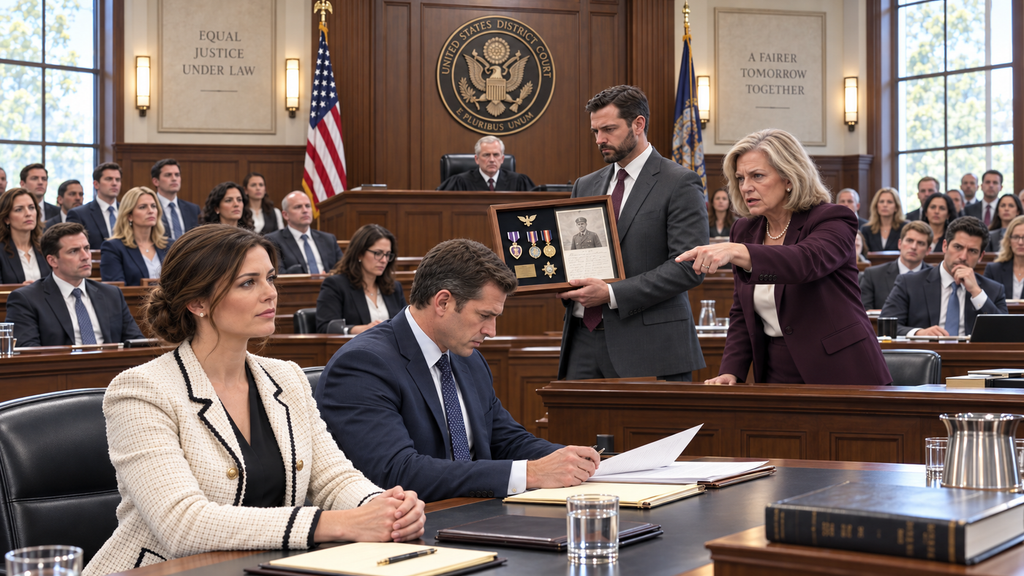
And Caleb—
Caleb went pale.
A tall man in a dark blue suit stepped through the doors first.
He was somewhere in his late fifties, broad through the shoulders, with silver hair cut close to his head and the posture of someone who had spent most of his life being obeyed without having to raise his voice.
Behind him came a woman carrying a locked black case.
Then another man.
Then two uniformed officers.
No one announced them.
They didn’t need to.
Something about the way they entered changed the atmosphere immediately.
The judge leaned forward.
The prosecutor’s expression hardened.
My attorney whispered, “Mara?”
I didn’t answer.
Because I recognized the man in front.
Colonel Daniel Hayes.
The last time I had seen him, twelve years earlier, half his face had been covered in blood.
We had both been lying in the dirt beside a burning transport vehicle in a place that officially, according to every public record, we had never been.
He had dragged me twenty yards while rounds struck the ground around us.
Then I had dragged him another forty after shrapnel tore through his leg.
For twelve years, neither of us had spoken publicly about that day.
For twelve years, he had existed only in my memories.
And now he was walking into a county courtroom while my mother sat under oath claiming that none of it had ever happened.
Hayes stopped just inside the doors.
His eyes found mine.
For the first time that morning, my composure nearly broke.
He gave me the smallest nod.
It wasn’t military.
It wasn’t formal.
It was the nod of a man saying:
I’m here.
You held long enough.
Now let us carry some of it.
The judge lifted her hand.
“Who are you, sir?”
Hayes stepped forward.
“Colonel Daniel Hayes, United States Army, retired.”
The prosecutor stood immediately.
“Your Honor, I object to whatever this is. This witness was not disclosed—”
The woman carrying the black case interrupted him.
“Your Honor, my name is Rebecca Sloan. I’m senior counsel with the Department of Defense Office of General Counsel.”
The room went completely silent.
She continued.
“We are not here as ordinary witnesses. We are here pursuant to federal authorization issued this morning concerning classified materials directly relevant to these proceedings.”
The prosecutor froze.
I looked at the clock.
11:49.
Eleven minutes.
Judge Eleanor Walsh removed her glasses.
“This court has received no notice of federal intervention.”
“You received notice at 11:42,” Sloan said. “It was transmitted through chambers because the underlying order remained sealed until authorization was granted.”
The judge looked toward her clerk.
Her clerk was already standing.
A folded document was in her hand.
Judge Walsh took it.
She read the first page.
Then the second.
The expression on her face changed.
Caleb saw it too.
His hand moved toward his lawyer.
The lawyer didn’t look at him.
He was staring at the federal attorney.
My mother shifted uneasily.
“What is happening?”
No one answered her.
Judge Walsh looked at me.
“Ms. Bennett.”
“Yes, Your Honor?”
“Did you know this order was coming?”
“I knew a review was underway.”
“That is not what I asked.”
I looked toward the clock.
11:50.
“I knew that certain records might become releasable at noon.”
My mother laughed suddenly.
It was sharp and brittle.
“Oh, please.”
Every head turned toward her.
She shook her head.
“This is what she does. This is exactly what she does. She creates theater. She creates drama, and then everyone treats her like some mysterious hero.”
Hayes looked at her.
For the first time.
I watched something move behind his eyes.
Not anger.
Something colder.
Recognition.
He had never met my mother.
But he knew that kind of person.
We all did.
People who decided truth was whatever helped them survive the next five minutes.
Judge Walsh spoke firmly.
“Mrs. Bennett, you will remain silent unless asked a question.”
My mother pressed her lips together.
The judge looked back at Sloan.
“What exactly are you requesting?”
“A temporary recess until 12:00 p.m.”
The prosecutor stepped forward.
“Your Honor, this is highly irregular.”
Sloan turned toward him.
“So is prosecuting a decorated veteran for falsifying military service while relying on the absence of records the federal government itself classified.”
A murmur rolled through the courtroom.
The prosecutor flushed.
“We had no confirmation that those records existed.”
“You were repeatedly informed by defense counsel that relevant military records were restricted.”
“We were informed of an assertion.”
“You were informed of a classification barrier.”
“The defendant refused to substantiate it.”
“She was legally prohibited from substantiating it.”
My attorney stood.
“That is what we have been saying for four months.”
Judge Walsh raised her hand.
“Enough.”
Silence fell again.
She turned toward the jury.
“Ladies and gentlemen, we will take a brief recess. You are not to discuss the case among yourselves, and you are not to speculate regarding what you have just seen.”
She looked toward the bailiff.
“Escort the jury out.”
Chairs scraped against the floor.
The jurors filed past me one by one.
The same people who had spent the morning looking at me like I was filth now avoided my eyes entirely.
One woman, Juror Number Six, hesitated near the door.
She glanced at the medals on the prosecutor’s table.
Then at me.
Her expression had changed.
Not belief.
Not yet.
But doubt.
Sometimes doubt is where justice begins.
When the final juror left, the doors closed.
My mother stood from the witness chair.
“Can I go now?”
“No,” Judge Walsh said.
Victoria looked offended.
“I have testified.”
“You remain under subpoena.”
Caleb rose.
“Your Honor, surely my mother doesn’t have to sit here while the federal government stages some ridiculous—”
“Mr. Bennett.”
Judge Walsh’s voice cut through him.
“Sit down.”
Caleb sat.
Slowly.
That was when I knew he was scared.
My brother had spent his entire life arguing when he believed he could win.
He only became obedient when he sensed a door closing behind him.
I looked at the clock.
11:52.
Eight minutes.
Hayes approached the defense table.
He stopped a few feet away.
For twelve years, I had imagined what I would say if I ever saw him again.
Thank you.
I’m sorry.
You saved me.
I thought you died.
I never forgot.
Instead, the first thing that came out of my mouth was:
“You got old.”
One corner of his mouth lifted.
“So did you.”
My attorney stared between us.
“That’s the reunion?”
Hayes looked at him.
“We weren’t sentimental people.”
“That’s a lie,” I said.
Hayes looked at me.
“Fine. We were sentimental in extremely classified locations.”
Despite everything, I laughed.
It was barely more than an exhale.
But the sound startled me.
I hadn’t laughed in weeks.
Maybe months.
Hayes’s expression softened.
Then his gaze dropped to the wooden display box holding my medals.
He became still.
He stepped closer.
The prosecutor instinctively moved toward the case.
Hayes looked at him.
“Don’t.”
One word.
The prosecutor stopped.
Hayes looked through the glass.
His jaw tightened.
“That Silver Star,” he said quietly, “was pinned to her hospital blanket because she wasn’t conscious when the award was approved.”
No one spoke.
My mother’s face hardened.
Hayes continued.
“She woke up six days later and asked whether the other people made it.”
My eyes burned.
I looked away.
I had spent years learning how not to remember that hospital room.
The fluorescent lights.
The tubes.
The terrible thirst.
And the faces that were missing when I woke.
Hayes looked at me.
“You never told them that part, did you?”
“No.”
“Of course not.”
My mother crossed her arms.
“You expect us to believe this?”
Hayes slowly turned.
“No, ma’am.”
There was no warmth in his voice now.
“I expect you to listen.”
Victoria raised her chin.
“You don’t know my daughter.”
Hayes stared at her.
“I knew your daughter when she was twenty-seven years old and holding pressure on a soldier’s throat with one hand while returning fire with the other.”
My mother blinked.
“I knew your daughter when she refused evacuation because two members of our unit were still missing.”
Her mouth opened.
Nothing came out.
“I knew your daughter when she carried a radio operator twice her size through a burning corridor because she refused to leave him behind.”
He took one step closer.
“And I knew your daughter when she woke in a military hospital and apologized for surviving.”
The courtroom disappeared again.
Not literally.
But grief has a way of draining color from everything around it.
I heard that hospital monitor.
Beep.
Beep.
Beep.
I heard myself asking for names.
Corporal Ellis?
Dead.
Sergeant Moody?
Alive.
Tanner?
Missing.
Ramirez?
Dead.
Hayes?
Surgery.
Again and again.
Names.
Answers.
Pieces of a life I had buried under twelve years of silence.
My mother stared at me.
For once, she didn’t look triumphant.
She looked confused.
As if it had only just occurred to her that the daughter she had decided to destroy might contain an entire world she had never bothered to understand.
But sympathy did not last long on Victoria Bennett’s face.
She turned to Hayes.
“Anyone can tell a story.”
Hayes nodded.
“You’re right.”
He checked his watch.
11:56.
“Good thing we brought records.”
Caleb stood again.
“Records can be fabricated too.”
This time, everyone looked at him.
He realized too late how desperate he sounded.
Sloan set the black case on the defense table.
It had two locks.
She didn’t open them.
Not yet.
“Four minutes,” she said.
Caleb’s lawyer leaned toward him and whispered urgently.
Caleb shook his head.
They whispered again.
Then Caleb slammed his palm against the table.
“No.”
Judge Walsh looked at him.
“Is there a problem?”
“My attorney wants a recess.”
“You are already in recess.”
“I mean a longer one.”
“For what purpose?”
Caleb opened his mouth.
His attorney answered instead.
“To confer privately with my client.”
Judge Walsh studied them.
Then she glanced at the clock.
11:57.
“You have three minutes.”
Caleb and his attorney hurried toward a side room.
My mother started after them.
The bailiff blocked her.
“I’m his mother.”
“You’re also a witness.”
“That is my son.”
“You stay here.”
Victoria looked toward me.
For the first time all day, fear was visible in her eyes.
“Did you plan this?”
I said nothing.
She stepped closer.
“Mara.”
No answer.
“What did you do?”
My attorney started to intervene.
I raised one hand.
Then I looked directly at my mother.
“I told the truth.”
Her nostrils flared.
“You think this makes you better than us?”
“No.”
“Your father always treated you like you were special.”
“No.”
“Yes, he did.”
“He trusted me.”
“Same thing.”
“No, Mom. It isn’t.”
She laughed bitterly.
“You disappeared for years. You missed holidays. You didn’t call. You showed up with scars and secrets and expected us to worship you.”
“I never asked anyone to worship me.”
“You always acted above us.”
“I was overseas.”
“So you say.”
Hayes took a breath.
I stopped him with a glance.
This conversation was not his fight.
Not yet.
I looked at my mother.
“You want to know what I expected?”
She stared at me.
“I expected my mother not to commit perjury to help my brother steal Dad’s company.”
Her face went white.
“That is not what happened.”
“Then what happened?”
“Your father made a mistake.”
“Leaving me the company?”
“Yes.”
There it was.
Simple.
Ugly.
Honest.
Maybe the first honest thing she had said all morning.
She continued.
“Caleb spent his entire life waiting for that company.”
“And I didn’t?”
“You left.”
“I served.”
“You abandoned the family.”
“I came home every time I was allowed.”
“You chose strangers over us.”
My throat tightened.
“No. I chose a country I believed was worth serving.”
“And what did it give you?”
She pointed toward the medals.
“Those?”
Her voice rose.
“Those little pieces of metal?”
My hand curled against the table.
Hayes went still.
My attorney whispered, “Mara.”
But I couldn’t stop now.
My mother had spent years asking that question without actually asking it.
Why did you leave?
Why weren’t we enough?
Why didn’t you become the daughter I planned?
I stood.
“What did it give me?”
“Yes.”
My voice came out quieter than hers.
“It gave me twenty-three-year-olds who called me ma’am because they were scared and wanted me to pretend I wasn’t.”
Victoria stared.
“It gave me people who trusted me to make decisions when there was no good decision left.”
My eyes filled.
I didn’t wipe them.
“It gave me letters from mothers whose children I brought home.”
A tear slipped down my cheek.
“And letters from mothers whose children I couldn’t.”
No one moved.
“It gave me nightmares.”
My voice broke.
“It gave me six surgeries.”
I pressed one hand against the scar beneath my ribs.
“It gave me a body that predicts rain.”
Hayes lowered his head.
“It gave me names I still say in my head every Memorial Day.”
My mother looked away.
“And yes,” I whispered, “it gave me these little pieces of metal.”
I pointed toward the case.
“But those medals were never why I served.”
I looked at Victoria.
“And the fact that you never understood that is not something I can fix for you.”
The side door opened.
Caleb returned.
He had heard at least the last sentence.
His attorney looked sick.
The clock changed.
11:59.
Sloan stood beside the black case.
The judge returned to the bench.
Everyone watched the minute hand.
I had imagined this moment for weeks.
At first, I thought I would feel relief.
Then anger.
Maybe vindication.
Instead I felt strangely empty.
Because no document could restore what my mother had chosen to destroy.
Even if the whole world believed me after noon, I would still know that Victoria Bennett had sat under oath and called her own daughter a fraud.
Some wounds are not healed by being proven right.
The second hand climbed.
Five.
Ten.
Twenty.
Thirty.
No one spoke.
At forty seconds, Caleb wiped sweat from his forehead.
At fifty, my mother lowered herself slowly into the witness chair.
At fifty-five, Hayes looked at me.
At fifty-eight, I closed my eyes.
At fifty-nine—
I remembered my father.
Protect the company.
But don’t expose your unit.
I promise.
The clock struck noon.
Sloan’s phone vibrated.
She checked the screen.
Then she unlocked the first latch.
Click.
The sound carried across the courtroom.
She entered a code.
The second latch opened.
Click.
Rebecca Sloan looked at Judge Walsh.
“Authorization confirmed.”
She opened the case.
Inside were four thick folders, a digital evidence drive, two sealed envelopes, and a document marked with multiple government stamps.
The prosecutor sat down.
Very slowly.
Sloan lifted the top folder.
“Your Honor, pursuant to declassification order 26-1147, limited portions of records concerning former Captain Mara Elizabeth Bennett are now authorized for disclosure in these proceedings.”
Captain.
My mother’s head snapped toward me.
Caleb stared.
Sloan continued.
“Certain operational details remain redacted. However, the Department of Defense is authorized to authenticate Captain Bennett’s military service, rank, deployment history, decorations, injuries sustained in service, and the authenticity of documents previously challenged by the prosecution.”
My attorney closed his eyes.
He exhaled.
Then he whispered:
“Thank God.”
I hadn’t realized until then how scared he had been.
Judge Walsh looked toward the prosecutor.
“Mr. Grant?”
The prosecutor stood.
His confidence was gone.
“Your Honor, I request time to review the materials.”
“You’ll receive appropriate time.”
She looked at Sloan.
“Before I bring the jury back, I need to understand whether these records directly contradict sworn testimony provided this morning.”
Sloan glanced toward my mother.
“Yes.”
Victoria shifted.
The judge’s gaze sharpened.
“To what extent?”
Sloan opened the first file.
“Mrs. Bennett testified that her daughter never served in the United States Army.”
“Yes.”
“That statement is false.”
My mother’s face turned red.
“She testified Captain Bennett never deployed overseas.”
“Yes.”
“False.”
“She testified that the medals entered into evidence were purchased online.”
“Yes.”
“False.”
Sloan lifted a certificate.
“The Silver Star entered into evidence bears the correct award serial reference associated with Captain Bennett’s classified citation.”
Another document.
“The Purple Heart corresponds to injuries sustained on October 17, 2014.”
Another.
“The unit patch contains trace damage consistent with the incident report from the same operation.”
My mother stood abruptly.
“I didn’t know.”
Judge Walsh’s voice hardened.
“Sit down.”
“I was told—”
“Sit down, Mrs. Bennett.”
Victoria sat.
Her hands trembled.
Sloan removed another folder.
“There is also documentation establishing that members of Captain Bennett’s immediate family received limited notification of her active-duty status during portions of her service.”
My heart stopped.
I looked at Sloan.
“What?”
She turned toward me.
“You were not aware?”
“No.”
My mother went completely still.
Hayes looked at Victoria.
Something changed in the room again.
The judge noticed.
“What does that mean?”
Sloan opened the file.
“It means Mrs. Bennett’s claim that she believed her daughter’s military service was fabricated is inconsistent with government correspondence she personally signed for.”
I stared at my mother.
No.
I had assumed Caleb had convinced her.
I had assumed greed had made her willing to repeat whatever he told her.
But this—
This was different.
Sloan lifted a photocopied form.
“September 2010. Family emergency contact verification. Signature: Victoria Bennett.”
Another.
“June 2011. Restricted deployment family notification. Signature: Victoria Bennett.”
Another.
“January 2013. Medical liaison acknowledgment after Captain Bennett suffered a training injury.”
My mother stared at the floor.
Sloan spoke more quietly.
“Signature: Victoria Bennett.”
The silence that followed was unbearable.
I could hear my own breathing.
My mother had known.
Of course she had known.
Some part of me had always understood that.
But denial is strange.
You can know something and still build a softer version around it because the harder truth would hurt too much.
I stood slowly.
“Mom?”
She didn’t look at me.
“Look at me.”
Nothing.
My voice cracked.
“Look at me.”
She raised her eyes.
There were tears in them.
I hated that.
I hated seeing tears because some stupid, ancient part of me still wanted to comfort her.
Children do not stop being children simply because their parents hurt them.
“What did Caleb tell you?”
She shook her head.
“Nothing.”
“Then why?”
No answer.
“Why would you sit there and say I never served when you knew I did?”
Caleb shouted from across the room.
“Don’t answer that.”
Judge Walsh slammed her gavel.
“Mr. Bennett!”
My mother flinched.
The judge looked at her.
“Mrs. Bennett, you are under oath. You will answer questions only when they are properly asked.”
My attorney whispered, “Let me do this.”
I sat down.
Barely.
He rose.
“Your Honor, with permission, I would like to recall Mrs. Bennett immediately.”
The prosecutor looked horrified.
Caleb’s attorney stood.
“I object.”
Judge Walsh looked at him.
“On what basis?”
“My client—”
“Your client is not the witness.”
He sat down.
The jury was brought back.
They entered quietly.
Every juror looked different now.
Word had not been given to them during recess.
But people know when a room has changed.
The black case sat open.
Colonel Hayes sat behind the defense table.
Federal counsel remained beside the evidence.
My mother returned to the witness stand.
Her shoulders were lower.
Her face had aged ten years in fifteen minutes.
My attorney approached.
“Mrs. Bennett, earlier today you testified that your daughter had never served in the Army.”
“Yes.”
“Was that testimony true?”
Victoria looked at Caleb.
My attorney noticed.
“Please look at me.”
She did.
“Was it true?”
Her mouth trembled.
“No.”
A murmur moved through the gallery.
One of the reporters nearly dropped his pen.
My attorney let the silence sit.
“You knew your daughter had served?”
“Yes.”
“How long have you known?”
“Since she enlisted.”
My attorney nodded.
“So when you told this jury that your daughter invented twelve years of military service—”
“I was upset.”
“That was not my question.”
Victoria swallowed.
“No.”
“You knew it was false?”
“Yes.”
The word landed harder than shouting ever could.
I stared at the table.
Hayes put one hand beside mine.
He didn’t touch me.
He just placed it there.
Close enough that I knew I was not alone.
My attorney continued.
“Did you know Captain Bennett had deployed overseas?”
“I knew she had deployments.”
“Did you know she had been injured?”
“Yes.”
“Did you visit her after one of those injuries?”
My mother’s eyes filled.
“Yes.”
I looked up.
I had forgotten that.
Or maybe I had buried it.
A hospital at Fort Sam Houston.
My mother sitting beside the window.
Complaining about parking.
Complaining about the flight.
Refusing to look directly at the bandages around my torso.
She stayed two hours.
Then left because Caleb had an awards dinner.
My attorney approached the medal case.
“Did you know these medals were real?”
Victoria hesitated.
“Some of them.”
“Which ones?”
“I knew about the Purple Heart.”
“Because?”
“She received it after she was hurt.”
“And the Silver Star?”
“I had heard about it.”
“Heard from whom?”
“My husband.”
My chest tightened.
Dad.
My attorney paused.
“Your husband knew about Captain Bennett’s decorations?”
“Yes.”
“And nevertheless, you testified that she bought them online.”
Victoria covered her mouth.
“Yes.”
One juror shook his head.
Another folded his arms.
The prosecutor stared at his notes as if he wished he could disappear into them.
My attorney’s voice softened.
“Mrs. Bennett, why?”
Victoria’s chin trembled.
Caleb stood.
“Mom.”
Judge Walsh pointed at him.
“One more interruption, and I will have you removed.”
Caleb sat.
Victoria began to cry.
“I was trying to protect my son.”
My attorney looked toward me.
Then back at her.
“You have two children.”
She closed her eyes.
“I know.”
“Which son were you protecting?”
“Caleb.”
“From what?”
My mother didn’t answer.
“Mrs. Bennett?”
She looked at my brother.
He slowly shook his head.
That tiny movement told me everything.
My attorney saw it too.
“From what?”
Victoria whispered:
“Prison.”
The courtroom erupted.
Reporters started writing so quickly the scratching of pens sounded like insects.
Caleb sprang to his feet.
“She’s confused.”
Judge Walsh struck the gavel.
“Order.”
“She’s confused!”
“Sit down!”
“She doesn’t know what she’s saying.”
The bailiff moved toward Caleb.
His attorney pulled him back into his chair.
Judge Walsh leaned toward Victoria.
“Mrs. Bennett, do you understand that you are under oath?”
“Yes.”
“Do you understand the implications of what you just said?”
“Yes.”
My attorney waited.
Then asked:
“Why did you believe Caleb might go to prison?”
Victoria wiped at her face.
“Because of the money.”
Caleb whispered, “Mom, stop.”
My mother kept going.
Maybe the truth, once cracked open, had finally become easier than maintaining the lie.
“Your father found out.”
She looked at me.
I stopped breathing.
“Found out what?”
“Caleb had been moving money.”
My attorney said, “From Bennett Meridian Systems?”
“Yes.”
“How much?”
“I don’t know exactly.”
“Ballpark.”
“Millions.”
Caleb slammed both hands onto his table.
“She is lying!”
The judge turned toward him.
“Bailiff.”
Two deputies moved instantly.
They stood behind Caleb.
His attorney grabbed his arm.
“Do not say another word.”
Caleb looked at me.
Not at the judge.
Not at his lawyer.
Me.
And for the first time since we were children, there was no arrogance in his face.
Only hate.
Pure and frightened.
My mother continued crying.
“He said it wasn’t theft.”
“Who?”
“Caleb.”
“He said what was it?”
“Temporary transfers. Tax strategies. He said everyone does it.”
“And your husband discovered them?”
“Yes.”
“What happened?”
“They fought.”
“When?”
“About three weeks before Henry died.”
Dad had died twenty-two days after that argument.
I remembered those last weeks differently now.
The phone calls he took behind closed doors.
The files stacked beside his bed.
The way his hands shook when he said:
They’re moving money through shell companies.
I had assumed “they” meant corporate executives.
Outside actors.
Business partners.
Not my own brother.
My attorney asked:
“Did your husband intend to report Caleb?”
Victoria nodded.
“He told him he had forty-eight hours to return the money and resign.”
“And did Caleb?”
“No.”
“What did he do?”
“He asked me to talk to your father.”
“Did you?”
“Yes.”
“And?”
“Henry said there was nothing to discuss.”
My mother looked at me.
“He said the company would go to Mara because she was the only one he trusted to clean it up.”
A terrible heaviness settled inside me.
Not pride.
Not victory.
Grief.
Dad hadn’t left me the company because he loved me more.
He left it because he had run out of people he trusted.
My attorney paced once before the witness stand.
“After Henry Bennett died, a second will appeared.”
Victoria nodded.
“The will naming Caleb as controlling heir?”
“Yes.”
“Was that will genuine?”
Silence.
Caleb’s lawyer stood.
“Your Honor, I advise the witness to obtain independent counsel.”
Judge Walsh looked at Victoria.
“You have the right to consult counsel before answering questions that may incriminate you.”
My mother stared at her hands.
Then she looked at me.
Everything in her face changed.
I saw my mother as she had been when I was eight.
Standing behind me on my first day of school.
Fixing my collar.
Telling me not to cry.
I saw her when I was sixteen.
Clapping at my graduation.
I saw her the day I enlisted.
Angry.
Terrified.
Proud despite herself.
And I saw the woman who had sat twelve feet away from me that morning and told strangers that my entire adult life was a lie.
People are rarely monsters every day.
That is what makes betrayal so difficult.
Sometimes the person destroying you is also the person who once taught you how to tie your shoes.
Victoria took a slow breath.
“No.”
Caleb went rigid.
My attorney asked:
“The will was not genuine?”
“No.”
“Who created it?”
My mother looked toward Caleb.
The whole courtroom followed her eyes.
“My son.”
Caleb exploded.
“You signed it!”
His attorney grabbed him.
My mother cried out.
The jury gasped.
Judge Walsh stood.
“Remove him.”
“No!”
Deputies seized Caleb by both arms.
He fought them.
Not violently at first.
Just enough to make himself look worse.
“This is insane!”
One deputy ordered him to turn around.
“You can’t arrest me!”
“No one said you were under arrest.”
Caleb looked around wildly.
“This is her fault!”
He pointed at me.
“This was always her!”
I did not move.
“You abandoned us!”
His voice cracked.
“You left for twelve years and came back acting like Dad’s favorite!”
I stared at him.
“You stole from him.”
“You had everything!”
“What?”
“Everything!”
He fought against the deputies.
“You were the brave one. The disciplined one. The one Dad bragged about.”
Tears filled his eyes.
“You know what he said about me?”
I didn’t answer.
“He said I had potential.”
Caleb laughed bitterly.
“That’s what parents say when one child makes them proud and the other doesn’t.”
My heart twisted despite everything.
Because I remembered.
Dad at dinner.
Mara handles pressure.
Mara follows through.
Mara understands responsibility.
Caleb needs to grow up.
A thousand careless comparisons.
A thousand tiny cuts.
But pain does not turn theft into innocence.
And jealousy does not turn perjury into truth.
I stood.
“Caleb.”
He stared at me.
“I never asked Dad to compare us.”
“You loved it.”
“No.”
“Yes, you did.”
“I spent half my life wondering whether I was going to die somewhere he would never be allowed to visit.”
Caleb’s face tightened.
“I didn’t want his company.”
“You took it anyway.”
“He asked me to protect it.”
“He gave it to you!”
“Because you were stealing from it!”
Silence.
He looked away.
There was the truth.
Not in words.
In surrender.
The deputies led him toward the side.
He twisted around one last time.
“This isn’t over.”
Colonel Hayes spoke for the first time in several minutes.
“For you, I suspect it’s just beginning.”
Caleb looked at him.
Then at the federal counsel.
Then at the open evidence case.
And suddenly his threat seemed much smaller.
He was removed from the courtroom.
My mother remained on the witness stand.
She looked broken.
My attorney returned to his table.
The prosecutor rose.
“Your Honor.”
Judge Walsh looked at him.
He cleared his throat.
“Given the authenticated federal records introduced today, the state can no longer maintain several material assertions underlying its case.”
My attorney stood.
“Several?”
The prosecutor swallowed.
“Potentially all.”
A sound moved through the gallery.
Judge Walsh stared at him.
“Be precise.”
He looked toward me.
For the first time since the charges were filed, the prosecutor looked directly at me as a human being.
Not a defendant.
Not a file.
Not a theory.
“Your Honor, the state moves to dismiss the fraud and forgery counts related to Captain Bennett’s military service.”
My attorney said, “With prejudice.”
The prosecutor hesitated.
“Given the circumstances—yes.”
Judge Walsh looked at Sloan.
“Do the federal materials establish authenticity of the challenged service documents?”
“Yes, Your Honor.”
She looked toward the prosecutor.
“And was the absence of ordinary searchable records caused by federal classification?”
“Yes.”
The judge sat back.
Her expression was severe.
“Then the court grants dismissal with prejudice as to all counts based on alleged fabrication of military service.”
My eyes closed.
There it was.
Months of accusations.
Headlines.
Neighbors staring.
Former employees whispering.
People sending photographs of me to stolen-valor forums.
Strangers calling my scars makeup.
All of it collapsed in one sentence.
Dismissed with prejudice.
My attorney gripped my shoulder.
“Mara.”
I opened my eyes.
The jury stared at me.
Juror Number Six was crying.
But the judge wasn’t finished.
“Regarding the remaining charges arising from allegedly falsified estate documents—”
The prosecutor interrupted.
“Your Honor, in light of Mrs. Bennett’s testimony concerning the second will, the state requests permission to withdraw those counts pending further investigation.”
My lawyer said:
“We request immediate dismissal.”
Judge Walsh looked at the prosecutor.
“Do you possess any independent evidence that Captain Bennett forged the later will?”
“No.”
“Any evidence she possessed the document before it was submitted by Caleb Bennett?”
“No.”
“Any evidence connecting her to its creation?”
“No.”
“Then those charges are dismissed.”
The gavel fell.
Once.
Sharp.
Final.
I had imagined that sound every night for four months.
I thought I would collapse.
Instead I simply sat there.
Still.
Because freedom sometimes arrives too quietly for the body to understand.
My attorney leaned toward me.
“It’s over.”
I shook my head.
“No.”
He looked confused.
I looked at my mother.
“No. It isn’t.”
Judge Walsh turned toward Victoria.
“Mrs. Bennett, remain seated.”
My mother looked frightened.
The judge removed her glasses.
“You knowingly provided false testimony in this courtroom on multiple material facts.”
Victoria began crying again.
“I was trying to protect my family.”
Judge Walsh’s expression did not change.
“Perjury does not become lawful because you consider the motive familial.”
“I understand.”
“I am not certain you do.”
The judge glanced toward the prosecutor.
“Mr. Grant, I expect your office to preserve the transcript and refer the matter for investigation.”
“Yes, Your Honor.”
My mother covered her face.
For a fraction of a second, I wanted to ask them not to.
That instinct ashamed me.
Even after everything, some part of me still wanted to protect her.
Then I remembered sitting alone at my kitchen table six weeks earlier.
My face on television.
LIAR?
STOLEN VALOR HEIRESS FACES PRISON.
I remembered my mother giving an interview on the courthouse steps.
Sometimes you have to tell the truth, even when it’s about your own child.
She had said that.
She had looked directly into the camera and said it.
I lowered my hands.
No.
I would not protect her from consequences she had knowingly created.
Judge Walsh turned toward me.
“Captain Bennett.”
The title echoed through the courtroom.
I had not heard it spoken publicly in twelve years.
“Yes, Your Honor.”
“I owe you an observation.”
I waited.
“This court relied upon evidence presented by both sides. But I recognize that the circumstances surrounding your inability to publicly substantiate your service placed you in an extraordinary position.”
I nodded.
She continued.
“You were instructed by law to remain silent while that silence was used against you.”
“Yes.”
“That should trouble everyone in this room.”
The prosecutor looked down.
The judge said:
“You are free to go.”
My throat tightened.
I managed:
“Thank you, Your Honor.”
I stood.
The courtroom erupted.
Reporters rushed for the aisle.
Questions flew instantly.
“Captain Bennett!”
“Mara!”
“Did the Army know about the prosecution?”
“Are you suing your family?”
“What operation were you involved in?”
“Did your brother forge the will?”
“Is your mother facing charges?”
“Captain Bennett, can you tell us where you served?”
Hayes stepped between me and the microphones.
“Back up.”
They didn’t.
A reporter shouted:
“Colonel Hayes, did she really earn the Silver Star?”
Hayes stopped.
He turned.
The room quieted slightly.
“Yes.”
“Can you tell us what she did?”
Hayes looked toward Sloan.
She gave a subtle nod.
Only approved information.
Hayes faced the reporters.
“Captain Bennett was part of a joint operation in October 2014.”
Cameras rose.
“The mission suffered catastrophic compromise.”
I looked at him.
I had never heard the event described in public.
Not once.
“Her vehicle was struck. Several members of the team were injured. Despite being wounded herself, Captain Bennett coordinated extraction under sustained fire.”
A reporter asked:
“How badly was she wounded?”
Hayes glanced toward me.
“Badly enough that the medical team didn’t expect her to remain conscious.”
I swallowed.
He continued.
“She refused evacuation until the surviving members of her team had been accounted for.”
Another reporter:
“How many did she save?”
Hayes’s face changed.
“More than she believes.”
My eyes filled again.
He looked directly at me.
“That has always been her problem.”
A few people laughed softly.
I didn’t.
I could barely breathe.
Hayes said:
“She remembers the ones we lost.”
His voice lowered.
“We remember the ones who came home because she stayed.”
The courtroom fell silent.
I looked down.
For twelve years, I had carried the mission as a list of failures.
Three dead.
One permanently injured.
One man I couldn’t reach.
One voice on the radio that stopped answering.
I had never counted the others.
Maybe because survivors rarely do.
Hayes stepped closer.
“You should have been told that years ago.”
I shook my head.
“Don’t.”
“Yes.”
“Daniel.”
“You should have.”
The use of my first name broke something open inside me.
I covered my mouth.
He wrapped both arms around me.
The courtroom disappeared behind camera flashes.
I had not hugged him since the hospital.
I held on.
Not because I was weak.
Because I was tired of pretending I had never needed anyone.
Hayes whispered:
“We got home, Captain.”
My shoulders shook.
“Not everyone.”
“I know.”
“I still hear them.”
“I know.”
“I should have—”
“No.”
His grip tightened.
“No more rewriting that day so you’re the villain.”
I closed my eyes.
For twelve years, classified had meant secret.
Silence.
Locked rooms.
Black lines on paper.
But there are secrets that protect missions.
And secrets that become prisons.
Maybe I had confused the two.
When we finally stepped apart, my mother was standing a few feet away.
She had watched everything.
Her face was wet with tears.
“Mara.”
I froze.
Reporters immediately turned toward her.
Hayes looked at me.
“You want me to stay?”
I nodded once.
My mother approached.
For the first time in my life, she seemed uncertain how to speak to me.
“I didn’t know it was like that.”
I stared at her.
“What difference would it make?”
Her face crumpled.
“I thought—”
“You knew I served.”
“Yes.”
“You knew I was injured.”
“Yes.”
“You knew Dad believed me.”
“Yes.”
“Then what exactly didn’t you know?”
She looked down.
“How bad it was.”
I laughed once.
There was no humor in it.
“So if I had suffered more visibly, you wouldn’t have lied?”
“No.”
“That’s what you just said.”
“I didn’t mean—”
“You didn’t need to understand every detail of my service to know that lying about it was wrong.”
She reached toward me.
I stepped back.
Her hand fell.
“Mara, please.”
“No.”
“I’m your mother.”
“I know.”
“I was scared for Caleb.”
“So you tried to send me to prison?”
“I never thought it would go that far.”
“You testified under oath.”
“I thought they would settle.”
I stared at her.
“What?”
She began speaking quickly now.
“Caleb said if the pressure became serious, you’d give up the shares. He said you would settle the estate dispute to avoid publicity.”
My stomach turned.
So that was the plan.
Not merely to defeat me.
To humiliate me until I surrendered.
“He said nobody would prosecute.”
“But they did.”
“I know.”
“And you kept lying.”
Her mouth trembled.
“I was already in too deep.”
There it was.
The excuse people use when they have chosen themselves repeatedly.
I was already in too deep.
As if every new lie were not another opportunity to stop.
I looked at her.
“When they arrested me at Dad’s company, were you there?”
Her eyes lowered.
“Yes.”
“I saw you sitting in Caleb’s car.”
She nodded.
“You watched them put me in handcuffs.”
Tears slid down her cheeks.
“Yes.”
“Did you know I spent that night in a holding cell?”
“Yes.”
“Did you know I had a panic attack because they locked the door and the room smelled like diesel?”
She looked at me sharply.
“No.”
“Well, I did.”
My voice trembled.
“And for about thirty seconds, I wasn’t in Colorado anymore.”
The courtroom around us quieted.
“I was back inside a burning vehicle.”
My mother covered her mouth.
“I screamed so loudly a deputy thought I was having a seizure.”
“Mara…”
“And the next morning, you told a reporter you were disappointed in me.”
She began sobbing.
I didn’t feel vindicated.
I felt exhausted.
“So don’t tell me you didn’t know how far this could go.”
“I’m sorry.”
I looked at her.
The words I had wanted for months.
I’m sorry.
And they meant almost nothing.
“I believe you’re sorry now.”
She nodded desperately.
“I am.”
“But I don’t know whether you’re sorry for what you did or sorry it failed.”
She stared at me.
That hurt her.
I could see it.
It was supposed to.
Not because I wanted revenge.
Because sometimes truth hurts when it reaches the exact place a lie was protecting.
My mother whispered:
“What happens to us?”
I looked toward the empty seat where Caleb had been.
“I don’t know.”
“Will you testify against him?”
“If I’m subpoenaed.”
Her face twisted.
“He’s your brother.”
“Yes.”
“Mara.”
“And I was his sister.”
She had no answer.
The bailiff approached.
“Mrs. Bennett, the prosecutor needs you to remain available.”
My mother looked at me one final time.
Then she walked away.
I watched her go.
Hayes stood beside me.
“You all right?”
“No.”
He nodded.
“Good answer.”
My lawyer laughed tiredly.
“Can we get her out of here before someone finds another felony?”
We left through the side entrance.
Outside, rain had started.
Cold September rain.
The kind that makes pavement shine like black glass.
Federal security guided us toward a waiting vehicle, but I stopped beneath the courthouse awning.
I needed air.
Real air.
Not courtroom air.
Not hospital air.
Not the recycled air of interrogation rooms and attorney offices.
Rain blew against my face.
Hayes joined me.
For a while, neither of us spoke.
Then I asked:
“How many?”
He knew exactly what I meant.
“Seven.”
I looked at him.
“Seven what?”
“Seven came home from that operation because you stayed.”
I shook my head.
“No.”
“Yes.”
“Daniel—”
“Seven.”
He turned toward me.
“Tanner survived.”
My entire body went cold.
“What?”
“He survived.”
“No.”
“He was transferred out under another program. You were never cleared to be told.”
I stared at him.
“No.”
“I’m sorry.”
“No, they told me he was missing.”
“He was.”
“For how long?”
“Eleven days.”
My knees nearly gave out.
Hayes caught my arm.
“He’s alive?”
“Yes.”
I started crying.
Right there beneath the courthouse awning.
Not graceful tears.
Not movie tears.
I folded over with both hands pressed against my face and sobbed like something inside me had finally torn open.
Tanner.
The radio operator whose voice had vanished.
The man I had believed I left behind.
Alive.
Hayes held my shoulders.
“Why didn’t anyone tell me?”
“Classification.”
I laughed through tears.
“Of course.”
“He’s married now.”
I looked up.
“What?”
“Two kids.”
I laughed again.
This time for real.
A broken, ridiculous sound.
“Two?”
“Girls.”
“God.”
“He named one Mara.”
I stopped.
Hayes smiled.
“That’s why I said you remember the wrong count.”
I could not speak.
Somewhere behind us, reporters were yelling questions.
Cars moved through wet streets.
A courthouse door opened and closed.
The world continued.
And Tanner had two daughters.
One named Mara.
For twelve years I had carried his ghost.
Now I had to learn how to put it down.
Hayes reached into his coat.
He pulled out a folded envelope.
“This is technically not government business.”
I stared at it.
“What is it?”
“A letter.”
“From Tanner?”
“Yes.”
I took it with shaking hands.
“Did you read it?”
“No.”
“You’re lying.”
“Yes.”
I laughed.
He smiled.
“He told me I was allowed.”
I opened the envelope.
The letter was handwritten.
Not long.
Only one page.
Mara,
If Hayes is actually handing you this, it means somebody finally unlocked the bureaucratic coffin we’ve all been buried in.
You need to know something.
I remember you coming back for me.
Not clearly.
Mostly smoke, noise, and you yelling at me to stay awake.
I know you spent years believing you failed.
You didn’t.
I had eleven more days in hell after you lost contact, but the reason I survived the first one was you.
My oldest daughter is named Evelyn.
My youngest is Mara.
My wife says that when Mara gets stubborn, it is somehow your fault.
I agree.
You gave me the chance to become her dad.
That is what you did that day.
Not the fire.
Not the medal.
Not the report.
That.
You gave me Tuesday mornings packing lunches.
You gave me soccer practice.
You gave me burnt pancakes and arguments over bedtime.
You gave me the boring life we used to joke about wanting.
I hope one day you let yourself have one too.
— Tanner
By the time I finished, the page was wet with my tears.
I pressed it against my chest.
Hayes looked toward the rain.
“He wanted to come.”
“Why didn’t he?”
“His daughter has surgery today.”
I laughed softly.
“Which daughter?”
“Mara.”
“Of course.”
“He said if you gave him trouble about not being here, I should remind you that family comes first.”
That sentence hurt in a completely different way.
Family comes first.
I had heard those words used as a weapon all my life.
Protect Caleb.
Forgive your mother.
Don’t embarrass the family.
Give up the company.
Keep the peace.
But Tanner meant something else.
He meant sitting beside a child before surgery.
He meant showing up.
Family does not come first because family is entitled to destroy you.
Family comes first when family behaves like love.
I folded the letter carefully.
“Tell him I understand.”
“Tell him yourself.”
Hayes held out his phone.
A number was already on the screen.
I stared at it.
“No.”
“Yes.”
“I look terrible.”
“It’s a phone call.”
“I sound terrible.”
“You always sounded terrible.”
“Colonel.”
“Captain.”
I took the phone.
Tanner answered on the second ring.
“Hayes?”
I couldn’t speak.
He paused.
Then:
“Mara?”
My eyes closed.
His voice had changed.
Older.
Rougher.
Alive.
“Yes.”
Silence.
Then he laughed.
“Oh, you have got to be kidding me.”
I started crying again.
“You’re alive.”
“That’s generally how phones work.”
“You idiot.”
“Good to hear you too.”
“You named your kid after me?”
“My wife lost a bet.”
I laughed through my tears.
“You’re lying.”
“Completely.”
A child’s voice sounded faintly in the background.
“Dad?”
Tanner spoke away from the phone.
“One second, bug.”
Then back to me.
“That’s her.”
My chest tightened.
“Mara?”
“Yeah.”
“Can I…”
I stopped.
“Can I hear her?”
“Hang on.”
There was rustling.
Then a younger voice.
“Hello?”
I covered my mouth.
“Hi.”
“Who is this?”
I looked at Hayes.
He turned away, giving me privacy.
“My name is Mara too.”
The girl gasped.
“You’re Army Mara?”
I laughed.
“I guess so.”
“My dad says you’re super bossy.”
“That is classified.”
She giggled.
Just like that.
A child laughed.
A child who existed because a man I had believed dead had lived long enough to become a father.
Whatever bitterness I had carried out of the courtroom could not survive that sound unchanged.
Not disappear.
But change.
There is a difference.
Two weeks later, federal investigators entered Bennett Meridian Systems with warrants.
By then, Caleb’s story had fallen apart completely.
The shell companies my father had warned me about were real.
So were the transfers.
More than $8.7 million had been moved over four years through consulting contracts, false vendor payments, and accounts controlled by Caleb and two executives he had brought into the company.
The forged will had been created eight days before Dad died.
Not signed by Dad.
Not witnessed by the people named on the document.
One supposed witness had been in Florida on the date of signing.
The other had died eleven months earlier.
Caleb had assumed nobody would investigate carefully if he could destroy my credibility first.
That was his mistake.
He had mistaken silence for weakness.
People do that often.
They see someone refusing to fight publicly and assume the person cannot fight.
They see restraint and imagine fear.
They see classified records and imagine emptiness.
They see quiet and imagine surrender.
Caleb learned otherwise.
Three months after the trial, he was indicted on charges related to wire fraud, conspiracy, forgery, obstruction, and witness tampering.
My mother was charged separately with perjury and obstruction.
The prosecutor who had pursued the case against me was investigated too.
Not because he had believed Caleb.
Believing a witness is not misconduct.
But investigators discovered his office had received two written notices warning that my records were restricted and might require federal verification.
Those notices had never been included in disclosures to my defense.
Whether that was deliberate or negligent became its own battle.
By then, I no longer wanted to fight every battle myself.
I had spent enough years living as if survival required me to carry everything alone.
The company was another matter.
Bennett Meridian Systems had nearly collapsed.
News of the fraud caused clients to leave.
Employees panicked.
Banks froze credit facilities.
For the first month, I slept four hours a night.
Sometimes less.
Every morning at 5:30, I walked through the same doors Dad had entered for thirty-four years.
His photograph still hung in the lobby.
Henry Bennett.
Founder.
Engineer.
Father.
Flawed man.
Good man.
Complicated man.
The first week after my exoneration, I stood in front of his photograph for nearly ten minutes.
“You could have told me,” I whispered.
Of course, photographs do not answer.
Maybe fathers don’t either.
Not when it matters.
He had tried to protect me from the family war by giving me the power to survive it.
But perhaps he should have told me the war had already begun.
Still, anger toward the dead is exhausting.
Eventually, love becomes easier.
I hired an independent forensic accounting team.
Removed three executives.
Returned money where we could.
Reported every questionable transaction we discovered.
No secrets.
No shortcuts.
No family exceptions.
On my first day as permanent chief executive, I called every employee into the manufacturing hall.
Almost four hundred people stood between assembly stations and metal worktables.
Many had worked for my father.
Some had believed the headlines about me.
Some had not.
I walked onto a temporary platform without notes.
I hated speeches.
Dad loved them.
Caleb loved them more.
But I had learned that there are moments when silence stops being integrity and starts becoming absence.
“My father built this company,” I began.
The room quieted.
“He believed engineering should solve real problems for real people.”
I looked across the faces.
“Over the last several years, people inside this company betrayed that trust.”
No euphemisms.
No corporate language.
“They stole.”
Several employees lowered their eyes.
“They lied.”
I breathed in.
“And my family tried to cover those lies with more lies.”
My voice remained steady.
“I cannot promise you this company will recover quickly.”
People shifted.
“I cannot promise no jobs will be affected.”
That hurt.
“But I can promise one thing.”
I looked at Dad’s oldest employees.
“At Bennett Meridian Systems, truth will never again be treated as a threat.”
The room stayed silent.
Then an older machinist named Robert raised his hand.
I almost smiled.
“Yes?”
He cleared his throat.
“Captain Bennett?”
I winced.
“Mara is fine.”
A few people laughed.
Robert smiled.
“Your father would be proud.”
I looked at the floor.
For a moment, I couldn’t answer.
Finally:
“I hope so.”
Then someone started clapping.
Just one person.
Then another.
Then dozens.
Soon the whole manufacturing floor was filled with applause.
I did not feel triumphant.
Triumph is overrated.
I felt responsible.
That mattered more.
My mother’s case took longer.
She called me fourteen times in the first month after the courtroom.
I answered none of them.
Then came letters.
The first was six pages of explanations.
Caleb manipulated me.
Your father pressured him.
I was scared.
I didn’t understand the legal consequences.
You were always stronger.
I thought you could handle it.
That sentence made me angrier than everything else.
You were always stronger.
Strong people hear that too often.
As though strength means pain does not count.
As though the person who can carry more should always be given more weight.
As though surviving previous cruelty creates permission for future cruelty.
I put the letter away.
The second letter was shorter.
No excuses.
Mara,
I keep trying to write an explanation that makes me less ashamed.
There isn’t one.
I knew you served.
I knew the Purple Heart was real.
I knew your father trusted you.
I lied because I was terrified Caleb would lose everything, and somewhere along the way I decided your life was the thing I was willing to sacrifice to save his.
There is no motherly way to say that.
There is no decent way to say it.
I chose one child over another.
Worse, I chose the child doing wrong over the child telling the truth.
I do not expect forgiveness.
I only want you to know that I finally understand what I did.
Mom
I read that letter three times.
Then I put it in the same drawer as Tanner’s letter.
Not because they belonged together.
They didn’t.
One reminded me of the life I had helped save.
The other reminded me of the part of my own life I needed to stop sacrificing.
Six months after the trial, I visited my mother.
She was awaiting sentencing.
We met in her lawyer’s office because neither of us wanted the courthouse.
She looked smaller.
Gray at the temples.
No expensive blazer.
No careful makeup.
Just my mother.
I sat across from her.
For almost a minute, neither of us spoke.
Then she said:
“You came.”
“Yes.”
“Why?”
“I don’t know.”
That was true.
She nodded.
“I’m glad you did.”
I looked at her.
“Do not mistake this for forgiveness.”
“I won’t.”
“I mean it.”
“I know.”
“I may never trust you again.”
Her face tightened.
“I know.”
“And if you ask me to intervene in your case, I will leave.”
“I won’t.”
That surprised me.
She folded her hands.
“I deserve whatever happens.”
“No.”
She looked up.
I continued.
“That’s not for you to say either.”
She frowned.
“The judge decides what happens legally.”
I leaned back.
“And I decide what happens between us.”
She nodded slowly.
“Yes.”
For once, she understood.
She started crying.
“I miss you.”
I looked toward the window.
Cars moved along the street below.
People carrying groceries.
A man walking a dog.
Ordinary life.
Tanner had called it boring.
The greatest luxury in the world.
“I missed you too,” I said.
Her breath caught.
“Past tense?”
I looked at her.
“I miss who I thought you were.”
That hurt her.
But she nodded.
“That’s fair.”
“No. It isn’t about fair.”
I had learned that too.
“Some things aren’t fair. They just are.”
We sat in silence.
Finally, she asked:
“Can I ever fix it?”
I thought about the question.
“No.”
Her face fell.
Then I continued.
“But you might be able to build something different.”
She stared at me.
“It won’t be what we had.”
“I understand.”
“And you don’t get to decide how quickly.”
“I understand.”
“And Caleb cannot be the price of having a relationship with you.”
Her eyes filled again.
“He’s still my son.”
“I know.”
“I love him.”
“I know.”
“But I won’t ask you to forgive him.”
“Good.”
She nodded.
“I think that may be the first useful thing I’ve said in years.”
Almost against my will, I smiled.
A small one.
She noticed.
She didn’t reach for me.
That mattered.
Old Victoria would have grabbed my hand because she wanted immediate proof everything was okay.
This version let the moment remain small.
Maybe change begins that way.
Not grand apologies.
Not tears.
Restraint.
Respecting the space you once believed you owned.
When I left, she said:
“Mara?”
I turned.
“I am proud of you.”
My chest tightened.
There had been a time those words could have bought almost anything from me.
Now they were simply words.
Still, I nodded.
“Thank you.”
Outside, I breathed easier than I expected.
I did not forgive my mother that day.
I haven’t completely forgiven her even now.
People like clean endings.
They want betrayal followed by punishment, punishment followed by apology, apology followed by forgiveness.
Life is rarely that tidy.
Forgiveness is not a courtroom verdict.
There is no gavel.
No moment when someone announces that pain is officially over.
Sometimes forgiveness is simply deciding the wound will not be allowed to choose your future.
Sometimes it means reconciliation.
Sometimes it means distance.
Sometimes it means saying:
I love you, but you no longer get access to every part of me.
Caleb never apologized.
Not truly.
He took a plea agreement eleven months after the courtroom hearing.
The evidence was overwhelming.
Financial records.
Messages.
Witness testimony.
Draft versions of the forged will recovered from a laptop he thought had been wiped.
And one recording.
My father.
Dad had recorded his final confrontation with Caleb.
I listened to it only once.
His voice was weak but clear.
“You’re going to return the money.”
“Dad, you don’t understand how the accounts work.”
“I understand perfectly.”
“You’re destroying everything over bookkeeping.”
“You stole from people who trusted our name.”
“I built this company too.”
“No.”
A pause.
Then my father said something I will never forget.
“You benefited from this company. That is not the same as building it.”
Caleb swore.
Dad continued.
“Mara understands something you never learned.”
“What, how to disappear?”
“No.”
Dad coughed.
“How to be responsible when nobody is watching.”
I had to stop the recording.
For years, I believed my father valued me because I was strong.
Then I understood.
He trusted me because he believed I would do the right thing even when it hurt me.
Sometimes being trusted is heavier than being loved.
But I think he loved me too.
He just wasn’t very good at saying it.
Two years after the trial, Bennett Meridian Systems posted its strongest quarter in company history.
We were smaller.
Leaner.
More transparent.
No private family offices.
No unchecked discretionary accounts.
No relatives hired without independent board approval.
When the board asked me whether I wanted the CEO title permanently, I said no.
That shocked everyone.
Especially me.
For two years, I had believed saving Dad’s company meant running it forever.
But Tanner’s letter stayed in my desk.
You gave me the boring life we used to joke about wanting.
I began to understand what he meant.
I had spent my twenties serving.
My thirties recovering.
My early forties fighting my family.
I was tired of defining my life by emergencies.
So I hired a CEO.
A brilliant woman named Naomi Chen, who had no interest in Bennett family mythology.
Exactly what the company needed.
I remained chair of the board.
Then I bought a small house outside Colorado Springs.
Not large.
Not impressive.
A porch.
A mountain view.
A kitchen with terrible cabinet space.
Hayes laughed the first time he visited.
“You defended people under fire and this pantry defeated you?”
“Shut up.”
He opened another cabinet.
“Where do you keep anything?”
“Daniel.”
“I’m just saying, enemy logistics were more efficient.”
Tanner visited that summer.
He brought his wife and both daughters.
When I saw him walking up my driveway, I froze.
He had a limp.
Gray in his beard.
A little heavier.
Alive.
For twelve years I had remembered a twenty-five-year-old man covered in soot.
Now a forty-year-old father was walking toward me carrying a cooler while yelling at a child not to step in mud.
He set the cooler down.
We stared at each other.
Then he said:
“You look old.”
I laughed.
“You stole Hayes’s line.”
“He stole mine.”
I hugged him.
Hard.
His youngest daughter stood behind him.
Mara.
She was eleven.
Curly brown hair.
Green sneakers.
A suspicious expression.
“You’re shorter than Dad said.”
I looked at Tanner.
He shrugged.
“I may have exaggerated.”
I crouched slightly.
“I heard you’re stubborn.”
She looked at her father.
“He told you that?”
“Yes.”
She crossed her arms.
“He lies a lot.”
I smiled.
“I already like you.”
We spent the weekend cooking outside.
Talking.
Not talking.
Remembering.
Not remembering.
On Saturday evening, Tanner and I sat alone on the porch.
His daughters chased fireflies across the yard.
“You okay?” he asked.
I thought about the question.
For most of my life, okay meant operational.
Standing.
Capable.
Not currently bleeding.
That night, I answered differently.
“Yeah.”
He looked at me.
“Actually?”
“Actually.”
He smiled.
“Good.”
His daughter Mara shrieked with laughter in the grass.
I watched her run.
“You really named her after me.”
“Yep.”
“Why?”
Tanner leaned back.
“Because there are names you give children because you like the sound.”
He looked toward his daughter.
“And names you give them because you hope they grow into something.”
My throat tightened.
“What did you want her to grow into?”
“Someone who goes back.”
I looked at him.
He continued.
“When other people run away from something hard, you go back.”
His voice softened.
“That’s what I remember about you.”
I looked toward the yard.
For years, I had thought going back was my curse.
Back for soldiers.
Back for my father’s company.
Back into a courtroom where silence made me look guilty.
Back to my mother.
Maybe Tanner saw it differently.
Maybe courage wasn’t never leaving.
Maybe courage was deciding what was worth returning for.
A year later, my mother finished her sentence.
It was less severe than Caleb’s.
She served time, paid fines, and completed supervised release.
Our relationship remains cautious.
We have coffee sometimes.
Public places at first.
Then my porch.
She has never asked for a key.
That might sound small.
It isn’t.
The first Christmas she visited, she brought no presents.
“I didn’t know what would feel manipulative,” she said.
I almost laughed.
“So I brought pie.”
“What kind?”
“Apple.”
“That can still be manipulative.”
She stared at me.
Then I smiled.
She laughed.
It was the first time we had laughed together since Dad died.
We ate pie.
We did not talk about Caleb.
We did not pretend everything was fixed.
And strangely, that made the evening feel more honest than most of our old holidays.
Caleb and I have not spoken.
He sent one letter.
Three pages explaining why Dad had been unfair.
Two pages blaming pressure.
One paragraph admitting he should not have involved me.
Not apologizing.
Admitting.
There is a difference.
I did not reply.
I don’t hate him anymore.
Hatred requires too much maintenance.
I simply no longer give him space in my daily life.
People sometimes ask whether that makes me cold.
I tell them no.
Boundaries are not hatred.
A locked door does not mean you wish harm on the person outside.
Sometimes it simply means they no longer have permission to enter.
The medals are no longer in a wooden display case.
For a while, I couldn’t look at them.
Then one morning, I took the Silver Star, the Purple Heart, and the scorched patch to a framing shop.
The owner asked how I wanted them arranged.
I almost said:
It doesn’t matter.
Then I changed my mind.
I asked her to leave space beneath the medals.
“For what?” she asked.
“A letter.”
Tanner’s letter now hangs beneath them.
Not the whole thing.
Just one line.
You gave me the boring life we used to joke about wanting.
That line matters more to me than the citation.
Because medals tell you what happened during the worst minutes of someone’s life.
They rarely tell you what happened afterward.
The lunches.
The soccer games.
The marriages.
The children.
The ordinary Tuesdays that exist because somebody survived.
Three years after that courtroom, I was invited to speak at a veterans’ event in Denver.
I almost declined.
Public speaking still felt like standing in front of incoming fire without body armor.
Hayes told me that was dramatic.
I reminded him he once jumped out of a helicopter onto a rooftop.
He said:
“Different.”
It wasn’t.
I went.
The room held veterans from five wars.
Some wore uniforms.
Some wore jeans.
Some carried scars you could see.
Others carried scars nobody would ever notice.
I stood at the podium.
For a moment, I thought about telling them about the Silver Star.
The mission.
The courtroom.
My mother.
Caleb.
Instead I said:
“For a long time, I believed silence was the same thing as strength.”
The room quieted.
“I was trained to keep secrets.”
I looked at the faces.
“And sometimes secrets are necessary.”
A few people nodded.
“But pain is not always classified.”
A man in the second row looked down.
“You do not have to prove you are hurting badly enough before you are allowed to ask someone to sit beside you.”
My own voice shook.
“You do not have to earn help.”
Silence.
“And if someone uses your silence to invent a version of you that is convenient for them, you are allowed to tell the truth.”
I thought about the courtroom clock.
11:47.
Thirteen minutes.
All those people believing a lie while I waited for authorization.
“Sometimes the truth arrives late.”
I paused.
“But late is not the same as never.”
Afterward, an older veteran approached me.
Vietnam.
He wore no medals.
Just a baseball cap.
He shook my hand.
“My daughter thinks I don’t talk because I don’t care.”
I waited.
He swallowed.
“I don’t talk because I don’t know how.”
I understood that better than he knew.
“Maybe tell her that.”
He nodded.
“I think I will.”
That night, I drove home beneath a clear Colorado sky.
No cameras.
No lawyers.
No reporters.
Just highway lights and mountains in the distance.
When I reached my house, there was a package on the porch.
From Tanner.
Inside was a cheap plastic trophy.
BEST FAKE SOLDIER.
I laughed so loudly my neighbor’s dog started barking.
Beneath it was a note.
Saw this online.
Figured your mom was right after all.
— T
I called him immediately.
“You’re an idiot.”
He laughed.
“Put it next to the Silver Star.”
“I’m throwing it away.”
“You’d better not.”
“I hate you.”
“No, you don’t.”
He was right.
I put it on the shelf.
Right beside the medals.
People who visit sometimes stare at it.
Nobody understands.
That makes it better.
The courtroom case is still the thing strangers know me for.
Once every few months, someone recognizes me in a grocery store.
“Aren’t you the woman whose mother said she faked being in the Army?”
Yes.
That woman.
For a while, I hated the question.
Now I usually smile.
“Yes.”
Then they ask:
“What was it like when those records came out?”
They expect me to say satisfying.
Vindicating.
Powerful.
Instead I tell them the truth.
“It was sad.”
Because it was.
Being proven right does not erase the fact that people you loved wanted you to be wrong.
Winning does not return the months you spent afraid.
Justice does not turn betrayal into a good memory.
But sadness is not the same thing as defeat.
That took me years to understand.
The last time I visited Dad’s grave, I brought no flowers.
He hated flowers.
Said they were expensive compost.
So I brought coffee.
Black.
His favorite.
I poured a little beside the headstone.
Wasteful.
He would have complained.
I sat in the grass.
“Company’s okay,” I told him.
Wind moved through the trees.
“Naomi’s better at running it than I was.”
I smiled.
“You’d hate that.”
A bird landed nearby.
“Mom and I talk.”
I traced the edge of his name carved into stone.
“Not much.”
A pause.
“Caleb’s still angry.”
Another pause.
“I’m not.”
That surprised me when I said it.
I waited for resentment to rise.
It didn’t.
“I wish you had told me.”
My throat tightened.
“About the money.”
I looked down.
“About everything.”
The wind moved again.
“But I know why you trusted me.”
For years, that responsibility had felt like another weight placed on my shoulders.
That day, it felt different.
A gift, perhaps.
Not because I had carried it perfectly.
But because Dad had believed I would keep moving toward truth even when truth cost me something.
I stood.
Brushed grass from my jeans.
Then I touched the headstone once.
“Next time, leave better instructions.”
I walked away laughing.
I think he would have appreciated that.
People sometimes imagine the most important moment of my story was noon.
The minute classified became declassified.
It wasn’t.
It wasn’t the federal attorney opening the black case.
It wasn’t Hayes entering the courtroom.
It wasn’t my mother admitting she lied.
It wasn’t Caleb being taken out.
It wasn’t the judge dismissing the charges.
Those moments mattered.
But the most important moment came much later.
A completely ordinary Tuesday.
I woke up at 6:42 in the morning.
No alarm.
No court.
No company emergency.
No nightmares.
Rain tapped lightly against my bedroom window.
I walked barefoot into the kitchen.
Made coffee.
Burned toast.
Fed my neighbor’s cat because apparently he had decided I belonged to him.
Then I sat on my porch.
Nothing happened.
For nearly an hour.
Nothing.
No gunfire.
No lawyers.
No betrayal.
No ringing phone.
No person demanding I prove who I was.
I just sat there.
Watching rain fall across the mountains.
And suddenly I remembered Tanner’s letter.
The boring life.
I smiled.
Because after everything—
the Army,
the mission,
the scars,
my father’s death,
the stolen money,
the forged will,
my mother’s testimony,
the courtroom,
the lies,
the truth—
I had finally found it.
An ordinary Tuesday.
And I understood why men like Tanner and Daniel and I had fought so hard to come home.
Not for medals.
Not for speeches.
Not for people to call us heroes.
For mornings where nothing happens.
For daughters complaining about breakfast.
For dogs barking at mail carriers.
For terrible coffee.
For arguments about whose turn it is to take out the trash.
For rain against a kitchen window.
For the freedom to live a life that nobody will ever make a movie about.
That is what survival buys you.
Not glory.
Time.
My mother tried to erase twelve years of my life with one sentence.
“She was never in the Army.”
My brother tried to turn silence into proof of guilt.
He thought sealed records meant nonexistent records.
He thought classification meant weakness.
He thought if enough people repeated a lie loudly enough, truth would eventually become irrelevant.
He was wrong.
Truth does not always arrive first.
Sometimes it arrives bruised.
Sometimes it arrives late.
Sometimes it stands outside a courtroom while everyone inside has already decided what they believe.
Sometimes truth has to wait for authorization.
But when those doors finally open—
when the records are unsealed,
when the witness walks in,
when the person everyone called a liar is finally allowed to speak—
the lie suddenly discovers something it should have understood from the beginning.
Silence was never surrender.
And as for the scars my mother said were fake?
I still carry them.
The long one beneath my ribs.
The smaller one across my shoulder.
The pale line near my hip.
I no longer hide them.
Not because they prove anything to strangers.
I have nothing left to prove to strangers.
They remind me that there were moments when my body was broken and continued anyway.
The medals?
They’re real.
The service?
Real.
The people we lost?
Painfully real.
The people who came home?
Real too.
My mother’s betrayal?
Real.
My brother’s crimes?
Real.
My father’s trust?
Real.
Tanner’s daughters?
Very real.
Especially the younger one.
She calls me every birthday now.
Usually to ask for money.
Her father insists she inherited that from me.
That is slander.
And the life I built afterward?
That is real too.
Maybe that is the part people miss when they tell stories about betrayal.
The ending is not watching the people who hurt you lose.
The ending is reaching the day when their choices stop being the most important thing about your life.
I thought justice would be Caleb in handcuffs.
It wasn’t.
I thought justice would be my mother admitting she lied.
It wasn’t.
I thought justice would be hearing a judge call me Captain Bennett and dismiss every charge.
Even that wasn’t it.
Justice was waking up years later and realizing I had gone three whole days without thinking about either of them.
Justice was Tanner’s daughter laughing in my backyard.
Justice was hiring someone better than me to run my father’s company because I no longer needed it to prove he had chosen correctly.
Justice was sitting across from my mother and understanding that loving her did not require trusting her.
Justice was hanging Tanner’s letter beneath my medals.
Justice was a rainy Tuesday.
Justice was peace.
And peace, I eventually learned, is far more satisfying than revenge.
So if you ever find yourself sitting quietly while someone tells lies about who you are—
if people mistake your silence for guilt,
if someone who should have protected you decides instead to destroy your reputation,
if the truth is trapped behind a door you cannot yet open—
remember this:
You do not become a liar simply because someone lies about you.
You do not become worthless because someone fails to value you.
And you do not lose your history because another person tries to rewrite it.
Sometimes all you can do is keep your hands folded.
Keep breathing.
Watch the clock.
And wait.
Because sooner or later—
one way or another—
the door opens.
Mine opened at noon.
And when it did, my past walked through it wearing dress shoes and carrying a black government case.
But the greatest thing waiting on the other side was not proof.
It was my future.
And that future, at last, belonged entirely to me.
THE END! THANK YOU FOR READING!❤️